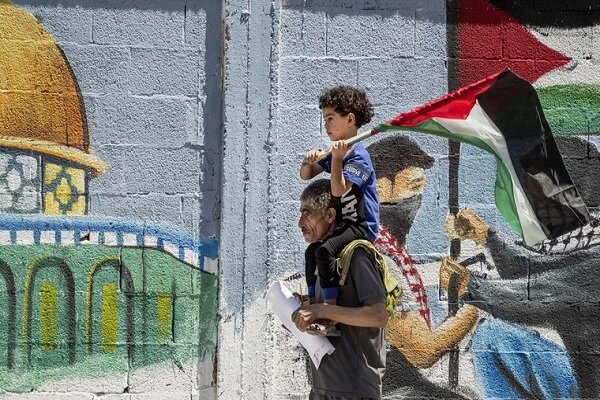
Uprooted Palestinians are at the heart of the conflict in the M.E Palestinians uprooted by force of arms. Yet faced immense difficulties have survived, kept alive their history and culture, passed keys of family homes in occupied Palestine from one generation to the next.
Why is Palestine considered the core issue when it comes to human justice, such that Al-Quds Day- a day to raise awareness about the plight of all oppressed groups is done in the name and the sanctity of Al-Aqsa?
1) The perpetrating entities of the oppression:
The formation of Israel was a settler-colonial conspiracy project- the biggest of its kind in history that was founded by the hegemonic global ruling system solely to serve their interest.
The reality is that the Zionists were hunters for sources of power in the world that could actualize their vision of a Jewish homeland, and wherever the imperialists place the Zionists, they will follow.
During the beginning of the 20th century, imperial Britain was adamant about creating for itself an extension in the land of Palestine, which was specifically chosen due to the benefits of the strategic location and the history of the land that could be used as a justifying pretext to the world.
It is the responsibility of all of humanity to correct the biggest shame that have occurred. All nations need to apply pressure on their governments to sever ties with the occupying state and grant the right of return and compensation for all Palestinian citizens. The Zionists and their imperial masters weaponized the anti-semitism that existed within sections of the people and activated this into a slogan that was used to justify the containment of settler Jews in Palestine whilst blackmailing those resisting the ethnic cleansing of Palestinians into accepting this new reality.
The U.S.S.R was the first government to recognize the illegitimate establishment of Israel and sent a large number of settler Jews there, whilst the U.S. took over Britain’s role after rising to power in post-WWII, providing the bulk of financial, political, security, and military support to the occupying state- to the extent that its existence is purely dependent and linked to the U.S.
Israel’s functional role is to act as a stick for the world superpower, namely the U.S., used in order to punish other entities in the region that fail to obey U.S. orders and for them to maintain a direct presence at the heart of the strategic Middle East (West Asia).
2) The nature of the oppression:
Israel is the only settler-colonial state existing today. This means the existence of the occupying Israeli settlers is predicated on the forced and violent removal of the land’s indigenous inhabitants prior to 1948.
During the 1948 Nakba, Israeli forces killed an estimated 13,000 Palestinians and forcibly evicted 700,000-1 million Palestinians from their homes and land. Five hundred and thirty-one (50%) of Palestinian villages were entirely depopulated and destroyed.
The Nakba continues today. Palestinians are the largest and longest-suffering group of refugees in the world. One in three refugees worldwide is Palestinian and over 60% are registered for humanitarian assistance with the UN. Within occupied Palestine, the occupying state has displayed no limits to their aggression in pursuit of their expansionist ideals while have not been held to any account for their crimes against humanity.
3) The magnitude of the oppression:
The perpetrators realize a great magnitude of direct force and violence is needed to prevent any rebellion movement since the thief understands the victim will resist with whatever they have, and they, therefore, seek to crush the spirit of this resistance. The occupying state has made it mandatory for every Israeli Jew to serve in the ‘IDF’, and they are indoctrinated from a young age to believe every Palestinian is a ‘terrorist’, whilst their survival is dependent on getting rid of the indigenous Palestinians.
With over 2.5 million Palestinian’s living in the West Bank, an extremely densely populated region, Israel is not only seizing the best land and resources through annexing the territories and giving themselves false authority over the land, but they are striving to create an unbearable condition for the Palestinian’s living within, such that they become hopeless and would want to immigrate and abandon their own homeland.
4) Continuity of the oppression:
Since the financial and military existence of Israel is completely linked to the U.S., this oppression will continue until Israel loses its functional role due to the balance of powers that are increasingly not in the U.S.’s favor in the region.
Besides the axis of resistance and its proponents, all countries are turning a blind eye to the continuous oppression in Palestine, which is legitimized by the majority of the world since there is an overlap between their aims and they only account for what is in their interests. They seek to wipe the history of Palestine and grant legitimacy to Israel’s existence, although acknowledging its illegality should by any standards create an uprising.
It is the responsibility of all of humanity to correct the biggest shame that have occurred. All nations need to apply pressure on their governments to sever ties with the occupying state and grant the right of return and compensation for all Palestinian citizens.
Palestinian refugees in Lebanon work in the informal sector to make ends meet. (Ray Smith/IPS)
BEIRUT, Lebanon (IPS) - Abu Yussif doesn't want to talk about his work anymore. "It's not going to help and nothing will change anyway," he says. The tall, white-haired Palestinian has just returned from work and relaxes in his little garden in the Burj al-Shamali refugee camp near the southern Lebanese city of Tyre.
Abu Yussif is a pharmacist. But the massive discrimination against Palestinians in the Lebanese labor market has forced him to give up his profession and work as a taxi driver.
Palestinian refugees and their descendants have been living in Lebanon for 62 years. Unlike their relatives in Jordan or Syria, they face massive legal discrimination. Lebanon is not a signatory to the UN Refugee Convention, but it has ratified the International Covenant on Civil and Political Rights and embodies the Universal Declaration of Human Rights in its constitution.
"According to the Refugee Convention, we'd have the right to access our host country's labor market freely after three years," says Suhail al-Natour at his office in Beirut. Al-Natour heads the Human Development Center, a Palestinian human rights organization. "After Palestinians were excluded from working in the public sector, the Lebanese government has restricted their access to employment in the private sector," he says. "What was left were the lowest, hard jobs that most Lebanese wouldn't do."
Despite their residence in Lebanon, the approximately 250,000 Palestinian refugees are treated sometimes worse than foreigners. Access to jobs is restricted in various ways. Some professions are forbidden, many others require a work permit. In addition, approximately 30 liberal professions are controlled by syndicates. Further, Palestinians can't run their own shops or companies, as they're not allowed to own property.
For Palestinians, two options remain, says al-Natour: "Either they work inside the refugee camps, where the Lebanese state doesn't exert its authority and forbidden jobs can be practiced. Or they work illegally and avoid inspections by the authorities." The labor market within the impoverished refugee camps is limited. For well-educated Palestinians it hardly poses an alternative.
At sunset, Mahmoud Aga usually goes to a small plantation outside Tyre, where he grows some fruits and vegetables and relaxes after his workday. For 15 years he's been working for a Lebanese company in Tyre. "Palestinians can't join the engineers syndicate, so I'm forced to work illegally," he says. Often working on-site, he's directly dealing with Lebanese principals. "Currently I'm overseeing the construction of a public school. Of course the Lebanese authorities know I'm Palestinian."
Aga enjoys working for his company and says his employer doesn't exploit his situation by paying him a much lower wage, as it is often the case with Palestinians. "However, I have no social rights or insurance."
Professional syndicates in Lebanon systematically deny Palestinians access. Sari Hanafi, associate professor at the American University of Beirut, explains: "Some of them have bylaws that restrict membership to Lebanese citizens. Others apply a reciprocity clause. However, the absence of a recognized Palestinian state makes the application of this principle impossible."
In mid-August, the Lebanese parliament amended the Labor Law. It hasn't touched the powerful position of the syndicates, however. Suhail al-Natour says that in theory the law is supposed to be above the syndicates' rules. "Practically, however, the syndicates rule."
The amended Labor Law obliges Palestinians to obtain a work permit for all jobs and eliminates the required fees. Al-Natour is far from happy, though: "There won't be more Palestinians applying for work permits, because many procedural problems remain in place." A contract with a Lebanese employer is a precondition for obtaining a permit. Al-Natour argues that employers wouldn't issue contracts as they'd have to pay for social security and declare the wage. "They benefit from exploiting Palestinians, so they don't want to change anything in the labor relations," he says.
Similarly, Sari Hanafi stresses that neither the employee nor the employer have an interest in signing a contract. "Both would pay for the social security fund, knowing the employee wouldn't benefit from it." In summer, the parliament also amended the Social Security Law, allowing legally-employed Palestinians to benefit from end-of-service indemnities. However, they remain excluded from family, illness or maternity payments.
The Palestinians' disenchantment with what's been loudly praised as a rights "reform" has made them lobby even harder at the international level. At the ninth session of the Universal Periodic Review (UPR) within the UN Human Rights Council held in Geneva earlier this month, the review dedicated to Lebanon revealed the increasing awareness especially among European member states concerning the Palestinians' dire situation in Lebanon.
Rola Badran, observing the conference for the Palestinian Human Rights Organization, says she's satisfied with the UPR session. "It showed that the rights issue of Palestinian refugees in Lebanon is on the international agenda. The Lebanese delegation seemed annoyed and under pressure and repeatedly insisted on directly responding to states' interventions that criticized the situation and recommended improvements," says Badran.
Criticism mainly focused on the denial of property rights, discrimination on the labor market and the lack of freedom of movement, as most of the Palestinian camps are encircled by the Lebanese army. But Badran is pessimistic about Lebanon changing its policy.
"At the UPR session, they repeated their usual excuses by stressing Lebanon's limited size and financial means." And, with a slightly sarcastic laugh in her voice she adds: "Lebanon's unwillingness is best illustrated by the delegation's statement that the Palestinians' presence has already been for so long and that Lebanon is still waiting for the Palestinians' return to their homeland."
All rights reserved, IPS -- Inter Press Service (2010). Total or partial publication, retransmission or sale forbidden.
The 2009 Land Administration Law allows for further theft of Palestinian land inside Israel. (Silan Dallal/ActiveStills)
Palestinians describe the Israel Land Administration Law (ILA) quietly passed by the Israeli Knesset in 2009 as the final stage in the 62-year process of displacement from their homeland. The legislation is expected to have a long-term, disastrous impact on Palestinian lives and precludes the possibility of a negotiated resolution to the conflict.
This legislation builds on a gradual transition from a welfare-based government to one based on neoliberal policies that began in the 1980s. Recently, the evolution took a dramatic step, as Israel enacted laws that privatize its historically state-owned land. While very little media attention has been given to this development, this law has profound implications for Palestinians.
In contrast to most countries, Israel has retained state control over and ownership of the bulk of its land. During the establishment of the state in 1948, Israel expelled more than 700,000 Palestinians from approximately 400 villages and cities -- what Palestinians call the Nakba or catastrophe. Since then publicly-owned lands have accounted for 93 percent of the state's territory.
"The state nationalized all the land in 1948 in order to facilitate the misappropriation of Palestinians and the reallocation of land in favor of Jews," Shir Hever, an economist for the Alternative Information Center, commented to The Electronic Intifada.
Israel has operated a system wherein Israelis and Palestinians leased their property from the state. However, in August 2009, the Knesset made the first move to end this system by enacting the ILA, also referred to as the Land Reform Law. This law allows the state to transfer ownership of all developed land to an individual, private company or corporation. With egregious disregard for international law, Israel's Land Reform Law applies not only to land within Israel proper, but also to occupied East Jerusalem and the Syrian Golan Heights, which Israel annexed in violation of international law in 1981.
The passage of this bill has grave consequences for internally-displaced Palestinians living in Israel and Palestinian refugees everywhere. Palestinians have long maintained a legal claim to return to the land from which they were forcefully evicted from and have held on to the hope to do so.
"This is the last phase"
"This is the last phase. You confiscate, you use it for whatever you want; the last phase is to sell it," Suhad Bishara, an attorney for the Israeli human and civil rights organization Adalah, said.
A significant portion of Israel's state-owned land was acquired through expropriation and confiscation of Palestinian property during and immediately following the 1948 dispossession. Through subsequent laws, most extensively through the Absentee Property Law (1950) and Land Acquisition Law (1953), Israel was able to systematically prevent the return of Palestinian refugees who fled or were expelled from their homes in 1948.
These confiscations have continued until the present day. For example, in order to obtain a building permit, one must enter into a lengthy, bureaucratically arduous and very costly process that presents an insurmountable obstacle for Palestinians to build "legally." This gives Israel the excuse to wantonly demolish Palestinian homes and confiscate their land.
As the seemingly endless peace negotiations continue into their 17th year, Israel has been quietly making plans to sell this very land.
"Privatizing all of these lands is basically ending this whole story. The state is not a stakeholder anymore. You have third parties -- who are individuals and companies -- who will have a say. Because they are the stakeholders, they are the owners of the land," Bishara added.
Economist Shir Hever explained that by redrawing property lines and changing the registry of the land, Palestinians will have an even more difficult time to assert their claim to the land or ask for compensation for it.
"The land reform will mainly affect Palestinians living inside Israel, and Palestinian refugees, because the re-drawing of property lines and the changing of the registry of land may be used as a tool to conceal the evidence for the previous Palestinian ownership of the land, and make it harder for refugees to demand their property back, or a suitable compensation," Hever said.
"This means you cannot ask for the properties back at any stage, once privatized," Bishara said.
Neoliberalism and ultra-nationalism
"The timing of the reform [bill] coincides with the very deep shift within Israel from a republican, strong-state model of an ultra-nationalist welfare state, into a new model of neoliberalism, while still keeping the ultra-nationalism," Hever said.
The stated intention of the Land Reform bill is to improve efficiency by decreasing government bureaucracy and its intrusion into free market activity. However, Hever refutes this as merely a guise. He explains that the decision to privatize land now is rooted in Israeli Prime Minister Benjamin Netanyahu's desire to appeal to the upper class and real estate capitalists of the country in anticipation of an economic downturn within Israel that will mirror the western world's current economic woes.
"There are many ways to deal with inefficiency, and the 'free market' approach is only one out of many. It favors the rich and gives them the ability to manipulate the market by creating local monopolies. [For example,] once a real-estate tycoon has taken over all available land in a certain area, he or she can set the price for everyone who wishes to live there. That is the real reason for the reform, in my opinion -- Netanyahu needs the support of wealthy people who also fund his campaigns," Hever said.
The city of Jaffa provides a prescient example of the havoc that private development can wreak on the lives of the indigenous Palestinian population. Here, one can see how the neoliberal scheme can in itself be used as an ethnic cleansing device. Beginning in the 1960s, ILA sold the land of Jaffa to the highest bidders. This resulted in the proliferation of elegant and expensive condominium complexes and housing units along the desirable coastal land, pushing out the indigenous population to overcrowded and under-served neighborhoods.
According to Dr. Yosef Rafiq Jabareen, a senior lecturer at The Technion - Israel Institute of Technology in Haifa, the privatization of land in cities throughout Israel would spell the final stage of the forced expulsion of Palestinians from their homeland which began in 1948. With privatization, the property of Palestinians would go on sale to capitalists and developers.
According to Adalah, "The legislation would eventually lead to the transfer of ownership, even without payment, to Jewish leaseholders and to a "clearance" sale of what remains of Palestinian property in many cities in Israel, such as Jaffa, Ramla, Lod, Beer Sheva, Tiberias, Beit Shean, Haifa and Acre, as well as the Palestinian property in West Jerusalem. Thus, the Palestinian Nakba would be completed in these cities in the future when the Palestinian space that has existed for many generations would be finally eliminated and it would become a case of privatized real estate for the enjoyment of Jewish developers, tycoons and individuals" ("The Geo-Political and Spatial Implications of the New Israel Land Administration Law on the Palestinians" Adalah's Newsletter, Volume 62, July 2009).
However, the Land Reform Law goes beyond this prototype that uses free market competition as a tool to drive out Palestinian residents. Within the bill and a previous agreement with the Jewish National Fund (JNF), Israel has ensured that the organization will be a dominating and guiding influence on how land sale transactions will be carried out from now on.
Ensuring that land sales will go primarily to Jewish buyers, the Land Reform Law has restructured the ILA so that it yields considerable control to the JNF. The Land Authority Council will become the new government body that oversees the sale of state land. The JNF, an organization whose charter directly prohibits it from leasing any of its land to non-Jewish residents, will now hold 6 out of 13 of the membership slots of the Land Authority Council.
With the JNF solidifying power over the process of privatization, it is impossible to characterize this reform as devoid of a political agenda. Israel's plan to sell the land of Palestinian refugees as well as land in the occupied Golan Heights and East Jerusalem belies any of its feigned gestures toward engaging with the international community on a real solution for peace. Charlotte Silver is a litigation assistant at the American Civil Liberties Union, Immigrant Rights Project and was active in the boycott, divestment and sanctions movement at Stanford. She lives in San Francisco and can be reached at charlottesilver A T gmail D O T com.
We want to inform our readers of an exciting development. One of the best Pro-Palestinian websites on the net, e.g. PoliticalTheatrics is planning to travel to Lebanon in order to take up the task of “on the ground” reporting.
PoliticalTheatrics will not only be assessing and reporting on Lebanese politics, BUT they will also be interning in Palestinian Refugee camps and of course keeping us all updated online with the brilliant reporting we have come to know and love!
You support for this worthy cause is much appreciated, please visit PoliticalTheatrics and give a few dollars, pounds, or Euros so that we can enjoy the chance to hear direct from Palestinians in Lebanon as well as the political reporting!!
Besides mass slaughter and destruction, wars create refugees, millions at times, uprooted, displaced and homeless, on their own somehow to survive. Israel's "War of Independence" was no different, dispossessing hundreds of thousands of Palestinians, a story Western media reports don't explain or even mention.
In his book, "My Father Was a Freedom Fighter: Gaza's Untold Story," Ramzy Baroud recounted his father Mohammed's story. Born in 1938 in Beit Daras village, he saw it conquered, leveled and erased, except from the memory he took to his grave. A captive in his own land, he lived years as a Gaza Nuseirat camp refugee, raising his family including son Ramzy, dreaming always of going home, struggling as a freedom fighter to end decades of conflict, violence, occupation, and oppression, what Edward Said called "a slow death," shattered hopes, and inexorable toll of its incalculable horror to so many.
Spanning over seven decades of history and survivor recollections, it tells a powerful firsthand story of those who lived it, not the airbrushed Western version of the new Israeli state, born in blood, mass slaughter, destruction, and displacement of hundreds of thousands of survivors, to this day oppressed, harassed, intimidated, humiliated, attacked and arrested for being Muslims, not Jews on their own land, in their own country, illegally occupied for decades.
In his book "Behind the Wall: Life, Love, and Struggle in Palestine," Rick Wiles recounts other refugee stories, people he encountered firsthand in the West Bank, connecting them to their original villages, expulsion, daily life and dreams of return.
Abu Gaush shared his own 1967 experience, saying:
During the Six Day War, "My family fled to the mountains as we were frightened that 1948 was happening all over again....The soldiers emptied all the houses in the villages and forced everyone out onto the streets. The only direction left was to Ramallah, and they told us to go there. Other soldiers were saying, 'Go to Jeddah (Saudi Arabia) - all land before there is ours - and if you stop before (arriving), we will kill you.' "
Including poignant photos, Wiles' book includes seven sections, discussing: Memories of Exile, The Wall, The Spirit of Resistance, Purity and Love, Land of Palestine, Strength and Sumoud (steadfastness), and Dreams of Return, including his final image of a grandfather giving his original home's key to his son, symbolic of the continuing right to return struggle, what won't ever stop until succeeding.
Numbers of Palestinian Refugees and Internally Displaced Persons
Al Awda, the Palestine Right to Return Coalition, says Palestinian refugees today are the world's "longest suffering and largest refugee population." In its January 2010 report titled, "Survey of Palestinian Refugees and Internally Displaced Persons, 2008 - 2009," the Badil Resource Center for Palestinian Residency and Refugee Rights (BRC) calls them "the largest and longest-standing case of forced displacement in the world today," numbering 9.8 million, increasing by about 100,000 a year.
Most are refugees, another 450,000 internally displaced. For over six decades, they've been denied solutions and reparations for their rights under international law and UN resolutions. An earlier article discussed BRC's report in detail, accessed through the following link:
Besides those internally displaced, Palestinians have lived in forced exile for decades throughout the world, most within 100 km of their original homes. Those in camps comprise about 21% of the total. Hundreds of thousands of others are in 17 unofficial camps in Occupied Palestine, Jordan, Lebanon and Syria. About 79% live outside UNRWA's 58 camps, including many in West Bank villages and cities, about 100 locales comprising over half the population.
In 2008, the European University Institute's Robert Schuman Centre for Advanced Studies published a report titled, "Palestine Refugee Camps: Disciplinary Space and Territory of Exception," examining daily camp life in 59 camps: 19 in the West Bank, 8 in Gaza, 12 in Lebanon, 10 in Jordan, and 10 in Syria. Saying they're not "natural" settings, they become "slum areas" or under-developed urban sprawls, some "open spaces," others "closed."
In Lebanon, for example, "the gap between the numbers of camp and urban refugee dwellers....is enormous," compared to Jordan and Syria where differences are minimal, yet even "country-by-country analysis does not in any way suggest internal homogeneity, because the question of camp locations within the different countries matters as well."
Some are more urban, other peripheral or rural, the differences among them huge, including job discrimination, poverty, and overall conditions. According to Norweigian Institute for Applied Social Science surveys in Jordan and Syria, Palestinian refugee living conditions for those outside camps differ little from host country populations. In camps, however, it's worse, especially in Lebanon. Education there is one of many problems, 60% of 18 - 29 year old Palestinians not finishing school.
In Lebanon and Jordan, 60% of camp homes lack proper sanitary installations for safe drinking water. Population density is a major issue, too many people occupying too little space, creating an enormous environmental and public health problem. Buildings are crammed together in narrow alleys, with little natural light, exposure to hazardous substances, inadequate temperature control, and poor ventilation. In Lebanon, the infant mortality rate is 239 per 100,000 births, and chronic infant illnesses are up to three times higher than the country's norm.
The Schuman Centre's study preceded Cast Lead, so its Gaza analysis needed updating. The war displaced up to 90,000 people and caused mass destruction. Yet little reconstruction is possible with the Strip under siege and virtually all needed materials and spare parts banned. In addition, three years of closure wrecked Gaza's economy, and sent unemployment and poverty levels soaring - the former up to 65%, the latter 80% with 96% of the Strip's industrial capacity shuttered, leaving well over 80% of the population aid-dependent. Three-fourths of Gazans live in camps, but all of them get below minimal amounts of everything, struggling daily to survive.
Overall, Palestinians see camps as "symbols of illegitimacy," a disconnected gray zone under occupation conditions. Of the 4.8 million registered by UNWRA, about 1.2 million live in Gaza, another 800,000 in the West Bank in 27 camps - 19 in the West Bank, 8 in Gaza, the rest in towns and villages.
According to the World Health Organization (WHO), their 2009 dependency ratio is 85.3% in Gaza and 72.1% in the West Bank. High unemployment and poverty remain grave in both areas, especially in Gaza. So does public health and malnutrition, causing growing levels of illnesses and chronic diseases.
UNWRA calls the refugee population "victims of health inequalities," the occupation, of course, the main contributor, resulting in a chronic imbalance between needs and demands on the one hand, and resources and other constraints on the other. Healthcare, personal safety, legal and political protection, and human welfare are fundamental human rights. Under occupation, they're consistently denied, especially in Gaza under siege.
Despite established laws, no international body has an explicit mandate to protect Palestinian refugees. After the 1948 Nakba, the UN Conciliation Commission for Palestine (UNCCP), UNWRA, and later the UN High Commissioner for Refugees (UNHCR) were supposed to provide aid, protection, and reparations, but supplied little. In addition, UN agencies, the ICRC, and world community, in deference to Israel, avoided durable solutions, including their obligation to enforce binding international law provisions.
Moreover, refugees are seen more as needing humanitarian aid than having mandated rights, even though international law protects them, including their "inalienable right" of return. As a result, displaced Palestinians remain among the world's most neglected, abused people, including diaspora ones (the majority) excluded from the political process and peace negotiations.
The Palestinian National Authority (PA) represents those in the Territories alone, but, in fact, given the Hamas/Fatah split, only West Bank and East Jerusalemites. Most Palestinians are thus disenfranchised. As a result, a volunteer Civitas participant, a collective research project on exiled Palestinian communities, expressed her frustration, saying:
"Before the peace treaties, Palestinian political parties were more effective, and we had a voice: we worked properly! We made our voice heard to the entire world. But the world now hears only the voice of the Palestinian president, and his prime minister. As a citizen, I no longer have a voice. His voice is enough, (and he collaborates with Israel. Earlier) my voice was heard. If....peace....silence(s) me then I don't want it!"
Diaspora and internal refugees demand their legal rights. Those in Gaza and the West Bank can challenge their occupier directly. Those outside cannot. Without legal documents, passports, travel rights, identity papers, electoral involvement, and ownership and inheritance entitlements, they can't seek redress for decades of injustice, what Israel all along has denied, unchallenged by PA officials.Unless their collective voices are heard, the conflict's historical roots and their rights will go unaddressed, and they'll remain the world's "longest suffering and largest refugee population."
Stephen Lendman lives in Chicago and can be reached at lendmanstephen@sbcglobal.net. Also visit his blog site at sjlendman.blogspot.com and listen to cutting-edge discussions with distinguished guests on the Progressive Radio News Hour on the Progressive Radio Network Thursdays at 10AM US Central time and Saturdays and Sundays at noon. All programs are archived for easy listening.
Children of Catastrophe: Journey from a Palestinian Refugee Camp to America
Author Jamal Kanj talks about life in a Palestinian refugee camp in Lebanon. In his recent book “Children of Catastrophe: Journey from a Palestinian refugee camp to America,” provides an account of life from Palestine to refugee camps in Lebanon and the events leading for the creation of the state of Israel.
INTIFADA PALESTINE – EXCLUSIVE INTERVIEW – With Jamal K. Kanj: Author Children of Catastrophe
A great deal has been written over the years addressing the Palestine–Israel conflict, and the creation of the Palestinian refugee problem. However, few works on the subject really present the personal aspect: What is it like to be a refugee? What propels a decent human being to take up arms, to become a freedom fighter or a “terrorist?” This book tells the remarkable story of one such refugee, following his journey from childhood in the Nahr El Bared Palestinian refugee camp in Lebanon, becoming a member of the Palestine Liberation Organization (PLO), through to eventual emigration, a new life as an engineer in the United States, and a ‘return’ trip to historic Palestine.
Jamal Kanj joined me in an exclusive interview to discuss his book Children of Catastrophe: Editor Elias Harb
==================
ELIAS HARB: In your book you convey the personal aspect of the life of the refugees. Can you tell us what inspired you to write Children of Catastrophe? JAMAL K. KANJ: The Americans and the West in general are not well aware of the Palestinian experience. On the surface and at an emotional level, they are generally more sympathetic towards Israel, but this is mainly due to their lack of understanding or total disconnect with the human side of the Palestinian story.
Also one must recognize that the peculiar relationship between Israel and the West is deeply rooted in a long history of abhorrent Western anti Semitism culminating in the Holocaust. Hence, it was a mix of sympathy, guilt, and religious institutions in America and Europe which played an important role in shaping the lopsided view towards the Palestine Israel conflict.
Having lived in the US for thirty years after leaving the camp, I discovered that most people tend to switch off when trying to make an intellectual or historical argument explaining the Palestinian position. At the same time, I observed that the majority can better connect and listen when the intellectual or the historical argument is framed within the personal experience. During those 30 years, almost everyone whom I came to know at a social level consciously or subconsciously became more sympathetic with the Palestinians.
To sum it up, the main impetuous for writing this book remains my strong conviction that we, as Palestinians have a powerful story to share with the rest of the world, especially in the West. Throughout the pages of this book, I hope to connect with all those whom I have not, or may not have the honor meeting personally, to share with them the personal aspects of the Palestinian side of the story.
EH:Can you briefly tell us of the British role facilitating the Zionist colonization of Palestine ?
JKK: While the World Zionist Organization (WZO) was founded in Europe in the late 1800s, their plan to colonize Palestine did not start to take shape until the 1920s and 1930s. One major reason, up until 1917 and in addition to Palestine , the Zionist movement contemplated other options for this “Promised land” such as Uganda , Cyprus , Sinai and parts of Argentina .
They basically were willing to take any “real estate” property a colonial power was willing to sell them. But in November 1917, and to sway the purported “influential” Jewish opinion in the US on the war (at the time, WZO had very close relation with the German Kaiser and maintained its headquarter in Germany ) the British Foreign Ministry issued a letter to a Jewish banker, Baron Walter Rothschild, promising the banker with a Jewish homeland in Palestine.
In 1920, and as the new occupying power, Britain appointed Herbert Samuel, a professed British Zionist as the high Commissioner for Palestine. Under his reign, Jewish immigration to Palestine increased exponentially and unlike the old Jewish residents, the new wave of European immigrants chose exclusive Jewish communities, segregated from the Native Palestinians and even from the old Jewish neighborhoods. With a lush of funds provided by the international Jewish National Fund (JNF), the new immigrants attempted to purchase land at any cost. Much like the extraneous prices they are willing to offer today for properties in East Jerusalem and Hebron.
As then and now, the Zionist organizations failed to acquire much, if any Palestinian owned properties. It is worth noting here, the JNF owned less than 7 per cent of Palestine when the UN voted to partition the land between its Natives and the new Jewish immigrants. Most of the properties the Zionists eventually purchased were from absentee landlords, mainly large feudal Lebanese land owners in the northern part of historical Palestine.
The aggressive land ownership program, combined with new exclusive communities, created a political and cultural chasm between the Native and the new settlers. At that point, it got even more complicated as this new European community closely allied itself with the despised colonial power. In response, the Palestinians waged in 1936 one of the longest civil disobedient strikes in the history of Palestine, lasting for more than six months protesting the mandate power and its policies of transforming the demographics from the local Native population with the new European colonists. After failing to quash the civil protest, Britain promoted, enabled, and armed Jewish military groups to help repress the local population. These same Zionist military groups metamorphosed into the Jewish Haganah, the nuclei of the future Israeli army, and became officially part of a joint contingent of British/Jewish military force suppressing the Native Palestinians.
To give you a good idea on the level of Palestinian resistance against the British colonial power and its Zionist instrument, before its departure from Palestine, England had more military forces in Palestine than they had in the entire Indian continent.
EH:How were the Zionists successful in driving Palestinian from their homeland? JKK: In short, well organized systematic terror campaign by the Zionist paramilitary groups. The terror campaign resulted in the expulsion of 805,067 Palestinians and the destruction of 531 indigenous villages, representing roughly 85 per cent of the native population and the seizure of 92 per cent of the land.
But as I pointed in the book, equally important to the Zionist campaign of terror, was the fact that more than 50 per cent (413,790) of the refugees mentioned earlier were forced out of their homes by the Zionists’ terror while Palestine was still ostensibly a British protectorate. As an example, the infamous Massacre of Deir Yassin took place on April 9 1948, over a month before the departure of the British army form Palestine. When according to UN investigation reports the Jewish Irgun organization, under direct orders from Menachem Begin, slaughtered a large number of the Palestinian civilians in the village. To justify murdering women and children, Begin explained that “The massacre was not only justified, but there would not have been a state of Israel without the victory at Deir Yassin.” Alas, Begin became a future Israeli prime minister and won the Noble “peace” prize!
But the overall Zionist campaign to ethnically cleanse Palestine was led by Ben Gurion, (first Israeli Prime Minister) who consciously or unconsciously assigned to their military operations jargons tantamount with ethnic cleansing, from names such as matateh (broom), tihur (cleansing), biur (a Passover expression meaning “to cleanse the leaven”) and niku (a Hebrew word for cleaning up).
This was a plan which Joseph Weitz, the head of the National Jewish Fund, described earlier in his diary on 20 December 1940 that “Not one village must be left, not one [Bedouin] tribe. The transfer must be directed at Iraq , Syria , and even Transjordan .”
EH: What happened to old Palestinian towns and villages?
JKK: Since 1948, the Jewish National Fund (which owns 85 per cent of land in Israel ) has led an international scheme to cover up the destroyed Palestinian villages with a specious environmental forestation campaign promoting the planting of trees in Israel. The JNF boasts that it “… has planted over 240 million trees in the land of Israel ”. The JNF does not, however, disclose to its unsuspected donors that at least eighty-six of these forests and parks are built over the ruins of destroyed Palestinian villages. As an example, the well-known Israeli Canada Park was built on the ruins of the ethnically cleansed villages of Emmuas, Yalu and Bayt Nuba; the trees in Biriya Forest grow over the foundation of the village of Amuka ; the town of Reihaniyeh is buried under Ramat Menashe Park and the remains of Ajur are fertilizing the greenery in Park Britain.
Wherever the JNF did not reforest what were once peaceful villages and as part of Israel ’s conjured history, Israel bestowed Hebrew pseudonyms replacing the Native names of Palestinian towns. Thus, Tel Rabi became Tel Aviv, Lubya turned into Lavi, Al Zeeb transpired into Gesher Haziv, Saffuriyya into Tzippori and Beit Jala metamorphosed into Gilo.
EH: Following the 1948 Nakba (Catastrophe) did Israel leave the Palestinian Refugees alone? JKK: The Zionists consider the mere existence of Palestinians whether under occupation or in refugee camps represent a negation to their ideology which denies the Palestinian people as a collective national identity. As mentioned in the book, the camp or camps became to symbolize Palestine away from home, it became little Palestine . I expounded extensively on this parallel which was very well understood by the Zionist ideologues. Hence, Israel maintained a terror campaign against camps and repression under occupation to force Palestinians into capitulation and self defeat. Israelis always tried to make the point: we won and you lost, just accept it.
However, Israelis fail to understand people’s connection to the land, for other than their religious patrimony, the people of Israel never in modern history have they had to experience that kind of relationship. I suspect that throughout their history of oppression in Christian Europe, Jews had accepted defeat and lived psychologically as a defeated community all the way through the Holocaust. While I am not a psychologist, I suspect by tormenting Palestinians under occupation and in refugee camps, Zionists are attempting to mirror their own experience of psychological defeat on the people of Palestine.
To their chagrin however, the refugees’ identity became an expression of nationhood and defiance, rather than privation and compliance. As Israeli writer Danny Rubinstein described the Palestinians in his book: Every people in the world lives in a place. For Palestinians, the place lives in them.
EH: Can you describe what is it like to be a refugee?
JKK: Aside from Israeli terror, and on the economic level, I am not sure I understood at the time, what it was like not to be a refugee.
However on the political level, it was very clear, and like all young children who were born in the camp, I realized at very young age that I was a victim of human injustice. I was reminded every day that I was born in Lebanon, a foreign country with no citizenship rights. And I don’t necessarily blame Lebanon for this, for the blame should fall on the entity that took my parent’s home and made me a stateless person. My parents’ only fault was that they belonged to a different religion. Unlike Israel, Lebanon gave us a place to call temporary home.
I do however fault Lebanon for depriving the Palestinian refugees from their political and economic rights. Palestinian refugees, who lived or were born in Lebanon , could not own a property and were not allowed to work in over 70 trades. The law was amended recently reducing the number of prohibited trades.
As I elaborated extensively in the book, at the emotional, we lived relatively a normal life in the camp. The strong family structure made up for life’s hardships and shortcomings. With as little as we had in the camp, I have no memory of lacking any of life’s intuitive pleasures. Philosophically speaking, it is not possible to lack what you have never experienced. In other words, you do not miss what you never had. In short, life as a refugee was normalized by what we had and not by what was lacking.
EH: Why did you believe your parents avoid conversations at home about the Nakba (Catastrophe)?
JKK: For Palestinian refugees in general and mine in particular, losing home was an experience beyond description. Deep inside they must have felt guilty, shamed and blamed themselves for leaving and not dying on their land; but more importantly they believed that they were hoodwinked by the Zionists and for believing in the sense of international justice.To them, talking about the Nakba was like adding salt to injury. I was not sure if they were trying to suppress their memory hoping to lessen their anguish, or simply avoid it.
At the same time, they were much happier talking about Palestine , the land and life before becoming refugees. They seemed more at peace and complete when reminiscing the little details about what it was like “back at home.” A person would have to be in their shoes to be able to comprehend or appreciate their life long trauma.
EH: In Children of Catastrophe you write that Palestinian refugees in Lebanon represent a special and unique case. Why are refugees in Lebanon different than Palestinian Refugees in other Arab countries?
JKK: As I indicated above and elaborated at length in the book, while all Palestinian refugees suffered the same terrible problem of adjusting from statehood to statelessness, unlike other Palestinian refugees, the refugees in Lebanon represented a special and unique case. From the outset, Palestinian refugees in Lebanon were treated as foreigners with no social, labor, or political rights. Unlike refugees in the West Bank and Jordan who were granted citizenship, and Syria where refugees were accorded full residency privileges, Palestinian refugees in Lebanon were prohibited from working in more than 70 trades and professions (the law was amended recently reducing the number of prohibited trades.) The Lebanese government instituted also special regulations restricting the movement of refugees within the state and limiting their ability to build or to own property in the country.
The confessional Lebanese democracy between various religious sects (18) certainly contributed to this complexity. For the presence of the Palestinian refugees was considered by some Lebanese as an upsetting factor in the balance of power in this small country. This is an important area, which is addressed at length in the book.
EH: In the summer of 2007, your camp, Nahr el Bared was completely destroyed following a raging battle between the Lebanese army and a little known group Fatah al Islam. Were there other reasons to destroy the camp and what happened to the camp residents?
JKK: Destroying the more than 6000 homes could have been easily avoided, but as I surmised in the book, the destruction of the camp must have been an end by itself.
The camps with a very high population density, over 40,000 inhabitants living in an area less than one square mile. Fatah al Islam numbered less than 300 fighters (a spokesman of the organization claimed in the Lebanese press the number at 98 fighters). Their defending positions were located at the north end of the camp. However, from the onset of the fighting, the Lebanese army bombarded the camp proper indiscriminately and did not limit the shelling to Fatah al Islam fighting positions.
According to Amnesty International and other Human Rights organization, the Lebanese army deliberately set some homes on fire and several houses were destroyed in the weeks after the end of fighting.
I have concluded in the book that there were at least three reasons for the destruction of the camp: Middle East peace process; 2nd Lebanese sectarianism and 3rd Economic reason. Not to mention the possible Israeli hand via its spy network within the Lebanese army. In 2009, Lebanon arrested an army Major, who played an important role in directing the battle of Nahr el Bared for working on behalf of Israel.
Now more than three years later, the camp residents are still homeless and awaiting the Lebanese government and the international community promises to rebuild the camp and return them to their homes.
EH: There was a tearful meeting of yours cousins (Amsha’s daughters) who you never met, when you were checked in at the Hadassah Hospital in Jerusalem. Can you tell explain why you have never met them?
JKK: I must say that meeting was a climax in mine and I am certain in their life too. Like many Palestinian families, my grandfather was forever separated from his only sister (Amsha) in that May Day in 1948. They both died later, she in her country that became no more, and he in a refugee camp in other lands. Amsha left behind three daughters who remained in what became Israel.Despite a UN resolution calling on Israel to allow for the return of refugees back to their homes. Israel did not comply with the UN resolution, thus leaving many families forever separated from their loved ones and from their homes.
Our reunion was not planned, but it was destiny for us to meet after 50 years since they were split forever from my father. In late 1996 I was checked in at the emergency room at the Hadassah hospital, and when my cousins (Amsha’s daughters) found out, they were next to my bed in no time. It was our first ever meeting. A section in the book details how even under a semi comatose condition, I recognized them before they had a chance to introduce themselves to me.
Sadly, they lived less than 200 miles from the camp, but when I met them at the emergency room, my travel was via the US over 10,000 miles away. Yet, I may have been the lucky one, for others have never had a chance to be reunited with their loved ones gain.
EH: Do you think there will be light at the end of the tunnel for Palestinian refugees in general, and in Lebanon on in particular?
JKK: Meeting with the refugees, I can attest to the Israeli writer whom I quoted earlier, that Palestine lives inside every one of them. However at this period in time, I am not very optimistic with a light at the end of the tunnel. Israel far right hard liners have hijacked Israeli politics, not that their left was much better off. It is clear, the more the Palestinian leadership is willing to compromise, the more Israel moved to the far right, which has manifested today by the call to recognize Israel as a Jewish democracy (theocracy).
The light at the tunnel will come when the international community can live up to its commitments for a just peace that takes into heart the right of return for the Palestinian refugees and allow the Palestinians to exercise their God given right in a country they can call their home.
EH: Thank you Jamal for your interview with Intifada Palestine, and congratulations on your new book Children of Catastrophe.
===============
CHILDREN OF CATASTROPHE
Journey From A Palestinian Refugee Camp to America
Author Jamal Kanj talks about life in a Palestinian refugee camp in Lebanon. In his recent book “Children of Catastrophe: Journey from a Palestinian refugee camp to America,” provides an account of life from Palestine to refugee camps in Lebanon and the events leading for the creation of the state of Israel.
Though the detail is unclear, the PLO leadership is airing the notion of offering "historic" concessions to Israel to bring it along the path of peace, writes Khaled Amayreh in Ramallah
The Palestine Liberation Organisation (PLO) has expressed willingness to offer Israel far-reaching concessions in return for the establishment of a viable Palestinian state in all or most of the West Bank, Gaza Strip and East Jerusalem. Some the offered concessions constitute clear abandonment of Palestinian national constants and other long-standing Palestinian positions.
Earlier this week, PLO Secretary Yasser Abed Rabbo said in an interview that his organisation would be willing to recognise Israel as a Jewish state if Israel agreed to give the Palestinians a state based on 1967 borders. "We would be willing to recognise Israel as whatever the Israelis want, even as a Chinese state," said Abed Rabbo.
The remarks infuriated most Palestinians, including many Fatah leaders, who urged PA leader Mahmoud Abbas to fire Abed Rabbo. The leaders of the Arab community in Israel were especially upset by Abed Rabbo's statements, with one of them -- Mohamed Barakeh -- also urging Abbas to dismiss Abed Rabbo. "He has no right to interfere with the fate of Arab citizens of Israel. He doesn't represent them; this is none of his business."
Israel hasn't spelled out explicitly what it means by "recognising Israel state as a Jewish state". However, it is widely believed that Israel is harbouring ill designs against its large Palestinian minority, which constitutes nearly one fourth of Israel's overall population, such as deporting most or all of them to a prospective deformed Palestinian state on parts of the West Bank.
This is the worst possible scenario for the nearly two million Palestinians still living in their ancestral homeland and who, more than anyone else, understand the implications of the "Jewishness of Israel".Obviously angered by Abed Rabbo's remarks, several leaders and Knesset members representing the Arab community in Israel raced to Ramallah to meet with Abbas and communicate to him the indignation of their community.
One of the leaders addressed Abbas, telling him: "Mr President, does Mr Abed Rabbo realise that most Israelis understand that his remarks constitute Palestinian consent to the deportation of our people from their homeland at some point in the future? If he does, it is a calamity; if he doesn't, it is a greater calamity."
Following the meeting, Abbas told reporters that he would never recognise Israel as a Jewish state, "because this is none of our business". "Besides, why didn't Israel ask Egypt and Jordan to recognise it as a Jewish state?"
It is not clear if Abed Rabbo's remarks were a slip of the tongue or had been coordinated with Abbas beforehand, as many Palestinians suspect.
Meanwhile, another political bombshell went off Monday evening, 18 October, when Abbas said during an interview with Israeli television that the PLO would be willing to give up all "historical rights" in return for the establishment of a Palestinian state in the territories occupied in 1967.
Abbas didn't clarify what he meant by "historical rights", but many -- probably most --Palestinians thought he was alluding to the right of return for Palestinian refugees uprooted from their homes when Israel was created in 1948.
Ghassan Al-Khatib, head of the Palestinian Authority (PA) Information Office, denied that Abbas was voicing willingness to give up the right of return. "The right of return is one of the elements upon which the entire peace process is based. In my opinion, Abbas was alluding to other historical rights, such as Palestinian ownership of land in what is now Israel."
However, this and similar explanations are not accepted by Hamas which has accused the Palestinian leadership in Ramallah of "giving free concessions to Israel and receiving nothing in return."
"I am no longer surprised by anything done or said by this entity called the Palestinian Authority. They are giving up our rights in return for more and more illusions. Today they are giving up the right of return, and tomorrow they will give up Jerusalem and God knows when this wheel of concessions will stop," said Nayef Rajoub, one of the most popular Islamist leaders in the West Bank.
"I can tell you that the PA has already become an integral part of the Israeli security system," he added. Rajoub, who won the largest number of votes in the 2006 elections, was only recently released from Israeli custody, having spent more than four years as a political captive for his affiliation with the political wing of Hamas.
Meanwhile, the PA, which seems unable to get its act together, is planning to ask the UN General Assembly to declare Israeli colonies in the occupied territories, including East Jerusalem, illegal and in violation of international law.
The initiative, which comes in coordination with Arab states, would replace an earlier idea of seeking Security Council recognition of a Palestinian state in the territories occupied in 1967. It is widely believed that the Arab group at the UN decided to abandon the idea after the US made it clear that it would veto any resolution to that effect at the UN Security Council.
However, a UN resolution against settlements wouldn't be strong enough to push Israel to reverse its present policy, especially given unrestricted US backing. Moreover, any new resolution against Israeli settlements in the occupied territories would only be an addition to a long list of prior resolutions that both Israel and the US have ignored, riding roughshod over them and international law.
Trying to thwart PA efforts at the UN, Israel has given certain indications that it might agree to a partial and brief settlement freeze to "give peace a chance". The Israeli media quoted Israel's new ambassador to the UN, Meron Reuven, as saying that "the [Israeli] government is looking into possibilities and different ways of seeing where to take the peace process and how to take it from here."
Reuven declined to say when or under what circumstances Israel might continue to the settlement freeze, saying the decision would have to be taken by the Israeli government.
Fatah official Ahmed Qurei dismissed "all these efforts and negotiations" as "a reproduction of the same illusions, tricks, deception manoeuvres and failure that we have become quite accustomed to seeing." Speaking in Cairo earlier this week, Qurei said an alternative to futile talks was to unilaterally declare statehood and then request that the state be put under international protection.
Qurei noted, however, that the intra- Palestinian rift would have to be bridged, and despite "counter efforts" from certain regional parties, before any such move would be possible. "This is the gravest juncture in the history of the Palestinian issue, and if we don't get our act together as Arabs and Palestinians, there will be a disaster whose ramifications would affect the entire region."
Bedouin near al-Araqib village protest land confiscation by the State of Israel and the Jewish National Fund, April 2009. (Oren Ziv/ActiveStills)
Israel has exploited the country's natural environment for its own political ends for decades. Since 1948 olive trees have been uprooted, quarries mined, the most fertile lands taken for settlements and water illegally extracted. However, in the Naqab (Hebraized as Negev) desert and the Galilee this ecological occupation takes on a very different form. Instead of uprooting trees, they are planted in huge numbers by the Jewish National Fund (JNF), a Zionist organization setup in 1901 and which displaced Palestinians during the 1948 dispossession or Nakba, and has since planted more than 24 million trees covering more than 250,000 acres of land in the country.
Although the JNF states that it is working to improve the environment by making the regions "green and prosperous," a recent incident in the Naqab desert where the local Bedouin population was accused of damaging 1,600 JNF trees tells a different story. The Israeli mayor Pini Badash of Omer, a small town bordering Beersheba where the alleged attacks took place this September, told the Israeli daily Haaretz that he believed that more than 10,000 trees had been uprooted by the Bedouin in the last year alone. If the allegations are true, they suggest that the local Arab Bedouin object to the JNF's afforestation projects and also see them as symbols of occupation that need to be resisted.
Since 1948 the JNF has played a key role in the colonization of Palestine, working with the State of Israel to disposes Palestinian Arabs and create Jewish-only communities. Following the destruction of 500 Palestinian villages during the Nakba, the JNF purchased more than a million dunams of land (a dunam is the equivalent of 1,000 square meters) for the exclusive use of the Jewish state which it later shared with the Israel Land Authority. The dispossession continued into the 1960s in the Galilee region where destroyed villages were planted over by the JNF with pine trees. The West Bank was also targeted through a subsidiary group called the Hemnuta, which illegally acquired lands and houses, focusing on occupied East Jerusalem.
In the Naqab, JNF trees are planted row after row, cutting off Bedouin communities from their land, constricting their nomadic movements and pushing them into the poor urban townships. Entire Bedouin villages such as that of al-Araqib, Karkur and Twail Abu Jarwal have been destroyed and their populations made homeless simply to make way for JNF forests. The largest JNF forest is the Yatir forest located in the northern Naqab which covers 30,000 dunams and is in fact Israel's largest planted forest. Inspired by Zionist mythology to make the desert bloom, the JNF's forestation schemes now includes the "Blueprint Negev" project -- a ten year and $600 million initiative which includes program for water conservation and further afforestation in the Naqab. None of these facilities, of course, will be for the benefit of the Bedouins living in "unrecognized" villages which Israel states are illegal although the Bedouin have lived there for generations.
By 2003 the JNF had acquired more than 2 million dunams of Palestinian land, although trees were planted and around 100 parks were built to obscure the sites of the Palestinian villages.
Consequently, it is not difficult to understand why trees planted by the JNF are seen as part and parcel of the Israeli occupation and therefore as legitimate targets of resistance and protest. As the Israeli historian Ilan Pappe states in a report on the JNF released by the Scottish Palestine Solidarity Campaign in 2010, "The 'green lungs' of Israel have been created as part of the colonization of the country and the dispossession of the Palestinian people -- and not out of care for ecology and nature."
Although the JNF continues its work as an environmental charity, its efforts to green the Naqab have come under scrutiny by environmental experts who state that the afforestation in the Naqab is actually causing "serious and irreparable damage to nature and the environment." Other critics such as Alice Gray, an environmental expert living in the West Bank, believe that the JNF uses afforestation as a means to control Bedouin land. "Trees are used by the JNF to actualize their control over tracts of land and prevent the Bedouin from using it. Are the Bedouin allowed to plant trees? No," she says.
"The state has repeatedly destroyed Bedouin crops of all sorts -- they used to spray them with Round-Up [a broad-spectrum herbicide] out of helicopters until too many were hospitalized with chemical poisoning and the [high court] forbade it ... Between that practice and frequent house demolitions, the Bedouin of the unrecognized villages are subjected to continuous harassment and abuse by the Israeli state. Their entire way of life is delegitimized while at the same time the JNF is able to move with impunity," Gray says.
Bedouin leaders have also refuted the tree-cutting allegations made by mayor Badash as completely unfounded, adding that damaging trees goes against the Bedouin culture of caring for the environment. Ra'ed al-Mickawi, a Bedouin from the Naqab who works with Bustan, a nongovernmental organization promoting environmental justice in the region, added, "Bedouins practice sustainability as a default -- we are self-sufficient and consume very little, both in the past and now. We lead very humble lives and live on the things that we produce and I think that is a major factor in shaping the way that my community sees nature ... In fact, many Bedouin practices are aimed at supporting and protecting nature."
While the accusations against the Bedouin remain unconfirmed allegations, the trees the JNF plants are not symbols of a mutually-shared environment. They represent a form of Israeli oppression that has taken root in Palestinian land and which is constantly damaging the Bedouin way of life. As Gray remarks, "if the Bedouin did cut the trees -- unproven but not entirely unlikely -- they did so in resistance to an ongoing campaign of delegitimization and exclusion that is being waged against them by the State of Israel in collusion with the JNF."
In early May 2010, the boycott, divestment and sanctions movement to hold Israel accountable launched a campaign highlighting the JNF's greenwashing which activists say obscures its colonizing and apartheid activities. The Stop the JNF campaign is also working to challenge the organization's charitable status in more than fifty countries and to document the JNF's ongoing role in the ethnic cleansing of Palestine. An open letter signed by 26 organizations was issued ahead of the JNF's annual meeting in October, urging it to stop forestation activities in areas of existing Bedouin villages and to end their complicity in the dispossession of Israel's Bedouin community.
Arwa Aburawa (http://arwafreelance.wordpress.com/) is a freelance journalist based in the UK who writes on the Middle East, the environment and various social issues.
L'effondrement de nos sociétés, par Thierry Meyssan
-
L'Europe du Sud-Ouest et l'Inde ont été touchés par d'importantes
manifestations, tandis que les États-Unis ont été bouleversé par des
élections locales. N...
Right Religion Matters
-
Right Religion Matters October 31 2026 ___________________________________
More Vids! +BN Vids Archive! HERE! ___________________________________
Support T...
Cracks in the foundations of Pax Judaica
-
World Jewry is terrified of the Kushner revelations from Cole as they
attack the foundations of Pax Judaica. We already know the basic facts of
the corrupt...
Report on Beth Israel vigil 09-12-26
-
*Eat-a-Cheeseburger Day Approaches*
This year, EAC Day appears on Monday, September 21st. The date coincides
with the Jewish holiday called Yom Kippur. Cl...
-
Hello all,
It is with great sadness that I share with you the passing of our beloved
sister, Mother, and Grandmother, the individual that you all knew ...
Best Horror Podcast
-
Best Horror Podcast Introduction: Horror podcasts […]
The post Best Horror Podcast appeared first on Copper Shock Horror Podcast.
Ikhras Endorses Muntadhar Al-Zaidi
-
“Oh parties of banditry and sectarianism and corruption, we have come and
our goal is to destroy you.” Ikhras formally endorses Muntadhar al-Zaidi,
Iraqi j...
Prince Charles: Foreign Jews behind bloodshed in ME
-
In May, 2017, British Crown Prince Charles declined an invitation from
Zionist entity’s president Reuven Rivlin‘s to attend the 100th anniversary
of the no...
Palestinian Women – One for All, All for One
-
Honouring All Palestinian Women by Honouring Three: Hanin Zoabi, Ahed
Tamimi, Samah Sabawi Vacy Vlazna “Palestinian women have always stood side
by side ...
US’s Saudi Oil Deal from Win-Win to Mega-Lose
-
By F. William Engdahl Who would’ve thought it would come to this? Certainly
not the Obama Administration, and their brilliant geo-political think-tank
neo-...
-
*Mordechai Vanunu wins human rights prize of Brazilian Press Association *
* http://www.alternativenews.org/english/index.php/features/updates/7038-mordechai...
Abdul Aziz Rantissi:
"My ultimate wish, my God, is to attain martyrdom,"...God granted him his wish on April 17, 2004, at the hands of Israeli assassins.