Showing posts with label Pak-US Relations. Show all posts

Saturday, 27 July 2019

Destabilizing Pakistan: Bookending Washington’s China Policy


Global Research, July 26, 2019
Much is being said of US activities aimed at China. Recent protests in Hong Kong together with a US-led propaganda campaign aimed at Beijing’s attempts to quell a growing terrorist threat in Xinjiang are aimed at pressuring the nation to fall back into line within Washington’s enduring unipolar international order.
The latter of these two campaigns in particular – claims of Chinese authoritarianism as Beijing attempts to neutralize US-backed separatists and terrorists in Xinjiang – has also been spun as China “targeting Muslims.”
This ignores the fact that one of China’s closest and oldest allies in Eurasia is Pakistan – a Muslim-majority nation. It also ignores the fact that in Pakistan, the US is playing the same game aimed at cultivating violent extremism, separatism, violence, division, and even the dissolution of Pakistan’s current borders.
Balochistan – the other Xinjiang 
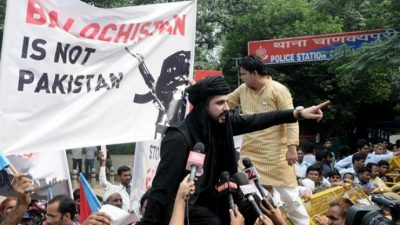
While all the focus has been directed by the Western media on Xinjiang and a supposed “anti-Muslim crackdown” in the region, Pakistan faces the same problem in its southwestern province of Balochistan. In Pakistan – attempts by the government to root out violent separatists surely is not “anti-Muslim.” 
In Balochistan, the US agencies involved in fanning the flames of separatism and violence instead portray Islamabad and the Pakistani military’s efforts to restore order as simply trampling “human rights.” 
US interference in Balochistan is just as extensive as it is in China’s Xinjiang.
Despite the recent move by Washington to list the armed Balochistan Liberation Army (BLA) as a terrorist organization – Islamabad has long accused Washington of funding and arming it along with segments of the Indian government aligned with US interests.
The fact that otherwise ignored activities by Balochistan separatists are covered by certain Indian newspapers even as recently as this year seems to give credence to these accusations. NDTV’s article, “Pro-Balochistan Slogans Raised During Imran Khan’s Address In US,” and India Today’s article, “16 EU Members of Parliament write letter to Trump to intervene in Balochistan,” are just two such examples.
US support is much easier to track down.
US-based Stanford University’s Mapping Militant Organizations project admits that the BLA receives much of its financial aid from the Balochi diaspora. The project’s profile on the Balochistan Liberation Army notes:
Due to high community support for autonomy and independence from people of the Balochistan, many analysts suspect that a large amount of the BLA’s income and weapons supply come from donations from the Balochi people. Balochi leaders have also claimed that financial contributions from the Balochi diaspora make it possible to procure arms and ammunition through the black market.
Thus, even if the US is not directly arming and funding the BLA, it is openly supporting pro-separatists among the Balochi diaspora who even Stanford University experts admit are – in turn – funding the BLA’s terrorism.
The US move to designate the BLA as a foreign terrorist organization holds little meaning. The BLA will find itself beside organizations like Jabhat Al Nusra in Syria which is all but openly funded and armed by the United States and a large cross-section of Washington’s closest European and Arab allies.
Arming militants is only half of the overall strategy seeking to destabilize Pakistan. Subverting national institutions and replacing them with those interlocking with US special interests is the other half.
US NED Working Hard in – and Against – Pakistan  
The US State Department-funded National Endowment for Democracy (NED) and its various subsidiaries are busy at work in Pakistan’s Baluchistan province as well as China’s Xinjiang.
NED has been directly funding and supporting the work of the “Balochistan Institute for Development” (BIFD) which claims to be:
“…the leading resource on democracy, development and human rights in Balochistan, Pakistan.”
In addition to organizing the annual NED-BFID “Workshop on Media, Democracy & Human Rights” BFID reports that USAID had provided funding for a “media-center” for the Baluchistan Assembly to “provide better facilities to reporters who cover the proceedings of the Balochistan Assembly.” It can be assumed that BFID meant reporters are “trained” at NED-BFID workshops and at its USAID-funded center.
There is also Voice of Balochistan whose every top-story is US-funded propaganda, including op-eds by US representatives promoting Balochi separatism, foundation-funded Reporters Without Borders, Soros-funded Human Rights Watch, and a direct message from the US State Department.
Like other US State Department funded propaganda outfits around the world – such as Thailand’s Prachatai – funding is generally obfuscated in order to main “credibility” even when the front’s constant torrent of obvious propaganda more than exposes the game.
The “Free Baluchistan” movement is a US and London-based organizations. The “Baloch Society of North America” serves as a useful aggregate and bellwether regarding US meddling in Pakistan’s Balochistan province. The group’s founder, Dr. Wahid Baloch, openly admits he has met with US politicians in regards to Balochistan independence. This includes Neo-Conservative corporate-lobbyist and National Endowment for Democracy board member, Zalmay Khalilzad.
Dr. Wahid Baloch considers Balochistan province “occupied” by both the Iranian and Pakistani governments – he and his movement’s humanitarian hand-wringing gives Washington the perfect pretext to create an armed conflagration against either Iran or Pakistan, or both, as planned in detail by various US policy think-tanks.
There is also the Baloch Students Organisation-Azad, or BSO. While it maintains a presence in Pakistan, it has coordinators based in London. London-based BSO members include “information secretaries” that propagate their message via social media, just as US and British-funded youth organizations did during the West’s operations against other targeted nations during the US-engineered “Arab Spring” in 2011.
And just as US-funded agitators in China’s Xinjiang region coordinate their activities with other US-backed groups across the rest of China – such as in Hong Kong and Tibet – other US NED-funded fronts in Pakistan also contribute to a wider campaign of dividing and undermining Pakistan.The US State Department funds Voice of America Deewa focused on Pakistan’s Pashtuns who inhabit Pakistan’s northwest region along its border with Afghanistan.
Despite VOA Deewa’s supposed area of focus, it is actually based in Washington DC. While many of the organizations it provides support for do not admit their US funding, organizations like “AdvoPak” are regularly promoted by VOA Deewa. US NED’s online publication, “Democracy Digest,” also promotes, interviews, and defends groups who appear to be funded by Washington and undoubtedly serve US interests in Pakistan.
This includes the Pashtun Tahafuz Movement (PTM) which was featured by the Digest earlier this year in an article titled, “Pakistan’s military targets protest movement, stifles dissent.” While PTM doesn’t disclose its funding, it is regularly accused of receiving support from and working for both India and the US.The Democracy Digest article featured a video interview with a PTM member – Gulalai Ismail – who is in fact an NED Fellow. There is also NED’s “Tribute to Gulalai Ismail at the 2013 Democracy Award.”And all of this is just scratching the surface of US meddling in Pakistan’s internal politics and of organizations committed to creating synergies with US-backed separatists in Balochistan.
What Does Pakistan’s Balochistan and China’s Xinjiang Have in Common? 
Balochistan and Xinjiang both appear to be suffering from separatist movements, terrorism, and political destabilization. The common factor is clearly US backing behind both separatist movements – but what is the common denominator that has attracted US attention in the first place?Both Xinjiang and Balochistan are settings for massive Chinese-led infrastructure and trade initiatives. Western publications like the Business Insider note the importance Xinjiang holds in terms of China’s One Belt, One Road (OBOR) initiative.
Many of the routes that lead out of China, across Central Asia, and eventually into the Middle East and Western Europe pass through Xinjiang. US attempts to destabilize the region in turn directly impact the viability of Beijing’s OBOR initiative and the economic wealth and influence it stands to grant Beijing.
Likewise, a significant leg of the OBOR initiative extends from China and across Pakistan from north to south, through Balochistan until reaching Gwadar Port. Thus, by destabilizing Balochistan, this essential corridor’s full potential is inhibited.
This is a truth US special interests and the media interests they own will never admit to. This is why – instead – diverse tales of China’s “anti-Muslim” crackdown and Pakistan’s “distain for human rights” in Balochistan are used to sell two different US-backed conflicts fuelled for a singular agenda – impeding China’s rise and that of its allies – including Pakistan.
*
Note to readers: please click the share buttons above or below. Forward this article to your email lists. Crosspost on your blog site, internet forums. etc.
Tony Cartalucci is a Bangkok-based geopolitical researcher and writer, especially for the online magazine “New Eastern Outlook” where this article was originally published. He is a frequent contributor to Global Research.
Featured image is from NEO

River to Sea Uprooted Palestinian   
The views expressed in this article are the sole responsibility of the author and do not necessarily reflect those of the Blog!

Wednesday, 6 February 2019

Pakistan relying less and less on US, turning to China, Saudi Arabia & UAE

By Darius Shahtahmasebi
Source
5c544bc8fc7e9326708b45ff.JPG

Pakistan is making important strides in its military and naval capacities with the help of China, relying less on US-made weaponry. Despite accepting money from all sides, Pakistan’s relationship with China continues to be strong.
After the Trump administration decided to suspend $3 billion in security assistance to Pakistan, complaining that Islamabad fails to do enough to combat terrorism, Washington has risked pushing Pakistan into the open arms of a number of other notable nations.

China-Pakistan relationship continues to strengthen

China has been a key ally for Pakistan in recent times and is almost certainly the reason why the US has taken a sharp turn in its approach to dealing with the country. (Considering that the Bush administration was caught red-handed funding Pakistani terrorist groups, Washington’s recent disdain for Islamabad makes little sense in the context of wider US imperialism).
Now, China is assisting Pakistan’s Navy to expand rapidly, with the completion and delivery of four advanced warships currently under construction in Shanghai. According to the Diplomat, Pakistan’s Chinese-made naval vessels will arrive through a bilateral arms agreement by 2021. Worth over $348 million, these frigates have the capacity to act as anti-ship and anti-submarine operations, as well as for air defense.
Reports seem to indicate that these ships are to be stationed for defense and security in and around the Gwadar port. This is the same port that many media outlets accused China of attempting to hijack and transform into its own naval base. Perhaps the media sounding the alarm over these reports have helped convince China to try a subtler strategy of creating a naval presence around this strategic area, but either way, the move to acquire Chinese naval ships is sure to irk the United States irrespective of the end result, as some experts are predicting that this will lead to regular Sino-Pakistani patrols across the region.
That being said, this is also the same port in which Saudi Arabia is planning to establish a $10 billion oil refinery, according to the Saudi Energy Ministry, setting Saudi Arabia up as a key partner in the China-Pakistan Economic Corridor (CPEC).

Pakistan turning down American arms

Unfortunately for Washington, Pakistani purchases of US-made military equipment have begun to fall. Data from the Stockholm International Peace Research Institute appears to show that US weapons exports to Pakistan dropped from $21 million in 2017, from a whopping $1 billion just seven years prior. Altogether, since the September 11 attacks, the US has provided over $22 billion in overt security aid to Pakistan and another $10 billion in economic aid, according to a July 2018 report conducted by consultant firm Avascent.
However, despite these initial findings, this same report found that Pakistan was increasingly turning to Beijing for its defense equipment and leaving Washington out in the sand. In total, Pakistan has signed billions of dollars’ worth of contracts for fighter aircraft, submarines and warships from China. The report estimated that over the next decade, Beijing will become the single most important arms supplier for the Pakistani military, but maintains options to obtain arms from Turkey and Russia as well. Turkey, for its part, will upgrade two of Pakistan’s Agosta 90B-class submarines, will provide four MILGEM corvettes to the Pakistani Navy, and already provided a navy fleet tanker in 2016.
Pakistan is also reportedly the largest importer of the F-7PG aircraft from China, with more than 50 F-7PG fighters in the Pakistan Air Force (one of these planes just recently crashed in Western Pakistan, killing the pilot).

The China-Pakistan Economic Corridor

In actuality, China and Pakistan are developing their relationship in more ways than at first meets the eye. It is one thing to spend millions of dollars attempting to beef up a nation’s navy, but it is something else entirely when two nations become attached on a much deeper level, particularly when it involves the citizens of those countries. Just this week, the government of Pakistan announced a new visa regimebetween Pakistan and China, tourism being an area of Pakistan’s economy that China has already been contributing heavily. Reportedly, millions of young Pakistanis are also foregoing English and learning Mandarin instead in order to obtain jobs and degrees. If we fast-forward a few decades down the line, I venture to bet that Western influence in Pakistan will be almost completely invisible.
Pakistani President Arif Alvi also just hailed the China-Pakistan Economic Corridor (CPEC), vowing that the scheme will bring economic prosperity to the two countries. The CPEC is essentially a combination of infrastructure projects in Pakistan funded by Chinese loans which are worth at least $62 billion. As explained above, Saudi Arabia is not sitting idly by watching this project develop (not surprising, when one understands why).
CPEC, combined with China’s New Silk Road Project, has top US lawmakers and intelligence personnel increasingly “concerned.” One senator stated that he was “concerned about data access China may control through digital infrastructure projects in countries around the world. What is the IC’s assessment of potential dual-use aspects of China’s Belt and Road Initiative and what threats do they pose to US interests?”

US allies and partners “seeking greater independence from Washington”

A report compiled by Daniel R. Coats, the director of national intelligence, entitled “Worldwide threat assessment of the US intelligence community” identifies Pakistan as a nation that contributes to the risks of escalation dynamics and security in the region. More noticeable, however, is that while Pakistan appears in the document a handful of times, China is mentioned at least 85 times right throughout the report.
“We assess that China’s leaders will try to extend the country’s global economic, political, and military reach while using China’s military capabilities and overseas infrastructure and energy investments under the Belt and Road Initiative to diminish US influence,” the report states. “China has built its first overseas military facility in Djibouti and probably is exploring bases, support facilities, or access agreements in Africa, Europe, Oceania, Southeast Asia, and South Asia.”
Most curious is the foreword of the report which, after outlining all the threats Russia and China pose to the United States in all the different ways, states that “[a]t the same time, some US allies and partners are seeking greater independence from Washington in response to perceptions of changing US policies on security and trade and are becoming more open to new bilateral and multilateral partnerships.”
Let’s do the math. As already stated, the US has deprived Pakistan of $3 billion in security assistance. Not too long ago, the Abu Dhabi Fund for Development (ADFD) UAE deposited $3 billion into the State Bank of Pakistan to support its economic growth. Saudi Arabia made a similar promise, agreeing to provide Islamabad with a one-year deferred payment facility for importation of oil worth up to $3 billion.
At around the same time, Emirati media announced that the UAE and Pakistan were accelerating defense cooperation after the federal minister for defense production in Pakistan, Zubaida Jalal, received Major General Staff Pilot Ishaq Saleh Al-Balushi, head of the executive directorate of industries and development of defense capabilities at the UAE Ministry of Defense in Islamabad.
Pakistan is also expected to sign a memorandum of understanding with Saudi Arabia on a framework for $10 billion in Saudi investments. While some media will present Pakistan’s willingness to work with Saudi Arabia as an issue which will rattle and unnerve China, the available evidence appears to show that Sino-Pakistan relations are continuing unabated.

The question of Pakistan’s nukes

Last Thursday, the Pakistani Army Strategic Forces Command conducted a successful test flight of the Nasr close-range ballistic missile, which is nuclear-capable and can reach a specification of 70km.
The target of the ballistic test may surprise you. According to the Pakistani Army statement, the Nasr “augmented Full Spectrum Deterrence posture remaining within the precincts of policy of Credible Minimum Deterrence, against prevailing and evolving threat spectrum more effectively including enemy’s ballistic missile defense and other Air Defence Systems.”
The “enemy” referred to in this statement appears to be a blatant reference to Trump’s recent 2019 Missile Defense Review, which admitted that the US had “discussed potential missile defense cooperation with India” in light of the fact that “a number of states in South Asia are developing an advanced and diverse range of ballistic and cruise missile capabilities.”
Currently, Pakistan has ballistic missiles with ranges that can hit anywhere inside India. It has also built nuclear-tipped cruise missiles that can travel up to 400 miles. Not surprisingly, it was the US that gave the green light to Pakistan to modify its F-16 fighters to be capable of dropping nuclear weapons.

Conclusion

Pakistan’s economic woes put the nation in an incredibly compromising position. Knowing that it can no longer rely on Washington for support, it has to turn to as many partners as it can to keep its economy afloat. While China may not be thrilled by Saudi Arabia’s attempt to wade in on its project at the Gwadar port, it does appear that Pakistan’s geopolitical significance, particularly in relation to China, will entail Beijing continuing to prioritize its relationship with Pakistan. This includes, if necessary, militarizing its available bases in the region through the supply of its Chinese-made naval vessels.

River to Sea Uprooted Palestinian   
The views expressed in this article are the sole responsibility of the author and do not necessarily reflect those of the Blog!