Uprooted Palestinians are at the heart of the conflict in the M.E Palestinians uprooted by force of arms. Yet faced immense difficulties have survived, kept alive their history and culture, passed keys of family homes in occupied Palestine from one generation to the next.
OneWorld is publishing the full text of the interview that Andrew Korybko gave to Giorgio Cafiero on this topic, some excerpts of which the latter included in his recent article for Inside Arabia titled “Israel’s Working Relationship with Russia Inside Syria”.
1. What does Russia believe it can get for itself through cooperation with Israel in relation to Syria?
Russia and Israel agreed to a deconfliction mechanism in September 2015 shortly before the onset of the former’s intervention in Syria. The two sides hoped to mitigate the risk of midair incidents since Moscow bombs forces that it and Damascus regard as terrorists while Israel does the same, albeit the latter strikes Syria’s IRGC and Hezbollah allies that were invited into the country but which Tel Aviv regards as latent national security threats. Neither wants to clash with the other since that could dramatically escalate regional tensions. Moreover, Russia and Israel have excellent relations, particularly proven by the fact that Tel Aviv declined to sanction Moscow in solidarity with its Western allies all these years.
Russia officially condemns Israel’s strikes from time to time but hasn’t ever taken any action to stop them, whether directly or indirectly. The second-mentioned observation gained extra credence in recent years after Syria has thus far failed to use the S-300s that it belatedly received from Russia in late 2018 after the incident near Latakia that President Putin described as a tragic chain of circumstances. Even though Russia also officially acknowledges the legality and anti-terrorist purposes of the IRGC and Hezbollah’s presence in Syria, some argue that the Kremlin might discretely be hoping for Damascus to request their dignified but phased withdrawal (in this context, under the duress of Israeli airstrikes) as part of a compromise solution for ending the war.
2. To what extent is Russian-Israel cooperation vis-à-vis Syria problematic for Moscow’s relationship with Tehran?
Russia and Iran both fight against ISIS/ISIL/Daesh and other terrorist groups in Syria, but the first-mentioned mostly does so through the air and via the sharing of tactical intelligence to the Syrian Arab Army (SAA) while the second joins the SAA and their shared Hezbollah allies in on-the-ground battles. Moscow and Tehran therefore have the same interest in supporting Damascus, but they seemingly differ over their post-war vision for the country. The Kremlin believes that a series of mutual compromises is needed by all parties of the conflict while the Islamic Republic’s implied stance is that its Arab ally doesn’t necessarily have to concede anything to those whom it doesn’t regard as its political equals.
Even though Russia isn’t directly involved in Israel’s strikes, Iran and Hezbollah might not be happy that Moscow doesn’t ever tip them off when it’s informed of these attacks ahead of time per the reported protocol connected with their deconfliction mechanism. There might also be some questions about why Syria hasn’t yet used its Russian-supplied S-300s that were belatedly shipped to the country after the September 2018 incident for the reported purpose of deterring what was described at the time as further irresponsible Israeli behavior. Since then, Israel has continued to strike Syria, with Damascus only targeting its incoming missiles and not using the S-300s or other anti-air defense systems to strike the attacking jets themselves like many earlier expected.
3. Does Bashar al-Assad’s government believe that Russia can pressure Israel in ways which suit the interests of Damascus?
It’s unlikely that Syria seriously has those expectations, and in the off chance that it did, they’re unrealistic. The power dynamic actually seems to be the inverse: Israel believes that Russia can pressure Syria when it comes to requesting Iran and Hezbollah’s withdrawal. Moscow doesn’t want to take sides since it has great relations with both, albeit of a different nature and strategic impact with respect to advancing its interests, hence why it’s hitherto sat back and passively let everything unfold between them as it has.
Nevertheless, it’s precisely this passivity in spite of occasional condemnations of Israeli strikes that can be interpreted as tacitly advancing Tel Aviv’s interests since Moscow doesn’t do anything to stop its attacks against the IRGC and Hezbollah, not directly nor indirectly as was earlier explained. This leads some to wonder whether Russia discretely prefers for Israeli strikes to function as a form of pressure for getting Syria to request Iran and Hezbollah’s withdrawal as part of a larger regional compromise that the Kremlin might hope to broker.
4. What are Israel’s incentives to work with Russia? Is there any good reason for Israelis to believe that Russia will act against Iranian influence/power in Syria?
There’s a massive Russian diaspora living in Israel that has gradually come to command sizeable influence in society and some parts of the permanent bureaucracy, including the formulation of foreign policy. President Putin is also very well respected in Israel for his resolute opposition to anti-Semitism, fascism, and historical revisionism connected to World War II. Furthermore, as an influential Great Power that’s returned to West Asia with its Syrian intervention and is nowadays considered the kingmaker for resolving that country’s crisis, Israel has every reason to pragmatically expand its relations with Russia, especially since this could give it some leverage to better balance its historical relationship with the US.
Nevertheless, Israelis shouldn’t have any unrealistic expectations about Russia directly acting against Iranian influence in Syria. Doing so would risk undermining Moscow’s anti-terrorist campaign there as well as its bilateral relations with the Islamic Republic which are important for maintaining stability in the South Caucasus, Caspian Sea, and Afghanistan. The most that Russia is seemingly willing to do is “passively facilitate” regular Israeli strikes against the IRGC and Hezbollah by not interfering with them per the reported conditions of the September 2015 deconfliction agreement and speculatively not authorizing Syria to use the S-300s and other anti-air defense systems for targeting attacking Israeli jets (which could escalate tensions), which is still a lot.
Newsweek’s interview with Russian Special Presidential Envoy to Afghanistan Zamir Kabulov was significant because it was the first time that Russia’s pragmatic stance towards the Taliban was given publicity and treated fairly by a major Western media outlet.
Russian Special Presidential Envoy to Afghanistan Zamir Kabulov was recently interviewed by Newsweek about his country’s pragmatic stance towards the Taliban. This high-profile and fairly conducted media appearance speaks to the fact that the US is taking note of Russia’s evolving position. It also signals the incipient progress that’s been achieved in improving bilateral relations since this summer’s Biden-Putin Summit because it shows that Russia and the US are interested in working more closely together on this issue of mutual concern. Prior to summarizing the insight that the envoy shared, the piece will point readers in the direction of the author’s prior analyses on this topic that were published at the Russian International Affairs Council (RIAC) in case they’re interested in some background briefings:
To sum it up for those readers with limited time, Afghanistan forms a crucial component of Russia’s Greater Eurasian Partnership (GEP) because it functions as the irreplaceable transit state for facilitating its overland connectivity with South Asia. Pakistan helped Russia enter into contact with the Taliban due to all sides’ shared anti-ISIS concerns, after which Moscow began to independently cultivate its own relations with the group that it still formally designates as terrorists. That political issue hasn’t hampered their cooperation though since they’re now coordinating on humanitarian, security, and socio-economic issues. Russia’s surprising successes in this respect are entirely attributable to its pragmatic grand strategy of attempting to become Eurasia’s supreme “balancing” force in the 21st century.
———-
Kabulov began the interview by stating Russia’s top two policy goals in Afghanistan: seeing it become a normal state at peace with itself and its neighbors; and containing international terrorist and drug trafficking threats. He then proceeded to explain that the Taliban has evolved from what he claims was its prior “global jihadist agenda” to becoming a “military political opposition” movement in Afghanistan. They beat NATO because they had better morale, he said. Although their post-war vision differs from the socio-political models that Russia and other countries adhere to within their own borders, Moscow nevertheless respects it. Even so, Kabulov insisted that his country wants the Taliban to abide by “basic human rights and international relations rules”.
These include an ethno-politically inclusive government and equal socio-economic opportunities for women. The envoy praised the progress that’s been achieved thus far, especially in terms of retaining a diversity of media outlets in the country and establishing law and order, but he of course also noted that a lot of work still remains to be done. Kabulov lauded the Taliban’s anti-terrorist struggle against ISIS (which is also banned in Russia) and said that they “are actually doing this much better than your and previous administration forces”. Since “they are serving both regional and international interests” in this respect, Russia is against all efforts to weaken its relevant capacities. The envoy also hopes that the US releases Afghanistan’s frozen funds so that the Taliban doesn’t need to rely on the drug trade.
As for the state of cooperation with the US on this issue, Kabulov sounded upbeat but noted that a lot of their discussions concerned dealing with the same financial and security messes that America itself is responsible for creating in Afghanistan. The Troika Plus framework between those two, China, and Pakistan was also presented as an example of their fruitful cooperation thus far. These four countries’ top priority right now is to avert Afghanistan’s impending humanitarian crisis and brainstorming multilateral solutions for sustainably improving its socio-economic situation. Broader cooperation with the Central Asian Republics (CAR), Iran, France, and Germany is possible too.
Kabulov expressed relief that the US hasn’t succeeded in setting up any regional bases, which he said would have provoked attacks against those host states by the Taliban and other terrorist groups. He also revealed how displeased Russia was with the US’ initial attempts to have it and the region shoulder the Afghan burden. A balance must be struck, he implied, between the US and its allies responsibly cleaning up the mess that they made there and other stakeholders assisting these efforts in a fair way that doesn’t ask too much of them or anything else that might be unrealistic. In the worst-case scenario that the situation deteriorates, Kabulov said this country’s CAR allies can count on Russia to defend their national security.
Russia will not, however, render any anti-terrorist military assistance to the Taliban, nor has such been requested of it from the group. Kabulov then commented on the emerging regional consensus surrounding the need to help stabilize Afghanistan and contain the various threats that might emanate from it. The Moscow and Islamabad Format talks, as well comparatively minor supplementary ones like the latest virtual event in Tehran, are proof of this in practice. The envoy cautioned, however, against needlessly multiplying meetings just for the sake of it without focusing on achieving tangible dividends from each process, the most urgent of which concern humanitarian issues followed by anti-terrorist and drug-related ones.
Russia’s goal is to prevent Afghanistan from ever being exploited by foreign terrorist organizations to carry out another 9/11. About that world-changing event, Kabulov said that it was unfair to punish the Afghan people when none of their compatriots participated in it and only Osama Bin Laden operated from there. Arming Afghans with political and economic instruments can help them prevent this from ever happening again, the envoy advised. Going forward, Russia will continue working with its Troika Plus partners to convince other donors like those in Europe to contribute to averting Afghanistan’s impending humanitarian crisis. In conclusion, Kabulov hopes that the Taliban will continue to make comprehensive progress by having their comparatively moderate elements keep radical ones in check.
———-
This interview was significant because it was the first time that Russia’s pragmatic stance towards the Taliban was given publicity and treated fairly by a major Western media outlet. Kabulov’s interviewer wasn’t aggressive or provocative like Western ones usually are. Rather, they seemed sincerely interested in better understanding his country’s position so that their own and others could potentially learn from it. This further reinforces the earlier mentioned observation that relations between those two countries are improving when it comes to areas of mutual concern. Evidently, both sides have made progress on responsibly regulating their rivalry since their leaders met this summer. Afghanistan can therefore serve as a perfect example of Russian-American cooperation and help build more trust.
Of course, that best-case scenario is still a far way’s off as seen by the US’ reluctance to release Afghanistan’s frozen assets, but there’s still no denying that the present state of affairs could obviously be a lot worse than it is. Russia hopes to lead the international community’s efforts to stabilize the situation in Afghanistan or at the very least avert its impending humanitarian crisis. China and Pakistan are playing major roles in this respect too, but the former is considered by the US to be its top global rival while the latter has limited influence on the global stage. That’s why it falls onto Russia to rally the international community around this shared cause. The US can greatly assist if it encourages its Western allies to follow suit. Until that happens, progress will remain limited and uncertainty will prevail.
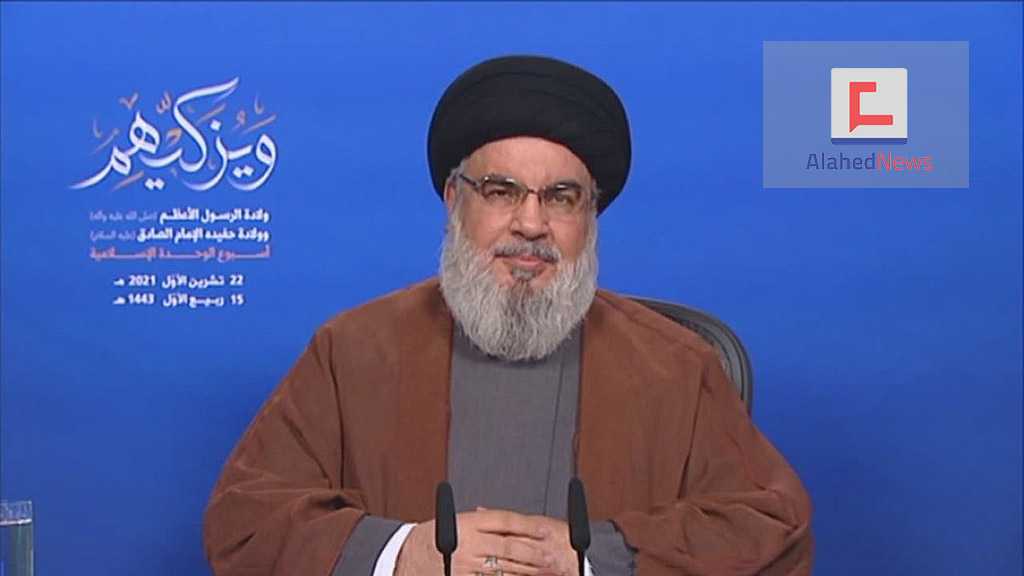
The political segment from the speech of Hezbollah’s Secretary General Sayyed Hassan Nasrallah at the festival held by the party marking the Prophet’s birthday and the Islamic Unity Week at the Ashura courtyard in Beirut’s southern suburbs.
1- Palestine:
The first file we will be talking about which is our priority as followers of the Messenger of God is Palestine, the point of consensus in this ummah. There is no disagreement about this. The Shiites, the Sunnis, and other Muslims are united on this file.
Here, we repeat and remind you of the responsibility. There are oppressed people in Palestine that are suffering from a siege and a suffocating livelihood crises and from very pressing humanitarian issues, including that of the detainees and their families, for example, and that of the displaced inside and outside the country – because there are displaced inside Palestine and outside. There is an occupied land and sanctities that have been violated – Islamic and Christian sanctities. No free person, not just a Muslim, any reasonable human being with feelings and instinct cannot say that this isn’t their concern. Let alone if this person is a Muslim. He cannot say that he is not concerned about this. We in Lebanon, Syria, Iraq, Hijaz, Yemen, and everywhere are concerned.
There are new theories that say that each person should be concerned with his country only. However, this is not a validation for interfering in the internal affairs of others. This is an occupied land whose people are persecuted and oppressed and their sanctities violated. To make matters worse, the enemy poses a threat to all neighboring countries, people in the region, and the nation. So, we must not say, for example, that this is not our concern and that we are neutral. The values that the Messenger of God called for say that we must bear a responsibility towards Palestine – if you cannot fight, you can spend money. Today the resistance in Palestine needs money – the steadfastness of the Palestinian people in their land in light of the stifling living crises, the unemployment crisis, the siege, and the crisis of temptations to buy land, which unfortunately are now assisted by merchants from Arab countries who deceive people. Those who have money should give. It is not mustahab.
This is part of the battle. If you do not have [the ability to support with] money, weapons, or taking part in fighting, you can have a position – show your support and do not turn your back as a result of flimsy pretexts, as is happening now in much of the Arab world. They abandoned Palestine and the Palestinian people. They began looking for the “Israelis’” right to the land of Palestine and talk about the “Israeli” society as an oasis of peace, etc. This is very unfortunate and very sad. Can you take a position? Your duty is to take a stand at a time when there is television and radio. However, today there is social media. Everyone has radio or television set. This is an influential matter. No one is saying that this is ineffective, but silence toward what is happening in Palestine is not right. We can never be silent. If you cannot speak out in a certain country, then do it in your heart – hate this enemy and to deny this occupation, this aggression, this injustice, and this violation.
Today, brothers and sisters, America and some Arab regimes want to destroy and eliminate this hatred and denial in the heart by our Arab and Islamic people, which is the weakest of faith, through normalization – we must love “Israel”, not only to recognize it but also to embrace it and love it, organize poetry for it and recognize its rights. Is this not what is happening today in some countries in our Arab and Islamic world. That is also why today this is one of the most important battles that must be fought. All of us can fight it, even as an individual, who does not belong to a party, movement, organization, group, current, faction, etc.
Each one alone can fight this battle in the face of normalization by boycotting and expressing positions or opinions. Let us take Bahrain, for example. Bahraini scholars issued statements of condemnation regarding what the Bahraini authority is doing with the “Israeli” enemy, in terms of relations, normalization, and opening embassies. They wrote their names in it even though they may be threatened with arrest and persecution. They did that anyways. A few days ago, we saw Bahraini youths taking to the street to denounce the visit of the enemy’s foreign minister and the opening of an “Israeli” embassy in Manama. They were suppressed, beaten, and arrested. They know the conditions of the detainees and the torture they are subjected to.
Despite their suffering, the Yemenis insist on supporting Palestine. They demonstrate and donate money for it. They declare their readiness even before the celebration of the Prophet’s birthday – the leader of Ansarullah declares his readiness once again to be part of the regional equation that protects Al-Quds and the holy sites in Palestine. This is an expression of commitment to duty and responsibility. This is the prophetic spirit. This is belonging to the Messenger of God.
We also find this in many countries in the Arab and Islamic world. A conference for normalization that was held in Erbil was meant to feel the pulse and was the beginning. If people were silent about it, normalization in Iraq would have passed. But the Sunni and Shiite religious authorities, Shiite and Sunni scholars, and the rest of the sects, political parties, resistance factions, clans, and tribes from the south to Anbar took a sharp, decisive, and harsh stance. The official and judicial position was also excellent. They cut off sedition from the start, and this was meant to feel the pulse. If the Erbil conference had passed without official, popular, scholarly, and religious reactions, other conferences would have followed. But now, the issue is different. Therefore, this battle must also be fought – for people to bear the consequences of standing by Palestine as the Islamic Republic in Iran, Syria, and others are bearing. This is one of the duties, one of the simplest duties that we must accept and coexist with. This is one file.
2- Yemen:
Also, it is our responsibility to talk about another file in a few words. I will mention all the files in a couple of words. The Yemen file.
From the beginning, we made a position. We said that these people are oppressed and assaulted. It’s been seven years since this aggression. The criminal or the wrongdoer in the Arab and Islamic world are those who stand by these oppressed people and condemn the aggression. Therefore, we are the ones who are wrong, and the actions of others are right. Therefore, we must be held accountable for this wrongdoing. This is absolutely not right. Isn’t this the responsibility of the Islamic peoples, Muslim scholars, Islamic movements, the Islamic nation, and indeed all the free people of the world in the face of this bloody war that has been going on for seven years?
The Security Council and the international community are talking about the will of the people. A few days ago, in the Yemeni capitals, major cities, and governorates that are with Ansarullah and with the Sana’a government, we saw huge demonstrations of millions, hundreds of thousands – describe them the way you wish – regardless of them celebrating the Prophet’s birthday. These people were expressing popular will and a popular position. Shouldn’t this popular will be respected? Who are concerned about the Yemeni people? These are the Yemeni people, who attended the demonstration in their millions in some cities and in the hundreds of thousands in others under the banner of this leader and this jihadi faith movement. Shouldn’t the will of these people be respected?
Thus, instead of condemning the victim, the world and the UN Security Council must work to put pressure on the powers, on America, on Saudi Arabia, and on the others – the forces that are continuing to wage the war and aggression? On the other hand, those who are saying that these brothers do not want to stop the war are wrong. They really want to stop the war, meaning a cease-fire and the lifting of the siege. However, a cease-fire and the continuation of a siege means the continuation of the war. Here, at the very least, we must have sympathy in our hearts and condemning this crime that has been going on for seven years are also among our duties.
3- Daesh:
The third file is Daesh [Arabic acronym for “ISIS” / “ISIL”] and what it brought upon the nation, Muslims and non-Muslims, humanity, and the Messenger of God, his religion, and his name. Unfortunately, all the atrocities it commits are under a banner that has the seal of the Prophet on it – “Muhammad is the Messenger of God”.
People are killed and slaughtered with knives, massacres are committed, and worshipers – men, women, and children – are killed in mosques and churches in suicide operations. However, many in this world remain silent. The Americans say we created Daesh. Yet, there are those who are not ready to hear this.
The Americans say that they are using Daesh to tear apart Muslims, to destroy armies and countries, and to destroy and tear apart peoples. Yet, there are those who are not ready to hear this talk. This is being said by the Americans and in previous and current post on a daily basis. One of the most imperative duties today in defending the Messenger of God, Muhammad, and his name is for Muslims, Muslim scholars and elites, Islamic movements, and, first and foremost, the general public to stand in the face of this brutal, terrorist, and murderous group, which is portraying the worst image of Islam and its Prophet since the Messenger of God was sent.
There has not been a monstrous and offensive model like this since the first days of Islam. This is also a responsibility – we cannot do anything for the people who are being killed in mosques. Today, thank God, it seems that we have come to a good end. However, last Friday in Kunduz during Friday prayer and the second Friday in Kandahar. Today, it seems good precautionary measures were taken. They send two or three suicide bombers to a mosque filled with hundreds of worshipers. What kind of mind is this? What kind of brutality is this? Then, you find people who are silent. They don’t even issue a condemnation. This is a strange and contradicts the spirit of Islam and belonging to this Messenger.
4- Islamic Unity:
Before I tackle some of the points concerning Lebanon, I will talk about the last file which is the Islamic unity file. We say the Islamic Unity Week. Of course, this file has been in the works since the victory of the Islamic revolution. Before the Islamic revolution, religious authorities and major religious centers in the Muslim world – Shiite and Sunnis – have been working on it. Following the victory of the Islamic revolution, a distinctive interest in it arose. When talking about Islamic unity, neither Imam Khomeini, nor His Eminence Imam Khamenei, nor any of the Sunni and Shiite scholars and elites meant by it is unity to merger, unity to cancel, unity to melt – call it whatever you want. No. The Sunnis have their own doctrines and understanding, so do the Shiites, etc.
There is no problem with this topic. There are also other Islamic groups. What is meant here is cooperation, closeness, collaboration, support, and integration between Muslims on the basis of {And cooperate with one another in virtuous conduct and conscience.} It also means avoid fighting, conflict, and negativity – {and do not dispute, lest you falter.} This is the intended meaning [of Islamic unity]. The whole point is this realistic idea because there will always be people – who have been arguing for forty years – who will argue that this [Islamic unity] slogan is unrealistic, an imaginary and philosophical talk, and talk that has no ground. Yes, if merger, and solubility is the intention, then this is true. Otherwise, it is hypothetical and imaginary talk.
But this was never the intention – for the Shiites to become Sunnis or the Sunnis become Shiite. Rather, all the great things Muslims have in common must all meet. Hence, they must cooperate, advise each other, and be like one body, but each having his own personality. This idea should be reorganized and work to achieve. Of course, in all the squares where they converged and cooperated, they triumphed. Through this closeness and cooperation, the resistance in Lebanon achieved victory. The resistance in Palestine triumphs when it unites inside and outside Palestine with the rest of the resistance as it is happening now. Today, the resistance that includes Sunnis and Shiites is a main force for resistance in Palestine. Similarly, when the Sunnis and Shiites fought shoulder to shoulder some of these groups, including a Daesh, they were able to achieve victory in more than one Arab and Islamic country.
When we cooperate, we triumph. When we fight, we fail. Our enemy who wants to dominate the region and control it and continue to occupy Palestine wants us to always be fighting each other. It wants to convert any political problem into a sectarian one. It wants to exploit any personal dispute and light it up to ignite a big sedition.
This is a great responsibility. Today, one of the Muslims’ greatest responsibilities, including their scholars, leaders, elites, and seniors, is to prevent any action that could lead to sedition, to rupture, to separation despite all the enemies’ conspiracies and all the existing ignorance and hatred. And let us be frank. Among the Shiites in the Arab and Islamic world, there are those who do not accept this idea and project and do not support it. They work to sabotage it. Some do so as a result of certain convictions, while others do so as a result of the American and British intelligence penetration into the Shiite community. Same goes to the Sunni community. Today, the Americans are toying with us Muslims, and the British, who have historical experience in this matter, are toying with us Muslims. Today, everything that brings you closer is an obligation, and everything that drives you apart is forbidden, and we must work to avoid it.
I will talk about the Lebanese files in a few words quickly.
1- The Tayouneh incident and the massacre that was committed:
On Monday, I spoke about it in some length. I will stick to what I said on Monday and assure everyone that we are all following up on the investigation. According to my data, it is a serious and accurate investigation that follows up on the details. It is also a brave investigation, and we should wait for things to come to an end. The political, popular, and media condemnation of the perpetrators, killers, and those who nearly dragged the country into strife, internal fighting, and civil war must also continue. The data does not justify them at all even though they are trying to say no, it is not. In any case, the investigation will reveal this topic. We once again commend and show our respect and appreciation to the awareness, patience, insight, and wisdom of the families of the oppressed martyrs of the Amal movement and Hezbollah. The families of these beloved and oppressed martyrs will, God willing, continue with this position, and together we will follow up on this file until its conclusion.
2- The demarcation of the maritime borders and the issue of the economic zone and the disputed area:
Regarding Hezbollah, since this issue has been raised in the country again, we said: We do not want to interfere in this matter. We will not express an opinion or a position related to the demarcation of the border – do we support Line 23? Do we support Line 29? Do we accept anything under Line 29? Do we accept below Line 23? We have declared on more than one occasion that we do not want to interfere in this matter. This is left to the state, and the state should take a stand and make up its mind. But what I want to talk about tonight is related to what the “Israeli” enemy has done recently –we heard from the media that it assigned one oil exploration company to start drilling for oil in the disputed area. We waited until we saw what position would be taken. Of course, we are continuing to collect information to verify these data. But I want to say tonight, clearly and frankly, is that when I spoke about the resistance’s ability, numbers, and capabilities, I said on Monday that the resistance’s capabilities are intended to defend Lebanon and protect Lebanon’s wealth, oil, gas, land, and waters from “Israeli” greed.
If the enemy believes that it can act as it wants in the disputed area before resolving this conflict, it is mistaken. I will not issue a position now not to complicate the existing negotiations, but I will definitely say that the resistance in Lebanon by following up on this file. When it finds that Lebanon’s oil and gas, even in the disputed region, are in danger, it will act accordingly at the right time and at the right moment. It is able to do so.
3- The IMF negotiations:
We have no problem with the negotiations. We hope that Lebanon will have a real unified delegation, not a bilateral, tripartite, or quartet delegation. They should act as a single Lebanese delegation to unify the numbers, the vision, and what is accepted and rejected. Secondly, Lebanon should negotiate from a position of responsibility and concern for the national interest and not from a position of surrendering and accepting dictates, some of which may not fit Lebanon’s circumstances, interests, people, and the harsh living conditions in the country.
4- Livelihood following the rise of petrol prices in particular in the past few days and its impact on employees, teachers, schools, factories, work, transportation, etc.:
So today you and I are appealing to the Lebanese government to go back to subsidizing fuel. This is talk futile, and no one will listen because the intention was for us to reach this point. They tortured people and brought them to this point. Secondly, they will tell us that we do not have money in the central bank. Thirdly, this is one of the conditions of the IMF that they want to follow – it is not possible to do anything. Yes, something can be done, of course, under the title of alleviating suffering:
1- Reminding them to launch the cash card as soon as possible. Basically, their idea was that the subsidies would be lifted as the cash cards are introduced. But subsidies have been lifted and there is no cash cards yet.
2- Activating the cash card
3- Agreeing to the demands of the employees in raising the transportation allowance so that their salary can at least get them to work and they’d have some left for food.
4- This is the most important – the revival of public transportation. It can be activated within a few weeks if there is serious follow-up. The Ministry of Public Works and Transport can shoulder this responsibility. It needs protection from the prime minister, the government, and the president of the republic. There is also a loan from the World Bank that has been frozen for a long period of time. This loan can be activated. This project can be activated and will help alleviate the suffering of people to a reasonable extent.
It is therefore not right for the state, government, and ministries concerned to say that there is no more money and that the IMF will not accept with us just to keep the tragedy going on.
We estimate that we can do a set of steps that can help relieve suffering. In all cases regarding this file, I would like to remind the rich that even those who pay Zakat from their money are responsible for people who are suffering under the poverty line. We remind traders to fear God when dealing with people – let them not monopolize, raise prices, and are looking for huge profits. We remind everyone to bear responsibility and cooperate, and that there are options that only need will, decision, and resolution from officials and the people.
In conclusion, I once again congratulate you on these occasions and venerable and great days. We, the resistance, will continue jihad and hard work and will heed to the appeal of God and His Messenger to liberate the land and sanctities as well as shoulder the responsibilities of this nation. Regarding the internal situation, we will continue to be patient and endure. We will continue to follow up wisely to prevent any internal fighting and maintain internal and domestic peace, coexistence, and cooperation to take our country out of all its crises, difficulties, and hardship.
Many happy return. May the peace, mercy, and blessings of God be upon you all.
Speech of Hezbollah’s Secretary General His Eminence Sayyed Hassan Nasrallah tackling a range of political developments on the occasion of the birth anniversary of Prophet Muhammad [PBUH] and his grandson Imam Jaafar Sadiq [AS], and the Muslim Unity Week.
I seek refuge in Allah from the accursed Satan. In the name of Allah the Most Gracious the Merciful. Praise be to Allah, Lord of the Worlds, and prayers and peace be upon our Master and Prophet, the Seal of Prophets, Abi al-Qassem Muhammad Bin Abdullah and his good and pure household and his good and chosen companions and all the prophets and messengers.
May the peace, mercy, and blessings of God be upon you all.
In the coming days, God willing, we will welcome a very dear, precious, and great occasion, which is the anniversary of the birth of the Greatest Messenger of God, the Seal of the Prophets, and the Master of Messengers, Muhammad bin Abdullah [PBUH]. I congratulate all Muslims in the world and all Lebanese on this great and solemn occasion in advance. God willing, on this occasion, we will hold a proper and appropriate celebration in a few days, and therefore, I will leave talking about the celebrant and the occasion itself until then.
With regard to the topics, I divided them into two part. One part I will talk about today, and the second I will talk about it, God willing, during that celebration.
I will begin with tonight’s topics. I will speak about the first topic as briefly as possible, appropriate, and unobtrusive.
1- The elections:
The country today is busy preparing for the electoral law, the dates of the elections, the administrative procedures related to the elections, and the natural prelude to entering the stage of the electoral atmosphere as well as having the elections on time.
Regarding the elections, I want to emphasize several points:
i- Holding the elections on time
We have already talked about this and emphasized it on more than one occasion. In any case, there still remain those who try to spread confusion by blaming a certain party, including us sometimes, of planning to extend and postpone the elections, etc. This is all baseless talk. We affirm, insist, and call for the elections to be held on time within the constitutional deadline. To be fair and according to our follow-up with all the parliamentary blocs, parties, and political forces, we believe that no one – so as not to make baseless accusations like some opponents do – whether implicitly or openly is planning or preparing to push matters towards the postponement of the parliamentary elections and the extension of the current Parliament. Therefore, let us put this issue behind us and let everyone engage in holding the parliamentary elections on time, and we are certainly one of those.
ii- The expatriate vote
We agreed to the current law, which was voted on in 2018 and followed in the 2018 elections, as a result of the discussions, and in all sincerity, taking our allies into account. We agreed to a number of things in that law. In the joint parliamentary committees, whether formally or informally, a discussion took place some time ago, and some parliamentary blocs asked to reconsider or demanded a reconsideration. Some of our deputies expressed a position based on an existing reality. This same discussion existed in 2018 and became more intense at the time than it was in the past. This issue was the expatriate vote.
Today, when we want to prepare electoral campaigns or for people who want to run for office or be elected, there is no equal opportunity, whether in conducting electoral campaigns, in candidacy, or even by going to the polls to exercise free elections, specifically with Hezbollah. There will be other political forces whose situation may be less sensitive, but Hezbollah’s situation abroad, in some European countries, in North America, in the Gulf, and some other Arab countries is known. There is no possibility for preparing an electoral campaign, candidacy, or elections. In fact, this is a point of appeal, and we had mentioned to our allies that with regard to Hezbollah, we would not submit an appeal.
But someone can file an appeal regarding the elections in terms of unequal opportunities. The brothers raised the issue from this angle, and an atmosphere emerged in the country that there were those who wanted to prevent the expatriates from voting. Extensive debates were held over this and there was no problem. We discussed the issue once again and came up with the following conclusion. It was expressed by our deputies at the last meeting of the joint committees. But I’d like to mention it here to close discussions on it.
We, once again, discussed and evaluated it. This is what we had to say. Regardless of how many countries in which expatriates or residents will take part in the parliamentary elections – they usually participate in presidential elections – and if there are countries that participate in parliamentary elections, this may be present and perhaps their number may be few, but in any case, as long as the injustice befalls specifically us, we do not have a problem.
This means that we, Hezbollah specifically, will be oppressed. We will not be allowed abroad or have the right to campaign, announce candidacy, or the freedom to vote. This even applies to our supporters. But as long as the injustice pertains to us and there is a national interest and it allows the Lebanese residing outside Lebanese to feel that they are partners and bear responsibility, we have no problem with that. We will overlook this observation, and that is why our brothers amended and said that we support the principle of expatriate voting, in principle. We divided the issue.
Now, there is a detail that whether the expatriates or those residing outside the Lebanese territories will vote according to the constituencies in Lebanon or elect the six representatives that are said to be allocated for the elections abroad. If they are going to vote according to the constituencies in Lebanese, we have no problem with that. And if voting on the six representatives will be confirmed, we are open to discussions when it’ll be discussed in Parliament. However, if the topic is not discussed, there is a law. So, work according to the law. Hence, we consider this matter closed.
And we hope, God willing, from our brothers, our expatriates and people residing outside the Lebanese territories to register and take part in the elections. They are welcome, and we hope that they will have the real opportunity to frankly express their opinion.
iii- Voting at the age of 18
With regard to the issue of [voting at] the age of 18, I honestly tell all the Lebanese people and young people between the age of 18 and 21 that this matter is only raised to be used locally. It is always raised at a time close to deadlines, and time does not help. Although it was brought up at a time way ahead of deadlines, something strange happened. Since 1992 when we first took part in the parliamentary elections, we’ve been known to have strongly supported giving young people at the age of 18 the right to vote.
Whenever you talk with political forces, you find that everyone is in favor. Yet, you go to the Parliament and it gets dropped. There is something strange in this country. We not only raised this in our speeches, slogans, and political and electoral programs, but we also seriously worked and fought hard for it. In March 2009, the Loyalty to the Resistance bloc proposed a constitutional amendment law to reduce the voting age to 18 since this needs a constitutional amendment. In March 2009, it was voted unanimously. This was before the 2009 elections. The constitutional amendment needs two-thirds of the members of the parliament. The government also voted unanimously on this proposal. It was returned to the parliament after the parliamentary elections in the February 2010 session. The session was attended by more than 100 deputies, out of which only 34 deputies voted on the project, mainly the Amal Movement, Hezbollah, and some other blocs. The rest of the blocs abstained, and it fell through. There is really something strange about this country.
If you now make an opinion poll for the parliamentary blocs and the political forces, they all tell you: yes, this is their natural right, and they must elect, etc. Of course, I heard a strange two days ago saying that young people need to be prepared and educated. What is this talk!
In Lebanese, children as young as five or six years old talk politics! You are talking about 18-year-olds. These need educating, preparation, school programs!!! What is this nonsense?!
Anyway, we once again call, the expatriates have the right to vote. All people should demand this right and respect it. If they are wronged somewhere like us, let us go beyond this oppression. With regard to the issue of voting at the age of 18, there is no injustice to anyone. If this right is not given, this is injustice to all Lebanese youth who are being deprived of the right to participate in the parliamentary elections only for purely partisan and personal reasons, not for national or real reasons..
iv- The MegaCenter
Also, related to the elections is the MegaCenter. We have no problem so that no one later says that Hezbollah is preventing this from happening. From now, we do not have a problem. You want to adopt the megacenter, go ahead. You don’t want the megacenter, also go ahead. You want to adopt the magnetic card, we don’t mind. Whether the Ministry of the Interior wants to adopt it or not, let it go ahead. What do you want us to vote with? The identification card? We’ll use it to vote. An excerpt of the civil registry? We’ll use it to vote. We’ll use whatever you want. We do not have a problem. Just hold the elections on time and don’t come up with excuses for not holding the elections on their constitutional dates. The rest of the matters related to the elections, nominations, alliances, the electoral program, and reading the electoral scene will be discussed at their right time, God willing.
2- The electricity file:
In fact, I should have started talking about this file, but I deliberately did not start with it because this file contains some annoyance. Hence, I opted to start with the elections.
In the past few days, they told the Lebanese that fuel has run out, the factories will stop working, and the country will go into complete darkness. Save us. What should we do? Now, they’ve found a temporary solution. They found some with the Lebanese army, and the army instructed to take advantage of what it has to overcome this stage. Of course, We thank the leadership of the Lebanese army for this kind humanitarian step.
But the question remains: Today, this issue should be an absolute priority for the current government. Basically, when the cry came out, it was necessary – this is our personal suggestion – that the government hold an extraordinary session, not a two- or three-hour session, but one that remains from dawn to dusk to find a solution. What does it mean that the country has entered complete darkness? This does not only mean that the country is in complete darkness because of power outage, the country is in a state of clinical death because here we are talking about hospitals, cooperatives, everything having no electricity. Despite this, what has been happening in the country? Instead of calling for a serious, radical, and real treatment, as usual, the Lebanese blamed each other for being responsible, insulted and cursed each other, and insulted one another. All of this does not bring electricity.
Eventually, responsibilities must be determined. But usually in the prevailing Lebanese way, people enter the labyrinth, with more grudges, insults, and swearing emerge. And you’ve seen social media in the past two days.
Since the government holds its session every Wednesday, the priority on the table must be the issue of electricity. What I want to call for tonight is for you to see what you want to do regarding electricity. Find a solution or put the country on the path to a solution, not that pump it with painkillers, i.e., take an advance from the central bank and buy fuel with it for power plants to generate electricity for a few hours. Does this solve the problem? How many days and weeks will this last? The issue needs a radical solution. There are contracts that exist. Make up your mind, say yes or no, but address the issue in any way.
Today, a sum of money was sent to the Lebanese government – the Lebanese state. One billion and one hundred million dollars is in the hands of the Lebanese government. If we want to speak as a matter of absolute priority, take advantage of this amount or part of it and primarily and radically address the issue of electricity – building new power plants, addressing the problem of existing plants. The matter is in your hands. There are many offers from various countries in the world, from the East and the West. You do not want from the East, from the West, then, unless there is an American veto.
If the Americans are forbidding you, tell the Lebanese people frankly: O Lebanese people, we are terrified and unable to bring in European companies because the Americans will be angry with us and have forbidden us from doing so.
In this way the people will express their opinions – whether or not they’d like to live in darkness and in humiliation with no electricity, as the Lebanese used to live in humiliation with the lack of gasoline and diesel. We’ll act depending on the outcome. I know, for example, in Iraq – this is a common and well-known thing there – that the Iraqis have an electricity problem. When they tried to reach an understanding with some European countries, the Americans intervened forcefully and prevented them. So, is there a veto here in Lebanon, an American veto preventing that?
As for the Iranians, there was an old offer. Today, there is a new offer. Two days ago, when His Excellency the Minister of Foreign Affairs of the Islamic Republic of Iran was in Beirut, he reconfirmed that we are ready to build two plants and provide a certain, large, and respectable quantity. Respond to him.
Ask for an exception since America is your friend. To us, they are our enemy, and we expect anything from our enemies. But they are your friends and allies. You trust them and consider them moral and humanitarian who possess human values and law. Ask them for an exception.
Iraq got an exception. Afghanistan under the rule of the Ghani government had an exception – it used to import many things from Iran. Other neighboring countries have exceptions. You ask for an exception. I learned a rather funny thing that was in fact published in the media – when one Lebanese official was by told by the Iranian foreign minister to ask for an exception as the other countries, the official replied to him, saying: I hope you will ask for the exception. It’s a very funny thing. Imagine a Lebanese official telling the Iranians who have enmity with the Americans to do so. There is an ongoing war between them and the Americans, and I him: you ask the Americans for an exception so that you can build us, for example, power plants, or so you can sell us fuel for the power plants, or so you can sell us gasoline or diesel. What a way of taking responsibility?
Anyway, regarding this issue along with all the people, we will raise the voice. The government, the President of the Republic, and the Prime Minister must determine the agenda. But we are among the people who have the right to demand that electricity be at the top of the agenda, or they should allocate an emergency and urgent special session and work for a real radical treatment for this issue. If the issue remains a matter of throwing accusations and scoring points and who disrupted, we will get nowhere.
Hezbollah or others may have raised this suspicion in the past. For the first time, I would like to raise a suspicion. I’m one of those people who has a feeling that somewhere there might be a certain game. Let me say how. It’s the same with what happened gasoline, diesel, and food stuff. The state knows that at some point it will have to lift the subsidies. Everyone tells you that there is no solution except the International Monetary Fund, and the IMF will ask for the subsidies to be lifted, and no one dares to take the responsibility of lifting the subsidy.
They’ll let the people fight, race to cooperatives, and queue at gas stations for petrol, diesel, etc. After a month, two, or three, they’ll start shooting each other, cursing one another, and wielding knives at each other. Then, they will call for the subsidies to be lifted just to be saved and accept the fact that the price of gasoline is 500,000LBP.
If the subsidies are lifted, the problem of the humiliating queues will be solved. Therefore, if you notice and you can go back to the media when we saw the humiliating queues, the voices called for the subsidies to be lifted. This action was serving this. Whether this was intentional and planned or not needs to be verified.
When talking about the subject of electricity, privatization and selling some state assets and some public sectors, including the electricity sector, are always mentioned. The electricity sector is always being eyed for privatization.
There is a fear I would like to raise today. I do not want to accuse anyone. It is very unclear to me, to be honest, that somewhere – within the government or outside it or whether they belong to the opposition or not – they want the electricity sector in Lebanon to collapse. Then, the state would be helpless and unable to solve the problem. Hence, there would be no solution except through privatization. Then, the Lebanese people would not want to live in darkness, so they’d demand to solve this problem with privatization. This is the real fear. We must pay attention to this subject.
From this subject, I will delve into the third point which is related to diesel, gasoline, and the like. I once again make appeal to the various political forces and leaders in Lebanon – brothers, go and check with your allies and friends. I repeat and say that whatever we are capable of doing with our allies and friends, we will do. What can Iran do more than this? They are already telling you that they are prepared to sell you gasoline, diesel, and fuel and build power plants and metro stations. They want to cooperate with you and offer you facilities. This is a solution.
The Syrians told you they do not have a problem. Bring Egyptian gas and electricity from Jordan. I will offer you the facilities you want. If there is anything else, I am at your service as well. These are our allies.
As for your allies, we have not seen them do anything. You have not done anything. Talk to someone to make you an exception. Talk to someone to help the Lebanese. If your allies told you that Hezbollah is part of the Lebanese people, then exclude Hezbollah and bring help for the rest of the Lebanese areas. Act responsibly, not maliciously.
Until now, we still hear that, for example, they brought diesel from Iran. They brought it across the border into Syria, so 1, 2, 3, 4, 5. We hear it every other Sunday, etc. Here is another example of the level of responsibility in the country. A politician reached a conclusion that the power cut stated happening when diesel was brought in from Iran as the power plants broke down. You all know. It is all known. He did not know that the state’s electricity plants run on fuel, and what was brought from Iran was diesel. There is no relation between diesel, fuel, and electricity plants. In any case, this is the level that exists in the country.
This is a call for the last time. Budge a little. Move a little, and don’t be malicious. What is your main role other than criticizing, insulting, and accusing? Do something positive for your people and your country.
3- Gasoline and diesel:
I moved to the third topic, in which I will talk about what happened with us and what will happen concerning diesel and gasoline.
So far, we consider ourselves still in the first phase. Of course, a number of ships have arrived so far, and we are gradually moving them to Lebanon. We consider that the first phase will continue until the end of October. During the first phase, we did two things, and we will continue with them.
The first thing we said is that there is a group that we will gift them diesel for a month and a group that we will sell diesel to. We did not put the diesel at the stations and said, “People, please. Who wants to buy can come.” Meaning that we are doing more than the goal. We said that the goal is to secure this material for these pressing and urgent cases, and we do not want to compete or block the way for companies and stations that sell diesel. In the end, we will give to a group and the rest can buy from the stations. By doing so, we are not cutting off people’s livelihood. We adopted this approach, and we will indeed continue until the end of October as a first phase.
Within this first phase, there are two points I would like to add.
1- We had announced a gift or donation for a group for a period of one month. That period has ended. There is a quantity that has arrived and another that is on the way, and it will reach them, God willing. What I would like to announce today is that we will renew this gift. This gift is for the same group and will be for an additional month, for a second month.
I will again mention the institutions belonging to this group: government hospitals, nursing homes, orphanages, centers for people with special needs, official water institutions, water wells belonging to municipalities, provided they are a poor municipalities, and fire brigades in the Civil Defense and the Lebanese Red Cross. After the end of the first month, I announce today that we will provide the quantity they need from this material as a gift and assistance, God willing, for a second month.
2- Regarding the groups, I would like to announce that this material would also be sold to the fishermen. This addition comes following many revisions that have been made. We’ve already started and not just starting. This happened in the last period. The fishermen has been added to the segments to which this material can be sold to. The same institutions that we talked about before will remain – private hospitals, pharmaceutical laboratories, mills, bakeries, etc. We will complete the first phase by working with the same [entities] we worked with last month.
When we reach the second phase, which starts from the beginning of November, we will add heating for families. We and our brothers are studying the standards because the most important thing is to abide by the standards. During the past month, there were cases that included people not belonging to the group that this material can be sold to contacted us. These people are very dear to us and we love to be of service to them. However, we had a serious commitment to the standards and the groups. If we did not abide, it will be chaotic, and, therefore, we would not be able to serve the groups that we considered a priority.
Today, we have the issue of heating that needs to be studied, and it is a very big topic. For example, among the entities that it will be sold to are private hospitals, bakeries, mills, laboratories, etc. We considered that establishments and companies operating generators are the largest segment, and they, in fact, are the ones that need the largest amount. But when we bring in the issue of heating, there is no comparison because here you are talking about Lebanese families in areas where there is cold and frost.
This requires different controls, standards, and a distribution mechanism that we are studying. God willing, before the beginning of November, we will talk about this issue, I or one of my brothers, and it will be announced in detail. Also because of winter, we may add new entities. This, too, is being evaluated and studied – first of all because of the high demand that happened. The volume of requests in all Lebanese regions was very large. I’d say it was greater than expected, yes, greater than expected. It is very large in all areas. This is on the one hand.
On the other hand, winter season is coming, and of course, the demand for diesel will increase exponentially – we had made diesel a priority. This means that we have decided to continue with diesel being the priority. We postponed bringing gasoline. Even if we get gasoline, we will exchange it for diesel with the merchants because the priority now is to provide the fuel oil in the way that it is secure. Thank God, now, in one way or another, the queues of humiliation are over. Gasoline is available at the stations, albeit at a high price. Our main concern was to get rid of the queues of humiliation. Now, these queues are over. Gasoline is available. We do not believe now, as a result of the large file, that we should work on all the entities. We have to focus our priority on diesel, especially since we are a few weeks away from winter season.
I will conclude this whole file. We heard people say, leave the Lebanese state buy its own gasoline and diesel from Iran. We support this talk. This is our demand. Let the Lebanese government ask the Americans for an exception, while the Lebanese companies buy. We guarantee that they will get facilities from Iran to buy diesel, gasoline, and fuel from Iran, etc. At that point, we will withdraw from this file. We will leave the file completely. We will not buy, nor bring ships, nor transport to Baniyas, nor bring from Baniyas to Baalbek. We will leave the matter completely. Go ahead, take responsibility. Open this door. This only needs some courage and boldness. Many countries neighboring Iran have exceptions – exceptions in buying gasoline, diesel, oil derivatives, and many other materials. Go ahead, work on this matter. This is one of the doors – you consider that we are violating sovereignty. Good, then help us so that we do not violate sovereignty. Go ahead, ask for an exception and open this door.
4- The Beirut Port [blast] investigation:
I would like to recall what I used to say since the beginning – we want and support the investigation. I honestly say and tell you that even if the families of the martyrs and the wounded abandoned the investigation, we, Hezbollah, will not abandon the investigation. We consider ourselves among those who were affected not only in terms of martyrs, wounded, and homes, but we were also affected morally, politically, and media wise. Taking humanitarian considerations towards the families of the martyrs, we want the truth and accountability. Politically and morally, we, as Hezbollah, want the truth and we want accountability. There is no discussion regarding this topic. It is not cutting of the road in front of the investigation nor is it to end or cancel the file. Never. Whoever says this is unfair. We want to reach a result. What is really required is justice. What the former judge did is clear. He was biased and politicized. We spoke loudly about this and gave advise. The man rose and asked with legitimate suspicion and left. The man made a legitimate request and left. However, instead of benefiting from all the mistakes and the observations made to the previous judge, the current judge continued with the same mistakes. He ignored these remarks and did worse. The current judge’s work is politically motivated and biased. His work is being politicized and has nothing to do with the truth and justice.
Before I conclude, I would like to address the families of the martyrs – if you expect to uncover the truth with this judge, you will not. If you expect that this judge will bring you justice, even at the level of an indictment, you will not get it. The work of this judge is politically motivated. He is exploiting the blood of the martyrs, the wounded, the tragedy, and the calamity to serve political goals and political targeting.
1- We previously talked about the evidence, but now I would like to highlight the issue more because we have reached a point that can no longer be tolerated.
Let us simply talk logically. Is this interference in the affairs of the judiciary? But first off, tell me this is a judiciary so that I can agree with you whether this is interference or not. This is not a judiciary. This is a politically-motivated job. As long as it is a politically-motivated job, allow me to say a couple of words. What do science and justice say? They say there was an explosion. Hence, look for the responsibilities. This is a problem that I will return to shortly.
I would like to ask the current judge – disregard the previous judge. Since the arrival of the ammonium nitrate ship to Lebanon’s Beirut Port to Lebanon, there have been two presidents: President Michel Suleiman and His Excellency President Michel Aoun. His Excellency, President Michel Aoun has said on more than one occasion – a transparent man – “I knew on this day and I followed up this way. I am ready for the judge to come and listen to me.”
Did you listen to him? You are a judge who works as the judiciary, did you listen to His Excellency the President and took his statement? He is the one telling to go to him. What are you afraid of?
Did you ask President Michel Suleiman? Did you listen to him? did you ask him – you were the president of the republic when this ship came and entered, did you know? What did you do? Regardless of whether he was responsible or not. You did not ask him, and you did not listen to His Excellency the President even though he invited you.
Since the day the ship entered Lebanon in November 2013, there have been multiple prime ministers. You, the judge, quickly belittled Prime Minister Hassan Diab and thought you can accuse him, summon him, etc.
One question. Did you ask former heads of government? Did you listen to them? I’m not telling you to summon them. Did you go to them? Did you sit with them? Did you ask them even a question about their knowledge of the subject? What did they do if they had knowledge? Were they responsible or not? You did not do any of this. You quickly went to Prime Minister Hassan Diab. Can you tell me that the explosion took place during the premiership of PM Hassan Diab? Why did you go after the former ministers and not the current ministers? I am not defending people who are our friends only. Among them are our friends and those who are not our friends. The people I’m telling you to investigate include some of our friends. Why did you not ask the ministers in the current government who were in office when the explosion occurred? Instead, you went to the former ministers. Why not all the former ministers? Did you ask all the finance ministers? Did you summon them all and investigated with them? Did you investigate and ask the ministers of works who were in office in November 2013? The current Minister of Works is also our friend. The ministers of interior who were in office in November 2013 until today is also our friend. The ministers of defense as well as the ministers of finance and works are also the ministers of guardianship. Did you investigate with the ministers of defense? Non, you didn’t. Did you ask the ministers of justice? No, you didn’t. Did you ask all the heads of the security and military services? No, you did not. I tell you no because they really did not ask them. he asked some of them, but not all of them. What do they call this? You are going after specific agencies, specific ministers, and a specific prime minister is clearly [political] targeting. Does the issue need a little understanding in order to see that there is clearly targeting? There is political targeting. This is the first point. We’ve spoken about this in the past. We also warned you. Do not be biased and politicized. Or else, we will demand you leave. Then he continues working as if nothing happened. On the contrary, he rose even more and behaved as if he was the ruler with regard to this file. This is the first point.
2- The main subject in the explosion:
The whole thing is incomprehensible. Yet, you skipped it. Basically, it is like what many Lebanese say. I am not saying anything new. The basic principle, O honorable judicial investigator, is that you go and tell the families of the martyrs before you incite them against the politicians. You have to tell these families that you sit with every other day who brought the ship, who let the ship dock, who gave permission, who left the materials in hangar 12, and who gave approval. You are not doing any of these. You are tackling another matter which comes in second place which is negligence. You are making a big deal out of this for settling political scores. O brother, tell the Lebanese people. If you don’t want to tell the Lebanese people, at least tell the families of the martyrs. And you, our people and our loved ones, the families of the martyrs, go and demand. This is your right to demand. Ask him how your children were killed? You, an investigative judge, do not want to tell them because this does not serve the politicization that you are working on. So, what did you turn to? To negligence. You are making a bigger deal out of negligence – the one who is charged with negligence should receive the most severe penalties.
I’m not asking for anything. I am only asking why he is disregarding and neglecting the first part of the issue. Why is the truth not told to the Lebanese? The judicial secrecy is the issue. It is not about someone killing another person. This is a catastrophe that has befell the country, and the country is heading towards a catastrophe if this judge continues working in this way. Therefore, the matter needs a different approach.
3- Bias:
The judges, who were involved and whose responsibility wss greater than that of the presidents of the republic, are responsible. I do not know. I am not a judge to rule on this matter. The responsibility of judges is greater than that of heads of government, ministers, and heads of the security services because the judges are the ones who allowed this material to enter and to be stored. The rest are all procedural. The two judges or the judges are the first to be responsible. O families of the martyrs, ask this judge. Ask him about those judges whose responsibility is unquestionable.
There might be a discussion about the responsibility of the prime minister, a specific minister, and the security apparatus. But there is no discussion that these judges are responsible. What did you do to them? You did nothing. You filed a lawsuit against them in court, the High Judicial Council and the Discriminatory Public Prosecution, and to appoint a special court. Great! You do not want to summon the judge, issue an arrest warrant for him, or imprison him because he is a judge. The judiciary wants to protect itself. However, you want to summon a respectable prime minister like Hassan Diab, subpoena him, issue an arrest warrant against him, and throw him in prison. Is this a state of law? Is this a state institution? Does this country have morals? The law says that judges go to court. The constitution says that presidents and ministers go to the presidents’ court. In the case of the presidents and ministers, why don’t you accept. You consider this your right and transcend all constitutional principles and attack people? However, in the case of the judges, the law says that they go to the High Judicial Council. Answer us so that we know whether what is happening is right, just, and fair or is political targeting?
4- The last part in this file:
When presidents, ministers, and representatives feel that they have been wronged, who do they turn to? They tell you – this specific judge is biased. He is attacking us and is unfair with us. He want to arrest us unjustly. He is impatient with formal matters as in talking with us and our lawyers. We are being wronged. Who do we turn to? In a state of law and institutions, the law must answer. They turned to a judicial body, and we see that this judicial body did not take its time to study the case, did not discuss, nor summon, nor investigate. It returned the request saying it’s outside of their jurisdiction. Whose jurisdiction is it? So, guide us. You say the law and the state of institutions, O Higher Judicial Council, answer. Bring the prime minister who will be summoned for arrest, the ministers, and others who may be caught up in lawsuits. Where are they being wronged? If there is no jurisdiction for so and so and so, who has jurisdiction then? This needs a solution and an answer. In any case, we have big problems. We consider that what is happening is a very bad situation. It will not lead to the truth and justice, but it will lead to injustice and to concealment of the truth. This does not mean that we are demanding that the investigation be closed. Not at all. We want an honest and a transparent judge, who works on a clear and transparent investigation based on rules, an investigation in which there is no bias. He must continue the investigation and this matter should not stop at all.
First, we want an answer. Where would an oppressed person and a person with suspicions seek refuge in this country?
Another thing, the issue is no longer a personal matter, the issue has repercussions at the national level and on the country. Today, I am appealing to the High Judicial Council. What is happening has nothing to do with the judiciary, nor with justice, with fairness, nor with the truth. You must find a solution to the matter. The Supreme Court does not want to resolve the issue. The Council of Ministers is required to resolve this issue. It referred this issue. It will be raised in the Council of Ministers. We will speak and others too. This matter cannot continue this way. There is no possibility for it to continue this way, especially in the next few days. Therefore, among the institutions, the High Judicial Council should meet and see how to address this issue. We are talking to you and on behalf of many people in this country. We are a large segment in this country, and we have the right to be heard. We have the right to be given an answer. We have the right to demand in the Council of Ministers. It is our right that the Council of Ministers discuss this issue and take a stance. In all honesty, I tell you this matter must not continue this way.
As for the rest of the points of discussion, I wanted to talk about the demarcation of the maritime borders, the disputed area, the new negotiations, the Israeli steps, and other files. We will talk about all this, God willing, during the occasion in a few days.
I just want to conclude with two points. I must, morally and ethically, talk about them.
The first point is the bombing that took place in Kunduz, a few days ago, in Afghanistan, in a mosque during Friday prayers, which led to dozens of martyrs and wounded. Of course, this is a painful matter. Any person, Muslim or not, will ache when he sees elderly people and children being killed, just because they were praying in a mosque. This is very sad and very painful.
Despite the distance, we also share with our family and loved ones and these oppressed families their grief and pain. We express our sorrow for what happened and condemn it. But what’s most important is that Daesh committed this crime and claimed responsibility. I say the Wahabi terrorist organization Daesh.
I hope from all our friends, companions, and the media in our axis, if they accept from me, to call it the Wahhabi terrorist organization. Because what Daesh is doing is the result of this school of thought that accuses the other of being an infidel. One can accuse the other of being an infidel, but he does not spill one’s blood and take his money and honor. A doctrinal disagreement, a certain person says that so-and-so is an infidel and does not believe in a specific cause. But what is more dangerous than takfir [accusing another Muslim to be an apostate] is spilling blood and taking someone else’s money, honor, and social public safety. It is this school of thought that led to these results throughout the world, especially in our Arab and Islamic world.
The one who also bears the responsibility is America. Before the Americans left Afghanistan and on more than one occasion, I mentioned to you in the media and in speeches that we and others have information that the Americans are moving Daesh from the east of the Euphrates and from the Al-Hol camp. They even transferred some from Iraq to Afghanistan. At that time, many were wondering what the Americans wanted from Daesh in Afghanistan? Of course, at the time, even when they transferred them to Afghanistan, Daesh did not carry out a single operation against the American forces there. Rather, they fought those who were fighting the Americans, including the Taliban. But today, the goal has appeared more, to be sure.
I am an enemy of the Americans and I am accusing them. A few days ago, Turkey’s foreign minister, who is an ally of the Americans but has a problem with them, also said that the Americans had moved Daesh from the east of the Euphrates and eastern Syria to Afghanistan. That’s the Turkish foreign minister, a country that is not a small one in the region. He is a friend of the Americans. This is well known. Why did the Americans take Daesh to Afghanistan during the year they were negotiating with the Taliban in Doha to withdraw?
They were preparing for a post-withdrawal phase. What is the post-withdrawal phase? It is preparing for a civil war in Afghanistan. They had two tools. The first tool was the Afghan state and the Afghan army, which they spent hundreds of billions of dollars on. This collapsed, but the alternative was ready, which was Daesh. Today, Daesh’s work in Afghanistan is to drag the country into a civil war. They carried out operations against non-Shiites in Jalalabad and Kabul. But targeting the mosque in Kunduz, where Shiite Muslims pray, is also to create a state of internal tension that will lead to a civil war in Afghanistan.
The Americans are responsible. The American policies, the American administration, the American army, the CIA, and all those who are working on the issue of Daesh and Afghanistan, we also hold them responsible for the innocent blood that was shed in Afghanistan. The responsibility of the current authorities – whether the world recognizes them or not – now that it is an authority that exists in Afghanistan, is to protect these citizens regardless of their affiliation to any religion or sect.
There is another matter that I must talk about from a moral standpoint, even though it has been a while since it transpired. An incident took place a while back in Palestine where a group of security services affiliated to the Palestinian Authority arrested, beat, and tortured martyr Nizar Banat, a Palestinian brother, a resistance fighter, and a thinker who had brave and courageous positions, which led to his martyrdom.
Of course, one may ask why are you talking about this now and that this story is old? At that time, although we saw that all the Palestinian factions took a position, we preferred to wait because the issue was not very clear, and we considered that it could be an internal affair. But today, it is my duty to pay tribute, even for a few minutes, to this resistant martyr, mujahid, thinker, and bold, brave, and oppressed martyr Nizar Banat. I am one of the people who during the previous period – I mean during his life and not after his martyrdom – I usually and for security reasons do not have internet, but every once in a while, the young men give me recorded summaries, I listen and watch what this person said, how he spoke, and how he expressed a position?
At various times, I listened and gave time to Brother Nizar. I was very impressed by his clarity, his pure thought on the issue of resistance, the issue of “Israel”, the issue of the situation in the region, the position on the axis of resistance, the conflicts in the region, and targeting the axis of resistance. I was amazed by his courage – he lives in the West Bank and it is possible that he might be attacked, arrested, or killed at any moment. Of course, I had in mind that the “Israelis” would kill him and not anyone from the PA. In fact, I would like to say a couple of words first to shed light on this bold, courageous, clear, authentic, and strong figure as well as his position on the issue of resistance, the Palestinian cause. He had courage until his martyrdom. Secondly, as this is the first time I am talking about the subject, we share with honorable family, all his family members, his loved ones, his friends, and his companions the pain and the unending grief. I know that to them this matter has not ended.
The third point is to demand justice and truth from the Palestinian Authority, the Palestinian judiciary, and all the Palestinian people for martyr Nizar must. Time will not stop this, and this blood must not be wasted just because those who have wronged him or committed crimes against him belong to a certain security apparatus. This is regarding martyr Nizar. I wanted to talk about him.
I said at the beginning of the speech that in a few days we will have a great and very dear occasion, which is the anniversary of the birth of the greatest Messenger of God. Of course, celebrations and commemorations take place in different regions of the Islamic world. But in the past years, what must also be noted with admiration and pride is how the dear and oppressed Yemeni people are commemorating this occasion. We are talking about the areas under the control of what they call the Sana’a government, meaning in the areas where Ansarullah is present. Huge crowds gather in all governorates and cities at the same time.
The whole world saw how they’ve been commemorating the birth of the Messenger of God Muhammad during the past two years despite the war, destruction, difficult economic conditions, difficult living conditions, rampant diseases, great dangers, and siege. But it is really amazing the way they commemorate this occasion, and as a Muslim, I tell you that I feel ashamed. Despite the circumstances and situation, these people mark the occasion in such a way, while we, the rest of the Muslims in different parts of the world, how do we commemorate this anniversary even though our circumstances are much better than theirs, even if there are some difficulties.
First, salutations to the dear and oppressed Yemeni people, who love and adore the Messenger of God, for what they will do during the next few days.
I consider the way the Yemenis mark [this occasion] as an argument for all of us as Muslims in the Islamic world.
In the past few years, we used to hold celebrations. It is possible that during the last two years, we’ve eased down on celebrations a little because of the coronavirus. This year, we want to hold a decent and respectful celebration. That is why starting from now I invite the lovers of the Messenger of God to make the marking and celebration of this year’s occasion appropriate and to the level of their love, adoration, and loyalty to the Messenger of God.
May God give you wellness. We’ll talk about the rest later, God willing, if God keeps us alive. May God’s peace, mercy and blessings be upon you.
Voltaire, actualité internationale, n°191
-
Outre ce site internet gratuit, nous publions une lettre confidentielle en
PDF, Voltaire, actualité internationale. Chaque jeudi soir ou vendredi
matin, vo...
A Jewish One World Government
-
A Jewish One World Government October 21 2026
___________________________________ More Vids! +BN Vids Archive! HERE!
___________________________________ Su...
The United States At A Crossroad
-
The United States At A Crossroad—An Analysis (16 Sept 2026) by Lawrence
Davidson Part I—Texas vs Minnesota Back in mid-May […]
Report on Beth Israel vigil 09-12-26
-
*Eat-a-Cheeseburger Day Approaches*
This year, EAC Day appears on Monday, September 21st. The date coincides
with the Jewish holiday called Yom Kippur. Cl...
-
Hello all,
It is with great sadness that I share with you the passing of our beloved
sister, Mother, and Grandmother, the individual that you all knew ...
Best Horror Podcast
-
Best Horror Podcast Introduction: Horror podcasts […]
The post Best Horror Podcast appeared first on Copper Shock Horror Podcast.
Ikhras Endorses Muntadhar Al-Zaidi
-
“Oh parties of banditry and sectarianism and corruption, we have come and
our goal is to destroy you.” Ikhras formally endorses Muntadhar al-Zaidi,
Iraqi j...
Prince Charles: Foreign Jews behind bloodshed in ME
-
In May, 2017, British Crown Prince Charles declined an invitation from
Zionist entity’s president Reuven Rivlin‘s to attend the 100th anniversary
of the no...
Palestinian Women – One for All, All for One
-
Honouring All Palestinian Women by Honouring Three: Hanin Zoabi, Ahed
Tamimi, Samah Sabawi Vacy Vlazna “Palestinian women have always stood side
by side ...
US’s Saudi Oil Deal from Win-Win to Mega-Lose
-
By F. William Engdahl Who would’ve thought it would come to this? Certainly
not the Obama Administration, and their brilliant geo-political think-tank
neo-...
-
*Mordechai Vanunu wins human rights prize of Brazilian Press Association *
* http://www.alternativenews.org/english/index.php/features/updates/7038-mordechai...
Abdul Aziz Rantissi:
"My ultimate wish, my God, is to attain martyrdom,"...God granted him his wish on April 17, 2004, at the hands of Israeli assassins.


![The Political Segment from Sayyed Nasrallah’s Speech on the Birth Anniv. of Prophet Muhammad [PBUH]](https://english.alahednews.com.lb/uploaded2/images/20211120122258.jpg)