Showing posts with label Police States. Show all posts

Sunday, 25 October 2020

Turkey to Send Troops to Combat Armenia in Nagorno-Karabakh?

By Stephen Lendman

Global Research, October 23, 2020
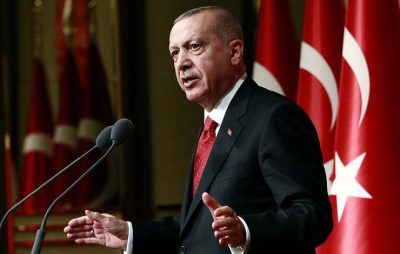
Like the US, Turkey’s Erdogan pursues interests at the expense of peace and stability.

He favors war for extending Turkey’s borders to further his neo-Ottoman aims.

He, his family members and regime profited earlier from stolen Syrian oil.

He gave ISIS and other terrorists safe haven in Turkish territory, providing them with weapons, other material support, and a launching pad for attacks on Syrian soldiers and civilians.

Turkey under Erdogan is a fascist police state — speech, media and academic freedoms they way they should be banned.

So is dissent. Anyone publicly criticizing or insulting him risks prosecution for terrorism, espionage or treason, including children.

As long as he doesn’t act against US interests, as a NATO member and in other ways, his tyrannical rule and regional destabilizing actions are tolerated — if only barely.

On Wednesday, his Vice President Fuat Oktay said Ankara is ready to send troops to back Azerbaijan’s war on Armenia in Nagorno-Karabakh (NK below).

In response to Turkey’s deployment of armed and directed jihadists to combat Armenian forces in NK, the country’s Prime Minister Nikol Pashinyan called on regional countries to unite against them and their Turkish paymaster.

“Regretably (they) have not responded to this reality seriously enough yet,” Pashinyan added.

“It is beyond doubt that the presence of foreign terrorists will pose a threat to the region in the future.”

“The region’s countries must deal with this issue more seriously.”

The Erdogan regime is also involved militarily in NK by providing Baku with command and control services, training of its military forces, and heavy weapons for warmaking.

He and hardliners surrounding him support war, not resolution in NK.

Pashinyan stressed it, saying “the Karabakh question…cannot have a diplomatic solution.”

“Everything that is diplomatically acceptable to the Armenian side…is not acceptable to Azerbaijan…”

Baku’s ruling authorities intend endless war until Armenian forces are driven from NK — no matter the human toll, according to comments from its leadership.Turkey’s Involvement in Nagorno-Karabakh

As Azeri forces advance, civilians in harm’s way are caught in the crossfire.

Unconfirmed reports suggest that they’ve taken control of areas bordering Iran and Armenia’s international border — increasing the risk of conflict spilling into both countries.

Armenia’s Defense Ministry spokesman Artsrun Hovhannisyan accused Azerbaijan of sending “small…subversive groups…into villages and towns, film(ing) themselves there, spread(ing) those images…to feed their society. But, unfortunately, this also affects us.”

While conflict continues, foreign ministers of both warring sides will meet with Trump regime’s Pompeo for talks in Washington on Friday.

Yet on Tuesday, Azeri President Ilham Aliyev said the following:

“We are fighting on our own land, giving martyrs and restoring our territorial integrity. These steps will continue to be taken.”

“Armenia must declare before it is too late that it is withdrawing from the occupied territories. After that the fighting may stop.”

From the above remarks and two failed Russian/Minsk Group arranged ceasefire, Aliyev is unwilling to compromise on his aims in NK.

With support from Turkey, including Erdogan’s willingness to send troops if asked, Aliyev rejects diplomacy while sending his foreign minister to discuss ceasefire with his Russian, French and US counterparts.

According to the Asia Times, Erdogan’s support for Azerbaijan is driven by energy interests in competition with Russia.

An unnamed Erdogan advisor said “Russia is neither an ally, nor an enemy, but we can’t negotiate if we are too dependent on them, especially when it comes to energy.”

“We have vital interests to protect,” including two pipelines from Azerbaijan to Europe, one for oil, the other for gas.

One runs close to NK, the other near northern Armenia, the unnamed advisor close to Erdogan adding:

“We can’t afford losing our sight on what’s going on around our pipelines in the Caucasus, especially in the Tavush region, where there have been several clashes (with Armenia) over the last years.”

The so-called BTC oil pipeline is owned by Azerbaijan, Turkey, and Britain’s BP.

The South Caucasus Pipeline runs from Azerbaijan’s Caspian Sea field to Turkey, and Georgia — soon as well to Italy, Greece and Bulgaria.

Earlier in October, Erdogan accused Armenia of endangering supplies of energy to Turkey and other European countries.

Oil and gas pipelines from Azerbaijan to Europe are only endangered by its preemptive war on Armenia in NK.

No danger would exist if conflict resolution ended weeks of fighting.

Russia also supplies gas to Turkey through Turkstream 1.

Turkstream 2 is under construction, completion expected around yearend.

Azerbaijan will compete with Russia for the European natural gas market.

Moscow prioritizes cooperation with other nations, confrontation with none.

Turkey’s Erdogan prioritizes the advancement of his neo-Ottoman interests.

*

Note to readers: please click the share buttons below. Forward this article to your email lists. Crosspost on your blog site, internet forums. etc.

Award-winning author Stephen Lendman lives in Chicago. He can be reached at lendmanstephen@sbcglobal.net. He is a Research Associate of the Centre for Research on Globalization (CRG)

His new book as editor and contributor is titled “Flashpoint in Ukraine: US Drive for Hegemony Risks WW III.”

http://www.claritypress.com/LendmanIII.html

Visit his blog site at sjlendman.blogspot.com.The original source of this article is Global ResearchCopyright © Stephen Lendman, Global Research, 2020

River to Sea Uprooted Palestinian   
The views expressed in this article are the sole responsibility of the author and do not necessarily reflect those of the Blog!

Thursday, 27 August 2020

FOURTH NIGHT OF VIOLENCE IN WISCONSIN, POLICE OFFICER WHO KILLED JACOB BLAKE IDENTIFIED

 South Front

27.08.2020 

Fourth Night Of Violence In Wisconsin, Police Officer Who Killed Jacob Blake Identified

On August 26th, residents took to the streets for a fourth night of violence-filled riots.

Authorities identified the police officer who shot Jacob Blake, whose killing led to the riots.

The Department of Justice also announced several other details, including that Blake had a knife and that officers first used a stun gun on him.

A video showing an alternative angle was also published online.

Video

According to the Department of Justice statement police officers attempted to arrest Jacob Blake, but without saying what the reason is.

Officers attempted to stun Blake, “however the taser was not successful in stopping” him, according to the statement.

The officer who shot Blake was identified as Rusten Sheskey, who has been with the Kenosha Police Department for seven years. He fired seven shots, and was the only officer to fire his weapon, the DOJ said.

According to the Wisconsin Department of Justice Division of Criminal Investigation, which is leading the probe into the incident, officers initially responded to the scene after a woman called to report that her boyfriend was at her home but “was not supposed to be” there.

On August 26th, at least three people were shot during the protests overnight in Kenosha, some 40 miles south of Milwaukee, and two of the victims died from their injuries, according to the Kenosha Police Department.

The third gunshot victim was taken to a hospital with “serious, but non-life-threatening injuries,” police said.

Due to the violence, US President Donald Trump and Wisconsin Governor Tony Evers mobilized additional members of the National Guard to Kenosha.

Cellphone video from the protest on August 25th protests showed a white man armed with what appeared to be a semiautomatic rifle running past police and being chased by demonstrators. The footage showed the man trip and fall and appear to open fire on demonstrators. He then is seen running away.

The alleged gunman surrendered himself to police in Antioch, Illinois, in the “pre-dawn hours” on August 26th.

He was identified as 17-year-old Kyle Rittenhouse and was arrested based on a warrant issued by Kenosha County authorities charging him with first-degree intentional homicide, police said.

He was also being held on a charge of “fugitive from justice,” for purposes of extradition to Wisconsin, at the Lake County Juvenile Detention Center in Vernon Hills, Illinois, authorities said.

Tony Evers gave a press conference calling on citizens to cease the violence.

Exactly two months earlier, on June 26th, US Senator Tim Carpenter was assaulted by protesters in Wisconsin for attempting to film them.

MORE ON THE TOPIC:


River to Sea Uprooted Palestinian   
The views expressed in this article are the sole responsibility of the author and do not necessarily reflect those of the Blog!

Monday, 24 August 2020

VIOLENCE AND INSANITY: UNITED STATES EVERYDAY LIFE IN 2020

 Violence And Insanity: United States Everyday Life In 2020

South Front

On August 21st, 31-year-old Trayford Pellerin, a black man, died after being shot 11 times by police officers in Lafayette, Louisiana.

Lafayette Police Department officers responded to a disturbance call, involving a man with a knife at a Shell gas station around 8 PM local time on August 21st.

When they tried to apprehend the suspect, identified as 31-year-old Trayford Pellerin, he allegedly ignored repeated orders to surrender as well as several taser shots fired at him.

He simply kept walking, with his back turned to police, while carrying a knife and attempted to enter the gas station’s store.

Around a dozen shots can be heard in the video above, sparking accusations of excessive use of force. Authorities argued that tasers were “ineffective” and failed to stop the suspect, and that he was still armed when he tried to enter the store with people inside.

On August 22nd, violent protests erupted in Lafayette. Protesters blocked traffic as they gathered on Moss Street in Lafayette near a police precinct to protest Pellerin’s death.

Police in riot gear gave a 10-minute warning before releasing flares and smoke canisters into the crowd of protesters, KATC reported.

Afterward, Interim Lafayette Police Chief Scott Morgan said that there were two groups of protesters – those who organized an event earlier in the day and those who he said “choose to be malicious.”

He said people blocked important roadways and started several fires in a grass area, and police observed some throwing fireworks into one of their buildings.

“Our intent is not going to be to just let people disrupt our town and put our citizens and our motorists and our neighborhood in danger. We’re going to use those resources that we have and those other agencies and we’re going to enforce these laws,” he said.

Lafayette Parish Sheriff Mark Garber issued a stern warning to “out-of-town agitators,” a trope sometimes used to try to undermine protest movements.

“If any out-of-town agitators are watching this, if anyone’s planning to enhance their techniques tomorrow or the next day, we are ready for you,” he said. “We are prepared. We will not willingly give up the city. You will have to go through every resource that I have and every resource that the police have in order to do harm to the citizens or to their property.”

“Once again, video footage has captured a horrific and deadly incident of police violence against a Black person who was brutally killed in front of our eyes,” Alanah Odoms Hebert, executive director of the ACLU of Louisiana, said in a statement.

Hebert said the shooting was an “inappropriate and excessive use of force” by the police.

“None of our communities are safe when the police can murder people with impunity or when routine encounters escalate into deadly shooting sprees,” Hebert said. “The ACLU of Louisiana will continue to demand justice for this brutal killing and push for reforms that will end the epidemic of police violence once and for all.”

Meanwhile, the trial against Derek Chauvin, who killed George Floyd on May 25th, is about to begin.

The police’s version of events is that George Floyd was intoxicated in some way, and that the use of force was needed. The general trend in cases such as this in the US when a police officer is accused of excessive brutality, is that the officer gets acquitted and it is done.

In other news of everyday American life, a black man from Bronx knocked the jaw out of a 17-year-old Pennsylvania park employee for asking him to wear a mask.

One of the BLM protesters hit a raccoon twice, then pulled out a baseball bat and beat him to death. The death of the raccoon was posted on social networks and was accompanied by an inscription that only white people care about the protection of animals.

Separately, a black man shot a 5-year-old white neighbor’s boy for driving his bicycle onto his lawn.

The news was not discussed in the American press, and if it was mentioned, instead of a photograph of the real killer, a photograph of his father was published.

News such as this are daily, this is currently considered “social activism” because it is being carried out by the correct group of people, otherwise, it would obviously be a crime.

Finally, Netflix has took it upon itself to also promote some questionable content.

For example, the French “coming-of-age comedy-drama film” Cuties. The main plot detail of the movie is pre-teenage girls twerking on camera. This is the synopsis of the film:

“Eleven-year-old immigrant girl Amy, originally hailing from Senegal, lives with her mother Mariam (Maïmouna Gueye) in one of Paris’s poorest neighbourhoods in an apartment along with her two younger brothers awaiting for her father to rejoin the family from Senegal. Things turn swiftly as Amy is fascinated by her disobedient neighbour Angelica’s twerking clique called Cuties, an adult-style dance troupe which has contrasting fortunes and characteristics to Mariam’s traditional customs, values and traditions.”

Another piece of content by Netflix is show AJ And the Queen, which features a 10-year-old transgender child, who fellow transgender actors joked about being a “top” or the person doing the penetrating in a homosexual relationship.

In the show, the child, who is the 10-year-old daughter of a drug-addicted prostitute, says she wants to be a boy “because people leave boys alone.” Netflix argued that the film was chosen by the fact that it received a prize at the festival Sundance, the founder of which, by coincidence, is also in prison for pedophilia.

Finally, the Democratic National Convention featured a convicted kidnapper and murderer – Donna Hylton.

On March 20, 1985, Donna Hylton and three female accomplices drugged and kidnapped 62-year-old Long Island real estate broker Thomas Vigliarolo at the behest of Louis Miranda, who thought Vigliarolo had cheated him out of $139,000 on a mutual con, in which the two allegedly sold shares in New York City condos and pocketed the money.

The kidnappers held Vigliarolo prisoner for 15–20 days. During that time, three men and four women, including Hylton, starved, burned, beat, sexually assaulted, raped, and tortured him. On April 5, 1985, with Hylton asleep in the next room, Vigliarolo died of asphyxiation. Three days later, his body was found locked in a trunk in a Manhattan apartment.

MORE ON THE TOPIC:


River to Sea Uprooted Palestinian   
The views expressed in this article are the sole responsibility of the author and do not necessarily reflect those of the Blog!

Friday, 26 June 2020

Bahrain: A Police State Built on Intimidation and Torture

Source
By Sondos al-Assad

Bahrain: A Police State Built on Intimidation and Torture

Welcome to Bahrain, the cemetery of the living, the home of chambers of death, the kingdom of widespread impunity, police brutality, extrajudicial killings and repression.
Welcome to Bahrain, where the most gruesome arts of torture are heinously and systematically practiced by the security services, including the use of electro-shock devices, forced standing techniques, suspension in painful positions [while handcuffed and exposed to extreme cold or hot temperature], medical negligence, beatings, threats of rape or murder and sexual abuse, etc. in order to inflict permanent suffering on the peaceful prisoners of conscience.
Indeed, little has been done to bring justice to those who perpetrated acts of violence and torture against peaceful demonstrators, despite the BICI’s recommendations to persecute those responsible for torture. The Bahrain Independent Commission of Inquiry [BICI] was established, in July 2011, allegedly charged with investigating allegations of human rights abuses in connection with the government’s suppression of pro-democracy demonstrations.
”All persons charged with offences involving political expression, not consisting of advocacy of violence, have their convictions reviewed and sentences commuted or, as the case may be, outstanding charges against them dropped,” the BICI’s report recommended.
The authorities; however, have spared no efforts to investigate and prosecute security personnel and high-ranking officials who have involved in or administrated torture. Those include, for instance, Prince Nasser bin Hamad Al Khalifa, Lt. Col. Mubarak Abdullah Bin Huwayl and Lt. Shaika Nura Al Khalifa, who were acquitted on all counts.
Prince Nasser, aka the Torture Prince of Bahrain, is the king’s son of the King, has tortured activists during the 2011 pro-democracy protests. Due to his immunity and the prevailing culture of impunity within the country, he has not been held accountable and continues to receive promotions and rewards rather than being imprisoned.
Bahrain’s security services have repeatedly resorted to torture for the apparent purpose of extracting confessions from human rights activists and political detainees. For instance, Maryam Al-Bardouli, Commander of the Isa Town Prison, has also assaulted many female political prisoners especial Zakia al Barbouri, the only remaining female prisoner of conscience.
Lawyer and legal adviser to SALAM human right organization Ibrahim Serhan recounts the severe torture he was subjected to in 2017, describing how he was stripped naked in front of other inmates as officials threatened to sexually torture him, a crime that frequently takes place during interrogation in Bahrain. This practice continues to take; however, many remain silent as they fear retribution or to be stigmatised.
Activists maintain that the international community and in particular the UK have played a central role in covering up torture in Bahrain. The University of Huddersfield, a UK-backed institution, enjoys a suspected multi-million-pound training contract with Bahrain’s Royal Academy of Policing, a notorious hub of torture

River to Sea Uprooted Palestinian   
The views expressed in this article are the sole responsibility of the author and do not necessarily reflect those of the Blog!

Monday, 22 June 2020

Protests And A Prognosis

 Posted by Lawrence Davidson


Author - American Herald Tribune
Part I—A Dangerous Dichotomy
If we go with the United States’ own picture of itself as a constitutional democracy that aims to guarantee citizens equal rights under law, how are we to interpret President Donald Trump’s reported desire to use ten thousand active duty troops to “dominate the streets” and quell largely peaceful protests against racist police behavior? A reasonable interpretation of President Trump’s attitude, and that of his supporters as well, is that they seek to prioritize the political and cultural desires of a largely racist subgroup of whites over the constitutional rights of citizens in general. This sets up a very dangerous dichotomy that constitutes a danger to the country’s democracy—at least as defined above.  
It should be kept in mind that the right-wing side of this dichotomy, and its challenge to a democracy based on a liberal interpretation of the Constitution has always been with us. Considering just the 20th and 21st centuries, figures such as Woodrow Wilson and his consistently racist use of power both prior to and during World War I; J. Edgar Hoover and his rights-defying use of the FBI; Joseph McCarthy and his pernicious use of anti-Communism; George W. Bush and his initiation of war on false premises; and now the clearly autocratic aspirations of Donald Trump. Such “leaders” have ruined countless lives while eroding the constitutional basis of equal rights.
Part II—The Bureaucratic Factor 
Why has the Constitution proven so fragile in this regard? One reason is the autocratic nature of bureaucracies. All these men wielded power through bureaucracies, and their power was magnified by such institutions. Bureaucracies are top-down affairs, and so those operating within them are expected to, and almost always do, follow the orders of their superiors. For instance, the President of the United States is also “Commander-in-Chief” of the armed forces—which in turn are themselves top-down bureaucracies. When, in early June, Commander-in-Chief Donald Trump demanded ten thousand active duty soldiers for deployment onto the streets of America, none of them could be expected to pull out a copy of the U.S. Constitution and fact-check the legitimacy of the orders issued. Nor were they expected to take seriously their induction oaths to “defend” the integrity of that same document. They were expected to readily follow their orders regardless of constitutional limits. Thus, all things being equal, President Trump should have gotten what he asked for. We are very fortunate that at that moment all things were not equal—a factor is to be considered below. 
If the regular army had hit the streets in June of 2020, they would have done so in order to suppress largely peaceful protests over the lack of equal rights and lack of legal treatment under the law. Indeed, in Washington, D.C.—the only place Trump’s order was partially followed—active-duty military police and the D.C. National Guard did act side-by-side against peacefully demonstrating citizens. Elsewhere, the National Guard called up by governors abetted the police in “riot control,” during which almost no distinction was made between looters and peaceful demonstrators. A few National Guard troops have subsequently expressed regrets over their participation.
The typical police force is also a bureaucracy with its own institutional culture that in many ways mimics the military. Most (there often proves to be a small number of exceptions) of those in the ranks are going to follow the orders of whomever they recognize as having authority. Quite frankly, there is a strong tendency over time for the police, particularly those assigned to minority neighborhoods, to forget all about the U.S. Constitution, its Bill of Rights, and other niceties of law, and slip into a fraternal (often white supremacist) culture which sets them apart from those they are “policing.” They are then easily used as an arm of establishment power. That certainly was the expectation of President Trump and many of the nation’s chiefs of police.  
Part III—All Was Not Equal
At this point we can ask, What were the demonstrators protesting? Specifically, thousands of citizens across the country were protesting the behavior of the police, who had long been brutalizing African American and other minority group citizens in the name of law enforcement. Most of the demonstrators understood their cause within the context of both human and U.S. Constitutional rights of citizens to live in a community where the law serves the cause of equitable justice. “No justice, no peace.”
The nation was fortunate that most of the protesters understood rights in this way. That understanding allowed them, in their great numbers (less a relatively small number of both black and white looters), to quite literally save American democracy. They did so by demanding that those who had authority confront one of the autocratic threats of our day—racist police forces, the brutality of which was captured repeatedly on video. The demonstrators used that evidence to force the issue, and this, in turn, caused the bureaucrats to eventually stop acting in a knee-jerk fashion. Thus, city councils, mayors, governors and even military officials had to choose between oppression (which included, in this case, following Trump’s order that they “dominate the streets) and the Constitution. Choosing oppression would have resulted in two things: erosion of the constitutionally sanctioned rule of law and the burning of cities across the land. No one, except perhaps Donald Trump and his white racist base, wanted either of those two consequences. So the notion that “without the right to protest, there can be no [liberal] democracy” was upheld, and that made the protesters “the nation’s true patriots.”
Part IV—Will the Changes Last?
According to a recent piece in the HuffPost, the demands of the protesters for a just and safe America are being heeded. As proof, the article notes the following:
—Police officers are being held accountable for brutal behavior.
—Some police departments are reforming police practices.
—Monuments to racist and hardline historical figures are coming down.
—Technology companies are halting cooperation with police departments when it comes to facial recognition techniques. 
—Finally, there has been a shift in public opinion: Americans “support the anti-racism protests by a 2 to 1 margin.”
 All this is for the better, but will it last? Barack Obama has compared the present protests to those of the civil rights movement of the 1950s and 1960s. He believes that they have brought about a similar “sea change” or profound transformation. Is that actually the case?
It should be recalled that the earlier civil rights protests led to a series of changes in law and, ultimately, the Civil Rights Act of 1964, that banned discrimination in the public realm. These changes smoothed the way for other legislation expanding rights to people with disabilities, to homosexuals, lesbians and transgender folks, and to others. However, and quite significantly, these events triggered a culture war that focused white resentment and resistance within conservative political and fundamentalist religious movements. Among their unofficial institutional allies were and are some of the nation’s police forces. The racism, now exhibited by today’s Republican Party and its leader, President Donald Trump, as well as modern episodes of police brutality toward African Americans, should be understood within the context of that on-going culture war.
Looking at things this way, we can ask if the progressive response to today’s protests is best described as a “sea change” or a continuing, albeit important, chapter in what is still a very long-term struggle? As one activist and organizer, Sajari Simmons, realizes this is certainly not the end of the struggle for justice. Referring to the protests, she noted that “This is not just it. This is just one component,” she said. “There’s a lot more that we can do to help impact and educate and support.”
Part V—Conclusion
The American political system is lobby based. If the average citizen is important, it is only to be rallied at election time. However, if they are organized into politically potent interest groups, those citizens can have a long-term impact. To ultimately win the culture war, today’s protesters must be somehow united into a standing movement capable of “educating and supporting” their cause at local, state and national levels over the long run. 
Lest we forget, the enemies of a liberal, non-discriminatory interpretation of the Constitution are still out there and they have power. President Trump and his minions are still in place, as are millions of racist voters. Their political power must be broken at the polls, in the courts, and through a multigenerational process of reeducation. In working toward these goals, demonstrations are necessary, but not sufficient. Without a competently led and lasting movement, police brutality will come back, and “ten thousand soldiers” might, someday, really “dominate the streets.”
About Lawrence Davidson
Lawrence Davidson is professor of history emeritus at West Chester University in Pennsylvania. He has been publishing his analyses of topics in U.S. domestic and foreign policy, international and humanitarian law and Israel/Zionist practices and policies since 2010.

River to Sea Uprooted Palestinian   
The views expressed in this article are the sole responsibility of the author and do not necessarily reflect those of the Blog!

Sunday, 21 June 2020

U.S. Supreme Court Reaffirms U.S. Police State


U.S. Supreme Court Reaffirms U.S. Police State
JUNE 20, 2020
by Eric Zuesse for The Saker Blog
On June 15th, the U.S. Supreme Court, with only the libertarian right-wing (basically anti-government) Clarence Thomas dissenting — reaffirmed that America’s law-enforcement officers have “qualified immunity” from prosecution when they do things such as to shoot an innocent person in his own yard whose unthreatening pet dog is seeking his protection from an officer who is trying to shoot it; or, as the libertarian lawyer Jay Schweikert put this matter: “the Supreme Court let stand an Eleventh Circuit decision granting immunity to a police officer who shot a ten-year-old child in the back of the knee, while repeatedly attempting to shoot a pet dog that wasn’t threatening anyone.” The officer was Deputy Sheriff Michael Vickers, of Coffee County, Georgia. He had been chasing a suspect, who happened to cross into the yard of Amy Corbitt, who at that time happened to be chatting with another adult, Damion Stewart. One of her children was referred to in the case as “SDC.” Here is how the lower court ruling stated the incident:
At some point after Vickers and the other officers entered Corbitt’s yard, the officers “demanded all persons in the area, including the children, to get down on the ground.” An officer handcuffed Stewart and placed a gun at his back. …  Then, “while the children were lying on the ground obeying [Vickers’s] orders … without necessity or any immediate threat or cause, [Vickers] discharged his firearm at the family pet named ‘Bruce’ twice.” The first shot missed, and Bruce (a dog) temporarily retreated under Corbitt’s home. No other efforts were made to restrain or subdue the dog, and no one appeared threatened by him. Eight or ten seconds after Vickers fired the first shot, the dog reappeared and was “approaching his owners,” when Vickers fired a second shot at the dog. This shot also missed the dog, but the bullet struck SDC in the back of his right knee. At the time of the shot, SDC was “readily viewable” and resting “approximately eighteen inches from Vickers, lying on the ground, face down, pursuant to the orders of [Vickers].” Barnett (the fleeing suspect) “was visibly unarmed and readily compliant” with officers. According to the complaint, “[a]t no time did SDC, or any other children … present any threat or danger to provoke … Vickers to fire two shots.” Importantly, the parties do not dispute that Vickers intended to shoot the dog and not SDC. Corbitt, individually and as SDC’s parent and guardian, brought a civil action against Vickers in his individual capacity pursuant to 42 U.S.C. § 1983. The complaint alleged deprivations of the right to be free from excessive force as guaranteed by the Fourth and Fourteenth Amendments to the United States Constitution. … In response, Vickers filed a motion to dismiss pursuant to Rule 12(b)(6). He asserted that he was entitled to qualified immunity because case law had not staked out a “bright line” indicating that the act of firing at the dog and unintentionally shooting SDC was unlawful.
The U.S. Supreme Court ruled for Deputy Sheriff Michael Vickers. The case against Vickers was one of many such, throughout the country, and the U.S. Supreme Court’s ruling dismissed all of them for the same reason. Here is how the Rutherford Institute, which backed all of these cases against the officers, phrased the officers’ argument in one of these cases:
Qualified immunity shielded the defendants’ actions from liability because Petitioner could not point to any factually identical case clearly establishing that law enforcement officials exceeded the scope of Petitioner’s consent to enter her home when they essentially destroyed her home. That reasoning sets an impossible standard. Because courts are free to advance to the ‘clearly established’ prong of the qualified immunity inquiry without first deciding threshold constitutional questions, it is unlikely that a body of case law with closely analogous factual circumstances will ever develop.
In other words: the U.S. Supreme Court ruled 8 to 1 that unless Congress will pass a new law which will specifically apply the 4th and the 14th Amendments so as to enable prosecution of law-enforcement officers who do the specific listed sorts of things that unequivocally are identified in those new statutes as being prohibited under those Amendments, America’s law-enforcement officers are free to continue doing these sorts of things and to avoid any sort of legal liability for having done them.
Attorney Schweikert headlined on June 15th “The Supreme Court’s Dereliction of Duty on Qualified Immunity”, and wrote about the Court’s ruling:
It’s impossible to know for sure what motivated the Court to deny all of these petitions. But one possibility is that the Justices were looking closely at developments in Congress — where members of both the House and the Senate have introduced bills that would abolish qualified immunity — and decided to duck the question, hoping to pressure Congress to fix the Court’s mess. It is certainly encouraging that so many legislators have finally turned their attention to qualified immunity. But the mere fact that Congress can fix this mess doesn’t absolve the Supreme Court of its obligation to fix what it broke — the Court conjured qualified immunity out of nothing in the first place, and the Justices had both the authority and responsibility to correct their own blunders, no matter what happens in the legislature.
Qualified immunity will go down in history as one of the Supreme Court’s most egregious, costly, and embarrassing mistakes. None of the Justices on the Court today were responsible for creating this doctrine, but they all had a responsibility to fix it — and except for Justice Thomas, they all shirked that responsibility. It is now all the more urgent that Congress move forward on this issue and ensure that all public officials — especially members of law enforcement — are held accountable for their misconduct.
However, Schweikert contradicts himself there, because he simultaneously acknowledges that qualified immunity was concocted by the Court and not imposed into the law by the Congress and signed into the law by the President. So, there is disingenousness in Schweikert’s proposed ‘solution’. An evil that is introduced by the U.S. Supreme Court cannot be eliminated by the U.S. Congress and a good President. Nor can it be eliminated by successfully going through the lengthy and arduous process of passing a new Amendment to the U.S. Constitution. No matter what types of actions by law-enforcement officers would be specifically listed in any such new law or new Constitutional Amendment, it would fail. An arbitrary, basically evil, U.S. Supreme Court will always be able to place its imprimatur upon and validate new rationalizations for the police-state that they have been constructing in this country, especially after 9/11. Congress and the President can’t fix this, they can’t fix a problem that they didn’t themselves create, but Congress and the President can condemn and shame the Court — which they never do. Better yet, they can impeach all of the sitting ‘Justices’ and replace them with decent people. But each of this Court’s members was placed there by the Congresses, and by the Presidents. It’s an extremely vicious circle, and no part of it can fix other parts of it.
This isn’t a failure ONLY by the U.S. Supreme Court. It is instead an expression of the American system as it now exists, and which failure renders the U.S. Constitution itself almost meaningless, especially as regards the rights of the people and the obligations of federal officials at all levels in the government. There is no accountability; there is only blame. And, as in any authoritarian system, all blame goes downward, and all praise goes upward. That’s the reality. The U.S. Constitution is by now just a string of words. America’s Founders are dead, gone, and no longer really even an influence. That’s the reality. Pretending otherwise won’t fix anything. Drastic changes are needed. And the American public has proven itself not up to the challenge, still refuses to face the reality. This is system-failure. And the public refuses to face it.
The corruption is beyond control, and the public ends up paying for all of it. People such as Amy Corbitt and her son “SBC” are mere collateral damages in such a system. The beneficiaries from the system run the system. The least that the public can do is to call it a “dictatorship” instead of a “democracy.” The most that the public can do is overthrow it and replace it with one that has the same Constitution and none of the existing case-law, and that adds a few Amendments, such as this. Also essential would be an entirely new and more rigorous methodology for interpreting the Constitution. There is no existing rigorous methodology for Constitutional interpretation. The present chaos in that regard is virtually inviting the degeneration and predominant corruption that currently exist. Especially after World War II, the U.S. Supreme Court has increasingly taken advantage of that chaos.
Currently, the phrase “American justice” is oxymoronic.
—————

River to Sea Uprooted Palestinian   
The views expressed in this article are the sole responsibility of the author and do not necessarily reflect those of the Blog!

Friday, 12 June 2020

The implications of declining U.S. leadership


June 5, 2020 – 20:14
The Trump administration’s ongoing policy of withdrawal from international institutions—including the 2015 Iran nuclear deal, the 2016 Paris Climate Change Accord, the Open Skies Treaty, and now the World Health Organization (WHO) in the middle of the greatest global health crisis—demonstrates the declining U.S. leadership ever since the post-World War II order was created.  This latest move is made at a time when the world relies heavily on the WHO’s leadership to steer the COVID-19 pandemic response.  
While as recently as two months ago praising China in the hope of salvaging bilateral trade ties between the two countries, Trump has now turned against China and the WHO.  The latter has been instrumental in managing and treating the worldwide spread of malaria, tuberculosis, SARS, HIV-AIDS, and other infectious and non-communicable diseases.  Trump’s recent announcement (May 29, 2020) to permanently end the U.S. contribution to the WHO, and even to withdraw U.S. membership, is yet another attempt to distract the public from his mishandling of the current coronavirus crisis—a move that will lead to further global U.S. isolation, ironically putting China in a much stronger position to influence that organization’s  policies.
      “Trump’s policies have been consistently unsuccessful both at home and abroad.”     
Over its more than seventy-year life, since its inception in 1948 within the UN framework, the WHO has had major achievements, such as eradicating smallpox, and failures, such as its sluggish reaction to the Ebola outbreak in 2014.  On balance, however, the World Health Organization’s raison d’être has never been called into question.  The significance of the organization will be amplified when and if a second wave of the coronavirus returns, again posing an existential threat to all the countries around the world.   Second waves have a history of striking back even harder than the initial outbreak, as was the case for the 1918 Spanish flue pandemic.
What does the U.S. withdrawal from this organization mean?  It means, among other things, that the United States is retreating from its global leadership role—morally and from the standpoint of its soft power.  On both accounts, the Trump administration’s unilateral approach has dramatically undercut the ability of the United States to influence the behavior of other states through the attractiveness of its culture and the persuasiveness of its policies.  The U.S. withdrawal from the WHO will further accelerate the ongoing decline in the perceived competence of the United States to effectively address new global challenges.  Most ominously, however, this development is likely to fuel a great-power discord between China and the United States, dehumanizing the former while damaging the long-term relationship between the two countries.
To fully understand the implication of the U.S. withdrawal from the WHO, one needs to note that the WHO relies on assessed and voluntary contributions from its member states.  In 2019, according to one study, the United States provided the WHO an estimated $419 million, representing roughly 15 percent of the World Health Organization’s total revenue over its current two-year budget period.  This move will most likely delay the discovery phase as well as clinical trials necessary to develop a global vaccine.  Perhaps, more importantly, this decision will weaken the effectiveness of the organization and the broader cooperation among countries to stem the spread of COVID-19 pandemic around the word.
“Instead of healing the wounds of racial and systemic discrimination and police brutality, Trump’s rhetoric, tweets, and public gestures have deepened the divides in an already polarized nation, significantly diminishing trust in his leadership skills and damaging his populist image beyond repair. “
Trump has ceaselessly harkened back to his outdated notions of building walls and imposing travel bans in pursuit of his populist policies at a time when the stakes have never been higher.  All of this flies in the face of the clear lesson to be learned from the COVID-19 crisis that the virus knows no boundaries and that walls and borders cannot separate one nation’s public health and safety from those of others.  Needless to say that a virus anywhere is potentially a virus everywhere in a world that has become increasingly globalized, hence the need for collaborative, multilateral governance.  Trump’s claim that virus is “going away very soon” runs counter to the growing spike in confirmed cases around the world.
Furthermore, Trump’s disregard for the detrimental effects of climate change, as well as his policies reversing pollution standards, have exacerbated the deleterious effects not only on environmental sustainability but also, more subtly, on human sustainability.  Earth scientists remind us that humans are altering the environment at a much quicker pace than at any other time in history, a fact that has contributed to the evolution, the mutation, and the spread of all types of viruses.  Human encroachment into animal habitats—consider, for example, how deforestation and forest degradation have contributed to global warming—has created further contact between humans and animals, rendering disease transmission more likely than ever before.At home, Trump’s mishandling of nationwide and global protests over the death of George Floyd—an African-American man who died at the hands of a white police officer while still in custody—was on vivid display on the Internet, as captured on several bystanders’ smartphones.  The incident has dramatically weakened Trump’s presidency, is likely to defang his entourage, and could possibly demoralize the riot police in the face of widespread national and global protests.  The nationwide and racially diverse protests, dominated by youth and vibrant civil society movements, have captured the world’s imagination, while posing the most serious challenge to the Trump administration.  Instead of healing the wounds of racial and systemic discrimination and police brutality, Trump’s rhetoric, tweets, and public gestures have deepened the divides in an already polarized nation, significantly diminishing trust in his leadership skills and damaging his populist image beyond repair.  The result has been obvious: Trump’s policies have been consistently unsuccessful both at home and abroad.        

Mahmood Monshipouri, Ph.D., is a professor of international relations at San Francisco State University and a lecturer at UC-Berkeley. He is the editor, most recently, of Why Human Rights Still Matter in Contemporary Global Affairs. (mmonship@sfsu.edu and mmonship@berkeley.edu) 

River to Sea Uprooted Palestinian   
The views expressed in this article are the sole responsibility of the author and do not necessarily reflect those of the Blog!