Showing posts with label Norway. Show all posts

Wednesday, 27 October 2021

Ambassadors “Persona Non-Grata”: Turkey’s National Interests, Foreign Policy or Political Considerations?

Source: Al Mayadeen

26 OCTOBER 2021

Ruqiya Anwar

Turkish businessman Kavala has been in prison for four years for his suspected role in the Gezi Park protests and his involvement in a failed coup attempt in 2016.


Osman Kavala

This research note discusses that the Turkish businessman Kavala has been in prison for four years for his suspected role in the Gezi Park protests and his involvement in a failed coup attempt in 2016. Kavala is one of Turkey’s most well-known civil society figures. Since the early 1980s, the billionaire has helped to establish multiple publishing enterprises in Turkey, and a decade later, he has supported numerous civil society organizations. 

Osman Kavala was one of Turkey’s most prominent activists. He has been held in pre-trial imprisonment in Silivri Prison since October 2017. Authorities in Turkey accuse him of initiating the Gezi Park demonstrations in 2013.

Significantly, President Erdogan has accused him of being the Turkish leg of billionaire US philanthropist George Soros, whom he claims is behind insurgencies in several nations. He has been held in detention pending the outcome of his latest trial, and he has rejected the charges. 

Whereas, the indictment of September 2020, according to Kavala’s lawyers, was nothing more than a presumed fantasy based on no real evidence. Human rights organizations around the world have slammed Kavala’s arrest, claiming the charges are politically motivated. Additionally, the European Court of Human Rights (ECHR) found that Kavala’s arrest was politically motivated and it was carried out with the goal of “bringing other human rights defenders, to the political prisoners.” (DW, 2021).

Following a similar line, the Council of Europe has given a warning to Turkey to comply with a European Court of Human Rights ruling to free Kavala pending trial, which was issued in 2019. Otherwise, it will file an infringement complaint against Turkey.

The ambassadors of the ten nations issued a unified statement urging Turkey to abide by the Council of Europe’s judgments. Germany, Canada, Denmark, Finland, France, the Netherlands, New Zealand, Norway, Sweden, and the United States all requested a “fair and swift” settlement to Kavala’s case (DW, 2021).

They further stressed, “The ongoing delays in Kaval’s trial, which include the merging of many cases and the establishment of new ones following a prior acquittal, throw a pall over Turkish court respect for democracy, the rule of law, and transparency. In light of the European Court of Human Rights’ judgment, they requested Turkey to release it as soon as possible. These ambassadors  demanded a fair and expeditious settlement to his case under Turkey’s international responsibilities and domestic legislation.”

Most importantly, Kavala who has been imprisoned since 2017, has been frequently demanded their release by international observers and human rights organizations. They claim that the detention is due to political concerns. While the officials deny the allegations and maintain that Turkish courts are independent.

While the Turkish government views the ambassadors’ declaration as direct involvement in domestic politics. Turkish President Recep Tayyip Erdogan condemned the diplomats’ behavior and threatened to expel them from the country. In an intensifying disagreement with the countries, who intervened in the case of a detained businessman by demanding his release.

After their statement demanding the release of Osman Kavala, President Erdogan authorized the Turkish foreign minister to proclaim the ambassadors of ten nations to Turkey “persona non grata”. Notably, when a diplomat is declared persona non grata, they are banned in their host country and they are now just one step away from expulsion.

In a speech, Erdogan remarked, “I have directed our foreign minister to expedite the declaration of these ten ambassadors,” These ten ambassadors must be declared persona non grata. They will be familiar with and understand Turkey”. He went on to say that these ambassadors would not release “terrorists” in their nations if they did not know and understand them (Arab News, 2021).

For this reason, tensions between Ankara and the United States, Canada, Germany, France, the Netherlands, Denmark, Sweden, Finland, Norway, and New Zealand soared over  Turkey’s president proclaimed the envoys “persona non grata.”

Moreover, the ambassadors had been instructed to “keep within the responsibilities of their duties after an insincere and double-standard approach and It was highlighted in our constitution that Turkey is a democratic state of law that protects human rights, and it was reminded that such reckless utterances would not affect the Turkish court”.

The government further noted that the European Court of Human Rights (ECtHR) judgments are frequently disregarded and not followed, claiming that focusing solely on Turkish cases to keep the Kavala case on the table at all times is ineffective (DW, 2021).

Whereas, former Turkish ambassador to Azerbaijan and senior fellow at the Carnegie Endowment in Washington, Alper Coskun, tweeted, “Expelling ambassadors is not a good strategy to protect national interests. Turkey’s isolation has been exacerbated by its rash foreign policy aimed at domestic politics” (Arab News, 2021).The opinions mentioned in this article do not necessarily reflect the opinion of Al mayadeen, but rather express the opinion of its writer exclusively.

Turkey’s Planned Expulsion Of 10 Western Ambassadors Is A Huge Diplomatic Move

25 OCTOBER 2021

By Andrew Korybko

American political analyst

Turkey

Simply denouncing them but declining to take any tangible action would have made President Erdogan look weak in everyone’s eyes unless they recanted their joint statement and apologized. He couldn’t afford to do that even though he must also have expected that Western pressure against him personally and his country more broadly will soon intensify as a result.

Turkish President Erdogan announced over the weekend that he instructed his Foreign Minister to declare 10 Western ambassadors persona non grata after they meddled in his country’s foreign affairs by releasing a joint statement demanding the release of a jailed businessman who they consider to be a “political prisoner”. This is a huge diplomatic move that will reverberate for some time to come. It shows that Turkey has zero tolerance for such high-profile foreign meddling and is ready to accept the potential political consequences for expelling the Canadian, Danish, Dutch, Finish, French, German, New Zealander, Norwegian, Swedish, and US Ambassadors.

Those diplomats must have predicted that the Turkish President would react in a similar way to how he ultimately did. This implies that they planned their joint statement as a political provocation intended to catalyze a self-sustaining cycle of escalations between their countries and Turkey. The purpose of doing so is to prompt the pretext for intensifying their information warfare against him and potentially threatening sanctions, whether on that basis or a different one.

Those diplomats’ countries probably also wanted to manipulate their people’s perceptions about Turkey by making it seem like it’s “anti-Western” and “despotic”. The planned expulsion of so many ambassadors of such influential countries will certainly provoke a diplomatic crisis. It’ll likely generate incredibly hostile coverage by the Western Mainstream Media too. In other words, all of this is part of the US-led Hybrid War on Turkey which aims to punish the country for its increasingly independent foreign policy in recent years.

From the Turkish perspective, it’s unacceptable to let those diplomats meddle in such a blatant way, especially regarding a jailed figure who they consider to be a “political prisoner”. Simply denouncing them but declining to take any tangible action would have made President Erdogan look weak in everyone’s eyes unless they recanted their joint statement and apologized. He couldn’t afford to do that even though he must also have expected that Western pressure against him personally and his country more broadly will soon intensify as a result.

From a larger viewpoint, Turkey is setting an example for other non-Western nations to follow. Not all of them are as confident as that country is nor might they have the “Democratic Security” capabilities to adequately defend themselves from the predicted intensification of US-led Hybrid Wars against them under such pretexts, but they might still be inspired by this huge diplomatic move. After all, a pivotal pillar of Turkish foreign policy is to present itself as a model for others to emulate, especially in the Global South and most recently in Africa.

Looking forward, Turkish-Western relations will likely continue to deteriorate. There’s a chance that the ambassadors who Turkey plans to expel might eventually return or be replaced after some time, but that probably won’t happen in the near future if the country does indeed go through with what its leader just threatened. The overall impact of this trend will be to accelerate Turkey’s proactive engagement with its new non-Western partners, with a priority given to Russia and China.

That development could be manipulated through information warfare means to reinforce the false narrative that Turkey is “anti-Western” even though it would just be pragmatically reacting to Western political provocations. Nevertheless, closer Turkish ties with Russia and China could fuel the intensification of the US-led Hybrid War against it through geopolitical fearmongering about that country’s grand strategic intentions. For this reason, Ankara must brace itself for myriad destabilization attempts ahead of the summer 2023 elections.

It’s impossible to predict the exact forms that they could take at this moment, but they’ll likely be comprehensive and thus involve economic, information, political, and perhaps even security plots. President Erdogan is increasingly portrayed by the Western Mainstream Media as a so-called “rogue” leader, the misleading perception of which will be exploited to intensify the US-led Hybrid War. He’s unlikely to capitulate to their political demands related to his foreign policy but he’s likely still interested in bargaining with them.

Related Videos


River to Sea Uprooted Palestinian   
The views expressed in this article are the sole responsibility of the author and do not necessarily reflect those of the Blog!

Thursday, 7 October 2021

A COLD, COLD WINTER IS COMING TO EUROPE (AND THE WORLD)

06.10.2021

South Front


A Cold, Cold Winter Is Coming To Europe (And The World)

The current situation in the energy market is quite worrisome. Europe is taking the brunt of it, and is concerned that a long and cold winter could send it off the edge into an economic crisis, as natural gas prices are soaring to never-before-seen heights.

The Asian market, which is the largest in the world is also in a tattered state, with China already feeling the consequences of reducing dependency on coal and lack of energy resources.

This all is a result of several factors that have led to the present reality of events and the exacerbating situation.

The spot price for natural gas continues breaking records, by reaching $1,600 per 1,000 cubic meters before dropping back to $1,400 on October 6th.

Spot is initially a high-risk market; it is based on the sellers of the product that create an artificial surplus or lack of said product. If the product was deficient by definition, for example there’s not enough of it to begin with, then buyers could potentially control the market, but this is a different story.

Furthermore, gas prices are much less controlled compared to oil prices, which fluctuated rapidly in 2020. Various energy resources’ prices depend on their own specifics, but it is an obvious fact that these prices connected.

The market is concerned about energy supply this winter and shrugged off October 4th’s news from Nord Stream 2 AG, the operator of the controversial Russia-led gas pipeline, which started filling the first string of the pipeline with gas to get ready for the moment that German authorities grant it an operational license.

While gas prices are soaring, US oil prices rose for the fifth day in a row to levels not seen since 2014, amid global concerns about energy supply due to signs of tension in the oil, natural gas and coal markets.

Brent prices also rose due to concerns about supplies, especially after OPEC+ decided to stick to the planned increase in production. To put it simply, there might be an artificial deficiency which causes an increase in price.

Following a short meeting on October 4th, the OPEC+ ministers approved an increase in production by 400 thousand barrels per day in November, after which the price of oil on the New York Stock Exchange reached its highest in almost seven years. On the eve of the talks, speculation spread that the cartel and its allies could increase production by 800 thousand barrels per day in November, but, according to delegates, such a proposal was not announced.

According to Amrita Sen, a leading oil analyst and co-founder of Energy Aspects, Saudi Arabia seeks to make as few changes as possible to the current OPEC+ agreement on monthly production increases.

Instead of pushing for increased production and lowered prices, the United States appeared satisfied with Riyadh’s plan and hasn’t exerted any political pressure to change the situation.

The American Petroleum Institute reported that oil reserves in the United States increased by 951 thousand barrels in the week of October 1st.

Despite increasing prices, the United States is increasing its reserves in the face of the potential increase in prices even further.

The biggest “victim” is the European consumer.

Europe is already feeling the pressure, as natural gas is incredibly important to industry, increasing oil prices complicate the situation even further.

Not only does industry need to use a lot of natural gas, but some part of it also needs to be distributed to households, and the colder the weather gets, the more gas is required. Civilian infrastructure, as well as households needing increasing amounts of natural gas led to a higher deficiency in industry, which could itself lead to an increase in the price of various products, as well as many businesses straight up closing.

Northern Europe is already feeling the strain, as the depletion of reservoirs hinders the production of hydroelectric power.

The water level in Norwegian hydroelectric power plants for this time of year is at a minimum level. This is a concern just a few weeks before the reduction of reservoirs in late autumn. There is not enough water for export to the continent and to the UK.

Ireland and the UK are the hardest hit by the global gas shortage and are experiencing a shortage of electricity.

In Asia, which is the trade center of LNG, the situation is also quite difficult.

LNG-AS spot prices reached a record high, approximately 100% higher than one month ago, and 500% higher year over year.

A standard LNG cargo of 3.4 trillion BTU (British Thermal Units) now costs $100-120 million, while at the end of February its cost was less than $20 million.

It is not clear if any buyer is capable of actually paying for the LNG they’ve bought, as such sellers are requesting letters of credit, guaranteeing that there will be solvency when the time to pay comes.

India following China is on the verge of an energy crisis as coal reserves have reached a critical level.

According to the Ministry of Energy of India, 135 thermal power plants in the country on average had coal reserves for only four days. The shortage of electricity has already begun to affect the economy of neighboring China, where last month the manufacturing sector experienced the first decline in indicators since the beginning of the pandemic.

What could be the reason for all of this?

Notably, the renewable energy agenda, launched in the early 2000s in conjunction with the shale production program in the United States.

Both of these were ways in which the West reduced its energy dependence on exports.

It was necessary to minimize the impact of the inevitable price spike by the time the global gas market was created.

Each acceleration of new mining projects was accompanied by an increase in prices, which provided an investment flow into more expensive production.

However, the renewable energy program structurally failed. To put it simply: the United States’ ambition fell apart, as the largest gas resources are located in Russia and Iran, and both are countries that Washington has little, if any, influence over. Qatar and Australia are not enough to turn the tide.

In this strategy of reducing energy dependence at the time of the formation of the global gas market, Europe relied on renewable energy, and the United States – on shale.

The share of renewable energy in the total energy balance of the USA does not exceed 8%, in Europe it is approximately 20%, and globally it sits around 5%, in the area of statistical mistake.

In accordance with the shares of renewable energy, we are seeing a gas price boom today. The United States, with the help of shale, forced not only OPEC and Russia, but also Europe and Japan to pay for the new market structure. It’s just like in 1973, when the spot-exchange oil market was created.

The current natural gas market is in shambles, as it suffered a terrible combination of circumstances.

Fuel reserves in Europe were reduced in the face of the very real possibility of a prolonged winter, a decrease in supplies from Russia and an increase in demand for LNG in Asia, which prevented the restoration of reserves in the summer.

This was joined by a decline in production in the North Sea, due to a maintenance that was delayed because of the pandemic.

This is all exacerbated by the hasty transition towards renewable energy sources without the necessary technology to adequately do so.

A surprising factor is also the fact that prices were also affected by a decrease in the average wind speed to the lowest since the 1960s, interruptions in the operation of nuclear power plants and a fire on an underwater power cable connecting the UK and France.

To put it in simple terms, the “Green Deal” is motivated not by a scientific or economic approach, but by populism aimed at voters: pseudo-leftists and neo-liberals.

This is in addition to the hesitancy of multi-national corporations to invest in infrastructure, fixed assets and production. It is much more preferable to fix the profit margin and distribute funds among shareholders and management.

Finally, Hurricane Ida was a sort of jump-start of the energy crisis, as it led to the shutdown of production of massive amounts of energy in the Gulf of Mexico.

According to the U.S. Bureau of Safety and Environmental Protection, as of September 12th, 48.6% of oil production and 54.4% of gas production in the Gulf of Mexico were still stopped.

Due to the hurricane, more than 40 million barrels of refined fuel were lost and slightly fewer were lost in blocked production.

Exporters were forced to redistribute trade flows around the Atlantic and America to ensure supplies.

All of these factors combined are promising a very cold winter, and a very bleak, and extremely expensive future, compared to which the 2008 financial crisis may seem like a minor inconvenience.

As a consequence, industry will suffer, but the final consumer will suffer the most.

The rise in gas and electricity prices in Europe sends a powerful signal to manufacturers to consider temporarily closing factories, and to owners of homes and offices to turn off thermostats to prevent stocks from falling to a critical minimum and depletion of fuel reserves this winter.

For manufacturers, a short-term closure has a double benefit: a reduction in electricity costs, as well as an increase in prices for their products, which helps protect profits from rising electricity and gas prices. Still, a balance needs to be found as a business cannot remain closed indefinitely.

After a sufficient number of reliable plant closures and other energy-saving measures are announced, futures prices are likely to decline, as there will not be enough buyers, regardless of the price.

The supply chain will be disrupted if factories close, and this brings along its own set of problems.

If the upcoming winter does not turn out to be mild, rising prices and physical shortages of gas, coal and electricity are unlikely to remain limited to energy markets, and this will affect the rest of the economy, as is already happening in China.

Separately, this is a wake-up call that climate change is rapidly turning into a direct factor influencing asset allocation decisions for investors. It used to be a fringe possibility, somewhere in the background.

Investors can no longer afford to ignore the disasters befalling the world, because all of these result in rising prices for natural gas and other commodities.

The centralized EU policy to achieve zero emissions by 2050, significantly aggravated and accelerated the development of the crisis. It promises to become even worse as Germany promises to close down nuclear power plants by the end of 2021. Berling stop supplying electricity to the very European networks that have taken the brunt of the crisis. The resulting gap will be felt by the whole of Europe.

MORE ON THE TOPIC:


River to Sea Uprooted Palestinian   
The views expressed in this article are the sole responsibility of the author and do not necessarily reflect those of the Blog!

Saturday, 14 August 2021

The Nobel Foundation Must Act Against The Power of the Norwegian Parliament

August 13, 2021  
About me
Lawrence Davidson is a retired professor of history from West Chester University in West Chester PA. His academic research focused on the history of American foreign relations with the Middle East. He taught courses in Middle East history, the history of science and modern European intellectual history.

Source

Posted by Lawrence Davidson 

The essay appearing below is posted here as a companion piece to Lawrence Davidson’s analysis, dated 16 September 2019, entitled “The Sorry State of the Nobel Peace Prize.”

“The Nobel Foundation must act against the power of the Stortinget (Parliament) over the Peace Prize” (22 July 2021) by Fredrik S Heffermehl

Argument: The Peace Prize must be awarded in accordance with the inventor Alfred Nobel’s will. In this context, the Swedish Nobel Foundation is superior to the Norwegian Parliament (Stortinget), and must therefore act to ensure that the Peace Prize in future goes to people who actively work for disarmament. 

Again, there is wrangling/tussle/strife around the Nobel Peace Prize. Now about money. The Norwegian committee for the peace prize is housed in a beautiful historic building in Oslo that is so expensive to maintain that the Nobel Foundation plans to sell it. This would be a great loss and the Norwegian committee has called on the Parliament of Norway, to pick up the bill and claims that the independence of the prize will not be harmed.

But it’s not at all that simple. According to my studies, the Stortinget’s relationship to the Peace Prize is a dark story of fraud. The award was never independent of the Stortinget. An annual appropriation would increase dependence.

As always, the starting point should be Alfred Nobel’s intention with the prize. The new CEO of the Nobel Foundation, the Norwegian lawyer Vidar Helgesen, emphasized in a recent radio interview the essence of all Nobel prizes: Alfred Nobel wished to change the world. In the nuclear age ending all wars is more imperative than ever, but how well does the Nobel Foundation maintain this essence of inventor Nobel peace vision?

He wanted to end all wars through global cooperation and disarmament based on international law. The core of the inventor’s peace innovation, global demilitarization, is explicitly mentioned in the will.

In his will Nobel entrusted Stortinget with appointing a committee of five, the Norwegian Nobel Committee, supposed to use the annual election of prize winners to promote the Nobel vision of how to create peace. But that never happened. The Peace Prize has been awarded in all directions and has become a general prize for goodness without a distinct idea or clear goals. The Stortinget should have appointed supporters of Nobel’s peace idea to committee members, but has instead chosen its own and used the prize for its own purposes.

That is a main conclusion in my recent book “Behind the medals”. The most obvious measure to fulfill Nobel’s last will would be to examine what his will really was and then

make it widely known. Instead, the leadership of the Stortinget decided in 1897 to quietly ignore the clear words of the will about the reduction or abolition of the military.

The will was put aside and never interpreted professionally. Instead, the Nobel Committee interpreted its own, self-chosen and diffuse concepts, such as “peace” and “peace work”, and took with it in practice freedom to do as it wished with the prize.

As a result the award never actively promoted the Nobel idea. Even if using entrusted funds for one’s own purposes must legally be regarded as embezzlement or infidelity to the testator, this has continued since I discovered, 15 years ago, that Nobel’s original intention with the prize had been ignored. Lawmakers violating the laws and refusing to adhere to criticism is a legal and democratic problem.

While working on the book, I gained access to the Nobel Committee’s internal archives – except the last 50 years that remain off-limits/secret. I have reviewed all 131 Peace Prizes over 120 years (1901–2020). My conclusion is that only 25 percent of them fulfill the purpose. The most interesting result of my review, however, was to get a picture of those who should have won, what the prize should have been, what it could have done for world peace if Nobel´s visionary idea had been respected.

The internal reports the committee received about the candidates reveal disdain and outright contempt for the idea and the people that Nobel intended his prize to support. I found 114 of them hidden/tucked away and forgotten in the Nobel Archives. Taken together these people are/constitute an important history of ideas. The sad fact is that the people Nobel wanted to support have throughout the years been ignored and suppressed by all of society, including the Norwegian Nobel Committee.

How could this happen? During the first ten years after Nobel’s death in 1896, the wish to be free from the union with Sweden dominated Norwegian politics. As King Oscar feared, the Peace Prize became a tool in the Norwegian freedom struggle. This caused permanent damage, Norwegian politicians got used to seeing the prize as their own. They elected themselves to the coveted committee seats. The committee was composed of members of the Stortinget and the government. In reality they developed an entirely Norwegian Peace Prize in the name of Nobel.

The first chairman of the committee in 1897 was a well-known lawyer who emphasized the importance of independence and distance from the Storting. He died in 1901 and was succeeded by Jørgen Løvland, leader of the Norwegian independence struggle, who wanted to link the peace prize as closely as possible to the Stortinget. He used the staff of the Nobel Institute in the struggle for national independence. When independence was won in 1905, the Nobel chairperson was also the Minister of Foreign Affairs. In the first ten months the ministry had no employees and the Nobel Institute functioned as Norway’s Ministry of Foreign Affairs.

The Norwegian committee has never followed up on its main task: to promote the Nobel Prize for a geopolitical U-turn and universal cooperation on global peace. The prize, inspired by Bertha von Suttner’s novel “Down with the Weapons!” (1889), should have been called the Nobel Disarmament Prize. Only twice has the Committee stated the true purpose of the prize: in the speech for Bertha von Suttner as prize winner in 1905 and for the International Peace Bureau in 1910. The Norwegian administrators of the Nobel Prize are willing to discuss economic issues and everything else, except my analysis of Nobel’s intention. Such criticism is taboo and has been ignored.

Last year, the situation became really untenable. The entire Stortinget, with the exception of two members, voted against taking the Nobel will into account. Doing so, the Stortinget openly took over and rejected serving the inventor’s own idea. This is an open mutiny that forces the Nobel Foundation to intervene. As manager of Nobel’s bequeathed money the foundation bears superior responsibility for implementing Nobel’s intentions. It cannot accept a subcommittee that ignores the idea of the prize.

In an investigation of the Peace Prize in 2012, the County Administrative Board of Stockholm, which is the supervisory authority for foundations, stated that both the Norwegian Parliament and Nobel Committee are sub-bodies of the Nobel Foundation. The public supervisory board decided that the Nobel Foundation is obliged to examine Nobel´s intention with the peace prize, give the necessary instructions to the Norwegian bodies, and check that their decisions serve the purpose of the prize.

The truth is that the Storting stole the Nobel Peace Prize as early as in 1897. Norwegian society keeps totally silent about this. My criticism of the prize is extremely unpopular in Norway, but for me the world and peace have to be more important. As we face the threats of global warming, mega-fires, sea level rise, pandemics, famine, refugee flows, we are all in the same very unsafe boat and simply have to co-operate for our common survival. All countries must stand together or we shall all perish. We cannot afford the continuing military arms races that only increase the risk of us being annihilated. To break the vicious circle of militarism, the world needs Nobel’s visionary idea of world peace through cooperation. The Nobel Foundation took responsibility when, in 2017, the Board, building on my legal advice, intervened against the administrators of the literature prize. The Storting’s mutiny against Nobel is much more serious. According to the law, the Nobel Foundation has an obligation to act against the Stortinget, which in this context – unbelievably – is a body subordinate to the board of a private Swedish foundation. By law the Board of the Nobel Foundation has the right and obligation to instruct the Stortinget. The important thing now is not to increase financial dependence on the Stortinget. Instead the Foundation has to intervene and demand that the Stortinget as soon as possible appoints a prize committee that will loyally promote the peace vision of Nobel – or find other ways to ensure that the Nobel Peace Vision is realized.

Fredrik S Heffermehl is a lawyer and author, editor of nobelwill.orghttps://www.dn.se/debatt/nobelstiftelsen-maste-agera-mot-stortingets-makt-over-fredspriset


River to Sea Uprooted Palestinian   
The views expressed in this article are the sole responsibility of the author and do not necessarily reflect those of the Blog!

Saturday, 16 January 2021

Fearmongering?! Norway Links 13 Deaths to Pfizer Vaccine

 Fearmongering?! Norway Links 13 Deaths to Pfizer Vaccine

By Staff, Agencies 

Inoculation with the Pfizer/BioNTech vaccine began four days before New Year’s Eve in Norway. Since Svein Andersen [67] at the Ellingsrudhjemmet elderly home became the first Norwegian to take the jab, over 33,000 Norwegians have received the vaccine in the subsequent weeks.

It was announced in advance that the vaccine may cause side effects of varying severity, and now the Norwegian Medicines Agency has mapped which ones have occurred in the country. A total of 29 side effects were reported, yet with an alarming share of deaths.

“Of these, there are 13 deaths, nine serious side effects and seven less serious side effects”, medical director of the Norwegian Medicines Agency Steinar Madsen told national broadcaster NRK.

A total of 23 deaths have been reported by the Norwegian Medicines Agency in connection with the vaccination. However, only 13 of these have been assessed so far.

All the surveyed deaths have occurred among frail, elderly patients in nursing homes. All of the dead are over 80 years old and some of them are even over 90.

“It seems that some of these patients get such severe side effects in the form of fever and malaise that it can lead to a very serious illness even, an more serious one, which may lead to death”, Madsen said.

At the same time, Madsen emphasised that these cases are rare and that many thousands of frail people have been vaccinated without a fatal outcome. “Frail” means patients with advanced heart conditions, dementia, chronic obstructive pulmonary disease and other serious diseases.

Madsen said his authority is not worried about the extent of side effects confirmed so far.

“We are not alarmed by this. It is quite clear that these vaccines have very little risk, with a small exception for the most frail patients”, Madsen said.

The nine patients who have had serious side effects complained of allergic reactions, strong malaise and severe fever. The seven less serious side effects included severe pain at the injection site.

Still, the Norwegian Medicines Agency cautioned the authorities to carefully consider the order of vaccination.

“Doctors must now carefully consider who should be vaccinated. Those who are very frail and at the very end of life can be vaccinated after an individual assessment”, Madsen said.

This is in line with the recommendations realeased by the Norwegian Institute of Public Health earlier this week.

Previously, six people died during the Pfizer/BioNTech vaccine trials, but only two of them were actually given the vaccine. The other four were given a safe placebo solution of salt and water.

Norway has seen over 57,000 cases of COVID-19 and over 500 deaths.

River to Sea Uprooted Palestinian   
The views expressed in this article are the sole responsibility of the author and do not necessarily reflect those of the Blog!

Tuesday, 28 April 2020

Corona Crisis: a Viral Episode or a Half-Life Nightmare*

 BY GILAD ATZMON


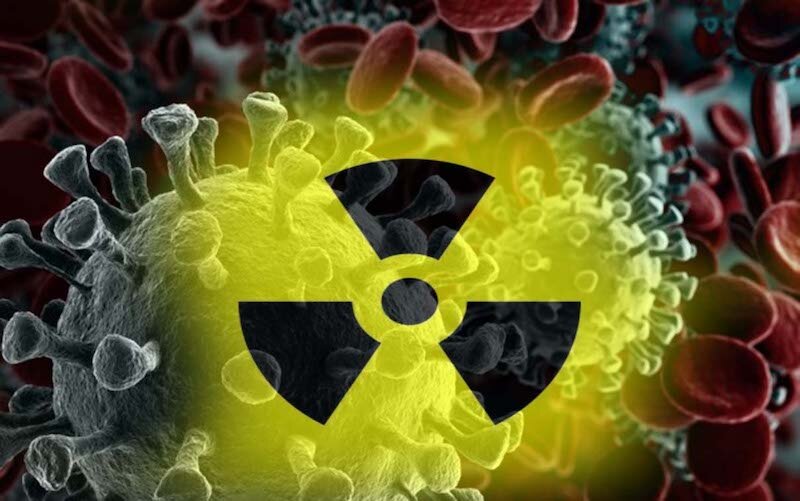
radioctive CV19.jpg

By Gilad Atzmon

Herd Immunity Ratio
As an intellectual exercise let’s think of an imaginary state, “State A.” Our fictional State A is devastated that 100 of its citizens are infected with Covid-19. For this exercise, we accept that these 100 citizens are representative of State A‘s demography, classes, ethnicities and so on. Apparently, State A’s nightmare is just the beginning because out of its 100 Covid-19 carriers, not one survives the next three weeks.
Let’s now imagine another case, we will call “State B.” State B is similar to state A in terms of its size, population, geography, climate, culture, ethnicity, nutrition, etc. In State B 100 citizens also tested positive for Covid-19. Following the experience of State A, State B braces itself for the possibility that all its infected citizens may perish but then for reasons that are not yet clear to us, no one in state B dies. And if this is not different enough, hardly any of the 100 develop any symptoms.
The crude difference between State A and B may tell us something about the herd immunity in States A and B. It is easy to detect that the ratio created by the number of fatalities (F) divided by the number of those infected (I) is an indication of the level of immunity or ‘herd immunity’ in a given region or a state.
State A: F/I = 100/100=1
State B: F/I = 0/100=0
State A’s immunity ratio equals 1. This means that anyone who contracts the virus in State A will likely die. In state B, on the other hand, one is likely to survive the virus. In fact, they may, without knowing it, have already survived.
But let us now consider some more realistic cases. In “State C,” again, a state similar to A and B, out of 100 who tested Covid-19 positive, 10 people died within the next few weeks.
State C: F/I=10/100=0.1
The herd immunity ratio in State C is 0.1. In terms of herd immunity, State C is far better off than State A as a virally infected subject may benefit from a 0.9 chance to survive. But State C’s situation is not as good as in State B where no one is expected to die as the F/I ratio in State B is O. We can see that the smaller the F/I ratio is, the greater is the herd immunity in a given state or a region.
But let us look at another realistic case. In “State D” out of 100 patients only 1 died within a few weeks.
State D: F/I=1/100=0.01.
This means that in State D the herd immunity is close to perfect. Someone who contracts the Covid-19 virus has only a remote chance that he will lose his life. In other words, the survival rate is 0.99
State C and D are not completely imaginary cases. The F/I ratio in State C is a good representation of the numbers we saw in Northern Italy, NYC, Spain, UK and other vulnerable regions that have suffered heavily in the last few weeks. The ratio in State D is very similar to South Korea and Israel. Though many people are identified with Covid-19 in these two states alone, very few have died.
Such a methodical search for herd immunity ratio may help to identify the survival rate in different states, regions and cities. It may help us to determine policy; to decide who, what and how to lockdown or maybe not to lockdown at all. It can also help to locate the origin and the spreaders of the disease as we have a good reason to believe that the regions with the most immunity to a given viral infection have likely experienced the disease in the past and have developed some form of resistance.
In reality, this model is problematic for many reasons and can hardly be applied. As things stand (in reality), we are comparing data that was collected under different circumstances and using various procedures designed with completely different strategies and philosophies. Both Israel and South Korea, for instance, conducted testing on mass scale and hence, identified many more carriers. More crucially both Israel and S. Korea made a huge effort to identify super spreaders and applied strict isolation measures to those spreaders and those who were infected by them. Britain, USA and Italy on the other hand conducted limited testing and have generally tested those who developed symptoms or were suspected of being infected.


Dr. Erickson COVID-19 Briefing – “millions of cases, small amount of death, millions of cases, small amount of death..”
But there is a far greater problem with the above herd immunity ratio model. It assumes that we know what we are dealing with i.e., an infectious viral situation, while the evidence may point otherwise.

The Radioactive Clock
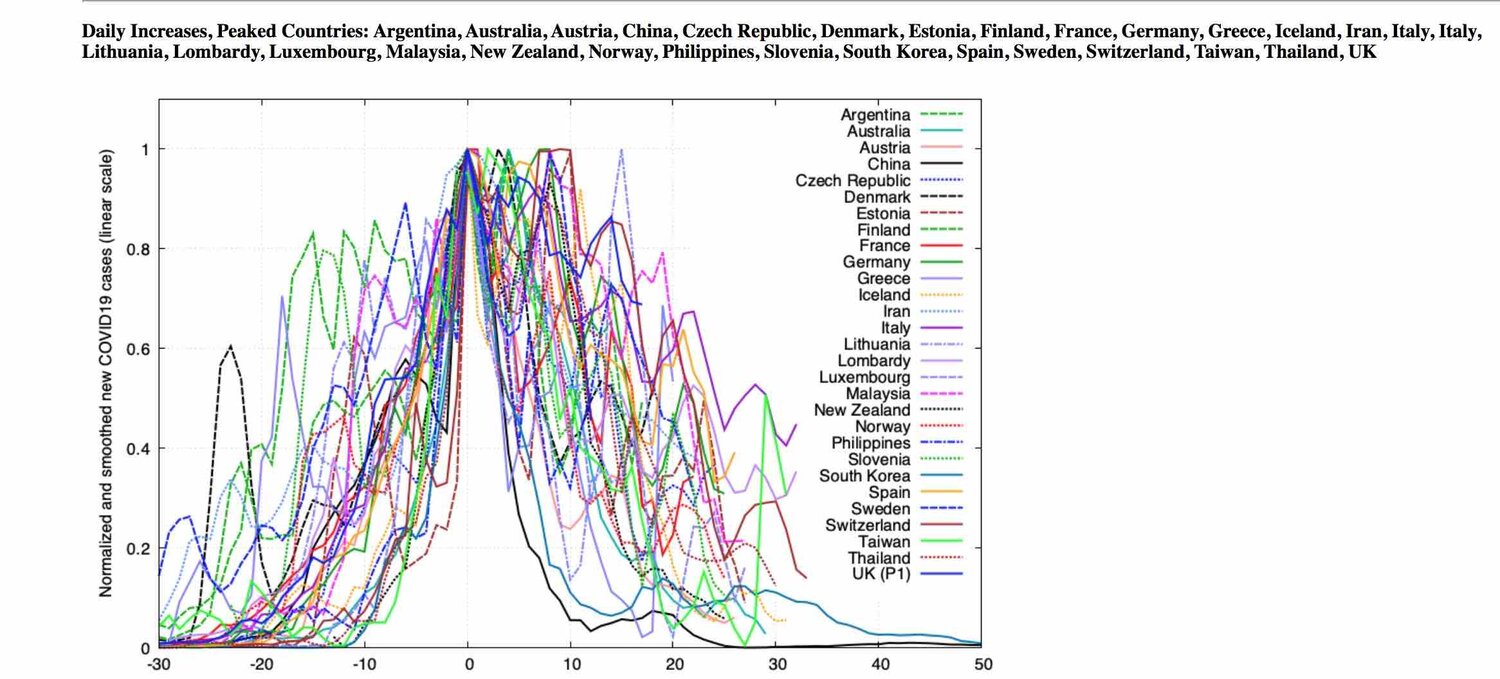
It has become clear that the health crisis we are facing isn’t consistent with anything we are familiar with. Those who predicted a colossally genocidal plague weren’t necessarily stupid or duplicitous. They assumed that they knew the root cause of the current crisis. They applied recognized models and algorithms associated with viral pandemics. They ended up eating their words, not because their models were wrong but because they applied their models to the wrong event. While no one can deny the alarming exponential growth of the disease, it is the unusual ‘premature’ curve-flattening point and then the rapid decline of infections which no one explained. In fact, some still prefer to deny it.
Many of us remember that our so-called ‘experts’ initially tended to accuse China of ‘hiding the real figures’ as no one could believe that the virus, all of a sudden, pretty much ran out of steam. Some also claimed that Iran was faking its figures to make its regime look better. Then came South Korea and the scientific community started to admit that despite its initial rapid exponential growth, for an unexplained reason, the ‘virus’ seems to run out of energy in an unpredictable fashion: the curve straightens out almost abruptly and starts to drop soon after, almost literally disappearing to the point where even a country as enormous as China passes days without diagnosing a single new Covid-19 carrier.


When Italy experienced its Corona carnage, every health ‘expert’ predicted that when the ‘virus’ slipped out of the rich Lombardy region and made it to the poor south, we would see real genocide. That didn’t happen.
Rarely we see scientists sticking their necks out telling the truth. This interview with Swedish Prof. Johan Giesecke is a must watch!
We have also started to notice that lockdowns have not necessarily saved the situation and that adopting relatively light ‘lockdown’ measures doesn’t translate into a total disaster as Sweden has managed to prove. The ‘virus,’ appears to stop spreading according to its own terms rather than the terms we impose upon it.


dailyincreaseGA.jpg

Thinking about the anomalies to do with the virus in analytical mathematical terms, as opposed to seeing the virus in biological or medical terms, has made me believe that a paradigm shift may be inevitable. We seem to have been applying the wrong kind of science to a phenomenon that is not really clear to us. This may explain what led a British ‘scientist’ to reach a ludicrous and farfetched estimate that Britain could be heading towards an astronomic death figure of 510.000. Following the same flawed algorithm, Anthony Fauci advised the American president that America could see two million dead. Both scientists were wrong by a factor of 25-40 times. Such a mistake in scientific prediction should be unforgivable considering the damage it inflicted on the world’s economy and its future. One might say that the good news is that our governments are finally listening to scientists, the tragedy, however, is that they are listening to the most idiotic scientists around.
Looking at the tsunami of raw data regarding worldwide spread of Covid 19 reveals a lot, perhaps more than we are willing to admit at this stage. The numbers, the shape of the Corona growth curve and the manner in which it flattens and declines suggests to me that something different may be at play. It seems as if the disease is shaped by an autonomous internal clock that determines its time frame and that it is not impeded by any form of organic resistance such as antibodies or herd immunity. The curve’s rise toward that flattening instant is indeed characterized by consistent and exponential growth. But then, in a seemingly arbitrary manner, the disaster stops its increase and the numbers of those infected by Covid-19 starts to drop.
Looking for such a pattern that produces an exponential growth that comes to a sudden end calls to attention the concepts of radioactivity in general and of the half-life in particular.
Each radioactive isotope has its own decay pattern. The rate at which a radioactive isotope decays is measured in ‘half-life.’ The term half-life is defined as the time it takes for one-half of the atoms of a radioactive material to disintegrate. Radioactive decay is the disintegration of an unstable atom with an accompanying emission of radiation. The change from an unstable atom to a completely stable atom may require several disintegration steps and radiation will be given off at each step.
Half-life is a measurement of time (set by the radioactive isotope) that involves a repeated release of radiation. Each time radiation is released the radioactive isotope is splitting in half, this repeats until it either reaches stability or maybe becomes ineffective. If you bear the half-life dynamic in mind you can see how one person can ‘infect’ or shall I say, radiate an entire stadium a few times over during a two hour football match. All it takes is a radioisotope with a half-life cycle of a few seconds.
Once the atom reaches a stable configuration, no more radiation is given off. For this reason, radioactive sources become weaker with time, as more and more unstable atoms become stable atoms, less radiation is produced and eventually the material will become non-radioactive. I wonder whether this could provide an explanation for the abrupt curve flattening that is associated with Covid-19
What may be possible is that Covid 19 is not the root cause of the current disease, it may instead be a by-product of a radioactive interaction. I am not in any position to substantiate this theory. Instead, I offer an alternative way of thinking about the problem that may shed light on the situation. If Covid-19 is a by-product of radiation, then the sudden decrease in radioactivity due to the nature of half-life reactions can explain why the virus loses its growth energy when it seems as if it has become unstoppable.
If this theory has any merit, then we are misdiagnosing the Corona crisis, misapplying the science and implementing the wrong strategies. It may also indicate that herd immunity won’t work, as we are not dealing with a viral infection but instead becoming ourselves, a source of radiation.
This theory may help explain why Israel and South Korea (State D) were so successful in combating the crisis. It wasn’t the lockdown that saved these countries. It was their aggressive search for and quarantine of super spreaders and those who were potentially radiated by them. Consciously or not, rather than stopping the virus they isolated the catalysts that were leading to the creation of the virus.
Our world is in a grave crisis and could benefit from thinkers who are slightly more creative, sophisticated and responsible than the characters who currently occupy the World Health Organisation, the CDC and London’s Imperial College. But more than anything else, I reiterate once again: we need to escalate our response to the Corona crisis into a criminal investigation so we can figure out every possible error or malevolent act that led humanity into the current grim situation .

River to Sea Uprooted Palestinian   
The views expressed in this article are the sole responsibility of the author and do not necessarily reflect those of the Blog!

Sunday, 4 November 2018

Germany is reluctant to fight the war against Russia with the rest of NATO, by Ruslan Ostashko

We have received an interesting data in regard with the saber-rattling NATO drill in Norway.
Why would it be so?
The Western Media headlines are screaming that NATO has never hold military exercise on the scale of the Trident Juncture. Under the aegis of a “unifyed 3-prong pitchfork” NATO has gathered servicemen from 29 countries members of the alliance plus formally non-NATO members Finland and Sweden. I think you have seen the numbers.
An active phase of this military excise will take part in Norway and the North Atlantic regions, in the Baltic Sea near Denmark and in the airspace of Finland and Sweden.  Some 50,000 troops from 31 countries, about 10,000 combat vehicles, 65 ships and some 250 aircraft are taking part in the drills that kicked off last week and will go on till November 7.
The showoff of strength? Without a doubt. I am sure this show will make pro-American Eastern European stooges very happy. “Look at our overlords,” they might say. “They are the strongest in the world. They will bend you over, damn Moscals, with one left hand. Piu-piu” … And so on.
But all this is on a surface level. Let’s look what exactly is gong on with one of the NATO’s members, Germany.
“Out of 97 pieces of military equipment delivered to the Armed Forces in 2017, only 38 are fully operational, the German Defense Ministry acknowledged, in response to a parliamentary inquiry. The proportion of working equipment works out at about 39 percent.”
Oi! Wait a minute. If the liberals to be believed it’s Russia where everything is rusty and wooden and German machinery is the coolest, per default. Germany builds its own weapons. Could it be that good German Bürgers are selling junk to the state?
“The ministry hopes to boost these figures to 70 percent. The cutting-edge Puma Infantry Fighting Vehicles (IFV) and the Airbus A400M military transport aircraft is what concerns the German military the most. The quality of new military equipment “still needs further improvements,” said the Parliamentary State Secretary for the Ministry of Defense Peter Tauber.”
“Only 27 out of 71 Puma IFVs delivered to the army in 2017 were actually combat-ready. Out of eight A400M aircraft delivered to the German Armed Forces, only 4 turned out to be ready for deployment. Only two out of seven ‘Tiger’ strike helicopters are ready for service; in the case of the NH90 transport copters, it’s four out of seven.”
Remember how in 1990s, there was a trend in Russia to label “Euro” everything to stress the exceptional quality of merchandise. We had “euro-house repairs,” “euro-fighters,” “euro-copters.” And here we see that 3 out of 4 or 70% of new fighter jets delivered to the troops are found to be not combat-ready. This is in a country with an annual defense budget in 37 billion Euros or $45 billion, which is on the fifth place in defense spending in the world.
So, what’s going on?
I have an idea.
Let’s set aside a working version that Europe is also a subject to a trivial theft from the state coffers. We are being left with only one possibility.
Germans are watching NATO’s military buildup on Russia’s border and understand that NATO, with the US at its helm, capable to start a war against Russia. Germans had already fought against Russia, and they really don’t need this. Let’s assume that the Deputy Federal Minister for Defence of Germany gets the defense manufacturers in his office and tells them something like that:
“So, meine Herren, let’s be frank, we are not ready to fight a war against Russians.”
“How exactly not ready are we?” ask disciplined manufacturers.
“We are not ready at all,” says the deputy minister. “We have only 39% of all new equipment functioning.”
“But we had at least 80% of equipment functioning,” the manufacturers try to correct him.
“No, you have an outdated data,” the deputy cuts them off. “We looked closely and realized that it’s only 39%, verstehen?”
“Jawohl! Herr gruppenfuhrer! Or, not a “gruppenfuhrer,” but still “Jawohl”
And the army keeps receiving faulty machinery.
“If tomorrow is a war against Russia, no one is ready due to some circumstances absolutely beyond our control, Mr. President of the Unites States.”
“Our Infantry Fighting Vehicles failed to start, and our fighter jets are not flightworthy. The reason, we suspect, are the Russian hackers. We manufacture the most advance technologies and they are very crafty. We wish you all the cheers, successful occupation of Moscow, without us, and a festive mood. We are right behind you, if we fix our equipment. Unfortunately, we have a shortage of mechanics, because our youth prefers to major in the Gender Studies and not engineering. Hello? … Hello? …  What’s going on? Oh, Putin got back to you? Tell him, if you can, that we weren’t a part of it.”
How do you like my version of events, my friends?
It’s either that, or we have to assume that the famous German quality is a myth and that they also steal from the state budget.
But, that’s impossible, isn’t it?


View image on Twitter

View image on Twitter

View image on Twitter


P_Deshayes
✔@P_Deshayes
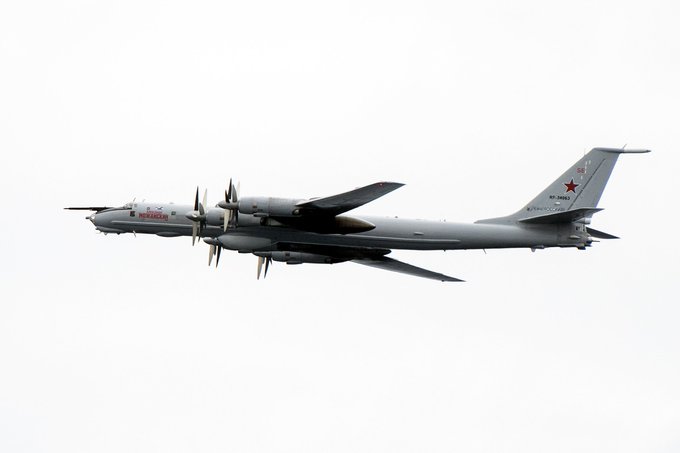
Et soudain, un Tupolev au-dessus du navire-amiral de l’: la Russie s’invite dans les grandes manoeuvres  (photos exclusives de @jnackstrand) http://u.afp.com/oKR3  
They didn’t see Russians coming.

River to Sea Uprooted Palestinian   
The views expressed in this article are the sole responsibility of the author and do not necessarily reflect those of the Blog!