Uprooted Palestinians are at the heart of the conflict in the M.E Palestinians uprooted by force of arms. Yet faced immense difficulties have survived, kept alive their history and culture, passed keys of family homes in occupied Palestine from one generation to the next.
Here is a story of a clash of ideas between two 18th-century thinkers, the Anglican Bishop George Berkeley (1685-1753) and litterateur/curmudgeon Samuel Johnson (1709-1784). At this time, there was an argument over the nature of reality. Berkeley argued that what we know of reality is limited to the ideas the mind derives from our senses. It is not that there is no reality external to us, it is just that we can’t know it in and of itself. We can only be aware of it (including features such as solidity) as sensory impressions. This was misunderstood by folks like Johnson, who thought Berkeley was denying an external, material world. He famously told his friend and biographer James Boswell that “I refute him [Berkeley] thus” and kicked a stone.
Despite Johnson’s scorn, there is room to draw lessons from Berkeley’s insight. Almost all of us mingle belief with reality. That is, we assume that the ideas in our heads reflect reality faithfully. Most of the time the two do correspond well enough, at least at a mundane level, for us to get through our day. But the correspondence is not there all of the time, and this fact can get us into trouble. Yet, so powerful is the assumed melding of perception and reality that we rarely bother kicking the stone—which here stands in for seeking objective evidence of that apparent connection. Instead, we go with first impressions, automatically accept community or peer group judgments, or are committed to misleading ideologies. Having done so, confirmation bias sets in and we downgrade any suggestion that our views are inaccurate.
If one is interested in examples of these sorts of problems, there are a number of good books to consult. One classic is Irving L. Janis, Victims of Groupthink (Houghton Mifflin,1972). Janis looks at such historical incidents as Kennedy’s decision to support the Bay of Pigs invasion and the misbeliefs that contributed to the U.S. war in Vietnam. One should also take a look at Madeleine L. Van Hecke, Blind Spots (Prometheus Books, 2007), which takes up such topics as thoughtlessness, “my-side bias,” and “trapped by categories.”
Part II—Critical Race Theory, Part 1
Today, we have an ongoing example of what happens when you mistake the ideas in your head for reality. It is the controversy that rages due to a purposefully distorted and fear-driven misrepresentation of critical race theory (CRT). CRT began as a field of academic study. This actually honed its accuracy as a social critique because, within the academic setting, it itself was open to critical analyses based on logic and evidence. What the theory posits is that, despite the reality that all human beings are biologically the same, “racism is institutionalized and is embedded in America’s history, legal systems, and policies.”
There is plenty of historical evidence for this. The process of institutionalization began quite early. The U.S. Constitution, as originally promulgated, legalized slavery. That status lasted into the 1860s, by which time racial bias and discrimination were accepted aspects of white society. Even after slavery was officially done away with, popular racist attitudes stood firm. Thus, following a brief period of “reconstruction,” the federal government turned a blind eye to state-based laws and practices that affirmed the continuing legal nature of racial discrimination. That official myopia lasted until the 1960s.
Thus, for most of the country’s history, over 200 years, racism was an expression of the white majority’s belief in non-white, and especially Black, inferiority. Such a long-embedded belief system does not go away easily. Indeed, a more common move is to defend it as part of sacred tradition. Therefore it is, even today, an element in the American psyche. On this basis, CRT “critiques how institutionalized racism [still] perpetuates a caste system [white privilege] that is inherently unequal.”
Despite the relative ease with which CRT’s claims can be defended using an objective reading of U.S. history, it remains both disturbing and confusing to most white Americans. For instance, many conservative white people dismiss CRT as a cover for the failure of those Black Americans to better themselves by their own efforts. These conservatives point to their own immigrant ancestors, many of whom were unofficially discriminated against yet “made it” to a comfortable middle-class life. While there is some truth to these immigrant stories, the comparison they engender is a false one. The mostly European ancestors of white Americans were never legally enslaved, were not systematically discriminated against via legalized racist practices lasting for multiple generations, and thus were relatively quickly able to assimilate into the dominant white society.
Some liberal white Americans have an even harder time with CRT. They often regard themselves as personally free of racism. They resent being seen as part of society’s racist problem by virtue of a white privilege they neither chose nor could have avoided. Structured into the institutions of their society, white privilege was simply there for them when they were born.
Part III—Critical Race Theory, Part 2
A reaction to CRT based on emotion has caused it to become a major point of public contention in the nation’s never-ending culture war. Here is an example. On Tuesday, 2 November 2021, I went to vote for a number of local elected offices, including school board membership. As I was walking to the poll building, a woman came up and, shoving a flyer at me, said I must vote for this write-in candidate because she is “against teaching CRT to our children.” I asked her to explain CRT to me. She said, “I don’t know much about it” but showed me an handout allegedly used in a public school that traced episodes of institutional racism in the U.S. in the 20th century. When I pointed out to her that, as far as I could tell, the examples were all historically accurate she got flustered and declared, “It’s politics. We have to keep politics out of the classroom.” When I suggested that the decision by a school board to censor history is a political one, she turned around and walked away. A certain idea of CRT had taken residence in her head and resulted in the distortion of reality. She obviously never bothered to “kick the stone” in order to get at the truth of the matter.
This sort of episode is not unique. The syndicated columnist Will Bunch, writing in the Philadelphia Inquirer of 7 November 2021, pointed out that in the recent Virginia governor’s election (won by the Republican candidate) “a surprisingly large number of Virginians [25% of voters] said they were energized [to vote Republican] by the out-of-nowhere rise of the perceived issue of critical race theory.” Bunch goes on to explain that a twisted notion of CRT has come to stand in for how the issue of racism is taught in the schools. He also noted that this same distorted notion is presented nightly by “Fox TV’s race-baiter-in-chief Tucker Carlson,” who also recently confessed “I’ve never figured out what critical race theory is, to be totally honest, after a year of talking about it.” Bunch concludes that the high-anxiety response to the idea of CRT in the schools is based on the fear that white children are being seduced away from “a traditional [white-dominated] American way of life.”
We can compare Will Bunch’s outlook with that of Marc Thiessen, a syndicated columnist who represents the hard right. How hard? Thiessen learned his trade as a speechwriter for George W. Bush and Donald Rumsfeld, both arguably war criminals responsible for the unnecessary U.S. invasion of Iraq.
Thiessen’s columns also appear in the Philadelphia Inquirer, and one concerning CRT was published on 12 November 2021. He also focuses on the Virginia voters’ concerns about race education in the schools. He sees as legitimate the fears and anger of some parents in Virginia’s Loudoun County because the local teachers were allegedly exposed to CRT during a series of inservice sessions run by Equity Collaborative, (EC). EC is “a national consulting firm focused on helping schools, school systems, and youth development organizations create educational equity.” Thiessen accuses EC of using CRT to teach that “racism is an inherent part of American civilization.” He does not challenge the accuracy of CRT’s view, but assumes it is, in any case, a scandalous proposition promoting the notion that even the American school systems support “systematic oppression.” Thiessen cites support for his charge using isolated quotes and the complaints of parents upset with CRT. EC has taken note of the charges and responded with a posting on its web site which describes its activities in Loudoun County and the concepts that were taught to the teachers attending their sessions.
Thiessen is also upset by what he describes as the “Left’s denial” that CRT is being taught to children in the schools. He says that the denial is “intellectually dishonest.” How so? Well, he asserts that America’s children are being instructed by teachers “trained in CRT to see everything through the prism of race.” He compares it to having all schoolchildren taught by “teachers trained in Marxist thought.” The truth is that most teachers report that they are not being pressured to integrate CRT into the curriculum, nor do they want it to be. As we will see below, these attitudes reflect the nation’s
tensions.
So Thiessen is wrong. CRT is not being pushed onto K-12 faculty or students. In fact, for most of the nation’s history, school systems have been doing just the opposite. Take a look at the interview with the historian Donald Yacovone published recently in the Harvard Gazette. Yacovone is an expert on the presentation of Black America in U.S. textbooks. He explains that the issues of slavery and subsequent discrimination and segregation of Black Americans were largely absent from textbooks and school lessons until the 1960s. “In the mid-1960s, textbooks began to change because attitudes and scholarship were changing in the wake of the Civil Rights Movement.” However, Yacovone points out that “even when textbooks are accurate, teachers have to be willing to teach it. We know there are many white teachers who are afraid of doing it. And you have to have school systems, both public and private, committed to doing this work and not to punish teachers for doing so.” He concludes that today such punishment is being carried out or threatened. Certainly this punitive approach was favored by some parents and educational administrators in Virginia.
Could it be that the backlash described by Will Bunch in Virginia is part of the effort to prevent teachers and school systems from teaching an accurate portrayal of the historical and contemporary influence of race in American society? And could it be that Marc Thiessen favors that suppression?
Part IV—Conclusion
There can be little doubt that traditional white America has always been deeply racist. As Yacovone concludes, “white supremacy precedes the origins of the United States. Every aspect of social interaction, particularly in the 18th and 19th centuries, was dominated by white identity, and white supremacy became an expression of American identity.”
This attitude persisted without effective challenge for over 200 years. That was plenty of time for socially contrived beliefs about white supremacy to dominate over the reality of a shared human status of all races. A challenge (the kicking of the stone) finally came in the 1960s when a successful alliance of black and white progressives temporarily marshaled the political power to overcome racist resistance at the state and federal government levels. The result was the enactment of laws that banned discrimination in the public realm. However, a decade of progressive political victories could not be sustained on a foundation of 200 years of racist tradition, and by the 1980s a pushback by conservative whites began. We are still experiencing that effort today.
That pushback has exacerbated tempers in an already divided nation. Unlike those capable of original thinking, such as Berkeley and Johnson, the average person sees his environment largely through community or peer group judgments and ideologies. It is groupthink that is comfortable for most, so no fact checking seems necessary. However, CRT is just that: fact checking. The result is a potentially effective challenge to assumptions that rationalize white privilege. And the result of that is school board meetings with parents screaming their heads off.
Israel demolished a Palestinian house in Lod. (Photo: via WAFA news agency)
Israeli authorities on Sunday demolished a Palestinian house in the Palestinian city of Lod inside Israel, the official Palestinian news agency WAFA reported.
Israeli forces, accompanied by bulldozers, raided the al-Mahatta neighborhood in Lod and demolished the house, according to eyewitness reports. The house belonged to Ibrahim Touri, a Palestinian man who has Israeli citizenship, WAFA noted.
“The house demolition came under the Israeli pretext it was built without getting a permit from the Israeli government,” Touri told local media, according to WAFA.
In the 1948 war, about 957,000 Palestinians, or 66 percent of the Palestinians who lived in historical Palestine, were expelled and displaced.
The remaining Palestinians continued to live in their cities, which were inside Israel’s 1948 border. They were subsequently given Israeli citizenship.
The Palestinian community today makes up 21 percent of Israel’s total population of more than 9.3 million.
Palestinians in Israel have suffered discrimination from authorities, according to rights groups reports, and have seen many of their homes demolished under the pretext of not having the required permits – which is often not granted or takes a long time to be approved.
Over 1,600 employees at tech giants Amazon and Google have urged their employers to pull out of a contract under which they will sell “dangerous technology” to the Zionist entity and its military and cut all ties with the regime over its atrocities against the Palestinian people.
Initially, more than 90 workers at Google and more than 300 at Amazon anonymously signed an open letter published by the Guardian newspaper on Tuesday, demanding the termination of Project Nimbus, which will provide cloud services for the Tel Aviv regime.
“The technology our companies have contracted to build will make the systematic discrimination and displacement carried out by the ‘Israeli’ military and government even crueler and deadlier for Palestinians,” the employees said in the letter.
“We condemn Amazon and Google’s decision to sign the Project Nimbus contract with the ‘Israeli’ military and government, and ask them to reject this contract and future contracts that will harm our users,” they said.
They underlined the need for the two companies to stop contracting with any militarized organization in the US and beyond.
Project Nimbus is a $1.2bn contract awarded last April to Google and Amazon, which succeeded in beating out bids from Microsoft, Oracle, and IBM, to provide cloud services for the ‘Israeli’ occupation regime and its military.
There are fears that the technology would allow for further illegal surveillance of Palestinians and facilitate the expansion of the Zionist regime’s illegal settlements across the occupied territories.
“This contract was signed the same week that the ‘Israeli’ military attacked Palestinians in the Gaza Strip, killing nearly 250 people, including more than 60 children,” said the “employees of conscience,” referring to the ‘Israeli’ regime’s latest war on Gaza which occurred in May and lasted for 11 consecutive days.
“We cannot look the other way, as the products we build are used to deny Palestinians their basic rights, force Palestinians out of their homes and attack Palestinians in the Gaza Strip, actions that have prompted war crime investigations by the international criminal court.”
In another opinion piece posted hours later on NBC, two workers at the tech giants updated the number of signatories, saying that nearly 1,000 anonymous signatories at Amazon and more than 600 at Google have joined the campaign.
“Since we have no ability to guarantee that the technology we build won’t be used to commit human rights abuses against Palestinians, cutting the contracts entirely is the only ethical option left for our companies,” Gabriel Schubiner, software engineer and researcher at Google, and Bathool Syed, content strategist at Amazon, wrote in the article.
The two employees said they agree with the two companies’ stated commitment to ethics, but also pointed to their hypocrisy. “We want to work for companies that do more than pay lip service to ethical business practices,” they noted.
“Instead, our companies signed contracts that they knew would be highly controversial, yet relinquishes their ability to enforce their own publicly stated principles while attempting to deny workers our say in how our labor is used.”
Many observers and organizations make parallels between the apartheid segregated Society of South Africa, the Jim Crow racial segregation laws of North America, and “Israel”.
Apartheid (/əˈpɑːrt(h)aɪt/, especially South African English: /əˈpɑːrt(h)eɪt/, Afrikaans: [aˈpartɦɛit]; transl. “separateness”, lit. “aparthood”) was a system of institutionalized racial segregation that existed in South Africa and South-West Africa (now Namibia) from 1948 until the early 1990s.
20 years on from the World Conference against Racism, Racial Discrimination, Xenophobia, and Related Intolerance, in conjunction with the International Decade of the World’s Indigenous People, held in Durban South Africa, where are we now?
The use of the law, in this case, an unjust and immoral law in South Africa by the minority white Dutch Afrikaans and the minority white British colonial invaders, was designed to keep white Europeans, in the ascendancy in South Africa.
Thirteen percent of the population who were white-ruled sixty-eight percent of the population who were black with an Asian community representing the remaining nineteen percent.
First, they ruled through a brutal military occupation, using the gun.
Then they ruled through a brutal racist government using repression and separation laws.
It was the use of apartheid laws that legalized and enforced a system of ‘separateness’. A system of dual apartness which left the races unable to socialize, congregate or work together as brothers and sisters, equal and indivisible under the constitution.
In South Africa, they legalized colonial white supremism through parliamentary statute, police enforcement, and judicial sentencing.
The first apartheid law passed in 1949 was the Prohibition of Mixed Marriages Act. This was followed by the Immorality Act of 1950 which made it illegal for many South Africans to marry or have sexual relations across racial lines.
The Pass laws were designed to force black people to live in designated areas, corralled as it were, like animals in a pen, thereby making them available as cheap labor for white farmers.
It was the coming to power of the African National Party in 1948 who created the apartheid laws and system of governing South African society, that reinforced the racial discrimination already self-evident in the country. A series of Land Acts gave more than 80% of the land to whites and banned Black crop sharers from working the land.
A series of discriminatory, racially biased laws, saw the permanent separation of the races, alongside a parallel system of separate transport systems, public lavatories, and housing districts.
In effect, the National Party which won the 1948 parliamentary elections on the slogan of Apartheid meaning ‘separateness’ created a privileged white minority class that used the indigenous black South Africans as a labor pool to work on the farms, clean their homes, as a subjugated underclass, kept in perpetual poverty, in appalling substandard housing units in shantytowns with poor education, poor health, and poor social provision.
Like all colonialists, they strove to keep the people apart by fomenting sectarian tensions between the regional ethnic groups in order to prevent a unified opposition to their racist endeavor. They encouraged black-on-black violence in the townships and in the countryside.
A land of milk and honey for the white supremacist colonial invaders beside a land of despair, oppression, and governmental indifference for the natives.
Apartheid lasted for 50 years in South Africa and only officially ended when the ANC, African National Conference which had historically opposed the apartheid system and fought a legitimate war against the unjust white only parliamentary system, finally came to power in 1993, when the majority of citizens were given the right to vote and they elected Nelson Mandela as the first Black President of the Republic of South Africa,
It can be claimed that not much has changed for the indigenous peoples of South Africa, While it is true they have a majority black representative government, the whites still own the land. White farmers still get rich while employing cheap black labor.
The captains of industry are still white although a new elite cadre of black politicians and civil servants may now live in gated (separate) communities, much of the pain of being poor, disenfranchised, and black has changed very little for so many.
A new black capitalist class also rides high above the black dispossessed workers and those who go to bed hungry.
Many observers and organizations make parallels between the apartheid segregated Society of South Africa, the Jim Crow racial segregation laws of North America, and “Israel”. The use of Israeli-only roads and Jewish-only settlements in the West Bank are prime examples of Israeli separation laws.
The discrimination against black African Americans is again reflective of the white European racism that underpins white American society. It is mirrored in the majority of the white legislator, judiciary, police, and army aficionados in power in American civil society and in the corporate, business, and banking sectors.
White Americans control the levers of power and influence, in the media as well as on Capitol Hill.
The continued destruction of black Afro American society through the widespread use of drugs, criminal gangs, poverty, underinvestment, governmental neglect, police brutality, judicial repression, are continued proof if it were needed, that a white European colonial mindset underpins discrimination and racial prejudice in societies where white Europeans want to maintain an internal hegemonic position of superiority which is then reflected in their foreign policies of exploitation and subjugation, in order to maintain white economic privilege in the countries of the EU, North America, Canada, and Australia.
All the countries I have mentioned above are guilty of genocide, racial intolerance, oppression, military adventurism, and ethnic cleansing.
Is “Israel” any different?
“Israel” is a white European colonial settler state.
It has followed all the steps taken by previous white European settler-colonial states such as South Africa, North America, Canada, and Australia,
It has colonized, subjugated, ethnically cleansed, and marginalized the indigenous populations of the country they have militarily conquered and supplanted.
“Israel” has its Nations state Law which many international observers see as a template for a Jewish only Israeli state that separates non-Jews and others from playing an active role in the state.
“Israel” now has usurped 85% of historic Palestine.
To me, apartheid is an abhorrent manifestation of a supremacist ideology that seeks to separate one from the other, to create disharmony, bitterness, hatred, and a divided dysfunctional broken society based on racial or religious purity.
“Israel” fulfills all these roles but it does so much more.
An apartheid state might use the law to discriminate. It may use the law to repress and isolate those it seeks to subdue but it doesn’t bomb kindergartens, schools, hospitals, and bakeries, does it?
It may have separate roads and separate housing areas but it doesn’t shoot countless children in the legs for throwing stones or bringing water to the kids resisting an illegal occupation, creating crippled boys, does it?
It does not shoot paramedics and leave the wounded to bleed out on the street to die, does it?
It does not murder physicists in another jurisdiction, indiscriminately bomb bridges and civil infrastructure in neighboring countries, does it?
It does not count the calorific intake of those it is legally responsible for, to break their will to resist, to withhold food, medicine, vaccines, fuel in order to impoverish and emasculate an entire population of 1.8 million people, does it?
It does not bomb neighboring countries that are not at war with it, deny building permits to the indigenous population while simultaneously dismantling their homes in a land you are illegally occupying, and forcing homes owners to destroy their properties. To detain citizens under Administrative detention, internment without trial. To murder, maim, imprison, torture, and kill at will with impunity, is this Apartheid? I think not. Yet these are the everyday actions of a rogue unaccountable state immune to international law and international sanctions, actively supported protected, and facilitated by the other white European ethnic colonies that Israel aspires to be.
“Israel” is Beyond Apartheid.
We must find a new way to describe “Israel” based on its everyday practices of Ethnic cleansing, murder, colonization, dispossession, and expansion.
We must call “Israel”, not an Apartheid State which it is, but an Ethno cleansing pariah genocidal rogue state, because that it was, it does? That is what it is. That is what we must call it.The opinions mentioned in this article do not necessarily reflect the opinion of Al mayadeen, but rather express the opinion of its writer exclusively.
Stanford University study reveals: “Some 80% of (Jews of colour) respondents said that they had ‘experienced discrimination’ within Jewish settings, including synagogues, congregations, and Jewish spiritual communities.”
By Gilad Atzmon
People who are familiar with the history of Zionism are aware of the rich history of White Jewish (AKA Ashkenazi) abuse towards Arab and Sephardi Jews in Israel. In the years after the creation of the Israeli state hundreds of babies went missing. Their parents, mostly Jewish immigrants from Yemen, were told their children had died, but suspicions linger that they were secretly given away to White Jewish childless families. The Israeli government approved earlier this year a NIS162 million settlement with the families of these ‘vanishing’ children.
Volunteering the Israeli population as guinea pigs wasn’t invented by Netanyahu or/and Pfizer. Blood samples drawn from Yemenites Jews in the 1950s were tested to determine whether they had “Negro blood.” According to the Times of Israel “60 hearts were harvested from the bodies of new immigrants from Yemen post-mortem for purposes of medical research, in a project purportedly funded by the US.” Also in the same period, the Jewish state irradiated children who arrived from North Africa and the Middle East en masse in an attempt to fight ringworm. In the years to follow many of these children died from cancer. In 1995 the Israeli government decided to compensate the victims and families of the Ringworm Affair.
In the late 1950-1960s Jewish immigrants from Morocco were sprayed with DDT as soon as their feet touched the ‘promised land.’ For them, this bitter departure was merely an introduction to decades of abuse and humiliation that is still taking place.
It took the Israeli Government more than a few decades to lift its 1977 ban preventing Jews from Ethiopia donating blood. This late immigration wave of African Jews sent their children to serve in the army and to die for Israel but apparently their blood wasn’t as good as their fellow Israelis.
The Yemenites, Moroccans and Ethiopians have something in common. They are ‘Jews of colour,’ not exactly the most privileged Jews in Israel. Just slightly above the Palestinians and the African non-Jewish immigrants. Some anti-Zionists may insist that this is exactly what we should expect from a racist criminal State. However, the fate of American Jews of colour isn’t any better, in fact it is far worse.
The Jerusalem Post reported yesterday on a study conducted by researchers at Stanford University that delved into the experiences of American Jews of Color. The new report titled Beyond the Count revealed large and systemic discrimination and scrutinization based on race in the Jewish Society.
The data was gathered at Stanford University by a multi-racial team of researchers, with over 1,118 respondents participating. It revealed that “Some 80% of respondents said that they had ‘experienced discrimination’ within Jewish settings, including synagogues, congregations, and Jewish spiritual communities.”
“Additionally, respondents indicated that they had previously experienced an increased sense of awareness regarding how others perceive them because of either their race or their Jewishness.” Some participants admitted they found it “more difficult for their identities to co-exist in predominantly white Jewish spaces than in Black indigenous people of color spaces.” Furthermore, 44% said they had changed how they dress or speak in white Jewish spaces, and 66% reported feeling “disconnected from their Jewish identities at times.”
I wouldn’t dare to ask Jews or anyone else to morph, to become more tolerant or harmonious, as that is not my task in life. I wouldn’t expect anyone who upholds racist and/or white supremacist views to change their spots. I just expect Jews in general and Jewish institutions (such as the ADL or AIPAC) in particular, to look in the mirror twice before they preach to us about ‘race’ in general or white privilege in particular.
JERUSALEM — In November of last year, an Israeli judge invoked the controversial Jewish Nation-State Basic Law when striking down a lawsuit against the city of Karmiel over funding transportation for two Palestinian students.
In his ruling, the chief registrar of the Krayot Magistrate’s Court, Yaniv Luzon, said that establishing an Arabic-language school in Karmiel or funding transportation for Palestinian Arab students would “damage the city’s Jewish character” and may encourage Palestinian citizens of Israel to move into Jewish cities, thereby “altering the demographic balance.”
Luzon cited Section 7 of Israel’s Jewish Nation-State Law, writing:
The development and establishment of Jewish settlement is a national value enshrined in the Basic Law and is a worthy and prominent consideration in municipal decision-making, including the establishment of schools and the determination of policies relating to the funding of [school] busing [of students] from outside the city.
The students’ father, Kasem Bakri, said of the judge’s decision, “The municipality treats my sons as guests in the best of times and as enemies in the worst of times.” The family was fined 2,000 shekels (roughly $600) and ordered to pay all of the court’s expenses.
The court ruling came just before a Supreme Court hearing on 15 petitions submitted by human rights organizations and Palestinian political leaders challenging the Nation-State Law in December. After only one discussion on the law, the high court last week rejected the petitions and upheld the 2018 law in a 10 to 1 decision. The single dissenting opinion was from the only Palestinian justice on the court, Justice George Kara.
Swift condemnation of the Supreme Court’s decision
“The Israel Supreme Court approved a law that establishes a constitutional identity, which completely excludes those who do not belong to the majority group. This Law is illegitimate and violates absolute prohibitions of international law,” Adalah – The Legal Center for Arab Minority Rights in Israel wrote in a press release. Adalah, one of the law’s petitioners, deemed this piece of legislation “a law that clearly shows the Israeli regime as a colonial one, with distinct characteristics of apartheid.”
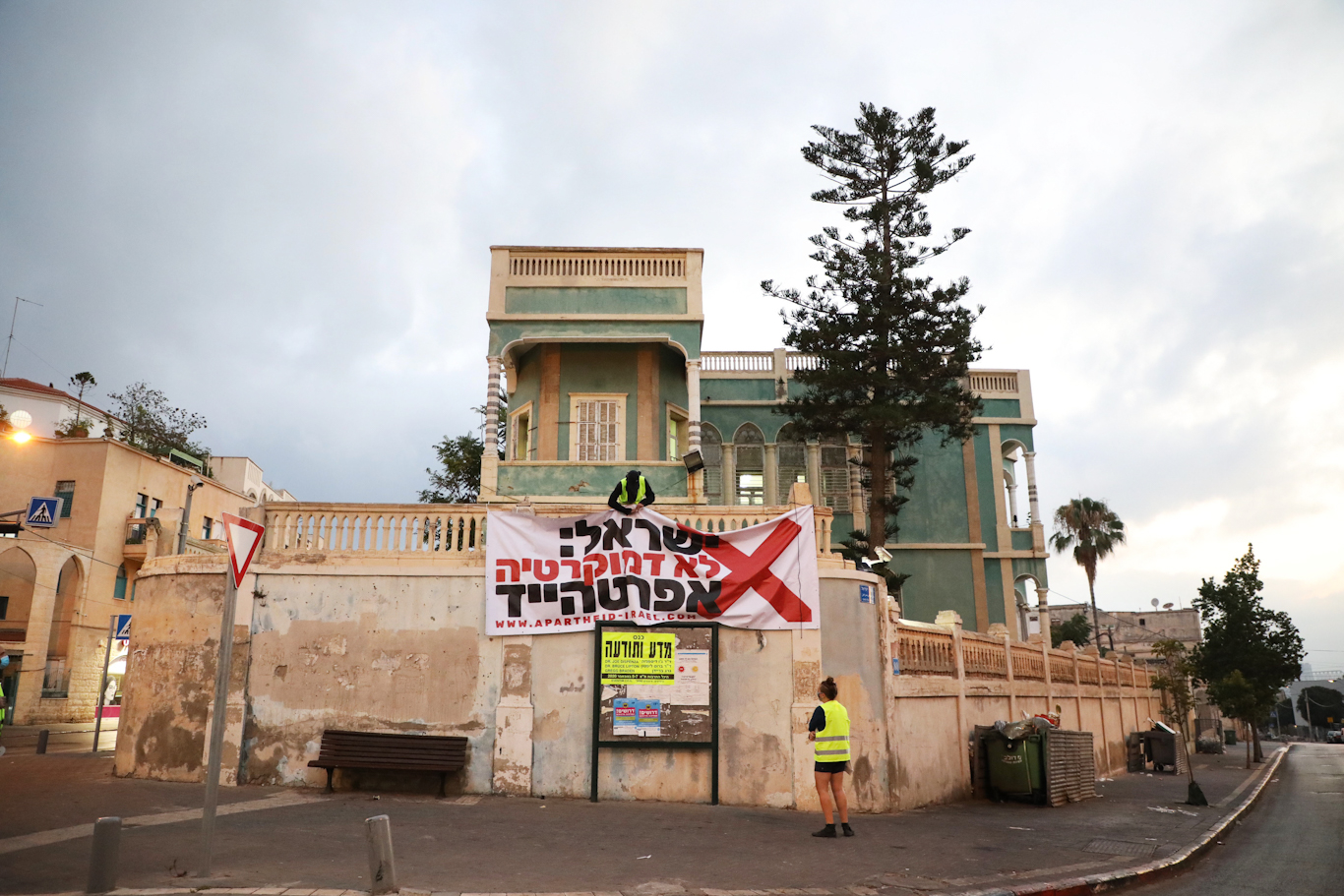
Activists drop a banner reading “Israel: Not a Democracy. Apartheid” from atop the Israeli military court in Jaffa, July 12, 2020. Photo | Activestills
“The Supreme Court refrained from doing what was essential — to defend the basic right to equality,” Dr. Yousef Jabareen, chair of the Human Rights Forum in the High Follow-up Committee for Arab Citizens of Israel and a former member of the Knesset, said in a statement, adding:
The so-called ‘Jewish Nation-State’ law formalizes in Israeli constitutional law the superior rights and privileges that Jewish citizens of the state enjoy over its indigenous Palestinian minority, who comprise roughly 20% of the population.”
What is the Jewish nation-state law?
In 2018, the Knesset voted to approve the nation-state law by 62 to 55. The basic law essentially legalizes Israel’s apartheid nature and states the following:
Exercising the right to national self-determination in the State of Israel is unique to the Jewish people.
The name of the state is ‘Israel.’
A greater, united Jerusalem is the capital of Israel.
The director of the land and planning rights unit at Adalah, Adv. Suhad Bishara, helped formulate Adalah’s petition against the nation-state law. “The overriding objective of the basic law is to violate both the right to equality and the right to dignity of the Arab citizens of Israel,” she said.
Additionally, the law promotes Jewish settlement and views it as a national value. It also demotes Arabic from one of the two official languages to a “special status.” With the nation-state law’s basic tenets, Palestinian history and identity are effectively erased from the land.
Emphasizing the law’s notion of Jewish settlement and demotion of Arabic, Amnon Be’eri-Sulitzeanu — co-director of Abraham Initiatives, an Israeli nonprofit focused on Jewish-Arab partnership — said the legislation institutionalizes inequality between Israeli Jews and Palestinian citizens of Israel. “It’s creating a situation in which, according to our basic laws, there is a sector in society that is not equal,” Be’eri-Sulitzeanu told MintPress News. “This is something that no democracy can allow.”
In a tweet, Abraham Initiatives advocated for repealing the law, writing that it “establishes the status of Arab citizens in Israel as second-class citizens.”
The nation-state law’s impact
Only a few years old, the nation-state law has already proven it can serve as a legal tool for discrimination and racial segregation.
The Bakri family in Karmiel sued the local municipality over their school transportation costs. Since there isn’t an Arabic-language school in Karmiel, the Bakri children were forced to travel nearly four miles to the town of Rameh for their education. According to the Bakris, the traffic often made the commute more than 30 minutes and cost the family 1,500 shekels (or roughly $460) each month. The family’s lawsuit requested reimbursement for their transportation costs totaling 25,000 shekels (about $7,683).
Nizar Bakri, the children’s uncle and the attorney who filed the lawsuit, condemned the magistrate court’s dismissal of the suit, saying, “The court’s decision wasn’t based on law; it was based on Jewish existence.” Following the ruling, Nizar Bakri filed an appeal with the Haifa District Court. The district court denied the Bakris’ appeal in February but determined the lower court’s reliance on the nation-state law was “fundamentally wrong” and “liable to damage the public’s trust in the courts.”
“The court may have unequivocally ruled that the registrar of the Krayot Magistrate’s Court made a mistake in the use of the nation-state law and its connection to this case, but this ruling should not satisfy the opponents and victims of the nation-state law,” Nizar Bakri told Haaretz.
For Adalah’s Bishara, the district court’s opposition to the magistrate’s court’s use of the nation-state law is irrelevant when it comes to future court decisions, as the grounds for discrimination are officially embedded into law. She explained:
It doesn’t really matter whether it’s explicitly mentioned or not because it’s the legal, constitutional framework that’s there that sets the basic principles of supremacy and of the right to self-determination only for one national ethnic group in the state. This sends a very clear message to all the authorities that you can not only go on with what you have been doing so far in terms of violating the rights of the Palestinian citizens as individuals and as a group, but this will certainly give you more backing to deepen these policies.”
Bishara told MintPress that she anticipates the legislation will add another dimension to Israel’s ongoing discrimination and have huge implications for Palestinians on both sides of the Green Line — not just 1948-occupied Palestine. “Since it speaks about the land of Israel as the historic land of the Jewish people and Jewish settlement as a constitutional value, this combination of both becomes very problematic both in Israel proper and in the Occupied Territories,” she said.
Israel’s long list of discriminatory laws
Globally, the state of Israel touts itself as the “only democracy in the Middle East,” but Dr. Jabareen said the nation-state law “prioritizes the Jewishness of the state over its democratic character,” specifically in “omitting any reference to democracy or equality.” He added:
The nation-state law further marginalizes the Arab-Palestinian community and entrenches Israel’s regime of racial discrimination and deterioration into apartheid. It will lead to more racist, anti-democratic laws, adding to the more than 50 laws already on the books that disadvantage non-Jewish citizens.”
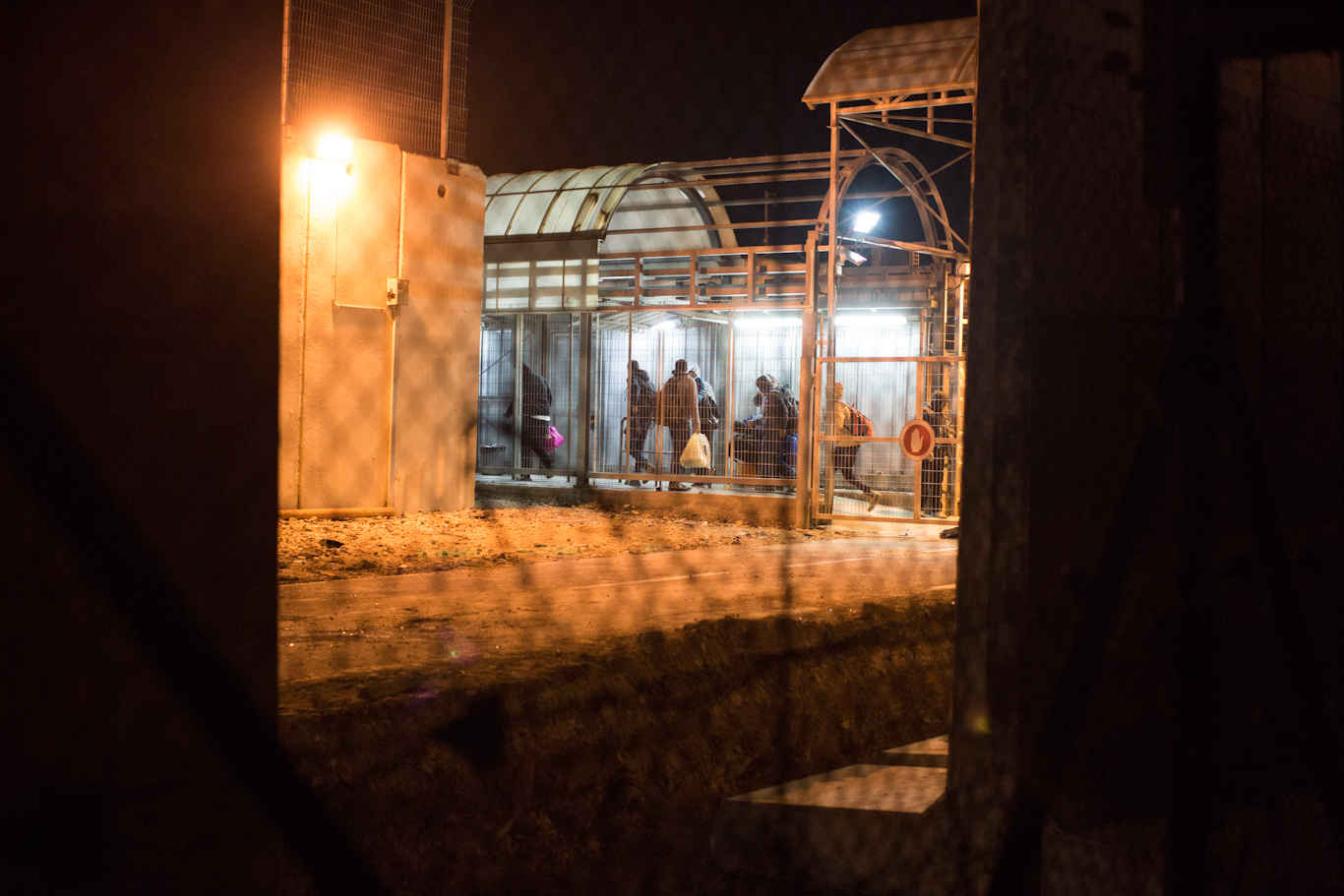
Palestinian workers cross the Eyal checkpoint, January 10, 2021. Keren Manor | Activestills
According to an Adalah database, Israel has more than 65 laws discriminating against Palestinian citizens of Israel and Palestinians in the Occupied Palestinian Territories (OPT). These laws encompass nearly every facet of daily life, from property and housing rights to citizenship and finances. The following are just a few notable examples:
The Admissions’ Committees Law, which permits towns built on state land to deny housing to Palestinians based upon the criterion of “social suitability.”
The Nakba Law, which bans groups or schools receiving government funding from commemorating Israel’s 1948 ethnic cleansing campaign against Palestinians during the state’s founding (known as the Nakba or Catastrophe).
The Boycott Law, which prohibits calls to boycott Israel. This legislation effectively outlaws the Palestinian-led Boycott, Divestment and Sanctions (BDS) movement.
The Absentees’ Property Law, which categorizes individuals who were expelled or fled their property after November 1947 as absentees and thereby having no ownership claims to their properties. However, Jews who lost property during this time are allowed to reclaim their land through the Legal and Administrative Matters Law. These laws are often used to displace Palestinian communities, as has been witnessed in the Occupied East Jerusalem neighborhoods of Sheikh Jarrah and Silwan.
The Law of Return, which guarantees citizenship to all Jews. No law exists guaranteeing Palestinians the right to citizenship — even if they were born in what is now considered modern-day Israel.
The Citizenship Law, which bans citizenship rights to Palestinians living in the OPT who are married to Israeli citizens. Settlers living in the Occupied West Bank are exempt. Israel’s new government failed to extend the law this month, but reunification still remains a significant problem for many Palestinian families.
Codifying apartheid into law
While the principles outlined in the nation-state law have always been part of Israel’s foundation and way of governing, enacting this legislation turns these de facto concepts into de jure ones and opens the floodgates for further inequity.
“This nation-state law is validating racist behavior against Palestinian Arabs,” Kasem Bakri said.
Despite the controversial legislation remaining, Kasem Bakri is steadfast. “I exist here as an Arab person and I have the right to be here,” he said. “Palestinians exist here like the cactus and the olive trees. We will never be gone from here.”
Whose Apartheid is/was the worst? This analysis will focus on the severity of South Africa’s Apartheid and will touch on other forms of Apartheid too. This article is motivated by The Saker’s call for action in seeking out the Truth, in his recent article: “Woke insanity: why is there so little pushback?!”
Before we proceed to South Africa, the following question is posed: What is/was the level of “Apartheid” (if any) in the following states/countries? Israel and Palestine (current/ongoing conflict); Ireland (Catholic and Protestant divisions in Northern Ireland); India (caste system); China (problems with ethnic minorities); Peru, Bolivia, Ecuador (Quality of life and education for indigenous peoples versus that for Europeans), Middle East (Sunni and Shia divisions); the formation and breakup of Yugoslavia; “Safe Spaces” for Woke?
Bearing that in mind, we now turn our attention to the Apartheid of South Africa (then and now).
The claim is often made that South Africa’s Apartheid was uniquely evil under the Afrikaners/Boers and that nobody could hold a candle to them (except perhaps Israel). First, we need to look at the definition of Apartheid. There are two definitions for it. When people refer to Apartheid, the first definition [below] is the one they usually refer to:
1. The term “Apartheid” was officially named a crime against humanity in 1966 by the United Nations General Assembly. The U.N. defined Apartheid as “inhumane acts committed for the purpose of establishing and maintaining domination by one racial group over persons of another racial group and systematically oppressing them.” The National Security Council adopted a stance against Apartheid in 1984 as a criminal act (Resource 1).
2. The Afrikaner government who were the originators of the term “Apartheid”, defined it differently. For them it was based on the parallel (separate) development of the different nations within South Africa:
“My point is this that, if mixed development is to be the policy of the future of South Africa, it will lead to the most terrific clash of interests imaginable. The endeavors and desires of the Bantu and the endeavors and objectives of all Europeans will be antagonistic. Such a clash can only bring unhappiness and misery to both. Both Bantu and European must, therefore, consider in good time how this misery can be averted from themselves and from their descendants.
They must find a plan to provide the two population groups with opportunities for the full development of their respective powers and ambitions without coming into conflict. The only possible way out is the second alternative, namely, that both adopt a development divorced from each other. That is all that the word apartheid means.”
– Speech of the Minister of Native Affairs, 5 December 1950, South Africa
It is often stated that Afrikaner leaders were the architects of Apartheid, but about 80% of the segregation laws for the Apartheid policy were already in place (in some form or another) before Apartheid was created (Resource 2). Those foundational segregation laws were promulgated by the Dutch and British colonial powers prior to the Afrikaners coming into power in 1948 (Resource 14).
The Apartheid policy (its reasons and objectives), as it developed, was openly and transparently communicated to local and international audiences by way of press releases, newsreels (Resource 3), and documents made available by South African foreign missions abroad. Here is an excerpt from one such document, a booklet titled, ‘Progress Through Separate Development – South Africa in Peaceful Transition’:
“Cannot you understand us fighting to death for our existence? And yet we do not only seek and fight for a solution which will mean our survival but seek one which will grant survival and full development, politically and economically to each of the other racial groups as well, and we are even prepared to pay a high price out of our earnings for their future.” “We prefer each of our population groups to be controlled and governed by themselves, as nations are. Then they can cooperate as in a commonwealth or in an economic association of nations where necessary. Where is the evil in this?” (Resource 4)
Two sentences in the above statement stand out, namely (1) “… us fighting to death for our existence” and (2) “…we are even prepared to pay a high price out of our earnings for their future.” For context both of these need to be interrogated:
1. “Cannot you understand us fighting to death for our existence?”
This sentence stands out because South Africa was not at war at that time, so it must have meant something else:
The Afrikaners/Boers were drastically seeking a solution that would guarantee and secure their survival as a nation at the foot of the African continent – for several reasons:
During the Anglo-Boer War (1899 – 1902) just 46 years prior to them getting into power in 1948, the Boers had lost virtually everything through a scorched earth policy enacted by the British. Their farms (30,000 were burned down), and their independence was lost, and very many of their women and children (26,000) died in concentration camps (22,000 were children under the age of 16). (Resource 5).
The Boers had lost their internationally recognized Boer Republics as a result of the Anglo-Boer War, so they couldn’t draw borders around themselves for protection. Post-war they were incorporated into a union of nations (the Union of South Africa) by the Imperial British government in 1910. In 1948 the Afrikaners came into power and inherited this Union of South Africa, along with responsibility for all the nations within the Union.
Demographic growth: The Afrikaners/Boers’ numbers and birthrates would have been much higher had they not lost so many females during the Anglo-Boer War. Moreover, their birthrates have always been much lower than African groups within South Africa (Resource 6).
The European colonies in other African countries were systematically being disbanded through a process of decolonization which was fully supported (and initiated in some case) by European countries. At the same time Western and Eastern nations were vying with each other, and among themselves, for favor (access to resources) among newly decolonized and decolonizing African leaderships by supporting Pan-Africanism against the local whites in Africa (Resource 7).
Afrikaners/Boers had no right of return to Europe, whereas whites in the other African nations did have that right (mainly British, French, Dutch, Belgian, Portuguese and German passport holders). Afrikaners held only South African passports. As a side-note, there were no Boer Republic passports, because the Boer Republics didn’t exist anymore after the Anglo-Boer War.
A common misconception is that Afrikaners/Boers are Dutch and can/should “go back to Europe”. Afrikaners are genetically, according to 2020 research, 34% to 37% Dutch, 27% to 34% German, 13% to 26% French and 6% to 12% non-European (mainly Asian and Khoisan). (Resource 8).
The Afrikaners have no right of return to the Netherlands because in 1814 the Netherlands sold its temporary Dutch colony at the Cape (including all the Afrikaners/Boers) to the British for 3 million pounds sterling, with no right for them to return to the Netherlands. In other words, the Afrikaners were “sold lock stock and barrel”. To this day the Dutch do not recognize Afrikaners as Dutch, or that they have a right of return (Resource 9).
The Afrikaners have no right of return to Germany, because the Germans who went to South Africa were single men, tradesmen, and artisans who migrated to South Africa for work and assimilated into the Afrikaner nation.
The Afrikaners have no right of return to France because the French immigrants that went to South Africa were Protestant refugees escaping religious persecution in France after Protestantism was outlawed in the 1680’s. No right of return to France exists for Huguenots to this day.
The ‘no right of return’ concept is not something that is so out-of-the-ordinary. The same would apply for many/most Chileans, Argentinians and Uruguayans because they are descendants from several European nations with a blended heritage, for example from Spain, Italy, Germany, Switzerland, and Poland.
Where would/could the Afrikaners go/have gone to? In their minds, they were/are already home (they consider/ed themselves to be White Africans), but after they gained power in 1948 they were also between a rock and hard place (no more Boer Republics). They decided to continue on with the segregation policies already put in place. At that time forms of segregation were also still in place in several other nations, such as USA, Australia, Canada and New Zealand.
The new objective with segregation (now called Apartheid) was for the devolution of the already existing traditional ethnic tribal Homelands into autonomous self-ruling ‘state-lets’ within greater South Africa. This devolution and self-rule would then pave the way for complete independence for each of the Homelands. In the interim, and even after independence, economic support would be available from the Apartheid state (Resource 4),
What was the reasoning behind that approach? The lack of industrialization in the Homelands caused an influx of migrant workers out of the Homelands to cities and towns in wider South Africa. This created the formation of townships (‘shantytowns’) on the outskirts of cities and towns by migrant workers (with resulting social issues). It has often been claimed that the Apartheid state “created” such townships, but they formed naturally because of that economic migration from the underdeveloped Homelands.
The populations of the tribal Homelands were becoming increasingly dependent on jobs far away, while not much modern development was happening naturally inside of them. The Apartheid state’s solution was to finance Homeland development (with state finances, i.e. white tax payers money, because black South Africans were exempted from taxes), so that there would be sufficient job creation and infrastructure development within the Homelands and their border areas, to reduce the economic migration. It was hoped such an aproach would result in reducing the informal settlement/squatter camp (and related) issues and would be the impetus for the long-term natural development of the Homelands.
2. “…we are even prepared to pay a high price out of our earnings for their future.”
Between 1964 and 1973 the Homeland of Transkei alone had already received $152-million (USD) from the Apartheid government (Resource 10).
By 1966 the equivalent of more or less (at the exhange rate at the time) $420-million (USD) had been invested in the development of border area industries neat to the Homelands and by that time 100,000 jobs had been created. (Resource 11).
Between 1962 and 1972 the UN paid out $298 Million USD to underdeveloped countries. In that same period it is estimated that South Africa (the Apartheid government) spent $558 Million USD on the development of the traditional tribal homelands for Self Rule (Resource 12).
The above figures are rather significant, even by today’s standards. Should the be adjusted for inflation to the equivalent in today’s terms these sums become even more impressive. Could it be that the white Apartheid government invested more in the development of indigenous peoples’ regions, within a short period of time than any other Western nation in history? This would have to be verified through research, but that seems to be a distinct possibility.
It has frequently been stated by activists that the Apartheid government created the Bantustans (Homelands) and dumped black South Africans in them against their will and that these areas were the least habitable and least desirable parts of the country – that they are desolate places resembling the Gaza strip … But, what are the facts?
The Homeland areas were originally inhabited by the Bantu African tribes during their migration into Southern Africa from the Great Lakes/Central and West Africa region (Resource 13). Clearly, Bantustans/Homelands were not created by the Apartheid government. Moreover, the outlines of the Homelands had already been confirmed by colonial administrations prior to Afrikaners coming into power in 1948 (Resource 14).
The Eastern part of South Africa, where the Homelands are situated, is actually the most fertile part of the country with the best agricultural potential, not the worst, and this can easily be observed and verified by looking at maps and also by looking at rainfall figures and soil quality (Resource 15).
Were human rights abuses committed in the process of implementing Separate Development, which was one of the components of Apartheid? Was this policy implemented explicitly “… for the purpose of establishing and maintaining domination by one racial group over persons of another racial group and systematically oppressing them”?
Separate development for Self Rule, which was the original South African meaning of Apartheid, does not seem to fit very well into the U.N.’s definition of Apartheid. That said, Apartheid had other components to it. In the rest of South Africa, outside of the Homelands, there were various segregation laws already in place that were inherited by the Afrikaners when they came into power. Those laws resembled the Jim Crow laws of the United States.
After 1948, the state increased the levels of segregation through Apartheid policies and in some cases removed some rights that had already been in place, like the voting rights for Brown people in the Cape Provence for example. Worse than that, it mandated that in some cases families had to be separated from each other when their members were of mixed ethnicity. Those were clearly human rights abuses and some of the most shameful excesses of the Apartheid regime.
If the worst excesses of South African Apartheid are considered as a benchmark for some of the worst human rights abuses of the nineteenth century, as has been claimed (Resource 16), then where would, for example, the caste system in India fall within the spectrum of worst human rights abuses? Or, for example, the forceful removal of aboriginal children from their families in Australia (the Stolen Generations) for assimilation into white families:
“Official government estimates are that in certain regions between one in ten and one in three Indigenous Australian children were forcibly taken from their families and communities between 1910 and 1970” (Resource 17)
Further on this subject, how were indigenous peoples treated in South America and Central America during the Spanish conquest and Portuguese colonialism, and how would that compare to the policy of separate development and/or Apartheid in general, in South Africa? The same questions could be posed about North American countries’ treatment of the indigenous peoples.
The point of the examples above is not to “embarrass anyone”, it is to make the point that the severity of South African Apartheid should be evaluated alongside all past and present segregation policies around the world where similar circumstances applied. Only through side-by-side analysis can an objective analysis be made. That’s the scientific method. Such a study has to date never been done. That’s perhaps for obvious reasons because the vast majority of people in the anti-Apartheid movements were/are from nations that would not escape scrutiny, should such an analysis ever be done honestly.
Why is such an analysis important? Because of the level of disinformation about what really happened during Apartheid. For example, in the document titled ‘Comparing South African Apartheid to Israeli Apartheid’ (Resource 1) the following claims are made about South African Apartheid:
Claim: The Apartheid regime created the Bantustans. (Incorrect: They already existed in some form).
Claim: Black citizens were made involuntary citizens of those Homelands. (Incorrect: Homelands were settled by Bantu tribes when they migrated into South Africa, although it’s true that not all people originally from Homelands wanted to return there against their will. There was strong support for Self-Rule among the leaders of the Homelands (sources available).
Claim: The objective of the “creation” of the Homelands was for the demographic majority of whites in South Africa to be preserved. (Incorrect: The objective of industrializing and developing the Homelands and border areas was to draw Homeland inhabitants back to the Homelands in order to reduce the problems associated with migrant labor, such as informal settlements. In addition, much higher birth rates among African demographic groups presented numerous future challenges related to infrastructure development (carrying capacity) and water resources as well as the future of social and cultural cohesion. The separate development project of the Apartheid government was meant to deal with some of those problems in advance, while – as stated before – the policy would also preserve the survival of Afrikaners/Whites in South Africa. That objective was honestly stated in communiques by the Apartheid government.
Claim: Apartheid was about keeping the best parts of the country for the whites and sending the black population to the least habitable, least desirable parts of the country. (Incorrect: The Homelands were and are the most fertile regions of the country).
Claim: Blacks were forcibly removed and relocated to black homelands and much of their land seized during Apartheid. (Facts: It is true that many blacks were forcibly removed and relocated to Homelands, but in the majority of cases compensation was involved (Resource 18). White people were also forcefully removed – the Apartheid government forced whites out of the Homelands back into greater South Africa).
A common claim that is made about Apartheid (and/or Afrikaners/Boers) is that tens of thousands or hundreds of thousands of black people were killed during Apartheid. The Truth and Reconciliation Commission’s report spearheaded by Rev Desmond Tutu (among other prominent black human rights activists), concluded that around 700 such deaths occurred in 46 years:
“Then there are people who argue that apartheid was a policy in terms of which huge numbers of black people were killed by the apartheid government. It is indeed true that black people were killed by the apartheid government, but the correct figures will come as a surprise to many people. The Human Rights Committee and the Truth and Reconciliation Commission found that roughly 21 000 people died in political violence between 1948 and 1994. Of those 21 000 people, roughly 100 were killed by white rightists and roughly 600 by members of the security forces. Roughly 19 000 people died following the ANC’s launch of the people’s war against competing black [black against black] institutions and organizations.” (Resource 19)
Finally, it would only be fair to evaluate what’s happening in South Africa today, as opposed to South Africa under Apartheid. How do South Africa’s racial policies in 2021 compare to the original Apartheid policies?
By the year 2017, there had been no less than 1700 farm murders (many seem to be politically motivated) and 12 245 farm attacks according to the statistics of the South African police. Only a small number of farmers murdered are black farmers (Resource 20)
Today there are more race-based laws in South Africa that discriminate against white people after 27 years of democracy than there were under 48 years of Apartheid and 38 years of British colonialism combined:
“The real problem, inadvertently highlighted by the controversy, is that such a large part of the media, civil society, and the DA do not see the ANC’s race laws as a problem. In fact, they are barely conscious that they exist at all. And yet it is simply impossible to understand South Africa’s predicament without reference to the ANC’s racial project, the plunder that this enabled, and the institutional and economic destruction that resulted.” (Resource 21).
For a few precious years in the early to mid-1990s South Africa was, for the first and last time, a country without operative racial laws. Over the past 26 years the ANC has put in place a web of binding racial requirements through constitutional provisions, legislation, white papers, regulations, charters, and party resolutions; as it has sought to advance through the different stages of the revolution, towards the goal of pure racial proportionality, everywhere. This article has documented some eighty of these, but this is not a complete list. It lists only a handful of regulations. By one count the ANC has incorporated racial requirements into ninety acts of parliament, excluding the Constitution, though many of these relate to the application of the “representivity” principle to the boards of statutory bodies. In addition, there are a number of judgments issued by the Constitutional Court, bending the interpretation of the Constitution in favor of the national revolution. ” (Resource 21).
Somehow the BDS movement has not picked up on these developments, but the question must be posed: “Does South Africa in 2021 (with its multitude of race laws, more than under the old Apartheid) qualify as “an Apartheid state” according to the U.N.’s definition of Apartheid?
The U.N. defined Apartheid as “inhumane acts committed for the purpose of establishing and maintaining domination by one racial group over persons of another racial group and systematically oppressing them”.
When they came into power in 1948 the Afrikaner government wanted to secure a future for the Afrikaners/Boers within South Africa, because they had lost their Homelands (the Boer Republics), which were their cultural heartlands. They, therefore, assumed that the policy of separate development (self-determination through self-rule for everyone) would be welcomed.
They also believed that the only way to secure a future for themselves would be to at the same time also secure a future for all the other nations within the artificially created country known as South Africa. They believed that if they did not do that, their future within South Africa would not be guaranteed. In other words, they acted from a position of self-preservation, which is the most basic human instinct.
Were they just being paranoid?
The following policies among others are currently in development in South Africa, or are already being implemented:
A land confiscation policy known as “Expropriation without compensation” is on the cards in South Africa. If this is passed it would be much worse than the Apartheid government’s forced removals to the Homelands and its resettlement policy in general because there will be no compensation. In other words, Afrikaners/Boers stand to lose everything, notwithstanding their historical developmental, economic, or financial contributions to the country or to black people in particular. (Resource 22).
The Afrikaans language, the language of the Afrikaners and also the first language of many Brown people in the Western Cape, has been deemed “non-indigenous” to South Africa in a new language policy by the current South African government. Universities in South Africa are already implementing this new policy and the Afrikaans language has been removed as a main form of instruction. English has been installed in its place. (Resource 23).
Affirmative action policies are in place that are formulated according to racial demographics. Higher birth rates for African groups mean higher growth numbers for them, meaning that whites are increasingly squeezed out of the economy for access to jobs, access to education, and access to government services. To an extent also applies to the private sector. (Resource 21).
Covid relief funds in some sectors have been made available only to Black Empowerment beneficiaries, while white people did not qualify for financial relief. (Resource 24).
Radical politicians in South Africa regularly call on their members to commit acts of violence with regards to farmers, with devastating consequences. Such actions (or worse) hardly ever make it into mainstream media coverage. (Resource 25).
The roots of all the current “wokeness” in the world are to be found in the selective blindness of the anti-Apartheid movements. Wokeness equals selective outrage and double standards with the objective to scapegoat. Most people have supported anti-Apartheid movements, but few are prepared to publicly denounce glaringly obvious discriminatory race policies against white people in South Africa in the present day.
Closing comments:
Some “experts in metaphysics” have claimed that Afrikaners/Boers “deserve” their current circumstances, because of “bad karma”. Apparently, according to them, it’s “just desserts” for their implementation of Apartheid policies in the past. If that is how Karma works (As ye sow, so ye shall reap), it would be interesting to see what the future holds for groups/individuals that have done or are doing, much worse things than were done by/under apartheid. How Karma really works is more likely based upon not bringing bad Karma upon oneself by wishing bad Karma upon others. Today we can see that a lot of South Africa’s problems regarding race issues have arrived in Western Nations too, while “the woke” are demanding their own apartheid: “safe spaces”.
Book: Segregeer of Sterf (‘Segregate or Die)’ ) by HJJM van der Merwe (1961).
Resource 8:
Book: Huguenots at the Cape by Philippa van Aardt & Elaine Ridge (2020), P247. ISBN 978-0-620-85911-0.
Resource 9:
Book: AmaBhulu – The Birth and Death of the Second America by Harry Booyens (2014).P99. ISBN 978-0-9921590-1-6.
Resource 10:
Book: Progress Through Separate Development – South Africa in Peaceful Transition (1963 – Fourth Edition), P68.
Resource 11:
Book: Apartheid en Partnership by N.J. Rhoodie (1968/1971). P337.
Resource 12:
“… it is estimated that South Africa (the Apartheid government) spent $558 Million USD on the development of the traditional tribal homelands for Self Rule”.
“If the worst excesses of South African Apartheid are considered as a benchmark for some of the worst human rights abuses of the nineteenth century – as has been claimed on occasion”:
The Throne Of Saint Jewry
-
The Throne Of Saint Jewry November 12 2026
___________________________________ More Vids! +BN Vids Archive! HERE!
___________________________________ Suppo...
Cracks in the foundations of Pax Judaica
-
World Jewry is terrified of the Kushner revelations from Cole as they
attack the foundations of Pax Judaica. We already know the basic facts of
the corrupt...
Report on Beth Israel vigil 09-12-26
-
*Eat-a-Cheeseburger Day Approaches*
This year, EAC Day appears on Monday, September 21st. The date coincides
with the Jewish holiday called Yom Kippur. Cl...
-
Hello all,
It is with great sadness that I share with you the passing of our beloved
sister, Mother, and Grandmother, the individual that you all knew ...
Best Horror Podcast
-
Best Horror Podcast Introduction: Horror podcasts […]
The post Best Horror Podcast appeared first on Copper Shock Horror Podcast.
Ikhras Endorses Muntadhar Al-Zaidi
-
“Oh parties of banditry and sectarianism and corruption, we have come and
our goal is to destroy you.” Ikhras formally endorses Muntadhar al-Zaidi,
Iraqi j...
Prince Charles: Foreign Jews behind bloodshed in ME
-
In May, 2017, British Crown Prince Charles declined an invitation from
Zionist entity’s president Reuven Rivlin‘s to attend the 100th anniversary
of the no...
Palestinian Women – One for All, All for One
-
Honouring All Palestinian Women by Honouring Three: Hanin Zoabi, Ahed
Tamimi, Samah Sabawi Vacy Vlazna “Palestinian women have always stood side
by side ...
US’s Saudi Oil Deal from Win-Win to Mega-Lose
-
By F. William Engdahl Who would’ve thought it would come to this? Certainly
not the Obama Administration, and their brilliant geo-political think-tank
neo-...
-
*Mordechai Vanunu wins human rights prize of Brazilian Press Association *
* http://www.alternativenews.org/english/index.php/features/updates/7038-mordechai...
Abdul Aziz Rantissi:
"My ultimate wish, my God, is to attain martyrdom,"...God granted him his wish on April 17, 2004, at the hands of Israeli assassins.