Showing posts with label Hindu nationalism. Show all posts

Tuesday, 8 June 2021

Zionism and Hindu Nationalism Bring Israel and India Together

 June 7, 2021

Source

Indian Prime Minister Narendra Modi (L) and Israeli Prime Minister Benjamin Netanyahu (R) visit the “Hall of Names” in the Yad Vashem Holocaust memorial museum in Jerusalem on July 4, 2017. Photo by Abir Sultan, AFP via Getty Images

Why Hindu nationalists have found a brother in arms in Israel and supported recent Israeli escalation in Gaza, which killed 253 Palestinians, 66 of whom are children

hen Israeli warplanes, artillery positions and armed drones rained missiles and bombs upon Gaza for 11 consecutive days last month, killing 253 Palestinians, 66 of whom were children, the Israeli Government received predictable support from the United States, but the words of solidarity it received from India has raised eyebrows around the world.

Whereas Congressional Republicans and Democrats in the U.S. offered boilerplate talking points in defense of Israeli military aggression against a largely defenseless civilian population, members of India’s ruling party – Bharatiya Janata Party (BJP) – and its allies unabashedly pontificated their solidarity with the self-proclaimed Jewish state on social media.

For more than a week, the hashtags #IndiaWithIsrael, “#ISupportIsrael, #IndiaStandsWithIsrael and #PalestineTerrorists were the top trending topics on Twitter in India, demonstrating widespread popular support for the Israel and its heavy-handed military response to Palestinian resistance.

Indian journalist Rana Ayyub reviewed tweets posted under these hashtags and found that “a common thread that runs through is a visceral hatred for Muslims and a bloodlust to see Muslims massacred and shown their place,” adding, “Most handles followed by one or more BJP minister or the PM himself.”

Read: Hindutva Ideology: India’s Gradual Move Towards Genocide

These tweets echoed pronouncements made by members of Prime Minister Narendra Modi’s Government, including Member of Parliament Tejasyi Surya, who posted on Twitter, “We are with you. Stay strong, Israel,” and a BJP spokesperson, Guarav Goel, who posted, “Dear Israelis, you are not alone, we Indians stand strongly with you.”

These expressions of solidarity with Israel by members of India’s ruling party and its supporters make it easy to forget that the Indian relationship with Israel has been anything but close or even cordial, with previous Indian administrations expressing hostility towards Israel for its persecution of the Palestinian people and occupation of the Palestinian Territories.

“Palestine belongs to the Arabs in the same sense that England belongs to the English or France to the French,” Mahatma Gandhi wrote in 1938. A decade later India would become one of only 13 countries to vote against the United Nations Partition Plan, which divided historic Palestine into two separate states – thus forming the foundation of the Israeli state in 1948.

Read: What is the Future for India’s Muslims with the Rise of Hindu Nationalism?

India also voted for a UN resolution that condemned Zionism as “a form of racism and racial discrimination,” stating, “The racist regime in occupied Palestine and the racist regime in Zimbabwe and South Africa have a common imperialist origin, forming a whole and having the same racist structure and being organically linked in their policy aimed at repression of the dignity and integrity of the human being.”

India’s Cold War alliance with the Soviet Union also made it a natural opponent of the United States’ geopolitical orbit, while its large Muslim population helped the country maintain close ties with the Arab world, particularly the Palestinians – but when the Communist superpower collapsed in 1991, New Delhi hit the reset button on its relationship with Tel Aviv.

A natural thawing of relations between the two former British ruled colonies has blossomed into a full blown “special friendship,” with many likening the bond between Israeli Prime Minister Benjamin Netanyahu and Modi as a full blown “bromance,” one that oversaw a record $1.5 billion arms deal in 2016, making Israel the second-largest weapons exporter to the Indian state. Bilateral trade between the two countries has ballooned from $200 million in the early 1990s to nearly $6 billion today.

This fledgling Modi-Netanyahu “bromance” is not only driven by trade deals, but also by shared values, as both Hindu nationalism and Zionism draw from the same spring of hate – ethno-nationalist ideologies. Whereas Hindu nationalists seek to transform India into a Hindu Rashtra (nation), one absent non-Hindu religious minorities, but particularly Muslims, Zionism aims to cleanse the Palestinian Territories of non-Jews, but particularly Muslims.

Read: India Makes the Lives of Kashmiri Prisoners Worse During COVID19

At the core of the Modi Government’s ideological DNA is the militant Hindu organization Rashtriya Swayamsevak Sangh (RSS), which has long admired Israel’s brutality of the Palestinian people. RSS chief Mohan Bhagwat gave voice to this sentiment when he said in 2016, “Israel was attacked by surrounding Islamic countries on five occasions, but the Israeli people repulsed their aggressions and extended their boundaries due to strong resolve to save motherland.”

Somdeep Sen, an associate professor of international development studies at Roskilde University in Denmark, accurately observes, “The electoral successes of the BJP have meant that what was once a fringe Hindu nationalist love affair with Israel has now become a matter of public policy.”

It’s no surprise then that India has modelled its settler-colonial-project in Kashmir on Israel’s settler enterprise in the Palestinian Territories by turning military outposts into settlements, and settlements into bona fide towns and even small cities. In both projects, the occupying force rules over a restive Muslim majority population, and it’s for this reason India has turned to Israel for its supply of occupation management tools and strategies.


River to Sea Uprooted Palestinian   
The views expressed in this article are the sole responsibility of the author and do not necessarily reflect those of the Blog!

Friday, 21 May 2021

How India makes Kashmiris pay for Palestine solidarity

 MEE writers

20 May 2021 10:58 UTC | Last update: 24 mins 55 secs ago

When cries emerge from Kashmir over Israel’s devastating brutality against Palestinians, authorities respond with threats, arrests and heightened surveillance

A Kashmiri child protests in support of Palestine in Srinagar in 2018 (AFP)

As the world has watched Israel kill Palestinians with brutality and impunity, and as Israeli bombs levelled the building housing the media offices of Middle East Eye, Al Jazeera and the Associated Press, Jammu and Kashmir police sent out a diktat via Twitter about social media usage.

“J&K Police is keeping a very close watch on elements who are attempting to leverage the unfortunate situation in Palestine to disturb public peace and order in the Kashmir valley … All irresponsible social media comments that results in actual violence and breaking of law including Covid protocol will attract legal action,” read the statement, a veiled threat in the name of law and order.

Despite repression and erasure, the call for freedom – from Kashmir to Palestine – continues to echo

This warning came as protests were held in parts in Kashmir, alongside an outpouring of support for Palestine by Kashmiri social media users. The region, militarily occupied by India and frequently likened to Palestine through a noticeable “motif of suffering”, often expresses solidarity with Palestinians fighting Israeli settler-colonialism even as Kashmiris fight their own battle against India.

Recently, graffiti reading “We are Palestine”, with the face of a crying woman wearing the Palestinian flag as a headscarf, was seen in Srinagar; police later had it covered with black paint. The graffiti artist and 20 other people who took part in protests were arrested. There are reports that some were released with a warning not to indulge in such activities.

A religious preacher, Sarjan Barkati, was also arrested for praying for Palestine and raising pro-freedom slogans for Palestine and Kashmir during the Eid sermon in his native village. Barkati, famous for his unique sloganeering style in support of Kashmir’s freedom, had been released in October last year after a four-year detention.

Challenging oppression

When an insurgency, backed by mass popular support, emerged in Kashmir in the late 1980s, a Palestinian man is known to have travelled there to join a local militant group. He was later arrested and died in prison.

In 2014, when Gaza was being bombed by Israel, a 14-year-old boy was shot dead by Indian forces in Kashmir at a pro-Palestine protest. These protests, joined by thousands across Kashmir, saw placards such as “Save Gaza” and “Down with Israel”, amid chants of “Go India, Go Back”. Young boys engaged in stone-throwing battles against Indian forces, who fired at protesters.

Indian soldiers are pictured on the outskirts of Srinagar on 30 December 2020 (AFP)

The slogans about Palestine and Kashmir, reflective of oppression and posing a challenge to suffocating state policies in each region, easily blend into each other, paving the way for an “affective solidarity”, as Kashmiri scholar Ather Zia puts it. 

After India’s 2019 decision to facilitate the process of Indian citizens settling in Kashmir, the parallels with Israel’s settler-colonialism in Palestine became even stronger. The Palestinian boycott, divestment and sanctions (BDS) movement has called for solidarity with Kashmiris “under military repression that in so many cases is similar to Israeli forms of subjugation and control”.

In November 2019, while Kashmir continued to suffer under a total communications blackout, India’s consul general to the United States was seen in a viral video calling for the Israeli model to be applied in Kashmir. 

Israel-India military ties

In 2015, India had also abstained when the UN Human Rights Council voted on a resolution condemning Israel’s Gaza violations, in what came to be seen as part of the Israel-India romance. Israel is a major defence partner for India, with annual arms sales averaging $1bn, and India is the largest purchaser of Israeli weapons systems. India reportedly signed a secretive defence deal with Israel last year, to the tune of $200m. The ‘Israel model’: The fragile paradise of Kashmir faces an existential threatRead More »

While the military occupation and settler-colonialism in Palestine and Kashmir have their own distinct histories, trajectories and specific ends for Israel and India, both countries rely on similar forms of violence and dispossession, largely triggered by Islamophobia and the need to discipline and control the Muslim “other”.

Home demolitions, cultural aggression, erasure of history, refusal to hand over bodies for last rites, criminalisation of protest, and strengthening of surveillance architecture are policies that resonate in both countries as “embodied experiences of colonial occupation”. This is in addition to killings, massacres, torture, sexual violence, arbitrary detentions, and various other human rights violations embedded in the everyday militarised order.

Yet, it is not simply the rise of the right wing that sees India aligning with Israel’s settler-colonial project. Like Palestine’s Nakba, which people continue to live through, most of these forms of violence have existed for decades in Kashmir, irrespective of the regime in power in India. They continue to be strengthened through more blatant forms of counterinsurgency and digital militarism.

‘Topographies of pain’

As much as the alliance of the settler-colonial regimes of India and Israel has strengthened over the years, the “similar topographies of pain” that Kashmiris and Palestinians share opens up possibilities for radical imaginings of liberation, alongside powerful solidarity. When cries emerge from Kashmir over Israel’s devastating brutality against Palestinians and al-Aqsa Mosque, authorities respond with threats, arrests and more surveillance of social media.

When a Kashmiri screams “Palestine” with love, admiration and rage, it is as much a threat to the occupying power as the slogan of “azadi” for Kashmir. It is an urgent, intimate prayer, a call for togetherness across occupied homelands. It rejects the hollowness of international human rights instruments that continue to protect the powerful through the “both sides” and “clashes” narratives.

Despite repression and erasure, the call for freedom – from Kashmir to Palestine – continues to echo.

The views expressed in this article belong to the author and do not necessarily reflect the editorial policy of Middle East Eye.MEE writers

The names of writers have been withheld for security reasons


River to Sea Uprooted Palestinian   
The views expressed in this article are the sole responsibility of the author and do not necessarily reflect those of the Blog!

Monday, 24 August 2020

People targetted for their faith in India and IIOJK: report

 Source

Islamabad, August 22 (KMS): As the world observes International Day Commemorating the Victims of Acts of Violence Based on Religion or Belief, today, reports of atrocities in Indian illegally occupied Jammu and Kashmir and India continue to surface.

A report released by the research section of Kashmir Media Service in connection with the Day, today, maintained that Indian troops are even denying the Kashmiri people their right to observe their religious practices. “India has snatched every right including religious freedom of Kashmiri Muslims. Demographic change in IIOJK is a proof that India targets people because of their faith. Religious minorities are being persistently hounded in India under rogue Modi’s regime. Killing and torture of Indian Muslims in the garb of cow slaughter is a scar on the concept of civilized world. Gujarat massacre in 2002 indicates victimization of Muslims in India,” it said.

The report pointed out that RSS and BJP are using hate campaign as a weapon against Muslims and other religious minorities in India. “There is an alarming rise of Islamophobia across India. Recent anti-Muslim riots in Delhi and Indian Supreme Court’s Babri Masjid verdict are ample proofs that India is becoming increasingly intolerable for Muslims. Religious sites of Muslims, Christians and other minorities in India are being vandalized by Hindutva forces with impunity,” it said.

The report stated that hatred towards religious minorities is at its peak in India and the RSS-backed racist Modi government is using terror as a policy to intimidate religious minorities across the country. RSS-inspired BJP government is planning ethnic cleansing of Muslims through discriminatory laws like Citizenship Amendment Act (CAA), the National Population Register (NPR), and National Register of Citizens (NRC) it said, adding that Modi’s fascist regime is trampling upon fundamental freedoms of religious minorities in India.

The report maintained that the global community must make sure that voices of victims of violence in IIOJK and across India are heard. World must take practical steps to protect rights of IIOJK people and of India’s religious minorities. Fascist Modi govt must be brought to book for its crimes against IIOJK people and religious minorities in India,” it added.

The report pointed out that the international community has already been warned of the genocide of Muslims in India and IIOJK. Muslims, Dalits and Christians are completely unsafe in India because of their faith, it added.

It is to mention here that the International Day Commemorating the Victims of Acts of Violence Based on Religion or Belief is a day designated by the UN for states to step up their efforts to combat intolerance, discrimination and violence against persons based on religion or belief.

River to Sea Uprooted Palestinian   
The views expressed in this article are the sole responsibility of the author and do not necessarily reflect those of the Blog!

Thursday, 25 June 2020

MODI CAN’T PUT THE GENIE OF INDIAN JINGOISM BACK IN THE BOTTLE


Prime Minister Modi released the genie of Indian jingoism after coming to power six years ago, irresponsibly hoping that the state-sponsored cultivation of hyper-nationalist sentiment would lead to the false domestic perception of the country as the “superpower” that it claims to be, which has actually been more successful than he planned since the indoctrinated masses are now becoming very disillusioned upon experiencing severe cognitive dissonance and are thus asking politically uncomfortable questions of his government after the disastrous aftermath of its brief border conflict with China last week.
***
The Genie Of Jingoism
The state-sponsored cultivation of hyper-nationalist sentiment is a dangerous tiger that few leaders in history have ever been able to tame, something that Indian Prime Minister Modi is quickly learning the hard way after he let the genie of Indian jingoism out of the bottle over the past six years as part of his irresponsible strategy of cultivating the false domestic perception that his country is truly the “superpower” that it claims to be. Nothing could have been further from the truth, but the indoctrinated masses were successfully conned after hearing this narrative multiple times a day in practically every media out in the country. Following the disastrous aftermath of India’s brief border conflict with China last week, however, many can’t help but feel disillusioned after the government itself was forced to acknowledge that it lost at least 20 soldiers and counted several times as many injuries as a result of non-firearm clashes with the People’s Liberation Army (PLA). Furthermore, Prime Minister Modi made an epic mistake when he told an all-party meeting on Friday that “no one has intruded into our territory“, which has been widely interpreted as ceding India’s claims to the recently disputed Galwan Valley and tacitly admitting to provoking the latest incident by invading Chinese territory, which essentially means that India’s servicemen were killed for no domestically justifiable reason.
Modi In Panic Mode
The author wrote more on this topic in his recent piece about how “Modi’s Major Himalayan Mistake Crushed The Indian Military’s Morale“, which explains that India expected to impress its new American ally by taking a high-profile lead in “containing” China at its behest. What it didn’t anticipate, however, was that the much more formidable PLA would so brutally expose India’s Bollywood dreams as nothing more than a dangerous self-delusion, which in turn prompted Modi to panic and instinctively try to “save face” in pretending that New Delhi had never laid claim to the Galwan Valley in the first place. That’s not factual true, but it goes to show just how much the Chinese have shaken the Indian leadership to its core that the country’s chief jingoist, Prime Minister Modi, was cowering in fear to such a degree that he conveniently forgot about his past six years of chest-thumping. A rapidly growing segment of Indian society is furious that their leader, who handily won re-election last year in a sweeping landslide largely due to his hyper-nationalist rhetoric, would behave in such a weak way that’s totally at odds with his strongman reputation and even arguably disrespects the recent losses that the Indian military recently experienced. The Prime Minister’s Office has since attempted to walk back his controversial statement by attacking its “mischievous” interpretation by many, but the damage is already done.
Cognitive Dissonance
Many Indians are experiencing severe cognitive dissonance after having been brainwashed into believing that their country was a “superpower” but then realizing that it’s really a “paper elephant” like the author described it in his previously cited analysis from last week. This is extremely dangerous for the country’s stability because the resultant psychological stress brought about by this revelation can provoke people into acting in ways that they otherwise wouldn’t, be it participating in violent protests or more peacefully disowning the ruling party that they used to sincerely look up to. Either way, the situation is untenable and Modi knows that he has to do something more to “save face” otherwise his, his party’s, and India’s reputations are all irreversibly ruined. There’s a chance that he might simply sit back and hope that the genie of jingoism that he unleashed over the past six years will go back into the bottle, but the likelihood of that happening is nil and some form or another of blowback is bound to occur in the coming future. For that reason, last week’s unconfirmed report by Nepal 24 Hours alleging the presence of “RAW And Indian Guard Commando Force With Weapons In Soaltee Crowne Plaza Nepal” deserves to be taken more seriously than it might initially seem.
India’s False Flag Plot
The report cites unnamed Nepalese security officials who allege that Indian intelligence agents and highly trained military forces are surreptitiously surveilling the capital from a safe house owned by the former King, who they claim is passively facilitating this treasonous activity out of hope that the conventional, unconventional, or false flag attack that these foreign forces might be planning could restore the monarchy. It’s unclear whether the details of Nepal 24 Hours’ report are true, but suspicions about Indian intentions towards Nepal are certainly warranted considering the recent thawing of their long-frozen border dispute that was caused by India’s jingoistic publication of a map last November that included the disputed Kalapani region as its own. The author analyzed the situation a month ago after Nepal’s tit-for-tat publication of its own map claiming Kalapani caused India to go into a tizzy. Titled “India’s Hybrid War On Nepal Backfired By Creating A Geopolitical Nightmare“, it explores the origins of this dispute and points out how the recent escalation might have been avoided had Indian leaders not been drunk with Bollywood-driven neo-imperial dreams of carving out “Akhand Bharat” (“Greater India”) in order to impose a “Hindu Rashtra” (Hindu fundamentalist state) in the region. The past month has seen relations between the two formerly “fraternal” countries deteriorate real drastically.
Hybrid War Blowback
Regarded as an Indian puppet state for decades, Nepal began liberating its foreign and military policies from de-facto Indian suzerainty following New Delhi’s disastrous unofficial blockade of the landlocked country in fall 2015 in response to the promulgation of a new federal constitution for ending the landlocked country’s long-running civil war. After India decontextualized, over-amplified, and propagated Nepal’s tit-for-tat cartographic response to New Delhi’s provocative publication of its jingoist map in November as “unprovoked aggression”, the tiny state realized that it was one of the next targets in India’s “Akhand Bharat” crosshairs. Accordingly, it began beefing up its border defenses, and some of its security forces even engaged in a lethal shootout with India two weeks ago. Shortly thereafter, the Nepalese Chief Of Army Staff visited the disputed Kalapani border area, following which it was revealed that Nepal will deploy its troops to that part of the frontier for the first time in India’s post-independence history. Quite clearly, Nepal perceives India to be a credible threat to its national security, which is a direct result of the larger state’s HybridWar on its much smaller neighbor. It’s for this reason why Nepal 24 Hours’ unconfirmed report should be taken seriously because it conforms with the expectations that an objective observer might have of the next phase in India’s Hybrid War on Nepal.
The Reverse-Donglang Scenario
That said, it remains to be seen whether Modi will go through with the scenario of launching some sort of attack (whether conventional, unconventional, or false flag) against Nepal in a desperate attempt to “save face” before India’s uncontrollably jingoistic population that his government is entirely responsible for provoking to this point. Perhaps the only thing causing him to think twice is his fear that China might undertake a “reverse-Donglang” in response. Just like Bhutan requested Indian assistance during the months-long summer 2017 border incident with China over the Donglang Plateau (referred to as “Doklam” by India and therefore most of the world’s media), so too might Nepal do the same in any forthcoming border incident over the disputed Kalapani region or any other part of their extensive frontier. The prospect of Chinese troops rushing to assist their Nepalese counterparts upon request, in spite of such a request being at odds with Nepal’s 1950 “Friendship Treaty” with India (but justified on the basis that India was the first to violate it by provoking whatever incident might eventually transpire), could worsen the nightmarish blowback from India’s Hybrid War on Nepal by possibly resulting in the PLA being deployed all along the Terai plains bordering India’s most populous state of Uttar Pradesh in the “worst-case” scenario.
Concluding Thoughts
Modi is visibly panicking after realizing that the genie of Indian jingoism can never be put back in the bottle after he irresponsibly unleashed it over the past six years as part of his party’s mistaken belief that it’ll unify the nation behind his Hindu nationalist leadership. The utter humiliation that the PLA inflicted on the Indian military last week without a single shot being fired, on top of Modi’s mistake in tacitly acknowledging Chinese sovereignty over the recently disputed Galwan Valley, is leading to tremendous pushback from his disillusioned population that’s now suffering in the throes of severe cognitive dissonance after having previously fallen for the lie that their country is truly the “superpower” that it professes to be. Faced with yet another looming disaster entirely of his own making, this time one which credibly runs the risk of further delegitimizing the ruling party and its ideology, Modi might desperately seek to “save face” by bullying what he wrongly regards as the weakest of his neighbors that India has some sort of dispute with. The unconfirmed report from Nepal 24 Hours suggests that some sort of operation might already be in the works, but that would be among the most epic mistakes that Modi ever made if he actually goes through with such a scheme because it could very easily result in the “reverse-Donglang” scenario of PLA troops being deployed all along India’s border with Nepal.

By Andrew Korybko
Source: One World

River to Sea Uprooted Palestinian   
The views expressed in this article are the sole responsibility of the author and do not necessarily reflect those of the Blog!

Monday, 20 April 2020

JAMMU & KASHMIR: A CASE OF BRUTAL DEMOGRAPHIC CHANGES AMID A GLOBAL PANDEMIC

The Indian government has not refrained from its nefarious agenda to alter the demography of occupied Jammu and Kashmir amidst the global pandemic.
***
The demography of Kashmir has become a subject of debate especially after Prime Minister Narendra Modi’s Hindu Nationalist government has imposed a new set of laws. It includes a controversial and contentious domicile law through which citizens from all across India can get the rights of living in the disputed territory.
The new domicile law allows being eligible for domicile certification to those who have resided in the region for fifteen years or studied for a period of seven years and appeared in class 10 or 12th examination through educational institutes located in the area. It also gives out residency rights to central government officials who have served in Indian-administered Kashmir for ten years and their children. Initially this law also included provisions that allowed all Indians to apply for jobs specified for Jammu And Kashmir except the low-level jobs. But after the severe backlash even from the Hindu-dominated region of Jammu, the decision of reservation for jobs was overturned. These steps of the Indian government violate the fourth convention of International Law as it declares that “The occupying power shall not deport or transfer parts of its own civilian population into the territory it occupies.”
Indian government abrogated article 370 and 35A of the constitution that guaranteed special status for jobs, scholarships, and allotment of land to permanent residents of Indian-administered Kashmir, in early August, last year. The law also gave rights to people of Jammu and Kashmir to establish their rule of law through their Parliament and have their own flag. Subsequently, the region having a Muslim majority was divided into two union territories, Jammu & Kashmir and Ladakh. The law also stripped any Kashmiri woman who married outside Kashmir of the right to own property in their native land so as to protect the unique identity of the region.
The new laws are widely seen as an attempt to implement a long-standing ideological vision of Rashtriya Swayamsevak Sangh (RSS), for the occupied region. RSS is broadly considered as the parent organization of India’s ruling Hindu nationalist faction, Bharatiya Janata Party (BJP). The RSS has been demanding the abrogation of the special status of Jammu and Kashmir for decades. They also passed a resolution that laid out their vision to remodify the geographic structure of the region such that it would benefit the Hindus. The BJP has also exploited the slogan of the resettling of Hindu Pandits, who were displaced during the uprising of last 1980s, for their electoral gains. This is due to which BJP has managed to create a significant voter base especially in Jammu.
Indian authorities have made several efforts to change the geographic dynamics of the occupied territory. First of which was in August-November 1947, when hundreds and thousands of Muslims in Jammu ware massacred by the Dogra ruler and the then-Indian government of Indian National Congress. There is no official account of this brutal bloodbath so we have to heavily rely on the reports of British newspapers operating in that area. Horace Alexander wrote in his article on 16 January, 1948, in The Spectator, that the number of people killed in those two months exceeds 200,000. Whereas Ian Stephens, the editor of The Statesman, claimed that more than a half-million people were killed and the other 200,000 were either displaced or went missing. Due to this genocide, the overwhelming majority of Muslims in the region were reduced to just 30 percent of the total population. Jammu’s demography was again altered by the Agrarian Reforms Act, 1976. The act provided land ownership opportunity to natives of Jammu and through this, thousands of non-natives were granted ownership of land by means of forged and tempered records. Another intrigue can be noticed by observing a sharp increase of the Hindu population in Leh and Kargil districts from 2001 to 2011. The population of Hindus has grown from 6.2 percent to 12 percent in this time frame. Experts claim such an increase of a hundred percent is unimaginable and impossible, considering the economic conditions of the region.
In the current situation, the more than half-million Indian soldiers deployed in the region can buy land and become residents while Indian Muslims are too poor to do so and resettle in the area. Indian government plans to replicate the Israeli model of illegal settlements in occupied Palestine. A Kashmir-based political analyst told Middle East Eye, on the condition of anonymity, that “These domicile laws have been devised only to facilitate a non-Muslim Indian influx into Kashmir. Indian Muslims are poor. They don’t have resources to buy properties in Kashmir. In Kashmir, businesses are not running. Job opportunities are dismal. Any Indian who does not have the state financial and military muscle behind him can’t sustain in a conflict zone like Kashmir. Indian Muslims would never get any such support from the ruling government.” Kashmiris have long-feared such changes in their demography, culture and identity. Shimon Peres, the then-former Foreign Minister of Israel who afterward served as President of Israel, on his visit to India on 18 May, 1993, suggested that “India should not be afraid or hesitate to populate Kashmir with people from all over India. Only a demographic change in Kashmir can help India to claim it. The idea of a Muslim majority state living peacefully with a Hindu majority community is idiotic and this idea is nothing but anathema.”
While the world is busy in finding a way to cope with COVID-19, India has taken the pandemic as an opportunity to further oppress the people of occupied territories. They have also set aside the UN Resolution about the state of Jammu and Kashmir which clearly state that its fate lies in the hands of the people and they should be given their right of self-determination. The information ban and lockdown are extended as cases of Coronavirus increase. But all of these actions carried out and illegal laws being implemented without the consensus of local leaders may result in the eruption of another series of riots just like in the late ’80s.

By Hassan Aziz
Source: One World

River to Sea Uprooted Palestinian   
The views expressed in this article are the sole responsibility of the author and do not necessarily reflect those of the Blog!

Sunday, 19 April 2020

Stepped-up violent CASOs add to miseries of IOK people

Source
Srinagar, April 18 (KMS): In occupied Kashmir, the stepped-up violent cordon and search operations by Indian troops have added to the miseries and suffering of the people of the territory who are already suffering immensely due to continued lockdown for the last over eight months.
Amid intensification of the restrictions imposed by the occupation authorities to prevent the spread of coronavirus, Indian troops continue their violent operations in different areas of Budgam, Kupwara, Baramulla, Bandipore, Shopian, Kulgam, Pulwama, Islamabad, Kishtwar, Ramban, Rajouri, Poonch, Samba, Kishtwar and Kathua districts. These operations have created an atmosphere of fear, making the life of the people a hell. The residents of these areas told media that Indian forces’ personnel during the operations barge into their houses, harass the inmates and vandalize the household goods.
On the other hand, Indian police have arrested several persons from different areas of the Kashmir Valley on the charges of violating the restrictions imposed to stop spread of coronavirus.

River to Sea Uprooted Palestinian   
The views expressed in this article are the sole responsibility of the author and do not necessarily reflect those of the Blog!

RAW, IB targeted Canadian politicians to support Indian interests: report


Islamabad, April 18 (KMS): Indian intelligence agents working for Research & Analysis Wing (RAW) and Intelligence Bureau (IB) attempted to use money and disinformation to covertly influence Canadian politicians and falsely link Pakistan and its diaspora with “terrorism” through well-funded lobbying, according to a highly sensitive government document.
The document shows that Canadian security officials suspected India’s two main intelligence branches had asked an Indian citizen to sway politicians in Canada into supporting Indian government interests, Global News reported. The paper said that the RAW and IB were behind the operation since 2009.
A Canada government official said the government was “concerned when any country shows destabilising behaviour, including interference in other countries’ democratic systems”.
The report claims the Canadian intelligence authorities suspect Indian agencies of trying to use the chief editor of an unnamed Indian publication for this purpose. It adds that the wife and kids of that editor are Canadian nationals and a secret security investigation against him began when he applied to immigrate to Canada.
Details of alleged Indian involvement were first revealed in a Canadian federal court, where Canadian authorities have accused the said editor – referred to as AB in the document seen by Global News – of espionage.
The report claims that the accused Indian national allegedly met Indian intelligence officials more than two dozens times over a period of six years.
“You stated that you were tasked by RAW to covertly influence Canadian government representatives and agencies on behalf of the Indian government,” according to a letter sent to him by an immigration official.
“You stated that you were told to identify random Caucasian politicians and attempt to direct them into supporting issues that impacted India,” the letter continued.
“You stated that the guidance from RAW included that you were to provide financial assistance and propaganda material to politicians in order to exert influence over them.”
One of his tasks was “to convince politicians that funding from Canada was being sent to Pakistan to support terrorism,” according to the letter, dated May 30, 2018.
At least 1.2 million Canadians are of Indian descent. India has always suspected thousands of Sikhs, living in Canada, of supporting Khalistan movement and seeking independence from India.
Allegations made against RAW in a Canadian court are especially embarrassing for India because only in December 2019 a German court sentenced an Indian couple after they admitted to spying on Kashmiri and Sikh freedom groups for the Indian intelligence agency RAW.
Court documents said the couple, named only as Manmohan S and his wife Kanwal Jit K, were paid more than €7,000 (£6,000) for passing on information.
Manmohan S was given an 18-month suspended prison sentence for espionage while his wife received a hefty fine.
The court in Frankfurt was told that Manmohan S, 51, was recruited by RAW in 2015 and asked to spy on Kashmiri freedom groups.
“The accused reported on the internal affairs of the Sikh temples in Cologne and Frankfurt, as well as on protest events in the Sikh community,” a court statement said.
He attended regular meetings with an Indian intelligence officer from July 2017 and was paid €200 a month for the information he provided.
Also in December 2019, it emerged that a global network of pro-India fake websites and think-tanks was established by RAW across Europe aimed at influencing decision-making in Europe in favour of India and to oppose Pakistan.
The co-ordinated network of 265 sites operates across 65 countries, according to a report by EU Disinfo Lab, a Brussels-based NGO. The network was also found to involve groups responsible for anti-Pakistan lobbying events in Europe.
“More than the fake media outlets alone, it is their combination with the fake NGOs that’s really worrying because it provides a mirage of online and grassroots support to a cause. That’s exactly where the disinformation lies,” Alexandre Alaphilippe, executive director of EU Disinfo Lab, said.

River to Sea Uprooted Palestinian   
The views expressed in this article are the sole responsibility of the author and do not necessarily reflect those of the Blog!

Saturday, 7 March 2020

Imam Khamenei Urges India to Stop Extremist Anti-Muslim Violence


By Staff, Agencies
Leader of the Islamic Revolution His Eminence Imam Sayyed Ali Khamenei deplored the massacre of Muslims in India, calling on the New Delhi government to confront extremist Hindus.
In a post on Thursday, Imam Khamenei’s official Twitter account denounced the recent wave of violence against Muslims in India.
“The hearts of Muslims all over the world are grieving over the massacre of Muslims in India,” the post read.
“The govt of India should confront extremist Hindus & their parties & stop the massacre of Muslims in order to prevent India’s isolation from the world of Islam,” it added.
The post ended with the hashtag #IndianMuslimslnDanger.
Violence erupted in the Indian capital last week, leading to a three-day-long rampage, with Hindu mobs attacking Muslim homes, shops and mosques.
The attacks were carried out on protesters, who have been rallying against a new citizenship law, after the ruling Bharatiya Janata Party [BJP] leader Kapil Mishra threatened peaceful sit-ins would be removed from the streets.
The violence in Delhi killed scores of people.
It was the worst violence in Delhi since 1984, when more than 3,000 Sikh minority were killed following the assassination of then-Prime Minister Indira Gandhi.

River to Sea Uprooted Palestinian   
The views expressed in this article are the sole responsibility of the author and do not necessarily reflect those of the Blog!

Friday, 6 March 2020

Imam Khamenei Condemns Anti-Muslim Violence in India


Leader of the Islamic Revolution in Iran Imam Sayyed Ali Khamenei denounced massacres committed against Muslims in India, calling on the New Delhi government to confront extremist Hindus.
“The hearts of Muslims all over the world are grieving over the massacre of Muslims in India,” the English Twitter account of Imam Khamenei said in a post.
“The govt of India should confront extremist Hindus & their parties & stop the massacre of Muslims in order to prevent India’s isolation from the world of Islam,” the tweet added.
The post ended with the hashtag “Indian Muslims ln Danger”.
The Indian parliament in December passed a law that fast-tracks citizenship for persecuted non-Muslim minorities from neighboring countries. More than 40 people were killed last week in New Delhi in sectarian violence sparked by the citizenship law.
Violence erupted last week, leading to a three-day-long rampage, with Hindu mobs attacking Muslim homes, shops and mosques.
Source: Iranian media

River to Sea Uprooted Palestinian   
The views expressed in this article are the sole responsibility of the author and do not necessarily reflect those of the Blog!

Friday, 28 February 2020

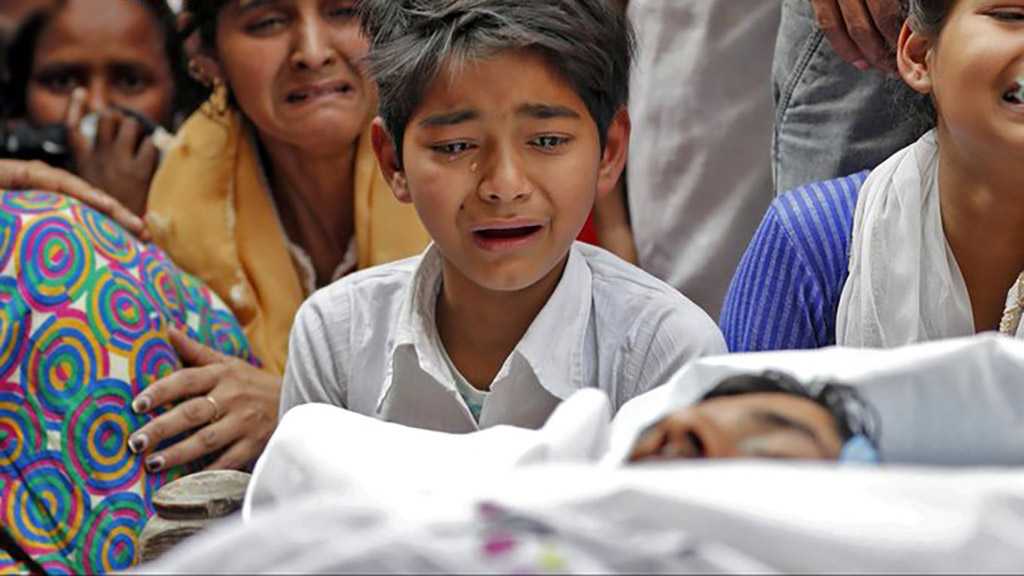
India Riots: ‘We Were Attacked Because We Are Muslim’


Yasmin, a 35-year-old mother of three, clutched her blue-and-white prayer beads as she waited at a hospital mortuary to retrieve the battered body of her brother-in-law.
A resident of a gritty New Delhi neighborhood where working class Hindus and Muslims have lived side by side for years, Mehtab, a 22-year-old construction worker, had gone out on Tuesday evening to buy milk but never returned. Hauled away by stick-wielding rioters, he was found dead hours later, his body bruised and burnt.
That night, Yasmin and her husband cowered at home as marauders threatened to incinerate their neighborhood’s Muslim-owned shops and residences.
“People were chanting slogans of Jai Shri Ram [‘Hail Lord Ram’] and saying ‘leave this house — we will set it on fire’,” Yasmin said, her voice shaking with emotion. “This is the first time I am seeing such conflict. We have always considered Hindus our brothers. [Mehtab] was murdered because he was Muslim. We were attacked because we are Muslim.”
The young laborer was one of at least 35 people killed, with 200 others seriously injured, in New Delhi this week. It was the worst outbreak of sectarian violence in a big Indian city since 2002 when more than 1,000 people, mainly Muslims, were killed in riots in Gujarat.
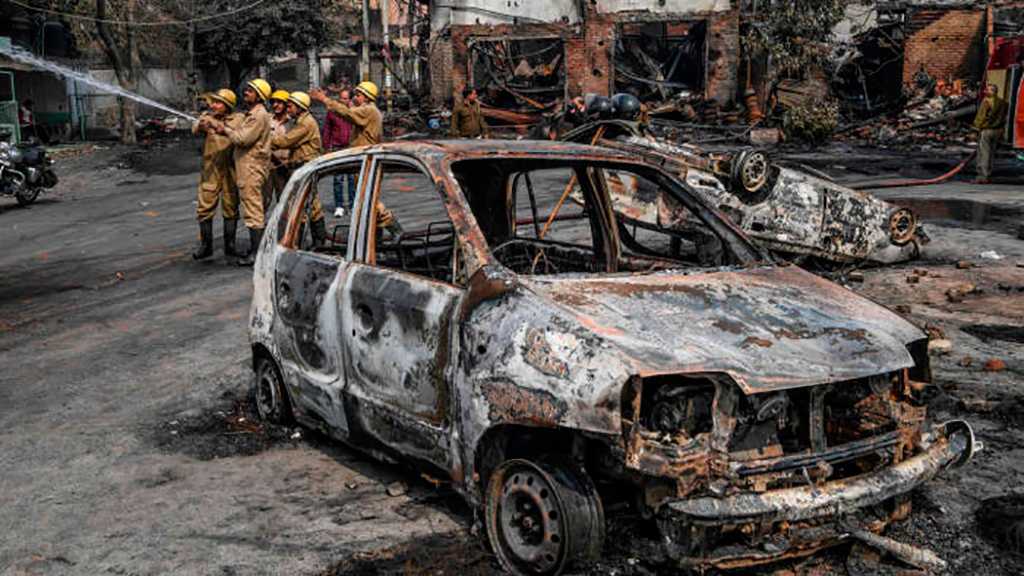
The carnage in the Indian capital — which left swaths of the city looking like a war zone, with burnt-out mosques, shops and other buildings, shattered glass and charred vehicles — follows a steady stoking of animosity between India’s Hindu majority and its Muslim minority by Narendra Modi’s ruling Bharatiya Janata Party, analysts said.
Sectarian tensions have surged since December when Modi’s government amended the country’s citizenship laws, incorporating religious criteria for the first time and giving Hindus and followers of other south Asian faiths priority over Muslims.
This week’s bloodletting coincided with a visit by Donald Trump to India, overshadowing the US president’s effusive praise for Modi. Analysts warned that the riots threatened to distract the government from the urgent task of reviving the faltering economy and realizing its ambition to become a global power.
“They’ve unleashed forces that cannot be fully controlled,” said Ashutosh Varshney, a political-science professor at Brown University. “Whether Modi and [home minister Amit] Shah can check these forces remains to be seen. Their foot soldiers on the ground are filled with the ideological fervor that has been drilled into them — the tropes of Hindu nationalism that see Muslims as enemies of India.”
Trouble in the affected area flared on Sunday after Kapil Mishra, a hardline local BJP leader, threatened Muslims who were blocking a road in an otherwise peaceful protest against the citizenship law. Addressing a crowd of rightwing Hindus right next to the sit-in, he warned that if the protesters were not gone by the time Trump’s visit was over, they would take matters into their own hands.
Shortly afterwards, witnesses said, groups of Hindus and Muslims began pelting each other with stones. By Monday, large areas were in the grip of a full-scale riot, with mobs of Hindu men, carrying firearms, petrol bombs and iron rods, marauding through the area’s congested streets, attacking passers-by and setting fire to property they suspected of being Muslim-owned.
“They were asking for identity cards to see if they are Hindu or Muslim and if they saw Muslim people they beat them,” said Abul Kalam, a 60-year-old salesman who was riding his motorbike with a Hindu colleague when they stumbled on the rioters.
In a grim echo of the violent 1947 partition of India — in which up to 2m people are thought to have died — rioters questioned people over their religion, demanding they recite prayers, show religious symbols or even pull down their trousers… said one social activist.
Witnesses said police appeared to do little to stop the rioters.
Mazid, a 32-year-old shop owner, said he and his neighbors on a mixed Hindu-Muslim street were standing together trying to protect their homes on Tuesday evening when they saw a crowd, accompanied by police officers, coming towards them.
“Police were with them and we thought maybe they will stop the violence, but then [someone] fired the shots,” said Mazid. His brother was killed and two neighbors were injured in the gunfire.
On Wednesday morning, Modi’s government, which has control over policing and is responsible for security in the capital, deployed thousands of additional paramilitary police to the riot-stricken areas to try to restore order. That afternoon, Modi took to Twitter to appeal for peace — his first public acknowledgment of the violence.
But even amid the strong police presence, tensions remained high, with many families fleeing to seek refuge with relatives elsewhere.
“People are afraid — they are leaving their homes,” said Shankar Thakur, a 28-year-old teacher. “The mobs who are coming, the police have no power to defeat them.”
Many are also questioning why it took the government so long to clamp down. “Historically, communal violence in India is never the result of weak state capacity,” said Gilles Verniers, a political-science professor at Ashoka University, near Delhi. “The state tends to prevent violence from erupting when it has the intention to do so.”
Analysts said the rioting may not be as severe as other urban violence that has rocked India. But the government’s apparent tolerance of two days of unchecked bloodshed had sent a powerful signal to a Muslim community that already felt under siege, they said.
“The violence has already served its purpose,” said Verniers. “It has asserted Hindu dominance and claimed ownership of the public sphere.”

River to Sea Uprooted Palestinian   
The views expressed in this article are the sole responsibility of the author and do not necessarily reflect those of the Blog!