Showing posts with label Shalom. Show all posts

Sunday, 30 May 2021

Lost in (Hebrew) Translation

lost in Hebrew Translation.jpg

by Gilad Atzmon

 Those who follow my work are probably familiar with the idea that there is no modern Hebrew word for peace (meaning harmony and reconciliation). The Hebrew Word Shalom (שלום) is interpreted in modern Hebrew as ‘security for the Jews.’ In Israel the reference to ‘shalom negotiation’ is construed as a premeditated set of conditions that guarantees ‘security’ for Jewish Israelis by means of: secure borders, disarmament of the Arabs, an American commitment to supplying arms to Israel, economic expansion and so on.   

It would be unreasonable to expect a culture that lacks a lucid notion of peace and reconciliation to lead the region towards harmony and human brotherhood. The truth of the matter is that even in the delusional heydays of the Oslo Accord, when some were foolish enough to believe that peace was about to prevail, the so-called peace enthusiasts amongst the Israeli decision makers (Shimon Peres & co) advocated the phantasy of a “New Middle East,’ a vision of a regional new order: an economic cooperation with the Jewish State at its very centre. The ‘dream’ of a ‘new Middle East’ entailed a coalition of so called ‘democratic states’ defying ‘Khomeinism’ by means of Western orientation and hard capitalism. Though the globalist agenda was clear to Shimon Peres, the one ingredient he managed to skip was the Palestinians and their prospects of returning to their land, orchards, fields, villages and cities.

Shalom in its contemporary Hebrew meaning, is a judeo-centric concept that is blind to otherness.

The recent conflict in occupied Palestine (especially the clashes in Israeli/Palestinian mixed cities) brings to light another crucial concept that has been lost in translation into modern Hebrew.

Often enough we hear from Israelis officials and Hasbara spokespersons about ‘Israeli/Arab coexistence.’ Yet, bizarrely enough, there is no Hebrew word for coexistence. While the English concept of coexistence refers to an harmonious and peaceful existence of two entities or more, the Hebrew word for coexistence is du ki-yum (דו קיום )Du ki-yum literally translates as twofold – existence, it refers to two entities that live side by side. Du ki-yum sustains the differentiation and particularity of its elements. In du ki-yum the elements stay apart, separated or even segregated. The notion of du ki-yum practically sustains the binary distinction between the ‘Jew’ and the ‘Goy.’ While coexistence is a synonym for harmony, togetherness and assimilation, du ki-yum, defies the possibility of human brotherhood. It points at success in ‘conflict management,’ presenting a prospect of living ‘alongside’ rather than ‘together’.

I guess that at this point no one will be surprised to find out that there is no word in Hebrew for harmony either. The first Israelis, who worked day and night to revive their biblical language and rename every possible Latin and Greek concept, didn’t bother to find a Hebrew word for harmony. When Israelis refer to harmony they deploy the Latin word harmonia (הרמוניה).

When we attempt to delve into the prospect of peace in the region, we may have to accept that a culture lacking notions of peace, harmony and coexistence may not be able to lead the region towards harmonious and peaceful coexistence. If peace ever prevails between the river and the sea, it is because Israel has surrendered to accepting its meaning.


River to Sea Uprooted Palestinian   
The views expressed in this article are the sole responsibility of the author and do not necessarily reflect those of the Blog!

Saturday, 4 May 2019

US “Deal of the Century” Eliminates Two-state Solution

Capture
May 3, 2019
US president’s son-in-law and advisor Jared Kushner said that the upcoming ‘peace’ plan (“Deal of the Century”) will not include a two-state solution to the Palestinian-Israeli conflict, considering that it has not worked out during the previous rounds of talks.
Speaking at the Washington Institute for Near East Policy, Kushner said that the creative ideas must be suggested to reach a solution, rejecting to reveal more details.
So far, US has carried out some of the Deal of the Century’s dangerous stipulations by acknowledging Al-Quds as the capital of the Zionist entity and annexing Syria’s Golan to ‘Israel’. It also stopped aiding the United Nations relief agency for Palestinian refugees in preparation for naturalizing them in the host countries.
Kushner pointed out that Washington would mull annexing the Zionist settlements in the West Bank with the Israeli officials after the formation of their government.
Related Videos
Related Cartons
Image result for two state solution abbas carton
Related image
Image result for treason abbas carton

River to Sea Uprooted Palestinian   
The views expressed in this article are the sole responsibility of the author and do not necessarily reflect those of the Blog!

Friday, 7 December 2018

Israel and the normalization: Golan is on one scale and the Gulf is on the other scale Israel and the normalization: Golan is on one scale and the Gulf is on the other scale «إسرائيل» والتطبيع: الجولان في كفّة والخليج في كفّة


Israel and the normalization: Golan is on one scale and the Gulf is on the other scale

ديسمبر 5, 2018


It was clear the American-Israeli endeavor for arranging the visits of the senior Israeli officers to the Gulf, who wander victorious between mosques and palaces is because there is no Palestinian political hope in fulfilling Jared Kushner’s dream “the success of the Saudi Crown Prince in securing the Palestinian partner to sign the waiver of Jerusalem and the right of return”. These humiliating visits to the Gulf governments which participated in their arrangements will not change the fact that the fate of the Palestinian cause and the balances on which it is based is for the Palestinians and that the Gulf money and the Arab influence are operated when they accompany the Palestinian mood that represents at least half of the Palestinians. Therefore, the Gulf normalizing partnership is used to compensate the deadlock resulted from the strength of the Palestinian popular steadfastness which restricts the leaders in their own borders. The normalizing compensation is essential at a moment of existential concern at the level of public opinion in the occupation entity and in the heart of a psychological warfare entitled suppression of the awareness and making awareness between the leaders of the entity and the forces of the resistance, it depends on two equations one tells the settlers that your entity will be dispersed, so do not be reassured, it tells the Palestinians and the people of the region that there is no longer defeats, now it is the time of victories, and the other tells the settlers that now we became a normal entity as the region entities, so do not worry, it tells the Palestinians and the people of the region that there is no advantage from arrogance, the recognition of Israel is a fait accompli that achieves success among the Arab rulers.
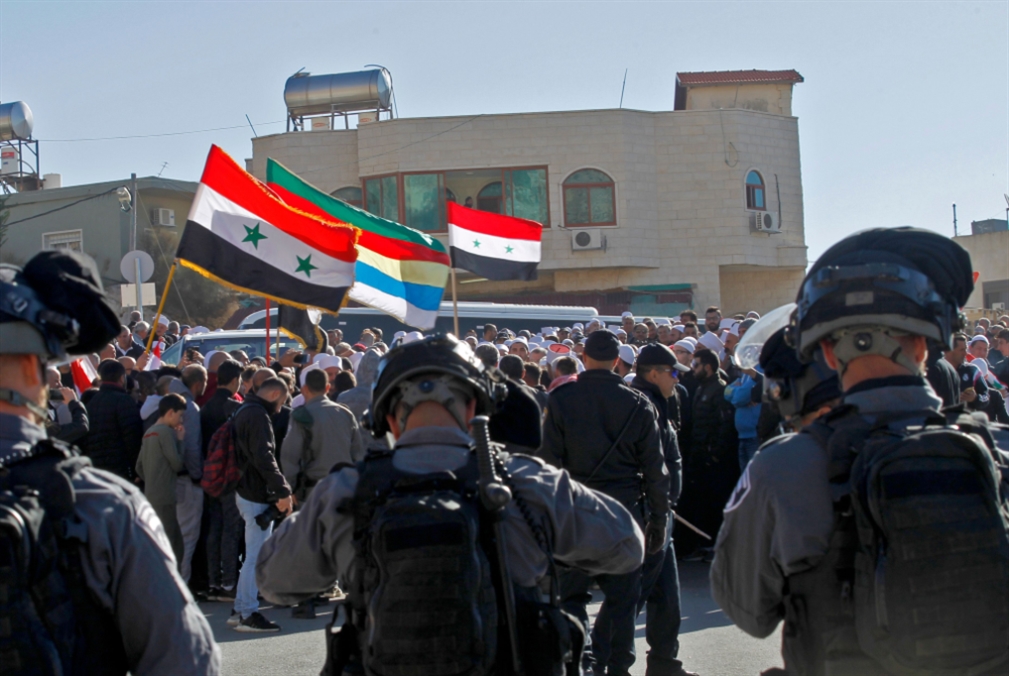
The measurement of the normalization path and its impact on the two Arab and Israeli confrontation fronts is seen in the popular field and in how to behave under the effect of that normalization. It was shown clearly in Golan, where there was the occasion of the local elections organized by the occupation entity, and where it included the occupied Arab Syrian villages and towns, and the same in the Arab Palestinian occupied towns in Galilee. The villages and the towns of Galilee witnessed confrontations with police in opposition of the elections, while Golan witnessed comprehensive uprising that prevents holding the elections as an expression of the sticking to the Arab Syrian identity and a refusal of any kind of normalization with the occupation entity. The Israeli mass media said that the supports of the Syrian President Bashar Al-Assad won the round against Israel inside Golan, despite the fact that some of those who glorified the intifada of Golan wanted to ignore the political identity of the Arab Syrians in Golan as stickers to their country, president, and army. This means that this uprising in Golan that coincided with the visits of normalization shows that the resistance forces are winning the psychological warfare and that the visits of normalization are without avail and that when Golan was versus the Gulf, Golan won by the knockout.
The leaders of the occupation entity know that there is no benefit from the Gulf receptions unless it is spent politically and morally inside the occupied territories whether among the Arabs or among the settlers. They say that the settlers’ eyes are observing the Golan, they say that there is no benefit from visiting any Gulf country, since they cannot go back to sleep safely in the geography on which the entity is based, while the Arabs in the occupied territories say that the Arab identity is not represented by those who accepted the normalization and that they belong only to those who raise the flag of the resistance among the Arabs, furthermore, they are boasting of their identity which embodies this spirit, no one can affect their steadfastness neither prince, nor king, nor sultan. They are proud of their own Arabism.
Translated by Lina Shehadeh,

انتفاضة تُسقط «الانتخابات»: لا «مجالس إسرائيلية» في الجولان


«إسرائيل» والتطبيع: الجولان في كفّة والخليج في كفّة

ناصر قنديل

– كان واضحاً المسعى الأميركي الإسرائيلي من ترتيب الزيارات الخليجية الصاخبة لكبار المسؤولين الإسرائيليين، يختالون بنشوة المنتصر بين المساجد والقصور، أن لا أفق سياسي فلسطيني يسمح بتحقيق حلم جاريد كوشنر بنجاح ولي العهد السعودي بتأمين الشريك الفلسطيني الوازن للتوقيع على التنازل عن القدس وحق العودة. وأن هذه الزيارات الاستعراضية المهينة للحكومات الخليجية التي شاركت في ترتيبها، لن تغير في حقيقة أن مصير القضية الفلسطينية والتوازنات التي تؤسس عليها لا يزال بيد الفلسطينيين، وأن المال الخليجي والنفوذ العربي يشتغلان عندما يواكبان مزاجاً فلسطينياً يمثل على الأقل نصف الفلسطينيين، فتمّ استعمال الشراكة الخليجية التطبيعية تعويضاً عن انسداد الأفق أمام الخطوات المرتجاة التي صارت أبعد فأبعد، بقوة الثبات الشعبي الفلسطيني الذي أغلق الأبواب على القادة واحتجزهم في مربع لا يمكنهم تخطّي حدوده. والتعويض التطبيعي جوهري بالنسبة لكيان الاحتلال في لحظة قلق وجودي على مستوى الرأي العام في كيان الاحتلال، وفي قلب حرب نفسية عنوانها كي الوعي وصناعة الوعي تدور رحاها بين قادة الكيان وقوى المقاومة، عنوانها الصراع بين معادلتين، واحدة تقول للمستوطنين كيانكم إلى زوال فلا تطمئنوا، وتقول للشعب الفلسطيني وشعوب المنطقة، ولّى زمن الهزائم وجاء زمن الانتصارات، وأخرى تقول للمستوطنين ها نحن قد أصبحنا كياناً طبيعياً من كيانات المنطقة فلا تقلقوا، وتقول لشعوب المنطقة وللفلسطينيين لا جدوى من المكابرة فالاعتراف بإسرائيل كأمر واقع يحقق النجاح بين الحكام العرب.

– القياس لاختبار المسار التطبيعي وتأثيره في جبهتي المواجهة العربية والإسرائيلية يكون في الميدان الشعبي وكيف يتصرّف، وهو تحت تأثير تلقي المشاهد التطبيعية، وقد جاءنا طازجاً من الجولان، حيث كانت مناسبة الانتخابات المحلية التي ينظمها كيان الاحتلال، وتشمل القرى والبلدات العربية السورية المحتلة، ومثلها قرى وبلدات عربية فلسطينية محتلة في الجليل، وفيما شهدت قرى وبلدات في الجليل مواجهات مع شرطة الاحتلال رفضاً للانتخابات، شهد الجولان انتفاضة شاملة منعت إجراء الانتخابات، تعبيراً عن التمسّك بالهوية السورية العربية، ورفضاً للتطبيع مع كيان الاحتلال، وخرجت وسائل الإعلام الإسرائيلية تقول إن أنصار الرئيس السوري بشار الأسد ربحوا الجولة على إسرائيل داخل الجولان، رغم أن بعض الذين صرّحوا بتمجيد انتفاضة الجولان أرادوا تغييب الهوية السياسية للعرب السوريين المنتفضين في الجولان كمتمسكين بدولتهم ورئيسهم وجيشهم، ومعنى هذه الانتفاضة في الجولان في توقيت الزيارات التطبيعية، أن قوى المقاومة تربح جولة الحرب النفسية، وأن زيارات التطبيع تذهب هباء منثوراً، وأنه عندما وقف الجولان في كفّة والخليج في كفّة، ربح الجولان بالضربة القاضية.

– يعرف قادة كيان الاحتلال أن لا نفع يُرتجى من الاستقبالات الخليجية ما لم يتم صرفه سياسياً ومعنوياً داخل الأراضي المحتلة، سواء بين العرب أو بين المستوطنين. وهم اليوم يقولون إن عيون المستوطنين مسمّرة على قراءة حدث الجولان ويقولون ما نفع أن نزور عاصمة خليجية ولا نستطيع العودة لننام بأمان في الجغرافيا التي يقوم عليها الكيان، بينما يقول العرب في المناطق المحتلة إن الهوية العربية لا يمثّلها المطبّعون، وإنهم ينتمون فقط لمن يحمل راية المقاومة بين العرب ويفتخرون بهويتهم التي تجسّد هذه الروح، ولا يفتّ في عضدهم وثباتهم لا أمير ولا ملك ولا سلطان، فلهم عروبتهم ولنا عروبتنا.

Related Videos
Related Articles

River to Sea Uprooted Palestinian   
The views expressed in this article are the sole responsibility of the author and do not necessarily reflect those of the Blog!

Thursday, 1 November 2018

لا للتطبيع… وإنْ كانت عُمان

Enzo's+pic.jpg
Earlier today the world lost a distinguished insightful mind and I lost one of my best friends. Enzo Apicella, the greater than life, tireless cartoonist passed away in Rome this morning.
Many of my followers had a lot of fun with our A to Zion – The Definitive Israeli Lexicon. The book of alphabetic satire was Enzo’s idea. Enzo saw in me an aphorism artist–that I could get at the truth with few words. He set me to work on a collection of hard-hitting definitions and he produced the relevant cartoons. As always, Enzo illustrated the truths that can’t be reduced into words.
I met Enzo in 2011 and we stayed in close touch since then. Despite his age, Enzo was the liveliest person around. He knew how to enjoy life — wine, food, garlic and women were his existential mantra.  And Enzo delivered, he never missed a day of producing one of his hard hitting cartoons, always in support of the weak and the oppressed, often in support of Palestinians, and  critical of the English speaking empire.
The world is crippled without Enzo Apicella.
I am very sad this morning and I am certainly not alone.


Screen+Shot+2015-05-02+at+10.56.21.png


Screen+Shot+2015-05-02+at+10.51.28.png


SW.png


static1.squarespace.jpg


17352555_10158353721250032_4006783466327789089_n.jpg


 The OHE …

apicella.jpg

River to Sea Uprooted Palestinian   
The views expressed in this article are the sole responsibility of the author and do not necessarily reflect those of the Blog!

Saturday, 15 September 2018

Oslo Paved the Way to Deal of Century: "It Was A Mistake To Have Negotiated With Israel At All"

Israel's Prime Minister Yitchak Rabin and PLO Chairman Yasser Arafat conferring after being awarded, together with Foreign Minister Shimon Peres, the 1994 Nobel Peace Prize in Oslo
Buoyed by the Oslo Accords, I moved to the West Bank as a legal adviser to the PLO team. I was wrong. 25 years since that iconic Arafat-Rabin handshake, it’s clear talks are futile – and Palestinians are no closer to freedom
By Diana Buttu
September 13, 2018 “Information Clearing House” –    Twenty-five years ago this month, on the White House lawn, the lives of a generation of Palestinians changed forever when the late Palestinian leader,Yasser Arafat, shook hands with Israeli Prime Minister Yitzhak Rabin. That handshake marked the start of the Israeli-Palestinian negotiations, with promises of a new era of peace, freedom and prosperity.
25 years later, Palestinians are no closer to freedom, as Israel has further entrenched, rather than lessened, its now 51-year military occupation.
Like countless others at the time, I was optimistic that the negotiations would finally lead to Palestinian liberty as promised and based on this, I decided to move to the West Bank to work as a legal advisor to the Palestinian negotiating team. During that period, I met with countless diplomats, worked on scores of proposals and even began a house-to-house campaign to speak to Israelis about ending Israel’s military rule.
But while I and others worked to end occupation others worked to entrench it, including the Israeli government and its settlers: within the first seven years after the negotiations began, Israel used incentives to nearly double its settler population. Today, the settler population is more than three times the size it was in 1993, with nearly 700,000 settlers living in the West Bank.
Back in 1993, settlements were, for the most part, confined to hilltops, with Israeli settlers considered to be fringe. Far from being ostracized, today, some Israel’s largest cities are settlements, settlers have taken over homes in the heart of Palestinian towns and settlers command positions on the Israeli cabinet and on the Supreme Court. In short, settlers are the norm, not the exception. Today, Israeli settlers speak openly about annexing the West Bank or expelling Palestinians.
I am often asked why the negotiations process failed. It is easy to point to the rise of right-wing Israeli governments, poor leadership or weak or uninterested U.S. presidents. But the real reason for failure lie beyond these factors.
It is because the parties should not have started negotiating in the first place.
To demand that Palestinians – living under Israeli military rule – negotiate with their occupier and oppressor is akin to demanding that a hostage negotiate with their hostage taker. It is repugnant that the world demands that Palestinians negotiate their freedom, while Israel continues to steal Palestinian land. Instead, Israel should have faced sanctions for continuing to deny Palestinians their freedom while building illegal settlements.
Twenty-five years later, rather than living the joys of freedom, we mark each day, by thinking about how to maneuver the maze of Israel’s more than 500 checkpoints, put in place to accommodate Israeli settlements, just to be able to get to work or to school. A 25 year-old in the West Bank has likely never been able to visit the sea – a few miles away – while a 25 year-old in Gaza has never been able to leave the Gaza Strip, to visit friends and family in the West Bank and Jerusalem or even abroad.
It isn’t just movement of people that is affected. Palestinians have not been able to take advantage of technological progress for “security reasons” for example, as cancer treatment advances throughout the world, Palestinian hospitals are barred from acquiring radiation equipment. Even our postal system remains hostage to Israel’s whims.
But, rather than recognize the mistake of negotiations, the world continues to demand that we continue the facade even though negotiations irrevocably broke down more than a decade ago. The negotiations process has, in effect, served as cover for the world to do nothing – while giving Israel the cover to build and expand settlements.
If peace is to be achieved, it must entail costs – and this time, not shouldered by the Palestinians. Rather, Israel must receive the strong message, the first in its history, that settlements will no longer be tolerated but rather reversed, and that Palestinians must be free.
I am under no illusions that the Trump Administration will put into place such sanctions. While previous administrations tried to maintain a semblance that they were helping “both sides,” Trump has come decidedly in support of Israel’s right-wing pro-settler movement.
Whether by declaring Jerusalem as Israel’s capital or by attempting to extinguish the right of return, President Trump has shown that his “deal of the century” will undoubtedly accommodate Israeli settlements, take away Palestinian rights and reward Israeli wrongs. The closure of the PLO office in Washington D.C. this week is yet another check on Israel’s wish list.
For Israel and its supporters, the past 25 years have been a victory. With Trump at the helm, Israel’s settlers are at an all-time high, Palestinians are confined to bantustans and the U.S. is cracking down on Palestinians for demanding their freedom.
But this short-term fix has long-term implications. While Oslo changed the lives of a generation of Palestinians, this generation and the next have certainly learned its lessons: that negotiating is futile, and that our rights cannot be compromised. With this, it is only a matter of time before we begin struggling for equal rights in a single state, rather than press for statehood.
Diana Buttu is a Ramallah-based analyst and activist, and a former adviser to Mahmoud Abbas and the negotiating team of the Palestine Liberation Organisation. Twitter: @dianabuttu 
This article was originally published by Haaretz 
Related Videos
Related Articles

River to Sea Uprooted Palestinian   
The views expressed in this article are the sole responsibility of the author and do not necessarily reflect those of the Blog!

Wednesday, 12 September 2018

Transcending ‘Chosenness’: Journey of an ‘ex-Jew’


40474_GILAAD_1536594598559.jpg
GA: TRT published yesterday this extensive interview. Those who struggle with my ideas or fail to understand where I come from, may want to read this article. It clarifies where I stand on most relevant issues.

Transcending ‘Chosenness’: Journey of an ‘ex-Jew’

An interview By Nafees Mahmud
How a former Israeli citizen Gilad Atzmon left Israel and how becoming a musician helped him understand Palestinian suffering.

LONDON — If you are despised by both conservative Zionists and liberal anti-Zionists, it can only mean one thing: you are Gilad Atzmon.
Born in Israel in 1963 into a Zionist household, he saw his birthplace as the Jewish promised land and says he was expected to serve and cement the Israeli ideology of Jewish supremacy.
However, at age 17, he was mesmerised by the sounds of African American jazz musician Charlie Parker. As a passionate Israeli, this challenged what he’d believed up until that point: only Jews produce greatness.
Serving as a paramedic and musician in the Israeli military during the 1982 invasion of Lebanon, he witnessed the immense suffering of Arabs.
At this point, he says, he began to view life “from an ethical, rather than a Zionist point of view.”
Years later he moved to Britain to study philosophy and launched his career as a jazz musician. Today, he attempts to enlighten and unite people through his art.
Yet his work as a writer examining Jewish identity has seen him described as a peddler of anti-Semitic conspiracy theories. He argues that this is an attempt to censor honest analysis of, and reflection upon, Jewishness’ immense impact on mass culture, politics and global economics through the likes of The Frankfurt School and Milton Friedman.
As Israel increasingly meets international criticism and boycott, Atzmon believes his former homeland can only be seriously challenged for its injustices, if it is understood in the wider context of Jewish identity politics – a context he is trying to remove himself from. TRT World spoke to him to find out why.

TRT WORLD: As a musician, how do you feel about Lana Del Ray and many others cancelling their performances at the Meteor Festival in Israel following pleas from the BDS campaign?
Gilad Atzmon: It’s a beautiful thing.
I don’t support BDS mounting pressure on artists, but I think it is well appreciated when artists refuse to perform in states where there are so many crimes against humanity. I myself decided to boycott Israel a long time before the BDS movement was born. Since 1996, I haven’t visited my home country.
There have been major stories in the news this year regarding Israel. One of the most significant was the Jewish nation-state bill. What do you make of that?
GA: It confirms what we’ve known for more than a while: Israel is the Jewish state and everything that is happening in Israel should be understood within the context of its Jewishness. It confirms what I’ve been saying for many years. We must dig into the notions of Jews, Jewishness and Judaism to understand the difference between these three and the relationship between them.
Break that down for us.
GA: I make a clear differentiation between Jews, the people, which I regard as an innocent category; Jewishness, the ideology; and Judaism, the religion.
I argue that both Jews and Judaism are innocent categories. The fact you are born a Jew doesn’t make you a war criminal or a supremacist. Also, Judaism is a relatively innocent notion. We know the only genuine Jewish collective who really operate actively for Palestine are Torah Jews, Orthodox Jews.
When it comes to Jewishness, this is complicated.  I had a debate about this with a supremacist Jew yesterday and his argument was there is no such thing as Jewishness – it changes along the years. I couldn’t agree more, elasticity is inherent to Jewishness.  One thing that remains constant is the exceptionalism. Jewishness is different explorations of the notion of “chosenness.
” Some Jews feel they are chosen because they are elected by God, some Jews feel they are chosen because they are Bolsheviks, and a week later they can feel chosen because they are supporting a free market – like Milton Friedman. They can feel chosen because they are religious, and they can feel chosen because they are secular. It is this exceptionalism that is the core of “chosenness,” that is racially driven, that I believe is the common ground for all Jewish cultures.
This is why I have never in my life referred to Jews biologically, nor as a race, nor ethnicity. But I believe supremacy is something that is essential to Jewishness. This is why instead of talking about “Jews” I talk about the people who identify “politically” as Jews.
Gilad Atzmon (Tali Atzmon/)
You’ve made a 180 degree turn from what Israel represents, but tell us about your childhood during which you say you were heavily influenced by your Zionist grandfather.
GA: I don’t think you can talk in my case about 180, 45 or even 360 degree turns. I see my role as a philosopher, and as a philosopher, my job is to refine questions rather than subscribe to or recycle slogans. I’m working now on Zionism, and I find – this is interesting – you’ll be the first one I explore this idea with. I grew up in a society that saw itself as a revolutionary society. I was subject to an ultranationalist upbringing driven by complete contempt towards the diaspora Jew, something I didn’t understand because I was growing up in Israel and I didn’t know any diaspora Jews. But the diaspora Jews were seen by us as a bunch of capitalists, unsocial abusers of the universe, and we were born to become ordinary people – workers. My father was a hard-working man, my mother was a hard-working woman and I was raised to be a hard-working Israeli.
Unlike the diaspora Jews who went like lambs to the slaughter in Auschwitz, we were raised to fight and, accordingly, I was happy and looking forward to dying in a war. This was my upbringing. Let me tell you: when the war came, I wasn’t sure if I wanted to die for Israel. I started to understand that something wasn’t right.
Now, I never understood what the problem was with the diaspora Jews. All I knew was that when you immigrate to Israel, we called it aliyah. Aliyah means ascending. If you leave Israel and become a diaspora Jew, it is called yerida – descending. So here, you already see within Zionism an internal concept of “chosenness;” so the Israelis are the “uber-chosen.”  What I do understand, nowadays, looking at the shift that happened in Israel after 1967, Israel gradually stopped seeing itself as the Israeli state and more and more as the Jewish state. The dichotomy between “us” the special emancipated Israelites and the diaspora Jews started to disappear.
As we became a Jewish state, we started to adopt more and more Jewish symptoms. We became victims, we started to cry about the Holocaust. When I was young, we looked at the Holocaust with contempt. We looked at the Jews who went like lambs to the slaughter with contempt. If you don’t believe me, read Tom Sergev: The Seventh Million. It’s about the million who survived the Holocaust, how badly they were treated in Israel. There are films about it. My parents tell me, and you can hear it from a lot of people, that they were not allowed to play with or bring home young survivors of the Holocaust. They were looked upon by the Israelis at the time as sub-humans. There is a film about it: Aviya’s Summer.
What I understood recently is that I was initially very enthusiastic about this Israeli revolution. I agreed with it.
I just wanted to be an ordinary human being. But as Israel was transforming into a Jewish state, I had to leave the country.
What were you taught at school about the creation of Israel?
GA: We were misled. We were told the Palestinians left willingly. I didn’t hear the word nakba until the late nineties. However, when I was in Lebanon in 1982, I started to see all the refugee camps. I started to dig into it and I realised the scale of the ethnic cleansing.
Can you share some of the things you saw?
GA: I don’t like to talk about it. But when I saw the Israeli army in Lebanon, I understood that we were not as righteous as we claim to be and this was the beginning of my transition in the early 1980s. My journey really started there.
What was the tipping point that made you leave?
GA: Very simple – the Oslo Agreement of 1993. Until that point, there was a common belief that we, the Israelis, wanted peace. When I look at the peace deal that was imposed on the Palestinians, I realised by then the Palestinians were the ones expelled from the country that I believed to be mine. I understood then that we don’t mean peace, that what Israel means by peace is security for the Jews.
This is why I am not hopeful. You will not hear me talking about resolution. Israel will be defeated into a solution by the facts on the ground.
How did music change you? It’s part of your journey away from Israel, isn’t it?
GA: It was the first time I understood that I can join a discourse that is universal – aiming at beauty – rather than being a part of an ultranationalist tribal ethos. If jazz was the music of the oppressed, I gladly joined the oppressed and learned their language and I made it into quite a successful career.
How does being a jazz musician aid your philosophical work?
GA: In my thirties, I tried to integrate Arabic music into my jazz. By then I could pretty much play any kind of music, but I realised how difficult it is for me to play Arabic music which is surprising because I grew up with Umm Kulthum, the Egyptian singer, all around me.
I found it really difficult. But then I realised that in Arab music it’s all about the primacy of the ear, as opposed to Western musical education where they put you in front of notes and you have to learn to translate the primacy of the eye. The West is obsessed with the primacy of the eye but humanity is all about the primacy of the ear.  Primacy of the ear is where ethics starts. We have to listen to each other. I made a huge effort to listen to the Palestinians and understand their plight. If you were a Jewish journalist you would say: “What about listening to the Jews?” I say listening to the Jews is not necessary because you get it all over – from the media to the Holocaust museums. But Gaza, Syria, Iraq, Libya is the holocaust that is most relevant for us now.
Tell us about some of the thinkers, philosophers and activists who have influenced you?
GA: I am disgusted by most forms of activism and I think activists have very little to contribute to our understanding. This is why they achieve nothing.  They are part of the controlled opposition. I ended up learning German philosophy. I started with Immanuel Kant and what I took from him is the ability to refine questions. Then Hegel, Nietzsche and most important, Heidegger who is the ultimate master in refining questions, and this is what I do. By refining questions, I can see the answers are flexible. They are changing as the questions are shifting.
Heidegger was about “being,” right?
GA: Obviously, but being is the goal. How do you reach the understanding of “being,” if ever? Through questioning. What is “being?” What is that thing that is unique, most fundamental to us human beings? What he called dasein. This “Being,” with a capital B, that we can never touch.
So, what were you told “Being” was when you were growing up in Israel?
GA: I guess that being an Israeli meant, at the early stage of my upbringing, being forceful, being determined, fighting for what you believe in and the willingness to sacrifice for that goal. Believe it or not, in that sense, I am 100 percent Israeli and I had to leave Israel because Israel was not Israel anymore. It stopped being Israeli. It became Jewish, and Jewishness is celebrating victimhood which is something that I would never do. I prefer to die than be a victim.
How do you describe yourself now?
GA: I aim at a universal understanding of humanism. To be a universal humanist is a challenge for everyone, it’s a task rather than a state of being. It is being inspired by the ability to see yourself as an ordinary creature. To remove yourself from any sense of privilege.
Universal humanism is not the human rights declaration, not a set of commandments. It’s an organic thing that is changing all the time and is finding itself to be more and more inclusive, and this is why you can only aspire to become one and work on it twenty-four seven rather than declare yourself to be one.
Is universal humanism not part of the cultural Marxist doctrine, which you find impedes human flourishing?
GA: On paper, yes. But in reality, definitely not. The new left, cultural Marxists – the Frankfurt School – are all people in the open who define who is in and who is out.  They invented no platforming. How can people who adhere to no platforming be universalists?
Aren’t you still seeing the world from a Jewish perspective despite trying to move beyond this?
GA: I hope not, you know. Some people would argue they see some Jewish traits in my thinking, and I accept that. The one thing that I would admit to you is that the one thing I learnt from Otto Weininger – he’s one of the people who inspired me – is that in art, self-realisation is the realisation of the world. So while a scientist looks at the world and tells us something about the world, artists close their eyes and write a poem, and through this poem we understand the world, or through a symphony – and this is the most important thing. So when I look at myself, I occasionally deconstruct the Jew that is left in me. It’s not a privilege, it’s an instrument towards developing a better understanding and a better world.
This interview has been edited for clarity

River to Sea Uprooted Palestinian   
The views expressed in this article are the sole responsibility of the author and do not necessarily reflect those of the Blog!

Wednesday, 21 February 2018

Abbas bows before UN

Palestinian President Abbas bows before UN


River to Sea Uprooted Palestinian   
The views expressed in this article are the sole responsibility of the author and do not necessarily reflect those of the Blog!