Uprooted Palestinians are at the heart of the conflict in the M.E Palestinians uprooted by force of arms. Yet faced immense difficulties have survived, kept alive their history and culture, passed keys of family homes in occupied Palestine from one generation to the next.
Tehran – Iranians are celebrating the 42nd anniversary of the seizure of the US embassy in Tehran by Iranian students and the closure of the American spy den, which acted as a central nervous system for espionage, and interference.
The leader of the Islamic Revolution, Imam Khomeini described this event as the second revolution. This day also coincides with the anniversary of Imam Khomeini’s exile from the country in 1964 and the beginning of the Islamic renaissance in Iran. Imam Khomeini led the revolution and returned to the country in 1979. The revolution of the Iranian people triumphed under his leadership.
This day also commemorates the martyrdom of dozens of Iranian school and university students who perished at the hands of the Shah’s regime during a march in front of the University of Tehran.
This year’s anniversary of the closure of the American spy den in Tehran coincides with another blow dealt to the US in international waters when the Islamic Revolutionary Guard prevented American pirates from stealing Iranian oil.
On this occasion, Al-Ahed news website sat down with a member of the Presidency of Iran’s Assembly of Experts, His Eminence Ayatollah Sheikh Abbas Al-Kaabi, who confirmed that the discourse of the Islamic Revolution presented a model for civilized jihad in the face of arrogance. This discourse, which was initiated by the honorable Imam Khomeini and continued by the Grand His Eminence Imam Sayyed Ali Khamenei is based on several elements:
1st element: Transforming weaknesses of the nation into strengths at all levels – cultural, economic, political, social, scientific, technical, defense and military
2nd element: Turning enemy threats into opportunities for development and civilization at all levels
3rd element: The cognitive view of power as a means of creating civilization not creating and producing power in order to dominate other human beings
4th element: Emphasis on the value system that starts from monotheism, justice, and human dignity and continues to consolidate the principles of ethics, development, science, religious governance of the people, and effective political participation in the light of values and morals
5th element: Removing the obstacles by combating tyrants, aggressors, corrupters, and the arrogant
6th element: Interaction with the Islamic awakening movement, restoration of nation-building and rooting the culture of resistance and the creation of civilization
7th element: The establishment of principles and values and the preservation of Islamic belief and knowledge in order to create an Islamic way of living that is compatible with Islamic values within the Islamic nation
8th element: The fight against backwardness and moving towards scientific development among the sons of the Islamic nation
9th element: Combating strife within the nation and emphasizing the strategy of unity among its sons
10th element: Focusing on the scientific and religious reference for the people of the nation in line with the requirements of the age and time
11th element: Knowledge and subordination to the righteous and intellectual leadership to create victory after victory in the face of global arrogance
12th element: Creating a new general structure for the nation and overthrowing structures, organizations, and administrative frameworks of global arrogance in international relations
13th element: Supporting independence, freedom, and movement towards achieving justice and development for Islamic peoples and countries in the face of hegemony, influence, and penetration of global arrogance
14th element: Focusing on interreligious and intercultural dialogue in the framework of monotheism, justice, and human dignity
Ayatollah Al-Kaabi concluded by saying: These 14 elements need the rise and resistance of the sons of the nation against the global arrogance system at all levels.
The discourse of the Islamic Revolution in the light of the ideas of Imam Khomeini and Imam Khamenei today created glory for the nation as well as an uprising and a movement of resistance against global arrogance. Today, we are stronger than ever, and global arrogance and its puppets in the region are weaker than ever. We are living in an era of great victories and the nation’s children pioneering resistance against global arrogance.
Leader of the Islamic Revolution His Eminence Imam Sayyed Ali Khamenei described the issue of Palestine as the main index of unity among the Islamic nations, saying if Muslim unity is realized, then the Palestinian issue will be resolved in the best way.
Imam Khamenei received the participants in the 35th International Islamic Unity Conference in Tehran on Sunday.
The meeting, also attended by the heads of the three branches of the Iranian government – judiciary, executive, and legislative – and a group of government officials, was held on the auspicious occasion of the birth anniversaries of Prophet Mohammad [PBUH] and Imam Sadiq [AS] at Imam Khomeini Hussainiyyah on Sunday morning.
“An indicator of Muslim unity is the issue of Palestine. If Muslim unity is realized, the issue of Palestine will be solved in the best way. Some Islamic governments committed a grave sin by normalizing relations with the usurping, despotic Zionist regime. They must repent and compensate,” Imam Khamenei emphasized at the meeting.
“On the auspicious birth anniversaries of the Great Prophet Muhammad and Imam Sadiq [PBUT], I congratulate the Islamic nation and the world’s free-thinking people and I send my greetings to the pure spirits of those who were martyred on the path of Islam,” His Eminence noted.
“The birth of the Prophet of Islam is in fact the beginning of a new era in humankind’s life. It’s an announcement that a new era of the divine will and divine favors for humankind have commenced,” Imam Khamenei stated.
“In any period of time, it is the believers’ duty to look at what situation they are in, what the religion expects of them, and what mission has been assigned to them. In this era, acting duly based on Islam’s comprehensiveness and the issue of Islamic unity appear to be very important,” His Eminence said.
“Islam is an all-inclusive religion. One must act according to this all-inclusiveness. Worldly political powers insistently try to limit Islam to individuals’ deeds and beliefs. The Quran rejects this in 100s of verses. Islam is active in all social, political, international areas,” Imam Khamenei underlined.
“The Islamic Unity is definitely a Quranic obligation. The unity of Muslims is not a tactical matter that some people assume we should be united in certain situations. No, it is a principle. Cooperation between Muslims is necessary. If Muslims are united, they will all be strong,” Imam Khamenei noted.
Disproportionate attention has been paid to Cirque du Soleil-style departure by the United States armed forces from Afghanistan, the scene of the West’s most dragged out heist. Clumsily-written roles for Russia, China, and others that seem to be pre-scripted are bandied about in the media (right, left, and center).
The Taliban, attired in quasi-reformed dunces and utilized as convenient props for more than three decades, have now been shoved into the center stage for their final participatory act dressed as independent defiance. Initially, they were dumbfounded with the position in which they had found themselves and kept glancing at their rears with dazed looks to figure out who was it that pushed them. If it were not so tragic for the people of Afghanistan, it would be comedic.
Here, I would like to sidestep catchpenny thrills for a moment and describe the events through a regional historical and contemporary wide-angle Iranian lens. Specifically, I would like to offer evidence that fracturing Afghanistan into what is dubbed as “zones of influence” but more accurately “fragmented infernos” is a mechanism to thrust a lethal sword into the heart of the heartland of the world[1] and to force Afghanistan to metastasize spreading instability and chaos into the entire region, and more specifically into Iran, China, and Russia, in order to unravel serious economic and political upturns and advancements.
There are two overarching goals for the West, US/England to be exact, to achieve. One is to “buy time” to recuperate economically, militarily, and politically while trying to keep the rising powers down. In an article was titled “Injustices Deadline and a Nation’s Ajal” published by the Saker last year, addressed the whole “buying time” preoccupation (See Here). In that article, I discussed why I believe the AngloZionist regimes’ time is up. The other overarching goal is to disperse and reposition the Resistance forces away from the vicinities of the Occupied Palestine/Zionist Regime west of Iran to Afghanistan in its east.
Afghanistan is a major keystone species in this ecosystem. Disintegration of Afghanistan means the new “Silk Road” will first turn into a “Rough Road” and then into an “Abandoned Road” and ultimately destroys the concord among the main players in Asia. In addition, it can serve as a tool for the application of internal-external clamp-style customized and separate pressures on Iran, Russia, China, and other countries in the region.
When the Taliban took over Kabul and the US military put its full power on display last month, Ayatullah Khamenei likened their newly emerging image as a deceitful fox. He stated:
“To be fair, [US] America, behind the scene of diplomacy, is a savage wolf. The appearance is diplomacy, smiles, and talks, occasionally self-righteous and seemingly truthful talks. But in its essence, it is wolf, a wild savage wolf that one sees around the world. Of course, sometimes it takes different shapes, sometimes a wolf and sometimes a deceitful fox, a manifestations of which has been put on display in Afghanistan today.”[2]
Very well. In this article, I would present information and discuss key players in Afghanistan from an angel I have not seen discussed in other essays. First though, I would conceptualize the image of the events (and the crux of this article) in the collage below (I am not a good artist). We shall see what unfolds amounts to unzipping or zipping up.
Afghanistan: Unknown Demographics
Notable facts on the ground regarding Afghanistan are helpful in understanding the past, deciphering the present, and predicting the future. There are some facts & figures, like demographics, that serve as foundations for quantitative analysis of things. These figures must, therefore, have certain level of reality and accuracy.
Take any source of information regarding Afghanistan’s demographics, be it the UN, the CIA “fakt” book, World Bank, IMF, etc. Take any analytic and/or opinion article that uses maps and figures containing descriptive data on ethnicity, religion, and geographic distribution of people in Afghanistan. Let’s take a look at an article posted on this very blog as an example:
“Before the 1979 Soviet incursion and the 1980s jihad, that accounted for 40% to 55% of Pashtuns, 35% to 45% to Persian-speaking ethnic groups, and 10% to 15% to Turkish-speaking ethnic groups. It hasn’t changed much since.”
Let us look at a critical fact as well: In the history of Afghanistan, there has been absolutely no official or unofficial census count taken in full. Ever. Efforts undertaken by Soviet Union for an official population census count that began in 1979 amounted to little, the endeavor was aborted, data collection was abandoned midway, and the whole project was left unfinished.
Another decision was made by the so-called transition Afghan government in 2008 to take a count. The efforts then, too, suffered early miscarriage. A third attempt, planned and funded by the United Nations’ Population Fund in 2013 began a door-to-door census count beginning with the “most secure” districts at the time. That attempt ended in abortion in the first trimester. These are the facts on the ground.
In a 2013 article with a rather telling title, “Afghan census dodges questions of ethnicity and language,” The Guardian reporter, Emma Graham-Harrison wrote:
“[T]he complexity of Afghanistan’s ethnic politics means any kind of counting is controversial. The first results, from normally calm central Bamiyan province, showed an actual population barely half official estimates. The area is mostly home to Hazaras, a Shia minority who have often been persecuted in Sunni-dominated Afghanistan, and many took the findings as another form of attack. ’Death to the enemies of Bamiyan! The statistics are wrong!’ shouted more than 1,000 demonstrators as they marched on UN offices in the small town this summer, the Pajhwok news agency reported. A previous attempt to end the decades-long wait for a count of the Afghan people, in 2008, was scrapped, with the government citing security problems. In December officials even dropped plans to unveil a new estimate of the population.”[3]
Things are, of course, even more interesting than they appear. The Guardian article I cited above included a reference to a 170-pages 2012 report by Center for Strategic and International Studies (CSIS). In there, I came across a particularly noteworthy, albeit flippant, remark. It states,
“Several sources for detailed data on Afghanistan provide an amazing amount of precision for a country at war, that has had massive population displacements, and that has been in a crisis or civil war for more than three decades. The fact that such data are generated, however, in no way makes them reliable or useful. Trend data are particularly suspect because many past estimates are either made long after the fact, or rely on estimates that had to be made at a time when the Afghan government either did not have any real sources for such data, had nothing approaching its current CSO [Central Statistics Organization], and/or did not have a functioning presence in many districts throughout the country.”[4]
Even for the partial attempts of telephone or door-to-door surveys by young locals hired for the task, CSIS report is even blunter:
“This is particularly true when the analysis does not provide maps of the collection effort or relies on phone sampling and interview numbers where the collector is effectively paid by the claim or simply for providing output, and not by a validated collection effort. Corruption is not simply the privilege of senior power brokers and the wealthy.”
If precise and accurate demographic information do not serve an important function in our assessments, then we should not base any of our assessment on that. If, however, they do, it would be a good start to say, “We really don’t know what percent of who is where.” Even more importantly, if this information were not that important and guestimates with wide margins would have sufficed, why were so many attempts made and why did they all fail? Assumptions based on non-existing data are counter-productive to deep understanding of things.
At any rate, I recommend a thorough read of the above somewhat dated (almost a decade old) CSIS report for those who are interested to see into what sort of a quagmire the US had gotten itself which had become quite evident in the very first years. In addition, it gives clear and detailed description of how and why the US/West plan for Afghanistan had already fallen apart. The report exudes frustration since billions upon billions of funding were tied to specific population sub-groups, regions, and the like, all adorned with extremely meticulous stats that were fabricated year after year:
“Unfortunately, however, no one knows how much outside money is being spent on, much less inside, Afghanistan. There are no reliable figures for how the US and other ISAF countries are actually spending on the war. Moreover, there is a major security aspect of this issue. In early 2011, the US and ISAF were planning on spending some $7-9 billion a year after Transition in 2014 on the ANSF for a force of over 300,000 through 2020 – most of the financing coming from the US. As of June 2012, the US was talking about a total of $4.1 billion a year for a force of 230,000, with only 25% to come from the US, 50% from other donors, and 25% from the Afghan government. This may be a more credible and sustainable figure, but it presents a real risk that Afghanistan cannot sustain the forces it needs and will see large numbers of young men with arms and military/police experience thrust back on an economy that cannot give them anything like the same job opportunities or income.”
The plan and process appear to have been set up to fail right from the beginning.
The Taliban
Ethnically, the Taliban is Pashtun, with an apparent twist. On January 17, 2010, The Guardian headlined a report titled: “Pashtun clue to lost tribes of Israel: Genetic study sets out to uncover if there is a 2,700-year-old link to Afghanistan and Pakistan.” An excerpt from the article read:
“Some leading Israeli anthropologists believe that, of all the many groups in the world who claim a connection to the 10 lost tribes, the Pashtuns, or Pathans, have the most compelling case. Paradoxically, it is from the Pashtuns that the ultra-conservative Islamic Taliban movement in Afghanistan emerged. Pashtuns themselves sometimes talk of their Israelite connection, but show few signs of sympathy with, or any wish to migrate to, the modern Israeli state. Now an Indian researcher has collected blood samples from members of the Afridi tribe of Pashtuns who today live in Malihabad, near Lucknow, in northern India. Shahnaz Ali, from the National Institute of Immunohaematology in Mumbai, is to spend several months studying her findings at Technion, the Israel Institute of Technology, in Haifa.”[5]
Allow me to give a bit of background so that you could better contextualize the events. In the past few decades, projects to “Jewrize” several local populations in India, that is, to convince them they are actually one of the lost tribes of Jews and revert them back to becoming Jews, appeared to have been going rather smoothly.
Shavei Israel, a supposed non-profit organization, “has been spearheading the movement to bring back Jews from the lost tribe looking to immigrate to Israel and have coordinated the aliyah (immigration) of most of the Bnei Menashe community members living in Israel”[6]. On May 31, 2021, it was reported that: “Some 160 Jews from the north-eastern Indian community of Bnei Menashe reached Israel on Monday but 115 others were left behind in India after 38 of them tested positive for COVID-19, according to authorities here.”[Ibid]
I must also note that evidence on the ground, however, shows the communities inside Israel are not that receptive to this sort of “grafting” and, in fact, said efforts have had destabilizing effects inside the Israeli society itself. On the other hand, in the communities within India, where a noteworthy number of people have been convinced of their “Jewish” origin 27 centuries later, good many have been trained to serve as 5th columns, pressure levers, and sticks over Indian government’s head.
Since 1970’s into 1980’s, Israel has been busy with similar projects to wake the Pashtuns in Afghanistan and Pakistan to their “Jewish” origins. Just a few days ago, on September 9th, 2021 to be exact, the Jerusalem Post ran an article titled: “Are the Taliban descendants of Israel?” The article goes on to assert:
“The Pashtuns, or Pathans, are said to number in the tens of millions, with the bulk living in Pakistan, Afghanistan and India. They consist of several hundred clans and tribes that have fiercely preserved their heritage amid waves of foreign conquest and occupation. Prior to the rise of Islamic fundamentalism in the region, many of the Pashtuns declared themselves to be what they referred to as Bani Israel (Sons of Israel), an oral tradition that their ancestors passed down through the generations.”
“The mere possibility of a shared historical identity could serve as a basis for discussion between Jews and Pashtuns, one that could lead to a dampening of hostility and suspicion and perhaps lay the groundwork for a stronger relationship in the future. In light of their fanatical theology, the Taliban are of course not an address for such efforts. But there are plenty of other Pashtuns worldwide with whom we should seek to build bridges, whether or not one believes them to be our long-lost cousins.”[7]
There your have it, Taliban! Your “cousins” are knocking. What’s going to be? While Taliban is pondering “to be or not to be” a Zionist or a Zionist puppet, at the least, a bit more specific background might be useful. An Iranian specialist on Afghanistan, Muhammad Ruhi, who was interviewed by IRIB a few months back, stated: “During 70’s and 80’s, Zionist organizations conducted significant activities to ‘Jewrize’ various Pashtun tribes of Afghanistan by employing and developing young Pashtuns in Beirut, Lebanon, and some other Western countries.”[8]
A well-known character who benefited from those sorts of activities was none other than Zalmay Khalilzad. An anthropologist who was formerly with Northern Illinois University, Dr. Muhammad Jamil Hanifi, who is also a contributor to the website Khorasan Zamin, wrote an essay (2015) titled: “Afghanistan in the Claws of Zionized Imperial Feminism.” In that essay, he referenced Khalilzad’s and Ghani’s past and presented interesting thoughts on the role they and their respective Zionist wives have been playing in Afghanistan. The essay followed the broadcast of an interview Rula Ghani (Ashraf Ghani’s wife) had done with BBC. Hanini stated,
“Rula Saade Ghani’s desire for Afghan men to become like her father or husband, her aspirations to Christianize the women of Afghanistan, her demand of more respect for Afghan women, and her consciousness about the presence of Judaism (see below) in her matrilineage, offer an opportunity to speak to her laments, longings, and aspirations and to identify and historicize the social context in which her cosmologies for changing social life in Afghanistan were constructed. An important layer of this context consists of a quartet: two Kabuli young boys—Ashraf Ghani Ahmadzai and Zalmay Khalilzad—seeking “higher education” and two hypermodern young women—Rula Saade, a Europeanized Lebanese Zionist Christian and Cheryl Benard, a Euro-American staunch Zionist Jew. All four contemporaneously attended the ultra-liberal American University of Beirut (AUB) during the early 1970s. Ashraf Ghani and Zalmay Khalilzad are prominent names in the American political discourse about the occupation of Afghanistan from its first step during October 2001 to the present.”
“Here I wish to draw attention to the young women (especially Rula Ghani) in this quartet and reflect on how these two women and the two Kabuli boys coalesced into one of the most influential bands of Zionized feminists and feminized compradors in the service of the American imperial savagery in Afghanistan. How did two Western-struck Kabuli boys and their Western Zionist wives end up playing such crucial roles in the bloody American destruction of Afghanistan? Specifically, how did a Westernized hypermodern fiery feminist Lebanese Christian woman (with Zionist genes) end up being the “banu-ye awal” (Farsi, first lady) of Afghanistan being interviewed by the BBC in the presidential palace of Afghanistan?” [9]
It is useful to remember that Zalmay Khalilzad was in charge of negotiation with Taliban and served under Bush, Obama, Trump, and Biden until he fully handed Afghanistan back to Taliban.
Just as a side note, it might be interesting for you to note that Wikipedia reports the following information about Dr. Hanifi, the author of the essay quoted above:
“Hanifi received his Master’s degree from Michigan State University, and his Ph.D. from Southern Illinois University, Carbondale. Hanifi was a faculty member at Northern Illinois University and under consideration for the chairmanship of the Department of Anthropology when allegations of plagiarism in his dissertation surfaced. He wound up resigning from the university. He is no longer affiliated with the Department of Anthropology at Michigan State University.”[10]
People in the US have “freedom of speech” but whoever interpreted it to mean “freedom of consequences of speech” is beyond me.
It is well beyond the reasonable length of this essay to go into more details. I think there is enough material to give the gist of events that are unfolding. I would like to go back to the Muhammad Ruhi’s interview referenced earlier and quote him in the conclusion of his interview in which he summed the situation with a question posed to Taliban:
“This is a critical test to verify the truthfulness of Taliban’s knowledge of Islam and their love of the motherland. For Taliban, cleansing their hands and garbs of collaborating with Islam’s oldest sworn enemy and rejecting Zionist Regime’s claim regarding Jewish origin of Pashtun and Taliban is at the moment more critical and necessary than talks with the [US] America to obtain all seats to power in Afghanistan. This is also a test for other groups and tribes who claim some sort of Islamic rule in Afghanistan. At what price are they going to achieve their claims to power?”[8]
He went further and called for unity among all people of Afghanistan:
“It is, therefore, imperative for all ethnic groups, warriors, fighters, opposing groups, Ansar, all Afghans, young and old, regardless of their religion, school of thought, and tradition, to save the territorial integrity of Afghanistan. Of the utmost importance at this juncture is preserving Afghanistan as one cohesive nation and cutting off the hands of the ill-wishers. Let Afghanistan not to become another Occupied Palestine. With collaboration and participation of all groups and respect for all religions of God, the people of this country could ward off the danger the [US] America and the occupying regime of Al-Qos has concocted for our region.”[Ibid]
Taliban Not Involved in Iranian diplomats’ Massacre. On Mordad 17, 1377 [August 8, 1998], a group of armed men dressed like Taliban stormed into the Islamic Republic of Iran’s Consulate in Mazar Sharif, Afghanistan. They took nine Iranian diplomats and a reporter to a room in the basement of the Consulate, opened fired on 9 diplomats and an Iranian reporter. Taliban returned to the Consulate that night, threw the bodies of 8 diplomats and the reporter in a well in Sultan Razi school yard right behind the Consulate. One severely injured diplomat by the name of Allah Madad Shahsevan managed to escape and return to Iran. In an interview with Iranian Students News Agency on Bahman 27, 1393 [February 16, 2015], he described the events as follows:
“I dislike speaking about myself. However, since this story concludes with me, I am forced to speak. Seventeen years has passed since Mazar Sherif’s incident. For 17 year, for specific reasons, they left me in isolation. Although I love life and work hard, but I received treatments that I wished I would have been martyred, too. The martyrdom of those beloved people was bitter but since this one person had survived that event, it was sweet. I review the scenes with myself and I realize without a doubt, it was a real miracle. I journeyed 800 kilometer, sometimes on foot and sometimes in a vehicle, to get myself to the border. I did not show any weakness.”
“I had communicated with Tehran two months earlier and had explained the situation in Mazar Sharif. In Mazar Sharif, the amount of work was so much that I would begin work in the morning while it was still dark. I found out the Balkh Brigade had fallen and Taliban commanders had bought this brigade and Afghanistan’s Minister of Interior had told the commander of this brigade they will send a helicopter to get him over the border. When I heard this, I knew everything was finished. I immediately began hiding and destroying the special files. I woke everyone up and told them Mazar Sharif had fallen. I helped [Martyr] Saremi to communicate the news [to Tehran].”
“My work was such that I knew a lot. When [Martyr] Rigi who was the head consular told me I must stay, I obeyed. Otherwise, the conditions were such that I wanted to collect my belonging and return to Tehran. They told me to stay and I stayed but I also told them about the threats.”
“After these events, I found out this was an operation conducted by Pakistan since before then, they had told us from Tehran that ‘we have put you under the protection of Pakistanis.’ When this group came in, it was clear they were operating separately from Taliban. They had an order. They executed it and immediately left the scene. When one of those who had stormed in [to the Consulate] asked if he could contact Pakistan, I began to doubt them. Right then and there, I knew this was Pakistan’s work. After I had reached the Foreign Ministry and told them this, Mr. Brojerdi who was a special envoy in Afghanistan affairs just confessed that the operation had been done by Pakistan.”[11]
Alaeddin Brojerdy was then President Khatami’s special envoy to Afghanistan at that time. In an interview published on Mehr 16, 1391 [Oct. 7, 2012] by Mashregh News, he explained:
“Two to three days later, group of Taliban came to Mazar Sharif and killed our people. Of course, they had an order to do this. Mr. Jafarian (who has made a documentary about this) told me something that was quite significant. He told me a high-ranking ISI officer [Pakistani Intelligence] who had some position at that time had somehow relayed the news our embassy in Pakistan about a month before it happened that ISI has made this decision and was going to carry it out. He had said he was baffled as to why the information was not sent back to Iran.”[12]
When directly asked if indeed Taliban had killed the Iranian diplomats, Mr. Brojerdi said, “Multiple evidence show that this massacre was not the work of Taliban. Even Mr. Jafarian believes that Pakistan feared a closer relationship between Taliban and Iran.”
Mohammad Hussain Jafarian was the Islamic Republic of Iran’s cultural attaché in Afghanistan from 1375 to 1377 [1996 to 1998]. He also made a documentary titled “Who killed us?” and was interviewed by Quds Online News and said, “Taliban had not part in the martyrdom of our diplomats.” In making the documentary, he explained how he went to that building in Mazar Sharif with “Allah Madad Shahsavan” so that the scene can be fully constructed. He also interviewed Wahidullah Mojdeh who had been one of Taliban’s commanders at the time:
“He [Mojdeh] vigorously denied Taliban’s role. He was quite logical. ‘For what would we want the dead bodies of diplomats? Could we have obtained important intelligence from them? Could we have used them as hostages to exert pressure on Iran for something? If the goal was punishing Iran, we could have constructed some sort of scene in which two or three people would be injured or killed. What sane mind would say this would have had any benefit what so ever for Taliban to order the massacre of the diplomats?’ Why of all foreign consulates in the city of Mazar Sharif, only the Iranian diplomats suffered that fate?!”[13]
At the same time, the Zionist-driven media outlets were quite busy beating the drums of war between Iran and Afghanistan:
Inside September 11, 1998 article, it was written though: “The Taliban, who control most of Afghanistan, said the Iranians had been killed by renegade forces who had acted without orders. But Iran, which had responded to the diplomats’ disappearance with a major military buildup along the Afghan border, appeared in no mood for swift forgiveness.”
And September 12, 1998 article reported: “Some Iranian officials took pains today to emphasize that Iran would not be drawn into hasty action. But the public declarations compounded an atmosphere of heavy tension already overlaid by an Iranian troop buildup along the Afghan border.”
CNN, Guardian, and multiple other mainstream media were salivating over the prospect of a war. However, getting the Islamic Republic of Iran into a war of attrition with Taliban in Afghanistan while reconstruction of the country after 8-year Iraq-Iran war was still ongoing was a dream of the US Inc. that never materialized.
I conclude this section by an excerpt from Ayatullah Khamenei, the Leader for piloting this ship in very turbulent waters:
“I quoted something from a well-known [US] American officials. Later s/he denied it. Apparently, they confessed that they themselves created these currents. Even if they had not confessed, we have evidence. We know. I don’t forget, late Sheykh Saeed Sha’ban – brining up his name now is not a problem – he was a well-known Sunni scholar in Mashhad. At that time, it was during the war [Iraq-Iran war during ‘80’s]. He told me, ‘I have information they are working to get you busy and involved in your eastern borders.’ I said, ‘Well, to our east is Afghanistan.’ He said, ‘Yes. From Afghanistan.’ This was before any of those talks about Taliban and Al-Qaedah in Afghanistan had taken shape. He had connections with all sorts of political and religious circles of Ahl-e Sunnah. He was present in sensitive places and was a very respectable character and had become aware of this. He said to me, ‘I feel it was my obligation to tell you.’”
“Before long, these events occurred and we understood they were as he said. There is no doubt that these currents are created by these very Western powers and their agents in the region. Now, sometimes they do not enter into the scene directly and enter others. But sometimes they act directly.”[14]
The Fatemiyoun
The Fatemiyoun unit is the Afghan arm of Qods Force and a significant fighting unit in Syria against ISIS and other terrorists. In a video documentary “The Time to Be,” the formation of the Fatemiyoun, why they joined the Qods Force, and some of their operational encounters are explained.
The documentary is in Farsi and I have chosen to translate specific excerpts of the transcript for you in this article. The excerpts are limited. However, they could give some clues into why there might be a sudden surge in media propaganda (especially in Western-funded Persian language media) urging the Islamic Republic of Iran as well as the Fatemiyoun into some sort of “intervention” in Afghanistan:
“It was around the year ’90 [2011], some events in Syria had taken place the news of which got to us as well. People protests were happening…and these people’s protests began to gradually take a new shape. Gradually, it transformed into chaos and armed battle and increasingly fighters from other countries began to pour into Syria. They advanced their ways toward Muslims’ holy places to destroy them…And we began to feel the danger that this movement of theirs go towards Hazrat Zeynab’s (Salaamullah Alayha) holy shrine. Our honor was threatened and we needed to do something.”
“One day Mr. Tavasolli, we were friends, we knew each other, he came and said, ‘have you heard the news? Of what has happened?’ I said, ‘yes.’ He said, ‘Are you to be?’ I asked, ‘What do you mean?’ He said, “Right now, there is a war in Syria. This war has advanced to haram of Hazrat Zaynab (SA). There is a probability the desecration that happened to the tomb of Hujr Ibn Aday to be brought upon the tomb of Hazrat Zaynab (SA).’ I said, ‘Of course we are. Why wouldn’t we Be?!’ Mr. Tavasolli said, ‘So, what should we do? What is the solution? How can we enter?’”
“There were all these questions and we had no information. So, there was not much talk after that. He said, ‘Very well, then. We will let you know. But you just be alert and prepared so that whenever we called you, you would be ready.’ I said, ‘For sure.’ That was it. We made our decision right then and there.”
Thus the time “to Be” arrived and the journey began. Over the following few months and after much ups and downs, a small group of Afghans were deployed to Syria on Ordibehesht of 1392 [April 2013]. They had no formal unit and were placed with Heydarioun unit of Iraqi forces. Sayyad Mousavi narrates:
“Because there were very of us, they didn’t take us seriously at first. In the very first operation in Ferrosiah, they sent us to an area and told us to go and take that area and secure it. Iraqi brothers were to our right and Hizbullah brothers were to our left. So, we were all supposed to conduct a coordinated attack and take the region.”
“As soon as the operation began, our kids went and got the entire area and even took a few houses beyond that. That means, before Lebanese kids and Iraqi kids did anything, our kids took the region and secured it and went a few houses beyond that. So, they kept on asking through the wireless where we were and we told them where, they kept on saying, ‘no, that is impossible because the terrorists are here, here and here. We want to make sure to know where you are so that we could begin the operation and hit those points.’”
“So, we told them not to hit because we were there. They said, ‘there is no way possible that you are there.’ We told them that no, we were there and gave them signals to show them we had secured the region… Here was when they realized these kids are good warriors. Gradually, Afghan forces increased and experience showed that any operation in which they participated they gained victory…That was when they gave these kids an axial position and more ammunition.”
“One day we were at Forousiyyah base, Mr. Tavasolli said that every group here has a name and we should choose a name for our unit. He said, ‘Iraqis are called Haydariyoun; Lebanese are Hizbullah, so, we, too, should have an identity.’ So, we said we came for the love of Hazrat Fatimah Zahra (SA), we call ourselves Fatemiyoun.”
The above excerpts give some information about the formation of the Fatemiyoun. However, it is at 15:31 into the documentary that things get more interestingly relevant. Three warriors (one of whom, Abu Hamed aka Mr. Tavassoli who was martyred later) are standing atop a hill overlooking Golan Heights in the horizon. It is the voice of Abu Hamed:
“Here is now Tal Mari’ah [Mari’ah mount]. The final mission is that white high mountain ahead of us which is Golan Heights and in the hands of Israelis. And now we are very close to Israel.”
Another voice says,
“Haj Agha, what is the plan? When are we going to go to there, Inshallah? Abu Hamed responded, ‘In the Summer!’ ‘Tal-a-Qarin, under a heavy bombardment by the enemy…’ In Tal-a-Qarin different and unusual events happened. The kids [i.e. Fatemiyoun fighters] were now in a one-to-one fight with the enemy [Israelis] …gun-to-gun and face-to-face in a real face off…”
Abu Hamed (Marty Alireza Tavasolli) was martyred in Tal-a-Qarin on Esfand 9, 1393 [February 28, 2015]. In the final few minutes of the video, the crux of the presence of Fatemiyoun in Syria is explained:
“The hardships of which I spoke were not even a fraction of the hardship the kids endured. The kids in Edlib, too, were fighting for the love of fighting with Israel. The battles in Edlib and Tedmore is just a preparation for the Fatemiyoun kids for a fight against Zionists. We truly love fighting these cowards. They are more of cowards than what is talked about them. Israel and [US] America with the help of their sycophants began this fire so that they could increase Israel’s security and reduce the power of the Resistance. But they committed a grave mistake because a force like Fatemiyoun was added to the Resistance’s camp. And till we have not brought the life of Zionists to its end, we are not going to let go. In remembering Abu Hamed an in his memory, we will continue his path until there is no Zionist is left.”
When some previews of that documentary had been released, newspapers in Israel went into a panic mode[15].
Fork in the Taliban’s Road
Atlantic Council headlined an article on August 20, 2021, that read: “Iran spent years preparing for Taliban victory. It may still get stung.”[16] Within the first few opening paragraphs and in the closing paragraphs, the article did not fail in being quite predictable:
In opening paragraphs: “Twenty-three years ago, the Taliban murdered eleven diplomats and a journalist at Tehran’s mission in Mazar-i-Sharaf, nearly sparking a war between the two countries.”
In closing paragraphs: “Even as Iranian officials boasted that the embassy in Kabul and consulate in Herat would remain open, the foreign ministry revealed on August 15 that it quietly shuttered missions in Jalalabad, Kandahar and, of course, Mazar-e Sharif, where the Taliban murdered Iranian personnel.”
I am not too sure whether Atlantic Council is more worried about the Iranians’ safety and security or is anxious to separate the Pashtun cousins from their Muslim roots so that they could find and embrace their supposed Jewish roots in isolation from the region.
I am dead certain, however, that only Taliban and Pashtun could demonstrate with their actions whether they are with the Zionists or with the people of Afghanistan and their Muslim brothers in the region.
References
[1] Mackinder HJ (1904). “The Geographical Pivot of History.” The Geographical Journal, No. 4, Vol. 23, Pages 421-437.
[2] Ayatullah Khamenei. Speech delivered during visit with the new president [Ayatullah Raisi] and the members of the 13th Administration on Shahrivar 6, 1400 [August 28, 1400]. Accessed online at: https://farsi.khamenei.ir/speech-content?id=48588
[4] Cordesman AH, Gold B, and Mann ST (2012). “The Afghan War: Creating the Economic Conditions and Civil-Military and Efforts Needed for Transition.” Center for Strategic & International Studies (CSIS), Sept. 18, 2012. Accessed online at: http://www.CSIS.org/burke/reports
[11] Iranian Students News Agency (ISNA). “Untold Account of the only survivor of Terror of the Iranian Diplomats.” Monday, Bahman 27, 1393 @ 14:23 pm, News Code: 93112715048. Accessed Online at: https://www.isna.ir/news/93112715048/
[13] QUDSonline: News-Analytical Website. “A documented account of the martyrdom of Iranian diplomats in Mazar Sharif.” Azar 6, 1393, @ 00:51; News Code: 249169. Accessed online at: http://www.qudsonline.ir/news/249169/
[14] Ayatullah Khamenei. Speech delivered in a visit with members of the Assembly of Khobregan Rahbari on Shahrivar 13, 1393 [September 4, 2014]. Accessed online at: https://farsi.khamenei.ir/speech-content?id=27356
Leader of the Islamic Revolution His Eminence Imam Sayyed Ali Khamenei said the interference of foreign actors in the region is a source of discord and damage, calling on the regional states to follow the example of Iran for power and rationality.
Imam Khamenei praised Iran’s armed forces in a virtual address to a ceremony held for graduates of military academies in Tehran Sunday, calling them “a defensive shield in the true sense of the word against the hard threats of the external and internal enemies.”
His Eminence’s remarks came after Iran’s Army held military exercises on its northwestern border, with Foreign Minister Hossein Amir Abdollahian stating that Tehran “does not tolerate the Zionist regime’s activity against its national security”, referring to the Zionist entity’s relations with neighboring Azerbaijan.
“The interference of foreigners in the region is a source of discord and damage. All issues and incidents must be resolved without foreign interference and the countries of the region should follow the example of Iran and the armed forces of the Islamic Republic for power and rationality,” His Eminence said.
Imam Khamenei said regional armies can provide security in the region, adding that some states should not allow foreign armies to intervene or have a military presence in the region to protect their own interests.
“The events that are taking place in the northwest of Iran in some neighboring countries should be resolved with the same logic of avoiding giving permission to the presence of foreigners,” His Eminence noted.
“The armed forces of our dear country always act with power combined with rationality, and this rationality should be a model for other countries and a factor in solving the existing problems, and everyone should know that whoever digs a pit for his brothers shall fall therein first,” he added.
Imam Khamenei described security as the “basic infrastructure of all necessary activities” for Iran’s development, saying it is important to achieve security without relying on foreigners.
His Eminence noted that while security is something normal for the Iranian nation, many countries – even in Europe – have a problem to achieve it, citing a recent spat between France and an emerging Anglo alliance over building submarines after Australia cancelled apparently under US pressure a $56 billion contract with Paris and awarded it to American and British companies.
“Some Europeans called the US action a stab in the back and in a way said that Europe should ensure its security independently without relying on NATO and in fact on America,” he said, referring to French Foreign Minister Jean-Yves Le Drian’s remarks in an interview.
“When European countries feel having a deficiency in achieving lasting security because of their reliance on the United States, which is not opposed to Europe, the comeuppance of other countries that have placed their armed forces under the control of the United States and other foreigners is clear,” His Eminence said.
To provide security by relying on foreign powers is just an “illusion”, Imam Khamenei said.
“Those who suffer from this illusion will soon get slapped because the direct or indirect interference of foreigners in the security, war and peace of any country is a catastrophic disaster.”
Elsewhere in his remarks, the Leader of the Islamic Revolution touched on the disgraceful withdrawal of well-armed US troops from Afghanistan in August, saying it was an example in pretension of power which proved hollow.
“Those Hollywood images of the US military and countries like it are just a show because their true nature is what was seen in Afghanistan,” Imam Khamenei said.
“The Americans launched a military campaign against Afghanistan 20 years ago to overthrow the Taliban and during this long occupation, they committed many massacres and atrocities and caused great damage, but after all the material and human costs, they handed over the government to the Taliban and withdraw – a fact that is a lesson for all countries.”
Imam Khamenei also touched on the hatred of the East Asian people for the US military, saying “the Americans are hated by nations wherever they intervene.”
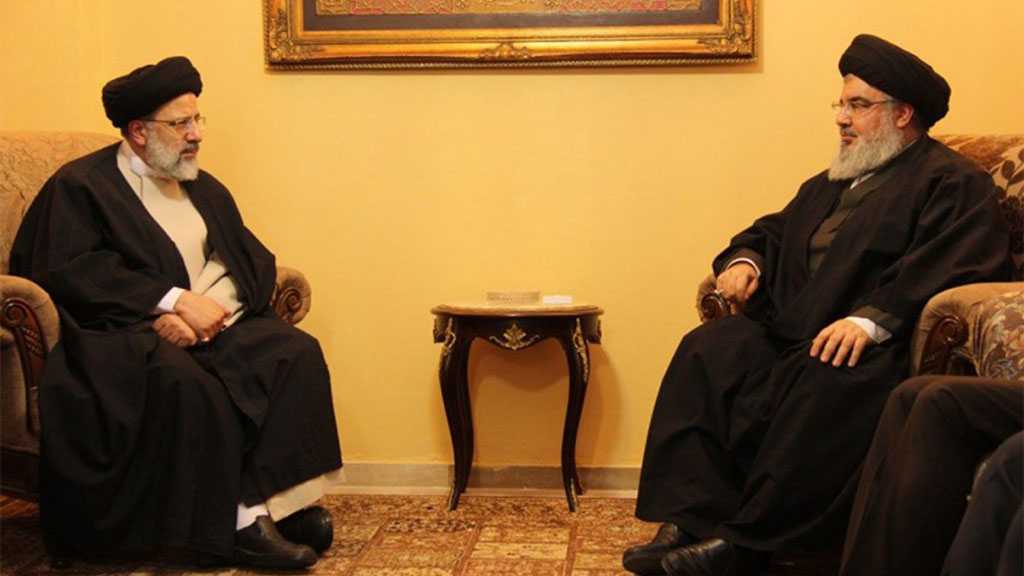
Iranian President Sayyed Ebrahim Raisi sent a thank you letter to Hezbollah Secretary General His Eminence Sayyed Hassan Nasrallah, which read the following:
The Secretary General of Hezbollah
My dear brother, Hujjatul Islam wal Muslimin, You Eminence Sayyed Hassan Nasrallah, may your blessings perpetuate
I thank you for your special congratulations on electing me as the President of the Islamic Republic, and the honest meanings of love conveyed in your letter.
Hezbollah is the good tree that has borne fruits thanks to your leadership, the resistance of the revolutionary and faithful youths, and the bloods of the righteous martyrs of the resistance… As long as we move forward, the blessings of this tree and its achievements will shine and sparkle more, to be the true hope of the Muslim nation. The power of the Islamic Resistance has made the leading revolutionary youth a nightmare that haunts the Zionist entity. It has also imposed a new deterrence equation on this usurper entity.
The role played by the Islamic Resistance in cementing safety and security in the face of the state terrorism and the Takfiri terrorism has turned this revolutionary tide of resistance into an influential element in regional equations… in which neither any political, military, or security side in the region, nor could any international power ignore its existence.
I am totally confident that, under the political guidance of His Eminence Imam Khamenei “May his shadow endure”, the Islamic Resistance can present a unique model of political work that conforms with the religious principles, in the course of cementing national independence through wide horizons of stability, development, and welfare.
Despite all animosities and grudges trailing it, the geography of the Islamic Resistance is not any more limited with Lebanon and Palestine… additionally, its efforts are not only focused on fighting the oppressors, aggressors, and the disordered… as the Islamic Resistance today has turned into an integrated school that raises the banner of security and stability in Lebanon, and calls for liberating the occupied Palestinian territories, and urges peace based on regional justice.
I ask Allah the almighty for the health, safety, and sublimity of my dear Mujahid brother, and for the good luck, happiness, and prosperity of the Islamic Resistance fighters.
A senior Iranian commander praised the Air Defense Force’s achievements over the past years, saying the country, a pioneer in the technology of directed energy, is today capable of targeting micro air vehicles [MAVs] that violate its airspace.
In an interview with ISNA news agency on Wednesday, First Brigadier General Mehdi Saqafifard, the deputy head of the planning department of Khatam Al-Anbia Air Defense Base, said the Air Defense Force has become self-reliant and rendered ineffective the sanctions imposed on the country by the West.
Prior to the 1979 Islamic Revolution, he said, Iran was only able to detect flying objects from a distance of 380 kilometers using Western-supplied equipment.
Today, however, the country has been finalizing projects that enable the Air Force to intercept targets within a distance of up to 3,000 kilometers, said the commander, adding that the Air Force units operate radars that have a detection radius of 800 kilometers.
Saqafifard also said that the number of radar platforms has increased by about 400 times in the country, compared to the time before the Revolution.
Radars have had their technology upgraded from old interception systems to hybrid mode, he said, noting that radars are currently equipped with optical and sound-detection sensors, and other types of sensors that cannot be mentioned.
“At a low anti-cruise altitude, we have at least five to six projects that are between the testing and operational phases, including Majid, Nawab, Zubin and Dezful systems,” he said.
“After 10 years of endeavor in the field of directed energy, we have been able to reach a point that the countries possessing this technology claim to be standing at. Directed energy means that we can get rid of the MAVs intruding into our skies. That means hitting a $900,000 cruise missile at a cost of only $10,” he explained.
The commander also pointed to the progress that the Air Defense Force has made regarding electronic warfare.
“In the field of electronic warfare, we have reached a point that the world does not believe,” he said.
Following the non-delivery of Russia’s S-300 missile defense system, Iran managed to manufacture Bavar-373 with the guidance of Leader of the Islamic Revolution His Eminence Imam Sayyed Ali Khamenei and efforts of the Defense Ministry knowledge-based companies, Saqafifard said.
“Today, the Bavar-373 strategic system has nothing less than the S-300, and in some areas it is even more advanced. In the near future, we will hear good news from this system to break the record and reach the levels of the next system, the S-400.”
Beirut – Hezbollah Secretary General His Eminence Sayyed Hassan Nasrallah gave a televised speech on the 10th of Muharram to commemorate Ashura.
During his speech on Thursday, Sayyed Nasrallah tackled various local and regional issues, notably the fuel crisis in Lebanon and the US defeat in Afghanistan.
His Eminence began his speech by offering his heartfelt condolences to the Islamic nation as well as its Leader His Eminence Imam Sayyed Ali Khamenei on the martyrdom of Imam Hussein [AS].
First and foremost, Sayyed Nasrallah stressed, “The top of our priorities is facing the Zionist entity occupying Palestine and some lands in Syria and Lebanon,” and asserted that “Our firm and endless position is to support Palestinians in their right to return their land from the sea to the river despite all pressures and normalization attempts”.
“We are looking forward to the day when the Zionist invaders will leave Palestine, because this is the end of all invaders,” His Eminence said.
The SG called on the protection of the religious sites and said, “To confront the threats that Al-Quds and its holy sites are facing, we urge the establishment and afforming a regional equation that protects these holy sites”.
“We call for making the protection of the holy sites the task of the entire Resistance Axis, not just the Palestinian sites,” Sayyed Nasrallah said.
Moving to Iraq, Sayyed Nasrallah renewed Hezbollah’s thanks to the Iraqi factions for expressing their readiness to protect the holy sites in Palestine.
The SG hailed the cooperation among the Resistance forces in the region alongside the resistance in Palestine and stated that this cooperation “will increase the hope in liberating Palestine”.
Sayyed Nasrallah highlighted what the United States represents to the world and explained, “The successive US administrations represent the head of tyranny and injustice in the world”.
His Eminence assured that the “Sovereignty in our region over its resources, water, oil and land must be to its peoples and countries”.
Sayyed Nasrallah also noted that, “After the American defeat in Afghanistan, eyes are focused on the US occupation in Iraq and Syria”.
His Eminence further said, “The Zionists fear any Iraqi role in any grand war,” highlighting that, “Iraq has decided that the US combat forces should leave its soil at the end of the year, and this is an important issue on the way of achieving Iraqi sovereignty”.
“The Iraqis should take into consideration the issue of American advisors by looking at the experience of Afghanistan,” the SG added.
Sayyed Nasrallah also explained, “What constitutes a real guarantee for Iraq in the face of Daesh [Arabic acronym for ‘ISIS’ / ‘ISIL’] and the Takfiris is the Hashd Shaabi [PMU]”.
“The Hashd Shaabi resembles one of the greatest manifestations and embodiments of the response to the fatwa [a ruling on a point of Islamic law given] of the religious authority in Holy Najaf ,” His Eminence stated.
The Resistance leader has a firm stance regarding the American presence in the Middle East, vying for their withdrawal, “The US forces must leave the Tanaf area [in Syria], because there are no Daesh forces there”.
In a parallel notion, “The Hashd Shaabi must be strengthened, because it is a great guarantee for Iraq,” Sayyed Nasrallah asserted, warning that “US forces facilitate the development of Daesh and help it move from one region to another”.
“The American forces must leave east of the Euphrates, and the goal of their presence is to steal the Syrian oil,” the SG said, adding that “the fate of the American occupiers in Syria is to leave so that the land and its oil will return to Syria”.
Tackling the war on Yemen, Sayyed Nasrallah said, “The US-Saudi aggressive war on Yemen must stop, and this aggression will not be able to achieve its goals”.
“We stand with the oppressed people of Bahrain, who are prevented from expressing their opinion and expressed their readiness to support Palestine,” His Eminence said regarding Bahrain.
“Let no one make wrong calculations,” the Resistance leader warned, saying that “‘Israel’ is the anxious party these days”.
On the Lebanese arena, Sayyed Nasrallah said, “We reiterate to friends and foes that the Resistance in Lebanon is strong”.
On the issue of the Lebanese government formation, His Eminence called for “the formation of a government in Lebanon and we reject vacuum”.
Sayyed Nasrallah added, “We wait for the results of the meetings between President of the Republic and the Prime Minister-designate over the government’s formation”.
“We believe more than ever in the correctness of our decision, in the resistance, and that we’re close to victory,” the SG announced.
However, His Eminence cautioned, “There are those inside and outside who are trying to hold us responsible for the failure to form the government, and this is not true,” adding, “Some accuse us of not exerting enough pressures on our allies and friends, but this is meaningless”.
Regarding the fuel crisis Lebanon is facing, Sayyed Nasrallah said, “Our first ship will sail from Iran within hours, carrying the needed material, and we give priority to the fuel”.
His Eminence assured, “More ships will also come from Iran, not only this ship”.
On this issue, Sayyed Nasrallah issued a firm warning to the Americans and “Israelis”, “The ship that will sail in a few hours will be from the first moment a Lebanese territory”.
Sayyed Nasrallah also said, “Whoever imposed this decision on us is the one who imposed the economic war on us”.
Voltaire, actualité internationale, n°191
-
Outre ce site internet gratuit, nous publions une lettre confidentielle en
PDF, Voltaire, actualité internationale. Chaque jeudi soir ou vendredi
matin, vo...
A Jewish One World Government
-
A Jewish One World Government October 21 2026
___________________________________ More Vids! +BN Vids Archive! HERE!
___________________________________ Su...
The United States At A Crossroad
-
The United States At A Crossroad—An Analysis (16 Sept 2026) by Lawrence
Davidson Part I—Texas vs Minnesota Back in mid-May […]
Report on Beth Israel vigil 09-12-26
-
*Eat-a-Cheeseburger Day Approaches*
This year, EAC Day appears on Monday, September 21st. The date coincides
with the Jewish holiday called Yom Kippur. Cl...
-
Hello all,
It is with great sadness that I share with you the passing of our beloved
sister, Mother, and Grandmother, the individual that you all knew ...
Best Horror Podcast
-
Best Horror Podcast Introduction: Horror podcasts […]
The post Best Horror Podcast appeared first on Copper Shock Horror Podcast.
Ikhras Endorses Muntadhar Al-Zaidi
-
“Oh parties of banditry and sectarianism and corruption, we have come and
our goal is to destroy you.” Ikhras formally endorses Muntadhar al-Zaidi,
Iraqi j...
Prince Charles: Foreign Jews behind bloodshed in ME
-
In May, 2017, British Crown Prince Charles declined an invitation from
Zionist entity’s president Reuven Rivlin‘s to attend the 100th anniversary
of the no...
Palestinian Women – One for All, All for One
-
Honouring All Palestinian Women by Honouring Three: Hanin Zoabi, Ahed
Tamimi, Samah Sabawi Vacy Vlazna “Palestinian women have always stood side
by side ...
US’s Saudi Oil Deal from Win-Win to Mega-Lose
-
By F. William Engdahl Who would’ve thought it would come to this? Certainly
not the Obama Administration, and their brilliant geo-political think-tank
neo-...
-
*Mordechai Vanunu wins human rights prize of Brazilian Press Association *
* http://www.alternativenews.org/english/index.php/features/updates/7038-mordechai...
Abdul Aziz Rantissi:
"My ultimate wish, my God, is to attain martyrdom,"...God granted him his wish on April 17, 2004, at the hands of Israeli assassins.