Uprooted Palestinians are at the heart of the conflict in the M.E Palestinians uprooted by force of arms. Yet faced immense difficulties have survived, kept alive their history and culture, passed keys of family homes in occupied Palestine from one generation to the next.
This agreement constitutes, not only a move against a two-State solution that Jordan claims to achieve but also an act of Arab collaboration with a usurper entity that seeks to impoverish and erase the native Palestinian inhabitants of the land.
Stirring tensions between the Jordanian public and its rulers, Amman signed its biggest ever cooperation deal with Tel Aviv and Abu Dhabi. As protesters opposing the deal took to the streets, facing arrests and beatings, Jordanian King Abdullah II continued to ignore the violations carried out against not only Palestinians but Jordanians, in East Jerusalem by “Israel”.
Whilst “Israel” continues to violate the sanctity of the Third Holiest site in Islam, the al-Aqsa Mosque, which is supposed to be under the special custodianship of the Hashemite ruler of Jordan, the King completely ignores the site and instead signs a historic energy-water swap deal.
In recent years, a legacy of tension between former Israeli Prime Minister, Benjamin Netanyahu, and King Abdullah II of Jordan, had come to a boiling point after speculation caused the King to believe Saudi Arabia may take over his nation’s custodianship of Jerusalem’s Holy Sites. Yet since the current Israeli PM, Naftali Bennett, had organized a secret meeting this July, the Israeli-Jordanian relationship seems to have been restored, after a three-year period of no high-level contact.
To add insult to injury, “Israel” has been raising one of the oldest Islamic-Palestinian burial sites, the Al-Yusofiya Cemetery, in recent months and had unearthed the remains of Jordanian soldiers in the process. The desecration of graves in the area comes so that “Israel” can build Jewish sites for settlers on top of it. Not only has the Jordanian King refused to act to prevent further unearthing of graves at the site, but has continued to ignore the house demolitions, settler home takeovers, and settler raids into the al-Aqsa Mosque, all taking place in East Jerusalem.
On November 22, a deal between Jordan-UAE-“Israel” was signed, which would see an Emirati firm, called Masdar, construct a massive solar panel farm on Jordanian territory. The Solar Farm will be designed to generate energy for “Israel”, not Jordan, creating roughly 180 million dollars in revenue each year, half of which will be made by Amman and the other half belonging to Masdar. “Israel” in return has agreed to provide Jordan with 200 million cubic meters of water, which the Israelis will desalinate and draw from the Mediterranean sea.
Although the deal only serves the UAE, Jordan, and “Israel”, the plan was actually first presented by an NGO, called ‘EcoPeace Middle East’, that the Palestinian Authority (PA) be involved in some meaningful way, yet this has not come to fruition as of yet. The West Bank currently has a major water crisis for Palestinians who are prevented from accessing their water from the Basin below them. In Gaza, “Israel” purposely destroyed Gaza’s primary aquifer and has allowed seawater intrusion, making it irreparable. Gaza’s water is currently 97% undrinkable, essentially making it so that Palestinians are forced to bathe in and drink contaminated water, causing rampant illness. Therefore, this agreement constitutes, not only a move against a two-State solution that Jordan claims to achieve but also an act of Arab collaboration with a usurper entity which seeks to impoverish and erase the native Palestinian inhabitants of the land.
The joke of the century is that “Israel”, which exploits the resources of the West Bank and the Leviathan gas fields off the occupied Palestinian coast, is working on this project with the joint aim of combating climate change. According to the Brookings Institute – a think-tank based in Washington DC – this is a good move as it utilizes clean energy and represents a push by “Israel”, the UAE, and Jordan towards a climate-wise future. It is ironic that “Israel”, which constantly drops thousands of tons of explosives all over the Middle East and has created an environment in the Gaza Strip – that it illegally besieges – which according to experts at the UN has been uninhabitable for human beings since the start of 2020, is now viewed as a progressive State on climate. The mainstream dialogue on Climate Change, between Western powers and their Arab reactionary allies, is not only a farce, it’s an attempt to brainwash their populations into believing that they are led by responsible leaderships. You can’t drop millions of tons of toxic explosives and then turn around claiming to care about the impact of the emissions let off by conventional energy consumption.
In reaction to this move by the Jordanian regime, students of the Hashemite University of Jordan gathered in protest of the move, singing a popular Arab Nationalist song ‘Mawtini’. Another demonstration was organized at the University of Jordan, calling on their authorities to release protesters who have been arrested for voicing opposition to the deal and urging them to abandon the agreement, which implicates Jordan in the Trump-era normalization deals. The Jordanian public overwhelmingly reject Arab normalization with “Israel” and regard the ‘peace treaty’ signed between “Israel” and Jordan in 1994 as a betrayal.
Jordan’s Minister of Water, Mohammed Al-Najjar, says that “Jordan is not building its water strategy on this declaration, if it is turned into an agreement, it will be presented to the parliament for approval.” Whilst Al-Najjar says it is not connected to the normalization deals, this is clearly not seen as being the case by fellow Jordanian officials who have come out strongly against the move. For many Jordanians, the fact that “Israel” had historically benefited from the diversion of the Jordan River leaves a bad taste in their mouth and so now relying on “Israel” for their water supply is not only a matter of pride, but also puts the nation in a very weak position.
But the Amman-Tel Aviv cooperation doesn’t end there. The Palestinian Authority (PA), led by President Mahmoud Abbas, is facing an economic crisis in the West Bank, amidst an environment descending into outright rejectionism of its altruistic self-rule. Palestinians in Nablus, Jenin, Al-Khalil, and elsewhere are taking it upon themselves to form armed groups to resist “Israel’s” occupation, which the PA fears will turn on its own security forces. “Israel” has pursued all avenues necessary, including giving the PA a 155 Million dollar loan in August,as well as calling on foreign powers like the EU to increase their funding. Taking this further, “Israel’s” ‘Minister of Economy’ Orna Barbivai and Jordan’s ‘Minister of Industry, Trade and Supply’ Yousef Al-Shamali, met earlier this month and secured a deal on West Bank export to the PA from Jordan. The deal secured is speculated to boost West Bank bound exports from Jordan annually, meaning that the 150 million dollars of exports will increase to as much as 700 million dollars worth.
Although Jordan claims to care for a “Two-State Solution”, the Hashemite ruler continues to demonstrate that he couldn’t care less. It’s a matter of words over reality, King Abdullah II doesn’t have a sense of pride on the matters of Jerusalem or the Palestinian people, it’s simply an act and his cooperation with the occupation shows this clearly.
The opinions mentioned in this article do not necessarily reflect the opinion of Al mayadeen, but rather express the opinion of its writer exclusively.
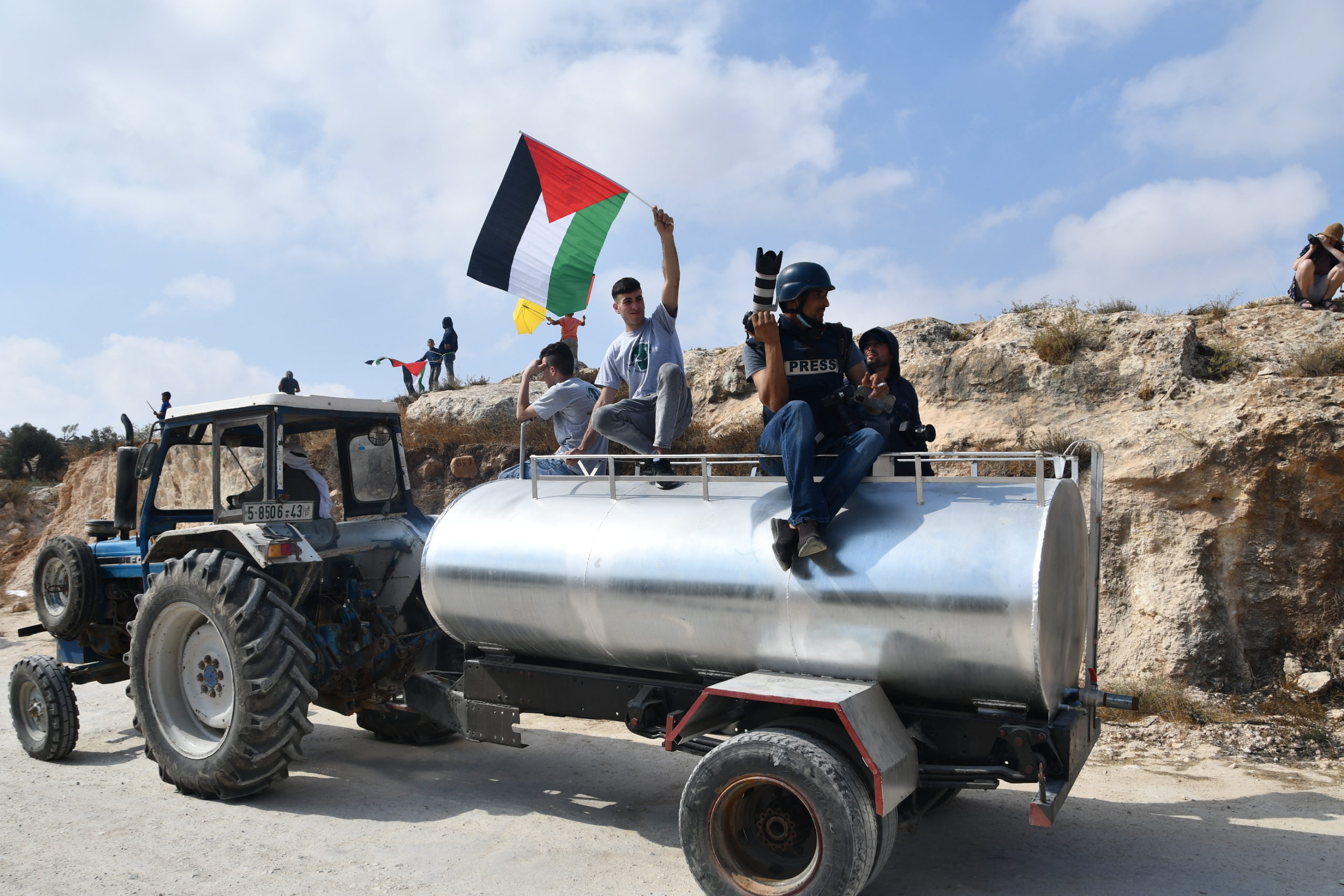
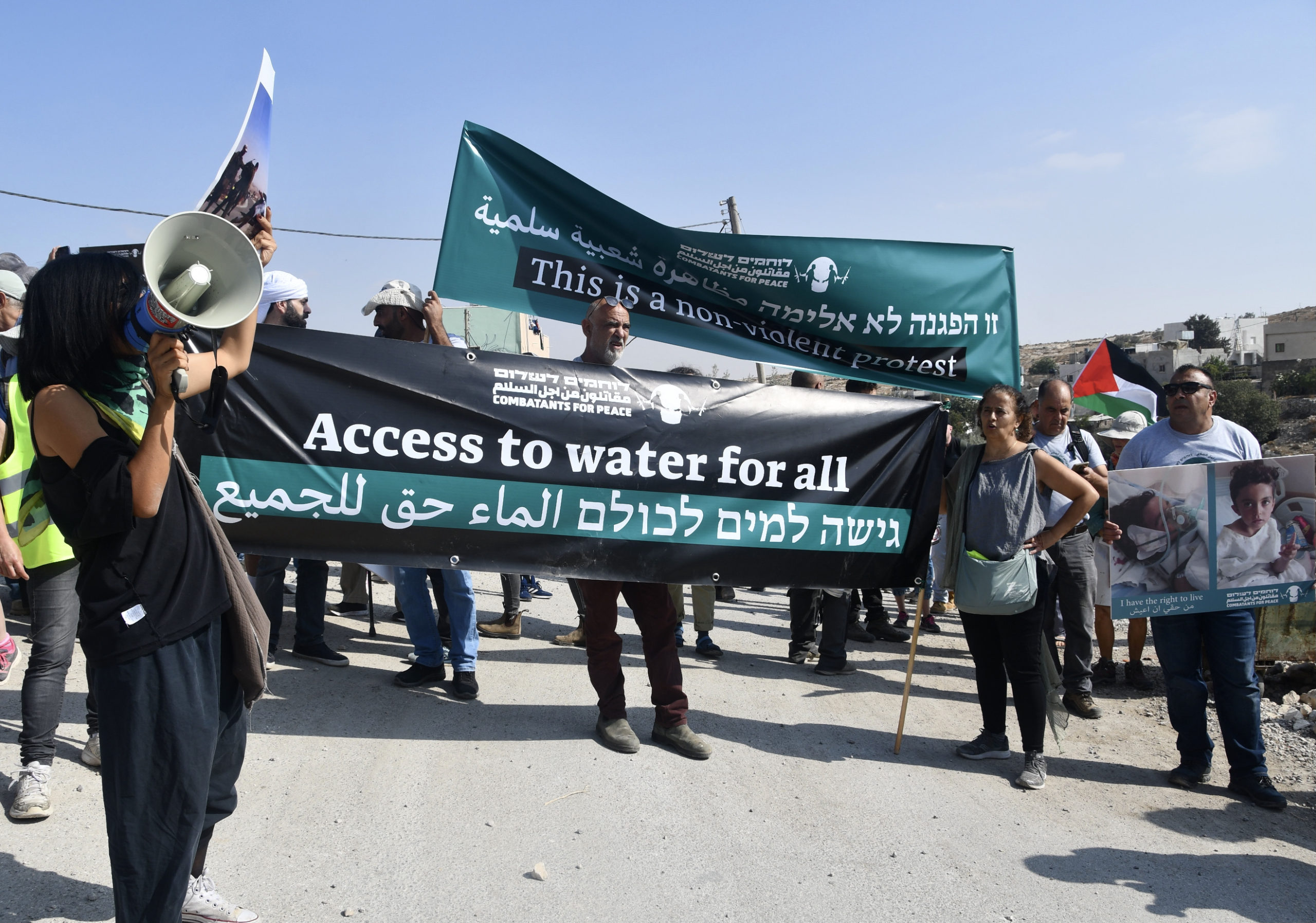
MASAFER YATTA, OCCUPIED WEST BANK — Last weekend, around 600 Israeli, Palestinian and international activists marched across Masafer Yatta in the Occupied West Bank to deliver a water tanker to Palestinian villagers. Their message was clear: Water is a human right, and Israel is depriving Palestine of this basic necessity.
Amid a sea of rippling Palestinian flags, demonstrators walked alongside a tractor transporting the water tanker from the village of At-Tuwani. The protesters did not reach their intended destination. Instead, they turned back at the village of Mfakara in order to avoid a confrontation with the Israeli Army waiting for them atop a nearby hill.
Demonstrators attempt to deliver a water tank from the Palestinian village of At-Tuwani.
“Water is a right for everyone. It doesn’t matter if you’re Black or white or Jewish or Arab,” Adam Rabee — an activist with Combatants for Peace (CFP), one of the march’s organizers — told MintPress News.
On Monday, CFP, along with other human rights organizations, submitted an urgent appeal to international bodies, demanding they “pressure Israel to allow access to water to Palestinians living in Area C,” the Occupied West Bank area that includes Masafer Yatta.
CFP started the water accessibility campaign for Palestine in August. In September, they led a field visit to Masafer Yatta for 20 diplomats from the European Union, the United Kingdom, Canada, Brazil, Mexico and Switzerland. During the tour, CFP raised awareness of Palestine’s water crisis and urged the representatives to engage in dialogue with Israel toward providing Palestinians with full access to water.
“[The diplomats] saw families and children without water,” Rabee said of the visit. “My feeling is that they want to help and we have support.”
Soldiers aiding settlers in water attacks
Saturday’s protest was calm and without clashes, but the event was underscored by earlier violence.
Tuesday of that week, at least 60 masked Israeli settlers raided Mfakara — throwing stones, turning over cars, cutting water pipes and slitting the throats of sheep. Five children were injured during the attack, including a four-year-old boy who was sent to the hospital after being pelted in the head with rocks. Israeli soldiers watched from the sidelines — during what activists are describing as a “pogrom”– intervening only to fire tear gas, stun grenades and rubber-coated steel bullets at Palestinians.
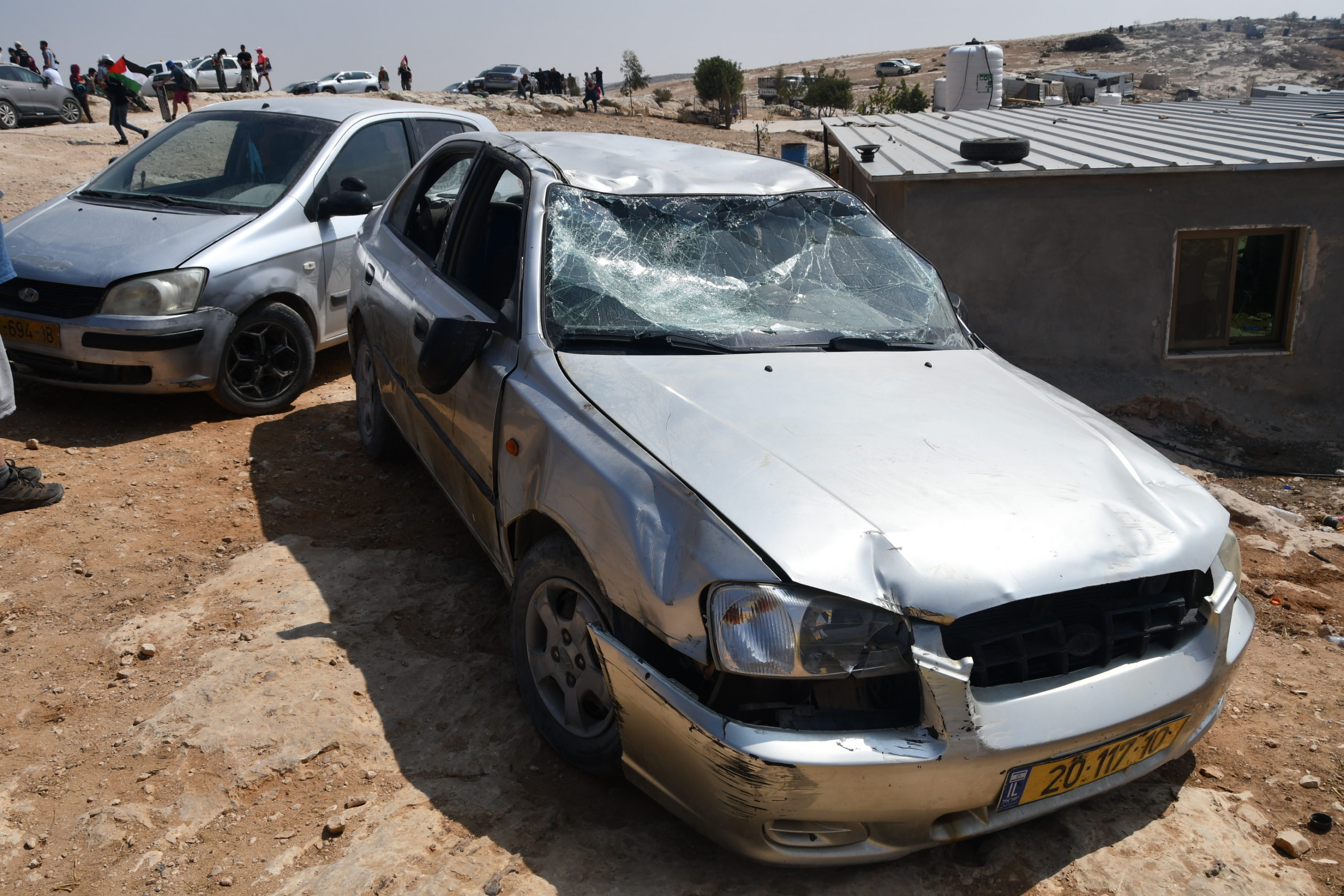
Protesters held blown-up images of the recent violence as they marched last weekend. In Mfakara, the ground was strewn with shards of glass. Several of the villagers’ cars were dented and the windshields shattered.
The windshield of a Palestinian villager’s car was shattered when Israeli settlers and soldiers attacked the village of Mfakara.
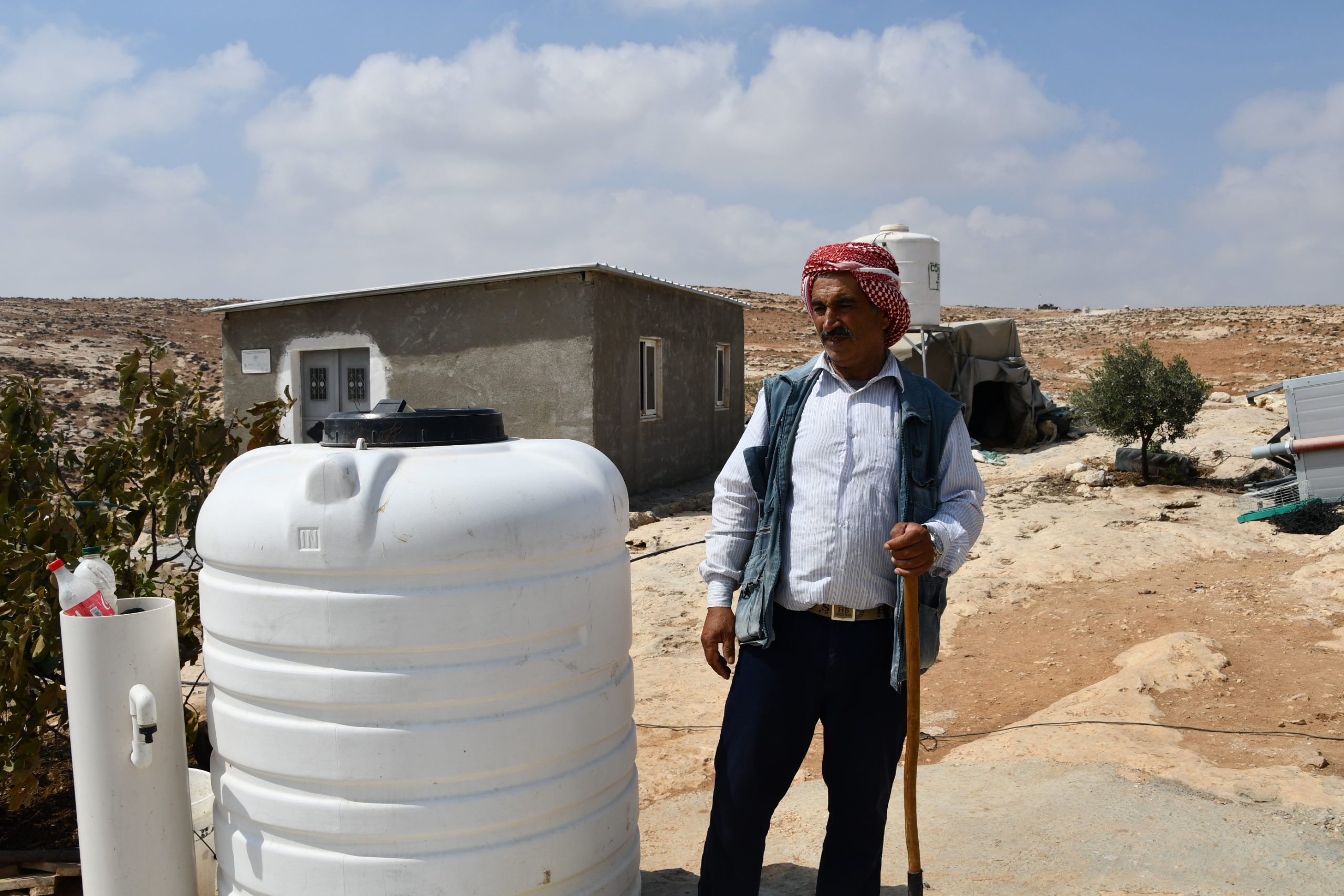
Noma Hamamdah, a Palestinian shepherd living in Mfakara, picked up a tear gas canister off the ground outside his home. He said this was one of 20 launched at the community by the army on Tuesday. He lifted his pants’ leg to reveal where he was hit with a rubber bullet. His daughter-in-law, Sabreen Hamamdah, said the army fired tear gas into their homes and settlers slashed the tires of their water tanker during the raid.
Noma Hamamdah with his son.
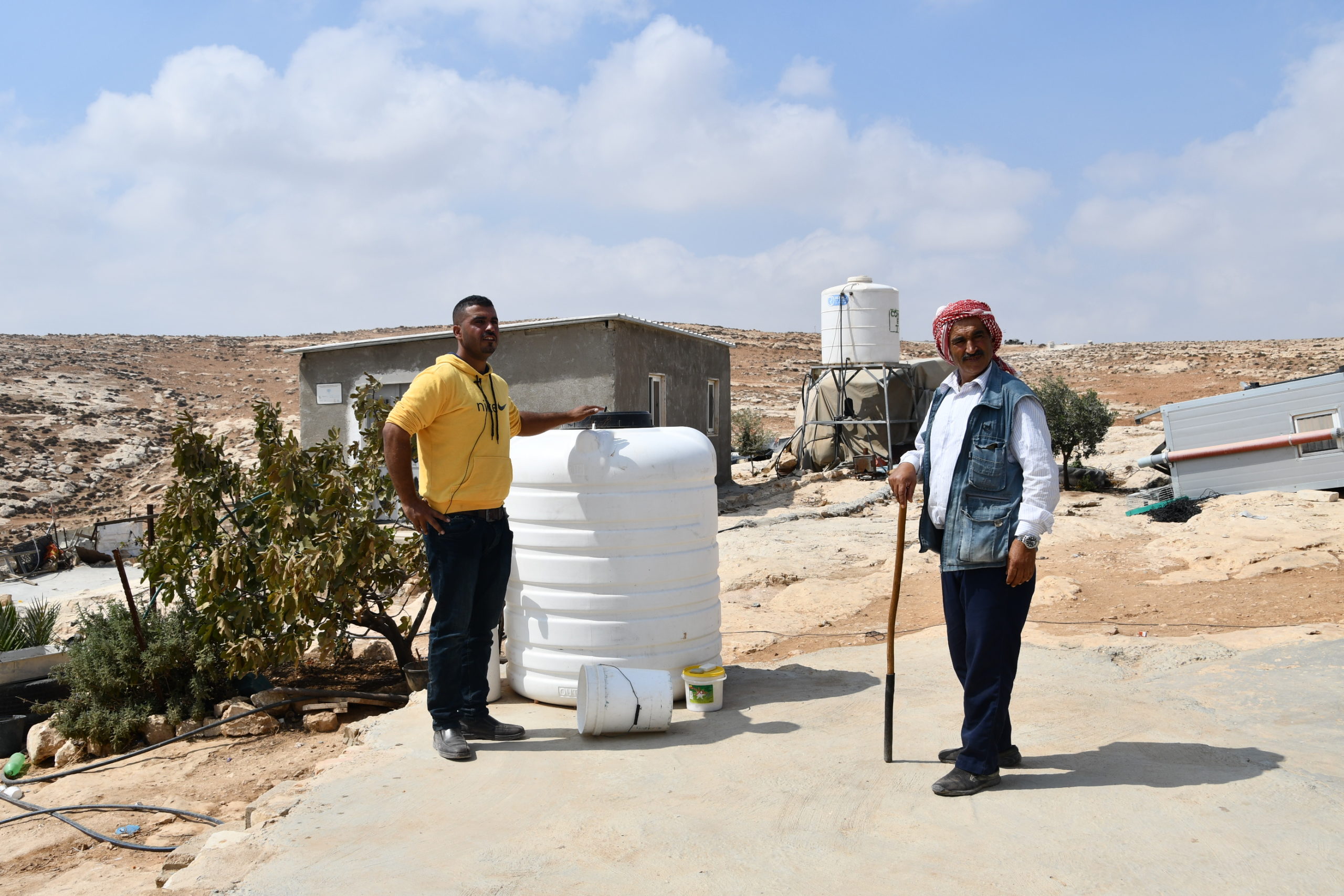
“Since last Tuesday we didn’t get water until today,” Noma said, referring to the delivery of the new tanker from activists. “The army aids the settlers and it’s because of the army the settlers have the ability to attack us and destroy our water tanks.” Eight windows in the family’s home were broken, Noma said. He pointed to a bullet hole in the wall of his house where Israeli soldiers fired when trying to disperse settlers. “We’ve been told [President Joe] Biden is a man of peace and he loves peace, but we’ve never heard him mention the Palestinians even once,” Noma continued. “And if the Havat Maon illegal settlement leaves us alone, then there will be peace in this area.”
Noma Hamamdah standing next to his water cistern, in which he stores the water.
Havat Maon is a notoriously violent, illegal settlement outpost adjacent to the Palestinians villages in Masafer Yatta. All of Israel’s settlements are illegal under international law but legal under Israeli law. Outposts, constructed without Israeli authority, are defined as illegal by both international and Israeli law.
Living without water
On days without water, Mfkara operates much like a commune. “We usually borrow from each other and when the water comes, we redivide the water,” Noma said.
Sabreen described how household chores like washing dishes, doing laundry and bathing the children are put off until water is replenished. “I have to put everything on hold until there is water,” she told MintPress. “I can’t do anything until the water comes back.”
Noma Hamamdah’s daughter-in-law, Sabreen.
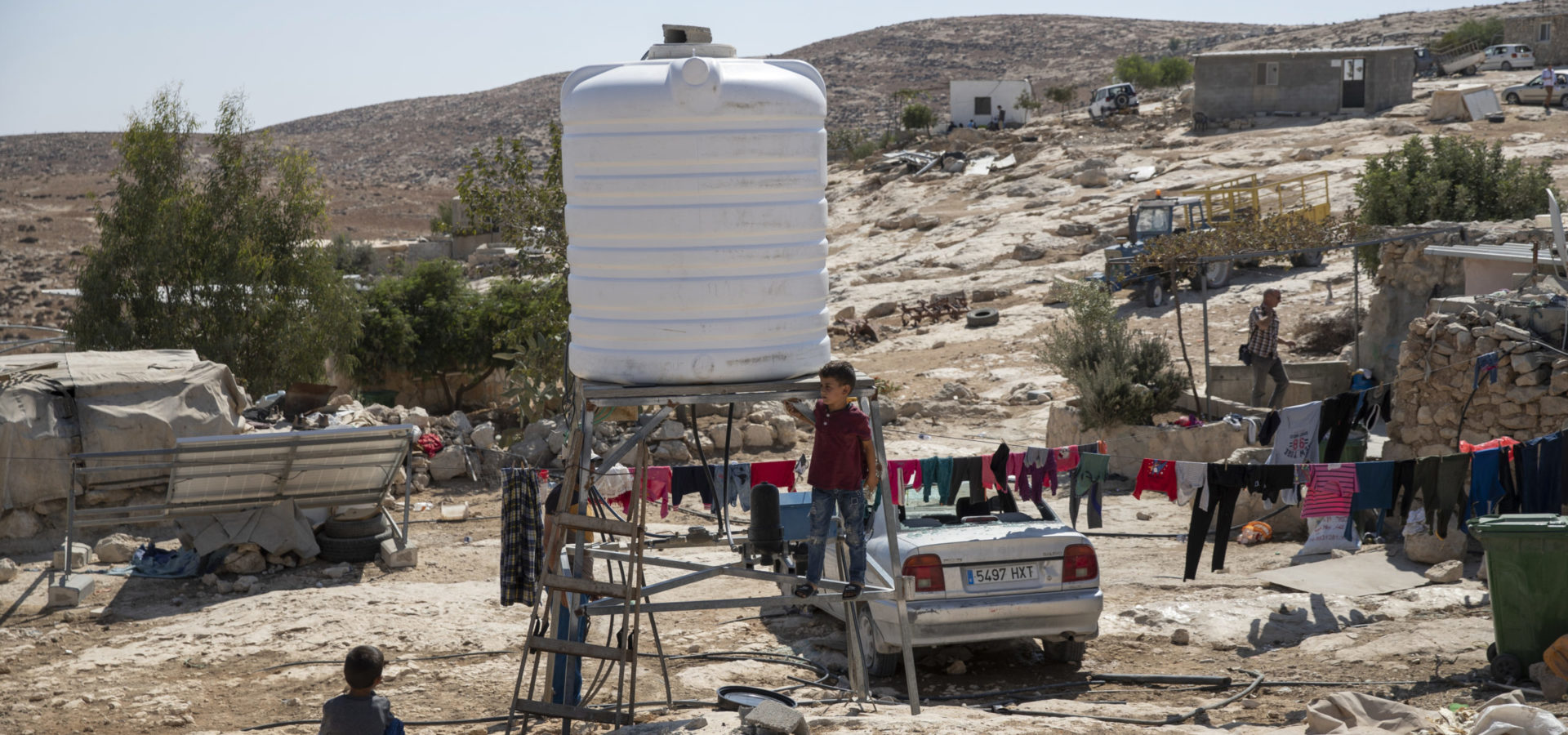
Sabreen receives 20 liters of water (about 5 gallons) costing 500 shekels ($155) from At-Tuwani, or she sources water from a nearby aquifer. That same amount of water costs nearby Israeli settlers about 100 shekels or $30. Water is stored in a cistern serving 10 people for domestic, agricultural and livestock use and may last between two to four days.
The average American uses between 80-100 gallons of water per day for indoor use. This number doesn’t account for outdoor water use, which, for herding communities like Masafer Yatta, is a significant portion of their water consumption. According to the Palestinian Hydrology Group (PHG), Palestinians in the West Bank consume about 18 gallons of water per day. This is below the World Health Organization recommendation of 26-31 gallons of water daily to maintain a basic standard of living. By comparison, Israelis use about 80 gallons of water per day and Israeli settlers may use up to 210 gallons daily.
The history of water apartheid
When Israel occupied the West Bank and Gaza after the 1967 war, it took control of the areas’ water resources. The state established pumping quotas and banned construction of new wells in the occupied territories.
Mekorot, Israel’s national water company, was put in charge of the Occupied Palestinian Territories’ (oPT) water in 1982. By 1986, pumping quotas were reduced by 10 percent for Palestinian wells — fostering greater water insecurity.
The 1995 Oslo II Accord was portrayed as a turning point for water independence in Palestine. The Palestinian Water Authority (PWA) and Israeli-Palestinian Joint Water Committee were created but Israel retained control of the flow and volume of water given to the oPT. Despite the name, the PWC doesn’t oversee water resources. Instead its role is to distribute the limited water supply Israel provides.
The agreement was supposed to last only five years but remains in effect today. Under the initiative, 80 percent of the West Bank’s water is for Israeli use and 20 percent is for Palestinian use. Israelis also enjoy an unlimited supply of water while Palestinians have their supply restricted.
What was billed as a cooperative venture between Palestine and Israel is merely the occupation of water in disguise.
“There are no official meetings between the Palestinans and the Israelis because the Israelis don’t consider us as a counterpart,” Dr. Abdelrahman Al Tamimi, PHG’s director, said.
The Coordinator of Government Activities in the Territories (COGAT) nonetheless told MintPress that the Palestinian Authority is responsible for providing water to the West Bank and touted collaboration between Palestine and Israel.
“Master programs are being promoted in the area of Judea and Samaria [West Bank], which will address the water supply until the years 2040-2050, to all populations in the area. We will note that these programs are being coordinated with the Palestinian Water Authority and [have] even been shifted in light of its requests,” a COGAT spokesperson said.
“The only solution for lack of water is water”
Dr. Al Tamimi outlined the three main reasons for water scarcity in the oPT — all originating from Israel’s occupation.
First, Israel has not increased the West Bank’s water quota to meet the demands of its rapidly growing population, which is now nearly double what it was in 1995. Al Tamimi explained Israel only increased the commercial consumption (about 10-12 percent of the demand) to around 160 million gallons.
Al Tamimi added that the Oslo II Accord doesn’t allow for Palestinians to do groundwater drilling — eliminating this as a possible water resource. And finally, owing to Israeli military control of Area C of the West Bank, Palestinians are often blocked from developing wells and springs in the region.
Al Tamimi explained these three main factors have intensified the water crisis, specifically in remote Palestinian communities, noting “Some villages in the south of Hebron or north of Jenin receive water twice a month or once a week.”
Water access varies by region in the West Bank. Urban and developed areas have running water while villages Israel prevents from connecting to a water grid rely mostly on costly trucks delivering water that is then stored in black and white tanks on people’s roofs.
“When water is moved from place to place, it’s vulnerable to pollution,” Al Tamimi said. “Because you cannot guarantee the cleanliness of the truck, how they pumped water from the well to the truck and how they empty the trucks. Water is vulnerable to be polluted by air, by bacteria and by other things.”
“The problem is there is no monitoring and there is no authority controlling the quality of water in Area C,” he added.
Palestinians also have to pay a relatively high price for potentially unsafe water. Tanker prices increase when transported on rough terrain — another infrastructural problem, caused by Israel forbidding these communities to pave their roads.
“According to international standards, the average cost of the water bill should not be more than 1 percent of that family’s income. But in some Palestinian villages, they pay more than 10 or 12 percent of their income just to purchase the water,” Al Tamimi said. “The only solution for lack of water is water. There are no other alternatives.”
Access to water in Area C is exacerbated by Israel’s systematic policy of demolishing and confiscating water equipment and resources. Italian NGO WeWorld reported nearly 10 percent of the buildings demolished by Israeli forces in 2020 were water, sanitation and hygiene structures.
The Military Commander of the West Bank justifies these practices by saying that the Palestinian communities in Area C did not receive building permits; however, the Israeli government’s own policy does not allow Palestinians to obtain building permits in this area. At the same time, all the Israeli outposts and settlers who live in buildings without legal permits are allowed to connect to the water grid.
Activists from the Israeli organization Combatants for Peace hold a banner demanding water for all.
For CFP’s Rabee, water deprivation in Area C highlights the severe discrimination Israel perpetuates. “The Palestinian man can only get water three days a week. And then this illegal outpost next to it has running water,” Rabee said. “So it’s just a very stark example of apartheid.”
International relations researcher and specialist in Turkish affairs
The following is the English translation from Arabic of the latest article by Turkish career journalistHusni Mahali he published in the Lebanese Al-Mayadeen news site Al-Mayadeen Net:
After Turkey has become a main party in the overall developments of the Syrian file with the years of the so-called ‘Arab Spring’, Ankara has developed many scenarios and calculations for its future relations with Damascus, and through it with the rest of the region, especially Iraq which is bordering Turkey, Syria, and Iran.
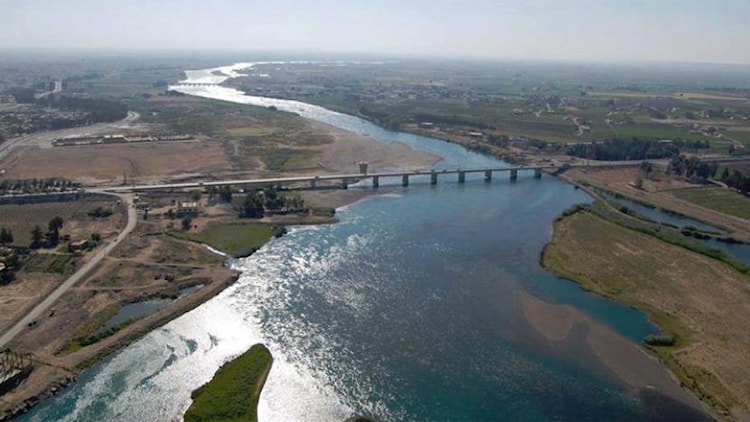
The waters of the Euphrates, Tigris and other small rivers (about 12 rivers with Syria and 3 with Iraq) come within these calculations, especially with the continuing dry seasons, which seem to be reflected in one way or another on Ankara’s water policies in the future with the two mentioned countries.
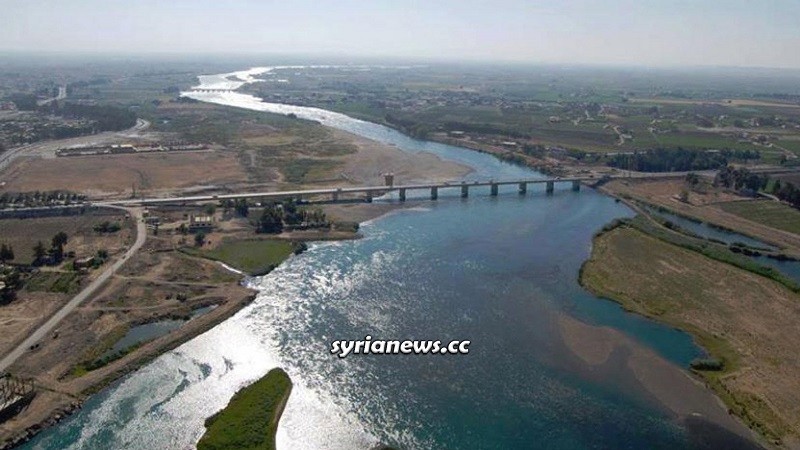
The water of the Euphrates has always been an important material in Turkish bargaining with Syria and Iraq, together or separately since Turkey began building dams on the Euphrates River, the first of which was the Kaban Dam which was inaugurated in 1974, and then the Karakaya Dam in 1987. The Ataturk Dam, which was inaugurated in 1991 was the most important in the water crisis between Turkey and both Syria and Iraq, especially after Prime Minister Suleiman Demirel said in 1991 ‘The Arab countries sell their oil, so why we do not sell our water also?’.
Ankara has insisted from the beginning on building dams after it refused to sign the international agreement (1997) that regulates the joint use of shared international water, including the Nile, the Euphrates and the Tigris, and it says that the last two are Turkish rivers crossing the border and they are not two shared rivers and that it has the right to dispose of its waters as it wishes, taking into account the interests of the downstream countries.
The roots of the Turkish water crisis with Syria and Iraq go back to the year 1920 when ‘tripartite and bilateral’ agreements were signed between Turkey and both Syria (a French colony) and Iraq (a British colony) to divide the water according to international standards followed at the time. The ‘Lausanne’ agreement (1923) by which Western countries recognized the modern Turkish republic, the heir to the Ottoman Empire, included a clause regarding the Tigris and Euphrates rivers, stating: “No country from these three countries has the right to build a dam or a reservoir or divert a river course without coordinating with other countries to ensure that their interests are not harmed.’
With the independence of Syria and Iraq, water remained a fundamental problem hindering the establishment of lasting friendly relations between the three countries, which has enough other problems that prevented them from developing relations between them, with the Syrian and Iraqi doubts always regarding the possibility that the Turkish side would use water as a weapon against them.
The documents of the US embassy in Tehran (November 4, 1979) indicated that “the CIA proposed to the Director General of the National Water Corporation, Suleiman Demirel in the year 1955-1956, to build large dams on the Euphrates, to be a weapon in Ankara’s hand against Syria, whose relations were bad at that time with Turkey.’
This explains the failure of the agreement signed by President Turgut Ozal in 1987 with the late President Hafez al-Assad, after it was affected by the tensions in the relations between the two countries, due to Ankara’s accusation of Damascus of supporting the PKK, if we ignore the psychological-influencing issue of the Iskenderun Strip.
According to the 1987 agreement, the Turkish side pledged to leave 500 cubic meters per second of the Euphrates water for Syria (42%) and Iraq (58%), provided that this amount would increase to reach 650 cubic meters after 5 years, in exchange for Damascus giving up this support, without this agreement preventing Ankara from building the dams of Perajik (50 km from the border with Syria) and Qaraqamish (3 km from the Syrian border) and two dams on the Tigris River, while the National Water Corporation plans to build a total of 22 dams on the two mentioned rivers, to reach the amount of the water that will be stored in these dams amounts to about 140 billion cubic meters.
Ankara plans to irrigate 1.8 million hectares of agricultural land with this water, and it also aims to generate 27 billion kilowatt hours of electricity (23% of Turkey’s consumption) from these dams, in addition to about 750 dams of various sizes (550 of which are large dams) built by Turkey on dozens of small and large rivers, the length of which exceeds 20 thousand km inside the Turkish borders.
President Erdogan’s statements last week in which when he said, “Turkey is not rich in water, as some believe,” raised many questions about the possibilities of using water as a weapon in Ankara’s potential bargains with Syria and Iraq, and most importantly with the “SDF” and the Kurdish People’s Protection Units that control the East of the Euphrates with the support of Washington, which Ankara fears that it seeks to establish an independent Kurdish entity in the region as is the case in northern Iraq.
Official Turkish circles develop many scenarios regarding water policies that include serious studies about water sources, including rain and groundwater, in addition to the mentioned rivers, which number more than 100.
These studies estimate the total capacity of surface (rain) and groundwater that can be utilized at about 115 billion cubic meters, of which about 60 billion cubic meters are used annually. These figures prompted Ankara to implement many projects to build underground dams, a new technology that contributes to storing groundwater as is the case in the rivers on which Ankara builds its dams.
These accounts did not prevent Ankara from continuing to build hundreds of dams on dozens of rivers that flow into its lands and flow into the seas (Aegean, Mediterranean, Marmara and Black), or leave it to other neighboring countries, including Iran, Georgia, Armenia, Bulgaria and Greece, or come from these countries, in. At the time when Turkey succeeded in laying the pipeline (80 km) that carries water under the sea (75 million cubic meters annually) to Turkish northern Cyprus with plans to sell this water to the Greek Cypriots, and even to ‘Israel’, the late President Turgut Ozal failed in his water pipeline project to ‘Israel’ through Syria and Lebanon, and another pipeline extending to the Gulf countries via Jordan to sell the water of the Saihan and Caihan rivers to these countries.
Many academic studies in the West see the Turkish datum as a sufficient reason for both Iraq and Syria to fear about the possible repercussions of Ankara’s policies with the two countries mentioned with the Kurdish element in them, everyone knows that Ankara’s implementation of its projects on the Euphrates, Tigris and other small rivers will put Iraq and Syria in front of serious challenges that will be cause serious implications for agriculture, food security, drinking water and energy generation, especially with the environmental fluctuations that threaten of drought years, according to all scientific studies worldwide.
As Ankara continues its current policies in Syria and Iraq, it has become clear that sooner or later it will use water as an influential card in its bargaining with Damascus, Baghdad and the Kurds, who are the primary beneficiaries of the waters of the Euphrates, the Tigris and other small rivers, given that the Syrian dams are in the “SDF”. This explains the presence of Ankara in Afrin (Afrin River) west of the Euphrates in general, in addition to the area extending from Ras al-Ain to Tal Abyad, where many of the small Turkish rivers enter Syria, without ignoring their presence in Jarablus, the entrance to the Euphrates into Syria, and its attempt to control Ayn al-Arab (Kobane), which is on the eastern bank of the river, similarly is the case in northern Iraq, as Turkey succeeded in establishing many military bases in the strategic mountains overlooking or near the waterways, including the Tigris and the Great Zab.
The bet or hope remains in the possibilities of returning to friendly relations between Ankara and each of Damascus and Baghdad, and even Iran, which is also a party to the water issue, especially with Iraq, after Ankara succeeded after 2003 in establishing friendly relations with Syria, Iraq, Iran and the rest of the countries of the region; President Erdogan, and before him President Abdullah Gul, announced more than once that “there is no longer a so-called water problem with the two aforementioned neighbors so that Mesopotamia will return again as the cradle of the civilizations that lived in it thousands of years ago.” This is what has been blown in the wind and the feelings of brotherhood and friendship between Ankara and both Baghdad and Damascus have become forgotten, after the policies of “zeroing problems with neighbors” succeeded in “zeroing the neighbors”, and water will soon be their most difficult concern!
To help us continue please visit the Donate page to donate or learn how you can help us with no cost on you. Follow us on Telegram: http://t.me/syupdates link will open Telegram app.
تضع الأوساط التركية الرسمية العديد من السيناريوهات في ما يتعلق بالسياسات المائية التي تتضمّن دراسات جدية حول مصادر المياه، ومنها الأمطار والمياه الجوفية، إضافةً إلى الأنهار المذكورة التي يزيد عددها على 100 نهر.
بعد أن أصبحت تركيا طرفاً أساسياً في مجمل تطورات الملف السوري مع سنوات ما يسمى بـ”الربيع العربي”، وضعت أنقرة العديد من السيناريوهات والحسابات لعلاقاتها المستقبلية مع دمشق، وعبرها مع باقي دول المنطقة، وفي مقدمتها العراق المجاور لتركيا وسوريا وإيران.
وتأتي مياه الفرات ودجلة والأنهار الصغيرة الأخرى (حوالى 12 نهراً مع سوريا و3 مع العراق) ضمن هذه الحسابات، وخصوصاً مع استمرار مواسم الجفاف التي يبدو أنها ستنعكس بشكل أو بآخر على سياسات أنقرة المائية مستقبلاً مع الدولتين المذكورتين.
وكانت مياه الفرات دائماً مادة مهمة في المساومات التركية مع سوريا والعراق معاً أو على انفراد، منذ أن بدأت تركيا ببناء السّدود على نهر الفرات، وأولها سدّ كابان الذي تمّ افتتاحه في العام 1974، ثم سدّ كاراكايا في العام 1987. وكان سدّ أتاتورك الذي تمّ افتتاحه في العام 1991 هو الأهم في أزمة المياه بين تركيا وكل من سوريا والعراق، وخصوصاً بعد أن قال رئيس الوزراء سليمان ديمريل في العام 1991 “إن الدول العربية تبيع نفطها، فلماذا لا نبيع أيضاً مياهنا؟”.
وقد أصرّت أنقرة منذ البداية على بناء السّدود بعد أن رفضت التوقيع على الاتفاقية الدولية (1997) التي تنظم عملية الاستخدام المشترك لمياه المجاري الدولية المشتركة، ومنها النيل والفرات ودجلة، وهي تقول إنّ الأخيرين نهران تركيان عابران للحدود، وليسا نهرين مشتركين، ومن حقّها التصرف بمياهها كما تشاء، مع مراعاة مصالح دول المصب.
تعود جذور أزمة المياه التركية مع سوريا والعراق إلى العام 1920، عندما تم التوقيع على اتفاقيات “ثلاثية وثنائية” بين وتركيا وكل من سوريا (مستعمرة فرنسية) والعراق (مستعمرة بريطانية) لتقسيم المياه وفق المعايير الدولية المتبعة آنذاك. وتضمّنت اتفاقية “لوزان” (1923) التي اعترفت الدّول الغربية بموجبها بالجمهورية التركية الحديثة، وريثة الدولة العثمانية، بنداً خاصاً بنهري دجلة والفرات جاء فيه: “لا يحق لأية دولة من هذه الدول الثلاث إقامة سد أو خزان أو تحويل مجرى نهر من دون أن تنسق مع الدول الأخرى لضمان عدم إلحاق الأذى بمصالحها”.
ومع استقلال سوريا والعراق، بقيت المياه مشكلة أساسية تعرقل إقامة علاقات ودية دائمة بين الدول الثلاث التي لديها ما يكفيها من المشاكل الأخرى التي منعتها من تطوير العلاقات في ما بينها، مع استمرار الشكوك السورية والعراقية دائماً باحتمالات أن يستخدم الجانب التركي المياه كسلاح ضدها.
وقد بيّنت وثائق السفارة الأميركية في طهران (4 تشرين الثاني/نوفمبر 1979) “أن المخابرات الأميركية CIA اقترحت على مدير عام مؤسسة المياه الوطنية سليمان ديميريل في العام 1955-1956 بناء سدود كبيرة على الفرات، لتكون سلاحاً بيد أنقرة ضد سوريا التي كانت علاقاتها سيئة آنذاك مع تركيا”.
ويفسر ذلك فشل الاتفاقية التي وقع عليها الرئيس تورغوت أوزال في العام 1987 مع الرئيس الراحل حافظ الأسد، بعد أن تأثرت بالتوترات التي شهدتها العلاقات بين البلدين، بسبب اتهام أنقرة لدمشق بدعم حزب العمال الكردستاني، إذا ما تجاهلنا قضية لواء الإسكندرون ذات التأثير النفسيّ.
وقد تعهّد الجانب التركي وفق اتفاقيّة 1987 بترك 500 متر مكعب في الثانية من مياه الفرات لكل من سوريا (42%) والعراق (58%)، على أن تزداد هذه الكمية لتصل بعد 5 سنوات إلى 650 متراً مكعباً، مقابل تخلي دمشق عن هذا الدعم، من دون أن تمنع هذه الاتفاقية أنقرة من بناء سدي بيراجيك (50 كم عن الحدود مع سوريا) وقرقميش (على بعد 3 كم من الحدود السورية) وسدين على نهر دجلة، فيما تخطط مؤسسة المياه الوطنية لبناء ما مجموعه 22 سداً على النهرين المذكورين، لتصل كمية المياه التي سيتم تخزينها في هذه السدود إلى حوالى 140 مليار متر مكعب.
وتخطّط أنقرة لريّ 1.8 مليون هكتار من الأراضي الزراعية بهذه المياه، كما تهدف إلى توليد 27 مليار كيلو واط /ساعة من الكهرباء (23% من استهلاك تركيا) من هذه السدود، إضافةً إلى حوالى 750 سداً بمختلف الأحجام (550 منها سد كبير) بنتها تركيا على عشرات الأنهار الصغيرة والكبيرة، ويزيد طولها داخل الحدود التركية على 20 ألف كم.
وجاءت أقوال الرئيس إردوغان الأسبوع الماضي، إذ قال “إن تركيا ليست غنية بالمياه، كما يعتقد البعض”، لتثير العديد من التساؤلات حول احتمالات استخدام المياه كسلاح في مساومات أنقرة المحتملة مع سوريا والعراق، والأهمّ مع “قسد” ووحدات حماية الشعب الكردية التي تسيطر على شرق الفرات بدعم من واشنطن، التي تتخوّف أنقرة من أن تسعى إلى إقامة كيان كردي مستقل في المنطقة، كما هو الحال في الشمال العراقي.
وتضع الأوساط التركية الرسمية العديد من السيناريوهات في ما يتعلق بالسياسات المائية التي تتضمّن دراسات جدية حول مصادر المياه، ومنها الأمطار والمياه الجوفية، إضافةً إلى الأنهار المذكورة التي يزيد عددها على 100 نهر.
وتقدّر هذه الدراسات الطاقة الإجمالية للمياه السطحية (الأمطار) والجوفية التي يمكن الاستفادة منها بحوالى 115 مليار متر مكعب، يتم استغلال حوالى 60 مليار متر مكعب منها سنوياً. ودفعت هذه الأرقام أنقرة إلى تنفيذ العديد من المشاريع لبناء السدود الجوفية، وهي تقنية جديدة تساهم في تخزين المياه الجوفية، كما هو الحال في الأنهار التي تبني عليها أنقرة سدودها.
ولم تمنع هذه الحسابات أنقرة من الاستمرار في بناء مئات السدود على عشرات الأنهار التي تنبع في أراضيها وتصب في البحار (إيجة والأبيض المتوسط ومرمرة والأسود)، أو تغادرها إلى دول مجاورة أخرى، ومنها إيران وجورجيا وأرمينيا وبلغاريا واليونان، أو تأتيها من هذه الدول، في الوقت الذي نجحت تركيا في مد الأنبوب (80 كم) الذي ينقل المياه تحت البحر (75 مليون متر مكعب سنوياً) إلى شمال قبرص التركية مع حسابات لبيع هذه المياه للقبارصة اليونانيين، وحتى “إسرائيل”، فقد فشل الرئيس الراحل تورغوت أوزال في مشروعه لمد أنابيب المياه إلى “إسرائيل” مروراً بسوريا ولبنان، وأنبوب آخر يمتد إلى دول الخليج عبر الأردن لبيع مياه نهري سايهان وجايهان لهذه الدول.
وترى العديد من الدراسات الأكاديمية في الغرب في المعطيات التركية سبباً كافياً لتخوّف كل من العراق وسوريا من الانعكاسات المحتملة لسياسات أنقرة مع الدولتين المذكورتين بالعنصر الكردي فيهما، فالجميع يعرف أن تنفيذ أنقرة مشاريعها على نهري الفرات ودجلة والأنهار الصغيرة الأخرى سيضع العراق وسوريا أمام تحديات جدية ستكون لها انعكاسات خطيرة على الزراعة والأمن الغذائي ومياه الشرب وتوليد الطاقة، وخصوصاً مع التقلبات البيئية التي تهدد بسنوات الجفاف، وفق كل الدراسات العلمية عالمياً.
ومع استمرار أنقرة في سياساتها الحالية في سوريا والعراق، بات واضحاً أنها، عاجلاً أم آجلاً، ستستخدم المياه كورقة مؤثرة في مساوماتها مع دمشق وبغداد والكرد، المستفيد الأول من مياه الفرات ودجلة وباقي الأنهار الصغيرة، باعتبار أن السدود السورية في “قسد”. ويفسر ذلك تواجد أنقرة في عفرين (نهر عفرين) غرب الفرات عموماً، إضافةً إلى المنطقة الممتدة من رأس العين إلى تل أبيض، حيث العديد من الأنهار التركية الصغيرة التي تدخل منها إلى سوريا، من دون أن نتجاهل تواجدها في جرابلس، مدخل الفرات إلى سوريا، ومحاولتها السيطرة على عين العرب (كوباني)، وهي على الضفة الشرقية للنهر، وهو الحال في شمال العراق، إذ نجحت تركيا في إقامة العديد من القواعد العسكرية في الجبال الاستراتيجية المطلة أو القريبة من المجاري المائية، ومنها دجلة والزاب الكبير.
ويبقى الرهان أو الأمل في احتمالات العودة إلى علاقات الصداقة بين أنقرة وكل من دمشق وبغداد، وحتى إيران، وهي أيضاً طرف في قضية المياه، وخصوصاً مع العراق، فبعد أن نجحت أنقرة بعد العام 2003 في إقامات علاقات ودية مع سوريا والعراق وإيران وباقي دول المنطقة، أعلن الرئيس إردوغان، وقبله الرئيس عبد الله جول، أكثر من مرة، أنه “لم تعد هناك ما يسمى بمشكلة المياه مع الجارتين المذكورتين، ليعود ما بين النهرين من جديد مهداً للحضارات التي عاشت فيها قبل آلاف السنين”، وهو الكلام الذي أصبح في مهب الريح، كما أصبحت مشاعر الأخوة والصداقة بين أنقرة وكل من بغداد ودمشق في ذاكرة النسيان، بعد أن نجحت سياسات “تصفير المشاكل مع الجيران” في “تصفير الجيران”، وستكون المياه قريباً همها الأصعب!
Finian Cunningham Former editor and writer for major news media organizations. He has written extensively on international affairs, with articles published in several languages
July 17, 2020
Ethiopia appears to be going ahead with its vow to begin filling a crucial hydroelectric dam on the Nile River after protracted negotiations with Egypt broke down earlier this week. There are grave concerns the two nations may go to war as both water-stressed countries consider their share of the world’s longest river a matter of existential imperative.
Cairo is urging Addis Ababa for clarification after European satellite images showed water filling the Grand Ethiopian Renaissance Dam (GERD). Ethiopia has stated that the higher water levels are a natural consequence of the current heavy rainy season. However, this month was designated by Addis Ababa as a deadline to begin filling the $4.6 billion dam.
Egypt has repeatedly challenged the project saying that it would deprive it of vital freshwater supplies. Egypt relies on the Nile for 90 per cent of its total supply for 100 million population. Last month foreign minister Sameh Shoukry warned the UN security council that Egypt was facing an existential threat over the dam and indicated his country was prepared to go to war to secure its vital interests.
Ethiopia also maintains that the dam – the largest in Africa when it is due to be completed in the next year – is an “existential necessity”. Large swathes of its 110 million population subsist on daily rationed supply of water. The hydroelectric facility will also generate 6,000 megawatts of power which can be used to boost the existing erratic national grid.
Ominously, on both sides the issue is fraught with national pride. Egyptians accuse Ethiopia of a high-handed approach in asserting its declared right to build the dam without due consideration of the impact on Egypt.
On the other hand, the Ethiopians view the project which began in 2011 as a matter of sovereign right to utilize a natural resource for lifting their nation out of poverty. The Blue Nile which originates in Ethiopia is the main tributary to the Nile. Ethiopians would argue that Egypt does not give away control to foreign interests over its natural resources of gas and oil.
Ethiopians also point out that Egypt’s “claims” to Nile water are rooted in colonial-era treaties negotiated with Britain which Ethiopia had no say in.
What makes the present tensions sharper is the domestic political pressures in both countries. Egypt’s President Abdel Fattah al-Sisi is struggling to maintain legitimacy among his own population over long-running economic problems. For a self-styled strong leader, a conflict over the dam could boost his standing among Egyptians as they rally around the flag.
Likewise, Ethiopia’s Prime Minister Abiy Ahmed is beset by internal political conflicts and violent protests against his nearly two years in office. His postponement of parliamentary elections due to the coronavirus has sparked criticism of a would-be autocrat. The recent murder of a popular singer-activist which resulted in mass protests and over 100 killings by security forces has marred Abiy’s image.
In forging ahead with the dam, premier Abiy can deflect from internal turmoil and unite Ethiopians around an issue of national pride. Previously, as a new prime minister, he showed disdain towards the project, saying it would take 10 years to complete. There are indicators that Abiy may have been involved in a sinister geopolitical move along with Egypt to derail the dam’s completion. Therefore, his apparent sudden support for the project suggests a cynical move to shore up his own national standing.
Then there is the geopolitical factor of the Trump administration. Earlier this year, President Donald Trump weighed in to the Nile dispute in a way that was seen as bolstering Egypt’s claims. Much to the ire of Ethiopia, Washington warned Addis Ababa not to proceed with the dam until a legally binding accord was found with Egypt.
Thus if Egypt’s al-Sisi feels he has Trump’s backing, he may be tempted to go to war over the Nile. On paper, Egypt has a much stronger military than Ethiopia. It receives $1.4 billion a year from Washington in military aid. Al-Sisi may see Ethiopia as a softer “war option” than Libya where his forces are also being dragged into in a proxy war with Turkey.
Ethiopia, too, is an ally of Washington, but in the grand scheme of geopolitical interests, Cairo would be the preferred client for the United States. Up to now, the Trump administration has endorsed Egypt’s position over the Nile dispute. That may be enough to embolden al-Sisi to go for a showdown with Ethiopia. For Trump, being on the side of Egypt may be calculated to give his flailing Middle East policies some badly needed enthusiasm among Arab nations. Egypt has the backing of the Arab League, including Saudi Arabia and the United Arab Emirates.
Egypt has previously threatened to sabotage Ethiopia’s dam. How it would do this presents logistical problems. Egypt is separated from Ethiopia to its south by the vast territory of Sudan. Cairo has a strong air force of U.S.-supplied F-16s while Ethiopia has minimal air defenses, relying instead on a formidable infantry army.
Another foreboding sign is the uptick in visits to Cairo by Eritrean autocratic leader Isaias Afwerki. He has held two meetings with al-Sisi at the presidential palace in the Egyptian capital in as many months, the most recent being on July 6 when the two leaders again discussed “regional security” and Ethiopia’s dam. Eritrea provides a Red Sea corridor into landlocked Ethiopia which would be more advantageous to Cairo than long flights across Sudan.
Nominally, Eritrea and Ethiopia signed a peace deal in July 2018 to end nearly two decades of Cold War, for which Ethiopia’s Abiy was awarded the Nobel Peace Prize. However, the Eritrean leader may be tempted to dip back into bad blood if it boosted his coffers from Arab money flowing in return for aiding Egypt.
There will be plenty of platitudinous calls for diplomacy and negotiated settlement from Washington, the African Union and the Arab League. But there is an underlying current for war that may prove unstoppable driven by two populous and thirsty nations whose leaders are badly in need of shoring up their political authority amid internal discontent.
Israeli forces and the Israeli Civil Administration cut off water supply for dozens of Palestinians living in communities in Bardala village in the Jordan Valley in the northern occupied West Bank, on Wednesday
Mutaz Bisharat, an official who monitors settlement activity in Tubas/Jordan Valley, told Ma’an that Israeli forces cut off water supply for 60% of residents of the Bardala village; that is 2600 people.
Israeli forces also cut off water supply for 1800-2000 dunams of Palestinian agricultural lands that must be continuously irrigated.
Bisharat added that Israel claims that water sources supplying residents with water are illegal, stressing that the water comes from water wells in the village and inside Palestinian lands.
He pointed out that as Israeli forces cut off water supply for Palestinians, they construct water wells for Israeli settlers.
Bisharat called upon international and humanitarian institutions to immediately intervene to stop Israeli violations of human rights.
The Jordan Valley forms a third of the occupied West Bank, with 88 percent of its land classified as Area C — under full Israeli military control.
Water allocations are very necessary for the increase of agricultural production, in order to support the economic growth of many Palestinian farmers.
Jordan Valley residents mostly live in enclaves closed off by Israeli military zones, checkpoints, and more than 30 illegal Israeli settlements
Another Epstein Class whistleblower ‘suicide’
-
“How US commerce secretary’s Epstein links were uncovered by British
whistleblower“ (Verity/Byrne/Milne):Andriesz suspected there was yet more
to find in t...
The Legendary Golem
-
The Legendary Golem October 3 2026 ___________________________________ More
Vids! +BN Vids Archive! HERE! ___________________________________ Support
The B...
The United States At A Crossroad
-
The United States At A Crossroad—An Analysis (16 Sept 2026) by Lawrence
Davidson Part I—Texas vs Minnesota Back in mid-May […]
Report on Beth Israel vigil 09-12-26
-
*Eat-a-Cheeseburger Day Approaches*
This year, EAC Day appears on Monday, September 21st. The date coincides
with the Jewish holiday called Yom Kippur. Cl...
-
Hello all,
It is with great sadness that I share with you the passing of our beloved
sister, Mother, and Grandmother, the individual that you all knew ...
Best Horror Podcast
-
Best Horror Podcast Introduction: Horror podcasts […]
The post Best Horror Podcast appeared first on Copper Shock Horror Podcast.
Ikhras Endorses Muntadhar Al-Zaidi
-
“Oh parties of banditry and sectarianism and corruption, we have come and
our goal is to destroy you.” Ikhras formally endorses Muntadhar al-Zaidi,
Iraqi j...
Prince Charles: Foreign Jews behind bloodshed in ME
-
In May, 2017, British Crown Prince Charles declined an invitation from
Zionist entity’s president Reuven Rivlin‘s to attend the 100th anniversary
of the no...
Palestinian Women – One for All, All for One
-
Honouring All Palestinian Women by Honouring Three: Hanin Zoabi, Ahed
Tamimi, Samah Sabawi Vacy Vlazna “Palestinian women have always stood side
by side ...
US’s Saudi Oil Deal from Win-Win to Mega-Lose
-
By F. William Engdahl Who would’ve thought it would come to this? Certainly
not the Obama Administration, and their brilliant geo-political think-tank
neo-...
-
*Mordechai Vanunu wins human rights prize of Brazilian Press Association *
* http://www.alternativenews.org/english/index.php/features/updates/7038-mordechai...
Abdul Aziz Rantissi:
"My ultimate wish, my God, is to attain martyrdom,"...God granted him his wish on April 17, 2004, at the hands of Israeli assassins.