Showing posts with label MEK. Show all posts

Sunday, 27 June 2021

Terrified Washington resorts to piracy as it loses grip over West Asia


Terrified Washington resorts to piracy as it loses grip over West Asia

June 25, 2021

by Aram Mirzaei for the Saker blog

In what can only be called an act of piracy, the US government “seized” several pro-resistance media outlets in a coordinated attack this week. One of the outlets that were siezed was Presstv.com. Other web domains, including Palestine al-Youm, a Palestinian-directed broadcaster, Karbala TV – the official television of the Imam Hussein (PBUH) shrine in the holy Iraqi city of Karbala, Iraqi Afaq TV, Asia TV and al-Naeem TV satellite television channels, as well as Nabaa TV which reports the latest stories about Saudi Arabia and other Persian Gulf countries, were also seized.

Citing bogus reasons such as “threat to national security”, the US regime once more proved what a great leader of democracy and freedom it indeed is. Apparently, Washington believes that it cannot win a free and fair debate with outlets such as PressTV, so the only way to “win” is to prevent others from presenting their viewpoint. Imagine if other countries did the same thing and seized CNN or Fox News’ website. The US would probably start a war if countries like Iran or North Korea made such moves. The self-worshipping West loves to criticize other countries for “suppressing free media” while they portray themselves as a safe haven for “opinions of all kinds”.

The fact that the United States ranks last in media trust — at 29% — among 92,000 news consumers surveyed in 46 countries, doesn’t seem to matter. That’s worse than Poland, worse than the Philippines, worse than Peru, yet Washington still seems to have the “moral” right to condemn these countries as well, because any lack of trust in US media is explained as being the result of “foreign disinformation campaigns” and totally not related to the fact that the US media only exists to manufacture consent for Washington’s continued imperialist aggression.

Ironically, the suppression of information is happening while Washington funds and supports perhaps hundreds of propaganda networks such as BBC Persian, VOA Iran and ManotoTV, all known for disseminating vulgar and unprofessional propaganda. Some of these networks are being run by the family members of the Shah of Iran and via using the Iranians’ plundered wealth, to openly call for violent regime change and the return of the degenerate monarchy. Other networks, connected to John Bolton’s close friends in the MEK terrorist cult, openly call for terrorist attacks inside Iran. These are the people that want “democracy” for Iran, and these are the people that Washington supports.

If it hadn’t been proven a thousand times before, then this pathetic move proved once more that America’s claim about advocating freedom and democracy as well as freedom of expression is nothing more than a lie and hypocrisy. Washington is and has always been morally bankrupt, however, this recent act of thuggery shows that Washington, known for lecturing other governments overseas about free speech, democracy, and freedom of expression, is also scared and panicking.

Of course they are afraid. Is it a coincidence that these seizures happened right now? No! The Iranian nation elected what the westerners call a “hardliner” president. They know that the game of “diplomacy and talks”, which they use to stall the lifting of sanctions, is over. President-elect Seyyed Ebrahim Raeisi won’t be as kind to them as the previous administration has been. He has already declared that there will be no talks with Washington over the US return to the JCPOA. On top of that, Yemen’s Ansarullah movement has rejected the Saudis shameful “peace proposal” and are in their way to capture the crucial city of Ma’rib, further humiliating Washington. So Washington resorted to silencing the world’s poorest country, which is under siege by land, sea and air in what can only be called a genocide.

There is absolutely no way for Washington to save face here. It is clear that they are terrified as the pro-resistance outlets are getting their messages across. More and more people are seeing Washington for what it is: a terrorist entity that takes pride in killing and starving people who refuse to bow down to them. This coincides with Washington’s waning influence in the region of West Asia, or as they call it, the “Middle East”. (the term “Middle East” is a colonial term from the British Empire era in which Europeans believed that they were the centre of the world, while West Asia was “the near east”).

Apparently, hundreds of US troops, aircraft and air defence batteries are being withdrawn from the puppet Persian Gulf kingdoms, as the Biden administration allegedly wants to focus on Russia and China instead. In reality, this is Washington’s way of quietly leaving the region as they know and understand what the inevitable alternative would be – getting kicked out of the region with force. Throughout the region, from Syria and Iraq, to Palestine and Yemen, the forces of colonialism and imperialism are losing ground and influence. Their repeated and continued atrocities and crimes are fuelling the fire in our hearts as more and more people, not just in the region, but worldwide are realizing the criminal nature of the imperialists.

This is not the first time nor the last time that the imperialists and their tools have silenced the voices of dissent. Throughout the years, tens or perhaps hundreds of thousand blogs, and social media pages have been shut down for supporting Syria, Palestine or Yemen. I have personally had 4 social media accounts shut down over the years, for supporting Syria’s legitimate government, for posting pictures in loving memory of Martyr Soleimani and for speaking out against the genocide going on in Yemen. But I will not back down, nor will I give up, and neither should anyone who has spoken out against the savage actions of the imperialists. It should never be forgotten that they silence and shut us down because they fear us, not because they are morally superior to us.

Resistance must continue on all fronts. Every act of aggression should be seen as an opportunity to show the world what liars and hypocrites the Western warmongers are who think that they can win the hearts of the people of this region through their lies and crude propaganda while bombing the people’s homes and loved ones.


River to Sea Uprooted Palestinian   
The views expressed in this article are the sole responsibility of the author and do not necessarily reflect those of the Blog!

Wednesday, 23 December 2020

The Assassin’s Creed: Murder As Israeli State Policy

 By Jeremy Salt

Source

“If our dreams for Zionism are not to end in the smoke of assassins’ pistols and our labor for its future to produce only a new set of gangsters worthy of Nazi Germany, many like myself will have to reconsider the position we have maintained for so long in the past.” — Winston Churchill, November, 1944, from his address to the House of Commons on the murder of Britain’s Resident Minister in the Middle East, Lord Moyne, by two members of the zionist terrrorist organization, Lehi. [1]
Mohsen Fakhrizadeh Terror df757

Israel’s crimes against Iran in the past decade include the sabotage through the Stuxnet virus of the centrifuges in its nuclear development program,  the killing through missile attack of its militia members in Syria, the sabotage of its Natanz nuclear plant in July this year and the murder in recent years of five of its leading nuclear scientists,  most recently, a few days ago, Mohsen Fakhrizadeh.

Each of these attacks would have been carried out at least with the approval of the US government, if not the active involvement at some level of both the US and its puppet Iranian terrorist organization, the MEK (Mujahedin e-Khalq). In reverse,  Israel would have been closely involved in the US assassination of  Qasim Suleimani in Iraq in January this year.  These murders might be state operations but are no different in their brazen nature,  their illegality and their brutality from hits organised by Mafia gangs.  In the case of Mohsen Fakhrizadeh,  a distinguished physicist,  he was apparently dragged from his car during the attack and finished off in the middle of the road.  The crime was so heinous that even voices usually hostile to Iran (including the New York Times and former CIA director John Brennan) were appalled.

Each of these attacks is a casus belli for war. Two can play at this game, which means that by these attacks, Israel is virtually inviting the assassination of its own political leaders and military commanders, or its senior representatives abroad. That Iran does not strike back, in the same way, is not necessarily a sign that it does not have the capacity to organise such retaliation.  Apart from the criminality and violations of international law that such actions represent,  Iran is never going to strike back at a time of Israel’s choosing.

Nevertheless, the government is under pressure from its own people to deal a devastating counter-blow, not necessarily against individuals but against Israeli infrastructure such as the port at Haifa.  Each of these provocations pushes Iran closer to the edge, as intended by Israel.  The repeated refusal of the government to respond is being criticised in Iran as a sign of weakness,  as the more Israel gets away with the more it will try to get away with. At the same time, even though Israel is responsible, an Iranian reprisal would trigger off a large-scale military response by Israel and full-scale war that no one in their right mind would want. It is a further sign of the moral void at their centre that Netanyahu and many of the fanatics around him do want such a war and are prepared to drop bombs on live nuclear reactors to achieve their aims

The general view seems to be that Israel did this so Biden would not be able to sign back on to the Joint Comprehensive Plan of Action (JCPOA) nuclear agreement from which Trump withdrew the US in 2018. That may be so, but Netanyahu might have calculated that this latest savagery would be the final spark igniting the war he has wanted for years.  Either of these outcomes would suit him.

There are always parallels in history and for Israel’s attempts to provoke an open war with Iran, one parallel would be Israel’s attempts to draw Egypt’s President Gamal Abd al Nasser into war in 1967.  This was no ‘preemptive’ war but another war of choice.  1948 was the first, because only through war could the zionists seize  Palestine, at least most of it.  1967 was the second,  launched to destroy Egypt’s armed forces, to destroy Nasser’s Arab world leadership, and to occupy the rest of Palestine. 

It was strikingly successful. All Palestine ended up under occupation and the Egyptian military was shattered.  Nasir’s pan Arab leadership was not destroyed but gravely weakened by Egypt’s failure to see the war coming and defend itself.

Just as Israel has been trying to draw Iran into the open through the assassination of its scientists and the sabotage of its nuclear plants,  so in the year before the 1967 war it set out to draw Nasser into the open through provocations along the Syrian armistice line.  These took the form of incursions by armored tractors into the DMZ, triggering off shelling by the Syrian army and then air attacks by Israel.  

Although Israel was determined to destroy any Arab nationalist government and to destroy Arab nationalism itself, the main target of these provocations was Nasser.  He was the foremost Arab champion and Israel wanted him where it could get at him.  It knew that sooner or he would have to respond to its provocations on the Syrian front by taking action on the Egyptian front.

When Israel shot down six Syrian planes in April 1967, the ball started to roll.  Israeli politicians talked of going further than ever before, of teaching Syria a lesson, and even of invading Syria and occupying Damascus, 15 years ahead of its invasion of Lebanon and occupation of Beirut. 

By the second week of May, war was regarded as inevitable.  Nasser moved troops and tanks into Sinai and called for the withdrawal of the UN Emergency Force (UNEF) from the armistice line.  Although Israel was the aggressor in the 1956  war, UNEF forces were inside Egypt because Israel refused to accept them on its side of the armistice line, and as usual, it got its way. 

On May 22 Nasser closed the Straits of Tiran, the entrance point to the Gulf of Aqaba, but without actually blocking them to Israeli shipping.  Under pressure,  however,  to stand up to the Israelis,  he had moved the final piece on the board that set the stage for war. 

Israel repeated the rhetoric of 1948.  İt was again being threatened with extermination and annihilation at the hands of an Arab ‘ring of steel.’ In fact,  it knew, and so did the CIA, that it would easily defeat any Arab army or combination of Arab armies.  Behind the panic deliberately set in motion among the Israeli population,  the generals could not wait to get going.   They vowed to be on the banks of the Suez Canal within a week. This was an opportunity  – one they had created – that Israel could not afford to miss. The military would deliver a knockout blow: according to Yigal Allon, “There is not the slightest doubt about the outcome of this war and each of its stages.”

And so it turned out to be.  On the Arab side, there is not the slightest doubt that Nasser did not want war. His threats were those of the Arab champion and his intended audience the Arab world,  but behind the scenes, he was looking for a way out of the crisis into which he had been maneuvered. An Egyptian delegation led by  Vice-President Zakaria Muhi Al-Din was due to fly into Washington on June 7 for talks to begin the following day on bringing the crisis to an end. On June 5, with the window of the opportunity for war about to close,  Israel attacked.

There is symmetry in all of these wars. Israel plays the role of the victim even while preparing to attack.  In 1948 Chaim Weizmann talked of extermination while assuring the Americans behind the scenes that the Arab armies counted for nothing. Israel’s arrogance was checked in the first week of the 1973 war, with humiliation at the hands of Hizbullah waiting in 2000 and 2006.  Yet if there is a learning curve Israel does not see it, an example of what long ago US Senator J. William Fulbright called the “arrogance of power.”

Israel applies the same tactics at the micro as well as the macro level.  On the West Bank and Gaza, it murders and massacres, and when there is a Palestinian response it has its rationale for more crushing blows.  On the West Bank, this usually takes the form of enlarging settlements or building new ones. 

From the Zionist point of view, this has been a good year.  Following the establishment of diplomatic relations with Israel by the UAE and Bahrain, the UAE has gone as far as blocking entry visas to the citizens of a dozen Muslim countries while allowing Israelis visa-free entry.  Talks in Saudi Arabia between Netanyahu and Muhammad bin Salman – apparently arranged without the knowledge of the king – open the way to the establishment of diplomatic relations, although for the time being this is not expected.  MBS can give Israel most of what it wants without needing to come into the open, and as the nominal custodian of the two holy places such a move would enrage Muslims around the world,  with explosive consequences possible at the time of the hajj.

Israel’s strategic advances also include the commercial,  military, and strategic relationship it is establishing in the eastern Mediterranean with Greece and the Greek government of southern Cyprus, which has already allowed Israeli military units to train on the island because of the similarity of the topography to southern Lebanon. Successfully playing off fears of Iran in the Gulf,  Israel plays off Greek rivalry with Turkey in the eastern Mediterranean.  

Able to attack from the very centre of the central Arab lands – occupied Palestine – Israel is now steadily moving into a position that will eventually enable it to threaten Arab states and Iran from the periphery, from the gulf in the southwest and from the northeastern corner of the Mediterranean.  It has pushed these doors open and on the basis of all its past behavior, it will keep pushing until it gets what it wants.

The assassination of Mohsen Fakhrizadeh has antecedents dating back to the barrel bomb murders in Palestinian markets in the 1930s, the assassination of Lord Moyne in Cairo on November 6,  1944,  the blowing up of the King David Hotel in 1946, the assassination of Count Folke Bernadotte in 1948  and the massacres and destruction that have marked the zionist presence in the Middle East ever since.  Whether the enemy is a state, an organization, or an individual,  the enemy must be destroyed.   The standing refusal of the international ‘community’ to punish Israel for any of these crimes only encourages the zionist state to go still further.

Speaking to the House of Commons after the murder of Lord Moyne, Churchill, a strong advocate of Zionism all along,  remarked that “If there to be any hope of a peaceful and successful future for Zionism  these wicked activities must cease and those responsible for  them must be destroyed root and branch.” [2] These wicked activities have never ceased, those responsible for them have never been destroyed root and branch, the smoke of the assassins’ pistols now hangs over an entire region and Zionism has produced generations of criminals fully worthy of Nazi Germany.    

No state can endlessly endure Israel’s provocations. Iran and Hizbullah are playing the long game, compared to Netanyahu’s greed for instant satisfaction but at some point, there will be a limit to what they can endure and then there will be war,  possibly if not probably the most devastating in the modern history of the Middle East.  What will the international ‘community’ say then? It will be far too late to regret that it should have done something to stop Israel earlier.

Endnotes

[1] Catrina Stewart ‘Sir Winston Churchill: Zionist hero,’ Independent, November 3, 2012[2] ‘Palestine (Terrorist Activities) in the House of Commons at 12am on 17th November, 1944.’ theyworkforyou.com/debates/?id=1944-11-17a.2242.1  For more on Commons debate on the murder of Lord Moyne,  see also api.parliament.uk/historic-hansard/commons/1944/nov/07/assassination-of-lord-moyne#S5CV0404PO_19441107_HOC_294  Churchill assured the House that the Zionists had lost a good friend in Lord Moyne.  According to Yitzhak Shamir, however, one of the architects of the murder, and a terrorist who later became an Israeli Prime Minister (like Menahim  Begin), Moyne was an anti-semite who did not believe in a Jewish nation or a Jewish people.  See Joanna Seidel ‘Yitzhak Shamir: why we killed Lord Moyne,’ Times of Israel, July 5, 2012. 

River to Sea Uprooted Palestinian   
The views expressed in this article are the sole responsibility of the author and do not necessarily reflect those of the Blog!

Monday, 30 November 2020

Assassination of top Iranian nuclear scientist sparks a blame game in Tehran

Killing of Mohsen Fakhrizadeh prompts accusations of lax security and incompetence
Iranian scientist Mohsen Fakhrizadeh (right) during a meeting with the Iranian supreme leader in Tehran (AFP)

By Rohollah Faghihi in Tehran

Published date: 28 November 2020 15:54 UTC

It was around 4:30pm in Tehran that reports emerged about the assassination of Mohsen Fakhrizadeh, a top nuclear scientist, by an armed group suspected of links to Israel.

Fakhrizadeh, who wasn’t a publicly well-known figure, was a physics professor at University of Imam Hussein, the defence minister’s deputy and the head of the Research and Innovation Organisation for the ministry.

His death has been seen in some quarters as linked to the victory of Joe Biden in the US presidential elections. Biden has promised to return America to the 2015 nuclear deal with Iran, which has alarmed Israel and pro-Israel politicians in the US.

Speaking on condition of anonymity, a former Iranian official told MEE: “It is obvious that [Israeli Prime Minister Benjamin] Netanyahu is striving to kill two birds with one stone. On one hand, he wants to create an excuse for a US-led attack on Iran’s nuclear sites, and on the other hand he wants to put an unremovable obstacle in the way of Iran-US de-escalation and Biden’s rejoining the [nuclear deal].

“The obstacle will be at least raising pressures on [Iranian President Hassan] Rouhani’s administration by the emboldened hardliners and the establishment to decrease the level of cooperation with the IAEA [International Atomic Energy Agency] and not to adopt a new posture towards the future administration of the US for detente.”

How was he assassinated?

According to the Iranian Revolutionary Guard Corps-affiliated Tasnim news agency, the attack occurred at 2:30pm, while Fakhrizadeh was in Aabsard county, close to Tehran. As his car was passing a pick-up truck, the truck exploded and a group of armed men opened fire on him, leading to his bodyguard being shot four times.

However, Fars, another IRGC-affiliated news agency, published a slightly different and likely more accurate account of the incident. At first, Fakhrizadeh’s car and two cars of his bodyguards were stopped as a group of men started constant shooting, and then a pick-up truck full of timber exploded in front of the car.

“After the explosion, the terrorists who had ambushed [them] began shooting at the car of the nuclear scientist from an unclear point,” reported Fars, adding that one of the bodyguards put his car in front of the gunmen to protect Fakhrizadeh, leading to his “martyrdom”.

Fakhrizadeh was soon taken to hospital, but his wounds proved fatal.

Iran’s state TV said that “based on unconfirmed reports,” one of the gunmen had been captured.

‘Remember that name’

According to General Amir Hatami, Iran’s defence minister, Fakhrizadeh was “in charge in the field of nuclear defence in the Ministry of Defence, and the issue of nuclear defence and his [ties] with nuclear scientists had made him famous as a [nuclear scientist]”.

He added that the use of “lasers in air defence or the detection of intruding aircraft by means other than radar” was also among his work. Fakhrizadeh, who was called “Mr Mohseni,” was also active in missile programmes too.

Hatami said a rapid Covid-19 test kit was produced under the supervision of Fakhrizadeh and claimed he was also successful in developing a coronavirus vaccine, which is in the first phase of human trials.

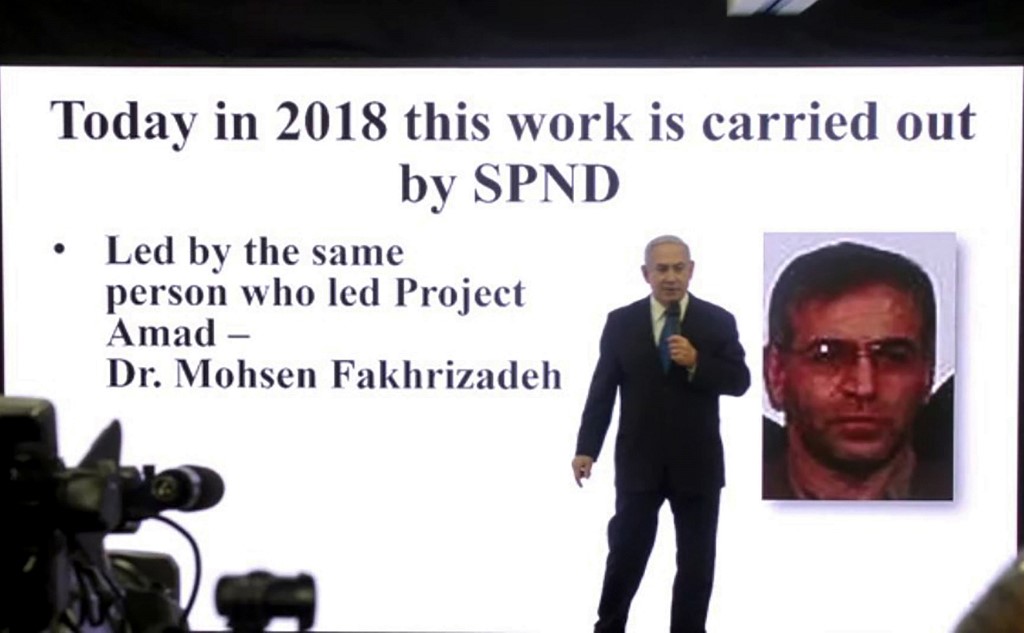
Israeli Prime Minister Benjamin Netanyahu delivers a presentation about Mohsen Fakhrizadeh
Israeli Prime Minister Benjamin Netanyahu delivers a presentation about Mohsen Fakhrizadeh (AFP)

While relatively little known within Iran, Fakhrizadeh had gained a reputation in foreign intelligence circles.

In 2018, Israeli Prime Minister Benjamin Netanyahu claimed that Iran has designed a nuclear payload on Shahab 3 missiles and was expanding its range for nuclear-capable missiles that could reach Riyadh, Tel Aviv and Moscow but were planning for a much further reach. He identified Fakhrizadeh as the head of the project and told his audience to “remember that name”.

In an interview with Kan TV in 2018, former Israeli prime minister Ehud Olmert also warned that Fakhrizadeh would “have no immunity”.

Prior to this, in 2017, Saudi Arabia’s Al-Arabiya covered a summit of the exiled Mojehedin e-Khalq (MEK), a controversial opposition group once on the US terrorism list, at which the organisation claimed Fakhrizadeh was behind Iran’s project for producing a nuclear weapon.

Fereidoun Abbasi, an Iranian MP, said that Fakhrizadeh had survived a similar attack 12 years ago.

In recent years, five other top nuclear scientists have been assassinated in Iran. The latest assassination happened only a few days ahead of the anniversary of the killing of nuclear scientist Majid Shahriari in 2010.

Criticisms of Iran’s security apparatus reaches its peak

While many in Iran believe that Israel was behind the assassination of Fakhrizadeh, on social media many Iranians slammed the security apparatus for its failure to protect their country’s nuclear scientists.

Some complained that the intelligence forces were wasting their time arresting innocent journalists and researchers while the real spies are wandering freely in Tehran.

“I’m more angry with the security apparatus, which is arresting university professors, lawyers and journalists while the wolves are committing assassination in broad daylight,” wrote Sharare Dehshiri, an Iranian user, on Twitter.

Another user under the name of “elsolito” tweeted: “The intelligence organisations must answer to the public about what are they doing exactly? What happened to all your claims of having intelligence monitoring?

“When you are searching for spies among environment activists, journalists and protesters, the result is today’s catastrophe, when the country’s [top people] get assassinated in the heart of the country in the broad daylight.”

Meanwhile, retired General Hossein Alai, a reform-minded figure and former commander of  the IRGC Naval force, called for a reassessment of the performance of the security apparatus.

“We should [study] what weakness there is in the structure of Iran’s security apparatus, which despite the possibility of assassinating people like Fakhrizadeh and providing bodyguards for them, the Israeli operation still succeeds,” argued Alai.

He emphasised that “the assassination of Dr Mohsen Fakhrizadeh by Israel indicates that the Israeli spy and operational circle is still active in Iran”.

Simultaneously, Hesam Ashena, a senior adviser to Iran’s president and a former top intelligence official, called for an “Integrated Intelligence and Security Command” and “synergy of abilities instead of low-yield competitions [between intelligence agencies of Iran]”.

Hardliners point at President Rouhani

Iran’s hardliners have accused President Hassan Rouhani of complicity in Fakhrizadeh’s death after his administration allowed Yukiya Amano, a former head of the International Atomic Energy Agency, to meet the slain scientist.

Javad Karimi Ghoddousi, an Iranian MP, tweeted: “Mr Rouhani, during your presidency over the executive branch, and with the insistence of the enemy and the emphasis of you, Dr Mohsen Fakhrizadeh met with Amano.”

However, Raja News, close to hardliners, denied the allegation brought up by Karimi Ghoddousi. Hassan Shojaie, another MP, claimed that Fakhrizadeh was asked by “pro-western” officials in Iran to meet Amano but the supreme leader, Ayatollah Ali Khamenei, did not allow it.

In a report published on the hardline Mashregh News site in 2014, the IAEA had urged Iran to provide them a meeting with Fakhrizadeh.

Impeding diplomacy

“The reason for assassinating Fakhrizadeh wasn’t to impede Iran’s war potential, it was to impede diplomacy,” tweeted Mark Fitzpatrick, a former senior US diplomat.

That seems to be working to some extent, as the hardliners have already raised pressure on the Iranian government. Hamid Rasai, a hardline activist and former MP, wrote that Rouhani’s administration was putting pressure on Iran’s state TV not to call Fakhrizadeh a nuclear scientist, as they see this assassination a “blow” to their “negotiation project” with US President-elect Joe Biden.

Moreover, Raja News argued that “it is not clear why the pro-West [administration of Rouhani] which is serving their last months, is still emphasising … the failed strategy of compromise”.

“What is clear is that the current strategy of the government has portrayed Iran as weak [in front of] enemies and have persuaded them to commit crimes against people of Iran.”

Iran is due to hold a presidential election next June. 

In the meantime, reformists and conservative newspapers have both called for retaliation.

Headlines used by Iran’s newspapers include: “Eye for an eye,” “If don’t hit them, we will get hit,” “Trap of tension,” and “The cowardly assassination of Fakhrizadeh”.

Prominent reformist and former political prisoner Mostafa Tajzade tweeted: “I unconditionally condemn the assassination of Dr Mohsen Fakhrizadeh. Netanyahu is the first person accused in this crime and seemingly he has no goal other than lighting the fire of war and conflict and preserving the sanctions. Iran can and must expose and isolate the Israeli regime by mobilising global public opinion against state terrorism.”

What will Iran do?

In reaction to Fakhrizadeh’s assassination, Supreme Leader Ayatollah Ali Khamenei issued a statement calling for investigation of “this crime” and firm prosecution of “its perpetrators and its commanders”.

The statement contained no vow of revenge, however, suggesting “strategic patience” was still the plan.

Hossein Kanaani-Moghaddam, a former IRGC commander who headed Iran’s forces in Lebanon for period in the 1980s, told MEE: “Iran’s reaction to this act of terrorism will be shown based on prudence and in the right time and place.”

He added: “Iran will not be influenced and affected by Zionists and will not fall in the trap of Zionists who want Iran to do something that would create a war.

Kanaani-Moghaddam emphasised: “Iran will take revenge from those who ordered this assassination in intelligence organizations of Israel and US.”

Meanwhile, Fereidoun Majlesi, a former Iranian diplomat in the US before the 1979 Islamic Revolution, believes that Netanyahu and US President Donald Trump’s joint efforts to prevent a de-escalation between Tehran and the incoming Biden administration will continue.

“It is crystal clear that Israel was behind this assassination as they seek to provoke Iran to give them an excuse for military attack or a full-scale war before the end of Trump’s presidency,” added Majlesi.

However, it seems Iran will continue its “restraint” policy, as Ali Rabie, the spokesperson for Iranian government, has stated that Iran will avenge the assassination, but “not in the game field the [enemy] has designated”.

Read more


River to Sea Uprooted Palestinian   
The views expressed in this article are the sole responsibility of the author and do not necessarily reflect those of the Blog!

حرب الاغتيالات المفتوحة من طهران إلى فلسطين

محمد صادق الحسيني

يقول الإمام علي عليه السلام:

“… فإذا نزلتم بعدو أو نزل بكم، فليكن معسكركم في قبل الاشراف، أو سفاح الجبال، أو أثناء الأنهار… واجعلوا لكم رقباء في صياصي الجبال، ومناكب الهضاب… واعلموا أنّ مقدّمة القوم عيونهم، وعيون المقدمة طلائعهم، وإياكم والتفرّق، فإذا نزلتم فأنزلوا جميعاً، وإذا ارتحلتم فارتحلوا جميعاً، وإذا غشيكم الليل فاجعلوا الرماح كفّة، ولا تذوقوا النوم إلا غراراً…”.

هي حرب الاغتيالات الجبانة إذن بديلاً عن حرب المواجهة الميدانية كما توقعناها وحذرنا منها…!

ولا بدّ لنا ان نحزم أمرنا ونستعدّ لها على كلّ المستويات وبكلّ ما أوتينا من قوة وحيلة.

نعم لقد أوذينا كثيراً في استشهاد عالم الفيزياء الأول في إيران البروفيسور محسن فخري زاده.

وبالمناسبة فهو صاحب إنجازات علمية مهمة جداً آخرها كما أعلنت الجهات الإيرانية كلّ الإنجازات المتعلقة بمواجهة وباء كورونا.

هو أيضاً رجل منظومة الدفاع الإيرانية المقتدرة ومساعد وزير الدفاع لشؤون البحث والتحقيق العلمي.

لكنه قطعاً هو ليس عبد القدير خان (إيران) صاحب القنبلة الباكستانية، كما يحاول العدو الصهيوني الإيحاء بذلك كذباً وزوراً بهدف اتهام إيران بالتسلح النووي..!

هل تتذكّرون عشرات الاغتيالات لعلماء عرب ومسلمين بينهم سوريون ومصريون وعراقيون وآخرهم عالم الفيزياء الفلسطيني فادي البطش!؟

هم يضربون في العلم والعلماء ولا عزاء لنا إلا الحكمة والحزم وشجاعة الإقدام في اللحظة التي تختار قيادتنا.

هو نال كلّ ما يريد في الدنيا والآخرة؛ هنيئاً له. ونحن خسرناه وهي ضربة مؤلمة لا ننكرها، لكن انْ فكّر أحد، أيّ أحد، بأنّ أيّ مشروع علمي قد توقف او سيتوقف في إيران باغتيال عالم هنا او هناك فهو واهم.

فكلّ بقعة من إيران مختبر للعلوم ومنظومة للدفاع.

عن الانتقام والردّ والإجراءات العقابية نترك الكلام لأصحاب العلاقة والمعنيين وفي مقدّمهم إمام المقاومة وسيدها الخراساني العظيم الإمام السيد علي الخامنئي ربان هذه السفينة، والذي يعرف تماماً كيف يدافع عن أبنائه ويحفظ لهم كراماتهم.

لكن الدرس البليغ الذي نستخلصه ولا بدّ أن نسجله هنا هو:

1

ـ أميركا كما ربيبتها الاسرائيلية عدو واحد لا يقبل القسمة على اثنين. وهما من خططا وأشرفا على عملية الاغتيال الجبانة هذه كما في عمليات اغتيال العلماء النوويين السابقة.

2

ـ الحوار والمفاوضات مع هذا العدو المتوحش حول المبادئ والسياسات العامة والإنجازات بكلّ مستوياتها سمّ قاتل. ومَن لم يتعلم الدرس بأنّ هؤلاء غير موثوقين كما يقول السيد القائد: إما أنه لا يعرف ألف باء السياسة أو لا يعرف ألف باء الغيرة والحياء.

3

ـ منذ الإنزال الاسرائيلي في أبو ظبي والذي سمّيناه بالإنزال خلف خطوط التاريخ والجغرافيا، قلنا إنها حالة إعلان حرب “إسرائيلية” استخبارية ضدّ إيران وليست مجرد تطبيع…!

وحسب اعتقادنا فإنّ التحقيقات حول الاغتيال اليوم ستؤكد ما نعتقده بانّ ابن سلمان ورهطه في بقايا قراصنة الساحل متورّطون في هذا العمل الإجرامي الجبان وغيره.

وذلك من خلال تدريب وتجهيز صغار العملاء من منظمة منافقي خلق ومثلهم من بائعي الضمير والوجدان ومرتزقة البترودولار.

4

ـ بالوثائق والمعلومات فإنّ كلّ أجهزة الأمم المتحدة من الصحة العالمية الى الطاقة الذرية، انما هي حسب العقيدة الأميركية أجهزة تابعة للجيش الأميركي.

تفصيل ذلك وماذا ينبغي علينا فعله أمر موكول لأصحاب الشأن وكل ذي عقل حصيف.

المعركة مفتوحة ولم تنته بعد، وبرنامج اغتيالاتهم لن يتوقف عند هذا الحدّ، وساحة عملهم ليست إيران فقط.

كلّ ساحات محور المقاومة مسرح متاح لعملياتهم.

قلنا ذلك من قبل، نعيد ونكرّره هنا… العدو يعمل ليل نهار محاولاً إيقاف دورتنا العلمية والدفاعية. وقياداتنا تعرف ذلك تماماً وهي على قدر الموقف. أُسود لا تهاب أحداً الا الله وثقتنا بها عالية جداً، والأمر لله من قبل ومن بعد.

بعدنا طيبين قولوا الله…

River to Sea Uprooted Palestinian   
The views expressed in this article are the sole responsibility of the author and do not necessarily reflect those of the Blog!

Wednesday, 5 February 2020

Reaffirming the Revolution: The Islamic Republic of Iran at 41

By Yuram Abdullah Weiler
Qasem Soleimani in 2017 rally b3707
In number theory, 41 is a prime number meaning it is not divisible by any number except itself and one.  Similarly, the Islamic Revolution in Iran so far has been unique in its success and indivisible unity of purpose, despite numerous attempts at sabotage by external and internal actors.  At this prime age of 41, Iran is fully capable of charting an assertive leadership path to recapture the spirit and reaffirm the original goals of the Islamic Revolution of 1979, among which is the propagation of Islam to bring about social change for the welfare of all humanity.[2]
It is no minor accomplishment for the Islamic Republic of Iran to have maintained an independent geopolitical course for a period of forty one years in spite of the overwhelming diplomatic, economic and military pressure employed by the United States to force Tehran to cave in to the diktats of the Washington regime. Even before the erstwhile shah, Mohammed Reza Pahlavi, had fled the country on January 17, 1979, U.S. air force general Robert E. “Dutch” Huyser had arrived on January 3rd on a mission to test the waters for a rerun of the August 1953 coup, which had originally placed the U.S.-backed dictator in power in the first place.[3]
With the victory of the Islamic Revolution on February 11, 1979, Ayatollah Khomeini (r) went on to found an Islamic Republic, whose constitution (Article 154) explicitly states that Iran “is concerned with the welfare of humanity as a whole and takes independence, liberty and sovereignty of justice and righteousness as the right of people in the world over.”  Imam Khomeini was very clear in his view that “Islam is revealed for mankind,” and, therefore, the revolution must be exported.[4] This concept, which raised fears of popular uprisings toppling the U.S.-abetted tyrants in the region and beyond, put the nascent Islamic Republic on a collision course with the Washington regime.  Among the despotic leaders shaken by Iran’s Islamic Revolution was the U.S.-supported Iraqi dictator, Saddam, who denounced Imam Khomeini and called upon Iranian Arabs to revolt.[5]
If external threats to the newly-established Islamic Republic weren’t enough, others arose internally. Massoumeh Ebtekar, who witnessed the revolution firsthand and is currently Vice President of Iran for Women and Family Affairs, recalled that “we were sure that foreign elements were actively involved in attempts to weaken and undermine the young republic.” To avert the suspected foreign plot to overthrow the Iranian government, a group of students, including now Vice President Ebtekar, decided to act, and on November 4, 1979 occupied the U.S. embassy in Tehran and detained the staff.[6]  U.S. president Jimmy Carter responded ten days later by freezing US $12 billion’s worth of Iran’s assets in the U.S., and later banned all trade with and travel to Iran.[7] Also affected were Iranian assets in U.S. banks in Britain, much of which were in Bank of America’s London branch.[8]  The following year on April 7, the U.S. cut diplomatic relations with Iran, and has never reinstated them.[9]  If Carter had not allowed the deposed shah entry to the U.S., the embassy takeover most likely would not have occurred.[10]
Another internal threat, the Mujahedin-e Khalq (MeK), was openly unhappy over the constitution, which, according to them, did not address their demands.  After a humiliating defeat in the March and May 1980 parliamentary elections (no MeK candidates were elected),[11] the MeK became increasingly belligerent over their lack of position in the new government, directing their frustration ever more violently towards members of the Islamic Republic Party (IRP), which had won a decisive victory in the elections.  Despite the electoral defeat, the MeK openly backed Iran’s first president, Abolhassan Bani Sadr, however, following his removal from office for incompetency in June 1981, the MeK declared an armed struggle against the standing government. On June 28, 1981 and again on August 30, the MeK carried out terror bombing attacks against the IRP and government leaders.  In 1986, the MeK moved its operations to Iraq and aligned itself with Saddam, who backed the terrorist group until being ousted by the U.S. invasion in 2003. To date, the Washington regime views the MeK as a viable means by which to overthrow the legitimate government of Iran.[12]
Following the student takeover of the U.S. embassy, which was later shown to be a nerve center for CIA espionage in the region,[13] U.S. president Carter ordered a desperate mission on April 24, 1980 to invade Iran and free the hostages despite negotiations for their release still being in progress.[14] The so-called hostage crisis and the U.S. president’s failed interventionist response provided a perpetual pretext for Washington’s vehemently vindictive view against reestablishing any level of diplomatic relations with the Islamic Republic of Iran.  The 444-day crisis, according to sworn testimony by Israeli intelligence agent Ari Ben-Menashe, was a joint effort by the CIA and Mossad to delay the release of the 52 hostages and thereby ensure an electoral victory for Ronald Reagan in the 1980 U.S. presidential race.[15]
In the midst of the post-revolutionary struggle to establish a fully functioning Islamic government, Iraqi dictator Saddam, with U.S. blessing, attacked the fledgling Islamic Republic on September 22, 1980, imposing a costly 8-year-long war that consumed some 60 to 70 percent of Iran’s national budget, not to mention the suffering of the Iranian people and their sacrifices in defense of Iran and Islam.[16]  The economic impact of the war on Iran itself was enormous with estimated direct costs in the range of US $600 billion and total cost of US $1 trillion.[17]  In the course of this U.S.-supported war, chemical agents were used extensively for the first time since the First World War, resulting in the deaths of some 4,700 Iranians in a single attack.  The U.S. also provided Saddam with biological agents such as anthrax and E. coli.[18]
Howard Teicher, director of political-military affairs for the U.S. National Security Council from 1982 to 1987, in an affidavit stated, “CIA Director [William] Casey personally spearheaded the effort to ensure that Iraq had sufficient military weapons, ammunition and vehicles to avoid losing the Iran-Iraq war.” Teicher also testified that U.S. president Reagan had sent a secret message to Saddam advising him that “Iraq should step up its air war and bombing of Iran.”  Teicher’s sworn testimony provides strong evidence that the U.S. intent was for Saddam to bomb Iranian cities, thereby unavoidably targeting civilians.[19]
Saddam followed Reagan’s advice to the letter by launching eleven SCUD B missiles at Tehran on February 29, 1988.  Over the next two weeks, more than 100 of Saddam’s missiles rained down upon the cities of Tehran, Qom and Isfahan along with bombing raids conducted against a total of 37 Iranian cities. Earlier in October 1987 and again in April 1988, the U.S. as part of its overt but undeclared war against the Islamic Republic, attacked Iranian ships and oil platforms under expanded rules of engagement.[20]  As a result of Washington’s designation of the Persian Gulf as essentially a free-fire zone for Iranian targets, the commander of the USS Vincennes, William C. Rogers, fired two missiles (after twenty-three failed attempts)[21] at what he claimed was a military target but in fact was Iran Air Flight 655 carrying 290 civilian passengers from Bandar Abbas to Dubai.  For downing the civilian airliner and killing all on board, Rogers was awarded the Legion of Merit “for exceptionally meritorious service” for this appalling atrocity.[22]
Yet in spite of the near universal support given by the U.S. and its western minions to Saddam, the people of Iran rose up to defend their newly liberated land in what were termed “human wave attacks” in the western press. Giving their lives selflessly in the cause of defending Islam and Iran, these martyrs, whose numbers reached to half a million,[23] struck fear in the black heart of Saddam and presented a conundrum to the materialistic west.  Ayatollah Mohammad-Taqi Rahbar explains that martyrdom, while clearly understood in the Islamic world, “is incomprehensible and even pointless in materialist and atheistic cultures.”[24]
The incomprehensibility to most westerners of the spiritual basis of Iran’s Islamic Revolution leads to some interesting “anti-explanations.”  Professor of Sociology at the University of North Carolina Charles Kurzman wrote, “After the Iranian Revolution, those who had considered the upheaval unthinkable became preoccupied with understanding how they could have been so mistaken.” After pointing out the shortcomings of the various political, economic, cultural and other explanations, Kurzman notes, “The more I learned about the Iranian Revolution, the more theoretical anomalies I discovered.” Yet this author acknowledges that 55 percent of educated, middle-class Iranians and 71 percent of others he interviewed spoke of Islam as being involved in their decision to participate in the revolution.[25]
Apparently, for secular-leaning western scholars, Islam cannot be accepted as the basis for an explanation of a successful revolution. For example, even Iranian expatriate scholar Ervand Abrahamian blames the Islamic Revolution on “overwhelming pressures” in Iranian society due to the shah, who “was sitting on such a volcano, having alienated almost every sector of society.”[26]  Downplaying the role of Islam in Iran’s revolution, Iranian expatriate scholar Asef Bayat insists that there was a “strong secular tendency,” which peaked in the 1970s.  Bayat incredulously claims, “In Iran, an Islamic movement was in the making when it was interrupted by the Islamic revolution.”[27]  Other scholars date the origin of the Islamic movement in Iran to the tobacco crisis of 1890-1891, while Farhang Rejaee, a professor at the Carleton Centre for the Study of Islam in Ottawa, Canada, points to the assassination of Nasr al-Din Shah in 1896.[28]
The current Islamic movement in Iran had begun on the 15th of Khordad, 1342 (June 5, 1963), predating the Islamic Revolution by some 15 years.  In a June 1979 speech marking the anniversary of the 15th of Khordad uprising, Imam Khomeini specifically referred to the Islamic movement and its creation in the mosque network.  “Who are they that wish to divert our Islamic movement from Islam?” asked the Imam. “It was the mosques that created this revolution,” he emphasized, adding. “It was the mosques that brought this [Islamic] movement into being.”[29]  Likewise refuting the theories of the western and westernized scholars, Ayatollah Mohammad-Taqi Rahbar explains, “The secret of success of the Islamic Revolution of Iran also is naught but this: valuing the high ideals of Islam and of the Islamic humanities.”  As to the failure of other revolutions, he blames “want of a sufficient depth in its spiritual dimension.”  Finally, he affirms, “The revolutionary experience of Iran should indeed become a model for others to emulate.”[30]
By basing economics and social change on the solid foundation of Islam, Iran has achieved greater progress in many areas, such as reducing poverty, improving health care, eliminating illiteracy, increasing access to education and expanding opportunities for women, than had been the case during the shah’s regime.   As a result, despite the unending U.S. hostility against Iran through ruthless imposed wars, covert and overt aggressions, punitive economic sanctions and continuous diplomatic isolation, the Islamic Republic has managed to amass an impressive list of accomplishments.  U.S. economic sanctions have had the effect of causing Iran to seek self-sufficiency in a number of areas, including weaponry and other military hardware, food production, steel, paper and paper products, cement, heavy industrial machinery, pharmaceuticals and telecommunications equipment. In particular, the domestic production of armaments has helped to ensure the country’s independence and security, as has the highly developed military strategy of the “fast boat swarm” for naval defense in the Persian Gulf.[31]
Moreover, in the field of health care, Iran has made laudable strides, increasing life expectancy from 56 years in the 1970s to over 70, and reducing the infant mortality rate from 104 per 1,000 births to 25.[32]  The Islamic Republic has created, and continuously expanded, a system of hospitals and health clinics, concentrating on areas impacted by economic hardship.  The results have been sufficiently impressive for some universities and NGOs in the U.S. state of Mississippi to introduce Iranian-style health care into the impoverished areas of the Mississippi Delta region.[33] Rural areas also benefitted from the revolution in other ways besides access to health care.  By 2002, rural literacy had risen to 70 percent, each village had an average of two college graduates, and 99 percent of rural households had electricity. In 1976 only ten percent of the rural work force was employed in the industrial, construction and service sectors, whereas 51 percent was employed therein by 1996.[34] Land was redistributed among peasants, who formed numerous cooperatives, which assisted in raising prices for agricultural products.  Even the poorest of Iranians were able to have at least some level of access to modern consumer goods.[35]
“The biggest advances in the educational, professional and social standing of women in Iran’s history have come since the revolution,” wrote scholars Hillary Mann and Flynt Leverett.[36] After the victory of the Islamic Revolution, female literacy rates skyrocketed from 36 percent in 1976 to 74 percent in 1996, with urban women toping 82 percent.[37] Women were provided with the same educational opportunities as men, and were employed in both the public and private sectors.  Not only were women allowed to drive (unlike other “Islamic” countries), but also participated in political, commercial and civil activities, as well as in the security sector.  Health care in the Islamic Republic included women’s clinics, where progressive family planning and other services were available.[38]
“This united gathering which took place in Iran, and this great change which happened, must be taken as an example to be followed and never forgotten,” said Imam Khomeini (r) on 7th of Esfand 1359 (26 February 1981). [39] Despite that to date, no other Muslim-majority nation has yet to emulate successfully the revolutionary path taken by the valiant people of Iran, the paradigm remains as does the potential for Iran’s leadership to bring about a united Islamic Ummah.

Thursday, 23 January 2020

“Death to the Islamic Republic” they chant now- and they call themselves Iranians

January 18, 2020
Nobody has escaped the news of the so called “popular demonstrations” in Iran during the recent days. Hundreds of thousands of articles, updates and tweets have been made on this matter, and many have talked about what the reasons behind these protests have been. Many videos show groups so called Iranians tearing down the pictures of Martyr Qassem Soleimani, while others chant “death to the Islamic Republic” and “death to Khamenei”. Thousands of such people have appeared across Iran and many of those Iranians outside of Iran cheer on them while the Empire takes every chance to attack Iran as these protests are used by the Western Media to wage psychological warfare on the Islamic Republic.
This marks a new stage in the audacity of dissent in the Islamic Republic. In order to understand what I’m talking about; we should take a trip back in history to recognize the sworn enemies of the Islamic Republic. The Islamic Republic has since the beginning of its existence had two mortal, existential enemies – the MEK cult and the Monarchists. For a while, the Communists were a force too to be reckoned, especially in the 1980’s.
The MEK cultists, advocating “Islamic Marxism”, seek to replace the Islamic Republic’s old and conservative policies with their “modern interpretation”. In their quest for power, they’ve committed heinous acts, such as terrorism and treason, to the point where even the US, Canada and the European Union, enemies of Iran, had listed them as a terrorist organization. They have since lifted the designation and have been grooming them into becoming a “viable opposition group”.
After the 1979 revolution, the Islamic Republic had managed to drive away or execute most Monarchists and many of their supporters went into exile in the West, mostly the US, where they continued their opposition. With most of Iran’s wealth taken away by the monarchists in exile, the Islamic Republic defended by a group of ill-trained and poorly equipped group of men calling themselves “Army of Guardians of the Islamic Revolution”, fought against internal and external enemies during most of the 1980’s. The invading Iraqi Army, Communist guerrilla groups, MEK cultists armed by the Saddam regime, and separatist groups were fought vigilantly during the entire war with neighboring Iraq.
One by one, they were defeated and driven out of the country, into exile and the Islamic Republic won the battle for its survival. The communists were all but destroyed and driven into exile and the once powerful Tudeh party was split into several factions. The war ended when the MEK terrorist group were defeated in 1988, after they had been armed by the Saddam regime and launched an invasion into their own country. Saddam, who had been armed and supported by Western countries, including the US, was driven back from Iranian land and the war with Iraq resulted with a status quo ante bellum, and over a million dead Iranians. With the MEK driven back into Iraq, the Islamic Republic had survived this tremendous test and stood its ground and yet many more challenges stood in its way in the coming years. Only a year after the end of the war, the founder of the Islamic Republic, Imam Khomeini passed away, leaving what many believed would be a vacuum for his successor to fill. The morning after Khomeini’s death, on June 4, 1989, Ayatollah Ali Khamenei was elected as the new Leader of the Islamic Revolution despite not belonging to the rank of Marja (Grand Ayatollah), as required by the constitution, although this requirement was later removed through amendments to the constitution.
Throughout Khamenei’s rule, several rounds of rather large and widespread protests have struck Iran. The first significant one occurred in 1999, when students in Tehran protested against the closure of a reformist newspaper. The next challenge was the 2009 presidential elections and the aftermath of widespread protests due to the alleged election fraud in which Mahmoud Ahmadinejad was elected president for a second term. Both of these incidents were marked by violence and disaffection among the protesters, yet they never chanted against the Islamic Republic, they never rioted and attacked security forces in the ways that we have seen recently. In both of those protests, the protestors were pro-reformist and chanted in support for ex-president Mohammad Khatami and the presidential candidate of the 2008 elections – Mir Hossein Mousavi.
Yes, the 2009 protests were foreign backed, but not in the same obvious ways that we see today. For the first time in November 2019, I witnessed slogans calling for the death of Khamenei and outright regime change. The heinous act of tearing down Martyr Qassem Soleimani’s show these people’s absolute contempt for the Islamic Republic, but it also shows something else: that they are not protesting due to poor living standards or lack of freedom. It would make absolutely no sense to tear down the poster of Martyr Soleimani if they were poor or feeling oppressed since Martyr Soleimani’s struggle was mainly conducted abroad in an effort to liberate the region from the hands of tyrants. In fact, Iranians have Martyr Soleimani and the Quds Force to thank for their own safety from terrorism, as Imam Khamenei once said: “If we were not fighting Daesh in Aleppo or Mosul, we would be fighting them in the streets of Kermanshah and Tehran.”
If poverty was an issue, then the government reform to the gas subsidies should be welcomed by the poor since that money will now go to the poorest families in Iran. Yet the same “protestors” instead turned to rioting and set fire on banks and government buildings, rather strange isn’t it?
One should also take note of some curious things this time around. We all know that Iran announced that it accidentally shot down the Ukrainian airliner. On that same day, small anti-government began to spring up in Tehran, mainly led by university students, chanting “death to the liars”, the only problem is that nobody lied. Iran admitted to have accidentally downed that plane. Yes. it took a few days, because there had to be an investigation first before drawing any conclusions, despite whatever evidence other countries supposedly had. It’s not like these countries, allies of the Terrorist Empire, haven’t lied and pinned incidents on Iran before…
In any case, the media have been very anxious for this news. Barely any mention on the Yellow vests and the violent protests in Chile, instead they focus on a couple of thousands of protestors, with rather shady agendas, compared to the 25 million Iranians that mourned for Qassem Soleimani, and portray it as if three poster-tearing “free Iranians” represent the true Iranian sentiment for Martyr Soleimani.
Interestingly, the calls for foreign intervention among these protestors and their supporters abroad is on the rise. The so called protestors and their Twitter fans also deliberately spread videos of these “proud Iranians” who refused to step on the US and Israeli flags, as a way to bait US public support for “American help” while chanting that “the US and Israel aren’t our enemies, our enemy is right here”. There is no question as to who and what these so-called protestors represent. On some videos one can hear pro-Monarchist and pro-MEK chants. MEK communiques such as their social media platforms are filled with active propaganda and calls for regime change. Threats are constantly issued to the Islamic Republic along with instructions and encouragement to attack security forces and military bases. These people openly stand with the Terrorist Empire against their own country – and they dare to call themselves Iranians.
The Monarchists, MEK and the Terrorist Empire want people to believe that Monarchist Iran was a modern and prosperous country. In truth, Iran was a country in decline during the monarchy era, starting from the era of the Qajar dynasty in the late 1700s to the early 1900s, and continuing with the Pahlavi era to 1979. It was a country were up until 1978, 60% of the population were illiterate, where large parts of the population lived without electricity or running water, and a large majority of the country’s oil belonged to foreign powers, with a leader who had come to power through a foreign backed coup. Only the Islamic Republic has successfully ended 200 years of humiliation in the face of foreigners. Only the Islamic Republic can defend Iran from US colonialism. Only the Islamic Republic can lead the region into a rebellion with the aim of kicking the US out of West Asia. They have done more for Iran than any king has since the fall of the Great Safavid dynasty. True Iranian Patriots would wish for an independent Iran where she has retained her culture, instead of having switched it out for Western culture.
This is the Islamic Awakening. For the first time in more than a century, the Islamic world can regain its long lost honor and free itself from the shackles of colonialism and imperialism. But only with the Islamic Republic..

River to Sea Uprooted Palestinian   
The views expressed in this article are the sole responsibility of the author and do not necessarily reflect those of the Blog!

Thursday, 12 December 2019

IF IRAN FALLS, ISIS MAY RISE AGAIN نيوزويك” تحذر: إذا سقطت إيران، سيصعد داعش مجدداً


BY  
As disorder deepens in Iran amid widespread protests, fears are rising that the fall of Iran’s revolutionary Shiite Islamic Republic could lead to disaster in the region and the re-emergence of an even greater foe of the United States—the Islamic State militant group known as ISIS.
Violent protests sparked by a cut in gas subsidies continue to erupt across Iran, fueled further by a forceful crackdown on protesters from the government. The unrest, coupled with crippling U.S. sanctions and costly campaigns across the Middle East, has incensed those fighting for regime change from within the country, opening an opportunity for Iran’s enemies both at home and abroad to capitalize on this discord and vulnerability.
“Different groups hostile to the Iranian government, including ISIS, separatists or other ones, have and will take advantage of any unrest in the country,” Abas Aslani, a visiting scholar at the Istanbul-based Center for Middle East Strategic Studies and editor-in-chief of the Iran Front Page outlet, told Newsweek.
“They could find a way in this situation to bring more damage to the country,” he added. “This will not be limited to the groups, but also some foreign countries inside and outside the region will also use the opportunity for weakening or changing the regime in Iran and bring instability to the country.”
Iran has remained steadfast in the face of its foes foreign and domestic, and few expect the full demise of the government. But even those inside and outside Iran who support the rallies that continue day and night against the clerics running the nation fear the chaos alone could foster conditions for ISIS to breed.
“Any collapse or weakening of a state in the region is likely to fuel into more instability in the region,” Aslani told Newsweek. “This is also a concern of even opponents in Iran, in so that they are not sure in the case of the collapse of the current system in the country who will replace them and how the situation will be.”


iran protest isis daesh tehran embassy
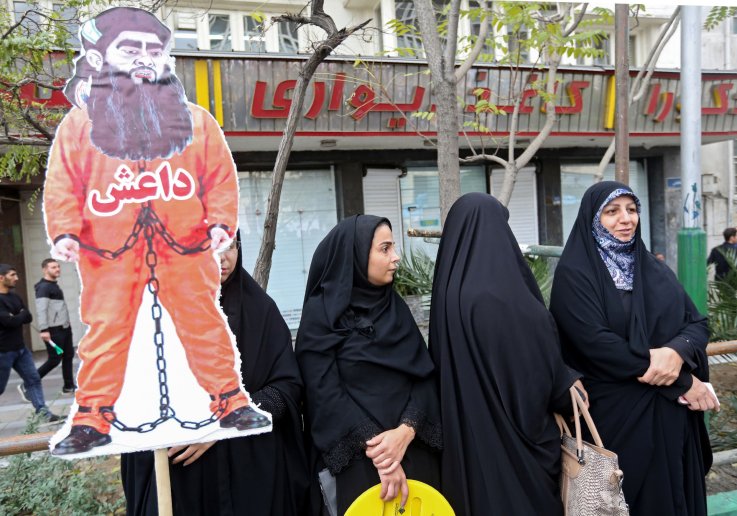
An Iranian woman holds a cardboard cutout representing an ISIS member in chains, during a demonstration outside the former U.S. embassy in the Iranian capital Tehran on November 4 to mark the 40th anniversary of the Iran hostage crisis. On November 4, 1979, less than nine months after the toppling of Iran’s once-CIA-reinstalled shah, students overran the embassy complex to demand the United States hand over the ousted ruler after he was admitted to a U.S. hospital.ATTA KENARE/AFP/GETTY IMAGES

To Iran, the fight against ISIS has always been an existential one. Just as the Pentagon began coordinating its own involvement in June 2014, Iran had begun mobilizing mostly Shiite Muslim militias in both Iraq and Syria to beat back lightning gains made by the Sunni Muslim insurgents that reveled in the slaughter of those deemed to be outside of their ultraconservative ideology.
This proved vital in turning the tide against the jihadis, who have been largely defeated in recent years.


“Iran was critical in providing logistical and advisory support to Iraqi paramilitary forces who battled ISIS in Iraq, particularly during the early days of the campaign,” Rodger Shanahan, a research fellow at the Lowy Institute’s West Asia Program and former director of the Australian Army’s Land Warfare Studies Centre, told Newsweek.
As for Syria, where ISIS spread amid an ongoing civil war, Shanahan said Iran’s support for President Bashar al-Assad “also meant that it has contributed to the anti-ISIS campaign, although it is fair to say that that was by no means the aim of their support for Assad and the targeting of ISIS has been sporadic at best.”
In fighting ISIS abroad, Iran managed to help dismantle the jihadis and broaden the Islamic Republic’s own support network of partnered forces also hostile to Israel, Saudi Arabia and the U.S. Establishing this so-called Axis of Resistance proved a major strategic victory, but it came at a steep price.
These campaigns cost Iran capital, both human and financial, and strict U.S. sanctions have choked up Tehran’s access to disposable income. Although the Iranian government is believed to still have access to considerable wealth to run its operations, the dual effects of a U.S.-imposed trade siege and domestic mismanagement have made life more difficult for everyday Iranians unable to take advantage of the economic reforms promised by President Hassan Rouhani.


iran police station burned protests
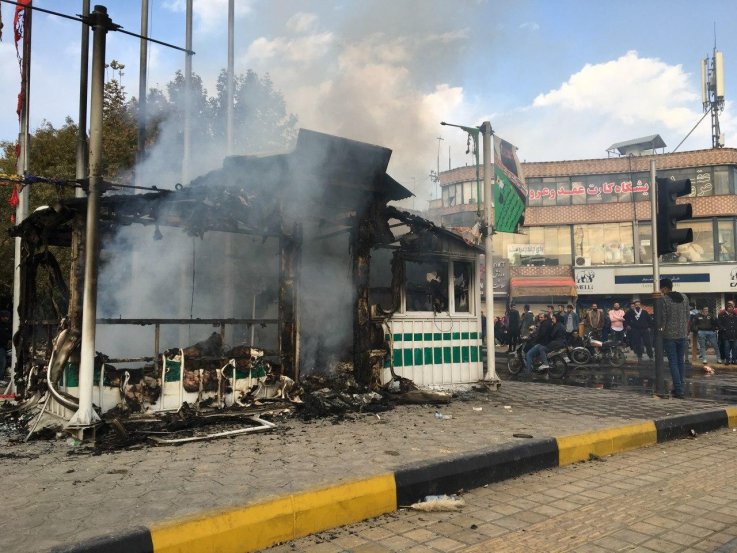
Iranians gather around a charred police station that was set ablaze by protesters during a demonstration against a rise in gasoline prices in the central city of Isfahan, November 17. Iran responded to violent protests with an internet blackout and a swift crackdown that continues to result in bloodshed, with some members of security forces among those killed.AFP/GETTY IMAGES

The Rouhani administration’s decision to cut fuel subsidies last month and ultimately transition to a welfare-based system had actually been in the works for some time and was supported by the International Monetary Fund. Still, the sudden shift was seismic for Iranians accustomed to cheap fuel and people have taken to the streets to protest in massive numbers.
The government’s reaction on the ground was swift and, against who officials claimed were rioters, deadly.
Amnesty International has estimated that more than 200 Iranians have been killed during the unrest and Brian Hook, the State Department’s special representative for Iran, placed the casualties at “many hundreds, perhaps over a thousand”—a figure far higher than other estimates provided by human rights monitors. No conclusive count exists and the Iranian government has disputed these numbers.


Those groups are “the biggest non-state threat to Iran today,” Ariane Tabatabai, an associate political scientist at the RAND Corporation and an adjunct senior research scholar at Columbia University’s School of International and Public Affairs, told Newsweek. The most volatile border areas are Sistan-Baluchistan, Khuzestan and Kurdistan. Watchers worry that any escalation of insurgencies in these parts could propel Iran toward the sectarian strife seen in Syria.
“That’s part of what’s deterring many Iranians from outright pushing for regime collapse: The lessons of Syria loom large,” she added.


Insurgencies were waged by separatist Arab, Baluch and Kurdish militias for decades before ISIS, Al-Qaeda or even the 1979 Islamic Revolution that overthrew the pro-West shah, who long-enjoyed the CIA maintaining his rule. The Islamic Republic has managed to keep these restive communities in line, but deadly attacks persist, such as a February bus bombing that killed up to 27 members of the Revolutionary Guard.
The operation was claimed by Jaish ul-Adl, which along with fellow Sunni Islamist group Ansar Al-Furqan, has taken advantage of previous periods of unrest in an attempt to undermine the Iranian government. ISIS, notorious for its ability to build bridges across continents, has actively sought to exploit these national struggles as it does in countries as far away as the Philippines.
The group’s reach within Iran remains fairly insignificant, Tabatabai added. She explained, however, that “ISIS has mostly focused its efforts in the areas with significant Kurdish and Arab minority populations—because these are populations that have been historically neglected if not repressed by the central authority.”
While eradicating adversarial forces and projecting its own influence abroad were integral motivations for Tehran’s entrance into the fight against ISIS, so was disrupting any potential nexus between the influential jihadi group and other opponents of Iran within the country itself. Shanahan told Newsweek that from the beginning, “Iran was concerned at the threat ISIS posed to Iranian territory, and the possibility of support for low-level insurgencies amongst Arab and Baluch Sunni groups inside Iran.”


Even with limited success in its infiltration, ISIS managed to strike at the heart of the Islamic Republic in June 2017 when several Sunni Kurdish militants aligned with the group staged twin attacks on the Iranian parliament and the shrine to the late Ayatollah Ruhollah Khomeini, killing 18 people.
An attack last September at a Revolutionary Guard parade in Ahvaz commemorating the Iran-Iraq War—during which Saddam Hussein, too, tried to foster Arab separatism in Khuzestan—killed two dozen people, half of them soldiers, and was claimed by both ISIS and Ahvazi Arab separatists.
In response, Iran launched Zulfiqar and Qiam missiles that flew hundreds of miles across Iraq and into the eastern Syrian province of Deir Ezzor, an ISIS stronghold at the time assaulted by two rival campaigns led by the Syrian government and the U.S.-backed, majority-Kurdish Syrian Democratic Forces. The unprecedented strike was seen not only as a message to ISIS, but as a testament of Iran’s missile prowess directed toward its top three national foes.


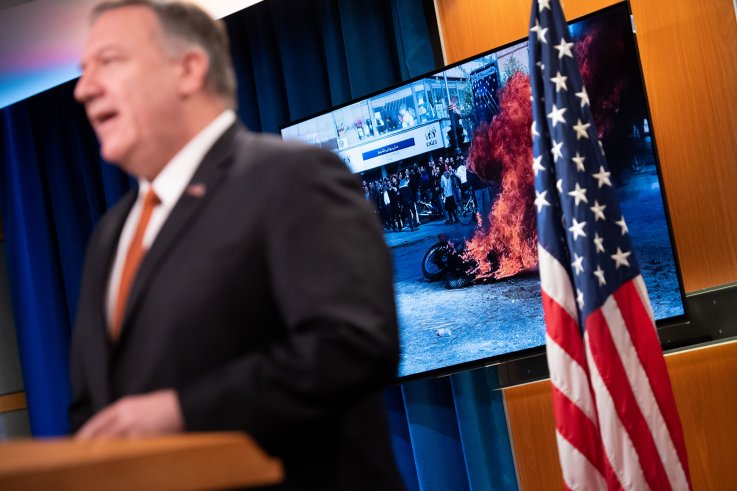
us, iran, protests, mike, pompeo
Secretary of State Mike Pompeo speaks alongside a photograph of demonstrations in Iran as he holds a press conference at the State Department in Washington, November 26. In a message addressed to protesters, Pompeo said: “The United States hears you. We support you and we will continue to stand with you in your struggle for a brighter future for your people and for your great nation.”SAUL LOEB/AFP/GETTY IMAGES

Iran has often blamed the U.S., Israel and Saudi Arabia for fomenting discord within the country in an attempt to overthrow a government they view as destabilizing to the region. No conclusive evidence of such a conspiracy regarding the current demonstrations has emerged, although top Washington figures—such as former national security adviser John Bolton, a devout war hawk—have openly courted opposition forces like Ahvazi Arab separatists and the People’s Mojahedin Organization of Iran, or Mujahedin-e-Khalq (MEK).


All three experts interviewed by Newsweek said they believed the collapse of the Iranian government was unlikely in the near future, despite the “maximum pressure” campaign by the U.S. against it. Even for Washington, this may not necessarily be a bad thing: It has repeatedly learned that an enemy government’s loss of control often had far-reaching repercussions in the form of mass refugee flows, the formation of new, more powerful enemies, and costly military interventions to fight them.
The fall of Iran—a nation whose population is higher than all three of those war-torn nations combined—would likely have even more devastating side effects and give ISIS and other underground forces new room to operate.
For now, the threat of ISIS appears to be under control. But worsening economic woes resulting from U.S. restrictions and political infighting among Iran’s own hard-liners and moderates ensure the militant group will continue to root for, if not actively seek out, Iran’s capitulation.

نيوزويك” تحذر: إذا سقطت إيران، سيصعد داعش مجدداً

توم أوكونور

من المرجح أن يكون لسقوط إيران آثار جانبية مدمرة أكثر، وهذا سيمنح داعش والقوات المتطرفة الأخرى مساحة جديدة للعمل.

“نيوزويك” تحذر: إذا سقطت إيران، سيصعد داعش مجدداً

رأت مجلة “نيوزويك” الأميركية أنه مع تزايد الفوضى في إيران وسط احتجاجات واسعة النطاق، تتصاعد المخاوف من أن سقوط الجمهورية الإسلامية الشيعية الثورية في إيران يمكن أن يؤدي إلى كارثة في المنطقة وظهور عدو أكبر للولايات المتحدة هو تنظيم “داعش”.

وقالت المجلة إن الاحتجاجات العنيفة الناجمة عن خفض الدعم عن الوقود لا تزال تندلع في جميع أنحاء إيران، مما زاد من حدة القمع القوي للمتظاهرين من الحكومة. وأدت الاضطرابات، إلى جانب العقوبات الأميركية المشددة والحملات المكلفة في جميع أنحاء الشرق الأوسط، إلى إثارة غضب أولئك الذين يقاتلون من أجل تغيير النظام من داخل البلاد، مما أتاح الفرصة لأعداء إيران في الداخل والخارج للاستفادة من هذا الخلاف والضعف.

وقال عباس أصلاني ، باحث زائر في مركز الدراسات الاستراتيجية في الشرق الأوسط ومقره إسطنبول لـ”نيوزويك”: “هناك مجموعات مختلفة معادية للحكومة الإيرانية، بما في ذلك داعش والانفصاليون أو غيرها، وستستفيد من أي اضطرابات في البلاد”. وأضاف “يمكنهم إيجاد طريقة في هذا الموقف لإحداث مزيد من الضرر للبلاد. لن يقتصر هذا على المجموعات، ولكن أيضاً ستستغل بعض الدول الأجنبية داخل المنطقة وخارجها الفرصة لإضعاف النظام أو تغييره في إيران وجلب عدم الاستقرار إلى البلاد”.

ورأت المجلة الأميركية أن إيران بقيت صامدة في وجه خصومها الأجانب والمحليين، ويتوقع القليلون الزوال الكامل للحكومة. لكن حتى أولئك داخل وخارج إيران الذين يدعمون المسيرات التي تستمر ليلاً ونهاراً ضد رجال الدين الذين يديرون البلاد يخشون من أن الفوضى وحدها يمكن أن تعزز الظروف لنمو “داعش”.

وقال أصلاني لنيوزويك: “أي انهيار أو إضعاف دولة في المنطقة من المرجح أن يؤدي إلى مزيد من عدم الاستقرار في المنطقة. هذا مصدر قلق حتى للمعارضين في إيران، حتى أنهم غير متأكدين في حالة انهيار النظام الحالي في البلد من الذي سيحل محله وكيف سيكون الوضع”.

وأضافت “نيوزيويك” أنه بالنسبة لإيران، كانت المعركة ضد “داعش” دائماً وجودية. وكما بدأ البنتاغون في تنسيق مشاركته في حزيران / يونيو 2014، بدأت إيران في حشد الميليشيات التي يغلب على سكانها الشيعة في كل من العراق وسوريا للرد على المكاسب السريعة التي حققها المتمردون “الجهاديون السنة” الذين قاموا بذبح أولئك الذين يُعتبر أنهم خارج نطاقهم أيديولوجيتهم فائقة التشدد.

وقال رودجر شاناهان، وهو زميل باحث في برنامج غرب آسيا التابع لمعهد لوي ومدير سابق لمركز دراسات الحرب البرية في الجيش الأسترالي، قال لمجلة نيوزويك:

“ثبت أن هذا أمر حيوي في قلب المد ضد الجهاديين، الذين هُزموا إلى حد كبير في السنوات الأخيرة. لقد كان لإيران دور حاسم في تقديم الدعم اللوجستي والاستشاري للقوات شبه العسكرية العراقية التي حاربت داعش في العراق، خاصة خلال الأيام الأولى للحملة”.

أما بالنسبة لسوريا، حيث انتشر داعش وسط حرب أهلية متواصلة، قال شاناهان إن دعم إيران للرئيس بشار الأسد “عنى أيضاً أنها ساهم في الحملة ضد داعش، رغم أنه من الإنصاف القول إن هذا لم يكن بأي حال من الأحوال هدف دعمهم للأسد وكان استهداف داعش متقطعاً في أحسن الأحوال “.

وقالت “نيوزويك” إنه في قتال “داعش” في الخارج، تمكنت إيران من المساعدة في تفكيك الجهاديين وتوسيع شبكة دعم “الجمهورية الإسلامية” للقوات الشريكة المعادية لـ”إسرائيل” والسعودية والولايات المتحدة. وقد أثبت إنشاء ما يسمى محور المقاومة هذا انتصاراً استراتيجياً كبيراً، لكنه جاء بسعر عالٍ.

فقد كلفت هذه الحملات رأس المال الإيراني، البشري والمالي، وفرضت عقوبات أميركية صارمة على وصول طهران إلى عائداتها المتاحة. ورغم أنه يُعتقد أن الحكومة الإيرانية لا تزال لديها إمكانية الوصول إلى ثروة كبيرة لإدارة عملياتها، إلا أن الآثار المزدوجة المتمثلة في الحصار التجاري الذي تفرضه الولايات المتحدة وسوء الإدارة الداخلية جعلتا الحياة أكثر صعوبة بالنسبة للإيرانيين العاديين غير القادرين على الاستفادة من الإصلاحات الاقتصادية التي وعد بها الرئيس حسن روحاني.

وتنقل المجلة عن أريان طباطبائي، وهي عالمة سياسية مشاركة في مؤسسة راند وكبيرة الباحثين المشاركين في كلية الشؤون الدولية والعامة في جامعة كولومبيا، قولها إن هذه المجموعات المتمردة هي “أكبر تهديد من غير الدول لإيران اليوم”. فأكثر المناطق الحدودية اضطراباً هي سيستان – بلوشستان، وخوزستان وكردستان. ويشعر المراقبون بالقلق من أن أي تصعيد لحركات التمرد في هذه الأجزاء يمكن أن يدفع إيران نحو الصراع الطائفي الذي شوهد في سوريا. وأضافت “هذا جزء مما يردع الكثير من الإيرانيين عن الدفع الصريح من أجل انهيار النظام: دروس سوريا تلوح في الأفق”.

وقد شنت التمردات من قبل الميليشيات العربية الانفصالية والبلوشية والكردية لعقود من الزمن قبل ظهور تنظيمي داعش والقاعدة أو حتى قبل الثورة الإسلامية في إيران عام 1979 التي أطاحت بالشاه الموالي للغرب ، الذي كان يتمتع لفترة طويلة بدعم وكالة الاستخبارات المركزية الأميركية (سي آي إيه)، التي حافظت على حكمه. تمكنت “الجمهورية الإسلامية” من الحفاظ على هذه المجتمعات المضطربة في خطها، لكن الهجمات المميتة لا تزال قائمة، مثل تفجير حافلة في فبراير / شباط الماضي الذي أسفر عن مقتل ما يصل إلى 27 من أعضاء “حرس الثورة الإسلامية”.

وقد تم تبني هذه العملية من قبل “جيش العدل”، الذي استفاد مع زملائه من جماعة “أنصار الفرقان” الأصولية في فترات سابقة من الاضطرابات في محاولة لتقويض الحكومة الإيرانية. لقد سعى “داعش”، الذي اشتهر بقدرته على بناء الجسور عبر القارات، بنشاط إلى استغلال هذه الصراعات الوطنية كما يفعل في بلدان بعيدة مثل الفلبين.

ورأت طباطبائي أن وصول “داعش” داخل إيران لا يزال ضئيلاً إلى حد ما. وأوضحت، مع ذلك، أن “داعش ركز معظم جهوده في المناطق التي تضم عدداً كبيراً من الأقليات الكردية والعربية – لأن هؤلاء هم  (على الأقل) السكان الذين تم إهمالهم تاريخياً، هذا إذا لم تقمعهم السلطة المركزية”.

وفي حين أن القضاء على قوات الخصوم وتوقع نفوذها في الخارج كانا بمثابة دافعين أساسيين لدخول طهران في الحرب ضد “داعش”، فقد كان ذلك يعطل أي صلة محتملة بين هذه الجماعة الجهادية المؤثرة والمعارضين الآخرين لإيران داخل الدولة نفسها. وقال شاناهان لـ”نيوزويك” إنه منذ البداية “كانت إيران قلقة من التهديد الذي يشكله تنظيم داعش على الأراضي الإيرانية، وإمكانية دعم التمردات المنخفضة المستوى بين الجماعات العربية والسنية البلوشية داخل إيران”.

وأضاف شاناهان: “لديهم دعم محدود داخل إيران لكنهم قد يسعون إلى استغلال تركيز الأجهزة الأمنية على الاحتجاجات للقيام ببعض الأعمال التكتيكية المحلية”، مشيراً إلى أن التظاهرات الحالية كانت “حول استياء الإيرانيين من النظام ككل، مع رفع دعم الوقود كحافز، ولا يتعلق الأمر بحقوق الأقليات”.

وعلى الرغم من النجاح المحدود في تسلله، تمكن “داعش” من ضرب قلب “الجمهورية الإسلامية الإيرانية” في حزيران / يونيو 2017 عندما قام العديد من المسلحين الأكراد الذين انضموا إلى الجماعة بهجمات مزدوجة على البرلمان الإيراني وضريح الراحل آية الله روح الله الخميني، مما أسفر عن مقتل 18 شخصاً. فقد أسفر هجوم في أيلول / سبتمبر الماضي على عرض لـ”حرس الثورة” في الأهواز في ذكرى إحياء ذكرى الحرب العراقية-الإيرانية – التي حاول خلالها صدام حسين كذلك تعزيز الانفصالية العربية في خوزستان – عن مقتل عشرين شخصاً، نصفهم من الجنود، وتبنى كل من “داعش” والانفصاليون العرب المسؤولية عنه.

ورداً على ذلك، أطلقت إيران صواريخ “ذو الفقار” التي طارت مئات الأميال عبر العراق إلى محافظة دير الزور في شرق سوريا، وهي كانت معقلاً لـ”داعش” في ذلك الوقت حيث تمت مهاجمتها من قبل حملتين متنافستين بقيادة الحكومة السورية و”قوات سوريا الديمقراطية” ذات الأغلبية الكردية المدعومة من الولايات المتحدة. لم ينظر إلى الضربة غير المسبوقة كرسالة إلى “داعش” فحسب، بل كدليل على براعة الصواريخ الإيرانية الموجهة نحو خصومها الوطنيين الثلاثة الذين يأتون في أول القائمة.

وكثيراً ما ألقت إيران باللوم على الولايات المتحدة و”إسرائيل” والسعودية لإثارة الفتنة داخل البلاد في محاولة للإطاحة بحكومة يتهمونها بأنها تزعزع الاستقرار في المنطقة. لم يظهر أي دليل قاطع على مثل هذه المؤامرة فيما يتعلق بالتظاهرات الحالية، على الرغم من أن شخصيات بارزة في واشنطن – مثل مستشار الأمن القومي السابق جون بولتون، أحد صقور الحرب المتدينين – قد جنّد قوات المعارضة علناً مثل الانفصاليين العرب الأهوازيين ومنظمة “مجاهدي خلق” الإيرانية.

حتى عام 2012، كانت منظمة “مجاهدي خلق” منظمة إرهابية معينة من قبل الولايات المتحدة، وهو ما يمثل الخطوط الواضحة التي حددت منذ فترة طويلة سياسات واشنطن في الشرق الأوسط. في قتال داعش، شاركت الولايات المتحدة مع وحدات حماية الشعب (YPG) ، وهي مجموعة كردية سورية يُنظر إليها على نطاق واسع على أنها مرتبطة بحزب العمال الكردستاني المحظور، وعلى الرغم من أن ترامب قد تبنى موقفاً متشدداً ضد إيران، فإن البنتاغون قد أُجبر على مواصلة التعاون غير المباشر على الأقل مع قوات “الحشد الشعبي” العراقية، وهي مظلة لميليشيات تضم “كتائب حزب الله” المحظورة، المدعومة من إيران، من بين مجموعات أخرى.

وقال الخبراء الثلاثة الذين قابلتهم “نيوزويك” إنهم يعتقدون أن انهيار الحكومة الإيرانية أمر غير مرجح في المستقبل القريب، على الرغم من “أقصى ضغط” التي قامت بها الولايات المتحدة ضدها. حتى بالنسبة لواشنطن، قد لا يكون هذا شيئاً ضرورياً: فقد علمت مراراً أن فقدان سيطرة حكومة العدو في كثير من الأحيان كانت له تداعيات بعيدة المدى في شكل تدفقات كبيرة للاجئين، وتشكيل أعداء جدد أكثر قوة، وتدخلات عسكرية مكلفة لمحاربتهم.

وختمت “نيوزويك” أن من المرجح أن تكون لسقوط إيران – وهي دولة يزيد عدد سكانها عن الدول الثلاث التي مزقتها الحرب مجتمعة – آثار جانبية مدمرة أكثر وسيمنح داعش والقوات السرية الأخرى مساحة جديدة للعمل.

ففي الوقت الحالي، يبدو أن تهديد تنظيم “داعش” تحت السيطرة. لكن تفاقم المشاكل الاقتصادية الناجمة عن القيود الأميركية والاقتتال السياسي بين المتشددين والمتطرفين في إيران سيشجع المجموعة المتشددة على السعي بنشاط لاستسلام إيران.

ترجمة: هيثم مزاحم – الميادين نت

إن الآراء المذكورة في هذه المقالة لا تعبّر بالضرورة عن رأي الميادين وإنما تعبّر عن رأي الصحيفة حصراً


River to Sea Uprooted Palestinian   
The views expressed in this article are the sole responsibility of the author and do not necessarily reflect those of the Blog!