Showing posts with label Israeli Settlements. Show all posts

Monday, 8 November 2021

Words without Action: The West’s Role in Israel’s Illegal Settlement Expansion

 November 04th, 2021

By Ramzy Baroud

Source

The international uproar in response to Israel’s approval of a massive expansion of its illegal settlement enterprise in the occupied Palestinian West Bank may give the impression that such a reaction could, in theory, force Israel to abandon its plans. Alas, it will not, because the statements of ‘concern,’ ‘regrets’, ‘disappointment’ and even outright condemnation are rarely followed by meaningful action.

True, the international community has a political, and even legal, frame of reference regarding its position on the Israeli occupation of Palestine. Unfortunately, however, it has no genuine political mandate, or the inclination to act individually or collectively, to bring this occupation to an end.

This is precisely why the announcement on October 27 by Israel that it has given a ‘final approval’ for the building of 1,800 housing units and initial approval for another 1,344 will unlikely be reversed anytime soon. One ought to keep in mind that this decision came only two days after an earlier announcement that the Israeli government had advanced construction tenders for 1,355 housing units in the occupied West Bank.

Israel has rarely, if ever, reversed such decisions since its establishment on the ruins of historic Palestine. Moreover, since Israel’s occupation of Palestinian East Jerusalem, the West Bank and Gaza in 1967, Israel’s colonial project has remained in constant and unhindered expansion. 54 years should have been enough for the international community to realize that Israel has no intentions whatsoever to end its military occupation on its own accord, to respect international law and to cease construction of its illegal settlements.

Yet, despite this obvious fact, the international community continues to issue statements, moderate in their language, at times, even angry at others, but without ever taking a single action to punish Israel.

A quick examination of the US government’s reaction to the news of settlement expansion tells of the lack of seriousness from Washington towards Israel’s continued disregard of international law, peace and security in the Middle East.

“We strongly oppose the expansion of settlements,” said US State Department spokesman, Ned Price, adding that the Israeli decision is “completely inconsistent with efforts to lower tension and ensure calm.”

Since when was Israel concerned about ‘lowering tensions’ and ‘ensuring calm’? If these were truly important US demands and expectations, why then, does the US keep funneling billions of dollars a year in military aid to Israel, knowing fully that such armaments will be used to sustain the illegal Israeli occupation of Palestine and other Arab lands?

If, for the sake of argument, we assume that Washington is finally shifting its policies on Israel and Palestine, how does it intend to pressure Israel to cease settlement construction? Mr. Price has the answer: The Biden Administration would “raise our views on this issue directly with senior Israeli officials in our private discussions”, he said on October 26. “Raise our views”, as opposed to demanding accountability, threatening retaliation, or, God forbid, withholding funds.

While it is true that the US government is Israel’s main western benefactor, Washington is not the only hypocritical administration in this regard. The Europeans are not fundamentally different, despite the fact that their statements might be a tad stronger in terms of language.

“Settlements are illegal under international law and constitute a major obstacle to the achievement of the two-state solution and a just, lasting and comprehensive peace between the parties,” read a statement issued by the office of EU foreign policy chief, Josep Borrell, on October 29.

The statement mirrors the exact sentiments and language of numerous statements issued in the past, ones that “strongly reject” the Israeli action, and “urge” the Israeli government to “revoke” its recent decisions for the sake of “sustainable peace”, and so on. One may even muse to claim that the task of preparing these statements must be the easiest of all clerical work at the EU offices, as it is largely a matter of a simple ‘cut and paste’.

Yet, again, when it comes to action, Brussels, like Washington, refrains from taking any. Worse, these entities often bankroll the very action they protest, while insisting that they are standing at the exact same distance between Israelis and Palestinians, assigning themselves such roles as “honest peace brokers”, “peace mediators” and the like.

One should not be in the least surprised by Israel’s recent announcement. In fact, we should expect more settlement expansion and even the construction of new settlements, because that is what colonial Israel does best.

Within a matter of a few days, Israel has announced its intentions to build, or start bids for, nearly 4,500 settlement units. Compare this number with the settlement expansion during Donald Trump’s term in office. “Israel promoted plans for more than 30,000 settler homes in the West Bank during the four years (Trump) was in power,” the BBC reported, citing an Israeli group, Peace Now, as saying in its recent findings.

Those figures in mind, if the Israeli government under Naftali Bennett continues with this hurried pace of illegal housing construction, it could potentially match – and even overtake – the expansion that took place during the terrible years of the Trump era. With no accountability, this catastrophic political paradigm will remain in place, irrespective of who rules Israel and who resides in the White House.

Israel is doing what any colonial power does. It expands at the expense of the native population. The onus is not on colonial powers to behave themselves, but on the rest of the world to hold them accountable. This was true in the case of the South African Apartheid and numerous other examples throughout the Global South. It is equally true in the case of Israeli Apartheid in Palestine.

The truth is that a thousand or a million more statements by western governments will not end the Israeli occupation, or even slow down the pace of Israeli military bulldozers as they uproot Palestinian trees, destroy homes and construct yet more illegal colonies. If words are not backed by action – which is very much possible, considering the massive military, political and economic leverage the West wields over Israel – then the West remains a party in this conflict, not as a ‘peace broker’, but as a direct supporter of the Israeli occupation and apartheid.


River to Sea Uprooted Palestinian   
The views expressed in this article are the sole responsibility of the author and do not necessarily reflect those of the Blog!

Wednesday, 3 November 2021

The Enemy Fears Hezbollah’s “Invasion” of Its Settlements

 Nov 1, 2021

The Enemy Fears Hezbollah’s “Invasion” of Its Settlements

By Staff

Facing Hezbollah and its threat is the ‘Israeli’ enemy’s main concern. It is conducting a series of maneuvers this week in preparedness for war scenarios that aim at comprehending the last war on Gaza and “Operation al-Quds Sword”, in addition to testing the training concerning the “Formulation of Galilee” that was carried out by the General Staff last month and that simulates Hezbollah’s “invasion” of the Zionist settlements.

“Walla” news website quoted a senior Zionist officer in the northern command as saying that the ‘Israeli’ military establishment is highly concerned about an abrupt ‘invasion’ from the northern borders. “We are working on the issue confidentially and publicly. It will be really difficult on Hezbollah, yet it’s a good course of action. We are getting ready with a physical obstacle, with forces, and with activities that I won’t elaborate about. We have “positive” news concerning working on the obstacle,” the official claimed.

According to the website, the officer tackled the possibility of Hezbollah using toxic substances to hypnotize the Zionist soldiers, saying that “the core endeavor is invading the “Israeli” lands. Using such substances or using them under the cover of 15 Kornet missiles is a dramatic transformation,” as Kornet is one of most advanced anti-tank missiles in the world.

As Hezbollah’s Military Might Grows, So Does ‘Israeli’ Fear


River to Sea Uprooted Palestinian   
The views expressed in this article are the sole responsibility of the author and do not necessarily reflect those of the Blog!

Friday, 22 October 2021

Report Reveals European Firms Have More Than $255B Entwined in Illegal Israeli Settlements

October 21st, 2021

By Jessica Buxbaum

Source


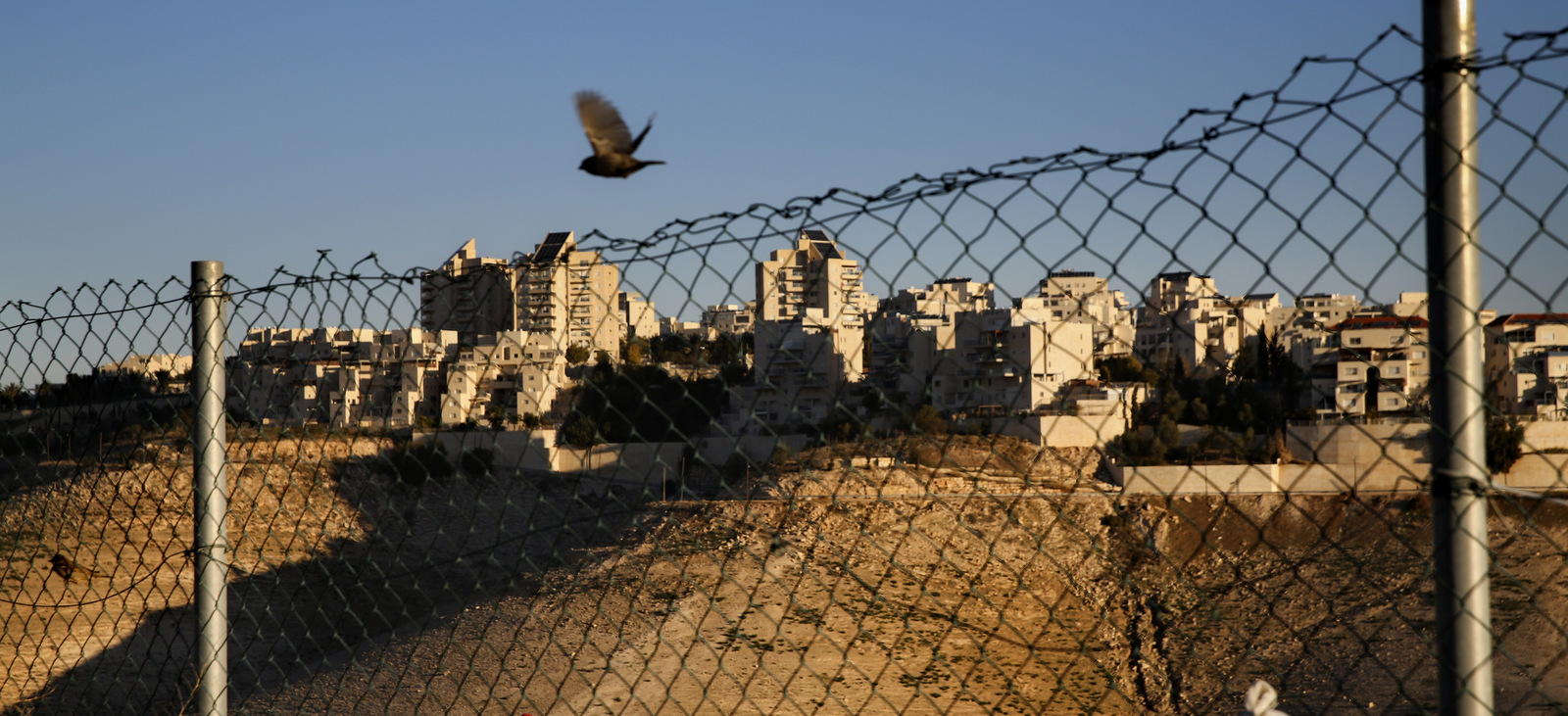
The Israeli Jewish-settlement of Maale Adumim, near Jerusalem, Feb. 7, 2017. (AP/Oded Balilty)
The continuous settler takeover of Palestinian land has prevented Palestinians from developing and utilizing their resources and therefore significantly depleted their economy.

OCCUPIED WEST BANK, PALESTINE — Nearly 700 European firms have financial ties worth $255 billion with businesses actively involved in Israeli settlements, according to a new civil society report.

The Don’t Buy Into Occupation (DBIO) coalition is a joint project between 25 Palestinian and European non-governmental organizations investigating the business connections between companies operating in illegal Israeli settlements in the Occupied Palestinian Territories (oPT) and European financial institutions. The coalition’s latest research found 672 European financial institutions had relationships with 50 businesses participating in Israel’s settlement economy. Between 2018 and May 2021, major European firms provided loans and underwritings amounting to $114 billion to these businesses while investing $141 billion.

“The involvement of these corporations with the settlements — through investments, banking loans, resource extraction, infrastructure contracts, and equipment and product supply agreements — provides them with the indispensable economic oxygen they require to grow and thrive,” Michael Lynk, UN Special Rapporteur on the Situation of Human Rights in the Palestinian Territory Occupied since 1967, wrote in the report.

The findings

The DBIO coalition found that the top 10 creditors collectively gave $77.81 billion to businesses involved in the Israeli settlements. These firms are BNP Paribas, Deutsche Bank, HSBC, Barclays, Société Générale, Santander, ING Group, Commerzbank, UniCredit, and Crédit Agricole. And the top 10 investors — Deutsche Bank, Crédit Agricole, Government Pension Fund Global (GPFG), Investor AB, BPCE Group, Allianz, Swedbank, Legal & General, AB Industrivärden, and Alecta — contributed $67.22 billion.

The coalition reached out to 138 firms as well as three corporations highlighted in the report and additional businesses the coalition found to be heavily involved in the settlement economy. Booking.com, BNP Paribas, and HeidelbergCement and 21 financial institutions responded to the report’s results.

Replies varied, with some banks wanting to set up meetings to further discuss the findings while other institutions said they’ve already investigated human rights concerns with their business partners. The report’s authors declined to disclose with which institutions they are meeting, but DBIO said they plan to publish updates in the future.

“Some of them claim they did their human rights due diligence, but still decided to be involved in a settlement enterprise, which is quite against any of the suggestions or analysis of human rights experts,” Dr. Anna Khdair — a legal researcher at Al-Haq, a Palestinian human rights organization, and one of the report’s co-drafters — told MintPress News.

Other institutions said any ties to Israeli settlements are not within their sphere of decision-making because settlements are legal under Israeli law. While they are warranted by Israel, settlements are illegal under international law.

“So, we still have a lot of work to do to explain how the settlement enterprise actually works and how much it is connected to the Israeli economy, [while] Israel itself will not provide enough information or transparency about those links with the illegal settlement enterprise,” Khdair said.

Holding corporations accountable

The Palestinian-led Boycott, Divestment and Sanctions movement has experienced incredible mobilization recently. American ice cream maker Ben & Jerry’s made headlines over the summer after announcing it will stop selling in Israeli settlements. Two pension companies named in the DBIO report also recently divested from companies linked to the settlement enterprise. In July, Kommunal Landspensjonskasse (KLP), Norway’s biggest pension firm, divested from 16 companies involved in Israeli settlements.

“In KLP’s assessment, there is an unacceptable risk that the excluded companies are contributing to the abuse of human rights in situations of war and conflict through their links with the Israeli settlements in the occupied West Bank,” KLP said in a statement regarding their decision.

The businesses from which KLP divested are:

  • Ashtrom Group Ltd.
  • Electra Ltd.
  • Alstom SA
  • Bank Hapoalim
  • Bank Leumi
  • Israel Discount Bank
  • First International Bank Israel
  • Bezeq
  • Mizrahi Tefahot Bank
  • Altice Europe
  • Partner Communications
  • Cellcom
  • Delek Group
  • Paz Oil
  • Motorola Solutions
  • Energix Renewable Energies

In September, the Norwegian pension company GPFG announced it will stop working with Elco Ltd., Ashtrom Group Ltd., and Electra Ltd. because of their activities in the Israeli settlements. In the last decade, Deutsche Bank, HSBC, and Barclays have also divested from some companies involved in the settlements.

Nonetheless, Willem Staes, coordinator of the DBIO coalition, noted:

Despite the illegal nature of Israeli settlements under international law, European financial institutions continue to throw a financial lifeline to companies operating in the settlements. European financial institutions should take up their responsibility and follow the example of KLP and GPFG. They should end all investments and financial flows into Israeli settlements, and not buy into the Israeli occupation.

Even with these divestment decisions, however, the aforementioned firms still associate with settlement-entwined businesses. KLP is invested in eight companies involved in the settlement enterprise: Delta Galil Industries, FIBI, Matrix IT, Mivne Group, Rami Levy Chain Stores Hashikma Marketing 2006, Shapir Engineering and Industry, and Shufersal. GPFG still has business dealings with 34 companies linked to the settlements. These businesses are:

  • ACS Group
  • Atlas Copco
  • Bank Hapoalim
  • Bank Leumi
  • Bezeq
  • Construcciones y Auxiliar de Ferrocarriles (CAF)
  • Caterpillar
  • Cellcom
  • CNH Industrial
  • Delek Group
  • Delta Galil Industries
  • DXC Technology
  • Energix
  • CETCO Mineral Technology Group
  • Cisco Systems
  • Expedia
  • FIBI
  • General Mills
  • Hewlett Packard Enterprise (HPE)
  • Israel Discount Bank
  • MAN Group
  • Tripadvisor
  • Manitou
  • Shufersal
  • Siemens
  • Matrix IT
  • Mizrahi Tefahot Bank
  • Volvo Group
  • WSP GLobal
  • Motorola Solutions
  • Partner Communications
  • Paz Oil
  • Rami Levy Chain Stores Hashikma Marketing 2006
  • Terex

These ongoing financial relationships put into question the firms’ commitment to human rights.

Maha Abdallah, one of the co-drafters of the report and the International Advocacy Officer at Cairo Institute for Human Rights Studies, told MintPress News that the DBIO’s findings definitely contradict the institutions’ purported ethical responsibilities.

“These companies and financial institutions claim that they’re committed to human rights, but then we see the facts on the ground and the level of their involvement in the settlements,” Abdallah said. “So clearly these are all in violation of their responsibilities under international law and towards human rights standards.”

Al-Haq’s Khdair speculated, however, that the slow pull-out from the settlement enterprise may stem from fears of political backlash. “We saw how the reaction from [the] Israeli government towards Ben & Jerry’s’ decision was,” Khdair said. “So some companies would be wary of reputational risk and also see [divestment] as problematic for their shareholders. It’s a process of finding the right balance in terms of their gains and their goals.”

All 50 companies named in the report participate in at least one of the activities listed by the United Nations as criteria for inclusion in its database of companies operating in the Israeli settlements. Of the 50 companies implicated, 15 are American. These businesses are:

  • Airbnb
  • Booking Holdings
  • Caterpillar
  • CETCO Mineral Technology Group
  • Cisco Systems
  • CNH Industrial
  • DXC Technology
  • Energix
  • Expedia
  • General Mills
  • HPE
  • Motorola Solutions
  • RE/MAX Holdings
  • Terex Corporation
  • Tripadvisor

Israeli settlements crushing Palestine’s economy

More than 600,000 Israelis live in settlements across the oPT and 42% of the West Bank is under settlement control. Area C of the West Bank abounds with natural resources, but 68% of this region is reserved for Israeli settlements while only 1% is designated for Palestinian use.

The continuous settler takeover of Palestinian land has prevented Palestinians from developing and utilizing their resources and therefore significantly depleted their economy.

Restricted access to the Dead Sea, quarries and mines has led to an over $1 billion annual loss in revenue for Palestine, according to a 2015 policy brief from Palestinian thinktank Al-Shabaka. And companies’ exploitation of West Bank quarries is estimated at $900 million annually. The DBIO report authors write:

The exploitation of natural resources means that the Palestinian people are denied their right to self-determination and permanent sovereignty over their natural resources. By profiting from the depletion of Palestinian finite quarry resources, individual corporate actors may be held criminally liable for complicity in the crimes of appropriation, environmental destruction and the pillage of natural resources.

European Union’s hypocrisy

The EU provided more than $40 million in humanitarian aid to Palestine in 2021. It also follows international law in declaring the Israeli settlements illegal. Yet the EU is Israel’s largest trade partner, with a total of approximately $36 billion in traded goods last year.

“There are conflicting interests even between different European institutions [each with] their [own] priorities,” Khdair said, explaining that the goals of foreign affairs units often clash with human rights entities in the EU.

The EU does not support the UN database on companies complicit in Israeli settlements and continues to block funding to update the resource over budgetary constraints. Yet again in contradictory fashion, an EU court also ruled in 2019 that consumers have a right to know if products sold in EU markets were made in Israeli settlements.

“On the one hand, the EU has a very consistent approach and position on the illegality of settlements and all the associated violations that come along with it that undermine Palestinian rights,” Abdallah said. “But at the same time, we’re seeing that European businesses and financial institutions are still freely and without any consequences are being involved and active with the settlement enterprise.”

For Abdallah, European business activity in the settlements seems in stark contrast to the EU’s stated allegiances to the Palestinian cause. “We know what that means in reality,” Abdallah said. “It means giving them an economic lifeline allowing them to sustain themselves and expand and grow with time because these settlements, at the end of the day, rely on money in order to prosper and sustain and expand.”


River to Sea Uprooted Palestinian   
The views expressed in this article are the sole responsibility of the author and do not necessarily reflect those of the Blog!

Thursday, 7 October 2021

Water as Weapon of War: Activists Say Israel is Drying Out the West Bank to Drive Out Palestinians

October 06th, 2021

By Jessica Buxbaum

Source

MASAFER YATTA, OCCUPIED WEST BANK — Last weekend, around 600 Israeli, Palestinian and international activists marched across Masafer Yatta in the Occupied West Bank to deliver a water tanker to Palestinian villagers. Their message was clear: Water is a human right, and Israel is depriving Palestine of this basic necessity.

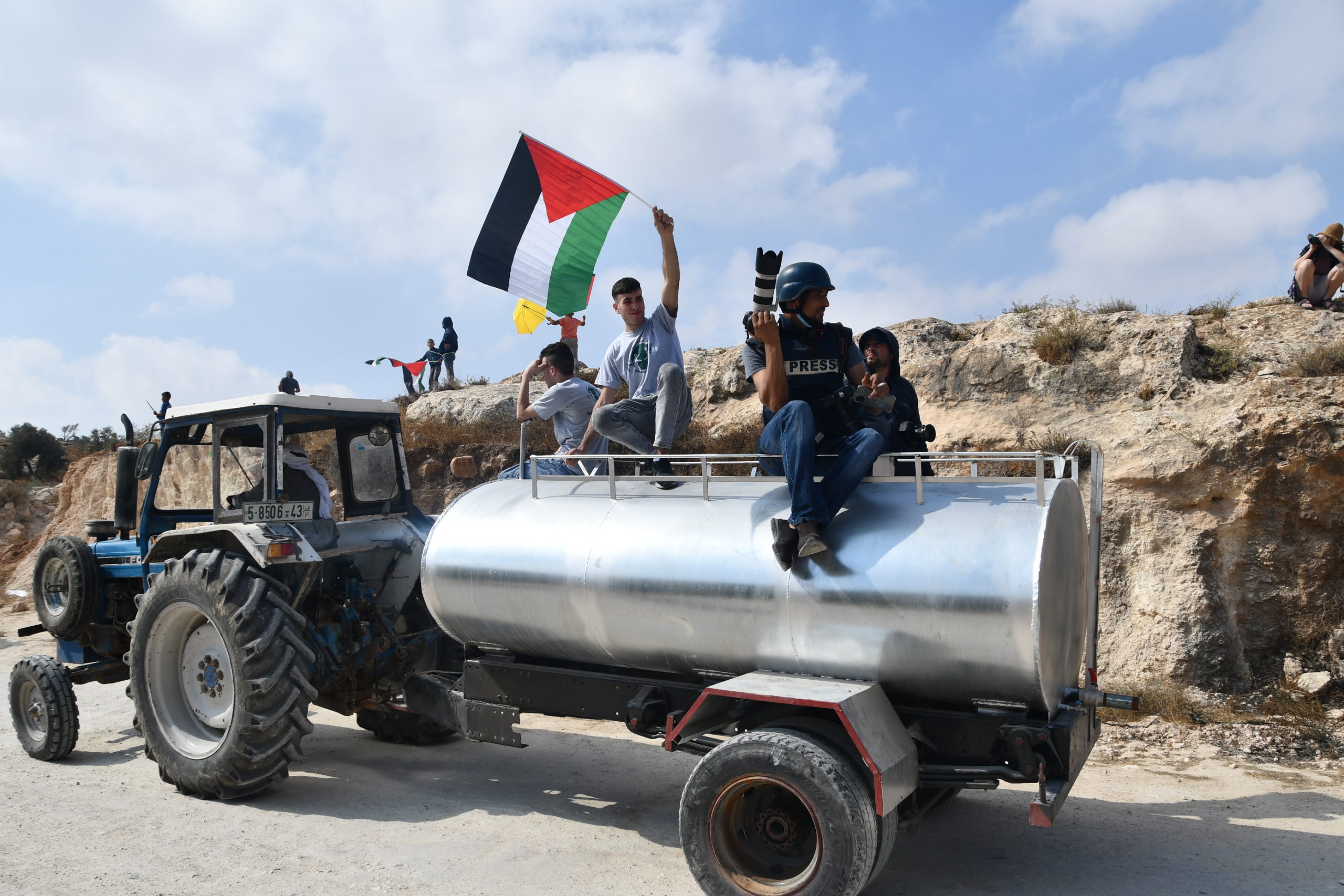
Amid a sea of rippling Palestinian flags, demonstrators walked alongside a tractor transporting the water tanker from the village of At-Tuwani. The protesters did not reach their intended destination. Instead, they turned back at the village of Mfakara in order to avoid a confrontation with the Israeli Army waiting for them atop a nearby hill.


Demonstrators attempt to deliver a water tank from the Palestinian village of At-Tuwani.

“Water is a right for everyone. It doesn’t matter if you’re Black or white or Jewish or Arab,” ​​Adam Rabee — an activist with Combatants for Peace (CFP), one of the march’s organizers — told MintPress News.

On Monday, CFP, along with other human rights organizations, submitted an urgent appeal to international bodies, demanding they “pressure Israel to allow access to water to Palestinians living in Area C,” the Occupied West Bank area that includes Masafer Yatta.

CFP started the water accessibility campaign for Palestine in August. In September, they led a field visit to Masafer Yatta for 20 diplomats from the European Union, the United Kingdom, Canada, Brazil, Mexico and Switzerland. During the tour, CFP raised awareness of Palestine’s water crisis and urged the representatives to engage in dialogue with Israel toward providing Palestinians with full access to water.

“[The diplomats] saw families and children without water,” Rabee said of the visit. “My feeling is that they want to help and we have support.”

Soldiers aiding settlers in water attacks

Saturday’s protest was calm and without clashes, but the event was underscored by earlier violence.

Tuesday of that week, at least 60 masked Israeli settlers raided Mfakara — throwing stones, turning over cars, cutting water pipes and slitting the throats of sheep. Five children were injured during the attack, including a four-year-old boy who was sent to the hospital after being pelted in the head with rocks. Israeli soldiers watched from the sidelines — during what activists are describing as a “pogrom”– intervening only to fire tear gas, stun grenades and rubber-coated steel bullets at Palestinians.

Earlier in September, a CFP protest to deliver water to Palestinian communities was met with violence from Israeli soldiers. Six Israelis and two Palestinans were injured — including Rabee, who was hit in the stomach with a tear-gas canister.

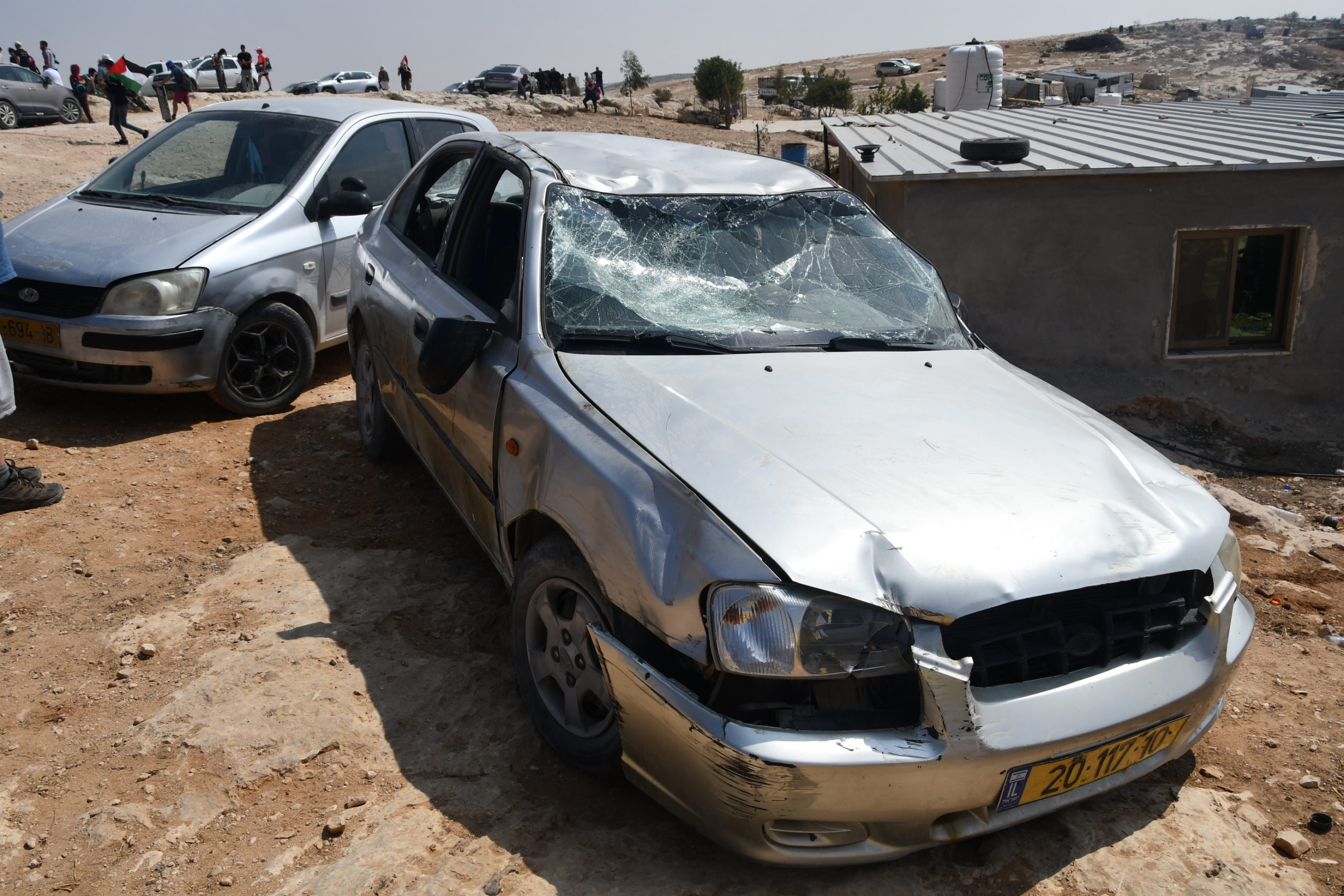
Protesters held blown-up images of the recent violence as they marched last weekend. In Mfakara, the ground was strewn with shards of glass. Several of the villagers’ cars were dented and the windshields shattered.


The windshield of a Palestinian villager’s car was shattered when Israeli settlers and soldiers attacked the village of Mfakara.

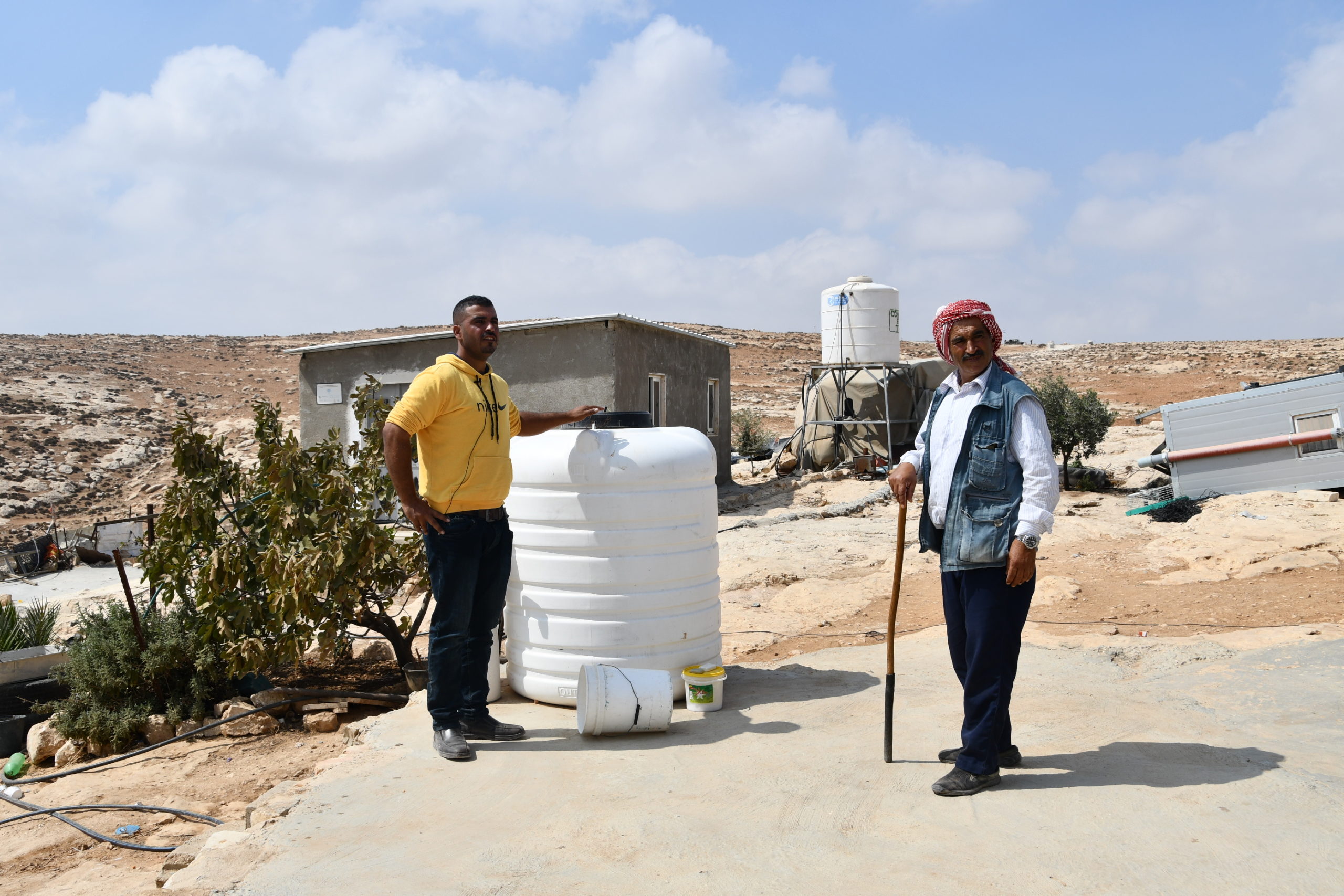
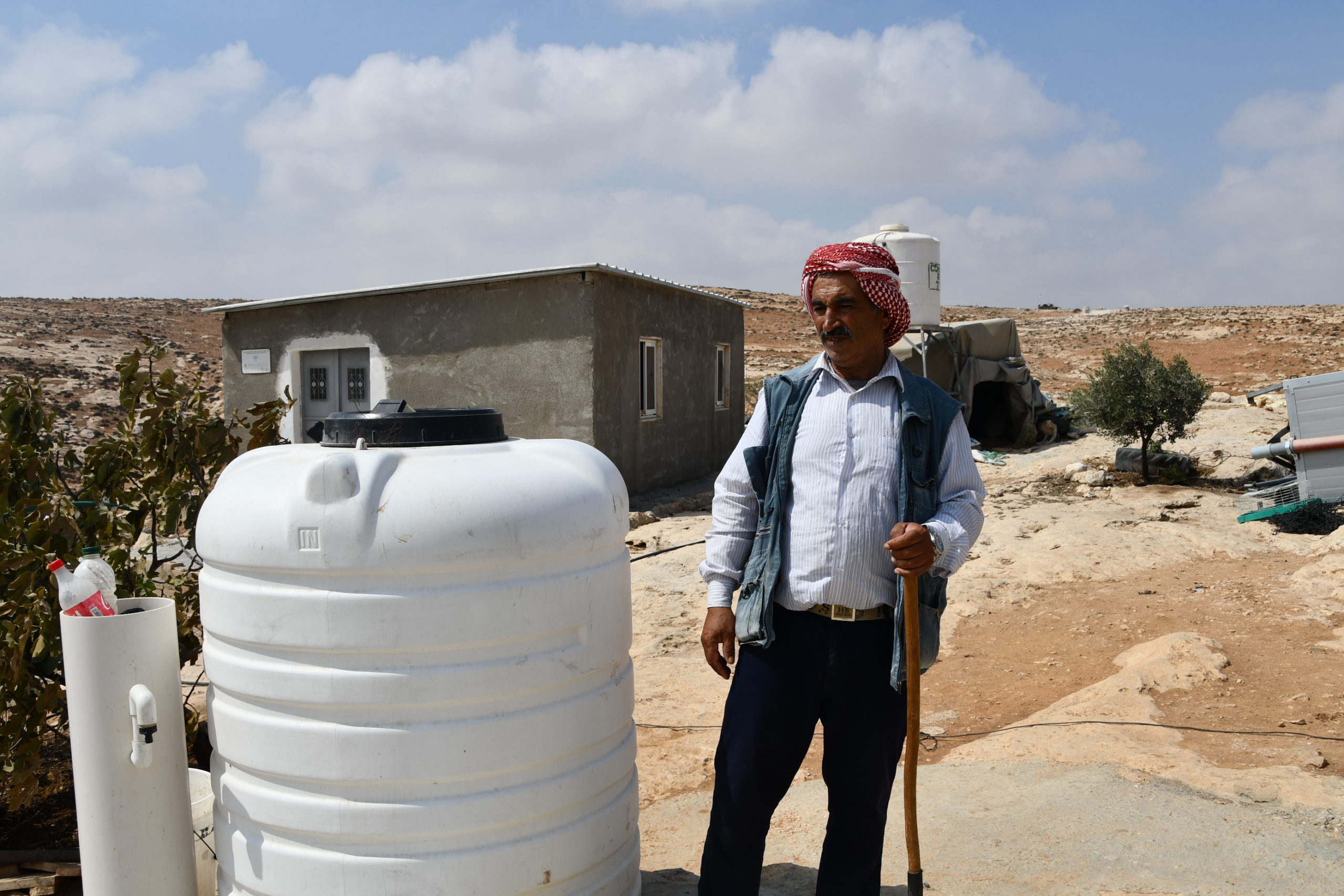
Noma Hamamdah, a Palestinian shepherd living in Mfakara, picked up a tear gas canister off the ground outside his home. He said this was one of 20 launched at the community by the army on Tuesday. He lifted his pants’ leg to reveal where he was hit with a rubber bullet. His daughter-in-law, Sabreen Hamamdah, said the army fired tear gas into their homes and settlers slashed the tires of their water tanker during the raid.


Noma Hamamdah with his son.

“Since last Tuesday we didn’t get water until today,” Noma said, referring to the delivery of the new tanker from activists. “The army aids the settlers and it’s because of the army the settlers have the ability to attack us and destroy our water tanks.” Eight windows in the family’s home were broken, Noma said. He pointed to a bullet hole in the wall of his house where Israeli soldiers fired when trying to disperse settlers. “We’ve been told [President Joe] Biden is a man of peace and he loves peace, but we’ve never heard him mention the Palestinians even once,” Noma continued. “And if the Havat Maon illegal settlement leaves us alone, then there will be peace in this area.”


Noma Hamamdah standing next to his water cistern, in which he stores the water.

Havat Maon is a notoriously violent, illegal settlement outpost adjacent to the Palestinians villages in Masafer Yatta. All of Israel’s settlements are illegal under international law but legal under Israeli law. Outposts, constructed without Israeli authority, are defined as illegal by both international and Israeli law.

Living without water

On days without water, Mfkara operates much like a commune. “We usually borrow from each other and when the water comes, we redivide the water,” Noma said.

Sabreen described how household chores like washing dishes, doing laundry and bathing the children are put off until water is replenished. “I have to put everything on hold until there is water,” she told MintPress. “I can’t do anything until the water comes back.”


Noma Hamamdah’s daughter-in-law, Sabreen.

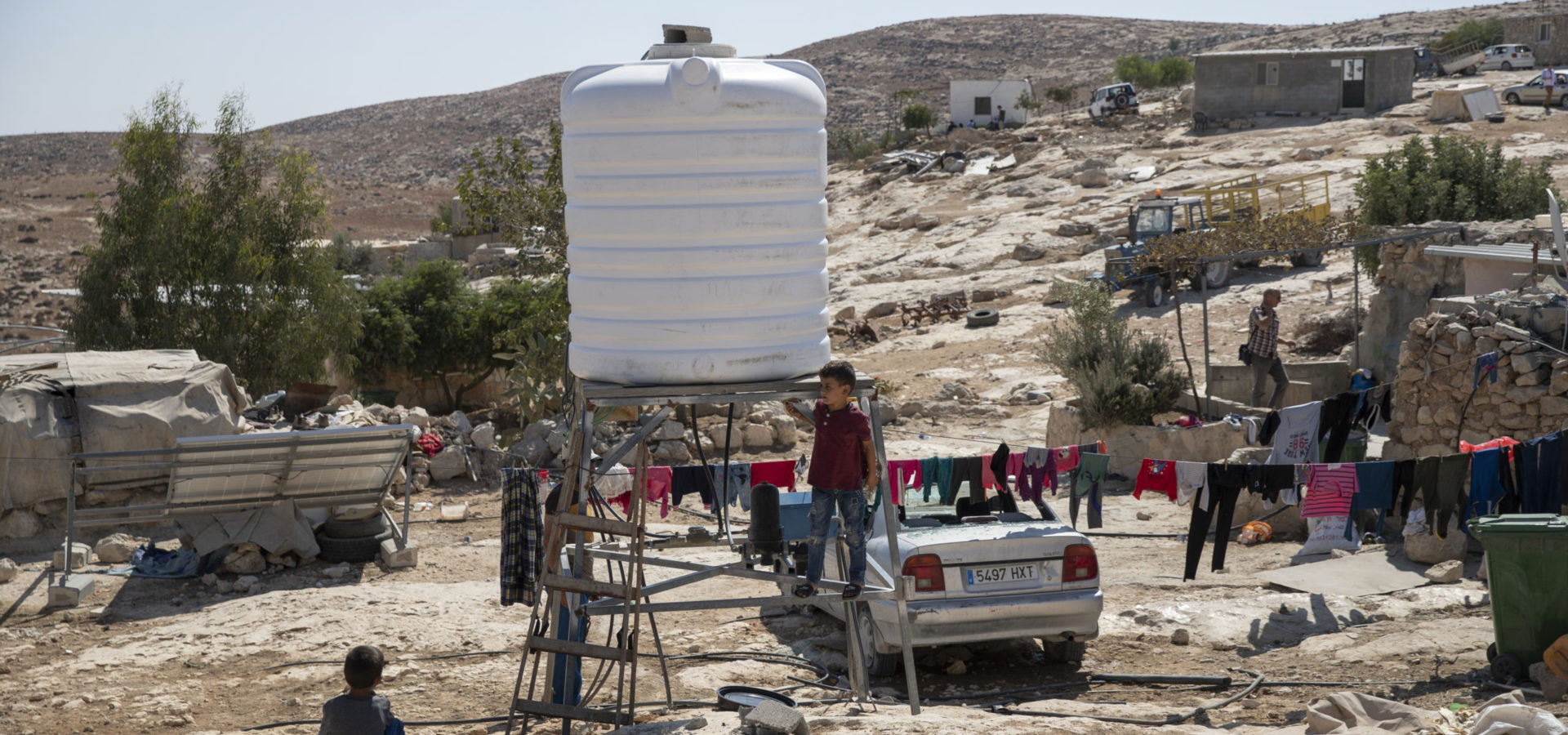
Sabreen receives 20 liters of water (about 5 gallons) costing 500 shekels ($155) from At-Tuwani, or she sources water from a nearby aquifer. That same amount of water costs nearby Israeli settlers about 100 shekels or $30. Water is stored in a cistern serving 10 people for domestic, agricultural and livestock use and may last between two to four days.

The average American uses between 80-100 gallons of water per day for indoor use. This number doesn’t account for outdoor water use, which, for herding communities like Masafer Yatta, is a significant portion of their water consumption. According to the Palestinian Hydrology Group (PHG), Palestinians in the West Bank consume about 18 gallons of water per day. This is below the World Health Organization recommendation of 26-31 gallons of water daily to maintain a basic standard of living. By comparison, Israelis use about 80 gallons of water per day and Israeli settlers may use up to 210 gallons daily.

The history of water apartheid

When Israel occupied the West Bank and Gaza after the 1967 war, it took control of the areas’ water resources. The state established pumping quotas and banned construction of new wells in the occupied territories.

Mekorot, Israel’s national water company, was put in charge of the Occupied Palestinian Territories’ (oPT) water in 1982. By 1986, pumping quotas were reduced by 10 percent for Palestinian wells — fostering greater water insecurity.

The 1995 Oslo II Accord was portrayed as a turning point for water independence in Palestine. The Palestinian Water Authority (PWA) and Israeli-Palestinian Joint Water Committee were created but Israel retained control of the flow and volume of water given to the oPT. Despite the name, the PWC doesn’t oversee water resources. Instead its role is to distribute the limited water supply Israel provides.

The agreement was supposed to last only five years but remains in effect today. Under the initiative, 80 percent of the West Bank’s water is for Israeli use and 20 percent is for Palestinian use. Israelis also enjoy an unlimited supply of water while Palestinians have their supply restricted.

What was billed as a cooperative venture between Palestine and Israel is merely the occupation of water in disguise.

“There are no official meetings between the Palestinans and the Israelis because the Israelis don’t consider us as a counterpart,” Dr. Abdelrahman Al Tamimi, PHG’s director, said.

The Coordinator of Government Activities in the Territories (COGAT) nonetheless told MintPress that the Palestinian Authority is responsible for providing water to the West Bank and touted collaboration between Palestine and Israel.

“Master programs are being promoted in the area of Judea and Samaria [West Bank], which will address the water supply until the years 2040-2050, to all populations in the area. We will note that these programs are being coordinated with the Palestinian Water Authority and [have] even been shifted in light of its requests,” a COGAT spokesperson said.

“The only solution for lack of water is water”

Dr. Al Tamimi outlined the three main reasons for water scarcity in the oPT — all originating from Israel’s occupation.

First, Israel has not increased the West Bank’s water quota to meet the demands of its rapidly growing population, which is now nearly double what it was in 1995. Al Tamimi explained Israel only increased the commercial consumption (about 10-12 percent of the demand) to around 160 million gallons.

Al Tamimi added that the Oslo II Accord doesn’t allow for Palestinians to do groundwater drilling — eliminating this as a possible water resource. And finally, owing to Israeli military control of Area C of the West Bank, Palestinians are often blocked from developing wells and springs in the region.

Al Tamimi explained these three main factors have intensified the water crisis, specifically in remote Palestinian communities, noting “Some villages in the south of Hebron or north of Jenin receive water twice a month or once a week.”

Water access varies by region in the West Bank. Urban and developed areas have running water while villages Israel prevents from connecting to a water grid rely mostly on costly trucks delivering water that is then stored in black and white tanks on people’s roofs.

“When water is moved from place to place, it’s vulnerable to pollution,” Al Tamimi said. “Because you cannot guarantee the cleanliness of the truck, how they pumped water from the well to the truck and how they empty the trucks. Water is vulnerable to be polluted by air, by bacteria and by other things.”

“The problem is there is no monitoring and there is no authority controlling the quality of water in Area C,” he added.

Palestinians also have to pay a relatively high price for potentially unsafe water. Tanker prices increase when transported on rough terrain — another infrastructural problem, caused by Israel forbidding these communities to pave their roads.

“According to international standards, the average cost of the water bill should not be more than 1 percent of that family’s income. But in some Palestinian villages, they pay more than 10 or 12 percent of their income just to purchase the water,” Al Tamimi said. “The only solution for lack of water is water. There are no other alternatives.”

Access to water in Area C is exacerbated by Israel’s systematic policy of demolishing and confiscating water equipment and resources. Italian NGO WeWorld reported nearly 10 percent of the buildings demolished by Israeli forces in 2020 were water, sanitation and hygiene structures.

CFP’s statement said:

The Military Commander of the West Bank justifies these practices by saying that the Palestinian communities in Area C did not receive building permits; however, the Israeli government’s own policy does not allow Palestinians to obtain building permits in this area. At the same time, all the Israeli outposts and settlers who live in buildings without legal permits are allowed to connect to the water grid.


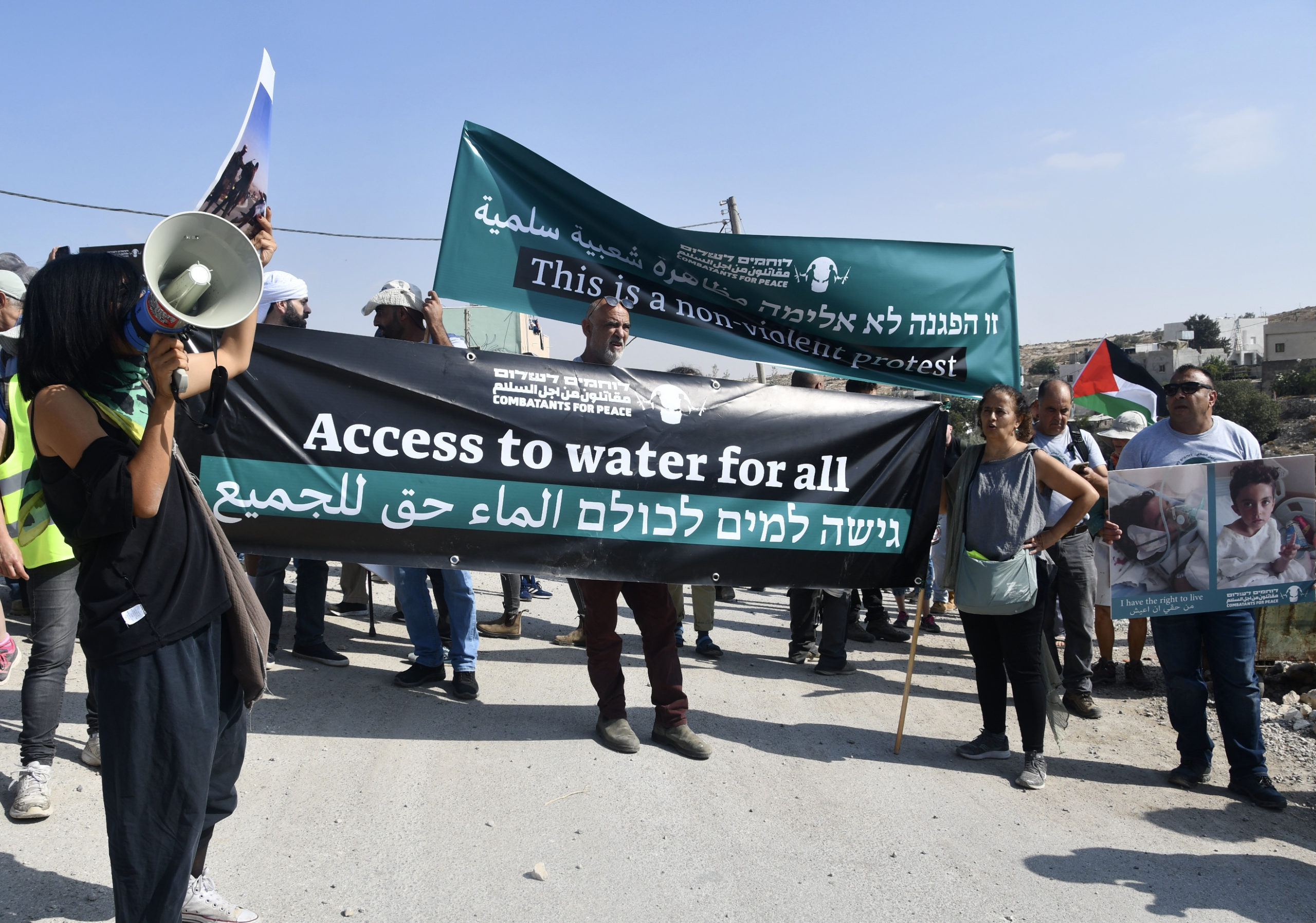
Activists from the Israeli organization Combatants for Peace hold a banner demanding water for all.

For CFP’s Rabee, water deprivation in Area C highlights the severe discrimination Israel perpetuates. “The Palestinian man can only get water three days a week. And then this illegal outpost next to it has running water,” Rabee said. “So it’s just a very stark example of apartheid.”


River to Sea Uprooted Palestinian   
The views expressed in this article are the sole responsibility of the author and do not necessarily reflect those of the Blog!

Wednesday, 8 September 2021

Israel-Palestine: ‘No war, no peace’ apartheid is Bennett’s best case scenario

The Israeli prime minister is first since Golda Meir to propose the racist status quo as a political platform

In March 2015, then Israeli economy minister Naftali Bennett during an election campaign gathering in Kibbutz Kfar Etzion in the Gush Etzion settlement in the West Bank (AFP)

By Meron Rapoport

Published date: 7 September 2021 13:02 UTC 

“There is no diplomatic process with the Palestinians, nor will there be one,” said a source close to Israeli Prime Minister Naftali Bennett last week after his defence minister, Benny Gantz, met with Palestinian President Mahmoud Abbas.Biden-Bennett summit a meeting of wishful thinkers who oppose NetanyahuRead More »

Thus is Bennett’s spiritual world revealed: a world in which Israel, and only Israel, exists, and where the Palestinians will never, under any circumstances, even if they change their positions, be able to attain equality with Israelis and negotiate with them as equals. There is a word for that: racism.

Nearly a decade ago, Bennett entered national politics after serving as director-general of the Yesha Council, the leading settler institution, although he himself was never a settler and doesn’t live beyond the Green Line. In a now-famous interview, he said: “The Palestinian problem is like shrapnel in the butt.” 

Today, his approach has not changed, although as prime minister, he may express himself less bluntly, as he admitted just before taking office in early June.

Bennett expressed this approach in an interview he gave the New York Times ahead of his recent trip to Washington. “This government will not annex, nor establish a Palestinian state, everyone understands that,” he said. “Israel will continue the standard policy of natural growth [of West Bank settlements].” 

In saying this, Bennett became the first Israeli prime minister, with the possible exception of Golda Meir in the years prior to the 1973 war, to propose what amounts to apartheid as a political platform.

Permanent status quo

It is true that the policy of “managing the occupation” is almost as old as the Israeli occupation itself. In February 1973, for example, then-Defence Minister Moshe Dayan said, “We must plan ahead for our actions in the territories [conquered by Israel in June 1967] … so that a situation of ‘no war and no peace’ will not be unbearable for us… Authority for deciding on what happens from Suez to the [Mt] Hermon is in the hands of the Israeli government. We will not idly delineate boundaries for our settlements nor be threatened by smouldering embers.”

But the philosophy Dayan articulated then still exists and every prime minister since, except perhaps Yitzhak Rabin – whose assassination makes it impossible to know whether he meant to break the mould – has adopted it with different variations: “No war, no peace” or, in other words, a continuation of the status quo. Seven months later, the “smouldering embers” that Dayan dismissed had become the firestorm of the October 1973 war, with thousands killed on both sides, forcing Israel to subsequently return the Sinai Peninsula to Egypt. 

Bennett basically said that this status quo of ‘no war, no peace’ is not an interim situation, but rather the permanent situation

But Bennett has gone one step further. Even Dayan called the territories occupied by Israel a “deposit” to be returned in exchange for a peace agreement meeting Israel’s needs. Since the 1990s, Israeli prime ministers have been discussing, at least officially, support for the two-state solution, including Ariel Sharon and even Benjamin Netanyahu, who adopted the Palestinian state idea in his 2009 Bar-Ilan speech. In 2020, he also accepted former US President Donald Trump’s “deal of the century” which included the establishment of a Palestinian state, however crippled and fragmented. 

In his New York Times interview, however, Bennett basically said that this status quo of “no war, no peace” is not an interim situation, but rather the permanent situation to which he aspires.

In this situation, Israel, on the one hand, will continue its military rule over the Palestinians in the West Bank and the Gaza Strip, and continue to accord Jewish citizens in the West Bank preferential rights as compared with Palestinians.

On the other hand, Israel will not accord Palestinians civil rights equal to those of their Jewish neighbours as would be necessitated by a partial or full annexation of the West Bank. This approach also has a name – apartheid – and Bennett believes it to be the only one possible.

‘Shrink the conflict’

We don’t know precisely what was said in Bennett’s discussions with President Joe Biden and Secretary of State Antony Blinken, but publicly at least no American reservations were heard about Bennett’s positions. Nor did the Jewish centre-left parties in Israel like Labor and Meretz, which are part of Bennett’s coalition, voice any protest. This is a dangerous precedent.

But it would be overly simplistic to say that the Bennett government will be more rightist or more violent toward the Palestinians. The opposite might be true.How Beita became a model of Palestinian resistance against IsraelRead More »

First of all, Bennett came into office from a position of political weakness. He heads a small party with six Knesset seats out of 120, and most of his coalition members are more leftist than he is – at least for Israel whose Labor Party positions toward the Palestinians would be considered right in Europe.

And there’s more. Bennett himself, along with his coalition partner, Gideon Saar, who had been a senior Likud figure and a leading candidate to replace Netanyahu, has changed his attitude considerably to the Palestinian question.

As the present government was being formed or immediately thereafter, both Bennett and Saar appeared to have relinquished the idea of Greater Israel and/or annexation, partially or wholly, embracing instead the new political concept of “shrinking the conflict”. The term originated with Micah Goodman, an Israeli of American extraction living in a West Bank settlement, whose books on the conflict have become bestsellers.

Goodman argues that the left in Israel has failed to bring an end to the occupation or to establish an independent Palestinian state, whereas the right failed with its idea of Greater Israel. Therefore, instead of talking about ending the conflict or continuing with the status quo, ways should be sought to “shrink the conflict”: to enable the Palestinians to manage their own affairs as independently as possible, while leaving “security” to Israel. After the conflict has been “shrunk,” says Goodman, it will be possible to discuss a permanent solution.

For a decade, Bennett pushed for annexation, but when the UAE and Bahrain signed the Abraham Accords in 2020, he realised it was impossible.

Goodman was an adviser to Saar and is considered to be close to Bennett. His influence was perceptible in an interview Bennett gave before taking office. “My approach is to shrink the conflict,” he said. “Where it is possible to have more crossings, better quality of life, more business, more industry, we will do it.”

For Bennett, this is a considerable shift. When he entered national politics in 2013, Bennett presented a detailed plan for the annexation of Area C, which is 60 percent of the West Bank. Over the years, he criticised Netanyahu and the Israeli army for not being aggressive enough toward the Palestinians and not “decisive” enough with Hamas. 

For a decade, Bennett pushed for annexation, but when the UAE and Bahrain signed the Abraham Accords in 2020, he realised it was impossible. He also understood that a “final resolution” of the conflict by achieving a victory over the Palestinian so crushing that they would relinquish their national aspirations was also impossible. Thus, his adoption of the idea of “shrinking the conflict” is coming from failure and weakness, even if he refuses to admit it.

Israeli right in crisis

Bennett, then, reflects the situation of the Israeli right. On the one hand, he sanctifies the status quo and has no desire or intention of relinquishing the occupation or ending apartheid. On the other hand, the right is gradually losing its faith in its own power to shape the Israeli-Palestinian reality as it sees fit. 

The fall of Netanyahu should be viewed in this context. Under Netanyahu, the right in Israel was united in a coherent, homogeneous bloc. The internal contradictions on the right, which Bennett represents, led to the fragmentation of this bloc and the establishment of a mixed government that contains elements of both right and left, including the United Arab List, an Palestinian-Islamist party headed by Mansour Abbas.Palestinian Authority losing control of West Bank, say insiders and activistsRead More »

Outwardly, all of these changes have not affected the situation on the ground. The occupation, and the settlements, continue. The political discourse in Israel remains stuck, in the best case, or else propounds Bennett’s thesis of “no peace, no war”. Israel is so strong – militarily and economically – that something significant would have to happen in order to threaten its control of the Palestinians and its power in the Middle East as a whole.

But at the same time, one cannot ignore the cracks. The ideological right in Israel is in trouble and the question is how and whether the radical left in Israel, or even more so the Palestinians, can turn that to advantage.

“Where there’s a crack, we have to make it a fissure, and where there’s a fissure, we have to make it a chasm,” a left-wing anti-occupation activist told me. Maybe that approach really will accomplish something.


River to Sea Uprooted Palestinian   
The views expressed in this article are the sole responsibility of the author and do not necessarily reflect those of the Blog!

Friday, 20 August 2021

My Visit to Lyd, Where Historical and Contemporary Zionist Oppression Meet

 August 19th, 2021

By Miko Peled

Source

Palestine stretches from the River Jordan to the Mediterranean and goes right through the ancient Palestinian city of Lyd.

LYD, PALESTINE — One of the toughest challenges facing those who fight for justice in Palestine is breaking the Zionist paradigm, which limits the name Palestine to the West Bank and the Gaza Strip. These two delineations of territory have no historical meaning and no geographical significance. They are no different from other parts of Palestine except that they were drawn by Zionists who, after the murderous 1948 campaign of ethnic cleansing, decided that they would not include those two areas within the boundaries of the Zionist state.

In 1967 the State of Israel occupied these two areas, and today the West Bank exists only in people’s imagination, while the Gaza Strip operates as a prison. After the disastrous Oslo process began in 1993, and the Palestinian Authority came into being, these two areas became known to the world as the State of Palestine.

Lyd as it was

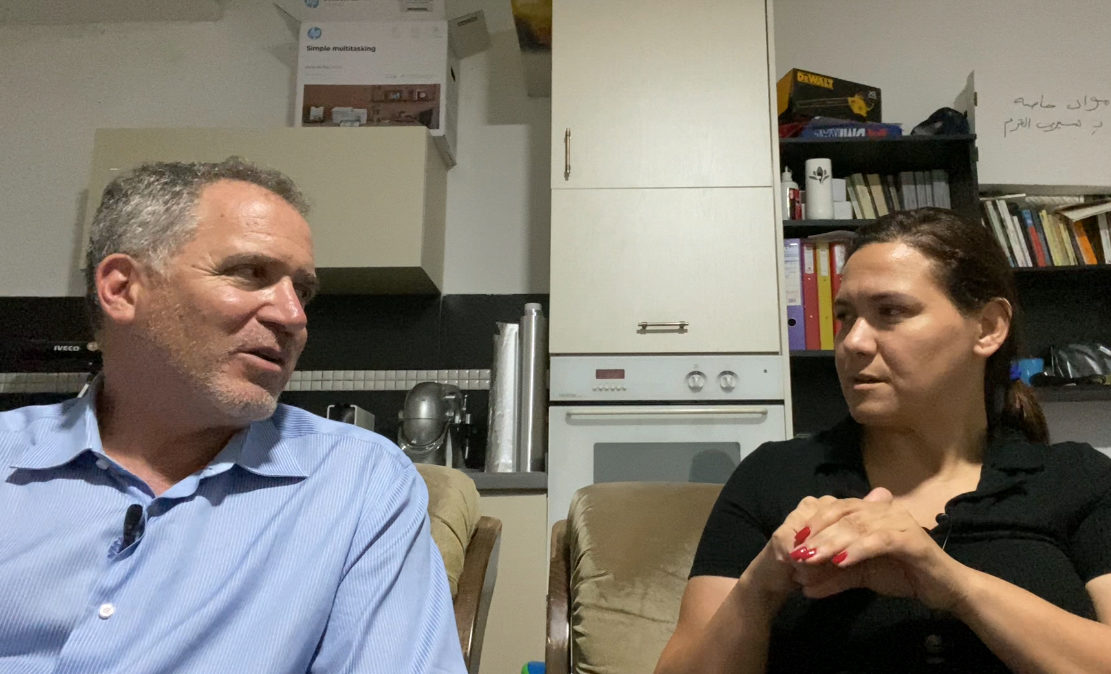
In July 2021, I visited the city of Lyd, where I met with Councilwoman Fida Shehada, a Palestinian member of the Lyd City Council who was kind enough to spend a day with me in her city. She gave me a tour of the town before we sat down for a lengthy and detailed interview, which will soon be posted to my Patreon page.

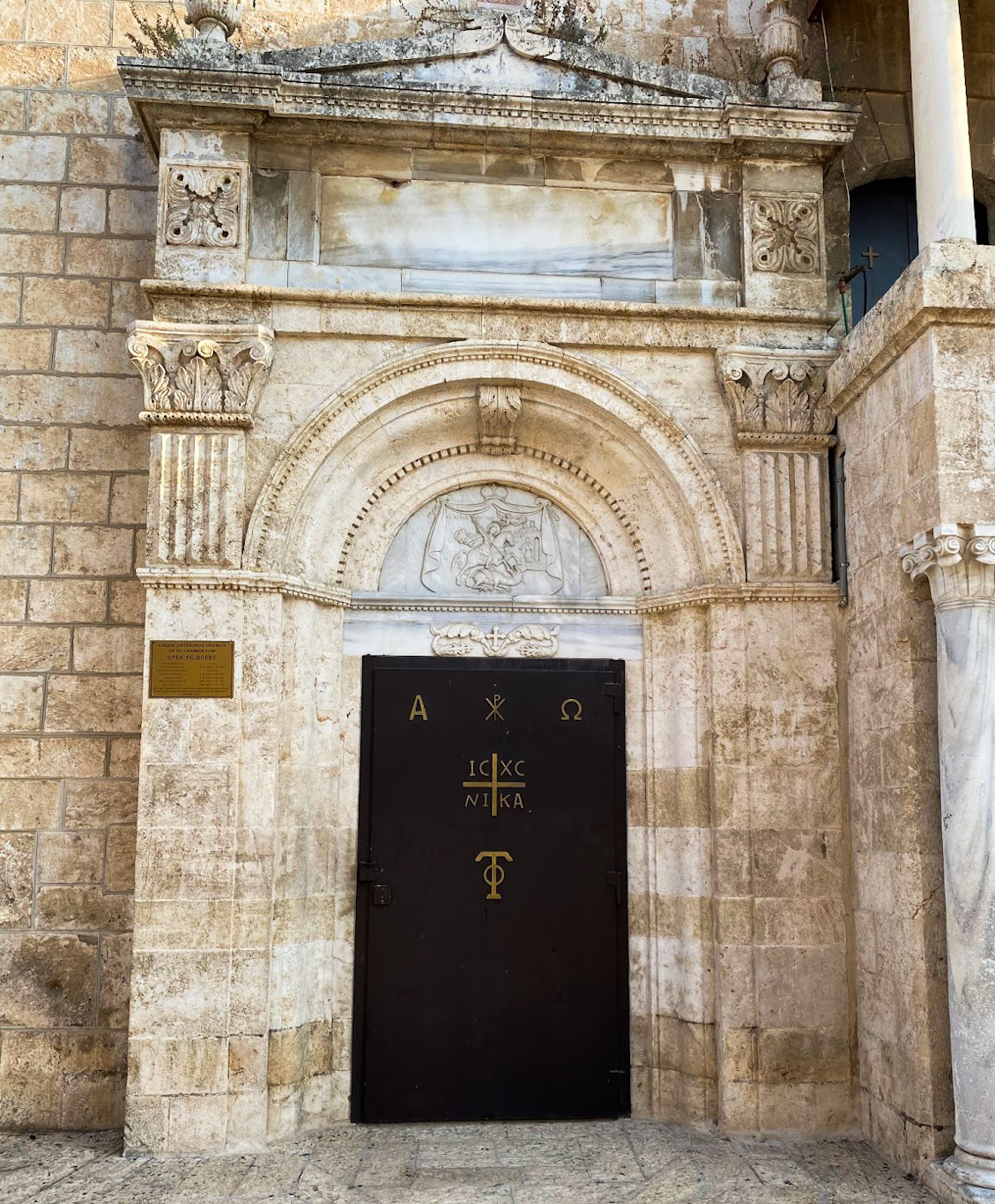
“Lyd has archeological sites that show it is as old as the city of Jericho,” Shehada told me. However, the state and the municipality refrain from excavating because these sites have no value to the Zionist narrative. Lyd is perhaps most famous for being home to the Church of Saint George. The church was built over the grave of the famous Saint George of Lyd, who was buried in the city of his Palestinian mother’s birth after he was martyred in the early fourth century.

Church of Saint George, Lyd
Church of Saint George, Lyd, Palestine

The world-renowned hip hop band “Dam” is also from the city of Lyd. According to their website, “Struck by the uncanny resemblance of the reality of the streets in a Tupac video to the streets in their own neighborhood in Lyd, Tamer Nafar, Suhell Nafar and Mahmood Jrere were inspired to tell their stories through hip hop.”

1948 bloodbath

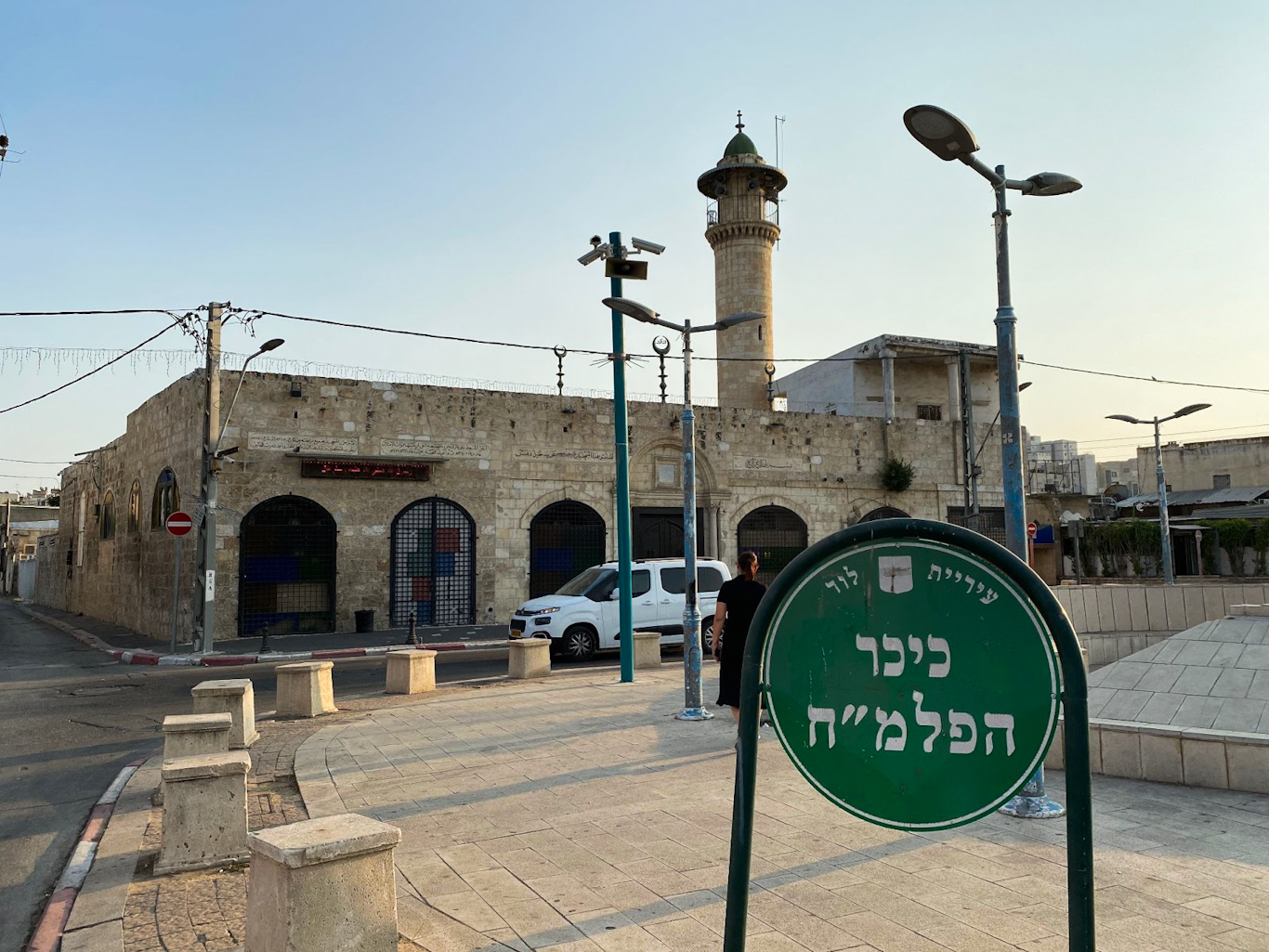
It is becoming clear today that the city of Lyd may well have been the site of the worst massacres by Zionist militia in 1948. In a move more cynical than can be imagined, the municipality of Lyd was renamed Lod in Hebrew, and a plaza was built to commemorate the Palmach right in front of the Dahmash Mosque. The Palmach was the largest of the Zionist militias and was responsible for committing massacres in the city.

The mosque itself was the site of a horrifying bloodbath when citizens from the city, who were fleeing the shooting, crowded into it seeking shelter from the violence. But a Zionist militia headed by Moshe Dayan and Yitzhak Rabin took no pity on those seeking refuge and massacred everyone in the mosque. More than 150 men, women and children were gunned down.

Palmach Plaza LYD
The Palmach Plaza in front of the Dahmash Mosque, the site of the massacre, commemorating the murderers as the memory of the victims lingers

Those who were not gunned down at the mosque or on the streets were forced to leave the city, and an estimated 40,000 men, women and children were made to take part in what became known as “The Death March.”

In her book “Palestinian Women, Narrative Histories and Gendered Memory,” published in 2011 by Zed Books, Dr. Fatma Kassem recorded the testimonies of Palestinian women from Lyd who survived the massacres and the forced expulsion.

Some of the women whom Dr. Kassem interviewed had witnessed the massacre at the mosque. One recalled:

The first days when the Jews came in, people went inside the mosques, they thought that the Jews would not kill them in the mosques. But they killed everyone who was inside.”

Another woman remembered:

My father and many others went inside the mosque to protect themselves. He was not fighting. He was an old man. My father and my cousin pushed them into the mosque and [the militia] shot all of them.”

The Kaminitz Law

In 2017, the Knesset passed legislation cracking down on “illegal” construction. The provisions of the new law were based on a report written by Deputy Attorney General for Civil Law Erez Kaminitz. According to Fida Shehada, this law has resulted in over 40,000 demolition orders for Palestinian homes in the north and central parts of the country alone — this does not include the Naqab, Jerusalem or the West Bank. The Kaminitz Law is one of many racist laws designed to keep Palestinian citizens of Israel from building homes.

“I remember one day I saw seven homes being demolished all at the same time, at the same minute,” Shehada told me. “I wanted to understand why this was happening and how to prevent this from happening in the future.”

This drove Shehada to study urban planning. But, she said, “then I saw that when they draw plans for the city, they only have plans for the Israeli population, not the Palestinians.” The city does not account for the growth of the Palestinian population, which makes up about 30% to 40% of the city’s population.

Miko Peled Fida Shehada

Miko Peled, left, meets with councilwoman Fida Shehada in the city of Lyd

“We have 30% Palestinian population, but 40% of the school children,” Shehada said, and smiled as she saw the puzzled look on my face. Officially, on record, the Palestinians make up 30%. Still — because of another racist law, called the Citizenship Law, which limits the rights of Palestinians to wed other Palestinians — some are Palestinian women who are married to Palestinian men are deprived of citizenship.

Their children are citizens but cannot attend public schools, “while their mothers are not allowed to study or work or leave their homes.” So, if the father dies, the mother has to leave, and if she takes the children with her back to the West Bank or Gaza, they will lose their status — which, with all its difficulties, is still better than that of the Palestinians in the West Bank and Gaza.

A new reality?

In an effort to instill the love of settlement activity in the hearts of Israeli Jews, religious Zionist settlers have made Lyd their home. They have their own municipal budgets and luxury apartments built for them exclusively, even as Palestinians struggle to find housing in the city. During the uprising of May 2021, over 500 armed settlers from the racist, violent Regavim movement moved into the city’s municipality. They aimed to incite violence and terrorize the Palestinian population.

When Councilwoman Shehada questioned the mayor about this, he threatened to report her to the Shabak. The Shabak is the Israeli secret police, known for targeting, detaining and torturing Palestinian political activists. She had to remind him that the Shabak does not work for the mayor’s office.

The most surprising thing I saw or heard during my visit to Lyd was a comment by Councilwoman Shehada: “I am very optimistic,” she said with a grin. “Things are changing, we have seen more Palestinians resist and organize, and I believe that we are facing a new reality today.”

If there is room for optimism, Shehada certainly has a big role in it. “I decided to run for mayor in the upcoming elections,” she told me. Local elections are scheduled to be held in the fall of 2021. Even if the world hasn’t come to terms with reality, Palestine stretches from the River Jordan to the Mediterranean and goes right through the ancient Palestinian city of Lyd.


River to Sea Uprooted Palestinian   
The views expressed in this article are the sole responsibility of the author and do not necessarily reflect those of the Blog!