Showing posts with label Indian Terrorism. Show all posts

Friday, 21 May 2021

How India makes Kashmiris pay for Palestine solidarity

 MEE writers

20 May 2021 10:58 UTC | Last update: 24 mins 55 secs ago

When cries emerge from Kashmir over Israel’s devastating brutality against Palestinians, authorities respond with threats, arrests and heightened surveillance

A Kashmiri child protests in support of Palestine in Srinagar in 2018 (AFP)

As the world has watched Israel kill Palestinians with brutality and impunity, and as Israeli bombs levelled the building housing the media offices of Middle East Eye, Al Jazeera and the Associated Press, Jammu and Kashmir police sent out a diktat via Twitter about social media usage.

“J&K Police is keeping a very close watch on elements who are attempting to leverage the unfortunate situation in Palestine to disturb public peace and order in the Kashmir valley … All irresponsible social media comments that results in actual violence and breaking of law including Covid protocol will attract legal action,” read the statement, a veiled threat in the name of law and order.

Despite repression and erasure, the call for freedom – from Kashmir to Palestine – continues to echo

This warning came as protests were held in parts in Kashmir, alongside an outpouring of support for Palestine by Kashmiri social media users. The region, militarily occupied by India and frequently likened to Palestine through a noticeable “motif of suffering”, often expresses solidarity with Palestinians fighting Israeli settler-colonialism even as Kashmiris fight their own battle against India.

Recently, graffiti reading “We are Palestine”, with the face of a crying woman wearing the Palestinian flag as a headscarf, was seen in Srinagar; police later had it covered with black paint. The graffiti artist and 20 other people who took part in protests were arrested. There are reports that some were released with a warning not to indulge in such activities.

A religious preacher, Sarjan Barkati, was also arrested for praying for Palestine and raising pro-freedom slogans for Palestine and Kashmir during the Eid sermon in his native village. Barkati, famous for his unique sloganeering style in support of Kashmir’s freedom, had been released in October last year after a four-year detention.

Challenging oppression

When an insurgency, backed by mass popular support, emerged in Kashmir in the late 1980s, a Palestinian man is known to have travelled there to join a local militant group. He was later arrested and died in prison.

In 2014, when Gaza was being bombed by Israel, a 14-year-old boy was shot dead by Indian forces in Kashmir at a pro-Palestine protest. These protests, joined by thousands across Kashmir, saw placards such as “Save Gaza” and “Down with Israel”, amid chants of “Go India, Go Back”. Young boys engaged in stone-throwing battles against Indian forces, who fired at protesters.

Indian soldiers are pictured on the outskirts of Srinagar on 30 December 2020 (AFP)

The slogans about Palestine and Kashmir, reflective of oppression and posing a challenge to suffocating state policies in each region, easily blend into each other, paving the way for an “affective solidarity”, as Kashmiri scholar Ather Zia puts it. 

After India’s 2019 decision to facilitate the process of Indian citizens settling in Kashmir, the parallels with Israel’s settler-colonialism in Palestine became even stronger. The Palestinian boycott, divestment and sanctions (BDS) movement has called for solidarity with Kashmiris “under military repression that in so many cases is similar to Israeli forms of subjugation and control”.

In November 2019, while Kashmir continued to suffer under a total communications blackout, India’s consul general to the United States was seen in a viral video calling for the Israeli model to be applied in Kashmir. 

Israel-India military ties

In 2015, India had also abstained when the UN Human Rights Council voted on a resolution condemning Israel’s Gaza violations, in what came to be seen as part of the Israel-India romance. Israel is a major defence partner for India, with annual arms sales averaging $1bn, and India is the largest purchaser of Israeli weapons systems. India reportedly signed a secretive defence deal with Israel last year, to the tune of $200m. The ‘Israel model’: The fragile paradise of Kashmir faces an existential threatRead More »

While the military occupation and settler-colonialism in Palestine and Kashmir have their own distinct histories, trajectories and specific ends for Israel and India, both countries rely on similar forms of violence and dispossession, largely triggered by Islamophobia and the need to discipline and control the Muslim “other”.

Home demolitions, cultural aggression, erasure of history, refusal to hand over bodies for last rites, criminalisation of protest, and strengthening of surveillance architecture are policies that resonate in both countries as “embodied experiences of colonial occupation”. This is in addition to killings, massacres, torture, sexual violence, arbitrary detentions, and various other human rights violations embedded in the everyday militarised order.

Yet, it is not simply the rise of the right wing that sees India aligning with Israel’s settler-colonial project. Like Palestine’s Nakba, which people continue to live through, most of these forms of violence have existed for decades in Kashmir, irrespective of the regime in power in India. They continue to be strengthened through more blatant forms of counterinsurgency and digital militarism.

‘Topographies of pain’

As much as the alliance of the settler-colonial regimes of India and Israel has strengthened over the years, the “similar topographies of pain” that Kashmiris and Palestinians share opens up possibilities for radical imaginings of liberation, alongside powerful solidarity. When cries emerge from Kashmir over Israel’s devastating brutality against Palestinians and al-Aqsa Mosque, authorities respond with threats, arrests and more surveillance of social media.

When a Kashmiri screams “Palestine” with love, admiration and rage, it is as much a threat to the occupying power as the slogan of “azadi” for Kashmir. It is an urgent, intimate prayer, a call for togetherness across occupied homelands. It rejects the hollowness of international human rights instruments that continue to protect the powerful through the “both sides” and “clashes” narratives.

Despite repression and erasure, the call for freedom – from Kashmir to Palestine – continues to echo.

The views expressed in this article belong to the author and do not necessarily reflect the editorial policy of Middle East Eye.MEE writers

The names of writers have been withheld for security reasons


River to Sea Uprooted Palestinian   
The views expressed in this article are the sole responsibility of the author and do not necessarily reflect those of the Blog!

Tuesday, 11 May 2021

Kashmiri Mothers Awaiting Jailed & Disappeared Sons

Source

Srinagar, May 09 (KMS): When most parts of the world are observing Mother’s Day, today, thousands of Kashmiri women continue to wait for the return of their sons imprisoned in jails and subjected to enforced disappearance in custody by Indian troops in occupied Kashmir over the past 33 years.

A report released by the Research Section of Kashmir Media Service on Mother’s Day, today, said that the continued Indian state terrorism had resulted in the killing of 95,780 Kashmiris including women and children from 1989 to 9th of May 2021. As many as 22,926 women have been widowed by the Indian forces and 11,240 women were raped, disgraced or molested during the period.

Over one dozen women including 60-year-old resistance leader, Aasiya Andrabi, Fehmeeda Sofi, Nahida Nasreen, Shazia Akhter,Haseena Begum Saima and Insha Tariq are illegally facing detention in different jails including in India’s infamous Tihar Jail on false charges.

The report pointed out that the troops had subjected about 8,000 Kashmiris to custodial disappearance during the period and the mothers of majority of these disappeared people had been waiting for their return. Second Sunday of May is observed as Mother’s Day since 1914 as a result of continued efforts by Anna Jarvis, daughter of Ann Reeves Jarvis, a peace activist in, West Virginia, the United States, for her mother’s contributions towards the society.

Meanwhile, several mothers including Haseena Begum died whose son Syed Anwar Shah, a wall painter by profession, went missing on 21 July 2000, when arrested by Indian troops in Srinagar.

Mahtaba Begum hailing from Kashmir’s far-off village Karhama died while looking for her son who was arrested during a crackdown in 1990. Her son Mohammad Yaqub Khan was a laborer. Misra begum of Bemina’s boatman colony died in the desolation of her only son Shabbir Hussain Gasi who was arrested by Indian army on 21 January 2000. Hameeda Parveen died in 2012 after searching from pillar to post with the hope that her son would one day return to home. Details informed that her son, Abid Hussain, was a student.

Zoona Begum, hailing from Raj Bagh, whose son disappeared in May 1996 when he was detained after forces raided his house. Her son Imtiyaz Ahmad was a forester. Zoona died in 2011 while waiting for her son to return home.

Haleema Begum, hailing from Batamaloo area, died in February 2020. She struggled for the last 24 years in search of her son, Basharat Ahmad Shah, who was studying at Aligarh Muslim University, India. Basharat was arrested on 7 January 1990 by Indian CRPF from Sopore area.

65-year-old Rehti Begum reflects on her quiet life in Chaki Kawoosa village of Budgam, before her only son went missing. Begum said Muhammad Ramzan was detained in 1994 by the Indian army. He was never seen again.

“There is no one around with whom I can share my pain,” she says. Her husband died months after their son disappeared and she has since worked odd jobs. She searched for Ramzan for three decades, even as age took a toll on her health.

Meanwhile, International Forum for Justice Human Rights Jammu and Kashmir has said that while the world is celebrating Mother’s Day, today, nobody seems to be bothered about the state of Kashmiri mothers.

In a statement issued in Srinagar, IFJHRJK Chairman Muhammad Ahsan Untoo said that while there are celebrations going on around the world to honour the mothers, the Kashmiri mothers are longing to see their sons who have been imprisoned in Indian jails and subjected to enforced disappearances.

He said that the mothers in Kashmir have been inflicted enormous pain by the Indian state by killing and maiming their sons, and murdering and blinding their husbands.

He said that the so-called civilized world should wake up to the sufferings of Kashmiri mothers and address their issues.

Untoo said that over the last several years the sufferings of the Kashmiri mothers have increased manifold. They have been denied bodies of their sons and husbands, killed by the troops.  He urged the world bodies including the United Nations, Human Rights Watch and Amnesty International and other bodies of women’s rights to take note of the sufferings of Kashmiri mothers.

Hurriyat AJK leader Abdul Majeed Mir in a statement said that Kashmiri mothers have nothing to observe the Mother Day as they have lost their sons to the brutal Indian troops. 


River to Sea Uprooted Palestinian   
The views expressed in this article are the sole responsibility of the author and do not necessarily reflect those of the Blog!

Monday, 12 October 2020

Turning a blind eye on pellet use in IIOJK

 Source

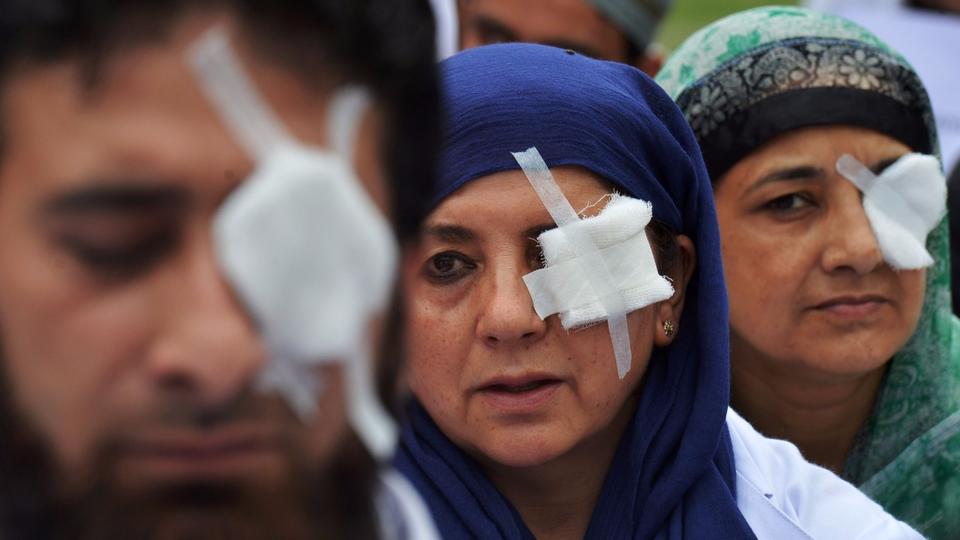
Kashmiri children injured by Indian forces firing pellets in Kashmir

On 28 August 2020, Indian forces in Srinagar opened fire with “pellet guns” on a peaceful religious procession. More than forty people were wounded while several were blinded. As usual, Pakistan protested vehemently. As usual, Indians responded on Twitter with triumphalism and aggression — if you don’t want to get shot, they said, don’t come out on the streets. And as usual, the world watched in silence.

It was not always so. India first started using pellet-firing shotguns against the Kashmiris in 2010 but the matter only hit international prominence in 2016 when protests following the death of Burhan Wani resulted in thousands of injuries, the blinding of hundreds and the deaths of over 70 people. The Guardian, for example, published a story asking if Kashmir represented “the world’s first mass blinding.” Even Indians were rocked by a viral series of pictures showing the distorted faces of celebrities.

The storm of international condemnation resulted in India scaling back the use of pellet-firing shotguns but not abandoning the weapons. In August 2019, when protests erupted against the revocation of Article 370, the Kashmiris were again dispersed with shotguns. Subsequently, shotgun usage subsided but that was simply because there was an unprecedented months-long lockdown in Kashmir in which people were confined to their houses. But as recent events show, India has not given up on shotguns. They remain India’s weapon of choice to deal with the Kashmiris.

One of the many tragedies of Kashmir is that it often gets subsumed into a larger narrative about the “unfinished business of Partition.” This narrative imposes a geostrategic lens on the issue and leads to a reductive analysis about whether Kashmir belongs to either India or Pakistan, a debate which India then further muddies by trying to paint all Kashmiri opposition as Islamic terrorists, a debate which the rest of the world has long since learned to tune out.

greater kashmir pellet victim

Kashmiris are not just symbols of injustice: they are real people living real lives in terrible pain. They also have rights under international law, rights which are being consistently violated. Irrespective of how the territorial issue of Kashmir is eventually resolved, there is a human aspect to Kashmir which needs to be confronted now. This is not just a dry legal dispute to be debated in textbooks and seminars: India’s ongoing use of shotguns is a war crime.

Indian sources and by extension, many international sources — normally do not use the word “shotgun” to describe the weapons used by Indian forces in Kashmir. Instead, they use the term “pellet gun.” This is a misnomer. The term “pellet gun” is associated with the type of airguns used to shoot balloons at village fairs; that is, guns which fire individual pellets and must be reloaded after every shot. However, the guns used by Indian forces bear no resemblance to such weapons. Instead, Indian forces use standard 12 gauge pump-action shotguns, each of which can be loaded with up to four shotgun shells.

Admittedly, each shotgun shell is in turn loaded with up to 600 pellets. But that, by itself, is no excuse to refer to a deadly weapon as if it was a child’s toy. As Orwell advised many years ago, it is generally better to use plain words. To quote a group of English parliamentarians,”[The phrase ‘shotgun’ may better convey the violence which these weapons embody. These shots can mutilate and blind and have had an impact on hundreds of individuals caught in the crossfire.”

So far as international law is concerned, the position is very simple: there is no legal regime which permits a state to routinely disperse crowds of civilians by firing shotguns at them. This is true whether it is assumed that India has illegally occupied and annexed Kashmir (as per Pakistan), that Kashmir is “disputed territory” (as per the UN Security Council, the UNGA and the OIC); or whether one assumes that Kashmir is an integral part of India (as per the Government of India).

If we start with India’s contention that it exercises undisputed sovereignty over Kashmir, it follows that the Kashmiris are entitled to the full range of human rights afforded to them under international law (including the right not to be shot at random with shotguns). Of course, India may argue that (a) international law is only applicable to the extent enacted into domestic law; and (b) India’s independent judiciary has decided that the use of shotguns for crowd control does not violate Indian law. However, there are certain human rights obligations which cannot be ignored by any state, irrespective of domestic laws and domestic judges. Article 6(1) of the International Convention on Civil and Political Rights (ICCPR) is one such norm and states as follows:

Kashmiri doctors and paramedics, their eyes covered by patches, protest at a hospital in India-held Kashmirs Srinagara area in hopes of evoking the plight of victims of pellet guns fired by Indian security forces to disperse crowds.

“Every human being has the inherent right to life. This right shall be protected by law. No one shall be arbitrarily deprived of his life.”

The key word here is “arbitrary.” And in this context, it is important to examine the weapon itself which is being used.

The shotguns used by the Indian army are manufactured at the Ordnance factory in Ishapore. Till date, Indian authorities have refused to divulge information about them on national security grounds. However, reports suggest that the guns are crude copies of the American Mossberg 500 series which were originally used in World War 1 for close-quarter combat.

In Kashmir, Indian forces have been using No. 6 (300 pellets of 2.79mm each) and No. 9 (600 pellets of 2.30 mm each) cartridges. For such small pellets the key issue is the distance from which they are fired. If they are shot at a closer range, the pellets do not have time to disperse and instead travel in a high-speed clump behaving almost like a handgun bullet. This makes them incredibly harmful and they can penetrate tissue and even bone, causing serious damage. However, if they are fired from a distance, the pellets disperse haphazardly.

According to the Omega Research Foundation (ORF), an independent UK-based organisation that monitors military equipment, “the spread pattern specified by the pellet manufacturer is so inaccurate that even when security forces use the weapon to target protesters’ legs, pellets are still likely to hit areas of the body above the waist.” According to a spokesman for the ORF, “This weapon should not be used at all. No modification could make its use compliant with international human rights law and standards.”

In simple terms, there is no safe or legal way to use a shotgun for crowd control. At close quarters, a shotgun is lethal. When used from a distance, a shotgun is entirely arbitrary and indiscriminate. Either way, the result is unjustifiable cruelty.

International human rights law on policing and the use of lethal weapons is enunciated most clearly in two documents approved by the UN General Assembly, the Code of Conduct for Law Enforcement Officials (1973) and the Basic Principles on the Use of Force and Firearms by Law Enforcement Officials (1990). Each of these is now regarded as declaratory of the customary law.

The content of these two documents amounts to basic common sense: that the use of force should be limited to the extent necessary, that it should not be disproportionate, that it should be backed by law and that there should be an effective means of accountability if force is used. In relation to the use of deadly force, these principles require additional care and precision: intentional lethal force can thus only be used if there is an imminent danger of death or serious injury that cannot otherwise be averted. Finally, there is the principle of precaution: that all operations be “planned, prepared, and conducted so as to minimize, to the greatest extent possible, the recourse to lethal force’.

India’s use of shotguns for crowd control fails all of these tests. Shotguns are not just inherently indiscriminate weapons, but India’s usage of them is horrendously cruel. Human beings instinctively shudder when confronted with the prospect of being blinded. One reason why the world banned chemical weapons after World War I is because of the collective trauma of watching blinded soldiers shuffle past, each with their hand on the soldier in front. More recently, an international convention banning the use of blinding laser weapons was promulgated in 1998 precisely because there is a unique revulsion attached to the deliberate blinding of humans.

More importantly, India regularly uses shotguns against crowds even when there is no imminent danger of death or serious injury to Indian forces. In the most recent instance, for example, the people who were fired upon were not even protesting: they were simply taking out a religious procession. There is also no realistic possibility of accountability. Back in 2015, Amnesty International noted that over the previous 25 years, “not a single member of the security forces deployed in [Kashmir] has been tried for human rights violations in a civilian court.”

Finally, there has been no serious attempt by India to develop alternate means of crowd control. A committee was set up to examine such options as far back as 2016 but till date, shotguns remain the preferred option for Indian forces in Kashmir. And India’s insistence that it has no other option is absurd. There is no other country in the world besides India which uses shotguns for crowd control. And even within India, there is no other place besides Kashmir where shotguns are regularly and consistently used for crowd control.

When faced with such queries, Indian defenders retreat to different norms. Kashmir is not a normal civilian area, they argue. It is instead a warzone where Indian soldiers are confronted with an externally fomented Islamist insurgency. In short, they argue, India’s actions in Kashmir need to be judged using the laws of war, not the laws of peace.

But the problem for these defenders is that Indian actions in Kashmir fail even the laws of war.

The precise relationship between international human rights law and the laws of armed conflict is heavily debated. However, there is a broad consensus that the laws of war represent a specialized set of rules which take precedence over international human rights law, but only to the extent there is an actual conflict in terms of the applicability of the two sets of laws. Thus, the mere fact that there is an armed conflict does not by itself negate the applicability of international human rights law. In fact, the ICJ has specifically held that “the right not to arbitrarily be deprived of one’s life [under Art. 6 ICCPR] applies also in hostilities.”

In the case of Kashmir, there is no actual conflict between the two sets of laws. This is because India is not using shotguns to fight militants. Instead, it is using shotguns as a crowd control measure against civilians. The laws of war do not regulate the conduct of normal policing measures or the manner in which local administrations can control otherwise peaceful protests. In fact, to the extent a state is called upon during times of war to perform normal policing functions with respect to a civilian population, it must act in accordance with normal policing procedures. And as already noted, the established norms of policing do not permit states to disperse crowds by firing shotguns at them.

One of the most fundamental principles of the laws of war is the principle of distinction, i.e., that fighting states must always distinguish between combatants and civilians. Even if it is assumed that Kashmir is the site of an armed conflict, that only authorizes the Indian military to use deadly force against combatants, not civilians. Furthermore, the law of armed conflict recognizes a very bright and clear line between the two categories: civilians cannot be attacked in the same manner as combatants “unless and for such time as they take a direct part in hostilities.”

Participating in a protest against Indian occupation does not constitute taking “a direct part in hostilities.” That standard is only met when a specific act directly targets military operations or military capacity of a party to an armed conflict and is specifically designed to cause a certain, non-minimal level of harm to that party. Shouting slogans at a march does not qualify as taking a “direct part in hostilities.” Even throwing stones at soldiers does not qualify as taking a “direct part in hostilities.”

Another, equally fundamental principle of the law of armed conflict is the principle of proportionality. In simple words, this principle prohibits attacks against a military objective if the incidental loss of civilian life would be “excessive in relation to the concrete and direct military advantage anticipated.” Even if some people participating in demonstrations are also actively helping Kashmiri freedom fighters, the use of shotguns is still illegal. Indian forces have no way of knowing which protestors — if any — are also active in the Kashmiri resistance. It cannot therefore use weapons which kill, blind, and maim at random.

It is this arbitrary aspect of shotgun usage which is the biggest issue. When an Indian soldier fires a shotgun at a crowd of Kashmiris, the current SOPs stipulate that he should fire from a distance of at least 40-50 metres. At that distance, it is impossible to aim a shotgun with any degree of accuracy: one is only aiming at a mass of people, knowing full well that a certain number of them are likely to die, that a slightly greater number are likely to be blinded, and that an even greater number are likely to be injured. The usage of shotguns for crowd control is thus no different from rounding up protestors and blinding (or killing) an arbitrary number of them.

Collective punishment has a long and inglorious history. The word “decimate” comes from the Roman Army’s tradition of killing every tenth member of a mutinous cohort. Conquering armies in Europe were traditionally allowed three days of pillage after subduing a city while the Mongols preferred to build towers from the skulls of those foolish enough to resist. In more recent times, the Nazis during World War II regularly massacred entire villages in response to the killing of a single German (see, for example, the 1942 killing of 340 Czechs in response to the assassination of Reinhard Heydrich). It is precisely for this reason that collective punishment is clearly prohibited by both the Third and the Fourth Geneva Conventions of 1949 as well as the Hague Regulations of 1899 (all of which have been signed and accepted by India).

In theory, India could argue that Kashmir is not an “armed conflict” of the type to which the laws of war apply. However, that debate misses the point: what India has deliberately and consciously adopted as a state policy in Kashmir is so cruel and so inhumane that it would constitute a war crime even if that type of armed conflict existed. Furthermore, international human rights law and the laws of armed conflict do not exist in separate silos. As noted by the International Criminal Tribunal for Yugoslavia in the Tadic matter, “elementary considerations of humanity and common sense” mandated that “[w]hat is inhumane, and consequently proscribed, in international wars, cannot but be inhumane and inadmissible in civil strife.”

The Security Council has chosen to remain quiet for many years on Kashmir. But the fact that Kashmir is disputed has nothing to do with the human rights of the Kashmiris. Their human rights are undisputed. And it is time that the international community stopped turning a blind eye to India’s violation of those rights.


River to Sea Uprooted Palestinian   
The views expressed in this article are the sole responsibility of the author and do not necessarily reflect those of the Blog!

Sunday, 20 September 2020

Anuradha Lifts Veil on Modi regime’s media gag in IOJK

 Source

Srinagar, September 09 (KMS): Anuradha Bhasin Jamwal, the executive editor of Kashmir Times, in her fresh article has said that journalism in Indian illegally occupied Jammu and Kashmir has begun to succumb to pressures from the Indian government.

According to Kashmir Media Service, Anuradha Bhasin Jamwal in the article titled “Kashmiri Editors Can’t Use Fear as an Excuse for Their Continued Silence” writes, “When August 5, 2019, descended, with the gagging and muzzling of dissent, newspapers completely lost their voice, even as some continued to be printed in their truncated forms and with content that was out of sync with the existing situation of the time.”

The article further goes as: “Setting aside the arrests, torture and human rights violations, the absence of reporting on the impact of a stringent lockdown on the day-to-day lives of ordinary humans and the devastating blow to the health and education sector was so pervasive, it ended up legitimising the myth of ‘normalcy’ that the [Indian] government was labouring to showcase.”

Referring to the military siege imposed after August 5, last year, she says, “The Valley’s leading newspapers have chosen to keep their publications alive by killing news stories and burying all morals of journalism.”

“When a bevy of newspapers agree to fall in line, without a whimper, the going becomes even tougher for the rest, including weekly and monthly publications as well as freelancers, many of who are courageously struggling to speak out and facing risks;” she added

“It has been a tight-rope walk for media personnel in Jammu and Kashmir, particularly in the Valley, since last year. But despite the logistical impediments of operating without a communication system and in an intimidating climate of partial bans where journalists are criminalised or summoned repeatedly, many brave journalists have resisted all kinds of pressures to ensure that news about Kashmir does not absolutely spiral down the black-hole,” the article said.

Although, the article is lengthy, yet the main chunk is being given as under:

Kashmiri Editors Can’t Use Fear as an Excuse for Their Continued Silence

Anuradha Bhasin Jamwal

Tazia processions during Muharram in Kashmir have rarely been event-free in the last three decades. This year however marked a departure for another reason.
As clashes erupted between mourners and the police in Srinagar on the ninth and tenth day of the Ashura on August 29 and 30, teargas shells and pellets were fired, slogans of Azadi were raised and stone-pelting broke the calm of the procession, the local newspapers responded with a conspicuous silence even as the scale of brutality surpassed those of previous incidents.

In the past, claims and counterclaims have been common after processions have gone awry. The recurrent cycle where the police and the locals blame the other for the provocation – effectively reducing the debate of whether police brutality preceded the sloganeering and stone-pelting or vice versa to a chicken and egg story – has come to occupy the columns of local newspapers in recent decades.

This year, the story all but disappeared – interestingly on the day that the world observes as the Day of Enforced Disappearances – instead papered by bold headlines of ‘Religious fervour’ of the Muharram processions. Evidently, many believed that the story didn’t merit any further coverage or was reduced to a footnote.

What was glossed over by the local newspapers, however, was splashed across social media on the evening of August 29 with appalling images of pellet riddled bodies and faces. The story figured prominently in some sections of the national and the international media the next day and was pursued by many others the day after that.

Since last year, particularly after the Jammu and Kashmir Reorganisation Bill was passed, Article 370 of the constitution was scrapped and a stringent lockdown accompanied the developments, local journalism has been in a state of stupor. While many professionals have struggled to keep the news alive and ward off any attempts to suppress the flow of information despite a communications blockade in place, multiple forms of intimidation and the launching of an Orwellian Media Policy 2020, the Valley’s leading newspapers have chosen to keep their publications alive by killing news stories and burying all morals of journalism.

For over a year, I have grappled with the question of ethics – whether as an editor of the newspaper Kashmir Times, I might be crossing the principled stand of commenting on the content and conduct of ‘rival’ newspapers, and thus held my peace.

But a race driven by purely material considerations is not my line of work. More importantly, when the actions of some affect a trend impacting journalism as a whole – and perilously so – it is important to speak out. In Jammu and Kashmir, the powerful dailies dictate the kind of journalism that the rest are obliged to follow, unless they choose to be out of sync with the rest and face consequences.

When a bevy of newspapers agree to fall in line, without a whimper, the going becomes even tougher for the rest, including weekly and monthly publications as well as freelancers, many of who are courageously struggling to speak out and facing risks.

Notable is the case of the editor of The Kashmir Walla, Fahad Shah, who was summoned by the Cyber Police and twice faced an interrogation for one particular report. I do not intend to take any high moral ground. As journalists, we go about the daily rigours of negotiating multiple challenges, including occupational hazards and deadlines for work, imperfectly. The excessive risks media professionals, particularly Kashmir based editors, are exposed also deserves acknowledgement. But when the very foundational principles of journalism stand compromised, there is a need for introspection. The idea behind writing this article is to initiate this much-needed debate.

Needless to say, it has been a tight-rope walk for media personnel in Jammu and Kashmir, particularly in the Valley, since last year. But despite the logistical impediments of operating without a communication system and in an intimidating climate of partial bans where journalists are criminalised or summoned repeatedly, many brave journalists have resisted all kinds of pressures to ensure that news about Kashmir does not absolutely spiral down the black-hole. The counter to the state’s narrative has made headlines in the national and international media due to their admirable efforts.

Are the pressures more exacting on local media organisations which have largely preferred to remain silent and submit to the powers that be over pursuing ethical journalism? The consideration of advertisements and finances apart, in July 2019, editors of two Kashmir based newspapers were grilled for several days by National Investigating Agency (NIA) as part of an investigation into a case of “terror funding”.

When August 5, 2019, descended, with the gagging and muzzling of dissent, newspapers completely lost their voice, even as some continued to be printed in their truncated forms and with content that was out of sync with the existing situation of the time. Setting aside the arrests, torture and human rights violations, the absence of reporting on the impact of a stringent lockdown on the day-to-day lives of ordinary humans and the devastating blow to the health and education sector was so pervasive, it ended up legitimising the myth of ‘normalcy’ that the government was labouring to showcase.

Even as editors were caught in a situation with a lack of choices, with two essentials vital for the existence of newspapers – local news and political comment – gone, the publications were reduced to mere shadows of their former selves. A year on, while some of this has been salvaged, the readers are judging the newspapers, not on the basis of what was reported but what was not.

The absence of the news on pellet gun injuries becomes an important case study in assessing the state of media in Kashmir and the interplay between journalism and its readers. What disappeared or appeared in a muted form on August 30, after the first day of the brutal crackdown on the Muharram processions, resurfaced, mostly apologetically on August 31, after the newspapers faced a severe backlash from Kashmiris on the social media.

One of the leading dailies, Greater Kashmir, in a report on August 30 titled ‘Ashura Today’, detailed the significance of Muharram procession in the opening paragraphs, and dismissed in two small paragraphs – which figured at the fag end of the report – that “the police used tearsmoke shells at Hamdania Colony Bemina” to disperse the procession leading to “injuries to mourners”. It also added that “The mourners alleged that metallic pellets were also fired on them. A couple of youth sustained pellet injuries.”

The Rising Kashmir blacked out the Muharram procession completely, neither carrying the ‘religious fervour’ associated with it, nor the disruptions to it. The Kashmir Reader published on August 30 dismissed in six small sentences a news item titled, ‘Restrictions in parts of Srinagar to prevent Muharram procession’, barely mentioning some barricades manned by police and CRPF.
What was missing on August 30 found a cautious and guarded presence in print the next day. The criticism on social media surrounding the lack of coverage of pellet injuries by local newspapers brought the news into focus the next day, even though the report about the ‘religious fervour marking the 10th day Ashura procession’ dwarfed the violent scenes on the road.

The Greater Kashmir published, on August 31, the news titled, ‘Two dozen mourners injured as police use force to stop Muharram processions in Kashmir‘ and a strap that read, ‘Our men too received injuries: SSP Srinagar’. It said that two dozen mourners sustained injuries from police action and two youth sustained pellet injuries. It went on to mention:

The clashes started after police deployed in huge numbers in Zadibal tried to stop a large procession. The mourners in turn clashed with the police who restored to tear gas shelling and fired pellets. The police also lathi-charged the mourners.”

The rest of the news article (about nine paragraphs) was dedicated to the police version of the events.

The Rising Kashmir, in its edition of August 31, carried the Muharram story titled ‘Amid COVID-19 restrictions, curbs, Ashura observed in Kashmir‘ and straps that read, ‘Clashes reported in Zadibal areas, Police officer among several injured; Rich tributes paid to Hazrat Hussain (RA) and other Karbala martyrs’. The news, an overall round-up of various Muharram processions in Jammu and Kashmir and Kargil, also made a cursory reference to the violent happenings of the day by saying:

“Later in the day, mourners gathered at Kathimaidan and tried to come on the main road in shape of the procession. Police used tear smoke shells and disperse them.

A Police official said that the mourners resorted to stone pelting at Kathimaidan.
A Selection Grade Constable Showkat Ahmed (1007/s) from Police Station Soura sustained head injuries.”

The Kashmir Reader on August 31 published a report ‘
Restrictions mark Ashura’ as its second lead story and a smaller box item under it, with a detailed news item titled ‘Mourners hit by pellets in eyes writhing in pain’. The report was based on the version of some eye-witnesses, a doctor, and pellet injured victims including a man who said, “I have forty pellets inside my eyes”.

Last year, the news about a protest in Soura, a locality in Srinagar, where hundreds of demonstrators had occupied a park with banners opposing the ‘abrogation of Article 370’ and an incident of violent clashes between protestors and security forces, was first broken by the BBC within days of the imposition of restrictions.

The Indian government responded to the report with an abject denial. Some Indian and foreign media organisations reported the same, one reported on how young men were using the mosque to mobilise the public in the area. Few others reported about young men being wounded by shotgun pellets and another reported that a young man had jumped into the Jhelum river that flows through the city to rescue himself. Some outlets also reported about cases of those who had been injured by pellet and were refusing to visit hospitals and were being treated by self-trained locality experts working with basic antiseptics and crude blades. The Indian state called these reports fake.

The handful of newspapers being printed from Srinagar maintained silent – they were cautious enough to even avoid reporting on the contested claims of both sides and instead cherry-picked ‘safer’ things to talk about. A contested incident about Kashmir and the controversy surrounding it, that garnered headlines in the foreign and national media, was not considered newsworthy enough in Kashmir.

They got away. Locked up in their homes with no internet connections or phones – probably also without any knowledge of the controversy or the incident – the readers made no public display of their disappointment.

What local newspaper organisations took for granted last year may no longer be possible. The overall shock and sense of fear that germinated last year has begun to wear off. The two days of coverage on the latest spree of pellet gunshots demonstrates that even a slight rebuff from readers and the general public is enough to compel media-houses to stop ignoring local voices and incidents.

This moral policing, however, has limitations. As long as involved readers expect the media to function and seek accountability with positive results, it may be fine. But at what point can this readership activism morph into mob-rage? In the last one decade, Kashmir’s media has dealt with its share of mobs setting newspapers on fire or disallowing selective journalists from entering certain areas on allegations of deliberate blacking out of the news of public protests and campaigns or human rights abuse.

When democratic spaces vanish, the dangers of a venomous and unstoppable mob are enhanced with a probable future of the thin line between reason driven criticism and irrational, vitriolic vengeance blurring. The only thing that can avert such a danger is a responsive media, guided purely by the principle of informing and enriching informed opinion. The realm of fear, real as it is, cannot be used as a perpetual excuse by editors of newspapers to defend their silence.

An unidentified editor of a Kashmir based newspaper was quoted in a report in The Telegraph on August 31, as having said, “the Kashmir dailies were ‘gradually reclaiming the space’ they had conceded last year after the clampdown.”

What can be reclaimed after they chose to turn a blind eye to the horrifying spectacle of over 200 injured men, many being sprayed with pellets on their bodies, faces and eyes?

According to the same report, another editor claimed the newspapers had been discreetly told to give the most extensive coverage to “developmental activities” by the government.

About two months ago, senior Indian journalist Ajaz Rashid, while researching about J&K’s new media policy, asked me whether journalists and editors would be willing to speak freely. I told him I had doubts about the latter. The editors who are part of the Editors Guild of Kashmir haven’t made a murmur as yet, and newspapers are carefully dropping anything that the government would be uncomfortable with. A day later, after trying to speak to some editors, he messaged back, “you were right. Either they don’t speak or speak little but do not want to be identified.”

Resisting what senior journalist Yusuf Jameel calls as the present moment of “Undeclared Censorship” requires not just overcoming fear but also searching for alternate models of revenue, without which the choice is either of ‘silence’ or of struggling to continue in keeping with the true spirit and ethics of journalism, at the risk of sagging circulation, downsized staff, poor quality of production and even the threat of closing down.

When the dictum comes ‘Fall in line or Perish’, the choice is not between survival and persecution, the choice is between saving a business enterprise or journalism which certainly cannot be reduced to a pamphlet fed on advertising.

Anuradha Bhasin Jamwal is the executive editor of Kashmir Times.

River to Sea Uprooted Palestinian   
The views expressed in this article are the sole responsibility of the author and do not necessarily reflect those of the Blog!

Sunday, 9 August 2020

Kashmiris worry about a demographic change after August 05 move: Khurram

 Source

This image has an empty alt attribute; its file name is Kuram-Parvaiz-280x126.jpg

Srinagar, August 08 (KMS): In Indian illegally occupied Jammu and Kashmir, Srinagar-based noted human rights activist, Khurram Parvez, has said that August 5 action by Modi government was yet another step towards completely annexing Kashmir – a move used to garner popular support in India at the expense of Kashmiris.

Khurram Parvez in an article in US-based Time magazine wrote that the consent of the governed, which is essential in a democracy, is not at all a concern for the Hindu nationalist government of India when it comes to the people of Jammu and Kashmir, which includes the Kashmir Valley.

Khurram Parvez, who is coordinator of the Jammu Kashmir Coalition of Civil Society and chairperson of the Asian Federation Against Involuntary Disappearances, wrote that IIOJK was under a lockdown long before COVID-19. “For weeks last year, all phone lines and internet services were cut off by the Indian government. Basic mobile-phone connectivity took months to be restored and a ban on high-speed 4G internet continues till this day,” he pointed out.

The rights activist wrote that the Indian government has made full use of coronavirus lockdowns by passing the domicile rule, which has caused alarm because of its potential to change the demography of the Muslim-majority Jammu and Kashmir, he maintained. “In just more than a month, around 400,000 people have already acquired domicile certificates. It could alter the results of any referendum seeking people’s opinion for the resolution of the larger, international dispute over control of the territory, he added.

Khurram Pervez wrote that the first attempt to change the demography of Jammu and Kashmir came in 1947 when the Muslim-majority district of Poonch in Jammu faced a siege, which resulted in a massacre of Muslims across Jammu. It is unclear exactly how many people died, but estimates put the casualty count between 20,000 to even more than 200,000 – with half a million being forced to migrate to Pakistan, he added.

He wrote that elections have been rigged and laws have been imposed by twisting the local government’s arm; anyone who opposes the Indian government’s writ was jailed or killed. “There has been absolute lawlessness as structures of accountability have been rendered dysfunctional. Not one armed forces’ personnel has ever been prosecuted in civilian courts for their involvement in human rights violations,” he maintains.

Khurram Pervez wrote that promises of a referendum allowing Kashmiris to decide the territory’s fate, made by then Indian Prime Minister Jawaharlal Nehru in 1947, had been buried and replaced by a new narrative that “Kashmir is an integral part of India”. He said, with every passing day, India’s stand on Kashmir has grown more rigid – and violence against people of Jammu and Kashmir has become a norm. He said that when Prime Minister Narendra Modi’s Bharatiya Janata Party (BJP) came into power in 2014, the policies of aggression became even more crude. He pointed out that the only difference was that the deceptive sophistication of the secular Congress government was replaced by the brazenness of the Hindu-majoritarian BJP.

Khurram Pervez maintained that the unilateral and undemocratic changes governing Jammu and Kashmir, unabated human rights violations, denial of basic facilities and land-grabbing due to militarization are all in violation of international law, UN resolutions, India’s own constitutional framework and India’s commitment to the Kashmiris. India can only feel encouraged to continue its violent policy because of the lack of international moral leadership, he concluded.


River to Sea Uprooted Palestinian   
The views expressed in this article are the sole responsibility of the author and do not necessarily reflect those of the Blog!

Sunday, 26 July 2020

Kashmir Martyrs’ Day – July 13


Background
svg%3EKashmiris on both sides of the Line of Control and across the world observe 13th July as Kashmir Martyrs’ Day, every year. The day is commemorated to pay rich tributes to the 22 Kashmiris who were shot dead, one after the other, outside the Srinagar Central Jail by the troops of Dogra Maharaja. The victims had gathered in the jail premises to attend the court proceedings against one, Abdul Qadeer, who had asked the Kashmiri people to defy Dogra rule.
The tension was brewing in the territory since 19th April 1931 when Imam Munshi Muhammad Ishaq was stopped by Dogra police chief, Chowdry Ram Chand, from delivering Eid Khutba (sermon) in the Municipal Park of Jammu. The incident triggered massive demonstrations in Jammu city that continued for many days. Ban on Eid Khutba was followed by the desecration of the Holy Quran at the hands of Dogra troops in Jammu. This outrageous act led to widespread resentment throughout the State.
In Srinagar, people held massive gatherings at historic Jamia Masjid and other mosques, shrines and Imamabargahs to denounce this blasphemy and demanded punishment to the culprits. A youth, Abdul Qadeer, was also part of a crowd, which was listening to the speeches delivered by prominent Kashmiri leaders at one such gathering held in Khanqah-e-Mualla. When the meeting concluded, Abdul Qadeer pointing his finger to the Maharaja’s palace raised full-throated slogans “destroy its every brick”. He was accused of sedition and arrested instantly. Abdul Qadeer was to be tried in the court but due to a large public resentment the court was shifted to the Srinagar Central Jail.
On 12th July, intense public demonstrations were held throughout the city against the shifting of the court to the Central Jail. On 13th July, thousands of people thronged the Central Jail to witness the trial of Abdul Qadeer. As the time for obligatory Zuhar prayers approached, one of the youth stood up and started reciting “Azan”. He was shot dead by the Dogra soldiers and next youth started the ‘Azan’ where it was left by the martyred youth. He was also killed and in the process of completing the ‘Azan’ a total of 22 Kashmiris were martyred, one after the other. This massacre is the blackest chapter in the history of Dogra regime.
Before this wholesale slaughter, the Kashmiris had been facing the worst brutalities of their rulers since the selling of Jammu and Kashmir – with predominantly Muslim population – by the Britain to Dogra dynasty for Rs 75 lac under the Treaty of Amritsar in 1846. The Dogra period is considered to be the worst phase of the Kashmir history on account of cruelties meted out to the Muslims.
13th July 1931 is a significant day due to the fact that it was the first occasion when the Kashmiris rose en masse against the oppression of the Dogra Maharaja.
Indian occupation
The new saga of Kashmiris’ sufferings started after the announcement of the understanding behind the Partition Plan of the Indian subcontinent by the British Government in 1947. Under the Plan, the British India Colony was to be divided into two sovereign states – Pakistan and India. The understanding behind the Partition Plan had given the right to the then Princely States to accede to either of the two countries on the basis of their geography and demography. The Kashmiris had a great feeling to join Pakistan due to their strong geographical, religious and cultural bonds with the country. However, their dream of becoming part of Pakistan was shattered by the landing of Indian Army in Srinagar on October 27, 1947 in total disregard to the Partition Plan that sowed the seeds of the Kashmir dispute. This shows that Kashmir is the unfinished part of the partition of South Asian subcontinent.
The Indian invasion faced stiff resistance from the people of Jammu and Kashmir. They launched a freedom struggle and succeeded in liberating a large part of the State, which is now known as Azad Jammu and Kashmir. The resilience and determination of the Kashmiris pushed India on the verge of defeat, forcing it to approach the UN Security Council on January 01, 1948 and seeking its help to settle the issue. The UNSC through its several successive resolutions called for settlement of the Kashmir dispute through holding of a free and impartial plebiscite to be conducted by the UN. It is a historical fact that India itself had taken Kashmir to the UN accepting it as a disputed territory and promising before the world community to give the Kashmiris their right to self-determination, but these commitments are yet to be honoured.
Mass uprisings
The continued denial of their rights by India compelled the people of the occupied territory to start a massive uprising in 1989. It picked up pace with the passage of time and gave sleepless nights to the Indian rulers. The people rose against the illegal occupation and vowed to continue their struggle till Kashmir’s liberation from Indian bondage.
The Kashmiris’ liberation movement took a new turn in 2008. For the next three consecutive years, thousands of people hit the streets of Srinagar and other major towns on a daily basis. At times, one million protesters were seen on the streets of Srinagar demanding their right to self-determination. The extrajudicial killing of a popular youth leader, Burhan Wani, on July 08, 2016, triggered another mass uprising in the territory. Unfortunately, instead of taking these mammoth anti-India demonstrations in all these years as Kashmiris’ referendum against its illegal occupation of their soil, India responded with brute force, resulting in the killing of hundreds of protesters and injuring of thousands. Since the killing of Burhan Wani, 1,231 Kashmiris had been martyred and 28,066 injured by Indian forces’ personnel till June 30, 2020. As many as 11,050 persons had received pellet injuries and 385 of them had lost their eyesight in one or both eyes.
Modi regime’s assaults
On 5th August 2019, the Narendra Modi-led fascist government repealed the special status of occupied Kashmir and placed the territory under military siege and communications lockdown. After this illegal move, Indian troops have stepped up the killing spree across occupied Kashmir to suppress the uprising and intimidate the Kashmiris into submission. The killing of a 65-year-old civilian, Bashir Ahmed Khan, by Indian troops in front of his 3-year-old grandson in Sopore town in early July 2020 is the glaring example of Indian state terrorism in the occupied territory. Since 5th August, last year, Indian troops had martyred 192 Kashmiris and injured at least 1,326 others by using brute force on peaceful demonstrators till July 05, 2020. The troops had damaged over 935 houses and structures and molested 77 women. Thousands of Hurriyat leaders, political and human rights activists, religious heads, journalists, businessmen, lawyers and civil society members, who were arrested after or before the 5th August 2019, continue to remain in different jails of India and occupied Kashmir.
The Modi regime has also introduced new domicile rules in occupied Kashmir, paving way for the Indian Hindus to get permanently settled in the territory. The basic aim of the move is to convert the Muslim majority into a minority. It has so far issued domicile certificates to over 300,000 Indian Hindus including an Indian Administrative Service (IAS) officer, Navin Kumar Choudhary.
However, the fact remains that the worst kind of Indian brutalities have failed to force the Kashmiris to surrender their just cause and they are determined to carrying forward their freedom movement.
Conclusion
The unparalleled sacrifices rendered by the people of occupied Kashmir in their just struggle during the past several decades have shaken the conscience of the world community, which has started to raise its voice in favour of their rights. The holding of discussion in the UN Security Council on the situation in occupied Kashmir twice within few months in the last over 50 years, the debates in the UK Parliament, the issuance of documents on Kashmir by the European Parliament and two reports by the UN High Commissioner for Human Rights highlighting the grave human rights abuses by Indian troops in Kashmir are some glaring examples of this fact. These developments show that the day is not far when India will have no option but to respect the Kashmiris’ aspirations and give them their right to self-determination it had promised several decades ago.

River to Sea Uprooted Palestinian   
The views expressed in this article are the sole responsibility of the author and do not necessarily reflect those of the Blog!