Showing posts with label Federal Reserve. Show all posts

Saturday, 25 April 2020

Global Economic Collapse Reveals the Complete Failure of Neo-Liberal Capitalism


Global Economic Collapse Reveals the Complete Failure of Neo-Liberal Capitalism
Written by Dr. Leon Tressell exclusively for SouthFront
  • Fitch Ratings, ‘Unparalleled Global Recession Underway’
  • Economist Sven Heinrich, ‘Central banks are weapons of economic mass destruction.’
As each day passes by data pours in revealing the immense economic damage caused by the Coronavirus pandemic. Most politicians and economic pundits will put the blame for up the economic hurricane, blasting tens of millions into unemployment, on Coronavirus lock downs. Fitch Ratings has given a brief snapshot of the unfolding economic catastrophe which it predicts will last well into the 2020s:
“World GDP is now expected to fall by 3.9% in 2020, a recession of unprecedented depth in the post-war period. This is twice as large as the decline anticipated in our early April GEO update and would be twice as severe as the 2009 recession.”
“The decline in GDP equates to a USD2.8 trillion fall in global income levels relative to 2019 and a loss of USD4.5 trillion relative to our pre-virus expectations of 2020 global GDP. Fitch expects Eurozone GDP to decline by 7%, US GDP by 5.6%, and UK GDP by 6.3% in 2020.”javascript:window[“$iceContent”]
Yet at the beginning of this year the financial media and political classes around the world were making rosy forecasts how we were going to experience moderate economic growth this year built upon solid economic foundations. There was no cause for worry or alarm just let global capital work its magic and trickle-down economics would ensure living standards would rise for all.
Fast forward 4 months and a global health pandemic has revealed how shallow, brittle and unstable were the economic foundations of the neo-liberal economic order that has been heralded as such a success since the Reagan-Thatcher era of the 1980s. These foundations were built upon infinitely low interest rates, an exponential rise in debt both public and private (sending global debt over the $250 trillion mark) and a massive increase in social and economic inequality. Alongside this, has been the intense exploitation of nations in the developing world and the use of regime change wars as naked resource grabs which cement the neo-liberal economic model in position.The world economy was slowing down during 2019 and heading towards a global recession. Japan’s economy had already entered recession territory in the last quarter of 2019, meanwhile PMI data from China and Germany indicated that they were hovering just outside recession territory.The global economy at the end of 2019 was teetering on the brink and just needed a catalyst or pin to pop the everything bubble which has seen massive inflation in the prices of paper assets across the globe ranging from stocks and bonds to derivatives such as collateralized loan obligations.
The anaemic economic growth experienced by global capitalism since the last financial crisis, which was a mere 12 years ago, has been based upon a gigantic expansion of the global money supply as central banks and governments mistakenly believe that the only way to sustain our debt fuelled economic system was to create ever more debt.
The last 12 years since the 2008 global financial crisis have witnessed an unparalleled wealth transfer from the working classes to the billionaire class which wields immense political influence over governments across the world. Central bank stimulus programs i.e. quantitative easing together with historically low interest rates fuelled a speculative bonanza which has pushed financial markets to all-time highs across the globe.
Meanwhile, governments across the world have sought to give the hard pressed billionaire class a helping hand by cutting capital gains, income and corporation taxes across the board. President Trump’s $1 trillion tax give away to the economic elites in 2017 is the most egregious example of this phenomena.
At the same time, wages for billions of ordinary people have stagnated or fallen whilst welfare benefits and health care have declined. We now have the utterly surreal situation whereby 26 billionaires control as much wealth as the poorest half of humanity amounting to over 3.8 billion people.
The working and middle classes together with the underemployed poor of the developing world were made to pay for the costs of the 2008 global economic crisis. Once the Coronavirus pandemic has finally burned itself out the working people of this world will be confronted with an economic depression which will rival and indeed may exceed in severity that of the 1930s. Governments across the board will once again seek to make ordinary people pay for the cost of the gigantic debts incurred by government and central bank bailouts.
In a desperate effort to prop up their system and protect the interests of their own class central bankers and corporate politicians across the globe are presiding over yet another wealth transfer that benefits the richest 1% in society. Bloomberg has noted how over $8 trillion has been printed out of thin air by global central banks and governments to prop up their debt fuelled system. The bulk of this horde of fiat money has gone to service the needs of Wall Street and its counterparts in London, Paris Frankfurt, Shanghai et cetera.The Wall Street Journal has openly acknowledged this truth in an editorial:
“The Fed may feel all of this is essential to protect the financial system’s plumbing and reduce systemic risk until the virus crisis passes, but make no mistake the Fed is protecting Wall Street first. The goal seems to be to lift asset prices, as the Fed did after the financial panic, and hope that the wealth effect trickles down to the rest of the economy.”
As the 2020s progress massive wealth and health inequalities, hunger and poverty will lead large numbers of people to question the hyper financialised economic system whose sole motive is to protect the interests of the 1%.
The American dominated monetary system which gives preferential treatment to the empire and its allies is in decline. Its decline will be exacerbated by the twin hammer blows of the Coronavirus pandemic and the global economic depression now unfolding.
During the coming decade the make the world will become an even more unstable place as the hegemonic power of our era seeks to maintain its dominant position in the global economy at the expense of other nations. The contradictions and tensions between the United States and its rival China will be greatly exacerbated during the next period. As we saw in the 1930s once these economic contradictions and tensions reach breaking point then the superpowers of the day have few course of action open to them beyond war or appeasement of their rival.Yet during the 1930s there were instances where the onward march to war could have been averted. If Republican Spain had defeated Franco’s fascist insurgency then the momentum towards war would have been slowed. It would have greatly strengthened the Popular Front government in France and halted the appeasement policies that allowed Nazi Germany to grow in strength like a cancerous tumour.
During the next decade there will no doubt be other such instances where the onward march to war can be averted.

River to Sea Uprooted Palestinian   
The views expressed in this article are the sole responsibility of the author and do not necessarily reflect those of the Blog!

Tuesday, 21 April 2020

Strengthening the US Dollar: Comments on Ramin Mazaheri

Source
April 19, 2020


Strengthening the US Dollar: Comments on Ramin Mazaheri
by Gary Littlejohn for The Saker Blog
Implications of Recent Changes in US Monetary Policy
Ramzin Mazaheri’s excellent article of 16th April attracted some very interesting comments:
This supportive response aims to provide recent relevant evidence that many of the likely changes Mazaheri describes are already happening very quickly. Over the past few months since December, it has become clear that the US Federal Reserve (the Fed, which has actually been privately owned since 1913 but is allowed unconstitutionally to act as the US Government’s central bank) has been grappling with serious problems of liquidity in various US financial markets. This included the ‘repo’ market which handles overnight lending between financial institutions, especially commercial banks, but also other very large financial markets, many of which did not have the funds to pay off debts that were due at the ‘year end’ of their contracts. Depending on the contract, the 2019 ‘year end’ could be at any time between 14 December 2019 and 16 January 2020, but it turned out that the problems did not end in mid-January. All of these problems have been made worse by the COVID-19 pandemic.
This link below times the start of the acute liquidity crisis to September 2019, before I had personally noticed it, and argues that the COVID-19 pandemic only triggered the current crisis, rather than caused it:
The author concludes that monetary policy as we know it is as dead as a doornail and that the Fed is, in effect, a lawless economic government unto itself. This deep crisis has recently led to the development of a new strategy to strengthen the US Dollar by new means that have effectively eliminated any safeguarding constraints on US monetary policy. These new measures are reported to have the implicit backing of the Bank of International Settlements [BIS]. This backing by the BIS is said to include backing for the new Fed policy of buying corporate bonds, which effectively means that the Fed controls which companies survive and which do not, and could probably do this internationally. If this BIS backing is true, then that confirms Ramin Mazaheri’s view that the USA would not be acting alone to retain the global dominance of the US Dollar. I think that time will also confirm Mazaheri’s view that such subaltern countries as the UK and the EU Member States will not oppose these new measures, even though they break the already stretched/broken conventions on monetary policy.
The recent outcome of this has been that a version of Quantitative Easing [QE, or electronic ‘printing’ of money] has been being run by the Fed without the usual requirement to buy US Treasury debts to avoid all that money going straight into the everyday economy and fuelling inflation.  Very recently, the Fed started to break its own rules and buy corporate bonds, which are private companies’ debt. This effectively means that the Fed is taking a stake in large private companies. Something very similar has happened with the European Central Bank (ECB, based in Frankfurt) but in the EU the Competition Commissioner has very recently changed the competition rules to allow but also to regulate this crisis-driven behaviour (see The Guardian newspaper recently). That has had the intention (if not the guaranteed effect) of trying to avoid one EU Member State supporting its own companies at the expense of other Member States.
Yet what seems to be happening in the USA is that Steve Mnuchin (US Secretary of the Treasury) has formed an alliance with head of the Fed Jerome Powell to permit the Fed to issue unlimited quantities of money but with no safeguards in corporate bond buying.  (Remember that corporate bond buying is itself against the Fed’s own rules.) This seems to allow the development of a possible strategy that discriminates against foreign-owned companies (such as Chinese-owned Huawei) to be starved of Fed funds. Indeed it may well become a lot easier to sanction both companies and countries that the US Government sees as a threat or merely a strong competitor. This approach seems to have influenced what looks like a recent change of attitude towards the IMF by Steve Mnuchin, and he has recently appointed a close ally as the No. 2 in the IMF. IMF policy is now especially important because the present crisis has meant that over half of the world’s countries have asked for IMF support.
This seems to give the USA enormous leverage in placing any company it dislikes in a difficult position, at a time when US Dollars [USD] remain the means of payment for at least 80 per cent of all international trade.  I will later refer to a link that shows how much USD is being held by various countries, compared to an estimate of how much they need to carry on trading as normal. The largest EU economies such as France and Germany have only a few per cent of USD in their foreign exchange [FX] reserves, and the same applies to the UK. So Mnuchin is now apparently in a position to inform Trump that he could cause very serious damage to the EU, China and Iran such that the USA could come out of this incipient global depression ahead of its main economic competitors. They may also think the same about Russia but in my view that would be more difficult, because Russia’s economy is inherently more resilient these days. And as indicated above, the USA could also target individual companies. [Incidentally, there is a lot of lobbying going on in Congress right now to gain access to the Fed’s largesse and other emergency funding, and so such preferential treatment could be applied within the USA in a Presidential election year.]
Before providing links to show this situation as it has emerged very recently, it is important to show that the non-financial sectors of the US economy have been in real and accelerating trouble, despite Trump’s claims to the contrary. These illustrative indicators make it clear that the problem is not only financial and so any recovery will probably be very slow because the ‘real’ US economy was heading for a deep recession anyway. Doubtless an awareness of this underlying situation has helped drive the desperate financial measures that we now witness, measures attempting to prop up the US Dollar and ensure that it fully recovers its global dominance.
The following indicators of the contraction of the US economy illustrate a process which started months before the COVID-19 pandemic. There were other earlier indicators – this list is just to give a flavour of the developing trends. The first shows that the Fed has been fully aware of all this:
Now for the evidence of the apparent policy changes described above:
[19 Mar 2020.]
[10 Apr 2020.] Mnuchin says IMF and World Bank are important partners in addressing global issues. So this is before the public change of heart.
Here is a crucial quote from the above link:
“In the U.S., Treasury Secretary Steven Mnuchin has forged a crisis partnership with Federal Reserve Chairman Jerome Powell, giving the central bank a bigger role in fiscal policy.”
Now for the public change of position on the IMF:
Also on the 16th April various reports covered the reasons that Mnuchin gave for not supporting the IMF issuance of Special Drawing Rights [SDRs] to support a whole series of countries: he basically suggested the use of much more limited IMF funds for developing countries on the grounds that 70 per cent of the IMF SDRs would go mostly to stronger economies, and developing countries would only get 3 per cent. But some commentators think that the real reason for this change of approach to the IMF is that SDRs would give China and Iran funding without any strings.
The Latent Demand for US Dollars at a Time of Serious Economic Contraction
The link below by Michael Every of Rabobank estimates the impact of the sudden global economic contraction on the demand by various countries for US Dollars:
It treats the global market for Dollars under a single label, namely Eurodollars, but if one adopts that approach then it tends to downplay the historical significance of the rise of the petrodollar after Nixon took the Dollar off its fixed exchange rate to gold in 1971. Following that major policy change, Saudi Arabia was quietly given permission to raise the price of oil in 1973 in exchange for US guarantees of its military security. What the US got out of this deal was a guaranteed demand for Dollars because Saudi Arabia agreed to insist that oil had to be traded internationally in Dollars. There was a repeat oil price shock in 1979, further strengthening the dominance of the US Dollar.
The article linked above in part uses The Matrix movie to make some of its points, but the argument is still understandable if you have not seen that movie. The BIS is often described as the central bankers’ central bank, but in my view there is a power hierarchy there. The article claims that the origins of the EuroDollar market are mysterious but in fact it was mainly the US Dollars that arrived in Western Europe as funding for the Marshall Plan for post-war reconstruction of Western Europe that created the market. One part of the argument slightly overstates its case, although it is historically true:
“However, there is a cost involved for the US. Running a persistent current-account deficit implies a net outflow of industry, manufacturing and related jobs. The US has obviously experienced this for a generation, and it has led to both structural inequality and, more recently, a backlash of political populism wanting to Make America Great Again.”
Yet while running a persistent current account deficit implies such a net outflow, it does not entail it. A more judicious policy promoting industrial investment and innovation could have fostered a greater resilience of US industry. Despite its reputation for innovation, in fact most post-war US innovation has either come from the military-industrial complex (increasingly feeble at creating new products owing to the political gravy train that reduced incentives to innovate) or was actually imported, mainly from Nazi Germany or the UK.
The important point now is that few countries can manage to trade without access to US Dollars [USD]. China has reduced its USD holdings for over $2 trillion a few years ago to less than $1.8 trillion now, judging by Table 1 in the link above. That Table highlights in red those countries that are most vulnerable to a US Dollar shortage. Yet it seems that China will need about double its current US Dollar reserves to avoid serious trading difficulties, according to the above article. China has been buying US Dollars and US Treasury Bills [T-bills] again recently, as Mazaheri would expect in the present circumstances:
No other country has anything like the absolute amount of US Dollar holdings as China, and few have as good a ratio of holdings to required US Dollar finance demands (0.52. for China, or 52 per cent).  Switzerland has 0.48, Russia has 0.36 and Saudi Arabia has 0.69. (Taiwan with 0.51 is too small an economy to have that much global impact.)  Russia has far greater resilience in my view than most other countries, because it also holds Euros and Gold, and has swap arrangements with various countries. It is also able to source most of its raw materials within its own borders, can feed its own population and has sufficient reserves to pay off all government and corporate debt immediately on demand – or did until the COVID-19 pandemic and the oil price war with Saudi Arabia and the USA forced it to start selling foreign exchange within the last few weeks. (The amount of such recent sales is not known.) But the currency swap deals will make it easier for it to keep its international trade going better than most countries.
However, such Russian currency swap deals must pale into insignificance in relation to the easy swap deals that the Fed has engaged in, and these have been ramped up in volume and now include additional countries. As Michael Every explains:
“The Fed has, of course, stepped up. It has reduced the cost of accessing existing USD swap lines–where USD are exchanged for other currencies for a period of time–for the Bank of Canada, Bank of England, European Central Bank, and Swiss National Bank; and another nine countries were given access to Fed swap lines with Australia, Brazil, South Korea, Mexico, Singapore, and Sweden all able to tap up to USD60bn, and USD30bn available to Denmark, Norway, and New Zealand. This alleviates some pressure for some markets – but is a drop in the ocean compared to the level of Eurodollar liabilities.”
He goes on later:
“Yet despite all the Fed’s actions so far, USD keeps going up vs. EM FX. Again, this is as clear an example as one could ask for of structural underlying Eurodollar demand.”
He shows this with a graph of the US Dollar holdings within European Markets’ Foreign Exchange holdings [EM FX]:


https://www.zerohedge.com/s3/files/inline-images/USD%20vs%20EM%20FX.jpg?itok=k7qkcjpM
He then quotes the Bank of International Settlements [BIS] where in a recent report the BIS argued that:
“…today’s crisis differs from the 2008 GFC [Global Financial Crisis], and requires policies that reach beyond the banking sector to final users. These businesses, particularly those enmeshed in global supply chains, are in constant need of working capital, much of it in dollars. Preserving the flow of payments along these chains is essential if we are to avoid further economic meltdown.”
Every comments:
“In other words, the BIS is making clear that somebody (i.e., the Fed) must ensure that Eurodollars are made available on massive scale, not just to foreign central banks, but right down global USD supply chains. As they note, there are many practical issues associated with doing that – and huge downsides if we do not do so. Yet they overlook that there are huge geopolitical problems linked to this step too.”
This clearly implies that the Fed has had a green light from the BIS to lend to companies, as I suggested near the beginning of my commentary on Mazaheri above. I mentioned some of the possible geopolitical problems then. But Michael Every spells out the logical endpoint of such an approach. He had earlier mentioned this as one of three outcomes that were possible in principle, while now pointing out that recent policy changes make this outcome the logical one, even if we have not yet reached it:
“Notably, if the Fed does so then we move rapidly towards logical end-game #2 of the three possible Eurodollar outcomes we have listed previously, where the Fed de facto takes over the global financial system. Yet if the Fed does not do so then we move towards end-game #3, a partial Eurodollar collapse.”
Even a partial Eurodollar collapse would do serious damage to those countries (more than half) which have sought emergency IMF support, and so this new power gives the Fed enormous political leverage over most major economies and over multilateral agencies such as the IMF, the World Bank or even the European Union [EU]. Given that Trump sees the EU as a potential competitor to the USA, and given the low proportion of US Dollars that its major economies have in relation to their trading needs, the EU is very vulnerable to US economic pressure in the present circumstances.
Since the US Dollar is used for about 80 per cent of global trade, then even the fact that the Euro is a fairly substantial international trading currency and forms part of the FX holdings of various non-EU governments such as Russia counts for relatively little. All it could be used for is to buy some time to trade when the global economy slowly pulls out of the COVID-19 recession/depression. A similar argument applies to non-Dollar currency swap arrangements between, for example China and Iran or Russia and Venezuela. All four countries could be potential targets, given that China is seen as the major economic competitor to the USA and the others have important oil and/or gas reserves while the US shale industry is now in deep trouble and will cost billions to keep in business. It should not be surprising that the USA is keeping up the military pressure on Venezuela:
Turning to the EU in more detail, it is clear that the Euro currency itself is under stress as it has led to increased economic inequalities between EU Member States. In addition, political solidarity with the EU has declined partly owing to these growing differences and the austerity policies of the European Commission [EC] and the European Central Bank [ECB]. The ‘bailout’ of Greece was really a bailout of French and Italian banks that had made loans to Greece, and the Greek economy has shrunk enormously since 2008. Now Italy is feeling the pinch as it finds itself constrained by EC/ECB policies in its attempts to kick start economic growth. A recent opinion poll shows that 49 per cent of Italians favour leaving the EU and only 40 per cent want to remain in it. Budgetary problems for the EU will increase after the UK leaves it since the UK is only one of about three net contributors to the EU budget and the tensions over the next EU budget are very visible.
The EU has again very recently failed to agree to ‘debt mutualisation’ whereby the richer economies such as Germany and the Netherlands would also take responsibility for the debts of others, mainly the southern European economies, especially the debts of Italy which is the third largest Eurozone economy. The latest attempt to reach this agreement though the issuance of common EU bonds meant that these proposed EU bonds were relabelled ‘coronabonds’ in the hope that the COVID-19 pandemic would concentrate minds. Despite a public apology from the head of the European commission for the EU’s failure to help Italy after the coronavirus outbreak there, the electorates of the northern EU countries will not accept what amounts to a fiscal union within the EU. No wonder the Italian Prime minister stated that the EU now faces an “existential crisis”. Trump (advised by Mnuchin) may see this as an ideal opportunity to undermine a competitor. It is not at all certain that the EU institutions themselves would survive the collapse of the Euro currency, even though some Member States still have their own currencies.
It may not be well-known worldwide, but it is well understood within the EU that most of the global trading in the Euro currency takes place in London, even though the UK stayed outside of the Eurozone when it was created. Paris, Frankfurt and Amsterdam would love to take over this trading market which amounts to trillions of Euros daily, but for practical reasons (well-established institutional expertise and even sheer amount of office space) this cannot happen in the near future, even though the UK is scheduled to leave the EU at the end of this year. Because of the importance of the Euro trading to the UK economy, the UK government is keeping a very close detailed eye on global financial flows, and is increasing its capacity to do so.
So if the Euro collapses as a currency in the coming depression, apart from causing a further bout of economic contraction in the EU, it would cause serious damage to the UK economy, thereby rendering the UK even more subservient to US interests than it is now. Doubtless the Fed and the Trump administration would take full advantage of this in any trade deal negotiations. [These have already being going on behind the scenes and it does not look good for important sectors of the UK economy including farming.]
So could the EU turn to the Eurasian Economic Union [EAEU] to retain some measure of independence from the USA and keep its economy growing? This would require a major cultural change within the European Commission and in some Member States which harbour hostility to Russia, and which may not see Central Asian markets as having much growth potential. Even China has not invested as much in Central Asia as those countries would like. That might change if economic relations between China and the USA become even worse, and China decides to invest more in countries where the Belt and Road Initiative has already provided infrastructure that is less susceptible to foreign military intervention. Yet the population sizes of the Central Asian countries place a limit on how quickly demand for Chinese and other foreign products can be fostered.
Conclusion
While the standoff between Russia and Saudi Arabia would have sounded the death knell for the US shale oil industry in normal circumstances (and it was dying anyway because US capital markets had effectively stopped lending to this sector) there is now a distinct possibility that it will be kept going by the Fed as part of a strategy to keep up pressure on economic competitors. Whereas I recently saw the declining price of oil as loosening US dominance of the global economy by reducing its means of influencing the price of oil, it now appears that giving the Fed unlimited powers to finance companies as well as financial institutions has so changed the global economic landscape that the USA may well emerge from the incipient global depression in a position whereby it remains dominant, albeit in a much smaller global economy.
In such a scenario, and given the inevitably increased dependence of developing countries on the US via the IMF, then the policy options for the Russia-China ‘helix’ will become more constricted as the BRICS group (Brazil, Russia, India, China and South Africa) becomes weaker owing to the probable increased dependence of India, Brazil and South Africa on USD funding. This inevitably raises the profile of the EAEU as a possible source of continued growth despite the fairly limited consumer power within this bloc at the moment. While Russia has managed more or less to stabilise its population and has reduced inflation, thereby easing pressure on living standards, China has been unable to turn round the effects of its earlier policy of limiting child birth. While China has been moving from an export-oriented growth strategy to one promoting rising living standards within its own borders, the ageing population (which like that of Japan has a high propensity to save) means that this strategy will run into limits if China cannot rely on exports to maintain its growth rates through what was intended to be a transition period to the new growth strategy. This implies that the EAEU becomes much more important to both Russia and China, although it would be prudent for China to use institutions such as the Asia Infrastructure Investment Bank to try to sustain the EU as a source of demand for its exports. It will have to do this at a time when it is possibly going to be under legal attack from the USA for what some in the USA are claiming is China’s legal responsibility for the COVID-19 pandemic.

River to Sea Uprooted Palestinian   
The views expressed in this article are the sole responsibility of the author and do not necessarily reflect those of the Blog!

Monday, 13 April 2020

Total system failure will give rise to new economy


Total system failure will give rise to new economy
April 11, 2020
by Pepe Escobar – posted with permission
Covid-19 driven collapse of global supply chains, demand and mobility will painfully spawn next great tech-led economic models

Is the world on a collision course with the financial and economic equivalent of a meteor impact with shock wave? Fractal illustration: AFP
Nobody, anywhere, could have predicted what we are now witnessing: in a matter of only a few weeks the accumulated collapse of global supply chains, aggregate demand, consumption, investment, exports, mobility.
Nobody is betting on an L-shaped recovery anymore – not to mention a V-shaped one. Any projection of global gross domestic product (GDP) in 2020 gets into falling-off-a-cliff territory.
In industrialized economies, where roughly 70% of the workforce is in services, countless businesses in myriad industries will fail in a rolling financial collapse that will eclipse the Great Depression.
That spans the whole spectrum of possibly 47 million US workers soon to be laid off – with the unemployment rate skyrocketing to 32% – all the way to Oxfam’s warning that by the time the pandemic is over half of the world’s population of 7.8 billion people could be living in poverty.According to the World Trade Organization’s (WTO) most optimistic 2020 scenario – certainly to become outdated before the end of Spring – global trade would shrink by 13%.  A more realistic and gloomier WTO scenario sees global trade plunging by 32%.
What we are witnessing is not only a massive globalization short circuit: it’s a cerebral shock extended to three billion hyperconnected, simultaneously confined people. Their bodies may be blocked, but they are electromagnetic beings and their brains keep working – with possible, unforeseen political and other consequences.
Soon we will be facing three major, interlocking debates: the management (in many cases appalling) of the crisis; the search for future models; and the reconfiguration of the world-system.
This is just a first approach in what should be seen as a do-or-die cognitive competition.

Particle accelerator

Sound analyses of what could be the next economic model are already popping up. As background, a really serious debunking of all (dying) neoliberalism development myths can be seen here.
Yes, a new economic model should be revolving around these axes: AI computing; automated manufacturing; solar and wind energy; high-speed 5G-driven data transfer; and nanotechnology.
China, Japan, South Korea and Taiwan are very well positioned for what’s ahead, as well as selected European latitudes.
Plamen Tonchev, head of the Asia unit at the Institute of International Economic Relations in Athens, Greece, points to the possible reorganization – short term – of Belt and Road Initiative projects, privileging investment in energy, export of solar panels, 5G networks and the Health Silk Road.
Covid-19 is like a particle accelerator, consolidating tendencies that were already developing. China had already demonstrated for the whole planet to see that economic development under a control system has nothing to do with Western liberal democracy.
On the pandemic, China demonstrated – also for the whole planet to see – that containment of Covid-19 can be accomplished by imposing controls the West derided as “draconian” and “authoritarian,” coupled with a strategic scientific approach characerized by a profusion of test kits, protection equipment, ventilators and experimental treatments.
This is already translating into incalculable soft power which will be exercised along the Health Silk Road. Trends seem to point to China as strategically reinforced all along the spectrum, especially in the Global South. China is playing go, weiqi. Stones will be taken from the geopolitical board.

System failure welcomed? 

In contrast, Western banking and finance scenarios could not be gloomier. As a Britain-centric analysis argues, “It is not just Europe. Banks may not be strong enough to fulfill their new role as saviors in any part of the world, including the US, China and Japan. None of the major lending systems were ever stress-tested for an economic deep freeze lasting months.”
So “the global financial system will crack under the strain,” with a by now quite possible “pandemic shutdown lasting more than three months” capable of causing  “economic and financial ‘system failure.’”
As system failures go, nothing remotely approaches the possibility of a quadrillion dollar derivative implosion, a real nuclear issue.
Capital One is number 11 on the list of the largest banks in the US by assets. They are already in deep trouble on their derivative exposures. New York sources say Capital One made a terrible trade, betting via derivatives that oil would not plunge to where it is now at 17-year lows.
Mega-pressure is on all those Wall Street outfits that gave oil companies the equivalent of puts on all their oil production at prices above $50 a barrel. These puts have now come due – and the strain on the Wall Street houses and US banks will become unbearable.
The anticipated Friday oil deal won’t alter anything: oil will stay around $20 per barrel, $25 max.
This is just the beginning and is bound to get much worse. Imagine most of US industry being shut down. Corporations – like Boeing, for instance – are going to go bankrupt. Bank loans to those corporations will be wiped out. As those loans are wiped out, the banks are going to get into major trouble.
Derivative to the max
Wall Street, totally linked to the derivative markets, will feel the pressure of the collapsing American economy. The Fed bailout of Wall Street will start coming apart. Talk about a nuclear chain reaction.
In a nutshell: The Fed has lost control of the money supply in the US. Banks can now create unlimited credit from their base and that sets up the US for potential hyperinflation if the money supply grows non-stop and production collapses, as it is collapsing right now because the economy is in shutdown mode.
If derivatives start to implode, the only solution for all major banks in the world will be immediate nationalization, much to the ire of the Goddess of the Market. Deutsche Bank, also in major trouble, has a 7 trillion euro derivatives exposure, twice the annual GDP of Germany.
No wonder New York business circles are absolutely terrified. They insist that if the US does not immediately go back to work, and if these possibly quadrillions of dollars of derivatives start to rapidly implode, the economic crises that will unfold will create a collapse of the magnitude of which has not been witnessed in history, with incalculable consequences.
Or perhaps this will be just the larger-than-life spark to start a new economy.

River to Sea Uprooted Palestinian   
The views expressed in this article are the sole responsibility of the author and do not necessarily reflect those of the Blog!

Friday, 10 April 2020

PEPE ESCOBAR: Who Profits from the Pandemic?

April 08, 2020
Pepe Escobar looks at a frightening future that might follow the already terrifying Covid-19 global outbreak. 


You don’t need to read Michel Foucault’s work on biopolitics to understand that neoliberalism – in deep crisis since at least 2008 – is a control/governing technique in which surveillance capitalism is deeply embedded.
But now, with the world-system collapsing at breathtaking speed, neoliberalism is at a loss to deal with the next stage of dystopia, ever present in our hyper-connected angst: global mass unemployment.
Henry Kissinger, anointed oracle/gatekeeper of the ruling class, is predictably scared. He claims that, “sustaining the public trust is crucial to social solidarity.” He’s convinced the Hegemon should “safeguard the principles of the liberal world order.” Otherwise, “failure could set the world on fire.”
That’s so quaint. Public trust is dead across the spectrum. The liberal world “order” is now social Darwinist chaos. Just wait for the fire to rage.
The numbers are staggering. The Japan-based Asian Development Bank (ADB), in its annual economic report, may not have been exactly original. But it did note that the impact of the “worst pandemic in a century” will be as high as $4.1 trillion, or 4.8 percent of global GDP.
This an underestimation, as “supply disruptions, interrupted remittances, possible social and financial crises, and long-term effects on health care and education are excluded from the analysis.”
We cannot even start to imagine the cataclysmic social consequences of the crash. Entire sub-sectors of the global economy may not be recomposed at all.  
The International Labor Organization (ILO) forecasts global unemployment at a conservative, additonal 24.7 million people – especially in aviation, tourism and hospitality.
The global aviation industry is a humongous $2.7 trillion business. That’s 3.6 percent of global GDP. It employs 2.7 million people. When you add air transport and tourism —everything from hotels and restaurants to theme parks and museums — it accounts for a minimum of 65.5 million jobs around the world.
According to the ILO, income losses for workers may range from $860 billion to an astonishing $3.4 trillion. “Working poverty” will be the new normal – especially across the Global South.
“Working poor,” in ILO terminology, means employed people living in households with a per capita income below the poverty line of $2 a day. As many as an additional 35 million people worldwide will become working poor in 2020. 
Switching to feasible perspectives for global trade, it’s enlightening to examine that this report about how the economy may rebound is centered on the notorious hyperactive merchants and traders of Yiwu in eastern China – the world’s busiest small-commodity, business hub.
Their experience spells out a long and difficult recovery. As the rest of the world is in a coma, Lu Ting, chief China economist at Nomura in Hong Kong stresses that China faces a 30 percent decline in external demand at least until next Fall.
Neoliberalism in Reverse?


San Miguel, Bulacan, Philippines, 2016. (Judgefloro, CC0, Wikimedia Commons)
In the next stage, the strategic competition between the U.S. and China will be no-holds-barred, as emerging narratives of China’s new, multifaceted global role – on trade, technology, cyberspace, climate change – will set in, even more far-reaching than the New Silk Roads. That will also be the case in global public health policies. Get ready for an accelerated Hybrid War between the “Chinese virus” narrative and the Health Silk Road.
The latest report by the China Institute of International Studies would be quite helpful for the West — hubris permitting — to understand how Beijing adopted key measures putting the health and safety of the general population first. 
Now, as the Chinese economy slowly picks up, hordes of fund managers from across Asia are tracking everything from trips on the metro to noodle consumption to preview what kind of economy may emerge post-lockdown.
In contrast, across the West, the prevailing doom and gloom elicited a priceless editorial from The Financial Times. Like James Brown in the 1980s Blues Brothers pop epic, the City of London seems to have seen the light, or at least giving the impression it really means it. Neoliberalism in reverse. New social contract. “Secure” labor markets. Redistribution.
Cynics won’t be fooled. The cryogenic state of the global economy spells out a vicious Great Depression 2.0 and an unemployment tsunami. The plebs eventually reaching for the pitchforks and the AR-15s en masse is now a distinct possibility. Might as well start throwing a few breadcrumbs to the beggars’ banquet. 
That may apply to European latitudes. But the American story is in a class by itself.


Mural, Seattle, February 2017. (Mitchell Haindfield, Flickr)

For decades, we were led to believe that the world-system put in place after WWII provided the U.S. with unrivalled structural power. Now, all that’s left is structural fragility, grotesque inequalities, unpayable Himalayas of debt, and a rolling crisis.
No one is fooled anymore by the Fed’s magic quantitative easing powers, or the acronym salad – TALF, ESF, SPV – built into the Fed/U.S. Treasury exclusive obsession with big banks, corporations and the Goddess of the Market, to the detriment of the average American.   
It was only a few months ago that a serious discussion evolved around the $2.5 quadrillion derivatives market imploding and collapsing the global economy, based on the price of oil skyrocketing, in case the Strait of Hormuz – for whatever reason – was shut down. 
Now it’s about Great Depression 2.0: the whole system crashing as a result of the shutdown of the global economy. The questions are absolutely legitimate: is the political and social cataclysm of the global economic crisis arguably a larger catastrophe than Covid-19 itself?  And will it provide an opportunity to end neoliberalism and usher in a more equitable system, or something even worse?
 ‘Transparent’ BlackRock
Wall Street, of course, lives in an alternative universe. In a nutshell, Wall Street turned the Fed into a hedge fund. The Fed is going to own at least two thirds of all U.S. Treasury bills in the market before the end of 2020.
The U.S. Treasury will be buying every security and loan in sight while the Fed will be the banker – financing the whole scheme.
So essentially this is a Fed/Treasury merger. A behemoth dispensing loads of helicopter money.
And the winner is BlackRock—the biggest money manager on the planet, with tentacles everywhere, managing the assets of over 170 pension funds, banks, foundations, insurance companies, in fact a great deal of the money in private equity and hedge funds. BlackRock — promising to be fully  “transparent” — will buy these securities and manage those dodgy SPVs on behalf of the Treasury.
BlackRock, founded in 1988 by Larry Fink, may not be as big as Vanguard, but it’s the top investor in Goldman Sachs, along with Vanguard and State Street, and with $6.5 trillion in assets, bigger than Goldman Sachs, JP Morgan and Deutsche Bank combined. 
Now, BlackRock is the new operating system (OS) of the Fed and the Treasury. The world’s biggest shadow bank – and no, it’s not Chinese.
Compared to this high-stakes game, mini-scandals such as the one around Georgia Senator Kelly Loffler are peanuts. Loffler allegedly profited from inside information on Covid-19 by the CDC to make a stock market killing. Loffler is married to Jeffrey Sprecher – who happens to be the chairman of the NYSE, installed by Goldman Sachs. 
While corporate media followed this story like headless chickens, post-Covid-19 plans, in Pentagon parlance, “move forward” by stealth. 
The price? A meager $1,200 check per person for a month. Anyone knows that, based on median salary income, a typical American family would need $12,000 to survive for two months. Treasury Secretary Steven Mnuchin, in an act of supreme effrontry, allows them a mere 10 percent of that. So American taxpayers will be left with a tsunami of debt while selected Wall Street players grab the whole loot, part of an unparalleled transfer of wealth upwards, complete with bankruptcies en masse of small and medium businesses.
Fink’s letter to his shareholders almost gives the game away: “I believe we are on the edge of a fundamental reshaping of finance.”
And right on cue, he forecasted that, “in the near future – and sooner than most anticipate – there will be a significant reallocation of capital.”
He was referring, then, to climate change. Now that refers to Covid-19.
Implant Our Nanochip, Or Else?


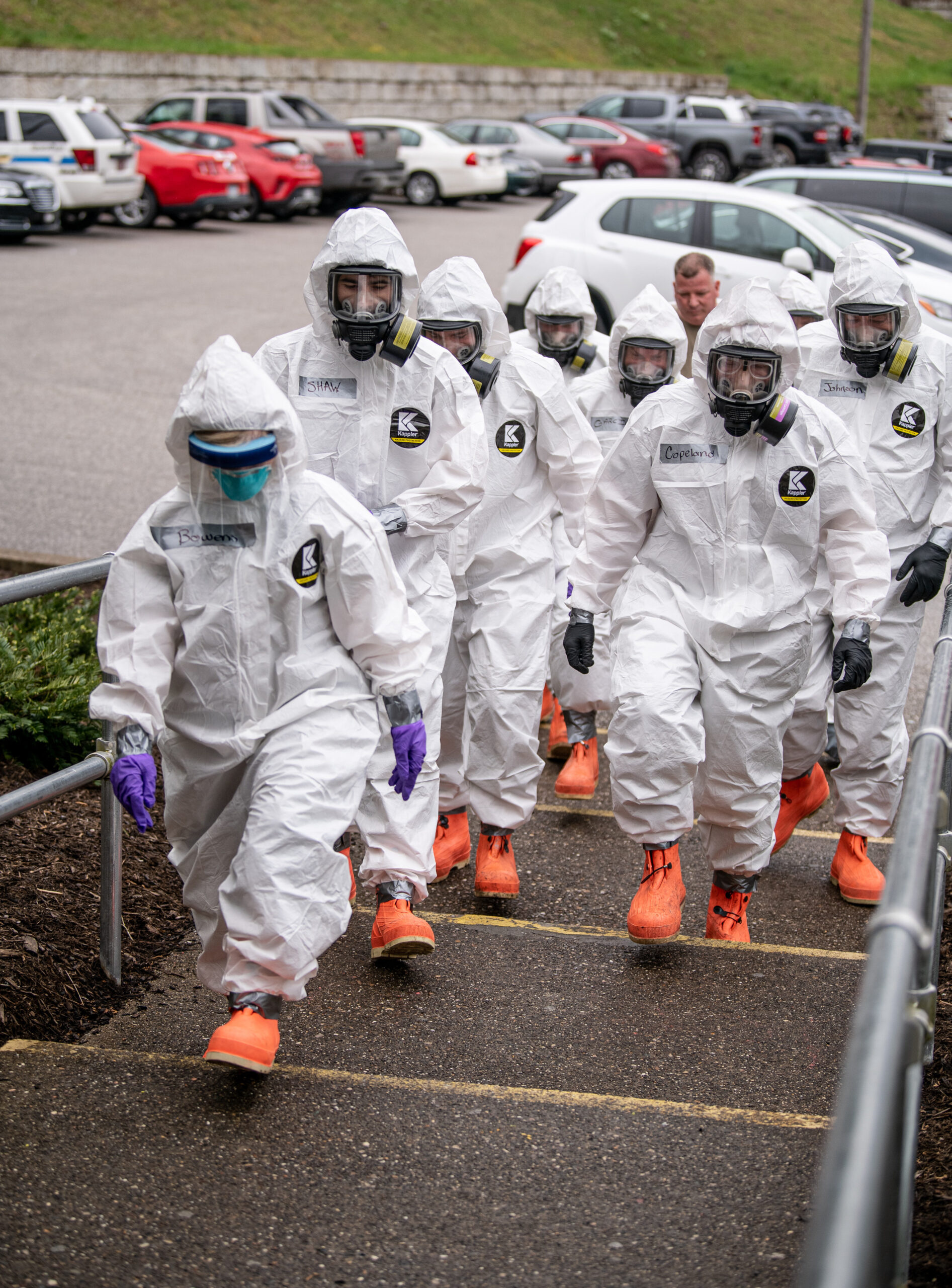
West Virginia National Guard members reporting to a Charleston nursing home to assist with Covid-19 testing. April 6, 2020. (U.S. Army National Guard, Edwin L. Wriston)

The game ahead for the elites, taking advantage of the crisis, might well contain these four elements: a social credit system, mandatory vaccination, a digital currency and a Universal Basic Income (UBI). This is what used to be called, according to the decades-old, time-tested CIA playbook, a “conspiracy theory.” Well, it might actually happen.
A social credit system is something that China set up already in 2014. Before the end of 2020, every Chinese citizen will be assigned his/her own credit score – a de facto “dynamic profile”, elaborated with extensive use of AI and the internet of things (IoT), including ubiquitous facial recognition technology. This implies, of course, 24/7 surveillance, complete with Blade Runner-style roving robotic birds.
The U.S., the U.K., France, Germany, Canada, Russia and India may not be far behind. Germany, for instance, is tweaking its universal credit rating system, SCHUFA. France has an ID app very similar to the Chinese model, verified by facial recognition.
Mandatory vaccination is Bill Gates’s dream, working in conjunction with the WHO, the World Economic Forum (WEF) and Big Pharma. He wants “billions of doses” to be enforced over the Global South. And it could be a cover to everyone getting a digital implant.
Here it is, in his own words. At 34:15: “Eventually what we’ll have to have is certificates of who’s a recovered person, who’s a vaccinated person…Because you don’t want people moving around the world where you’ll have some countries that won’t have it under control, sadly. You don’t want to completely block off the ability for people to go there and come back and move around.”
Then comes the last sentence which was erased from the official TED video. This was noted by Rosemary Frei, who has a master on molecular biology and is an independent investigative journalist in Canada. Gates says: “So eventually there will be this digital immunity proof that will help facilitate the global reopening up.”
This “digital immunity proof” is crucial to keep in mind, something that could be misused by the state for nefarious purposes.
The three top candidates to produce a coronavirus vaccine are American biotech firm Moderna, as well as Germans CureVac and BioNTech.
Digital cash might then become an offspring of blockchain. Not only the U.S., but China and Russia are also interested in a national crypto-currency. A global currency – of course controlled by central bankers – may soon be adopted in the form of a basket of currencies, and would circulate virtually. Endless permutations of the toxic cocktail of IoT, blockchain technology and the social credit system could loom ahead.
Already Spain has announced that it is introducing UBI, and wants it to be permanent. It’s a form insurance for the elite against social uprisings, especially if millions of jobs never come back.
So the key working hypothesis is that Covid-19 could be used as cover for the usual suspects to bring in a new digital financial system and a mandatory vaccine with a “digital identity” nanochip with dissent not tolerated: what Slavoj Zizek calls the “erotic dream” of every totalitarian government.
Yet underneath it all, amid so much anxiety, a pent-up rage seems to be gathering strength, to eventually explode in unforeseeable ways. As much as the system may be changing at breakneck speed, there’s no guarantee even the 0.1 percent will be safe. 
Pepe Escobar, a veteran Brazilian journalist, is the correspondent-at-large for Hong Kong-based Asia Times. His latest book is “2030.” Follow him on Facebook.
The views expressed are solely those of the author and may or may not reflect those of Consortium News.

River to Sea Uprooted Palestinian   
The views expressed in this article are the sole responsibility of the author and do not necessarily reflect those of the Blog!

Sunday, 5 April 2020

Ground Control to Planet Lockdown: This Is Only a Test

Pepe Escobar
April 2, 2020
Ground Control to Planet Lockdown: This Is Only a Test - Global ...
As much as Covid-19 is a circuit breaker, a time bomb and an actual weapon of mass destruction (WMD), a fierce debate is raging worldwide on the wisdom of mass quarantine applied to entire cities, states and nations.
Those against it argue Planet Lockdown not only is not stopping the spread of Covid-19 but also has landed the global economy into a cryogenic state – with unforeseen, dire consequences. Thus quarantine should apply essentially to the population with the greatest risk of death: the elderly.
With Planet Lockdown transfixed by heart-breaking reports from the Covid-19 frontline, there’s no question this is an incendiary assertion.
In parallel, a total corporate media takeover is implying that if the numbers do not substantially go down, Planet Lockdown – an euphemism for house arrest – remains, indefinitely.
Michael Levitt, 2013 Nobel Prize in chemistry and Stanford biophysicist, was spot on when he calculated that China would get through the worst of Covid-19 way before throngs of health experts believed, and that “What we need is to control the panic”.
Let’s cross this over with some facts and dissident opinion, in the interest of fostering an informed debate.
The report Covid-19 – Navigating the Uncharted was co-authored by Dr. Anthony Fauci – the White House face of the fight –, H. Clifford Lane, and CDC director Robert R. Redfield. So it comes from the heart of the U.S. healthcare establishment.
The report explicitly states, “the overall clinical consequences of Covid-19 may ultimately be more akin to those of a severe seasonal influenza (which has a case fatality rate of approximately 0.1%) or a pandemic influenza (similar to those in 1957 and 1968) rather than a disease similar to SARS or MERS, which have had case fatality rates of 9 to 10% and 36%, respectively.”
On March 19, four days before Downing Street ordered the British lockdown, Covid-19 was downgraded from the status of “High Consequence Infectious Disease.”
John Lee, recently retired professor of pathology and former NHS consultant pathologist, has recently argued that, “the world’s 18,944 coronavirus deaths represent 0.14 per cent of the total. These figures might shoot up but they are, right now, lower than other infectious diseases that we live with (such as flu).”
He recommends, “a degree of social distancing should be maintained for a while, especially for the elderly and the immune-suppressed. But when drastic measures are introduced, they should be based on clear evidence. In the case of Covid-19, the evidence is not clear.”
That’s essentially the same point developed by a Russian military intel analyst.
No less than 22 scientists – see here and here – have expanded on their doubts about the Western strategy.
Dr. Sucharit Bhakdi, Professor Emeritus of Medical Microbiology at the Johannes Gutenberg University in Mainz, has provoked immense controversy with his open letter to Chancellor Merkel, stressing the “truly unforeseeable consequences of the drastic containment measures which are currently being applied in large parts of Europe.”
Even New York governor Andrew Cuomo admitted on the record about the error of quarantining elderly people with illnesses alongside the fit young population.
The absolutely key issue is how the West was caught completely unprepared for the spread of Covid-19 – even after being provided a head start of two months by China, and having the time to study different successful strategies applied across Asia.
There are no secrets for the success of the South Korean model.
South Korea was producing test kits already in early January, and by March was testing 100,000 people a day, after establishing strict control of the whole population – to Western cries of “no protection of private life”. That was before the West embarked on Planet Lockdown mode.
South Korea was all about testing early, often and safely – in tandem with quick, thorough contact tracing, isolation and surveillance.
Covid-19 carriers are monitored with the help of video-surveillance cameras, credit card purchases, smartphone records. Add to it SMS sent to everyone when a new case is detected near them or their place of work. Those in self-isolation need an app to be constantly monitored; non-compliance means a fine to the equivalent of $2,800.
Controlled demolition in effect
In early March, the Chinese Journal of Infectious Diseases, hosted by the Shanghai Medical Association, pre-published an Expert Consensus on Comprehensive Treatment of Coronavirus in Shanghai. Treatment recommendations included, “large doses of vitamin C…injected intravenously at a dose of 100 to 200 mg / kg per day. The duration of continuous use is to significantly improve the oxygenation index.”
That’s the reason why 50 tons of Vitamin C was shipped to Hubei province in early February. It’s a stark example of a simple “mitigation” solution capable of minimizing economic catastrophe.
In contrast, it’s as if the brutally fast Chinese “people’s war” counterpunch against Covid-19 had caught Washington totally unprepared. Steady intel rumbles on the Chinese net point to Beijing having already studied all plausible leads towards the origin of the Sars-Cov-2 virus – vital information that will be certainly weaponized, Sun Tzu style, at the right time.
As it stands, the sustainability of the complex Eurasian integration project has not been substantially compromised. As the EU has provided the whole planet with a graphic demonstration of its cluelessness and helplessness, everyday the Russia-China strategic partnership gets stronger – increasingly investing in soft power and advancing a pan-Eurasia dialogue which includes, crucially, medical help.
Facing this process, the EU’s top diplomat, Joseph Borrell, sounds indeed so helpless: “There is a global battle of narratives going on in which timing is a crucial factor. […] China has brought down local new infections to single figures – and it is now sending equipment and doctors to Europe, as others do as well. China is aggressively pushing the message that, unlike the U.S., it is a responsible and reliable partner. In the battle of narratives we have also seen attempts to discredit the EU (…) We must be aware there is a geo-political component including a struggle for influence through spinning and the ‘politics of generosity’. Armed with facts, we need to defend Europe against its detractors.”
That takes us to really explosive territory. A critique of the Planet Lockdown strategy inevitably raises serious questions pointing to a controlled demolition of the global economy. What is already in stark effect are myriad declinations of martial law, severe social media policing in Ministry of Truth mode, and the return of strict border controls.
These are unequivocal markings of a massive social re-engineering project, complete with inbuilt full monitoring, population control and social distancing promoted as the new normal.
That would be taking to the limit Secretary of State Mike “we lie, we cheat, we steal” Pompeo’s assertion, on the record, that Covid-19 is a live military exercise: “This matter is going forward — we are in a live exercise here to get this right.”
All hail BlackRock
So as we face a New Great Depression, steps leading to a Brave New World are already discernable. It goes way beyond a mere Bretton Woods 2.0, in the manner that Pam and Russ Martens superbly deconstruct the recent $2 trillion, Capitol Hill-approved stimulus to the U.S. economy.
Essentially, the Fed will “leverage the bill’s $454 million bailout slush fund into $4.5 trillion”. And no questions are allowed on who gets the money, because the bill simply cancels the Freedom of Information Act (FOIA) for the Fed.
The privileged private contractor for the slush fund is none other than BlackRock. Here’s the extremely short version of the whole, astonishing scheme, masterfully detailed here.
Wall Street has turned the Fed into a hedge fund. The Fed is going to own at least two thirds of all U.S. Treasury bills wallowing in the market before the end of the year.
The U.S. Treasury will be buying every security and loan in sight while the Fed will be the banker – financing the whole scheme.
So essentially this is a Fed/ Treasury merger. A behemoth dispensing loads of helicopter money – with BlackRock as the undisputable winner.
BlackRock is widely known as the biggest money manager on the planet. Their tentacles are everywhere. They own 5% of Apple, 5% of Exxon Mobil, 6% of Google, second largest shareholder of AT&T (Turner, HBO, CNN, Warner Brothers) – these are just a few examples.
They will buy all these securities and manage those dodgy special Purpose Vehicles (SPVs) on behalf of the Treasury.
BlackRock not only is the top investor in Goldman Sachs. Better yet: Blackrock is bigger than Goldman Sachs, JP Morgan and Deutsche Bank combined. BlackRock is a serious Trump donor. Now, for all practical purposes, it will be the operating system – the Chrome, Firefox, Safari – of Fed/Treasury.
This represents the definitive Wall Street-ization of the Fed – with no evidence whatsoever it will lead to any improvement in the lives of the average American.
Western corporate media, en masse, have virtually ignored the myriad, devastating economic consequences of Planet Lockdown. Wall to wall coverage barely mentions the astonishing economic human wreckage already in effect – especially for the masses barely surviving, so far, in the informal economy.
For all practical purposes, the Global War on Terror (GWOT) has been replaced by the Global War on Virus (GWOV). But what is not being seriously analyzed is the Perfect Toxic Storm: a totally shattered economy; The Mother of All Financial Crashes – barely masked by the trillions in helicopter money from the Fed and the ECB; the tens of millions of unemployed engendered by the New Great Depression; the millions of small businesses that will simply disappear; a widespread, global mental health crisis. Not to mention the masses of elderly, especially in the U.S., that will be issued an unspoken “drop dead” notice.
Beyond any rhetoric about “decoupling”, the global economy is already, de facto, split in two. On one side, we have Eurasia, Africa and swathes of Latin America – what China will be painstakingly connecting and reconnecting via the New Silk Roads. On the other side, we have North America and selected Western vassals. A puzzled Europe lies in the middle.
A cryogenically induced global economy certainly facilitates a reboot. Trumpism is the New Exceptionalism – so that means an isolationist MAGA on steroids. In contrast, China will painstakingly reboot its market base along the New Silk Roads – Africa and Latin America included – to replace the 20% of trade/exports to be lost with the U.S.
The meager $1,200 checks promised to Americans are a de facto precursor of the much touted Universal Basic Income (UBI). They may become permanent as tens of millions of people will be permanently unemployed. That will facilitate the transition towards a totally automated, 24/7 economy run by AI – thus the importance of 5G.
And that’s where ID2020 comes in.
AI and ID2020
The European Commission is involved in a crucial but virtually unknown project, CREMA (Cloud Based Rapid Elastic Manufacturing) which aims to facilitate the widest possible implementation of AI in conjunction to the advent of a cashless One-World system.
The end of cash necessarily implies a One-World government capable of dispensing – and controlling – UBI; a de facto full accomplishment of Foucault’s studies on biopolitics. Anyone is liable to be erased from the system if an algorithm equals this individual with dissent.
It gets even sexier when absolute social control is promoted as an innocent vaccine.
ID2020 is self-described as a benign alliance of “public-private partners”. Essentially, it is an electronic ID platform based on generalized vaccination. And its starts at birth; newborns will be provided with a “portable and persistent biometrically-linked digital identity.”
GAVI, the Global Alliance for Vaccines and Immunization, pledges to “protect people’s health “ and provide “immunization for all”. Top partners and sponsors, apart from the WHO, include, predictably, Big Pharma.
At the ID2020 Alliance summit last September in New York, it was decided that the “Rising to the Good ID Challenge” program would be launched in 2020. That was confirmed by the World Economic Forum (WEF) this past January in Davos. The digital identity will be tested with the government of Bangladesh.
That poses a serious question: was ID2020 timed to coincide with what a crucial sponsor, the WHO, qualified as a pandemic? Or was a pandemic absolutely crucial to justify the launch of ID2020?
As game-changing trial runs go, nothing of course beats Event 201, which took place less than a month after ID2020.
The Johns Hopkins Center for Health Security in partnership with, once again, the WEF, as well as the Bill and Melinda Gates Foundation, described Event 201 as “a high-level pandemic exercise”. The exercise “illustrated areas where public/private partnerships will be necessary during the response to a severe pandemic in order to diminish large-scale economic and societal consequences.”
With Covid-19 in effect as a pandemic, the Johns Hopkins Bloomberg School of Public Health was forced to issue a statement basically saying they just “modeled a fictional coronavirus pandemic, but we explicitly stated that it was not a prediction”.
There’s no question “a severe pandemic, which becomes ‘Event 201’ would require reliable cooperation among several industries, national governments, and key international institutions”, as spun by the sponsors. Covid-19 is eliciting exactly this kind of “cooperation”. Whether it’s “reliable” is open to endless debate.
The fact is that, all over Planet Lockdown, a groundswell of public opinion is leaning towards defining the current state of affairs as a global psyop: a deliberate global meltdown – the New Great Depression – imposed on unsuspecting citizens by design.
The powers that be, taking their cue from the tried and tested, decades-old CIA playbook, of course are breathlessly calling it a “conspiracy theory”. Yet what vast swathes of global public opinion observe is a – dangerous – virus being used as cover for the advent of a new, digital financial system, complete with a forced vaccine cum nanochip creating a full, individual, digital identity.
The most plausible scenario for our immediate future reads like clusters of smart cities linked by AI, with people monitored full time and duly micro-chipped doing what they need with a unified digital currency, in an atmosphere of Bentham’s and Foucault’s Panopticum on overdrive.
So if this is really our future, the existing world-system has to go. This is a test, this is only a test.

River to Sea Uprooted Palestinian   
The views expressed in this article are the sole responsibility of the author and do not necessarily reflect those of the Blog!