Showing posts with label Journalism. Show all posts

Sunday, 4 July 2021

Lost in a Roman wilderness of pain: In praise of James Douglas Morrison, 20th century poet, dead at 27 half a century ago

 July 03, 2021

By Pepe Escobar, exclusively for the Saker Blog

He was like Blake’s tiger, always burning bright and chasing Rimbaud rainbows – just to finish, like Marat, in a bathtub. He was only 27.

Jim Morrison died on July 3, 1971 in Paris. Half a century later, The Collected Works of Jim Morrison: Poetry, Journals, Transcripts, and Lyrics lavishly celebrates the soul of the poet.

Before he died, Jim had self-published three limited editions of his poetry: The Lords/Notes on Vision (1969), The New Creatures (1969), and An American Prayer (1970).

Now, finally, we may have access to his complete writings, including the screenplay for his 50-minute experimental film, HWY, shot in Godard’s cinema verité style in the spring and summer of 1969 in L.A. and the Mojave desert, with Jim playing a hitchhiker. Old-school petrol heads will savor Jim on the wheel of his 1967 Shelby GT 500 Mustang in this HD clip from a film inspired by HWY.

The Collected Works feel like a collar of magic jade fragments, complete with handwritten pages in notebooks, crossed out words, underlines, the whole perhaps similar to the ‘Plan for Book’ Jim once sketched.

The overwhelming majority of us baby boomers belong to the “die young, stay pretty, leave a beautiful corpse” generation. Following our own road maps, prone to trial and error, we did live all the roads of excess; but unlike Blake’s dictum, we may not have reached the palace of wisdom. We never cease to be amazed that unlike Morrison, Hendrix, Joplin, Otis Redding, we are survivors at best.

For so many of us then in our teens, from 1967 to 1971 the Doors were impregnated in our body and soul. Jim was the psychedelic Dyonisus, his excessive alter egos – Lizard King, Mr. Mojo Risin’- propelling him over and over again towards the next ride in the infinite highway.

Before he metastasized into instant legend, Jim was what Hunter Thompson would immortalize in Fear and Loathing in Las Vegas, which came out in 1971: “A man on the move, and just sick enough, to be totally confident”.

Now the poetry oozing out of the freestyle soundscapes weaved by Krieger, Densmore and Manzarek, or HWY as a sort of prelude to L.A. Woman (“cops and cars / the topless bars / never saw a woman / so alone”) may be relieved as a prequel to what was about to vanish, poignantly evoked by Thomas Pynchon in Inherent Vice, the Greatest Hippie Detective Novel – or Raymond Chandler on LSD:

The Psychedelic Sixties, this little parenthesis of light, might close after all, and all be lost, taken back into darkness… how a certain hand might reach terribly out of darkness, and reclaim the time, easy as taking a joint from a doper and stubbing it out for good.

And all the children are insane

Any Top Ten list of 20th Century Poetry in the Anglo-American sphere would necessarily include Yeats’s The Second Coming, Eliot’s

The Waste Land and Pound’s Cantos. From the mid-century beats, comes Ginsberg’s Howl. Afterwards it’s Dylan land – from

Ballad of a Thin Man, Desolation Row and Visions of Johanna to the total dilaceration in Blood on the Tracks (Tangled Up in Blue, Simple Twist of Fate).

And then, there’s Jim Morrison’s The End – the closing track of

The Doors, recorded in August 66, released in January 1967, six months before the Summer of Love.

It was my dear friend Quantum Bird – not even born when Morrison died – who led me to a re-appreciation of The End in the Western canon, prompted by a Morrison epigraph I used in a column on NATO.

Striking images emerge like rocks out of the Morrison river, like “the streets are fields that never die”, in The Crystal Ship, or “speak in secret alphabets”, in Soul Kitchen.

Strange Days could not be more contemporary: “Strange days have found us / strange days have tracked us down / they’re going to destroy / our casual joys / we shall go on playing / or find a new town”.

Yet we could only guess what shore Morrison’s Crystal Ship was heading for, the words – “be-fore / you / slip / in-to / un-consciousness” – coiling like a snake, barely whispered. The journey could be anything: Chandler’s Big Sleep, an overdose of heroin, a ghastly murder, suicide, even a suicide pact.

Morrison was usually Blake on steroids, rewriting “some are born to sweet delight / some are born to endless night” in his own way. The End is a journey through the corridors of the endless night (“the killer awoke before dawn / he put his boots on / he took a face from the ancient gallery / and he walked on down the hall”). No wonder Coppola carefully chose it for the opening of Apocalypse Now – or Conrad’s Heart of Darkness set in Vietnam, where the Empire was lost “in a Roman wilderness of pain / and all the children are insane”.

Ride the snake

In 1966, when he wrote The End, two years before the assassination of Dr. Martin Luther King and Bobby Kennedy, it’s as if Morrison had already intuited that as a poet laboring at the apex of Empire, life would become necessarily unbearable.

LSD + Rimbaud + insights in Navajo land only amplified his aesthetic and philosophical illuminations. The End includes references to “every element of systemic collapse”, as Quantum Bird remarked, from imperial arrogance to cultural collapse, from wokeism to loss of control of the empire’s own internal space, from dystopic propaganda to the sense of total bewilderment facing a dying ethos. Woke soldiers are about to be reprogrammed as serial killers.

Morrison had his vision way before the Summer of Love, way before Woodstock (summer of 1969), way before the Stones at Altamont (winter of 1969) – the official end of peace and love.

When the Empire collapses “in a desperate land” – look at the tawdry, farcical Afghanistan remix, happening right now – there’s “no safety or surprise”. It’s “the end of laughter and soft lies / the end of nights we tried to die.”

The end of everything that stands.

I’ll leave you now mentally riding a Mustang in the desert, down on the infinite highway and – in geopolitical synchronicity – riding the snake.

Julian Assange – held under psychological torture in Belmarsh by the lords of the Empire for the crime of committing journalism – is 50 years old today.  Julian Assange was born the day Jim Morrison died.

Dance on fire. If you dare.


River to Sea Uprooted Palestinian   
The views expressed in this article are the sole responsibility of the author and do not necessarily reflect those of the Blog!

Saturday, 3 July 2021

Palestinian women journalists speak out against ‘deliberate’ attacks by PA forces

 Palestinian Authority forces have violently assaulted women reporting on protests in Ramallah

A recent protest in Ramallah, where Palestinian Authority forces have been targeting women journalists including Najlaa Zaitoun, photographed here (Supplied)

By Aziza Nofal in RamallahPublished date: 2 July 2021 14:49 UTC | Last update: 2 days 1 hour ago

For several days now, Palestinian journalist Najlaa Zaitoun has been trying to convince her children, 11-year-old Haytham and 8-year-old Zein, to leave the house. 

‘A person wearing plain clothes threatened me, to my face, that he would rape me, and then defame my reputation’

– Najlaa Zaitoun, journalist

“I’m afraid the person who beat you will come and beat me,” Zein said to her, as she urged them to keep up their training at the sports club they usually go to every day. 

On 26 June, the 35-year-old was assaulted by plainclothes security forces while she was covering protests called following the death of popular Palestinian activist Nizar Banat while in Palestinian Security Forces custody two days earlier. 

The security forces chased Zaitoun, seized her phone, which she was using to film the protest, and violently attacked her with a truncheon. She was also threatened with rape.

“A person wearing plain clothes threatened me, to my face, that he would rape me, and then defame my reputation,” she tells Middle East Eye.

Palestinian female journalists attacked by PA forces
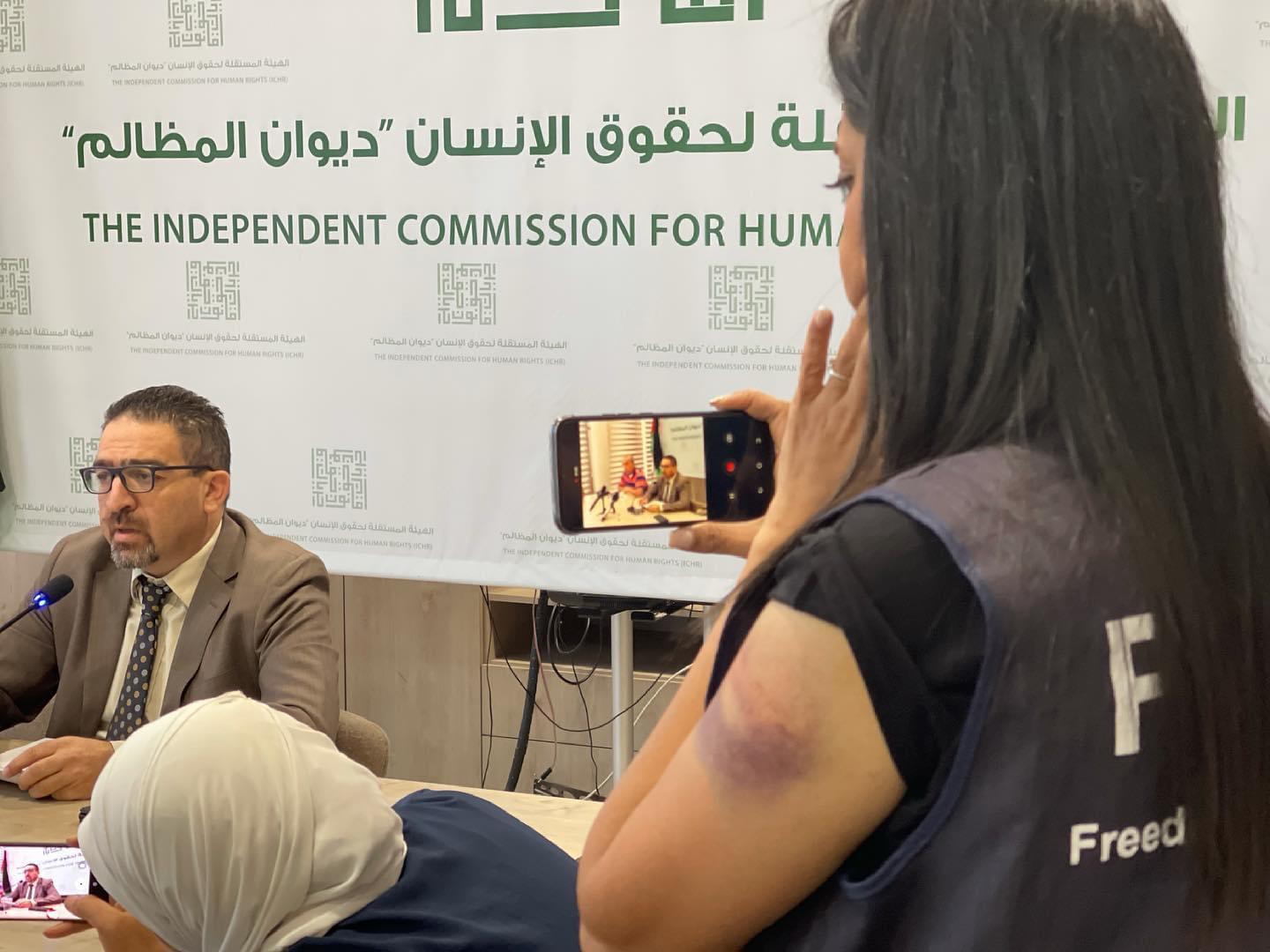
Bruises Najlaa Zaitoun sustained while covering the protests can be seen on her arm (Supplied)

Zaitoun has been living in a state of fear ever since and the violent beating she received has left visible marks on her body.

“I don’t feel safe, not even in my own home,” she says. Since the attack, Zaitoun has been staying at her parents’ house. 

Meanwhile, the assault on the journalist has moved online, with a smear campaign targeting her on social media accounts affiliated with the Palestinian Authority (PA) and accusing her of being the “one who attacked the security forces.” 

Targeted attacks

The attack on Zaitoun is one of several instances of violence against women journalists in the course of their work covering the protests. The incidents indicate that Palestinian security forces are specifically targeting women journalists, as reflected in the escalating levels of hostility and violence towars them compared to their male counterparts.

Attacks on women journalists have included physical violence, as was the case with Zaitoun and four others; confiscation of electronic devices used to cover the events; intimidation and harassment; chasing journalists in the street; arrest attempts and a ban on reporting. 

The assaults have continued even after the protests were over, with many female journalists receiving veiled threats that they will be discredited and defamed.

Saja al-Alamy is one of those attacked while reporting on the protests. On 24 June, Alamy was subjected to several attempts by security forces to prevent her from doing her job, and had to show her Palestinian Journalists Syndicate membership card each time. 


Palestinian female journalists attacked by PA forces

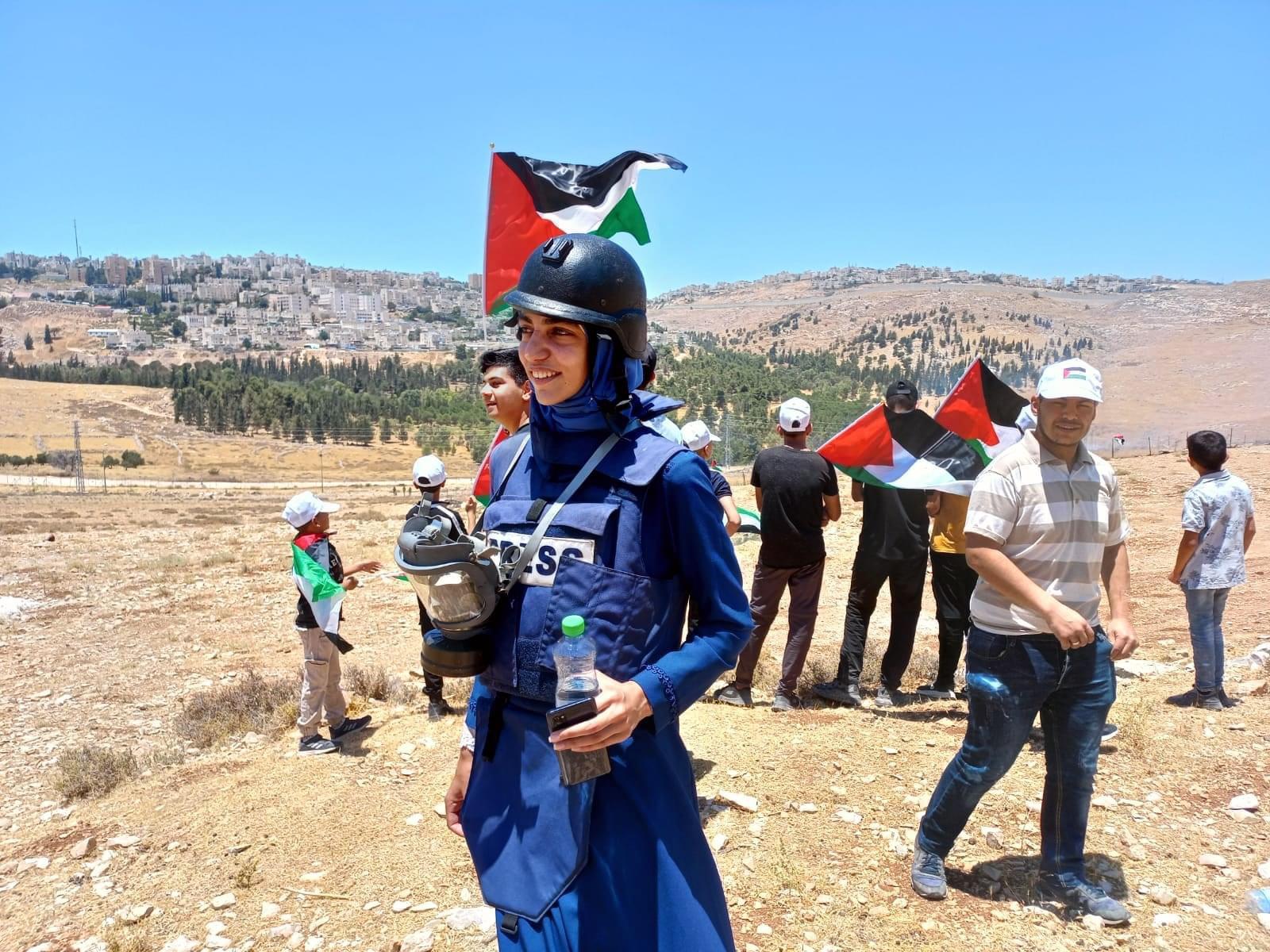
‘My press armour helped the perpetrators to identify me as a journalist, and attack me’, Saja Alamy says (Supplied)

Two days later, expecting journalist to go on being obstructed, Alamy wore her bulletproof press body armour and affixed her press card on the back of her phone, which she was using to film the events. 

None of this stopped her from being attacked. Instead, she believes the measures did her more harm than good.

“My press armour helped the perpetrators to identify me as a journalist, and attack me,” she says, adding that she was only able to escape the scene after she had taken off her press vest and concealed her identity as a journalist.

“There was a direct attack on us. One of the security officers in plainclothes was pointing at my female journalist colleague and me, asking his partner to take a photo of us so that he can identify us later,” she says.

Security forces had first attacked a group of journalists, including Alamy, with tear gas, but upon noticing her filming an attack on protesters, she was directly targeted. Alamy resisted the officers’ violent attempt to confiscate her phone, and refused to hand it over. She then managed to flee the scene to a nearby building and hide in a women’s toilet.

Alamy tried for more than an hour to reach her colleagues for help, but all entrances were being watched by security officers, including those who had chased her. She was eventually able to escape, after shedding her press armour, and pretended to be out shopping.

Life threatening

MEE reporter Shatha Hammad was also among the women journalists who were targeted in the attacks of 26 June.

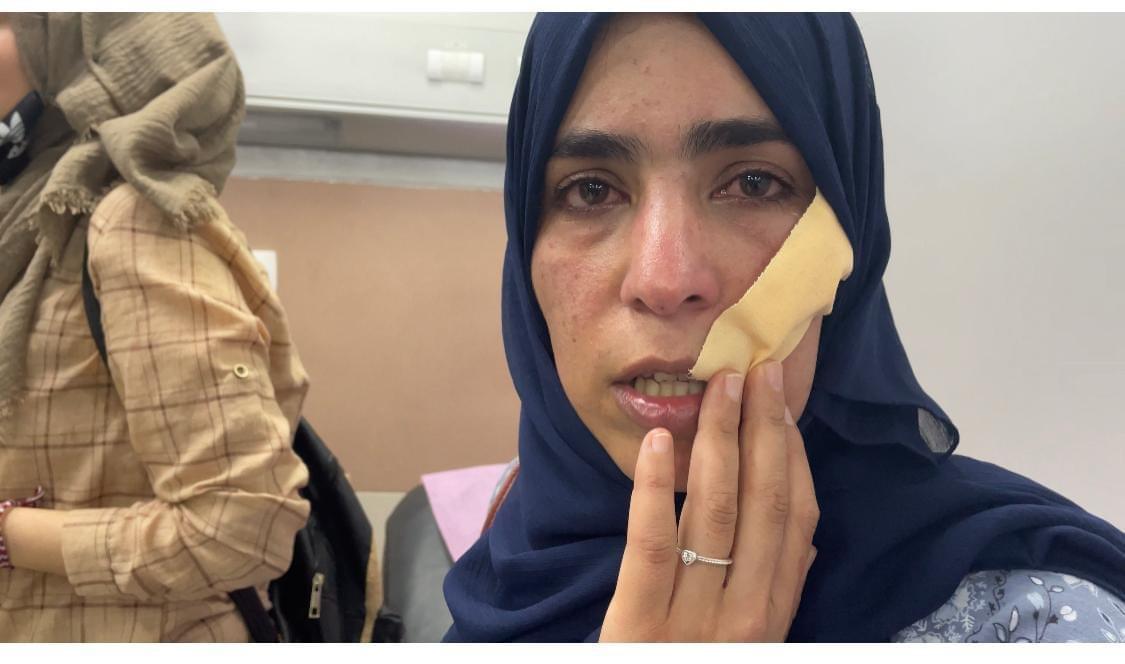
She sustained a shrapnel wound to her face from a tear gas canister that a security officer shot directly at her after failing to confiscate her phone. 

Hammad says that security officers in plainclothes had focused their attention on women reporters, singling them out by pointing at them, even before the clashes erupted, which, she believes, suggests that the assault was planned and deliberate.

According to Hammad, the unprecedented violence against women journalists made her feel insecure and trapped.

“What happened is life threatening,” she says, demanding immediate action from local and international organisations to provide the necessary protection for them.


Palestinian female journalists attacked by PA forces
Shatha Hammad sustained wounds to face after being directly targeted with a tear gas cannister 

The detailed testimonies of women journalists were shocking to many, especially the Palestinian Authority’s use of cultural norms to shame and intimidate women, exercising social pressure against them as an attempt to silence and prevent them from performing their work. 

According to Ghazi Bani Odeh, head of the monitoring and documentation unit at the Palestinian Centre for Development and Media Freedoms (Mada), these exponential attacks against women journalists are unprecedented and planned. 

“The assaults on female journalists have two levels. The first is the direct physical violence in the streets; then comes the online attacks designed to incite people to exert social pressure on them,” Bani Odeh tells MEE, in reference to the smear campaigns that use hate speech that could fuel violence against them. 

Smear campaigns

One of the journalists targeted by a defamation campaign was Fayhaa Khanfar, who was beaten up in the street on 26 June, with her phone stolen from her as she covered the protest.

‘When I regained consciousness, I went to security officers crying and asking for help. But no one moved a muscle’

– Fayhaa Khanfar, journalist

Security officers in plain clothes had chased Khanfar to confiscate her device and knocked her to the ground, causing her to briefly lose consciousness. 

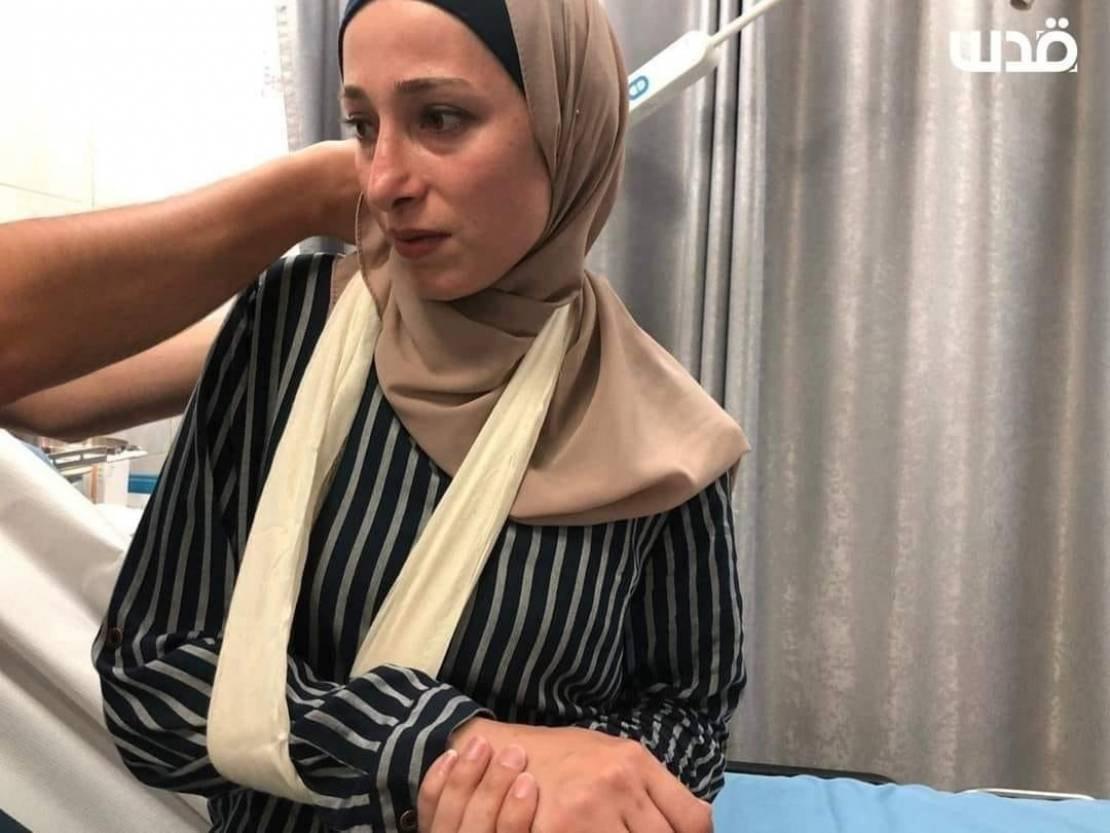
No one had intervened to help her. The attack resulted in a hairline fracture to her shoulder and bruises all over her body.

“I was attacked by security officers wearing plain clothes. They pushed me to the ground and stole my phone,” Khanfar tells MEE.

“When I regained consciousness, I went to security officers crying and asking for help. But no one moved a muscle.”

Orchestrated online attacks targeted Khanfar, who wears the hijab, aimed to discredit her in a conservative society by circulating images of a girl in beachwear, who looks very similar to Khanfar, and falsely identifying her as the journalist.

Khanfar was later summoned for interrogation at the intelligence headquarters in Ramallah, in the occupied West Bank, and told that she had to appear if she wanted to collect her phone, a move she considered an attempt to lure her in and arrest her.

Wafa Abdulrahman, the director of Filistiniat, a civil society organisation, sees the attacks on journalists as a chilling attempt to silence the women who have been spearheading the protests. 


Palestinian female journalists attacked by PA forces
Fayhaa Khanfar suffered a hairline fracture to her shoulder and bruises all over her body (Supplied)

Abdulrahman says that the systematic targeting of women journalists is intended to first send them a threatening message, and second, to warn the society that women reporters will not be spared and that the power of the security forces is unbreakable. 

As attacks on women journalists continue through online defamation campaigns and veiled threats, they find themselves living in constant danger and feeling personally insecure. 

According to Majid Arori, a media freedom activist and a human rights specialist, there has to be individual and collective legal actions to deter such attacks in the future. 

“The attacked women journalists must file legal complaints, providing the necessary documentation via local and international legal organisations to exert pressure on those who perpetrated the assaults,” he says, adding that these attacks are attempts to suppress critical voices and any protests against corruption. 


River to Sea Uprooted Palestinian   
The views expressed in this article are the sole responsibility of the author and do not necessarily reflect those of the Blog!

Thursday, 1 July 2021

Canada’s government is seeking to silence Canadian journalists at home and abroad with a draconian censorship bill

moi


Eva Bartlett

RT.com

As a Canadian journalist, I could be subject to a censorship bill which, if passed in Senate, means the government in Canada can effectively shadow-ban and censor my voice into oblivion, along with other dissenting voices.

After seeing his tweet on the issue of Bill C-10, recently passed in the House of Commons, I spoke with Canadian journalist Dan Dicks about this. He explained that the bill is being presented as being about Canada bringing Big Tech companies under the regulation of the CRTC (Canadian Radio-television and Telecommunications Commission), to have them display more Canadian content.

“But what people are missing,” he cautioned, “is that there were clauses put into this bill, protections for certain publishers and content creators that would protect people like myself and yourself.”

Those clauses, he said, were recently removed from the bill, leading many content-creating Canadians aware of the bill to worry they will be treated the same as a broadcaster or a programmer, subject to the regulations of the CRTC.

The bottom line is that, beyond the mumbo jumbo of the government, this is the latest attack on freedom of expression, and on dissent. 

“It really appears that it’s a backdoor to be able to control the free flow of information online, and to begin to silence voices that go against the status quo,” Dicks said, warning that fines for violators could follow.

“It’s not looking good for individual content creators. Anybody who has any kind of a voice or a significant audience, where they have the ability to affect the minds of the masses, to reach millions of people, they are going to be the ones who are on the chopping block moving forward.”

Names like James Corbett come to mind. Although based in Japan, as a Canadian he would be subject to the bill. And with his very harsh criticisms of many issues pertaining to the Canadian government, he is a thorn they would surely be happy to remove under the pretext of this bill.

Or Dicks, who likewise creates videos often critiquing Canadian government actions.

Or researcher Cory Morningstar, authors Maximilian Forte, Mark Taliano, Yves Engler, or outspoken physicist Denis Rancourt, to name a handful of dissenting voices. Agree or not with their opinions, they have the right to voice them.

Or myself. I’ve been very critical of Canada’s Covid policies and hypocrisy, as well as Canada’s whitewashing of terrorism in Syria, support to neo-Nazis in Ukraine, and unwavering support for Israel which is systematically murdering, starving, and imprisoning Palestinian civilians–including children.

An article on the Law & Liberty website, which describes itself as focussing on “the classical liberal tradition of law and how it shapes a society of free and responsible persons,” notes the bill enables “ample discretion to filter out content made by Canadians that doesn’t carry a desirable ideological posture and [to] prioritize content that does.”

The article emphasizes that the bill violates Canadians’ right to free expression, as well as “the right to express oneself through artistic and political creations, and the right to not be unfairly suppressed by a nebulous government algorithm.”

It noted that Canadians with large followings, like Jordan Peterson, Gad Saad and Steven Crowder, “each enjoy audiences which far exceed any cable television program.”

As with my examples above, these prominent Canadian voices likewise risk shadow-banning under this bill.

But, worse, there is another bill, C-36, that also portends heavy censorship: the “Reducing Online Harms” bill. This one not only involves censorship, but hefty fines and house arrests for violators

The same  Law & Liberty article notes, “Canada is also expected to follow the template of Germany’s NetzDG law, which mandates that platforms take down posts that are determined to constitute hate speech—which requires no actual demonstrated discrimination or potential harm, and is thus mostly subjective—within 24 hours or to face hefty fines. This obviously will incentivize platforms to remove content liberally and avoid paying up.”

The Canadian Constitution Foundation (CCF), rightly, contests this bill, noting, “the proposed definition of hate speech as speech that is ‘likely’ to foment detestation or vilification is vague and subjective.” 

Maxime Bernier, leader of the People’s Party of Canada, is likewise extremely critical of the bills.

Trudeau has made every issue about race, gender and religion since his election. Now he wants to criminalize everyone who disagrees with his tribalist vision.C-36 is the worst attack ever against free speech in Canada.https://t.co/6Z5EefmviP— Maxime Bernier (@MaximeBernier) June 25, 2021

The CCF points out the potential complete loss of Canadians’ fundamental rights with these bills.

It should be common sense that these bills are extremely dangerous to Canadians, however cloaked in talk of levelling playing fields and of combating hate speech they may be.


River to Sea Uprooted Palestinian   
The views expressed in this article are the sole responsibility of the author and do not necessarily reflect those of the Blog!

Wednesday, 30 June 2021

Kinzer: “The great curse of our press in the West is willingness to accept the official narrative. So many people in the American press who write about the world are merely stenographers.”

moi

 EVA BARTLETT

Here is the video interview I did with award winning journalist & author Stephen Kinzer.

My article on it was published yesterday.


River to Sea Uprooted Palestinian   
The views expressed in this article are the sole responsibility of the author and do not necessarily reflect those of the Blog!

Tuesday, 29 June 2021

‘Many US commentators have never BEEN to countries they comment on, see entire world from Washington perspective’ – Stephen Kinzer

moi

June 27, 2021, RT.com

-by Eva K Bartlett

Much of Western media is a mixture of sensationalist accusations and fear mongering about ‘enemy’ states. It is difficult to find perspectives divorced from US foreign policy, American journalist Stephen Kinzer has told RT.

I asked the author and journalist Stephen Kinzer how the corporate media came to be so devoid of honest content and discussed the rise of censorship by Big Tech.

Kinzer is a Boston Globe columnist and formerly a correspondent for the New York Times. With over two decades of experience reporting from around the world, including areas being targeted by American imperialism, Kinzer can offer a much needed critique on the state of journalism today.

He started as an independent journalist in Central America in the mid-70s, when few journalists were going there, later reporting from Central Asia, Turkey, the Caucasus, and Europe.

“I’m sometimes asked why I developed a different perspective on the world than many other people who comment in the American press,” he told RT. “I always seem to be the skunk at the foreign policy garden party. Why is that?

“Upon reflection, I think it has to do with the way that I learned about the world. Many people who write about the world in the United States learned about the world the same way: they went to international relations schools, they went to work on congressional staffs, then they worked at think tanks. And they’re very steeped in this Washington-centric view of the world.”

Unlike such journalists and commentators, Kinzer learned journalism by going places and writing firsthand what he saw and heard.

“I learned about the world from the perspective of the people who were the victims of American foreign policy. I was in the places where people were getting bombed. I saw American foreign policy from the perspective of the rest of the world.”

Having myself learned journalism the same way, I appreciated his words. And I had a followup question about the concept of journalistic qualifications, something my detractors have claimed I lack.

According to Kinzer, there are many qualifications for being a journalist that are much more important than what school you went to or what you studied.

“The most important one is independent thinking. The great curse of our press in the West is willingness to accept the official narrative,” he said. 

In his view, many American journalists are merely stenographers. 

“They’re sitting down at a press conference, they write down what some government spokesman says, then they go and print that in a newspaper. You hardly even need to have a sentient human there, you can get an algorithm to probably put most of those stories together.

“And when you want to have a story that’s very well-sourced, they call the State Department, and the Defense Department, and several think tanks, and some congressmen. And they think, ‘Well I sure covered the landscape on this one!’”

But that, Kinzer argues, is not what covering the landscape is about. 

“The great qualification you need for a journalist is the confidence to go out and see for yourself, and believe that your eyes are actually telling you more than press releases from some other country.”

Indeed, much of the lies and war propaganda about Syria, for example, have come from journalists situated in Istanbul, Beirut, or North America, most who have never been to Syria, or if they have – not in the past decade.

“It’s amazing to see how many people have built reputations as commentators on foreign countries and world affairs who have never been there, have no idea, beyond vague tropes, of what those countries are,” Kinzer said. “It’s because they are seeing the entire world from Washington’s perspective, and don’t think there is any other perspective worth having,” he added.

“It’s truly amazing, I’ve seen the decline of this profession into such willing subservience. We don’t have any core of regular columnists or people trying to challenge established narratives. We do have voices that pop up periodically, but they’re so drowned out by the regular columnists who just voice the same tropes over and over again,” Kinzer said. 

“The intellectual laziness of the American press in covering the world has never been as extreme as it is now. It’s just as dangerous in most of what’s called NATO countries to be contradicting the narrative as it is in the United States.”

Tremendous desire of CIA to control news 

In 2014, German journalist and editor, Udo Ulfkotte, told RT he had been forced to publish works not written by him under his own name (or risk being fired), including things “written by agents of the CIA and other intelligence services, especially the German secret service.” 

According to Kinzer, the CIA “has had a massive, long-term effort to influence” the Western media dating back to the Cold War era. 

“The CIA has placed its own people, people who are on its payroll, in the offices of major news outlets over many decades. There was a large project the CIA called ‘Operation Mockingbird’ aimed specifically at trying to influence the US press, and particularly what the US press writes about the world,” he said. 

He recalled that in 1954, “when the CIA was planning to overthrow the government of Guatemala… because its president was ‘communist’, a New York Times reporter there started writing stories saying that actually the president is not communist and that land reform is only answering a desperate need of starving Guatemalans.” 

At CIA Director Allen Dulles’ request, the publisher agreed to keep the correspondent, Sydney Gruson, out of Guatemala. 

“Now that’s an extreme example. But, the motivation behind it is still there. There is a tremendous desire on the part of the CIA to control news.” 

While not surprised that the CIA would interfere in journalism, Kinzer was emphatic about his disgust that journalists toe the line.

“What I don’t like is that journalists go along with this! Power has so many levers, why should journalists become yet another one of them. We are the ones that are supposed to be questioning. It’s the job of reporters not to submit themselves to that.”

‘Press a button, and the narrative changes’

Kinzer also noted how media narratives can suddenly change, like a switch has been flipped. 

“It’s so interesting that when power decides to change the narrative, it happens right away.

“I can remember just six months ago turning on my PBS News Hour, in the US, and seeing a very longreport with General Dunford and Kelly Ayotte and a bunch of these right wingers who had come up with a big report about Afghanistan. And it was about why we can’t leave Afghanistan, we have to stay. It was a 10-minute report, and no other voices, nobody came on to say, ‘Wait a minute, that’s nonsense.’ Everybody was saying, ‘We have to stay in Afghanistan forever.’

“Suddenly, the president of the United States decides, OK, we’re gonna withdraw. And now, suddenly, it’s acceptable to say, ‘That whole Afghanistan thing was a disaster.’ Somebody just has to press a button, then the narrative changes, then everybody is allowed to say what the president said. But if you had said it one day before, you would have been in a lot of trouble.

“You have to wait for the general narrative to change, then you can change your narrative, but don’t do it until power tells you it is acceptable to change.”

Later in our conversation, he gave the example of writing about Israel, which he said was hard to do, until recently.

“Suddenly, in recent weeks even, it’s become a little more OK to be critical of Israeli policies, because some people in Washington are now a little more critical.”

Big Tech censorship on the rise

In the past several years, there has been an increase in social media giants deciding what content is acceptable and what “violates” so-called “community standards.” And as I wrote recently, it has gotten to the point where Twitter issues scary warnings about “unsafe” or “spammy” content from websites the social media platform deems dangerous, potentially scaring readers away. 

Commenting on the matter, Kinzer said that “the power of private companies to decide what people see and don’t see is greater now than ever.”

As for censorship by the outlets he has written for, Kinzer said he was lucky to be writing from places that editors really didn’t have the knowledge to tell him how to report. “Nobody called me and said ‘I know everything about Uzbekistan and this is wrong.’”

That said, he does maintain that in writing his columns, some subjects are either taboo or you would have to frame them in the usual anti-Russia manner common in Western media.

“It’s very hard to get a story in the American press about Russia that’s anything other than fitting into the cliches. I’ve had trouble writing about Russia, because the narrative that Putin is something other than a killer is not welcome in the United States. And I’ve had trouble writing about Syria. And of course, it’s very difficult to write about Israel.”

Lather, rinse, repeat

On the 10-year anniversary of the war on Syria, I wrote about how, mind-bogglingly, Western media and pundits continue to repeat the cliched and debunked rhetoric and lies that have been recycled year after year.

Kinzer addressed this technique, the repetition of narratives.

“I had an editor at the New York Times years ago who told me: A lot of journalism is about repetition. And boy does the American press do that. We have been told certain things about certain countries so many times over. And it just seems like the truth.

“‘The evils that have taken hold of Russia. The daily genocide that’s happening under the killers in Syria…’ You don’t need to go, you don’t need to check, it’s just like the air, it’s like an obvious fact.”

“I even see it in what’s happened to the Pulitzer Prize for International Journalism,” he said, adding that in 2020 it “predictably” went to a series of reports on “how evil Russia is” and this year – to a series of reports on “how evil China is.” 

The Pulitzer, he argued, is supposed to encourage original reporting, “not people that just scribble down what officials say, and then put it in nicer prose, and use phrases that are calculated to make people believe that government opinion is actual fact.”

“The job of journalists is to rebel against the narrative. We are out there as the eyes and ears of the world. If you don’t want to do it, fine, but don’t pretend that you’re doing it, and sit in your little cubicle and think of the stereotypes you’ve been fed and just regurgitate them. That is not journalism, it’s just public relations.”

In conclusion, Kinzer recalled a quote by Mark Twain: “The majority is always wrong. When you find yourself on the side of the majority, it is time to reform.”

Indeed, time and again when the majority has written about “weapons of mass destruction,” “chemical attacks,” Iraqi troops “killing babies in incubators,” and other Washington-contrived narratives, those courageous few who have stood up against those lies-based-narratives have proven to be honest journalists. 

If only more journalists would follow.  


River to Sea Uprooted Palestinian   
The views expressed in this article are the sole responsibility of the author and do not necessarily reflect those of the Blog!

Sunday, 13 June 2021

Press Violations Explode to 180 in May Alone as Israel Cracks Down to Buff Its Image

 June 11th, 2021

Israel Press Freedom Feature photo

By Jessical Buxbaum

Source

“The more that Israel is exposed internationally for its human rights violations in Palestine, the more it becomes desperate in its attempt to crack down on journalists and the media in general.” — Dr. Ramzy Baroud

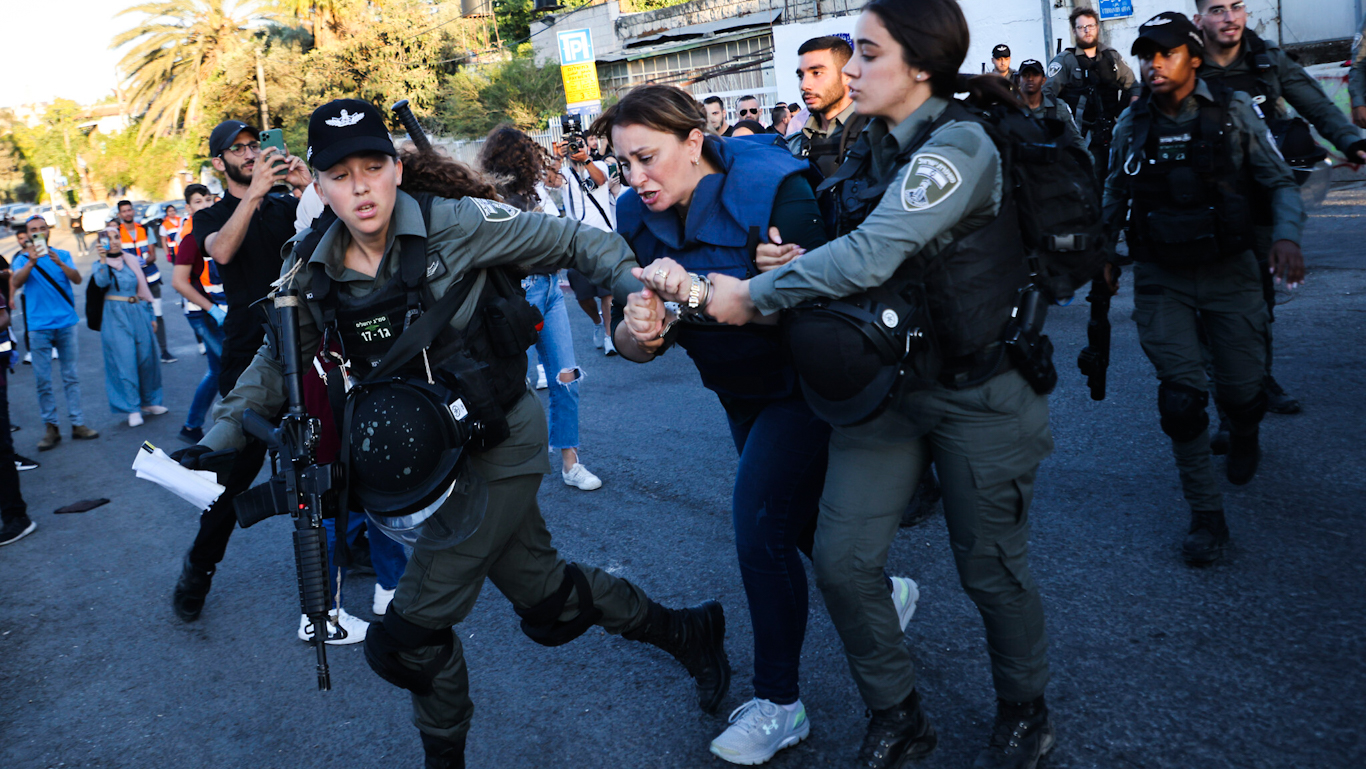
OCCUPIED EAST JERUSALEM — Despite wearing a press vest and holding a government press card, Al Jazeera Arabic correspondent Givara Budeiri was violently assaulted and arrested by Israeli police on June 5.

Budeiri was covering a demonstration in the Occupied East Jerusalem neighborhood of Sheikh Jarrah when Israeli forces attacked and then detained her for several hours on the grounds she kicked a soldier, which she denies. She was released only on terms that she doesn’t visit Sheikh Jarrah for 15 days.

“The silencing of journalists by terrorizing them has become a routine activity for the Israeli authorities, as witnessed in recent weeks in Gaza and occupied Jerusalem,” Dr. Mostefa Souag, acting director-general of Al Jazeera Media Network, said in a statement regarding Budeiri’s detention.

Violence against journalists, destruction of media property, and online censorship are all part of Israel’s systematic campaign to prevent the Palestinian narrative from reaching a global platform and exposing Israel’s crimes. And these efforts are only increasing.

The climate of press freedom

During the course of Israel’s 11-day war on Gaza, Israeli airstrikes destroyed four buildings housing at least 18 local and international media outlets. These included the offices belonging to Al Jazeera, Associated Press, Al-Araby TV, and Nawa Online Women Media Network. Israel’s bombardment also killed Palestinian journalist Yousef Abu Hussein and injured journalists Mohammad al-Louh and Elias Karram. Since April 21, a growing number of journalists have been harassed and assaulted by Israeli security forces and right-wing activists.

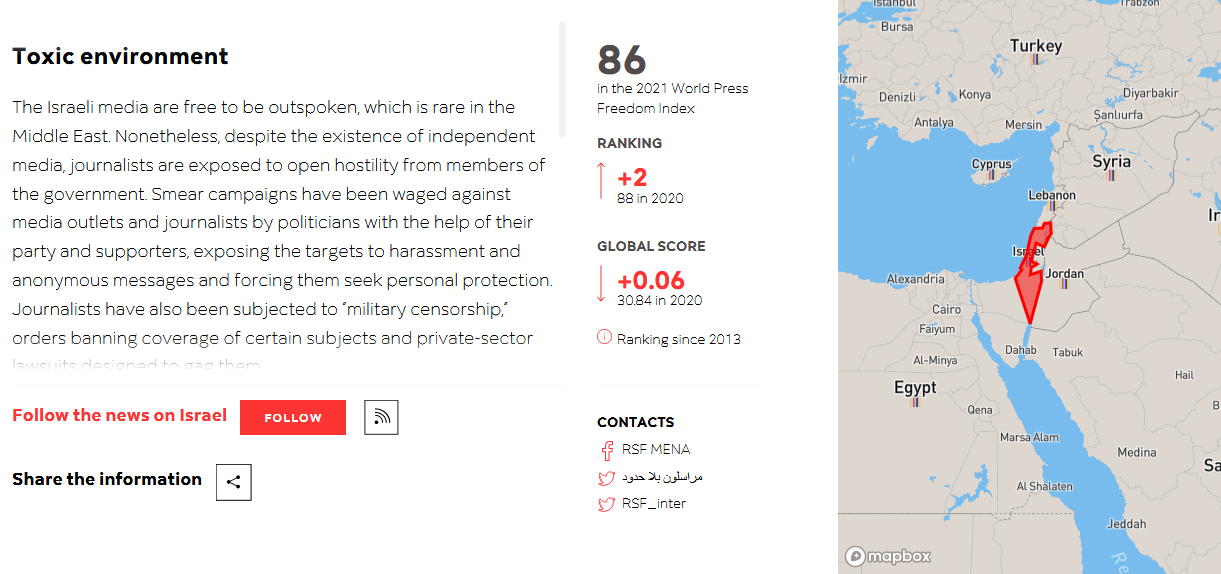
But attacks on the press aren’t exclusive to the recent violence in Palestine associated with Sheikh Jarrah, Al-Aqsa Mosque, and Gaza. Israel holds a ranking of 86 out of 180 countries in the World Press Freedom Index (with “1” being the most free) and Palestine sits at 132.

Israel Press Freedom

According to the Committee to Protect Journalists (CPJ), 18 journalists have been killed in the region since 1992; and currently 13 Palestinian journalists are imprisoned in Israeli jails. The Palestinian Center for Development and Media Freedoms (MADA) reported 408 violations in the Occupied West Bank, Jerusalem, and Gaza in 2020, with Israel responsible for 53% of the attacks. The Palestinian Journalists Syndicate (PJS) reported 608 media violations in 2020, with 490 of those violations committed by Israeli forces.

Israeli press violations encompass a wide range of dangerous actions, including physical assaults, targeting of media institutions, arrests, detentions, interrogations, raids, confiscation and destruction of equipment, and even using journalists as human shields.

A journalist’s personal experience

In one case, Dan Cohen — an American journalist and MintPress News contributor who was in Palestine from 2014 to 2017 — experienced being used as a human shield by Israeli forces firsthand. During an Israeli army raid into the Aida refugee camp in the West Bank in March 2014, a commander grabbed Cohen while he was reporting and forced him to stand in front of soldiers shooting at Palestinian youth. He was able to escape unscathed, but the incident still burns in his mind when considering freedom of the press in Israel-Palestine. “It was a very obvious case of the Israeli army attempting to use me as a hu

man shield either to punish me for documenting their activities, potentially injure me, or just to scare me,” Cohen said.

Cohen was harassed again during another army operation into the camp in 2014. A group of soldiers approached him, with one brandishing his weapon at Cohen. They forced him to turn around against a wall. “And then when I couldn’t see, they threw a flash [grenade] at me,” Cohen said. “Of course, it startled me and then they just laughed as they walked away. So, this is typical Israeli army harassment of journalists.”

Journalists — foreign and local — face a myriad of barriers when covering Palestine-Israel. But Cohen feels the pressures are more extreme for journalists who don’t fit into the establishment mold. “If you do the mainstream, New York Times reporting and stick to official events and don’t really challenge the hasbara narrative, then you’re not in any kind of danger. But if you dare to go to where Palestinians are demonstrating, then you’ll get tear gassed. You might get shot with a rubber-coated bullet and you may even get hit with live ammunition,” Cohen said. Hasbara is the Israeli term for propaganda and refers to the government’s diplomatic efforts to manipulate information and control the global narrative on Israel-Palestine. Cohen concluded, “A lot of it just depends on what you expose yourself to, but fundamentally journalists in Israel have no real protection.”

Israel Airstrike press offices

For journalists like Cohen, who has reported for alternative media outlets like Mondoweiss, challenging Israel’s status quo can turn you into a target. This is even more likely if you’re Jewish. “Zionists consider Jews who dissent from the Israeli government positions as traitors who are even worse than Arabs,” Cohen told MintPress, adding:

Jews speaking out against Israeli crimes — whether you’re an activist, a journalist, or anybody — severely undermines the so-called Jewish state’s ability to project itself as a defender of Jews worldwide and claim that its crimes against Palestinians are necessary to ensure the livelihood of a worldwide Jewry.

Yet it’s not just the Israeli military and government targeting the press. In recent weeks, CPJ, the Committee to Protect Journalists, uncovered far-right, Jewish nationalists encouraging violence against media professionals documenting these extremists’ coordinated attacks against Palestinians. “[We] can do both [target Arabs and journalists], it really doesn’t contradict. There are Arab terrorists and there are media terrorists,” read a WhatsApp message from a local group.

According to the Union of Journalists in Israel (ITONAIM), Israeli journalists faced dozens of attacks from the public and Israeli authorities from April 21 to May 15.

The I’lam – Arab Center for Media Freedom, Development and Research also released a report documenting 13 incidents of harassment and violence against Palestinian and Israeli journalists in May. The majority of these cases were committed by Israeli security forces. I’lam reported: 

According to the testimonies collected, the Israeli security forces’ attempts to eradicate journalists and prevent the media from reporting on the events aim to provide the official Israeli narrative with legitimacy and credibility in front of the world… Eradicating journalists is not only violating national and international laws, it also undermines the people’s right to know the facts, which it appears Israel is trying to hide.

Palestinian press under greater threat

Neither Israeli nor Palestinian journalists are immune to harassment — especially when it comes to reporting on Israeli corruption. But one group faces significantly greater danger in doing their job.

“There is very little margin for press freedom in Israel and the occupied Palestinian Territories. Traditionally, the limitations and the restrictions have been imposed on Palestinian journalists covering Israeli military activities, the Israeli occupation, and Israeli violations of human rights,” Dr. Ramzy Baroud, editor of Palestine Chronicle, told MintPress News, adding:

As of late, even Israeli journalists and media that seem to be sympathetic in any way with Palestinians or who are exposing the right-wing policies of Benjamin Netanyahu and his government have also faced a degree of limitation and restriction. But, of course, we are still talking about a vastly disproportionate difference here in how Palestinian and Israeli journalists are treated.”

According to a report from PJS’ Freedom Committee, Israel committed more than 180 press violations against Palestinians in May. About 80 violations occurred in the Gaza Strip, with around 37 media institutions targeted and at least 10 journalists injured by rocket fire.

In the West Bank and Jerusalem, roughly 100 Palestinian journalists have faced ongoing attacks from Israeli authorities through work restrictions, confiscation of equipment, tear gas, sound bombs and rubber bullets.

PJS called on the United Nations Human Rights Council (HRC) to send a commission to investigate Israeli crimes against Palestinian journalists. The HRC responded on May 27 by adopting a resolution establishing a commission to investigate press violations that have occurred in Palestine-Israel since April 13.

Amid Israel’s latest crackdown on Palestinian journalists, Cohen emphasized, however, that this isn’t a new phenomenon explaining:

For decades Palestinian journalists have been persecuted by an Israeli military dictatorship that doesn’t afford Palestinians any rights or guarantee any kind of freedom, whether that’s freedom of press or anything else. So, the recent attacks on Palestinian journalists and media institutions are part and parcel of the modus operandi of the apartheid regime.”

Media attacks worsening

As previously mentioned, multiple press watchdog groups monitoring Palestine-Israel indicate a drastic increase in media violations in recent months. Dr. Baroud agrees freedom of the press is worsening as Israeli crimes are broadcast on the world stage, concluding:

The more that Israel is exposed internationally for its human rights violations in Palestine, the more it becomes desperate in its attempt to crack down on journalists and the media in general. [Journalists] pose a threat to Israel in the sense that their job exposes Israeli practices and human rights violations against the Palestinians. So, in the eyes of Israel the journalist becomes the enemy because, even though he’s not carrying a weapon, the camera and the pen become weapons.”


River to Sea Uprooted Palestinian   
The views expressed in this article are the sole responsibility of the author and do not necessarily reflect those of the Blog!