Showing posts with label Human rights violation. Show all posts

Tuesday, 23 November 2021

Banning of Palestinian NGOs: How Israel Tries to Silence Human Rights Defenders

 November 22, 2021

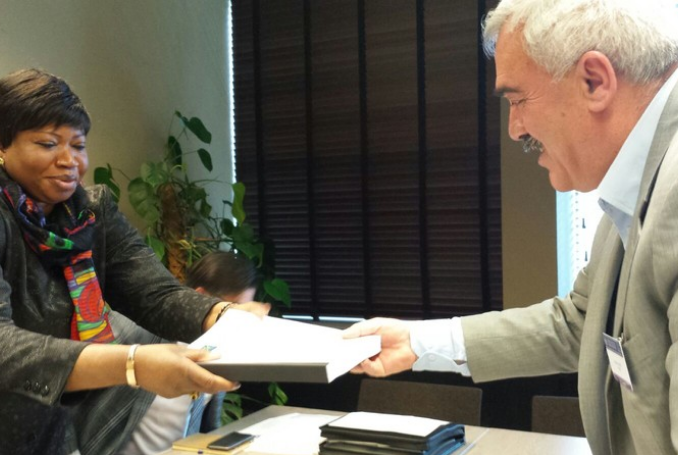
Al-Haq director Shawan Jabarin hands evidence of Israeli crimes in Gaza to ICC prosecutor Fatou Bensouda in November 2015. (Photo: via Al-Haq)

By Ramzy Baroud & Romana Rubeo

On October 21, Israeli Defense Minister Benny Gantz announced the issuance of a military order designating six prominent Palestinian human rights groups as ‘terrorist organizations’. Gantz claimed that they are secretly linked to the Popular Front for the Liberation of Palestine (PFLP), a socialist political group that Israel considers, along with most Palestinian political parties, ‘a terrorist organization.’

The Palestinian organizations included in the Israeli order are Addameer Prisoner Support and Human Rights, Al-Haq, the Bisan Center for Research and Development, Defense for Children Palestine, Union of Agricultural Work Committees (UAWC) and the Union of Palestinian Women’s Committees.

Considering the significance of these organizations in Palestine and their global networks among like-minded civil society organizations, the Israeli decision provoked a public outcry. One of the many statements of condemnation was a joint statement by rights groups, Amnesty International (AI) and Human Rights Watch (HRW), in which they called Gantz’s move an “appalling and unjust decision”, which represents “an attack by the Israeli government on the international human rights movement.”

Strong Words, but No Actions

AI and HRW, which have documented Israeli human rights violations of Palestinians for many years, fully understand that the ‘terrorist’ designation is consistent with a long trajectory of such unlawful moves:

“For decades, Israeli authorities have systematically sought to muzzle human rights monitoring and punish those who criticize its repressive rule over Palestinians. While staff members of our organizations have faced deportation and travel bans, Palestinian human rights defenders have always borne the brunt of the repression. This decision is an alarming escalation that threatens to shut down the work of Palestine’s most prominent civil society organizations.”

Equally important in the world’s leading rights groups’ statement is that it did not fail to highlight that the “decades-long failure of the international community to challenge grave Israeli human rights abuses and impose meaningful consequences for them has emboldened Israeli authorities to act in this brazen manner.”

True to form, the international community did react to Gantz’s decision, albeit it was the kind of ineffectual reaction, which persisted in the realm of rhetoric that is rarely followed by substantive action.

A joint statement by UN experts called the Israeli decision “a frontal attack on the Palestinian human rights movement, and on human rights everywhere”.

Michelle Bachelet, United Nations High Commissioner for Human Rights, criticized the “arbitrary” decision by Israel and warned of the “far-reaching consequences as a result,” in terms of work, funding and support for the targeted organizations.

Many governments around the world also condemned the Israeli move and echoed the sentiment conveyed by UN experts. Even the US expressed its ‘concern’, though, using the same typically cautious and non-committal language.

US State Department spokesman, Ned Price, told reporters on October 23, in Washington, that his country “believe(s) respect for human rights, fundamental freedoms and a strong civil society are critically important to responsible and responsive governance.” Instead of an outright condemnation, however, Price said that the US will “be engaging our Israeli partners for more information regarding the basis for these designations.”

However, like other governments, and certainly unlike AI and HRW, Price made no link between the Israeli decision of October 21 and numerous other past practices targeting human rights and civil society groups in Palestine and, more recently, in Israel as well. Also worth noting is that the supposed link between such organizations and the socialist PFLP is not new.

The following are a few examples of how Israel has attempted to silence some of these organizations, which, eventually were declared to be ‘terrorist.’

Raids, Arrests and Death Threats

Addameer – In December 2012, the Israeli army raided the headquarters of Addamer in Ramallah, confiscating laptops and a video camera. The offices of the Union of Palestinian Women Committees were also raided by Israeli occupation forces on the same day. The organization is one of the six now designated by Israel as ‘terrorist.’

In September 2019, Addameer’s offices were raided, once again. The Israeli military raid at the time, however, did not generate as much attention or outrage, despite the accompanying violence, let alone the blatant violation of human rights. Then, Al-Haq – also one of the other six effectively banned Palestinian groups – issued a statement warning that “the private property of human rights organizations in occupied territory is especially protected under Article 46 of the Hague Regulations (1907).”

Expectedly, such legal constraints mattered little to Israel.

Al-Haq – Al-Haq’s staff have faced many restrictions throughout the years. Shawan Jabarin, the General Director of Al-Haq, has been banned from travel on various occasions, starting in 2006.

In March 2009, Jabarin was prevented by Israel from traveling to the Netherlands to receive an award on behalf of his organization. Again, in November 2011, this time, Jabarin was now allowed to travel to Denmark.

The Israeli obstacles began taking even more sinister turns when, in March 2016, Jabarin began receiving death threats over the phone. These anonymous calls began arriving “in the context of increasing harassment of Al-Haq and its members, amid their recent work at the International Criminal Court (ICC) seeking justice for human rights violations being committed in the Occupied Palestinian Territories,” the Front Line Defenders website reported.

Defense for Children International-Palestine – In July, and again August 2021, Israeli forces raided Defense for Children International – Palestine (DCIP) offices in Al-Bireh, in the occupied West Bank. They seized computers, hard drives and other material, alleging a link between the organization and the PFLP.

This allegation had already been advanced in 2018, when UK Lawyers for Israel (UKLFI) persuaded Citibank and the Arab Bank PLC to stop providing banking services to DCIP, providing what they defined as “evidence of the close ties” to the PFLP.

While it is true that the recent Israeli measures against Palestinian NGOs are a continuation of an old policy, there are fundamental differences between the growing perception of Israel, now, as an apartheid state and the misconstrued perception of the past, namely Israel as an oasis of democracy.

Even international entities and groups that are yet to brand Israel an apartheid state are becoming familiar with the Israeli government’s undemocratic nature.

A ‘Tectonic Shift’

In December 2019, and after years of haggling, the ICC resolved that “there is a reasonable basis to proceed with an investigation into the situation in Palestine, pursuant to Article 53(1) of the (Rome) Statute.” Despite intense Israeli and western pressure, the last hurdle in the way of the investigation was removed last February, as the ICC has finally approved the Prosecutor’s request to open legal proceedings regarding war crimes in the occupied Palestinian territories, including Gaza.

This legal milestone was cemented by major declarations, one made by Israel’s own rights group, B’tselem, in January, and another by HRW in April, both slamming Israeli policies in Palestine – not just the occupied territories – as ‘apartheid’.

This critical change in the international legal position regarding Israel’s new, unflattering status, was boosted by Israel’s own violent actions in East Jerusalem, Gaza and throughout Palestine in May. Unlike previous wars, the May events have shifted sympathy mostly towards Palestinians, who are fighting for their freedom, homes and other basic human rights.

The change was also notable within the US government itself, which is unprecedented by any account. An increasing number of US lawmakers are now openly critical of the State of Israel, due to a radical change in the US public opinion and, again, unprecedently, they are not paying a heavy price for it as was often the case in the past due to the great influence of the Zionist lobby in Washington.

“The shift is dramatic; it’s tectonic,” the BBC, on May 21, quoted US pollster, John Zogby, as saying. “In particular, younger generations are considerably more sympathetic to the Palestinians – and that age gap has been on full display with the Democratic Party,” the BBC noted.

Israel’s losses are not just sentimental or political, but economic as well. Last July, the international ice cream giant Ben & Jerry’s decided to stop selling its products in illegal Jewish settlements while pinpointedly condemning Israeli occupation, a move that was described by Amnesty as “legitimate and necessary”. A few months later, the sports clothing manufacturer, Nike, followed suit, announcing that it will end the sale of its products in Israeli stores starting May 2022, although it did not justify its decision based on political reasoning.

While Israel continues to lash out at its critics, it no longer seems to behave according to a centralized strategy.

Lacking a strong leadership after the dethroning of former Prime Minister Benjamin Netanyahu and the formation of a diverse ‘unity government’, the new Israeli government does not seem capable of holding back international criticism of its conduct in occupied Palestine. The notion that everything that Israel does is justifiable as a form of ‘self-defense’ is simply no longer a strong selling point. The May war is the perfect example of this assertion.

In the case of the banned NGOs, for example, aside from sending a representative from the Israeli intelligence agency, Shin Bet, and another from the Israeli Foreign Ministry to Washington on October 25 with “relevant intelligence” to justify its decision, Tel Aviv continued to carry out the same policies that further exposes its apartheid in the eyes of the international community.

Indeed, on October 27, Israel announced the construction of thousands of new housing units in illegal Jewish settlements, in its first such move during the presidency of Joe Biden.

A perfect illustration of the frantic nature of the Israeli response came on October 29, when the Israeli envoy to the United Nations, Gilad Erdan, during his speech at the General Assembly, tore into pieces a report issued by the UN Human Rights Council illustrating Israeli ongoing violations of international law.

“The Human Rights Council attacked and condemned Israel in 95 resolutions compared to 142 resolutions against the rest of the world,” Erdan said. “This distorted and one-sided report’s place is in the dustbin of anti-Semitism,” he ranted.

Branding Israeli Apartheid

We may be at the cusp of a fundamental change in terms of Israel’s relationship with the international community. While Tel Aviv continues to heavily invest in its apartheid infrastructure, the international community is slowly, but clearly, becoming aware that Israel’s apartheid status is a permanent one. The successive statements by B’Tselem, HRW, the joint HRW-Amnesty statement condemning the de facto outlawing of the Palestinian NGOs and, again, the ICC investigation are all indicative of this growing awareness.

The question remains – will Israel be able to use its power, influence and leverage in Western societies to force the world to accept and co-exist with a full-fledged apartheid regime in Palestine? And if yes, then, for how long?

The South African apartheid example showed that, despite decades of apartheid and initial acceptance, if not support, by western societies of legalized racial separation in South Africa, the pendulum eventually turned. Even before the formal end of apartheid in that country in 1994, it was becoming clear that the days of the racist regime of Pretoria were numbered. That realization was possible because of the growing international awareness, especially at grassroot, civil society level, of the evil of apartheid.

A similar scenario seems to be evolving in the case of Israeli apartheid in Palestine as well. A critical mass of support for Palestinian rights is being constructed around the world, thanks to the Boycott, Divestment and Sanctions (BDS) movement and hundreds of pro-Palestine civil society groups all around the globe.

For years, Israel seemed keen on countering the influence of Palestine’s solidarity around the world using a centralized strategy. Large sums of money were dedicated, or pledged, towards that end, and a partly government-controlled company was even established, in 2017, to guide the Israeli global campaign. Much of this has amounted to very little, however, as BDS continues to grow, and the conversation on Palestine and Israel is gradually changing from that of a political ‘conflict’ into recognition of Israeli racism, apartheid and utter disregard of international law.

Of course, it will take more time, more decided effort and, certainly, more sacrifices on the part of Palestinians and their supporters to expose Israeli apartheid to the rest of the world. Now that Israel seems to have accepted that there is little it can do to reverse this brand, it is accelerating its colonial efforts, while hunkering down for a long fight ahead.

The onus is now on the international community to force Israel into dismantling its apartheid regime. Though it is ultimately the people who liberate themselves, international solidarity is essential to the process of national liberation. This was the case in South Africa, and will surely be the case in Palestine, as well.

– Ramzy Baroud is a journalist and the Editor of The Palestine Chronicle. He is the author of five books. His latest is “These Chains Will Be Broken: Palestinian Stories of Struggle and Defiance in Israeli Prisons” (Clarity Press). Dr. Baroud is a Non-resident Senior Research Fellow at the Center for Islam and Global Affairs (CIGA) and also at the Afro-Middle East Center (AMEC). His website is www.ramzybaroud.net

– Romana Rubeo is an Italian writer and the managing editor of The Palestine Chronicle. Her articles appeared in many online newspapers and academic journals. She holds a Master’s Degree in Foreign Languages and Literature and specializes in audio-visual and journalism translation.


River to Sea Uprooted Palestinian   
The views expressed in this article are the sole responsibility of the author and do not necessarily reflect those of the Blog!

Thursday, 18 November 2021

Urgent Appeal to Protect the Lives of Palestinian Administrative Detainees on Hunger-Strike in Israeli Prisons

 November 16, 2021

By KhamakarPress News –


Human rights NGOs, Qadiri attacked, Sheep farm dismantling, Settlement terror, Palestinian kidnapped, Palestinians injured, Olive trees set on fire

Israel’s Terrorism Against Human Rights NGOs

Since its founding in 1948, the “State of Israel” has promoted an intense campaign to erase Palestinian history, culture and resistance on all its fronts. Human rights organizations such as the Boycott, Divestment and Sanctions Movement (BDS) and activists around the world are the constant targets of this attack.
Recently, “Israel” attacked the Palestinian human rights movement head-on, designating six non-governmental organizations (NGOs) as “terrorist groups” with the aim of silencing, restricting and interrupting the work they are doing. If human rights NGOs are “terrorists”, how should we identify the “State of Israel” guilty of violations of humanitarian law, war crimes, crimes against humanity and apartheid?

Watchdog: Nachshon repression unit attacked Qadiri

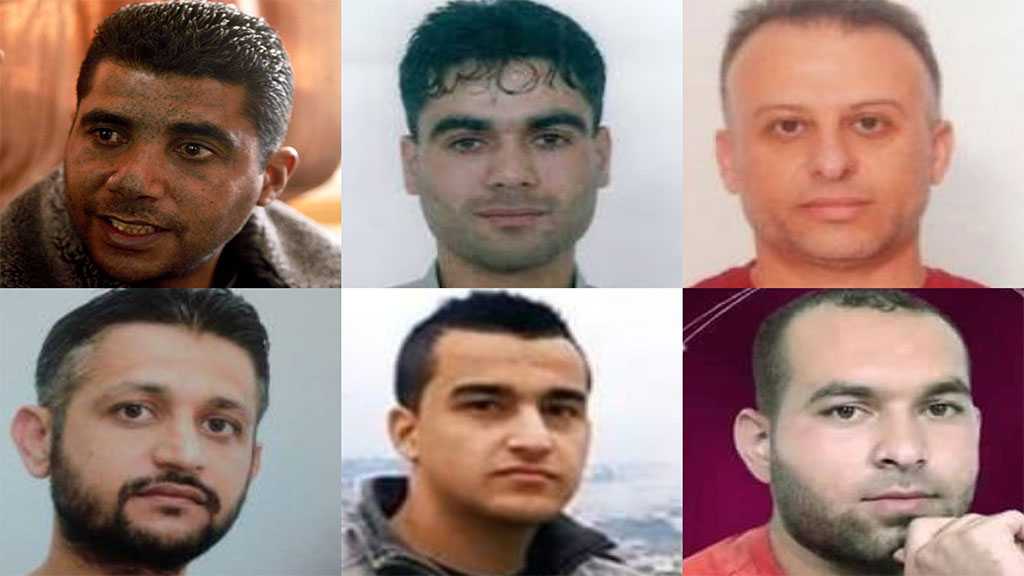
The Committee of Detainees’ and Former Detainees’ Affairs said members of Nachshon’s repression unit attacked Ya’qoub Qadiri, one of six Gilboa escapees, after his latest court hearing. His lawyer said more than 20 guards attacked him, threw him to the ground and stepped on his handcuffs, causing injuries to his right hand.
The commission added that the Israel Prison Service (IPS) refused to send Qadiri to the prison clinic.

It added that the IPS also continues to hold Qadiri in solitary confinement in Rimonim Prison with Israeli dangerous criminal prisoners. His cell is not fit to live and is guarded around the clock.

‘Israel’ dismantles, confiscates Palestinian barn under construction in Hebron

Israeli occupation forces dismantled and seized an under-construction sheep barn in Palestine at Masafer Yatta in the city of Hebron in the occupied West Bank earlier on Monday.
Local sources said earlier today that Israeli forces have escorted bulldozers into the area and have begun dismantling an under-construction barn owned by Palestinians before it is seized.

Soldiers dismantle a barn, kidnap a Palestinian, near Hebron

Israeli soldiers on Monday raided two communities near the town of Yatta, south of the southern West Bank city of Hebron, dismantled and confiscated a barn and kidnapped a Palestinian.
Fuad al-Amour, the coordinator of the Protection And Steadfastness Committee in Masafer Yatta and the southern hills of Hebron, said several Israeli military vehicles invaded the village of Erfa’eyya, dismantled a barn and seized it.

B’Tselem: ‘Israel’ uses settler terror as a tool to steal Palestinian land

Israeli authorities are using settler terrorist attacks as “an important informal tool” to take over Palestinian land in the occupied West Bank, Israel’s B’Tselem said.
In a report released Sunday, the major Israeli human rights group said the occupying state uses two main methods to steal Palestinian land in the West Bank: official annexation through its legal system and unofficial acts of intimidation and violence by the settlers. to drive native Palestinians from their homes.
“The state fully supports and assists these acts of violence, and its agents sometimes participate directly in them,” the report said.

B’Tselem: Israel is embezzling West Bank land due to settler violence

The Israeli occupation government has used settler violence as “an important informal tool” to take over Palestinian land in the occupied West Bank, B’Tselem, a leading Israeli human rights group, has found.
In a report released on Sunday, B’Tselem said Israel is using two complementary ways to confiscate Palestinian land in the occupied West Bank: official annexation through its judicial system and unofficial acts of intimidation and violence by the settler population.

Israeli settlers injure three Palestinians near Nablus

Israeli settlers on Monday attacked many Palestinian farmers near the village of Burqa, north of the northern West Bank city of Nablus, injuring three.
Ghassan Daghlas, a Palestinian official who oversees Israel’s illegal colonialist activities in the north of the West Bank, said settlers attacked Palestinian farmers on their land near the Jenin-Nablus main road, throwing rocks at them.
Daghlas added that a Palestinian identified as Nasser Hijja suffered a facial injury after a settler threw a stone at him.

Sources: Extremist settlers attack and injure Palestinians in Nablus

Israeli settlers on Monday attacked Palestinian farmers near the village of Burqa north of Nablus, in the northern occupied West Bank, injuring at least three people, according to local sources.
Ghassan Daghlas, who monitors Israeli settlement activities in the north of the West Bank, said in a press statement that Israeli settlers stoned Palestinian farmers while on their land in the village of Burqa, injuring at least three people.
One of the farmers was attacked in the face with a stone, another was injured after being hit on the head, while the third farmer was bruised.

At least 50 olive trees burned by Israeli settlers in Hebron

Israeli settlers on Monday set fire to more than 50 Palestinian olive trees in the town of Ash-Shuyukh northeast of Hebron, in the occupied southern West Bank, according to local sources activist Ahmad al-Halayqa.
The activist reported in a press statement that settlers set fire to at least 50 mature olive trees and set up two mobile homes on Palestinian-owned land next to the illegal Israeli settlement of Asfar, in an apparent prelude to taking the land for the benefit of settlement expansion.

(Sources: Days of Palestine, Quds News Network, IMEMC, The Gaza Post)

Henny A.J. Kreeft
Independent Citizen Journalism

© Khamakar News Agency / 15.11.2021


River to Sea Uprooted Palestinian   
The views expressed in this article are the sole responsibility of the author and do not necessarily reflect those of the Blog!

Tuesday, 9 November 2021

The Bell Tolls for Israel

 November 8, 2021  

About me

Posted by Lawrence Davidson

Six Human Rights Groups Shuttered and Still the Bell Tolls for Israe

Part I—Six Human Rights Groups Shuttered

On 19 October 2021, the Israeli Defense Ministry officially labeled six well known Palestinian human rights associations as “terrorist organizations.” Israel uses a definition of “terrorism” that is unreasonably broad. Just about any criticism as well as non-violent resistance to its evolving apartheid regime can and often is deemed “terrorism.” As this instance shows, this arrangement allows Israeli authorities to themselves terrorize groups that most sane people would recognize as having nothing to do with terrorism.

The six organizational victims of this strategy are Addameer, al-Haq, Defense for Children Palestine, the Union of Agricultural Work Committees, Bisan Center for Research and Development, and the Union of Palestinian Women Committees. Applying the terrorist tag “authorizes Israeli authorities to close their offices, seize their assets and arrest and jail their staff members, and it prohibits funding or even publicly expressing support for their activities.”

There are only two classes of people who would fall for this deceit: (1) those embedded in the Zionist thought collective—the world of Israel “über alles” (my use of this specific term is explained below); and (2) those politicians and bureaucrats so firmly tied (financially or otherwise) to the various Zionist lobbies that they would be compelled to forgo reason and agree to anything the Zionists say. Much of the Washington power structure falls into this category.

Beyond those categories, people capable of independent thought and in knowledgable positions condemned the Israeli action:

 The Israeli news magazine +972, which has obtained copies of the classified testimony providing “evidence” against the six groups, has characterized the charges as unproven. +972 describes it as a “political attack under the guise of security.” In their estimate the entire case is a hodgepodge of innuendo and assumption, some of it obtained by Israel’s security service, Shin Bet, by threatening witnesses and their families.

Human Rights Watch and Amnesty International, both of which have long interacted with many of the charged groups, condemned the Israeli action in harsh terms:

“This appalling and unjust decision is an attack by the Israeli government on the international human rights movement. For decades, Israeli authorities have systematically sought to muzzle human rights monitoring and punish those who criticize its repressive rule over Palestinians. … Palestinian human rights defenders have always borne the brunt of the repression. … The decades-long failure of the international community to challenge grave Israeli human rights abuses and impose meaningful consequences for them has emboldened Israeli authorities to act in this brazen manner.”

The often clear-sighted Israeli newspaper Haaretz also took exception to the government action. 

“The government’s declaration of civil society organizations in the West Bank as terrorist organizations is a destructive folly that tarnishes all of the parties in the coalition and the state itself. The outlawing of human rights groups and persecution of humanitarian activists are quintessential characteristics of military regimes, in which democracy in its deepest sense is a dead letter.”

Besides its habitual and often sadistic persecution of Palestinians, Israel had immediate reasons to silence these six organizations. An analysis given by Open Democracy noted that on 5 February 2021 the Pre-Trial Chamber of the International Criminal Court  (ICC) ruled that the ICC had jurisdiction over events occurring in Israel’s Occupied Territories. Then, on 3 March the court opened up a criminal investigation into Israeli practices and policies in this area. Open Democracy then explained:

“All six banned organizations have for decades been critically involved in the documentation and monitoring of alleged Israeli human rights violations, war crimes and Apartheid in the OPT [Occupied Palestinian Territories]. … All of this work has been a major evidential basis for the demand to open criminal investigations by the International Criminal Court (ICC).”

In other words, Israel’s “terrorist” canard is, at least in part, the Zionists seeking to obstruct justice. Like most organized groups of law-breakers they prioritize their own interests above those of the community—in this case the international community. In doing so they undermine inter-community standards of ethics and values enshrined in international law. Ultimately, they see such law as an obstacle to their ideologically driven goal of national expansion and Jewish (that is, the Zionist version of Judaism) supremacy.  

Part II—Yet the Bell Still Tolls for Israel

None of this is new. The Zionists have always been this way. Driven by an ethnic-centered, settler nationalism, their incapacity to deal fairly with the Palestinians was recognized even before the Balfour Declaration was announced in 1917. Below are some of the earlier, prescient warnings of the danger to Judaism inherent in a Zionist state ideology.

Ahad Ha-am (the pen name of the famous Jewish moralist Asher Ginzberg) noted as early as 1891 that Zionist settlers in Palestine have “an inclination to despotism. They treat the Arabs with hostility and cruelty, deprive them of their rights, offend them without cause, and even boast of these deeds.” He warned that such behavior stemmed from the political orientation of the Zionist movement which could only end up “morally corrupting” the Jewish people.

Unlike the Zionist leader Chaim Weizmann, who famously desired that the Jews become a nation like all other nations, Ha-am believed that the return to Zion was worthwhile only if the Jews did not become like other nations. By 1913, Ha-am knew this was not to be, and he rejected the nature of Zionism as it was evolving. “If this be the Messiah,” he wrote, “I do not wish to see his coming.”

 As the issuance of the Balfour Declaration drew nearer, other Jews voiced their worries. In the United States, a letter representative of the Jewish opposition to Zionism was sent by Henry Moskowitz to the New York Times on 10 June, 1917. Moskowitz was an Jewish activist and cofounder of the NAACP. He wrote the following: “What are the serious moral dangers in this nationalistic point of view from the standpoint of the Jewish soul? First, it is apt to breed racial egotism.”

In a 1945 essay, Hannah Arendt, one of the most insightful Jewish political philosophers of the 20th century, described the Zionist movement as a “German-inspired nationalism” (thus my use of “über alles” above). That is, as an ideology that holds “the nation to be an eternal organic body, the product of inevitable natural growth of inherent qualities; and it explains peoples, not in terms of political organizations, but in terms of biological superhuman personalities.”

In 1948, Arendt and 27 other prominent Jews living in the United States—including Albert Einstein—wrote a letter to the New York Times condemning the growth of rightwing political influences in the newly founded Israeli state. Citing the appearance of the “Freedom Party” (Tnuat Haherut) led by Menachem Begin, they warned that it was a “political party closely akin in its organization, methods, political philosophy, and social appeal to the Nazi and Fascist parties.” Begin would go on to become one of Israel’s prime ministers. The contemporary Israeli party Likud is a successor of the “Freedom Party.”

Albert Einstein was also a person of moral sensitivity. As such, he turned down an offer to become Israel’s president and distanced himself from both Zionism and the Israeli state. The Zionist treatment of the Arabs had alienated him. In 1938, he observed, “I would much rather see reasonable agreement with the Arabs on the basis of living together in peace than the creation of a Jewish state. I am afraid of the inner damage Judaism will sustain–especially from the development of a narrow nationalism within our ranks.”

In August 2002, as a consequence of aggressive Israeli behavior in the occupied West Bank, England’s chief rabbi, Jonathan Sacks, warned that Zionist state policies, as they manifest themselves in the colonization process and the associated persecution of the Palestinians, are perverting “the deepest ideals” of Judaism.

Today, the American organization Jewish Voice for Peace (JVP); the British organization, Jews for Justice for Palestinians (JFJFP); and Jews for a Just Peace (JJP), a federation of groups in ten European countries, all keep up this tradition of admonition and critical analysis while promoting the “human, civil, and political rights” of the Palestinians.

Part III—Conclusion

Toward the end of his life, Albert Einstein warned that “the attitude we adopt toward the Arab minority will provide the real test of our moral standards as a people.” The conclusions drawn by every human rights organization that has examined Israeli behavior toward the Palestinians over the last 70 years, including Amnesty International, Human Rights Watch, Israel’s own B’Tselem, and the Palestinian Human Rights Organization (PHRO), leave no doubt that the Zionists have failed Einstein’s test. 

Yet that conclusion is just what the Zionists have never been able to face. Thus, any reminder of the movement’s failure in the form of contemporary critiques and documentation are not only denied, but condemned as anti-Semitic. Jews who express such concerns are systematically denigrated as “self-hating.” The U.S. media, still bound by the mythology of Israel as a democratic, modern, secular state that shares America’s pioneering tradition, have traditionally ignored or downplayed critics of Zionism. This leaves most in the West ignorant of Israel’s actual policies and practices.

Today, Judaism is now on the cusp of ethical collapse. The vehicle for this collapse is the purposeful transformation of the religion into an arm of Zionist-Israeli state ideology. Simply put, Ahad Ha-am, Henry Moskowitz, Hannah Arendt, Albert Einstein, Jonathan Sacks, JVP, JFJFP, and JJP were and are correct in their criticism of Zionism and Israel. Thus, we confront an ironic situation. The survival of the Jewish people as a civilized group with a collective sense of ethical standards is not in the hands of the State of Israel, but in the hands of those Jews who oppose that state and support the humanity and rights of Palestinians. 


River to Sea Uprooted Palestinian   
The views expressed in this article are the sole responsibility of the author and do not necessarily reflect those of the Blog!

Friday, 29 October 2021

Riyadh Seeks US Help to Boost Missile Systems amid Yemeni Resistance Retaliatory Operations

 28.10.21

Riyadh Seeks US Help to Boost Missile Systems amid Yemeni Resistance Retaliatory Operations

By Staff, Agencies

A report revealed that Saudi Arabia has turned to the United States to seek help in strengthening its missile interception systems, as the kingdom — which has been leading a protracted war on Yemen — remains unable to protect its soil against its southern neighbor’s retaliatory operations.

Riyadh is seeking the US help amid pressure by Washington to end its blockade of Yemeni ports that is an obstacle to ceasefire talks, Reuters quoted two sources with knowledge of discussions to end the Yemen war as well as a US official as saying.

“Publicly and privately, we’ve been putting a lot of attention on the port and the airport issue… It’s the right thing for Saudi Arabia to do,” the senior US government official said on condition of anonymity.

The source was referring to US pressure on the Saudi-led war coalition against Yemen to fully open access to the ports and the Sanaa airport, controlled by the Yemeni government, as demanded by the Ansraullah movement, which runs state affairs, as prerequisites to ceasefire talks.

The Riyadh regime, however, wants the US to first provide it with weapons so it can promote its air systems in the face of the Yemeni army’s stepped-up drone and missile operations on the kingdom’s soil, according to the sources.

Since 2015, Saudi Arabia has led a military campaign against Yemen to overthrow the popular Ansarullah movement and reinstall the Riyadh-friendly regime of Abd Rabbuh Mansur Hadi, who resigned in 2014 and fled to the kingdom.

The prolonged war, accompanied by an economic siege that has targeted Yemen’s key ports, has failed to reach its goals, killing hundreds of thousands of Yemeni people, and in turn, throwing the poorest Middle Eastern country into what the UN calls the world’s worst humanitarian crisis.

According to the latest estimate by UNICEF, the protracted war on Yemen has killed or maimed at least 10,000 children, which is equivalent to four children every day.

Riyadh enjoyed cordial relations with the US under former president, Donald Trump, who inked hefty arms deals with the kingdom despite worldwide outcry over Riyadh’s war against Yemen and its human rights violations, including the murder of the journalist Jamal Khashoggi.

However, under Joe Biden, the US has sought to reflect a hardening of its attitudes toward Saudi Arabia, with Biden vowing to end his predecessor’s carte blanche to the kingdom.

Related Videos

Related News


River to Sea Uprooted Palestinian   
The views expressed in this article are the sole responsibility of the author and do not necessarily reflect those of the Blog!

Wednesday, 13 October 2021

Amazon, Google Employees: Crimes against Palestinians to Get ’Deadlier’ After Tech Giants Contract with ’Israel

 October 13, 2021

Amazon, Google Employees: Crimes against Palestinians to Get ’Deadlier’ After Tech Giants Contract with ’Israel

By Staff, Agencies

Over 1,600 employees at tech giants Amazon and Google have urged their employers to pull out of a contract under which they will sell “dangerous technology” to the Zionist entity and its military and cut all ties with the regime over its atrocities against the Palestinian people.

Initially, more than 90 workers at Google and more than 300 at Amazon anonymously signed an open letter published by the Guardian newspaper on Tuesday, demanding the termination of Project Nimbus, which will provide cloud services for the Tel Aviv regime.

“The technology our companies have contracted to build will make the systematic discrimination and displacement carried out by the ‘Israeli’ military and government even crueler and deadlier for Palestinians,” the employees said in the letter.

“We condemn Amazon and Google’s decision to sign the Project Nimbus contract with the ‘Israeli’ military and government, and ask them to reject this contract and future contracts that will harm our users,” they said.

They underlined the need for the two companies to stop contracting with any militarized organization in the US and beyond.

Project Nimbus is a $1.2bn contract awarded last April to Google and Amazon, which succeeded in beating out bids from Microsoft, Oracle, and IBM, to provide cloud services for the ‘Israeli’ occupation regime and its military.

There are fears that the technology would allow for further illegal surveillance of Palestinians and facilitate the expansion of the Zionist regime’s illegal settlements across the occupied territories.

“This contract was signed the same week that the ‘Israeli’ military attacked Palestinians in the Gaza Strip, killing nearly 250 people, including more than 60 children,” said the “employees of conscience,” referring to the ‘Israeli’ regime’s latest war on Gaza which occurred in May and lasted for 11 consecutive days.

“We cannot look the other way, as the products we build are used to deny Palestinians their basic rights, force Palestinians out of their homes and attack Palestinians in the Gaza Strip, actions that have prompted war crime investigations by the international criminal court.”

In another opinion piece posted hours later on NBC, two workers at the tech giants updated the number of signatories, saying that nearly 1,000 anonymous signatories at Amazon and more than 600 at Google have joined the campaign.

“Since we have no ability to guarantee that the technology we build won’t be used to commit human rights abuses against Palestinians, cutting the contracts entirely is the only ethical option left for our companies,” Gabriel Schubiner, software engineer and researcher at Google, and Bathool Syed, content strategist at Amazon, wrote in the article.

The two employees said they agree with the two companies’ stated commitment to ethics, but also pointed to their hypocrisy. “We want to work for companies that do more than pay lip service to ethical business practices,” they noted.

“Instead, our companies signed contracts that they knew would be highly controversial, yet relinquishes their ability to enforce their own publicly stated principles while attempting to deny workers our say in how our labor is used.”


River to Sea Uprooted Palestinian   
The views expressed in this article are the sole responsibility of the author and do not necessarily reflect those of the Blog!

Tuesday, 21 September 2021

199 Rights Groups Urge Protection for Rearrested Palestinian Inmates

  SEPTEMBER 21, 2021

199 Rights Groups Urge Protection for Rearrested Palestinian Inmates

By Staff, Agencies

Nearly 200 human rights organizations have held the Zionist entity fully responsible for the lives and safety of six prisoners who tunneled their way out of a maximum security Zionist detention center earlier this month and were arrested later.

A total of 199 organizations, in a joint statement released on Monday, called for the formation of an independent international investigation committee to immediately look into the conditions of their detention.

“According to the testimony of lawyers, ‘Israeli’ occupation forces assaulted them harshly from the moment of arrest, causing multiple bodily injuries. The injuries necessitated hospitalization of some of them as they had been subjected to unjustified violence and torture,” the statement read.

“They are deprived of sleep, and have been interrogated after complete sleep deprivation, according to available information. Interrogators have made death threats against some of them, and their relatives have also been arbitrarily arrested for the purposes of revenge.”

The human rights organizations stressed that the mistreatment of the prisoners amounts to a violation of international and humanitarian principles.

They demanded the “urgent formation of an independent, impartial and honest international investigation committee to examine circumstances surrounding the arrest of the six Palestinian prison escapees, and to hold the perpetrators of violations to account.”

The organizations called upon Arab nations and expatriates to advocate for Palestinian prisoners and detainees in Zionist occupation jails, and to raise their cause through social media platforms.

The rights organizations asked the Hague-based International Criminal Court to prosecute ‘Israeli’ prison officials responsible for the torture of Palestinian detainees.

They urged the Arab League and its bodies to support Palestinian prisoners, and to activate effective mechanisms at the international level.

The rights organizations stressed that UN special rapporteurs, especially Special Rapporteur on the situation of human rights in the occupied Palestinian territory Michael Lynk, should actively shed light on the Zionist entity’s systematic torture of Palestinian prisoners and detainees, and take the matter to the United Nations.

On Sunday, the Zionist occupation forces arrested the two remaining prisoners, who had escaped from Gilboa Prison more than two weeks ago.

A former commander of the al-Aqsa Martyrs’ Brigade in Jenin and five Islamic Jihad members had tunneled their way out through their cell’s drainage system and escaped from the prison on September 6.

There are reportedly more than 7,000 Palestinians held at Zionist jails. Hundreds of the inmates have been apparently incarcerated under the practice of administrative detention.

River to Sea Uprooted Palestinian   
The views expressed in this article are the sole responsibility of the author and do not necessarily reflect those of the Blog!

Friday, 17 September 2021

To A Wider Prison: Bahraini Regime Conditionally Releases Some Political Prisoners

September 16, 2021 

To A Wider Prison: Bahraini Regime Conditionally Releases Some Political Prisoners

By Staff, Agencies

As if the Bahraini regime is just sending political prisoners from small cells to a wider prison…

The Bahraini regime has conditionally released 30 prisoners under new rules allowing electronic monitoring and home detention instead, the government and activists said on Wednesday. Almost all those freed are considered political detainees by rights groups.

The Gulf state has imprisoned thousands of protesters, journalists and activists – some in mass trials – since an anti-government uprising in 2011. It says it prosecutes those who commit crimes in accordance with international law, and rejects criticism from the United Nations and others over the conduct of trials and detention conditions.

Under a 2017 “alternative sentences” law prisoners who had served at least half their sentence in jail were allowed to complete it outside via measures including community service, rehabilitation courses and electronic surveillance.

Last week, the king amended the law to allow a switch to non-custodial punishments at any point in a sentence.

Sayed Ahmed Alwadaei, a Bahraini activist in exile who heads the Bahrain Institute for Rights and Democracy [BIRD], said 27 of those released this week were political prisoners, and many had been detained when they were juveniles.

“However, they will continue to face severe restrictions on their liberty and these rare releases remain overshadowed by the continued incarceration of hundreds of political prisoners in Bahrain,” said Alwadaei. He called on the government to unconditionally release all political detainees.

One of those released on Sunday night was Kameel Juma Hasan, who was arrested at age 14 and sentenced to 28 years in 2019. The United Nations Working Group on Arbitrary Detention [WGAD] in May said it considered him to have been arbitrarily detained.

Documents seen by Reuters show some release offer conditions including devices to monitor movements and bans on speaking to the press, using social media or any political activities.

Hassan Mushaima, who was arrested in 2011 and jailed for life for anti-government protests, declined a conditional release offer this week, his son Ali Mushaima told Reuters.

Several high-profile government critics remain in prison, including Abduljalil al-Singace who has been on hunger strike for more than 60 days.

Leading human rights activist Nabeel Rajab was released under the alternative sentence law in June 2020.

BIRD estimates that there are over 1,400 political prisoners out of a total prison population in Bahrain of around 3200-3800.

On Wednesday the public prosecution claimed it was considering alternative sentences for six children, without elaborating.

Earlier this year prisoners and security forces clashed inside Jaw prison, and families protested outside, after COVID-19 outbreaks.


River to Sea Uprooted Palestinian   
The views expressed in this article are the sole responsibility of the author and do not necessarily reflect those of the Blog!

Tuesday, 31 August 2021

Enforced Disappearance: A Crime against Humanity Systematically Practiced by Saudi Arabia

 August 31, 2021

Enforced Disappearance: A Crime against Humanity Systematically Practiced by Saudi Arabia

By the European Saudi Organization for Human Rights

On the International Day of the Victims of Enforced Disappearance, which is commemorated every year on August 30, UN Secretary-General Antonio Guterres stressed that, despite being “strictly prohibited by international human rights law in all circumstances, enforced disappearances continue to be used worldwide as a means of repression, intimidation and stifling opposition. Lawyers, witnesses, political opposition and human rights defenders are at particular risk of enforced disappearance,” he said. “This deprives families and communities of the right to know the truth about their loved ones, accountability, justice and reparations.”

The Kingdom of Saudi Arabia practices enforced disappearance, on a large scale, especially against political detainees and opinion-makers through blatant circumvention and evasion. Most families of the victims are unaware of the fate of their relatives, after they have been detained on the street or in their workplaces, because they have been deprived the right to communicate with them and have no access to a lawyer.

In many cases, after a forced disappearance, that last for hours or days, officials at General Investigation Prisons allow the disappeared person a brief contact to inform his family of his whereabouts, only to return and disappear for periods lasting a year or more, during which he is tortured and denied the right to communicate with the outside world or access a lawyer.

In other cases, enforced disappearance extends without any information about the victim’s whereabouts or the reason for the arrest, for months or years. In light of Saudi Arabia’s intimidation policy against activists and human rights defenders.

The European-Saudi Organization for Human Rights documented the Saudi Arabian government’s use of enforced disappearance as a prelude to torture, extracting confessions, and in many cases the use of these confessions to issue death sentences.

Enforced disappearance is defined, according to the article II of the International Convention for the Protection of Persons from Enforced Disappearance, as “arrest, detention, abduction or any other form of deprivation of liberty by agents of the State or by persons or groups of individuals acting with the authorization, support or acquiescence of the State, followed by a refusal to acknowledge the deprivation of liberty or by concealment of the fate or whereabouts of the disappeared person, which deprives him of the protection of the law”.

During 2021, ESOHR monitored the practice of enforced disappearance by the security services against a number of detainees, including activists:

Abdullah al-Mubaraki:

On July 22, 2021, Al-Mabaheth forces arrested online activist Abdullah bin Awad al-Mubaraki from his home in Yanbu. The family does not officially know the reason for the arrest and news broke from the moment of the arrest. Despite attempts by the family to find out where he is, and to verify his whereabouts from the prisons of Yanbu, Medina and Jeddah, they have been unable to reach him. However, activists believe that the reason for his arrest stems from his expression of opinion, his participation in campaigns on social media to defend political and civil rights, and his opposition to government policies.

Lina al-Sharif

In late May 2021, officials from the Saudi State Security Presidency raided the Sharif family’s home in Riyadh, arresting Dr. Lina al-Sharif and taking her to an unknown location. Before her arrest, al-Sharif had been active on social media, discussing Saudi politics and defending human rights issues in Saudi Arabia.

Abdullah

On May 12, 2021, State Security forces arrested Abdullah Jilan, in Medina, after it stormed his mother’s house and searched him before taking him to an unknown location. Jilan was active on Twitter, calling for his right to work and fundamental freedoms in Saudi Arabia. So far, his fate and whereabouts remain unknown.

Najla Abd El-Aziz:

Saudi security forces arrested activist Najla Abdul Aziz Mohammed al-Marwan on July 20, 2021, from her home in the capital al-Riyadh. Najla is a young divorced woman and a mother of two children. According to reports, Saudi Arabia is still forcibly hiding her after more than a month in detention, and the family has no information about her.

Najla’s Twitter account shows that she welcomed and supported the call to demonstrate in conjunction with Arafa Day. A group of activists launched a hashtag called #Arafat_Day_protest, and called for participation in a campaign against the government’s policies and the Crown Prince Mohammed bin Salman, with the goal of calling for the release of detainees, in addition to enabling young people’s right to employment, tax removal, and more.

ESOHR also monitored other arbitrary arrests. Local sources said victims were also subjected to enforced disappearance, including Sheikh Abdullah al-Shihri, who was arrested for tweets criticizing statements made by Crown Prince Mohammed Bin Salman. Among those reported missing are Reina Abdulaziz and Yasmine al-Ghafili.

Continuous Enforced Disappearances:

In addition, Saudi Arabia regularly hides individuals, with no information on their whereabouts for years.

In April 2016, preacher Suleiman al-Darwish disappeared during his visit to Mecca. His family does not know any details about the arrest or its reasons nor has it been officially informed of any information about his whereabouts. However, the Ministry of Interior posted his name on its website, which is dedicated to identifying the names and status of detainees. The statement indicated that he was “under investigation”, but his name was removed after a while.

Al-Darwish is still missing and despite the request from the UN Working Group on Enforced Disappearances for official information from Saudi Arabia on his whereabouts, his whereabouts remain unknown.”

Human rights organizations that received information in May 2012 confirmed to them that Al-Duwaish was transferred directly to the office of Saudi Crown Prince Muhammad bin Salman after his arrest, where he beat him.

In August 2015, the Saudi government announced the arrest of Ahmad al-Mughassil in the Lebanese capital, Beirut. Since his arrest six years ago, the family has not been able to contact him or to know his whereabouts. Although Saudi Arabia announced the arrest, it did not announce where he was being held or the charges he is officially facing. Information the family received about the possible murder or death under torture raised concerns that the family could not get any information about his condition since his arrest.

In January 2020, Saudi security forces arrested Mohammed Al Ammar during a military raid in Qatif. The Saudi government announced the arrest of Ammar, who had been on wanted lists for years, but the family was unable to find out where he was, and they did not allow him any visits. In light of information about his severe injury during the arrest. Al-Ammar was not offered a trial, unless his whereabouts were known to be in enforced disappearance.

Hide as an introduction to unfair judgments:

Besides the cases in which individuals are still forcibly disappeared, detainees face harsh sentences, sometimes up to death, despite being subjected to enforced disappearance at the time of arrest. Among them is Mohammed Al-Shakhouri, who was forcibly disappeared by the Saudi government for three days after his arrest, and who was then able to communicate with his family in brief call, not being able to know what he was exposed to for eight months. The organization has also monitored executions of detainees including minors, despite violations there were subjected to including enforced disappearances, such as Abdelkrim al-Hawaj.

According to ESOHR, the Saudi government uses enforced disappearance for a variety of reasons. While in many cases concealment is used as a prelude to torture in order to extract confessions, it is used for reprisal motives that refuse to disclose definitively the status and location of the person forcibly disappeared and to intimidate the community and families.

The organization maintains that Saudi Arabia, through its practice of enforced disappearance, is committing a “crime against humanity” violating its domestic and international laws. And it recalls that no justification for the continuation of this crime can be invoked, as affirmed in the International Convention for the Protection of All Persons from Enforced Disappearance: “No exceptional circumstances whatsoever, whether a state of war or the threat of war, internal political instability or any other exception, may be invoked to justify enforced disappearance.”


River to Sea Uprooted Palestinian   
The views expressed in this article are the sole responsibility of the author and do not necessarily reflect those of the Blog!