Showing posts with label US-India Relations. Show all posts

Sunday, 23 February 2020

INDIA 2020: 'SUPERPOWER' OR STILL 'SUPER POOR'?


The hopes of India’s over 1.3 billion people were shattered after their country objectively failed to become the “superpower” that many of their leading “influencers” (read: propagandists) predicted it would be by 2020, with this finally being acknowledged by the popular Hindu nationalist Shiv Sena party last week after it did an about-face by pleading for Trump to reclassify their country as a “developing” one because it “is miles away from the status of developed countries on parameters like education, health, employment, cleanliness and poverty alleviation” and thus supposedly deserves to retain tariff-free access to the American market.
“Superpower 2020”?
Indians entered the current decade with bated breath, having been indoctrinated since shortly before the turn of the century with the completely false expectation that their country would finally become a “superpower” by 2020. They didn’t know exactly what this would mean in practice, but it sounded prestigious enough and was a welcome distraction from the abject poverty that marks many of their lives. After all, Prime Minister Modi told them last March that they were now a “space superpower” after successfully conducting an anti-satellite missile test. He then declared less than a month later ahead of the parliamentary elections in May of that year that only he could fulfill India’s “superpower” dreams. Then-BJP President Amit Shah seconded this statement shortly thereafter prior to it being reiterated by Modi’s Minister of State in September when he promised his people that India is on the “verge of being a superpower”. Once again, nobody ever really explained what being a “superpower” entailed, but the hyper-nationalist population wanted so desperately for the rest of the world to recognize them as one anyhow.
An Epic Disappointment Decades In The Making
That was why it was a disappointment of epic proportions for them that India entered 2020 without becoming the envy of the world like they falsely expected. The popular Indian online news site Scroll.in published a powerful piece at the time titled “India Superpower 2020: Tracing the brief history of a spectacularly incorrect prediction“, which touched upon the 1998 origin of the “superpower 2020” prediction and then explained its viral evolution across the proceeding years to the point where it basically became the country’s unofficial slogan over the last decade. Those who had earlier expressed their reservations about this unrealistic expectation were viciously attacked for being so-called “anti-nationals”, and if they weren’t Indian, then they were usually accused of “Hinduphobia”, but those defamatory abuses are no longer relevant after the influential Shiv Sena Hindu nationalist party publicly acknowledged that India isn’t even a “developed nation”, let alone anywhere near becoming a “superpower”.
The US Calls India’s “Superpower” Bluff
This was very important development because the organization contributes to framing the national narrative, meaning that Indians might never talk about being a “superpower” again, as if what Scroll.in described in their article as the nation’s “collective delusion” over the past two decades never happened at all. Shiv Sena didn’t suddenly switch their narrative from one of impending “superpower” status to that of India simply being yet another “super poor” “Global South” country no different from dozens of others just for sake of factual accuracy but because the nation stands to lose several billion dollars a year if it sticks to that debunked script. The US recently reclassified India as a “developed economy” ahead of Trump’s visit to the country later this month where he’s expected to sign major military and trade deals with America’s new strategic partner. Asia Times reported that this decision was made for technical reasons since India’s share of world trade was above the 0.5% threshold qualifying it for “developing economy” status, hence why nearly 2000 of its products are no longer eligible for the Generalized System of Preferences (GSP) regime that had previously given $5.7 billion in imports to the US duty-free status in 2017, thus making it the largest beneficiary of this program.
$5 Billion In Economic Restrictions Got Shiv Sena To Switch Their Narrative
Shiv Sena, forgetting all about everything that it had said in the previous years about India’s supposedly imminent “superpower” status, furiously lashed out at the US last week by describing its move as “a big blow to our economy…a big crisis for India.” Walking back its entire narrative of India’s “miraculous growth” which had hitherto won it millions of devoted followers all across the country, the Hindu nationalist party repeated the same observations that the nation’s critics at home and abroad have been saying for years already, namely that “India is miles away from the status of developed countries on parameters like education, health, employment, cleanliness and poverty alleviation.” Evidently, speaking incessantly about India’s supposedly impending “superpower” status is useful for winning votes but becomes economically counterproductive the moment that the US acts like it believes that false narrative and then makes moves to eliminate the country’s preferential market access as a result. With $5.7 billion on the line, Shiv Sena had no choice but to tacitly admit that it and everyone else who had been celebrating India’s rise as a “superpower” were simply lying this whole time.
It’s No Longer “Hinduphobic” To Share Facts About India
There are some crucial lessons that other countries can learn from India’s humiliating experience, the most obvious of which is for political leaders to be more responsible when talking to the public about their country’s future status. Giving the largely impoverished masses unrealistically high expectations of global prestige using a never-defined slogan such as “superpower” is deceptive to the extreme and strongly suggests that they were deliberately manipulating their people for political purposes, likely to distract them from their dire economic situation with delusions of international grandeur. It’s all fun and games until the deadline for “superpower status” finally passed with a whimper and then the US took India at its word by restricting duty-free market access for $5.7 billion worth of its exports, thus dealing a heavy blow to some of its companies which were dependent on that regime in order to remain competitive. Shiv Sena is right, “India is miles away from the status of developed countries on parameters like education, health, employment, cleanliness and poverty alleviation”, but they were wrong for lying about that all this time, though at least those who repeat the party’s new rhetoric can finally speak freely without fear of being attacked as “anti-national” or “Hinduphobic”.

By Andrew Korybko
Source: One World

River to Sea Uprooted Palestinian   
The views expressed in this article are the sole responsibility of the author and do not necessarily reflect those of the Blog!

Tuesday, 28 May 2019

Russia Took Pakistan’s Side In South Asia’s Tit-For-Tat Missile Tests — Eurasia Future

Russian Deputy Foreign Minister Sergey Ryabkov staunchly defended Pakistan’s “sovereign right to take care of its security” amidst South Asia’s tit-for-tat missile tests, with this unprecedented statement not only signifying the strength of the Russian-Pakistani Strategic Partnership, but also potentially being a response to the Indian Ambassador to the US’ […] The post Russia Took…

River to Sea Uprooted Palestinian   
The views expressed in this article are the sole responsibility of the author and do not necessarily reflect those of the Blog!

Wednesday, 24 April 2019

Trump And PM Khan Might Have Just Ruined Iranian-Indian Relations

By Andrew Korybko
Source
The American and Pakistani leaders independently took two very important and uncoordinated moves at almost the exact same time that might coincidentally have the same effect of ruining Iranian-Indian relations.
Iranian-Indian relations might be about to enter their worst-ever period in modern history as a result of two very important and uncoordinated moves undertaken at almost the exact same time by the American and Pakistani leaders. PM Khan just paid his first visit to Iran where he and his hosts announced that they’ll enter into a new era of anti-terrorist cooperation that geopolitical analyst Adam Garrie comprehensively analyzed in his recent piece on this breaking news event. The ball was indeed in Iran’s court to stop India’s anti-Pakistani Baloch terrorism like I wrote the other day, and to Tehran’s credit, its leadership finally understood this and decided to expand its military partnership with the global pivot state of Pakistan. This will greatly complicate India’s Hybrid War capabilities in clandestinely using Iranian territory to carry out terrorist attacks against Pakistan by proxy as it obsessively seeks to sabotage CPEC, meaning that PM Khan’s visit will have far-reaching and long-term geostrategic security consequences in the New Cold War.
In parallel with this, Trump decided that the US won’t renew its Iranian oil sanctions waivers and that Washington’s GCC partners of Saudi Arabia and the UAE will help the Islamic Republic’s energy customers replace their imports with Gulf resources instead. India was very vocal last year about its intent to defy the US’ unilateral sanctions against Iran, but as I wrote in my piece at the time about the “Indian Illusion“, all of this was just rhetoric to hide the fact that New Delhi was quietly implementing its new American patron’s will. Trump just put Modi on the spot, however, and it might augur negatively for the Indian leader during the ongoing month-long electoral process if he publicly capitulates to the US’ demands and replaces Iranian resources with Gulf ones like I suspected he’s been planning to do since late last year after his summit in Argentina with Saudi Crown Prince Mohammed Bin Salman. As such, this American move might also be yet another “bad cop” tactic against Modi to get more strategic concessions out of India.
It therefore wouldn’t be an exaggeration to say that Trump and PM Khan might have just ruined Iranian-Indian relations for good when considering the combined effect of their latest moves to that relationship. The Pakistani leader exposed India’s Hybrid War terrorist plot during his talks with the Iranian leadership which probably explains why the two neighboring nations decided to take their military cooperation with one another to the next level, while the American leader is forcing India to stop importing Iranian oil under the threat of potentially crippling “secondary sanctions” and to replace its resources with those from the Islamic Republic’s hated GCC foes. Although Iran and India still have shared strategic interests in the Chabahar Corridor and North-South Transport Corridor, the trust that formerly defined their relations is broken and their ties will never be the same. The end result is beneficial to the US and Pakistan for different reasons and might even interestingly be a tangential outcome of their recent diplomatic cooperationin Afghanistan.

River to Sea Uprooted Palestinian   
The views expressed in this article are the sole responsibility of the author and do not necessarily reflect those of the Blog!

Friday, 5 April 2019

The IN-US Plot Against The RF-PK Partnership Got Facebook To Ban Pakistani Pages

By Andrew Korybko
Source
Facebook’s decision to ban 103 Pakistani pages earlier this week might have been done in order to comply with India’s new domestic legislation prohibiting “unlawful” content on social media such as the “inconvenient” information that would have presumably been shared on those pages debunking the country’s Bollywood-like lies about the latest conflict and raising awareness about India’s state-sponsored terrorism in Kashmir, but the move also suggests a broader American-influenced infowar motivation to advance the bizarre theory recently  put forth by an Indian academic alleging that Russia and Pakistan are now brothers-in-arms waging Hybrid Wars across the world.
Business & Politics
All of Pakistan and the world at large is wondering what really led to Facebook’s unexpected decision to ban 103 Pakistani pages earlier this week for what the company alleged was so-called “coordinated inauthentic behavior”, with it initially appearing likely that this was done in order to suppress the information networks most critical of Indian Prime Minister Modi on their platform ahead of the onset of that country’s general elections next week. That very likely played a part in the timing behind Facebook’s decision, which wouldn’t be surprising because the tech company has a vested interest in supporting the incumbent leader in its largest market, or at least wouldn’t want to get on his bad side and therefore felt compelled to do his government a “favor” upon possible request.
It therefore might not even be that Facebook “deviously” decided to play a partisan role in this process but that it didn’t believe it had a choice if it wanted to continue expanding its presence in the country, though it obviously needed to concoct a so-called “probable cause” in order to do so, ergo the unverified claims about “coordinated inauthentic behavior”. Even so, it’s a murky business speculating about backdoor deals between Facebook and various governments, which is why it’s pertinent to raise awareness about the “legal” basis upon which India could have very likely made their request to get some of the platform’s most popular Pakistani pages taken down, and that’s the country’s recent promulgation of a controversial piece of legislation prohibiting “unlawful” content on social media.
Censoring Social Media
Reuters specifically mentioned in its report about this back in January that it includes any material that affects the “sovereignty and integrity of India”, which is vague catch-all designation that could have easily been applied to the material that those banned Pakistani pages presumably shared debunking India’s Bollywood-like lies about the latest conflict and raising awareness about its state-sponsored terrorism in Kashmir. Even something as simple as sharing the Pakistani map that includes the territory of Gilgit-Baltistan as part of Pakistan and not India like New Delhi claims it is per its maximalist approach to the Kashmir conflict could have been enough to violate that law, like I wrote at the time in my piece about how “Social Media Might Ban The Pakistani Map At India’s Behest”.
Considering that Facebook has self-interested reasons in staying on the good side of the authorities in its largest market, there’s a certain logic to why it might have banned those 103 Pakistani pages if India claimed that they broke its domestic law and might have been engaged in “coordinated inauthentic behavior” as part of an alleged perception management operation conducted by its neighbor. That would certainly be enough of a “plausible” reason for Facebook to take action against those pages and give it a “legitimate” excuse to hide behind in protecting its future profits in that market by doing New Delhi’s bidding. It’s likely that this was the case, but a further analysis needs to be conducted about the way in which most of the Mainstream Media reported on this decision.
The “Gerasimov Of South Asia”
Reuters, which usually sets the tone that most other Mainstream Media outlets follow, reported in its original piece breaking this news that Pakistan’s Inter-Service Public Relations (ISPR), the media wing of the Pakistan Armed Forces, was somehow or another supposedly connected to the 103 banned pages. They also curiously included a sentence asserting that “The military’s spokesman has often mentioned the term ‘fifth generation warfare’ during press conferences, referring to an unconventional battlefield that includes the dissemination and countering of information on social media”. This was clearly a dog whistle of innuendo implying that the ISPR was waging “fifth generation warfare” on Facebook through those pages, which in turn triggered Indian media to run with that narrative and call ISPR spokesman Asif Ghafoor the “Gerasimov of South Asia”.
That’s not incidental either, since Ghafoor and Russian General Chief of Staff are both being deliberately misportrayed as practitioners of “fifth generation warfare” despite both of them merely warning about the said tactics that their adversaries are using against them and never saying anything about their own country’s capabilities in this field or intention to “fight fire with fire” like has been falsely alleged. In fact, the false comparisons might go even further because there’s a high likelihood that Pakistan’s ISPR will be compared to Russia’s “Internet Research Agency” (IRA) as India copies a page out of the US’ infowar playbook to pin the blame for “fifth generation warfare” on its hated enemy just like America did with Russia in order to distract from its own employment of these technologies.
The Indo-American Plot Against The Russian-Pakistani Partnership
My professional prediction as a Hybrid War expert (officially recognized as such by the NATO Defense College in two papers that they published citing my 2015 bookon the topic) isn’t without precedent, however, since I wrote an analysis earlier this week about how “A Leading Indian Academic Just Alleged A Far-Fetched Russian-Pakistani Plot” strangely suggesting that the two countries are brothers-in-arms waging Hybrid Wars across the world. In hindsight, that weaponized narrative actually appears to have inspired the aforementioned piece about Ghafoor being the “Gerasimov of South Asia” and therefore laid the basis for the first-ever joint Indo-American infowar against the Russian-Pakistani Strategic Partnership out of fear that the Great Power convergence of the Afro-Eurasian “balancer” and the global pivot state is a game-changing development that’s bound to geostrategically reshape the Eastern Hemisphere.
Pakistan, and not the Indian “rogue state”, is the focal point of Russia’s “Return to South Asia” because of the “balancing” benefits that Moscow expects to derive from Islamabad vis-à-vis Beijing and New Delhi, albeit for different reasons but in pursuit of the same end of stabilizing hemispheric affairs. While this is welcomed by China, it’s regarded by India and its new American patron as a threat to their grand strategic interests, which is why they’re doing everything that they can to thwart it through their combined infowar means of manufacturing fake news about a supposed Russian-Pakistani global Hybrid War plot against them both. Due to New Delhi, “Russia’s ‘Deep State’ Divisions Over South Asia Are Spilling Over Into The Public”, but it’s also clumsily making many mistakes such as when “India’s Ambassador To Russia Lied About Rejecting International Mediation”.
Concluding Thoughts
Reflecting on the insight that was revealed in this analysis, the case can strongly be made that Facebook banned 103 Pakistani pages based on fabricated claims by India alleging that the targets were engaged in “coordinated inauthentic behavior” as part of a “fifth generation warfare plot” and possibly in violation of the country’s recently passed legislation banning “unlawful” content such as what could have been presumed to have been shared on those pages about the latest conflict and Kashmir. Facebook, not wanting to jeopardize its growing presence in its largest market anywhere in the world, promptly complied with the request, which then created a news event that was subsequently spun by the Mainstream Media to propagate the US-influenced weaponized narrative about a Russian-Pakistani global Hybrid War conspiracy.
The US and India have clearly joined forces in a plot to thwart the Russian-Pakistani Strategic Partnership, afraid as they are about the game-changing implications that the increasingly close cooperation between the Afro-Eurasian “balancer” and the global pivot state is poised to have on the outcome of the New Cold War. The most visible manifestation of this is the coordinated infowar being waged by these two unipolar allies against their multipolar targets, which largely relies on the dramatic buzzwords of Hybrid War and “fifth generation warfare” as unmistakable dog whistles to signal to their surrogates to add on to this storyline with each subsequent article until an entirely artificial reality is constructed in the Mainstream Media which serves the purpose of justifying the US & India’s further preplanned joint measures against Russia & Pakistan.

River to Sea Uprooted Palestinian   
The views expressed in this article are the sole responsibility of the author and do not necessarily reflect those of the Blog!

Tuesday, 5 February 2019

India’s Hand in The 2020 US Presidential Election

By Adam Garrie
Source
While many believe that the Russian government worked to achieve the victory of Donald Trump in the 2016 US Presidential election, those concerned with foreign governments interfering in the political processes of other states ought to investigate the relationship between Tulsi Gabbard and the India’s BJP government of Narendra Modi. Whilst Donald Trump did not meet the Russian President prior to his election in the US, current Democratic presidential candidate Congresswoman Tulsi Gabbard first met the Indian Premier in 2014.
Even prior to that time, Gabbard was rallying for Modi’s cause in the United States. When Modi was Chief Minister of Gujarat, he fanned the flames of the sectarian Gujarat Massacre of 2002 and as a result, was prohibited from entering the United States. Modi’s pre-premiership ban from America was called “a great blunder” by Gabbard, one of Modi’s most consistent and loudest champions in the US Congress. This alone demonstrates Gabbard’s callousness regarding the thousands of casualties caused by the wave of anti-Muslim violence whipped up by the BJP and its then leader in Gujarat, Narendra Modi.
Since then, her ties with the BJP and its armed RSS wing have caused controversy among those following Gabbard’s controversial career. If Trump’s ties to Russia were ambiguous enough to require the lengthy Mueller investigation in order to determine whether he did or did not conspire with Russia to meddle in the 2016 US election, Gabbard’s links to India’s ruling party do not require a special investigation because they are all out in the open. It is not just that Gabbard has been alleged to have received funds from Hindutva organisations in the United States, but beyond this, Gabbard has exhibited hostility towards the same targets that Hindutva radicals in India attack in order to foment extremism.
Gabbard has publicly defamed Pakistan by accusing state authorities of harbouring and collaborating with terrorists. In addition to slandering Pakistan on Twitter, in 2016 Gababrd said:
“People within the Pakistani government continue to provide tacit and overt support for terrorism. This is not new – this pattern of attacks has been occurring now for the past 15 years, and it must end. That’s why I’ve continued working in Congress to cut back US assistance for Pakistan and increase pressure on Pakistan to stop this violence. In the past, the US government took steps to increase pressure on Pakistan, and it’s time to revisit that approach”.
In the same statement Gabbard said that “We stand in solidarity with India…”
Therefore it is clear to see that Gabbard has closer links with India’s ruling faction than Donald Trump may have had with Russia’s prior to his election victory. It is also clear that Gabbard is wiling, ready and able to articulate India’s position vis-a-vis neighbouring Pakistan far more forcefully than for example Donald Trump was able to articulate Russia’s position vis-a-vis Kiev in 2015 and 2016.
Thus, while it is not known whether India’s BJP government is actively supporting Gabbard’s campaign behind the scenes, the favourable coverage she receives from pro-BJP media outlets and her undeniable cultivation of pro-BJP public opinion means that it is almost certain that there is no candidate in the current US election that New Delhi would like to see in the White House more than Tulsi Gabbard.
If people were worried about Donald Trump and Russia, they should be incredibly frightened of Tulsi Gabbard and India.
Below is Eurasia Future’s report on the dangers posed by a would-be Gabbard Presidency in the United States
From the fake news candidate to the fake peace candidate 
Yesterday, much of social media across the US and among watchers of American politics was thrown into a collective fit of delusion due to US Congresswoman Tulsi Gabbard declaring that she intends to secure the candidacy of the Democratic Party in the 2020 US Presidential Election. While Gabbard has painted herself as a peace candidate, recalling her military record in Iraq as a factor influencing her subsequent opposition to the US war in Iraq as well as the US wars in Libya and Syria, these anti-war sentiments in the Arab world obscure an extremist tendency in Gabbard’s politics that have seen her openly embrace the friendship of some of the most outrageously anti-Muslim political and paramilitary movements in Asia.
A trail of saffron blood
The year 2002 remains a watershed in the post-colonial history of India as it was then in Gujarat state that a violent pogrom was instigated against Muslims leaving up to 2,000 dead. Most worrying, the Chief Minister of Gujarat in 2002 was a man called Narendra Modi who is now India’s Prime Minister. Many witnesses to the violence in Gujarat continue to assert that Modi’s state government as well as police and other public authorities intentionally allowed the violence to spiral out of control when clearly it is the duty of any government to quash violence and enforce an orderly rule of law.
It was in 2002, that the the authorities in Washington denied Modi a visa to visit America due to his role in provoking the pogrom in Gujarat. Later it was none other than Tulsi Gabbard who called America’s decision not to welcome Modi to US soil “a great blunder“.
While Donald Trump has been accused of harbouring anti-Muslim sentiments, at best these sentiments (if they exist at all) are visceral rather than cerebral. While Trump has never actively courted support from bodies like America’s racist KKK, Tulsi Gabbard has courted a friendship with India’s RSS, a Hindutva (Hindu supremacist) paramilitary force that is considered by most to be the armed wing of India’s ruling Hindutva Bharatiya Janata Party (the BJP).
Modi’s rise from Gujarati strongman to Indian Prime Minister in many ways coincided Gabbard’s rise to fame as a maverick member of the US Congress. In fact, Gabbard entered national politics in the US in 2012, just two years before Modi rode a wave of hatred to become the Prime Minister of what is called the “world’s largest democracy”. But while India’s constitution guarantees secular law with an explicit prohibition against discrimination on the grounds of religious background, caste and ethnic identity, Modi’s government has effectively torn these pages of India’s constitution off and thrown them atop a giant saffron tinged bonfire.
This has not stopped Gabbard from sharing a very public friendship with Modi, a man who once called the secular opposition Congress party, “a party for Muslims only”. This is the same Modi who openly praises Hindutva’s ideological forefather VD Savarkar. Some of VD Savarkar’s more memorable contributions to the decline of India’s intellectual traditions include his thesis that rape is a justified political tool when used by Hindu men against female Muslims.
It is perhaps no wonder that a man like Modi who once declared VD Savarkar as an individual “worthy of worship” should be presiding over a rape epidemic in which members of his party openly declared their support not for the victims of one of the worst crimes known to humanity, but instead offer their public sympathy to the Hindutva rape gangs. It cannot be emphasised enough that the pro-rape tendencies among far too many BJP politicians and supporters are not isolated incidents but part of a wider trend by the BJP and RSS to systematically dehumanise and threaten Indian Muslims.
It is likewise under Modi’s BJP government that so-called cow vigilante mobs have beaten, lynched and mutilated the bodies of Muslims accused of eating or selling beef. In many cases, the Muslim victims of murder and vicious assault were simply targeted for being Muslims rather than for having anything to do with butchering cows, selling or eating beef.
The contemporary assault on Muslims in India however is not just limited to the mob violence which is clearly sanctioned by elements of the ruling party and their far-right allies. The historic city of Allahabad in the Indian state of Uttar Pradesh has recently been the site of controversy after the BJP’s Uttar Pradesh Chief Minister Yogi Adityanath decided to unilaterally rename the city Prayagraj. This is a clear attempt to erase the history of the Mughal Empire which incidentally was the pre-1947 independent sovereign entity which came closest to uniting all of what was now India in the early modern period.
One of India’s most internationally famous monuments, the Taj Mahal was built on the orders of Mughal Emperor Shah Jahan as an Islamic shrine for his wife. While Indian tourism associations promote the Taj Mahal as one of the country’s top destinations, the Archaeological Survey of India have now taken the decision to prohibit Muslim pilgrims from worshipping in the Taj Mahal’s mosque on every day of the week except Friday.
This attempt to de-Islamify one of the world’s most recognisable Islamic shrines is yet another attempt to erase Muslim history and specifically Mughal history from the collective consciousness of modern India.
But beyond the attempts to culturally cleanse Islam from India, it was recently reported that a Uttar Pradesh Assembly member of the ruling BJP just stated that he is ready to bomb minorities who claim that their safety is no longer guaranteed in India.
Just this week, the BJP passed a law in the lower house of India’s parliament granting an amnesty to undocumented civilians in India unless they are Muslims. By contrast, while Donald Trump has temporarily banned travel to the US for citizens of a handful of majority Muslim countries (which also have in some cases substantial Christian minorities), Modi’s government has effectively rendered four million Muslims in Assam State as stateless individuals, in spite of the fact that most have known nothing by India as their home for most if not all of their lives. For a member of the American party that is supposed to be pro-migrant, Tulsi Gabbard has no problem supporting the BJP leader whose party seeks to deprive basic human rights to genuine Muslim refugees and their progeny.
With friend’s like Modi…
These are just some of the systematic, top-down anti-Muslim discriminatory measures pursued by the BJP, RSS and supporters of both. At this juncture, before turning back to Gabbard, one must make it clear that under Trump, the US has extended its Bush and Obama era pivot towards India and that Trumps specifically has spoken highly of Modi. On the other hand, the two cannot be described as friends, as Trump has openly insulted Modi. From Trump’s demeanour and record, it is clear that he sees India as a strategic tool in his attempts to provoke China, but little more.
By contrast, Gabbard has gone out of her way to court Modi’s friendship and that of his BJP colleagues and in the process has helped Hindutva extremists to whitewash their war against Islam. Gabbard has gone out of her way to promotethe normalisation of Modi in the US, thus playing an important part in his public revival since being unwelcome in America in 2002. Beyond this, Gabbard is on record defending India’s violence against the demonstrators of Kashmir who since 1947 have been denied their UN recognised right to exercise self-determination. Gabbard’s unflinching support for the occupiers of Kashmir has shown no signs of slowing down in spite of 2018 being the deadliest year for Kashmiris for a decade.
Trump as a friend of Muslims? 
While Trump, like many far more mild US politicians has jumped on the anti-Islamic bandwagon in terms of his rhetoric, Trump is ultimately a pragmatist who uses the rhetoric of extremism in order to garner attention. By contrast, Tulsi Gabbard wraps her support for Hindutva extremism in a veil of a pleasant, moderate sounding exterior that betrays an attitude towards Muslims that is clearly ideological motivated, calculated and dangerous.
Whilst Barack Obama could be accused of betraying his heritage (he had Muslim family members) by waging wars on Muslim majority nations and while one wouldn’t be surprised if George W. Bush knew nothing about the Muslim majority nations he bombed, Gabbard is far more dangerous a character because she actually knows what she is doing, knows who her friends are and is confident in advancing a pro-BJP agenda.
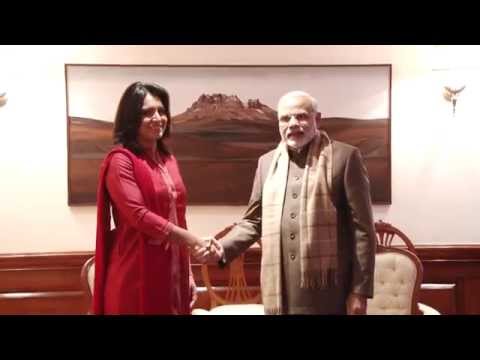
Beyond this, while Donald Trump was never photographed with Vladimir Putin prior to becoming president, Gabbard has been photographed with Modi on multiple occasions.
While some in the United States are waking up to Gabbard’s rhetoric of peace being out of step with her support for an extremist Hindutva government, for far too many, Gabbard’s calculated promotion of Hindtuva fits in with a United States that has been collectively brainwashed into thinking that somehow Islamic extremism is unique among the world’s fanatical religious movements. This is why it is all the more important to show ordinary Americans that while there is little direct evidence of Donald Trump conspiring with Vladimir Putin, there is plenty of evidence to demonstrate that Gabbard and Narendra Modi have a close if not too close public friendship that bears the same amount of scrutiny as do Trump’s alleged ties with Moscow.
Likewise, while Donald Trump’s “Muslim ban” was little more than a travel ban against countries with which the US has long had dubious relations at best, Gabbard supports a political movement in India that has made life for many of India’s 172 million Muslims, little short of a living hell and in some cases something even worse.
Conclusion 
For those still in the dark about the realities of Gabbard, one should remember that while Hinduism is a spiritual practice, Hindutva is a violent, extremist political movement. Therefore, criticisms of Gabbard have everything to do with her Hindutva and nothing to do with her Hinduism. Ironically, as Modi’s once electorally monolithic BJP is now facing a serious challenge from opposition groups led by the secular Congress party, one is now faced with the irony of Indians rejecting Hindutva politics just as Americans may be sleepwalking their way into promoting the most pro-Hindutva individual in the history of the US Congress as a potential future leader of the United States.
In a country like the US where it is still easy to win votes by offering a simplistic view of Islam based on the post-9/11 mass hysteria which still hasn’t fully evaporated from US political discourse, while Gabbard may be a long shot to win the White House, her anti-Islamic posturing could make her a surprisingly effective candidate.
Should Gabbard win the Democratic nomination for 2020, it has to be said that President Donald Trump with his big mouth and pragmatic streak would be a far sounder choice for Muslims and supporters of peace than a woman who hides her extremism behind a manipulative veil of moderation.

River to Sea Uprooted Palestinian   
The views expressed in this article are the sole responsibility of the author and do not necessarily reflect those of the Blog!

Friday, 9 November 2018

Why’d The US Issue A Sanctions Waiver For Chabahar?

By Andrew Korybko
Source
Many observers are wondering why the US issued a sanctions waiver for the Indian-built port of Chabahar in southeastern Iran and the railroad project that’s supposed to one day extend from it to Afghanistan, but the reason is that America sees this curious “Lead From Behind” arrangement as one of its last chances to retain its long-term influence in the landlocked country.
For as tough as the US promised that its reimposition of sanctions on Iran would be, it unsurprisingly went soft when it came to the issue of the Indian-built port of Chabahar in the southeastern part of the Islamic Republic. The State Department confirmed earlier this week that the US granted a sanctions waiver for this project, which simultaneously drew attention not only to the project’s significance, but also the special nature of the American-Indian Strategic Partnership if Washington thought it important enough to preserve at the expense of undermining its sanctions regime against Iran. The reason for this is that the US understands the long-term strategic ramifications of redirecting Afghanistan’s international trade away from Pakistan (and increasingly China) and towards the rest of the world market via the access that it obtains through Chabahar, which is why the railroad that’s supposed to branch off from this port to the landlocked country is also excluded from the sanctions regime.
Between A Rock And A Hard Place
The US isn’t just losing influence in Afghanistan on the military front after the Taliban’s recent spree of gains across the country, but also on the economic one as well after China’s recent inroads there, which America worries could soon have political consequences if Beijing succeeds in establishing new patronage networks with the internationally recognized Kabul elite. This could in turn make it less likely that the US can keep Kabul and the Taliban from striking a deal, especially one at its expense, which is why there’s such an interest in ensuring that America can still retain its control over Afghanistan’s permanent military, intelligence, and diplomatic bureaucracies (“deep state”). Suitcases full of cash aren’t sustainable, whereas the clinching of privileged business deals with China are, hence why the US had to urgently streamline a solution and realized that it was forced to rely on its newfound Indian ally.
No reasonable comparison can be made between China’s ability to exert influence in Afghanistan and India’s, but the two BRICS “frenemies” nevertheless did agree to cooperate in jointly training its diplomats. There’s also the possibility that they’ll pool their infrastructure resources together in turning the country into a shining example of the “China-India-Plus-One” framework that they unveiled before this summer’s BRICS Summit, thereby putting an end to the competition between the New Silk Road and the “Asia-Africa Growth Corridor”. On the surface, all of this should be appalling to America because of how much it risks undercutting its strategic ambitions in Afghanistan, but Washington is clearly wagering that mutual suspicions will persist between China and India which will in turn make the railroad a feasible opportunity for indirectly exerting influence through its South Asian “Lead From Behind” partner.
Keeping India In Line
Iran will obviously receive some residual knock-on benefits from being the transit country facilitating Indian-Afghan trade (which, to remember, is intended to function as a more sustainable means of ‘buying off’ Kabul’s “deep state” than suitcases full of cash in the face of China’s New Silk Road competition), but the US is willing to turn a blind eye to that because of how comparatively insignificant those profits will be. After all, the US could always sanction individual Indian or Afghan companies that trade with Iran across this route instead of keeping their economic activities on a strictly bilateral basis (apart from paying transit dues and other unavoidable expenses that go into the country’s coffers), so the plan is at least conceptually viable and doesn’t necessarily subvert the spirit of Trump’s sanctions policy against the Islamic Republic.
It needs to be emphasized that the US is engaging in long-term strategic planning that won’t yield immediate dividends, but that it’s undertaking this approach because of the high level of trust that it’s established with India since the election of PM Modi in 2014. The US now regards India as a strategic partner, one which is indispensable to “containing” China, even though India itself is playing a “double game”  by working closer with China over the past few months through a cunning strategy that it regards as “balancing” (officially described as “multialignment” in its official parlance). There’s always the chance that India could disappoint the US, but that’s unlikely since it needs access to the US marketplace to continue its growth and is deathly afraid (whether rightly or wrongly) of having its domestic industries swamped by Chinese imports if it pivots towards the New Silk Road.
A Reason To Rethink The Hybrid War On CPEC
This strategic backdrop suggests that the Indian-American Strategic Partnership is here to stay and that the US will continue indirectly backing New Delhi’s efforts to circumvent Pakistan and trade with Afghanistan via Iran in spite of the Trump Administration’s sanctions against the Islamic Republic. Adding another wrinkle to this already complicated arrangement is that Pakistan might counterintuitively benefit in some respects from Chabahar’s success so long as this gets the US and India to stop destabilizing Balochistan out of fear that the resultant blowback could endanger the Afghan corridor that New Delhi is building. Terrorism could easily spill across the border and threaten the project, thereby harming the US and India’s long-term joint strategic interests, and Iran might also take serious issue with India’s covert sponsorship of these terrorists to make its continued hosting of this corridor conditional on New Delhi discontinuing its support for them.
Pakistan and Iran are on the same page regarding the role that third-party actors have in provoking occasional border problems between them through these means, so considering the increasingly strategic importance that both countries attach to their relations with one another, it follows that Tehran’s interests would be best served by leveraging its influence over the Chabahar Corridor to ensure security in the transnational Baloch space. This is the only scenario in which Pakistan could partially benefit from the Chabahar Corridor, so it’s incumbent on those in Islamabad to do everything that they can to encourage their Tehran counterparts to take every step in that direction. The US and India have obvious reasons for wanting to continue their Hybrid War on CPEC, but the argument can be made that their support of Baloch terrorism to this end runs an unacceptably high risk of blowback that could scuttle their joint plans for Afghanistan and the rest of Central Asia.
Concluding Thoughts
The prima facie impression is that the US must have had some reason or another for waiving its sanctions against Chabahar, but cohesive explanations for why this is have been far and few between. It sounds absurd that the US’ interests in Afghanistan are furthered by Iran of all countries and especially at this specific point in time, but that’s the reality as it presently exists. To be clear, Iran isn’t intentionally assisting the US with anything, but its hosting of the Indian-built Chabahar Corridor to Afghanistan could be instrumentalized by Washington through its strategic partnership with New Delhi to advance the US’ grand strategic interests. On the other hand, however, Iran isn’t a completely passive bystander to this process either, and could at the very least work directly with its Indian partner to ensure that neither it nor the US continue their destabilization of Balochistan through the Hybrid War on CPEC because of the blowback that it could cause for the Chabahar Corridor.

River to Sea Uprooted Palestinian   
The views expressed in this article are the sole responsibility of the author and do not necessarily reflect those of the Blog!

Pakistan in the Middle of Saudi, Iran and Rival Pipeline Plans


Pakistan in the Middle of Saudi, Iran and Rival Pipeline Plans
 08.11.2018

Pakistan in the Middle of Saudi, Iran and Rival Pipeline Plans


Pepe ESCOBAR

A tweet roared like announcing a blockbuster premiere and sanctions did engulf Iran on time – despite opposition from Russia, China and the EU-3 (France, Germany and the United Kingdom), who still support the United-Nations endorsed Iran nuclear treaty.
Iranian President Hassan Rouhani has called this an economic war waged by a “bullying power”.

The US has imposed sanctions on Iranian shipping, finance and energy exports, blacklisting 700 people. They target the EU special mechanism to facilitate purchases of Iranian oil, a sort of alternative international payment system, and threats persist about cutting Iran completely off the Swift system (although several Iranian banks are already suspended).
There are also “temporary waivers” related to oil exports granted mostly to China, India, Japan, South Korea, Taiwan and Turkey, plus two Italy and Greece. This means that in the real world, beyond all the bluster, there’s no way to downgrade Iranian oil imports to “zero” without causing a global energy crisis.

The key exemption might as well be Chabahar port in Iran, the cornerstone of India’s own mini-New Silk Road strategy for South Asia and Central Asia, which depends on exports to and across Afghanistan.

In the words of John Bolton, the US National Security Adviser, they seek to achieve a “massive change in the regime’s behavior”.

But is that ever likely to happen? I got a different take on this when I visited a Pakistani courtyard…

Meanwhile, in Islamabad…

It’s a balmy night in an Islamabad courtyard and, punctuated by salutary laughs, a geopolitical carousel develops among some of the sharpest minds in West Asia, Southwest Asia and South Asia. They are  Junaid Ahmad from the School of Advanced Studies at the UMT in Lahore, Professor Mohammad Marandi of the University of Tehran, and Tugrul Keskin, a professor of Sociology at Shanghai University.

A Pakistani, an Iranian, a Turk and this global nomad. Inevitably our conversation swirls around the tasty possibilities of an Ankara-Tehran-Islamabad rapprochement.

We have had the privilege of being part of one of the most extraordinary conferences in recent times, “The Geopolitics of Knowledge and Emerging World Order,” which could not possibly take place in a paranoid West, but only in Asia, at the relatively young National Defense University (NDU) in frontline state Pakistan.

Not to mention the extra bonus of watching Pakistani generals talk about international relations across the Global South from what is a center-left, genuinely progressive perspective.    

The merit for the conference goes to gentleman-scholar Dr Ejaz Akram, professor of Religion and World Politics at the NDU, and a gifted, dedicated team.

Where else to discuss, in the same breath, the unity of Eastern civilizations in a New World Order, as exposed by Prof. Li Xiguang of Tsinghua University and a member of the Chinese Foreign Ministry Advisory Committee or be rocked by Isa Blumi, professor of Turkish Studies at Stockholm University, totally ripping apart Western silence on the genocidal war inflicted on Yemen by the “Saudi-led coalition?”

But for some of us, the real star of the show was a putative, developing alliance that could turn into a crucial game-changer in Eurasia integration. Hopeful signs are on the cards.

Presidents Erdogan and Rouhani have a very good relationship and are both deciders in the Astana process trying to solve the Syrian tragedy. Whatever the pressure, Turkey won’t cease to buy Iranian oil. Iranian Foreign Minister Javad Zarif was in Islamabad last week talking to Prime Minister Imran Khan. Turkey-Pakistan relations are extremely tight.

On a Shanghai Cooperation Organization (SCO) level, Pakistan is a full member, Iran will soon become a full member and Ankara is very much interested – and so are powerhouses Russia and China to have them all together inside the club.

Pakistan and China will start trading in yuan, as announced by Pakistani Information Minister Fawad Chaudhry, who has just extolled an expansion of the China-Pakistan Economic Corridor (CPEC) to agriculture and the construction of industrial zones.

At the China International Import Expo in Shanghai, Imran Khan defined CPEC as a vital link to the Middle East and Central Asia. CPEC is the flagship project of the New Silk Roads or the Belt and Road Initiative (BRI). Iran is a crucial BRI node as well. Turkey, though, is far from being integrated with Erdogan still studying the chessboard.

Still, an irresistible geopolitical pull – heavily influenced by Washington’s sanctions obsession – would drive Turkey-Iran-Pakistan closer to BRI and trading in their own currencies or in yuan.

Spoiler in the room

Of course, daunting pitfalls abound. Pakistan’s foreign policy is largely shaped by the army, where a significant faction just can’t get enough of “gifts” from the US industrial-military complex.

Imran Khan’s position, on the record, is that Pakistan will defend Saudi Arabia against all enemies – the Pakistanis head the Saudi Islamic Military Alliance and their two militaries are very close. But what if Imran, after visiting China and Saudi Arabia, pulls out a stunner and heads to his neighbor Iran?

Iran and Pakistan need a clear understanding about Wahhabi-indoctrinated fanatics using Pakistani Balochistan to wreak havoc in Iranian Sistan-Balochistan, as Imran and Zarif discussed last week in Islamabad.

On the energy front, a major soap opera that I have been tracking for years, the Iran-Pakistan pipeline, could finally be sorted out, much to the benefit of energy-starved Pakistan. The Iranian stretch was finished long ago while the Pakistani sector has been derailed by relentless pressure from Washington.

And that’s exactly where the ultimate spoiler, the House of Saud, comes in.

Pakistani Finance Minister Asad Umar insists Riyadh “did not ask for anything” in return for a crucial $6 billion aid package that includes selling $3 billion in crude oil on deferred payment. Islamabad badly needed it, as its foreign exchange reserves had dropped to a paltry $7.8 billion last week.

Riyadh not asking for anything in return does not cut it. On the energy front, Riyadh is very much aware that last month Tehran and Moscow signed a preliminary agreement with Islamabad to build a 2,775 km-long offshore natural gas pipeline from Iran to India via Pakistan.

The Saudi counterpunch was not less than spectacular; renewed investment to finally build the Turkmenistan stretch of another such link: the Turkmenistan-Afghanistan-Pakistan-India (TAPI) pipeline. The Iran-Pakistan pipeline and TAPI have been in virtual competition since the days of the Dick Cheney regime.

Turkmenistan, the ultimate idiosyncratic regime, has had enormous trouble – with both Iran and Russia, for different reasons – exporting its natural gas wealth. Ashgabat’s only secure market is China. Riyadh believes that by helping Turkmenistan on TAPI, Pakistan will not become too heavily dependent on the Iranian pipeline or the proposed offshore pipeline.

Yet there’s no guarantee that TAPI will ever be completed. TAPI starts at the Galkynysh gas field in Turkmenistan and goes right through Kandahar province in Afghanistan, which remains largely immune to Kabul’s influence. There’s no way a pipeline can be built there without Taliban acquiescence – and that would mean a negotiating process led by the SCO, which neither Russia nor Iran, for energy market reasons, are fond of.

So the key in all these interlocking intrigues is how Imran Khan will decide to position himself – between Iran and Saudi Arabia – for maximum leverage. Riyadh, for all its faults, still carries enormous weight on all matters Pakistani.

Meanwhile, deep in the Persian Gulf, a fleet of large Iranian oil tankers, actually “floating storage containers” as traders call them, have their geolocation devices turned off and stand ready to deliver oil on demand to any sanctioned, un-sanctioned or soon-to-be-sanctioned nation. And that’s a reality no roaring barrage of tweets is able to change.

River to Sea Uprooted Palestinian   
The views expressed in this article are the sole responsibility of the author and do not necessarily reflect those of the Blog!