Showing posts with label Book reviews. Show all posts

Friday, 8 October 2021

Book Review: The Russian Army on Parade

Book Review: The Russian Army on Parade

Today, I want to quickly review a truly superb two volume book called “The Russian Army on Parade” and “The Russian Commemoration Parade at the 75th Anniversary of Victory in World War Two” both written by Jim Kinnear (and Andrey Akesenow for the 2nd volume).  Here are the links to publisher from whom you can order both books:

These two books are absolutely unique and, in my opinion, invaluable.

First, let’s talk about the parades themselves.

Both in the Soviet times and in the post 1991 Russia, the Victory Day parades have had a very special meaning to both the Russian people and for their enemies.  These were not just “patriotic shows” (which they definitely are), but also a way to show to the Russian people and their enemies the latest achievements of the Russian military industry.  Furthermore, for military specialists, what might look like a boring parade of military hardware to a civilian can yield extremely valuable information not only about the hardware itself, but also about the Russian military thinking.  One example:

Russian tanks tend to be very different from their western counterparts.  They are all the product of compromises: the ideal tank is light, can cross rivers or even float, small, indestructible, fast and has unstoppable weapons – but in reality such a tank cannot be built as these criteria, and many many more, are mutually exclusive.  For example, tank building countries can put so much armor on their tanks that they would be close to impossible to breach (at least in theory), but the weight and size of the tank will make them huge which, in turns, limit the kind of bridges they can cross, what kind of river banks they can climb or how big they will look in the targeting systems of the enemy.  Then there is the issue of costs.  Would you rather have one (purely theoretically) “perfect” tank costing X or 10 “somewhat less than perfect” tanks for the same price (or even less!)?

So, as most weapons systems, tanks are the results of very complex compromises and a trained eye will even see what kind of terrain and tactics one tank has been designed for, as opposed to another tank.  Furthermore, if you look “deeper” inside the tank (even by its external features) you can make some good guesses on the kind of sensors or communication systems these tanks probably have.  Of course, the Soviets and the Russians always knew that, so they carefully decide what they do want to show or don’t want to show.  They can even deliberately try to hide the real capabilities of any weapons system/platform from “unfriendly eyes”.

I mention all of the above to explain that these two superb volumes (filled with hundreds of excellent color photographs!) are not just for hardware geeks and technology fanboys, they are a voyage through Russian military thinking!

The first volume covers the Russian military parades in the 1990s, then those in the 2000s and then those in the 2010s.  It concludes with an commented index of all the hardware shown between 1992-2019.

The second volume covers “only” the truly amazing parade in 2020 for the 75th commemoration of the defeat of Nazi Germany.

One might wonder, what about the Soviet, pre-1991 parades?

Here you have to remember that the development cycle for a weapons system/platform can take years or even decades, so almost all the current Russian military technologies have deep roots in Soviet military thinking.  Furthermore, the design philosophy of a complex weapons system can change over time, but often rather slowly.  This is simply an issue of common sense: why re-invent the wheel when it already works?  Of course, if the geostrategic environment changes dramatically, and instead of being deployed in eastern Europe the Russians now have NATO literally right across their border, things will change, and they have changed, often dramatically.

These two volumes focus on post-Soviet, Russian, military parades, they will give the reader an superb insight into Soviet military thinking (as opposed to the crap western propaganda like to spew about it during the Cold War).  Of course, the fall (or, more accurately, the dismembering by the Party elites) of the Soviet Union in 1991 had a major impact on Russian military thinking and while much of the superb Soviet military and scientific capabilities still lies at the root of modern Russian weapon systems/platforms, a new generation of (often much younger) engineers and scientists has produced (quasi) purely ‘Russian’ technologies (such as the Su-57 or the “Armata” series).

Thus, these volumes are also a extremely interesting way to look not at hardware, but at the evolution of Russian designs and their underlying force planning philosophy.

I highly recommend these two volumes to all those who want to understand why Soviet/Russian designs are so different from their western equivalents.  And no, it is not true to say that Russians like cheap and sturdy while westerners prefer high tech (that is purely propaganda). But I think that it is true to say that Russian designs are by and for soldiers and war whereas western designs are mostly by and for engineers and for big, juicy, military contracts.

If you want to see what kind of designs result from about 1000 years of existential, survival, warfare, then you can’t do better than getting these two volumes.  You will not be disappointed.

Andrei


River to Sea Uprooted Palestinian   
The views expressed in this article are the sole responsibility of the author and do not necessarily reflect those of the Blog!

Saturday, 10 April 2021

Raging Twenties Book Review – Pepe Escobar – the philosopher, the court jester, the mystic, the historian.

April 08, 2021

By Larchmonter445 for the Saker Blog

Early on in the introduction to “Raging Twenties”, Pepe Escobar points to the change, the disruption that confronts the Established Elites who for 30 years ruled the globe with a free hand: “The Empire we have been taught to accept as a fact of life is irretrievably losing its leadership position—and will have to deal with much pain implicit in the acceptance of an increasingly multipolar world.”

Escobar’s concept from “Raging Twenties” that impressed is: “We are all being carried forward through the tides by a harpooned whale, with no idea how, where, or when our journey ends. Like Melville’s Ishmael, we’ve got to stay cool as we relentlessly fight the winds of fallacy, fiction, fraud and farce that the expiring system manipulates non-stop.”

This is the vision of Pepe’s book “Raging Twenties”, a volume of works dedicated to the Covid-19 pandemic’s impact on people, governments and world affairs, especially the macro world economy.

Escobar is a man of many journeys, an adventurer, explorer, mapper and story-teller. For decades he has traveled the capitals of the globe and trekked the backroads of the third and fourth worlds more than any writer in our lifetime.

His professional vocation is understanding the human condition and transmitting via his writings that understanding of facts, people, events and situations. He has a unique quality to absorb information he personally gathers, demonstrating his grasp of geopolitical, philosophical and historical context, from ancient to modern.

Focusing on this decade, the “Raging Twenties”, a collection of Pepe’s definitive prose, is a “voice-over” that narrates the change in our world from a single-polar hegemon to a multi-polar world order in the time of a pandemic. He teases apart the complexities that often are unknown, misunderstood or misconstrued. His “voice” is pleasing though authoritative, yet instantly familiar. Writing that talks, as if it were an audio track, is his style.

“For the first time in two millennia, China is able to combine the dynamism of political and economic expansion both on the continental and maritime realms, something that the civilization-state did not experience since the short expeditionary stretch led by Admiral Zheng He in the Indian Ocean in the early 15th century. Eurasia, in the recent past, was under Western and Soviet colonization. Now it’s going all-out multipolar—a series of complex, evolving permutations led by Russia-China-Iran-Turkey-India-Pakistan-Kazakhstan.”

Escobar is a man comfortable in any of the five civilizations on Earth. He moves easily in the West, China, Russia, India or Iran, and most parts neighboring these giant cultures. He presents his narratives, tales of his travels and meetings in differing performances. Escobar has mastered four story-telling voices–philosopher, court jester, mystic, historian. He moves through these presenters seamlessly, embellishing his writing with intellectual depth and artful illumination.

In Chapter 8, “How the Riddler may teach us to fight a disease”, we perceive the Philosopher investigating the nature of our universe through the eyes of Heraclitus, the Riddler. “In his heart of hearts a contemptuous aristocrat, this master of paradox despised all so-called wise men and the mobs that adored them. Heraclitus was the definitive precursor of social distancing.”

“Heraclitus was a Taoist and a Buddhist. If opposites are ultimately the same, this implies the unity of all things. Heraclitus even foresaw the reaction we should have towards COVID-19: ‘It is disease that makes health sweet and good, hunger satiety, weariness rest.’ The Tao would approve it. In the Heraclitus framework of serial cosmic recycling, disease gives health its full significance.”

The Court Jester authors Chapter 5, entitled “We are all Stoics now”. Imagine a Court Jester flowing with Stoicism as pop culture in Ancient Greece. Pepe brings it to you. Escobar marks the first punk in History, Diogenes the Cynic. “It’s enlightening to know that the upper classes of the Roman empire, their 1%, regarded Zeno’s insights as quite solid, while—predictably—deriding the first punk in History, Diogenes the Cynic, who masturbated in the public square and carried a lantern trying to find a real man.”

He follows the transition from Greece to Rome as the ideas of the Stoics migrate over the centuries and better suit the Roman minds of Seneca, Epictetus and Marcus Aurelius, the trio we view as role models of Stoicism.

“The Stoics were very big on ataraxia (freedom of disturbance) as the ideal state of our mind. The wise man cannot possibly be troubled because the key to wisdom is knowing what not to care about.”

Have you ever read such a ‘take’ on Stoics, Cynics, Epicureans, Humanists, and Skeptics? Pepe ties it into the impact of the pandemic.

“Perhaps the ultimate Stoic secret is the distinction by Epictetus between things that are under our control—our thoughts and desires—and what is not: our bodies, our families, our property, our lot in life, all elements that the expansion of COVID-19 now put in check.”

“What the postmodern world retains from the Stoics is the notion of resigned acceptance—which makes total sense if the world really works according to their insights. If Fate—once again, Zeus, not the Christian God—rules the world, and practically everything that happens is out of our hands, then realpolitik means to accept “everything to happen as it actually does happen”, in the immortal words of Epictetus. Thus, it’s pointless to get excited about stuff we cannot change. And it’s pointless to be attached to things that we will eventually lose. But try selling this notion to the Masters of the Universe of financial capitalism.” You can hear Pepe’s laughter.

“So, The Way—according to the Stoics—is to own only the essentials, and to travel light. Lao Tzu would approve it. After all, anything we may lose is more or less gone already—thus we are already protected from the worst blows in life.”

As with each of the personas of Pepe we perceive in his collected work, he changes from one to another in mid-flight. The Court Jester can be seen and felt throughout “Raging Twenties”. Just take a tour of the Chapter Headings and the section sub-headings. Pepe does floor gymnastics, handstands and backflips, cartwheels and tumblesaults with terminology and labels. That big Escobar smile and hearty chest laugh abound: “Remember Pax Mongolica”, “The Sirens and La Dolce Vita”, “The Westlessness Myth”, “East is East, West is More”, “Barbarism With A Human Face”, “Enter The Triad”, “The City In A Time of Plague”, “Show Me Your Fragility”, “Barbarism Begins At Home”, “Flying Dragon, Crashing Eagle”, “Blake Meet Burroughs”.

The modern Mystic is with us in Chapter 10, “How Confucious, Buddha and The Tao Are Winning This War”, as well as the anchor chapter, “Eurasia, The Hegemon and the Three Sovereigns”. The Mystic appears most definitely in Chapter 25, a retrospective column Pepe chose to explore the digital ether that has wrapped around our brains. “Kim No-Vax Does Darpa” is a trip back into the early days of AI,3 research financed by Darpa, the teat that nearly all US computer scientists sought to suck. Reading this nostalgia spotlights the many dead-ends of US technology that generated the perverse present High-Tech Silicon Valley feudalism.

Travel with the Mystic to Venice, Chapter 3, “The Sirens and La Dolce Vita”. Pepe floats in Venice waterways to retrace selected steps with Ezra Pound. In “The Cantos”, we find The Sirens, sculptures that represent to Pound the beautiful culture, a time and place of the best which preceded a time (the present) of tawdry cheapness. The Mystic smoothly elides into “La Dolce Vita”, the Fellini film, that epitomizes the glitzy ugliness oncoming in the sixties. A period of trash culture that now envelopes the globe, foretold by Pound, embossed by Fellini and absorbed by us.

Pepe the Historian appears nearly everywhere in the pages of “Raging Twenties”. In a most clever Chapter 13, “Siren Call of A ‘System Leader’”, Pepe wends through the Mongol age of Genghis Khan, to the death of Kublai Khan and the end of that Empire right into the 21st Century where the USA Empire, like the last great Khan, faces China. However, China is a part of Eurasia, the vast resource of the multi-polar sovereigns China, Russia, Iran, India, their neighbors and friends, arrayed ready to construct a new world based on four civilizations, not an ideology like the failed Empire of the USA.

The Historian gathers from Thucydides and others regarding plagues. Pertinently, Escobar delivers the connection of the fall of empires and plagues as cause. “Predictably eyeing the Decline and Fall of the American Empire, a serious academic debate is raging around the working hypothesis of historian Kyle Harper, according to whom viruses and pandemics—especially the Justinian plague in the 6th century—led to the end of the Roman Empire.”

Escobar’s journalistic roots remain in real politic while consistently pointing out the gap between the twisted souls that feel the need to lie, cheat and murder to achieve their ends. With acerbic ink, he writes: “Those were the days when NATO, with full impunity, could bomb Serbia, miserably lose a war on Afghanistan, turn Libya into a militia hell and plot myriad interventions across the Global South. And of course, none of that had any connection whatsoever with the bombed and the invaded forced into becoming refugees in Europe.”

Pepe’s economic interest in Belt and Road and the China-Russia comprehensive strategic partnership of coordination for a new era opens our eyes to the real geo-political shifts. The pandemic has fractured world trade. “Soon we will be facing three major, interlocking debates: the management of the crisis, in many cases appalling; the search for future models; and the reconfiguration of the world-system.”

Peering over our Covid masks, we read Chapter 12, “How To Think Post-Planet Lockdown”. Pepe’s main insight remains valid: the state of exception has been completely normalized. And it gets worse: “A new despotism, which in terms of pervasive controls and cessation of every political activity, will be worse that the totalitarianisms we have known so far.”

“As dystopia and mass paranoia seem to be the law of the (bewildered) land, Michel Foucault’s analyses of biopolitics have never been so timely, as states across the world take over biopower—the control of people’s life and bodies.”

Pepe gives us, among many, Giorgio Agamben, who redoubles his analyses of science as the religion of our time: “The analogy with religion is taken literally; theologians declared that they could not clearly define what is God, but in his name they dictated rules of conduct to men and did not hesitate to burn heretics. Virologists admit they don’t know exactly what is a virus, but in its name they pretend to decide how human beings shall live.”

In the section, “Enter the triad”, Chapter 10, Pepe postulates: “I offer as a working hypothesis that the Asia triad of Confucius, Buddha and Lao Tzu has been absolutely essential in shaping the perception and serene response of hundreds of millions of people across various Asian nations to COVID-19—compared to the being is the greatest joy.” It also helps to know that “life is a series of natural and spontaneous choices. Don’t resist them—that only creates sorrow. Let reality be reality. Let things flow naturally forward in whatever way they like.” Buddhism runs in parallel to the Tao: “All conditioned things are impermanent—when one sees this with wisdom, one turns away from suffering.” And to keep our vicissitudes in perspective, it helps to know that, “better it is to live one day seeing the rise and fall of things than to live a hundred years without ever seeing the rise and fall of things.”

Quo Vadis. Where are you marching?

Pepe shows us the way, the paths we are on. He offers, too, a pantheon of “travelers” who opine from the high clouds of history, from books on dusty shelves of libraries, from blogs and videos on digital platforms, all snatched by his rapier mind to weave affirmation into his ideas and analysis. In sum, a feast awaits the reader, taken as a banquet or a serial read chapter by chapter. Enjoy.

###

Where you can buy RAGING TWENTIES by Pepe Escobar


River to Sea Uprooted Palestinian   
The views expressed in this article are the sole responsibility of the author and do not necessarily reflect those of the Blog!

Wednesday, 24 March 2021

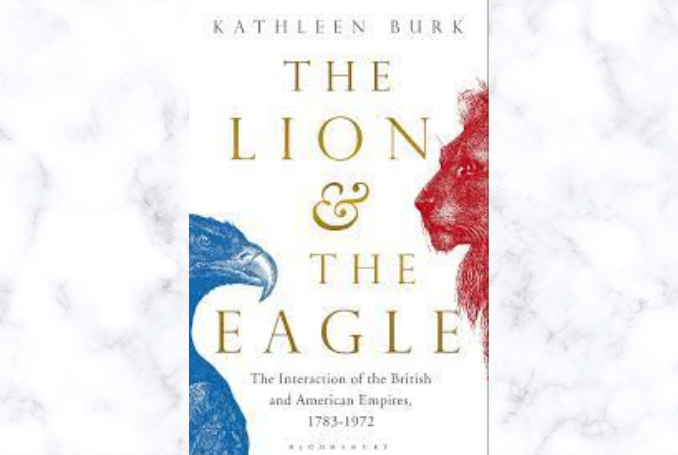
The Lion and the Eagle: The Interaction of the British and American Empires, 1783-1972 – Book Review

 March 23, 2021

The Lion and the Eagle: The Interaction of the British and American Empires, 1783-1972 by Kathleen Burk. (Photo: Book Cover)

By Jim Miles

(The Lion and the Eagle – The Interaction of the British and American Empires 1783-1972.  Kathleen Burk.  Bloomsbury, London/New York, 2018)

The 200-year historical span of Kathleen Burk’s “The Lion and the Eagle” shows the changes in the interactions between the newly formed United States and its imperial drive and the ongoing imperial drive of the British. In general, the former overtook the latter with the United States momentarily being the single superpower, but still with strong ties to Britain and the remnants of empire and the Commonwealth. Along the way, there were agreements and disagreements as well as many commonalities that pervaded both empires.

North America’s Dividing Line – The US-Canada Border

The first two chapters cover the not-so-well-known minor conflict between Britain and the US over the border between Canada and the US as they spread across the continent. The only actual war, although there were other skirmishes – including one in which the only casualty was a pig – was the war of 1812 which ended with both sides able to claim some kind of victory.

Apart from these descriptions the overriding theme became that of both countries not really wanting to go to war with each other in spite of political rhetoric. Britain was preoccupied with France and other European countries all striving for a ‘balance’ in Europe from which to control all the different colonial enterprises overseas.  The United States remained financially tied to Britain through various loans and debts, while the US navy for much of the time could not match the power of the British navy’s ability to blockade their former colony.

By the time the border was fully resolved (1903) the power differential between the two empires had shifted.  The U.S had settled many of its internal problems, and its navy grew to a strong enough position to negate any possible British threat. Throughout most of this time, while technically independent, “the US was a developing country, an economic and financial colony of Britain.”  The US industrial production grew significantly but Britain “did maintain its overwhelming supreme position…in finance.”  The pound sterling was the world’s “only reserve currency and the City of London was the world’s financial center.”

A discussion that was not developed was the manner in which both empires looked at the ‘new world’ and how they treated the indigenous people and the resources of the land.  For all the talk of freedom and independence, control of the land and the people, and power and money ruled the empires. This becomes much more evident in Burk’s discussion concerning China and Japan.

Empirical parallels

The histories of the “opening” of China and Japan are – or should be – relatively well known.  What stands out in Burk’s discussion, much of it extracted from original journals and government records is the arrogance and self-aggrandizement of both empires in their self-righteous roles to control the resources and people of the world.   Underneath it all lies the largest factor – racism.

From the Chinese perspective, “Any relationship between the Celestial Empire and a foreign country must be as one between supreme ruler and vassal…the uncultured barbarian would recognize the superiority of Chinese civilization…by bringing tribute and taking part in full Court ritual” – kowtowing.  The British of course refused to kowtow and expected to be treated as an equal and indeed saw itself as the superior power.

“The Chinese saw Western Ocean barbarians as warlike and dangerous and the British as the most dangerous of all. The Emperor warned…that ‘England is stronger and fiercer than the other countries in the Western Ocean. Since things have not gone according to their wishes, it may cause them to stir up trouble.’”

As for British cultural superiority, the first British ambassador, Viscount Macartney, after presenting British presents to the Emperor, “was taken from the pavilion to pavilion and realized just how relatively unimpressive were the objects that he had brought from Britain.”

Burk’s discussion develops the history through the opium wars, the intrusions of the other European powers, and more importantly for this work, shows how the US adventures in China more or less rode along on the coat-tails of the other empires, in particular the British.

Japan was different in many aspects, but the same racial arrogance from both empires becomes obvious, and the use of military power – at least the threat of using it – is one of the main bargaining points of  US diplomacy.  Japan was a unified country but at the time of initial US interventions, a power struggle was developing between the Emperor and the Shogunate.  At this point, the US “remained an economic colony of Britain”  and used mainly threats to coerce the Japanese into accepting trade relations.

The British in Japan showed the same arrogance towards the Japanese as they did the Chinese and their actions “were largely conditioned by Britons’ experience in China…assuming there were few differences between Asian countries,” and that “Japan had no right to prevent other countries from sharing its riches.”  At the initial stages the US “had substantial economic interests in China, not least in the opium trade, but relatively little diplomatic or military influence,” and was “running behind the British.”   British negotiations with Japan came mostly as military threats.

The Japanese were in a different position than China, and between the two factions, the one that succeeded to power wished to acquire “scientific and engineering knowledge” in order to push out the barbarians after they had mastered the technology.

Empires Reversed…

The last chapter covers a large span from 1897 to 1972.  During that period two World Wars and several financial crises affected the relationship.  World War II was the final turning point as one of the US’ goals was “significant control over international finance.”  The Bretton Woods agreement which essentially established this formally is only mentioned in regards to the financial havoc created by the US’ Vietnam War. The Suez Crisis and the Israeli attack on its Arab neighbors combined with the financial demise of the British pound, brought the US empire to full dominance militarily and financially. The US became the prime supporter of the colonial-settler state of Israel militarily and financially, while Britain remained as a military empire in its own right with 145 bases around the world to complement those of the US.

…Current Events

In her very short epilogue “Envoi”, Burk ends on a confusing note.  She talks briefly about the US empire of bases and then mentions the invasions of Afghanistan and Iraq. Her next statement, her next to the last statement, reads, “As long as these countries can be protected without becoming protectorates, this American power will be welcomed, or at least tolerated.”  By the rules of grammatical sequencing, this refers to Afghanistan and Iraq, making the statement a rather sad wilfully ignorant ending as there is no way the US’ presence in either of these two countries is either welcomed or tolerated.

If it is an improper grammatical reference to 130 countries with military bases then its sentiment remains highly arguable.  The many countries with bases (which do include Afghanistan and Iraq) may have governments accepting US bribes, graft, and financial manipulation, but it is not likely the everyday citizen is as accepting of the US presence.

…And Beyond

That small point aside – and it is the only point in the book that I question marked – both empires have moved on.  The US is no longer the sole superpower, although it remains the most powerful military and financial empire. It uses both its military power (mostly – covertly and overtly) and financial power – sanctions mainly – vis a vis its control of the “Washington consensus” institutions (the IMF, World Bank, BIS, SWIFT, et al).

Britain remains within the US thrall, supporting the arrogance and imperial lies that sustain domestic support during the election cycles.  As a part of NATO, as a member of the “Five Eyes”, with veto power on the Security Council at the UN, and maintaining a recently renewed arsenal of 260 nuclear weapons, Britain is no slouch.

Concomitant with that is the residual power of the “City”, the London financial district.  The LIBOR, the London Interbank Offered Rate still powers much of the world’s financial interactions. Established much more recently, the LBMA, the London Bullion Market Association, comprises the largest gold and silver markets in the world. It would be unusual if these two organizations do not liaise with their US counterparts to maintain control of the current global financial position in which the US $ is now the world reserve currency.

Also important financially are the other polar elements of world power, China and Russia.  Both have mainly extricated themselves from direct US currency manipulations (it’s not all that easy) and both have accumulated large amounts of the “barbarous relic” – gold – which many of the world’s central banks are also accumulating or repatriating from New York and London.

With Brexit, with the COVID crisis, and with the US ‘recovering’ from four years of an overtly racist government, the entanglements between the two empires will continue with that racism and general arrogant outlook towards the rest of the world.  Kathleen Burk’s “The Lion and the Eagle” is an excellent history covering the events and attitudes of the politicians involved with this ongoing duet.

– Jim Miles is a Canadian educator and a regular contributor/columnist of opinion pieces and book reviews to Palestine Chronicles.  His interest in this topic stems originally from an environmental perspective, which encompasses the militarization and economic subjugation of the global community and its commodification by corporate governance and by the American government.


River to Sea Uprooted Palestinian   
The views expressed in this article are the sole responsibility of the author and do not necessarily reflect those of the Blog!

Friday, 5 March 2021

Book review: “Disintegration” by Andrei Martyanov

Book review: “Disintegration” by Andrei Martyanov

THE SAKER • MARCH 1, 2021

This is the third book by Andrei Martyanov that I am reviewing, the first one was “Book Review – Losing Military Supremacy: the Myopia of American Strategic Planning by Andrei Martyanov”, while the second one was “Book Review: Andrei Martyanov’s The (Real) Revolution in Military Affairs”. I also interviewed Andrei about this second volume here. The book I am reviewing today, “Disintegration: Indicators of the Coming American Collapse” can be pre-ordered from Clarity Press here and from Amazon here.

If the first two volumes mostly focused on issues of force planning and military power, this third volume addresses the wider context and shows example after example that the United States is not only failing at its attempts to remain a world hegemon, but the US is, in fact, in a process we could call “full-spectrum collapse” or, like Martyanov, simply “disintegration”. Specifically, the book looks into the manifestation of disintegration in the following spheres:

  1. Consumption
  2. Affluenza
  3. Geoeconomics
  4. Energy
  5. Making Things
  6. Western Elites
  7. Losing the Arms Race
  8. Empire Über Alles – Including Americans
  9. To Be or Not To Be
  10. Conclusion: Not Exceptional, Not Free, Not Prosperous – Not America?

These are tantalizing subject headings which I will not further describe because I really want to really encourage as many people as possible to read this book. Why?

Mainly because while Martyanov’s first two books were dealing primarily with military and geostrategic issues, this one goes much wider and looks at the wider socio-cultural reasons which create the context for such a dramatic lack of real military capabilities.

A month ago I wrote an article I called “Zone B Exists, Thus There Is Hope, I Promise You!” in which I tried to show that the pseudo “reality” in which most people in the West are artificially kept in by the most effective (and insidious) propaganda machine in history is not the “real reality” at all! Not only that, but that most of the planet has been living in “Zone B” for quite a while. In fact, this “Zone B” has already moved on, even if the legacy ziomedia never reports about this.

Well, you can think of Martyanov’s books like the perfect example of a “Zone B book”: not only does Martyanov debunk most of the myths of the US propaganda machine, he contrasts these delusions with examples from the real world.

You could buy only one or two of Martyanov’s books, and each of them stands on its own, but I really think of them as a trilogy which should be read and discussed by as many people in the West as possible. In fact, you could think of them as each a kind of “crash course on debunking delusions and returning to reality”. The overarching message of all three volumes is this: “People of the United States, your ruling elites are lying to you just like the chamber orchestra on the Titanic that was playing music while the supposedly “unsinkable” Titanic was sinking!”.

Interestingly, Martyanov adds that, of all nations, Russians understand these processes better than anybody else because they they too suffered the same fate during the “democratic nightmare of the 1990s” (I would add that descendents of White Russians like myself also remember the “democratic nightmare” under Kerenskii in 1917). Martyanov writes:

“The collapse of the Soviet Union and the economic catastrophe which followed taught Russians a lot, and also left an aftertaste of the humiliation of losing power – a process the United States is going through right now”

Truth be told, Martyanov is hardly the first person to have mentioned the uncanny similarities between the Soviet Union of the late 80s, or the Russia of the 90s, with the US of the last two decades (or more). For example, Martyanov mentions Dmitry Orlov whose many books have looked into what he calls the “stages of collapse” (financial, economic, political, social, cultural and, later, he added ecological) and have became a precious analytical tool for many researchers. Many decades earlier, Alexander Solzhenitsyn, whom Martyanov intensely dislikes, also often mentioned that the West of the 80s reminded him of the Russia of the early 20th century. This is just to illustrate Martyanov’s point that,

“Speaking in layman’s terms, the Russians get it. They, unlike any other people in the world, can relate to what the United States is going through right now. Russians can read the signs extremely well, while the U.S. elite not only has no experience with it, but is completely insulated from understanding it. This is America’s tragedy unfolding before our very eyes. Not only is America’s crisis systemic, but its elites are uncultured, badly educated and mesmerized by decades of their own propaganda, which in the end, they accept as a reality”

I couldn’t agree more. I would also add that those Russians who write books and articles desperately trying to warn the people of the US of real catastrophe taking place do that not because they are hostile to the United States, but precisely because they are sympathetic to the people of the US. The flag-waving pseudo-patriots who accuse these Russians of being “anti-American” simply don’t understand the “evil Russians” they hate so much (mostly because modern Russia under Putin has been fantastically successful, in spite of sanctions, threats, subversion, etc., while the US is in agony – that is why these folks are willing to believe anything bad, no matter how self-evidently stupid, about Russia and/or Putin).

Yes, of course, Russians hate and despise the US ruling Nomenklatura, just as they despised their own, Soviet, Nomenklatura. But that in no way implies what many mistake for “anti-American” hostility.

In my almost 58 years of life I have been blessed with the chance to travel a lot and speak six or so languages, yet I have never come across what I would call “anti-Americanism”. Even in countries supposedly hostile to the US the actual focus of the anger and disgust of people are the actions of the AngloZionist Empire, the ugly parasite feeding off its US host. Take a country like, say, Brazil. Anti “yankee” feelings have always been strong there, yet Brazilian musicians are known to beautifully fuse US and Brazilian music (see this superb example). The same is true elsewhere: people hate US policies, but very rarely the people of the US. Right now, judging by the Runet and emails from friends, Russians mostly feel pity for the people of the US, not hate, and this is so because they “get it” as Martuyanov correctly states. Of course, there are stupid and/or bigoted people in all countries and I am sure that there are those who hate the United States as a country, but I am confident that this is a small minority. There is one interesting category left: those who become critical of the US society after having lived in the US; a famous example of that would be Sayyid Qutb

None of that is meant to whitewash all the violence and ugliness of the short but extremely violent US history. But violence and ugliness exist in the history of probably every country on the planet (there sure was plenty of violence and ugliness in the history of Russia!). True, the US was probably one of the most bloody and violent regimes in history, but that violence ought to be attributed to imperialism and capitalism and not to something unique to the US (the British Empire was possibly the most criminally violent in history). Even more important to the understanding of US history is that most of its violence had its roots not in national or racial causes, but in the many social or, better, class struggles which peppered the history of the US. Again, discussions of class issues have been comprehensively blotted out from all the school books in Zone A, depriving those who had the misfortune to be educated in the West from one of the most important tools of political and economic analysis.

The importance of the above cannot be overstated and this is why Martyanov comes back to the topic of the education of the western ruling classes over and over again. In the last pages of Disintegration Martyanov writes:

Thus, no viable ideas or solutions to the current unfolding economic, social and cultural catastrophe can originate within these elites, who see the world only through the Wall Street and New York Times lenses. Real intellect, courage and integrity are simply not there: they all have been traded for the perks and sinecures of what many correctly describe as the Washington D.C. blob, whose only purpose for existence is self-perpetuation.

I would only add that there is a karmic irony in the fact that it is precisely because these ruling classes have no other purpose in life than self-perpetuation (and consumption, I would add) that they are driving themselves, and the country which they exploit, into extinction.

Conclusion: these are “must read” books for all of Zone A! (and even Zone B!)

Finally, it is precisely because Martyanov’s books are like “messages from Zone B” that I urge every person living in the US or in the EU to read them. As I said, each of these books stands on its own, but together they reach a kind of intellectual critical mass which makes them truly “must read” books, especially for those who hate their ruling regime but love their country.

These books are all pretty short, very well written, they have decent (but not perfect) indexes and are an easy read. If you want to get a superb summation of what is really going on in the United States (as opposed to the frankly laughable AngloZionist propaganda or the inchoate and outright childish slogans of the flag-waving “Trump patriots”) – read these books. If you have brainwashed friends, give them any (or, better, all of) these books: they are like a “crash course in reality studies”. If you have family members who still believe all the nonsense about “American exceptionalism”, challenge them to read these books.

Folks living in Zone B would also immensely benefit from reading Martyanov’s books. Not because these books will tell them much they weren’t already at least vaguely aware of, but because these books are also a very truthful “state of the United States” kind of SITREP. In my experience, while most folks (at least the well-read ones) in Zone B do mostly understand that the Empire is dead (or very close to death) and while they also feel the US are undergoing a massive internal catastrophe, most of these folks in Zone B do not fully appreciate the magnitude and severity of these crises. For them too Martyanov’s books will be an eye opener. This is also why I hope that all three of Martyanov’s books will be quickly translated into Russian: they will become instant blockbusters and, what is even more important, they will be read in Russian academies and universities. French and Spanish are another two languages I hope that these books will be translated into.

But, most of all, I hope (against any common sense or logic) that these books will be read by truly patriotic US officers, force planners, analysts, political decision-makers, etc. Right now, there is a real threat of these folks stumbling into a shooting war with Russia which the US will never survive (nor would Russia or much of the rest of the world, of course). But even if by some miracle this potential war remains non-nuclear, the US will still be destroyed, at least as a functioning country, by Russian conventional capabilities. This is the single biggest danger and possible disaster authors like Myartyanov are so desperately trying to prevent: a major war caused by a clueless ruling Nomenklatura involving a country (the US) which has never fought a defensive war in its history and which has never experienced real warfare, especially not against a competent adversary. I can only add that in case of a conventional war, Russia now has the means to defend not only her airspace, but a conceptual “Russian border proximity zone” of roughly 800km-1000km (and this range is steadily increasing). The US cannot. Neither can the EU or NATO. And for all the silly MIC+Pentagon promises of super-duper missiles, this is not something which will change in the short to medium time frame.

The more people in the US realize this, the better the chances avoid a terrible catastrophe. Hence the timely importance of Andrei Martyanov’s books.


River to Sea Uprooted Palestinian   
The views expressed in this article are the sole responsibility of the author and do not necessarily reflect those of the Blog!

Friday, 24 August 2018

Book Review: The Russian Peace Threat by Ron Ridenour

August 24, 2018
[This article was written for the Unz Review]
*******
Ron Ridenour’s latest book (this is his 10th book on international relations and politics) takes a direct shot at one of the most prevailing myths in the western political discourse: the thesis that Russia, then the Soviet Union, and, since 1991, Russia again have been uniquely aggressive and generally bellicose states. At a time when rabid russophobia is the order of the day (again – chronic russophobia has been a regular feature of western political culture for many centuries now), this is a very timely and important book which I highly recommend to those interested in history.
The book is separated into three parts. In the first part of the book (The Great Capitalist Socialist Divide), Ridenour looks at the Cuban Missile Crisis in some detail and uses it to debunk the many myths which the “official” US historiography has been presenting as dogma for decades. In this first section, Ridenour also provides many fascinating details about Captain Vasili Arkhipov “the man who prevented WWIII”. He also recounts how the US propaganda machine tried, and still tries, to blame the murder of JFK on the Russians. The second part of the book (Peace, Land, Bread) goes back in history and looks into the ideological and political struggle between the collective West and the Soviet Union from the revolution of 1917 and well into the Cold War. The third part of the book (Russia At the Crossroads – the Putin Era) conclude with very recent events, including the western backed coup d’etat in the Ukraine and the Russian intervention in Syria.
The first and the third parts of the book are extremely well researched and offer a rock-solid, fact-based, and logical analysis of the Cuban Missile Crisis and its modern equivalent, the AngloZionist “crusade” against modern Russia. This is a very important and good choice because the two crises have a lot in common. I would even argue that the current crisis is much more dangerous than the Cuban Missile Crisis because of the extremely low personal and intellectual qualities of the current US ruling elites. Ridenour shows that in 1962 it was not the Soviets, but the US which pushed the world to the edge of a nuclear war, and in the third section of his book he shows how, yet again, the Empire is cornering Russia into a situation which, again, very much risks resulting in a nuclear conflict.
For those who would have a knee-jerk rejection of Ridenour’s crimethink, the book, on page 438-444, offers a list of governments the USA has overthrown since WWII (50), countries which the USA has bombed (30), foreign leaders it has murdered (50+), suppressed populist/nationalist movements (20), and subverted democratic elections (30). Ridenour then asks how it is that with a tally like that the US gets to moralize about Russia. He is absolutely right, of course. Compared to the USA, the Soviet Union was a peace-loving, non-interventionist and generally international law respecting country. Oh sure, the USSR had its share of horrors and evil deeds, but compared with the “land of the free and the home of the brave” these are minor, almost petty, transgressions.
The book is not without its faults. Sadly, in the second part of his book Ridenour repeats what I can only call the “standard list of western clichés” about the 1917 Revolution, it’s causes and effects. Truth be told, Ridenour is most certainly not to be singled out for making such a mistake: most of the books written in English and many of those written in Russian about this period of Russian history are basically worthless because they are all written by folks (from all sides of the political spectrum) with a vested ideological interest in presenting a completely counter-factual chronology of what actually took place (Russian author Ivan Solonevich wrote at length about this phenomenon in his books). Furthermore, such a process is inevitable: after decades of over-the-top demonization of everything and anything Soviet, there is now a “return of the pendulum” (both in Russia and outside) to whitewash the Soviet regime and explain away all its crimes and atrocities (of which there were plenty). For these reasons I would recommend that readers skip chapter 7 entirely (the description of the 1905 and 1917 revolutions are particularly bad and sound like a rehash of Soviet propaganda clichés of the early 1980s).
This weakness of this historical analysis of the two Russian revolutions is, of course, rather disappointing, but it in no way affects the pertinence of the fundamental thesis of this book: that, for all its very real faults, the “Evil Empire” was a gentle and timid regime when compared to the AngloZionist “Axis of Kindness” and its never-ending violent rampages all over the world (literally) and its orgy of subversion and violence in the name of democracy, freedom, human rights and all the rest of the western propaganda buzzwords.
The book’s afterworld begins with the following words “WAITING AND WAITING! Waiting for the end of the world! Waiting for Godot! Although, unlike in Samuel Beckett’s Theater of the Absurd play, in which Godot never arrives, the mad men and mad women leaders of the US, France and UK (and Israel) are bringing us their bombs”. Having been warning about the very risks of war for at least 4 years now, and having, along with others, posted a special “Russian Warning” to warn about this danger, I can only wholeheartedly welcome the publication of an entire book aimed at averting such a cataclysmic outcome.
My other big regret with this book is that it does not have an index. This is particularly frustrating since the book is packed with over 500 pages of very interesting information and can be used as a very good reference book.
Still, these criticisms should not distract from the very real value of this book. One of the most frightening phenomena today is that the Empire and Russia are currently headed directly for war and that, unlike what took place during the Cuban Missile Crisis, almost nobody today speaks about this. The western corporate media is especially guilty in this regard, as it encourages a constant escalation of rabid anti-Russian rhetoric (and actions) without ever mentioning that if brought to its logical conclusion such policies will result in a devastating war which the West cannot win (neither can Russia, of course, but that is hardly much of a consolation, is it?).
There have been courageous voices in the West trying to stop this crazy slide towards a nuclear apocalypse (I especially think of Professor Stephen Cohen and Paul Craig Roberts) but their’s were truly “cries in the wilderness”. And it doesn’t matter one bit whether somebody identifies himself as a conservative, liberal, progressive, libertarian, socialist, anarcho-capitalist or by another other (mostly meaningless) political label. What matters is as simple as it is crucial: preventing the Neocons from triggering a war with Russia or with China, or with Iran, or with the DPRK, or with Venezuela, or with… (fill in the blank). The list of countries the US is in conflict with is very long (just remember Nikki Haley berating and threatening the entire UN General Assembly because the vast majority of its members dared to disagree with the US position on Jerusalem), but Russia is (yet again) the designated arch-villian, the Evil Empire, Mordor – you name it! Russia is the country which wants to murder everybody with poison gas, from the Skripals in the UK, to the innocent children of Syria. Russia is the country which shoots down airliners and prepares to invade all her western neighbors. Finally, Russia is the place which hacks every computer in the “Free World” and interferes with every single election. The longer that list of idiotic accusations stretches, the bigger the risk of war becomes, because words have their weight and you cannot have normal, civilized relations with the Evil Empire of Mordor which is “highly likely” to invade, nuke or otherwise subvert the peace-loving peoples of the West.
Except that there never was any such thing as a “peace loving West” – that is truly a self-serving and 100% false myth. The historical record shows that in reality the collective West has engaged in a 1000 year long murderous rampage all over the planet and that each time it designated its victim as the culprit and itself as the defender of lofty ideals. Ridenour’s The Russian Peace Threat: Pentagon on Alert (alongside with Guy Mettan’s “Creating Russophobia: From the Great Religious Schism to Anti-Putin Hysteria”, whose original French edition I reviewed here) does a long way towards debunking this myth.
With the few caveats mentioned above, I highly recommend this book.

River to Sea Uprooted Palestinian   
The views expressed in this article are the sole responsibility of the author and do not necessarily reflect those of the Blog!

Tuesday, 29 May 2018

In Memory of Philip Roth

Introduction by GA: I wrote the following  book review a decade ago. 10 years later, Israel and its subservient English Speaking Empire are still mounting pressure on Iran,  the Middle East is bleeding and peace looks like a remote fantasy. Pre TSD is the medium in which we operate and a prospect of a better future seems like a delusional dream. A decade ago I concluded this review wiring that “the current plot isn’t just against America. It is a plot against humanity and human dignity.” Sadly, nothing really changed.

6_13_025.jpg

The Plot Against America – a book report and a reality check

…Roth is no doubt an astonishing writer but somehow he has always failed to convince me. I always had the feeling that Roth is just too aware of his enormous talent; something that made him slightly technical and pretentious at times. Being a prolific writer, Roth can be slightly impersonal to my taste and yet, in his latest book he is free from that. No literary imposed tactics or strategies can be traced. In his latest book, Roth is overwhelmingly personal. Astonishingly enough, the fictional reality he conveys is so convincing that I found myself totally captivated from beginning to end. So enthralled was I, that I even managed to forget how depressing the world is out there. I avoided the anti-Iranian media blitz. I switched it off for three days and let the international community attack the Iranian president in a single Judeified voice.
‘The Plot Against America’ is a fictional tale that unwinds like a historical document enriched with personal detail. Its theme is: what would have happened if ace pilot Charles Lindbergh, the man who made the first solo transatlantic flight in 1927, the man who later called Hitler ‘a great man’, and was decorated by the Führer for his services to the Reich, had run for the American presidency against Roosevelt in 1940 and managed to win? Lindbergh’s message to the American nation is a classic Republican isolationist one. ‘No more war! Never again will young Americans die on foreign soil’. The year is obviously 1940 and Lindbergh is referring to Europe and the Pacific rather than Iraq, Afghanistan, Syria or Iran. In Roth’s book, instead of Roosevelt being elected for an unprecedented third term, Lindbergh wins in a landslide victory. He then signs non-aggression treaties with Germany and Japan. Soon enough the charismatic Lindbergh is cheered by American society as a whole. Every American loves him except of course the Jews who are far from being happy with a ‘peace loving’ president who happens to make business with the enemies of the Jewish people. But in fact this isn’t entirely true, a single prominent liberal Rabbi named Bengelsdorf positions himself right behind the new president.
The narrator is Philip Roth himself, a seven-year-old Jewish Ghetto boy from Newark, New Jersey. He tells a story of a Jewish family encountering a major disastrous political shift. Young Phil is telling the story of father Herman, mother Bess and brother Sandy. It is a story of collective fear, a story of a Jewish family’s reaction to the rise of anti-Semitism. However, throughout the book it is very hard to determine whether anti-Semitism constitutes a real objective threat or rather something the Jews bring on themselves. This very confusion is in my opinion the greatest literary asset of the book.
Roth is sketching a very deep and complex narrative in which each family member responds differently to the ‘devastating’ historical circumstances. Once again, Roth managed to convey an interesting image of the difficult amalgam of the Jewish identity both psychologically and sociologically. Like most American Jews, Herman the father is overtly pessimistic from the very beginning. He wouldn’t give Lindbergh even a single day of mercy. However, he is a proud patriotic American. He demands his civil rights. Were he in our midst, he would criticise the emerging catastrophic reality applying to the American liberal ideology. The mother Bess is far more practical, she tries to maintain the family’s sanity, behaving as if life must go on. More than anything else, she must calm down her righteous husband. Phil’s brother Sandy is a gifted painter and assumes a very interesting role. In the summer he disappears for an “apprenticeship” with a tobacco farmer in Kentucky. In a way he makes it into the heart of America. Later he is joining a new assimilation scheme by encouraging Jewish city boys to follow his example. This program is put together by Rabbi Bengelsdorf, the devoted supporter of Lindbergh. Sandy is doing very well, eventually he is invited to a reception at the White House. This is obviously far more than Herman can take. For Herman, the democratically elected American president is nothing but an enemy of the Jews and he refuses to give his son permission to go to Washington. The tension between family members threatens the stability of the family itself, which is on the brink of falling apart. However, all that time,  America has been kept out of the war. American boys aren’t dying in a far away country. American people are very happy but somehow the Jewish Americans aren’t.
All the way through the book father Herman is portrayed as a paranoid Ghetto Jew. He is totally single minded in interpreting reality, he is overly tragic. But he isn’t alone in his obsession. Alongside his Newark Jewish Ghetto neighbours he draws a lot of support from the famous Jewish journalist and broadcaster Walter Winchell who is spreading his anti-Lindbergh poison to the nation. It doesn’t take long before Winchell is stripped of his positions as a journalist, first in the printed press and later in his prime time radio slot. But Winchell won’t surrender; once he loses his job, he decides to run for the presidency. Winchell, the Jew, decides to reshape the American future. In other words, he is determined to take America into war in Europe. Within a short time into his campaign, Winchell is assassinated. Again, the reader may wonder whether the assassination is an anti-Semitic act or rather a punishment Winchell and the Jews insist upon bringing on themselves.
All the way through most of the book I couldn’t make up my mind whether the plot against America is a Jewish or rather a Nazi one. Clearly most of America into war that may serve their cause or if it was Hitler who employs an agent in the very centre of the American administration as the mastermind behind the plot. When time is ripe, young Phil provides us with a shadow of an answer.
Towards the very end of the book Lindbergh disappears with his private fighter plane without leaving a trace. Mysteriously, the wreckage of his plane has never been found. No forensic evidence can suggest what happened to him. Foreign governments volunteer their versions: the Brits blame the Nazis for kidnapping the president, the Nazis suggest that it was ‘Roosevelt and his Jews’ who abducted the American hero. These suggestions are all highly charged, unfounded gossip that are there to serve an international political cause. However, Roth deliberately decides to leave us with a very personal account. We hear Rabbi Bengelsdorf’s account told by his wife Evelyn who happens to be Philip’s aunt. Brilliantly, Roth’s historical narrative takes the shape of modern ‘Jewish history’. History is then reduced to a mere personal account in the shape of gossip devoid of any factual or forensic reference.
Following Rabbi Bengelsdorf’s account, we are entitled to assume that Lindbergh was indeed a Nazi agent. Anyhow, this is the time to remind us that Roth’s President Lindbergh is a fictional character. In fact Lindbergh, the real man, was an American hero, a man who ended the Second World War as a P38 combat pilot at the age of 42. ‘The Plot Against America’ is a fictional tale, Lindbergh wasn’t a traitor, he was an American patriot who happened, like many others, to have admired Hitler for a while. Lindbergh was an American nationalist who loved his people and truly believed that his country should stay out of the ‘Jewish War’. Roth’s Lindbergh is indeed imaginary, but the Jewish collective paranoia isn’t. It is very real. Moreover, the Jewish intent upon shaping American reality is more than real.  Most importantly, while the Nazi plot to run America is totally fictional, the Jewish Plot to run America is now more vivid than ever. Nowadays, when the American army is acting as an Israeli mission force in the Middle East, when Syria and Iran are just about to be flattened by Anglo-American might, it is rather clear what the real meaning of the ‘Plot Against America’ may be.
I read Philip Roth’s book while the entire international community was standing shoulder to shoulder behind the war criminal Sharon. While in Roth’s book the Herman Roths and the Walter Wichells were expecting  America to sacrifice its best sons on the Jewish altar, we are now watching the entire world joining the Jewish war against Islam. It is rather depressing to see our Western politicians enthusiastically adopting the most corrupt version of Jewish morality: a totally blind worldview based on supremacist endorsement of the justice of the stronger. Clearly, there is no isolationist Lindbergh to save us all. Unfortunately, there is not even a single Rabbi Bengelsdorf to suggest an alternative friendly human Jewish morality.
By the time I put Roth’s book down, the storm around the Iranian president subsided somehow. The Jewish world and the Jewish state had another great victory to be cheerful about. The UN’s General Assembly has passed a resolution designating 27 January as the annual ‘Holocaust Memorial Day’ throughout the world.
Why the 27th of January? Because this is the day Auschwitz was liberated. The resolution also rejects any denial that the Holocaust was a historical event in which the mass murder of six million Jews and other victims by Nazi Germany during World War II took place. Seemingly, the UN has a new role, while for years it has been engaged in securing world peace, now it is mainly concerned with securing Jewish history.  No doubt, a very nice present for the Jewish state, a state that holds the highest record for failing to comply with UN resolutions.
By the time I put Roth’s book down I am more or less ready to learn my lesson. Once again I failed to acknowledge that suffering is an exclusive, internal Jewish affair. No one is allowed entry, neither the Palestinians of Gaza’s concentration camp, nor the massacred inhabitants of Fallujah and Tikrit. One million victims of Rwanda are obviously out, three million in Vietnam are out as well, so are the innocent civilians of Hamburg, Hiroshima, Dresden and Nagasaki and millions of others who were killed in the name of democracy. By the time Roth’s ‘Plot Against America’ finds its way onto my bookshelf, I agree with myself at least: A young Rabbi Begelsdorf is long overdue. If we are being Judeified, we may as well take the best of Judaism rather than its supremacist brutality, namely Zionism. By the time Roth’s tome is resting I realise as well that the current plot isn’t just against America. It is a plot against humanity and human dignity

River to Sea Uprooted Palestinian   
The views expressed in this article are the sole responsibility of the author and do not necessarily reflect those of the Blog!