Showing posts with label Labour Patty. Show all posts

Sunday, 20 December 2020

Against the Witch Hunt: On the Instrumentalization of Antisemitism in Britain’s Labour Party

UK Labour Party voted in favor of a motion which could see Britain cease trade with Israel. (Photo: via Twitter)

By Ronnie Kasrils

The assault on free speech within Britain’s Labour Party speaks like a ghost from my past. I was banned from public speaking in apartheid South Africa almost sixty years ago. My crime aged 23, was advocating votes for all. The apartheid government accused those like me of undermining the safety of whites. When all avenues of peaceful change were blocked, we had no option but to turn to armed struggle.

We argued that there was no equivalence between the state violence of the oppressor and the resistance of the oppressed. International solidarity helped bring about the demise of the apartheid system. We empathize with those in the Labour Party today, who are being victimized by a double agenda: for their socialism and defending Palestinian rights. It is astonishing and deplorable that a witch hunt is underway within those ranks – as elsewhere.

I was invited to address a BDS event in Vienna over a year ago which the city council quickly banned. A couple of months ago I was involved in a planned event with Palestinian freedom fighter Leila Khaled, at San Francisco State University, which was blocked. Then attempts to have our discussion broadcast via Zoom, Facebook and YouTube were obstructed. The voice opponents of free speech were desperate to gag was Leila Khaled. The Palestinian narrative being the primary target.

Those who attack human rights, whether in advanced capitalist countries or feudal tyrannies, simultaneously attack Palestinian rights. They follow violent precedents and consequences.

Repressing freedom of speech in South Africa paved the way for the emergence of a terrorist state. Ruthless suppression was instrumentalized in Europe’s colonies, and by USA imperialism on the back of slavery and genocide; and in the colonization and dismantling of Palestine.

The latter context falls within the project to counter the national liberation upsurge of the 20th Century.

The Apartheid regime’s use of anti-communism as a blanket device to smash opposition; along with Joe McCarthy’s witch-hunting; is mirrored in manipulating “anti-Semitism” as a shield to protect Israel. It is an umbrella formula to delegitimize the Palestinian cause and BDS (Boycott, Divestment, Sanctions) campaign.

Upholding Palestinian rights has been reflected in United Nations resolutions; and statements by Nelson Mandela, Archbishop Tutu, Angela Davis, Arundhati Roy, Noam Chomsky; and back in time Jewish scholars such as Eric Fromm and Martin Buber.

Apartheid alleged the South African struggle was about sweeping whites into the sea and handing the country to Russia. This echoes the claim that giving in on the human and national rights of the dispossessed Palestinians means the extinction of the Jewish people.

Those linking freedom of expression and Palestinian solidarity articulate the same goals as we did in South Africa’s struggle – the objective is about changing a system not destroying a people.

Criticizing Zionism, an exclusivist ethnic-based political doctrine is not anti-Semitic. It is the valid criticism of a reactionary political theory.

Zionism, not the Judaic religion; Israel, not the Jewish people is the focus of criticism.

The anti-communism of apartheid South Africa, and charges of anti-Semitism against Israel’s critics, are terms of Machiavellian elasticity stretched by charlatans to stifle opposition. This is the new taboo. The untouchable holy cow shamelessly peddled in Western countries that preach freedom of expression.

Those who fall prey, who are deceived by the confusion sown, should note the lesson of the boy who cried wolf. When the real monster of anti-Semitism strikes, the most steadfast of opponents, have been on the left of the political spectrum.

False allegations of anti-Semitism weaken the fight against the real demon. This is exactly the pitfall of the International Holocaust Remembrance Alliance (IHRA) treatise conflating criticism of Israel with hate speech. It is biased and fatally flawed. A dubious, non-internationally represented Eurocentric document, devised by a hand-picked cabal of sophists seeking to be referee and player at the same time. With a veiled attempt at “objectivity,” Israel is given umbrella-like cover, impunity for its crimes and a cudgel to beat its opponents.

In 1948 when Menahem Begin visited New York to raise funds for his party – later to become Sharon and Netanyahu’s ruling Likud – Albert Einstein and Hannah Arendt labeled him a “fascist”. After cold-blooded massacres of Palestinians that year, an Israeli cabinet minister, Aharon Cizling, declared “now we too have behaved like Nazis and my whole being is shaken.”

In terms of the IHRA’s guidelines, they would be labeled anti-Semitic. Jeremy Corbyn’s “crime” that accusations of anti-Semitism within the Labour Party have been exaggerated is minuscule by comparison.

Manufacturing mountains out of molehills, characterizes the sophistry of medieval inquisitors, hitching Labour to the Blairite anti-socialist bandwagon. Unopposed this witch hunt will escalate, attacking popular protest wherever humanity opposes injustice.

We say to the deceit of Labour Party leaders, Keir Starmer and Angela Rayner, who misappropriate a sacred trade union principle: Yes! “An injury to one is an injury to all” – but in your denialism you ignore the millions of Palestinians facing the bullets and bombs of Israeli aggression.

The recent statement of prominent Palestinian and Arab figures with regard to the IHRA’s false strictures eloquently attests to how the issue of anti-Semitism should be formulated.

They declare:

“Antisemitism must be debunked and combated. Regardless of pretense, no expression of hatred for Jews as Jews should be tolerated anywhere in the world.”

The left and human rights movement, including Black Lives Matter and formations such as the African National Congress of South Africa, should join those Palestinian and Arab voices in formulating genuinely international guidelines regarding defense of free speech; and in combatting the scourge of anti-Semitism and all forms of racism.

– Ronnie Kasrils, veteran of the anti-apartheid struggle, and South Africa’s former Minister for Intelligence Services, activist and author. He contributed this article to The Palestine Chronicle


River to Sea Uprooted Palestinian   
The views expressed in this article are the sole responsibility of the author and do not necessarily reflect those of the Blog!

Wednesday, 18 November 2020

The Long Goodbye of Social-Democracy


The Long Goodbye of  Social-Democracy

November 17, 2020

by Francis Lee for the Saker Blog

The ongoing process of political degeneration which has been happening in the UK Labour Party is basically part of a deep-going movement which has been taking place in all left-of-centre parties in Europe. In political/ideological terms, they have been swept away by the rampaging neo-liberal globalist forces – circa 1980 onwards and have, like good little boys and girls, trimmed their sails to the globalist agenda. This, straight betrayal has been justified by the usual TINA cliche. The roll-call of the sell-outs has included the SPD (Germany) the PS (France) Pasok/Syriza (Greece) the old ex-communist party of Italy, (now rebranded as the Democratic Party) PSOE (Spain) not forgetting the Democratic Party in the US. This historical betrayal has given the militant right a chance to attack the very real sell-out of the centre-left parties and publications which includes the Guardian, New York Times, Economist, Washington Post, . L’Express, La Figaro, Der Spiegel – the list is extensive.

THE BRITISH LABOUR PARTY

The Guardian newspaper had long been a supporter of the Labour Party but more recently has been the trend-setter in this ‘liberal turn’ if we may call it such. There has taken place an unseemly metamorphosis from centre-left to the Blairite right. Going back to earlier days the Manchester Guardian, as it was then called, steered an honest social-democratic course under the leadership of C.P.Scott famous for his catchphrase, ‘’Comment is free but facts are sacred.’’ was the ultimate statement of values for a free press and continued to under-pin the traditions of good newspapers throughout the western world, (but sadly of course this is no longer the case, not by a long shot).  Looking back, Scott and the then Manchester Guardian resolutely opposed the British war against the Dutch settlers (Boers) in South Africa (1899-1902). For his pains Scott’s home was physically attacked by jingoistic mobs and he required police protection, as did the property of the Manchester Guardian which was also attacked.

That was then, this is now.

The rot in the current Guardian newspaper began with the conversion of what was once a campaigning left-of-centre political publication into a straightforward business journal with a centre-right political orientation; this happened earlier in this century when the Scott Trust was rebranded as the Scott Trust Limited, along with the Guardian Media Group – GMG – both of whom became registered as a commercial company by decamping to the tax haven of the Cayman Islands British Overseas Territory, for tax reasons – i.e. tax avoidance.

THE CORBYN AFFAIR

As for the whole ‘anti-semitic’ brouhaha surrounding ex-leader of the Party, Jeremy Corbyn, and the Labour Party itself, this was engineered from both internal and external sources. It should be understood that anyone who is anyone in the Parliamentary Labour Party (PLP) and who entertains political and occupational preferment in the PLP is a member of the ‘Labour Friends of Israel’ – this is mandatory. The same is true of the Conservative Party and the Liberal Democrats. So we have here a situation where an ostensibly sovereign state, the UK, has been penetrated by another sovereign state, Israel which in effect is selecting who and who shall not be members of the Labour Party’s policy and decision-making processes. This blatant process was caught by a mole planted by the Kuwaiti TV Station Al Jazeera and televised under the name of ‘The Lobby’ where the mole in question interviewed a member of the London Israeli embassy – Shai Masot – about the ‘taking down’ of pro-Palestinian politicians and spreading Zionist influence inside independent political groups active in the UK. This TV interview showed Mr Masot – who was blissfully unaware of being televised – discussing with his interlocutor how to cause embarrassment to pro-Palestinian politicians deemed to be detrimental to Israeli interests.

Students and campaigners told a reporter posing as a pro-Israel activist they had been given funding and support from Israel’s embassy in London to counter the Boycott, Divestment and Sanctions (BDS) movement. When asked whether he had ever “built a group”, Mr Masot replied: “Yeah, I did several things like that, yeah…in Israel and here. Nothing I can share but yeah.’’

“It’s good to leave those organisations independent, but we help them actually.”

The UK National Union of Students said it was investigating alleged attempts to influence last year’s leadership election, which saw its first black, Muslim, female president Malia Bouattia voted in.

Following claims that opposing NUS members held “secret meetings” with activists supported by the Israeli embassy, a spokesperson for the union said: “The NUS takes these allegations seriously. We are looking into them and, when we have all the information available, the behaviour of NUS officers will be reviewed, and appropriate action taken.” (1)

This seemed outrageous, but such is the influence of extra-national political configurations in British politics. This was instanced in the manner in which the now ex-leader of the Labour party – Jeremy Corbyn – was subject to a relentless but bogus assault internally from the Blairites, the media and also Britain’s Jewish opponents on the basis of his ongoing support for Palestinian rights. Of course anyone who in Zionist terms is a supporter of Palestinian rights is ipso facto an anti-Semite. On absolutely no evidence Corbyn was suspended from the leadership of the party which was now under the leadership of one (Sir) Keir Starmer QC, who doesn’t seem to have any political views at all, apart from his unconditional support of Israel, which of course befits yet another political carpet bagger on the make. ‘What are my politics?’ What would you like them to be?’

Of course the same scenario also applies to the United States – a fortiori. This latter case of organized Jewish influence both internal and from outside (Israel) is so open, widespread and obvious that it barely needs mentioning. (2) Moreover, socialism in the United States, or even social-democracy, has, never, since the days of Eugene Debs been anything other than a minor curiosity and led by a leadership so venal that it collapses at the first serious challenge. Such was the fate of Bernie Sanders, who managed to capitulate to the DNC powers-that-be not once but twice.

But to return to the Labour Party, this political hollowing-out of what was once a mass and proud reformist party has by now been pretty much neutered and in keeping with centre-left conditions just about everywhere. The list does not make pretty reading. Currently there is no centre-left party, in western Europe at least, worthy of the name, the capitulation seems complete. As follows:

GREECE. THE RISE AND FALL OF SYRIZA

On its accession to power Syriza laid great emphasis on trying to convince their opponents that their proposals were financially sound and of benefit to all in the long-run. This is one of the characteristics of social-democracy. It is an approach based upon ‘the truth’, as they understood it, and rationality of their approach and compared favourably to the mistaken beliefs of their political opponents. What Syriza did not understand, however, was that the social virtues and heritage of social democratic reform was now history, buried deep under the refuse pile of new neoliberal values.

The political imperatives of SYRIZA’s position consisted of an adamantly committed policy to stay in the eurozone and the euro regime; but this was a regime of structural flaws which only benefitted the elites rather than ordinary folk. Concurrent with this the Greek people were consistently indicating in various polls taken that they did not want to leave the eurozone either. Like Syriza they wanted to end austerity and stay in Europe and keep the euro. Neither thus understood that the root of austerity lay in the neoliberal euro regime that they wanted to keep. One would have thought that following the crowd in this instance was a dereliction of duty on the part of the Syriza leadership who should have known better, but it is so much easier to take the easy way out than actually lead.

Syriza wanted a European version of the US 1930’s New Deal, but there was no FDR on the horizon, and, moreover, this was 70 years later, and history was not about to repeat itself.

The upshot of this sad historical nemesis was when Syriza took the road of least resistance. The European base of neoliberalism required the arrangement of goods and services and free movement of labour and capital which had indebted Greece (and other peripheral economies) and ensured some form of perpetual austerity. But this was precisely how the system was designed to work.

‘’Over the course of the third debt restructuring negotiations in 2015, Syriza would at first deny and then resist this reality, then concede in steps as it retreated from its positions and its Thessaloniki programme. In August 2015, it capitulated. Like its political predecessors, New Democracy in 2012, and PASOK in 2010, Syriza would also eventually settle into the ‘caretaker’ role for the neoliberal Troika.’’ (3)

FRANCE – LE PARTI SOCIALISTE – ABJECT FAILURE.

In late 2016, French President Francois Hollande became the first leader of the 5th Republic to announce that he would not seek re-election leaving his Parti Socialiste to find another candidate for the April 2017 presidential election. The five years of Hollande’s presidency had not been kind to the ruling party. Terrorist attacks, a shift to the right on domestic matters, persistent unemployment, internal party divisions, and even an illicit love affair, eroded confidence in Hollande’s government and left the Socialists with little in their playbook that remained popular with voters.

Hollande’s choice for economy minister, Emmanuel Macron, created new problems for the president right from the start. Just 36 when he was appointed in 2014, Macron was a former investment banker at a firm owned by the Rothschild family – an unusual choice for a president who once declared that the world of finance was his “enemy”.

Macron soon angered the Socialist’s left wing with his criticism  of the 35-hour work-week and by calling for the deregulation of the French economy. Socialist deputy Yann Galut spoke for many in his party when he accused Macron of “disowning all the values of the left”. But then what else from an investment banker did the party expect?

The pro-business reforms, known as the “Macron laws”, included allowing stores to remain open  on Sundays and late in the evenings. A more wide-ranging labour code 5, made it easier for firms to hire or fire and to extend employee working hours, soon followed suit. The proposed reforms prompted months of sometimes violent protests  over the summer from students and unions who were angry over diminished labour protections. Yes it was all straight from the neoliberal policy manual. Hollande’s government controversially pushed the bill  through parliament in June 2016 without holding a vote, igniting a new burst of outrage.

Macron was not the only member of Hollande’s cabinet to anger the party’s leftist base. Manuel Valls, 54 – the French Tony Blair – who served as interior minister and then prime minister before resigning to announce his own presidential run, has proved that even a Socialist Party can have a right wing.

As protests against labour reforms spread across France last summer, Valls once again took a hard line, moving to ban further demonstrations in Paris after sporadic outbreaks of violence. It was the first time since the 1960s that union demonstrations had been banned in France and it sparked outrage across the political spectrum, including within the already divided Socialist Party. After a weeklong stand-off, the unions were eventually allowed to hold a protest march via a different route.

Valls has said he wanted to ‘modernise’ the Socialist Party, even suggesting that it rename itself because the term “Socialist” is too “old-fashioned”. He says that a revitalised party could unite all of the country’s “progressive forces” into one movement. Valls’ brand of ‘right-wing Socialism’ (i.e., a neoliberal party) highlighted the quandary the party faced. If Hollande is seen as representing the traditional yet ineffectual left, its more dynamic members now look like the centre-right.

As unemployment continued to hit record highs, Valls infuriated many by saying more needed to be done to encourage the unemployed to get back to work. Macron, for his part, had said that the costly system of unemployment benefits needed to be revised, blaming the unions for deadlocking negotiations.

Statements such as these, coming as record numbers of French citizens struggled with a lack of job opportunities, have heightened resentment among much of the public and divided those within the Socialist party. And they seem more like admonishments that would come from the right-wing Les Républicains party than from the fresh new faces of France’s left. But after the erratic Hollande years, the party now faced the task of reinventing itself as a movement that combines traditional leftist values with a fresh dynamism that is ready to meet the challenges of the future. In short, the PS had to change into a neoliberal outfit. After all – TINA!

Humiliated, unloved, and threatened to be plundered by Macron’s movement, the French socialists stood shivering at a crossroad. Hardly unexpected of course. France was, after all, being corralled into the neoliberal sheep-pen.

France has predictably followed the universal neoliberal economic prescriptions and rewarded with the wholly expected failed outcomes. After growing at an estimated rate of 1.7% in 2018, GDP grew by an abysmal estimated 1.3% in 2019. Minimal growth rates needed to overcome this economic standstill needed to be at least 2% to make any impact on what has become a secular stagnation. This has had political ramifications.

The European elections of May 2019 saw the victory of the National Rally of Marine Le Pen (far right), gathering 23% of the vote, compared to 22% for the Republic in March of Emmanuel Macron. On the international scene, the president intends to strengthen the integration of the euro zone by revitalizing the Franco-German partnership. But Macron’s delusions of grandeur are simply swimming against the stream here with unemployment at 10%, trade figures all negative, private debt to GDP at 227% and Sovereign debt at 98%. Unquestionably France is in a deep structural political/economic crisis.

From Gaullism in 1945 consisting of independence and distrust of the Anglo-Saxon bloc, to the current force feeding of neoliberalism and an unquestioning loyalty to NATO. Mission accomplished? Not quite. And then comes the emergence of the Gilet Jaunes. What next for France?

GERMANY: THE SPD

The oldest, Social Democratic Party in Europe, the Sozialdemokratische Partei Deutschlands, can be traced back to the 1860s, and for much of the 20th and 21st centuries it has represented the centre-left in German politics, although not the far left politics of the pre-war KPD (Communists) and SAP (Socialist Workers’ Party’ where Willie Brandt was once a member). Nevertheless from 1891 to 1959 the Party at least theoretically espoused Marxism. Of course this all changed in the main due to Cold War but more importantly for the need for political deals and coalition governments which were made the sine qua non for the formation of governments in Germany. At the present time, the SPD is in a fragile coalition government together with the conservative CDU/CSU and the SPD, the Grand Coalition as it is called.

THE EUROPEAN POWER-HOUSE:

In economic terms Germany had always been the economic powerhouse of Europe and possibly even the world. It’s dynamism came from a globally competitive industrial base, pivoting on automobiles, chemicals, and machine tools. Its exports enabled it to command vast surpluses on current account thus providing the wherewithal to lend globally.

Whether this Teutonic pre-eminence was a conscious policy choice on the part of Germany, or merely a policy-drift due to the internal structure of Germany’s post-war policy configuration seems debatable. Germany had certainly bucked the Anglo-American trend of de-industrialisation and financialization which had become de rigueur internationally as a result of the putative ‘efficiency’ of the Anglo-American model. Germany had not deindustrialised, had a smallish stock market compared with other developed states, eschewed as far as possible a system of equity funding and maintained a traditional reliance on bank funding for industry since long term relations were easier to develop among corporations and banks and the internal structure of corporations is not driven by the desire to placate stock markets. Moreover, the German banking system had a multitiered and competitively structured organization which included a raft of smaller and medium sized banks, the Sparkassen, which operated with a local focus. This stood in stark opposition to the oligopolistic banking monoliths of the Atlantic world.

Additionally, there were further reasons why Germany emerged as the EU hegemon. Primarily, Germany did not sacrifice its world class industrial-export sector on the altar of deindustrialisation. But instead adopted and adapted its own variant of financialization while at the same time protected its industrial sector by manipulating its exchange rate to protect exports. The German manufacturing sector is highly productive, export-oriented and has maintained relatively strong union representation in the wage formation process compared to the rest of the private (domestic) sector which has modest productivity and relatively weak unions in comparison with other EU countries.

In the domestic economy, however, Germany was able to restructure (i.e., lower) wage costs and working conditions with the imposition of the Hartz reforms – a set of policies arrayed against German labour which pushed down costs through the implementation of ‘flexible’ labour markets. This gave Germany a competitive first-mover, edge in intra-European trade resulting in an ongoing surplus on its current account. And when one state achieves a (recurring) surplus on current account other states must record a deficit on current account. In this instance this was the southern periphery. If this smacked of neoliberalism –that’s because it was.

In sharp contrast to the southern periphery the eastern periphery of central Europe was not part of the eurozone which means that they were not ensnared in the Iron Cage of EMU and enabled to keep their own currencies. But heavy German investment in this area produced a core-periphery relationship where low-wage, semi-skilled assembly work was farmed out to Slovakia, Slovenia, Czech Republic, Hungary, and Poland. That is the usual pattern of FDI supply chains. High-end production, including R&D was kept at Home Base.

Additionally, Central European peripheries have come to depend heavily on Germany for technology and markets. If Germany faced a severe recession so would probably be the whole of Central Europe.

Thus, Germany was to become the overseer of an increasingly neo-liberal order precisely at the time when the 2008 blow-out was to cross the Atlantic and usher in a quasi-permanent period of instability for the whole EU project. The main actors in the future development of the EU were the ECB the EC and the IMF, the infamous Troika. The ECB in particular was the paragon of Banking, monetary and fiscal rectitude. This was underlined insofar as it was domiciled in Frankfurt as was the Bundesbank and was heavily influenced in policy terms by this particular institution.

Then came the 2020 derailment. Prior to this, however, growth rates had been zero to miniscule at less than 1% per quarter since 2018. Then came the yo-yo bounce in 2020. Ten Year Bunds Yields were at -0.53 (that’s a minus sign BTW), unemployment was beginning to rise, inflation was at -0.2% which means that it was actually deflation, interest rates were at zero, consumer confidence was at -3.1, retail sales at -2.2%, Sovereign Debt-to-GDP 68%, Private Debt-to-GDP at 154% (but these latter private figures were based upon 2018 statistics).

THE SPD VANISHING TRICK:

And where was the SPD during all this time? It was following the trend of course. The then party leader and Chancellor, Gerhard Schröder, defended his counter-reformist ‘Agenda 2010’ and praised Tony Blair’s ‘New Labour’ as a successful example of ‘modern’ social democracy. At the same time, up and down the country, some 90,000 workers responded to a call by the Trade Union Federation, the DGB, and demonstrated against attempts to dismantle the welfare state. In East Germany, 84% of all steel workers organised in the IG Metall voted in favour of industrial action for the 35-hour week which had been introduced in the West back in the 1990s.

Horrified by high unemployment (4) and fear of recession and even depression, Schroder and his think tanks were doing what they had always accused the previous Helmut Kohl government of doing: they were attacking the unemployed and not unemployment. They claimed that dismantling the welfare state and massive tax reductions were to the benefit of the employers and the rich but in general would open the path towards economic growth and a new jobs miracle. In doing this, they could count on the applause of the bourgeois media and politicians who kept pushing them further and further down that road.

But later developments in 2019 have led to a new inward turn of the SPD which will give the already rapidly changing party system a further push. Both the CDU and SPD have lost dramatically during recent European and regional elections. The winners have been the ‘woke’ Green party and the far-right Alternative fur Deutschland (AfD). The Green party, also led by a new team since January 2018, has been a clear beneficiary of the rise of the urban middle-class and the weakness of the two governing parties. The Green party is now solidly number two in the party system and highly likely to join the next government, either with the CDU or the two parties on the ‘left’, the SPD left centrist and Der Linke the old East German Communist Party.

CONCLUSION

Throughout Europe the Social-Democratic tradition has been in crisis since the 1980s onwards and is heading rapidly toward marginalization and oblivion. Having prostrated itself before the deities of neo-liberalism and globalization, and swallowed the holy dogmas whole there seems no way back. And if anything the situation in the southern and eastern peripheries are even more dire than those in Western Europe. The political structures in Europe now range from outright fascist, right and centre right, and an allegedly centre-left that acts like a centre-right, a Guardian-style liberal woke party. That’s it folks. Europe seems to be heading to a turbulent and ugly future

NOTES

(1) The Lobby – Al Jazeera – The Independent newspaper – London 12-January-2017

(2) The Israel Lobby – John J Mearsheimer and Stephen Walt – passim.

(3) Looting Greece: A New Financial Imperialism Emerges – Jack Rasmus – passim.

(4) The story of the German jobs miracle is misleading. It is true that the number of people in employment increased by more than 10 percent between 2003 and the end of 2016 from 39 to 43 million. But this was achieved mainly by replacing full-time jobs by part-time and mini jobs. In fact, actual working time did not increase at all up to 2010; the work was just spread over more people.” And also since the economic climate improved in 2011, the volume of work has been growing much more slowly than employment and is still below the levels of the early 1990s. And that is why in 2016, 4.8 million people in Germany were living entirely from mini jobs. A further 1.5 million are working against their will in part-time jobs. And then there are around 1 million contract workers and more than 2 million self-employed without employees, and most of them do not have enough work.

The “industrial reserve army“ of the unemployed, as Karl Marx once called them, “was reduced in size at the price of a growth in the reserve army of the under-employed in part-time work and the over-employed who have to do several jobs to get by.”

River to Sea Uprooted Palestinian   
The views expressed in this article are the sole responsibility of the author and do not necessarily reflect those of the Blog!

Sunday, 8 November 2020

Suspension of Corbyn will define Starmer as Iraq defined Blair

 Source

David Hearst

2 November 2020 17:54 UTC |

David Hearst is the editor in chief of Middle East Eye. He left The Guardian as its chief foreign leader writer. In a career spanning 29 years, he covered the Brighton bomb, the miner’s strike, the loyalist backlash in the wake of the Anglo-Irish Agreement in Northern Ireland, the first conflicts in the breakup of the former Yugoslavia in Slovenia and Croatia, the end of the Soviet Union, Chechnya, and the bushfire wars that accompanied it. He charted Boris Yeltsin’s moral and physical decline and the conditions which created the rise of Putin. After Ireland, he was appointed Europe correspondent for Guardian Europe, then joined the Moscow bureau in 1992, before becoming bureau chief in 1994. He left Russia in 1997 to join the foreign desk, became European editor and then associate foreign editor. He joined The Guardian from The Scotsman, where he worked as education correspondent.

Keir Starmer’s silence on Palestine and his treatment of his predecessor have set the Labour leader on a collision course with many within his own party

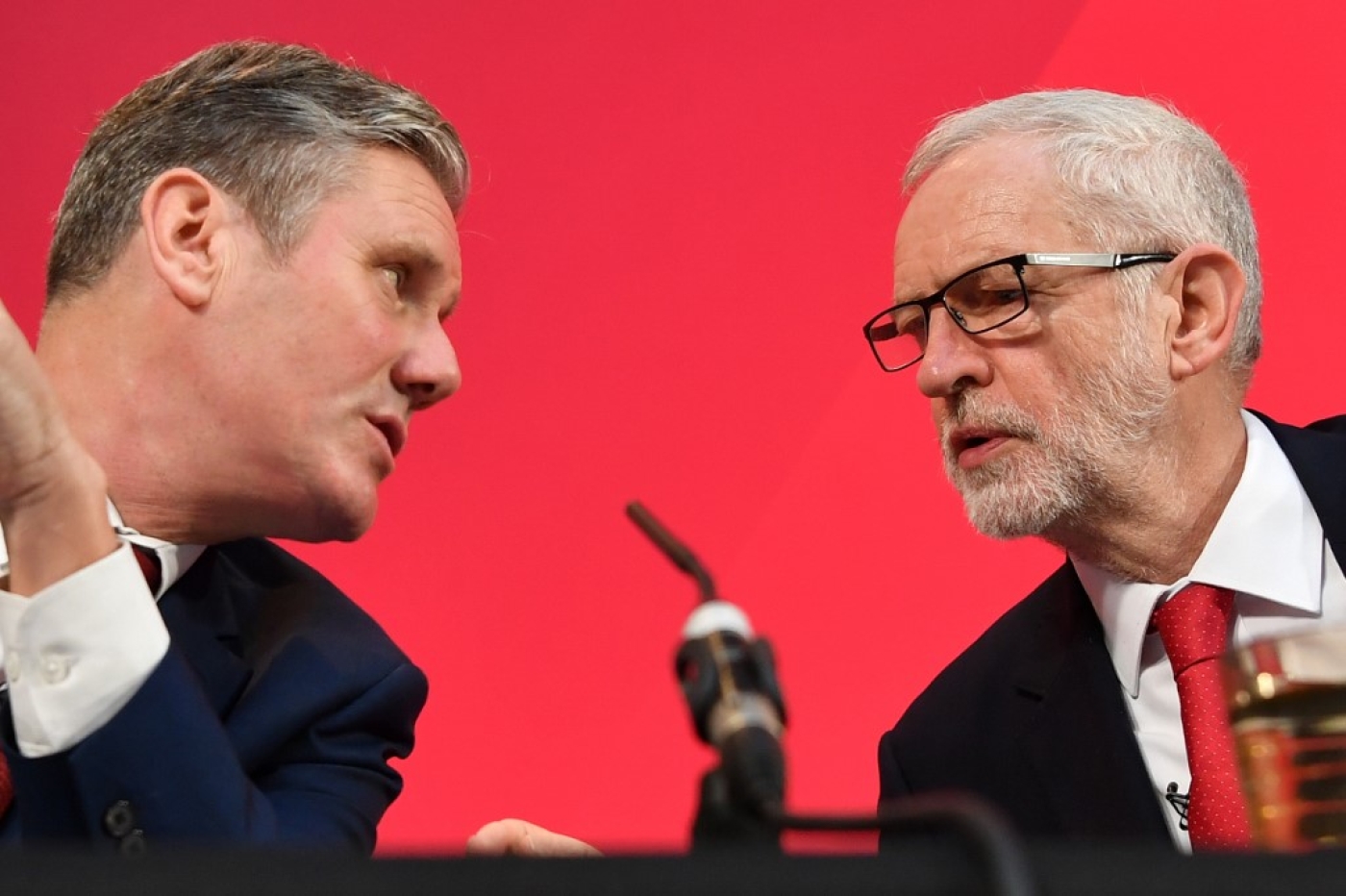
Keir Starmer (L) with Jeremy Corbyn at a press conference in London in December 2019 (AFP)


One of the lesser known aspects of Keir Starmer’s assault on the left of his party since becoming Labour leader is his growing silence on Palestine.

Silencing the Palestinian lobby in Britain has always been a goal of Israel’s Ministry of Strategic Affairs, which has gone to some lengths to condition debate inside the Labour Party on Israel.

In 2017, an Al Jazeera documentary exposed the efforts of the ministry’s man in London, Shai Masot, to start a youth wing in the Labour Party. Masot was also filmed by an undercover reporter saying he wanted to “take down” government ministers and MPs considered to be causing “problems” for Israel.

Silencing the Palestinian lobby in Britain has always been a goal of Israel’s Ministry of Strategic Affairs, which has gone to some lengths to condition debate inside the Labour Party on Israel

When Masot was rumbled and expelled, a continuous feed of Jeremy Corbyn’s meetings as a backbench MP with Palestinians, dating back in some cases over a decade, was created to stoke the furore over the then-Labour leader.

This feed was doctored.

When Corbyn met three Hamas politicians whose Jerusalem IDs had been revoked and had staged a sit-in a tent in the grounds of the Red Cross (this was a cause celebre at the time and many Israelis went to show solidarity with the case), the presence of a second Labour MP, Andy Slaughter, who is not a Corbyn ally but is pro-Palestinian, was excised from British reports.

However, a picture of Slaughter appeared in Israeli news channel i24’s exclusive of “Corbyn’s secret visit” in its report in 2018, which was eight years after the MPs’ visit took place in November 2010. 

Role of Shin Bet

The precise details of Corbyn’s visit to Israel in 2010, including who was on it, who arranged it and who they met, were monitored and logged by Israel’s domestic security service, Shin Bet.

When these visits were over, Shin Bet invited Corbyn’s local fixer in for what turned out to be five hours of questioning in a police station in Haifa.

Shin Bet told her they were relaxed about her charity work for the Palestinian cause, but would not tolerate her campaigning inside the Houses of Parliament in the UK.EXCLUSIVE: Jeremy Corbyn questions impartiality of EHRC antisemitism inquiry

If she did not heed the warning, she would spend the rest of her days in prison as an enemy of the state. Her lawyer told her that such a charge could indeed be fabricated against her and that an Israeli court would send her to prison if this happened. She is an Israeli citizen.

At the very least, the warnings given to Corbyn’s fixer confirm that Israel’s security services had set their sights on the MP at least five years before he became Labour leader and long before antisemitism in Labour became a newsworthy issue.

Nobody in the Labour Party was bothered with Corbyn’s travels, which certainly were not secret. He was a backbencher on the fringes of the party. Only Shin Bet took note.

The smear campaign has been wonderfully effective. Of course, many groups joined in for different reasons, including people indifferent to the conflict in Palestine who had shown no past interest in it.

The compromising material of Corbyn’s past contacts would have had no purchase had there not been a determination within the Parliamentary Labour Party and at Labour headquarters to stop Corbyn at all costs. But taken together, it worked.

A poll conducted by Survation last year asked member of the British public who were aware of antisemitism in Labour what percentage of party members had complaints against them.

Their mean average reply was 34 percent. The real figure is a fraction of one percent. The perception of antisemitism was over 300 times the reality in Corbyn’s party.

Palestine lost

Since becoming leader, Keir Starmer has avoided contact with Palestinian leaders, either in Israel or in Britain.

Starmer has had two opportunities to engage.

On 26 June this year, 15 members of the Knesset who comprise the Joint List wrote to all party leaders in Britain to urge them to “actively oppose” attempts by Israel to annex territory unilaterally.Israel’s Joint List urges British political parties to oppose annexation

The Joint List, the main coalition representing Palestinian citizens of Israel, is the third largest group of MKs in the parliament. The letter was sent by Yousef Jabareen, the head of the Joint List’s international committee.

Prime Minister Boris Johnson instructed one of his ministers, James Cleverly, minister of state for the Middle East and North Africa, to reply.

“We continue to urge Israel not to take these steps. The prime minister has conveyed the UK’s opposition to unilateral annexation to Prime Minister Netanyahu on multiple occasions,” Cleverly wrote.

Starmer did not reply, and still has not replied. Jabareen received an automated reply from Starmer’s office, telling him that he receives hundreds of emails each day.

On 16 September, a group of leading British Palestinians, many of whom were members of Labour, but some not, wrote an open letter to the Labour Party insisting on “the right of Palestinians to accurately describe our experiences of dispossession and oppression” and rejecting Labour’s attempts to conflate anti-Zionism with antisemitism.

The letter was accompanied by emails to Starmer to set up a meeting. They were told that Starmer was too busy to meet them. They were referred to Lisa Nandy, the shadow foreign secretary, who also declined to meet them.

A ‘dressing down’

However when Stephen Kinnock, who comes from the right wing of the party and is a bitter critic of Corbyn, called in a parliamentary debate for the UK to “ban all products that originate from Israeli settlements in the occupied territories”, Nandy found the time to intervene.

Nandy told the Board of Deputies of British Jews and the Jewish Leadership Council – according to a source quoted by MailOnline – that Kinnock, a consistent and long-standing critic of Israel’s policy towards the Palestinians, had been given a “dressing down” for his remarks made during the Commons debate.

Starmer’s sole intervention in this debate occurred when he was asked by Jewish News about sanctions and he stressed the need instead to maintain a ‘strong working relationship with Israel’

“Lisa made no secret of the fact she and the leader were angry with Kinnock,” the source is quoted as saying.

“Especially after all the work that has been done to try and restore Labour’s relationship with the Jewish community.”

Starmer was said to be “infuriated”.

Nandy herself proposed a ban on the import of goods from illegal settlements in the West Bank, but only if Israel pressed ahead with annexation.

Starmer’s sole intervention in this debate occurred when he was asked by Jewish News about sanctions and he stressed the need instead to maintain a “strong working relationship with Israel”.

Starmer said: “I don’t agree with annexation and I don’t think it’s good for security in the region, and I think it’s very important that we say that.

“Whether sanctions follow is another matter but at the moment let’s resolve this in the proper way. But this is not good for security in the region. That should be a paramount consideration.

When pressed further, he added: “There needs to be a strong working relationship where we are able to exchange views frankly, as you would with an ally and on some of these issues, a frank exchange is what we most need, I think.”

Labour’s history

This Monday marks 103 years since the Balfour Declaration committed British governments to support for a Jewish homeland in Palestine.

The 1917 document predates Labour’s emergence as a political force in the years after World War One, but the party has a history of its own in the Middle East which no leader can ignore.Jeremy Corbyn suspended from Labour following antisemitism report

In 1944, when the territory of Palestine was still under British control, its national executive committee authored a motion, passed by conference, which read: “Palestine surely is a case, on human grounds and to promote a stable settlement, for transfer of population. Let the Arabs be encouraged to move out, as the Jews move in. Let them be compensated handsomely for their land and let their settlement elsewhere be carefully organised and generously financed.”

But it has history more recent than that.

The suspension of Corbyn after the Equality and Human Rights Commission (EHRC) report into antisemitism last week contrasts with Corbyn’s treatment of Tony Blair, who as a former Labour prime minister was excoriated by the 2016 Chilcot Report over his decision to invade Iraq in 2003.

John Chilcot, a former senior diplomat, eviscerated Blair, stopping short of accusing him of lying to parliament.

Chilcot said that at the time of the invasion, Saddam Hussein “posed no imminent threat” and revealed a private note that Blair sent to Bush in July 2002 which read: “I will be with you, whatever.”

In a two-hour press conference following the publication of the report, Blair was unrepentant. “I believe we made the right decision and the world is better and safer,” he declared.

He argued that he had acted in good faith, based on intelligence at the time which said that Iraq’s president had weapons of mass destruction. This “turned out to be wrong”.

Corbyn’s suspension

Corbyn offered a total apology on behalf of the party for the decision to invade Iraq.

He said: “So I now apologise sincerely on behalf of my party for the disastrous decision to go to war in Iraq in March 2003. That apology is owed first of all to the people of Iraq. Hundreds of thousands of lives have been lost and the country is still living with the devastating consequences of the war and the forces it unleashed. They have paid the greatest price for the most serious foreign policy calamity of the last 60 years.”

He went on: “The apology is also owed to the families of those soldiers who died in Iraq or who have returned home injured or incapacitated. They did their duty but it was in a conflict they should never have been sent to.”

Corbyn appeared as if he was defying the leadership, even though at the time he spoke, he had no idea what Starmer would say on a key point that defined their dispute

Blair at the time was just a member of the party, in the same situation as Corbyn was last week.

Corbyn, however, did not suspend Blair for not apologising and uttering words which went against the party line.

Instead, the opposite was happening. The “party of war” within the Parliamentary Labour Party went on the offensive against the leadership.

MPs who had backed the Iraq war, and consistently voted against inquiries into it, went after Corbyn.

Of the 71 MPs who voted no confidence in Corbyn in 2016 and who had been in parliament in 2003, 92 percent had voted in favour of the Iraq war and seven against.

In justifying his action to suspend Corbyn, Starmer said that the former leader had defied his response to the EHRC report, which condemned anyone trying to claim that antisemitism had been exaggerated for political reasons.

The night before the report was published, Starmer phoned Corbyn to say he would not be condemning him by name in his statement of reply to the EHRC report. Corbyn and his team repeatedly asked Starmer what he would say in his statement. Starmer said he would send them his lines.

Angela Rayner, the deputy leader, also promised Corbyn’s team that she would send them the lines of Starmer’s statement. Both failed to do so. The reactions of the two men were thus set on collision course.

Corbyn appeared as if he was defying the leadership, even though at the time he spoke, he had no idea what Starmer would say on a key point that defined their dispute.

Corbyn subsequently failed to back down, but one possibility is that Starmer’s team knew what Corbyn would say, while Corbyn himself was kept in the dark until it was too late.

The left bites back

Corbyn did not defend himself against allegations that he tolerated antisemitism or that he himself was an antisemite, claims that are still being made today. To the extent that he let this campaign run unchallenged in the High Court, he himself is responsible.

Quite apart from the fate of Corbyn, support for Palestine is much greater in the party than Starmer is comfortable with. Palestine, which he knows about much less than Corbyn, is his blindspot

On the day Corbyn was suspended, the Campaign Against Antisemitism, the original complainant in the EHRC investigation, wrote to Starmer and David Evans, the general secretary, demanding investigations into 32 members of the Labour Party, including Angela Rayner, Starmer’s current deputy, and 10 other MPs. 

In response, seven trade unions affiliated to the Labour Party and one which backed Starmer as candidate, published a statement expressing “serious concern” about the manner and rationale for Corbyn’s suspension, suggesting it had undermined party unity and democratic processes.

Far from being his “Clause 4” moment – the issue that Tony Blair used to define New Labour by dropping the party’s historic commitment to state ownership of key industries – the suspension of Corbyn could define Starmer’s leadership in the same way that Blair’s decision to invade Iraq has cast a shadow over everything a man elected three times as prime minister did. The ghosts of Iraq follow Blair around to this day.

Quite apart from the fate of Corbyn, support for Palestine is much greater in the party than Starmer is comfortable with. Palestine, which he knows about much less than Corbyn, is his blindspot.

Unless Corbyn is reinstated quickly, the decision to suspend him from the party could prove to be a permanent and defining stain on Starmer’s leadership.

The views expressed in this article belong to the author and do not necessarily reflect the editorial policy of Middle East Eye.


River to Sea Uprooted Palestinian   
The views expressed in this article are the sole responsibility of the author and do not necessarily reflect those of the Blog!

Monday, 2 November 2020

Anglo-Zionist Smearing of Jeremy Corbyn

By Stephen Lendman

Source

While anti-Semitism is real, time and again the accusation is made to smear and discredit individuals or groups for justifiable criticism of Israel.

It’s also an unjustifiable tactic used to divert attention from Israeli high crimes of war, against humanity, and persecution of Palestinians for not being Jewish — especially by Jewish state officials.

Anyone forthrightly criticizing Israeli apartheid ruthlessness is vulnerable to unjustifiable vilification.

Zionism is tyranny by another name. It’s undemocratic, hateful, ruthless, racist, destructive, and hostile to peace, equity, justice, and the rule of law.

It’s a monster threatening anyone and anything it opposes, a cancer infesting Israel, America, other Western societies and elsewhere.

The late Joel Kovel called Zionism “a machine for the manufacture of human rights abuses.”

Daring to criticize Israel and Zionist extremism got him fired by Bard College. Other US academics have been mistreated the same or in similar ways.

Zionism is an ideological scourge. It considers Jews superior to others. Nazism believed in Aryan superiority.

Anglo-Zionism is a hugely destructive force threatening everyone everywhere. 

Britain’s so-called Equality and Human Rights Commission (EHRC) was legislatively established by the militantly hostile to peace, equity and justice Tony Blair regime in 2006.

Pretending to promote and enforce equality and non-discrimination in the UK, it unjustly and irresponsibly accused former Labor Party leader Jeremy Corbyn of “serious failings (on the issue of) addressing antisemitism and an inadequate process for handling antisemitism complaints (sic).” 

“Our investigation has highlighted multiple areas where its approach and leadership to tackling antisemitism was insufficient (sic),” according to its interim EHRC head Caroline Waters, adding:

“This is inexcusable and appeared to be a result of a lack of willingness to tackle antisemitism rather than an inability to do so (sic).”

Time and again in the West, anti-Semitism is over-hyped, and irresponsibly used to smear legitimate critics of Israeli viciousness.

Corbyn’s support for Palestinian rights got him falsely accused of anti-Semitic rhetoric and actions — the price he paid for honesty.

Throughout last year’s campaign ahead of parliamentary elections in Britain, establishment media one-sidedly supported hardline PM Boris Johnson-led Tories over Labor leader Corbyn’s progressive change agenda.

Last April, Keir Starmer replaced him as Labor leader in the wake of the vilification campaign against him that cost the party 59 seats in parliament.

On Thursday, a Labor spokesman said Corbyn was suspended from the party, pending an investigation, adding:

Under his leadership, the party became “institutionally anti-Semitic (sic).”

The phony accusation reflects how Israeli critics in government, academia, and other walks of life are systematically and wrongfully vilified.

Israeli influence in the West has much to do with singling out legitimate critics for vilification.

Often they’re sacked or in Corbyn’s case prevented from gaining a Labor Party electoral victory and being suspended — for doing the right thing.

Earlier and current anti-Semitism charges against Corbyn were and remain manufactured, not legitimate.

UK owned and controlled BBC propaganda falsely claimed anti-Semitism became “a big problem” in Britain’s Labor Party after “Corbyn’s election” as party leader in September 2015 (sic), adding:

“Mr Corbyn and his allies on the left had spent decades campaigning for Palestinian statehood, in contrast with the more nuanced position taken by many of his predecessors (sic).”

“Nuanced” is code language for one-sidedly supporting Israel, ignoring its decades of high crimes against Palestinians and regional states.

Accusations of anti-Semitism are longstanding canards used against public figures, academics, and others who forthrightly criticize Israel and call for accountability.

Ignored is that anti-Zionism isn’t anti-Semitism.

Yet the long ago discredited canard keeps resurfacing against figures like Corbyn and numerous other profiles in courage like him.


River to Sea Uprooted Palestinian   
The views expressed in this article are the sole responsibility of the author and do not necessarily reflect those of the Blog!

Saturday, 31 October 2020

Corbyn and the Tyranny of Correctness

  BY GILAD ATZMON

corbyn.jpg

By Gilad Atzmon

Liberal film maker Michael Moore, who in 2016 predicted Donald Trump’s electoral victory, is again interfering with the premature celebration over Biden’s victory.

 Yesterday, just  five days before the election, Moore sounded the alarm, strongly suggesting that the polls showing Biden with a comfortable lead over Trump are not accurate. 

In a TV interview Moore said: “The Trump vote is always being undercounted. Pollsters- when they actually call the Trump voter, the Trump voter is very suspicious of the ‘Deep State’ calling them and asking them who they’re voting for.”

 Moore is devastated by the thought that Trump may continue residing at the same address for another four years, but that does not affect the acuity of his observation. In this peculiar world, a large proportion of Americans are reluctant to admit their support for the elected president. This is not just an American phenomenon. Many Brits won’t admit that they voted Brexit and would probably vote Brexit again. Many Brits wouldn’t admit that they supported the Tories but when they voted, they served up the Labour party its biggest blow in its electoral history. The same happened in Israel’s recent elections. Netanyahu performed far better on election day than in the pollsters’ predictions. The explanation given in Israel was that his voters do not tell the truth to pollsters.

History provides us with a manifold of occasions in which the masses pretended to support the regime, the ruling party or a tyrant. What we  see in the West currently is the opposite. A large segment of the public is actually fearful of the opposition, of those who are committed to ‘liberate’ them from their ‘crypto fascist’ rulers in the name of ‘liberal values’ and ‘freedom.’

Americans aren’t fearful of Trump, his party, the intelligence services, the NSA, the FBI or the CIA.  They are actually afraid of the ‘progressive’ social media giants and their ‘community standards’. In the USA much of the mainstream media  isn’t shy of being one sided and  blatantly conceals  news that may present the presidential challenger in a negative light. It is even more disturbing that many Americans appear to be fearful of the opposition and its powers over them. This suggests that America isn’t even remotely a free place. In America, as in Britain, the opposition has evolved into a dark, authoritarian force.

What is at the core of this authoritarian shift?  The so-called Left; ‘liberals’ and ‘progressives’ are totally removed from the cultural and political core values that made the Left into a meaningful argument. The level of detachment is so severe that most Leftists, progressives and liberals don’t even remember what those values are. The so-called Left has failed to adapt to the new reality. They, evidently,  seek political  power, but they fail to provide a plan that would make the world a slightly better place. It doesn’t take a genius to point at Trump’s dysfunctional operation as much as it is easy to point at Boris Johnson’s comical cabinet but what is it that the opposition offers instead? I would have liked to say ‘not a lot,’ but the answer is actually ‘nothing at all.’

The humiliating crash of Jeremy Corbyn is probably the most useful window into the evaporation of Left and progressive politics on both sides of the Atlantic. When Corbyn was elected to lead the Labour Party in September 2015, he was regarded as a principled Left ideological icon, a man who had supported the oppressed throughout his entire political career: even those who did not support him agreed that Corbyn was Britain’s leading anti racist. Within days of  Corbyn’s nomination as the Labour PM candidate, Corbyn displayed all the traits of a rock star. Millions of young Brits and others around the world saw him as a hero of justice and offered themselves as his avant-garde in his battle for justice and against austerity.

Yesterday, the same Corbyn was subject to the final humiliating blow. He was suspended from the party he led until a few months ago. What happened between 2015 and 2020?  

As soon as Corbyn assumed the lead of Labour both he and his party were subject to relentless attacks by the Israel Lobby and British Jewish Institutions. One after another, Corbyn’s closest allies were targeted. Corbyn didn’t stand up for any of them, or if he did, he made sure to conceal his intervention. Thousands of Labour members were suspended and expelled from the Party for criticising Israel, its lobby, or noting any exceptionalist aspects of Jewish political culture. But throughout the witch hunt, Corbyn remained silent. And when it came to politics, Corbyn couldn’t take a firm position on Brexit or any other matter. It took Corbyn only four years to waste the huge support he had initially  and to reduce his party into a tragic act. In those four years, the British Labour Party explored every authoritarian method. It harassed and collected private information about its members, it even spied on its members’ social media accounts.  It operated in concert with the police and the Israel lobby against its own precious members. During all that time while Corbyn was the leader of the party,  not once did he act as a  leader and stand  up and call for a stop to the madness.  

Corbyn was suspended yesterday following his reaction to the Equalities and Human Rights Commission’s (EHRC) verdict that Labour had broken the law in its handling of antisemitism complaints during the period when Mr Corbyn was in charge.

No one in the treacherous British press dared mention it, but the meaning of this suspension is that even the ex-leader of the Labour party, a person who was a PM candidate last December, is not allowed to express his personal views. All he is allowed to do is to follow the script. Clearly it isn’t just the masses who are terrorised by tyranny of correctness, even the Labour Party and its leadership are subject to the most authoritarian proscriptions. They are commanded to follow a script. The only question that remains open  is who writes the script and who translates it into English?

But the absurdity is even greater. The EHRC was formed by the Labour government back in 2007. Its non-official task was to tackle right wing racism in an attempt to interfere with the British National Front. From its inception, the EHRC was designed to police thought and speech. Looking at Corbyn and the damage the Labour party inflicted on itself, the chickens have come home to roost. Labour has been beaten by the dictatorial machine it invented to police its political enemies.

We do not yet know who is going to win the USA presidential election. But even if Biden wins, it is impossible to deny the fact that pretty much every second American voter believes that Trump is the better man to lead the country. The same applies in Britain, even if Labour had won the last election, every second Brit believes that Brexit is the right way forward.

I believe that if there is anything left out of the Athenian spirit and Christian ethos that made the West into a precious civilization that inspired others, it is that we must  ‘love our neighbour.’  In 2020 loving your neighbour means to agree to disagree, to see a human and humanity in each other. To love your neighbour is to search for that which unites us and to stand firm against those who break us into biological identitarian segments separated by gender, skin colour, sexual orientation etc. To love your neighbour in 2020 is to seek harmony.

The Left in its current authoritarian form cannot lead us towards this goal. It is an occupied zone. The Left needs a reset, it needs to delve into its metaphysical origin: into that unifying instinct that is also universal. Corbyn was a star when people believed that he really cared for ‘the many’ and not ‘the few.’ He evaporated as a political power when the many understood that he and his party were puppeteered by the very few.  

Donate


River to Sea Uprooted Palestinian   
The views expressed in this article are the sole responsibility of the author and do not necessarily reflect those of the Blog!