Showing posts with label Minsk Agreements. Show all posts

Friday, 3 December 2021

Lavrov gives press conference after OSCE Ministerial Council in Stockholm

 December 02, 2021

Russian Foreign Minister Sergei Lavrov holds a press conference after the 28th OSCE Ministerial Council in Stockholm on Thursday, December 2. The annual OSCE Ministerial Council, chaired by Sweden, takes place on December 2-3. The ministers are expected to discuss security issues in the OSCE area and review the organisation’s activities.


Please forward the video.


River to Sea Uprooted Palestinian   
The views expressed in this article are the sole responsibility of the author and do not necessarily reflect those of the Blog!

Tuesday, 30 November 2021

The NATOstan Clown Show

 November 29, 2021

Flags wave ahead of a NATO Defence Ministers meeting at the Alliance headquarters in Brussels, Belgium, October 21, 2021. REUTERS/Pascal Rossignol – RC28EQ9178EG

The charade has come to a point that – diplomatically – is quite unprecedented: Foreign Minister Sergey Lavrov lost his Taoist patience.

Source

Independent geopolitical analyst, writer and journalist

By Pepe Escobar,

American hysteria over the “imminent” Russian invasion of Ukraine has exploded every geopolitical Stupid-o-Meter in sight – and that’s quite an accomplishment.

What a mess. Sections of the U.S. Deep State are in open revolt against the combo that remote controls Crash Test Dummy, who impersonates POTUS. The neocon-neoliberal axis is itching for a war – but has no idea how to sell it to an immensely fractured public opinion.

UKUS, which de facto controls the Five Eyes spy scam, excels only in propaganda. So in the end it’s up to the CIA/MI6 intel axis and their vast network of media chihuahuas to accelerate Fear and Loathing ad infinitum.

Russophobic U.S. Think Tankland would very much cherish a Russian “invasion”, out of the blue, and could not give a damn about the inevitable trouncing of Ukraine. The problem is the White House – and the Pentagon – must “intervene”, forcefully; otherwise that will represent a catastrophic loss of “credibility” for the Empire.

So what do these people want? They want to provoke Moscow by all means available to exercise “Russian aggression”, resulting in a lightning fast war that will be a highway to hell for Ukraine, but with zero casualties for NATO and the Pentagon.

Then the Empire of Chaos will blame Russia; unleash a tsunami of fresh sanctions, especially financial; and try to shut off all economic links between Russia and NATOstan.

Reality dictates that none of the above is going to happen.

All exponents of Russian leadership, starting with President Putin, have already made it clear, over and over again, what happens if the Ukro-dementials start a blitzkrieg over Donbass: Ukraine will be mercilessly smashed – and that applies not only to the ethno-fascist gang in Kiev. Ukraine will cease to exist as a state.

Defense Minister Shoigu, for his part, has staged all manner of not exactly soft persuasion, featuring Tu-22M3 bombers or Tu-160 White Swan bombers.

The inestimable Andrei Martyanov has conclusively explained, over and over again, that “NATO doesn’t have forces not only to ‘counter-act’ anything Russia does but even if it wanted to it still has no means to fight a war with Russia.”

Martyanov notes, “there is nothing in the U.S. arsenal now and in the foreseeable future which can intercept Mach=9-10+, let alone M=20-27, targets. That’s the issue. Same analytical method applies to a situation in 404. The only thing U.S. (NATO) can hope for is to somehow provoke Russia into the invasion of this shithole of a country and then get all SIGINT it can once Russia’s C4ISR gets into full combat mode.”

Translation: anything the Empire of Chaos and its NATO subsidiary try in Donbass, directly or indirectly, the humiliation will make the Afghanistan “withdrawal” look like a House of Gucci dinner party.

No one should expect clueless NATO puppets – starting with secretary-general Stoltenberg – to understand the military stakes. After all, these are the same puppets who have been building up a situation which might ultimately leave Moscow with a single, stark choice: be ready to fight a full scale hot war in Europe – which could become nuclear in a flash. And ready they are.

It’s all about Minsk

In a parallel reality, “meddling in 404” – a delightful Martyanov reference to a hellhole that is little more than a computer error – is a totally different story. That perfectly fits American juvenilia ethos.

At least some of the adults in selected rooms are talking. The CIA’s Burns went to Moscow to try to extract some assurance that in the event NATO Special Forces were caught in the cauldrons – Debaltsevo 2015-style – that the People’s Republics of Donetsk and Lugansk, with Russian help, will concoct, they would be allowed to escape.

His interlocutor, Patrushev, told Burns – diplomatically – to get lost.

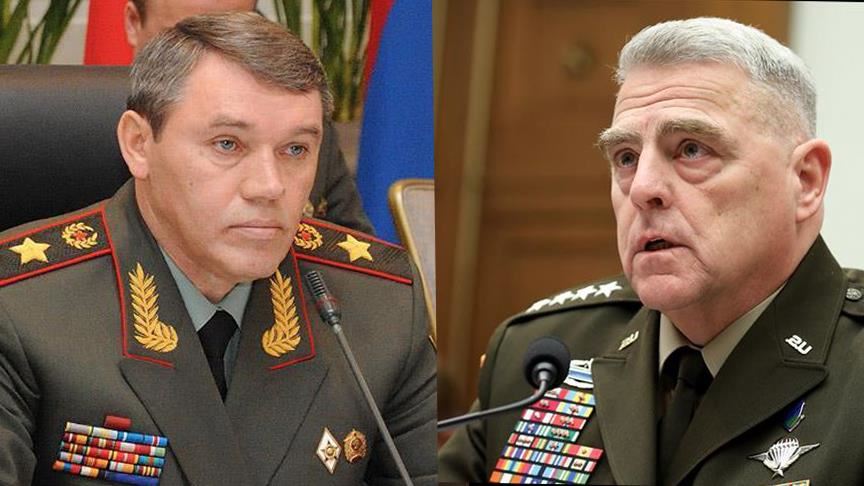
Chief of the General Staff, Gen Valery Gerasimov, had a phone call with Chairman of the Joint Chiefs, Gen Mark Milley, ostensibly to ensure, in Pentagonese, “risk-reduction and operational de-confliction”. No substantial details were leaked.

It remains to be seen how this “de-confliction” will happen in practice when Defense Minister Shoigu revealed U.S. nuclear-capable bombers have been practicing, in their sorties across Eastern Europe, “their ability to use nuclear weapons against Russia”. Shoigu discussed that in detail with Chinese Defense Minister Wei Fenghe: after all the Americans will certainly pull the same stunt against China.

The root cause of all this drama is stark: Kiev simply refuses to respect the February 2015 Minsk Agreement.

In a nutshell, the deal stipulated that Kiev should grant autonomy to Donbass via a constitutional amendment, referred to as “special status”; issue a general amnesty; and start a dialogue with the people’s republics of Donetsk and Lugansk.

Over the years, Kiev fulfilled exactly zero commitments – while the proverbial NATOstan media machine incessantly pounded global opinion with fake news, spinning that Russia was violating Minsk. Russia is not even mentioned in the agreement.

Moscow in fact always respected the Minsk Agreement – which translates as regarding Donbass as an integral, autonomous part of Ukraine. Moscow has zero interest in promoting regime change in Kiev.

This charade has come to a point that – diplomatically – is quite unprecedented: Foreign Minister Sergey Lavrov lost his Taoist patience.

Lavrov was forced, under the circumstances, to publish 28 pages of correspondence between Moscow on one hand, and Berlin and Paris on the other, evolving around the preparation of a high-level meeting on Ukraine.

Moscow was in fact calling for one of the central points of the agreement to be implemented: a direct dialogue between Kiev and Donbass. Berlin and Paris said this was unacceptable. So yes: both, for all practical purposes, destroyed the Minsk Agreement. Public opinion across NATOstan has no idea whatsoever this actually happened.

Lavrov did not mince his words: “I am sure that you understand the necessity of this unconventional step, because it is a matter of conveying to the world community the truth about who is fulfilling, and how, the obligations under international law that have been agreed at the highest level.”

So it’s no wonder that the leadership in Moscow concluded it’s an absolute waste of time to talk to Berlin and Paris about Ukraine: they lied, cheated – and then blamed Russia. This “decision” at the EU level faithfully mirrors NATO’s campaign of stoking the flames of imminent “Russian aggression” against Ukraine.

Armchair warriors, unite!

Across NATOstan, the trademark stupidity of U.S. Think Tankland rules unabated, congregating countless acolytes spewing out the talking points of choice: “relentless Russian subversion”, “thug” Putin “intimidation” of Ukraine, Russians as “predators”, and everything now coupled with “power-hungry China’s war on Western values.”

Some Brit hack, in a twisted way, actually managed to sum up the overall impotence – and insignificance – by painting Europe as a victim, “a beleaguered democratic island in an anarchic world, which a rising tide of authoritarianism, impunity and international rule-breaking threatens to inundate”.

The answer by NATOstan Defense Ministers is to come up with a Strategic Compass – essentially an anti-Russia-China scam – complete with “rapid deployment forces”. Led by who, General Macron?

As it stands, poor NATOstan is uncontrollably sobbing, accusing those Russian hooligans – scary monsters, to quote David Bowie – of staging an anti-satellite missile test and thus “scorning European safety concerns”.

Something must have got lost in translation. So here’s what happened: Russia conclusively demonstrated it’s capable of obliterating each and every one of NATO’s satellites and blind “all their missiles, planes and ships, not to mention ground forces” in case they decide to materialize their warmongering ideas.

Obviously those deaf, dumb and blind NATOstan armchair warrior clowns – fresh from their Afghan “performance” – won’t get the message. But NATOstan anyway was never accused of being partial to reality.


River to Sea Uprooted Palestinian   
The views expressed in this article are the sole responsibility of the author and do not necessarily reflect those of the Blog!

Friday, 26 November 2021

Who Wants Some Ukraine?

 November 25, 2021

by Dmitry Orlov, posted with permission of the author

On Tuesday, 23 November, Russia’s most senior military general, Valery Gerasimov, had a “deconfliction” phone conference with US Chairman of the Joint Chiefs of Staff Mark Milley, in which the two discussed “pressing issues of international security.


US, Russia army chiefs talk recent skirmish in Syria

” Actual details of what they discussed are not available; what is available is Western media speculation, which in recent days has included false reports of Russian troops massing on the Ukrainian border and supposedly getting ready to invade. What Western media has studiously ignored is an actual massing of Ukrainian troops on the borders of the Donbass region—the industrialized temporarily Ukrainian region that has been de facto independent since the Kiev putsch of 2014.

Following that putsch, and the refusal of the Donbass (along with Crimea) to recognize the new US State Department-installed Ukrainian government, the Ukrainians made attempt to recapture the Donbass by force. This attempt failed, and Kiev managed to avoid all-out defeat by signing the Minsk agreements of February 2015, but has clearly had no intention of ever fulfilling them. Instead, ever since then, Ukrainian forces have been shelling the no man’s land between Ukrainian-held territory (which is mostly open prairie) and Donbass (which is urbanized and thickly settled), killing small numbers of civilians and local militia members and causing considerable property damage. Although Western press has continuously reported on “Russian forces” in the Donbass, they are yet to present any evidence of it. And although Western press likes to describe the Donbass using the hackneyed epithet “war-torn” it is actually more prosperous and stable than the rest of the Ukraine, integrated into the Russian economy and essentially functioning as a Russian region.

Turning down Western media noise, a Russian military effort to capture the Donbass, never mind the rest of the Ukraine, is exceedingly unlikely. Russia already has everything it wants. Unlike Crimea which in its 2014 referendum produced a 97% vote for integration of the region into the Russian Federation with an 83% voter turnout, in a similar referendum in the Donbass (held against Moscow’s wishes) only 27.5% of the 74.87% who turned out voted in favor of joining the Russian Federation. Based on this result, Moscow chose to soft-pedal the Donbass situation, providing humanitarian aid and diplomatic support, granting Russian citizenship to those who want it and gradually integrating the region socially and economically. In other Ukrainian regions, were similar referendums to be held there, the level of support for joining Russia would in all likelihood have been even lower, and now, seven years later, would be lower still. From this, a conclusion can be drawn: other than Crimea (which was part of an independent Ukraine for just 23 years), none of the Ukraine was or is a candidate for inclusion within the Russian Federation. The Russians living there will receive some amount of Russian support and are, of course, welcome to move to Russia, but that is really it.

Having ruled out that which is exceedingly unlikely, let us turn to that which is quite likely; and that is a provocation in the Donbass staged by the authorities in Kiev and by their State Department, Pentagon and CIA handlers, designed to deflect the blame from the truly disastrous economic situation that is unfolding there in the hopes of being able to maintain political control of the situation. In blundering into the Ukraine and converting it into a sort of anti-Russian bulwark, the US gained a brazenly corrupt and unruly dependency. Unable to stop its inexorable slide into failed-statedom and political and social disintegration, the US is faced with the prospect of another Afghanistan-style rout, with desperate left-behinds running after US transport planes hastily taking off from Kiev’s Borispol Airport, after which point even the mental laggards who run the European Union will be forced to admit that American security guarantees are an utter joke and will start getting ready to walk into the Kremlin on their knees to kiss the gem-encrusted felt slipper.

Given this unwelcome scenario, the US is quite eager to control the optics and to make it look like it is all Russia’s fault. Since merely jumping up and down and screaming “The Russians are coming! The Russians are coming!” is no longer doing the trick, they are looking for something—anything!—that will make the Russians show up and put up even a tiny bit of a fight so that CNN and MSNBC can broadcast staged photos of a bloodied baby blanket and US Congress can then harrumph-harrumph about “Russian aggression” and impose sanctions on Russian baby blanket manufacturers. That “anything” is called a provocation, and what better place to stage it than the Donbass, which is an existing bleeding sore they’ve been picking away at for seven years now. Of course, they will do this in great trepidation of an escalation they would be unable to control, hence the hasty “deconfliction” conference with General Gerasimov: “Look, we go pew-pew, then you go pew-pew, then we declare hostilities over and toast each other with vodka and caviar; OK?”

Given that a provocation of some sort appears to be very likely, it is worth pondering what it would look like and what the outcome of it might be.

First, here is some background. The Ukraine (which is Russian for “borderland”) has always been less a country than a heterogeneous, endlessly disputed territory, tossed back and forth between Russia, Turkey, Poland, Austria, Germany and even, very briefly, Sweden. It mostly borders Russia (Crimea, Krasnodar, Rostov, Voronezh, Belgorod, Кursk and Bryansk regions). It also borders Belarus (short for “White Russia”) which is a whole lot like Russia. It has smaller borders with Poland, Slovakia, Hungary, Romania, Moldova and the unrecognized, Russian-defended Transnistria. It also borders Donetsk and Lugansk regions, collectively known as the Donbass, which is short for “Donetsk Coal Basin,” and which was formerly part of the Ukraine but de facto independent for the last 7 years and economically integrated with Russia.

Of these, the Ukraine, Belarus and Moldova were quite recently part of the USSR while the rest were part of the Warsaw Pact allied with the USSR. For most of them, those were the good days; for reasons incomprehensible to rapacious Western imperialists, Russia lavished a great deal of attention and investment on its ethnically heterogeneous periphery, not only building a great deal of social and industrial infrastructure and enterprises there but also staffing it all with relocated Russians. This, most Russians now realize, was a poor choice. This lesson is continuously reinforced by observing just how poorly the former Soviet republics have performed since they gained their independence. The Ukraine is a case in point, losing as much as a third of its population (exact numbers are impossible to ascertain) and steadily degenerating from a prosperous, highly developed region to the poorest one in all of Europe.

The Ukraine aspires to NATO and EU membership, but this prospect appears exceedingly unlikely since it is much more of a liability than an asset: destitute, bankrupt, politically unstable and not in control of its own government or its own territory—a failed state, essentially. Plus, the EU and NATO are themselves perhaps not too long for this world, the EU having recently lost the United Kingdom and NATO having just fabulously failed in Afghanistan, and not really capable of accepting new members. Sensing their own weakness, and projecting onto Russia their own instincts to engulf and devour all that they can, they automatically assume that Russia will exploit this weakness and reconquer the Ukraine and perhaps some other parts of Eastern Europe as well. But this is all it is—a projection, because the contemporary Russian project is something else entirely. Russia does periodically move its troops around its own territory, thereby keeping the West in a constant state of nervous agitation bordering on outright panic, but from the Russian perspective that is just a pleasant side-effect of regularly scheduled training exercises. There was a recent hysterical outburst in Western press over Russian tanks massed on the Belorussian border, for instance. Russia is always “about to invade,” on Tuesdays especially, but somehow never gets around to it.

That is not because Russia lacks the means or the opportunity; but it does entirely lack the motive. Does it need more land? Certainly not! Does it need a restive, alienated population that will then demand to be fed, hospitalized as needed and kept safe and warm all the while resisting assimilation? Not at all! Does it need the reputational losses from unprovoked aggression? Again, no. Quite the opposite, Russia is most eager to draw the line somewhere—a notional Great Wall of Russia, with the stable, economically liberal and socially conservative Orthodox/Moslem/Buddhist Russian World on one side and an alien, increasingly bankrupt, culturally degenerate, sexually deviant and permanently hostile Europe on the other. This will give Russia the peace and stability it needs to continue developing. The problem is that, because of the messy way in which the USSR broke up, many Russians were left stranded on the wrong side of previously insignificant borders, and this Great Wall has to remain porous, allowing Russians to filter back in.

A point can be made that Russia’s romance with Western Europe was always destined to end in tears. Russia’s cooperative, egalitarian instincts have been developed and perfected over many centuries within the Eurasian context of a relatively small population controlling a vast but difficult land with almost infinite but rather diffuse resources. In this context, cooperation rather than competition are keys to survival. These instincts have been wasted on little Eastern European fiefdoms that have spent an eternity squabbling over their tiny plots of land. Their history has conditioned them to only understand and respect subservience and domination, causing them to see Russian largesse as a weakness to be exploited. When the USSR suddenly vanished, they swiftly switched allegiance, forgetting their Russian, learning English and eagerly welcoming American and Western European financial swindlers and thieves to come and pick them clean. And now that they’ve been picked clean and Americans are leaving, they would perhaps be happy for Russia to “reoccupy” them and resume feeding them (if it were not for their wounded pride), but Russia will have none of it.

Within this overall context, each Eastern European country has its own unique fate. Most of them—specifically, Estonia, Latvia, Lithuania and Moldova—are simply too small and inconsequential to matter and have been left to wither away slowly, being of little interest to the West or to Russia. Belarus stands out in that it quickly joined a union state with Russia, but this has not saved it from some fateful dalliances with the West which almost ended in disaster in the summer of 2020 when a foreign-instigated astroturf insurgency threatened to overthrow the elected government and install a Western stooge by the name of Svetlana Tikhanovskaya, nicknamed the cutlet fairy. Since then, Minsk and Moscow turbocharged their integration process, producing the odd situation where the Belorussians feel free to poke their fingers in the eyes of Western leaders while hiding behind Russia’s broad back.

And then there is the Ukraine. It is the second-largest country in Europe by area—second only to Russia—and strategically located to be rather consequential. Ever since its independence, which it was awarded against the wishes of the majority of its population when the USSR was dissolved by a tiny group of conspirators, it has been ruled by a succession of swindlers and thieves who have continuously looted and robbed it until now it is a mere shadow of its former self, broken and destitute. This has made it an easy mark for Western geopolitical engineers who sought to fashion into a sort of anti-Russia, with the idea of preventing Russia from becoming an empire based on some flawed reasoning by the rabidly Russophobic Pole Zbigniew Brzeziński. Grand plans hatched by fools tend to misfire grandly, and this one is no exception. Instead of somehow containing Russia, it gave Russia everything it could ever want:

1. The fantastic level of Ukrainian political dysfunction that resulted from endless Western political meddling reduced the Ukraine from one of Russia’s major regional competitors to а major regional basket case and supplier of qualified Russian-speaking labor. The Ukraine once had strategically important industries that were essential for Russia’s military and civilian production, including large marine diesels, helicopter engines, rocket engines, aircraft building, shipbuilding and much else. All of these industries have now been relocated to Russia, often together with all of the blueprints and the technical expertise, and produce great value for both domestic consumption and export.

2. The 2014 putsch allowed Russia to return Crimea by undoing two mistakes—by Khrushchev, who gave it to the Ukraine in 1954, and by Gorbachev, who failed to get it back in 1991. It also allowed Russia to partially undo an older mistake—by Lenin, who gave the Donbass to the Ukraine in 1920. While the Donbass is strategically not too consequential, the return of Crimea provided numerous benefits. Coupled with the western enclave of Kaliningrad on the Baltic and new Russian hypersonic rockets, Crimea has allowed Russia to keep all of NATO’s European territory within its sphere of military dominance, providing an effective treatment for Europe’s congenital defect which causes it to periodically march on Moscow. Western sanctions imposed in response to Russian annexation of Crimea allowed Russia to claw back all of the disadvantages it incurred by joining the World Trade Organization, including bringing back agriculture and key manufacturing sectors, to find new, friendlier trading partners around the world, and to find ways to thrive within conditions of limited autarky. Crimea has also provided a very useful litmus test for political participation: automatically excluding anyone who would claim that Crimea is Ukrainian made it possible to effectively purge the ranks of all internal enemies and foreign agents. There are numerous other benefits as well, too many to mention.

3. The civil war in the Donbass, which is ongoing, gave Russia the opportunity to force through the Minsk agreements, whose implementation is mandated by the UN Security Council Resolution 2202 (2015), and which require the Ukraine to federalize, granting a high level of autonomy to its regions. This, in the Ukrainian context, equates with the end of the Ukrainian unitary state. Beyond that point, the Ukraine becomes a set of disparate, disconnected, foreign-dominated fiefdoms, each with its own pathetic little oligarchy, with Kiev retained as a purely symbolic capital and an ancient Kievan Russia museum and tourist attraction. The government in Kiev has resisted the implementation of the Minsk agreements, realizing full well that this would spell its end, but this is merely a postponement. The civil war also simplified any future anti-Nazi mop-up operation and war crimes tribunal. Whereas before various Ukrainian nationalists and krypto-Nazis might have been difficult to identify, it has forced them to not only stand up and be counted but also to commit crimes for which there is no statue of limitations, making it easy to permanently take them out of circulation when the time comes to clean the place up.

This, then, is the background to the current situation, bringing us to the present, in which the US seems to be cooking up something in a big hurry. First, the US sends the message that Kiev must fulfill the terms of the Minsk agreements. Second, the US claims that Russia is massing troops on the Ukrainian border, getting ready to invade. The Ukrainian military denies this fact. The US repeats their claim and also sends some more weapons to the Ukraine. As the Ukrainian military is still unsure what’s going on, they are summoned and told exactly what to think. And so, there is going to be a provocation. But Russia is certainly not interested in any sort of attack or invasion, so what do you suppose is going to happen? A reasonable battle plan is for the Ukraine to attack first, to preempt the Russian invasion and to take up defensive positions within the Donbass territory. That’s a brilliant plan, if I say so myself!

The most the Ukrainian military can do is launch an attack on the Donbass. Attacking Crimea across the isthmus would be stupid and pathetic; attacking Crimea from the water would be stupid and absolutely hilarious to watch. And so Donbass it has to be, again. It won’t take long for the Russians to respond using unidentified long-range precision artillery and demolish the Ukrainians’ supply lines, trapping them in cauldrons where they will run out of ammunition, food and fuel and gradually bleed out. This is what transpired before, in 2015, leading Kiev to sign on to the Minsk agreements, because their other choice was to lose their entire army. Except now there will not be another set of Minsk agreements, no terms of surrender, no cease fires and no safe corridors for withdrawal. There will just be death. To the Russians, these people are terrorists, and terrorists get to meet God before the rest of us.

And that, perhaps, may be the entire point. The US wants to close out the entire sorry Ukrainian saga, cut its losses, pull an Afghanistan and leave in a hurry, because it has a long list of countries it has to pull out of before the fuel and the money run out, and it badly needs to pick up the pace. Okinawa is on that list; Guam; Puerto Rico; Alaska. California. Texas. The Ukraine has been refusing to even start fulfilling the Minsk agreements, which start with military deescalation along the line of contact. What seems to be the problem? Perhaps, as the US has finally figured out, it has to do with the fact that the Ukraine has a military; if it no longer had any military of any sort at all, there would be nothing to deescalate and the problem would not exist. And so that may be the clever plan for the Ukraine: suicide by Russia. As an added bonus, there will be Russia to blame because, no doubt at all, it will have all been Russia’s fault. Sanctions against Russian baby blanket manufacturers are being drafted as we speak. American TV viewers will watch it, and they will like it. They will think, “Bad Russkies! America strong!”

“But what about the Ukraine?” you might be tempted to ask. Well, the correct answer to that question seems to be, “Nobody cares.” Seriously, looking at recent Ukrainian history, that seems to be the only answer that makes sense. The Americans certainly never cared, the Russians once cared but care less and less with each passing day, and the Ukrainians themselves don’t care either and have been making that point by voting with their feet. The European Union and NATO may care a great deal about having a large failed state in the middle of Europe, and they should, because that is probably just the beginning, but a very good start.


River to Sea Uprooted Palestinian   
The views expressed in this article are the sole responsibility of the author and do not necessarily reflect those of the Blog!

Saturday, 6 November 2021

Foreign Minister Sergey Lavrov’s interview with Rossiya 24, Moscow

 November 05, 2021

Foreign Minister Sergey Lavrov’s interview with Rossiya 24, Moscow

Foreign Minister Sergey Lavrov’s interview with Rossiya 24, Moscow, November 1, 2021

Question: Not so long ago, you said that Russia would not use ideology-based rules in its international diplomatic practices. What examples can you give to explain this to a layman in matters of politics?

Sergey Lavrov: It’s simple. Ideally, any society should obey generally accepted rules that have proved their efficacy and sensibility.  Speaking about international life, the United Nations Charter is a book of collectively and universally coordinated rules. Later, when new members joined the UN, they accepted these rules in their entirety, without any exemptions, because UN membership requires that the Charter be ratified without any reservations. These rules are universal and mandatory for all.

With the age of multipolarity now dawning – and its emergence is an objective fact – new centres of economic growth, financial power and political influence have come into being. The multitude of voices is louder at the UN. A consensus or a vote are required in a situation where new solutions or rules have to be developed based on the UN Charter. In both cases, this work involves conflicting opinions and the need to defend one’s position and prove it is correct. Truth springs from argument and this is what this collective work is all about.

Conscious of the fact that its arguments are increasingly vulnerable because its policy is aimed at slowing down the objective formation of a polycentric world fully in keeping with the UN Charter, the collective West thinks it more beneficial for itself to discuss current issues outside of universal organisations and make arrangements within its inner circle, where there is no one to argue with it. I am referring to the collective West itself and some “docile” countries it invites from time to time. The latter are needed as extras and create a semblance of a process that is wider than a purely Western affair. There are quite a few such examples.

Specifically, they are pushing the idea of a “summit for democracy.” This summit will take place in December at the invitation of US President Joe Biden. To be sure, we will not be invited. Neither are the Chinese on the list of invitees. The list itself is missing as well. Some of our partners are “whispering in our ear” that they have been told to get ready: supposedly an invitation is in the pipeline. Asked, what they would do there, they reply that theirs will be an online address, after which a final statement will be circulated. Can we see it? They promise to show it later. So we have here the “sovereign” and his “vassals.”

The Summit for Democracy seeks to divide people and countries into “democracies” and “non-democracies.”  Furthermore, my colleagues from a respected country have told me that they could infer from the invitation they had received that the democratic countries that were invited to attend were also divided into “fully” and “conditionally” democratic. I think the Americans want to have the biggest possible crowd to show that the Washington-led movement has so many followers. Watching who specifically gets invited and in what capacity will be quite amusing. I am certain that there will be attempts to reach out to some of our strategic partners and allies, but I do hope that they will remain faithful to the obligations they have in other frameworks instead of taking part in artificially concocted, one-off unofficial summits.

The same applies to the initiative Germany and France proposed two or three years ago. I am referring to the idea of an Alliance of Multilateralists. Asked, why should it be formed – after all, the United Nations, where all sovereign states are represented, stands at the pinnacle of multilateralism – they gave rather an interesting answer.   According to them, there are many conservatives at the United Nations, who hinder the genuine multilateral processes, while they are the “forerunners,”   they want to lead the van and show others with their example how to promote multilateralism. But this prompts the question: Where is the “ideal” of multilateralism? Allegedly, it is personified by the European Union, a paragon of “effective multilateralism.” Once again, they understand multilateralism as the need for the rest to accept the Western world’s leadership along with  the superiority of Western “values” and other things western. At the same time, multilateralism, as described on the US dollar  (E pluribus unum) and as embodied in the United Nations, seems  inconvenient, because there is too much diversity for those who want to impose their uniform values everywhere.

Question: Is this a constructive approach?

Sergey Lavrov: Of course, not! Let me reiterate that this is how they understand the serious processes that are unfolding across the world against the backdrop of the emerging multilateralism and multipolarity. The latter, by the way, were conceived by God, for He created all men equal. And this is what the US Constitution says, but they tend to forget its formulas, when it comes to geopolitics.

There are other examples. The Dutch and the British are pushing the idea of a Global Partnership on Artificial Intelligence. Why not do this at UNESCO? Why discuss this outside the organisation that was specifically created for dealing with new scientific achievements and making them available to mankind? There is no reply.

There are several competing partnerships, and the Media Freedom Coalition formed by Canada and Britain is one of them. The French, together with Reporters without Borders, promote the Information and Democracy Partnership. Once again, not everyone is invited to join it. Several years ago, Britain held the Global Conference for Media Freedom.

Question: Russia was not invited to attend, was it?

Sergey Lavrov: At first, there was no invitation, but then we reminded them that if this was a “global forum,” it was right to hear opposing points of views. But they did not invite us all the same.

Examples of this kind are not in short supply. Talking about these matters, there are mechanisms within UNESCO, which is fully legitimate and competent to deal with these issues. However, it gives a voice to others who may have a different view on media freedom compared to that of our Western colleagues. I think that this sets the international community on a path that is quite destructive, just like the attempts to “privatise” the secretariats of international organisations.

The Organisation for the Prohibition of Chemical Weapons (OPCW) is a case in point, since people from Western and NATO countries are fully in control of its Technical Secretariat. The Chemical Weapons Convention (CWC) states that everything must be done by consensus. However, the Technical Secretariat obediently tolerates gross violations of the Convention. The Western countries vote for their decisions, which is completely at odds with the CWC, and claim that executing these  is the Secretariat’s duty. By arrogating the right to pinpoint who is to blame for using chemical weapons, the Technical Secretariat takes over the functions of the UN Security Council.

The West has now instructed the Technical Secretariat to crack down on Syria, where many shady things and outright provocations took place over the past years. We exposed them and held news conferences in The Hague, where the OPCW has its headquarters, as well as in New York. We showed that the Technical Secretariat was being manipulated with the help of destructive and extremist NGOs like the White Helmets. I would like to note that we are starting to hear statements along these lines from heads of certain respected organisations. For example, some senior executives of the UNESCO Secretariat have come forward with the initiative to promote “values-based multilateralism.”

Question: And they are the ones who define these values, aren’t they?

Sergey Lavrov: Probably. The UNESCO leadership also represents a Western country and NATO. There is no doubt about this.

We do know that at the end of the day, behind all this talk on building consensus and having regard for the opinion of all countries, the collective West will set the tone. This has already happened more than once. The way the West views “values-based multilateralism” will shape its negotiating position.

At the same time, there is an effort to promote a “human rights-based” approach. If we look at the challenges the world is currently facing, there is security, including food security, as well as ensuring livelihoods and healthcare. This is also related to human rights. The right to life is central to the Universal Declaration of Human Rights, but it is being trampled upon in the most blatant manner, just like the socioeconomic rights. The United States has yet to join the International Covenant on Economic, Social and Cultural Rights, and has only signed the International Covenant on Civil and Political Rights that the West is seeking to emphasise. Lately they have been focusing on the ugliest ways to interpret these rights, including on transgender issues and other abnormal ideas that go against human nature itself.

Question: You mentioned the humanitarian aspect, which is very important. The border crisis in Belarus. Refugees from Syria and other Middle Eastern countries trying to enter the EU are being deported peremptorily. It is a serious crisis, and the problem has grown in scale. It concerns the border with the EU, which claims to respect human rights and the humanitarian rules. Can Russia mediate the settlement of this conflict? Can we influence the situation at all? And would there be any point?

Sergey Lavrov: I don’t think that mediation is needed here. I do not see any violations of international law or obligations by Belarus. I have access to information about these developments, just as all the other stakeholders. According to this information, those who do not want to live in Belarus are trying to enter the EU from the territory of Belarus. Demanding that President Alexander Lukashenko and the Belarusian law enforcement agencies stop this would be contrary to international law, especially humanitarian law. The hysterical claims made in some EU countries that Belarus, supported by Russia, is deliberately encouraging these flows of refugees are unseemly for serious politicians. This means that they are aware of their helplessness, including in terms of international law, which is why they are growing hysterical.

Here is a simple example. You have said that the EU does not want refugees to enter its territory. I believe that it is not the EU but individual countries that do not want this. The situation is different across the EU in terms of the positions of individual countries and regions. There is no unity on this matter. Poland and Lithuania are pushing the refugees eager to enter their territory back to Belarus. I wonder how this is different from the recent developments in Italy. Former Interior Minister Matteo Salvini refused to allow refugees to disembark in Italy. He argued that there were several other EU countries along their route where they could request asylum. Salvini is likely to face trial for endangering the lives of those refugees, who had fled from the dire, catastrophic conditions in their home countries. What is the difference between the behaviour of the Baltic states and Poland and the decision for which the former minister is about to  stand trial?

There are many other examples of double standards here, but just take a look at the identity of those refugees fleeing to Europe. They are Syrians, Iraqis and, recently, Afghans. People from the Sahel-Sahara region in Africa are trying to enter Europe via Libya.  As we list the countries from which illegal migrants are exporting instability, we should not forget the reason behind the collapse of their home countries. This collapse has been brought about by Western adventurism. A  case in point is the US adventure in Iraq, where tens of thousands of NATO troops and  contingents of other countries eager to please Washington were later stationed in a cover-up ploy . Look at the aggression against Libya, and the failure of the 20-year-long war trumpeted as a mission to restore peace in Afghanistan. They attempted to do the same in Syria. As a result, several million people have been uprooted and are now trying to enter Europe from Lebanon, Jordan and Turkey. This is our Western partners’ style. They regard any situation from a historical and chronological angle that suits them best. They launched devastating bombing attacks on Libya and Iraq. But after both countries were reduced to ruins, they urged everyone to assume a shared responsibility for the fate of refugees. We asked, why this should be a “shared responsibility?”After all, it was them who created the problem in the first place. They replied: “Let bygones be bygones.” There is no point looking back, they have awakened to the problem, and now it rests with us. Ukraine is another remarkable example of the logic of forgetting historical embarrassments.

Question: I would be remiss not to ask you about Ukraine. The situation there is escalating. Not so long ago, an officer, a Russian citizen,from the Joint Centre for Control and Coordination (JCCC) on Ceasefire and Stabilisation in Southeastern Ukraine was detained (in fact, kidnapped) on the demarcation line. The Ukrainian military have become increasingly active in the grey zone. With that in mind, how much longer can the Normandy format dialogue continue? Is a ministerial meeting being planned? How productive will this dialogue be?

Sergey Lavrov: I would like to revisit the diplomatic tactics of cutting off inconvenient historical eras and periods. How did it all begin? In our exchanges with our German or French colleagues who co-founded the Normandy format and the February 2015 Minsk agreements, they unfailingly maintain a “constructive ambiguity” with regard to who must comply with the Minsk agreements. We keep telling them: What ambiguity is there? Here, it is clearly written: Kiev, Donetsk and Lugansk must enter into consultations and agree on a special status, an amnesty and elections under the auspices of the OSCE. This is clearly stated there. They say they know who plays the decisive role there. We reply that we do not know who else plays the decisive role there except the parties whom the UN Security Council has obliged to act upon what they signed. To their claims that we “annexed” Crimea, we say that, first, we did not annex Crimea, but rather responded to the request of the Crimean people, who had come under a direct threat of destruction. I remember very well the Right Sector leaders saying that Russians should be expelled from Crimea, because they would never speak, think, or write in Ukrainian. Everyone back then was telling me that it was a figure of speech. It was not. Recently, President of Ukraine Vladimir Zelensky confirmed this when he said: If you think you are Russian, go to Russia. This is exactly the ideology proclaimed by the Right Sector immediately after the EU-guaranteed settlement document had been trampled upon in the morning by the same people who had signed it on behalf of the opposition with President Viktor Yanukovych. When you remind them of Russophobia, which instantly manifested itself among the putschists who seized power as a result of the coup, they say no, it is a thing of the past. They propose starting the discussion with the fact that the sanctions were imposed on us. This is an unsavoury approach.

I am disappointed to see such a decline in the Western negotiating and diplomatic culture. Take any hot item on the international agenda and you will see that the West is either helpless or is cheating. Take, for example, the alleged poisoning of blogger Alexey Navalny. This is a separate matter.

Returning to Ukraine and the Normandy format, indeed, the situation has escalated. There are attempts to create a provocative situation, to provoke the militia into responding and to drag Russia into military actions.

The Bayraktar drone incident is nothing short of a mystery. The Commander of the Armed Forces of Ukraine said that this weapon was indeed used, while the Defence Minister claimed that nothing of the kind had happened. I think they are now pondering options to see which one will work better for them: either to show how tough they are having started bombing in direct and gross violation of the Minsk agreements, or to say that they are complying with the Minsk agreements and to propose to get together in the Normandy format. We do not need a meeting for the sake of holding a meeting. They are sending mixed messages through characters like Alexey Arestovich (he is some kind of a semi-official adviser), or head of the presidential executive office Andrey Yermak, or Denis Shmygal, or President Zelensky himself. But they follow the same logic: the Minsk agreements should not and must not be fulfilled, because this will destroy Ukraine. Nothing could be farther from the truth. The Minsk agreements were created as a result of 17-hour-long talks precisely in order to preserve Ukraine’s territorial integrity. Initially, having proclaimed their independence, the new republics were even unhappy with us for encouraging them to find common ground with Kiev. Whatever the new authorities may be, Ukraine is our neighbour and a fraternal nation. After signing the Package of Measures for the Implementation of the Minsk Agreements in Minsk, the Russian Federation convinced representatives of Donetsk and Lugansk to sign this document as well.

Accusing us of destroying Ukraine’s territorial integrity is unseemly and dishonest. It is being destroyed by those who are trying to make it a super-unitary state while reducing the languages ​​of ethnic minorities, primarily Russian, to the status of token tools of communication, and making education in Russian and other languages nonexistent​. This is a neo-Nazi approach to society building.

As you may be aware, in April 2014, immediately after the Crimea referendum, former US Secretary of State John Kerry, former EU High Representative for Foreign Affairs and Security Policy Catherine Ashton, Acting Foreign Minister of the new regime in Ukraine Andrey Deshchitsa and I met in Vienna. We agreed on one page of a “dense” text to the effect that the United States, the EU and Russia welcomed the Kiev authorities’ plan to hold a nationwide dialogue on federalisation with the participation of all regions of Ukraine. It was approved. Truth be told, this document did not go anywhere, but it remains open information. It was made available to the media. That is, back then, neither the United States nor the EU wanted to make a “monster” out of Ukraine. They wanted it to be a truly democratic state with all regions and, most importantly, all ethnic minorities feeling involved in common work. Up until now, the Ukrainian Constitution has the linguistic and educational rights of ethnic minorities, including the separately stated rights of Russian speakers, enshrined in it. Just look at the outrageous things they are doing with the laws on education, languages ​​and the state language. There is a law recently submitted by the government titled On State Policy during the Transition Period. It does more than just cross out the Minsk agreements. It explicitly makes it illegal for Ukrainian political, diplomatic and other officials to fulfil them. The Venice Commission of the Council of Europe recently came up with a positive opinion about this law, which did not surprise us. This decision does not say a word about the fact that this law undermines Ukraine’s commitments under the Minsk agreements and, accordingly, Kiev’s obligations to comply with the UN Security Council resolution.

Question: If I understood you correctly, a ministerial meeting cannot even be prepared in this atmosphere.

Sergey Lavrov: Our German and French colleagues have been saying all the time: let’s preserve “constructive ambivalence” as regards who must observe the Minsk agreements. An EU-Ukraine summit took place literally two days after the telephone conversation of the President of Russia, the Chancellor of Germany and the President of France, when Vladimir Putin said such law-making was unacceptable, including the destructive draft law on a transitional period. Following the summit, President of the European Commission Ursula von der Leyen, President of the European Council Charles Michel and President of Ukraine Vladimir Zelensky signed a statement a good quarter of which is devoted to the crisis in southeastern Ukraine. The top-ranking EU officials and the Ukrainian President officially stated that Russia bears special responsibility for this crisis because it is a party to the conflict. We immediately asked Berlin and Paris: so which is it: constructive ambivalence or this position? We were told that we shouldn’t be surprised because from the very beginning of the crisis in 2014 they proceeded from the premise that we ought to do all this. If that is the case, what was the point of signing the Minsk agreements?

Now they are trying to draw us in, citing President Vladimir Putin, who promised to organise the Normandy format at least at the ministerial level. We are not avoiding meetings. But promising to instruct Russian officials to work on this process, President Putin said that first we must fulfil on what we agreed in Paris in December 2019. The Kiev authorities were supposed to do everything the sides agreed upon then. They did not move a finger to implement the Steinmeier formula, determine a special status for Donbass, fix it permanently in the Ukrainian legislation and settle security issues.

A draft of this document was prepared when the parties gathered for this summit in Paris in December 2019. Its first item was an appeal by the Normandy format leaders for the disengagement of troops and withdrawal of heavy artillery along the entire contact line. President Zelensky said he could not agree to do this along the entire contact line and suggested doing it in three points only. Even the German and French participants were a bit perplexed because the aides of the presidents and the Chancellor coordinated the text ahead of the summit. Eventually, they shook their heads and agreed to disengagement in three points. Ukraine has not carried out this provision so far. Its conduct was indicative: it did not want to adopt a radical measure that would considerably reduce the risks of armed clashes and threats to civilians.

With great difficulty, the parties agreed on special measures in the summer of 2020. They signed a Contact Group document stating that any fire must not immediately trigger reciprocal fire. Otherwise, there will be an escalation. After each shelling, a commander of a unit that was attacked was supposed to report to the supreme commander. Only after his approval, the commander of the unit could open reciprocal fire. The republics included this provision in their orders but Ukraine flatly refused to fulfil it. Then, several months ago, it was persuaded to accept it and went along with this, implementing what was agreed upon a year ago. However, recently the Commander-in-Chief of the Armed Forces of Ukraine said that none of this was required: if you hear a shot, even into the air, you can go ahead and bomb the civilian population.

Question: Let’s move on to Central Asia, if you don’t mind. The Taliban coming to power is a daunting challenge to Russia and the post-Soviet Central Asian countries, which are our former fraternal republics. Are we ready to take up this challenge and how can we help our neighbours in Central Asia?

Sergey Lavrov: We saw it coming one way or another all these years while the Americans were trying to “stimulate” agreements between the Afghans. This was done, I would say, not too skilfully. I’m not hiding my assessment. The agreement that was concluded with the Taliban in Doha without the involvement of then President Ashraf Ghani was the last “diplomatic victory” as it was portrayed by the previous US administration. On the one hand, it gave rise to a hope that the Taliban would now be amenable to talks. On the other hand, there were many skeptical assessments, because the Taliban agreed to create some kind of common government bodies in exchange for a complete withdrawal of all foreign troops by May 1, 2021. Former President Ghani was outright unhappy with this since he realised that if this agreement was fulfilled, he would have to share power. Under all scenarios, he was unlikely to remain the number one person in the new Afghan government. So, he did his best to slow down the process. As a result, the Americans stayed longer. According to a number of US political analysts, this happened because Washington failed to withdraw its troops by the agreed deadline. The Taliban then decided they were free from any commitment to form a government of national accord.

However, this is a thing of the past, and we believe that the United States and those who stayed there for 20 years promising to make a model country out of Afghanistan must now get directly involved, primarily financially, to avert a humanitarian disaster. In this sense, we want to preserve historical continuity with its causal relationship.

An event that we held recently in Moscow with the participation of Afghanistan’s neighbours and other leading countries of the region and the SCO and CSTO-sponsored events that took place not so long ago in Dushanbe were aimed at urging the Taliban to deliver on their promises and the obligations that they made and assumed when they came to power. First of all, this is to prevent the destabilisation of neighbouring countries and the spread of the terrorist and drug threat from Afghanistan and the need to suppress these threats in Afghanistan itself, to ensure the inclusive nature of government in terms of ethnopolitical diversity and to be sure to guarantee, as they said, Islam-based human rights. This can be interpreted fairly broadly, but, nevertheless, it provides at least some benchmarks in order to get the Taliban to make good on its promises.

Humanitarian aid must be provided now. I see the Western countries making their first contributions. The issue is about distributing this aid. Many are opposed to making it available directly to the government and prefer to act through international organisations. We see the point and are helping to reach an agreement with the current authorities in Kabul to allow international organisations, primarily humanitarian organisations, to carry out the relevant activities. Of course, we will do our fair share. We are supplying medicines and food there. The Central Asian countries are doing the same. Their stability is important to us, because we have no borders with our Central Asian allies, and we have visa-free travel arrangements with almost all of them. In this regard, President Putin told President Biden in Geneva in June that we are strongly opposed to the attempts to negotiate with the Central Asian countries on the deployment of the US military infrastructure on their territory in order to deliver over-the-horizon strikes on targets in Afghanistan, if necessary. They came up with similar proposals to Pakistan as well, but Pakistan said no. Uzbekistan has publicly stated that its Constitution does not provide for deployment of military bases on its territory. Kyrgyzstan has also publicly, through the mouth of the President, announced that they do not want this.

Knowing the pushy nature of the Americans, I do not rule out the possibility of them continuing to come up with the same proposal from different angles. I heard they are allegedly trying to persuade India to provide the Pentagon with certain capabilities on Indian territory.

Refugees are issue number two, which is now being seriously considered. Many of them simply came to Central Asia on their own. These countries have different policies towards them and try in every possible way to protect themselves against these incoming flows. In Uzbekistan, special premises for the refugees have been allocated right outside the airport, from where they are flown to other countries and they are not allowed to enter other parts of the Republic of Uzbekistan. Our Tajik neighbours are doing the same. They are also being pressured to accept refugees. They want to set up holding centres under strong guarantee that after some time the refugees will be relocated. The West rushed to beg the neighbouring countries to accept tens of thousands of refugees, each claiming that it was a temporary solution until the West gives them documents for immigration to Western countries.

Question: But it turned out it was for the long haul …

Sergey Lavrov: Thankfully, no one has agreed to that, at least not to the numbers the West was talking about. Of course, some refugees relocated there, and proper arrangements must be made with regard to them. The West said they needed “two to three months” to issue documents for these people and it was necessary to save them, since they collaborated with the coalition forces. But if you collaborated with these Afghans on the ground for a long time and employed them as translators and informants, you surely ran background checks on them. If, after they had worked for you for so long you were still unable to decide whether you could trust them or not, why are you then “dumping” them onto the Central Asian countries, which are our allies? This issue remains open.

As you may be aware, we have come up with a proposal for the UN to convene a conference to address the Afghan people’s pressing humanitarian needs. I think the message was taken, so we expect a more specific response will come.


River to Sea Uprooted Palestinian   
The views expressed in this article are the sole responsibility of the author and do not necessarily reflect those of the Blog!

Thursday, 21 October 2021

FM’s Sergey Lavrov’s answers to media at the 18th Valdai Club

 October 20, 2021

FM’s Sergey Lavrov’s answers to media at the 18th Valdai Club

Foreign Minister Sergey Lavrov’s answers to media questions following the 18th annual session of the Valdai International Discussion Club, Sochi, October 19, 2021

Question: The day before yesterday, Moscow announced measures in response to NATO’s aggressive moves. Are these measures prompted by Russia’s belief that NATO has to take the first step towards improving relations with Moscow?

Sergey Lavrov: Yes, this is our approach. We have never been the first to start aggravating our relations with NATO, or the European Union, or any other country in the West or elsewhere. Everyone knows the following story: when in August 2008, Mikheil Saakashvili issued the criminal order to bomb the city of Tskhinval and the peacekeeper’s positions, including Russian peacekeepers, Russia insisted that the Russia-NATO Council meet to consider the situation. US Secretary of State at the time, Condoleezza Rice, refused flatly, although, according to the Founding Act, which was signed by Russia and NATO when they established the Council, it must be effective in any “weather,” particularly in the case of a crisis. This was one example [in a series of events] that led to the status quo of today in relations between our country and NATO.

Question: Turkish President Recep Tayyip Erdogan said that the UN Security Council had no right to decide the fate of the whole world, referring to the five countries that won WWII as a handful of victors. He added that he had a road map to drive the UN Security Council members into a corner. What do you think of this? Is it possible?

Sergey Lavrov: President Erdogan’s eloquence is well known.  He feels free to air his views on different topics. I agree that the five countries which are the permanent members of the UN Security Council have no right to dictate the world’s fate. They do not, however, claim this role – they only have the authority provided for in the UN Charter, which reflects the collective will of all members of the world community. The five permanent member countries bear special responsibility for the situation in the world, primarily, for preventing a global conflict. Their efforts have proved successful in the course of more than 75 years. Hopefully, the situation will remain like this in the future.

But today, the UN and the Security Council need to adapt to a new reality. There are not 50 countries in the world, the way it was when the UN was established, and not 70 countries, like at the time the UN Security Council grew from 12 to 15 members, but many more: this world organisation has 193 member countries. The developing countries have every right to insist that their representation at the main UN body be increased. Today, of the 15 members on the UN Security Council, at least six are Western countries. When Japan is elected to the Security Council to represent Asia, it is counted as a seventh vote in favour of the policy that the West is pushing via the UN Security Council. No more seats at this body should be given to the West, while it is absolutely necessary to have more developing nations from Asia, Africa and Latin America represented in the UN Security Council.

Question: NATO officials said they regret Russia’s decision to suspend the NATO mission in Moscow. However, they were the ones that started this. Why do you think NATO continues to degrade our relations? Will the Russia-NATO Council continue?

President of Ukraine Vladimir Zelensky said again yesterday that he is ready to meet with President of Russia Vladimir Putin in any format. That said, the Press Secretary of the Russian President described such a meeting as unlikely. In what case will Ukraine succeed in “soliciting” a meeting with the Russian President? Is it true that Victoria Nuland came to Moscow to agree on US accession to the Normandy format (as reported by Kiev)?

Sergey Lavrov: As for NATO, I have talked about how this all began and how NATO itself has buried the main rules underlying the formation of the Russia-NATO Council – the need for urgent consultations in crises. This went on when the Americans provoked and supported the coup in Ukraine in February 2014, while the European Union swallowed the actions by the opposition even though on the eve of the coup Germany, France and Poland guaranteed by their signatures on an agreement between then president of Ukraine Viktor Yanukovich and the opposition. On the following morning, the opposition trampled underfoot these EU guarantees and had its own way. In response, the EU imposed sanctions on the Russian Federation. This is not about logic.

The same applies to statements made in NATO capitals as regards our forced response to three steps by NATO. Our mission was reduced three times. The main point is that the mission is simply not allowed to do its work. To get into NATO headquarters, our representatives, as distinct from all other NATO partners, have to apply in advance for a permit to enter the building and use only designated corridors. There have been no information exchanges with NATO headquarters in a long time.

The main thing is that all contact between the military personnel was cut off, and this was officially announced. So, what loss of an opportunity or talks are we talking about? Two years ago, Chief of the General Staff of the Russian Armed Forces Valery Gerasimov suggested coming to terms on withdrawing exercises to a certain distance from the Russia-NATO contact line and on the minimum distances not to be violated by combat aircraft and warships. There were many other proposals at that time as well. There was a wall of silence. The Foreign Minister of Germany said Russia’s actions showed that it was not ready for talks. I have just told you that we were fully ready for talks and NATO has simply been ignoring us for many years. Western officials understand that such statements are self-defeating. They want to put the blame at the wrong door and they lack diplomatic culture.

As for statements by President of Ukraine Vladimir Zelensky, they attracted many comments. They were made by the chief of his office, some advisor (I don’t remember his name) and President Zelensky himself just recently. A number of days before that, someone from his office said that President Putin seemed to be ready but his entourage did not advise him to meet one-to-one because such a meeting might produce a surprise. I will not even comment on this stream of consciousness. It is impossible to react to all public statements made in Ukraine as regards possible meetings at various levels or developments in Donbass and around Ukraine. One’s imagination is too limited for that, but they fantasise everywhere and every day.

When John Kerry was US Secretary of State, he came to Moscow on a regular visit. We were received by the President of Russia. Vladimir Putin said we saw how the Americans exerted influence on Ukraine. He mentioned a special US envoy to whom Pyotr Poroshenko listened. Maybe it is worth talking with Germany and France so you can join the Normandy format? I was at this meeting. John Kerry said that if they were invited they would probably consider it. Later, we asked the Germans and French about this but they bluntly rejected the idea: no, we need to work in the format that was created and in which the Minsk agreements were signed. This is the only option. It is not necessary to turn the Four into the Five or into Seven to facilitate a settlement. The Americans have a dominant influence on Zelensky and his team. Our dialogue resumed. Victoria Nuland met with Dmitry Kozak who is in charge of supervising issues of Ukraine, other near-abroad and CIS countries. They agreed to stay in touch. If the Americans are indeed willing to support the implementation of the Minsk agreements, it would be possible to resolve the problem very quickly.

Question: Unfortunately, the KP newspaper reporter in Belarus, Gennady Mozheyko, is still in prison. KP is banned in Belarus. Can anything be done in this regard?

Sergey Lavrov: I have already commented on this. We have posed this question to our Belarusian colleagues. We are working on it.

Question: Is Russia ready to become the first country to recognise the Taliban as the official authority in Afghanistan, and what are the conditions for this?

The United States will not be participating in the Moscow format meeting on Afghanistan. Will this influence the significance of the meeting in any way?

Sergey Lavrov: Russia has already stated its position on the Taliban. Like most other countries that have an influence in that region, we maintain contact with them and urge them to deliver on the promises they made when they came to power to ensure inclusiveness in the government not only in terms of ethnicity, but also in terms of political conviction so that the entire range of political allegiances in their society has a voice in the government. Official recognition has not yet been discussed; we have said this publicly.

The new US Representative for Afghanistan, Thomas West, called our representative Zamir Kabulov yesterday and expressed regret with that turn of events. He was appointed right before the Moscow format meeting and said that he definitely wanted to contact us and come to Russia. We will be delighted to have him.


River to Sea Uprooted Palestinian   
The views expressed in this article are the sole responsibility of the author and do not necessarily reflect those of the Blog!