Monday, 10 August 2009

Fatah Ignores the Real Issues,Clamoring Over Hollow Titles


Link


8/10/2009 12:30:00 AM
Author

Editor Publisher Hiyam Noir


From Khalid Amayreh in Bethlehem

09/08/2009 - 04:07 PM


Many Palestinians had thought that the Fatah convention in Bethlehem would revitalize the movement by delivering it from its current dishonorable subservience to Israel and putting it on the right track again, the track of authentic national struggle that would free the Palestinian people and their usurped homeland from cruel Zionist occupation and domination.

However, what we have been witnessing in the past few days instead is cacophony of raving and ranting that has miserably failed to tackle the real defining issues facing the Palestinian people and endangering its vital national interests.


Indeed, while the estimated 2,200 Fatah delegates were harrowing after hollow titles, they carefully sidestepped central issues such as the Right of Return, the inherently ignominious scandal of security coordination with Israel and the persistent Israeli blockade of the Gaza Strip as well as the criminal Israeli policy of barring building materials from reaching Gaza.


Fatah has also overlooked the scandalous show otherwise known as the “peace process,” which has been used by Israel as a cover for continuing Jewish settlement expansion as well as the unrelenting obliteration of Jerusalem’s Arab Islamic identity.


To be sure, no one in his right mind had expected the Fatah conference would declare war on Israel. However, every Palestinian has an absolute right to expect Fatah delegates to prove themselves as being worthy of representing the Palestinian people they claim to be.


What is even more tragic is there is a widespread impression that Fatah delegates are putting their own parochial and partisan interests before the national burden.


Well, woe unto a nation split into groups, each group viewing itself as a nation.


Unfortunately, Fatah is not what it used to be. The erstwhile liberation movement is allowing itself to be thoroughly domesticated and de-revolutionized by its corrupt leadership while mendaciously claiming to be clinging to the path of resistance and armed struggle.


Well, this leadership has exhaustively tried the path of negotiations with Israel since 1993 but to no avail. In fact, the only outcome of nearly 15 years of marathon talks with Israel has assumed the form of more Jewish settlements in the West Bank and more theft of Arab land, so much that there is no real room left for the establishment of a true and viable Palestinian state.


Now this leadership, which continues to shamelessly function under the false rubric of patriotism, is promising more of the same, namely more fruitless talks with Israel, probably until nothing is left to bargain for. Unfortunately, this is their deformed understanding of pragmatism and realism.


The way the Bethlehem conference has related to the Right of Return is very worrying, to say the very least. Fatah officials, including Chairman Mahmoud Abbas, made vague, imprecise and general allusions to the right of return.


These allusions showed that Fatah might be using the most paramount Palestinian issue as a sort of bargaining chip to get Israel to agree to give the Palestinians a state, however devoid of substance that “state” might be.


Indeed, a careful reading into Abbas’s speech suggests that the PLO and Fatah leadership would be willing and ready to effectively compromise the ROR in return for a certain political compensation.


More to the point, Abbas’s boasting about the return of 300,000 Palestinians to the West Bank and Gaza Strip following the conclusion of the Oslo Accords shows a real tendency on his part to consider the “return of displaced Palestinians to the territories occupied by Israel in 1967" as a partial implementation of the ROR.


If true, this would amount to a definitive betrayal of the ROR cause and perfidious abandonment of millions of suffering refugees who have been dreaming to return to the homes, villages and towns from which they or their fathers and grandfathers were uprooted when the evil Zionist state was created more than 60 years ago.


We all know that Abbas is accustomed to talking about the ROR in dismissive and depreciative terms. This is what endears him to Israel and makes him earn the vacuous epithet of “moderate.” We also know that had it not been for efforts by Hamas and other dignified Palestinian nationalists to assert the centrality of the ROR, Fatah, under its compromising leadership, would most probably have allowed the issue to slip into oblivion.


This shows that Fatah alone can’t be entrusted with the sacred right of the refugees to return to their homes. This was true during the Arafat era and it is even truer now with the appearance of a new generation of Fatah leaders who show more concern for smart cars and accumulation of wealth than for the suffering of the Palestinian people.


Another issue that the Fatah convention has nearly completely ignored is the disgraceful “security coordination” with Israel in the West Bank. This abominable security coordination is nothing short of treason.


The security coordination takes a variety of ugly forms and expressions, including a systematic persecution and hounding of Hamas sympathizers, closure of Islamic institutions, dismissal of Islamic civil servants from their jobs as well as exchange of data on potential resistance activists.


Last year, a high-ranking Palestinian security commander was quoted as telling a Zionist military commander that “We are allies, not enemies, we have a common enemy that is Hamas.”


Unfortunately, this officer and his colleagues were never rebuked let alone punished for making these treacherous remarks. In fact, some of these so-called officers are taking part in the Bethlehem conference.


Needless to say, the close collaboration between the PA security agencies and Israel has had disastrous consequences on the cause of Palestinian national unity.


Since the mid 2007, it is believed that as many as 10,000 Islamic activists have been arrested in the West Bank, with many of them subjected to severe and life-threatening torture.


Indeed, at least eleven people, including religious leaders, teachers, and other professionals have died under torture at the hands of PA interrogators.


The latest victim is Kamal Abu T’iema, a school teacher and community leader at the Fawwar refugee camp near al-Khalil, who spent one forth of his life languishing in Israeli jails and dungeons.


Abu T’iema died last week, succumbing to a massive stroke he suffered a few weeks ago as a result of severe torture at the Hebron headquarters of a PA security agency. He never imagined in his wildest nightmares that he would die of torture at the hands of the very people who claim to be fighting for the freedom of Palestine.


Unfortunately, very few Fatah delegates in Bethlehem had the moral courage to call the spade a spade, especially when they saw the spade in the hands of people such as Muhammad Dahlan who readily and enthusiastically acted at the Bush administration’s beck and call in order to ignite civil war in Palestine in the service of Israeli goals and designs.


Fatah used to be a reputable house struggling for a worthy cause, the cause of an oppressed people resisting a Nazi-like aggressor seeking their demise and obliteration from the face of earth.


Now, it seems, Fatah has effectively morphed itself into a five-star hotel where former revolutionaries are striving to enjoy life, while watching with utter insensitivity the very country they seek to liberate being pulverized and arrogated by the Zionists and the very people they claim to represent being raped, savaged and tormented by Israel, the presumed partner for peace.


Well, Fatah as we have known it for decades seems to be dead. Maybe another Fatah, a cleaner and honorable movement will rise up in place of the dead one. This is inevitable because treachery doesn’t prosper in this land. (end)


Source: Palestine Information Center

© PalestineFreeVoice Copyright reserved 2003 - 2011
Intellectual Rights Retained

Australia’s reversal of ban on Al-Manar angers Jewish groups

link


By DALIA MAHDAWI

BEIRUT: Australia has overturned two earlier bans and announced it will now allow the broadcast of Hizbullah’s television channel Al-Manar, prompting indignation from the country’s Jewish groups.


Explaining the ruling, the Australian Communication and Media Authority (ACMA) said the channel did not violate Australia’s anti-terrorism requirements for television. After monitoring Al-Manar for a nine-day period in August and September last year, ACMA said in a recent report that while the channel made references to Hizbullah, “the material, prima facie, could not be ‘reasonably construed’ as either ‘soliciting funds for a terrorist organization’ or ‘assisting in the collection or provision of funds for a terrorist organization’ as the content broadcast did not specifically seek funds for Hizbullah.”


Al-Manar was banned from Australian television in 2004 and 2008. The channel is also currently prohibited in the United States, France, Spain and Germany, all of which consider Hizbullah to be a terrorist organization. Canberra’s proscription on the armed wing of Hizbullah will remain in place.


Deploring the decision to restore the cable television channel, Australia/Israel Jewish Affairs Council (AIJAC) Director Colin Rubenstein said the country’s anti-terrorism standards had been nullified. “ACMA’s guidelines appear to make it legal for terrorist organizations to establish television stations broadcasting to Australia, and even solicit recruits and funds, as long as they omit requisite details on joining or providing donations,” he told reporters.


“It is under these guidelines that Al-Manar has legally broadcast into Australia content that seeks to incite to violence and hatred, particularly of Jews but also of other people, and to encourage donations to Hizbullah. Raising funds for Hizbullah is illegal under Australian law.”

Executive Council of Australian Jewry president Robert Goot also alleged Al-Manar had an anti-Semitic agenda. “We were and remain focused on how their programming can be seen with regard to the Racial Discrimination Act,” he said last week, adding he will lodge an appeal to the decision at the Communications Ministry. “If the programs to be screened to Al-Manar’s subscribers have similar content to those previously shown, then there may well be cause for concern and justifiable action under the act.”

Australian Arabic Council chairman Roland Jabbour meanwhile defended the decision to broadcast Al-Manar, saying the channel had nothing to do with terrorism or anti-Semitism. The Arabic Council opposed anti-Semitism, Jabbour said, adding that Al-Manar programs were often “twisted” by rivals to appear as being racist.


Source


Posted by JNOUBIYEH at 2:13 PM


Embassy Official ‘Confesses’ UK Role in Riots

Link


BRITAIN’S fraught relations with Iran suffered a further setback yesterday when a local member of its embassy staff on trial in Tehran “confessed” to espionage. He said Britain had provided financial assistance to Iran’s reformists to undermine the hardline clerical regime during June’s disputed presidential elections.

Hossein Rassam, a political analyst with the embassy, said a budget of £300,000 had been allocated by the embassy to establish contacts with political groups, individuals and activists.

He said he had personally made contact before the election with the campaign headquarters of Mir Hossein Mousavi, the pro-reform candidate who claims he was robbed of victory by President Mahmoud Ahmadinejad.

“My main responsibility was to gather information from Tehran and other cities by setting up contacts with individuals and other influential parties and political groups and send reports to London,” he said.

He said because of Britain’s hostile policies towards Iran and fear of exposure, the embassy employed local staff to establish such contacts.

Rassam was paraded in Tehran’s Revolutionary Square in a mass show trial along with dozens of opposition figures accused of crimes, including rioting, spying and plotting a “soft overthrow” of the regime after the elections. Apologising for his “mistakes”, he appealed for clemency. The charge of espionage carries the death sentence in Iran.

His appearance seemed to catch the Foreign Office unawares. The first the embassy knew about it was when diplomats spotted him in television coverage of the trial. The Foreign Office said his trial was an “outrage” and directly in contravention of assurances it had received from the Iranian authorities after they had released him and eight other local staff arrested during the postelection violence.

Rassam was paraded together with Clotilde Reiss, a Frenchwoman, who was arrested on July 1 as she prepared to leave Tehran after five months as a university teaching assistant. She was accused of collecting information and provoking rioters. France said the allegations against her were “absolutely baseless”.

The trial of Rassam and Reiss demonstrated the clerical regime’s determination to paint the opposition as tools of the West, particularly Britain and America, trying to spark a revolution to overthrow Iran’s Islamic system.

Human rights groups and opponents of the regime criticised it as a sham and said the confessions were scripted by the authorities and extracted through pressure.

Source
here.

Posted by Faisal Tehrani at 7:35 AM

Reigning in Amal's hoodlums..."

Link


In the National, here

"BEIRUT // At the Cola intersection in West Beirut, the front line of three political-sectarian zones of influence meet. To the south is the Sunni area of Tarik Jdedeh, controlled by the Future Movement. Beyond the bridge to the north is Moussaitbeh, a Druze stronghold controlled mostly by Walid Jumblatt’s Progressive Socialist Party, and within Moussaitbeh is the Lebanese University area, historically controlled by the Shiite group Amal but increasingly sporting the yellow flags of their coreligionist allies Hizbollah.


Working class, religiously mixed areas such as this are a tinderbox of tension and have seen several clashes since the assassination of the former prime minister Rafiq Hariri in 2005..........

While Lebanon’s opposing factions have found it useful in the past to keep their supporters charged up, in a new era of reconciliation since the signing of the Doha Accord last June, they are determined to keep a lid on street tensions.....

“At the moment, the politicians don’t want any problems. We are under order not to confront,” said a Hizbollah volunteer unit leader, speaking on condition of anonymity behind a wall at the Cola intersection...........


And in the areas traditionally controlled by Amal, that is increasingly falling to Hizbollah.
“Hizbollah is trying to discipline the Amal kids,” said Walid, a young Palestinian from Tarik Jdedeh who has friends in Hizbollah. “Hizbollah started taking responsibility because they were getting a bad reputation for the Amal boys.”

Timur Goksel, an expert in Lebanese security issues at the American University of Beirut, said: “Hizbollah are now responsible for everything the Shiite do, and Amal are becoming less and less organised......“They are a bunch of hoodlums,” said one leader of an Amal unit, who asked to remain anonymous.

“They go on the streets like gangs, destroying properties.” ......He said he was glad to have Hizbollah’s assistance in calming down the streets, although admitted that some Amal supporters do not like being told what to do by Hizbollah...........


Another way in which Hizbollah is trying to promote social discipline – and build ideological support – is through its targeting of drug users. Hashish and prescription drugs such as Benzeksol, which cost around 15,000 Lebanese pounds (Dh40) for a pack of 16, are hugely popular in the economically marginalised neighbourhoods of Tarik Jdedeh and the Dahiyeh........

Hizbollah has a network of informants in drug circles in the Dahiyeh. “If people are caught they will be beaten up, taken to hospital and sent home,” said Mahmoud. “Then they [Hizbollah] will try and talk to them, supervise them, start putting religion in to their brain.”

............Hizbollah is very careful not to be seen to be taking over the complete functions of the state,” said Mr Goksel. “Also they don’t want to make themselves unpopular.”
Although Hizbollah appears to be expanding its role at Amal’s expense, the relationship between the two parties, who fought each other during the civil war, is said to be mutually beneficial, according to political analysts. For Amal, once the main Shiite party in Lebanon, the alliance offers an opportunity to remain politically relevant. ..."
Posted by G, Z, & or B at 11:05 AM

Sunday, 9 August 2009

EVICTED PALESTINIANS BEATEN BY TERRORIST SETTLERS

Link

August 9, 2009 at 5:36 pm (Crime, Ethnic Cleansing, Extremism, Illegal Settlements, International Solidarity, Israel, Occupation, Palestine, Settler Violence)


A comment from the writer of this piece….

Kawther Salam said,

August 9, 2009 My site is currently down, after publishing this article. This has turned into a certainty: almost everything I publish carries as a “consequence” a denial-of-service attack, what causes the blog to be unavailable for several hours.
Thank you for copying it before it went off-line.

~~~~~~~~~~~~~~~~~~~~~~~~~~~~~~~~~~~

Ethnic Cleansing in Jerusalem

Kawther Salam

p02

the settlers used stones, sticks, and chairs in their criminal attack again al-Gawi and Hannoun families.

See Photos

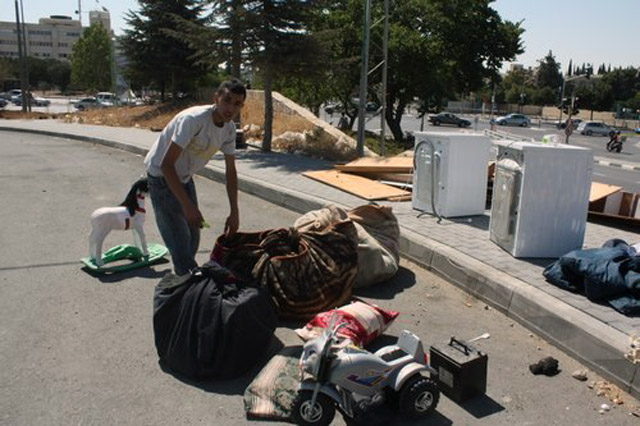
Yesterday August 8 2009 at noon, about 40 ultra-orthodox jewish squatters, the Israeli terrorists generally known as “Siknaj”, attacked the tent of the Al-Ghawi family and beat and wounded four members of these families, who were forcibly expelled from their own house on last 2 August 2009.
The criminal settlers, or “Siknaj”, were wearing black talars and hats, and used stones, sticks, and chairs in their criminal attack. The victims were three children aged between 10 – 13 and a woman. One of them was left bleeding in critical condition.

Naser Al-Gawi, one of those robbed of his house by the israeli government, said that a large detachment of Israeli police came to the place of the assault, and that rather than preventing the criminal attacks of the Siknaj, they protected them and arrested Khaled Al- Gawi, aged 40, another victim of the israeli theft. Al-Gawi denied that his family had provoked the Siknaj settlers. He said that the settlers wanted to remove their tents, which they set up near their houses, which are now occupied by the siknaj. He confirmed that he will not leave the area until he is able to return to his house.

On August 2 2009, the Israeli criminal forces forcibly terrorized and expelled two Palestinian families, Al-Gawi and Hannoun from their houses in the Sheikh Jarrah neighborhood in East Jerusalem after they demolished the gates of the houses (11 houses, eight houses belong to Aberd Al-Fattah Hannoun and his sons, and three houses belong to Maher Hannoun and his brothers), and forced the families to get out under the threat of murdering them. The criminal armed Israeli police pointed their guns at the civilians and denied them the right to take the necessary things for their children, or to remove from their furniture and other belongings.

Few hours after the Palestinian family’s expulsion, a truck of ultra orthodox jews, Siknaj, came to live in the Palestinian houses. The Siknaj and the criminal forces of Israel threw the furniture of the two families out of their homes and moved their belonging of the Siknaj to the Palestinian houses, while the Israeli police stood to guard to protect them from any attempt from the Palestinian families to recover their property. Before that, on November 2008, the Israeli military border police forcibly expelled Mahmoud Al-Kurd, an old paralyzed man on a wheelchair, his wife Fawzia, Um Kamel, and their five children and their families, from their home in Sheikh Jarrah in the East of Jerusalem.

Mohammed Al-Kurd had lived in the Sheikh Jarrah neighborhood from 1956 until the morning of November 9, 2008 when the Israeli police enforced a court order that evicted them. Few days after this expulsion, Mahmoud Al-Kurd died of heart attack in his protest tent in the neighborhood of his house. The criminal Israeli Zionist organization police has since then destroyed the tent of the Al-Kurd family several times.

The Vice President of the European Parliament, Luisa Morgantini, had sent a letter for Al-Kurd family after their expulsion from their house in the Sheikh Jarrah neighborhood in East Jerusalem . She wrote:

Dear all,

you may remember that last Thursday during the plenary session we passed a urgency resolution on the expulsion of the Al Kurd family from the house they bought and lived in since 1956 in East Jerusalem. A group of extremist settlers claimed ownership to that house and 26 other houses in the same neighbourhood, on the basis of an Ottoman title deed dating from 1880, the authenticity of which is doubtful and which is also disputed by United States. The project of the Jewish associations is to build 200 hundreds colonial units that will replace the Palestinian homes. Mohammed Kamal Al Kurd the husband of Umm Kamal did not survive, yes he was already ill, but the expulsion from the house, and the destruction by the Israeli police of the tents were they were staying after being expelled from their home , has been unbearable to him. He died in the Hospital.
Best regards,

Luisa Morgantini
Vice President of the European Parliament

Currently, a total of around 28 Palestinian families of East Jerusalem face Israeli expulsion from their homes in Al- Shiekh Jarrah neighborhood. The Palestinian families had lived in their homes in the Sheikh Jarrah neighborhood since the days when east Jerusalem was under Jordanian control. The United Nations upon contract with Jordan allotted them the land after they became refugees when they were expelled from their homes in west Jerusalem by Zionists during the 1948 war.

Despite the UN and the Palestinian denials, and despite the fact that the lawyer of the Sheikh Jarrah families found that there is no evidence in the Turkish archives that the Siknaj are the owners of the land and the houses, the Israeli Supreme Court ordered the expulsion of the Palestinian families following an appeal by the Zionists Nahalat Shimon settler group, which claimed that the Siknaj lived in, or bought plots in these areas before the establishment of Israel itself and by the partition resolution of 1948.

Two third of the houses in the West of Jerusalem belong to Palestinian families whose owners are denied the right to retake them. Some of these owners have appealed to the Israeli Supreme Court to regain their property, but always this court has always rejected their appeals, thus in fact creating injustice and supporting crimes.

What the Israeli Supreme Court and the Zionists organization “State of Israel” must remember and never forget is that we are all the Palestinians will NEVER give up and never forget, and that FOR EVER there are tens of thousands, millions of us who have their land and the homes in occupied Palestine, since 1948 and prior to that, and that we have the documents which prove our ownership.

Over 750.000 of us Palestinians were forcibly expelled in 1948 by the Israeli Zionists, turning us into refugees in Arab countries and in the Diaspora, and that also millions of us live in the occupied West Bank, Jerusalem, and Gaza Strip. We all have the right to return and to ask about our property. The Siknaj will be institutionalized, the whole criminal enterprise called “Israel” will go, and after that ALL jews of the world will be forever held in contempt everywhere, even in countries where today they are highly respected.[Kawther]

There are many houses and land belonging to Palestinians, which since 1948 – and until now, have been stolen and occupied by these European and American jews, which today are occupied by Israeli ministers. One of these thieves is the Israeli Prime Minister Benjamin Netanyahu, who lives in a house stolen from a Palestinian family in the Al-Talibia Arab district in the west of Jerusalem.

The Sheikh Jarrah neighborhood in East Jerusalem was built by the UN and Jordanian government in 1956 to house Palestinian refugees from the 1948 war. In 1967 Israel captured and illegally annexed Jerusalem during the six day war. We Palestinians want East Jerusalem to be the capital of a future state that includes the West Bank and the Gaza Strip, and so it will be with or without the consent of the Siknaj, who better start packing.

Source

Sami, The Bedouin - Adam, "the Terrorist"

Link

By Guest Post • Aug 8th, 2009 at 20:17 • Category: Children's Corner, Counter-terrorism, No thanks!, Israel, Newswire, Palestine, Somoud: Arab Voices of Resistance, Zionism

(via Uruknet) This picture, of my wife and our little baby I got yesterday evening Aug. 5th 09, a moments before dusk. Today my wife went to visit her brother in the "israeli" jail, and of course she got to take our baby Adam with her.

Adam, our baby, is less than two months, he’s exactly 54 days old today as he went to visit his detained uncle for the first time.

The "israeli" jail is some 40km away from our home, and the journey to it takes some 30-40 minutes in a normal country. In a normal country everything is normal but in a racist regime like in "israel", everything is hell for the "less human" native Palestinians. In a normal country the trip takes 30-40 minutes, but in a racist regime it takes more than 12 hours.

Today, my wife got up in down and prepared herself to go and meet her dad and sister in Jenin city before they go to the busses of the International Red-Cross to take them to the "israeli" jail. She went and took our baby and they all got in the busses and seemingly everything was OK.

The busses drove 20 minutes to reach the Israeli Apartheid Segregation Wall to get into the Palestinian territories occupied in 1948, ie inside the racist "israeli" regime.

When they got there, the busses were stopped and the "israeli" soldiers, or intelligence agents got into the busses scrutinizing every human and every aspect inside there, they intend to turn the visitor’s journey into hell and they always succeed.

The soldier, interrogator, security agent or who the hell he was kept searching until her reached my wife. He looked at her angrily asking of our baby: "Who’s this?"
-"It’s my baby." Replied my wife.
-"And what is he doing here?"
-"He’s my baby." Replied my wife amazed at his question.
-"You are violating the rules, he is not allowed to go in." said the soldier decisively.
-"What? He’s just a baby." Shouted my wife unbelieving what is going on.
-"He’s not allowed and you are violating the law. Next time you got to be punished."
-"What?" still unbelieving what is going on.
-"He is not a first degree relative, and not allowed to visit accordingly." Replied the soldier angrily.

And for those who don’t know the "israeli" "law", their racist law anyway, only the first degree relatives are allowed to visit the prisoner, ie his mom, dad, sisters and brothers…. And Adam, our 54 days old baby is not allowed simply because he’s just a nephew and not first degree relative…. The hell with the racist "israeli" regime’s "law"!!!

For my wife’s luck, who didn’t see her brother in jail for seven months, she had her old father with her, some 70+ years old man. Her father suggested a solution that he would return and take the baby back to his grandma until she comes back from the visit, that finally it’s been a long time she didn’t see her brother in the jail.

Yes, it was like this today, a crazy racist country called "israel" prevented our 54 days old baby from visiting his uncle, that their "law" decided it is forbidden for a nephew to see his uncle even if he was less than two months old. But my little Adam was happy to spend a joyful day with his grandma until his mom came late in the evening frustrated and exhausted of a journey that lasted more than 12 hours!!

This is the racist "Israel" that Adam must know and fight against. I will teach him to fight for his freedom and I wouldn’t mind if he loose his life for a dignified life!!! The hell with the "israeli" law, the hell with all the racist regimes.

Sami, the Bedouin.
Aug. 6th 09.
source: Uruknet http://www.uruknet.info/?p=m56774&hd=&size=1&l=e

Tagged as: , , ,


Guest Post is the author as indicated in the tagline. He/she (or the source that is indicated within the post) reserves the rights to the material published.
Email this author All posts by Guest Post

Top Iran Official Says Mousavi, Karroubi Must Be Tried


Top Iran Official Says Mousavi, Karroubi Must Be Tried
Readers Number : 90


09/08/2009 Yadollah Javani, the head of the elite Revolutionary Guard's political bureau,
said a plot to topple the Islamic regime through a "velvet coup" has
been exposed.

"The question is who were the main planners and agents of this coup. What is the role of Khatami, Mousavi and Karroubi in this coup?" he said, referring to former president Mohammad Khatami and defeated presidential candidates Mir Hossein Mousavi and Sheikh Mehdi Karroubi.
"If they are the main agents, which is the case, judiciary and security officials should go after them, arrest them, try them and punish them," he said in an article in Sobh-e Sadegh, the Guards' weekly journal.

Meanwhile, Iran's police chief said that protesters who died at a detention centre which was ordered closed last month had succumbed to a viral disease and denied they were beaten to death," the ILNA news agency reported .

He did not specify the disease, nor give the number of people who died, but Iranian officials have previously said that some protesters who died in custody succumbed to meningitis .
Protesters and their leaders have claimed that several people detained over the massive street protests against the re-election of President Mahmoud Ahmadinejad had died after being beaten .

Last month, an Iranian official said Kahrizak was ordered to be closed by supreme leader Ayatollah Sayyed Ali Khamenei as it did not meet "required standards.”
Iran's chief prosecutor Ghorbanali Dorri Najafabadi said that the authorities will continue to probe the situation at Kahrizak .

Bardawil: Hamas pays no attention to threats of Al-Ahmad


Bardawil: Hamas pays no attention to threats of Al-Ahmad

[ 09/08/2009 - 04:29 PM ]

GAZA, (PIC)-- Hamas legislator Dr. Salah Al-Bardawil said on Sunday that his Movement isn’t worried about the threats uttered by Fatah MP Azzam Al-Ahmad, describing such threats as a reflection of collaboration with Israeli occupation authority (IOA).

In a televised interview on Saturday night at the Dubai-based Al-Arabiya satellite TV, Al-Ahmad castigated Hamas and threatened to take action against the Movement and the besieged Gaza Strip.

Bardawil strongly reacted to Ahmad’s threats, asking him to identify the party he was speaking in its name if it is Fatah or the PA.

“We have heard such kind of threats in the past many times, and we believe that Ahmad’s threats aren’t worth the airtime they were broadcasted, and Hamas isn’t worried about those threats”, the Hamas’s leader underlined in a press statement.

He also commented on Fatah’s endorsement of Mahmoud Abbas as the faction’s supreme leader saying that it indicated the fragility of Fatah, and that it was no longer a national Movement.

No to armed resistance:


Meanwhile, the spokesman of Fatah’s sixth conference in Bethlehem Nabil Amr shrugged off statements of a number of Fatah leaders participating in the congress that Fatah still adheres to the option of armed resistance and rejects the “futile” negotiations with Israel, saying that such statements don’t reflect Fatah’s real choice.

“Fatah now follows a political line through the PLO and through the PA, and the Israelis are aware of this trend, and if there are statements issued in support of the armed resistance by some Fatah leaders here and there, I think they shouldn’t be magnified or taken seriously”, asserted Amr in a press conference in Bethlehem.

He also rejected the remarks of Israeli war minister Ehud Barak that Fatah’s stands were similar to those of Hamas, saying, “Fatah is a real force of peace”, adding that Fatah’s “resistance” would remain within the “boundaries of the international legitimacy”.

“We [in Fatah] didn’t change… we are ready to sit for negotiations with Israel at any time, and all issues are subject for negotiations”, Amr highlighted, underlining that “it is up to the Israelis to identify the structure and identity of their state”.

“We recognize Israel, and Israel is the one that specifies the form of its state”, he added.

But contrary to the soft language he spoke with regarding Israel, Amr issued fiery statements against Hamas Movement, and accused it of “committing a massacre against the Palestinian democracy”.

Hamas won a landslide victory in the PA legislative elections in 2006 before Fatah circumvented the outcome of the elections and put obstacles in Hamas’s path.

Geo. Galloway on Jewish Destruction League JDL - Telecon to Canada

Saturday, August 8, 2009


Geo. Galloway on Jewish Destruction League - Telecon to Canada:

"Geo. Galloway on Jewish Destruction League - Telecon to Canada"


Palestine Video - A Palestine Vlog

Good-bye Fatah?

Good-bye Fatah?
A single question hangs over Fatah's first general conference in 20 years. What is the movement for? There are no easy answers, writes Amira Howeidy


Click to view caption
IN THE SHADOW OF ARAFAT: Abu Mazen presiding over the opening session of Fatah's general conference taking place in Bethlehem now. Scheduled to coincide with the birth anniversary of Arafat, the meeting invoked the late PLO leader as the icon of a time when Palestinians were more united and the resistance more effective, but whether Fatah will overcome its own internal divisions remains doubtful


It is almost five decades ago that Fatah emerged as an icon of armed resistance against Israeli occupation. Under the leadership of Yasser Arafat the movement which launched its first military operation in January 1965, grew to control the Palestine Liberation Organisation (PLO), "the sole, legitimate representative of the Palestinian people," as heads of Arab states decided in their 1974 Rabat summit.

Thirty five years and several "peace agreements" later, the PLO's charter has been modified to recognise Israel's right to exist and renounce "terrorism" (aka resistance) when Arafat, in his joint capacity as both Fatah leader and PLO chairman, approved the Oslo Accords, the maze-like framework between Israel and the Palestinians that was supposed to lead to a "peace settlement".

The Palestinian Authority (PA), formed in 1994, also led by Arafat, was born as a result, mandated to represent the PLO in the "peace negotiations" and to "control" -- on behalf of the Israelis -- areas in the occupied West Bank and Gaza, and disarm the resistance. As negotiations continued, so too did the building of illegal Israeli settlements in the PA-controlled territories.

Not entirely comfortable with his U- turns, Arafat began to drag his feet over Palestinian concessions. In 2002 he was effectively placed under house- arrest by Israel until his death in 2004. Almost inevitably rumours that he was poisoned began to circulate, with accusing fingers pointed at his aides. No investigation or postmortem was conducted. His successor, Mahmoud Abbas (aka Abu Mazen), assumed both the presidency of the PA and the leadership of Fatah. And it is Abbas who is the purported star of Fatah's ongoing four-day sixth general conference, its first in 20 years.

Just as questions began to be asked about the post-Oslo relevance of the PLO, so is Fatah's role being questioned today.

In mid-July, Fatah's founding member and the movement's second-in- command, Farouk Kaddumi, accused Abbas and Mohamed Dahlan, Gaza's former security chief, of conspiring with Israel to poison Arafat. Kaddumi's accusations were rejected by Abbas, who nonetheless vowed to set up an investigative committee to examine the allegations. The timing of Kaddumi's bomb shell announcement, only weeks ahead of Fatah's planned conference, was clearly aimed to thwart the meeting which is held in occupied Bethlehem.

Further more, many senior Fatah members have been prevented by Israel from entering the occupied territories to attend. Meanwhile, Hamas, which controls the Gaza Strip, barred some 350 Fatah members in Gaza from leaving for Bethlehem, announcing that they could travel only if Abbas's security forces released over 800 Hamas members detained in West Bank prisons. Hamas spokesmen accuse the PA of torturing its detainees, some of whom have died in custody.

This bizarre landscape could not be more different to the unity that pertained in the 1960s. Hardly surprising, then, that the Arab media has devoted so much space to opining the end of Fatah. The run-up to the sixth congress has resembled nothing more than an extended requiem mass.

Abdel-Bari Atwan, editor of the London-based pan-Arab Al-Quds Al-Arabi, says the congress marks the final demise of "old Fatah", an organisation that for 40 years "led the Palestinian struggle with honour". He notes, "it is the first time in history that a national liberation movement has met in congress under the guns of the occupiers and with their blessing".

Leading Palestinian analyst Bilal Al-Hassan, in a commentary published on aljazeera.net website, writes that while "historic Fatah" maintained its objectives, today's Fatah has "new" and "different targets", one of which is to "end... Palestinian resistance to the occupation".

The post-Arafat Fatah now convening in Bethlehem, he argues, is seeking to create a framework that will convert the movement into a ruling party, concerned with administration and the economy "and not national liberation".

"To protect this new venture" it wants an entirely new security apparatus in place, one void of freedom fighters. "Hence," says Al-Hassan, the "perfect" cooperation between the PA and the US administration, through US Security Coordinator Lieutenant General Keith Dayton.

A third objective of the congress, according to Al-Hassan, is to remove public servants affiliated with Palestinian resistance institutions from their posts and replace them with apolitical employees. The change, he points out, is already being facilitated by a new law promoting early retirement. "Eventually one order [will emerge] that accepts what Israel is offering the Palestinians, regardless of their legitimate rights and demands."

It is all a far cry from Fatah's origins.

"This conference will end what remains of Fatah," says Abdel-Qader Yassin, a Palestinian analyst based in Cairo. "There is no way that a congress held under occupation will adopt resolutions supporting armed struggle and the liberation of Palestine."

The conference will elect new members to the movement's top governing bodies, the "revolutionary" council (a 100-member body), and a 21-member central committee, many members of which had been killed or died in the 20 years separating Fatah's fifth general conference held in Tunis and its sixth taking place now in Bethlehem.

Yassin believes Fatah's leader, Abbas, opted to hold the conference in Bethlehem because he knew Israel would prevent the attendance of Fatah leaders in exile opposed to his policies. Technically, Fatah and the PLO are separate entities, though Arafat's leadership of both acted to muddy the separation.

Salman Abu Sitta, a member of the Palestinian National Council (PNC), the PLO's supreme legislative body, insists that while "it is true that Fatah played a major role in the PLO's growth, the PLO and the PNC are not one and the same".

If Fatah is fading as a result of divisions and rifts, the PLO and, more importantly, the PNC, should be preserved because, says Abu Sitta, "it is the sole, legitimate representative of the Palestinian people". (see p.5)

I would like to reclaim the Old Country from the jaws of Zionism.

THE ZIONIST-DOMINATED PRESENT

August 9, 2009 at 8:46 am (Culture, History, Holocaust, Israel, Nostalgia, zionism)


In the beloved Old Country, a Jew has visions of her homeland

by Lizzy Ratner

Last month I visited the Old Country for the first time. Poland. Land of my grandmother and grandfather, burial ground of countless unknown relatives. For six days, I wandered the country, and for six days I marinated in a deep nostalgia for a Jewish past I have never lived but have always felt far more connected to than, say, the Zionist-dominated present.

In one particularly moving episode, I walked the still-cobblestoned street where my grandfather walked as a boy, a narrow lane of Bialystok called Czysta Street where he, his parents, and eight siblings all lived [old homestead is pictured, below].

Lizzy Ratner's family's homestead in Bialystok

In another, I celebrated, cake and all, what would have been my great-grandparents’ 118th wedding anniversary. I visited the synagogue in Tykocin where one of my great grandfathers might have prayed. And I roamed the overgrown cemeteries of Warsaw and Bialystok, wondering which of my relatives were buried there, marveling at the tangled breadth of what once was, mourning its loss, and puzzling over why, if we’re going to insist on having some kind of a “homeland,” so many Jews demand that it be Israel when it so clearly should be Poland. Poland, land of latkes and bialys. Poland shel zahav.

This, of course, isn’t the reaction you’re “supposed” to have. In the popular Zionist narrative, the Old Country – and the unspeakably murderous brutality that Jews suffered there – is the (non-Biblical) justification for the state of Israel. It’s the narrative stepping-stone that gets people from anti-Semitism to Eretz Yisrael, from colonization to justification, and a whole industry of books, teen tours, and UJA-style delegations has sprouted up to help cement the connection.

And yet, when I returned from my trip and one of my more Zionist relatives asked the inevitable question – “So now you understand why Jews need Israel, right?”I still couldn’t say “yes.” For me, the Old Country opened up a very different set of narratives.

Let’s start with some basic facts. Jews have a long history in the sprawling eastern European basin that is and has been Poland. Some say this history stretches back over 1000 years, and almost all agree that there have been bona fide Jewish settlements in Polish lands since at least the 11th Century. These Jews seem to have come, at least initially, from the wilds of Western Europe, driven by the rabid Jesus-freakery of the crusaders into the relatively tolerant arms of the emerging Polish kingdom (and the word “relative” really does need to be emphasized). It was hardly a picnic, but Poland’s comparative merits meant that Jews kept coming for decades and then centuries. By the mid-16th Century, as much as 75 percent of the world’s Jews on Polish soil, and by the eve of the Holocaust, Poland was home to the largest Jewish population in Europe. My own grandfather’s shtetl-town was a solid 70 percent Jewish in 1939; my grandmother’s town, Warsaw, was one-third Jewish. And as of 1998, it was estimated that more than three out of four American Jews could trace at least once grandparent to pre-Nazi Poland.

As one of these three-out-of-four American Jews, I can attest to the enduring power of my Old Country roots. My childhood was Roman Vishniac photographs and The Fools of Chelm (along, oddly, with unhealthy doses of WASPy Victorianism courtesy of my all-girl private school). It was Yiddish-accented great-aunts and uncles who’d never managed to slough their Bialystoker ticks. It was an ethos of always needing to prepare for the worst – for famine, plague, or pogroms – despite obvious security and plenty. And it was stories, lots and lots of stories, of my grandpa Harry, né Osher, a small man who barely reached 5’ 4”,who had little more than an eighth grade education but amply made up for it with sechel and chutzpa, who was generous to a fault, and who believed, profoundly, that the fate suffered by Europe’s Jews meant that you did everything possible to prevent other people from suffering the same thing.

Or, put differently, if I have any cultural proclivities at all other than those of the deracinated modern-day American, they clearly belong to the Yiddishe world of Jewish Poland – not the aggressive, militarized one of modern Israel.

This sense persisted – pecked at me, really – throughout my Polish sojourn, and by the time I was half way through the trip I’d begun to nurture a stubbornly-elaborate fantasy: rather than settling in Israel, Jews had instead migrated en masse to the Polish Old Country where they re-claimed their homes, land, synagogues, and streets. What’s more, these Jews were joined in my imagination by Romany, gay folks, all the “undesirables” of the Nazi regime along with any other oppressed and dispossessed. After all, wouldn’t that have been a far more just resolution and rebuke to the powers of European racism and brutality – creating a refuge for the persecuted right in the bastards’ back yards – than creating a distant Jewish nation on Palestinian soil? Than repeating the war’s dark lessons of nationalism? And let’s be honest, if there was a land to which Jews had a legitimate, strong connection, wouldn’t it have been the one where the majority (though not all) had spent hundreds upon hundreds of years?

No doubt any Zionists or ultra-religious folk who might happen to be reading this are probably frothing at the mouth right about now, yanking at their beard hairs. “You’re romanticizing the Old Country!” they’ll shout (even as they romanticize Israel). “The Bible makes no mention of the land surrounding the Vistula and beyond,” they’ll cry. And then they’ll accuse me of the greatest crime of all: of failing to understand the lessons of the Holocaust, of shrugging off centuries of hate.

In fact, I would argue that it’s just the opposite (though, if we’re talking guilt, I will cop in this instance to a certain regrettable Ashkenazi-centrism, though I’d also like to think this is more polemical than actual).

Like most Jewish kids of a certain time and place, I grew up with the Holocaust as a kind of cosmic microwave background, glowing radioactive in the distance. From the time I was tiny, I could recite many of the essential, horrendous details the way some young Jews can recite Talmud: six million, Hitler, Mengele, Auschwitz, Einsatzgruppen, gas chamber, death march, Final Solution. And now, having actually had the chance to visit Poland, I suspect I’ll never fully recover from the sucker-punch of the experience: from Auschwitz, Treblinka [where the author is pictured below], and the utter obliteration of an entire way of life. The Nazis (with later help from the Poles and the Communists) really did do a smash-up job of erasing a whole culture. Where there were once homes, synagogues, and artisans’ shops there are now parks, churches, and ruins. Where there were once towns full of families, there are now mass graves. And where Yiddish music and theater once thrived there is now, as we discovered one distressing afternoon in Tykocin, the Polish equivalent of minstrel shows: young Varsovians dressed as if they’d raided the wardrobe department of Fiddler on the Roof – in peyos, tzitzit, black vests, and caps – doing the sorriest wedding-dance I’d ever seen.


treblinka

But far from freeing me to embrace Israel, this just made me more disturbed – more ragingly angry, frankly – by what Israel has done, and continues to do, to Palestinians. Again and again, as I stared at the remnants of ghetto walls, I wondered, baffled, how a people that was forced to live – and die – behind walls could force another people to live – and die – behind walls? Or how these same people who were pushed from their homes could push another people from their homes? Or force them to cross checkpoints, carry I.D., waste from hunger, dig tunnels to get food, and die at the blunt end of an Israeli missile? These are things I simply cannot understand. And as powerfully as I felt them before going to Poland, I feel them more powerfully now.

So in an attempt to re-wire the discourse just a bit, I would like to reclaim the Old Country from the jaws of Zionism. Instead of tours that whisk young people from Auschwitz to Israel, I would like to see trips that go from the Warsaw ghetto to the Jabaliya refugee camp. In place of a Jewish mainstream that looks only – and mistakenly – to Israel for its identity, I would like to see Jews who reach across time and space, to old countries and new countries, for a sense of who they are – and might be. But above all, if I can’t see an all-inclusive Yiddishe utopia resurrected in Poland, I would at least like to see the true lessons of “never again” enshrined in a single, consummately-inclusive Israeli-Palestinian state – a state that serves, through its unparalleled openness and respect for the rights of all its residents, as a true rebuke to the forces of hatred and genocide. I’ll admit that I don’t know exactly how to make it happen; policy often eludes me. But I do know that every reality begins with the notion of its possibility.

This originally appeared at

Crossposted at Ibn Ezra

Orthodox conference: Patriarchate is involved in judaizing Jerusalem


Link
[ 09/08/2009 - 02:31 PM ]


OCCUPIED JERUSALEM, (PIC)-- The executive committee of the Orthodox conference in Palestine on Saturday accused patriarch Theophilus and the Orthodox patriarchate of occupied Jerusalem of contributing to the judaization of the holy city and waiving more Palestinian lands near the monastery of Mar Elias.
The executive committee demanded Theophilus to cancel his deal with Israeli companies and to respect the written commitments he made to the Arab Orthodox community.

The committee explained that as the conflict over the eligibility to seize the Arab Orthodox endowments and property heated up between two Zionist companies called Bara and Talpiot and reached to the courts, many facts were revealed about waiving endowed land near the Mar Elias monastery in Jerusalem.

Former patriarch Irineos had signed a deal on 14/12/2007 with Bara company to give it the right to administrate the patriarchate’s property without any restrictions, while current patriarch Theophilus signed a deal on the land near the mar Elias monastery with Talpiot company.

Dwaik: Fatah backtracked on its approval to my return to the PLC


Link

[ 09/08/2009 - 03:37 PM ]


AL-KHALIL, (PIC)-- Dr. Aziz Dwaik, the speaker of the Palestinian legislative council (PLC), said Sunday that his failure to return to his office to assume his parliamentary duties was attributed to Fatah faction which backtracked on the agreement signed by all parliamentary blocs in this regard.

In a press statement to Palestine newspaper, Dr. Dwaik stated that his work outside the PLC headquarters, after his release from Israeli jails, is ongoing, adding that he decided to delay his return to the PLC until Fatah finishes its sixth conference in order to know its positions more clearly.

“My rule is always based on not adding a new burden to the Palestinian arena, but my duty and the duty of all Palestinian leaders is to alleviate these burdens and to bridge the gap between estranged parties in the hope of agreeing on one national agenda that serves the interests of the Palestinian people,” the speaker underlined.

Regarding the issue of elections, he explained that the Palestinian rivals must agree on the electoral law, set a date for the elections and make all preparations regarding the participating blocs and lists, adding that the international community must also respect the outcome of these democratic elections, or else the experience of 2006 would be repeated.

The speaker noted that he has no intention of running for the PLC presidency if new legislative elections were held, highlighting that his biggest concern is to achieve the national reconciliation between the Palestinian rivals.

In Lebanon, sects come first, the nation second

Link


In the NATIONAL, here

"....Yes, Mr Jumblatt is the leader of a sect of just 300,000 people “who can reinvent himself every decade and take his entire community in a new direction”.

The size of the Druze sect in Lebanon has never been a detrimental factor in shaping politics in the country, but it is its strength to influence what direction politics take.

This is historically true in the case of Lebanon and it is likely to continue as long as Lebanon holds on to its sect-based system.

First, since independence in the 1940s, the Druze have almost always held the political balance in the country. The late leader of this sect, Kamal Jumblatt,was famously known as “the king maker” for nearly three decades. His son, Walid, is simply trying to maintain this role.

Second, Walid Jumblatt says his party’s five-year-old alliance with the “Future” bloc led by Saad Al Hariri, the prime minister designate, was “an alliance of necessity” and now has become outdated.

This must come as no surprise as many other sect leaders in Lebanon feel the same, one way or another, about their current alliances, including the partnership between the Christian Maronite leader, General Michel Aoun, and the Shiite militia leader, Hassan Nasrallah.

Third, the explanation given by Mr Jumblatt, as Emile Hokayem wrote, that he was acting in the best interests of his community, not necessarily with a sense of Lebanese citizenry but as a member of the Druze sect.

In the current Lebanese political elite, in both majority and minority blocs, only a handful of powerless intellectuals will conduct themselves with this sense. Everyone else will speak on behalf of their sects and not necessarily on behalf of the Lebanese citizen."


Posted by G, Z, & or B at 3:09 AM

Abbas Re-elected Fatah Chief at Congress Marred by Disputes


Abbas Re-elected Fatah Chief at Congress Marred by Disputes


08/08/2009 Fatah on Saturday re-elected Palestinian president Mahmud Abbas as head of the secular movement on the fifth day of its first congress in 20 years, which has been marred by disputes on how to revive its authority. The Fatah congress, which has convened in West Bank city of Bethlehem, elected Abbas – who was the only candidate bidding for office – unanimously.

But a vote to renew the governing bodies of the secular movement was delayed again and re-scheduled to take place on Sunday.

More than 2,000 delegates at the congress in the West Bank city of Bethlehem unanimously raised hands in favour of Abbas, who took over as party chief after the 2004 death of Yasser Arafat.

In his victory speech, Abbas vowed to "free the Palestinian land and people" of Israeli occupation.

He later said: "This congress must be a new beginning for Fatah" urging everyone to assume their responsibilities.

"We are here out of the desire to achieve the Palestinian people's goals," he continued. "We are here to liberate the Palestinian land and to form our state with Jerusalem as its capital."

Fatah, he concluded, is "strives to see all 11,000 Palestinian prisoners held in Israeli prisons, free."

At the end of his speech, the Palestinian president addressed Farouk Kaddoumi, the PLO's second in command, who recently accused him of collaborating with Israel to assassinate former leader Yasser Arafat. "We are all human, we all make mistakes, and we all forgive," Abbas said.

Abbas did not go into details about diplomatic talks, but at the start of the congress last week, he spoke of the understandings he reached with Israel with an American guarantee.

He said this included all of occupied east Jerusalem, the Jordan Valley and all parts of the Dead Sea located in the West Bank. "But now the Israelis are trying to deny this and create a reality in Jerusalem, claiming that Jerusalem is united under their sovereignty," he said last week.

"Although we have chosen peace, we maintain the right to launch an armed resistance, which is legitimate as far as international law is concerned."

The convention, which started on Tuesday and had been due to last three days, was extended after bitter arguments between the old guard and young delegates seeking a stronger role and broad reform.

Saturday's discussions centered on ways to clean up the corruption plagued party and offer an alternative to their bitter rivals in the Islamic resistance Hamas movement.

Debate focused on how to restore Abbas's authority in Gaza after Hamas seized control of the enclave in June 2007, routing Fatah forces and limiting Abbas's power to the Israeli-occupied West Bank.

Fatah, which controls the Palestinian Authority, exercised undivided power among Palestinians before it lost heavily to Hamas in a 2006 parliamentary election.

In a new sign of the continued rivalry between the factions, Fatah accused Hamas on Friday of briefly detaining a number of its senior leaders in Gaza. Infighting and corruption allegations have further weakened Fatah, which was founded by Arafat in the late 1950s.