Monday, 14 December 2009

Regime Change: "...Focus on the IRGC as "the face of repression," ... without arousing Iranian national pride over their nuclear program .."

Link


Declassified/ here
".... In fact, Levey's reappointment as undersecretary of the Treasury for terrorism and financial intelligence in February provoked bitter protests from Iran, whose finance minister at one point denounced him as "one of the U.S. government's Zionist deputies." Through back channels, Tehran passed word that it viewed the move as inconsistent with Obama's public pledge to pursue a friendlier approach, according to a source directly familiar with the protest who asked not to be identified because of diplomatic sensitivities. Levey himself was surprised to get the call telling him that the pro-engagement president wanted him to stay on—and he hesitated before accepting.
Until now, Obama has kept Levey in his back pocket. But the president has concluded that his offer of an "outstretched hand" to Iran will not, on its own, produce the results he needs..... "There is nothing happening," says one senior European diplomat who would not discuss the talks on the record. "Zero. Zero. Zero.".....
So Stuart Levey's moment on the world stage has arrived once again. The White House has approved an aggressive plan to squeeze Iran's economy, and Levey will be at the center of it, the senior administration official says. One key target will be the Iranian Revolutionary Guard Corps, the force that has largely taken control of the country and its economy......
While the Revolutionary Guards pretend to be the incorruptible shield of the Islamic Revolution, individual commanders are believed to be wealthy private investors, especially in neighboring countries like Dubai. "What will cause the Guards their demise is their corruption," an Iranian intelligence official told NEWSWEEK on condition that his name not be used. "For the past 20 years, they've been allowed by the Supreme Leader and consecutive governments to make money in a shadowy world." The West's new approach, Levey indicated, is to focus on the IRGC as "the face of repression," thereby supporting democracy activists in Iran without arousing Iranian national pride over their nuclear program.
The plan is for Levey's office to publicly identify "dozens" of Iranian Revolutionary Guard Corps front companies and then pressure suppliers and trading partners to cut off ties—or risk being sanctioned by the U.S. government, says the senior administration official. "There will be a big effort by Stuart to work with like-minded countries to target IRGC front companies," the official says. "We know which ones [the IRGC] are affiliated with and we know which ones they control." Levey says he wants to make the foreign firms understand that "if they're dealing with Iran it's nearly impossible to protect themselves from being entangled in that country's illicit conduct."


Posted by G, Z, or B at 12:16 PM

PALESTINE TODAY ~~ ENCOUNTERS AND ACTIONS

Link


By Mazin Qumsiyeh, PhD


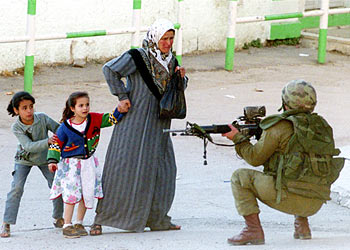
Days pass by here each one very unpredictable.  Yesterday we heard significant complaints about the rumored plans by the accomodationist branches of Fatah for the creation of a department for “Mughtaribeen” (expatriates) dropping the language of exile and diaspora and coming closer to abrogating fully the internationally recognized rights of refugees.   Whatever the real story is, the sensitivity shows that the issue of refugees remains the core of the Palestinian struggle.  Earlier, we went to help a farmer in Um Salamone to reclaim his land by planting trees and clearing rocks.  We are told that a settler had come and uprooted the trees of another farmer and burned them the day before.  The settler comes from the nearby colony of Migdal Oz which is surrounded by video cameras so clearly if they want to stop this they could.  In any case, the farmer actually follows procedure and lodges a complaint with Israeli police via phone, a policeman arrives and takes his statement and asks him to go with him to (where else) the colony of Migdal Oz.  Not more than ten minutes after they leave, heavily armed Israeli occupation soldiers arrive and ask us what we are doing then pick on the younger Palestinian men volunteering with us (asking them for their ID cards and asking them questions).


We toured the Old city of Hebron with visitors of mixed background including a Jewish and Catholic couple (even though not religious).  The soldier at the gate to the Ibrahimi Mosque says the woman with Jewish background needs to go from another entrance to the section that is just for Jews. The building has been a mosque for 1400 years but has always welcomed visitors of all religions. After a Jewish terrorist killed 29 worshippers and injured over 100 in 1994, the Israeli authority did not react as you would have hoped (by removing the 400 racist fanatical settlers living in the heart of this city of 400,000 Palestinians) but reacted by securing more space for the colonial settlers, taking over more buildings in the heart of Hebron and dividing the mosque into a “Jewish” and “nonJewish” areas.  As we walked in the old section of Hebron (now very much commercially dead thanks to the settlers), we encountered Israeli soldiers on patrol and we talked to a young man who took us into the roof of his house showing us along the way a room that had been burnt by settlers. On the roof we see the building next door (connected actually) that was taken over by settlers and soldiers.  A soldier in the watch tower and settlers on their window is what the 9 Palestinian Children in the house see as they play in the balcony.

We also encounter wonderful Jewish and non-Jewish colleagues and supporters who do not swim with the tide of oppression.  Many Israelis who do not buy their government’s lie about avoiding “Area A” (the 5% of historic Palestine that now is the concentration camps for us Palestinians).  They come, share meals with us and learn new things and yes build friendships.  These kind of unexpected encounters are common here every day.  Life with human camaraderie and solidarity in the Unholy/Holy Land remains beautiful despite all of the problems and challenges.  We hope you come experience it.

I will be in Spain 14-15 Dec in Madrid, 16-18 in Barcelona participating in conferences and giving talks.  In Madrid, in the frame of joint activities carried between The Culture, Piece, and Solidarity Haydee Santamaria Association, and AIDUN Center for Refugee are convening the second international symposium entitled : ”Middle Eastern Politics: Myth & Reality http://www.culturaypaz.org/conferencias-las-politicas-en-oriente-medio-mitos-y-realidades-ii-los-dias-14-y-15-de-diciembre-en-el-circulo-de-bellas-artes-de-madrid-a-partir-de-las-1830h
(I will be in Italy in early January and in the US in March also on speaking tours)
Video: Palestinians being evicted from their home in Jerusalem to be taken over by settlers
http://www.youtube.com/watch?v=EISikrLcSw8
Action 1: European Union demands Israel ends all its settlement and occupation of areas beyond the Green Line including in Arab East Jerusalem [This is significant but European public needs to push their governments to now follow-up with sanctions until Israel complies with International law http://news.bbc.co.uk/2/hi/middle_east/8401913.stm
Action 2: The March on Gaza Dec. 27-Jan 1 will be accompanied by demonstrations and vigils around the world.  We will have a meeting tomorrow (Thursday) in Bethlehem area to plan actions. Email me for details.  Please plan events in your city and try to include BDS actions (http://www.bdsmovement.net )

*********************

Quote of the day from the chief Rabbi of the city of Safad (a city that was before 1948, 80% Palestinian and has since been ethnically cleansed of its native Palestinian population, see http://www.palestineremembered.com/Safad/Safad/index.html ): "From a Jewish Law perspective, their [the 1.5 million Palestinians in the Gaza Strip] electricity and water need to be shut off” (of course Rabbis from Rabbis for Human Rights and Naturei Karta would have a different perspective but there is unfortunately a lot of officials/leaders here who believe this)

Jeffrey Feltman: "To be frank, we don't have independent information about this..."

Link

Iran, Hezbollah & Al Qaeda coalescing, but Al Ansi (alone) figured it out.
Al Arabiya/ here


"Unnamed intelligence sources on the Saudi-Yemeni border detected a secret meeting between Yemen's Houthi rebels and an official from Iran’s Revolutionary Guard and top Hezbollah leaders, press reports revealed Sunday. In addition to Iran, Houthi rebels are also backed by al-Qaeda .....

Arab and Egyptian sources, speaking on condition of anonymity, said that the meeting was held last month to plan for an escalation of the conflict between the Shiite rebels and the Yemeni and Saudi forces, London-based Asharq al-Awsat reported.


The sources told Asharq al-Awsat they were surprised by Jeffery Feltman's, statements that there is no evidence supporting the involvement of Iran in the Houthi conflict.
“Many of our friends and partners have talked to us about the possibility of outside support to the Houthis and we have heard the theories about Iranian support to the Houthis,” Feltman said in a regional security conference held in Bahrain.“To be frank, we don't have independent information about this,” he concluded.
Meanwhile, Ali Mohamed al-Ansi, director of the Yemeni National Security Bureau, said there is strong evidence that Iran is backing the Houthi rebels but he cannot disclose details to the media.
“The ship Yemen intercepted in October was smuggling arms to the Houthis,” he said on the fringes of the Manama dialogue, the conference held in the Bahraini capital to discuss the strategic and security challenges facing the Gulf region. “We also have proof that it was coming from Eritrea.”


Posted by G, Z, or B at 10:57 AM

GAZA ~~ RELIVING THE CHANUKAH MASSACRE

Link December 13, 2009 at 11:43 am (Flashback.... from the archives, Gaza, Genocide, History, Israel, Palestine, Photography, War Crimes)

Never to forget….. Never to forgive!

PHOTOS OF THE CHANUKAH MASSACRE

PHOTOS OF THE DAY

gaza86.jpg
I selected the following photos to sum up all that can be said to describe the Israeli massacre in Gaza today and what we expect to see very soon.

(Click image(s) to enlarge)

First, peace? What peace? gaza6

The Israeli terrorist war machines used 60 jet fighters to attack Gaza and drop 100 ton of explosives there. The operation was concluded in two minutes:

gaza116

gaza38

gaza39

A new world record in massacring people in one day. Congratulations to Israel (I mean it, congratulations for winning the bloody record):

gaza11

gaza68

gaza76

gaza105

gaza110

Israeli citizens watching with JOY and taking memorial photos of their terrorist attack on Gaza:

gaza13

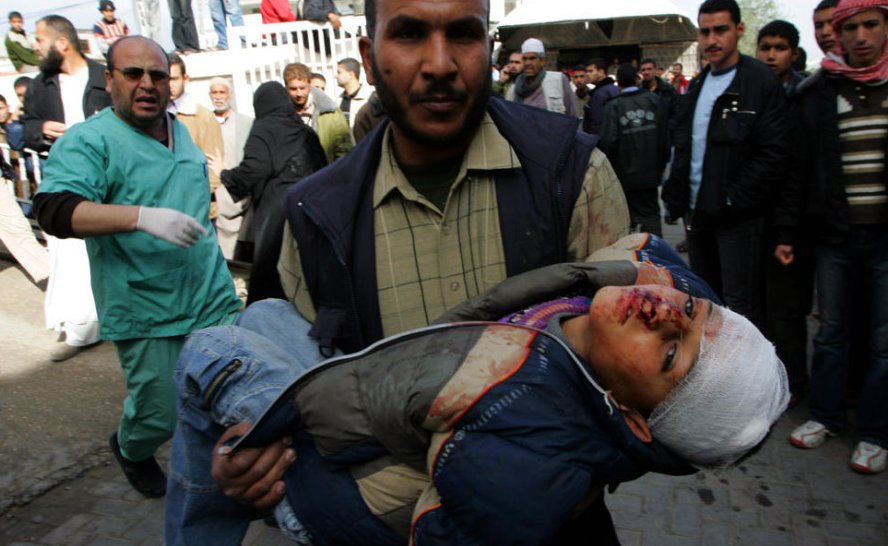
The casualties: 225 killed (including ten of children and toddlers, and still counting) and more than 700 injured, hundreds of them in critical condition. The Israeli terrorist state chose the peak hour in Gaza – while kids are returning home from school – to cause maximum death:

gaza65

gaza1

gaza47

gaza60

gaza65

gaza85

gaza86

Palestinians in the Occupied West Bank went demonstrating against the Israel terrorist crimes in Gaza and attacked Israeli terrorists with stones. Reports indicated that all fractions between political parties vanished during these demonstrations, which included Hamas and Fatah supporters who attacked Israel’s terrorist army side by side.

gaza48

gaza3

gaza36

gaza43

gaza120

gaza121

And finally, Palestinian President, Mr. Mahmoud Abbas was drinking Arabian coffee in Riyadh, Saudi Arabia. Enjoy it Mr. President!

abbas

Petraeus: "The flow of foreign fighters through Syria has been reduced dramatically ..."

Link

Reuters/ here


"There is no question that Al Qaeda in Iraq has been significantly reduced in its capability and capacity," Petraeus, the head of U.S. Central Command, told reporters on the sidelines of a security conference in Bahrain.

"The flow of foreign fighters through Syria has been reduced dramatically from 110 a month at the height of the flow to under 10 per month now," he said.

"What they have decided to do, we believe, is literally to conduct a lower level of attacks day-to-day and periodically coordinate high profile attacks so that they get the big press bounce out of that."

The United States still has thousands of troops in Iraq backing the Shi'ite-dominated government of Prime Minister Nuri al-Maliki, which has often accused neighboring Syria of not taking action to stop militants operating in Iraq.

Violence has dipped sharply in Iraq over the past 18 months but the recent bombings have stoked doubts about the ability of Iraqi security forces to keep the peace before the elections.

Militants linked to al Qaeda claimed bombings in Baghdad on Tuesday that police said killed 112 people.

Petraeus said Washington was on track with plans to reduce its forces in Iraq to 50,000 by August 31, 2010 from around 115,000 now. The United States hopes to end combat operations in Iraq next August, before a full pullout by the end of 2011."


Posted by G, Z, or B at 10:49 AM

A clear case of Identity-theft...


Link

one Israeli..... .. accused.


We have received a message
from the Heavens,
It seems that those " Historical-Chosen- people "
have filed a Court case,
 accusing all the current-Israeli- citizens
of  Identity-theft.


Eng. Moustafa   Roosenbloom
Reporter from high-level

Posted by Тлакскала at 8:05 PM
Labels:

From today’s edition of The Independent

Link

Gaza one year on: The aftermath of a tragedy To mark the anniversary of the offensive which left hundreds of innocent civilians dead, Donald MacIntyre revisits the scene of one of the most horrifying conflicts of our time


Devastating: The Israeli attack on the town of Rafah on 13 January 2009
EPA
Devastating: The Israeli attack on the town of Rafah on 13 January 2009

Hilmi Samouni still hopes at some point – “inshallah” – to go back to his old job as a kitchen assistant in the Palmyra, Gaza City’s best known shwarma restaurant. But unlike his 22-year-old brother Khamiz, who is working once again in a car paint shop, and his 20-year-old cousin Mousa, on a two-year accountancy diploma course at Al Azhar University, Hilmi, who is 26, found that he couldn’t cope when he returned to the Palmyra after the war. “Everyone there was very supportive,” he says, “but I couldn’t do good work.” Unlike Mousa, who also lost his parents, and Khamiz, Hilmi saw the bodies not only of his father Talal and his mother Rahme but also of his wife Maha, age 20, and their only son, six-month-old Mohammed, among the 21 killed in the shelling of the warehouse in which they had been ordered by Israeli troops to gather. It still bothers Hilmi that he has no pictures of any of them; they were burnt when the family home was fired on the day before.

Now Hilmi mainly potters round the house, set amid devastated orchards and chicken coops in the southern Gaza City district of Zeitoun. The graffiti in English and Hebrew on the interior walls, left by the men of the Israeli army’s Givati brigade, are the only relics of their two-week occupation of the building – a gravestone drawn beside the words “Gaza we were here”; “One down and 999,000 to go”; “Death to Arabs”. Has the family deliberately kept the graffiti visible? “Yes, but anyway we didn’t have paint to cover them,” he says. One of Hilmi’s duties is to help look after his dauntingly self-possessed 11-year-old sister Mona, who turns the pages of artwork inspired by her memories of the morning of 5 January 2009. “This is me cleaning the face of mother who is dead. This is my father who was hit in the head and his brains came out. This is my dead sister-in-law. This is my sister taking the son from my sister in law…”

The warehouse shelling commemorated in Mona’s artwork was one of the worst of many attacks on civilians in Gaza by Israeli forces between 27 December and 18 January. The Israeli military offensive had been a long time coming but still the multiple Saturday-afternoon bombing raids with which it began came as a surprise. The stated purpose was to halt the rocket and mortar attacks – 470 of which had spread undoubted fear through the border communities of southern Israel since an Israeli raid on Hamas ended an uneasy but largely effective five-month ceasefire in early November 2008.

But if the timing was a surprise, the unprecedented ferocity of the onslaught on Hamas-controlled Gaza was even more so. More than two weeks into the war, the Israeli foreign minister Tzipi Livni would boast in a radio interview that “Israel … is a country that when you fire on its citizens it responds by going wild – and this is a good thing”. Whether, as Judge Richard Goldstone’s UN-commissioned report on Operation Cast Lead charged, Israel “targeted” the civilian population, or whether, as some soldiers have since attested, the military simply subordinated the preservation of Palestinian lives to those of its own troops, the figures tell their own story of the extent to which “a country” went “wild”. Though disputed by the military, exhaustive research by the respected Israeli human-rights agency B’Tselem put the total death toll at 1,387, of whom 773 were civilians. In the same period, four Israelis were killed in Israel by rocket fire, and nine soldiers in Gaza, four from friendly fire. Because the borders were closed, there was no flow of refugees out of Gaza of the sort that would have followed an equivalent onslaught elsewhere.

That early-morning bombardment of Wael Samouni’s half-finished warehouse – where some 100 of his extended family, including his young relative Hilmi, had been sheltering – is one of more than 20 events being investigated by the Israeli military police. Last month, pointing out that so far only one soldier has faced trial over his conduct of the war – for stealing a Palestinian’s credit card – B’Tselem complained that since the Army itself was doing its own investigating, any indictments would be directed only against “the lower echelon” and that an independent inquiry capable of attributing blame to “senior officers” and government policy-makers in the “political echelon” was needed.

Either way, there is no sign as yet of an investigation into a separate incident early the previous day, the first of the ground invasion. Israeli soldiers, their faces camouflaged in black, some with branches round their helmets, stormed into the house behind Hilmi’s home, where his uncle, Atiya Samouni, a 46-year-old farmer, was taking refuge with his two wives and 15 children.

The family say that the house’s front door had deliberately been left open so the advancing troops would see there were children inside. According to their account, Atiya, who spoke some Hebrew, walked with his hands up to the open door of the children’s room – where the family was huddled – to show himself to the soldiers who were by now in the adjacent living room. His four-year-old son Ahmad followed him, crying out “Baba, Baba” – “Daddy” – and Atiya told him: “Don’t be afraid.” But as Atiya started to speak to the soldiers he was shot dead. The troops then began shooting into the children’s room, to screams from the adults of “katan” and “ktanim” – “little one(s)” in Hebrew. Five of the children were hit; Ahmad was shot twice in the chest, fatally.

Eleven months later, the widowed Zeinat Samouni seems cheerful at first, pressing visitors with a hospitable smile to take one of the round flatbreads she is baking for the imminent Muslim festival of Eid al Adha in the one room she now shares with her seven surviving children. But she cannot stop crying as she describes how they left the house – and the body of her husband – with an older son carrying the heavily bleeding Ahmad to the house of another relative. As evening came, she gave Ahmad, his face now yellowing, bread dipped in water; “It was like feeding a bird,” she recalls. The family called an ambulance but were told that it was too dangerous for it to approach the area. Ahmad died in the early hours of Monday morning. “If we’d been able to get an ambulance, I think he would be alive now,” she says.

Zeinat’s daughter, 10-year-old Amal, carries everywhere in her pocket two worn photographs of her dead father and brother. “I want to look at them all the time,” she says, almost a year after they were killed. “My house is not beautiful without them.” Amal was also injured and says her head and right eye still hurt. But the psychological trauma for Amal is compounded by the fact that she ran off before her mother and siblings left the house after the shooting. Four days later, she was found, partly buried under rubble, dehydrated and in shock, one of 15 other survivors in the immediate area when Red Cross ambulances were finally allowed to get close enough to bring them out. At school, Amal’s favourite subjects are Arabic and English. “I don’t know much English, but I like it,” says the girl, who wants to be a doctor when she grows up.

Of Atiya’s children with his other wife, Zahawa, the most affected is Kannan, now 13, who still limps from the gunshot in his left thigh. Before the war, he was a keen midfielder but he no longer plays football. For him, too, the impact has not only been physical, however. In the months after the shooting, he had nightmares – and was several times found crying in his sleep or shouting, “They want to shoot my father”. “He won’t go to the toilet on his own,” his mother says, adding that he is easily scared – for example, by the sound of gunfire from a nearby Hamas police-training camp. Kannan, too, has a sketchbook – his drawing encouraged by the counsellor who saw him for four months after the war. It depicts the shooting of his father … children frightened of aeroplanes overhead … a destroyed Mosque.
Even for the Samounis, however, life goes on. Kannan’s family should soon be able to grow six rows of lettuces, peppers and tomatoes on a small plot of land, thanks to a Red Cross irrigation repair project – two wells were destroyed during the military occupation of Zeitoun. It’s not enough produce to sell, as they had before, but it’s a start. His cousins have also been lent an acre of land, producing olives, figs and vegetables.

Down the road, 22-year-old Rami Samouni, whose brother Hamdi was killed by Israeli forces along with the 18,000 chickens in his coop, is helping to rebuild the destroyed house of his cousin Arafat. The rebuilding is partly funded by the 4,000-euro compensation from the Hamas government earmarked for anyone who lost their home in its entirety, along with $5,000 from the rival Palestinian Authority in Ramallah, discreetly channelled by the UN Development Programme to ensure that no political stigma attaches locally to its beneficiaries. Rami, who will graduate next year with an education degree from Al Azhar University, sees the reconstruction as a metaphor. “You have to have hope. If you consider yourself sick, you’re going to be sick. You die if you don’t rebuild. Our enemies want us to give up and stop life. We have to move on.” Despite his talk of “enemies”, Rami says more than once in our conversation that he would accept a solution based on the 1967 borders, with Israel and a Palestinian state existing side-by-side.

Elsewhere, too, there is varied but pervasive evidence of the famous Gazan resilience, even where the damage is worst. A year on, there are few bleaker sights than the rubble still left by last winter’s large-scale dynamiting and bulldozing of houses in the northern Gaza districts of Abed Rabbo and Atatra. All but a small minority of those made homeless by the war are renting homes or lodging with relatives. But in Atatra, where much of the destruction occurred during the last days of the war, a few are still living in tents. It seems to be the women here who are holding things together. The house of Arifa abu Leila, the 40-year-old mother of nine children, was destroyed after the family was forced to leave by Israeli soldiers. Now, under canvas, the family has only a hosepipe and a large plastic bowl for washing. She says the family never got the 4,000 euros from the Hamas authorities and muses the reason may be because her husband “used to be in Hamas but then he left it a long time ago”. But when her husband Saleh arrives, he denies adamantly that he was ever in Hamas.

Their neighbour, 30-year-old Majda Ghabin, has a significantly more positive reason for living in a tent. With the money he received for his house – destroyed after he was forced out of it, arrested by Israeli troops, and held in Israel for five days during the war – he has rehabilitated his land and invested in carrots, cheaper to care for than the strawberries he used to farm. “I thought it was better to keep working than to find another house,” he explains. “That way I can make some money and maybe build a house in the future.”

Over in the Abed Rabbo district, east of Jabalya and closer to the Israeli border, the wreckage has even generated its own micro-economy. At 6.30 each morning, Saber Abu Freih and his 60-year-old mother Ghazala arrive at what was once their house, partly to sift – so far in vain – through the rubble to find the jewellery they left behind 11 months ago and partly to load a donkey cart with blasted masonry needed to make new breeze-blocks for small-scale construction. A day’s work may bring around 100 shekels (£16) to be shared with his six brothers. “We are clearing the land, collecting stones that will be used for building at the same time,” he says cheerfully. “We may only get 10 shekels [£1.60] a cartload. But what can we do?”

Donkey carts like this one head for the nearby Al Shobaki concrete works to be ground down and made into building blocks. Here, the owner, Abdel Salem al Shobaki, succinctly describes the business spiral of his company since the works was started during the height of the Intifada in 2003 as “excellent to good to bad to unbelievable”. The “bad to unbelievable” period, which began in mid-2007, reflects the recent political history of Gaza. Having won the 2006 electoral contest for control of the Palestinian parliament, to the consternation of just about everyone, possibly including Hamas itself, the militant Islamic faction rapidly found itself at odds, not only with Israel and the international community, which united in demanding that it recognise Israel as it had consistently failed to do, but also with the Fatah Palestinian President Mahmoud Abbas, who unlike his political co-habitants had long renounced violence and long embraced the idea of a two-state solution. Despite the mounting tensions through 2006, exacerbated by the abduction of the Israeli corporal Gilad Shalit and the ensuing military conflict, a short-lived Saudi-brokered coalition with Fatah was established in February 2007. In June of that year, however, the coalition broke down amid savage internecine fighting on Gaza’s streets which was decisively won by Hamas, who seized control in Gaza. Abbas “sacked” the Hamas prime minister Ismail Haniyeh, leaving the putative future Palestine split between the West Bank under his own control, and Gaza under that of Hamas. And Israel imposed a total economic siege which at a stroke halted Gaza’s once- vibrant manufacturing and agricultural sectors – which often exported to Israeli trading partners – by closing the borders to all but the inward passage of basic humanitarian goods. It is a policy for which Gaza’s population of 1.5m has been paying the price ever since.

Among much else, it left Mr Al Shobaki short of a crucial commodity that he used to import regularly from Israel. Ever since June 2007, he says, he’s had “4,000 tons of gravel but no cement”. Then two months ago, Mr Al Shobaki – who says he actually pays 15-20 shekels (£2.40-£3.20) for a good cartload of war rubble – was finally able to procure enough cement to start the works going again, thanks to the tunnels through which it is smuggled from Egypt. Gazans are often sceptical about the quality of Egyptian cement – a joke doing the rounds is that a new Hamas-affiliated mosque on Gaza City’s beach road has remained uncompleted because the imams are holding out for Israeli cement. But the real problem is the price. Mr Al Shobaki pays 1,400 shekels (£220) a ton for Egyptian cement through the tunnels – compared to the 380 shekels (£60) or so he paid when the crossings were open and it came from Israel. “First I’d like to see reconciliation between Fatah and Hamas,” he says, “and then I’d like to see the crossings open. Anyone who says that the Israeli economy and Gaza’s are not connected is stupid. They are one economy.” Nevertheless, the tunnels have allowed him to restart production – though at next-to-no profit. For most Gazans, they are now the only tangible contact with the outside world.

A large tent city stretches along Gaza’s southern border in Rafah, on the old Philadelphi Road which until 2005 was the Israeli-controlled no-man’s land between Egypt and Gaza. Overlooked by the watchtowers of Egyptian security rising above the border fence on the south side and the apartment blocks raddled by Israeli shelling from the years of the Intifada on the Palestinian side, the tents protect the entrances to hundreds of smuggling tunnels. These tunnels have served as Gaza’s lifeline since June 2007 – and have continued to do so despite the almost-daily Israeli bombing raids during Operation Cast Lead and the 117 deaths of workers, mostly from natural tunnel collapses, in the past year. Now the tunnels are among the Israeli Air Force’s retaliatory targets of choice every time a Qassam rocket is launched into southern Israel in breach of the undeclared but – most of the time – effective ceasefire.

Today, as the late-November sun sets over the Mediterranean to the west and a solitary F16 flies high overhead, an earthmover has been at work for several hours beginning the repairs to a tunnel entrance destroyed that morning.

 Surveying the wreckage, tunnel worker Abu Yusef recalls that he once earned 300 shekels (£48) a day as a gardener in Israel when the crossings were open, and would willingly do so again rather than risk his life for a third of that. “If there was other work, I wouldn’t look at a tunnel again,” he says.

One of the wrecked tunnel’s owners, who answers only to the name of Abu Hassan, estimates that it will cost almost £40,000 to repair the tunnel but it will – eventually – be worth it. Reeling off the goods he transports through the tunnels – “clothes and food, Galaxy chocolate, empty cola bottles, biscuits” – he acknowledges: “It will take me five months to cover the repair costs – before I would have done it in a month.” For business is down, largely because the market is saturated by the tunnels themselves. Supervising the arrival of a bamboo consignment and explaining that his tunnel also handles “clothes and sheep”, Mohammed, a 27-year-old from Khan Younis, says “it’s not like it used to be – there are a lot of products in Gaza. Gaza is full of bamboo.”

Every diplomat familiar with the area believes that Hamas is actually benefiting from the tunnel economy created by the siege. It’s not just the 10,000 shekels (£1,600) each operator has to pay the Hamas-controlled Rafah municipality, ostensibly for “regulation and health and safety” – but which has not prevented 32 children and young people under the age of 18 being killed in the tunnels this year. One prominent Gaza businessman says that Hamas also brings in consumer goods through its own secret tunnels – the ones Israel believes it uses to import weapons – and then enlists tame traders to distribute the goods and share the profits with the faction. All of which can only make a mockery of the idea that the Israeli-imposed blockade hurts Hamas rather than the civilian population.

Thanks to the tunnels, the shops are fuller than at any time since June 2007, probably making the gift exchanges at this year’s Muslim festival of Eid al Adha a little cheerier than last year, with plentiful Egyptian goods – at least for those who can afford to buy. A good imported box of chocolates costs around 150 shekels (£24) compared with just 60 shekels (£10) when it came from Israel, a sweater three times its old price of 50 shekels (£8). But this year’s Eid also signified something else: a deep reluctance on the part of many Gazans to wallow in their post-war grief and loss. True, a livestock trader in Jabalya estimated that only 35 per cent of Gazan families would be able to afford one of the traditional sheep for Eid – Sudanese, Libyan or Egyptian this year because imported through the tunnels. But in the vibrant pink feathers and the cloth flowers sported in the hair by perfectly turned-out little girls in the ruins of Atatra, or the parties of young middle-class Gazan women – their heads stylishly covered – crowded into the fashionable seafront Al Deira hotel, you could see a determination to make the best of the festival.

The celebratory mood was certainly reinforced by the hope of an imminent prisoner exchange for the release of Gilad Shalit – and the prospect, whether bankable or not, that it would be followed by Israel’s at-least-partial lifting of the siege. But what neither the Eid celebrations nor the constant if costly flow of consumer goods through the tunnels can disguise, however, is the scale and impact of Gaza’s de-development. Jadwat Khoudary, one of Gaza’s most prominent businessmen, points out that even in “normal” times – without the present dire need for massive post-war reconstruction – Gaza’s daily requirement was for around 1,500 tons of cement. The expensive cement coming through the tunnels amounts to around 150 tons, enough for a relatively few individual families to repair their war-damaged homes. And he gives a striking example of Gaza’s Alice in Wonderland economics from one of his companies, which unlike many hundreds of others has – just – managed to keep going. It used to manufacture flexible foam, used in mass-produced cushions. But because the chemical raw materials are no longer available from Israel, the firm is now producing just 5 per cent of what it did, cutting and shaping ready-made flexible foam imported through the tunnels. He has laid off more than 200 workers; most of those who found jobs went “either to the Hamas internal police, the [regular] police, the [Hamas-run] Ministry of Works or muncipalities belonging to Hamas. How can I blame them if I cannot pay them salaries?” he says.

We are talking on the eve of the Eid in his popular – but now, in the late afternoon, empty – beachfront restaurant. “Why do you think there’s no one here?” he asks. “Because most people are fasting before the Eid. Twenty years ago, only 1 per cent would have done that. Now it’s about 90 per cent.” Although Hamas had issued no edicts on this issue, Khoudary believes the phenomenon results from messages handed down from the mosques since Hamas came to power. He sees this, and the similar turn-round in those going to the Mosque to pray regularly, as evidence of the Islamic Hamas’s “credibility in the street” – one which the winter war of 2008-09 has done nothing to diminish.

Certainly you can see the weakening of secularism on Gaza’s streets. More women are covering their heads; there is a greater sprinkling of them wearing the once rarely-seen nakab, the garment covering the whole face except for the eyes. And the greatest internal pressure on Hamas is not Fatah, which has been effectively repressed in Gaza, but from more extreme Islamist groups. To Khoudary, these developments are the function of what he calls “a mental siege” in which lack of contact with the outside world is turning Gaza inwards. To take a single example, there has been a complete halt to the once-steady flow of many hundreds of students a year, often to pursue postgraduate studies, abroad or in Israeli universities. Now Israel has used the closure to stop students even travelling to the West Bank, let alone to Israel or foreign countries. Thanks to the tunnels, says Khoudary, and provided you can afford it, “you can order anything you want in 36 hours. But the mental siege is the most dangerous and harmful siege.” He asks why Israel fosters a climate which in the long run will encourage extremist groups “worse than the Taliban”. “Israel is so stupid,” he says. “They are punishing the wrong people.”

No one here has done more to try to ease this “mental siege”, within the constraints of total closure, than John Ging, the UN Relief and Works Agency (UNWRA) director of operations and the man responsible for the education and welfare of Gaza’s almost one million refugees. Ging, a former Irish Army officer, is a brave man; he was at the UNRWA headquarters when its warehouse was destroyed under Israeli white-phosphorus shelling attack during the third week of Operation Cast Lead. In March 2007, when lawlessness in Gaza was at a peak from which it has now declined thanks to Hamas policing, Ging’s UN convoy was ambushed and 18 bullets fired into his armoured vehicle by Palestinian gunmen seeking to abduct him. Two months later, one of his bodyguards was injured when a UN school he was visiting came under fire. Even more extreme elements within Hamas – though never the de facto Hamas government itself – have issued threatening critiques of the highly successful summer games UNRWA ran for 250,000 children, of Ging’s warning to UNRWA’s Palestinian staff to leave their politics at the door when they come to work, and – most recently – of his bold determination to include holocaust studies in the UNRWA school human-rights curriculum.

Yet what gives Ging his high credibility in Gaza is his tireless championing of the civilian population in the face of what he repeatedly calls the “failed and flawed” policies of isolating it. The end of the war, he says, left Gazans “worse than before” because of the “unfulfilled hope” that it would also mark the end of “that era of collective punishment … that had been their daily life for so long”. For the war had at least finally generated an international realisation “that it was the civilian population that was paying a devastating price not only in loss of life but [also] in their living conditions”.

But rather than an end to isolation, Ging says, the traumatised Gazans have seen that “daily life continues to deteriorate and, as they listen and they read of more talk of war, they see the peace process is in further peril”.

Ging acknowledges that this is not a “typical human emergency” made visible by “emaciated bodies and an overwhelmed medical service” – though he points out that 80 per cent of Gazans are dependent on food aid, that the medical services are overloaded but somehow coping, and that the water and sewage infrastructure is on the brink of crisis with 80m cubic litres of raw sewage pumped daily into the Mediterranean, 80 per cent of the drinking water below WHO minimum standards and 60 per cent of people with only irregular access to water. Instead, he says, “the problem here is the destruction of a civilised society and what the impact of that will be for the solution to this conflict”.

As a man for whom belief in international law is a driving passion, he has sought to combat this trend with a human-rights curriculum in UN schools which is anything but routine, less than a year after a war about which the Goldstone report accused mainly Israel but also Hamas of war crimes. Ging is convinced about the positive response of Gazan civilians. “You only have to talk to them,” he argues, to know that “they are not terrorists, they are not violent people. They are deeply civilised people … not withstanding the provocative nature and injustice of their circumstances.”

Their aspirations are not, he says, “vengeance or revenge or violence or destruction – their aspirations are the same as any civilised person on this planet. They want the space to live, basic fundamental freedoms of human rights. They understand the difference between right and wrong and sanctions against those who are in violation of the law, but their claim – which I fully support – is that the innocent should not be sanctioned.”

Like Jadwat Khoudary, Ging is fearful however of the extremism that the “devastatingly” negative conditions of Gaza threaten to breed, including among school pupils. “How do we motivate them to achieve their academic potential when their mothers and fathers, brothers and sisters have no job and no prospect of a job? They listen every day to rhetoric, very destructive, which capitalises on their physical experience which is very negative – and tries to attach that to violent activity as being the way out of those circumstances.” UNRWA, says Ging, aims to counter that through education. But, he adds, “the most important support is to change the circumstances”.

The UN Girls’ Preparatory School A in Zeitoun, the very neighbourhood where calamity overtook the Samouni family, helps to illustrate the point. Three of its pupils were killed during the war, 25 injured and many more were made homeless by the destruction. Late last month, it staged a varied day of activities to reinforce another Ging initiative – one that perhaps would not go amiss in many British schools – the Respect and Discipline programme. They ranged from a parade – “We call it ‘military’ because we want the discipline of soldiers without the violence,” explained teacher Soha Sohoor – to a playlet set in court in which teenage girls acted the parts of a female lawyer, teacher, doctor, engineer and housewife successfully defending themselves against a judge’s draconian anti-woman ruling. Afterwards, four articulate 14-year-olds discussed issues ranging from domestic violence and the impact of the winter war to the determination of all four to go to university. All said they favoured a two-state solution based on 1967 borders.

Shaima Remlawi, who is learning English, wants to be an international interpreter but also sees herself campaigning for women’s rights – particularly against early marriage and fathers who discourage their daughters from completing their education. “I will not marry until I am more than 20,” she declared. Afrian Naim wants to be a journalist, “so I can give the message of the Palestinians all over the world.” Islam Aqel wants to become both a professor and a “novelist who can write books that everyone can read.” And Ahlam Al-Haj Ahmed said: “I want to be a journalist writing about the sufferings of the Palestinian people. But I want to be effective in society, to be a member of the PLC [the Palestinian Parliament], not in Fatah or Hamas but as an independent, so I can tell the others when they are doing well and when they are not doing well.” It’s hard not to be impressed with these girls, brimming with healthy ambition. But hard also not to wonder – without that “change in circumstances”, an end to Gaza’s siege, mental and physical – how long it will be before their dreams crash into irrevocable disappointment.
“It’s urgent that we change,” says Ging. “Because time is against us. A whole generation is growing up.”

Herzl's diaries are full of admiration for the German state.


Link.


By Uri Avnery - Israel

A short historical quiz: Which state:
1. Arose after a holocaust in which a third of its people were destroyed?
2. Drew from that holocaust the conclusion that only superior military forces could ensure its survival?
3. Accorded the army a central role in its life, making it “an army that had a state, rather than a state that had an army”?
4. Began by buying the land it took, and continued to expand by conquest and annexation?
5. Endeavoured by all possible means to attract new immigrants?
6. Conducted a systematic policy of settlement in the occupied territories?
7. Strove to push out the national minority by creeping ethnic cleansing?

For anyone who has not yet found the answer: it’s the state of Prussia.
But if some readers were tempted to believe that it all applies to the State of Israel – well, they are right, too. This description fits our state. The similarity between the two states is remarkable. True, the countries are geographically very different, and so are the historical periods, but the points of similarity can hardly be denied.

The state that was respected and feared for 350 years as Prussia started with another name: Mark Brandenburg. (Mark: march, border area). This territory in the north-east of Germany was wrested from its Slavic inhabitants and was initially outside the boundaries of the German Reich. To this day, many of its place names (including Berlin neighboruhoods, like Pankow) are clearly Slavic. It can be said that Prussia arose on the ruins of another people (some of whose descendants are still living there).

A historical curiosity: the land was first paid for in cash. The house of Hohenzollern, a noble family from south Germany, bought the territory of Brandenburg from the German emperor for 400,000 Hungarian gulden. I don’t know how that compares with the money paid by the Jewish National Fund for parts of Palestine before 1948.

The event that largely determined the entire history of Prussia up to World War II was a holocaust: the 30-years war. Throughout these years – 1618-1648 – practically all the armies of Europe fought each other on German soil, destroying everything in the process. The soldiers, many of them mercenaries – the scum of the earth – murdered and raped, pillaged and robbed, burnt entire towns and drove the pitiful survivors from their lands. In this war, a third of the German population was killed and two thirds of their villages destroyed. (Bertolt Brecht immortalized this holocaust in his play, “Mother Courage”.)

North Germany is a wide open plain. Its borders are unprotected by any ocean, mountain range or desert. The Prussian answer to the ravages of the holocaust was to erect an iron wall: a powerful regular army that would make up for the lack of seas and mountains and be ready to defend the state against all possible combinations of potential enemies.

At the beginning, the army was an essential instrument for the defence of the state’s very existence. In the course of time, it became the centre of national life. What started out as the Prussian defence forces became an aggressive army of conquest that terrified all its neighbours. For some of the Prussian kings, the army was the main interest in life. For a time, the soldiers and their families constituted about a quarter of the Berlin population. An old Prussian saying goes: “Der Soldate / ist der beste Mann im Staate” – the soldier is the best man in the state. Adulation of the army became a cult, almost a religion.

Prussia was never a “normal” state of a homogenous population living together throughout the centuries. By a sophisticated combination of military conquest, diplomacy and judicious marriages, its masters succeeded in annexing more and more territories to their core domain. These territories were not even contiguous, and some of them were very far from each other.

One of those was the area that came to give the state its name: Prussia. The original Prussia was located on the shores of the Baltic Sea, in areas that now belong to Poland and Russia. At first they were conquered by the Order of Teutonic Knights, a German religious-military order founded during the Crusades in Acre – the ruins of its main castle, Montfort (Starkenberg), still stand in Galilee. The German crusaders decided that instead of fighting the heathens in a faraway country, it made more sense to fight the neighbouring pagans and rob them of their lands. In the course of time, the princes of Brandenburg succeeded in acquiring this territory and adopted its name for all their dominions. They also succeeded in upgrading their status and crowned themselves as kings.

The lack of homogeneity of the Prussian lands, composed as they were of diverse and unconnected areas, gave birth to the main Prussian creation: the “State”. This was the factor that was to unite all the different populations, each of which stuck to its local patriotism and traditions. The “State” – Der Staat – became a sacred being, transcending all other loyalties. Prussian philosophers saw the “State” as the incarnation of all the social virtues, the final triumph of human reason.

The Prussian state became proverbial. Demonized by its enemies, it was, however, exemplary in many ways – a well organized, orderly and law-abiding structure, its bureaucracy untainted by corruption. The Prussian official received a paltry salary, lived modestly and was intensely proud of his status. He detested ostentation. A hundred years ago Prussia already had a system of social insurance – long before other major countries dreamed of it. It was also exemplary in its religious tolerance. Frederick “the Great” declared that everyone should “find happiness in his own way”. Once he said that if Turks were to come and settle in Prussia, he would build mosques for them. Last week, 250 years later, the Swiss passed a referendum forbidding the building of minarets in their country.

Prussia was a very poor country, lacking natural resources, minerals and good agricultural soil. It used its army to procure richer territories.

Because of the poverty, the population was thinly spread. The Prussian kings expended much effort in recruiting new immigrants. In 1731, when tens of thousands of Protestants in the Salzburg area (now part of Austria) were persecuted by their Catholic ruler, the king of Prussia invited them to his land. They came with their families and possessions in a mass foot march to East Prussia, traversing the full length of Germany. When the French Huguenots (Protestants) were slaughtered by their Catholic kings, the survivors were invited to Prussia and settled in Berlin, where they contributed greatly to the development of the country. Jews, too, were allowed to settle in Prussia in order to contribute to its prosperity, and the philosopher Moses Mendelssohn became one of the leading lights of the Prussian intelligentsia.

When Poland was divided in 1771 between Russia, Austria and Prussia, the Prussian state acquired a national minority problem. In the new territory there lived a large Polish population that stuck to its national identity and language. The Prussian response was a massive settlement campaign in these areas. This was a highly organized effort, planned right down to the minutest detail. The German settlers got a plot of land and many financial benefits. The Polish minority was oppressed and discriminated against in every possible way. The Prussian kings wanted to “Germanize” their acquired areas, much as the Israeli government wants to “Judaeize” their occupied territories.

This Prussian effort had a direct impact on the Jewish colonization of Palestine. It served as an example for the father of Zionist settlement, Arthur Ruppin, and not by accident – he was born and grew up in the Polish area of Prussia.

It is impossible to exaggerate the influence of the Prussian model on the Zionist movement in almost all spheres of life.

Theodor Herzl, the founder of the movement, was born in Budapest and lived most of his life in Vienna. He admired the new German Reich that was founded in 1871, when he was 11 years old. The king of Prussia – which constituted about half of the area of the Reich – was crowned as German emperor, and Prussia formed the new empire in its image. Herzl’s diaries are full of admiration for the German state. He courted Wilhelm II, King of Prussia and Emperor of Germany, who obliged by receiving him in a tent before the gate of Jerusalem. He wanted the Kaiser to become the patron of the Zionist enterprise, but Wilhelm remarked that, while Zionism itself was an excellent idea, it “could not be realized with Jews”.

Herzl was not the only one to imprint a Prussian-German pattern on the Zionist enterprise. In this he was overshadowed by Ruppin, who is known today to Israeli children mainly as a street name. But Ruppin had an immense impact on the Zionist enterprise, more than any other single person. He was the real leader of the Zionist immigrants in Palestine in their formative period, the years of the second and third Aliyah (immigration wave) in the first quarter of the 20th century. He was the spiritual father of Berl Katznelson, David Ben-Gurion and their generation, the founders of the Zionist Labour movement that became dominant in the Jewish society in Palestine, and later in Israel. It was he who practically invented the Kibbutz and the Moshav (cooperative settlement).

If so, why has he been almost eradicated from official memory? Because some sides of Ruppin are best forgotten. Before becoming a Zionist, he was an extreme Prussian-German nationalist. He was one of the fathers of the “scientific” racist creed and believed in the superiority of the Aryan race. Up to the end he occupied himself with measuring skulls and noses in order to provide support for assorted racist ideas. His partners and friends created the “science” that inspired Adolf Hitler and his disciples.

The Zionist movement would have been impossible were it not for the work of Heinrich Graetz, the historian who created the historical image of the Jews which we all learned at school. Graetz, who was also born in the Polish area of Prussia, was a pupil of the Prussian-German historians who “invented” the German nation, much as he “invented” the Jewish nation.

Perhaps the most important thing we inherited from Prussia was the sacred notion of the “State” (Medina in Hebrew) – an idea that dominates our entire life. Most countries are officially a “Republic” (France, for example), a “Kingdom” (Britain) or a “Federation” (Russia). The official name “State of Israel” is essentially Prussian.

When I first brought up the similarity between Prussia and Israel (in a chapter dedicated to this theme in the Hebrew and German editions of my 1967 book, Israel without Zionists) it might have looked like a baseless comparison. Today, the picture is clearer. Not only does the senior officers corps occupy a central place in all the spheres of our life, and not only is the huge military budget beyond any discussion, but our daily news is full of typically “Prussian” items. For example, it transpires that the salary of the army chief of staff is double that of the prime minister. The minister of education has announced that henceforth schools will be assessed by the number of their pupils who volunteer for army combat units. That sounds familiar – in German.

After the fall of the Third Reich, the four occupying powers decided to break up Prussia and divide its territories between several German federal states, Poland and the USSR. That happened in February 1947 – only 15 months before the founding of the State of Israel.
Those who believe in the transmigration of souls can draw their own conclusions. It is certainly food for thought.

- Uri Avnery is an Israeli journalist, writer and peace activist. He contributed this article to PalestineChronicle.com.


Mishaal: Hamas will remain facing the global arrogance until achieving victory


[ 13/12/2009 - 06:11 PM ]

TEHRAN, (PIC)-- Khaled Mishaal, the head of Hamas's political bureau, stated Sunday in Tehran that his Movement alongside the Palestinian people and resistance would continue to face the global arrogance until the achievement of victory.

During his meeting with Iranian president Mahmoud Ahmadinejad, Mishaal added that Hamas would foil the enemies’ plots with its faith, steadfastness and common sense.

He also expressed his heartfelt thanks to Iran’s leadership and people for their non-stop support for the Palestinian people and resistance.

For his part, Ahmadinejad said that faith and resistance are key factors in the achievement of major victories against the world’s arrogant powers, stressing that Israel’s crimes and the deceptive policies of the US administration would not save their authoritarian regimes.

He also hailed the fortitude of Hamas and its resistance, stressing that Iran would continue its support for the Palestinian people against the Zio-American arrogance.

For his part, Hamas official Ezzat Al-Resheq told the Palestinian information center (PIC) that the Hamas delegation to Iran headed by Mishaal briefed the Iranian leadership on the latest developments in the Palestinian arena especially the failure of the peace process and the escalating Judaization activities in occupied Jerusalem.

Resheq, who participated in the delegation, added that the Hamas leadership also highlighted its keenness on ending the inter-Palestinian division and the success of the Egyptian mediation efforts.

A delegation of Hamas officials led by Mishaal has arrived at dawn Sunday in Iran on an official visit to meet with the Iranian leadership.


Ahmadinejad to Meshaal: Iran Will Always Stand By Resistance

13/12/2009 Iranian President Mahmoud Ahmadinejad renewed on Sunday Iran's support for the Palestinian "resistance" in a meeting with the Hamas Resistance movement leader Khaled Meshaal.

"The Iranian nation and government will always stand by the resistance and the oppressed Palestinian people," he told Meshaal, state television reported.

Ahmadinejad predicted that "the fall of the global arrogance and the Zionist regime will be quick and simultaneous."

For his part, Meshaal, who arrived in Tehran earlier the same day, vowed that "Hamas, the resistance and Palestinians will continue to battle the global arrogance until final victory."

The Minarets of Swisserland.....or One Minaret for each 33.000 Muslim !!

Link


  The Poster in Switzerland :
" say yes to Minaret-ban "


This poster issued by a right-wing-party
in Switzerland
has risen a lively discussion.
 
The Court did not forbid it
or rather
it could not forbid it.
 
 
Fair enough,
it does not scare me.
 
 
Knowing that Switzerland has
400.000 Muslim inhabitants
and only 12 Minarets
which is one minaret
per 33.300 Muslim-person.
 
Whereas the highest Minaret
is 12 meters only ( 36 feet)


I wonder if we should not
refill all the holes in the Swiss-cheese
as a signal of protest ?? !!
or ask the right-wing-Swiss for a refund
for the empty holes.....in their cheese
(and , in their heads). 


Eng. Moustafa  Roosenbloom
Swiss-Cheese- driller
 
 
Posted by Тлакскала at 8:09 PM

Sunday, 13 December 2009

News from Amsterdam

Link


 Empty Houses of an empty-ideoligy


my Jewish-Lord- Mayor
of Amsterdam


There are more illegal-Israeli- settlements build
than there are any new (or old) settlers.... ...to live in them.
Israel is building just for the sake of land-expansion.

Since many decades
more Israelis are leaving the State of Israel ,
than there are new-Israelis (Jews) entering it .


Here in the Netherlands
during the last twenty years 45.000 Israeli-citizens
have settled in and around Amsterdam
when only 1.852 have moved out of the Netherlands
into that "Promised-land"
and from those 1.852
some 741 were originally Russian-Jews, in transit,
and 144 were just going there for their retirement (on pension)
and they have kept their Dutch passports.


Sherlock Hommos

demographe


NB:
The author lives in Amsterdam since 1975
and have witnessed ,since, 4 Jewish Lord-Mayor .
Posted by Тлакскала at 8:07 PM 

IOF soldiers arrest mother of five detainees, steal jewelry


PIC

NABLUS, (PIC)-- Israeli occupation forces (IOF) arrested Um Bakir, 65, in downtown Nablus at dawn Sunday after storming and ransacking her home, Ahrar center for prisoners' studies and human rights reported.

It said in a statement that Um Bakir is the mother of five detainees in Israeli jails, noting that early last month the IOF soldiers also detained her daughter-in-law Nilli Al-Safadi then early this month arrested her remaining son Omar and her grandson Bakir Bakir, 19.

Fuad Al-Khafsh, the director of the Ahrar center, said that Um Bakir is considered the oldest Palestinian woman prisoner and was being detained in Petah Tikwa interrogation center. Her eldest son Bakir and Nilli's blind husband were also moved to that center.

He opined that the repulsive image of Israel is displayed in its ugliest form in the kidnap of the old Palestinian grandmother, who is suffering a number of illnesses, to pressure her sons. He asked for immediate intervention to ensure release of Um Bakir.

In another development, IOF troops arrested a Palestinian young man in Al-Khalil city at dawn Sunday after searching his home and stealing Jewelry from the house.

Local sources told the PIC that Akram Al-Haddad was arrested and his jewelry was stolen during the search.