*the thick fog in rural southern Lebanon hills was an ally to Lebanese resistance against the Zionist occupation soldiers in their hilltop military bases.

I go south to stay with M and his family, and over the next week see a number of Lebanon’s significant sites of resistance and victory over the Zionist occupation of southern Lebanon, including a former prison known for its torturing of prisoners, and various villages where Hezbollah, the Lebanese resistance party, waged a resistance that eventually, in May 2000, drove the Zionists out of Lebanon. The sites and scars of the 34 day 2006 Israeli bombardment of Lebanon are remembered throughout the south and much of Lebanon. But unlike Gaza—where the over 4000 completely destroyed homes have still not been rebuilt thanks to a strangling siege which bans construction materials (among a great many other things)—Hezbollah was able to largely re-build the 15000 homes, 94 roads and over 70 bridges destroyed by IOF bombings [also destroyed: electrical power plants, 20 gas and fuel stations, 350 schools, food factories, dams, churches, mosques, hospitals, ambulances...] As we traverse the many villages and hamlets of the south, M notes person after person martyred by IOF bombings or during resistance, and points out villages where re-built homes disguise the IOF bombings six years ago.
Aside from the major southern city of Saida,and the smaller An Nabatiya further south, the area is largely rural, with overlapping hills and winding roads curling through valleys, Christian and Shia’a Muslim villages interspersed seamlessly. Olive, fruit and nut trees abound — as they formerly did in occupied Palestine before being bulldozer, stolen, burned and bombed by the Zionists — and roosters crow throughout the early morning. In the village, everyone are family or friends and families are tight. Every evening, relatives and friends drop in to visit M, talking and teasing for hours over tea, coffee and shared dinners.
 The mountain backdrop provides both stunning scenery and history: many of the hilltops were occupied by IOF bases, optimal points from which to survey, shoot, and enforce the IOF occupation. M points out hilltop after hilltop where sometimes the remains of IOF bases can still be seen, and which—even without the visible reminder—locals have engraved in their memories. “During the daylight and tense periods, you couldn’t move along the roads and paths because the IOF would target you,” M says.
Many days the fog lies thickly over all but the base of the hill-mountains, some days so thick you can’t see beyond 10 meters. It was the resistance’s ally: “They’d move up the mountain in stages, using the fog as cover,” he says, explaining how resistance would take days under the cover of fog to climb up the hillside towards IOF military occupation bases, carrying everything they needed on their backs.

Until I go to Mleeta (site of Hezbollah resistance to the Israeli occupation, now a museum), I don’t grasp the significance of this: everything, from basic provisions to resistance weapons to desktop computers and infirmary equipment, was carried on their back; they endured harsh conditions and lived in simplicity for years in order to liberate Lebanon of the Israeli occupation, which they successfully did, driving the Zionists out in May 2000.
And yet, as we sip coffee on the balcony or walk through the hills, the sporadic roar of IOF fighter planes startles me: I’m well-accustomed to this violation of airspace and life from the fly-overs in Gaza, often accompanied by terrorizing sonic boom blasts…but this is Lebanon, the occupation is over. What are these planes doing still flying in Lebanese territory? “It’s psychological warfare,” M answers. Cease-fire in place since the end of the Israeli bombing in 2006, IOF warplanes and UAVs still taunt Lebanon.


Khiam, the torture prison:


 We head further south, descending cool hills into the comparative heat, passing rolling fields of flowers, grazing sheep, olive trees. Serene and pastoral, it is the same terrain as Palestine, minus the Zionist presence. Here, when not being bombed by the IOF, life and the land can flourish as it is not allowed in occupied Palestine.
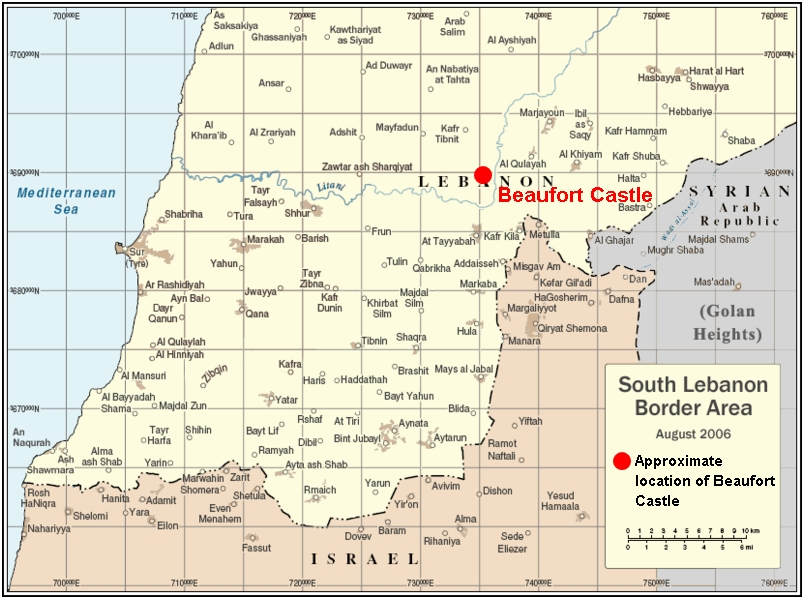
Beaufort Castle)—site of the Global March to Jerusalem and Palestinian Land Day celebrations in Lebanon on March 30—towers with a view and position to repel invaders from all directions. Used as an IOF base during the Zionist occupation of southern Lebanon, the castle—towering hundreds of metres above the Litani river—was ultimately a site to which Hezbollah resistance climbed up and waged attacks against the IOF occupiers.
To our west, perched mountain-ridge, Qalaat el-Chaqif (the
“They went up there. Imagine.


Look at all that rock,” M muses.
Continuing south, we pass the Litani river and on to Khiam, a mixed Shia’a Muslim and Christian village. A roadside sign points out El Madrasa Issa Ibn Mariam (School of Jesus, son of Mary). “You see, in the heart of a Shia’a village there are Christians living uninterrupted,” M tells us. He’s already pointed out the scattered Christian villages around his area and the mutual Christian and Shia’a support for Hezbollah for their resistance to and victory over the occupying Israeli army.
Our car twists up the road through the village, the snow-topped Jebal el Sheik (Mount Hermon) emerging and dominating the eastern landscape, and arrives at the former Khiam prison. A chipped, hand-written sign announces:“the prison is open.”


The prison, M says, was built by the French in ’33, originally a military post, but from 1984 to 2000 was used by the occupying Israeli army as a prison for both women and men. His brother, imprisoned there in ’84-’85, motions to the small cement building at the entrance to the prison on which a sign reads: “A room for meetings every three months after the entrance of the Red Cross.” No, he says, when I ask if he was ever visited by the Red Cross. As we enter the former prison, he begins pointing out familiar rooms, like the torture chambers and the cells. We pass a large sign, the faces and names of 10 martyrs of the prison, killed through torture, he says. Among the ten is a man in his fifties, head covered in traditional white scarf and face like that of a farmer.


*torture victims and rooms in Khiam prison
A former prisoner, now a guide for the open prison, tells us that another 6 prisoners died as a result of their illnesses which their keepers would not allowed to be treated.
“I was a prisoner here for 4 years,”he says. “I was released on ‘Liberation Day’.” On 25 May, 2000, with the expulsion of occupying Israeli forces, prisoners were set free. “In 2006, the Israelis bombed Khiam heavily, for revenge, to destroy this symbol and real history of the power of the resistance.” They were, he explains, pissed off at their 2000 expulsion. The bombing destroyed many of the complex’s buildings and killed 4 UNIFIL posted at Khiam who right up until their deaths had been pleading for the IOF to stop bombing.

The Guardian reported:
Israel suffers some of its most severe criticism from the west after an air strike kills four UN observers at Khiyam in southern Lebanon, despite 10 warnings from UN officials that they were in the building. UN secretary general Kofi Annan calls the strike “apparently deliberate” and asks Israel to investigate the attack.
Behind the prison, with a view overlooking occupied Palestine kilometres away,a monument to the martyred UNIFIL soldiers reads “in the service of peace”. A swath of trees grows near the actual site of the bombing, “but the resistance didn’t want to take land belonging to civilians, so they built the moment over here,” roughly 20 metres away.
The ruins of the prison, and other ruins I see throughout the day, are like those of Gaza: melted roofs on piles of rubble, metal support beams jutting out at painful angles. Beyond the ruined and partially standing prison buildings, a 10x10m crater from the one ton and other gargantuan bombs the IOF dropped, the same craters I saw in Gaza. In Gaza, some of the craters were twice as large, but I’m told that the case is likewise in Lebanon, with the added insult of the millions of cluster bombs the IOF dropped in the final three days of its 34 day 2006 assault on Lebanon. [Human Rights Watch reports: “The UN Mine Action Coordination Centre South Lebanon (MACC SL) has estimated that Israel fired cluster munitions containing as many as 4 million submunitions,” citing “as many as one million hazardous unexploded submunitions that (litter) fields and orchards and dozens of towns and villages in south Lebanon, threatening the returning civilian population.”]
Later, driving along the road from Khiam, we pass a sign for the de-mining of these deadly, illegal cluster bombs.
Our former prisoner/guide gives us the tour: over the years, the prison held 5000, including 500 women, in 4 small cell blocks and numerous torture rooms of varying sizes.


We pass the shell of a 1 ton bomb, mounted on a stand, a reminder of the 2006 Israeli assault. Between an array of Israeli tanks and numerous missiles and rocket launchers, 2 examples of the resistance’s missiles stand amidst the prison rubble and IOF weaponry graveyard, a Hezbollah flag fluttering above them, the missiles and the flag reminders of their victory.

 Despite the gross imbalance of power (Israeli high-tech military tanks, jeeps, warplanes and US-made bombs), during Israel’s occupation of much of Lebanon and during the 2006 Israeli war on Lebanon, the Hezbollah resistance—lacking such military might—were able to face and drive out the IOF. Flanking the path to the cells, rows of poster-sized photos depict ‘Liberation Day’, when prisoners were released and families united: wives hug husbands and sons kneel at their mothers’ feet (likewise for the female prisoners held at Khiam).
The guide walks up to a metal, ladder-like pole—behind which a tangle of razor wire marks the prison walls—and re-enacts the exhausted sag of a prisoner strapped naked by one arm to the pole for hours, too tired to stand, unable to sit, and tortured all the while.
Prisoners were also hung upside-down, completely naked, from the metal pole, says the guide. “They put a tight cover over our heads. Soldiers would pass by and hit us, kick us in the head. In winter — it’s very cold here,it snows — the prison guards would douse us with hot water and cold water while whipping and beating us…hot, cold, hot, cold… and when the prisoner was completely soaked the guards would bring an electrical charge and electrocute us.”
 A, one of M’s brothers, endured the various means of torture. Good-natured and humourous, he isn’t ashamed to display his scars: as I film him re-living his imprisonment and torture, he smiles humbly and shoves his stubby, melted fingertips forward for me to see, results of repeated electrocution.
At the same metal pole, A demonstrates another torture position, standing with both arms strapped up high.
“They strapped me to this pole from 8pm to 2 am every night for 8 months. While I was locked to this pole, they beat me with a whip and batons all over…on my back, my shoulders, my legs…After that, from 2 am they’d take me to another room, where another 6 prisoners were and start shocking us. I was tortured by my own pain and that of my cellmates (hearing the screaming of other inmates is yet another form of psychological terror).”
At the same time, families of the imprisoned suffered as they knew of the torture going on — word traveled from those released or of those who died of torture.
“Collaborators would come by the house, offering to get a prisoner released if paid for it,” M tells me. Another type of psychological torture…giving false hope when release was impossible.
The “visits,” when family members would stand outside the Khiam prison to view their loved ones who were rooftop-only, occurred thanks to bribes to prison guards.
Our guide, while explaining the prison life, speaks with the familiarity of one who has given this speech before, and one who has endured untold cruelty at the hands of his captors. Nonetheless, he doesn’t describe in detail what his the prison guards did to his wife, saying only, detachedly: “They used to bring our wives and sisters and torment us by being vulgar to them, threatening them…When I hadn’t given in after 5 months of detention and torture, they brought my wife, took off her headscarf, and stripped her naked…I can’t talk about the rest.”


The guide and A take us to a telephone booth-sized cement isolation cell, oven-like during summer months, freezing during the winter.
“I was held in this room, a 1m x 1m cement block, for 2 months. They’d put a bag over my head and leave me in this concrete cell day and night, with a bucket for a toilet,” says A.
 “The soldiers would bang the metal door with metal rods ever so often,” he says, the guide demonstrating with a rock. Even from outside the cell the clanging is painful; inside, every ten or fifteen minutes it would have been excruciating. “I wasn’t allowed out of this cell for 2 months; no exercise, no fresh air.”
He points upward to a small hole in the ceiling, his only source of light and air, and a conduit for rain to flood into his cell.
But there was worse.
Bending over, he draws a line with his hand, cutting the box halfway to that of a container just above knee height. “There was another box made of cement. They called it the ‘sardine’ box,” he says, clapping his hands together as though crushing something, effectively how one would feel stuffed inside the ‘sardine’.

“They put a wire around a finger of each hand, around the waist, and on the head,” A demonstrates with his mutilated fingertips. Also on display, a panel of hand-made stitching and prayer beads. The guide pulls out a denim backpack with zippers. “I was arrested in these pants. Later, I made them into a backpack to carry my things in.” He points out flowery wall-hanging of coloured beads. “I worked the names of my wife and children into it,” he says. [I am reminded of Palestinian prisoners I've met in occupied Palestine who crafted similar things, using olive pits to make prayer beads...or incredible projects like Anwar (a medic in Rafah, Gaza Strip) who crafted an ornate sailboat and the Dome of the Rock, using pieces of wood, beads and the ample time of being imprisoned by the occupation.]


Another display holds remnants of IOF bombs used on the prison, including an American-made “smart bomb” M notes. The walls are adorned with various photos of former prisoners, resistance martyrs, and one, the guide laughs as he points it out, of IOF soldiers sinking into Lebanese mud.
He shows us IOF uniforms left behind, and pulls out a IOF jacket, pointing to the Hebrew letters for “IDF” then pointing to a photo in which Hezbollah resistance spelled “IDF” in Hebrew using IOF boots. As he reaches the glass-encased model of the prison, he takes the IOF jacket and begins shining the glass. “We use this for cleaning,” he laughs, “but it doesn’t clean anything.”
Later, back at M’s with various siblings and relatives sitting around talking, the Khiam visit comes up and they start talking of the imprisonment of their loved ones. M’s mother—a feisty and very kind woman—suffered not only the imprisonment and torture of M’s brother A but of her husband and various relatives. Recalling those years, they argue over dates of loved ones’ imprisonment, one man using his own period of imprisonment as a reference to figure out the date of his cousin’s.
A relative tells me of his imprisonment in Palestine and in a different prison complex called Ansar, closer to Nabatiya:
On June 6, 1982, the Israelis invaded Lebanon again. On July 7, the Israeli army took me from my house when I was sleeping. I wasn’t a member of the resistance, but I was vocal about supporting Palestinians. They took 30 other the same night, taking us to a prison in (occupied) Palestine, as the Khiam prison wasn’t in use yet.
After 1 month, we were transferred to Ansar prison, which consisted of 31 prison camps, 500 prisoners per camp. It wasn’t just Lebanese and Palestinians, there were Syrians, Bangladeshis,…many foreigners in Lebanon at that time were rounded up and treated like the Israelis treat Palestinians. After 6 months, they separated the foreigners and sent them back to their countries, leaving just Lebanese and Palestinians in the prison.
They tortured us during the initial stage of our imprisonment. They’d beat us with sticks and shock us with electricity… to try to make us confess something.
Our food was sparse. We got half an egg per person or half a piece cheese and 1 piece toast per meal. When we were allowed to bathe, we had to use cold water year round. And we had to go to bathroom in front of everyone, in buckets.
After a long time, they realized they had nothing on us and didn’t want to care for us, so they began releasing us as it cost them money to imprison us.
I was 20 years old.


more:
There are approximately 4,600 Palestinian political prisoners inside Israeli jails. Palestinians, living under occupation and oppression for nearly 64 years, have been targeted for mass imprisonment and detention by the Israeli occupation. Nearly every Palestinian family has been touched by political imprisonment – a father, mother, son, daughter, sister, brother, cousin, uncle, aunt. Since the occupation of the West Bank and the Gaza Strip in 1967, over 650,000 Palestinians from those areas have been held as political prisoners – one out of every four Palestinians from the West Bank and Gaza. Forty percent of Palestinian men in the West Bank and Gaza have spent some time in occupation jails.
NO CHARGE? NO TRIAL? NO JUSTICE!

320 Palestinians are currently held under administrative detention, including 24 members of the Palestinian Legislative Council. Administrative detention is a procedure that allows the Israeli military to hold prisoners indefinitely on secret evidence without charging them or allowing them to stand trial. It is renewable indefinitely for repeated periods of up to six months. Palestinians held under administrative detention are not charged with any crime, nor are they brought to trial even before the Israeli occupation’s rigged military courts.
The Canadian government is complicit in Israel’s ongoing use of mass imprisonment against the Palestinian people when it vocally supports Israeli aggression in the UN and around the world.
Despite the harsh conditions of imprisonment, the frequent use of isolation, ransacking of cells, confiscation of media, and denial of access to education among Palestinian prisoners, the Palestinian prisoners’ movement is central to the Palestinian struggle for freedom and liberation. Palestinian prisoners are not only victims of an unjust and oppressive legal/military structure – they are part of an entire people seeking their freedom and liberation, including the end of occupation, the right of return of Palestinian refugees, and full rights for all Palestinians.
River to Sea
 Uprooted Palestinian

The views expressed in this article are the sole responsibility of the author and do not necessarily reflect those of this Blog!


 Sunday, April 15, 2012 at 7:46AM


 The White House hailed the "positive attitude" from Iran and world powers on Saturday, while British Foreign Secretary William Hague said in a statement that the talks "were a first step towards that objective, but there is still a long way to go."