Sunday, 22 April 2012

Activists who talk like zionists continue to betray Palestine


by Greg Felton
Saturday, April 21st, 2012

Activists who talk like zionists continue to betray Palestine

Greg FeltonFor some time now, I have been trying to get in touch with Ali Abunimah to ask him to explain his denunciation of Gilad Atzmon. I am used to Palestinian activists, Arab or non-Arab, attacking each other over this or that political or doctrinal difference, but this attack is worse than most.

Abunimah has been in the forefront of the anti-Zionist movement for years, and over that time has built a considerable reputation. His website, electronicintifada.net, is still an outstanding source for non-zionist (read: uncensored) news about the Occupation. Consequently, his denunciation of Atzmon was guaranteed to be influential and reach a large audience, thereby maximizing the potential damage to Atzmon’s reputation and scholarship.

Ali Abunimah's Antics Against Gilad Atzmon
The effect of the attack, though, has been suitably ironic. Rather than harm Atzmon’s reputation, Abunimah has elevated it beyond anything Atzmon could have done by himself. Outpourings of support have come from prominent activists like Kim Petersen, Alison Weir, Kevin Barrett, Mark Glenn, and Prof. Norton Mezvinsky. If Abunimah wanted to limit the reach of Atzmon’s arguments, he should have kept quiet and just let the hasbarats do what they do best.

What puzzles me is the manner of the attack less than the attack itself. For instance, why did Abunimah denounce Atzmon so maliciously, and did he seriously think he could escape condemnation? I wanted to put these and other questions to this champion of Palestine, but in the absence of co-operation I have had to come up with my own answers.

VILIFYING GILAD ATZMON


1. Smear and Run

I can understand that Abunimah might dissent from Atzmon in whole or in part, but to denigrate him categorically and mount a campaign to disavow him is evidence of personal animus, not scholarly disagreement. For example, after making passing reference to Atzmon’s new book, The Wandering Who, Abunimah gets personal:
“With this letter, we call for the disavowal of Atzmon by fellow Palestinian organizers, as well as Palestine solidarity activists, and allies of the Palestinian people, and note the dangers of supporting Atzmon’s political work and writings and providing any platforms for their dissemination. We do so as Palestinian organizers and activists, working across continents, campaigns, and ideological positions.”
The implication here is that Gilad Atzmon is not a Palestinian solidarity activist or an ally of the Palestinian people. In fact, Abunimah deems him to be an enemy of Palestine and tries to excommunicate Atzmon from the community of Palestinian activists. How is this constructive?! Whether or not Abunimah wants to admit it, Atzmon and he are on the same side, but such dogmatic hostility suggests strongly that the motive for the attack goes deeper than a squabble over activist orthodoxy.

2. The Attack

The next paragraph outlines Abunimah’s “case” against Atzmon followed by Atzmon’s comments (italics):

1. “Atzmon’s politics rest on one main overriding assertion that serves as springboard for vicious attacks on anyone who disagrees with his obsession with ‘Jewishness’.”
“It is a complete misrepresentation of my thoughts. Also was Freud obsessed with unconsciousness? Was Einstein obsessed with relativity?”
Abunimah provides no evidence to substantiate either the claim of vicious attacks or obsession. Could one argue that Abunimah is obsessed with Palestine?

2. “He claims that all Jewish politics is ‘tribal,’ ”…

No. I refer only to third category Jewish politics; hence, I do not talk about all Jewish politics.
In The Wandering Who, which Abunimah has not read, Atzmon divides “Jews” into three categories:

• Those who follow Judaism;
• Those who regard themselves as human beings that happen to be Jewish; and
• Those who put their “Jewishness” above all other traits.

The idea of political tribalism clearly does not apply to the first two categories, so Abunimah’s charge against Atzmon is without merit.

3. “…and essentially, Zionist. Zionism, to Atzmon, is not a settler-colonial project,…”

It is a settler project but not colonial for there is no Jewish mother state.

“but a trans-historical “Jewish” one, part and parcel of defining one’s self [sic] as a Jew. Therefore, he claims, one cannot self-describe as a Jew and also do work in solidarity with Palestine, because to identify as a Jew is to be a Zionist.”

This is complete nonsense!

In fact, the positions Abunimah attributes to Atzmon do not appear anywhere in the pages of The Wandering Who. Moreover, they are obviously ridiculous, given Atzmon’s careful distinction among Jews. Even a cursory read of Atzmon’s book could have prevented Abunimah from conflating “Jew” with “Jewishness”, but that implies that Abunimah was interested in depicting Atzmon fairly, but the end of the paragraph proves otherwise:

“We could not disagree more. Indeed, we believe Atzmon’s argument is itself Zionist because it agrees with the ideology of Zionism and Israel that the only way to be a Jew is to be a Zionist.”

3. Jewish sensitivities come first


The_Wandering_Who
Abunimah, like a lot of Palestinian activists, subscribes to the cult of Jewish victimhood, thereby allowing zionists to define the boundaries of acceptable discourse. One would expect a Palestinian activist like Abunimah to be less concerned with upsetting Jews than with exposing the role that Judaism and Jewish chauvinism play in the persecution of Palestinians. This is precisely what Atzmon does in The Wandering Who, but instead of embracing Atzmon’s candour and honesty, Abunimah sets himself up as “Judge, Jewry and Executioner” against Atzmon:

“We reaffirm that there is no room in this historic and foundational analysis of our struggle for any attacks on our Jewish allies, Jews, or Judaism; nor denying the Holocaust; nor allying in any way shape or form with any conspiracy theories, far-right, orientalist, and racist arguments, associations and entities. Challenging Zionism, including the illegitimate power of institutions that support the oppression of Palestinians, and the illegitimate use of Jewish identities to protect and legitimize oppression, must never become an attack on Jewish identities, nor the demeaning and denial of Jewish histories in all their diversity.”

The wandering who- Gilad Atzmon
Because Israel claims to be a Jewish state, and admits that it persecutes Palestinians as a matter of national policy, it is expected, even necessary, for all things Jewish to come in for criticism. This is especially true of the Holocaust®, the founding myth of the zionist entity.

For example, the number “six million” in connection with mass violence against Jews predates the Holocaust® by a quarter century. On Oct. 31, 1919, the American Hebrew published “The Crucifixion of Jews Must Stop,” a blithering screed by former New York Governor Martin H Glynn that began: “From across the sea, six million men and women call to us for help, and eight hundred thousand little children cry for bread.” The number “six million” is repeated four times! Further instances of this number appear in the New York Times (July 20, 1921, p.2; Feb. 17, 1945, p.8; Jan. 9, 1938 p. 12; and Jan. 8, 1945, p.17).

Does Abunimah believe that anyone who denies the absolute, dogmatic facticity of “six million” is a Holocaust® denier? If he does, that makes him a zionist, not Atzmon.

Finally, of the 10 paragraphs, only three actually mention Atzmon by name. The majority of the atttack is devoted to Marxist-sounding slogans, boasts of the morality of the Palestinian cause, and congratulatory backslapping for anti-Atzmon activists. This imbalance leads me to conclude that the attack wasn’t really about Atzmon at all; rather, it seems that Abunimah wanted to boost his own image at Atzmon’s expense. This view explains why he put no effort into being accurate.

Why Abunimah would jeopardize his reputation so recklessly is unclear, but in the absence of a definitive response from him, I have to conclude that he felt personally and politically threatened.
Unlike Abunimah, Atzmon does not buy into the cult of Jewish victimhood or allow “Jewish sensitivities” to limit the boundaries of acceptable political discourse. Abunimah accepts Jews, Jewish history and Jewish culture as given and treats themwith kid gloves, but in Atzmon’s hands they are shorn of all moral privilege and subjected to searing, honest criticism. The Wandering Who is an unsparing psychological analysis of the Jewish mind and the sociopathic zionist state. It is essentially a rebuke to the inhibitory “reasonableness” that makes official Palestinian positions more like collaboration than liberation.

Abunimah went berserk on Atzmon because he saw in him the kind of honesty that, as a representative of Palestinian officialdom, he is unable or unwilling to articulate.


River to Sea Uprooted Palestinian  
The views expressed in this article are the sole responsibility of the author and do not necessarily reflect those of this Blog!

Iran Builds Prototypes of U.S. RQ170 despite US Doubts

Local Editor

Iranian Aerospace Force commander Brigadier General Amir Ali Hajizadeh.jpgIran has started to copy the captured U.S. spy drone RQ 170, the commander of the Aerospace Force of the Islamic Revolution Guards Corps announced on Saturday, Iranian Mehr news agency reported.

Brigadier General Amir Ali Hajizadeh who was speaking on the anniversary of the establishment of the IRGC also said experts are receiving information from the captured spy plane, and revealed what he said were "codes" gleaned from the unmanned aircraft.

"I am giving you four codes so the Americans understand just how far we have gone in penetrating the drone's secrets," he told state television.

"In October 2010, the aircraft was sent to California for some technical issues, where it was repaired and after flight tests, it was taken to Kandahar (in Afghanistan) in November 2010, when a series of technical problems still prevailed," he said.

"In December 2010, it was sent to an airport near Los Angeles for repair of its equipment and sensors, and flight tests. The drone was then sent back to Kandahar," he said.


Hajizadeh did not give further details, saying: "This aircraft is a national treasure for us, and I cannot divulge information about it."

But he added Iran has "started producing a copy of the RQ-170 drone," stressing it used the same US technology in stealth fighters and bombers.

US Senator Joe LibermanFor his part, the US Senator Joe Lieberman said that Tehran’s declaration about copying the US spy drone amounts to little more than "Iranian bluster."

"There is some history here of Iranian bluster particularly now when they're on the defensive because of our economic sanctions against them," said the independent lawmaker, chairman of the Democrat-led Senate's Homeland Security Committee said.

Lieberman made his remarks to the "Fox News Sunday" program after General Hajizadeh’s speech on state TV, saying that he felt "skepticism" at the claim, the first reaction from a senior US politician.

However, Tehran’s technological and military capabilities prove the opposite, and the coming days will reveal the truth.

The unmanned, bat-winged RQ-170 Sentinel drone went down in Iran four months ago, and Iran's gleeful military proudly displayed it on state television apparently intact, though with what appeared to be damage to one of
its wings.

Source: Agencies
22-04-2012 - 17:36 Last updated 22-04-2012 - 18:04
Related Articles

River to Sea Uprooted Palestinian  
The views expressed in this article are the sole responsibility of the author and do not necessarily reflect those of this Blog!

Syrian Opposition Leader: Syrian People Want Peace with Israel

Via FLC

"...One of the leaders of the Syrian opposition is saying that the Syrian people will seek regional peace, including with Israel. 
In an interview with Kol Yisrael radio, portions of which were released on Friday, Nofal al-Dawalibi, said that if Presdient Bashar Assad's regime falls, the Syrian people will realize their deprived rights and will seek peace in the region.
Speaking from Paris, al-Dawalibi said that the Friends of the Syria conference which was held in Paris this week does not bode well for the Syrian people, and that it offered no practical solutions for the ongoing crisis in the country.
The Kol Yisrael reporter asked al-Dawalibi who can guarantee that a more extreme regime will not rise in Syria after Assad’s fall, to which al-Dawalibi replied that the guarantee is that the Syrian people do not want war with Israel and are in great need for peace and stability..."
River to Sea Uprooted Palestinian  
The views expressed in this article are the sole responsibility of the author and do not necessarily reflect those of this Blog!

S. Sudan Withdraws from Heglig, Damages Revealed

Local Editor

Heglig area of Sudan occupied by South SudanSouth Sudan's army has completed its withdrawal from Sudan's main Heglig oil field, the military said Sunday, but condemned the north for bombing the area.

Juba seized the flashpoint oil hub on April 10, claiming that Khartoum was using Heglig as a base to attack the South's oil-producing Unity State.

Although South Sudan disputes it, Heglig is internationally regarded as part of Sudan.

The South's Sudanese Peoples Liberation Army (SPLA) "completed its withdrawal from Heglig yesterday," the South's military spokesman Philip Aguer told AFP.

However, Sudan’s presidential assistant, Nafie Ali Nafie, has accused South Sudan’s government of deceiving its people by saying that its army withdrew from Heglig, Sudan Tribune reported.

Sudan Presidential Assistant Nafie Ali NafieAddressing a mobilization rally of Sufi groups in the capital Khartoum on Saturday, Nafie claimed that Juba had in fact pleaded with international mediators to stop Khartoum from shelling SPLA troops inside Heglig.

UN chief Ban Ki-Moon branded Juba's 10-day occupation of the region illegal and US President Barack Obama has said the long-time rivals must negotiate to avoid further military escalation along their contested and volatile border.
For his part, The Sudanese First Vice President Ali Osman Taha ruled out quick return to negotiations with S. Sudan, suggesting that negotiations with the South are pointless.

In an interview with Blue Nile TV, Taha also accused Juba of launching economic war on Sudan when SPLA damaged the operating system software of Heglig oil facilities and set the main controls of the plants on fire. The details and scope of the destruction will be revealed in the coming hours, he added.

Sudanese Vice President Ali Osman Taha visiting a wounded man during the clashes in HegligSudan state TV aired footages from inside Heglig showing major destruction in the town while oil facilities were still burning and efforts were made to put out the fires.

The Washington-based Satellite Sentinel Project (SSP) said in a statement today that new satellite imagery revealed that a key part of the pipeline infrastructure was destroyed.

“The damage appears to be so severe, and in such a critical part of the oil infrastructure, that it would likely stop oil flow in the area,” SSP’s statement read.

The Heglig violence was the worst since South Sudan won independence in July after a 1983-2005 civil war in which about two million people died.

Tensions have gradually mounted over the disputed border and other unresolved issues.

Source: Agencies
22-04-2012 - 16:11 Last updated 22-04-2012 - 16:11

River to Sea Uprooted Palestinian  
The views expressed in this article are the sole responsibility of the author and do not necessarily reflect those of this Blog!

Imran Khan on Pakistan’s ties with other nations

Pranay Sharma, associate editor of Outlook India magazine recently interviewed Pakistan’s most outspoken and popular politician. He is leader of a small political party, Tehreek-e-Insaf, and former world renowned cricketer, Imran Khan. The interview was taken at Imran Khan’s farm house near Islamabad.

He told Pranay Sharma that Pakistan’s ties with United States should be like relation between India and United States – based on mutual respect. “The US have always treated Pakistan as someone who is paid to do a job and is not doing it,” said Khan.

I’m affraid – Imran Khan is living in fantasy. The India-US ties are based on hatred against Muslims and fear of China emerging as a super-power. The Pakistan-China close relations have always been considered a threat to US interests in the region by both Washington and New Delhi.

On India-Pakistan ties, Sharma claims that Imran Khan wants those to be modeled on US-Canada relations. If that’s true – I’m affraid Imran Khan needs to study the US-Canada relation from some objective source. As a Canadian myself – I can tell that the US-Canada ties have mostly been like a Boss and his private secretary. Since Stephen Harper took over government in Ottawa – both the US and Canada have become satellites of Israel. So much so that both Washington and Ottawa consider any threat to the Zionist regime as a threat to North America.

Answering allegation that he is Pakistan Army front man – Imran said: “My communication with the army is negligible compared to Zardari and Nawaz Sharif. You can’t get the army to bring record crowds in rallies“.

Imran is also against private militia groups supported by local and foreign agencies. “Pakistan needs to completely disarm its militant groups. The time has come when we can’t have them. We’ve to turn jehad into nation-building,” says Khan.

Regarding Obama’s $10 million bounty for Hafiz Saeed – Imran said that both the US and India say India “says he is a terrorist. But we have no evidence of that. We know of the Jamaat-ud-Dawa’s humanitarian work“.

Imran Khan, was married to Jemina Marcelle Khan, daughter of British Zionist billionaire Lord James Goldsmith – but he has never been in Jewish Lobby’s ‘good book’. Jemina Khan is associate editor of British daily New Statesman.

Read the entire interview here.

River to Sea Uprooted Palestinian  
The views expressed in this article are the sole responsibility of the author and do not necessarily reflect those of this Blog!

Western Journalist: Visa Denied


Item number five on UN Envoy Kofi Annan’s 6-point plan for Syria is the following:
“(5) Ensure freedom of movement throughout the country for journalists and a non-discriminatory visa policy for them.”
At a delicate moment in the hard-fought Syrian conflict that could potentially destabilize the entire Middle East, the United Nations believes getting more journalists into Syria is one of the six most urgent actions to consider?

Why? Are foreign reporters trained in special “observer” skills – with unique truth-detecting abilities bubble-wrapped in bullet and mortar-proof goop? And what will they see that Syrians – who know Syria best – cannot observe for themselves?

What the UN is really demanding – let’s be honest here – is for the Syrian government to open up the country to “Western” journalists. Yet, in all the conflicts covered in recent years, I cannot recall one that has been more badly covered by the mainstream western media than this Syrian crisis.

Almost to a person, western journalists are blaming their substandard coverage on the fact that they have been denied entry into Syria. And also – to a person – they seem to think that the world needs them there to understand what is going on inside the country.


"Journalist" Paul Conroy is MI6 operative In this photo,
he can be seen in Libya (in blue bulletproof vest)
with, on the right, Al-Qaeda leaders Mahdi al-Harati (in black body armor)
and Abdelhakim Belhaj (in camouflaged jacket).

Paul Conroy, the Sunday Times freelance cameraman who was injured by an explosive in Homs in February, tells the BBC’s Hard Talk that Syrians need their events verified by people like himself and his now-deceased colleague, war correspondent Marie Colvin, in order to be believed:
“It is a sad state of affairs that it does need people to go in…and actually be Western and be official journalists to make it real in the public eye.”
Is that like a Western-journalist-verification-stamp of some sort? Does it come with a guarantee – for accuracy in reporting?

Because, right now, I honestly cannot think of a group of people less capable of verifying things in Syria than western journalists. And it is not because they aren't physically there or can't string together more than two words in Arabic. It is largely because they feast at the trough of their own governments’ narratives on All Things. Western journalists are heady with a sense of righteousness leached from the oxymoronic “western values” shoved down our collective throats. Those same western values that demand “accountability” and “transparency” from all nations – while offering cover for western governments to hack their way through Muslim and Arab bodies in endless "national security" wars.
Do tell… Which major mainstream western media outlet has ever fundamentally questioned their government’s narratives on these wars? Which major western journalist risked career for truth on affairs related to the Middle East? Give me the name of that brave western network reporter who disrupts press conferences regularly with inconvenient questions on weapons sales to Gulf dictatorships – and has his bosses go to the wall to ensure he remains in the White House press pool. Show me the western reporter at the Washington Post, New York Times, CNN, BBC, France 24 who has made a career of doggedly questioning Israel’s disproportionate use of force against civilian populations – a journalist who sticks a microphone under Sarkozy, Obama or Cameron’s nose and bellows: “What fucking Peace Process are you chaps banging on about?”

No? Not one? Come on!

“No Syrian Visa” is just a convenient excuse for the lazy and sloppy reporting of western media in this Syrian conflict. It is a handy sound bite these days – one that quite deliberately ignores the Arab League Monitors' January 2012 Report that 147 foreign and Arab media organizations were operating in Syria during their month-long observations.

"No Syrian Visa" tries hard to distract from the reality that most western journalists never actually go out to the front lines of conflict when filing their stories. Increasingly, reporters are sent out in organized pools by host governments – or in the case of recent US-initiated wars in the Middle East – by the invading armies.

"No Syrian Visa" selectively forgets that entering US-foe Syria as a journalist today is no more difficult than waltzing into US-ally Saudi Arabia - or US-ally Bahrain, when Formula One cars are not racing there.

And "No Syrian Visa" will blush hard when recalling that there was no similar collective western media outrage when the government of Israel declared "No Gaza Entry" as it pounded Palestinian populations in 2009.

Glossy Journalists Seek Content Not Facts

No. The problem with western reporters is that they are past their due date – remnants of an industry we once believed brandished standards of objectivity we never actually witnessed.

They are news-as-entertainment professionals - packaging glossy corporate content for maximum distribution and big bucks. The goal is not objective reportage. Their targets are quantifiable and highlighted in a business plan somewhere. Success is based on a simple formula: stay within parameters “understandable” to a wide audience that devours sound bites and familiar storylines on the hour, every hour. Like trained seals whose every desire, instinct and buying pattern has been measured by corporate media’s marketing department for the consumption of its advertisers, the audience demands satisfaction – and western media delivers it.

With the exception of a few proud holdouts, western media has made a beeline for the sexy story in Syria – which is essentially the fairytale of the “Arab Spring” with a little twist: Bad regime, good activists – but kick out this dictator and it’s a three-for-one, with Iran and Hezbollah tossed in as a bonus.

There are only three guiding rules for most western journalists inside or outside of Syria:
  • 1) only quote anti-regime populations,
  • 2) do not seek out independent domestic opposition figures,
  • 3) evidence is unimportant, as long as you loosely "source" it:
They head straight for the Syrian activist, the anti-regime demonstration, the man with the gun in a “hot spot.” These are one side of the Syrian story, for sure. But you will not find mainstream western journalism broadcasting a pro-regime rally of tens of thousands, the national flag painted on the faces of Assad supporters – young and old - waving posters of their president. Pro-regime Syrians, a majority of whom voted in a national referendum in February to adopt constitutional reforms, are never interviewed by these reporters.


Opposition figures have gathered in Damascus to
discuss 'how to solve the crisis' in Syria [AFP]

You will not find western journalists side-stepping the NATO-friendly Syrian National Council (SNC) “opposition” to interview the dozens of domestic Syrian opposition figures – most who have spent years in regime prisons – but who also unanimously reject the militarization and internationalization of the conflict; i.e., “non-Syrians butt out.”

And most importantly, you will never find mainstream western journalism seeking out “evidence” to support the false narratives of their governments. Who is included in the daily death count reported around the world? Who has killed thousands of Syrian soldiers? Who is killing children in Syria? Who is killing journalists in Syria? Who stands to gain from these deaths? Who stands to gain from this video footage or still photo emailed to my desktop? How do I know that plume of smoke was caused by a regime mortar? Who is the sniper? Why do so many Syrians still support Bashar al-Assad?

Propaganda As a Weapon of War

The “Big Lie” is a propaganda technique used liberally by western governments in the Middle East. The Big Lie refers to “the repeated articulation of a complex of events that justify subsequent action. The descriptions of these events have elements of truth, and the Big Lie generalizations merge and eventually supplant the public's accurate perception of the underlying events.”

Using Big Lie techniques in the Middle East are particularly easy because western media is so happily complicit in propagating one-dimensional stereotypes of Arabs and Muslims. These assumptions are programmed so deeply, that even after months of watching on our TV screens disparate populations of all backgrounds and political convictions rally to reshape their governing systems…we still see regional events only through the prism of a one-size-fits-all Arab Spring.

The US Military’s Special Forces Unconventional Warfare manual describes ways to overthrow a government outside of a conventional combat format. In a section headlined “Will of the Population,” the manual explains ways to overcome popular support for the existing national government and alter natural hostility to foreign intervention:

“Information activities that increase dissatisfaction with the hostile regime or occupier and portray the resistance as a viable alternative are important components of the resistance effort. These activities can increase support for the resistance through persuasive messages that generate sympathy among populations.”

The manual expounds on this in another area: “The USG (US Government) begins to shape the target environment as far in advance as possible. The shaping effort may include operations to increase the legitimacy of U.S. operations and the resistance movement, building internal and external support for the movement, and setting conditions for the introduction of U.S. forces. …The population of a recently occupied country may already be psychologically ready to accept U.S. sponsorship, particularly if the country was a U.S. ally before its occupation. In other cases, psychological preparation may require a protracted period before yielding any favorable results.”

The Syrian crisis is not about reforms any longer – it has become a geopolitical battle for influence in the Middle East, with NATO, the GCC and BRIC nations taking sides. Western media fails to address this larger picture, so glaringly obvious to people in the region. Instead it focuses almost entirely on the “David vs Goliath” or "good vs evil" themes that appeal to a broad audience of dumbed-down media consumers. These populations in turn become perception "leaders" when they back foreign military adventures in opinion polls broadcast back to us by - you guessed it - western media. And in that neat trick, your western government checks off a tick-box called "citizen approval."

But Syrians have approved no such thing. More than a year after the first anti-government protests - which have never grown into the hundreds of thousands and millions experienced elsewhere in the region - Syrians have not ejected their leader, nor is there any evidence that the majority of Syrians wish to do so. The constitutional referendum in February, which a small majority of Syrians approved in an excellent turnout, should have been some indication for the media that popular sentiment is not necessarily reflected in an unverifiable cellphone image.

The daily casualty statistics coming out of Syria are deliberately misrepresented as regime "kills," satellite photos of alleged regime shelling contradict the dominant narratives, activists faking events begs the question "why would they need to falsify evidence if the regime is so brutal?" But western media hears and sees nothing that doesn't suit their formulaic narrative.


There is no better example of how mentally embedded western media has become with the Syrian “opposition” (itself a very broad and mixed bag), than a recent incident with CNN in Homs. Correspondent Arwa Damon and her non-Arab crew were tipped off about a potential pipeline explosion, so they pre-positioned their camera in a window frame facing the exact location of the anticipated bombing. When the pipeline explodes some time later, Damon and her crew look exultant – almost drunk on their success. Scoop? Try complicity in an act of terrorism. Can you imagine them doing this if the target was an American installation in Iraq or a NATO depot in Afghanistan? They would never live it down.

Reality Check

A year after the first small protests in Syria, the Syrian government stands strong, bolstered by its many constituencies, and spared the mass defections experienced by other Arab leaders. It appears that propaganda is not enough to shake the foundations of all Arab states. Now is the time for western media to ask why they got it so wrong. And some are indeed questioning their information, sources and assumptions.

There are western journalists who are doing a more than creditable job of writing about Syria from outside the country – the Independent’s Patrick Cockburn and The Guardian’s Seumas Milne come to mind. Please feel free to list other responsible, professional western journalists in the comments section below - I am sure we all want to celebrate their courage and increase their page views.

As for the others, their arrogance and cowardice is dangerous. False narratives have emboldened Syrians and other regional actors to act incautiously, angrily, even euphorically, when they might have benefited from nuance and calculation. People have died in the spinning of this conflict.

It is clearly time to challenge the dated concept that mainstream western media is impartial, objective or professional in their coverage of Mideast affairs. But we shouldn’t just bemoan this injustice in yet another stream of impotent essays and editorials. We must drag this industry of disinformation into the public arena, and make them accountable throughout the region by acting to affect ratings and readership.

Kofi Annan needs to immediately drop item number 5 on his Syria plan. While freedom of speech is important to uphold - even more so in times of strife - today, mainstream western journalism is nothing more than another face of the "external intervention" he so gravely warns against. Toss those western journos out of Syria unless they can demonstrate independent, objective, responsible reporting of this conflict. False narratives are costing Arab and Muslim lives. And media "combatants" need not apply to practice their craft in this region any longer.

Sharmine Narwani is a commentary writer and political analyst covering the Middle East. You can follow Sharmine on twitter @snarwani.

River to Sea Uprooted Palestinian  
The views expressed in this article are the sole responsibility of the author and do not necessarily reflect those of this Blog!

China-Russia Military Ties: A Joint Navy Drill

Local Editor

Chinese and Russian warships gathered at the eastern Chinese harbor of Qingdao Saturday to prepare for their first joint exercise, slated for April 22-27 in the Yellow Sea.

A total of 16 vessels and two submarines from Chinese navy have been summoned at Qingdao of east China's Shandong Province, including five missile destroyers, five missile frigates, four missile boats, a support vessel and hospital ship. Together with them are 13 aircraft and five shipboard helicopters.

On Sunday morning, Russian naval deputy chief of staff Rear Admiral Leonid Sukhanov announced here on Sunday the official start of the joint exercise with the Chinese navy, the state-run Xinhua news agency said.

More than 4,000 Chinese servicemen will attend the drill, said the navy sources.

Russian naval flagship arrives in China for joint drill; April 21, 2012 The Russian warships include the Pacific Fleet's flagship Varyag, a slava-class guided missile cruiser, and Marshal Shaposhnikov, Admiral Panteleyev and Admiral Vinogradov, three Udaloy-class destroyers.

According to Xinhua, the exercise will focus on joint maritime air defense and defense of marine traffic arteries, including subjects of joint escort, maritime search and rescue, anti-submarine tactics as well as joint effort to rescue hijacked vessels.

The two navies will also deploy aircraft and special force units to conduct joint maritime anti-terror task in the exercise.
China and Russia have conducted four bilateral and multilateral military exercises since 2005.

The upcoming China-Russia maritime drill will further promote strategic coordination and mutual trust between the two militaries.

Friendly military-to-military cooperation is an important aspect of the China-Russia strategic partnership, Chen said, adding the drill is the first of such moves by the two countries' navies.

Since 2005, China and Russia have conducted several joint military exercises within the framework of the Shanghai Cooperation Organization.

Source: Agencies
22-04-2012 - 10:50 Last updated 22-04-2012 - 10:53

River to Sea Uprooted Palestinian  
The views expressed in this article are the sole responsibility of the author and do not necessarily reflect those of this Blog!

Khader Adnan: Freed for How Long?

by Stephen Lendman

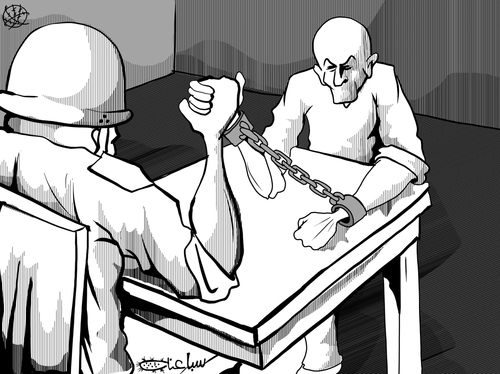
My PhotoOn April 17, Palestinian Prisoners Day, Khader gained freedom. At issue is for how long?
As announced, Israel released him as scheduled. He endured 66 hunger striking days to be free.
 
So was Hana Shalabi last October when released with other Palestinian prisoners in exchange for Gilad Shalit. Held two and a half years without charge, she wasn’t free long.

On February 16, she was again arrested and detained uncharged. After 44 hunger striking days, she was lawlessly exiled to Gaza where she’s recuperating from her ordeal. Weeks after he resumed eating, Khader also perhaps still struggles to regain full health.

On April 18, Maan News quoted him saying:
“The happiness I saw on my peoples’ faces made me forget all the suffering I experienced when I was on hunger strike.”
On arrival in Jenin, he went to an Arraba village sit-in tent to meet Jaafar Izz Addin’s parents. Imprisoned, he’s now hunger striking for justice. So are hundreds of other other Palestinian prisoners.
On April 17, they began an open-ended strike against abusive prison conditions and practices. Children young as 10 are affected. So are women.


Khader, Hana, and others inspired them. They’re doing it en masse for justice. Hundreds more may join them. Israel holds thousands of Palestinian political prisoners. Three al-Aridha brothers are among them – Amjad, serving 20 years, Mahmoud for life, and Raddad indefinitely without charge.

Khader also went to Kafr Raai village to meet Bilal Thiab’s mother. He’s been hunger striking about 50 days. Asked about his last prison moments before freedom, Khader said:
“It looked like an uprising as all my hunger-striking fellow prisoners began chanting ‘Allahu akbar’ (Allah is greater).
“I tried to bid them farewell, but I was denied that and was moved from one detention center to another until I finally arrived at Salem center in the northern West Bank.”
Abusively moving him from one location to another delayed his release 16 hours. At Salem, ICRC got custody. They took him to Arraba. Khader added that Israel’s delay reactivated his hunger strike. He feared not being released.
“They detained me in the darkness so that nobody could see them, and when they released me they did it in the darkness so that nobody could welcome me. They failed in that because I had a reception which indicates that our people are still committed to the prisoners’ cause and will support them until they are all freed.”
Israeli abuses don’t quit. Even on days prisoners are released they’re abused. Windows in other prisoners’ cells were “shut down” to prevent them from seeing Khader leave.

He believes hunger striking for justice works. He supports prisoners doing it in “stages.” First dozens, then hundreds, then en masse to expose prison and occupation harshness. He hopes hundreds more will join those now striking.
“My hunger strike was not a new form of hunger strike, but the long duration gave it special importance. This is like vertical expansion where you construct a building on a small area of land, but that building benefits everybody.”
On April 17, Al Haq quoted hunger striking prisoners saying, “We will live in dignity.” The human rights organization highlighted thousands of lawlessly held Palestinian political prisoners, many without charge or trial.

Their mistreatment “includes internment, the denial of family and lawyer visits, prolonged periods of isolation, and the lack of fair trial.” Letting the whole world know is vital.
On Palestinian Prisoners Day, Al Haq marked the occasion by highlighting abusive Israeli treatment and thousands of affected political prisoners.

Special attention was given to Bilal Diab and Thaer Halahleh. Ignored by the international community, they’ve been hunger striking around 50 and counting. Israel only responds to world condemnation. Even then, very rarely. Most often, it’s to lash out.

UN Member States must pressure Israel to obey international law, stop abusive practices, or face sanctions and other measures with teeth. That and much more needs to happen to end decades of abuse.
On April 17, Addameer and 12 other human rights organizations “salute(d) all Palestinian political prisoners, especially those engaging in brave civil disobedience through ongoing hunger strikes.” At issue are appalling abuses and long denied justice.

hunger strike martyrs © google images
They called imprisoning Palestinians “a form of Israeli institutionalized violence.” It includes torture and other ill-treatment from arrest to detention. Brutality, injustice, and racism define Israeli policy.
Corporate profiteers are involved. The British/Danish security firm G4S was highlighted. In 2007, its Israeli subsidiary Hashmira contracted with the Israeli Prison Authority to provide security systems.
Ketziot and Megiddo have them. Both notoriously hold Palestinian political prisoners inside Israel in violation of international law. They also service Ofer prison in the West Bank, as well as Kishon and Moskobiyyeh where human rights organizations documented extreme torture and abuse.

G4S is complicit with other occupation practices. It provides equipment and services for West Bank checkpoints along the Separation Wall’s route. Also to terminals besieging Gaza and for Israeli police and business enterprises operating in illegal settlements.

“A panel of legal experts concluded that G4S may be criminally liable for its activities.” At issue is its involvement with Israel’s illegal Wall and other international law violations.

The EU announced it won’t renew its G4S contract following pressure from Palestinian rights organizations. Global civil society groups denounce its complicity with lawless imprisonment, worker rights abuse, and other human rights violations.

prison martyrs © palestineposterproject.org
 
Addameer and other groups “demand that the Palestinian leadership bans G4S from private and public tenders, and ask for the strict application of the boycott legislation in the Arab world against companies cooperating with the Israeli prison system.”

On April 18, the Samidoun Palestinian Prisoner Solidity Network highlighted ongoing mass hunger strikes. On April 17, 1,200 Palestinian political prisoners began them. Another 2,300 refused meals. They intend greater solidarity actions against detentions without charge or trial, abusive isolation, and other harsh prison abuses.

Last October, as part of the Shalit prisoner swap deal, the Israeli Prison Service (IPS) agreed to cease abusive isolation and other punitive measures within three months if prisoners ended hunger strikes.

April 18 marks six months since the agreement. No policy changes occurred. Business as usual continues. Israel makes deals, then breaks them. Mass Palestinian hunger strikes protest what’s no longer tolerable anywhere.

Ten or more Palestinians remain on long-term strikes of from 28 to about 50 days. Ahmad Saqer is Israel’s longest held uncharged prisoner. April 18 marked his 32nd hunger striking day. Mohammed Suleiman protested by refusing badly needed medical treatment.

Mohammad Taj demands prisoner of war status. He’s been hunger striking nearly five weeks. Others also against numerous abuses. All demand justice. Israel provides none. IPS prohibited Addameer lawyer, Samer Sam’an, from visiting hunger strikers in violation of IPS regulations. At issue is further isolating them to break their spirit.

In response to Israeli abusiveness, Palestinian prisoners are increasingly determined to hunger strike for justice. They hope the whole world’s watching. It’s time to end decades of abusive injustice.

Palestinian courage needs supportive global pressure. Both must be sustained for effectiveness. Change won’t happen easily or quickly, but always comes bottom up. Even Israel’s not immune from what’s too robust to ignore. Hopefully, change is just a matter of time.

A Final Comment

April 18 marked Bahraini human rights hunger strike Abdulhadi Alkhawaja‘s 70th hunger striking day. Perhaps doctors can explain how he lasted this long. He called his wife and said he’ll stop allowing IV and other intravenous fluids. He’ll only ingest water.
 
On day 67, his family finally got to see him after being denied for days. His daughter Zainab said one hour was provided. Family members were searched and escorted by police and soldiers.
His appearance was frightening. “I didn’t think he could look worse than the picture we saw, but he did.” He was a skeletal version of his former self. He “looks like someone who is in the final days of a long fight with a terminal illness.”

Nonetheless, he greeted family members with a smile, saying: “Why do you all look so sad?”
His eyes weren’t normal or focused. His hands were ice cold. He hasn’t spoken to doctors for days. He’s in imminent danger of death. He could go any time. He said “Whatever happens is in the interest of the people.” He’s willing to die for justice.

Like Khader, Hana, and other long-term hunger strikers, few anywhere match their courage. They deserve sustained world support in response.

River to Sea Uprooted Palestinian  
The views expressed in this article are the sole responsibility of the author and do not necessarily reflect those of this Blog!