Sunday, 9 September 2012

Palestinian Prisoners in Israeli Jails: The Case of Ahmad Saadat

15 Jan 2002 Sa'adat is arrested by Arafat's special forces after being lured to a meeting in a Ramallah hotel with PA Intelligence chief Tawfiq Tirawi.
By: Linah Alsaafin
Published Sunday, September 9, 2012
 
The last time that 26 year old Sumoud Saadat saw her father, the Secretary-General for the Popular Front for the Liberation of Palestine (PFLP) Ahmad Saadat, was during a court session in 2008.

Sumoud and two of her three siblings are banned from visiting their father as they constitute, according to the Israeli Prison Service (IPS), a “security threat.” Her mother Abla and oldest brother Ghassan are able to visit Saadat as they are both holders of the blue Jerusalem ID card, which grants them more privileges and enables relative freedom of movement within the West Bank and the 1948 occupied territories.

The agreement, signed on 14 May 2012 between the IPS and the Higher Committee of Prisoners which signaled the end of the 28 day mass hunger strike of approximately 2,500 Palestinian prisoners, contained five provisions that Israel has systematically violated.

One of the conditions, according to prisoner rights group Addameer’s Quarterly Update, is the reinstatement of family visits for first degree relatives of prisoners from the Gaza Strip (who have been banned from visitation rights for five years) and for families from the West Bank who have been denied visits based on vague “security” reasons.
 
“There are 700 families from the West Bank who, prior to the agreement, were prevented from visiting their loved ones in Israeli jails based on security reasons, as well as the accusation of having no familial ties to the prisoner,” said Saadat’s lawyer, Mahmoud Hassan.
The families who are still banned from visiting their relatives behind bars have directed their anger at the International Committee of the Red Cross (ICRC), the body responsible for facilitating the family visits to prisoners inside Israeli prisons. However, director of the ICRC branch in Ramallah Suha Musleh criticized the agreement for not taking into consideration the role of the ICRC in its conditions.
During the hunger strike in Israeli prisons, or the Battle of Empty Stomachs as it is popularly referred to, the Red Cross’ team of doctors would visit the hunger strikers whenever the IPS allowed them to do so.
“Every day, permits are issued by Israel to family members to visit the prisoners,” Musleh commented. “Yet, we were not a part of or even asked to be a part of the agreement. As far as I know, no one has a copy of the agreement,” she added.
“The fault is on the Palestinian side for not taking concrete guarantees for ensuring the conditions of the agreement to be upheld,” Hassan emphasized, “and on the Egyptian mediator for not taking any official guarantees and instead relied on the good intentions of Israel. The supposition that Israel has good intentions is completely flawed, because it bases its decisions purely on politics, not security.”
Tawfiq Tirawi, head PA Special forces 
In 2002, Ahmad Saadat was arrested by Palestinian Authority (PA) Special Forces, after the PA succumbed to pressure from Israel who accused Saadat of organizing the assassination of the far-right Israeli Minister of Tourism, Rehavam Zeevi in October 2001.
 
Zeevi was a known proponent of targeted assassinations of Palestinians and forced expulsion, and his murder was seen as a response to the targeted killing of Abu Ali Mustafa, the previous secretary-general of the PFLP, in his office in Ramallah.
A month later, four members from the PFLP’s armed wing, the Abu Ali Mustafa Brigade were arrested in Nablus by the PA’s General Intelligence Services and together with Saadat, were held in the Muqata compound in Ramallah.
 
The PA, contrary to the popular reaction from Palestinians, condemned the assassination and Jamil Rjoub, the former head of the West Bank Preventative Security Forces was the one who issued an ultimatum against Saadat to turn himself in or face arrest.
 
On 1 May 2002, Saadat and five other PFLP members were moved from Muqata to Jericho prison in a deal between Israel and the late president of the PA Yasser Arafat that ended the 33 day siege on Muqata.

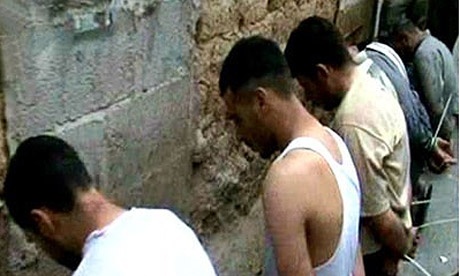
Palestinians security forces, after being forced
to strip down to their underwear
by Israeli troops, sit captive in front of an army vehicle (AP).

Four years later, on 3 March 2006, the Israeli occupation army raided Jericho Prison, which under the façade of PA control was actually guarded by US and UK observers.
 
The time between Israel’s arrest and sentencing of Saadat, a total of two years, involved more than 30 court sessions, mostly held in Ofer prison on the outskirts of Ramallah.
These sessions allowed for only two members of the Saadat family to attend at a time, and Sumoud had to alternate with her two brothers, sister and mother to ensure that everyone got to see him. Sumoud got to visit her father four times.
“Inside the court room,” Sumoud recalls, “we weren’t allowed to speak to my father. We weren’t allowed to physically touch him, even for a handshake. We tried to communicate with facial expressions, that was it.”
Defining herself as the closest to her father, Sumoud attributes that to the fact that her father was missing from her life for her first two years, as he was behind bars. “He made an extra effort to get closer to me, since I kept rejecting him and referred to my uncle as my father.”
Saadat was sentenced on Christmas Day in 2008 to a life sentence of 30 years in prison. A few months later, there was an order of six months of solitary confinement against Saadat that was renewed every six months for three years before the May 14 agreement was signed.
Saadat refused to recognize the military court, which couldn’t charge him with anything concrete and relied only on circumstantial evidence. He was charged with being the head of the party that carried out the assassination of Zeevi as well as being responsible for actions that were carried out by various members of the PFLP, dating back to the 1980s.
Sumoud affirmed that her father would refuse to be released based on the “good intentions” of Israel, a provision that Israel uses to reward the PA for resuming negotiations, a term that has been synonymous with PA concessions. Saadat is adamant that the only way he will be released is through a prisoner exchange or an end to the occupation.
 
On 23 September 2011, Saadat went on a hunger strike for 23 days to protest against his solitary confinement. The hunger strike ended as a result of the brokered deal between Hamas and Israel that saw captured Israeli soldier Gilad Shalit of five years exchanged for 1027 Palestinian prisoners. Saadat remained in solitary confinement.
 
Since the capture of Shalit, Saadat’s name was among those put forward. As news of a possible prisoner exchange began to leak out, high profile members of Hamas, including Aziz Duweik and politburo Khaled Meshaal, personally assured the Saadat family that he was without a doubt among the prisoners returning home and not one of those sent to exile.
Rumors oscillated between the release of Saadat along with popular Fatah man Marwan Barghouti to their continued imprisonment. Nevertheless, when final confirmation of the list of prisoners due to be released in October was out, Sumoud and her siblings were shocked that their father’s name was not one of them.
“My father always told us to never get our hopes up so high, since the Israeli Prison Service are so unpredictable,” Sumoud said. “But it was still a huge shock for the family, especially after Hamas guaranteed us that he would be released.”
On April 17 this year, Saadat joined a mass hunger strike, which grew to involve approximately 2,500 prisoners out of the total 5,000 Palestinian prisoners in Israeli jails. His health deteriorated rapidly, and he was transferred to the Ramleh prison hospital, where he was still kept in total isolation.
Former hunger striker Thaer Halahleh, who went 77 days without food and was also in the Ramleh prison hospital, relayed to Sumoud how even on the brink of death, Saadat was kept in a small cell all by himself, padded with some sort of nylon sheets that prevented him from catching any snippets of conversations from the other prisoners. The only time he saw the prisoners was during the night the agreement was signed on May 14, where he was brought out in a wheelchair.
After three years in isolation, Sadaat secured a major triumph and is now in Shatta prison, sharing a cell with other prisoners. Although his wife Abla and oldest son Ghassan were able to visit him after the hunger strike ended, his other children are still banned from doing so, on the pretext of being considered as “security threats” by the IPS.
 
Saleh Hammouri, the French Palestinian former prisoner who spent seven years in jail before being released in the second half of the deal’s implementation in December 2011, was in Hadarim prison with Saadat back in 2007.
 
“Once, the prison warden, who used to show up barely once a month, came in the morning and informed Saadat that he had a private visit from someone,” Hammouri recalls. “A private visit is a big deal, because it means that the visit is conducted without any physical barrier, and usually they are granted only in the most urgent cases or after dozens and dozens of applications.”
Saadat had asked the warden if the private visit was for all the prisoners. The warden replied that it was just for him.
“Saadat refused to go unless all the other prisoners got the same privilege,” Hammouri smiles. “The prison warden took that as a personal insult against him, and treated him, let’s say, less favorably from that day on.”
Lawyer Mahmoud Hassan acknowledges that the end of Saadat’s isolation is a victory, and is adamant that the release of all Palestinian prisoners is not an unattainable dream, as it is presented in international law.
The Fourth Geneva Convention forbids the forced transfer of persons from occupied land to the territory of the occupier. Therefore Israel using the excuse that it does not give permits to family members because they do not hold Israeli IDs is fallacious because it is primarily based on violating international law by transferring the prisoners in the first place.
“Israel from the very first day intended to use the prisoners as a pressure card for negotiations,” Hassan stated.
The most recent example is Netanyahu promising to release 125 prisoners incarcerated before the signing of the Oslo Accords and the establishment of the PA in 1993 if Abbas returns to the negotiating table, or conversely vowing not to release prisoners if the PA was to go the UN.
“If there was significant pressure from the Arab countries and the world in general,” Hassan continued, “the prisoners’ cause will end with the release of all prisoners, precisely because it is an international cause, as Israel is contravening the Geneva Conventions.”
This article is an edited translation from the Arabic Edition.
 
River to Sea Uprooted Palestinian  
The views expressed in this article are the sole responsibility of the author and do not necessarily reflect those of this Blog!

Canada ‘isolates’ Iran; Really!


Last month Tehran hosted the largest international event. The leaders from 120 Non-Aligned Movement (NAM) and 27 other nations including China and Russia assembled in Tehran and gave unanimous support to country’s nuclear program. The support proved by any standard that the Islamic Republic is more popular among the 193 United Nations members than any other country. The Veterans News Now has called the summit Iran’s great diplomatic victory over the US and Israel which tried their level best to sabotage the summit.

To the great horor of the Zionist Occupied Nations (ZONs) – Iran will not only steer the NAM affairs for the next three year – but NAM will stay closer to Iran’s interests after Iran’s term expires in 2015. After Iran, the rotating NAM chairmanship will goes to Venezuela and Bolivia, both Iran’a allies.
Since the US and Israel don’t have diplomatic relations with the Islamic Republic – they chose their poodle Harper regime in Ottawa to Isolate Iran. To realize how funny Israel-Firster Harper government’s decision to expel Iranian consulate staff from Canada and recall its diplomatic staff from Tehran – the two countries were never represented at ambassadorial level since the 1980s with the exception of a three-year stunt in 1990s. Furthermore, the trade between the two nations was less than $10 million.

Ottawa has claimed that it took the decision to “isolate” Iran from the international community due to Iran’s refusal to stop its nuclear program and being an ‘existential threat’ to Israel. Interestingly, Canadian foreign minister, Israel-Firster John Baird chose to make the announcement in Moscow and not in Ottawa. Maybe he intended it a message for Putin for later’s support for Tehran.

Since 1979 Islamic Revolution, Canada’s relation with Iran has been ‘shady’ on international level. In 1980, Tehran expelled Canadian ambassador in Tehran, Kenneth Taylor, for being the top CIA agent in Iran. On April 24, 1980, American Air Force, based on Ken’s intelligence briefing, planned and carried its incursion Operation Eagle Claw to rescue 52 American embassy staff members captured as ‘spies‘. The Operation involved eight RH-53D Sea Stallion helicopters. Before the ‘American braves’ reached their destination in Tehran – three of the eight helicopters were lost in the desert sand storm (a Divine intervention, perhaps). The surviving crew and the soldiers in panic returned to the base at Masirah without taking along 8 of the bodies of dead US soldiers.

Canadian delegate always staged walk-out during Ahmadinejad’s speeches at the UN General Assembly for criticizing the Zionist regime.

Canadian delegate walked out of Durban I (South Africa) and Durban II (Geneva) conferences on combating racism for majority of member states’ criticism of the Zionist regime for its apatheid policies.

In September 2011, Harper government boycotted Durban III conference in New York, because its keynote speaker was no other than Iran’s President Dr. Ahmadinejad.

In October 2010, Stephen Harper government’s blind support for the Zionist entity and its participation in US-NATO war in Afghanistan had cost Canada its bid to secure a non-permanent member seat at the UN Security Council for the first time in the last six decades.

In May 2011, Canadian Foreign Affairs Minister John Baird issued a statement, saying, “Canada deplores the election of Iran to a seat on the United Nations Commission on Population and Development. Canada remains extremely troubled by the outrageous human rights abuses committed by Iran against its own citizens, and by Iran’s threats and actions to undermine the safety, security and stability of its neighbors (read Israel)”.

In May, Canadian embassy in Tehran stopped issuing visas to the relatives and friends of 400,000 Iranian diasporas living in Canada. Now in order to visit Canada they must go to Ankara in neighbouring Turkey to get a visa.

In February 2012 – Canadian pro-Israel groups slammed US Chairman of the Joint Chiefs of Staff Gen. Martin Dempsey for saying that Iranian regime is “a rational actor”.

Tehran has maintained a token diplomatic relation with Ottawa since 1980s.

I was very surprised by the Canadian announcement,” James Devine, an Iran expert at Mount Allison University in Sackville, N.B., told CBC News, noting that it isn’t tied to a specific event or a reaction to “an acute crisis in the relationship.” Devine also emphasized that Canada’s move is likely to have little impact in Iran as Canada is not an international player.

In May 2012, Iran’s deputy foreign minister and Tehran’s representative at the EU, Ali Asghar Khaji, in an Interview with Paul Koring of Toronto daily The Globe and Mail, called Canada Israel’s lapdog.
 
River to Sea Uprooted Palestinian  
The views expressed in this article are the sole responsibility of the author and do not necessarily reflect those of this Blog!

"The Middle East peace process is dead.... it may well go on (decomposing) indefinitely"

"Via FLC


"..."The Middle East peace process is dead. More precisely, the two-state solution is dead; the peace process may well go on indefinitely if this Israeli government has its way.The two-state solution did not die a natural death. It was strangulated as Jewish settlements in the West Bank were expanded and deepened by successive Israeli governments in order to prevent the emergence of a viable Palestinian state. The settlement project has achieved its intended irreversibility, not only because of its breadth and depth but also because of the political clout of the settlers and their supporters within Israel who have both ideological and economic stakes in the settlements’ permanence" ..."

River to Sea Uprooted Palestinian  
The views expressed in this article are the sole responsibility of the author and do not necessarily reflect those of this Blog!

One Asad can be just as tough as another.

Syria's Foreign Policy Challenges U.S. Interests

This is the second of a two-part series marking the six months since Bashar al-Asad became president of Syria on July 17, 2000. Read Part I. 

Bashar has tried to demonstrate that one Asad can be just as tough as another.

His approach to Israel consists of three basic elements:

1) No yielding on the peace process Bashar is unbending on the basic requirement for peace he inherited from his father — Israeli withdrawal to the June 4, 1967 borders, leaving Syria a riparian on the Sea of Galilee.

Recovery of the Golan Heights, he says, "tops our national priorities."

As a neophyte president trying to impress the Baathist old guard, this is probably the last area in which he would show flexibility, even if he were so inclined. But, more than his father did in his final years, Bashar also has spoken of the need to fulfill Palestinian rights — statehood with a capital in Jerusalem and return of the refugees — as a condition for achieving comprehensive peace. Like his approach to Iraq, this stance is probably popular at home, particularly as the intifada rages.

Meanwhile, there is no known change in the status of radical Palestinian groups based in Damascus.

2) Support for Hizballah and the Lebanese claim to Shebaa Farms Syria not only endorsed an Arab League summit statement supporting Lebanon’s claim to Shebaa farms, but Syrian U.N. ambassador Mikha’il Wahbi also wrote in an October 24 letter, "Israel . . . has not completed the withdrawal from south Lebanon to the internationally recognized borders, including the Shebaa farms."

This stance, in effect, justifies ongoing Hizballah attacks on Israel, retaining for Syria a source of pressure on Israel, despite the "loss" of southern Lebanon. Syria has supported and has no doubt directed Lebanon’s refusal to deploy its troops to the border following the Israeli withdrawal.

3) Rhetorical fervor, including support for the intifada, reactivation of the Arab boycott, and the severing of all Arab ties with Israel

In his Arab summit speech, Bashar said Arab states should aim for the "peace of the strong" instead of the "peace of the weak," in an apparent call for the strengthening of Arab militaries.

River to Sea Uprooted Palestinian  
The views expressed in this article are the sole responsibility of the author and do not necessarily reflect those of this Blog!

“Iran will Drag any War to Israel’s Own Ground”

 
Local Editor
 
The Islamic Republic of Iran responded to the Israeli leaks about preparations for hitting the Iranian nuclear facilities within the coming 50 days, warning that “in case of any attack, we will drag the war into the enemies’ own ground”.

Iran nuclearMehr news agency quoted Islamic Revolutionary Guards Deputy Chief, Brigadier General Hossein Salami Ali as saying that the enemies of Iran are aware of its power, and that the Iranian forces will not permit dragging the war into its grounds.

He further stated that the enemies of the Islamic Republic did not spare any effort against Iran in the past 34 years, and noted that “they tried to paralyze the Iranian economy but soon after that they faced an economic crisis.”

“In contrast, our society is accomplishing new advancements without relying on any (foreign) power, and without fearing any threats,” Salami added.

The Iranian official pointed to the efforts made to obstruct the NAM Summit in Tehran, and revealed that short warning letters were sent to the countries participating in the summit.

Maariv had earlier published information it said were “dangerous” and “confidential” about Israeli Prime Minister Benjamin Netanyahu’s preparation for hitting the Iranian nuclear sites within 50 days.
The Zionist paper quoted Israeli Minister Tzachi Hanegbi as saying that “the next 50 days will be crucial to our fate.”
 
River to Sea Uprooted Palestinian  
The views expressed in this article are the sole responsibility of the author and do not necessarily reflect those of this Blog!

‘Jews Need to Respect Others,’ says priest in wake of Monastery Attack

Father Pierbattista Pizzaballa--'If you as a Jew
want people to respect you,  you need to respect others.'
By Richard Edmondson


  The state of Israel seems to be in “damage control mode” over the vandalism of a monastery earlier this week. While the attack, apparently perpetrated by Jewish settlers, received limited coverage from the US mainstream media, the news has been carried on a number of Christian websites (see here, here, here, here, here, here, here, here, and here— see also my own article on the attack which I posted on Tuesday) and has equally gotten wide attention from the international media.

The vandals attacked the Monastery of Notre-Dame de Sept-Douleurs, located in Latrun, about 25 kilometers west of Jerusalem, setting fire to the front door and defacing the walls with hate-filled graffiti, including the words “Jesus is a monkey.”

The incident has been viewed as a “price tag” vandalism carried out in response to the clearing of Migron, a West Bank settlement outpost, a day earlier. And while other vandalisms of Christian sites in Israel—such as the attack on the Narkis Street Baptist Church in February this year—largely escaped notice, this one seems to have provoked a more visceral reaction from the Christian world.

“The Christian community awoke this morning…to discover with horror that once again it is the target of forces of hatred within Israeli society,” said a Catholic statement issued in response to the attack. “What happened in Latrun is only another in a long series of attacks against Christians and their places of worship.”

The statement went on to ask: “What is going on in Israeli society today that permits Christians to be scapegoat and targeted by these acts of violence?”—and also wondered, “What kind of ‘teaching of contempt’ for Christians is being communicated in their schools and in their homes?”

The statement was released by the Assembly of Catholic Ordinaries in the Holy Land and included the signatures of Fouad Twal, Latin Patriarch for Jerusalem, Gerogio Lingua, Apostolic Nuncio for Jordan, and former Latin Patriarch Michel Sabbah. The church officials called upon the Israeli authorities to “act to put an end to this senseless violence and to ensure a ‘teaching of respect’ in schools for all those who call this land home.”

Outside the Holy Land, the attack was also condemned by the Catholic Church in England and Wales, where Bishop Declan Lang warned of a climate of “rising intolerance” in Israel and said the incident follows a “disturbing pattern in which Christian and Muslim sites are being targeted by extremists or settlers within Israeli society.”

This “disturbing pattern” was also remarked upon by Father Pierbattista Pizzaballa, a Franciscan priest who serves as the Vatican’s Custos, or Custodian of the Holy Land, and who discussed the matter within the context of the tearing apart earlier this year of a copy of the New Testament by an Israeli Knesset member.

It was shocking,” Pizzaballa said of the book destruction. “If you as a Jew want people to respect you, you need to respect others. There are billions of Christians for whom this book is holy.

And that seems to be what has Israelis worried. As I said, there is a certain amount of damage control going on. And as is typically the case when, say, Israel commits war crimes against Palestinians, it isn’t so much the act itself but rather the damage to Israel’s public image that appears to be of foremost concern. Consider the following news item from Ynet:


Cables sent by Israeli ambassadors in Europe to the Foreign Ministry in Jerusalem indicate that the recent desecration of a monastery outside Jerusalem has resulted in a major hit to Israel’s image in the continent.

“The media coverage (of the vandalism) is causing grave damage to Israel’s image in France,” a cable sent by the embassy in Paris read.
 
 
And indeed, the attack has even been condemned by the French government (not a peep of protest from our own, but of course that’s par for the course), while the Italian media, perhaps not too surprisingly, are in a frenzy over the affair as well. Again from Ynet:

Media outlets in Italy criticized Israel’s security forces, who “apprehend terrorists before they leave for their mission but fail to catch a few Jews who are operating right under their noses.”

The following video, posted by the Jerusalem Post, reports on the monastery attack but also takes pains to emphasize the more positive aspects of Israeli society. Lucky us, we also get to see a visit to the monastery by a high-ranking Israeli official.


  Pizzaballa says the animosity toward Christianity is reflected throughout Israeli society, and in an interview with Haaretz he also discussed the common occurrence of priests being spat upon as they walk through the city of Jerusalem.

In a reference to the long-standing, continual incidents of Orthodox Jewish extremists in Jerusalem spitting at Christian clergy, Pizzaballa said: "When I came to the country, I was told that I should know that if I walk around with a frock in the city [of Jerusalem], people would spit on me, and I shouldn't be offended, it's normal."

No matter how high his position, any priest who makes his way around the city will sooner or later be spat upon and cursed by a yeshiva student, he added.

Pizzabella, by the way, is head of the Franciscan order in the Middle East, and has lived in Israel for 22 years. Again from Haaretz:

After more than two decades here, he said he knows the areas of Jerusalem where he is at risk of being spat upon, including the area of Jaffa Gate and the Armenian Quarter…

In February, following incidents in Jerusalem, Pizzaballa wrote to President Shimon Peres that in recent years, he and his colleagues had learned to ignore provocations, but that now they were escalating to the point that they had become intolerable.

The monastery’s vandalism was also condemned in a statement by Hamas, which called it a “racist crime,” and went on to add:

“The organized crimes committed by this regime against the holy Islamic and Christian monuments show the real face of the racist Zionists.”

Indeed, on June 19 a mosque in the West Bank village of Jaba was torched by vandals who spray painted a number of slogans including the words “pay the price,” “death to Arabs,” and “the war has begun.”

As I mentioned in my previous post on the matter, the monastery attack was also condemned by Palestinian Authority spokesman Saeb Erekat, who called it “further confirmation of the culture of hatred and racism” by Israeli settlers.

Pizzaballa believes at least part of the problem is the tendency by Jews to blame Christianity for their problems of the past. Or as he put it, “When you say ‘Christianity’ to the Israelis, they immediately think of the Holocaust and the Inquisition. People don’t know that we are here and that we have roots (here).”


Is Christianity really responsible for all the misfortunes Jews have suffered through history? Apparently a good many Jews prefer to believe that rather than examine their own behavior for possible causes. But as I said in a post two years ago, views antagonistic toward Jews in the ancient world were harbored and expressed long before Christianity came into being.

In the church vandalism back in February, the attackers spray painted, “Jesus is dead,” “Death to Christianity,” and “Mary was a prostitute.”


More on the monastery attack in video:


 Addendum:

Interestingly, vandalism of Christian sites in Israel is also discussed in a Wikileaks cable dating back to February of 2009. The cable seems to have originated from the US consulate in Jerusalem and makes mention of Consul General Jake Walles. Apparently the Franciscans and the Vatican Custos appealed to the US consulate for help at that time in curbing acts of Israeli vandalism. “Macora said the Franciscans reported the vandalism to the Israeli police, but he does not expect a response,” the cable reads at one point.

Here is the full text of the cable
:

C O N F I D E N T I A L JERUSALEM 000245
 SIPDIS
NEA FOR FRONT OFFICE AND IPA. NSC FOR SHAPIRO/PASCUAL E.O. 12958: DECL: 01/22/2024 TAGS: KWBG, PGOV, PREL, PTER, PHUM, KPAL, IS SUBJECT: FRANCISCANS REQUEST USG ASSISTANCE PROTECTING CATHOLIC PROPERTIES REF: 08 JERUSALEM 1758
Classified By: Consul General Jake Walles, per reasons 1.4 (b) and (d) 1. (C) Summary. The Franciscan (Catholic) Custos of the Holy Land reported vandalism against a monastery on Mount Zion and requested USG assistance to protect Jerusalem's Christian holy sites. A representative of the Custos told PolOff vandals accessed the monastery from the neighboring Cenacle complex (see background in paras 4-5), and the Franciscans believe students at the yeshiva in that complex are the perpetrators. In the most recent act of vandalism on January 30, someone broke a stone cross off the top of the monastery. (Note: Photos of vandalism at the monastery can be found on the ConGen's classified website at http://www.state.sgov.gov/p/nea/jerusalem/ind ex.cfm by clicking on the link for Political Reporting Attachments. End note.) End Summary.
2. (C) Father Athanasius Macora, Head of the Christian Information Center and a representative of the Custos of the Holy Land, briefed PolOff on February 2 about a series of acts of vandalism against the monastery on Mount Zion. Macora said that vandals broke a stone cross off the top of the Franciscan monastery on January 30, adjacent to the Cenacle complex. Other incidents include throwing stones through windows and tossing heavy metal objects over the wall into the monastery's courtyard. Macora said that all acts of vandalism have originated from the Cenacle complex, which houses a yeshiva, and he suspects students at the yeshiva are the perpetrators. The person who broke the stone cross apparently used a ladder from the yeshiva rooftop to access the monastery.
3. (C) Macora said the Franciscans reported the vandalism to the Israeli police, but he does not expect a response. Macora said that vandalism has damaged church property, caused stress to the monks living there, and strained an already fragile relationship with the yeshiva. He asked for USG assistance to protect this and other Christian holy sites in Jerusalem.
BACKGROUND ON THE CENACLE AND FRANCISCAN MONASTERY ON MOUNT ZION
 ----------------------------------
4. (U) The Cenacle is the purported site of the Last Supper. The building contains the Cenacle room, the Room of the Holy Spirit, and a cenotaph associated with King David. It is part of a former Franciscan monastery. The site housed one of the earliest Christian churches in Jerusalem, and has been razed and rebuilt at least twice. The Franciscans acquired the property in 1342 and established a monastery, but were forced out by the Ottomans in 1552. The complex served as a mosque until the mid-twentieth century and contains Muslim symbols and a Muslim cemetery. The GoI took control of the property after 1967 and a yeshiva was established there in 1975. Many Jews consider King David's cenotaph a holy site.
5. (C) The Franciscans have a monastery in an adjacent building in order to maintain a presence on Mount Zion, and it is this monastery that is being vandalized. The Franciscans claim continuous ownership of the site since 1342, in spite of not having control of it since 1552. The Custos of the Holy Land has complained to the GoI that the yeshiva is removing Christian symbols from the Cenacle complex that undermine the Franciscan claim to the site (reftel). Franciscan contacts have said that vandalism threatens to eliminate Mount Zion's historic Christian nature. WALLES


River to Sea Uprooted Palestinian    
The views expressed in this article are the sole responsibility of the author and do not necessarily reflect those of this Blog!

Cinepolitics - "Searching for Sugar Man" (Press Tv)


I highly recommend all of you to view Malik Bendjelloul's Searching for Sugar Man. An incredible film with a very clear message about life, being in the world, politics, ethics, Apartheid and beyond. I learned a lot. I plan to write about it soon..
Cinepolitics - Searching for Sugar Man" (Press Tv) from Gilad Atzmon on Vimeo.
 
River to Sea Uprooted Palestinian  
The views expressed in this article are the sole responsibility of the author and do not necessarily reflect those of this Blog!

Bin Laden on the Head of a Pin


 Bin Laden on the Head of a Pin

Bin Laden on the head of a pin
Bin Laden in the sea
Bin Laden on the planet Mars
Bin bon appétit!

Bin Laden in the apple orchard

Takes a bite of a crisp, delicious, reality-is-whatever-we-say-it-is red apple,
Hums a song in his heart through the fervid fizz of his Khazarian memory
And tosses the half-eaten apple on the ground,
Leaves the orchard without a sound.

Bin Laden as a prom corsage

Where is the truth?
It lies in the attic.
Bin Laden as decoupage

Bin Laden in the piss-Christ glass
Bin Laden at the dancehall makes a pass
At a lovely girl whose name was Jill
He took her to the woods and cut her heart open with his sica blade
Gave his false flag a nice, smart wave
Left Jill’s body on the blood soaked ground
And returned to the lights of the dance hall—
Flashed his Mossad I.D. at Michael Chertoff,
Hopped on the next flight to Israel
And announced he’d only been there to document the event.

Bin Laden eating liver and grouse

Flosses with the tail of a mouse
Bin Laden has a golden rule:
To each smug, land-thieving Jew in the West Bank an Olympic pool!
Bin Laden on the head of a pin
Bin Laden’s second coming again and again.

Bin Laden put the nano-thermite explosives in place

To do a controlled demolition of America
From Maine to Hawaii
And when the explosives went off
America fell neatly into its own footprint,
And nobody recognized hell’s flashing lights
And nobody recognized the snake that bites
We all just sort of wondered where the time went.

Bin Laden peruses the market trends

Flying over Kansas with his Sayanim friends
Not worth bothering to make amends
Just another ho-hum day of decapitating goyim.
Bin Laden swipes his credit card
Rushes off to a Hollywood set—
O what a beautiful day!—
His eye captured by a shapely leotard
Films his next video for the CIA.

Bin Laden in the lion’s den

Now become the king of beasts
Bin Laden with his goyim slaves
Riding the crest of the perfect wave,
Dining at the think tank feast.
Bin Laden looking fit and tanned,
Ever the whiz-kid in demand.

Bin Laden perusing the market trends

Once again over Kansas with his Sayanim friends
Bin Laden laying down XYZ
In the studios at ABC.
And nobody recognized hell’s flashing lights
And nobody recognized the snake that bites.
And nobody recognized the snake that bites
.

Bin Laden rising higher and higher

Tightrope walking on the telephone wires
The imperial Lord of holy rites
And nobody recognized the snake that bites
Bin Laden on the planet Mars
Bin Laden headed for the stars
Bin Laden will return some day
In another mask, another way.

Bin Laden on the head of a pin

Bin Laden in the sea
Bin Laden on planet Earth
Bin bon appétit!

And nobody recognized hell’s flashing lights

And nobody recognized the snake that bites.


By Richard Edmondson

 
River to Sea Uprooted Palestinian   The views expressed in this article are the sole responsibility of the author and do not necessarily reflect those of this Blog!

ABNORMAL NORMALIZATION


Is deceived and mistaken who thinks that normalization has failed. They go around telling us that normalization has failed in Egypt and failed in Jordan and so on . Normalization has not failed anywhere and speaking about the failure of normalization is - in itself - one of the constituents of normalization. Normalization has reached the 1.5 billion Muslims and the half billion Arabs ; very few have escaped .

You can be a Muslim and pray and fast and normalize , you can perform Hajj and normalize . This coexistence between the two has succeeded . You can also take to the streets and demonstrate and ask for all kinds of freedom and –on the other hand- normalize , you can even start a revolution and normalize .

Normalization does not mean to raise the Israeli flag, or to recognize Israel or to establish diplomatic relations with the enemy.

Normalization is to raise the Saudi flag or the Qatari flag , is to ask for democracy in Syria , is to be set against the Syrian government , is to see what is happening in Syria as a political opposition on the ground , is to believe that what is happening in Syria is an internal war and that there is something called the International community or that UN is representative of all nations. It is to think that there is an international law that protects people, and that UN defends International rights; it is also to believe that US is different from Israel and that the Israeli Lobby rules the United States and that US is a victim of Israel.

Not only the Egyptians and the Jordanians but the Palestinians have also normalized. Israel is no more their enemy, even though it is still slaughtering them and killing them, and usurping their land, and confiscating their property, and humiliating them at the various checkpoints, and besieging them, and incarcerating them, and abducting their children, and building walls of separation to sever them from their families, and violating the sanctity of their holy shrines and temples, and forcing them to destroy their own houses with their own hands, and mutilating the bodies of their dead, and selling the organs of their martyrs and smuggling them across the ocean.

All this most Palestinians have normalized with and adjusted to, considering it as part of their lot that cannot and will not be changed . For this reason they have found a new enemy , an enemy they can fight and challenge and eventually kill and slaughter and chase out of his home and village and track and capture and execute at leisure and mutilate and disfigure, if not directly at least virtually.

This is how Palestinians have been set against Syrians , they have found- at last- their longed for enemy, not in the Zionist Jew, but in the Arab Syrian who is their brother, and their helper, and their host, and the host of their leaders, and the supporter of their cause . This Syrian has turned into their enemy because it was required that they absolve their real killer : the Zionist Jew - after identifying with him- and then start defending him and protecting him and fight for him and wage his wars and kill his enemies; if all this is not normalization then what is it?

River to Sea Uprooted Palestinian  
The views expressed in this article are the sole responsibility of the author and do not necessarily reflect those of this Blog!

Lebanese Customs Foil Attempt to Smuggle Communication Devices to Syria

 
Local Editor
 
Security sources told Al-Manar TV that the Lebanese customs
confiscated 15 advanced communication devices
in addition to 15 surveillance equipments.
Only two weeks after capturing communication tools on the private Qatari plane in the Lebanese airport, security sources told Al-Manar TV that the Lebanese customs confiscated 15 advanced communication devices in addition to 15 surveillance equipments.

According to the source, two Syrian women from Homs, an Egyptian doctor, and a Lebanese were in the airport receiving them.

The security sources further clarified to Al-Manar that the devices are highly advanced and could be put on roofs of the buildings for live broadcast.
Information revealed that the devices were to be se
nt to Syria, for the two women who received them were heading towards Syria via the Lebanese-Syrian borders.
 
River to Sea Uprooted Palestinian  
The views expressed in this article are the sole responsibility of the author and do not necessarily reflect those of this Blog!

Military Analysts Say Syrian Army Is Far from Point of Collapse

David Enders

McClatchy Newspapers

The State Department has said repeatedly that the Syrian Army is growing weak, but independent military analysts say it is still capable of handling the rebel forces.

Though degraded by a war of attrition against increasingly capable guerrilla militias, the Syrian military remains a cohesive force capable of continuing its operations for the foreseeable future, according to independent military analysts.

The assessment that the Syrian military remains a potent force contradicts months of suggestions by Obama administration officials that defections and the pace of the increasingly violent conflict is overstretching the military, a theme that’s been voiced repeatedly for months in official State Department briefings.

“We think that the army is increasingly overstretched. We think that the economy is under increasing strain. And we think the rebels are getting stronger,” State Department spokesman Patrick Ventrell said Aug. 9 in one typical comment.

Yet despite a bombing in July that killed four of President Bashar Assad’s closest advisers – including his minister of defense – Syrian military strategy has changed little from six months ago: using the highly mechanized army – built to fight the Israeli army – to surround rebel-held areas and pound them with artillery and airstrikes before making incursions with infantry and paramilitary forces.

“They’re still capable of handling the threats that they’re dealing with, and they’ve been reaching deeper and deeper and deeper into their armory,” said Joseph Holliday, a researcher at the Institute for the Study of War in Washington who specializes in the Syrian conflict.
syria army
That’s not to say that the rebels haven’t made the conflict costly for the military. Since the conflict began, the military has been forced to call up reserves and it continues to use paramilitary forces to supplement its infantry.

“They’re taking somewhere around 40 (killed in action) a day. If you extrapolate from that, wounded would be about four times that number. So you can see there’s a steady toll just from combat on the army,” said Jeff White, a senior defense fellow at the Washington Institute for Near East Policy.

While there continue to be individual defections from the military, mass defections generally haven’t occurred, something Holliday credits in part to a government strategy of teaming units made up of conscripts with more professional, better trained troops.

“They are pairing their elite, reliable units with their less reliable units to prevent defections,” Holliday said.

White thinks the overall trend is downward for the army and that the rebels eventually will prevail. He thinks the fact that the rebels continue to contest areas in Aleppo, Syria’s largest city, and in Damascus, the capital, show the military’s weaknesses.

“The army’s going to become less and less capable of conducting operations successfully, and I think the best example of that now is Aleppo,” he said. “The city is critical to the regime by all accounts, and it is disputed territory. For the regime, I think that is defeat. It’s not decisive defeat, but the regime’s inability to reclaim the city is a defeat.”

Holliday is more skeptical. “The rebels are trying to harass supply lines, but the corollary to that is that the regime is making sure it has everything it needs in place. It’s not going to lose a fight in Aleppo,” Holliday said.

The mixing of army units that Holliday described has made it difficult to track which military units are fighting where, though Holliday said it was clear that Syria’s 4th Armored Division and Republican Guard were undertaking most of the fighting near Damascus. The 4th Armored Division is led by Assad’s brother, Maher Assad.

The rebels have managed to destroy significant amounts of the army’s equipment, becoming particularly adept at attacking armored vehicles with rocket-propelled grenades and roadside bombs.
“At the beginning we were seeing T-72s,” White said, referring to the most advanced tanks, bought from Russia, that the Syrian army possesses. “Now we’re seeing some T-54s and T-55s.”

T-54s and T-55s are Cold War-era tanks that first went into production at the end of World War II.
But the army hasn’t yet deployed some of its heaviest weaponry. Despite punishing artillery and rocket strikes on rebel-held areas, a number of rocket and artillery systems haven’t yet been used.

“To me, that’s the most important advantage the Syrian military has over the rebels,” White said.
He predicted that the rebels eventually will acquire anti-aircraft weapons or learn to use the weapons they have to shoot down jets and helicopters, which the Assad military has begun to use more frequently. The use of jets to bomb rebel positions is among the developments that led the death toll to surge in August to 5,384, more than triple the number of dead recorded in May and the highest monthly total yet of the 18-month conflict.

But that won’t erode the regime’s advantage in artillery, White said. “The one thing they will find it very difficult to deal with is the artillery,” he said of the rebels.

White said that even if the military were to be broken, it probably wouldn’t end the violence. He suggested that some commanders would use the mayhem to set up regions that they’d control. “It isn’t going to be just one outcome for the army,” he said.

Holliday pointed to the shabiha, a pro-government militia whose membership is drawn largely from Syria’s Allawite religious minority, to which Assad and much of the country’s elite belong, as one likely outcome for a dissolved army. The militia has been used as infantry across the country, and human rights groups and the rebels accuse it of carrying out some of the worst atrocities in the conflict to date.

“The shabiha are a big deal, not only because they’re being used as infantry, but it’s also a nightmare scenario for what the army could become,” Holliday said.

(The Christian Science Monitor)

River to Sea Uprooted Palestinian  
The views expressed in this article are the sole responsibility of the author and do not necessarily reflect those of this Blog!