Sunday, 15 June 2014

Iraq: Understanding the coup in Mosul and its consequences

Iraqi men take part in a demonstration to show their support for the call to arms by Shia cleric Grand Ayatollah Ali al-Sistani, in the city of Najaf on June 13, 2014. (Photo: AFP - Haider Hamdani)
Published Saturday, June 14, 2014
There is a huge difference between the conspiratorial interpretation of events and the interpretation of an actual conspiracy, which many tend to overlook, namely, that the former is a subjective view that holds everything is a plot by the enemies – where even sand storms that hit Iraq could be a conspiracy – while explaining an actual conspiracy, entails a realistic analysis of causes, effects, and evidence thereof, with the intention of understanding a real conspiracy that has been planned and executed by one side against another. Major conspiracies are not rare throughout history, and some historians have even stated that history is nothing but a long series of plots.
In a recent speech, hours after Mosul, Iraq’s second largest city, fell to radical Islamic insurgents, Iraqi Prime Minister Nouri al-Maliki said that the collapse of the government forces in the city was a conspiracy. Some on social media, including myself, saw this as a continuation of the old tradition adopted by the defeated, though I had reservations about this view in the end.
Indeed, when Maliki used the terms “deception” and “coordinated rumors” to describe what had happened, I recalled immediately what the late Baathist leader Hani al-Fekaiki once revealed. Fekaiki was one of the masterminds of the military coup of February 8, 1963. In his book, the “Dens of Defeat,” he wrote, “We have toppled the regime of Abdul Karim Kassem with the weapon of rumors.” In truth, the Baath regime used psychological warfare very skillfully, as many experts assert.
The facts are starting to unfold. What happened in Mosul was a “special kind of military coup” that the faction led by Izzat Ibrahim al-Douri had been working on silently, patiently, and cunningly for a long time, until it finally managed to plant a complex and formidable network of former officers who had been excluded during the de-Baathification from the military in favor of more favored officers according to the sectarian quota system, especially in the provinces of Nineveh and Salah al-Din. ISIS was used as a “husk” in which their move was embedded, in order to terrorize their opponents, as part of a cynical nihilistic alliance.
Nihilistic because the time when the Baath can plan, execute, and triumph then rule the country for decades is behind us for good. The facts on the ground in Mosul and Tikrit will no doubt dispel the dreams of Douri and his militias in a matter of months, if not weeks, though this unfortunately will be very bitter and painful for the Iraqis in those regions.
The first nightmare that Douri will have to deal with is the inevitable clash between his men and the jihadis from the Islamic State of Iraq and Syria (ISIS) and other groups. In effect, clashes as such almost erupted very recently when portraits of Douri were put up for display in the areas seized by the insurgents. 

Ultimately, however, what is certain is that this coup has moved to implement the plan for the partition of Iraq in earnest, and opened the door wide to direct intervention by regional powers Iran and Turkey, as well as Western and other world powers.
Maliki’s speech was inconsistent, superficial, and betrayed his confusion. It seems that his primary goal was to increase the morale of his allies and partners in government, with no signs that he has any regrets, or that he could ever tire of the misinformation and lies of his military leaders and advisers, even when he is facing a dangerous and earthshaking military defeat.
Maliki said there was a conspiracy behind the fall of Mosul, claiming that he knew the names and details of those who launched rumors and ordered troops to withdraw, even though they were more than capable to repel the attack on the city. Yet hours later, Tikrit – no less – fell to the insurgents as well. So did Maliki know the details there too, but did not have enough time to avoid the second strike? It is not clear.

Maliki’s remarks suggest there was a security breach in the army command in Mosul, engineered by ISIS and Douri’s faction in the Baath Party. This is very plausible if not very likely, but the problem and the cause of the defeat in Nineveh at the hands of ISIS and the Baath insurgency does not lie there, but with the prime minister and his partners in the sectarian political process. For one thing, Maliki and his partners have failed to end this process or at least make it viable, because it was created by the U.S. occupation as an antithesis to the pluralism and diversity of Iraqi society.
Maliki failed to achieve real national and communal reconciliation. He failed on services, he failed on security, and he became an enabler of corruption and a protector of the corrupt in his government. His government exacerbated sectarian and ethnic polarization in the country, and as a result of all of this, the political process continued to rot and decay. Patriotic and democratic Iraqis opposed to the occupation and sectarianism had warned against the consequences of this for Iraq’s unity and existence so many times that their voices went hoarse.
ISIS and its allies’ takeover of the capital of northern Iraq and other cities, and the events of the past few days, is an official death certificate for the sectarian political process. Maliki has only two options now: Drown Iraq in a devastating and protracted civil war that no side will win; or – and this is the second option that I believe Maliki does not have the courage to pursue – end the sectarian political process and call a constitutional convention with the participation of all political forces and community leaders to amend the constitution and launch a national political process that would criminalize political sectarianism, and declare a secular and civil state based on the principles of citizenship rather than on confessional foundations, as the occupiers and their allies wanted.
Otherwise, in a month or two, Maliki will still be peddling the same claims, except that thousands more Iraqis will have been killed, injured, or driven out from their homes, and many more cities will have been razed to the ground, while the unity of Iraq and its people will be up in the air.
But, how was the Mosul coup executed?
According to events on the ground, and an analysis of testimonials and news reports, we believe that two main factions took part in the attack: Douri’s Baath faction, which was in charge of planning and planting Baathist officers in the government troops leadership and preparing hundreds of fighters as part of the Naqshbandi militias, to replace the Baath’s defunct militias, and Takfiri groups like ISIS, Ansar al-Sunna, and others, who provided well-trained fighters. 
This is in addition to tribal-sectarian forces led by people like Harith al-Dhari, who gave his blessings to the coup from Amman, Ali Hatem, and clerics like Rafi Rifai and Abdul Malik al-Saadi, who have always claimed that the Iraqi army is an “occupation army” in the Western regions. 
Meanwhile, according to eyewitnesses who spoke to the news website Al-Badil Al-Iraqi, the gunmen who first stormed Mosul were mostly non-Iraqis. Later on, those gunmen were replaced by Iraqi militants spotted protecting banks and public installations, while the foreign fighters moved on to other battlefronts.
The plot was carried out smoothly and easily at the predetermined zero hour, which the coup leadership had relayed to its “moles” inside the Iraqi army in the provinces of Nineveh and Salah al-Din. Thus, senior army commanders such as the Deputy Chief of Staff Abboud Qanbar and Land Forces Commander Ali Ghaidan found themselves without an army or middle-ranking officers, and their only option was to request to be evacuated by Kurdish militias to the nearby city of Erbil.
The commander of Nineveh Operations Mahdi Gharrawi was able to escape a similar fate, as he had at the time been at the headquarters of one of his brigades on the outskirts of Mosul, in al-Khazer region. Kurdish parties have attempted to smear the man and forged a picture showing him with the Peshmerga militia behind him, but he succeeded in proving that he had not left his position and that he was in the process of regrouping his forces.
It is worth noting that the Peshmerga have played a suspicious role in the events in Mosul, with reports that the Kurdish militia was forcing retreating Iraqi soldiers to undress and put on civilian clothes, before photographing them in a manner that suggested they were fleeing from the battle.
Consequences of the Mosul coup
Of the major consequences on the medium and long terms for the Mosul coup orchestrated by Douri and his allies in the suicidal Salafi groups, we highlight the following:
Iraq is on the path to being partitioned into sectarian mini-states, or at least, the provinces of Nineveh, Tikrit, and parts of Diyala could be carved out of Iraq by force of arms. However, Anbar’s special tribal circumstances make it difficult to implement a similar plan there. Indeed, in Anbar, an Iraqi national identity remains strongly rooted, and a plan to turn the province into an autonomous region was thwarted despite all the clamoring by strong parties to this end. Hostility to Takfiri groups is strong throughout the province as well, with the exception of Fallujah perhaps, though there are local frictions that were not visible in the recent past, and which now mar relations between communities and clans in Anbar and Nineveh.
The door is now wide open to regional intervention, especially by Iran, with its sectarian calculations and concerns regarding Western belligerence, and Turkey, which has similar calculations in addition to its old ambitions in the “Province of Mosul” of the Ottoman Empire. The door is also open to Western intervention, which could take the form of a direct albeit gradual comeback by U.S. occupation forces into Iraq, or at least, the form of substantial backing for the sectarian system in a way that would ensure further dependency on the United States.
The Mosul coup has put an end to the idea of stopping or even tapering de-Baathification in the context of the Accountability and Justice law. Instead, the current government might launch a violent and comprehensive campaign against Baathists, and it will no longer be easy for democratic and left-wing voices demanding an end to or a tapering of de-Baathification – or to have it deemed a criminal rather than a political process – to restate these demands. For one thing, it has been proven beyond a shadow of a doubt that the Baath’s chronic obsession with plots and coups is incurable, which will mean that thousands of innocents are set to pay the price for Douri’s folly and power hunger […].
The coup will be the final nail in the coffin of “Saddamism” and militia-minded forces in Iraq, and will strengthen the flames of sectarian polarization and open the door to sectarian fighting among Iraq's Arabs. In the process, a new disgraceful episode has been added to the record of Saddam’s Baath Party, while its enemies will note that the Baath had cooperated with Western intelligence in the past to carry out its coups, the Baath under Douri is collaborating with extremist groups who have killed scores of his people, and suicide bombers who blew up Iraqi civilians in the streets and houses […]. This may push some Iraqi Baathists loyal to their ideas and experience to oppose what happened, although we are not very optimistic about this.
The coup will cause the loss of the oil-rich and ethnically diverse province of Kirkuk to the Kurdistan Regional Government. The province has been practically under occupation by the Kurdish Peshmerga since June 12. Not many Sunni Arabs will rush to defend it after what happened in Mosul and Tikrit. However, the Anbar province may reach out to the provinces of the center and the south to form the nucleus of a different Iraq that would end the sectarian militia-led mini-states in Mosul and elsewhere, if the sectarian system in Baghdad falls.
On the flip side of this gloomy picture, the coup could also spell the end for the era of sectarian power-sharing and the constitution drafted by the occupation, having proven its threat to the unity of Iraq, its territorial integrity, and the wellbeing of its people. The question now is this: How can this era be practically ended, to launch the process to build an Iraq based on citizenship and equality, atop the ruins of the Iraq of sects and quotas?
This article is an edited translation from the Arabic Edition.
Related

River to Sea Uprooted Palestinian   
The views expressed in this article are the sole responsibility of the author and do not necessarily reflect those of the Blog!

Lebanese army cracks down on al-Nusra Front in Ersal


Lebanese army soldiers stationed outside a neighborhood in Beirut after capturing a wanted jihadist earlier this year. (Photo: Marwan Tahtah)
Published Saturday, June 14, 2014
The Lebanese army intensified its security measures near the country’s borders with Syria’s Qalamoun region amid a crackdown on al-Nusra Front militants fleeing Syria. The military operation will in fact take some time, and is expected to further intensify if the Syrian army decides to regain control over al-Zabadani.
After the battle in Syria’s Qalamoun subsided and the army seized back most towns and villages neighboring the Lebanese border, the threat of militants fleeing to Lebanon turned into a serious crisis.
Ersal, a Lebanese border town that has been dragged into the Syrian crisis since the onset of the conflict, has turned into a vital site for al-Nusra Front and other militants who have been attacking Lebanese residents and Syrian refugees alike, committing murders, theft and kidnappings for ransom. Many citizens have also been prevented from reaching their lands on the outskirts of the town.
However, early on Friday, June 13, troops from the army’s Airborne Regiment patrolled the town’s barren ranges and raided refugee camps in Wadi Hamid, mainly targeting the Martyrs’ Camp, to arrest fugitives and seize logistic equipment.
Measures taken by the Lebanese army, along with the military campaign launched by the Syrian army a few months ago, mitigated the effect of militants pouring into Lebanon and stopped bomb-rigged cars and suicide bombers from reaching deep into Lebanese territory.
Distressed, militants besieged in barren mountains recently began to push deeper into the Lebanese territory, seeking food and cash.
In addition to the threat they pose, information received by security forces suggested that some militants were planning to erect residential buildings in Ersal’s rugged hills, paving the way for a permanent foothold in the border area, which pushed the army to take action.
Meanwhile, information from al-Zabadani suggests that the Syrian army will soon launch a military operation to retake the region, which will lead more militants to head toward Lebanon.


Lebanese military sources confirmed to Al-Akhbar that “the Lebanese army is determined to preserve security in the border regions and to stop militants from attacking citizens,” adding that “the operation is proceeding slowly but that its results are guaranteed.”
The sources stressed on the importance of “coordinating with the Syrian armed forces in the coming period because coordination was limited in the past during Qalamoun battle.” The sources added, “It is important for the two countries to coordinate if the Syrian armed forces launch an operation in al-Zabadani.”
On the ground, Friday’s army raids in search of militants and terrorist suspects led to the arrest of five individuals “confirmed of having received training with terrorist groups,” a security official told Al-Akhbar.
Zaher. A, a member of Abdullah Azzam Brigades, in addition to four others, Nour C, Adel G, Mohamed G and Haytham G were among those arrested, the source revealed.
According to the official, the cameras, computers and CDs that were seized “prove that the militants have received training with terrorist groups.” Wireless communication devices, cell phones and IDs were also found with them.
Although the army campaign was hailed in Ersal, some residents complained about “restricting it to the town, instead of expanding [the operation] to the ranges where militants are preventing us from inspecting our land and benefiting from it,” one of Ersal’s prominent residents told Al-Akhbar.
The man revealed that a local named Abdel Rahman al-Houjairi “was hit with a bullet in the chest while inspecting his field in the area,” explaining that “militants showed no mercy for a 65-year-old man who remains today in intensive care, suspended between life and death.”
He urged the army “to do more than just conduct a raid every month or so,” and called upon it to “patrol the area daily to prevent the militants’ violations.”
However, the military operations have not yet succeeded in releasing Mekhayel Mourad, a Ras Baalbek resident who was kidnapped by al-Nusra Front militants four days ago from a rock crushing plant at his town’s outskirts.
Security forces have also been unable to uncover the fate of two Syrian refugees who came from the town of Qara, Mahmoud and Atef al-Badawi, who were kidnapped by al-Nusra Front militants from inside their refugee camp at the outskirts of Ersal, while a third relative named Ahmed Youssed al-Badawi, 32, was killed after being accused of spying for the Syrian regime.
Security forces have also been unable to gather any information regarding the fate of other kidnapped individuals.
The killing of al-Badawi reminded locals of the communiqué distributed in Ersal last February, threatening to execute “people from the towns of Qara, al-Maara and al-Jraijir who cooperate with the Syrian regime.” At the time, the bodies of Ali al-Naqshi and others were retrieved while security forces have yet to resolve any of those crimes.
Within this framework, mayor of Ras Baalbek, Michel al-Arja told Al-Akhbar , “We have not received any information about Mekhayel Mourad until yesterday afternoon,” saying that kidnappers asked the rock crashing plant owner, Refaat Meshref, for a US$ 150,000 ransom to release Mourad and return the machines and equipment they stole.
Arja revealed that, “We are communicating with our friends in Ersal who are negotiating with militants and we were promised yesterday afternoon that he was going to be released.”
However, Arja did not seem very confident and urged, “the Lebanese state to step in to protect its citizens and liberate Mourad,” calling upon the army to “deploy soldiers from its two barracks in the region to protect Ras Baalbek from attacks, since the plant’s incident, which included kidnapping and theft, was the fifth in just a few months.”
Meanwhile, Syrian army intelligence services arrested a man named Yehya Abdullah al-Hussein in Mashari al-Qaa region and seized drugs in his possession. The man is thought to belong to the group of Omar al-Atrash, an Ersal local who has already been arrested by the Lebanese army and charged with terrorism. The army also arrested Hussein Ali al-Atrash, accused of stealing motorbikes.
In the meantime, Syrian military planes carried out air strikes near the border with al-Tufail village, targeting militants from al-Nusra Front that “tried to sneak into the Syrian village of Rankous while some al-Nusra militants were attacking the army’s positions in the village.”
This article is an edited translation from the Arabic Edition.
River to Sea Uprooted Palestinian   
The views expressed in this article are the sole responsibility of the author and do not necessarily reflect those of the Blog!

Behind the Scenes: Iraq Gov’t to Turn ISIL Threat into Opportunity


Local Editor
  • It is estimated that the fronts in two or three places in Syria will witness a total collapse of the Takfiri groups. This is because government forces have been successfully able to tighten the noose over them and to kill many of their leaders and inflict heavy damage in their ranks.
                    Gunmen surrendering (archive)
  • Iraqi official authorities have been able to contain the military developments in Mosul. The expectations now that the authorities change this major threat into an opportunity and restructure its forces and reschedule priorities and make a total counterattack that would help spread its control over Mosul again.
                  Iraqi soldiers
  • Lebanese government will soon agree on a policy to run the cabinet affairs. Many ministers expressed hope the government will finalize an agreement to ensure smooth running of cabinet affairs.
Source: Al-Manar Website
14-06-2014 - 10:52 Last updated 14-06-2014 - 10:52 

Related Articles
River to Sea Uprooted Palestinian   
The views expressed in this article are the sole responsibility of the author and do not necessarily reflect those of the Blog!

Kiev goes for broke, killing and bombing its own citizens

Russia has repeatedly extended an olive branch to the Kiev regime. ~ The reply has only been the killing of more people in the east. ~ When will Kiev come to the negotiating table? ~ CrossTalking, directed by Peter Lavelle, with Ben Aris, Manuel Ochsenreiter and Michael Shank. ”

River to Sea Uprooted Palestinian   
The views expressed in this article are the sole responsibility of the author and do not necessarily reflect those of the Blog!

Neocons Double-Down on Iraq/Syria


America’s neocons won’t let go of their Middle East delusions, now trying to leverage the worsening crisis in Iraq into an excuse to return U.S. forces to that tragic country while also escalating military involvement in Syria, a compounding of misjudgments, say Flynt and Hillary Mann Leverett.


The debate over America’s Middle East policy has reached a new level of surreality. In the wake of President Barack Obama’s West Point commencement address last month — in which he pledged to “ramp up” U.S. support for Syrian rebels seeking to overthrow President Bashar al-Assad — Washington elites are exhorting the Obama administration to do much more.

Former U.S. Ambassador to Syria Robert Ford urges intensified training and more advanced weapons for “moderate” opposition fighters; others argue for direct U.S. military involvement. At the same time, Washington has been stunned by the success of the Islamic State in Iraq and Syria (ISIS), which has seized Mosul, Iraq’s second-largest city, and several other strategic targets, and is drawing close to Baghdad.
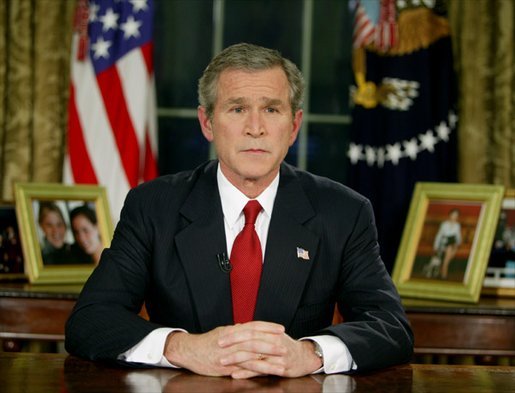
President George W. Bush announcing the start of his invasion of Iraq on March 19, 2003.

Washington elites are effectively compartmentalizing these stories — but, in fact, they are intimately related, and policymakers need to understand the connection to avoid another disaster in the heart of the Middle East.
In Iraq, the resurgence of sectarian violence stems not from the 2011 American withdrawal. It is, rather, the fruit of America’s 2003 invasion of Iraq, the subsequent U.S. occupation, and the much vaunted “surge” of 2007-2008.
The U.S. invasion and occupation destroyed the Iraqi state and ignited tensions among Iraq’s sectarian and ethnic communities. The surge sought to empower certain Sunni militias while paying them (temporarily) not to kill American soldiers; this ended up giving Sunni militants the means to press their grievances through escalating violence once U.S. forces were no longer around.
Unfortunately, Washington seems determined to compound its appalling policy choices in Iraq with equally grievous choices regarding Syria. For over three years, America has provided Syrian oppositionists with “nonlethal” aidtrained opposition fighterscoordinated with others openly providing lethal aid for U.S.-vetted recipients, and extended high-level political backing to the anti-Assad campaign — including serially reiterated public demands from Obama that Assad “must go.”
Yet, from the conflict’s start it has been clear that opposition fighters would not dislodge Assad, no matter how much external help they received — because, from the beginning, the constituencies supporting Assad and his government have added up to well over half of Syrian society.
Objective measures of public opinion in Syria are not as robust as any serious analyst would like. Nevertheless, for over three years, every piece of relevant data — including multiple polls, participation in the February 2012 constitutional referendum and the May 2012 parliamentary elections, participation in this month’s presidential election (including by thousands of refugees), and other evidence — indicates that a majority of Syrians continues to back Assad.
Conversely, there is not a scrap of objective evidence suggesting that anywhere close to a majority of Syrians wants Assad replaced by some part of the opposition.
These realities were readily observable in spring 2011; we have been writing and speaking about them for over three years. Yet the Obama administration decided, within weeks after the outbreak unrest in parts of Syria in March 2011, to support oppositionists seeking to overthrow Assad. It did so — as administration officials told the New York Times in April 2011 — because it calculated that destabilizing Assad’s government would undermine Iran’s regional position.
This was a colossally irresponsible exercise in policymaking-by-wishful-thinking, for two reasons. First, outside support for opposition fighters — a sizable percentage of whom are not even Syrian — has taken what began as small-scale, indigenously generated protests over particular grievances and turned them into a heavily militarized insurgency that could sustain high levels of violence but could not actually win.
The Obama administration prides itself on overthrowing Libya’s Muammar al-Gaddafi in 2011 without putting U.S. boots on the ground (though the results are comparable to those in Iraq: the destruction of a functioning state and the arming of militias that kill with impunity — including the U.S. ambassador in 2012).
Assad is a vastly tougher target. Stepped up support for anti-Assad fighters will not accomplish anything positive strategically; it will, however, perpetuate conditions in which even more Syrians die.
Second, it was utterly foreseeable that backing an armed challenge to Assad would worsen the threat of jihadi militancy — in Syria, in neighboring countries like Iraq, and beyond. Well before March 2011, it was evident that, among Syria’s Sunni Islamist constituencies, the Muslim Brotherhood — whose Syrian branch was historically more radical than most Brotherhood cells — was being displaced by more extreme, al Qaeda-like groups.
External support for anti-Assad forces after March 2011 accelerated the trend and reinforced it with an infusion of foreign fighters, including organ-eating extremists. Many of these jihadis,according to the U.S. Director of National Intelligence, are now working not just to bring down Assad but also to mount attacks against the United States.
The Obama administration’s transformation of Syria into a magnet-cum-training ground for transnational jihadi fighters has directly fed the resurgence of jihadi extremism we are witnessing in Iraq.
Three years ago, at the beginning of the Syrian conflict, the Islamic State of Iraq — formed in 2006 from Abu Musab Az-Zarqawi’s “Al-Qaeda in Iraq” movement — was on the ropes. Reinvigorated through the creation of an externally supported insurgency in Syria by the United States and America’s European and regional partners, it rebranded itself in 2013 as the Islamic State of Iraq and Syria and, like the Taliban in Afghanistan before 9/11, has taken over swaths of both Syria and Iraq with lightning speed.
Washington has only itself and its collaborators in the anti-Assad crusade to blame for such an outcome. As ISIS captures more cities and territory in Iraq, it is also capturing stockpiles of weapons and military equipment that America supplied to the post-Saddam government — weapons and equipment that will enable further gains by ISIS fighters.
Against this backdrop, calls to increase the flow of weapons into neighboring Syria are a case study in Einstein’s (apocryphal) definition of insanity — “doing the same thing over and over again and expecting a different result.” Calls for the United States to “go back” to Iraq, to undo the horrific damage it has already done there, are equally delusional.
The Syrian conflict will ultimately end with negotiated power-sharing between the Syrian government, still headed by President Assad, and those elements of the opposition with some popular base inside Syria.
This can happen relatively sooner, if America begins basing its Syria policy in on-the-ground reality. Or the process can be protracted by open-ended external backing for opposition fighters with no meaningful popular base.
Neither the interests of ordinary Syrians and Iraqis nor the interests of ordinary Americans will be served by Washington doubling down on its ill-considered arming of brutal and unrepresentative militias.
Flynt Leverett served as a Middle East expert on George W. Bush’s National Security Council staff until the Iraq War and worked previously at the State Department and at the Central Intelligence Agency. Hillary Mann Leverett was the NSC expert on Iran and – from 2001 to 2003 – was one of only a few U.S. diplomats authorized to negotiate with the Iranians over Afghanistan, al-Qaeda and Iraq. They are authors of Going to Tehran. [This article previously appeared at The World Post and athttp://goingtotehran.com/spreading-bad-american-policy-from-iraq-to-syriaand-back-again .
River to Sea Uprooted Palestinian   
The views expressed in this article are the sole responsibility of the author and do not necessarily reflect those of the Blog!

How the US is Arming Both Sides of the Iraqi Conflict

Global Research, June 13, 2014
Zero Hedge 12 June 2014


american flag skulls war missile
… the US will deliver the first of 36 F-16 fighter jets to Iraq in what Baghdad’s envoy to the United States called a “new chapter” in his country’s ability to defend its vast borders with Iran and other neighbors. ….the US earlier in March provided Iraq with some 100 Hellfire missiles as well as assault rifles and other ammunition. Then in April the US sent more arms, providing Iraq with 11 million rounds of ammunition and other supplies.
It is unknown how many of these have fallen into Al Qaeda/ISIS hands (we do know that at least one Iraqi Black Hawk chopper was captured during the rush for Mosul). What is known is that as PBS Frontline reported two weeks ago, while the administration has denied arming Syrian “rebels”, i.e. the same ISIS militants that have crossed the border and are now fighting in Iraq…
… the reality is that it has. From: “Obama Says Not Arming Syrian Rebels, Syrian Rebels Say He Is
… the Syrian rebels themselves say they are already armed and trained by US in the use of sophisticated weapons and fighting techniques, including, one rebel said, “how to finish off soldiers still alive after an ambush.” The interviews are the latest evidence that after more than three years of warfare, the United States has stepped up the provision of lethal aid to the rebels, as PBS notes “it appears the Obama administration is allowing select groups of rebels to receive US-made anti-tank missiles.”  The commander of the unit also told Ali that their American contacts had asked him to bring 80 to 90 members of his unit to Ankara for training. One of the fighters said they received three weeks of training in how to conduct ambushes, conduct raids and use their weapons. They also said they received new uniforms and boots. “They trained us to ambush regime or enemy vehicles and cut off the road,” said the fighter, who is identified only as “Hussein.” “They also trained us on how to attack a vehicle, raid it, retrieve information or weapons and munitions, and how to finish off soldiers still alive after an ambush.”
To summarize: the US was arming and training the same Al Qaeda/ISIS groups of Jihadists, that it concurrently gave Iraq weapons to fight. And since the Iraq army has so far proven utterly incapable of any resistance, it is now up to US drones to “fight” the same “rebels” that the US itself was collaborating with until a month or so ago.
The clear winner here? The US military-industrial complex, of course, as well as the banks who lend money to the governments to fight wars provoked by various “developed nation” spy agencies.
Collateral damage? Millions of innocent people on the ground in Syria and Iraq, and everywhere else too.


River to Sea Uprooted Palestinian   
The views expressed in this article are the sole responsibility of the author and do not necessarily reflect those of the Blog!

Washington’s Iraq “Victory”

Paul Craig ROBERTS | 14.06.2014

The citizens of the United States still do not know why their government destroyed Iraq. «National Security» will prevent them from ever knowing. «National Security» is the cloak behind which hides the crimes of the US government.

George Herbert Walker Bush, a former Director of the Central Intelligence Agency who became President courtesy of being picked as Ronald Reagan’s Vice President, was the last restrained US President.  When Bush the First attacked Iraq it was a limited operation, the goal of which was to evict Saddam Hussein from his annexation of Kuwait.
Kuwait was once a part of Iraq, but a Western colonial power created new political boundaries, as the Soviet Communist Party did in Ukraine.  Kuwait emerged from Iraq as a small, independent oil kingdom.  

According to reports, Kuwait was drilling at an angle across the Iraq/Kuwait border into Iraqi oil fields.  On July 25, 1990, Saddam Hussein, with Iraqi troops massed on the border with Kuwait, asked President George H. W. Bush’s ambassador, April Glaspie, if the Bush administration had an opinion on the situation.  Here is Ambassador Glaspie’s reply: «We have no opinion on your Arab-Arab conflicts, such as your dispute with Kuwait. Secretary [of State James] Baker has directed me to emphasize the instruction, first given to Iraq in the 1960’s that the Kuwait issue is not associated with America».

According to this transcript, Saddam Hussein is further assured by high US government officials that Washington does not stand in his way in reunifying Iraq and putting a halt to a gangster family’s theft of Iraqi oil: «At a Washington press conference called the next day, State Department spokesperson Margaret Tutweiler was asked by journalists: ‘Has the United States sent any type of diplomatic message to the Iraqis about putting 30,000 troops on the border with Kuwait? Has there been any type of protest communicated from the United States government?’ «to which she responded: ‘I'm entirely unaware of any such protest.’

«On July 31st, two days before the Iraqi invasion [of Kuwait], John Kelly, Assistant Secretary of State for Near Eastern affairs, testified to Congress that the ‘United States has no commitment to defend Kuwait and the U.S. has no intention of defending Kuwait if it is attacked by Iraq’». [See here among other sources]

Was this an intentional a set-up of Saddam Hussein, or did the Iraqi takeover of Kuwait produce frantic calls from the Bush family’s Middle Eastern business associates?

Whatever explains the dramatic, sudden, total change of position of the US government, the result produced military action that fell short of war on Iraq itself.

From 1990 until 2003 Iraq was acceptable to the US government.

Suddenly, in 2003 Iraq was no longer acceptable. We don’t know why. We were told a passel of lies:  Saddam Hussein had weapons of mass destruction that were a threat to America. The spectre of a «mushroom cloud over an American city» was raised by the National Security Advisor. The Secretary of State was sent to the UN with a collection of lies with which to build acceptance of US naked aggression against Iraq. The icing on the cake was the claim that Saddam Hussein’s secular government «had al Qaeda connections,» al Qaeda bearing the blame for 9/11.

As neither Congress nor the US media have any interest to know the reason for Washington’s about face on Iraq, the «Iraq Threat» will remain a mystery for Americans.

But the consequences of Washington’s destruction of the secular government of Saddam Hussein, a government that managed to hold Iraq together without the American-induced violence that has made the country a permanent war zone, has been ongoing years of violence on a level equal to, or in excess of, the violence associated with the US occupation of Iraq. 
Washington is devoid of humanitarian concerns. Hegemony is Washington’s only concern. As in  Afghanistan, Libya, Somalia, Pakistan, Yemen, Ukraine, Syria, and Iraq, Washington brings only death, and death is ongoing in Iraq.

On June 12,  500,000 residents of Mosul, Iraq’s second largest city, benefactors of Washington’s «freedom and democracy» liberation, fled the city as the American trained army collapsed and fled under al Qaeda attack.  The Washington-installed government, fearing Baghdad is next, has asked Washington for air strikes against the al Qaeda troops. Tikrit and Kirkuk have also fallen.  Iran has sent two battalions of Revolutionary Guards to protect the Washington-installed government in Baghdad.

Does anyone remember the propaganda that Washington had to overthrow Saddam Hussein in order to bring «freedom and democracy and women’s rights to Iraqis»? We had to defeat al Qaeda, which at the time was not present in Iraq, «over there before they came over here».  

Do you remember the neoconservative promises of a «cakewalk war» lasting only a few weeks, of the war only costing $70 billion to be paid out of Iraqi oil revenues, of George W. Bush’s economic advisor being fired for saying that the war would cost $200 billion? The true cost of the war was calculated  by economist Joseph Stiglitz and Harvard University budget expert Linda Bilmes who showed that the Iraqi war cost US taxpayers $3  trillion dollars , an expenditure that threatens the US social safety net.

Do you remember Washington’s promises that Iraq would be put on its feet by America as a democracy in which everyone would be safe and women would have rights?  
What is the situation today?  

Mosul, the second largest city in Iraq, has just been overrun by al Qaeda forces.  These are the forces that Washington has claimed a number of times to have completely defeated. 

These «defeated» forces now control Iraq’s second largest city and a number of provinces. The person Washington left in charge of Iraq is on his knees begging Washington for military help and air support against the Jihadist forces that the incompetent Bush regime unleashed in the Muslim world.

What Washington has done in Iraq and Libya, and is trying to do in Syria, is to destroy governments that kept Jihadists under control.  Washington faces the prospect of a Jihadist government encompassing Iraq and Syria. The Neoconservative conquest of the Middle East is becoming an al Qaeda conquest. 

Washington has opened Pandora’s Box.  This is Washington’s accomplishment in the Middle East.

Even as Iraq falls to al Qaeda , Washington is supplying the al Qaeda forces attacking Syria with heavy weapons.  It is demonized Iran that has sent troops to defend the Washington-installed regime in Baghdad!  Is it possible for a country to look more foolish than Washington looks?

One conclusion that we can reach is that the arrogance and hubris that defines the US government has rendered Washington incapable of making a rational, logical decision.  Megalomania rules in Washington.

River to Sea Uprooted Palestinian   
The views expressed in this article are the sole responsibility of the author and do not necessarily reflect those of the Blog!