Wednesday, 22 July 2015

The Agenda Behind ISIS' Cultural Genocide


In what UNESCO is calling ‘Cultural Cleansing’, the Islamic State in Iraq and Syria (ISIS) have begun destroying 2000 year old Syrian statues in the ancient city of Palmyra and are claiming to have rigged the ancient ruins with explosives. This follows the systematic destruction of historical sites across the Middle East. So far ISIS has destroyed several sites across Iraq, which includes the destruction and looting of Mosul Museum, the destruction of the 3000 year old Assyrian city of Nimrud and the bulldozing of the 2000 year old fortress city of Hatra. Recently ISIS militants threatened to destroy Egypt’s Sphinx and pyramids.
While the world watches ISIS terrorists destroy the relics of the very birth place of civilization, we must reflect upon the reason why this is happening and how we have reached this point. These crimes against history are portrayed in the mainstream media as nothing more than the result of mindless destruction by ISIS barbarians. However it is in fact part of a US Government plan to balkanise the Syrian and Iraqi nation-states, and by attacking the heart of their nationalist identity, their history.

Systematic destruction of both Islamic and Non-Islamic sites.

ISIS’s take over of historical sites are not incidental, they expend military resources to target these sites. ISIS attacked Palmyra in spite of the fact it would have been more militarily strategic to focus on attacking the Syrian city of Deir Ezzor.

The purpose of the focus on destroying historical sites partly stems from ISIS’s adherence to Wahhabi doctrine which is a Puritan interpretation of Islam. Islam forbids idolatry and in the mind set of Wahhabi extremism this translates to ‘all statues are forbidden’. This is how ISIS justifies the destruction of ancient statues, in spite of the fact no one worshiped those statues. The destruction of ancient tombs can also be explained by Wahhabi doctrine which is hostile to burial sites for fear they may become a site for veneration or worship.

But even Wahhabism does not explain the destruction of walls in ancient cities. It is argued that ISIS is destroying non-Islamic sites, to bury any history of pre-Islamic civilisation. It coincides with what has been the gradual ethnic cleansing of Middle East Christians over the last two decades. The Patriarch of Syriac Catholic church in Iraq, Ignatius Joseph III Yonan, described the destruction of Christian sites in Iraq as a conspiracy which the West is complicit. He told the Guardian that he believed it was part of a “Machiavellian strategy” by the West to evict Christians from their ancestral homes across the Middle East.

However, ISIS has also destroyed mosques and Islamic historical sites, revered by both the Shi’ite and Sunni sects. They have even threatened to destroy Mecca, the holiest site in Islam. The Saudi Arabian monarchy share the same Wahhabi ideology as ISIS, and they have been demolishing Saudi Arabian Islamic historical sites to make way for hotels and shopping centres. This has been on going since 1985 but the rate has recently increased in conjunction with the growth of ISIS. The Saudi regime has also destroyed UNESCO heritage listed buildings in the old town of Sanaa,Yemen, through a targeted air strike on the old town of Sanaa. This attack, like the ISIS attacks on old city buildings, cannot be explained by Wahhabism alone. But far from what are seemingly random acts of violence, there is an agenda behind the destruction but it belongs to the United Sates not ISIS.

Cultural Cleansing Pre-Dates ISIS 

The Cultural cleansing is a direct result of US foreign policy in the middle east and has been going on for decades. ISIS was borne in 2006 as a result of the US invasion of Iraq. In 2011 the US destabilised Syria by backing the Muslim Brotherhood linked insurrection, creating the fertile ground for the growth and empowerment of ISIS. But the systematic destruction of middle eastern artifacts was happening before ISIS even existed. In Syria, the US backed Free Syrian Army (FSA) were digging up archaeological sites and selling artefacts for weapons. This has been happening since at least 2012, well before ISIS was a presence in the Syria.
New York Times:Fighters allied with the Free Syrian Army units battling the regime of Syrian President Bashar Assad have told him that they are developing an association of diggers dedicated to finding antiquities in order to fund the revolution. “The rebels need weapons, and antiquities are an easy way to buy them,” says Abu Khaled, who goes by his nickname in order to protect his identity.
Furthermore, Jabhat Al Nusra (JAN), Al Qaeda’s Syrian wing, was busy wiping out historical sites well before ISIS became a significant presence in Syria. In May 2013, JAN bulldozed a mausoleum in the town of Ayn Al-Arous visited by pilgrims for the prophet Abraham, who supposedly spent some time with his wife Sarah in the town. This year JAN destroyed a 13th century mausoleum of leading Islamic scholar, Imam Nawawi, in Dera’a province.

The Al Qaeda linked JAN follows the same puritanical Wahhabi Islam as ISIS and Saudi Arabia, but they have not received the same coverage as ISIS in the mainstream media. Instead the Qatari interest groups, think tanks and the NATO media attempted to rebrand them as “moderate”.

Going back even Further, In April 2003, only a few days into the US invasion of Iraq, Baghdad Museum was looted. Iraqi soldiers had been defending the museum against an attack by the US military, but were forced to retreat. US forces were accused of being responsible for the looting, but denied the allegations. However there was evidence to suggest that the looting was pre-meditated as thousands of valuables were stolen from locked concealed store rooms. Regardless the US illegally obtained and kept thousands of Iraq’s cultural treasures.
Iraqi archaeologist and architect Ihsan Fathi stated that :
“Huge amounts of documents representing historical importance that cannot be assigned a monetary value were taken by the US.”
“The Iraqi government was trying to get them back but the American Administration wanted to strike a deal and return only half of the documents,” he explained.
Many of the looted artefacts ended up in New York, London and Israel. In 2008 Baghdad officials charged Christie’s auction house in New York, with trying to sell looted artefacts.
Looted Iraqi artifacts found in London included a guardian angel statues from the ancient Assyrian city of Nimrud, a city that has been recently attacked by ISIS. Babylonian Torah Scrolls were smuggled into Israel with the help of the US military contracted mercenaries,. Israel refuses to return the scrolls to Iraq.

Syria is already repeating the same tragedy as Iraq, in a new brazen method of black market advertising Facebook pages selling precious Syrian antiquities have emerged . Chinese news paper Xinhaunet reported that Syrian antiquities were already turning up in Israel, brought in by smugglers who received them through trade with the FSA.

If we continue to go back in time even further pre-ISIS, US destabilisation of Afghanistan in the 80s resulted in the empowerment of the Taliban and the birth of Al Qaeda. In 2001 the Taliban destroyed 1700 year old Buddha statues with dynamite.

In all cases it was the intervention of the US and its allies that resulted in the destruction and theft of Middle Eastern history. The destruction was caused either directly by the actions of occupation forces or indirectly through the backing of extremist groups. The destruction of Antiquities has been to systematic and purposeful to pretend it was simple the result of a foreign policy mistakes.

An Attack on Nationalism and Identity 

34234666The destruction antiquities during invasions and occupation has been common occurrence through out history and is a way for the invading forces to loot a countries resources and demoralize the spirit of nationalism which may unify a country against the invader.

The Roman Empire applied the concept “Damnatio memoriae” (to remove from memory) to those it believed were its greatest enemies. The Romans advocated this against the city of Carthage and “sowed its the ground with salt” to prevent its inhabitants from prospering again. The Nazi plundering of cultural property from the territories it occupied is well documented. Britain, France and Germany also plundered the artefacts of Middle Eastern colonies after the first world war. Many Syrian and Egyptian artefacts remain at the Louvre Museum in Paris. In 2002, on year before the invasion, the Iraqi government appealed to Berlin for the return of the Babylon Gate.

The U.S. seems to have adopted the concept of “Damnation Memoria” against Iraq, Syria and perhaps the wider middle east. The plan to balkanise and redraw the Middle East was laid out by former U.S. Secretary of State Condoleezza Rice in 2006 called “The Project For a New middle East”. The US’s policies during the Iraq war, such as the use of death squads and the introduction of federalism, were designed to cause sectarian divisions. Even as early as 2007, think tanks such as the Brookings Institute were suggesting the ‘soft partition of Iraq’. In 2013, at the University of Michigan, Henry Kissinger stated that he would prefer to see the partition of Iraq and Syria. The strategy is becoming more and more openly discussed not only amongst think tanks but in the media.

The neocolonialist powers in the United states have exploited Wahhabism to pave the way towards balkanisation. Saudi Arabia, ISIS, Al Qaeda and the Taliban have all been useful to this end. In the book Confessions of a British Spy and British Enmity Towards Islam it is claimed that Britain founded Wahhabism in order to weaken the ottoman empire. Whether or not the book’s claims are legitimate, it is clear that Wahhabism and specifically ISIS objectives fit seamless with the imperialist agenda of the United States. A declassified Defence Intelligence Agency document stated that creation of the Islamic State, would be useful in order to isolating Syria from Iraq and Iran. Dividing and conquering, these nations into sectarian based state lets in constant antagonism towards each other, will make them perpetually weak and unable to defend themselves. Israel has already set out its designs to claim the Golan heights as its own if Syria disintegrates.

The balkanisation process is expedited by dismantling a nations Identity. Syria and Iraq derive their national identity from there thousands of years of history. By destroying these ancient artifacts ISIS are wiping out any tangible evidence of Syrian and Iraqi ancient civilisations even existed. Looting these artifacts, and selling them to Europe and the US, also detaches these ancient civilisations from modern day Iraq and Syria. ISIS also useful in that it shares the US government’s disdain for middle eastern nationalism. They believe all loyalties should lie in religion rather than the nation state. British citizens of Pakistani origin who have joined ISIS are claiming Syria as land that belongs to them, though they have never stepped foot in Syria, simply because they perceive it to be a ‘Muslim country’.

It is because of these powerful imperialist interests, that world stands by and watches as ISIS destroys the cradle of human civilisation. The so called ‘Anti-ISIS coalition’ spear headed by the US, is nothing more than window dressing and is never serious about defeating ISIS. They US doesn’t just want to destroy Syria and Iraq, they want to wipe out any memory that these countries ever existed.

Maram Susli also known as “Syrian Girl,” is an activist-journalist and social commentator covering Syria and the wider topic of geopolitics. especially for the online magazineNew Eastern Outlook”.

First appeared:http://journal-neo.org/2015/07/18/the-agenda-behind-isis-cultural-genocide/

River to Sea Uprooted Palestinian   
The views expressed in this article are the sole responsibility of the author and do not necessarily reflect those of the Blog!

Tuesday, 21 July 2015

FBI Tracked Chattanooga Shooter's Family for Years


July 17, 2015 (Tony Cartalucci - LD) - Once again, another convenient shooting has helped supercharge anger, hatred, fear, and division across the Western World after an alleged "Islamist extremist" opened fire on and killed 4 US Marines at a recruiting station in Chattanooga, Tennessee. 


Without any knowledge of how the US has in fact created Al Qaeda and its many global affiliates, including vicious terrorist groups plaguing Southeast Asia, and the most notorious to date, the so-called "Islamic State" (ISIS), the American public will predictably react in a manner that will simply further justify America's meddling across the globe amid its self-created and perpetuated "War on Terror." It will also help in efforts to further tighten control over the American public itself, with increased justifications for expanding police state measures and future pushes to disarm the American people.

Yahoo News would report in their article, "Shootings at Chattanooga military facilities leave 4 Marines, gunman dead; act called 'domestic terrorism'," that:
A U.S. official told the Associated Press that Abdulazeez had not been on the radar of federal law enforcement before Thursday's shooting. 
But also added:
His father had been investigated several years ago for "possible ties to a foreign terrorist organization" and added to the U.S. terrorist watch list, according to a report in the New York Times, but that probe did not surface information about Abdulazeez, the paper said.
This means that yet another case of "domestic terror" has involved someone either investigated by the FBI, entrapped by an active FBI operation where FBI investigators posed as terrorist leaders and walked a patsy through every step of a terrorist attack before arresting them and thus "foiling" the attack, or linked directly to someone the FBI was investigating.

Ironically, the immense omnipresent police state the West has erected to combat the so-called "terrorist" threat, including the total surveillance of all communications online and across all telecommunication networks, at home and abroad under the National Security Agency (NSA) will only expand, despite it once again apparently failing, and despite attempts by special interests on Wall Street and in Washington to claim this latest attack "again" somehow circumvented these already sweeping measures.

Meanwhile, The US Continues Supporting Extremists Abroad

And while this latest attack is passed off as a "domestic terrorist attack" and the result of "Islamic extremists," rather than a false flag event, the US continues to openly support the very "terrorists" it claims threatens its homeland and has inspired these sort of attacks.

Just recently, the Washington Post literally allowed a spokesman of Al Qaeda to defend his faction's role in the fighting in Syria, and his condemnation of the United States for not rendering more aid for the cause of overrunning and destroying the Syrian nation - a goal the US itself is likewise pursuing.

Labib Al Nahhas, "head of foreign political relations" for terrorist organization Ahrar al-Sham, wrote in his Washington Post op-ed titled, "The deadly consequences of mislabeling Syria’s revolutionaries," that:
Stuck inside their own bubble, White House policymakers have allocated millions of U.S. taxpayer dollars to support failed CIA efforts to support so-called “moderate” forces in Syria. But these “moderate” groups have proved to be a disappointment on nearly every count, not least of all in confronting the Islamic State.

He also states:
That question should prompt Washington to admit that the Islamic State’s extremist ideology can be defeated only through a homegrown Sunni alternative — with the term “moderate” defined not by CIA handlers but by Syrians themselves.
Essentially, the Washington Post afforded a terrorist organization space to make an appeal to the American public for military support. Ahrar al-Sham regularly coordinates with and fights within operations led by Al Qaeda's Al Nusra Front, a US State Department designated terrorist organizationfrom which ISIS itself sprung.

Al Nusra and Ahrar al-Sham are described as the "closest" of allies by Western think-tanks and media reports. It is also revealed that Ahrar al-Sham worked along side ISIS itself.

A Stanford University report under "Mapping Militant Organizations" explained (emphasis added):
Ahrar al-Sham quickly became one of the largest military organizations operating in Syria, and it has been active in efforts to unite the Islamist opposition under a single banner. It rejects the idea of Western intervention but sometimes works alongside Free Syrian Army brigades. It routinely cooperates with al-Nusra and, until relations soured in 2013, also worked with ISIS. In February 2014, the U.S. Director of National Intelligence called Ahrar al-Sham one of the three most effective rebel groups in Syria.
The Washington Post isn't the only voice in the Western media promoting Al Qaeda. Foreign Policy in 2012 abhorrently proclaimed, "Two Cheers for Syrian Islamists: So the rebels aren't secular Jeffersonians. As far as America is concerned, it doesn't much matter." As much as an admission that the US is backing what is essentially terrorism in Syria, the Foreign Policy article attempted even then to promote the alleged "pragmatism" of supporting Al Qaeda to eliminate America's foreign enemies.

Image: 100's of trucks a day pass over Turkey's border with Syria, destined for ISIS territory. NATO literally is supplying ISIS with an endless torrent of supplies, weapons, and fighters meaning that no matter how many token airstrikes the US carries out, many times more fighters and materiel will fill the void. 

And while Foreign Policy and terrorists writing in the pages of the Washington Post demand more weapons and support from the West, it is already a documented fact that immense and constantly flowing supply convoys are streaming out of both NATO-member Turkey and US-ally Jordan's territory, into Syria and Iraq, for the purpose of resupplying ISIS. This explains ISIS' otherwise inexplicable ability to not only maintain its impressive fighting capacity as it simultaneously wages war against both the Syrian and Iraqi armies, but to expand its fighting to all fronts opposed to US regional hegemony.

This includes Yemen, Libya, and even Egypt where ISIS most recently managed to hit an Egyptian naval vessel with a missile. Foreign Policy would again weigh in. Their article, "Islamic State Sinai Affiliate Claims to Have Hit Egyptian Ship With Missile," states:
The use of a guided missile to strike an Egyptian ship represents a higher level of technological sophistication than what has been previously observed in Sinai attacks. It is unclear, however, exactly what kind of missile was used in the attack, beyond the militant group’s claim that it was a guided munition.
Militant groups in the region have in the past used guided missiles to attack government ships in the Mediterranean. During the 2006 war between Israel and Hezbollah, an Iranian anti-ship missile fired by the militant group struck the Israeli warship Hanit, badly damaging the vessel and killing four crew members.

Of course, Foreign Policy and others across the Western media will be quick to point out that Hezbollah is a state-sponsored militant organization which receives its weapons from Syria and Iran. The question then becomes how ISIS replicated this level of "technological sophistication," and which state-sponsors put the missiles into their hands. 

The US supporting Al Qaeda is not really news. Al Qaeda was initially a joint US-Saudi venture to create a mercenary army to fight the Soviets in Afghanistan during the 1980's. This mercenary army would again fight Russian interests in Serbia and Chechnya before eventually being used as the pretext for US invasions and occupations of both Afghanistan and Iraq from 2001 onward. In 2007, it was revealed that the US, Saudi Arabia, and Israel sought to use the terrorist organization to raise a proxy military front to overthrow Syria and Iran. The resulting bloodbath in Syria beginning in 2011 is the operational execution of this documented conspiracy.

Al Qaeda and its various affiliates serve both as a proxy mercenary front to strike where Western forces cannot, and a pretext to invade abroad. It also serves as a constant justification for increased tyranny at home. With the most recent shooting carried out by yet another target of the FBI's "investigations," and the predictable divisive backlash that will follow, it is assured that the American public will be further blinded to the fact that this so-called "Islamic extremism" was born in Washington and on Wall Street, in Riyadh and Tel Aviv, not in a mosque or springing forth from the pages of the Qu'ran.

In fact, the vast majority of the world's Islamic people are locked in mortal combat with the West's mercenary terrorist forces, with tens of thousands of them having shed their blood fighting Al Qaeda everywhere from Libya to Egypt, to Iraq and Syria. While the US attempts to pose as the leading power in the fight against extremism, its token airstrikes deep within Syrian territory are quickly undone by the torrent of supplies it itself oversees flooding into Syrian territory. For every fighter killed by a US airstrike, 10 more are being trafficked in through US and NATO-run networks stretching as far afield as Xinjiang, China.

The US presence in Iraq and Syria serves simply as one of several planned stepping stones to eventually and directly intervene militarily in toppling either or both governments, before moving on to Tehran.

The "War on Terror" is a fraud, and each "terrorist attack" a carefully orchestrated means of further perpetuating that fraud.

River to Sea Uprooted Palestinian   
The views expressed in this article are the sole responsibility of the author and do not necessarily reflect those of the Blog!

Reflection on Gaza’s Beach Boys–Slaughtered by Israel One Year Ago


See also:
 photo f4c199c7-6f63-4dae-a448-3e93e2030ab2_zpsc8c93735.jpg
 photo gzabchatack_zpscee4d436.jpg

The views expressed in this article are the sole responsibility of the author and do not necessarily reflect those of the Blog!

Will America’s New Deal With Iran Leave Russia Out In The Cold?


Russo-Iranian Alliance
Global Research, July 21, 2015
Mint Press News 17 July 2015

The implications of the recent Iranian nuclear deal extend far beyond centrifuges and uranium enrichment. Russia, which has long played tensions between Tehran and Washington to its own ends, may know this better than anyone.

MONTREAL — Tehran and Washington have both been constrained by their own post-1979 rhetoric about one another. Even after a final nuclear deal was signed in Geneva on Tuesday, officials in Tehran and Washington say they are not normalizing ties. Generally, however, both sides have long wanted to improve relations without making any concessions, giving up their respective strategic goals, or publicly abandoning their ideological positions.
It should not be forgotten that Washington and Tehran started a secret dialogue via diplomatic backchannels in the Sultanate of Oman in 2013, shocking their allies and enemies alike. The U.S. threats to attack Syria in August 2013 may have been aimed at gaining traction and leverage in the secret bilateral talks between Tehran and Washington.
According to Banafsheh Keynoush, a former translator to four Iranian presidents and the Iranian reformist lawyer Shirin Ebadi, Tehran has long wanted to rekindle trade with Washington.

Journalist Gareth Porter makes a similar claim, even arguing that Iranian officials deliberately used uranium enrichment to normalize ties with Washington. Writing for Middle East Eye on Wednesday, Porter contends that during Bill Clinton’s second term in the Oval Office, “Iranian strategists began to discuss the idea that Iran’s nuclear programme was its main hope for engaging the hegemonic power.” There was even a letter faxed by Iran for a “grand bargain” in 2003 that Mohammad Javad Zarif, Iran’s foreign minister, acknowledges as an Iranian response to a misleading signal from a third party claiming to speak on Washington’s behalf.

Russian President Vladimir Putin walks with  Iranian President Hassan Rouhani, left, in Ufa, Russia, Thursday, July 9, 2015.

Getting down to business

It is no coincidence that as the nuclear talks progressed, chatter about a resumption of business ties between Iran and the United States flared up on Wall Street and in Tehran’s bazaars. When a final deal was announced in Vienna this week, it was also announced inside Iran that a “special plan” has been drafted to export petrochemical products to the U.S., among other places, according to Iran’s Mehr News Agency. The announcement was not hearsay, but made by the prominent Iranian Association of Petrochemical Industry Corporations.

The plan to export Iranian petrochemicals is just the tip of the iceberg, though. Tehran Times reports that on May 23, Gholamreza Shafei, the head of the Iranian Chamber of Commerce, Industries, Mines, and Agriculture, “said the Iranian government has given the green light to private business owners to forge trade ties with their American counterparts.” He also acknowledged that the establishment of a joint Iranian-U.S. chamber of commerce had been discussed for about ten months up until that point. In fact, talk of establishing a joint Iranian-U.S. chamber of commerce was disclosed by the Iranian government’s Islamic Republic News Agency (IRNA) in 2013. IRNA reported that discussions about a joint Iranian-U.S. chamber of commerce started at the same time that Washington and Tehran began direct talks in 2013.

The convenience of normalizing trade ties between Iran and the U.S. is that the process could unfold with little public sign of normalization. Iran-U.S. trade and business transactions can ensue without a normalization of diplomatic relations and without any significant changes in the public perception of Iran-U.S. ties in either country. Rhetoric on both sides could, more or less, be kept in place while trade prospers, and hardliners on both sides opposing rapprochement could be kept at bay as well.

Changing geostrategic parameters between the US, Russia, and Iran

Hostilities between the U.S. and Iran have been something that other international actors have long taken advantage of for their own agendas. Tehran and Washington have been cognizant of this.

The Russian government has used the tensions between Tehran and Washington as a card for its own negotiating strategies a number of times. Moscow, however, has always consciously tried not to cross a certain line when playing on Iranian-U.S. differences as it’s sought concessions from Washington. Moscow has never wanted to weaken Iran or let Washington subdue Tehran. The Russians and Iranians both know very well that their security is organically interlocked.

With the normalization of U.S. and Iranian ties and the conciliatory approach that Washington and Tehran took in 2013, the leveraging of Russia’s bilateral ties with Iran against the U.S. is a path Moscow essentially can no longer pursue. The Kremlin realizes this, and since 2013 it has taken earnest steps to cement Russo-Iranian ties as a strategic partnership that could mirror the Sino-Russian partnership. This includes taking steps to establish greater confidence and trust between Moscow and Tehran. Moscow has also atoned for former Russian President Dmitry Medvedev’s decision to halt the shipment of S-300 missile air defense systems to Iran in 2010 by revoking his ban on the systems’ delivery, upgrading systems, and offering to sell the superior Antey-2500 to the Iranian military if Tehran withdraws its lawsuit against Rosoboronexport for failing to deliver the S-300 at the Geneva-based Conciliation and Arbitration Court of the Organization for Security and Cooperation in Europe (OSCE).

Non-nuclear bilateral talks between Tehran and Washington have undoubtedly included some type of U.S. effort to turn the Iranians against the Russians, especially now that the European Union needs an alternative energy supplier to replace the Russian Federation. Even when the U.S. pushed the Russians in 2010 to cancel the S-300 deal that Moscow made with Iran in 2007, it was celebrating the fact that the Iranian government took Russia to the OSCE’s Court of Conciliation and Arbitration in 2011 seeking $4 billion in compensation for a breach of contract by the Kremlin.

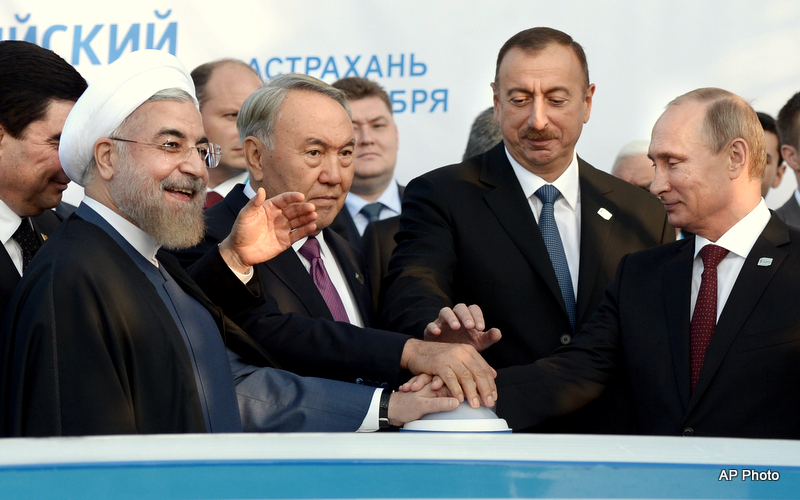
From left, President of Turkmenistan Gurbanguly Berdymukhamedov, President of Iran Hassan Rouhani, President of Kazakhstan Nursultan Nazarbayev, Azerbaijan’s President Ilham Aliev and Russian President Vladimir Putin press a symbolic button to release some young belugas (white sturgeons) to the Volga river, during the Caspian Summit in Astrakhan, Russia, Monday, Sept. 29, 2014.


The information war against Russia

The U.S. mainstream media and intelligentsia working within the constellation of U.S. interests have launched an anti-Russian information campaign emphasizing that Iran and Russia are “allies of convenience” and that the Russo-Iranian partnership will not last. They claim Russia is the biggest loser in a nuclear deal between Iran and the P5+1 (China, France, Russia, the United Kingdom, and the U.S., plus Germany). Their talking points decidedly point to the negative aspects of the history between Russia and Iran and emphasize that Moscow and Tehran will be competitors in the energy market, especially in Europe. They also emphasize that the Russians have fearfully rushed to secure trade agreements with Iran before the Iranian market opens for trade to the U.S. and Western Europe. They presuppose that Iran will prefer U.S. and Western European corporations to Russian ones because the Russian ones are not as advanced and the Russian technology is outdated.

At the same time, another narrative claims Russia and Iran are trading places in the international community. This transformation has gradually been described over the last decade as Russia being like Gaullist France, an independent part of the West agitating against Washington. Descriptions then began to paint Russia in terms of the People’s Republic of China when tensions flared between Moscow and NATO during and after the Russo-Georgian war over South Ossetia and the missile shield in Europe. Russia was described as separate from the West, like China, but co-existing.

After EuroMaidan in Ukraine, Russia slowly began being described as the new Iran, a country involved in a hostile relationship with the West. This is why the U.S. government’s Radio Free Europe claims: “After decades as an isolated rogue state, Iran appears to be finally coming in from the cold. And after decades of pretending to be a partner to the West, Russia has gone rogue.”

A lot of these assessments are either polemics or sophistry. One widely circulated Reuters article by Agnia Grigas and Amir Handjani claims that Russia will be the “big loser” in a nuclear deal with Iran, but it’s riddled with mistakes and presuppositions. The authors, both experts in the energy sector, were not aware that the BP Statistical Review of World Energy had announced that Iran held the world’s biggest natural gas reserves with a volume of 1202.4 trillion cubic feet. Nor were Grigas, an expert on Russia and the post-Soviet space, who has consulted for the Eurasia Group, and Handjani aware that it was the Chinese empire — not Iran — that had lost the most territory to Russia in the past.

Putting those errors aside, the Reuters article stipulates that the “Russo-Iranian alliance has been more a marriage of convenience than a genuine partnership.” This is wishful rhetoric from the Washington Beltway. The authors supported this assertion by claiming that, “Russia uses Iran as a geopolitical foothold in the energy-rich Persian Gulf and to poke a finger in the eye of U.S. allies in the region.”

“In return, Iran takes advantage of Moscow’s veto power at multinational forums such as the United Nations,” they continued.

They further presume that, “[a]n Iran that is engaged with the West in areas such as energy, trade and peaceful nuclear power generation would no longer see Russia as protector of its interests.”

Russia has no foothold in the Persian Gulf, and there is no evidence that Moscow has used Tehran to hassle any of Washington’s regional allies in the Middle East. Inversely, the Kremlin has no interest in instigating problems with U.S. allies in the Middle East, like Israel and Saudi Arabia, and instead wants to trade with them and lure them away from Washington.

On the other hand, however, the Iranians will never let themselves be manipulated to do the bidding of another international actor and have always worked as the protectors of their own interests without depending on other countries. There has not been a long track record of Russia using its veto for Iran. Nor is Iran in the same position as its ally Syria, as Tehran does not have any overt fears and concerns with the U.N. Security Council; this is why Iran was not shaken by any of the U.N. Security Council resolutions passed against it.

Bavar-373s, S-300s, and the UN weapons sanctions

On the other side of the spectrum in the information war between Moscow and Washington, sectors of the Russian media point out that the opening of the Iranian market will mean big business for Russian corporations — including Russian arms manufacturers, the Russian nuclear industry, and the Russian energy sector.

An Iranian Bavar-373.

Some Russian experts, however, have warned of Iranian infidelity. In June, the Russian news agency TASS reported that Vladimir Sazhin, senior research fellow in the Russian Academy of Sciences, argued: “Iran does not care at all about Russia’s interests. It needs money and at some future date it will be able to offer considerable competition to Russia, and not in Europe alone: on the oil market, in two or three years from now, and on the gas market, in five to seven years.”

Reports emerging from both the U.S. and Russia are generally exaggerated or they misunderstand Iran. They also fail to recognize that Iran manufactures most of its own military equipment, including ballistic missiles, submarines, combat jets, tanks, helicopter, drones, and radar detectors.

It is correct that the dropping of the weapons sanctions would give a boost to the Russian weapons industry. The boost, however, will not be a business bonanza because the Iranian military is not dependent on Russia for its security or equipment. As mentioned before by this author, even if the Iranians purchase some of their military hardware from the Russians, Tehran has a “policy of military self-sufficiency and primarily manufactures its own weapons.” When Moscow refused to repair three Russian-made Kilo class submarines because Iran was not willing to send them to Russia, the Iranian military did the overhauls itself. The Iranian military even contends that its Bavar-373 air defense system is more or less the equivalent of the Russian S-300.

Iran’s arms industry is “a dynamic and modern industry that is moving ahead; we may supply our needs from friendly states, but we basically believe that our deterrent power should be based on a home-grown technology,” Brigadier General Ali Shadmani, the Iranian Armed Force’s deputy chief of staff, told the Fars News Agency in April, in response to reports that the S-300 was going to significantly safeguard Iranian air space as if Iran could not protect its own skies. Shadmani went on to explain that Tehran did need the missile defense system in 2006 and 2007, and the deal for the S-300, which was solicited by Russia, was a sound move at the time. He further noted that Iran still wanted the system, even though it is producing the Bavar-373, because “production is not fast enough to satiate” the needs of the Iranian military.

It is very likely that the main goal for the Iranians for dropping the arms sanctions was to export their own weapons. U.N. Security Council Resolution 1747, unanimously adopted in 2007 with the consent of both China and Russia, actually kept the Iranian arms industry from competing on the weapons market with the arms manufacturers of the P5+1. Iranian President Hassan Rouhani even addressed the Iranian public, saying all of Tehran’s objectives were fulfilled in Vienna under the terms of the final nuclear deal, even though the U.N. arms embargo against Tehran will partially remain for a few years.

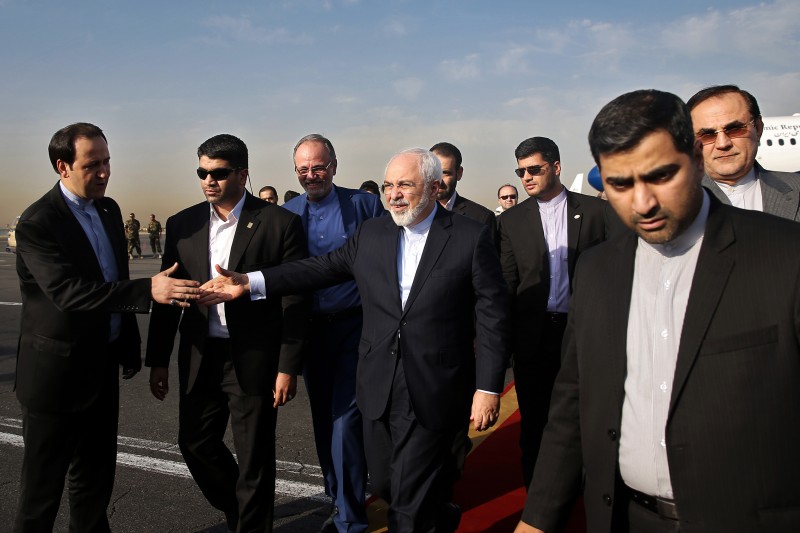
Iran’s Foreign Minister Mohammad Javad Zarif, who is also Iran’s top nuclear negotiator, center, shakes hands with an official upon arrival at the Mehrabad airport in Tehran, Iran, Wednesday, July 15, 2015. Zarif and his entourage returned to Tehran on Wednesday morning, a day after Iran and the West reached a historic nuclear deal. (AP Photo/Ebrahim Noroozi)

While Iran trades with the West, Eurasia will remain its strategic depth

Although there is jockeying to enter the Iranian market, the various assessments in sympathy or hostility toward Russia or the U.S. disregard two important facts. First, it is Tehran that decides who it trades with and who it does not trade with. Second, the Iranians are not limited in their post-Vienna options for trade partners.

Iran has made trade deals with Russia on the basis of preferential treatment for a secured strategic partner and ally. Moscow and Tehran are working to build an insulated strategic alliance in Eurasia, and they aim to establish a bond similar to the one that China and the Russian Federation have.

While the Iranians will not give up their strategic ties with Russia, they will work in their best interests and hope for a balanced strategic partnership with Moscow. Tehran seeks a balanced approach with Russia in a mutually beneficial relationship with the Russian Federation that does not reduce Tehran to becoming subordinate to Moscow. Iran will engage Western European and U.S. businesses, and make deals with them in place of Russian businesses where it is needed and deemed appropriate.

Despite any blossoming of trade with the U.S. and Western Europe, Tehran will maintain its strategic depth in Eurasia. This is why the Iranians have lobbied and applied for Iran to become a full member of the Shanghai Cooperation Organization alongside Russia and China.

Moreover, Tehran does not trust Washington. As has been stated during the negotiations, the nuclear agreement is not built on trust but on verification and reciprocity.

What of the war clouds?

From the start, the Iranian nuclear dossier was political in nature. Gareth Porter writes that as a “militarily weak but politically influential regional ‘middle power,’” Iran essentially prompted the nuclear standoff as leverage to engage the U.S. with the goal of normalizing ties with Washington. The nuclear standoff, however, was a crisis manufactured by Washington to rein in the Iranians and the “Axis of Resistance,” comprised of Syria, Hezbollah, Hamas, and other regional actors in the Middle East. Allegations that the Iranian nuclear energy program was not peaceful were a convenient tactical charade used by Washington and its allies to try to pressure Iran. The objective of this was to rein in Tehran to restructure the Middle East as part of Washington’s broader unipolar roadmap of targeting the Russians and Chinese and establishing control over Eurasia.

Beijing, Moscow, Tehran, and Washington all have contingency plans for different scenarios. The chances of betrayal do exist and the Iranians are prepared for this. In 2009, the Brookings Institute even recommended that Washington create the illusion that it gave the Iranians a chance to negotiate before attacking them “to ensure the logistical support the operation would require and to minimize the blowback from it.” The Pentagon should “strike only when there is a widespread conviction that the Iranians were given but then rejected a superb offer — one so good that only a regime determined to acquire nuclear weapons and acquire them for the wrong reasons would turn it down,” the Brookings Institute report “Which Path to Persia?” advises.

For months, while Foreign Minister Zarif and his negotiating team of Iranian deputy foreign ministers were trying to draft a deal with U.S. Secretary of State John Kerry and the P5+1 or EU3+3, Iranian military commanders were making parallel statements about being ready for war and the need for military upgrades. In fact, Ayatollah Ali Khamenei gave specific directions to the Iranian government and military to increase spending on June 30. Khamenei has ordered them to renew their preparedness for conflict, too. At the conclusion of the nuclear negotiations in Vienna, the supreme leader told President Rouhani that certain members of the sextet that Zarif had inked the final nuclear agreement with were untrustworthy and had to be watched carefully. This mistrust in itself ensures that Iran will take a balanced approach toward the U.S. and Russia.

For Mint Press News by Mahdi Darius Nazemroaya. Originally published on July 17, 2015.

River to Sea Uprooted Palestinian   
The views expressed in this article are the sole responsibility of the author and do not necessarily reflect those of the Blog!