Uprooted Palestinians are at the heart of the conflict in the M.E Palestinians uprooted by force of arms. Yet faced immense difficulties have survived, kept alive their history and culture, passed keys of family homes in occupied Palestine from one generation to the next.
Linda Sarsour is the trash that just keeps on sinking, ain’t she? This vile, ultra-collaborationist, boot-licking House Muslim, fresh off “protesting” with every degenerate known to man at the Soros-funded #WomensMarch, is back in the news after she organized a fundraiser and procured $100,000.00+ in the name of repairing damaged Jewish graves in Missouri. Where to even BEGIN with this slimy creature and her latest slimeball activity?
The most logical starting point perhaps is that Sarsour The Sanhedrin Slave’s move represents an upholding of Muslim “Goyhood”–that is, the Jewish narrative that Muslims cannot be considered human, or decent, or part of the greater fabric of the US “melting pot” unlessthey are subservient to Judaic discourses, fawning over Jews, acting like Jews and going out of their way to please Jews. Linda L’Chaim is what her name should be as she is saying “cheers” to Jewish supremacy whilst cloaking it in salaams and a hijab. Yet again, she’s plastered throughout liberal media where praise is heaped upon her by Jews across the spectrum for her promotion of (fake) Muslim-Jewish solidarity.
We all know that if she raised money for a defaced mosque, a burnt-down church or, GOD FORBID, children in Yemen orphaned and disabled by the Zionist-aligned Saudi regime–which, for the record, she adores and whitewashes–the establishment would either not give a rat’s ass or find a way to slander her. But in this age of an Israelified America specifically and a Judaized West more generally, kissing the Jew-ring of the Jew-kings is a surefire way to skyrocket one’s person to social and political stardom.
Which brings us to the next point of pertinence: If this wasn’t a matter of socio-political opportunism and/or Linda Lilith getting marching orders from one of her controllers, what the hell would be the point ANYWAY when police don’t even know who did it? It still hasn’t been designated a “hate crime” after a week of investigation and if we’re keeping it 100% honest here, even if a “White Supremacist” or a “Muslim extremist” turns out to be the patsy, the most likely culprit for wrecking the headstones is the Jews themselves! Every single time the MSM hysterically screeches about a swastika or some other fake expression of “Jew-hatred” being scripted on a synagogue or in a dorm room, a Jewish community center or on Jewish graves, a Jew turns to be responsible.
It just happened recently at Northwestern. Why do the Yahoudlings do this? Easy! To keep the fraudulent notion of “anti-Semitism” alive and well so other minorities–Gentile minorities, that is–think of Jews as “one of their own” instead of the privileged, wealthy, globe-holding oppressor-class that they actually are.
Next question:
Why in the name of God is a Palestinian woman, and an ostensible “activist” and “liberation advocate” at that, raising money for a Zionist institution? Yes, the Chesed Shel Semeth Society is both Orthodox Jewish (read: the most supremacist of the supremacists) and Zionist. The group, which also operates the Beth Shalom Cemetery, was founded by Russian Zionist Jews and has served as the historic link between the St. Louis Orthodox Jewish community and the Jewish usurpers in Palestine since 1888. For decades, it funded Zionist Hebrew schools in both Poland and Russia. It also has operational ties to the Jewish Federation of St. Louis, one of the most powerful Zionist organizations in the Midwest and the group responsible for sending St. Louis Blue Bacon (cops) to the cancerous Zionist regime for “riot” training.
Considering these facts, Sarsour The Succubus and her partner in this hideous escapade Tarek El-Messidiweren’t raising money for “their Jewish brothers and sisters” but an organ which represents the Halakhic-Talmudic terrorist cancer occupying Palestine. I’d ask how she likes THOSE apples, but knowing what we do about this putrid woman, she probably won’t care and will happily bob for more if that’s what Soros orders.
And finally: Why did ANYONE have to raise money for these Zionist pigs ANYWAY, Muslim or otherwise? Don’t they have the damn dough themselves? Obviously, they do. Just look at the top two personalities on the board of the Jewish Federation of St. Louis – Harvey N. Wallace (Board Chair), the owner of the second-biggest accounting firm in all of St. Louis, and the extraordinarily demonic Kenneth Kranzberg, an American Jewish Committee patron and the the Chairman of Kranson Industries, (dba TricorBraun), one of the biggest packaging suppliers in all of Amreeka. Couldn’t one of these “philanthropic” Jewish gents paid to renovate the rather minuscule damage to Chesed Shel Semeth’s headstones? Of course they could’ve. It is, for lack of a more eloquent phrase, piss-on money to them. So why didn’t they? Because then they couldn’t milk the story for all that it’s worth and keep Jews in the news to the detriment of “Goyim” everywhere. Keeping this in mind, it should be more than evident that Linda Bint Shlomo’s fundraiser is indeed nothing more than a publicity stunt to reinforce Jewish hegemony and colonize Muslims even further.
To close:
While we wish it didn’t have to be said, thanks to the likes of Linda Sarsour, it most definitely and emphatically does – Muslims do not have to give one iota of a damn about anything that befalls Jews in America (or anywhere in the world for matter), let alone lick Jewish boots, just so we can be considered “upstanding citizens” in this hyper-capitalist, hedonistic, materialistic, consumerist society which is diametrically opposed to everything good and righteous we hold somewhat dear. We simply don’t. For we are the ones oppressed here; the ones aggressed against; the ones threatened and in danger always.
It is in fact the Jews who should be proving ***their*** humanity to ***us*** since they are the ones who fuel Islamophobia, degrade society with pornography, lobby for the wars that destroy our homelands with direct invasions and indirect terrorist destabilizations, stage false flags, brainwash our children with their Hollywood filth, do everything in their power to illegally uphold the disease in Palestine called “Israel” and so on. Jews are the 1% of the 1%. The shadow government behind the shadow government. The puppetmaster pulling the strings of the puppetmaster. And the vice-regents of Dajjal. We don’t owe them a bleeding thing except our resistance to their criminal, hegemonic, Kabbalistic system.
As for Sarsour, she is the gleeful agent of this system–the Sanhedrin’s Slave, as mentioned above; the Mishpucka’s Menial; the Vilna Gaon’s Vassal. And it is beyond telling that with all the horrors facing the Ummah today because of Organized Jewry and the illegitimate, virus-like ‘Israeli’ regime, from the Takfiri terrorist assaults on Syria and Iraq, to the genocidal destruction of Yemen by Al-Saud, to the occupations of Palestine and Kashmir, to the renewed aggression against Iran, Linda The Liar thought her time was best spent raising money for superficially damaged Jewish graves instead of any of the aforementioned states. She’s operating outside the fold of Islam. No clue why she even bothers keeping up the facade anymore. When she disregards the suffering of her brothers and sisters in faith for those who are responsible for their suffering, she’s totally exposed.
She might as well just convert to Judaism. And truth be told, with her services rendered to the Kehilla in her tirades of hasbara against Syria and Yemen, her defense of the murderous Saudi regime, her commitment to the existence of ‘Israel’, her censorship of all discussion on Palestine at the #WomensMarch and now THIS… She’s practically a member of “The Tribe” already.
March 13, 2017 “Information Clearing House” – “RT” – In the same week that the United States sent thousands of additional troops to Kuwait for deployment in Iraq and Syria, Russia was busy pursuing a heavy-duty diplomatic deployment.
The contrast speaks of a paradigm-shift in geopolitics. Russia has become the main player in the future of the vital Middle East region, where the US and its European allies formerly claimed to be the lynchpin powers.
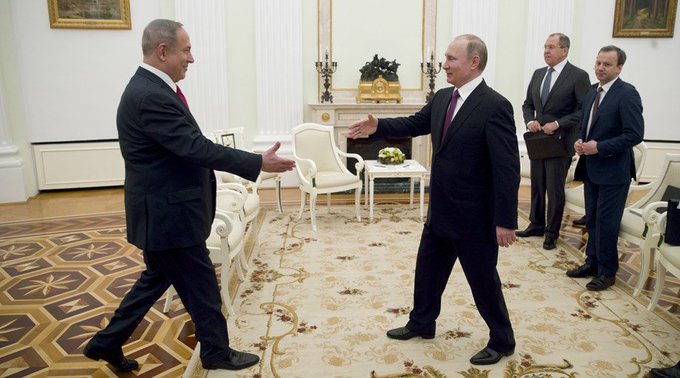
On Thursday, Russian President Vladimir Putin hosted Israeli premier Benjamin Netanyahu in Moscow.
The next day, it was Turkish leader Recep Tayyip Erdogan’s turn to be greeted in the Kremlin. The meeting in Moscow confirms the restored relations since the fatal Turkish shoot-down of a Russian fighter jet over Syria in November 2015.
The presidents of Russia and Turkey have held a meeting in Moscow on Friday, putting behind a 16-month-old crisis in bilateral relations. High-profile infrastructure projects and the Syrian crisis…
rt.com
Russia can rightly claim to have gained the respect of virtually all the countries in the Middle East, ranging from allies and foes alike. Syria and Iran, longtime allies, have expressed gratitude for Moscow’s military intervention in Syria to salvage that country from a nearly six-year war, while, at the same time, states normally thought of as US clients, such as Israel, Turkey, Saudi Arabia, have also paid their respects to Russia over its principled use of military force to stabilize the restive region.
The latter countries are particularly significant, given that they have backed proxy forces in Syria that have been fighting against Russia’s ally, the Syrian government of President Assad. Israel and Saudi Arabia are also implacably opposed to Iran, another key Russian ally.
But here is a measure of Russia’s kudos in the region. When Israel’s Netanyahu came to Moscow this week – his third visit in 16 months – he was reportedly put in his place by Putin over a remark he had made comparing Iran to ancient Persia, claiming it was trying to “destroy Jews.” Putin wagged his finger and told the Israeli leader to “stop dwelling in the past” and instead deal with a “changed world”. The bumptious Netanyahu was suitably quietened by the admonishment.
It’s hard to imagine any other international leader commanding that kind of deference.
Other countries in the Middle East that have recently sought renewed contact with Russia include Egypt, Libya, Qatar, and Bahrain.
The remarkable thing is how Russia has been able to garner the respect of such a diverse range of states with such divergent political and religious outlooks, some vehemently opposed to each other. Yet, in Russia, they all find a reliable gravitational center.
American political commentator Randy Martin says that the leadership displayed by Russia stems from a fundamental difference in how the US operates. He says that Moscow genuinely wants to build peace and development in the region, whereas Washington has always been motivated by selfish reasons of hegemonic dominance.
Says Martin: “Russia under Putin is trying to build relationships, regional development, multilateralism and peace-making. Russia understands that the only viable future for itself and others is to create a stable, multi-polar international order. And Russia is showing true leadership by demonstrating a principled tolerance of others.”
The commentator added: “It is instructive to contrast Russian military intervention and subsequent diplomacy with that of the US. Everywhere the US has been involved in has imploded in relentless violence and failure. That’s because Washington is only interested in exploiting the oil-rich region ultimately for its own strategic ends. By contrast, Russia has a real stake in the region’s future as a neighbor and partner.”
After witnessing a series of destructive US-led wars across the region, from Afghanistan and Iraq to Libya, it seems the Russian government has made a strategic resolution that the apocalyptic dynamic had to stop, not just for its own sake, but for the world at large. Syria was the line in the sand.
Through the principled use of military power, Russia’s intervention in Syria has put out the flames of a conflict that was threatening to engulf the entire region. While Washington and its clients who backed regime-change have cause to be displeased with Russia’s intervention, nevertheless, there can at least be a tacit acknowledgement that it was Russia’s leader, Vladimir Putin, who brought the madness to an end.
That newfound respect for Russian power has materialized in the sponsorship of peace talks on Syria by Russia and Turkey. Both countries brokered a ceasefire in December, which has largely held, to facilitate two rounds of negotiations between the Assad government and the Syrian opposition. Those talks in Astana, Kazakhstan, have now paved the way for rebooted peace negotiations in Geneva next week under the auspices of the United Nations.
In his meeting with Erdogan in Moscow this week, Putin noted that the talks in Astana were the “first time ever that the conflicting parties in Syria came to the negotiating table.” He added that “this tangible result” was grounds for “cautious optimism for a full-fledged political settlement.”
Of greater significance, Putin referred to Russia’s bigger strategic picture. He said that the political talks marked the “start of the process of rebuilding Syria and others countries in the region.”
The bedrock principle laid down by the Russian leader is respect for sovereignty. That applies to Russia’s allies as well as their foes. Moscow is saying that if the conflict-torn region is to have any future then, at a minimum, each and every player must have a modicum of respect for sovereignty. The dark days of zero-sum, regime-change intrigues against others must end.
Through its commendable stand in the Mideast, Russia has shown that it is a power that can be trusted, whereas the US and its European allies have been fatally compromised through their own unscrupulous, treacherous scheming. Not even supposed allies have confidence that Western powers can be trusted in the long-run.
The case of Turkey and Israel – both ardent allies of Washington – coming to Moscow this week to pay homage to Putin shows that they realize that Russia, despite their political differences, has become the indispensable player in the region. Washington, London, and Paris are like yesterday’s men.
Randy Martin, the political commentator, says that the consummate difference between Russia and the US is due to the former’s profound understanding of war and peace.
“Russia knows the cost of war, and so appreciates the price of peace,” says Martin. “Given the vast destruction and pain that Russia endured through war over the past century, perhaps no other country on the planet has a better understanding of the importance of making peace. By contrast, the US has never experienced the suffering of war the way Russia has. The US only knows how to incite war and inflict suffering.”
This fundamental distinction appears to be why Russia has emerged as a reliable leader in the war-torn Middle East and beyond. It is a power that others can respect.
It’s those that don’t respect Russia – Washington and its surrogates in Europe – who accuse Putin of being an aggressor, who are showing their true colors. Their accusations are projections of their own aggressor-status. Russia is putting an end to their warmongering through genuine world leadership – and that is why they jealously slander Putin as an aggressor.
The views expressed in this article are solely those of the author and do not necessarily reflect the opinions of Information Clearing House.
“Any foreign troops coming to Syria without our invitation or consultation or permission, they are invaders, whether they are American, Turkish, or any other one,” Assad said.
“And we don’t think this is going to help. What are they going to do? To fight ISIS? The Americans lost nearly every war. They lost in Iraq, they had to withdraw at the end. Even in Somalia, let alone Vietnam in the past and Afghanistan, your neighboring country. They didn’t succeed anywhere they sent troops, they only create a mess; they are very good in creating problems and destroying, but they are very bad in finding solutions.”
March 13, 2017 “Information Clearing House” – Damascus, SANA-President Bashar al-Assad said that the solution to the crisis in Syria should be through two parallel ways: the first one is to fight the terrorists, and this is our duty as government, to defend the Syrians and use any means in order to destroy the terrorists who’ve been killing and destroying in Syria, and the second one is to make dialogue.
The president added in an interview given to Chinese PHOENIX TV that any foreign troops coming to Syria without our invitation or consultation or permission, they are invaders, whether they are American, Turkish, or any other one.
Flowing is the full text of the interview:
Question 1: Thank you Mr. President for having us here in Dimashq, the capital of Syria. I think this is the first interview you have with Chinese media after the national ceasefire and after so many fresh rounds of talks, both in Astana and in Geneva, and of course after US President Donald Trump’s inauguration, and these days, as we have seen, your troops are making steady progress in battlefields, but peace talks do not seem just as productive. So, as far as the Geneva talks is concerned, your chief negotiator, Mr. Jaafari, was trying hard to find out who should be sitting on the other side of the negotiation table. So, according to your idea, who should be sitting there?
President Assad: This is a very crucial question. If you want those negotiations to be fruitful, we have to ask “who is going to be sitting there?” I mean, there could be a lot of good people with good intentions, but the question is: who do they represent? That’s the question. In this situation, you have different groups, you have people who are, let’s say, patriotic, but they don’t represent anyone, they represent themselves. You have others who represent the terrorists, and you have terrorists on the table, and you have others who represent the agenda of foreign countries like Saudi Arabia, like Turkey, like France, UK and maybe the United States. So, it’s not a homogeneous meeting. If you want it to be fruitful, going back to the first point that I mentioned, it should be a real Syrian-Syrian negotiations. In spite of that, we went to that meeting because we think any kind of dialogue could be a good step toward the solution, because even those people who are terrorists or belonging to the terrorists or to other countries, they may change their mind and go back to their normality by going back to being real Syrians, detach themselves from being terrorists or agents to other groups. That’s why I say we didn’t expect Geneva to produce anything, but it’s a step, and it’s going to be a long way, and you may have other rounds, whether in Geneva or in Astana.
Question 2: But anyway, it is an intra-Syrian talks, right? But the matter of fact is, it is proxy dialogue. I mean, main parties do not meet and have dialogue directly.
President Assad: Exactly.
Journalist: Are you personally satisfied with the current negotiation format or mechanism?
President Assad: we didn’t forge this mechanism; it was forged by de Mistura and the UN with the influence of the countries that wanted to use those negotiations in order to make pressure on Syria, not to reach any resolution. As you just said, each one represents a different agenda, even the opposition delegations, it wasn’t one delegation; different delegations of the opposition. So, if I’m going to – as a government – if I’m going to negotiate with someone, who’s it going to be? Which one? Who represents who? That’s our question. So, you are right, this time there was no negotiations in Geneva, but this is one of the reasons, that’s why it didn’t reach anything. The only thing we discussed in Geneva was the agenda, the headlines, what are we going to discuss later, that’s it.
Question 3: But as we see, lot of time, money, energy have been put into this effort, and the clashes are still going on, people are still dying, and the refugees are still increasing.
President Assad: Exactly.
Journalist: What is the possible way of having a negotiation?
President Assad: Again, you are correct. The more delay you have, the more harm and destruction and killing and blood you’ll have within Syria, that’s why we are very eager to achieve a solution, but how and in which way? You need to have two parallel ways: the first one is to fight the terrorists, and this is our duty as government, to defend the Syrians and use any means in order to destroy the terrorists who’ve been killing and destroying in Syria. The second one is to make dialogue. This dialogue has many different aspects; you have the political one, which is related to the future of Syria; what political system do you need, what kind? It doesn’t matter which one, it depends on the Syrians, and they’re going to have referendum about what they want. The second part is to try to bring many of those people who were affiliated to the terrorists or who committed any terrorist acts to go back to their normality and lay down their armaments and to live normal life in return for amnesty that has been offered by the government, and we’ve been going in that direction for three years, and it worked very well. It worked very well. So, actually, if you want to talk about the real political solution since the beginning of the crisis, of the war on Syria, till this moment, the only solution was those reconciliations between the government and the different militants in Syria, many of them joined the government now, and they are fighting with the government. Some of them laid down their.
Question 4: But talking about the Syria war, you can never exclude the foreign factors. The Saudi-backed high negotiating committee, HNC, are saying that they are counting on the Trump administration to play a positive role instead of the mistaken policies under his predecessor Barack Obama. So, from your side, what do you expect from Trump’s Middle East policy, particularly policy on Syria?
President Assad: The first part that you mentioned about their hopes, when you pin your hopes on a foreign country, doesn’t matter which foreign country, it means you’re not patriotic, and this is proved, because they should depend on the support of the Syrian people, not any other government or administration.
Now, regarding the Trump administration, during his campaign and after the campaign, the main rhetoric of the Trump administration and the president himself was about the priority of defeating ISIS. I said since the beginning that this is a promising approach to what’s happening in Syria and in Iraq, because we live in the same area and we face the same enemy. We haven’t seen anything concrete yet regarding this rhetoric, because we’ve been seeing now certain is a local kind of raids. You cannot deal with terrorism on local basis; it should be comprehensive, it cannot be partial or temporary. It cannot be from the air, it should be in cooperation with the troops on the ground, that’s why the Russians succeeded, since they supported the Syrian Army in pushing ISIS to shrink, not to expand as it used to be before that. So, we have hopes that this taking into consideration that talking about ISIS doesn’t mean talking about the whole terrorism; ISIS is one of the products, al-Nusra is another product, you have so many groups in Syria, they are not ISIS, but they are Al Qaeda, they have the same background of the Wahabi extremist ideology.
Question 5: So, Mr. President, you and Mr. Donald Trump actually share the same priority which is counter-terrorism, and both of you hate fake news. Do you see any room for cooperation?
President Assad: Yeah, in theory, yes, but practically, not yet, because there’s no link between Syria and the United States on the formal level. Even their raids against ISIS that I just mentioned, which are only a few raids, happened without the cooperation or the consultation with the Syrian Army or the Syrian government which is illegal as we always say. So, theoretically we share those goals, but particularly, not yet.
Question 6: Do you have personal contact with the President of the United States?
President Assad: Not at all.
Journalist: Direct or indirect.
President Assad: Indirect, you have so many channels, but you cannot bet on private channels. It should be formal, this is where you can talk about a real relation with another government.
Question 7: As we speak, top generals from Turkey, Russia, and the United States are meeting somewhere in Turkey to discuss tensions in northern Syria, where mutually- suspicious forces are allied with these countries. So, do you have a plan for a final attack on Daesh when the main players actually do need an effective coordination in order to clear Syria of all terror groups?
President Assad: Yeah, if you want to link that meeting with ISIS in particular, it won’t be objective, because at least one party, which is Turkey, has been supporting ISIS till this moment, because Erdogan, the Turkish President, is Muslim Brotherhood. He’s ideologically linked and sympathetic with ISIS and with al-Nusra, and everybody knows about this in our region, and he helped them either through armaments, logistically, through exporting oil. For the other party, which is the United States, at least during Obama’s administration, they dealt with ISIS by overlooking their smuggling the Syrian oil to Turkey, and this is how they can get money in order to recruit terrorists from around the world, and they didn’t try to do anything more than cosmetic against ISIS. The only serious party in that regard is Russia, which is effectively attacking ISIS in cooperation with us. So, the question is: how can they cooperate, and I think the Russians have hope that the two parties join the Russians and the Syrians in their fight against terrorism. So, we have more hopes now regarding the American party because of the new administration, while in Turkey nothing has changed in that regard. ISIS in the north have only one route of supply, it’s through Turkey, and they’re still alive and they’re still active and they’re still resisting different kinds of waves of attacks, because of the Turkish support.
Question 8: Now, US troops are in Manbej. Is the greenlight from your side? Did you open the door for these American troops?
President Assad: No, no, we didn’t. Any foreign troops coming to Syria without our invitation or consultation or permission, they are invaders, whether they are American, Turkish, or any other one. And we don’t think this is going to help. What are they going to do? To fight ISIS? The Americans lost nearly every war. They lost in Iraq, they had to withdraw at the end. Even in Somalia, let alone Vietnam in the past and Afghanistan, your neighboring country. They didn’t succeed anywhere they sent troops, they only create a mess; they are very good in creating problems and destroying, but they are very bad in finding solutions.
Question 9: Talking about Russia and China, they just vetoed a new UN sanction on Syria last week. What do these Chinese vetoes mean exactly for your country?
President Assad: Let’s be very clear about their position, which is not to support the Syrian government or the Syrian president, because in the West they try to portray it as a personal problem, and as Russia and China and other countries and Iran support that person as president. It’s not the case. China is a member of the Security Council, and it’s committed to the Charter of the United Nations. In that veto, China has defended first of all the Charter, because the United Nations was created in order to restore stability around the world. Actually, the Western countries, especially the permanent members of the Council as a tool or means in order to change regimes or governments and to implement their agenda, not to restore stability, and actually to create more instability around the world. So the second part is that China restored stability in the world by creating some kind of political balance within the United Nations, of course in cooperation with Russia, which is very important for the whole world. Of course, Syria was the headline, the main headline, this is good for Syria, but again it’s good for the rest of the world. Third, the same countries that wanted to use the UN Charter for their own vested interested are the same countries who interfered or tried to intervene in your country in the late 90s, and they used different headlines, human rights, and so on, and you know that, and if they had the chance, they would change every government in the world, whether big country or small country, just when this government tries to be a little bit independent. So, China protected the Chinese interests, Syrian interests, and the world interests, especially the small countries or the weak countries.
Question 10: If I’m not mistaken, you said China is going to play a role in the reconstruction of Syria. So, in which areas you think China can contribute to bring Syrian people back to their normal life after so many years of hardships?
President Assad: Actually, if you talk about what the terrorists have been doing the last six years, it’s destroying everything regarding the infrastructure. In spite of that, the Syrian government is still effective, at least by providing the minimum needs for the Syrian people. But they’ve been destroying everything in every sector with no exception. Adding to that, the Western embargo in Syria has prevented Syria from having even the basic needs for the livelihood of any citizen in Syria. So, in which sector? In every sector. I mean, China can be in every sector with no exception, because we have damage in every sector. But if we talk about now, before this comprehensive reconstruction starts, China now is being involved directly in building many projects, mainly industrial projects, in Syria, and we have many Chinese experts now working in Syria in different projects in order to set up those projects. But of course, when you have more stability, the most important thing is building the destroyed suburbs. This is the most important part of the reconstruction. The second one is the infrastructure; the sanitation system, the electricity, the oil fields, everything, with no exception. The third one: the industrial projects, which could belong to the private sector or the public sector in Syria.
Question 11: Alright. And it seems no secret that there are some Chinese extremists are here, fighting alongside Daesh. I think it is a threat to both Syria and China. What concrete or effective measures do you have to control border and prevent these extremists from free movement in the region?
President Assad: When you talk about extremists or terrorists, it doesn’t matter what their nationality is, because they don’t recognize borders, and they don’t belong to a country. The only difference between nationality and nationality, is that those for example who came from your country, they know your country more than the others, so they can do more harm in your country that others, and the same for Syrians, the same for Russian terrorist, and so on. So now, the measures, every terrorist should be defeated and demolished, unless he changed his position to the normal life. Second, because you’re talking about different nationalities -more than 80 nationalities – you should have cooperation with the other governments, especially in the intelligence field, and that’s what’s happening for example with the Chinese intelligence regarding the Uyghur terrorists who are coming from China through Turkey. Unfortunately, the only means that we don’t have now and we don’t control is our borders with Turkey, because the Uyghur in Particular, they came from Turkey, the others coming maybe from Iraq, Jordan, Lebanon, form the sea, maybe, and the majority from Turkey, but the Uyghur terrorists coming mainly from Turkey. Why? I don’t know why, but they have the support of the Turkish government, and they were gathered and collected in one group, and they were sent to the northern part of Syria. So, the mission now is to attack them, wherever they existed. Of course, sometimes you cannot tell which one… who is who, they mix with each other, but sometimes they work as separate groups from different nationalities. And this is very crucial kind of cooperation between the Syrian and the Chinese intelligence, and we did many good steps in that regard.
Question 12: Mr. President, as you may be fully aware that the “White Helmets” took an Oscar this year for the best documentary short, but folks are saying that the truth about this “White Helmets” is not like what Netflix has presented, so what is your take on this?
President Assad: First of all, we have to congratulate al-Nusra for having the first Oscar! This is an unprecedented event for the West to give Al Qaeda an Oscar; this is unbelievable, and this is another proof that the Oscars, Nobel, all these things are politicized certificates, that’s how I can look at it. The White Helmets story is very simple; it is a facelift of al-Nusra Front in Syria, just to change their ugly face into a more humanitarian face, that’s it. And you have many videos on the net and of course images broadcasted by the White Helmets that condemn the White Helmets as a terrorists group, where you can see the same person wearing the white helmet and celebrating over the dead bodies of Syrian soldiers. So, that’s what the Oscar went to, to those terrorists. So, it’s a story just to try to prevent the Syrian Army during the liberation of Aleppo from making more pressure on the attacking and liberating the districts within the city that have been occupied by those terrorists, to say that the Syrian Army and the Russians are attacking the civilians and the innocents and the humanitarian people.
Question 13: Right. Now Palmyra. I took a one-day trip to Palmyra this time. Now, the city is under your control, so as its strategic position is concerned, because Homs is the heart of Syria, it’s right in the middle, now, when you have Palmyra, what is your next target? Are you going to expand a military operation into Raqqa and Dier Ezzor?
President Assad: We are very close to Raqqa now. Yesterday, our troops reached the Euphrates River which is very close to Raqqa city, and Raqqa is the stronghold of ISIS today, so it’s going to be a priority for us, but that doesn’t mean the other cities are not priority, in time that could be in parallel, because Palmyra is on the way to Dier Ezzor city in the eastern part of Syria which is close to the Iraqi borders, and those areas that have been used by ISIS as route for logistic support between ISIS in Iraq and ISIS in
Syria. So, whether you attack the stronghold or you attack the route that ISIS uses, it has the same result.
Question 14: How many days do you think this war is going to last?
President Assad: if we presume that you don’t have foreign intervention, it will take a few months. It’s not very complicated internally. The complexity of this war is the foreign intervention. This is the problem. So, in the face of that intervention, the good thing that we gained during the war is the unity of the society. At the very beginning, the vision for many Syrians wasn’t very clear about what’s happening. Many believed the propaganda of the West about the reality, about the real story, that this is against the oppression. If it’s against the oppression, why the people in Saudi Arabia didn’t revolt, for example? So, now what we gained is this, this is our strongest foundation to end that war. We always have hope that this year is going to be the last year. But at the end, this is war and you can’t expect what is going to happen precisely.
Question 15: Mr. President, you are President of the Syrian Republic, at the same time, you are a loving husband and a father of three. How can you balance the role of being a President, a father, and a husband?
President Assad: If you cannot succeed in your small duty which is your family, you cannot succeed in your bigger duty or more comprehensive duty at the level of a country. So, there is no excuse that if you have a lot of work to abandon your duties; it’s a duty. You have to be very clear about that, you have to fulfill those duties in a very good way. Of course, sometimes those circumstances do not allow you to do whatever you have to do, your duties, fully, let’s say.
Journalist: During a day, how much time you spend on work, and how much time you spend with your family members?
President Assad: Actually, it’s not about the time, because even if you are at your home, you have to work.
Journalist: Okay.
President Assad: Let’s say, in the morning and the evening, you have the chance, but in between and after those times, you have the whole day to work.
Question 16: Have you ever thought of leaving this country for the sake of your family?
President Assad: Never, after six years, I mean the most difficult times passed; it was in 2012 and 2013, those times we never thought about it, how can I think about it now?
So, no, no, this is not an option. Whenever you have any kind of reluctance, you will lose. You will lose not with your enemies; you lose with your supporters. Those supporters, I mean the people you work with, the fighters, the army, they will feel if you’re not determined to defend your country. We never had any feeling neither me nor any member of my family.
Question 17: And how is Kareem’s Chinese getting along?
President Assad: He learned the basics of Chinese language, I think two years ago. Unfortunately, the lady and the man who taught him had to leave, because they were members of the Chinese Embassy. They went back to China. Now, he stopped improve his Chinese language.
Question 18: Do you think it is a good choice to learn Chinese for him?
President Assad: Of course, of course, because China is a rising power.
Journalist: You didn’t force him to learn Chinese? It’s his own option, right?
President Assad: No, no, we never thought about it, actually. I didn’t think that he has to learn Chinese, and I didn’t expect him, if I thought about it, that he would say yes, because for many in the world the Chinese language is a difficult language to learn. He took the initiative and he said I want to learn Chinese, and actually till this moment, I didn’t ask him why. I want him to feel free, but when he’s getting older, I’m going to ask him how? How did it come through your mind to learn this language, this difficult language, but of course important language.
Journalist: You didn’t ask him before? President Assad: No, not yet. Journalist: So, you think it’s a good choice?
President Assad: Of course, of course. As I said, it’s a rising power, it’s important. I mean, most of the world has different kinds of relation with China whether in science, in politics, in economy, in business, I mean, in every filed you need it now. And our relation for the future is going to be on the rise. It was good, but it’s going to be on the rise because when a country like China proves that it’s a real friend, a friend that you can rely on, it’s very natural to have better relation on the popular level, not only on the formal level.
Journalist: Thank you Mr. President, thank you for your time.
President Assad: Thank you for coming to Syria, you’re most welcome.
The views expressed in this article are solely those of the author and do not necessarily reflect the opinions of Information Clearing House.
Ukraine’s case in the ICJ looks like a device to avoid paying the likely High Court Judgment for payment of the $3 billion debt Ukraine owes Russia
The case Ukraine is bringing in the International Court of Justice is attracting scant international attention and has been almost entirely ignored by Western governments and by the Western media. Having said this it is an interesting case which begs a number of obvious questions.
Ukraine’s claim is set out in an indictment which apparently runs to 45 pages. The summary of its claim, which is dated 17th January 2017, can be found here.
Essentially Ukraine is demanding compensation from Russia for the damage it says Russia has done to Ukraine through its aggression in eastern Ukraine and because of the harm Ukraine alleges Russia is doing to the Ukrainian and Tatar minorities in Crimea.
Two questions about this case immediately stand out: (1) its timing; and (2) why does it fail to ask that the International Court of Justice declare that Crimea’s unification with Russia is contrary to international law?
(1) Timing of the Case
The case was brought on 16th January 2017, three years after the Maidan coup, three years after Ukraine and Russia found themselves in conflict with each other, and almost three years after Crimea seceded from Ukraine and united with Russia and eastern Ukraine rose up against the new Maidan government in Kiev.
Why has this case been brought only now?
There is in fact an obvious answer to this question. In January 2017, when this case was brought, the High Court in London finished hearing Russia’s application for summary Judgment in the case Russia has brought against Ukraine for payment of the $3 billion eurobond debt Ukraine owes Russia. A decision is expected in April.
Ukraine’s defence in this case is that it does not owe Russia any money because of the amount of the $3 billion debt has been extinguished by the far greater amount Ukraine says Russia owes Ukraine arising from the damage Russia did to Ukraine as a result of its aggression in eastern Ukraine.
I have always said that I believe that the High Court is likely to rule that it has no jurisdiction to hear this defence to the Russian claim. Way back on 21st April 2015, long before the case was brought, I explained why I thought this defence was unlikely to succeed
The debt is not repayable because Russia has made its repayment impossible by committing military aggression against Ukraine
Russia categorically denies it is committing aggression against Ukraine.
The Russians would undoubtedly argue that the question of whether or not Russia is committing aggression against Ukraine has been answered in their favour by Ukraine’s signature to the Minsk Memorandum. This treats the Ukrainian conflict as a civil war and commits Ukraine to a process for its settlement.
The High Court would anyway almost certainly refuse to look at this question. It would probably again say this a matter for the International Court of Justice. It is anyway doubtful even if Ukraine could persuade the High Court that Russia had committed aggression against Ukraine that this cancels Ukraine’s whole debt.
(bold italics added)
It seems to me that what has happened is that Ukraine’s lawyers have now given Ukraine the same advice.
They must have told Ukraine that Ukraine is likely to lose the case in the High Court because the High Court will almost certainly say it has no jurisdiction to hear Ukraine’s defence since the question of whether Ukraine is entitled to compensation from Russia because of Russia’s alleged aggression against Ukraine is not an issue the High Court in London is able to decide. The High Court will almost certainly say this is a matter for the International Court of Justice.
Ukraine has therefore brought its claim in the International Court of Justice in order to pre-empt what looks like a Judgment against it in the High Court.
Possibly Ukraine is hoping to persuade the High Court to stay enforcement of its Judgment until after the International Court of Justice has made its decision. If so then it is unlikely to succeed. The High Court is most unlikely to order a stay of one of its Judgment for payment of a debt until another court makes a ruling on an entirely different matter.
More likely Ukraine is hoping to persuade the IMF – with which it is currently negotiating for further funding, and whose Board is due to review its lending to Ukraine on 20th March 2017 – to disregard any Judgment the High Court makes which declares Ukraine in default of its debt to Russia on the grounds that the question of whether Ukraine owes money to Russia will not be finally decided until the International Court of Justice makes its decision.
Russia is a member of the exclusive Paris Club of creditors. The IMF is supposed to stop all lending to Ukraine if the High Court declares Ukraine is in default of its debt to a member of the Paris Club. Presumably Ukraine is hoping that the IMF, which has already relaxed this rule, will set it aside completely in Ukraine’s favour on the basis that the question of whether Ukraine owes money to Russia will not be finally decided until the International Court of Justice makes its decision.
If this is the argument Ukraine intends to make to the IMF (which I suspect it is) then legally speaking it is desperate.
Even if Ukraine wins its case against Russia in the International Court of Justice, any compensation it is awarded cannot be enforced against Russia through the ordinary courts. It would be entirely up to Russia to decide whether or not to pay it. Russia would almost certainly refuse to pay it.
By contrast since the claim Russia is bringing against Ukraine in the High Court is for payment of a eurobond (which is a promissory note) any Judgment Russia obtains against Ukraine can be enforced immediately.
There are therefore no logical or legal grounds for the IMF to say that Ukraine is not in default to Russia if the High Court says it is, simply because Ukraine is bringing a case against Russia in the International Court of Justice.
At this point however a word of caution is in order. Since the IMF has been lending to Ukraine for essentially political reasons all along, a cynic might say it will accept whatever argument Ukraine makes however legally dubious or threadbare it might be so that it can continue lending to Ukraine irrespective of what it’s own rules say.
All I would say about that is that that may indeed happen but if it does then legally speaking we are in unknown territory, with the Russians quite possibly in that case seeking to enforce their Judgment by taking legal action in the US and European commercial courts to seize Ukraine’s IMF bailout funds. That would be an extraordinary and unprecedented situation, and I do not know what the eventual outcome or the long term repercussions would be, and I doubt anyone else does either. However I suspect the long term repercussions would be huge, and I also suspect that there are people within the IMF’s bureaucracy who think the same and who will if only for that reason be counselling against it.
The High Court is expected to decide whether or not to grant Russia’s application for summary Judgment in April. The stakes could not be higher. That makes it understandable why Ukraine has brought its case in the International Court of Justice now, however desperate legally speaking that course might be.
(2) Crimea
Putting aside these highly technical (though potentially very important) issues, the single most striking omission in the case is that though Ukraine repeatedly refers in its claim to Crimea’s unification with Russia as an ‘illegal occupation’, and claims compensation for the alleged ‘discrimination’ and ‘oppression’ by Russia of Ukrainian and Crimean Tatar minorities in Crimea, it does not actually seek a declaration from the International Court that the unification of Crimea with Russia is contrary to international law.
The reason Ukraine has failed to do this is because its lawyers have undoubtedly advised it that if it were to seek such a declaration the International Court of Justice would refuse to grant it.
This is because the International Court of Justice in its Advisory Opinion on Kosovo has previously ruled that a declaration of independence made by the people of a territory declaring themselves independent of a country to which that territory belongs are not acting contrary to international law even if their action is made unilaterally, is backed by the use of force (including outside force), and is contrary to the constitutional arrangements and laws of the country from which they are declaring themselves independent.
The Western powers lobbied the International Court of Justice hard to obtain the Advisory Opinion on Kosovo. When they obtained it they hailed it as a famous victory. Since then they have come to regret it bitterly, and since Crimea cited it in its unilateral declaration of independence from Ukraine they have completely stopped talking about it.
The Russians by contrast talk about the Advisory Opinion on Kosovo whenever the subject of the alleged ‘illegality’ of Crimea’s unification with Russia is brought up. President Putin was the first to do so in the speech he made immediately following Crimea’s unification with Russia on 18th March 2014
As it declared independence and decided to hold a referendum, the Supreme Council of Crimea referred to the United Nations Charter, which speaks of the right of nations to self-determination. Incidentally, I would like to remind you that when Ukraine seceded from the USSR it did exactly the same thing, almost word for word. Ukraine used this right, yet the residents of Crimea are denied it. Why is that?
Moreover, the Crimean authorities referred to the well-known Kosovo precedent – a precedent our western colleagues created with their own hands in a very similar situation, when they agreed that the unilateral separation of Kosovo from Serbia, exactly what Crimea is doing now, was legitimate and did not require any permission from the country’s central authorities. Pursuant to Article 2, Chapter 1 of the United Nations Charter, the UN International Court agreed with this approach and made the following comment in its ruling of July 22, 2010, and I quote: “No general prohibition may be inferred from the practice of the Security Council with regard to declarations of independence,” and “General international law contains no prohibition on declarations of independence.” Crystal clear, as they say.
I do not like to resort to quotes, but in this case, I cannot help it. Here is a quote from another official document: the Written Statement of the United States of America of April 17, 2009, submitted to the same UN International Court in connection with the hearings on Kosovo. Again, I quote: “Declarations of independence may, and often do, violate domestic legislation. However, this does not make them violations of international law.” End of quote. They wrote this, disseminated it all over the world, had everyone agreed and now they are outraged. Over what? The actions of Crimean people completely fit in with these instructions, as it were. For some reason, things that Kosovo Albanians (and we have full respect for them) were permitted to do, Russians, Ukrainians and Crimean Tatars in Crimea are not allowed. Again, one wonders why.
(bold italics added)
By failing to ask the International Court of Justice to declare Crimea’s secession from Ukraine and subsequent union with Russia to be contrary to international law Ukraine appears to be conceding the point. Though Ukraine and its Western allies will doubtless go on calling Crimea’s secession from Ukraine ‘illegal’, in terms of international law there are actually no grounds to do so. Ukraine’s conduct of its case in the International Court of Justice effectively admits as much.
As to the eventual outcome of the case, I am not an expert in this field. I understand the Russians are denying that the International Court of Justice has the jurisdiction to hear the case. I suspect they are right and that the International Court of Justice will agree with them.
Even if it doesn’t and even if the case goes to a full hearing – which may take years – I doubt Ukraine will be able to prove many of the claims it is making, or that it will achieve much or indeed anything in the end by bringing the case. The stony silence of Western governments and of the Western media about the case all but says as much.
An Israeli minister says “life in Lebanon today is not bad” compared to Syria, adding Tel Aviv should target civilians in a future war with the country and send it “back to the Middle Ages.”
Education Minister Naftali Bennett has said all aspects of life in Lebanon must be targeted in a future war with Hezbollah, because the resistance movement is now an important part of the Lebanese people.
“Today, Hezbollah is embedded in sovereign Lebanon. It is part of the government and, according to the president, also part of its security forces,” Israeli newspaper Haaretz quoted Bennett as saying on Sunday.
The daily referred to statements made a month ago by Lebanon’s President Michel Aoun who ruled out outside pressures to disarm Hezbollah.
“As long as Israel occupies land and covets the natural resources of Lebanon, and as long as the Lebanese military lacks the power to stand up to Israel, [Hezbollah’s] arms are essential,” Aoun said.
“The Lebanese institutions, its infrastructure, airport, power stations, traffic junctions, Lebanese Army bases – they should all be legitimate targets if a war breaks out,” Bennett said.
“Life in Lebanon today is not bad – certainly compared to what’s going on in Syria. Lebanon’s civilians, including the Shia population, will understand that this is what lies in store for them,” he added.
Bennett said heavily targeting civilian infrastructure, along with additional air and ground action by the Israeli troops, will shorten the campaign as it will accelerate international intervention.
“That will lead them to stop it quickly – and we have an interest in the war being as short as possible,” he said.
Bennett’s approach is not new for the Israeli officials. In 2008, the head of the Israeli army’s Northern Command, who currently serves as the army’s chief of staff, Gadi Eisenkot, presented the “Dhahiya doctrine.”
This picture shows the aftermath of Israeli bombing of residential buildings in Dhahiya in southern Beirut in August 2006.
It referred to Israel’s heavy bombardment of the densely-populated Shia quarter in southern Beirut in the 2006 war because buildings in the neighborhood were identified with Hezbollah.
Haaretz said Hezbollah was able to launch more than 1,000 rockets into Israel in a single day of fighting, leaving Tel Aviv with either no or limited solution to confront them.
Bennett said hunting rocket launchers during a war is almost impossible, adding Hezbollah has learned to deploy them in a more sophisticated manner, thus the regime must hit civilian targets.
“If Hezbollah fires missiles at the Israeli home front, this will mean sending Lebanon back to the Middle Ages,” he said.
Bennett served as a reserve officer and commanded an elite unit sent deep into southern Lebanon to find Hezbollah’s rocket-launching squads during the second Israeli war on Lebanon in 2006, which ended after 33 days.
Many Israeli leaders admitted that the war marked a defeat for Tel Aviv, dealing another serious blow to its military’s myth of invincibility.
Last week, Israel’s Minister of Military Affairs Avigdor Lieberman said at a Knesset committee meeting that the Lebanese army was now “a subsidiary unit of Hezbollah.”
Hezbollah fighters are currently helping Syrian troops confront Takfiri terrorists and prevent the conflict from spilling over into Lebanon.
In a series of interviews with Lebanese media last month, President Aoun said Hezbollah operations “complement the actions of the army and do not contradict them.”
“They are a major part of Lebanon’s defense,” he said.
The Throne Of Saint Jewry
-
The Throne Of Saint Jewry November 12 2026
___________________________________ More Vids! +BN Vids Archive! HERE!
___________________________________ Suppo...
Cracks in the foundations of Pax Judaica
-
World Jewry is terrified of the Kushner revelations from Cole as they
attack the foundations of Pax Judaica. We already know the basic facts of
the corrupt...
Report on Beth Israel vigil 09-12-26
-
*Eat-a-Cheeseburger Day Approaches*
This year, EAC Day appears on Monday, September 21st. The date coincides
with the Jewish holiday called Yom Kippur. Cl...
-
Hello all,
It is with great sadness that I share with you the passing of our beloved
sister, Mother, and Grandmother, the individual that you all knew ...
Best Horror Podcast
-
Best Horror Podcast Introduction: Horror podcasts […]
The post Best Horror Podcast appeared first on Copper Shock Horror Podcast.
Ikhras Endorses Muntadhar Al-Zaidi
-
“Oh parties of banditry and sectarianism and corruption, we have come and
our goal is to destroy you.” Ikhras formally endorses Muntadhar al-Zaidi,
Iraqi j...
Prince Charles: Foreign Jews behind bloodshed in ME
-
In May, 2017, British Crown Prince Charles declined an invitation from
Zionist entity’s president Reuven Rivlin‘s to attend the 100th anniversary
of the no...
Palestinian Women – One for All, All for One
-
Honouring All Palestinian Women by Honouring Three: Hanin Zoabi, Ahed
Tamimi, Samah Sabawi Vacy Vlazna “Palestinian women have always stood side
by side ...
US’s Saudi Oil Deal from Win-Win to Mega-Lose
-
By F. William Engdahl Who would’ve thought it would come to this? Certainly
not the Obama Administration, and their brilliant geo-political think-tank
neo-...
-
*Mordechai Vanunu wins human rights prize of Brazilian Press Association *
* http://www.alternativenews.org/english/index.php/features/updates/7038-mordechai...
Abdul Aziz Rantissi:
"My ultimate wish, my God, is to attain martyrdom,"...God granted him his wish on April 17, 2004, at the hands of Israeli assassins.

 Uprooted Palestinian