Sunday, 16 July 2017

New Evidence Emerges in USS Liberty Attack


“The reason is apparently that the Americans have findings that show our pilots were in fact aware the ship was American.”

[ Ed. note – If you’re a Zionist or an Israeli (or both), then I guess the word that might come most immediately to your mind here would be “Oooops!”
Imagine this: a long-suppressed Israeli Foreign Ministry document comes to light. It consists of a communication sent from New York to Jerusalem, apparently shortly after the attack on the USS Liberty, which took place on June 8, 1967. The communique conveys the message that an Israeli official has reached a somewhat unsettling conclusion–that US officials just may “have findings that show our pilots were in fact aware the ship was American.”
This is what we have in the article below posted by Alison Weir. The Israeli historian who discovered the document doesn’t believe it amounts to a “smoking gun,” but smoking guns are very much like beauty: both are in the eyes of the beholder. If you were sitting on a jury and this evidence was presented by a prosecutor, which way would you vote? Would you find the Israelis who ordered and carried out the attack on the Liberty guilty of deliberately murdering Americans…or not?
Apparently, judging from the evidence presented here, the Israelis at the time felt they had reason to be worried. ]
***
Israeli Documents on USS Liberty: ‘Americans have Findings Showing Our Pilots Were Aware the Ship was American’
If Americans Knew Blog
Recently discovered documents show Israeli leaders were worried that evidence would come out that Israel’s 1967 attack on the USS Liberty was intentional.
The Liberty was a Navy electronics surveillance ship operating in international waters during the Six-Day War. Israeli forces perpetrated an extended air and sea assault on the ship that killed 34 Americans, injured 175, and damaged the ship beyond repair. Afterward, Israel claimed the assault was an accident and provided $6 million in compensation for the loss of the $40 million ship. (More information here.)
According to the Israeli newspaper Ha’aretz, Israeli historian Adam Raz recently examined hundreds of documents related to the Liberty that had been posted by Israeli State Archives.
(Raz is author of The Battle Over the Bomb,” available only in Hebrew. He also is reported to have written “a fascinating article about Israel’s nuclear secrets in last week’s Hebrew Haaretzsupplement.”)
Ha’aretz reports that Raz is “fully aware of the fact that the ‘smoking gun’ won’t be found in the papers in the State Archives, because if Israel really had intended to hit the ship, that would have been known only to a handful of people.”
One of the documents Raz did find is an Israeli Foreign Ministry communication sent from New York to Jerusalem. Ha’aretz quotes the document:
“Menashe [apparently an Israeli official] informed us we had better be very careful… The reason is apparently that the Americans have findings that show our pilots were in fact aware the ship was American.”
And later: “Menashe believes there is a recording on the ship of the conversations between the ship and our pilots, in which the ship’s crew said the ship is American. Menashe says that, in his opinion, our only chance of getting out of the crisis is to punish someone for negligence.”
In another document, the Israeli Embassy in Washington writes to the Foreign Ministry in Jerusalem under the heading “Urgent.”

River to Sea Uprooted Palestinian   
The views expressed in this article are the sole responsibility of the author and do not necessarily reflect those of the Blog!

Opposing Zionism is not racism, rules Scottish court (Apartheid is) #BDS

By Yvonne Ridley | MEMO | July 14, 2017
In yet another landmark legal victory, members of the Scottish Palestine Solidarity Campaign emerged from court victorious today after being accused of racism. Their “crime”? Standing up to Zionism.
The trial ended three years of speculation and pressure for SPSC members whose robust defence of their actions won the day in Glasgow Sherriff’s Court when the verdict was announced on Friday.
Four days of evidence and cross-examinations earlier this month focussed on the actions of two SPSC members who faced charges of racism and aggravated trespass for a protest against Israeli company Jericho cosmetics, which operates around the Dead Sea in the occupied West Bank. The protest was held in the wake of Israel’s 2014 military offensive against Palestinian civilians besieged in the Gaza Strip. More than 2,200 Palestinians were killed by the Israelis during the offensive, including 550 children, before in the war ended on 26 August. During the demonstration on 13 September 2014, the SPSC protesters denounced the killings.
Police were called to the shopping centre where the protest was being held, leading to the arrest of the two SPSC members accused of racism. “In other words,” explained Mick Napier, one of those arrested, “we were accused of being motivated by hatred of Israelis rather than opposition to Israel’s repeated massacres, apartheid across the whole of Palestine and genocidal violence in Gaza.”
During the Glasgow trial, the SPSC was buoyed by a High Court ruling in London that the Conservative government in Westminster acted unlawfully when it tried to prevent local councils in Britain from divesting from companies involved in Israel’s military occupation. The successful legal challenge for the right to boycott was brought by the Palestine Solidarity Campaign in London, supported by War on Want, the Campaign Against the Arms Trade and the Quakers.
However, Napier wasn’t convinced that the result of the latest trial was a foregone conclusion. “Given their past record, we felt it was unlikely that even this High Court ruling in favour of BDS [boycott, divestment and sanctions] would stop Scottish prosecutors’ related efforts to criminalise the campaign in support of Palestinian freedom.”
The prosecutor — called the Procurator Fiscal in the Scottish legal system — claimed in open court that the two accused in the Glasgow case were recycling an ancient anti-Semitic “Jewish blood libel” by speaking about Israeli mass murder of Palestinians. The Procurator Fiscal’s office made these claims, said Napier, while the violated people of Gaza “were still looking for ice-cream freezers and vegetable refrigerators in which to store the bodies of children killed by Israel’s military.”
In their testimony last month, Napier and his co-accused Jim Watson both rejected the claims made by prosecution witnesses, a Chief Inspector of police, the manager of the Jericho stall and two local Zionist activists. The prosecution claim was that staff were intimidated by “racist” placards and the shouting of “racist abuse”; this was the description of the SPSC’s criticism of the pro-Israel counter-demonstrators for supporting Israel’s most recent massacre of Palestinians.
The “racist” placard with which the Procurator Fiscal and Zionist witnesses took particular issue was a symbolic but graphic image of blood dripping under the name “Dead Sea cosmetics”. Napier pointed out that at the time of their protest, the UN Secretary-General was describing Israel’s massacre of thousands of Palestinians as a “moral outrage and criminal act” and a “gross violation of humanitarian law.”
“When the Scottish government joined in by denouncing the ‘deep inhumanity’ of the Israeli massacre,” noted Napier, “the Scottish procurators fiscal were working hand in glove with pro-Israel lobby groups to silence voices of Palestine solidarity.”
The SPSC has faced repeated efforts by pro-Israel lobbyists and Scottish prosecutors to criminalise the group’s pro-Palestine activities. The Zionist record to-date is one of almost total failure; legal action has failed to secure any convictions of pro-Palestine activists. “There was, however, a consolation prize [for the Zionists] when we were both found guilty of refusing to leave the shopping centre when asked to do so by the police,” said Napier. “I was also convicted of aggravated trespass for protesting inside the shopping centre. We will be appealing against both convictions so any celebrations by the Zionists will, I suggest, be a bit premature.”
In February last year, two employees of the pro-Israel Community Security Trust made allegations against SPSC members but that was also thrown out by Kilmarnock Sheriff Court when the Sheriff ruled that the crime as alleged had not taken place. “Had we not had the benefit of an Al-Jazeera Arabic language broadcast of the protest where the CST tried to secure an assault conviction there might have been a different outcome,” added Mick Napier.
Anyone wanting to help the legal fund for this latest appeal can donate on the SPSC website here: http://www.scottishpsc.org.uk
River to Sea Uprooted Palestinian   
The views expressed in this article are the sole responsibility of the author and do not necessarily reflect those of the Blog!

Nasrallah: The US Created ISIS

“The victory in Mosul is major. It’s as clear as the sun that the Obama administration established ISIS, and there is proof of this within the American government.”
–Hasan Nasrallah
The above quote from Hezbollah Secretary General Sayyed Hasan Nasrallah is taken from an Israeli website here. The report concerns a speech Nasrallah gave on Tuesday in which he praised Iraqi forces for their liberation of the city of Mosul. You can read more about the speech at Al Manar and at Press TV (h/t summitflyer).
I suspect we are going to see a new war between Israel and Hezbollah break out probably in the not-too-far-distant future. Perhaps worth keeping in mind is that Megiddo, the site in Israel traditionally thought of as where the Battle of Armageddon will be fought, is no more than 35 miles from the Lebanese border.
Over the past three days Israeli media have been full of stories about underground “missile factories,” supposedly built in Lebanon by Iranians, where Hezbollah members are now manufacturing missiles to fire upon Israel. The US media, preoccupied with the “Russiagate” story, have had little to say about it so far, although a couple of commentaries have been published, one in the Washington Times and the other in US News and World Report, and I suspect CNN, the New York Times and the rest of the herd will jump on the story before too long.
The commentary in the Washington Times, written by one Clifford D. May, includes a bellicose quote from Israeli Defense Minister Avigdor Lieberman:
“We are fully aware” of the factories, Defense Minister Avigdor Lieberman told military correspondents in a briefing in Tel Aviv on Sunday. “We know what needs to be done . We won’t ignore the establishment of Iranian weapons factories in Lebanon.”
The gist of the reporting on the story is that at least two factories–both built deep underground–have been set up, and that both are now actively producing weapons with which to attack poor, little Israel. Whether there is any validity to the reports at all is impossible to say, but clearly the groundwork is being laid to establish a pretext for an Israeli attack upon Lebanon. This of course comes after repeated Israeli attacks upon Syria, but of course all that will be forgotten. Forgotten also will be Israel’s brutal occupation of Palestine.
Of course, one thing we should try very hard not to forget is that, just as Bashar Assad’s government has protected Christians in Syria, so too has Hezbollah protected Christians in Lebanon. Here is a picture of the St. Joseph Maronite Church–located right in the heart of Haret Hreik, the Hezbollah neighborhood of southern Beirut:
I visited Beirut in 2014 and saw the church with my own eyes–in fact passed right down the alleyway you see in the picture that runs alongside of it. You don’t have to be a Shiite Muslim to live in Hezbollah-controlled areas of Lebanon; people are free to worship as they see fit.
One thing I’ve noticed about the Zionist media’s reporting on Hezbollah is that they always try to blur the line between Hezbollah and ISIS–as if deliberately trying to instill the impression that both are “terrorist” organizations and that both follow the same ideology. In fact, nothing could be further from the truth.
Suffice to say, Russiagate isn’t the only media deception game going on.

River to Sea Uprooted Palestinian   
The views expressed in this article are the sole responsibility of the author and do not necessarily reflect those of the Blog!

US Relocating ISIS Terrorists

 In war theaters where ISIS operates, America supports the scourge it pretends to oppose, along with al-Nusra and other terrorist groups.
An often used tactic involves relocating ISIS fighters from one area to another – last year from Mosul to Syria, currently from Raqqa to elsewhere in the country.
According to Fars News,
“US-led forces have several times transferred the ISIL leaders from Iraq and Syria to other regions by heliborne operations.”
“Local sources reported on Wednesday that three military helicopters of the US-led coalition carried out another heliborne operation in Eastern Homs, carrying a number of ISIL terrorists on board.”
“The Arabic-language al-Hadath news quoted the sources as saying that a group of ISIL terrorists were transferred by a van from the town of Ayash in Eastern Deir Ezzur to a ISIL-held desert region in the Eastern direction of the town of al-Sukhnah in Eastern Homs, where three helicopters of the US-led coalition were hovering over the region.”
On July 14, AMN news reported “foreign fighters” in Raqqa, saying US forces are aiding ISIS terrorists they claim to be combating, providing them “with military assistance, including air cover and munitions.”
In France at the Elysee Palace with French President Macron, Trump ignored daily US-led coalition terror-bombing in Iraq and Syria, responsible for massacring thousands of civilians, instead saying “ceasefire (in Syria) would be a wonderful thing.”
Macron deceptively said
“(w)e have one main goal, which is to eradicate terrorism, no matter who they are. We want to build an inclusive and sustainable political solution.”
“Against that background, I do not require Assad’s departure. This is no longer a prerequisite for France to work on that.”
Regime change, replacing Assad with pro-Western puppet rule, destroying Syrian sovereignty, and isolating Iran ahead of plans to oust its government remain key US/French imperial goals.
Their strategy throughout years of war remains in place. Tactics alone changed. On Thursday, Sergey Lavrov said Russia’s policy on Syria strictly adheres to international law and Security Council resolutions.
They clearly affirm the right of the Syrian people to decide the fate of their country, Lavrov stressed.
Separately, aboard Air Force One en route to Paris, Trump commented on dismal US/Russian relations, saying he’d like to invite Putin to the White House, but now isn’t “the right time,” adding:
“We have very heavy sanctions on Russia right now. I would never take (them) off until something is worked out to our satisfaction and everybody’s satisfaction in Syria and in Ukraine.”
Bipartisan US hostility toward Russia makes improved relations unattainable. Trump is captive to dark forces running America.
VISIT MY NEW WEB SITE: stephenlendman.org (Home – Stephen Lendman). Contact at lendmanstephen@sbcglobal.net.
Related Artiles
River to Sea Uprooted Palestinian   
The views expressed in this article are the sole responsibility of the author and do not necessarily reflect those of the Blog!

The New Silk Road Will Go Through Syria

China and Syria have already begun discussing post-war infrastructure investment; with a ‘Matchmaking Fair for Syria Reconstruction’ held in Beijing

July 14, 2017 “Information Clearing House” – Amid the proverbial doom and gloom pervading all things Syria, the slings and arrows of outrageous fortune sometimes yield, well, good fortune.
Take what happened this past Sunday in Beijing. The China-Arab Exchange Association and the Syrian Embassy organized a Syria Day Expo crammed with hundreds of Chinese specialists in infrastructure investment. It was a sort of mini-gathering of the Asia Infrastructure Investment Bank (AIIB), billed as “The First Project Matchmaking Fair for Syria Reconstruction”.
And there will be serious follow-ups: a Syria Reconstruction Expo; the 59th Damascus International Fair next month, where around 30 Arab and foreign nations will be represented; and the China-Arab States Expo in Yinchuan, Ningxia Hui province, in September.
Qin Yong, deputy chairman of the China-Arab Exchange Association, announced that Beijing plans to invest $2 billion in an industrial park in Syria for 150 Chinese companies.
Nothing would make more sense. Before the tragic Syrian proxy war, Syrian merchants were already incredibly active in the small-goods Silk Road between Yiwu and the Levant. The Chinese don’t forget that Syria controlled overland access to both Europe and Africa in ancient Silk Road times when, after the desert crossing via Palmyra, goods reached the Mediterranean on their way to Rome. After the demise of Palmyra, a secondary road followed the Euphrates upstream and then through Aleppo and Antioch.
Beijing always plans years ahead. And the government in Damascus is implicated at the highest levels. So, it’s not an accident that Syrian Ambassador to China Imad Moustapha had to come up with the clincher: China, Russia and Iran will have priority over anyone else for all infrastructure investment and reconstruction projects when the war is over.
The New Silk Roads, or One Belt, One Road Initiative (Obor), will inevitably feature a Syrian hub – complete with the requisite legal support for Chinese companies involved in investment, construction and banking via a special commission created by the Syrian embassy, the China-Arab Exchange Association and the Beijing-based Shijing law firm.
Get me on that Shanghai-Latakia cargo
Few remember that before the war China had already invested tens of billions of US dollars in Syria’s oil and gas industry. Naturally the priority for Damascus, once the war is over, will be massive reconstruction of widely destroyed infrastructure. China could be part of that via the AIIB. Then comes investment in agriculture, industry and connectivity – transportation corridors in the Levant and connecting Syria to Iraq and Iran (other two Obor hubs).
What matters most of all is that Beijing has already taken the crucial step of being directly involved in the final settlement of the Syrian war – geopolitically and geo-economically. Beijing has had a special representative for Syria since last year – and has already been providing humanitarian aid.
Needless to add, all those elaborate plans depend on no more war. And there’s the rub.
With the demise of Daesh (ISIS), or at least its imminent loss of any significant urban center, no one knows in what manner a fragmented, phony Caliphate “Sunnistan” might be manipulated into cutting Syria from its New Silk Road future.
Qatar has already provided a game-changer; Doha has gotten closer to Tehran (common interests in South Pars/North Dome gas-field oblige), as well as Damascus – much to the despair of the House of Saud. So, unlike the recent past, Qatar is not engaged in regime change anymore. But still there are the diverging interests of Saudi Arabia, Turkey, Israel and, of course, Washington, to accommodate.
A possible scenario out of what Putin and Trump negotiated in Hamburg – that was not relayed by either Lavrov or Tillerson – is that the ceasefire in southwestern Syria, assuming it holds, could mean US peacekeeping forces in effect sanctioning the creation of a demilitarized zone (DMZ) between the Syrian Golan and the rest of the country.
Translation: the Golan de facto annexed by Israel. And the “carrot” for Moscow would be Washington accepting Crimea de facto re-incorporated into the Russian Federation.
That may sound less far-fetched than it seems. The next few months will tell if this is indeed a plausible scenario.
The other big sticking point is Ankara against the YPG Kurds. Contrary to the ominous and quite possible Balkanization scenario, Washington and Moscow might well decide, in tandem, to let them sort things out by themselves. Then we will inevitably have the Turkish army occupying al-Bab for the foreseeable future.
The bottom line: that Saudi Arabia gets nothing. And Israel and Turkey get political/military “wins”. It’s hard to imagine how Moscow could possibly sell this arrangement to Iran as a victory. Still, Tehran may not have a free flow Iran-Iraq-Syria-Hezbollah route totally back in action, but it will maintain close relations with Damascus and be engaged in the expansion of the New Silk Roads.
The key question from now on seems to be whether Washington will follow the deep state “Syraq” policy – as in “Assad must go” mixed with support or weaponizing of non-existent “moderate rebels”; or whether Trump’s priority – to eliminate Daesh/ISIS for good – will prevail.
Beijing, anyway, has made up its mind. It will work non-stop for the Iran-Iraq-Syria triumvirate to become a key hub in Obor. Any bets against a future, booming Shanghai-Latakia container route?

Pepe Escobar is correspondent-at-large at Asia Times.

See also – ‘The Media Coverage on Syria is the Biggest Media Lie of our Time’ — Interview with Flemish Priest in Syria
The views expressed in this article are solely those of the author and do not necessarily reflect the opinions of Information Clearing House.
Click for Spanish, German, Dutch, Danish, French, translation- Note- Translation may take a moment to load.

River to Sea Uprooted Palestinian   
The views expressed in this article are the sole responsibility of the author and do not necessarily reflect those of the Blog!

WHO Cancels Shipment of 500,000 Cholera Vaccines to Yemen

With at least 320,000 cases of cholera in the country, the outbreak is caused by widespread damage to infrastructure during the Saudi-led war, U.N. officials said.


By Telesur
Global Research, July 15, 2017
teleSUR 13 July 2017

While the latest figures confirmed over 320,000 cases of cholera in Yemen, the World Health Organization announced that it would be canceling the planned shipment of nearly one million cholera vaccines to the country torn apart by a Saudi Arabia-led bombing campaign, citing security and logistical concerns in the decision to cancel the shipment.
An initial shipment of 500,000 doses are currently in Djibouti, ready to be shipped, however WHO spokesperson Christian Lindmeier told reporters that the doses might be rerouted to several countries in Africa instead.
WHO’s latest figures indicate that there have been around 320,000 cases of cholera, a disease that causes uncontrollable diarrhea and severe dehydration that can be deadly without treatment. The conditions in Yemen in the midst of a Saudi-led, U.S.-sponsored war have led to a spread of the disease on an epidemic scale. Lack of access to clean water, famine, and destruction of health-infrastructure resulting from the war have been the primary drivers of the outbreak.
United Nations officials placed blame for the crisis squarely on those parties involved in perpetuating the conflict.
“This cholera scandal is entirely man-made by the conflicting parties and those beyond Yemen’s borders who are leading, supplying, fighting and perpetuating the fear and the fighting,” U.N. aid chief Stephen O’Brien told the U.N. Security Council Wednesday.
He called for greater international pressure to end the conflict.
“Yemen is facing critical stoppages of hospitals and a lack of doctors and nurses. The health system has essentially collapsed, with an estimated 55 percent of facilities closed due to damage, destruction or lack of funds. Some 30,000 health care workers have not been paid in nearly a year and no funding has been provided to keep basic infrastructure such as hospitals, water pumping and sanitation stations operating,” O’Brien continued.
A Saudi Arabia-led coalition began a bombing and blockading campaign against Yemen in 2015 in an effort to back the government ousted by Houthi rebels. In addition to targeting civilian buildings, such as hospitals, the Saudi coalition has also nearly entirely closed off Yemen’s air and seaports.
The Saudi-led coalition is heavily backed by material and financial support from the United States and the United Kingdom.
River to Sea Uprooted Palestinian   
The views expressed in this article are the sole responsibility of the author and do not necessarily reflect those of the Blog!
Yemen's Ansar Allah Movement (Houthis): What Is It?
The Ansar Allah Movement was founded in 1992 under the name of “Faithful Youth Movement”. The movement’s followers are known as the Houthis, named after the founder of the movement Badr al-Din al-Houthi, who is considered its religious leader. While many believe that the Houthis are Shiites, they are in fact from the Zaydi faith, which is fundamentally different from the Shiite faith. The Zaydis in Yemen are of Hashemite origins.
One of the main reasons behind the establishment of the movement by Badr al-Din al-Houthi is the marginalization and persecution by the Yemeni governments of the Hashemites and Zaydis where the Hashemites were expelled from all important positions in the country after the establishment of the Republic of Yemen. In addition, Badr al-Din al-Houthi established the movement out of fear of the disappearance of the Zaidi doctrine, especially after many Zaydis converted to the Sunni faith following great persecutions by the Yemeni governments.
Sa’ada is the main center of Ansar Allah which now has between 300 and 500 thousand members many of whom are fighters. The heavy shelling of Sa’ada by the several right-wing parties during the civil wars in Yemen led most of the population to join the the Ansar Allah movement. Badr al-Din al-Houthi died on November 25, 2010, and his successor in the leadership is his son Abdul Malik al-Houthi.
Despite the movement’s adoption of the slogan “Death to America”, the movement has never gone against the American interests in the region, nor did it plan at any time to target US forces. On its behalf. the United States does not regard Ansar Allah a terrorist organization and had tried to push the Yemeni government to give the Zaydis their rights prior to 2011. After the outbreak of the Saudi-Yemeni war in 2014, the United States sided with Saudi Arabia, but still regards al-Qaeda and ISIS as the only terrorist organizations in Yemen.
Regardless of the claims that Ansar Allah is an Iranian Shiite movement, the movement is not Shiite. There are major differences between the Shiites and Yazidis. The movement also denies any direct links to Iran or Iranian intelligence as well. Moreover, despite claims by the Yemeni government and the U.S. and Saudi intelligence sources that the movement of Ansar Allah was in contact with Iranian intelligence services on several occasions, these parties did not provide any evidence.
Yemeni President Abdullah Mansour Hadi announced in 2009 that members of the Ansar Allah were arrested for working as spies for the Iranian intelligence, however, he did not present any evidence to prove his claim. These defendants were released when the Yemeni court proved their innocence.
Iran hasn’t denied those claims and is using them in propaganda campaigns in the Arab region. It is also believed that Ansar Allah has received some financial support and arms from Iran since 2009.
In 2004, the first clashes between Ansar Allah and the Yemeni government began after the Yemeni government demanded that Ansar Allah must hand over donations from their supporters in Sa’ada and several other areas. Thus, the limited clashes began and continued sporadically between 2004 and 2011 for various reasons.
The most important of these small wars were the following:
  • First War: June – September 2004
  • Second War: March – May 2005
  • Third War: November 2005 – January 2006
  • Fourth War: January – June 2007
  • Fifth War: March – July 2008.
The Houthi-Yemeni wars in many cases ended in political agreements. However, in the sixth war from August 2009 to February 2010, the crisis expanded as Saudi Arabia intervened against the Houthis.  The war began when the Yemeni Army launched an operation on August 11, 2011 under the name “Scorched Earth Operation” against the Houthis in Sa’ada. In the early days of the war, 80 civilians, supporters of the Ansar Allah movement, were killed. The Houthis attacked the Saudi border positions where they accused Saudi Arabia of allowing the Yemeni Army to use its land and border positions to attack them in Sa’ada.
On November 5, 2009 the Saudi Army and the Saudi Air Force began a bombing campaign in Sa’ada and targeted Ansar Allah fighters. However, Ansar Allah managed to advance and capture 46 Saudi villages in Jizan and Najran inside Saudi territory, causing important losses to the Saudi Army and managed to kill 133 Saudi soldiers within days.
A political agreement was reached to withdraw Ansar Allah from the Saudi villages and Sa’ada. The clashes ended on February 12, 2010. The withdrawal of the Houthis and the Yemeni army, allowed the United Nations High Commissioner for Refugees (UNHCR) to enter Sa’ada.
In 2014, the clashes resumed following provocations by extremist Saudi religious organizations such as the Sunni Yemeni Wissal to fight Ansar Allah. Through Saudi provocations, the forces of Sheikh Hussein al-Ahmar and the Osaimat tribe cut off the road between Sa’ada and Sana’a and began to persecute the Houthis. Ansar Allah quickly attacked Amran, the center of the Osaimat tribe and Al Ahmar.
The Yemeni Army maintained its neutrality during the violent clashes, which ended with an agreement between the Houthis and the Osaimat to reopen the road. However the agreement failed due to Saudi provocations and the Houthis managed to capture Amran on July 8, 2014.
Abdul Malik al-Houthi called on the Yemenis to protest in Sanaa against the increase of the fuel prices, where heavy clashes broke out in Hamdan, north of Sanaa, during which 32 civilians were killed. The Houthis began military actions to capture the capital and managed to do so on September 21, 2014. A national government to include all parties led by Khalid Bahah was formed.
Yemen's Ansar Allah Movement (Houthis): What Is It?
Hadi did not abide by the agreement which resulted in the Houthis attacking his home and government headquarters on January 19, 2015, and capturing it without any resistance. They also captured all the Yemeni Army bases. Most of the Yemeni Army divisions supported the Housthis, most notably the Republican Guard. Former Yemeni President Ali Abdullah Saleh supported Ansar Allah as well.
Hadi fled to Saudi Arabia. On March 25, 2015 Saudi Arabia, along with other Arab countries, the most important of which was the UAE, and with direct American support, launched operation “Decisive Storm” to return Hadi to power on the pretext that he was the legitimate president. Despite the heavy bombardment, the Saudi coalition was unable to recapture Sanaa city. In addition, Saudi Arabia imposed a land and sea blockade on the areas captured by Ansar Allah.
The end of Operation “Al-Hazm Storm” was announced on April 21, 2015 and on the same day the Saudi coalition launched Operation “Restore Hope”. The bombing continued without the Saudi alliance achieving any real gains on the ground.
The Saudi military intervention strengthened al-Qaeda’s influence in Yemen again, and ISIS managed to capture many areas in northeastern Yemen. The siege has led to severe shortages of food and famine in some areas. Diseases and epidemics such as cholera have spread, and the Saudi coalition bombings have resulted in the killing of large numbers of civilians, most notably of which was the bombing of a funeral hall on October 8, 2016 in Sana’a by Saudi warplanes, killing 140 civilians and wounding 525 others.
The Saudi Air Force used British-made cluster bombs against the civilian areas. It is believed that the Saudi coalition used heavy or prohibited weapons against civilians, especially American, British and Canadian-made. Although Britain has raised some restrictions against the export of arms to Saudi Arabia, Canada and the United States have still not done that.
Since 2015, Saudi Arabia has refused any political solution, although the Yemeni parties have reached several agreements to end the war. The Saudi coalition, however, has always worked to thwart any political agreement or ceasefire agreement through provocative bombardments.
Since the beginning of 2017, with the increase of ISIS influence in Yemen, some Saudi-UAE disagreements have begun to emerge in Yemen, especially after the Yemeni forces, backed directly by the UAE, seized the Aden International Airport and expelled the Saudi-backed forces from it in May 2017.
With the increasing complexity of the crisis in Yemen and the increase in the number of parties, it is widely believed that the Saudi alliance will not achieve any of its objectives in Yemen, and that they’ll continue the military intervention only to provoke Iran.
River to Sea Uprooted Palestinian   
The views expressed in this article are the sole responsibility of the author and do not necessarily reflect those of the Blog!

The Debate – Israeli-Palestinian Conflict


River to Sea Uprooted Palestinian   
The views expressed in this article are the sole responsibility of the author and do not necessarily reflect those of the Blog!

Saturday, 15 July 2017

Yemen’s Calamity Is of Damning Proportions. Mass Starvation, Cholera Epidemic, Torture

It is hard to imagine that along with the catastrophe that has been inflicted on Syria for the past six years, another calamity is unfolding in Yemen of damning proportions while the whole world looks on with indifference. What is happening in Yemen is not merely a violent conflict between combating forces for power, but the willful subjugation of millions of innocent civilians to starvation, disease, and ruin that transcends the human capacity to descend even below the lowest pit of darkness, from which there is no exit.
Seven million people face starvation, and 19 out of 28 million of Yemen’s population are in desperate need of humanitarian aid. Both the Saudis and the Houthis are restricting food and medicine supplies from reaching starving children; many of them are cholera-ridden, on the verge of joining the thousands who have already died from starvation and disease. More than 10,000 have been killed, and nearly 40,000 injured. UNICEF reports nearly 300,000 cholera cases, and a joint statement from UNICEF and the World Health Organization declares the infection is spreading at a rate of 5,000 new cases per day
The AP documented at least 18 clandestine lockups across southern Yemen run by the United Arab Emirates (UAE) or Yemini forces, where torture of unimaginable cruelty is routine. The torture of prisoners is reducing them to less than an animal ready for the slaughter. One example of such extreme torture is the “grill,” in which the prisoner is tied to a spit like a roast and spun in a circle of fire.
Another method of slow death is where detainees are crammed in shipping containers and guards light a fire underneath to fill it with smoke, slowly suffocating detainees. Prisoners are blindfolded and shackled in place in a box too small to stand in for most of their detention. Constant beating by steel wires is common, which often results in the death of the detainee. As Dostoyevsky said:
“People talk sometimes of bestial cruelty, but that’s a great injustice and insult to the beasts; a beast can never be so cruel as a man, so artistically cruel.”
The US has been aware for some time of allegations of torture, but professes that there have not been such abuses.
Moreover, the blockade of imports of food, medicine, and fuel, which Yemen is completely dependent on, is making the situation dire beyond comprehension. If humanitarian aid is not provided immediately, millions of children will starve to death, even though the international community is cognizant of this ominous situation.
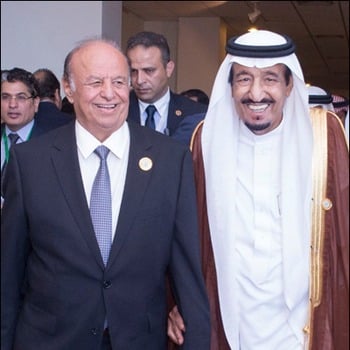
Yemeni President Abu Rabu Mansour Hadi
with Saudi King Salman
The conflict escalated in March 2015 when the Saudi-led coalition (including Bahrain and Sunni-majority Egypt, Jordan, Kuwait, Morocco, Sudan, Qatar, and the UAE) began a military operation to restore the internationally-recognized government of Abu Rabu Mansour Hadito power.
The Saudis’ targets are the Houthi forces, who are a Zaydi Shiite Muslim minority and have been fighting for control of the country. They are loyal to former President Ali Abdullah Saleh, who was deposed in 2011 following a popular uprising instigated by the Arab Spring. The Houthis have suffered immense discrimination, and their grievances have been addressed neither before nor after the Gulf Cooperation Council’s March 2013 initiative that launched a National Dialogue Conference, which failed to resolve the dispute over the distribution of power.
The Houthis joined forces with Saleh and expanded their influence in northwestern Yemen, culminating in a major military offensive against the military and a few rival tribes in which they captured the capital Sana’a in September 2014. The Saudis’ bombing against the Houthis has been indiscriminate: schools, hospitals, homes, marketplaces, weddings, and even funeral homes were targeted to maximize casualties, egregiously violating the laws of war and continuing to do so with impunity.
The Saudis claim Iran is behind the Houthis’ rebellion. Although Iran and the Houthis adhere to a different school of Shiite Islam, they share similar geopolitical interests. Iran is challenging Saudi Arabia for regional dominance, while the Houthis are the main rival to Hadi and the US-Saudi backed government in Sana’a. For the Saudis, losing Sana’a would allow Iran to exert major influence in the Arabian Peninsula in addition to its alliances with Iraq, Syria, and Lebanon. The Saudi coalition is meant to signal to Iran that it will not be allowed to gain any influence in Yemen.
The US along with the United Kingdom have for many years been selling offensive weapons to Saudi Arabia, which are now used to attack Houthi-held areas. The UAE, Kuwait, and Jordan received licenses to sell and service American-made military helicopters for Saudi Arabia, which sends a clear message to this unholy coalition that they can kill with impunity.
UK Home Secretary Amber Rudd shamelessly said [selling arms is] “good for our industry”—not an acceptable reason to sell offensive weapons that kill people indiscriminately. Nevertheless, the US does have national security and economic interests in the Arabian Peninsula: particularly, it seeks to ensure free passage in the Bab al-Mandeb, through which 4.7 million barrels of oil pass each day; and the support of a government in Sana’a that would cooperate with US counter-terrorism battles. That said, the US’ direct involvement in the conflict makes it complicit in the coalition’s violation of the laws of war, and top US officials could be subjected to legal liability.
Sadly, the Trump administration has forfeited its moral responsibility by not insisting that Saudi Arabia, over which it exercises tremendous influence, open the ports to ensure that enough food and aid enters the country, without which millions will starve to death.
The conflict is going from bad to worse as international efforts to press both sides have been woefully inadequate, and media attention is nearly absent. Continued fighting will further fuel the struggle between Saudi Arabia and Iran, and contribute to other regional conflicts. Moreover, the prospect of finding a peaceful solution is becoming increasingly difficult and laden with uncertainty, as the Trump administration believes that a solution lies with more military force. Trump justifies his bellicose approach as he sees Iran as the culprit who is raging a proxy war against the Saudis and benefiting from continued instability.
Destroyed house in the south of Sanaa, 13 June 2015 (Source: Wikimedia Commons)
For these reasons, the EU’s neutrality has allowed it to maintain contact with all the conflicting parties, and is best positioned to build on its credibility to persuade both sides to agree on a ceasefire and settlement. The Houthis want to negotiate with someone with authority rather than a mediator, and refuse to have talks with UN-appointed envoy Ismail Ould Sheikh Ahmed, who they consider to be biased. They also view the US and the UK with suspicion, as they are the chief suppliers of weapons to Saudi Arabia.
Although France and Britain are supportive of the military campaign, they can be coaxed by the EU into introducing a UNSC resolution that must first, focus on a ceasefire; second, address the humanitarian crisis; and third, work on a permanent solution that would take the Houthis’ interest into full account. As Gandhi once observed:
“Three-fourths of the miseries and misunderstandings in the world will disappear if we step into the shoes of our adversaries and understand their standpoint.”
The conflict in Yemen can end only through a political solution, as no solution secured by force will survive. The Trump administration must learn from Iraq and Syria’s intractable violent conflicts, which could not be resolved through military means. To resolve the conflict in Yemen, the US must join hands with the EU to achieve a peace agreement and put an end to the unconscionable tragedy inflicted on millions of innocent people.
Just take a look at the eyes of a starving, sick, and dehydrated little child whose heart is just about to stop. Multiply this image by tens of thousands and ask yourself, where have we gone wrong? We have gone wrong because it has been long since we lost our humanitarian and moral compass.
Dr. Alon Ben-Meir is a professor of international relations at the Center for Global Affairs at NYU. He teaches courses on international negotiation and Middle Eastern studies.
River to Sea Uprooted Palestinian   
The views expressed in this article are the sole responsibility of the author and do not necessarily reflect those of the Blog!