Sunday, 22 October 2017

The U.S. Bombed Afghanistan More in September than Any Month Since 2010, but the “Death Toll” Remains Hidden

In the war on terror, Trump doubles down on a failed strategy.
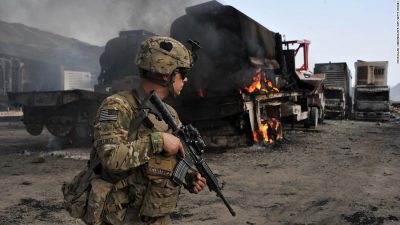
On August 21, U.S. President Donald Trump unveiled his long-awaited Afghanistan strategy. He made clear that the longest war in modern U.S. history had no end in sight, and that the U.S. government would increase its troop contingent by several thousand soldiers.
According to news reports, another 4,000 U.S. soldiers are slated for deployment to Afghanistan. However, Trump himself admitted the true numbers will remain in the dark, saying in his August 21 speech that the number of U.S. troops deployed to Afghanistan, Iraq, Syria and other countries would not be released by his administration in the future.
Nine days later, it was revealed that, instead of roughly 8,000 troops, as previously believed, at least 11,000 soldiers are currently deployed in Afghanistan. That’s not the only instance of information being withheld from the public: During the last days of Barack Obama‘s presidency, the Pentagon stopped releasing redacted investigations of major civilian casualty events caused by the U.S. military. This included war crimes in Syria, Afghanistan and several other countries where drones are haunting the skies, while special forces units are conducting shadowy operations on the ground.
Trump’s speech also dropped the pretense of “nation-building” that many across the political spectrum had used to justify the Afghanistan war. For him, it’s all about hunting down and killing “terrorists.”
Although the word “terrorist” has become vacuous, a label for everything and everyone, the question remains: Who are the “terrorists” in Afghanistan? Are they al-Qaeda, which has been practically non-existent in the country for years? Are they the leaders of the Taliban, which has grown since the start of the U.S.-led invasion and now controls many parts of the country? Are they the extremists of ISIS, whose presence was enabled by the violence of the U.S.-led war and invasion, too? Are they the brutal warlords and militia fighters who have become a crucial part of Afghanistan’s landscape and, since allying with the United States in 2001, have led parts of the Kabul government?
From an Afghan view, there are other “terrorists”: the drone operators who are remotely killing innocent people on a daily basis, or the Western soldiers who are hunting civilians and collect their body parts like trophies.
For the U.S. government, the answer is chillingly simple. Since 2012, the White House has maintained that every military-aged male in a strike zone is considered as an “enemy combatant.” This means what nearly all Afghan men—including teenagers—are considered “terrorists.” The same is true for Syrians, Iraqis, Pakistanis, Somalis, Yemenites and every other citizen of a country that has the luck to be terrorized by U.S. bombs and rockets, dropped by conventional aircraft or weaponized drones.
“We are all terrorists. If we get hit now, you are going to be called like that too,” a Taliban fighter in Nangarhar province in the east of the country told me when I visited his village in May. Local civilians who were nearby agreed with him.
What he said was true. I often thought how I would be described after getting killed by a drone strike, especially while researching in remote regions that are barely entered by Western journalists. Like most Afghan men, I have a beard and black hair. In today’s world, that’s enough to be called a “terrorist,” a danger to Western civilization.
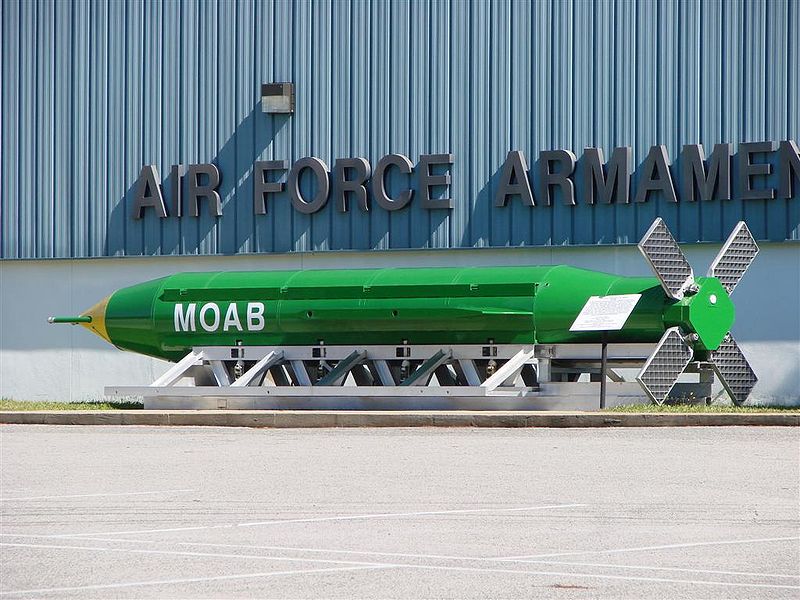
Since Trump took over the presidency, about 2,000 airstrikes have been conducted by the U.S. military in Afghanistan. On October 12, a U.S. drone strike killed 14 people; Afghan officials claim the victims were ISIS militants but a local member of parliament alleges those killed were civilians. Last month, the U.S. dropped more bombs and missiles on Afghanistan than in any other month since 2010. Most of these strikes hit Nangarhar province, which was also the target of the Massive Ordnance Air Blast (MOAB), also known as the “Mother of All Bombs”, the most powerful non-nuclear weapon in the Pentagon’s arsenal. According to recent UN data, U.S. strikes in Nangarhar are more likely to result in civilian casualties than strikes anywhere else in the country. But contrary to reports that often describe all victims as “suspected militants” or “terrorists,” many dead are civilians.
Provinces like Nangarhar, where the United States has been fighting its “War on Terror” since 2001, are the places where the U.S. lost this war. While the Taliban control many districts of such provinces, after years of constant occupation, many Afghan locals have developed a hatred toward the American soldiers, like their forefathers did towards the Russians and the British.
While Trump is giving one weird speech after the other, the Afghans in these remote areas live in real dystopia. The so-called government in Kabul, which was installed by the United States in 2001, has no influence here.
Instead, the people’s lives are controlled by Taliban insurgents who are often deeply connected with the local communities. More than 100,000 U.S. soldiers, who were deployed in Afghanistan during the Obama era, were not able to change this reality. It will not be much different under Trump.
It’s not just the mere presence of foreign troops that fuels war, but also what those troops have done and continue to do: carry out air strikes, conduct brutal night raids on civilians’ homes and torture detainees at places like Bagram Air Base—a place so notorious in Afghanistan that, to some, Guantanamo is considered a haven by comparison.
All signs indicate these atrocities will continue in the era of Donald Trump.
The identities of the people who have been murdered by the MOAB are still not known. While the Kabul government supported the attack and later announced that more than 90 ISIS militants have been killed, the White House preferred to stay silent. Too often, similar figures in the past have proven to be bogus. But in the United States, the stories of Afghans are only told when they fit with the interests of the U.S. empire. Otherwise, they remain faceless and invisible—and that’s how Donald Trump wants to keep them.
Emran Feroz is an Austrian-Afghan journalist and author based in Germany, and the founder of Drone Memorial, a virtual memorial for civilian drone strike victims. His book on the U.S. drone war just has been released in German.

River to Sea Uprooted Palestinian   
The views expressed in this article are the sole responsibility of the author and do not necessarily reflect those of the Blog!

Iran Doesn’t Have a Nuclear Weapons Program (israel does). Why Do Media Keep Saying It Does?

When it comes to Iran, do basic facts matter? Evidently not, since dozens and dozens of journalists keep casually reporting that Iran has a “nuclear weapons program” when it does not—a problem FAIR has reported on over the years (e.g., 9/9/15). Let’s take a look at some of the outlets spreading this falsehood in just the past five days:
  • Business Insider (10/13/17): The deal, officially called the Joint Comprehensive Plan of Action (JCPOA), aims to incentivize Iran to curb its nuclear weapons program by lifting crippling international economic sanctions.”
  • New Yorker (10/16/17): “One afternoon in late September, Secretary of State Rex Tillerson called a meeting of the six countries that came together in 2015 to limit Iran’s nuclear weapons program.”
  • Washington Post (10/16/17): “The administration is also considering changing or scrapping an international agreement regarding Iran’s nuclear weapons program.”
  • CNN (10/17/17): “In reopening the nuclear agreement, [Trump] risks having Iran advance its nuclear weapons program at a time when he confronts a far worse nuclear challenge from North Korea that he can’t resolve.”
The problem with all of these excerpts: Iran does not have a nuclear weapons program. It has a civilian nuclear energy program, but not one designed to build weapons. Over 30 countries have civilian nuclear programs; only a handful—including, of course, the US and Israel—have nuclear weapons programs. One is used to power cities, one is used to level them.
If you are skeptical, just refer to a 2007 assessment by all 16 US intelligences agencies (yes, those 16 US intelligence agencies), which found Iran had “halted” its nuclear weapons program. Or look at the same National Intelligence Estimate in 2012, which concluded again that there “is no hard evidence that Iran has decided to build a nuclear bomb.” Or we can listen to the Israeli intelligence agency Mossad, which concurred with the US intelligence assessment (Haaretz3/18/12).
The “Iran Deal,” formally known as the Joint Comprehensive Plan of Action (JCPOA), is built on curbing Iran’s civilian nuclear program, out of fear—fair or not—that it could one day morph into a nuclear weapons program. But at present, there is no evidence, much less a consensus, that Iran has an active nuclear weapons program. JCPOA cannot be used as per se evidence such a program exists today; indeed, it is specifically designed to prevent such a program from developing down the road.
A slightly less egregious variant of this canard is when outlets suggest the JCPOA stopped an ongoing existing weapons program—though they don’t make the mistake of saying it still exists: The JCPOA “called for the elimination of economic sanctions Iran in exchange for Tehran giving up its nuclear weapons program,” USA Today (10/13/17) wrote. US and Israeli intelligence do claim that Iran once had a nuclear weapons program—but they say it ended in 2003, not in 2015 as a result of the JCPOA.
The distinction between nuclear energy and nuclear weapons is, of course, non-trivial. Every time the media mindlessly report Iran has a “nuclear weapons program” rather than a “nuclear program” (or, better, a “nuclear energy” or “nuclear power program”), they further advance the myth that Iran’s intentions or “ambitions” are to build a nuclear bomb, which is something we have no evidence it is doing or plans to do—at least since the Ayatollah Ali Khamenei issued a fatwa against building nuclear weapons in 2003 (Foreign Policy10/16/14).
So why do some many reporters keep mucking this up? A few reasons: It’s just a mantra repeated ad infinitum, and journalists and pundits often mindlessly repeat an oft-repeated phrase. Some, such as nuclear arms expert Jeffrey Lewis at the Center for Nonproliferation Studies at Middlebury Institute, think it’s simply an issue of reporters not knowing how to express a complicated idea.
“I often see this point [about the civilian vs weapons program] mangled. I don’t think it’s malice, just a writer or editor not knowing how to express an idea,” he said on social media. “The JCPOA imposes measures that constrain Iran’s nuclear energy program to provide confidence that the program remains peaceful,” he added, offering an example of how that idea can be expressed.
Another major reason for this recurring falsehood, as FAIR (7/6/17) noted after the New York Times twice “mistakenly” accused Iran of carrying out 9/11 (one of the smears going uncorrected for over three years), is that one can say pretty much anything about Iran without any professional or public backlash. Because Iran is an Official US Enemy, and its motives are therefore always deemed sinister, the idea that it is plotting to violate the Nuclear Non-Proliferation Treaty and build a nuclear weapon is simply taken as a given. The lack of hard evidence for this is irrelevant: Intentions of those in the crosshairs of US power are always presented as cynical and malicious; those of the US and its allies benevolent and in good faith. Iran’s sinister motives are simply the default setting—no matter much evidence points to the contrary.

River to Sea Uprooted Palestinian   
The views expressed in this article are the sole responsibility of the author and do not necessarily reflect those of the Blog!

Saudi Royal Transition: Why, What, and When?

Saudi Deputy Crown Prince Mohammed bin Salman
Speculation is widespread that King Salman may soon abdicate in favor of Crown Prince Muhammad, but that is just one of several possible options.
Last June, King Salman of Saudi Arabia, one of the oldest heads of state in the Persian Gulf region, gave the title of crown prince to his favorite son Muhammad bin Salman, known as MbS. The thirty-two-year-old prince was the third to hold that title since Salman ascended to the throne in 2015, but he is widely regarded as his father’s true choice to become the next king. When that happens and under what circumstances could have important consequences for Saudi Arabia, the wider Muslim world, and the international oil market.
Saudi succession law does not lay out a strict system of primogeniture — it merely states that rule passes to the sons and grandsons of the country’s founder, Abdulaziz (Ibn Saud). This loose edict allows succession from brother to brother, creating a problem that has been growing with each transition — the sons of Ibn Saud have been acceding to the throne at older ages and living longer while in power, eventually straining their physical and mental capacities for leadership (click on chart below for high-resolution version). The accession of MbS could resolve that problem for years to come.
King Salman has two other titles as well: “Custodian of the Two Holy Places” and prime minister. This broadens the range of possibilities for transferring responsibilities to MbS. The scenarios could unfold as follows:
Salman abdicates and MbS becomes king. “Abdication” is probably not a favored option in the kingdom. It was last used in 1964 when the spendthrift King Saud was forced to give up after six years of tension with his half-brother Faisal, who replaced him. More recently, in 2013, Emir Hamad al-Thani of Qatar abdicated in favor of his son Tamim but retains much influence, along with the official title of “Father Emir.” Given Riyadh’s current bad blood with Qatar, the chances of Salman emulating the “Father King” model are likely zero, but a different slice of history could make full abdication more acceptable.
In 1902, Ibn Saud (only twenty-two at the time) led a group of fighters from exile to recapture his family’s ancestral village of Dariyah in central Arabia. In response, his father Abdulrahman ceded leadership of the House of Saud to him. Today, King Salman is said to see Ibn Saud’s character in his son, and the Wall Street Journal reports that he has already made a video announcing that MbS will be king.
Salman gives up the throne but remains Custodian. Since Ibn Saud captured the holy cities of Mecca and Medina in 1925, successive rulers have taken responsibility for the Islamic shrines. King Fahd formalized this role in 1986, changing his title from “majesty” to “Custodian of the Two Holy Places.” Retaining the religious title but relinquishing political leadership would be consistent with the sense that the former is more important — a key ingredient in Saudi Arabia’s claim to leadership of the wider Arab and Muslim worlds.
Salman appoints MbS prime minister. At present, the king is prime minister and the crown prince is deputy prime minister. Yet the weekly meetings of the Council of Ministers, which are chaired by the prime minister, are not the country’s most crucial decision making forums. That honor goes to the Council of Political and Security Affairs and the Council of Economic and Development Affairs, two bodies that were created in 2015 and are now chaired by MbS. Administratively, naming MbS as prime minister would arguably be tidier than the current arrangement. But this may be a delicate issue: Faisal and King Saud engaged in a long tug-of-war over bureaucratic control before the former’s accession, so Salman would have to be truly willing to give up the job if this division of labor is to work today.
MbS becomes regent. When Salman travels abroad, as he did to Moscow earlier this month, he “deputizes” MbS “to administer the state’s affairs and take care of the interests of the people during his absence,” according to the Saudi Press Agency. A version of this option — regency — is available in circumstances of illness or lengthy medical treatment abroad. Yet a protracted regency could be contentious. After King Fahd suffered a debilitating stroke in late 1995, Crown Prince Abdullah was appointed regent, but he held the title for only a few weeks — apparently because Fahd’s powerful full brothers (Sultan, Nayef, and Salman) were anxious to deny Abdullah complete authority. Despite the king’s poor physical condition thereafter, Abdullah did not assume full formal power until his own accession in 2005.
Salman dies. As crown prince, MbS would become king provided his leadership is acknowledged by senior members of the House of Saud, who must give him the oath of allegiance. Yet reported schisms in the royal family could lead some figures to contest his new authority. When Salman made MbS crown prince four months ago, three of the thirty-four princes on the Allegiance Council voted against him. According to the New York Times, his predecessor, Muhammad bin Nayef, did not give up the role and swear loyalty to MbS until he had been denied sleep and access to his medication; he reportedly remains confined to his palace today. Another potential opponent is Mitab bin Abdullah, son of the previous king and head of the National Guard, a significant military force if the succession is contested.
If his father passes away, MbS may be able to manoeuver around these family obstacles by carefully selecting a new crown prince, as is the king’s right. At present, though, it is far from obvious who that might be. Alternatively, he could delay that appointment, as King Faisal did in the 1960s before eventually naming Khalid. Earlier this year, the king sought to reduce royal family opposition to his son’s appointment as crown prince by changing the kingdom’s law of succession; the new law makes the young sons of MbS ineligible for that title. Prince Khalid, brother to MbS and ambassador to Washington, is ineligible as well
POLICY IMPLICATIONS
Regardless of internal hurdles, the transition toward MbS becoming king is already well established, and the main question is when it will be completed. Although the inner workings of the House of Saud are the ultimate determinant, domestic and foreign policy factors may be important as well. The crown prince’s ambitions for economic and social change, typified by his “Vision 2030” project and the recent announcement allowing women to drive, are currently enhancing his credentials and popularity. But the succession process could also be shaped by how he deals with external factors such as the stalemated war in Yemen, intra-Gulf tensions with Qatar, and a host of problems with Iran.
The United States has multiple policy concerns wrapped up in the succession, but few ways of influencing palace politics. Royal family thinking is often difficult to discern. Past Saudi decision making has been marked by caution and consensus, but neither characteristic fits the personality of MbS. The Washington bureaucracy is still coming to terms with the demise of Muhammad bin Nayef, who was a key interlocutor on counterterrorism issues when he served as interior minister and crown prince. For now, the greatest advocate for MbS appears to his father, which suggests that the crucial final steps in promotion — namely, using the power of the throne to block opposition and authenticate the new arrangement — need to be taken sooner rather than later.
SourceThe Washington Institute

River to Sea Uprooted Palestinian   
The views expressed in this article are the sole responsibility of the author and do not necessarily reflect those of the Blog!

Russia calls on US to expedite destruction of its chemical weapons

RT | October 18, 2017

Russia calls on US to expedite destruction of its chemical weapons

River to Sea Uprooted Palestinian   
The views expressed in this article are the sole responsibility of the author and do not necessarily reflect those of the Blog!
Balfour 100: Celebrating 100 Years of Injustice and Oppression

By Stuart Littlewood | American Herald Tribune | October 18, 2017
On 7 November, in London’s famous Royal Albert Hall, there’s to be “a unique event drawing Christians and Jews together in celebration of the centenary of the Balfour Declaration and all that it led to.”
Christians will be reaching out to support the Jewish community and the state of Israel, or so the organisers claim.
Our vision to stage such a big event at the Royal Albert Hall is ambitious and we recognise our reliance on God to enable every aspect of it.The evening’s programme will follow the history of God’s work through the Balfour Declaration that culminated in the independence of the modern state of Israel. We will use dance, film, song and drama sketches to illustrate how God used both Christians and Jews to fulfil the prophesied return of the Jewish people from exile to their ancient biblical homeland Israel,” says the blurb.
And it adds: “Christian leaders will read statements that will reflect Christians’ desire to…
  • Reconnect with the spiritual heritage of godly men who espoused the restoration of Israel to her Land;
  • Remember the Balfour Declaration and the Jewish-Christian partnerships that made it a reality;
  • Recognise the failure of Britain to fulfil the intent of the Balfour Declaration through the mandate for Palestine;
  • Rededicate ourselves as Christians to support Israel and the Jewish community.”
And the Royal Albert Hall, we are reminded, is where Lord Balfour celebrated with the Jewish community the granting to Britain of the Mandate for Palestine.
The rest of us of course remember Arthur Balfour as the Tory twit whose lamebrain ‘Declaration’ made it possible for Zionists who have no ancestral links to the Holy Land to dispossess, lock up and abuse Palestinians who do.
It was God’s work, we’re told. So that’s alright then And while we recover our composure we may well ask what kind of warped Christians dreamed up this Albert Hall caper, how the Balfour Declaration and its sickening legacy could possible have been “God’s work”, and how many “godly men” were among the perpetrators.
Then let’s cut to another declaration — The Jerusalem Declaration on Christian Zionism, a joint statement by the heads of Palestinian Christian churches, which
  • rejects Christian Zionist doctrines as false teaching that corrupts the biblical message;
  • rejects the alliance of Christian Zionist leaders with elements in the governments of Israel and the United States; and
  • rejects the teachings of Christian Zionism that advance racial exclusivity and perpetual war.
Thankfully, a sermon recently delivered in Westminster Abbey by Michael Doe, Preacher of Gray’s Inn, added some important context missing from the Royal Albert Hall‘s promo patter“The Balfour Declaration made way for the creation of Israel. It also said that nothing should be done ‘which may prejudice the civil and religious rights of existing non-Jewish communities in PalestineWe British who made the Declaration have an unfinished responsibility to ensure its implementation.
To be precise Balfour’s pledge said it being clearly understood” that nothing should be done to prejudice the rights of non-Jews. What’s not to understand? But that bit was conveniently forgotten within 30 years and is shrugged off today.
Who is behind this cringe-making celebration? Balfour 100. Who is behind Balfour 100? It’s hard to know. The Jewish Leadership Council’s website says that the Balfour 100 steering committee is comprised of 23 British-Jewish communal and Israel advocacy organisations but doesn’t name them. Among those, however, will be a number of fake Christians who are happy to stooge for the Zionists’ vile ambitions.
These pseuds have apparently ignored the cry for help issued only months ago by the National Coalition of Christian Organizations in Palestine to the World Council of Churches and the entire ecumenical movement. It was signed by over 30 organisations in Jerusalem, the West Bank and Gaza and can be read in full here.
They say: “We are still suffering from 100 years of injustice and oppression that were inflicted on the Palestinian people beginning with the unlawful Balfour declaration…. A hundred years later and there is still no justice! Discrimination and inequality, military occupation and systematic oppression are the rule…. Despite all the promises, endless summits, UN resolutions, religious and lay leader’s callings – Palestinians are still yearning for their freedom and independence, and seeking justice and equality.”
The churches’ message ends with these ominous words: “Things are beyond urgent. We are on the verge of a catastrophic collapse…. This could be our last chance to achieve a just peace. As a Palestinian Christian community, this could be our last opportunity to save the Christian presence in this land.”
The Royal Albert Hall was built by Queen Victoria to commemorate her beloved husband and consort Prince Albert. I’ll wager the idea of the flag of a rogue foreign military power fluttering from this fine building, or displayed inside, would have both of them spinning in their marbled vault at Frogmore.
And if Theresa May accompanies her guest Bibi Netanyahu to the Albert Hall shindig she’ll hand him and his cruel regime a huge propaganda victory.
River to Sea Uprooted Palestinian   
The views expressed in this article are the sole responsibility of the author and do not necessarily reflect those of the Blog!

Now that israel’s ISIS terrorists have more or less been defeated, attention turns to israel’s repeated violations of Lebanese territory

For the First Time Since the War Began, Syria Attempts to Confront Israel in Lebanon

How a “routine” flight has turned into a fight between Lebanon, Syria and Israel.
Lebanon Israel Syria da76a
Lebanon is a country that has come so far since the troubled times of its recent past. A lengthy civil war which wasted just as much in human blood as it did in years of time. Much of what was damaged during the Lebanese civil war, which including the years of Israeli occupation of Lebanon, has been replaced or rebuilt, yet, the country is still plagued to this day by troubles along its southern border which it shares with Israel and Syria.
Lebanon’s southern border is a largely disputed stretch of land which in part connects Lebanon, Syria and Israel altogether. The Shebaa Farms are a well-known disputed area which is considered an Israeli occupied territory by Lebanese and Syrian’s. The Golan Heights is another example, a rocky plateau in south-western Syria which Israel occupied following the Arab – Israel ‘6 Day-War’ in 1967. Israel later unilaterally annexed the Golan Heights in 1981 and the move was never recognised internationally – and so the dispute continues to this day.
“Routine” border violations
The political disputes of this region are merely the context for a much more disconcerting situation along the border. The almost daily illegal breaches of Lebanese sovereignty by the Israeli Defence Force (IDF) which has, at times, risked pushing the region into a new bloody confrontation. The numerous breaches come in many forms; the sight of Israeli military aircraft looming above towns and villages of South Lebanon has become a well-known phenomenon among the local inhabitants but the IDF also conducts regular ground and naval intrusions into Lebanese territory in clear defiance of two United Nations Security Council Resolutions, 425 and 1701.
To bring you an even greater idea for the sheer scale of the number of regular illegal intrusions committed by the IDF we should take a look at this months reported infringements as an example: so far this month the Lebanese Armed Forces (LAF) have registered at least seven severe incidents of Israeli military movements which have defied Lebanese territorial integrity between 4th – 16th October. These incidents include an IDF tractor vandalizing vegetation on the Lebanese side of the border, an IDF naval vessel entering Lebanese waters for a period of 25mins before departing back and an armed five-man IDF patrol which walked at least 50 meters into Lebanese territory and attempted to “kidnap” an unarmed Lebanese shepherd before exiting back across the border. These examples may appear inconsequential but on such a volatile border these small incidents can bubble up fast and erupt into something much more disastrous – a scenario the IDF is very much aware of.
On Monday the Israel air force breached Lebanese airspace a total of three times throughout the day, one of the morning breaches was a “routine” IDF reconnaissance flight over Lebanon that quickly escalated into a mini clash as a Syrian anti-aircraft missile launcher fired at the Israeli spy plane. The missile – an SA5 surface-to-air rocket – failed to hit its target, and, according to an Israeli military spokesperson, the anti-aircraft battery located 30 miles from Damascus was then hit by separate Israeli jets, “incapacitating” the launcher with four strikes.
This is the first time Israel has been challenged by Syria while spying on Lebanon since the Syrian war began. A clear sign from Syria that a day is coming when Israel won’t be free to violate Syrian & Lebanese sovereignty without retaliation. A freedom which Israel took full advantage of during the Syrian war, striking targets with complete insusceptibility, including senior Hezbollah figures and arms shipments, Iranian IRGC members and the Syrian Arab Army.
These types of highly combustible incidents have been allowed to escalate, becoming commonplace in the Levant, as the international community does little to rein in Israel’s intrusive behaviour while simultaneously adding fuel to the fire in conflict zones such as Syria & Iraq. The Lebanese, Syrian & Israeli border dispute has become a much greater cause for concern in recent years as the list of despicable offences continues to grow in number and rigorousness. In all honesty, many of the clashes could be avoided if the IDF choose to de-escalate its activity along the border region but has instead chosen to involve itself in Syrian & Lebanese affairs. The IDF have even been so bold as to criticise the UN peacekeeping force (UNIFIL) for not confronting Hezbollah in Lebanon. The IDF’s aggressive policy of intimidating local Lebanese civilians and antagonising the LAF, UN peacekeeping force (UNIFIL) and (most notably) the Hezbollah could lead to a new, much more gruesome, confrontation causing me to wonder if Israel really does want a new war.
The last war fought between Hezbollah and Israel was in July 2006 which began as a result of long escalating IDF vs Hezbollah border skirmishes, eventually, leading to a full-blown war between the IDF & Hezbollah. The IDF attempted to defeat Hezbollah militarily as it had done to the Palestinian PLO in Lebanon back in 1982 which evolved from the initial Israeli invasion to become an occupation of Southern Lebanon which went on to inspire the local Shia resistance – and so, Hezbollah was then born. The IDF’s anti-PLO objectives in the 82 war succeeded, Arafat lost his power in Lebanon and the PLO never returned to the South, but their similar plans in the July 2006 war against the Lebanese Shia Hezbollah failed miserably, only leading to death and destruction for both sides and a revitalized reputation for the Hezbollah.
Following that dreadful war, Lebanon’s people have now to live with the constant fear of low flying Israeli military aircraft posturing in a provocative fashion; emitting sonic booms that frighten and confuse local civilians who all live in fear that a new deadly war may once again commence. A war which several senior Israeli figures (including IDF Military chiefs and the Israeli Minister of Defence) claim will target civilian areas and vital Lebanese infrastructure across the country – which was also the case in the 2006 war.
The Lebanese government continues to respond to the endless list of border violations with an equally endless list of formal complaints to the UN about the IDF’s behaviour. The UN can do little except officially record the grievances and “investigate” the claims but no real action is ever taken to hold the IDF to account, and so, the violations continue.
Despite the UN’s best efforts the problem continues and with the promise to worsen as the war in Syria calms down leading to Israeli fears that Iran will expand its presence in Syria and look to challenge Israel for its dominance on the Golan & the Shebaa farms, however, the border dispute problem doesn’t only apply to the land but also to the sea as Lebanon and Israel now both look to the riches promised by the Mediterranean for the future prosperity of their nations – leading to yet more escalations coinciding with provocative political posturing between the Lebanese & Israeli’s.
The Mediterranean dispute
Lebanon and Israel are currently locked in a dispute over maritime boundaries. The 1949 Israel-Lebanon armistice line serves as the de facto land border between the two countries, and Lebanon claims roughly 330 square miles of waters that overlap with areas claimed by Israel based in part on differences in interpretation of relative points on the armistice line. The disputed stretch of water fanning out from the Lebanese coast towards Cypriot seas has been discovered to have huge reserves of natural gas and potential oil reserves below the seabed. Just another area of fierce contention between Lebanon and Israel which, following the estimates of the potential value, could lead to a new war according to some. Nabih Berri, the speaker of the Lebanese parliament, has described the maritime territory as “the Shebaa Farms of the sea”.
“If (Israel) continues with its expansionist plot through the government and the Knesset, that means that the spark of war is looming on the horizon,” Nabih Berri gave these comments to Lebanese journalists following news that Israel planned a complete annexation of the disputed sea area if the Knesset passed a new bill which lay official Israeli claim to the area – the bill would be recognised by Israel only, no one else.
Nabih Berri continued to say, ”We, on our side in Lebanon, we will not be quiet and we will not accept any compromise on our people’s rights to these resources, which have a degree of holiness to us.”
Lebanon is in desperate need for energy, a new industry to create jobs and a source of consistent revenue – all these things could be solved by the promise of lucrative natural gas fields off Lebanon’s coast but should Hezbollah begin to receive a profit from any future gas industry then Israel could find that intolerable. Similarly, if Israel does follow through with an annexation of disputed areas then the Lebanese may see it as a duty to respond with force to protect what Lebanon’s government considers its people’s birthright.
Israel has already begun to drill for gas and in 2010 entered into an agreement with Cyprus that draws a specific maritime border delineation point relative to the 1949 armistice line leading to major protests by the Lebanese. It has been estimated that the gas reserves in that area could be so lucrative that Israel, which has a naturally small demand for energy, could become an exporter of gas in the future creating huge new revenue and boosting the country’s independence. Lebanon has been left behind in this respect due, in part, to a long-lasting political deadlock and alleged government mismanagement of the affair. Now that Lebanon has a new President the country is looking towards the future and sees the Mediterranean’s gas and oil as a ticket to success. This would explain one reason why President Aoun has been so eager to move the Syrian refugees out of Lebanon, by any and all means, in order to free up Lebanese resources so they can pursue their gas drilling ambitions.
Lebanon currently consumes mostly oil and has no gas consumption whatsoever. If Lebanon did one day begin to produce its own gas it could replace the oil consumptions monopoly as oil makes up 93% of all the Lebanese energy consumption material with only coal and renewerble energy making up the remaining 7% – gas is cleaner to produce than oil and could help Lebanon to hit environmental targets while a revival in Lebanon’s domestic energy industry would simultaneously provide a solution to Lebanon’s crippling energy cut-outs that plague Lebanese daily life.
The future
President Aoun has wasted no time in kickstarting the process. This month the Petroleum Administration in the Lebanese Ministry of Energy and Water has already announced that an international consortium has won two licenses for exploration in two of Lebanon’s maritime blocks, zones 4 and 9 (Zone 9, located off the coast of Southern Lebanon, is one of the blocks which borders the disputed triangle zone which Israel lays claim too).
Israel has yet to decide on its reaction to the latest news and as Lebanon races to catch up with its regional gas rivals, the possibility of a new dimension to the heated disputes between Lebanon and Israel. Judging by the IDF’s behaviour on land and in the air, we will likely see Israel continue to push boundaries in the sea. The key difference between the dispute on land compared to the dispute in the Mediterranean is money – an element which history proves can easily drive countries to war.
Syria has sent a significant signal to the IDF by targeting an Israeli spy plane in Lebanon that a day is coming that Lebanon & Syria will, once again, not tolerate large-scale Israeli encroachment on their assets and will be willing to retaliate to any violations of new red lines – not just Syrian territory but Lebanese territory too. If the IDF wants to continue pushing boundaries – including in the Mediterranean – they will risk an escalation which will include Damascus and by default Tehran too. The IDF’s “routine” in Lebanon is no more. Russia shares good relations with Damascus and Tel Aviv so won’t enter into any future clash between the two, especially if it is just a Hezbollah – IDF skirmish but the possibility of further gas field discoveries could lead to more boundaries being tested risking further complications on the land, the sea and in the air.
References

River to Sea Uprooted Palestinian   
The views expressed in this article are the sole responsibility of the author and do not necessarily reflect those of the Blog!

UK: Corbyn calls for probe into israeli ‘interference’

UK: Corbyn calls for probe into Israeli 'interference'
Britain’s opposition Labour Party leader Jeremy Corbyn calls for an investigation into actions of Israeli embassy [File: Neil Hall/Reuters]
The leader of the United Kingdom’s Labour Party, Jeremy Corbyn, has called for an inquiry into the activities of an Israeli embassy officer who was caught on tape in an Al Jazeera investigation discussing a plot to “take down” British politicians.
In an open letter to Prime Minister Theresa May, Corbyn described the actions of Israeli embassy official Shai Masot as “improper interference in this country’s democratic process”. 
Explaining that he was “concerned” by UK foreign minister Boris Johnson’s announcement that the embassy’s activities were a closed matter, Corbyn urged May to launch an inquiry: “This is clearly a national security issue.”
He continued: “It is only on [the basis of an investigation] that Parliament and the public will be reassured that such activities will not be tolerated by your government.”
Masot was forced to resign from his position earlier this week, and Israeli officials have claimed he was a lone actor who was acting without the guidance or permission of his superiors.
The investigation, The Lobby, reveals plots by the Israeli diplomat and a British civil servant to destroy the careers of senior politicians.
Supporters of Corbyn, who is a leftist with a long history of Palestinian solidarity activism, were among those accused of anti-Semitism by Israeli officials, as Al Jazeera’s six-month investigation documented.
In The Lobby, Al Jazeera Investigations exposes how the Israel lobby influences British politics. Among the revelations were Israeli attempts to smear activists who question the illegal occupation of Palestinian land by helping to build racism cases against them.

Al Jazeera Investigative Unit’s series “The Lobby” can be viewed on Al Jazeera:
Episode One: Young Friends of Israel – Available online
Episode Two: The Training Session – Available online
Episode Three: The Anti-Semitic Trope – Available online
Episode Four: The Takedown – Saturday, January 14, 22:30 GMT
SOURCE: Al Jazeera News

River to Sea Uprooted Palestinian   
The views expressed in this article are the sole responsibility of the author and do not necessarily reflect those of the Blog!

US Air Force AIRLIFTS! ISIS Fighters From Raqqa to Fight Russians

Despite completely leveling Raqqa Dresden-style, the US deliberately let 1000 ISIS fighters escape, and, get this: AIR-LIFTED! them to Deir ez-Zor, to aide in the battle against Russia and Syria there.
Can’t make this stuff up.
Russian TV keeps hammering away at the US, accusing them of all manner of double-dealing and treachery – deliberately helping ISIS hang in there in Syria, despite the fact that their situation is hopeless militarily.
US aide to ISIS has become a very loud refrain on Russian TV, covered in detail on a daily basis.
Comments from the Ministry of Defense and top commentators are literally dripping with angry sarcasm:
“Only for the reasons of military ethics we don’t publish recently taken photos of the US military base in Al-Tanf, crammed with, to put it mildly, atypical for the US Army (weapons only ISIS would have need for)” – Russian Ministry of Defense
On October 13th, according to Voltaire.net:
The Russian Chief of Staff, General Sergey Rudskoy, indicated that the US Coalition’s bombings in Iraq are very infrequent. Because of this, a thousand Daesh fighters have been able to leave the country for Syria.
These fighters, together with another 2000 fighters, participated in an attack against the Syrian Arab Army. However the Syrian Arab Army had been able to ward it off.
(Transcript of report follows below)
One of the main reasons it’s interesting to watch Russian news is that it shows crucially important events occurring in the world that the MSM never covers. In this case, as in many others it’s the human story that’s swept under the rug.
While Americans only get distant reports of anonymous “troops” fighting ISIS, Russian reporters are boots on the ground, kilometers away from the front lines, and what they have shown us is tragic, but not surprising.
America has ‘Dresdened’ Raqqa
In contrast to the concern for civilians on behalf of Russia and Syria, by the time Trump is done “bombing the hell out of ISIS”, there won’t be a Raqqa to liberate.

Kiselyov (Russia’s Top Anchor):
Two weeks ago, we said that it was the Americans, and not combat capabilities of the barbarian pseudo-Caliphate terrorists, that became the main obstacle to ending the war in Syria.
This week, General Konashenkov, the Defense Ministry spokesman, called the actions of the US and their coalition in Syria and Iraq “an imitation of the fight against ISIS”.
In fact, Americans interact with terrorists, for example, at their illegally deployed military base Al-Tanf in southern Syria.
Igor Konashenkov, the Defense Ministry spokesman:
“Only for the reasons of military ethics we don’t publish recently taken photos of the US military base in Al-Tanf, crammed with, to put it mildly, atypical for the US Army off-roaders with large-caliber DShK machine guns and recoilless weapons.”
Kiselyov:
Nevertheless, the country’s liberation process is underway. Now ISIS is controlling less than 8% of the Syrian territory.
Meanwhile, the Americans have pretty much wiped the ISIS capital, Raqqa, off the map.
The ruins went to the Kurds. The remaining terrorist fighters were carefully transported to help those who are unsuccessfully defending Deir ez-Zor.
So cynical.

River to Sea Uprooted Palestinian   
The views expressed in this article are the sole responsibility of the author and do not necessarily reflect those of the Blog!