![]() |
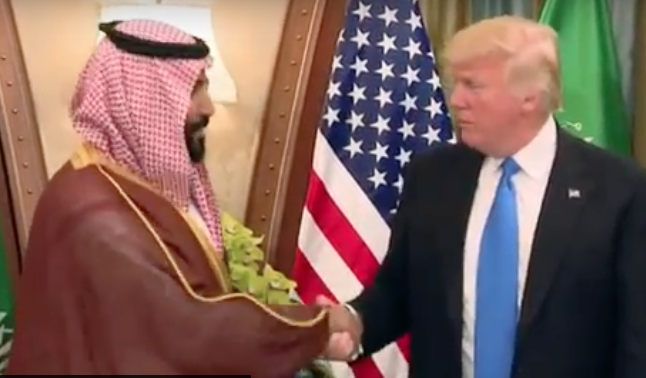
| President Trump shakes the hand of Saudi Deputy Crown Prince and Defense Minister Mohammad bin Salman on May 20, 2017. (Screenshot from Whitehouse.gov) |
Sunday, 19 November 2017
Trump’s Saudi Scheme Unravels
President Trump and his son-in-law bet that the young Saudi crown prince could execute a plan to reshape the Mideast, but the scheme quickly unraveled revealing a dangerous amateur hour, writes ex-British diplomat Alastair Crooke.
By Alastair Crooke
Aaron Miller and Richard Sokolsky, writing in Foreign Policy, suggest “that Mohammed bin Salman’s most notable success abroad may well be the wooing and capture of President Donald Trump, and his son-in-law, Jared Kushner.” Indeed, it is possible that this “success” may prove to be MbS’ only success.
“It didn’t take much convincing”, Miller and Sokolski wrote: “Above all, the new bromance reflected a timely coincidence of strategic imperatives.”
Trump, as ever, was eager to distance himself from President Obama and all his works; the Saudis, meanwhile, were determined to exploit Trump’s visceral antipathy for Iran – in order to reverse the string of recent defeats suffered by the kingdom.
So compelling seemed the prize (that MbS seemed to promise) of killing three birds with one stone (striking at Iran; “normalizing” Israel in the Arab world, and a Palestinian accord), that the U.S. President restricted the details to family channels alone. He thus was delivering a deliberate slight to the U.S. foreign policy and defense establishments by leaving official channels in the dark, and guessing. Trump bet heavily on MbS, and on Jared Kushner as his intermediary. But MbS’ grand plan fell apart at its first hurdle: the attempt to instigate a provocation against Hezbollah in Lebanon, to which the latter would overreact and give Israel and the “Sunni Alliance” the expected pretext to act forcefully against Hezbollah and Iran.
Stage One simply sank into soap opera with the bizarre hijacking of Lebanese Prime Minister Saad Hariri by MbS, which served only to unite the Lebanese, rather than dividing them into warring factions, as was hoped.
But the debacle in Lebanon carries a much greater import than just a mishandled soap opera. The really important fact uncovered by the recent MbS mishap is that not only did the “dog not bark in the night” – but that the Israelis have no intention “to bark” at all: which is to say, to take on the role (as veteran Israeli correspondent Ben Caspit put it), of being “the stick, with which Sunni leaders threaten their mortal enemies, the Shiites … right now, no one in Israel, least of all Prime Minister Benjamin Netanyahu, is in any hurry to ignite the northern front. Doing so, would mean getting sucked into the gates of hell” (emphasis added).
The Syrian Defeat
Let us be clear, the so-called Sunni Alliance (principally Saudi Arabia and UAE, with Egypt already backing off) has just been roundly defeated in Syria. It has no capability whatsoever to “roll-back” Iran, Hezbollah or the Iraqi PMU (a Shiite militia) – except by using the Israeli “stick.” Israel may have the same strategic interests as the Sunni Alliance, but as Caspit notes, “the Saudis are interested in having Israel do the dirty work for them. But as it turns out, not everyone in Israel is as excited about it.”
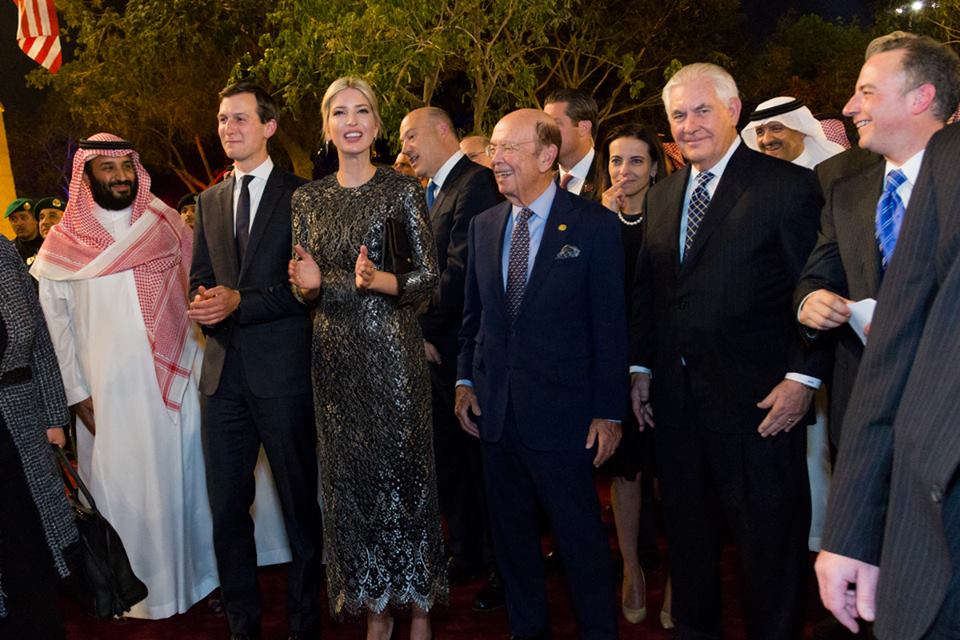
Senior White House Adviser Jared Kushner, and his wife, Assistant to the President Ivanka Trump, U.S. Commerce Secretary Wilbur Ross, U.S. Secretary of State Rex Tillerson, and White House Chief of Staff Reince Priebus arrive at the Murabba Palace as guests of Saudi King Salman, May 20, 2017, in Riyadh, Saudi Arabia. (Official White House Photo by Shealah Craighead)
Caspit calls a prospective clash between the Sunni Alliance and the Iranian-led front “a veritable war of Armageddon.” Those words encapsulate Israeli reservations.
This refusal to “bark” (in the famous Conan Doyle account of Sherlock Holmes) somehow knocks the blocks out from under Kushner’s “grand plan” because if Israel is opting out, what is there left to talk about? Israel precisely was the “stick” in Trump’s plan too. No stick: no Sunni Alliance roll-back of Iran; no further Saudi normalization with Israel; no Israeli-Palestinian initiative. MbS’ clumsiness (“reckless[ness]” a US official has called it) has pulled the rug out from under U.S. policy in the Middle East.
Why did Trump gamble so heavily on the inexperienced Kushner and the impulsive MbS? Well, of course, if such a “grand plan” had indeed worked out, it would have been a major foreign policy coup – and one done over the heads of the professional foreign policy and defense echelon who were excluded from it. Trump then would have felt himself freer to ascend above the Establishment tentacles: to attain a certain elevated independence and freedom from his “minders.” He would have achieved his coup through family channels, rather than be officially advised.
But, if it sinks into farce, and MbS becomes regarded in the U.S. as a maverick, rather than a Machiavelli, the (slighted) “system” will exact its revenge: presidential judgments will stand devalued — and ever more in need of justification and “minding.”
MbS (and Kushner) may have hurt President Trump in a much wider way therefore: the failed bet on the untried MbS may leach into other spheres – such as, in consequence, U.S. allies’ openly questioning the soundness of Trump’s North Korea judgments. In short, the U.S. President’s credibility will bear the consequences for his falling for MbS’ spin.
Wishful Thinking
There is, to be fair, much that is fanciful (even sycophantic) in the Western treatment of Saudi Arabia (President Trump is not alone in his thrall of things Saudi): the very notion of Saudi Arabia transforming itself into some muscular, “modern” regional powerhouse that can stare down Iran, in itself, would seem a tad unrealistic, yet this is widely accepted among U.S. commentators. Yes, the kingdom has little alternative but to transform as its oil dividend approaches expiry, and that may well mean, in theory, wrenching the kingdom onto a new course.
But defining exactly how the kingdom can re-invent itself, without tearing itself apart, is likely to be much more complex than advocating some superficial embrace of “Western modernity,” or that of combatting “corruption.” These are red herrings: the family is the state; and the state (and its oil wealth) is the family’s. There is no boundary, or demarcated frontier, between state and family. The latter enjoy the privileges and perquisites of birth (depending on proximity, or distance, from the throne). And perquisites awarded or appropriated, reflect only the monarch’s power-needs that serve to sustain his absolutism. There is no “damned merit” or equity in this system, nor was it ever intended.
What then can the term “corruption” mean in such a system? Saudi Arabia does not even pretend to a level, rules-based playing field. The law (and the rules) simply are what the king says, or signs, day-to-day.
What “corruption” used to mean, when Europe earlier “enjoyed” such a similar absolutist system, was clear enough: you had got in the king’s way, that is all that “corruption” implied. So, if the outside world thinks that MbS is moving Saudi Arabia towards a Western modernity, then they must mean either that MbS is planning the jettisoning of “the family” (the 15,000 princes of the blood royal), or he’s moving towards some constitutional monarchial set-up, and a rules-based society of citizens, rather than subjects.
Nothing in MbS’ actions suggest that he is moving in that direction. Rather, his actions suggest that he wants to recover and restore the absolutist aspect to the monarchy. And the modernity that he is seeking is of the type that you buy, virtually ready-made, ready to be assembled from its box. In short, the plan is to buy an industrial base, “in a box,” off the shelf, to make up for depleting oil revenues.
Vision 2030 tells us that this well-packaged, high-tech, “industrial base” is supposed to yield $1 trillion’s profit per annum, if all goes well … eventually. That is to say, it is intended as replacement source of income: precisely to support “the family” – and not displace it. It is not therefore “reformist” in the Western notion of modernity being “equality before the law” and of protected rights.
Unrealistic Hopes
Well, this type of non-organic, high-speed industrialization is not so easy to graft into society (if you are not Josef Stalin). It is expensive and, as history also tells us, is socially and culturally disruptive. It will cost a lot more than the reported $800 billion which MbS hopes to “recover” from his detainees (through physical coercion – some 17 have been already been hospitalized, in consequence of their treatment in detention).
President Donald Trump and First Lady Melania Trump join Saudi King Salman and Egyptian President Abdel Fattah Al Sisi, May 21, 2017, to participate in the inaugural opening of the Global Center for Combating Extremist Ideology. (Official White House Photo by Shealah Craighead)
But, if it is not to Westernize the economy, why then are so many senior family members needing to be “got out of the way”? This part of the “grand plan” relates perhaps, to the reason why MbS wanted, so much, to “woo and capture” President Trump (as Miller and Solkosky put it). MbS is frank about this: he has been telling President Trump that he wants to restore the kingdom’s former grandeur; to be again the leader of the Sunni world, and the guardian of Islam. And to do that, upstart Iran and the Shi’i revival must be knocked back down into subordination to Saudi leadership.
The difficulty is that some in the family would have opposed such adventurism against Iran. MbS seems to be pursuing a notion similar to that adopted by the neocons: i.e. the Kristolian argument that you can’t make (or restore) a “benevolent hegemony” omelet without breaking a few eggs. And as Miller and Sokolsky noted, Trump “didn’t take much convincing” — MbS’ vision intersected precisely with his own imperatives (and animus towards Iran). Trump duly tweeted his endorsement for the Saudi “corruption” crack-down.
And here lay the third leg to the “grand plan”: Israel would be “the stick” for the Saudi-UAE-U.S. alliance against Iran (Hezbollah was to be to be its peg for action). Saudi Arabia then, in return, would move to recognize the Jewish State, and Israel would give the Palestinians “something”: a “something” that might be called a state, even if it was much less than a state. The U.S. and Saudi Arabia would co-ordinate in pressuring the Palestinians to accept the U.S. proposals for a “settlement.”
Why did it go so wrong? Exaggerated expectations of that which each other party could realistically implement. Believing each other’s rhetoric. America’s love affair with Saudi royalty. Kushner’s family ties to Netanyahu. Wishful thinking on the part of Kushner and Trump that MbS could be the instrument to restore not just the Saudi kingdom as America’s “policeman” in the Islamic world, but even the American-led order in the Middle East, too.
Maybe Jared Kushner believed Bibi Netanyahu when he hinted that “normalization” of relations between Saudi Arabia and Israel would witness reciprocation in Israeli concessions to the Palestinians (when in fact, the Israeli security cabinet has already vetoed the concessions – well short of a state – that were being discussed in this connection)?
Maybe Jared believed MbS when he suggested that he could mobilize the Sunni world against Iran – if America and Israel backed him (when even Egypt opposed destabilizing Lebanon)?
Maybe MbS believed that Trump spoke for America when he offered to support him (when in fact, he spoke only for the White House)?
Maybe MbS thought that Trump would rally Europe against Hezbollah in Lebanon (in fact, the Europeans have prioritized Lebanese stability)?
And, maybe MbS and Kushner thought Netanyahu spoke for Israel when he promised to be a partner in the front against Hezbollah and Iran? Was it the “grand plan” that was affirmed between Netanyahu and Trump on the day before the latter launched his United Nations broadside at Iran in September? When in fact, while any Israeli Prime Minister can wage war against the Palestinians with a relatively free hand, the same is not true where the state of Israel itself is being put at stake. No Israeli P.M. can commit to a possibly existential conflict (for Israel), without having broad support from the Israeli political and security establishment. And the Israel Establishment will only contemplate war when it is plainly in the Israeli interest, and not merely to please MbS or Mr Trump.
Ben Caspit (and other Israeli commentators) confirm that the Israeli establishment does not see war with Hezbollah, and the risk of a wider conflict, to be in the Israeli interest.
The fallout from this episode is highly significant. It has exposed that Israel presently is deterred from contemplating a war in the region (as Caspit explains). It too has underlined the hollowness of MbS ambitions to mount a “Sunni Alliance” against Iran; and it has undercut President Trump’s containment policy for Iran. For now, at least, we may expect Iran and Russia to consolidate the state in Syria, and to stabilize the northern tier. Caspit’s “war of Armageddon” may yet arrive – but not for now, perhaps.
Alastair Crooke is a former British diplomat who was a senior figure in British intelligence and in European Union diplomacy. He is the founder and director of the Conflicts Forum.
River to Sea
The views expressed in this article are the sole responsibility of the author and do not necessarily reflect those of the Blog!
“Saudi Attempted to Expose Lebanon to Israeli Attack by Excluding Hariri”

Former Israeli Military Intelligence chief Amos Yadlin said Saudi Arabia attempted to expose Lebanon to an Israeli attack through excluding Lebanese Premier Saad Hariri.
In an interview with Israeli Channel 12, Yaldin praised what he called an alliance between the Zionist entity and Saudi, stressing that Riyadh “can go far away” with Tel Aviv.
Yaldin was hailing the Saudi decision to say it clearly that Riyadh enjoys good relations with the Zionist entity.
“The most important event that took place this week is not the interview which Israeli military chief gave to Saudi media, but rather the Saudi decision to publish it,” Yaldin said referring to the interview Saudi-owned Elaph online newspaper conducted with Lieutenant General Gadi Eizenkot.
The Israeli ex-intelligence chief meanwhile, disclosed that he meets from time to another Saudi princes in Europe and the United States.
Saudi officials “say it clearly: Iran is the enemy; they kill us but you no. Absolutely there is an alliance between us,” Yaldin said referring to relations between Saudi Arabia and Saudi Arabia.
Related Videos
Related Articles
- فرنسا ماكرون، ماذا تستثمر في قضية الحريري؟… حياة الحويك عطية
- مسؤول أمني عربي «مثلما أدى اغتيال الحريري الاب لخروج القوات السورية، اغتيال سعد الحريري يؤدي الى خروج “حزب الله” من لبنان»؟
- عودة الحريري مفتاح لكل الاحتمالات.. إلا الحل
- Saudi Arabia Birthplace of ‘Lethal Poison’ of Takfirism, Says Iran
- Saudi Torture Victims Include Former King’s Son
- Hariri Released from Saudi Arabia, Son and Daughter Still in Riyadh
The views expressed in this article are the sole responsibility of the author and do not necessarily reflect those of the Blog!
Saudi Arabia’s Stranglehold on Yemen Condemns Thousands to Die in Coming Weeks

by Scott Paul
What happens when the world’s largest humanitarian crisis takes a dramatic turn for the worse? A catastrophe of astonishing proportions is unfolding before our eyes as Yemen’s Houthi-controlled territory is sealed off and suffocated. . It is failing. Absent a rapid turnaround, we are likely to witness in Yemen an extraordinary level of devastation, the likes of which most of us have never lived through.
Widespread hunger and a massive cholera outbreak were already the reality in Yemen before Saudi Arabia strengthened its cruel and deadly de facto blockade with tacit international backing. Even before recent events, more than 17 million people in Yemen didn’t know where their next meal would come from, and 7 million were on the verge of famine. More than 928,000 people are believed to have contracted cholera in Yemen in 2017, the largest and fastest outbreak in recorded history. By comparison, the next largest cholera epidemic is in Haiti, where roughly 813,000 suspected cases have arisen – since 2010.
In the past two weeks, the situation has turned truly appalling. On Nov. 4, Houthi rebels fired a ballistic missile targeting the civilian airport in Riyadh. Saudi forces shot it down, but their leaders took notice. Both the Saudi-led coalition and forces aligned with the Houthis and Yemen’s former President Ali Abdullah Saleh have routinely targeted civilians and civilian objects in their nearly three-year-old war, but the attack on Riyadh demonstrated the Houthis’ newfound willingness and capability to threaten the center of the Saudi Kingdom.
In response, Saudi Arabia announced a total closure of Yemen’s land, air, and seaports. While it was unclear whether the Yemeni government formally consented to that decision, its position was of little consequence, as Saudi Arabia announced the reopening of Yemen’s government-controlled ports and crossings within days. Thus, as the dust settled, the same Houthi-controlled points of entry that the Saudi Arabia-led coalition has long desired to control are now shut down.
Among those points of entry is the Sana’a airport. Though controlled by the Houthis on the ground, its airspace – like all of Yemen’s – is controlled by the coalition. As a result, Saudi Arabia shut down commercial flights more than a year ago, even though those flights were stopped and inspected in Saudi Arabia en route. Saudi Arabia must also approve every passenger on every humanitarian aid flight, and has refused to allow journalists to enter to document the situation. This month’s escalation of the blockade, however, puts a halt to even these fully Saudi-vetted aid flights. So, for the time being, no humanitarian aid gets in, and no humanitarian workers get out.
Most critical of all for commercial shipments and aid delivery is the seaport of Hodeidah, which the coalition has long sought to control. More than 70 percent of Yemen’s food, and a substantial amount of its fuel, comes through Hodeidah, and it’s not by accident. Hodeidah’s deep water, proximity to populous areas, grain storage and milling infrastructure, and lengthy conventional and container berths, make its capacity irreplaceable by other ports. Saudi Arabia’s proposed alternatives – rerouting ships to Aden or the Saudi Arabian port city of Jizan, and then shipping supplies overland – are absurdly impractical. Even if either port had the capacity and infrastructure to accommodate Hodeidah’s commercial and humanitarian shipments, transporting cargoes overland from either port would involve long, dangerous, and expensive journeys. In either case, more expensive shipping would result in higher prices for Yemenis. Higher prices for Yemen’s vulnerable population in its collapsed economy means mass death.
Oxfam is currently reaching 1.5 million people with assistance, but even our aid won’t do much good if this course holds. In two governorates where we work, fuel has already run out. That means water pumps and purification mechanisms will grind to a halt, hospital lights will go out, refrigerators will turn off. Only water contaminated by sewage will be left to drink, and with price hikes pushing food even further out of reach, preventable disease will overwhelm compromised immune systems and weakened bodies. Aid workers, unable to drive, will find it difficult to stay in touch with communities. Medicines that need to be kept cold will expire and, with basic medicines unavailable, thousands of Yemenis will succumb to basic illnesses. Young children, pregnant mothers, and the frail elderly will be first, with others not far behind. Many of their fates have already been written, though lifting the blockade now could still prevent what the United Nations warns could be the worst famine the world has seen in decades, with millions of victims.
What makes this situation all the more disgusting is the patent uselessness of the blockade to achieve its stated purpose. It will not improve the security of Saudi Arabia one iota, because it is not in any way oriented to prevent the trafficking of weapons from Iran to Houthi rebels.
Large, international container ships, bulk carriers, and fuel tankers are screened by the United Nations Verification and Inspection Mechanism (UNVIM), a special, Saudi- and US-funded organization set up expressly to prevent weapons shipments through Houthi-controlled Red Sea ports. UNVIM carries out rigorous, intelligence-based interdiction, sometimes using x-ray technology, to prevent weapons smuggling. In fact, even Saudi Arabia has not alleged that any of these ships, or any humanitarian flights, have ever been used to smuggle weapons to the Houthis. But rather than step up its focus on the small ships it suspects may carry weapons, Saudi Arabia has elected to ban ships and planes that it knows do not – at great cost to the civilian population.
In spite of this backward logic, the US government has led its allies in demonstrations of solidarity with Saudi Arabia against Iran, ignoring a ghastly humanitarian crisis. The international community’s unqualified support for Saudi Arabia’s position nearly culminated in the adoption of a UN Security Council Presidential Statement condemning the Houthis and Iran’s malign activity without so much as a mention of Yemen’s dire humanitarian crisis and the steps taken by Saudi Arabia to push it to the brink of catastrophe. In a shameful display of complacency and appeasement, a group known as “the Quint” comprised of the U.S., the United Kingdom, Saudi Arabia, the United Arab Emirates, and Oman, canceled its Nov. 14 meeting, which was aimed at revitalizing peace talks.
The coming days and weeks will determine life or death for families across Yemen. If Saudi Arabia’s international partners delicately raise humanitarian access while offering statements of solidarity against Iran, nothing will change. Carefully balanced rhetoric will lead to a predictably and historically gruesome massacre of innocent people. On the other hand, a unified cry of outrage by the international community may just save millions of lives.
Originally published at Oxfam America’s Politics of Poverty and Just Security. Scott Paul is a senior humanitarian policy advisor at Oxfam America. Photo: Women and children collect water from a water point in Yemen’s Al-Qaflah district. (Photo: Moayed Al-Shaybani/Oxfam)
The views expressed in this article are the sole responsibility of the author and do not necessarily reflect those of the Blog!
So much in common, israel & Saudi Arabia. both love terrorists & genocide
By Stephen Lendman,

They’re strange bedfellows, allies of convenience against a common adversary – Iran for its sovereign independence and opposition to their hegemonic ambitions.
In an unprecedented interview with London-based, Saudi-owned Elaph.com, IDF chief of staff Gadi Eizenkot said Israel is willing to share intelligence with Riyadh.
He claimed with Trump as US president,
“there is an opportunity for a new international alliance in the region and a major strategic plan to stop the Iranian threat.”“We are ready to exchange experiences with moderate Arab countries and exchange intelligence to confront Iran.”
Riyadh and Tel Aviv share “many common interests,” he added, calling Tehran the region’s “biggest threat.”
Fact: Washington, Israel and Riyadh are the region’s leading state sponsors of terrorism – supporting the scourge the Islamic Republic opposes.
Fact: Iran hasn’t attacked another country in centuries. Israel and Riyadh are permanently at war internally and/or abroad – the region’s two leading human rights abusers, a threat to world peace, what Iran fosters and supports.
Eisenkot lied claiming Tehran aims “to control the Middle East by means of two Shiite crescents. The first from Iran through Iraq to Syria and Lebanon, and the second from Bahrain through to Yemen until the Red Sea.”
“This is what must be prevented in the region. In this matter, there is complete agreement between us and the kingdom of Saudi Arabia, which has never been our enemy. It has not fought us nor have we fought it.”
Fact: Israel seeks regional dominance along with Washington’s presence. Riyadh wants uncontested Arab world control.
Fact: Both countries are warrior nations. They support ISIS, al-Qaeda, its al-Nusra offshoot and other regional terrorist groups..
Fact: Allied with Washington, they represent an axis of pure evil. Iran is a peacemaker, not a belligerent, threatening no other countries anywhere.
Eisenkot:
“When I was at a meeting of the Joint Chiefs of Staff in Washington and heard what the Saudi representative had to say, I found it identical to what I think about Iran and the need to confront it and to confront its expansion in the region.”
Fact: Iran isn’t revanchist. It has no territorial ambitions. Nor does it seek dominance over other nations, fostering cooperative relations instead.
Netanyahu boasts about high-level cooperation with Riyadh. One rogue state supports another – best of friends apparently without formal diplomatic relations.
Iran doesn’t recognize Israel’s legitimacy, never saying it seeks the Jewish state’s destruction, as falsely claimed – or intends developing nuclear weapons it deplores and wants eliminated.
Eisenkot said
“(o)ur demand is for Hezbollah to leave Syria and for Iran and its militias to retreat from Syria.”“We have said openly, and also quietly and secretly too, that we will not accept Iranian consolidation in Syria in general, and their concentration west of the Damascus” – within 50 km of Israel’s border.“We will not allow any Iranian presence. We have warned them against building factories or military bases and we will not allow it.”
Iranian forces operate from Syrian bases, mostly as military advisors. It may or may not intend building one or more military bases in the country, its legal right with permission from Damascus.
Israeli military intelligence-connected DEBKAfile lied, claiming
“Iran already has 13 bases in Syria and tens of thousands of troops.” Utter rubbish!
Eisenkot’s interview came two weeks after Lebanese PM Saad Hariri’s forced resignation and detention under house arrest in Riyadh – along with scores of Saudi princes, ministers and others arrested and detained, as well as belligerent Saudi threats against Iran and Hezbollah.
If Washington, Israel and Riyadh launch war on Iran, it could be prelude to global war involving Russia – unthinkable but possible.
VISIT MY NEW WEB SITE: stephenlendman.org (Home – Stephen Lendman). Contact at lendmanstephen@sbcglobal..net.
My newest book as editor and contributor is titled “Flashpoint in Ukraine: How the US Drive for Hegemony Risks WW III.”
The views expressed in this article are the sole responsibility of the author and do not necessarily reflect those of the Blog!
In “democratic” israel you have different laws for people depending on their ethnic origins
Israeli army says the soldiers ultimately ended the clash; none of the stone-throwers were arrested
Israeli oldiers were documented standing by as a group of settlers threw stones at Palestinians in the Nablus area on Friday.
The incident was caught on camera by researchers with organizations Yesh Din and Rabbis for Human Rights. The Israel Defense Forces said the video misrepresented the incident, and that the soldiers “took action to end the friction.” None of the stone-throwers were arrested.
According to Yesh Din, at around 12:30 P.M., a trash fire started by a farmer near the Palestinian town of Burin began to spread. As firefighters arrived, a group of masked Israelis came to the area and began throwing stones at Palestinians present.
As for the video, the IDF claims it was “documented at the beginning of the discord and does not represent the event.” The soldiers, says the IDF, “did act to end the incident. After the settlers acted forcefully, the soldiers dispersed them using stun grenades and riot control measures.”
According to the army, the fire began near Burin and spread toward Givat Ronen, but wasn’t started at the outpost in the first place. This weakens the settlers’ claim of deliberate arson.
Last Summer Haaretz published a report on police investigations of similar situations that lead to no arrests. Left wing activists documented at least nine incidents of Israeli settlers attacking Palestinians within two months, one in which police stood by as Israelis threw stones at Palestinians, that concluded without a single arrest.
The views expressed in this article are the sole responsibility of the author and do not necessarily reflect those of the Blog!
Saudi Torture Victims Include Former King’s Son

Friday 17 November 2017
Prince Miteb bin Abdullah, the son of the late King Abdullah who was once considered a future crown prince, was beaten and tortured, along with five other princes, when he was arrested and interrogated in Riyadh during the ongoing political purge in the kingdom, Middle East Eye has confirmed.
All six princes were admitted to hospital in the 24 hours following their arrest. One of the men was in such a bad condition that he was admitted to the hospital’s intensive care unit – treatment which occurs when there is a high risk to the life of a patient, such as organ failure, from the heart, lungs, kidneys, or high blood pressure.
Hospital staff were told that the injuries sustained in each case were the result of “suicide attempts”. All had been severely beaten, but none of them had fractures. The marks on their bodies were consistent with the imprints left by military boots.
At least 17 of those detained were taken to hospital, but the number maltreated in the purge ordered by the current Crown Prince Mohammed bin Salman is certainly higher, according to sources who MEE is unable to identify because of concerns for their safety.
MEE has learned that medical units have now been installed in the Ritz-Carlton hotel where the beatings have taken place. This is to prevent torture victims from being taken to hospital.
MEE has also learned that in addition to the Ritz-Carlton, the detainees were also held in two other hotels including the Courtyard, Diplomatic Quarter hotel which is across the road from the Ritz-Carlton.
Both the Ritz-Carlton and the Courtyard are run by the Marriott International hotel chain. A spokesperson for Marriott International told MEE on Friday that the Ritz-Carlton and the Courtyard, Diplomatic Quarter were “not operating as traditional hotels for the time being”.
According to a civil rights attorney in Houston, Texas, the hotels are only liable to Saudi Arabian laws.
“If there is a crime being committed, then that crime is governed by the country which you are in,” Randall Kallinen told MEE.
Both hotels appeared to be booked out and not admitting guests for the whole of December, according to their websites on Friday.
Prince Miteb, who is 65, served as minister of the National Guard, a military force drawn from tribes loyal to the House of Saud whose main role is to protect the royal family, from 2013 until his arrest on 4 November.
Prince Miteb has a background in the military and was considered among the possible contenders to inherit his father’s throne prior to the appointment of the current King Salman as crown prince in 2012.
MEE can also confirm that Prince Abdul Aziz bin Fahd, the son of the late King Fahd who was arrested after this year’s Hajj in early September, was admitted to hospital close to the time of his arrest, although his fate is still unclear.
The purge, conducted in the name of an anti-corruption drive, has also involved the freezing of around 1,700 bank accounts.
According to one US source, bin Salman has claimed he intends to collect $1 trillion from the princes and businessmen that he has arrested.
The Financial Times newspaper reported on Thursday that Saudi authorities were offering deals to detainees, including billionaire tycoons such as Al-Waleed bin Talal bin Abdulaziz, in which they would surrender up to 70 percent of their wealth in return for their freedom.
The arrests, interrogation and mistreatment being conducted in hotels owned by a US-based chain with an international reputation has raised questions about how Marriott International has allowed its facilities to be used in such a way.
MEE asked Marriott International to clarify what its company policy was on allowing its premises to be used as detention facilities and asked for comment on allegations that detainees were being tortured.
A spokesperson said: “The Ritz-Carlton, Riyadh and the Courtyard, Diplomatic Quarter are not operating as traditional hotels for the time being. We continue to work with the local authorities on this matter.
“We remain in close contact with the guests and groups holding existing reservations; working with them to assist with their reservations and minimize disruption to their travel and event plans.”
Source: Middle East Eye
The views expressed in this article are the sole responsibility of the author and do not necessarily reflect those of the Blog!
Liberal Israeli leaders were contemplating genocide in Gaza already in 1967

Levi Eshkol, prime minister of Israel in the 1960s.
“Perhaps if we don’t give them enough water they won’t have a choice, because the orchards will yellow and wither.”That is what Israeli Prime Minster Levi Eshkol said in 1967 about Gaza, as revealed in newly declassified documents from the time. Ofer Aderet of Haaretz reported about this today.As I have already written, Eshkol, the leftist ‘liberal Zionist,’ was very willing to send Palestinians to the moon:“I want them all to go, even if they go to the moon”, he said.As is widely known, the standard UN definition of Genocide includes “Deliberately inflicting on the group conditions of life calculated to bring about its physical destruction in whole or in part”.These newly declassified documents reveal that the genocidal policy was indeed there already in 1967. This is important, because it sheds light on later policies, such as Israel’s siege of Gaza, which is part of an ‘incremental genocide,’ as historian Ilan Pappe has been calling it since 2006, and it puts the notion of a “huge concentration camp”, the term Haaretz journalist Amira Hass has used for Gaza, in historical perspective.Indeed, Eshkol was aware in the months after the 1967 war of the “suffocation and imprisonment” in Gaza in 1967, as the declassified documents reveal. And he was quite clear about this being an instrument to effect Israeli strategy:“precisely because of the suffocation and imprisonment there, maybe the Arabs will move from the Gaza Strip”, he said.Eshkol was also paraphrasing Herzl, when Eshkol told the cabinet he was “working on the establishment of a unit or office that will engage in encouraging Arab emigration.” He noted that“We should deal with this issue quietly, calmly and covertly, and we should work on finding a way from them to emigrate to other countries and not just over the Jordan [River].”This is a near quote of Herzl’s 1895 diary entry:“We shall try to spirit the penniless population across the border by procuring employment for it in the transit countries, while denying it employment in our country. The property owners will come over to our side. Both the process of expropriation and the removal of the poor must be carried out discretely and circumspectly”, Herzl wrote.Defense Minister Moshe Dayan was approving of Eshkol’s (and Herzl’s) ideas. He said,“By allowing these Arabs to seek and find work in foreign countries, there’s a greater chance that they’ll want to migrate to those countries later.”Dayan raised the idea of giving the Palestinians of the West Bank and Gaza permits to work abroad, in the hope that some would prefer to stay there.Eshkol was rather obsessed with the ethnic cleansing of Gaza as a prime issue:“We are interested in emptying out Gaza first”, he said.This shows that the notion of the complete ethnic cleansing of Gaza is not limited to right-wing politicians such as Moshe Feiglin, who as Likud Knesset co-speaker in July 2014, provided a 7-point plan to Netanyahu, to do just that.Eshkol also provides for other more apocalyptic options:“Perhaps we can expect another war and then this problem will be solved. But that’s a type of ‘luxury,’ an unexpected solution.”This ‘luxury’ (for Zionists, that is), is quite precisely what the ‘leftist’ Israeli historian Benny Morris was speaking about when he told Ari Shavit in 2004:“But I am ready to tell you that in other circumstances, apocalyptic ones, which are liable to be realized in five or ten years, I can see expulsions”.Dayan, by the way, was a bit more ‘generous’ than Eshkol, and suggested that out of the 400,000 Gazans, the 100,000 whom he considered ‘not refugees’ would be allowed to stay.Dayan also seems to suggest the ‘Bantustan’ blueprint, which is the idea that has informed Israeli policy in the West Bank, even within the ‘peace-process’ of the last few decades, even when Israel was supposedly being ‘generous’:“No soldier will have any interest in interfering in the lives of the inhabitants. I have no interest in the army sitting precisely in Nablus. It can sit on a hill outside Nablus”, Dayan said.In the same way, Israel does not need to be IN Gaza, or only occasionally. It’s much easier to just control the prison from outside, from a nearby hill…In 1967, Israel was experiencing the duality of exhilarated joy at the ‘liberation’ of the new territories (as even ‘leftist hero’ Ehud Barak puts it), and the ‘trouble’ of the Palestinian presence. This is embodied in Eshkol’s words:“I suggest that we don’t come to a vote or a decision today; there’s time to deal with this joy, or better put, there’s time to deal with this trouble”.The ‘trouble’ was of course the Palestinian ‘demographic problem’, which has been looming upon Israel from its very beginning.“I cannot imagine it — how we will organize life in this country when we have 1.4 million Arabs and we are 2.4 million, with 400,000 Arabs already in the country?”, Eshkol said.These words are very interesting to scrutinize. When Eshkol says “we are 2.4 million”, he is actually not including the Palestinian citizens of Israel (known in Israel as ‘Israeli Arabs’). This is clear, because in 1967, the total population of Israel was nearly 2.8 million. The last time the population was 2.4 million was early 1963. The prime minister couldn’t possibly be making a numerical error of that magnitude. No; Eshkol is clearly excluding the Palestinian population from the count, and treating it as a population to be regarded as a fifth column, an alien population, of ‘Arabs already in the country’ – just like the 1.4 million Arabs who have just come under Israel’s control. Let it be noted, that in late 1966, Israel relinquished its 19-year military regime over Palestinian citizens in Israel. Eshkol’s words demonstrate that whilst the relinquishing of this regime happened technically, and for ‘moral’ reasons, the establishment’s overall perception of Palestinian citizens was still as ‘others’.The concern with the ‘demographic problem’ in the minutes is all-consuming. Education Minister Zalman Aranne was emphatic about the ‘demographic threat’:“The way I know the Jewish people in Israel and the Diaspora, after all the heroism, miracles and wonders, a Jewish state in which there are 40 percent Arabs, is not a Jewish state. It is a fifth column that will destroy the Jewish state. It will be the kiss of death after a generation or a generation and a half”.Adding vitriolic spices of ‘Arab hatred’ and the ‘high birth rate’ of Arabs, Aranne continued:“I see the two million Jews before me differently when there will be 1.3 million Arabs — 1.3 million Arabs, with their high birth rate and their permanent pent-up hatred. … We can overcome 60,000 Arabs, but not 600,000 and not a million”.Finally, there is an interesting part about Jewish settlement in Al-Khalil (Hebron). Eshkol showed the ministers a letter he received in November 1967 from associates of the dean of Hebron Yeshiva — which had relocated to Jerusalem after the 1929 Hebron Massacre — asking the government to “make appropriate arrangements to let dozens of the yeshiva’s students, teachers and supervisors return and set up a branch in Hebron.” Labour Minister Yigal Allon (author of the famous Allon Plan to annex large swaths of the West Bank) was all for it: “There is a benefit in finding the first nucleus of people willing to settle there. The desire of these yeshiva students is a great thing. There aren’t always candidates willing to go to such a difficult place”, he said.So much for rogue religious rightwing settlers twisting Israel’s arm.Those who have followed the Zionist historical trace may not be surprised by these statements, nor that they are uttered by ‘liberal-Zionists’, by ‘leftists’.The logic here is, after all, Zionism 101. Nonetheless, they can still be shocking to read, and they should be. These are statements that convey clear intention of ethnic cleansing, and even Genocide. Emptying out, suffocation, deprivation of water till orchards wither. These words are not uttered by rightist Zionist leaders, but by leftist ones. No wonder Israel keeps these archives hidden for 50 years and more.
The views expressed in this article are the sole responsibility of the author and do not necessarily reflect those of the Blog!
Nasser Kandil: On the Free Patriotic President and the crisis between Lebanon and Hahoudi Arabia
The views expressed in this article are the sole responsibility of the author and do not necessarily reflect those of the Blog!
Subscribe to:
Posts (Atom)

&


