Sunday, 24 November 2019

Deep State Coup D’Etat: Subverting the U.S. Presidency from JFK to Trump

By Michael Welch, Mark Robinowitz, and Prof Peter Dale Scott
Global Research, November 24, 2019

On the Global Research News Hour we do our best to cover a wide spectrum of topics from the environmental crisis to economic and geopolitical analysis to debunking war pre-text narratives.
We welcome listener support to maintain and improve the quality of our regular broadcasts. Please consider a donation. Go to Global Research’s main donation page and tag your gift ‘GRNH.’
LISTEN TO THE SHOW

“The President of the United States is a transient official in the regard of the warfare conglomerate. His assignment is to act as master of ceremonies in the awarding of posthumous medals, to serve when needed as a salesman for the military hardware manufacturers and to speak as often as possible about the nation’s desire for peace. He is not free to trespass on the preserve of the war interests nor even to acknowledge that such an organism exists.” – Jim Garrison (May 27, 1969) [1]
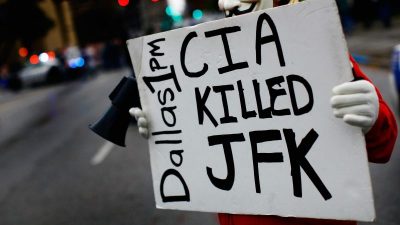
The murder of President John F. Kennedy on November 22, 1963 is widely recognized as a pivotal moment in U.S. history.
It was the first assassination of a U.S. president in the television age. The death of Kennedy enabled Cold Warriors within Washington to pursue their pillaging of the African, South American and Asian continents with substantially less resistance. But perhaps just as significantly, it marked an important chapter in a long-standing power struggle between big moneyed interests in America along with their intelligence operatives, and recognizable constitutional government, made up of representatives elected by the people and accountable to the public.
It was in direct response to inconvenient questions around the first Kennedy assassination that the CIA weaponized the term ‘conspiracy theory,’ a thought-stopping ad-hominem attack intended to disarm truth-seekers challenging the crimes that a controlled media fail to thoroughly investigate.
The existence of Wall Street overlords acting in tandem with military-intelligence figures as a kind of shadow government or ‘Deep State’ to appropriate the foreign policy and war-making apparatus of a country puts in doubt any assertions of America as a properly functioning democracy with power overseen and exercised by duly appointed representatives.
There have been several examples of similar State Crimes Against Democracy deliberately concealed and covered up so as to protect unaccountable elites. The assassinations of John Kennedy’s brother Robert, Martin Luther King, and Malcolm X, as well as the (false flag) terrorist attack known as 9/11 being among the more famous examples.
Against this backdrop, we witness the spectacle of President Trump having his authority challenged in an exhaustively publicized impeachment proceeding. Considering documented war crimes and other malfeasance committed by presidents spanning the last half century, one wonders why the particular allegations against Trump are being pursued so relentlessly, and not others. At the end of the day, impeachment or no, will the people end up with a marginally more accountable government, or will the unaccountable power behind the throne have been reinforced by this 21st Century Kabuki theater?
This week’s episode of the Global Research News Hour radio program is as much an attempt to view the current impeachment proceedings against Donald Trump through the lens of ‘deep politics’ as an anniversary commemoration of the assassination of one of America’s most popular presidents. We have taken the liberty to reach out to two authoritative scholars of events like the Kennedy assassinations and 9/11 to get their insights into what the Trump impeachment drama might mean from the stand-point of entrenched unaccountable power within the USA.
In our first half hour. We hear from writer, researcher and frequent guest Mark Robinowitz. He discloses his thoughts about how and why earnest investigators into clandestine operations implicating the Deep State get side-tracked and typically fail to achieve the changes in the political and legal system that should, in a fair world, spring from revelations of truths implicating high officials.
In our second half hour, legendary ‘Deep State’ researcher and author Professor Peter Dale Scott joins us to describe some of the characteristics all of these events have in common, he locates the commonalities between Trump and former Presidents Nixon and Kennedy, and tracks the evolution of the National Security State’s grip on power since that fatal shooting in Dallas 56 years ago.
Mark Robinowitz is a writer, political activist and ecological campaigner. He manages the sites oilempire.us and jfkmoon.org which look into the Deep Political events and how they intersect with politics, economics and ecology. He is based in Eugene, Oregon.
Peter Dale Scott is a former Canadian diplomat, Professor of English at the University of California, Berkeley, co-founder of the Peace and Conflict Studies program at Berkeley, poet, and 2002 recipient of the Lannan Poetry Award. His political books include American War Machine: Deep Politics, the CIA Global Drug Connection, and the Road to Afghanistan  (2010), The American Deep State: Wall Street, Big Oil, and the Attack on U.S. Democracy (2014) and  Dallas ’63: The First Deep State Revolt Against the White House (2015). He is a Research Associate of the Centre for Research on Globalization. His website is http://www.peterdalescott.net.
(Global Research News Hour episode 278)
LISTEN TO THE SHOW

The Global Research News Hour airs every Friday at 1pm CT on CKUW 95.9FM out of the University of Winnipeg. The programme is also podcast at globalresearch.ca .
The Global Research News Hour now airs Fridays at 6pm PST, 8pm CST and 9pm EST on Alternative Current Radio (alternativecurrentradio.com)
Community Radio Stations carrying the Global Research News Hour:
CHLY 101.7fm in Nanaimo, B.C – Thursdays at 1pm PT
Port Perry Radio in Port Perry, Ontario –1  Thursdays at 1pm ET
Burnaby Radio Station CJSF out of Simon Fraser University. 90.1FM to most of Greater Vancouver, from Langley to Point Grey and from the North Shore to the US Border.
It is also available on 93.9 FM cable in the communities of SFU, Burnaby, New Westminister, Coquitlam, Port Coquitlam, Port Moody, Surrey and Delta, in British Columbia, Canada. – Tune in  at its new time – Wednesdays at 4pm PT.
Radio station CFUV 101.9FM based at the University of Victoria airs the Global Research News Hour every Sunday from 7 to 8am PT.
CORTES COMMUNITY RADIO CKTZ  89.5 out of Manson’s Landing, B.C airs the show Tuesday mornings at 10am Pacific time.
Cowichan Valley Community Radio CICV 98.7 FM serving the Cowichan Lake area of Vancouver Island, BC airs the program Thursdays at 6am pacific time.
Campus and community radio CFMH 107.3fm in  Saint John, N.B. airs the Global Research News Hour Fridays at 10am.
Caper Radio CJBU 107.3FM in Sydney, Cape Breton, Nova Scotia airs the Global Research News Hour starting Wednesday Morning from 8:00 to 9:00am. Find more details at www.caperradio.ca
RIOT RADIO, the visual radio station based out of Durham College in Oshawa, Ontario has begun airing the Global Research News Hour on an occasional basis. Tune in at dcstudentsinc.ca/services/riot-radio/
Radio Fanshawe: Fanshawe’s 106.9 The X (CIXX-FM) out of London, Ontario airs the Global Research News Hour Sundays at 6am with an encore at 3pm.
Los Angeles, California based Thepowerofvoices.com airs the Global Research News Hour every Monday from 6-7pm Pacific time.
Notes:
  1. Interview with Jim Garrison, District Attorney for Parish of Orleans, Louisiana. File Reproduced at the National Archives and released June 7, 2004; 200https://statick2k-5f2f.kxcdn.com/images/pdf/garrison-interview-05-27-1969.pdf


River to Sea Uprooted Palestinian   
The views expressed in this article are the sole responsibility of the author and do not necessarily reflect those of the Blog!

Can Russia (or Iran) survive without China?

 • NOVEMBER 21, 2019
In a recent article entitled “China, Bolivia and Venezuela are proof that social democracy cannot thrive in the global capitalist order” my China-based friend and correspondent Jeff J. Brown asked me an exceedingly interesting and important question.  He wrote:
Russia is a social democracy, with a large, successful people owned industrial sector and many social services for the 99% from the Soviet era. But, unlike Bolivia and Ukraine, it is avoiding the West’s color revolution poison pill, because since 1999, Russia has gone from strength to strength, under the inspired leadership of patriotic President Vladimir Putin. But like all social democracies, the problem is what happens if another Western whore Boris Yeltsin succeeds Putin, and returns Russia to its dystopian Wall Street rape of the 1990s? Then what? It only took Macri four short years to bring Argentina back onto its groveling knees. Without a 100% nationalized media, Russians had better be demanding that Putin & Russian Patriots Inc. work overtime to censor all the Western overthrow garbage that is put in Cyrillic ink and on the airwaves.  I would love to hear what my good friend Andrei Raevsky thinks about this at The Saker (http://thesaker.is/), because let’s be honest: without China’s, Russia’s and Iran’s continued anti-imperial independence and socialist success into the 21st century, humanity can kiss its ass goodbye!
Let’s begin by deconstructing the assumptions and implications of Jeff’s question.
China and Russia *could* be separated
The first assumptions Jeff makes are the following ones:
  1. Russia is a social democracy
  2. The Russian media is not 100% state controlled
  3. A new Eltsin might succeed Putin
  4. The West is saturating the Russian information space with garbage
  5. That western propaganda can still strongly impact Russia
  6. China and Russia *could* be separated (hence the need to prevent that as the central thesis of Jeff)
And, finally, considering the above, Jeff offers the following compelling implication for the China-Russia-Iran triangle:
  1. Considering the above, China’s independence and support for Russia and Iran are vital for the sovereignty and freedom, if not survival, of Russia and Iran
Now let’s begin by looking into Jeff’s assumptions:
Russia is a social democracy:
Yes and no.  If we define a social democracy as being a specific polity and system of laws, then Russia is a social democracy.  However, if we define social democracy as a specific polity, system of laws and social culture, then I would argue that to the extent that Russia is, indeed, a social democracy, she is a rather weird one.  What do I mean by that?
By that I mean that thanks to the nightmare of “democracy” under Eltsin and his US curators, and thanks to the recent explosion of “democracy” in the Ukraine, the Russian people have by and large come to consider the words “liberal” and “democracy” as four letter words.  For example, the word “либерал” (liberal) has now given birth to a derived word либераст which takes the first letters of the word “liberal” and adds the last letters of the word педераст (pederast – a rude word for homosexual [yes, in Russian homosexuality and pederasty are not separated!]) which results in the new word “liberast” the closest to which in English would be something like “libfag”, hardly a compliment. In some interpretations, a “liberast” is also somebody who has been “f**ked by democracy“.  Not much better…  As for the word “демократия” (democracy) for years it has already been called “дерьмократия” (using the first letters of дерьмо (der’mo or shit) and the last letter of democracy to create der’mokratia or “shitocracy”.  Finally, there is also the saying that “демократия, это власть демократов” (democracy is the rule of the democrats), which for a country which has undergone the 1990s and seen the Ukraine being comprehensively FUBARed is ominous; not funny at all.  All this is simply to show that culturally the Russian society is not at all your typical social democracy.  It is a sort of democracy in which the majority of the people do not believe in democracy.  This is very important, crucial even, and I will address this issue later.
The Russian media is not 100% state controlled:
That is absolutely true!  However, it misses an important point: the real profile of the Russian media which is much more complex than “state controlled” vs “free media”.  To make a long story short, the main TV channels, while not really “controlled” by the state at all, are mostly pro-Kremlin.  But here we need to get the cause and effect right: these channels are not pro-Kremlin only because they get state funds or because of the political power of the Kremlin, the main reason why they are pro-Kremlin is the terrible rating of those media outlets who took a strong anti-Kremlin position.
To make my point, I want to mention the rabidly anti-Kremlin TV station which is very well known in Russia (Dozhd’ – see here for the (predictably complimentary) entry in Wikipedia for this TV channel).  In fact, Dozhd’ is just the best known of a fairly extensive anti-Kremlin media but, in reality, there are many more outlets which hold an anti-Kremlin pro-Empire line.  However, as I explained in a 2016 article entitled “Counter-Propaganda, Russian Style”  and then, again, in 2017, in the article “Revisiting Russian Counter-Propaganda Methods” the Kremlin has developed a very effective counter-propaganda strategy: instead of suppressing the Empire’s propaganda (like the Soviets did, most unsuccessfully), the Kremlin now directly funds that same propaganda!  Not only does the (state-owned) Gazprom finance Dozd’ – the western and Russian liberal guests which ridicule themselves on Russian TV are also generously paid for each of their appearances.  Even hardcore Ukronazi nutcases get invited regularly (when they truly overdo it they also get into fights, or get kicked out of the studios, which is all very much fin to watch and is therefore watched by millions).  The truth is that at this point the AngloZionist propaganda in Russia has much more of a very healthy “vaccination” effect then the ability to convince anybody beyond the “traditional” 2-4% of folks in Russia who still think that the West is some kind of heaven on earth and Russia an ugly, vicious and freedom crushing “Mordor”.
This being said, there is one channel through which the worst of the western consumer-society propaganda still permeates Russia: commercials.   Russian commercials are mostly absolutely disgusting; they basically vehiculate one crude and simple message “Russians must become US Americans”.  That propaganda via commercials is, I think the single most toxic and insidious form of de-russification I can think of and it is far more dangerous than any other means of “defacing” Russia.
Finally, and to my great regret, media outlets like RT and Sputnik have decided to “go native” I suppose and they now cater to western tastes much more than to Russian ones.  The quasi constant “reporting” about MMA fights, minimally clad ladies, sex in all its shapes and forms and Hollywood gossip – all of this just goes to show that the folks in charge of these media outlets have decided that catering the the lowest possible social common denominator is the way to promote Russia abroad.  I am not so sure.  What began with “Question More” and “Telling the Untold” now seems more preoccupied with trying to copy the yellow press in the UK than to challenge the Empire.  I very much regret that state of affairs.
Unfortunately, there are also a lot of 5th columnists and russophobes in these media outlets (especially in their online, Internet-based, websites; the actual radio/TV shows are mostly better).
So all is not rosy in the Russian media scene, but its not all bad either.
A new Eltsin might succeed Putin
Here I can only completely agree, and that is very scary.  Due to the lack of space, I will present my arguments in a short, bullet-point, list:
  • “Russia” is still very much a “one man show” meaning that Putin himself, as a person,  is still absolutely vital to the current functioning of Russia.  Not only are most Russians still strongly supportive of him personally, but there are no credible candidates to replace him.  Yes, there are a few potential candidates out there (in no special order: Ivanov, Shoigu and Rogozin would be the best known, but there are others, of course), but what makes it all worse is that historically, Russia, unlike China, has a very bad record of successions.
  • The 5th column is still there and while it keeps a very low profile (current events favor the Eurasian Sovereignists), it is still there, literally in all branches of power and very much inside the Moscow elites who hate Putin for putting an end to what they saw as the “Bonanza of the 1990s”.
  • There *is* a patriotic Russian opposition to Putin, and it is slowly growing, but it is poorly organized, has a lot of clueless nostalgics of the Soviet era and a lot of its criticisms are, frankly, naive or plain silly (along with very valid points too!).  I don’t see this opposition capable of producing a strong and credible leader.  But that might change in the future.
  • Thus the cornerstone of “Putinism” is Putin himself.  With him gone, for whatever reason, Putinism could very rapidly fade too.  This might be a good or a bad thing depending on the specific circumstances, but the chances that this might be a very bad thing are higher than the opposite being true.
“Putin The Man”, urgently needs to be replaced by “Putin The System”, but that is truly a herculean task because that means reforming/purging most of the immense and powerful Russian bureaucracy and find somewhere a new generation of men and women who could be both effective and trusted.  The problem is that in most cases when one man goes against a system, the system wins.  Putin is the proverbial case of a very good man in a very bad system.  True, he has successfully reformed the two branches of government which were most needed to make it possible for both him and Russia to survive the war the Empire was waging on Russia: the armed forces and the intelligence/security forces.  Other parts of the Russian state are still in a terrible shape (the entire legal system for starters!).
I think that the risk of an Eltsin-like prostitute coming to power is real, even if the bulk of the population would not necessarily approve of it (or be divided about it).  Long-term historical stability of a huge country like Russia cannot come from a man.  It can only come from institutions.  And just as Peter I destroyed the traditional Russian monarchy, so can one man destroy the current “new Russia” (for lack of a better descriptor), especially if this “new Russia” has only one man as its cornerstone.
Finally, history teaches us that every time that Russia is weak or disunited, the western powers immediately pounce and intervene, including with military means.  The Poles are still dreaming about yet another chance to prove Churchill’s diagnosis about Poland true and pounce on both the Ukraine and Russia if given the chance.
The West is saturating the Russian information space with garbage and western propaganda can still strongly impact Russia
As we have seen above, these are both at least partially true, but they are also not that much of a big deal.  This is clearly a source of potential concern, a danger, but not a threat (a danger being vague, a threat specific).  To the extend that this is a bad thing, this is mostly due to the hyper-materialistic consumer culture which currently competes against a much more traditional, Russian culture.  It is hard to say which one will win.  The former has much, much bigger financial means, the latter one has a strong ‘home turf advantage”.  Only time will show which will prevail.  So long as many Russians will  think “western propaganda lies” (which most understand) AND are attracted to western-style commercials (which are, in so many ways, an even much more effective and insidious form of propaganda), the jury will remain out on who will prevail should instability return to Russia.
China and Russia *could* be separated
This is probably the most important assumption made by Jeff.  First, since this is completely hypothetical, and since we are not future-seeing prophets let’s first agree to never say never and not dismiss this possibility out of hand.  This being said, I would like to remind everybody that Russia and China have gradually changed the labels which they applied to the other side.  The latest (as far as I know, Chinese speakers please correct me if needed!) expression used by Xi and other Chinese officials is “Comprehensive Strategic Partnership of Coordination for the New Era“.  There is a lot to unpack here, but let’s just say that this does not sound like the Chinese came up with that concept lightly or that they have many misgivings about the future of the relationship with Russia.  As for the Russians, they have now openly used the term “ally” on many occasions, including Putin.  In Russian that word “ally” (союзник) is a very strong one and contrasts sharply with the cynical and disgusted way the Russians always speak about their western “partners” (which often shocks those who don’t speak Russian).
And it is not all sweet talk either.  The Russians and the Chinese have had many and major joint military maneuvers, they have practiced the Russian equivalent of the US/NATO “Combined Joint Task Force” concept (see here for details).  Thus, while not formal allies, Russia and China do all the things which close allies do.  I would even argue that the “informal symbiosis” between Russia and China is far stronger than the NATO alliance.
It is my opinion that what Putin and Xi have done is something which has no previous equivalent in history, at least as far as I know.  Even though both Russia and China have been empires in the past, I strongly believe that both of these countries have entered a “post-imperial phase” in which the trappings of empire have been replaced by an acute sense that empires are extremely bad not only for the nations which it oppresses, but also for the nation which hosts it.  Both Russia and China have paid a horrendous price for their imperial years and both Russia and China completely understand that the people of the USA are also amongst the prime victims of the (transnational) Anglo-Zionist Empire, even if that is all too often forgotten.  Not only do they not want to repeat their own mistakes, they see the USA dying in the quicksands of imperialism and the last thing they want is to jump in and join the US.
I believe that the relationship between Russia and China is a symbiosis, which is much stronger than any alliances because while the latter can be broken, the former typically cannot (at least not without extremely severe consequences).  I also believe that Putin and Xi both understand that the fact that Russia and China are so completely different is not a problem, but a tremendous asset: they fit perfectly, like Lego or puzzle pieces.  What Russia has China does not and vice-versa.  And, just to clarify for the logically challenged: both sides also understand that they will never get from the other side by war what they could get by peaceful exchange.  Yes, the silly Polish dream of having Russia invaded by China several times (an old Polish joke of sorts) is only a reflection of the ancient Polish inferiority complex, not of geostrategic realities 🙂
Of course, in theory, anything could happen.  But I personally see no chain of events which could be sufficient to threaten the Sino-Russian symbiotic relationship, not even a collapse of “New Russia Putinism” (not elegant, but functional for our purposes) or the kind of chaos which a Eltsin type of comprador regime could try to reimpose on Russia.  At the end of the day, if Russia collapses then China will hold truly immense financial and economic power over Russia and will therefore be able to impose at least a China-friendly regime.  In that extremely unlikely case, Russia would, of course, lose her sovereignty, but not to the West, but to China.  That is not quite what Jeff had in mind.
Conclusion:
Yes, Russia and China need each other.  I would argue that they need each other.  Vitally.  And yes, the “loss” of one would threaten the other.  But that is not just true for Russia, it is also very true of China (which desperately needs Russian energy, high-tech, natural resources, weapons systems but most of all, Russian experience: for most of her existence Russia was threatened, invaded, attacked, sanctioned, boycotted and disparaged by a long succession of western states, and she defeated them all.  Sometimes quickly, sometimes slowly, but each time Russia prevailed.  The determination and ability to resist the West is something which is deeply embedded in the Russian cultural DNA (this in sharp contrast with the rest of the so-called “East European” countries).  Finally, and for all their very real recent advances, the Chinese armed forces are still far behind the Russian (or the USA for that matter) and in a one-on-one war against the USA China would definitely lose, especially if the USA goes “all out”.  Russia, on the other hand, has the means to turn the US and Europe into a post-industrial nuclear wasteland (using nuclear and, most importantly, non-nuclear munitions!).
I would also add something Jeff did not address: Iran.  I believe that both Russia and China also very much need Iran.  Okay, that is not a vital need, both Russia and China could survive without an allied Iran, but Iran offers immense advantages to both countries, if only because thanks to the truly phenomenal stupidity of the Neocons the USA’s breathtakingly stupid policies in the Middle-East (here is just the latest example) have turned Iran into a regional super-power eclipsing both Israel and the KSA.  Furthermore, if Russia has shown much more political and moral courage than China (which, lets be honest, has been pretty happy to have Russia taking the brunt of the Empire’s attacks), Iran has shown much more political and moral courage than Russia, especially concerning the slow-motion genocide perpetrated by the Zionist Entity in Palestine.
And this brings us full circle to the discussion of what kind of country Russia currently really is.  Russia is not the Soviet Union.  Neither is she pre-1917 Russia.  But what is she really?
Nobody really knows, I think.
It is a moving target, a process.  This process might lead to a new and stable “new Russia”, but that is by no means certain.  Paragraphs 1, 2 and 3 of Article 13 of the Russian Constitution say:
  1. In the Russian Federation ideological diversity shall be recognized
  2. No ideology may be established as state or obligatory one.
  3. In the Russian Federation political diversity and multi-party system shall be recognized.
In other words, not only is there no “no official ideology” in Russia, there is an explicit recognition for a multi-party political system (itself an ideological statement, by the way).  These are all potentially very dangerous and toxic items in the Russian Constitution which already are hindering a true national, cultural, psychological and spiritual rebirth of Russia.  Iran, in contrast, has succeeded in creating an Islamic Republic which is both truly and unapologetically Islamic and truly democratic, at least in the sense that, unlike western democracies which are mostly run by minorities and for minorities (or a coalition of minorities), in Iran the majority supports the system in place.
And since the vast majority of the Russian people do not want a single-party-system or a return to Soviet times yet don’t believe in (western style) democracy, Russian intellectuals would be well advised to take a very close and careful look at what I would call the “Iranian model”, not to simply copy it, but to see what aspects of this model could be adapted to Russian realities.  Historical Russia was an Orthodox monarchy.  That time is gone and will never return.  Soviet Russia was a Marxist atheistic state.  That time is also forever gone.  Modern Russia can only find references, lessons and implications in her past, but she cannot simply resurrect Czarist or Communist Russia.  Of course, neither can she reject her entire history and declare it all “bad” (which is what Russian “liberals” always do, which explains why they are so hated).
I don’t know what the future Russia will look like.  I am not even totally sure that this new Russia will ever really happen (though my gut feeling is that it will).  I hope that it will, but whether that happens or not will not be decided in China or by China (or any other country).  To conclude on a famous quote by Karl Marx “the emancipation of the workers must be the work of the workers themselves” (in Russian: “Освобождение рабочих должно быть делом самих рабочих”) which a famous Russian 1928 book turned into “the salvation of those who are drowning has to be the action of those drowning” (in Russian: “Спасение утопающих — дело рук самих утопающих”).  Whatever version you prefer (I prefer the 2nd one), the meaning is clear: you need to solve your problems by yourself or with those who share that problem with you.  In other words, Russians are the only ones who can save or destroy the Russian nation (I mean “Russian” in the traditional, Russian, multi-ethnic and multi-religious meaning of the words руссий and российский which in traditional Russian are both interchangeable or different depending on the context).
The Saker
PS: I leave you with a photo which, imho, speaks a thousand words

River to Sea Uprooted Palestinian   
The views expressed in this article are the sole responsibility of the author and do not necessarily reflect those of the Blog!

Syrian Civilians Killed and Wounded due to Al-Nusra Front Shelling on Aleppo Neighborhoods


By Khaled Iskef
al Nusra front targeting neighborhoods of Aleppo ac970
Seven people were killed and more than 30 others were injured on Thursday evening as a result of targeting Aleppo neighborhoods in northern Syria with homemade rockets and missiles by Al-Nusra Front militants.
Al-Nusra militants carried out their attacks from their positions in Al-Rashideen / 4 /area southwest of Aleppo city, where the shells hit Al-Jamailia, Al-Hamdaniya, Halap Al-Jadida , Al-Zebdieh, Al-Mashhad, Salah Al-Din and Al-A’zamiya neighborhoods.
Most of the casualties who reached hospitals were from Salah al-Din neighborhood in the south-east of the city, as the crowded popular market in the neighborhood was targeted, which also led to several fires in cars and houses. According to medical sources, an 8-year-old boy died along with three other adults as a result of being burned in a car that was hit directly by a missile.
Al-Nusra militants shelling continued for about 3 hours, after which the pace of the shells subsided in conjunction with Syrian Army intense targeting with rockets the positions of the militants in al-Rashideen area and the town of Khan al-Assal located in western Aleppo countryside.
The city of Aleppo recently has witnessed an increasing escalation by the militants of “Al-Nusra front” stationed in its surroundings through targeting residential neighborhoods with various types of shells, as was the case on Wednesday evening, which witnessed targeting Al-Hamdania, Aleppo.
Al-Jadida, Nile Street and Shahbaa neighborhoods with dozens of shells that resulted in material damages only.

River to Sea Uprooted Palestinian   
The views expressed in this article are the sole responsibility of the author and do not necessarily reflect those of the Blog!

Trump Goes to Israel: Another Settler from the United States?


By Philip Giraldi
Trump Israel c152d
President Donald Trump’s lack of any precision when he speaks or tweets sometimes means that multiple meanings can be construed from what he chooses to say or write. At a private gathering last week in which he was wooing potential Orthodox Jewish donors, he responded to a blessing from a rabbi with what he thought to be a joke. Fighting for his political life in the middle of an impeachment process, he observed that if things do no go well in the United States, he could always move to Israel and run for office, saying “if anything happens here, I’m taking a trip over to Israel. I’ll be prime minister.”
The fund-raiser at the Intercontinental Hotel in Manhattan was arranged by the America First Super PAC. Trump’s son-in-law and principal adviser Jared Kushner and his special representative for international negotiations Avi Berkowitz, both Orthodox Jews, also were in attendance. Numerous Trump supporters were present in the ballroom and began shouting out “Four more years!” when the president rose to speak. Rabbi Y.Y. Jacobson offered a blessing, saying “Blessed are you, our Lord, King of the universe, that you have shared of your glory and love and compassion with a human being who maintains the honor of every innocent person and Jew. Thank you, amen.”
The Trump joke appeared to be based on media reports that he enjoys an approval rating of 98% among Jewish voters in Israel, the only country in the world where he has a favorable rating. And he was also presumably referring to the fact that Israel has had two deadlocked elections and may be heading for a third due to the fact that neither Benjamin Netanyahu nor his opponent Benny Gantz seems able to pull  together a governing coalition. Trump quipped in his usual self-serving fashion, “What kind of a system is it over there, right, with Bibi? They’re all fighting and fighting. We have different kinds of fights, but at least we know who the boss is. They keep having elections, and nobody’s elected.”
The president also spent some time affirming his complete support for the Jewish state, citing how it was at that moment defending itself from missile attacks coming from the Palestinian Islamic Jihad group and Hamas in Gaza. He also recalled for the potential donors his unilateral (and illegal) recognition of Israeli sovereignty over the occupied Golan Heights and his decision to withdraw from the Joint Comprehensive Plan of Action (JCPOA) agreement limiting Iran’s nuclear program. As expected, the audience cheered.
Also, in a statement that should offend and serve as a wake-up call for all of America’s remaining Arab friends, Trump described how he was able to move the U.S. Embassy from Tel Aviv to Jerusalem. He claimed that when he received calls from Arab leaders objecting to the proposed shift, he refused to speak to them, saying to his aides “Just tell them I’m very busy, I’ll call them back. And then I did it, we got it done, it’s done. And then I announced it, and then I went into the office, I made about 25 calls…. I said, ‘Don’t worry about it, it’s done already; there’s nothing I could do about it.’ It’s much easier. I say, ‘I’m sorry, I wish I could have gotten back to you sooner.’”
So, on the surface it was a complete rah-rah evening among friends, saying wonderful things about Israel and dumb things about Arabs while also bringing in $4 million in donations from the Orthodox Jewish businessmen who made up most of the audience. But at the same time, the Trump remark about moving to Israel and being elected prime minister can be construed as having a darker meaning as Israel is, in fact, a settler state that illegally has dispossessed the original residents of the country and replaced them. Foreign Jews can move to Israel and become citizens automatically under the “law of return” but the people who used to live on that land cannot go to their homes. Trump, who joked about moving and becoming Israeli, described in his usual caustic, off-hand fashion the racist reality of the Jewish state.
Donald Trump might not have been in such a humorous mood if he had considered the fact that while he is wildly popular in Israel because he gives the Israeli Jews everything they want, he continues to be mistrusted and not very well received by American Jews, who continue to vote for and provide most of the funding for the Democratic Party. Some Israelis and many American Zionists have even come to the conclusion that Trump is not to be relied upon when he pledges total support for the Jewish state . They point to the recent White House decision to pull out of Syria, which was made in consultation with Turkey, which the Israelis regard as a hostile power, and without any input from Israel. The fact that Trump then reversed himself also has been noted as characteristic of his basic unreliability.
Some Israelis and their think tank associates in the United States have also expressed particular concern over the fact that Trump and Netanyahu, who still heads the interim government, have not even spoken over the phone in weeks. As Trump’s policy making style is best described as impulsive, there is concern that he will make bad decisions from the Israeli perspective. It is often noted that the Administration’s desire to confront Iran appears to have waned and will probably be even less evident as the 2020 election approaches. Some observers have also cited the example of the betrayal of the Kurds, suggesting that Trump might be inclined to abandon Israel and its other allies in the Middle East in the same fashion.
To be sure, Donald Trump has done everything possible to pander to American Zionists and to Israelis and it is clear that he considers Jews to be a group that has to be courted, if only due to their influence over the media and their willingness to donate large sums to political causes. Israeli concerns that he will pull the plug on them are overstated to put it mildly given their control over Congress and the media. As long as casino magnate Sheldon Adelson continues to be willing to donate $100 million to the GOP every two years, the status quo is guaranteed. But there remains a long-term problem due to the fact that American Jews are overwhelmingly politically liberal and they do not like Trump, no matter what he does for Israel. And Adelson is reported to be in poor health. If he dies and the cash flow dies  with him, Trump’s view of Israel just might change dramatically.

River to Sea Uprooted Palestinian   
The views expressed in this article are the sole responsibility of the author and do not necessarily reflect those of the Blog!

The United States Has Produced Very Few Anti-Imperialists. Noam Chomsky Is Not Among Them.


By Stephen Gowans
Noam Chomsky 15c7a
Imperialism has penetrated the fabric of our culture, and infected our imagination, more deeply than we usually think.—Martin Green. [1]
[Americans] have produced very, very few anti-imperialists. Our idiom has been empire.—William Appleman Williams. [2]
In a recent Intercept interview with the beautiful soul Mehdi Hassan, Noam Chomsky resumed his efforts to recruit the political Left into a scheme to support US imperialism.
In the interview, Chomsky spoke about his reasons for trying “to organize support for opposition to the withdrawal” of US troops from Syria. US troops ought to remain in Syria, he said, to deter a planned Turkish invasion and to prevent what he warned would be the massacre of the Kurds. Yet weeks after the Turks moved into northeastern Syria nothing on the scale of massacres had occurred.
The high-profile anarchist, former champion of international law, and one-time outspoken critic of wars of aggression, supports the uninterrupted invasion of Syria by US forces, despite the fact that the invasion is illegal and contravenes the international law to which he had so frequently sung paeans.
But the principles he once upheld appear to have been sacrificed to the higher goal of defending the anarchist-inspired YPG, the Kurdish group which had sought and received support from Washington to establish a Kurdish mini-state in Syria in return for acting as a Pentagon asset in the US war on the Arab nationalist government in Damascus. In this, the YPG recapitulated the practice of political Zionism, offering to act as muscle in the Levant in exchange for imperialist sponsorship of its own political aspirations. For Chomsky, the desired end-state—what he would like the political Left to rally in support of—is the restoration of the status-quo ante, namely, robust US support for a Kurd mini-state in Syria.
Washington’s illegal military intervention has been the guarantor of the YPG’s aspirations to create a state on approximately one-third of Syrian territory. A YPG state east of the Euphrates would be an asset to the US imperialist project of expanding Washington’s already considerable influence in the Middle East. A Kurd-dominated state under the leadership of the YPG would function as what some have called a second Israel. As Domenico Losurdo put it in a 2018 interview,
In the Middle East, we have the attempted creation of a new Israel. Israel was an enclave against the Arab World, and now the US and Israel are trying to realize something similar with the Kurds. That doesn’t mean to say that the Kurds don’t have rights and that they haven’t been oppressed for a long time, but now there’s the danger of them becoming the instruments of American imperialism and Zionism. This is the danger—this the situation, unfortunately. [3]
To make the US invasion palatable to the political Left, Chomsky misrepresents the US aggression as small-scale and guided by lofty motives. “A small US contingent with the sole mission of deterring a planned Turkish invasion,” he says, ‘is not imperialism.” But the occupation is neither small, nor guided by a mission limited to deterring a planned Turkish invasion. Either Chomsky’s grasp of the file is weak, or he’s not above engaging in a spot of sophistry.
Last year, the Pentagon officially admitted to having 2,000 troops in Syria [4] but a top US general put the number higher, 4,000. [5] But even that figure was, according to the Pentagon, an “artificial construct,” [6] that is, a deliberate undercount. On top of the infantry, artillery, and forward air controllers the Pentagon officially acknowledges as deployed to Syria, there is an additional number of uncounted Special Operations personnel, as well as untallied troops assigned to classified missions and “an unspecified number of contractors” i.e., mercenaries. Additionally, combat aircrews are not included, even though US airpower is critical to the occupation. [7] There are, therefore, many more times the officially acknowledged number of US troops enforcing an occupation of parts of Syria. Last year, US invasion forces in Syria (minus aircrew located nearby) operated out of 10 bases in the country, including “a sprawling facility with a long runway, hangars, barracks and fuel depots.” [8]
In addition to US military advisers, Army Rangers, artillery, Special Operations forces, satellite-guided rockets and Apache attack helicopters [9], the United States deployed US diplomats to create government and administrative structures to supersede the legitimate government of the Syrian Arab Republic. [10]
“The idea in US policy circles” was to create “a soft partition” of Syria between the United States and Russia along the Euphrates, “as it was among the Elbe [in Germany] at the end of the Second World War.” [11]
During the war on ISIS, US military planning called for YPG fighters under US supervision to push south along the Euphrates River to seize Syria’s oil-and gas-rich territory, [12] located within traditionally Arab territory. While the Syrian Arab Army and its allies focused on liberating cities from Islamic State, the YPG, under US direction, went “after the strategic oil and gas fields,” [13] holding these on behalf of the US government. The US president’s recent boast that “we have secured the oil” [14] was an announcement of a longstanding fait accompli.
The United States has robbed Syria of “two of the largest oil and gas fields in Deir Ezzour”, including the al-Omar oil field, Syria’s largest. [15] In 2017, the United States plundered Syria of “a gas field and plant known in Syria as the Conoco gas plant” (though its affiliation with Conoco is historical; the plant was acquired by the Syrian Gas Company in 2005.) [16] Russia observed that “the real aim” of the US forces’ (incontestably denominated) “illegal” presence in Syria has been “the seizure and retention of economic assets that only belong to the Syrian Arab Republic.” [17] The point is beyond dispute: The United States has stolen resources vital to the republic’s reconstruction, using the YPG to carry out the crime (this from a country which proclaims property rights to be humanity’s highest value.)
Joshua Landis, a University of Oklahoma professor who specializes in Syria, has argued that by “controlling half of Syria’s energy resources…the US [is] able to keep Syria poor and under-resourced.” [18] Bereft of its petroleum resources, and deprived of its best farmland, Syria is hard-pressed to recover from a war that has left it in ruins.
To sum up, the notion that the US occupation is small-scale is misleading. The Pentagon acknowledges that it deliberately undercounts the size of its contingent in Syria.  But even if there are as few US boots on the ground in Syria as the US military is prepared to acknowledge, that still wouldn’t make the US intervention trivial.
US boots on the ground are only one part of the occupation. Not counted are the tens of thousands of YPG fighters who operate under the supervision of US ground forces, acting as the tip of the US spear. These troops, it should be recalled, acted as muscle for hire to seize and secure farmland and oil wells in a campaign that even US officials acknowledge is illegal. [19]
Another part of the occupation—completely ignored by Chomsky—is US airpower, without which US troops and their YPG-force-multiplier would be unable to carry out their crimes of occupation and theft. US fighter jets and drones dominate the airspace over the US occupation zone. Ignoring the significant role played by the US Air Force grossly distorts the scale of the US operation.
What’s more, Chomsky’s reference to the scale of the intervention as anodyne is misdirection. It is not the size of an intervention that makes it imperialist, but its motivations and consequences.
Additionally, Chomsky completely misrepresents the aim of the US occupation. It’s mission, amply documented, is to: sabotage Damascus’s reconstruction efforts by denying access to revenue-generating territory; to provide Washington with leverage to influence the outcome of any future political settlement; and to block a land route over which military assets can easily flow from Tehran to its allies Syria and Hezbollah. [20] In other words, the goal of the occupation is to impose the US will on Syria—a textbook definition of imperialism.
The idea that it is within the realm of possibility for Washington to deploy forces to Syria with the sole mission of deterring aggression is naïveté on a grand scale, and entirely at odds with the history and mechanisms of US foreign policy. Moreover, it ignores the reality that the armed US invasion and occupation of Syrian territory is an aggression itself. If a man who has been called the principal critic of US foreign policy can genuinely hold these views, then Martin Green’s contention that “Imperialism has penetrated the fabric of our culture, and infected our imagination, more deeply than we usually think,” is surely beyond dispute.
The US occupation, then, is more substantial than Chomsky alleges; it is an aggression under international law, not to say under any reasonable definition; the claim is untenable that the sole motivation is to deter Turkish aggression; and the US project in Syria is imperialist. All the same, one could still argue that US troops should not be withdrawn because their presence protects the YPG and the foundations of the mini-state is has built. If so, one has accepted the YPG’s and political Zionism’s argument that it is legitimate to rent oneself out as the tool of an empire in order to achieve one’s own narrow aims, even if it is at the expense of the right of others to be free from domination and exploitation.
Endnotes
[1] Quoted in William Appleman William, Empire as a Way of Life, IG Publishing, 2007, p. 10.
[2] Ibid. p. 33-34.
[3] Domenico Losurdo, “Crisis in the Imperialist World Order,” Revista Opera, March 2, 2018
[4] Nancy A. Yousef, “US to remain in Syria indefinitely, Pentagon officials say, The Wall Street Journal, December 8, 2017.
[5] Andrew deGrandpre, “A top US general just said 4,000 American troops are in Syria. The Pentagon says there are only 500,” The Washington Post, October 31, 2017.
[6] John Ismay, “US says 2,000 troops are in Syria, a fourfold increase,” The New York Times, December 6, 2017; Nancy A. Yousef, “US to remain in Syria indefinitely, Pentagon officials say,” The Wall Street Journal, December 8, 2017.
[7] Ibid.
[8] Dion Nissenbaum, “Map said to show locations of US forces in Syria published in Turkey,” The Wall Street Journal, July 19, 2017.
[9] Michael R. Gordon, “In a desperate Syrian city, a test of Trump’s policies,” The New York Times, July 1, 2017.
[10] Nancy A. Yousef, “US to send more diplomats and personnel to Syria,” The Wall Street Journal, December 29, 2017.
[11] Yaroslav Trofimov, “In Syria, new conflict looms as ISIS loses ground,” The Wall Street Journal, September 7, 2017.
[12] Ibid.
[13] Raj Abdulrahim and Ghassan Adnan, “Syria and Iraq rob Islamic State of key territory,” The Wall Street Journal, November 3, 2018.
[14] Michael R. Gordon and Gordon Lubold, “Trump weights leaving small number of troops in Syria,” The Wall Street Journal, October 21, 2019.
[15] Abdulrahim and Adnan, November 3, 2018.
[16] Ibid.
[17] Raja Abdulrahim and Thomas Grove, “Syria condemns US airstrike as tension rise,” The Wall Street Journal, February 8, 2018.
[18] Joshua Landis, “US policy toward the Levant, Kurds and Turkey,” Syria Comment, January 15, 2018.
[19] Michael Crowley, “’Keep the oil’: Trump revives charged slogan for new Syria troop mission,” The New York Times, October 26, 2019.
[20] Gordon Lubold and Nancy A. Youssef, “US weights leaving more troops, sending battle tanks to Syria,” The Wall Street Journal, October 24, 2019; Gordon and Lubold, October 21, 2019.

River to Sea Uprooted Palestinian   
The views expressed in this article are the sole responsibility of the author and do not necessarily reflect those of the Blog!

Hezbollah Military Power Equals That of States, Not Organizations: Israeli Media


Capture
November 23, 2019
The Zionist media has newly highlighted Hezbollah military power, considering that it equals that of states, not organizations and small movements.
Yedioth Ahronoth military correspondent Yoav Zaytoun stressed that Hezbollah has developed its military capabilities and become more daring in facing ‘Israel’.
Zaytoun considered that Hezbollah attempt to down an Israeli drone and its rocketry attack on the Israeli military vehicle in Avivim are serious antecedents since 2006, adding that the party deployed on border dozens of its fighters equipped with anti-armored missiles and seized the chance just when the Zionist carrier mistakenly appeared.
The Israeli military correspondent revealed that the enemy is conducting secret drills and installing artillery batteries to face Hezbollah, describing its as Israel’s first enemy in the Middle East.
Related Videos
Related News


River to Sea Uprooted Palestinian   
The views expressed in this article are the sole responsibility of the author and do not necessarily reflect those of the Blog!