Uprooted Palestinians are at the heart of the conflict in the M.E Palestinians uprooted by force of arms. Yet faced immense difficulties have survived, kept alive their history and culture, passed keys of family homes in occupied Palestine from one generation to the next.
Meet the king: Added by UP Anyone talking about pre-war Libya is simply making it up. The King never lived under Gaddafi, still, he can tell you "everything" about Libya, and he is not making it up.
This post was first posted on 27 Oct 2011 as reply to Senior Editor of VT Gordon Duff, who rejoiced the Death of on TV: Gaddafi Questions. Though Duff never lived in pre-war Libya may be never visited Libya, he claimed he can tell his readers "everything" about Libya, and he is not making it up.
A Tour for Americans in Kaddafi's Libya they never saw on Television The Libya Americans never saw on Television
Comments on different news sites tell me how mislead many are. One of the most predominant comments is now Libya will come out of the Dark Ages.
Well I am not sure what dark ages they are talking about as Libya was quite advanced.
NATO has blown them back to the dark ages,
So take a tour of Libya with me and see how things were before US/NATO intervention and tell me if they lived in the Dark Ages.
Videos of how Libya was before the invasion are below. Definitely they did not live in the dark ages.
Before we start the tour there are a few things you need to know however.
1. There is no electricity bill in Libya; electricity is free for all its citizens.
2. There is no interest on loans, banks in Libya are state-owned and loans given to all its citizens at zero percent interest by law.
3. Having a home considered a human right in Libya.
4. All newlyweds in Libya receive $60,000 dinar (U.S.$50,000) by the government to buy their first apartment so to help start up the family.
5. Education and medical treatments are free in Libya. Before Gaddafi only 25 percent of Libyans were literate. Today, the figure is 83 percent.
6. Should Libyans want to take up farming career, they would receive farming land, a farming house, equipments, seeds and livestock to kickstart their farms are all for free.
7. If Libyans cannot find the education or medical facilities they need, the government funds them to go abroad, for it is not only paid for, but they get a U.S.$2,300/month for accommodation and car allowance.
8. If a Libyan buys a car, the government subsidizes 50 percent of the price.
9. The price of petrol in Libya is $0.14 per liter.
10. Libya has no external debt and its reserves amounting to $150 billion are now frozen globally.
11. If a Libyan is unable to get employment after graduation the state would pay the average salary of the profession, as if he or she is employed, until employment is found.
12. A portion of every Libyan oil sale is credited directly to the bank accounts of all Libyan citizens.
13. A mother who gives birth to a child receive U.S.$5,000.
14. 40 loaves of bread in Libya costs $0.15.
15. 25 percent of Libyans have a university degree.
16. Gaddafi carried out the world’s largest irrigation project, known as the Great Manmade River project, to make water readily available throughout the desert country.
17 Women’s Rights: Under Gaddafi, gender discrimination was officially banned and the literacy rate for women climbed to 83 per cent. The rights of Black’s were also improved.
To add to problems now facing those in Libya are the tons of DU dropped on them by US/NATO forces.
There was no DU before to make people sick, so now there will be numerous health problems never before seen in Libya.
1. Libya is Africa’s largest exporter of oil, 1.7 million tons a day,
which quickly was reduced to 300-400,000 ton due to US-NATO bombing.
Libya exports 80% of its oil: 80% of that to several EU lands (32%
Italy, 14% Germany, 10% France); 10% China; 5% USA.
2. Gaddafi has been preparing to launch a gold dinar for oil trade with
all of Africa’s 200 million people and other countries interested.
French President Nickola Sarkozi called this, “a threat for financial
security of mankind”. Much of France’s wealth—more than any other
colonial-imperialist power—comes from exploiting Africa.
3. Central Bank of Libya is 100% owned by state (since 1956) and is thus outside of multinational corporation control (BIS-Banking International Settlement rules for private interests). The state can finance its own projects and do so without interest rates
4. Gaddafi-Central Bank used $33 billion, without interest rates, to
build the Great Man-Made River of 3,750 kilometers with three parallel pipelines running oil, gas and water supplying 70% of the people (4.5 of its 6 million) with clean drinking and irrigation water.
5. The Central Bank also financed Africa’s first communication satellite with $300 million of the $377 cost. It started up for all Africa, December 26, 2007, thus saving the 45-African nations an annual fee of $500 million pocketed by Europe for use of its satellites and this means much less cost for telephones and other communication systems.
Some of the numbers above vary a bit from web site to web site but all are relatively close.
Great Man made River Project Libya Absolutely Amazing
The Great Man-Made River is a network of pipes that supplies water from the Sahara Desert in Libya, from the Nubian Sandstone Aquifer System fossil aquifer. Some sources cite it as the largest engineering project ever undertaken.
The Guinness World Records 2008 book has acknowledged this as the world’s largest irrigation project.
According to its website, it is the largest underground network of pipes and aqueducts in the world. It consists of more than 1300 wells, most more than 500 m deep, and supplies 6,500,000 m³ of freshwater per day to the cities of Tripoli, Benghazi, Sirt and elsewhere. Muammar al-Gaddafi has described it as the “Eighth Wonder of the World.
Great Man Made River Project Libya
Libya – Great Man Made River Project
Libya Telecom and Technology (LTT)
Libyan Farm–This is about half an hour driving from Tripoli,
Libya Footage
Libya footage II
Libya footage II.V
Libya Footage III
Photos around Tripoli, Libya
1. “Severan Arch, Leptis Magna”
2. “All roads lead to …”
3. “Detail of Severan Arch, Leptis Magna”
4. “Oration, Leptis Magna”
5. “Arches, Leptis Magna”
6. “Carved marble Leptis Magna”
7. “Detail on marble column, Leptis Magna”
8. “Doorways, Leptis Magna”
9. “Forest of columns Leptis Magna”
10. “Front terrace Villa Silin”
11. “Gargoyles on arches, Leptis Magna”
12. “Granite columns Leptis Magna”
13. “Leptis Magna”
14. “Majestic columns, Leptis Magna”
15. “Grave, Leptis Magna”
16. “Check the surf, Villa Silin”
17. “Market Leptis Magna”
18. “Market place Leptis Magna”
19. “Modern meets ancient”
20. “Tumbling into the ocean, Leptis Magna”
21. “Statues”
22. “The Latrines”
23. “View to the ocean Leptis Magna”
24. “Gum tree, Leptis Magna”
Photos from Libya
The Green Mountain of Libya
Libya as you never seen it
Libya Tourist Attractions
Libya’s beautiful beaches
Tripoli, Libya
Visit to Tripoli/Libya A walk about.
Libya 2009
Pro Gaddafi Rally in Benghaziin May 2011
Massive Anti-NATO-Rebel Demonstrations in Tripoli, July 1, 2011 1.5 million people were at this rally.
Translation of Gaddafi speech today, translation by Karim Budabuss:
The leader is talking now. He is saying that this is a historical day, and he is challenging Sarkozy, Cameron and Obama to switch on their TVs and watch the crowds and he is saying that they will find out that they are delusional because they entered a war which they never win, he also says if you continue targeting our houses we can do the same coz Europe is not far away but he said lets not do this and watch the crowds , kids and women.
They are not here because i ordered them to, it is they are free will. in this war you are not facing me you are facing these crowds. I am nothing, if you want peace with Libyans, it is up to the crowds.
If you want any thing , negotiate with the crowds. The regime is not Gaddafi regime, it is a Libyan regime . Even if many got scared, defected and escaped, the Libyans will remain, and each coward will be replaced with a hero.
Is it a democracy to bomb the civilans, we don’t want a democracy which comes with bombs. The socialist Jamahyria will win, the real democracy which serves the people. I advice you to stop bombing, and stop becoming mercenaries for some rebels.
The Libyans said their words, they marched, their tribes made it clear that the future is for Libyans, the oil is for Libya, Libya is ours. You are delusional, a group of traitors convinced you that Libya is easy to get, you hired mercenaries , propaganda, psychological war all that didn’t allow you to make any progress on the ground.
Turn on ur TVs and watch the longest Libyan flag 4.5 km, I didn’t make this flag, people donated to make this flag. Those rebels are no different from who betrayed Libyan during the Italian invasion.
Libyan people go in millions without weapons to liberate the regions under rebel control. You Libyan people are the only one who can finish this war with a victory. If they want to negotiate we welcome that, otherwise we are continuing and they are definitely losing no matter how many weapons they drop with parachute to the rebels.
We will not betrayed our history nor our children and their future. The glory is for you brave Libyans, the struggle will continue. (end of speech)
The Real Reason Why Gadaffi Was Killed & Why We’re In Libya
They also want the oil and water from Libya as well. The want to privatize everything they can so their companies make profits.
The US and EU hate not having their profiteers in a country and the IMF and World Bank also want their piece of the pie as well. They in essence steal everything from countries they can. They could care less about the people.
Criminal State – A Closer Look at Israel’s Role in Terrorism/NATO and US supporting the Rebels who are actually terrorist on the US/NATO Terrorist list. I thought the war was against terrorist not to help them. I guess they have been helping the Terrorists all along. Anything to keep the wars going for the profiteers.
NATO’s 26,000 sorties, including 9,600 strike missions, destroyed, water, schools, hospitals, food, and many other necessities needed by civilians. They also killed many civilians. These are War Crimes.
The Syrian Arab Army units operating in southwest Aleppo repelled an attack carried out by Nusra Front terrorists at the outskirts of Jamiyat Zahraa, the SAA units continue their advance through fortifications of the NATO terrorist groups.
Nusra Front terrorists used 4 car bombs (suicide booby-trapped vehicles) leading their attack, the vigilant SAA vanguard troops bombed the vehicles before reaching their targets and instantly bombed the locations where the herds of terrorists were gathering. The swift action by the SAA units foiled the attack and inflicted heavy losses among the terrorist groups.
NATO suicidal terrorists always use booby-trapped vehicles in their incursions to cause maximum damage and casualties and their infantry follows. In this case, they didn’t expect the SAA troops were alert and could destroy the incoming vehicles from distance and furthermore be able to locate and target the gatherings of the terrorists.
On another front, the SAA units continued their advance on Khan Touman axis towards Al-Khalidia and the grains silos areas destroying all fortifications and barricades built by the terrorist groups on their way.
Terrorists from Nusra Front and its affiliated groups carried out another attack last night against the advancing troops on this axis but was also foiled by the Syrian Arab Army.
After 18 months of breaching his own commitments and instead of segregating the terrorists into groups and disarming them from heavy weapons as he promised, the Turkish madman Erdogan instead has augmented the number of terrorists with new of his loyal followers and increased their supplies of weapons and gears, he then instructed them to carry out waves of terrorist attacks against the cities of Aleppo, Latakia, Hama and the liberated towns in Idlib province in order to keep the Syrian armed forces engaged defending the civilians and the military posts away from the areas the Turkish Army is working to Israelizenorth and northeast of the country. This all warranted the final decision to uproot the terror completely from the northwest of the country and then move to the rest of the regions infested with Erdogan assorted armies.
Related Videos
تغطية خاصة 2020/2/2 بهاء خير
حلب – محيط القصر البلدي | مراسل الإخبارية أنس رمضان واخر التطورات
ريف حلب – ممر الحاضر | الممرات الإنسانية لم تشهد خروج المواطنين منذ شهر بسبب جرائم الإرهابيين|
الاخبارية ترصد الوضع من داخل أوكار الإرهابيين في معردبسة
اضخم مقر عسكري تحت الجبل عثرعليه الجيش السوري في بلدة حيش حفرته جبهة النصرة ريف ادلب 1 2 2020
The Syrian Arab Army is inching towards Saraqib, another city on the Aleppo – Damascus M5 artery after cleaning the strategic city and NATO terrorists’ bastion of Maarat Numan.
While the terrorists commanded by NATO ‘strategists’ resorted to a technique of opening a number of fronts including bombing residential neighborhoods in Aleppo to scatter the SAA’s focus and strength, they were not expecting that the Syrian Arab Army had similar plans and opened stronger and heavier fronts for them forcing them to retreat and regroup while they were losing their reinforced fortifications.
The work of years of fortification and barricading by the terrorists fell in front of the advancing of the masters of the battlefields the SAA units in a matter of days and is now a few kilometers from Saraqib.
This report by the Lebanese Al-Mayadeen news channel is from Khan Touman, the latest town the SAA cleaned from NATO forces and NATO terrorists:Videl also available on BitChute
Transcript of the English translation of the video report:
Six days were enough to bring back Khan Touman in the southern Aleppo countryside to the Syrian Arab Army, Tilal Maher, Ma’rata, ‘Mahrouqat’ and Jerf Al-Sakhr, in addition to the Khan Touman warehouses, formed fire control of the town and brought it down.
SAA Soldier: In the past two days, we have advanced on the axis of the Khan Touman warehouses and Khan Touman Mechanics site, we were able to establish a strong and large military base, while destroying the most important and dangerous fortifications of the militants.
The Syrian Arab Army advance in the Rashidin 5th District and the Association of Journalists tightened the noose on Jabhat al-Nusra militants in the Rashidin 4th and led to the siege of the Turkish point in the south.
Syrian progress from the west and east of Aleppo-Damascus international highways simultaneously confused the militants’ calculations in the area and exhausted their defenses, which collapsed in the face of the weight of concentrated army strikes and attacks.
SAA Soldier: The strategy of this region for the mechanics site, the bulgur plant and the hill of Ma’rata tends to support the work of the army, which is advancing by Rashidin, this area is overlooking Khan Touman and we have been able to control it with fire control which is assisting the army to enter it from the side of Ma’rat al-Numan to open the Aleppo International Road.
The strategy of engaging by fire governs the reality of Aleppo fronts, the countryside and the city, the circumvention and incursions carried out by the Syrian Army forces contributed to a breach on the southern front and gave a strong impetus to the liberation of the entire southern and western countryside of Aleppo, thus reopening and securing the road From Aleppo to Ma’rat al-Numan in Idlib countryside and from there to Hama, Homs, and Damascus.
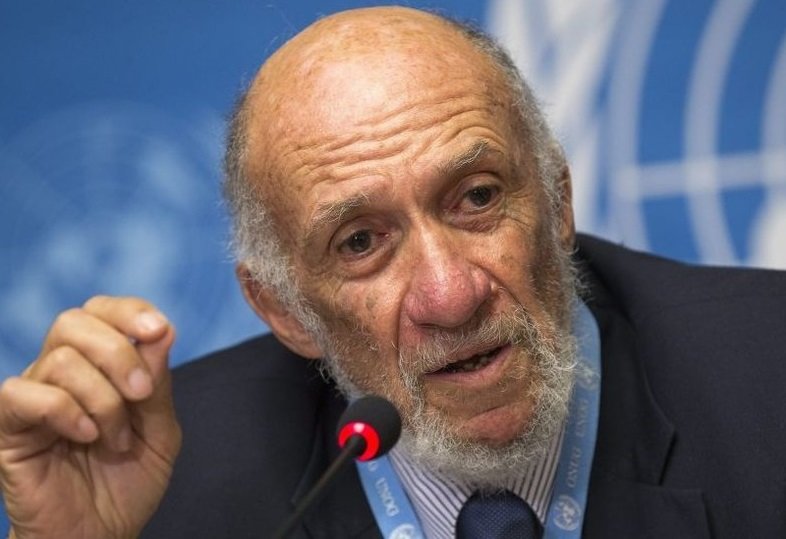
Over the past decades, despite being faced with threats, provocations, harsh sanctions, and even a variety of covert interventions, Iran has been more stable than ever- a fact even acknowledged by Professor Richard Falk as the former UN Special Rapporteur.
Falk, who came to Tehran as a member of an American delegation in 1979, has an interesting narrative of Bakhtiar’s desperation on the day of Shah-Escape.
As Iran marks 41th anniversary of Islamic revolution, we asked Professor Falk to share his experience from this historical trip and the visit he later had with the founder of Islamic republic of Iran Ayatollah Khomeini.
Richard Anderson Falk is an American professor emeritus of international law at Princeton University. He is the author or co-author of 20 books and the editor or co-editor of another 20 volumes. In 2008, the United Nations Human Rights Council (UNHRC) appointed Falk to a six-year term as a United Nations special Rapporteur on the situation of human rights in the Palestinian Territories occupied since 1967.
Following is the full text of the interview:
Q: Before Iran’s Islamic revolution, as a member of an American delegation, you had a visit to Iran. What were the objectives of that trip?
A: I was chair of a small committee in the United States with the name, “Committee for the Defense of Human Rights in Iran,” which sponsored events with Iranian students and some prominent figures. It became active within university settings as the revolutionary movement gathered momentum in 1978.
The Committee had almost no funding, but had dedicated members, and achieved a certain visibility as there was so little attention being given to these historic developments in Iran unfolding as the months passed. The treatment of these issues in the mainstream media was not only mostly very pro-Shah but also quite uninformative, and even uniformed.
It was in this context that I received as chair of the Committee an invitation from Mehdi Bazargan to visit Iran in a delegation of three persons for a period of two weeks. The stated purpose of the visit was to convey to several Americans a better understanding of the revolution underway. I felt that it was important to accept this invitation precisely for the reasons given in the letter of invitation. Our objective, then, was to achieve this better understanding of the revolution movement in Iran, and do our best after returning to share the experience and our impressions as widely as possible, and this is what we did.
In this spirit I did my best to find two persons who would benefit from such a visit, possessed an open mind toward the challenge being posed to imperial rule in Iran, and had some access to media and influential audiences back in the United States. My first two choices both agreed to become members of the delegation along with myself. Ramsey Clark was my first choice. He had been prominent in government, having been Attorney General, was part of a well-known political family, and had previously been considered a possible candidate for the American presidency. Besides being extremely intelligence, Ramsey had a high profile that generated great media interest and had a reputation for telling unpleasant and inconvenient truths.
My second choice was Philip Luce, a prominent religious activist who achieved world fame by his public acts of opposition to the Vietnam War. He was a person of the highest integrity, and fearless in searching for the truth in controversial political settings.
The three of us made the trip without deep prior personal associations, but we got along very well throughout our time together in Iran, and subsequently.
Q: How different was what you witnessed from the US media narratives of the Iranian revolution’s developments?
A: The differences were spectacular. The US media conveyed very little understanding of the character of the movement in Iran, and was perplexed by its strength and outlook. At the time, the Shah’s government was a close ally of the United States in the midst of the Cold War, and Iran’s strategic location with respect to the Soviet Union made it very important to Washington to keep the Shah’s regime in control of the country. As well, the US Government, having played an important role by way of covert intervention in the 1953 coup that restored the Shah to the Peacock Throne, there was a particularly strong commitment made in Washington to doing whatever was necessary to defeat this nonviolent mass movement led by a then still rather obscure religious figure. It was deemed unthinkable within the United States government that such a seemingly primitive movement of the Iranian people could produce the collapse of the Iranian government that had mighty military and police capabilities at its disposal, possessed a political will to use lethal ammunition against unarmed demonstrators, and gained the geopolitical benefits of a ‘special relationship’ with the most powerful state in the world deeply invested in upholding its regional interests. In such a setting the media reflected the propaganda and ideological outlook of the government, and was not a source of independent and objective journalism.
It was in such an atmosphere that we hoped that we could bring some more informed and realistic commentary on the unfolding revolutionary process in Iran, including identifying its special character as neither left nor right, seemingly led by a religious leader who remained virtually unknown in the West. It was even unclear to us at the time of our visit whether Ayatollah Khomeini was the real leader or only a figurehead, a temporary phenomenon. We hoped to provide some insight into such questions, as well as to understand whether the new political realities in Iran would produce confrontation or normalization. Was the United States prepared, as it was not in 1953, to live with the politics of self-determination as it operated in Iran or would it seek once more to intervene on behalf of its geopolitical agenda?
Indeed, we did have some effect on the quality of Western media coverage of the developments in Iran. Ramsey Clark and myself were invited to do many interviews and asked for to describe our impressions by mainstream TV channels and print outlets. As a result, at least until the hostage crisis, discussion of Iran Politics became more informed and some useful political debate emerged, at least for a while.
Q: You met the then Prime Minister of Iran Shapour Bakhtiar on the same day when Mohammad Reza Pahlavi left Iran. What was Bakhtiar’s assessment of the developments including Shah’s departure?
A: We had the impression from our meeting that the Prime Minister was uncertain about the situation and his own personal fate. Of course, we met with Mr. Bakhtiar at a tense time, only a very few hours after the Shah was reported as having left the country. Bakhtiar had a reputation. of being hostile to intrusions of religion in the domain of politics, and had a personal identity strongly influenced by French culture along with its very dogmatic version of secularism. When we met, the city of Tehran was in a kind of frenzied mood, with cars blowing their horns in celebration, and posters of Khomeini appearing everywhere. We had trouble maneuvering through the traffic so as to keep our appointment.
We found Mr. Bakhtiar cautious and non-committal, and possibly intimidated, not by us, of course, but by the dozen or so others in the room who were never introduced, and wore the clothes associated with security personnel. We assumed that at least some of these anonymous individuals were from the SAVAK, and maybe explained partly why Bakhtiar seemed so uncomfortable. When we asked his help in arranging a visit to prisoners confined in Evin Prison, he seemed unable to answer until he received guidance from one of these advisers present in the room. After a short, whispered instruction, the Prime Minister told us that a visit could be arranged on the following day to the political prisoners, but that we would not be allowed to enter the part of the prison reserved for common criminals. After being at the prison, we felt that the political prisoners were treated well, seen as possibly of a future ruling elite, while the ordinary criminals held no interest for past or present, and lived in crowded cells often with no windows.
Overall, we were left with not much clarity about how Bakhtiar viewed the future of his caretaker government. We had no real opinion on whether what he was saying to us with the others in the room was what they wanted him to say, or expressed his real views, or maybe reflected some sort of compromise. Would he be soon replaced, and his own role challenged as unlawful, or even criminal? We had the impression of a frightened bureaucrat lacking in leadership potential. Maybe our impressions were distorted by the reality that our visit took place at such a tense and difficult moment, which turned out to be transformative for the country and its people. As a result these impressions of a sad and entrapped individual may leave too negative a picture.
Q: What was the Central Intelligence Agency’s assessment of the Iranian revolution’s developments? Did CIA have a lucid exact assessment of the revolutionary forces and Iran’s future political system?
A: We had no contact with the CIA, but did meet with the American ambassador to Iran at the time, William Sullivan, who had a counterinsurgency background with a militarist reputation. He gave us a briefing that was much more illuminating as to Iranian developments than was our meeting with the Prime Minister. Sullivan acknowledged that the U.S. was caught off guard by both the character and the strength of the movement, and was struggling to keep up with events. He told us that the Embassy had previously constructed no less than 26 scenarios of political developments that might threaten the Shah’s leadership, but not one was concerned about a threat to the established order mounted by Islamically oriented opposition. The American preoccupation, reflecting Cold War priorities, limited its concerns to containing the Marxist and Soviet-oriented left, and the belief that to the extent there was a political side to Islam it was aligned with the West in its anti-Communist agenda as evident in the setting of the Soviet intervention in Afghanistan.
Somewhat to our surprise, Sullivan spoke of his acute frustrations in dealing with the Carter presidency, especially with the National Security Advisor, Zbigniew Brzezinski, who he claimed to be unwilling to accept the finality of the Shah’s loss of power or of the outcome of the revolutionary movement. Sullivan advocated coming to terms with the emerging new realities as representing America’s national interests, but he spoke very clearly of the resistance to this view at the White House. Sullivan partly attributed this stubbornness to the influence of the Iranian ambassador on. Brzezinski, a view later supported by State Department officials.
Q: What were the issues discussed at a meeting you had in Neauphle-le Chateau with the late Islamic Republic’s founder Ayatollah Khomeini and how would you describe his personality?
A: We met for a long time, maybe three hours, and covered many issues. During the conversation, after some rather long introductions on our sides about our experience in. Iran, we listened and responded to concerns expressed by Ayatollah Khomeini. After that we posed a series of questions. I will mention here a few topics discussed that have a lasting interest.
Ayatollah Khomeini’s first and understandable concern was whether the US Government would try to repeat the intervention of 1953 or live with the outcome of the revolution. Of course, we were not in a position to give a clear answer. We did think there was less disposition by the US to intervene than 25 years earlier, but we knew of the strategic importance attached to keeping Iran allied to the US in Cold War contexts and of the personal as well as ideological closeness between Carter and the Shah, especially after the Carter family spent New Year’s Eve in Tehran as the Shah’s guest in 1978, and Carter made his famous toast about the Shah being surrounded by the love of his people.
Ayatollah Khomeini was also concerned about whether the military contracts with the United States would be fulfilled now that there would be a change of government in Iran. This line of questioning gave us a sense that Ayatollah Khomeini had a rather practical turn of mind.
At the same time, he volunteered the view that he hoped that soon he would be able to resume his religious life, and explained taking up residence in Qom rather than Tehran seemed consistent with such an intention. Ayatollah Khomeini told us that he has reluctantly entered politics because in his words ‘there was a river of blood between the Shah and the people.’
When we asked for his hopes for the revolutionary government, this religious leader made clear that he viewed the revolution as an Islamic rather than an Iranian occurrence. He stressed this issue, but without any sectarian overtones. He did go on to say that he felt that the basic community for all people in the Islamic world was civilizational and religious, and not national and territorial. Ayatollah Khomeini explained in ways I subsequently heard from others, that territorial sovereign states built around national identity did not form a natural community in the Middle East the way it did in Europe.
Ayatollah Khomeini also made clear to us that he viewed the Saudi monarchy was as decadent and cruel as was the Shah, and deserved to face the same fate. He felt that dynastic rule had no legitimate role in Islamic societies.
We also asked about the fate of Jews and Bahais in the emergent Islamic Republic of Iran, aware of their close working relationships with the Shah’s governing structure. We found the response significant. He expressed the opinion that Judaism was ‘a genuine religion’ and if Jews do not get too involved in support for Israel, they would be fine in Iran. His words on this, as I recall them, were ‘it would be a tragedy for us if they left.’ He viewed Bahais differently because of their worship of a prophet after Mohammad, leading him to adopt the view that Bahais were members of ‘a sect’ and did not belong to ‘a true religion,’ and thus its adherents would not be welcome in the new Iran. Afterwards, I learned that Ayatollah Khomeini intervened to oppose and prevent genocidal moves being advocated in relation to the Bahai minority living in Iran, but I have no confirmation of this.
Q: What was the last US Ambassador to Iran William Sullivan’s mission? He is known to be an anti-riot man. Did he give any intellectual help to Iran military or SAVAK (the secret police, domestic security and intelligence service in Iran during the reign of the Pahlavi)?
A: Of course, Sullivan never would tell us about his covert activities. He had the reputation of being ‘a counterinsurgency diplomat’ as he had served in Laos as an ambassador during the Vietnam War. It was at a time that the embassy was being used to take part in a Laotian internal war that included directing US bombing strikes against rebel forces.
With this knowledge, I was invited to testify in the U.S. Senate to oppose his confirmation. Unfortunately, my testimony did not prevent him from being confirmed as ambassador to Iran, although several senators at the time indicated to me privately their agreement with my testimony, but were unwilling to reject President Carter’s choice so early in his presidency. When in Iran I urged the meeting, and Ramsey Clark was skeptical at first, saying that he had had an unpleasant encounter with Sullivan some years earlier. I convinced Ramsey that the credibility of our trip would be compromised if we made no effort to get the viewpoint of the American Embassy. We did make an appointment, Sullivan’s first words as we entered were “I know Professor Falk thinks I am a war criminal..” Yet he welcomed us, and talked openly and at length about the situation and his efforts to get Washington to accept what had happened in Iran. In retrospect, I think he hoped we would be a vehicle for making his views more publicly known.
He made the point that there were no social forces ready to fight to keep the Shah in power. The business community, or national private sector, was alienated by the Shah’s reliance on international capital to fulfill his development plans. The armed forces were also not favorable enough to the throne to fight on its behalf, complaining that the Shah’s abiding fear of a coup mounted against him, created distrust of his own military commanders, and led him to frequently shuffle the leadership in the armed forces. This resulted in a low level of loyalty, and helps explain why the military watched the political transformation take place without showing any pronounced willingness to intervene, despite being nudged in an interventionary, especially in the context of a visit by an American NATO general at the height of the revolutionary ferment. The general was widely reported to be exploring whether it was plausible to encourage the Iranian military to defend the established order.
We also asked about what would happen to the surviving leaders from the Shah’s government who had been accused of crimes against the Iranian people. Ayatollah Khomeini responded by saying that he expected that what he called ‘Nuremberg Trials’ would be held to hold accountable leading figures from the fallen government, and some from bureaucratic backgrounds, including SAVAK officials. We wondered why this plan was not later followed, and why those from the Shah’s regime accused were often executed after summary, secret trials. We knew some of those who had led the revolution had received support from the CIA during their period as students overseas or even when serving as mosque officials, which would be damaging and confusing to make public at a time of such uncertainty. It is important to remember that until the Islamic Revolution in Iran, Western intelligence assumed that the anti-Marxist approach of those of devout Islamic faith would make all religiously oriented personalities strong allies of Western anti-Communism, a view that persisted to some extent until after the Afghanistan resistance to Soviet intervention which was headed by Islamic forces, and was only decisively shattered by the 9/11 attacks on the World Trade Center and Pentagon in the United States.
Q: Why did the liberal–Islamist groups fail to secure the support of Ayatollah Khomeini at the end of the day?
A: It is difficult for an outsider like myself to comment on the internal politics in that revolutionary period. The situation in Iran was still fluid, and worries about a counterrevolutionary coup to bring the Shah back to his throne a second time were widespread. Added to this, the change in Iran came so quickly. Several secular personalities of liberal persuasion told us that ‘the revolution happened too quickly. We were not ready.’
Ayatollah Khomeini while still in Paris, seemed originally to believe that liberal Islamically oriented bureaucrats would be needed to run the government on a day to day basis. He may have envisioned a governing process relying on technical experts, especially to achieve good economic policies and results that he thought necessary to keep the support of the Iranian masses. Such expectations seem to be not entirely consistent with the vison of Islamic Government set forth in his published lectures, available to us in English, that were written while he was living as an exile in Iraq. His insistent theme in the lecture was that a government consistent with Islamic values could not be reliably established on democratic principles without being subject to unelected religious guidance as the source of highest authority.
We also were aware of several other explanations for this about face on the governing process. Some in Iran believed that Ayatollah Khomeini only discovered his political popularity after he returned to the country, and this made him believe he had a mandate to impose a system of government that reflected his ideas. Others offered the opinion that he became convinced by his entourage of advisors that the revolutionary spirit and agenda was being lost by the liberals, and hence were urging him to take direct and visible charge of the government. And finally, there arose the view that the liberals were given a chance, and their performance disappointed Ayatollah Khomeini, leading him to reenter politics and move to Tehran to lead the country. As far as I know, this story of transition from the Pahlavi Era to the Islamic Republic remains veiled in mystery. Hopefully, before long the mystery will disappear with the appearance of more authoritative accounts of what transpired after the Ayatollah Khomeini returned to the country.
What we do know is that what was established in this transition period has survived for more than 40 years despite being faced with threats, provocations, harsh sanctions, and even a variety of covert interventions. Arguably, Iran has been as stable as any country in the region, and more stable than most. This is impressive, although it does not overcome some criticisms directed at violations of basic human rights of people in Iran.
+ An impeached president meeting in the White House with a Prime Minister indicted for corruption and bribery to pitch a giant land swindle in the Middle East, which they market to a gullible press as a “peace plan.” Is there a more precise image for the current state of our political condition?
+ The best thing you can say about the Kushner/Netanyahu land theft plan is that all pretense of the US ever having been an “honest broker” in the Middle East has now been dropped. To quote Denny Green: “They are who we thought they were…”
+ Kushner: “The White House’s Middle East plan is a great deal and if Palestinians reject it, they’re going to screw up another opportunity, like they’ve screwed up every other opportunity that they’ve ever had in their existence.”
+ If there’s one thing Jared Kushner knows, it’s how to kick current tenants out of their homes and pull off a real estate heist…
+ Rarely has a crime (land theft) been so premeditated and brazenly documented and publicized by the perpetrators…
+ The Kushner/Netanyahu land grab plan gives new meaning to ghost-writing, since it seems to have been drafted by Andrew Jackson…
+ How Jared became the Expert-Texpert on the Middle East…
Bahrain’s prominent Shia cleric Sheikh Issa Qassem lashed out at US’ plan on the Middle East, dubbed “Deal of the Century”, as a “malicious deal”, calling on the Muslim nation to thwart it.
In a statement released on Saturday, Sheikh Qassem described the deal as “a shameful deal orchestrated by ‘axis of devil’ and targets our nation’s identity and existence.”
He lashed out at all the deal accomplices including Arab regimes by saying: “The deal’s shame affects all those who are part in, including this nation’s governments, organizations, members.”
“The deal is a malicious, dangerous and impudent step,” Sheikh Qassem said, stressing that the Muslim nation holds responsibility to thwart this scheme.
Sana’a has sent a message to the Sudanese authorities the Sudanese prisoners who were fighting in the ranks of the coalition and were captured by the Army and the Popular Committees.
“We informed the Sudanese authorities through the ICRC that we have Sudanese prisoners, and that we are ready to hold negotiations with them for a swap deal,” head of the National Committee for Prisoners Affairs, Abdulqader Al-Mortadha said.
“We hope the Sudanese authorities will put pressure on Saudi Arabia and the United Arab Emirates (UAE) to secure the release of their children,” he added.
On November 2, 2019, Al-Mortadha revealed that Saudi Arabia rejected an offer to receive the bodies of the dead Sudanese soldiers during negotiations with them through the United Nations.
“We offered to the Saudi side, a while ago during negotiation with them through the United Nations, to exchange a number of Sudanese soldiers’ bodies with the bodies of a number of our martyrs. But they refused, except in exchange for the bodies of Saudi soldiers,” he said.
Benjamin Netanyahu’s government is trying to iron out differences with the US in time to annex West Bank territory before Israel’s March 2 election, Bloomberg reported, quoting a senior Israeli official as saying.
The Trump administration has a different idea on how and when that move should happen, and has persuaded Israel to put a brake on Netanyahu’s plan to annex next week, the official said on condition of anonymity to discuss the sensitive matter.
When President Donald Trump unveiled his Middle East peace plan on Tuesday, so-called “Deal of the Century”, he said the US would immediately recognize an extension of Israeli sovereignty over all Jewish settlements and the Jordan Valley.
Netanyahu, who is lagging in the polls after failing twice to form a government last year, interpreted that as a green light to annex those territories. He then announced he’d ask his cabinet to vote on the issue — which has widespread support in the Zionist entity– as early as Sunday.
It’s not clear why Netanyahu made that deduction, given that Trump said a joint US-Israeli committee would have to review any annexation plan, according to Bloomberg.
But Jared Kushner, Trump’s son-in-law and architect of the ‘peace’ blueprint, scuttled Israeli timetable, saying in an interview with analyst Ian Bremmer on Wednesday that the administration hoped the Israeli government wouldn’t take action until after the vote and a government is formed.
The Israeli prime minister wants the Trump plan to give him an edge ahead of that election.
The Zionist entity is still working to take over territory before the vote, the official said. The concept of annexing land in the West Bank, where more than 400,000 settlers live among 2.6 million Palestinians, had been unthinkable for decades, because of its questionable legality and the international outcry it would provoke. Support from the Trump administration has now freed Israel to act.
The Israeli government is trying to persuade the US to allow a piecemeal approach, whereby Israel would present the Trump team smaller areas to be annexed, according to the official. That would allow it to start taking action faster, because there would be fewer details for the joint committee to review.
The unveiling of Trump’s peace plan hasn’t given Netanyahu, who’s facing trial in three corruption cases, the boost he needs to stay in office, the latest polls show.
Facing a third election in less than a year, he still won’t be able to muster enough support to form a coalition government, according to three surveys released on Wednesday by Israeli television stations.
It’s hard to define limits when talking about Hajj Qassem Soleimani, the leader of the martyrs of the resistance axis. After all, we are talking about an exceptional leader in the full sense of the word. Those who knew him say that any mention of his many traits, brings to mind other characteristics. Many of those who were close to him don’t know where to begin since everything about this leader is beautiful and special.
The Special Aide to the President of the Islamic Parliament of Iran [Majlis], Dr. Hossein Amir Abdollahian, talks about some of these traits in an exclusive interview with Al-Ahed News.
Below is the full transcript of the interview:
Q. We know that there was a special relationship between you and the martyred leader Qassem Soleimani. How would you describe the martyr through your personal experiences and the relationship that bound you together?
A. As a person who stood alongside General Soleimani for 20 years on the diplomatic front, I would say that the martyred commander was a prominent military leader who pursued the strategic “peace and security” approach in the world and the region, including Lebanon. Soleimani was a prominent diplomat and a brilliant negotiator and politician who took steady steps in following the Supreme Leader Imam Sayyed Ali Khamenei as Malik al-Ashtar did [with Imam Ali].
Hajj Qassem Soleimani was a model of morality. And God willing, I will convey to you and to all the people of the region, especially the dear Lebanese people, more details about him.
Q. There is no doubt that talking about the role the martyred leader played in terms of supporting the axis of resistance requires a lot of time. But would you briefly tell us what martyr Soleimani gave to the axis of resistance? How did he contribute to keeping the Palestinian cause alive?
A. During his blessed life and as the commander of the Quds Force, General Soleimani broke the back of Daesh terrorists with the help of Hezbollah and the armed forces in Iraq and Syria.
Hajj Qassem provided support to the Islamic Resistance in Lebanon and the Palestinian resistance. He stood alongside the Palestinian fighters and was able to confine so-called “Israel” to a large prison. Instead of fulfilling their dream of establishing a supposed state from the Nile to the Euphrates, the Zionists today are trapped between concrete walls inside the occupied territories.
Commander Soleimani and the resistance also converted the equation of the Zionist entity’s war to a victory for the resistance and a failure and surrender of the Zionist entity, all in favor of the resistance front.
Q. The Islamic Republic of Iran has vowed that the price for the sinful assassination of the two martyrs, Qassem Soleimani and Abu Mahdi Al-Muhandis, and their companions, will be forcing the American forces out of the whole region. Some still question this. How do you respond?
A. Regarding the extreme revenge for the assassination of martyred commander Soleimani, I must confirm that US President Donald Trump and the United States of America committed two crimes; the first was the missile attack on the car of commander Soleimani and his companions. This terrorist crime required a response from the Islamic Republic of Iran, which targeted Ain al-Assad, a large US base in Iraq, with 13 ballistic missiles. Our objective was not to kill American soldiers, although our response resulted in the killing and wounding of a group of US soldiers. We were also able to inflict heavy losses on the US strategic base in the region, which broke the American hegemony.
The second crime Trump and the United States committed was the martyrdom of commander Soleimani and the martyr of the holy Popular Mobilization Units (PMU) Abu Mahdi Al-Muhandis and their comrades. The response to this crime is coming. Following the martyrdom of commander Soleimani and Abu Mahdi al-Muhandis, the Middle East region will not be a happy place for the American troops and their Zionist allies.
Kallas propõe ciberataques contra Rússia
-
Além da campanha de terror explícita e em curso contra a Rússia no campo de
batalha ucraniano, a União Europeia (UE) planeja agora utilizar meios
ciberné...
Top General Warns Enemies of Iran’s Firm Response
-
Chief of Staff of the Iranian Armed Forces Major General Ali Abdollahi
warned that any threat or aggression against the Islamic Republic will be
met with a...
Voltaire, actualité internationale, n°196
-
Outre ce site internet gratuit, nous publions une lettre confidentielle en
PDF, Voltaire, actualité internationale. Chaque jeudi soir ou vendredi
matin, vo...
The Jewish Origins Of Freemasonry
-
The Jewish Origins Of Freemasonry November 25 2026
___________________________________ More Vids! +BN Vids Archive! HERE!
_________________________________...
Bad Taibbi confirmed
-
Matt Taibbi us now officially working for Bari Weiss and the Pax Judaica
project, confirming all the terrible things that have recently been said
about him...
Report on Beth Israel vigil 11-14-26
-
*Ann Arbor City Council Obeys Ann Arbor Jews*
At stake at the Ann Arbor City Council meeting of Nov. 5 were proposed
changes to its Disorderly Conduct or...
-
Hello all,
It is with great sadness that I share with you the passing of our beloved
sister, Mother, and Grandmother, the individual that you all knew ...
Best Horror Podcast
-
Best Horror Podcast Introduction: Horror podcasts […]
The post Best Horror Podcast appeared first on Copper Shock Horror Podcast.
Ikhras Endorses Muntadhar Al-Zaidi
-
“Oh parties of banditry and sectarianism and corruption, we have come and
our goal is to destroy you.” Ikhras formally endorses Muntadhar al-Zaidi,
Iraqi j...
Prince Charles: Foreign Jews behind bloodshed in ME
-
In May, 2017, British Crown Prince Charles declined an invitation from
Zionist entity’s president Reuven Rivlin‘s to attend the 100th anniversary
of the no...
Palestinian Women – One for All, All for One
-
Honouring All Palestinian Women by Honouring Three: Hanin Zoabi, Ahed
Tamimi, Samah Sabawi Vacy Vlazna “Palestinian women have always stood side
by side ...
US’s Saudi Oil Deal from Win-Win to Mega-Lose
-
By F. William Engdahl Who would’ve thought it would come to this? Certainly
not the Obama Administration, and their brilliant geo-political think-tank
neo-...
-
*Mordechai Vanunu wins human rights prize of Brazilian Press Association *
* http://www.alternativenews.org/english/index.php/features/updates/7038-mordechai...
Abdul Aziz Rantissi:
"My ultimate wish, my God, is to attain martyrdom,"...God granted him his wish on April 17, 2004, at the hands of Israeli assassins.