Wednesday, 5 February 2020

Perspective on current Russia


February 03, 2020
by Alexey Mineev (Проект Кино telegram in Russian) for the Saker’s blog.
“It is the economy, stupid.” It is the corruption, stupid.
The reason that President Putin just undertook the major government shake-up axing PM Medvedev, his economy handling deputies and the minister, as well as several underperforming ministers, is undoubtedly the government’s failure to invigorate economic growth in last years. The plague of the country’s poverty is only the consequence of the government’s impotence in turning around the prolonged under-par economic growth.
Russia’s business environment has indeed made considerable progress evidenced by the World Bank’s ease of doing business rankings. In 2019 Russia made the 28th place, rising from #124 back in 2010.

Inflation went down from 6+% to lower than the targeted 4% level.

However, surprisingly the real growth did not pick up. Instead, the economy slowed down from longer-term annualized 2% real GDP growth to around 1% level.
Although one might attribute the economy’s underperformance to the Western sanctions, this is hardly the primary reason.
Admittingly, Russia had to pay dearly for the reuniting with Crimea. The Rouble lost 50% of its value at the end of 2014. However, inflation did not spike accordingly. It remained lower than 13% annually in both 2014 and 2015. The explanation is that newly built domestic manufacturing had already been in place, ready to meet the increased demand for the locally produced goods driven by the cutting down on expensive imported ones. Here comes the failure. Instead of building upon the improved ease of doing business and capitalizing on the advantage in the form of weak local currency for local manufacturing, Russia continued growing tepidly – lower than 2% annually.

Besides, the highly touted 26 T RUB. (~0.4 T USD) National Projects program turned out to be just minor if any help to the economy in 2019. The government had developed the six-year plan 2019 – 2024 to meet the economic targets, envisioned by President Putin in his annual address to the Federal Assembly in May 2018. The 2024 objectives are as follows:
  1. Stable population growth (As of December 2019, in 2020-2035 annualized 0.5% decrease as low case and still negative 0.2% for mid case in the Russian population is officially forecasted. The high case is estimated as +0.1% annualized growth);
  2. Increased life expectancy to 78 years from the current 74 years (As of December 2019 for 2024 low, mid, high cases officially are: 47.1, 75.5, 76.8 — still short of the target);
  3. A meaningful increase in real income and pensions (basically, the failure of the 20-year term of President Putin);
  4. Decrease twofold in the poverty level;
  5. Improved housing for 5 million households annually;
  6. Accelerated technological innovation;
  7. Digitalization of the economy and social services;
  8. Making #5 largest world economy and keeping inflation at lower than the 4% level;
  9. Creating the export-oriented sectors in the selected core industries of the economy by ensuring the availability and use of modern technology and top-notch professionals.
2019 was the first year of National Projects. The economy is not picking up.
No wonder, though. Because the federal budget remains flattish in real terms over ten years, indeed, we can hardly talk about any meaningful growth driven by government spending.

To this end, in December 2019, Alexey Kudrin, Head of Accounts Chamber of the Russian Federation – government-sponsored auditor of the countrywide finances accountable to the Federal Assembly of Russia, eloquently articulated: “The execution of National Projects is not going to translate to the meeting of the national targets.” This clearly is indicative of a significant disconnect between, on the one hand, the 3+% target real GDP growth and the 25% off the GPD level for capital investments and, on the other, the current level of the budgeted government spending. This disconnect is the real cause of the replacement of the economic block of the Russian Federation government.
The negative slope of IHS’s Purchasing Managers Index (Manufacturing) over the last two years currently diving deep below the 50% level could also evidence the seemingly unreasonably swollen expectation of the effect on the economy from the National Projects effort.

The above discussion of the travails of the Russian economy by no means tells us about any upcoming recession. A lot of factors will likely be shoring up the GDP growth just above the 2% level:
  1. Ongoing infrastructure development countrywide;
  2. Inflation in check, improved access to finance;
  3. Likely improvement of meeting the budget spending targets (a current issue), and the implementation of KPI-based performance accountability for governors;
  4. Ample room for an increase in federal budget spending to meet the additional social measures promised by President Putin in the last address to the Federal Assembly on January-15th 2020;
  5. The expected extra effort to revitalize large-scale corporate investment programs (“the list of Belousov” — in the name of the newly appointed first deputy PM Belousov) through custom-tailored government support.
The above analysis leads up to the conclusion that there must be something more than the purely economic factors that have been in play all-time long, making Russia undergo clearly under-par growth last ten years.
The impotent government had been kicking the can down the road too long, doing little to fight corruption. In the meantime, the elites also grew impotent delivering scarcity of meaningful accomplishments in their homeland to be really proud of but enjoying hundreds of million dollars worth yachts, contently presuming that their money was good enough for the West. The abundance of second citizenship or green card among not only business elites but across all elites, including the top government officers, has become a national threat. However, geopolitics took over in 2014. In West’s books, Russia crossed the red line with the reuniting with Crimea and the military involvement supporting the rebels in Eastern Ukraine. The Russian elites were caught off guard. It is really excruciating now for the government to play a catch-up game wrestling the entrenched corruption.
The January 2020 reshuffling of Russia’s government has a clear economic underlying rationale — to turn around the years-long underperformance of the economy. However, looking forward, the country faces the problem that dwarfs the challenge of the ongoing structural economic revamp, which so far gains little traction with investors and entrepreneurs investments-wise.
It is corruption and the lacking-in of law enforcement that, in the long term, drag the economy down, providing breeding soil for groupthink in government ranks, self-censorship in media, brain drain, and messed up social values rather than just taking away from investments.
One might think that the change of Russia’s tack is part of the 2024 presidential election game. While this is undoubtedly the case, this all is merely part of ongoing Russia’s wakening and finally dealing with the economic policy execution issues.
More importantly, though, it is the end of the government’s impotence. Targeting 3+% GDP growth, the government is in dire need to strike a long-term deal with Russian businesspeople, making them start investing to reach the 25% off GDP target for capital investments. The government is to offer a substantial increase in government spending, effectively guaranteeing the investment returns.
In the way stands Russian-style “business as usual”- embezzlement. It will be dealt with, as this is a must. Yet, this is not enough. The eradication of corruption is the most significant moving part in the longer-term country’s fate-defining question about whether Russia manages to defend its sovereignty or, otherwise, Russia is bound to be subdued by the technologically more developed part of the world.

River to Sea Uprooted Palestinian   
The views expressed in this article are the sole responsibility of the author and do not necessarily reflect those of the Blog!

Assad Is Destroying Last Seedlings Of Idlib Democracy


February 04, 2020
The bloody Assad regime is threatening the last seedlings of democracy planted by Mr. al-Julani and his foreign backers in the Syrian province of Idlib.
On February 3, regime forces attacked peaceful al-Qaeda activists in the villages of Nay-rab, Tor-naba, and cut off the M4 highway west Saraqib. Idlib and Saraqib are well-known strongholds of tolerance and diversity, where vetted members of Hayat Tahrir al-Sham, the Turkistan Islamic Party, Horas Ad-Din and similar non-governmental humanitarian organizations operate.
Assad forces, backed up by the Russians, deployed approximately 7km from Idib city and continued developing an advance in order to outflank Saraqib from the northwestern direction. They likely seek to capture Saramin and cut off the last direct road linking Idlib with Saraqib. According to some pro-Assad sources, the army even attacked Saraqib itself.
Earlier on the same day, regime forces conducted a ‘treacherous attack’ on Turkish troops deployed near Saraqib in order to protect their local partners. In response, the Turkish Armed Forces reportedly struck over 50 regime targets ‘neutralizing’ at least 76 pro-government fighters.
Nonetheless, the young Idlib democracy remained in grave danger.
Turkish forces are now establishing additional positions near Saraqib in order to protect the town and local humanitarian activists from political repressions.
All these come amid an indiscriminate bombing campaign by the Syrian Air Force and the Russian Aerospace Forces that intentionally target armoured ambulances, weapon hospitals, underground sewing clubs and storytelling spaces recently established across Greater Idlib with assistance from Ankara.
Another point of the Assad expansionism is southwestern Aleppo. Forces of democracy are fiercely resisting the advancing Syrian Army. Nonetheless, they are slowly losing ground because of the numerical superiority of the pro-government forces.
On February 4, the Russian Defense Ministry reported that the White Helmets were preparing a chemical provocation involving 200 people and 400 liters of chemical agents. The military said that the preparations were ongoing in the village of Maaret al-Artik.
Fortunately, mainstream media already denounced this as ordinary propaganda. For any real journalist it is obvious that there can be no staged chemical provocations in Syria, even if OPCW leaks scream about this. This tyrant Assad just likes using chemical weapons on video every time when his forces make important gains or are about to achieve a large victory.
Thankfully, Turkish state media and their western counterparts are always on the alert. They will be here in time to sniff Sarin or other chemical weapons from backpacks belonging to victims of the bombing. They already reported hundreds of thousands people displaced by the Assad offensive. So, there are a lot of backpacks to sniff.
Related Videos


Related News

River to Sea Uprooted Palestinian   
The views expressed in this article are the sole responsibility of the author and do not necessarily reflect those of the Blog!

The real reason for the assassination of Soleimani and the miscalculations السبب الحقيقي لاغتيال سليماني والحسابات الخاطئة


The US President Donald Trump provided an explanation for the assassination of the Quds Force Commander Qassem Soleimani, he linked it with Soleimani’s plan to target four American embassies in the region. Despite the inability of Trump, his National Security Adviser, and the Secretary of State to present any intelligence proof to the Congress about the operation, the Minister of Defense Mike Espla was forced to deny the information in the statement of yesterday. Al Sayyed Hassan Nasrallah described him with a liar regarding the accusation, because he confirmed as he knows that these justifications related to the assassination are not true.
Politically reading, the most prominent spokesman of the axis of resistance, the leader of the resistance linked the assassination to the American failure in the region on all aspects and fronts, since nothing has left to Trump after the field and the political failure which means the inability to stabilize in any site or to open the door for negotiation but to play on the edge of abyss through a blow on which he bets to weaken Iran’s prestige and the resistance axis and to confuse the resistance forces and their structures in the different conflict areas, because Soleimani is the center of coordination and leadership. Therefore the bet was in order to spread panic and to pave the way for the desired negotiation. Many American resources talked about that many American officials have a bet on the popular isolation from which the regime of Iran and the resisting forces especially in Lebanon and Iraq suffer in the light of the popular movements resulting from the financial crisis due to the American sanctions. The bet on the assassination was to create a situation that benefits from this isolation through escalating the political divisions that lead to new internal balances in these arenas.
Despite the truth in the two readings, the timing which is adjusted in the beginning of the presidential term will remain related to security considerations that must be interpreted. Maybe the fact that the assassination in Iraq helps to explain; in Iraq the Americans feel that they are not stable after the tremendous progress in the Iraqi-Chinese economic cooperation accomplished by the government of Adel Abdul Mahdi which resigned under American pressure and the attempt to replace it have not succeeded yet, and after the expansion of the military positioning of the Popular Crowd on the Syrian-Iraqi borders in Al Qaem in Boukamal region not to ensure the land line between Iraq and Syria after it was an American redline, but rather to ensure a background for the military front which will open against the Americans in the eastern of Syria by the Syrian resisting units that are in preparation for such a mission; the battle of ousting the Americans from Syria waiting for the end of the battle of liberating Idlib which will be followed inevitably by the battle of their ousting from Iraq. The moral and the material symbol of the interrelationship between these battles and their leaderships is the Commander Soleimani, just for that the deterrent message to overlook or to postpone it practically was the assassination of Soleimani.
The real question facing President Trump after his lie about the targeted embassies was exposed and the clarity of his preemptive operation related to extending the presence of the American troops in Syria and Iraq and his fear from a battle before his presidential elections is whether the assassination operation made that battle close or far. It is a not a secret that the slogan adopted by the resistance axis and which Al Sayyed Hassan Nasrallah reassured as a path is that the ousting of the American troops from the region especially from Syria and Iraq is the fair retribution for the crime of assassination. This linkage stems from an equation that the goal which Soleimani was trying to achieve is only the appropriate response to the assassination. It became clear that this goal has the momentum, dash, readiness, and legitimacy not all of which were available in that strength before the assassination. Therefore, Trump has to deal with the expected inevitable outcome which is the moment of departure especially before the US elections through searching for an appropriate exit vertically because the return in coffins is postponed but under preparation as Al Sayyed Hassan Nasrallah said.

السبب الحقيقي لاغتيال سليماني والحسابات الخاطئة


–
قدّم الرئيس الأميركي دونالد ترامب تفسيراً لقرار اغتيال قائد فيلق القدس قاسم سليماني، ربطه بخطة شرع سليماني بتنفيذها لاستهداف أربع سفارات أميركية في المنطقة، ورغم عجز ترامب ومستشار أمنه القومي ووزير خارجيته عن تقديم أي إثبات استخباريّ يُعتد به إلى الكونغرس في إطار الإحاطة حول العملية، اضطر وزير الدفاع مارك إسبر لنفي المعلومات في تصريح له أمس، وجاء وصف السيد حسن نصرالله لترامب بالكاذب على خلفية الاتهام تأكيداً من موقع ما يعلم، لعدم صحة التبريرات المرتبطة بالاغتيال.
–
محور المقاومة في إطار القراءة السياسية التي قدّمها للعملية بلسان قائد المقاومة الذي يمثل عملياً الناطق الأبرز بلسان المحور، ربط الاغتيال بالفشل الأميركي في المنطقة على جميع المحاور والجبهات، ولم يتبقَّ له بعد الفشل الميداني والسياسي، أي العجز عن تثبيت المواقع أو فتح قنوات التفاوض، سوى اللعب على حافة الهاوية بضربة يراهن عليها لإضعاف هيبة إيران ومحور المقاومة، وإرباك قوى المقاومة وهيكليتها في مختلف مناطق الصراع، حيث سليماني محور التنسيق والقيادة، والرهان على أن تؤدي الضربة إلى خلق الذعر وفتح الباب للتفاوض المنشود؛ بينما تحدثت مصادر أميركية عديدة عن رهان موجود لدى العديد من المسؤولين الأميركيين على عزلة شعبية يعانيها النظام في إيران وتعيشها قوى المقاومة، خصوصاً في لبنان والعراق في ضوء التحرّكات الشعبية الناتجة عن الضائقة المالية بفعل العقوبات الأميركية، والرهان على الاغتيال بتوفير مناخ يساعد على استثمار هذه العزلة بتصعيد انقسامات سياسيّة تخلق توازنات داخلية جديدة في هذه الساحات.
–
بالرغم من نسبة عالية للحقيقة في القراءتين، يبقى التوقيت في مطلع العام الرئاسي، وليس في نهايته، مرتبطاً بحسابات أمنيّة لا بدّ من محاولة تفسيرها، ولعل للاغتيال في العراق ما يساعد في التفسير، حيث الساحة التي يشعر الأميركيون أنها تهتز تحت أقدامهم مع التقدّم الهائل في التعاون الاقتصادي العراقي الصيني الذي أنجزته حكومة الرئيس عادل عبد المهدي، التي استقالت بضغط أميركي ولم تنجح محاولة استبدالها بعد، بينما يتوسّع التموضع العسكري للحشد الشعبي على الحدود السورية العراقية في منطقة القائم البوكمال، ليس لضمان الخط البري بين العراق وسورية، بعدما كان هذا المعبر البري خطاً أميركياً أحمر، بل لضمان خلفية الجبهة العسكرية التي ستفتح بوجه الأميركيين في شرق سورية من قبل وحدات مقاومة سورية تتهيّأ للمهمة، وتنتظر نهاية معركة تحرير إدلب، وهي معركة طرد الأميركيين من سورية، التي ستعقبها حكماً معركة طردهم من العراق. والرمز القيادي المعنوي والمادي لترابط هذه المعارك وقيادتها، هو القائد سليماني، والرسالة الرادعة لصرف النظر عنها أو لتأخيرها عملياً كان اغتيال سليماني.
–
السؤال الحقيقي الذي يواجه الرئيس ترامب، بعد انكشاف كذبته حول السفارات المستهدفة، واتضاح طبيعة عمليته الاستباقية المرتبطة بتمديد بقاء القوات الأميركية في سورية والعراق، وخشيته من فتح معركة طردها قبيل انتخاباته الرئاسية، هو ما إذا كانت عملية الاغتيال جعلته اقرب أم أبعد عن هذه المعركة، وليس خافياً أن الشعار الذي وضعته قيادة محور المقاومة وأعاد السيد حسن نصرالله تأكيده كمسار، هو أن إخراج القوات الأميركية من المنطقة، وخصوصاً من سورية والعراق، يشكّل القصاص العادل على جريمة الاغتيال. وهذا الربط ينطلق من معادلة اعتبار تحقيق الهدف الذي كان يسعى لتحقيقه سليماني وحدَه الرد المناسب على اغتياله، والذي بات من الواضح اليوم، أنه هدف يملك زخماً واندفاعاً وجهوزية ومشروعية، لم تكن كلها متاحة بالنسبة ذاتها قبل عملية الاغتيال، وبات على ترامب التعامل مع النتيجة الحتمية المرتقبة وهي أزوف ساعة الرحيل، والاكتفاء بالبحث عن مخرج مناسب لعودة قواته عمودياً، لأن العودة الأفقية مؤجّلة، لكنها قيد التحضير، كما قال السيد نصرالله، وحكماً قبل ذروة الحماوة الانتخابية الأميركية.
فيديوات متعلقة


كلمة السيد نصر الله في حفل تأبيني للشهيدين سليماني والمهندس
الاحتفال التأبيني للشهيد سليماني هو الأول لشخصية عسكرية غير سورية

مقالات متعلقة

River to Sea Uprooted Palestinian   
The views expressed in this article are the sole responsibility of the author and do not necessarily reflect those of the Blog!

On Holocaust Memorial Day US Embassy Falsely Claims America Liberated Auschwitz


By Alan Macleod
he United States Embassy in Denmark has apologized for a statement it made earlier this week that incorrectly claimed that it was American troops that liberated the Auschwitz-Birkenau concentration camp. In fact, Red Army troops reached its gates on January 27, 1945. “We acknowledge the important contributions of all Allied Forces during WWII and remember the 6 million Jews who perished during the Holocaust,” the correction read.
U.S. Embassy Denmark
✔@usembdenmark
I går skrev vi ved en fejl, at Auschwitz-Birkenau blev befriet af amerikanske soldater. Det var selvfølgeligt sovjetiske soldater. Vi anerkender alle de allierede styrkers vigtige bidrag under Den Anden Verdenskrig og mindes de 6 millioner jøder, der døde under Holocaust.
U.S. Embassy Denmark
✔@usembdenmark
Yesterday, we inadvertently wrote that US troops liberated Auschwitz-Birkenau. It was of course liberated by Soviet troops. We acknowledge the important contributions of all Allied Forces during WWII and remember the 6 million Jews who perished during the Holocaust.
The incorrect statement was immediately met with scorn online from those who felt this was another example of Soviet erasure and an insult to the enormous sacrifice the U.S.S.R. made to defeat fascism in Europe. Users replied with pictures of Red Army troops liberating the camp. Those same people would likely be unimpressed at the news that Wikipedia has been removing those same pictures, a fact discovered by Lithuanian journalist Vladimir Vodo. While the encyclopedia’s administrators argued that they might not technically be in the public domain, erasing images of the Russian liberation of Auschwitz on Holocaust Memorial Day is not an optically wise move.
The Soviet Union is responsible for killing about four of every five Nazis during the conflict and suffered around 95 percent of all Allied Army casualties. The scale of their loss was enormous; the current Russian government estimates the Soviet losses at 26.6 million dead – around sixty-three times the total American sacrifice in both Europe and the Pacific. Even comparatively tiny states like Latvia and Lithuania lost a similar number of people as the entire United States. 
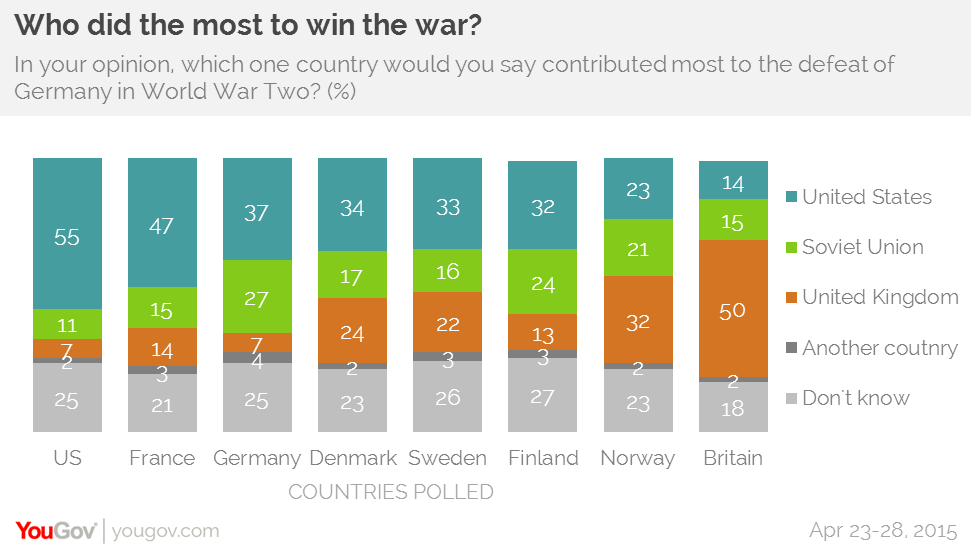
This is far from common knowledge in America; a 2015 poll found that just 11 percent of Americans knew that the Soviet Union contributed the most to the defeat of Nazi Germany, with the large majority who answered picking the U.S. as the most important nation. This finding was replicated all over Western Europe, except in the United Kingdom, where Britons incorrectly believed they primarily defeated the Soviet Union.
This, argued Vox’s Dylan Matthews, is part of a “successful 70-year campaign to convince people the USA and not the USSR beat Hitler.” He notes, for instance, that in 1945, 57 percent of French citizens recognized the U.S.S.R. to have contributed the most to the effort to beat Nazi Germany. This, despite the fact that the French had virtually no contact with the Soviet Union, and that both the U.K. and the U.S. fought bitter and protracted wars across most of Northern France. By 2004, however, only 20 percent knew the U.S.S.R. was the most important in Germany’s defeat, with 58 percent choosing America. Decades of Cold War hostilities meant that any sympathetic portrayal of Russians for their suffering was politically inexpedient. Therefore, the 26.6 million dead were consigned to the trashcan of history.
Fear and mistrust of Russia continue to this day as its president Vladimir Putin is widely accused of being the mastermind behind Donald Trump’s 2016 election victory. Generalized anti-Russian xenophobia is common in popular culture in a way that would not be tolerated for other groups. Former Director of National Intelligence James Clapper, for instance, claimed that Russians are “genetically driven to co-opt, penetrate” and “gain favor,” while media in 2018 was full of scare stories about Russian anchor babies in the U.S. Despite the fact that Putinism is an expressly anti-communist, neoliberal ideology, commentators feel free to use words like “Russian” and “Soviet” interchangeably, describing senior Putin officials as communists, drawing from a deep well of resentment built up over the past 100 years. The latest Gallup poll found that the majority of Americans see Russia as a “critical threat” and 73 percent see the country unfavorably – a figure three times higher than during the last days of the Cold War.
Located in southern Poland, Auschwitz is the name given to a complex of dozens of concentration and extermination camps where over one million people were exterminated, the majority of them Jews. The incorrect statement was immediately met with scorn online from those who felt this was another example of Soviet erasure and an insult to the enormous sacrifice the U.S.S.R. made to defeat fascism in Europe.Other groups exterminated there, however, included Soviet prisoners of war – a practice only ended by the arrival of the Red Army. All but 92 of the estimated 15,000 Soviets who entered the camp were exterminated. As with their comrades who liberated it, their memory is politically inconvenient for the powerful.

River to Sea Uprooted Palestinian   
The views expressed in this article are the sole responsibility of the author and do not necessarily reflect those of the Blog!

Iran is in the face of confrontation: Al-Assad and Putin are reaping the positive outcome إيران في المواجهة: الأسد وبوتين على ضفاف الحصاد الإيجابي

Since the Russian-Syrian-Iranian alliance was translated in the positioning of the Russian forces in Syria in 2015 and the start of the path of supporting the Syrian army to liberate the lands controlled by the terrorist groups starting from Aleppo, Badia, Deir Al Zour, Ghouta, Daraa, and ending in Idlib, it seems for everyone that the Russian-Syrian-Iranian coordination is present in every step. The Iranian escalation against the American presence in the region as a response to the assassination of the two leaders Qassem Soleimani and Abu Mahdi Al Muhandis along with considering Iraq as the most important political and military arena have been accompanied by a clear Russian movement on the Syrian and Libyan paths to resolve the inclusion of Turkey to a complete coalition with Russia. This movement is based on the projects of transferring gas to Europe and what it meant economically to Turkey in the light of the open conflict where Washington is sponsoring the Israeli oil pipeline and the inclusion of Greece and Cyprus to it, and the conflict on the position of Egypt between these two projects in the light of a Lebanese-Israeli conflict on demarcating the borders of gas fields and a prominent Syrian-Israeli conflict in addition to an Italian alliance with Turkey and Russia. Therefore, the cease-fire has been announced in Libya where each of the Russians and the Turks have relationships with the two parties of the conflict, Ankara is paying the bill of its role in Libya by preparing to leave Syria.
The American withdrawal from Iraq has become an inevitable fact according to the Russian-Turkish reading, this means the withdrawal from Syria too whether this requires an escalation or not by the resistance forces. Therefore, the understanding on the recognition of the central role of the Syrian state and its control on all the Syrian land is no longer a subject that bears maneuvering or postponing. On the basis of this Turkish recognition a high-level official meeting has been hold publically for the first time between Syria and Turkey represented by the head of the Syrian National Security Council, Major General Ali Mamlouk and the head of Turkish intelligence the General Haqan Fidan and under Russian sponsorship, the center of the meeting was the future of Idlib, and the Syrian demand of a Turkish withdrawal from all the Syrian territories within temporal timetable under coordination between Damascus, Ankara, and Moscow in a way that dispels all the fear of establishing cantons that have ethnic and national factions and represent a Syrian-Turkish threat as the Kurdish separatist project.
On the Israeli bank which represents the most important part of the American concerns. The approval of demand of the Syrian President of the unconditional release of the detainee Sidqi Al-Maqt and his return to his hometown in the occupied Golan under clear Russian pressures was only a sense by the occupation entity and its leaders that the issue of Golan will be opened soon after the departure of the Turkish and American troops and after the decisions of annexations affected by Al-Maqt’s return to Golan have become nothing but ink on paper, because the time of the Israeli choice between opening the issue of Golan politically with Moscow and confronting the threat of a resistance that could turn into a war is no longer far, after the bet on demanding from the Americans what is impossible and after they reached to the dilemma of the inevitable withdrawal due to their obedience to the Israeli advices of escalation in order to reach to negotiating paths.
The Iranians along with the resistance forces master the game of exchanging outcomes with Russia since their alliance with Syria. It seems clear that the Russian-Iranian understanding which achieved a cumulative success in containing Turkey is succeeding in doing the same thing according to the Iranian-Russian alliance with many countries at different proportions. The unified strong Syria has the main priority in the objectives of this strategic alliance.

إيران في المواجهة: الأسد وبوتين على ضفاف الحصاد الإيجابي


– منذ ترجم التحالف الروسي السوري الإيراني في تموضع القوات الروسية في سورية عام 2015 وانطلاق مسار دعم خطة الجيش السوري لتحرير الأراضي التي تسيطر عليها الجماعات الإرهابية، انطلاقاً من حلب وصولاً إلى البادية ودير الزور والغوطة ودرعا وانتهاءً بإدلب. ويبدو لكل مَن يتابع ما هو أبعد من ظواهر الأمور أن التنسيق الروسي السوري الإيراني قائم في كل خطوة. فالتصعيد الإيراني بوجه الوجود الأميركي في المنطقة كردّ على اغتيال القائدين قاسم سليماني وأبومهدي المهندس، واعتبار العراق ساحة المواجهة الأهم سياسياً وعسكرياً، رافقته حركة روسية واضحة على المسارين السوري والليبي لحسم ضمّ تركيا إلى تحالف كامل مع روسيا، تتأسس على مشاريع نقل الغاز إلى أوروبا وما يعنيه اقتصادياً لتركيا في ظل الصراع المفتوح مع رعاية واشنطن للأنبوب الإسرائيلي، وانضمام اليونان وقبرص إليه، والنزاع على موقع مصر بين المشروعين، في ظل صراع لبناني إسرائيلي على ترسيم حدود حقول الغاز، وصراع سوري إسرائيلي على كل شيء، وتموضع إيطالي مع تركيا وروسيا. فجاء الإعلان عن وقف إطلاق النار في ليبيا، حيث يتقاسم الروس والأتراك العلاقات بطرفي النزاع، وفي سورية حيث على أنقرة أن تدفع فاتورة دورها في ليبيا بالاستعداد للخروج من سورية.
– الانسحاب الأميركي من العراق بات حقيقة قادمة وفقاً للقراءة الروسية التركية. وهذا يعني الانسحاب الموازي من سورية حكماً، سواء استدعى ذلك من قوى المقاومة تصعيد العمليات أم لم يستدعِ، ولذلك فإن التفاهم على التسليم بمركزية دور الدولة السورية، وسيطرتها على كامل التراب الوطني السوري لم يعُد موضوعاً يحتمل المناورة والتأجيل، وعلى خلفية هذا الإقرار التركي نضجت الظروف لأول لقاء رسمي عالي المستوى علناً بين الدولتين السورية والتركية، برعاية روسية تمثل بلقاء رئيس مجلس الأمن الوطني السوري اللواء علي مملوك بالجنرال حقان فيدان رئيس المخابرات التركية، والمحور هو مستقبل إدلب، وترجمة المطالبة السورية بانسحاب تركي من كامل التراب السوري، ضمن جدول زمني يتم تنسيقه بين دمشق وأنقرة وموسكو، وبسط سلطة الدولة السورية وحدها على أراضيها بما يبدّد كل المخاوف من قيام كانتونات تحمل ألواناً عرقية وقومية، وتمثل مصدراً للقلق السوري والتركي كحال مشروع انفصالي كردي.
– على الضفة الإسرائيلية التي تمثل الوجه الأهم للهموم الأميركية، لم يكن القبول بطلب الرئيس السوري بالإفراج غير المشروط عن عميد الأسرى صدقي المقت وعودته إلى مسقط رأسه في الجولان المحتل، بضغوط روسية واضحة، إلا استشعاراً من كيان الاحتلال وقادته بأن ملف الجولان سيفتح قريباً بعد رحيل القوات التركية والأميركية، وأن قرارات الضمّ التي كسرتها عودة المقت إلى الجولان، باتت مجرد حبر على ورق، وأن زمن الاختيار الإسرائيلي بين فتح ملف الجولان سياسياً مع موسكو وبين مواجهة خطر مقاومة يمكن أن تتحوّل حرباً لم يعد بعيداً، بعدما صار الرهان على مطالبة الأميركيين بالأكثر مستحيلاً، وقد وصلوا بسبب إطاعتهم للنصائح الإسرائيلية بمفاعيل التصعيد لإنضاج مسارات تفاوضية، إلى المأزق الذي لا مفر منه إلا بالانسحاب.
– يجيد الإيرانيون ومعهم قوى المقاومة لعبة رمي الهدايا في حضن الروس منذ تحالفهم في سورية، ويبدو واضحاً، أن التفاهم الروسي الإيراني الذي حقق نجاحاً تراكمياً في احتواء تركيا، ينجح في فعل الشيء نفسه وفق معادلة المطرقة الإيرانية والسندان الروسي مع آخرين كثر ولو بنسب واتجاهات مختلفة، وتبقى لسورية الموحّدة والسيدة والقوية الأولوية في أهداف هذا التحالف الاستراتيجي.

River to Sea Uprooted Palestinian   
The views expressed in this article are the sole responsibility of the author and do not necessarily reflect those of the Blog!

Reaffirming the Revolution: The Islamic Republic of Iran at 41

By Yuram Abdullah Weiler
Qasem Soleimani in 2017 rally b3707
In number theory, 41 is a prime number meaning it is not divisible by any number except itself and one.  Similarly, the Islamic Revolution in Iran so far has been unique in its success and indivisible unity of purpose, despite numerous attempts at sabotage by external and internal actors.  At this prime age of 41, Iran is fully capable of charting an assertive leadership path to recapture the spirit and reaffirm the original goals of the Islamic Revolution of 1979, among which is the propagation of Islam to bring about social change for the welfare of all humanity.[2]
It is no minor accomplishment for the Islamic Republic of Iran to have maintained an independent geopolitical course for a period of forty one years in spite of the overwhelming diplomatic, economic and military pressure employed by the United States to force Tehran to cave in to the diktats of the Washington regime. Even before the erstwhile shah, Mohammed Reza Pahlavi, had fled the country on January 17, 1979, U.S. air force general Robert E. “Dutch” Huyser had arrived on January 3rd on a mission to test the waters for a rerun of the August 1953 coup, which had originally placed the U.S.-backed dictator in power in the first place.[3]
With the victory of the Islamic Revolution on February 11, 1979, Ayatollah Khomeini (r) went on to found an Islamic Republic, whose constitution (Article 154) explicitly states that Iran “is concerned with the welfare of humanity as a whole and takes independence, liberty and sovereignty of justice and righteousness as the right of people in the world over.”  Imam Khomeini was very clear in his view that “Islam is revealed for mankind,” and, therefore, the revolution must be exported.[4] This concept, which raised fears of popular uprisings toppling the U.S.-abetted tyrants in the region and beyond, put the nascent Islamic Republic on a collision course with the Washington regime.  Among the despotic leaders shaken by Iran’s Islamic Revolution was the U.S.-supported Iraqi dictator, Saddam, who denounced Imam Khomeini and called upon Iranian Arabs to revolt.[5]
If external threats to the newly-established Islamic Republic weren’t enough, others arose internally. Massoumeh Ebtekar, who witnessed the revolution firsthand and is currently Vice President of Iran for Women and Family Affairs, recalled that “we were sure that foreign elements were actively involved in attempts to weaken and undermine the young republic.” To avert the suspected foreign plot to overthrow the Iranian government, a group of students, including now Vice President Ebtekar, decided to act, and on November 4, 1979 occupied the U.S. embassy in Tehran and detained the staff.[6]  U.S. president Jimmy Carter responded ten days later by freezing US $12 billion’s worth of Iran’s assets in the U.S., and later banned all trade with and travel to Iran.[7] Also affected were Iranian assets in U.S. banks in Britain, much of which were in Bank of America’s London branch.[8]  The following year on April 7, the U.S. cut diplomatic relations with Iran, and has never reinstated them.[9]  If Carter had not allowed the deposed shah entry to the U.S., the embassy takeover most likely would not have occurred.[10]
Another internal threat, the Mujahedin-e Khalq (MeK), was openly unhappy over the constitution, which, according to them, did not address their demands.  After a humiliating defeat in the March and May 1980 parliamentary elections (no MeK candidates were elected),[11] the MeK became increasingly belligerent over their lack of position in the new government, directing their frustration ever more violently towards members of the Islamic Republic Party (IRP), which had won a decisive victory in the elections.  Despite the electoral defeat, the MeK openly backed Iran’s first president, Abolhassan Bani Sadr, however, following his removal from office for incompetency in June 1981, the MeK declared an armed struggle against the standing government. On June 28, 1981 and again on August 30, the MeK carried out terror bombing attacks against the IRP and government leaders.  In 1986, the MeK moved its operations to Iraq and aligned itself with Saddam, who backed the terrorist group until being ousted by the U.S. invasion in 2003. To date, the Washington regime views the MeK as a viable means by which to overthrow the legitimate government of Iran.[12]
Following the student takeover of the U.S. embassy, which was later shown to be a nerve center for CIA espionage in the region,[13] U.S. president Carter ordered a desperate mission on April 24, 1980 to invade Iran and free the hostages despite negotiations for their release still being in progress.[14] The so-called hostage crisis and the U.S. president’s failed interventionist response provided a perpetual pretext for Washington’s vehemently vindictive view against reestablishing any level of diplomatic relations with the Islamic Republic of Iran.  The 444-day crisis, according to sworn testimony by Israeli intelligence agent Ari Ben-Menashe, was a joint effort by the CIA and Mossad to delay the release of the 52 hostages and thereby ensure an electoral victory for Ronald Reagan in the 1980 U.S. presidential race.[15]
In the midst of the post-revolutionary struggle to establish a fully functioning Islamic government, Iraqi dictator Saddam, with U.S. blessing, attacked the fledgling Islamic Republic on September 22, 1980, imposing a costly 8-year-long war that consumed some 60 to 70 percent of Iran’s national budget, not to mention the suffering of the Iranian people and their sacrifices in defense of Iran and Islam.[16]  The economic impact of the war on Iran itself was enormous with estimated direct costs in the range of US $600 billion and total cost of US $1 trillion.[17]  In the course of this U.S.-supported war, chemical agents were used extensively for the first time since the First World War, resulting in the deaths of some 4,700 Iranians in a single attack.  The U.S. also provided Saddam with biological agents such as anthrax and E. coli.[18]
Howard Teicher, director of political-military affairs for the U.S. National Security Council from 1982 to 1987, in an affidavit stated, “CIA Director [William] Casey personally spearheaded the effort to ensure that Iraq had sufficient military weapons, ammunition and vehicles to avoid losing the Iran-Iraq war.” Teicher also testified that U.S. president Reagan had sent a secret message to Saddam advising him that “Iraq should step up its air war and bombing of Iran.”  Teicher’s sworn testimony provides strong evidence that the U.S. intent was for Saddam to bomb Iranian cities, thereby unavoidably targeting civilians.[19]
Saddam followed Reagan’s advice to the letter by launching eleven SCUD B missiles at Tehran on February 29, 1988.  Over the next two weeks, more than 100 of Saddam’s missiles rained down upon the cities of Tehran, Qom and Isfahan along with bombing raids conducted against a total of 37 Iranian cities. Earlier in October 1987 and again in April 1988, the U.S. as part of its overt but undeclared war against the Islamic Republic, attacked Iranian ships and oil platforms under expanded rules of engagement.[20]  As a result of Washington’s designation of the Persian Gulf as essentially a free-fire zone for Iranian targets, the commander of the USS Vincennes, William C. Rogers, fired two missiles (after twenty-three failed attempts)[21] at what he claimed was a military target but in fact was Iran Air Flight 655 carrying 290 civilian passengers from Bandar Abbas to Dubai.  For downing the civilian airliner and killing all on board, Rogers was awarded the Legion of Merit “for exceptionally meritorious service” for this appalling atrocity.[22]
Yet in spite of the near universal support given by the U.S. and its western minions to Saddam, the people of Iran rose up to defend their newly liberated land in what were termed “human wave attacks” in the western press. Giving their lives selflessly in the cause of defending Islam and Iran, these martyrs, whose numbers reached to half a million,[23] struck fear in the black heart of Saddam and presented a conundrum to the materialistic west.  Ayatollah Mohammad-Taqi Rahbar explains that martyrdom, while clearly understood in the Islamic world, “is incomprehensible and even pointless in materialist and atheistic cultures.”[24]
The incomprehensibility to most westerners of the spiritual basis of Iran’s Islamic Revolution leads to some interesting “anti-explanations.”  Professor of Sociology at the University of North Carolina Charles Kurzman wrote, “After the Iranian Revolution, those who had considered the upheaval unthinkable became preoccupied with understanding how they could have been so mistaken.” After pointing out the shortcomings of the various political, economic, cultural and other explanations, Kurzman notes, “The more I learned about the Iranian Revolution, the more theoretical anomalies I discovered.” Yet this author acknowledges that 55 percent of educated, middle-class Iranians and 71 percent of others he interviewed spoke of Islam as being involved in their decision to participate in the revolution.[25]
Apparently, for secular-leaning western scholars, Islam cannot be accepted as the basis for an explanation of a successful revolution. For example, even Iranian expatriate scholar Ervand Abrahamian blames the Islamic Revolution on “overwhelming pressures” in Iranian society due to the shah, who “was sitting on such a volcano, having alienated almost every sector of society.”[26]  Downplaying the role of Islam in Iran’s revolution, Iranian expatriate scholar Asef Bayat insists that there was a “strong secular tendency,” which peaked in the 1970s.  Bayat incredulously claims, “In Iran, an Islamic movement was in the making when it was interrupted by the Islamic revolution.”[27]  Other scholars date the origin of the Islamic movement in Iran to the tobacco crisis of 1890-1891, while Farhang Rejaee, a professor at the Carleton Centre for the Study of Islam in Ottawa, Canada, points to the assassination of Nasr al-Din Shah in 1896.[28]
The current Islamic movement in Iran had begun on the 15th of Khordad, 1342 (June 5, 1963), predating the Islamic Revolution by some 15 years.  In a June 1979 speech marking the anniversary of the 15th of Khordad uprising, Imam Khomeini specifically referred to the Islamic movement and its creation in the mosque network.  “Who are they that wish to divert our Islamic movement from Islam?” asked the Imam. “It was the mosques that created this revolution,” he emphasized, adding. “It was the mosques that brought this [Islamic] movement into being.”[29]  Likewise refuting the theories of the western and westernized scholars, Ayatollah Mohammad-Taqi Rahbar explains, “The secret of success of the Islamic Revolution of Iran also is naught but this: valuing the high ideals of Islam and of the Islamic humanities.”  As to the failure of other revolutions, he blames “want of a sufficient depth in its spiritual dimension.”  Finally, he affirms, “The revolutionary experience of Iran should indeed become a model for others to emulate.”[30]
By basing economics and social change on the solid foundation of Islam, Iran has achieved greater progress in many areas, such as reducing poverty, improving health care, eliminating illiteracy, increasing access to education and expanding opportunities for women, than had been the case during the shah’s regime.   As a result, despite the unending U.S. hostility against Iran through ruthless imposed wars, covert and overt aggressions, punitive economic sanctions and continuous diplomatic isolation, the Islamic Republic has managed to amass an impressive list of accomplishments.  U.S. economic sanctions have had the effect of causing Iran to seek self-sufficiency in a number of areas, including weaponry and other military hardware, food production, steel, paper and paper products, cement, heavy industrial machinery, pharmaceuticals and telecommunications equipment. In particular, the domestic production of armaments has helped to ensure the country’s independence and security, as has the highly developed military strategy of the “fast boat swarm” for naval defense in the Persian Gulf.[31]
Moreover, in the field of health care, Iran has made laudable strides, increasing life expectancy from 56 years in the 1970s to over 70, and reducing the infant mortality rate from 104 per 1,000 births to 25.[32]  The Islamic Republic has created, and continuously expanded, a system of hospitals and health clinics, concentrating on areas impacted by economic hardship.  The results have been sufficiently impressive for some universities and NGOs in the U.S. state of Mississippi to introduce Iranian-style health care into the impoverished areas of the Mississippi Delta region.[33] Rural areas also benefitted from the revolution in other ways besides access to health care.  By 2002, rural literacy had risen to 70 percent, each village had an average of two college graduates, and 99 percent of rural households had electricity. In 1976 only ten percent of the rural work force was employed in the industrial, construction and service sectors, whereas 51 percent was employed therein by 1996.[34] Land was redistributed among peasants, who formed numerous cooperatives, which assisted in raising prices for agricultural products.  Even the poorest of Iranians were able to have at least some level of access to modern consumer goods.[35]
“The biggest advances in the educational, professional and social standing of women in Iran’s history have come since the revolution,” wrote scholars Hillary Mann and Flynt Leverett.[36] After the victory of the Islamic Revolution, female literacy rates skyrocketed from 36 percent in 1976 to 74 percent in 1996, with urban women toping 82 percent.[37] Women were provided with the same educational opportunities as men, and were employed in both the public and private sectors.  Not only were women allowed to drive (unlike other “Islamic” countries), but also participated in political, commercial and civil activities, as well as in the security sector.  Health care in the Islamic Republic included women’s clinics, where progressive family planning and other services were available.[38]
“This united gathering which took place in Iran, and this great change which happened, must be taken as an example to be followed and never forgotten,” said Imam Khomeini (r) on 7th of Esfand 1359 (26 February 1981). [39] Despite that to date, no other Muslim-majority nation has yet to emulate successfully the revolutionary path taken by the valiant people of Iran, the paradigm remains as does the potential for Iran’s leadership to bring about a united Islamic Ummah.

Tuesday, 4 February 2020

حكام العرب في مأزق وليس لبنان… فلا تبتزّوا دياب!


– تتعرّض حكومة الرئيس حسان دياب، التي لا تتبنّى انحيازاً مسبقاً لأي رأي أو محور إقليمي، للابتزاز تحت عنوان، إياكم وأن تُغضِبوا حكام الخليج، فلبنان في مأزق ويحتاج إلى عطف ورحمة هؤلاء الحكام، عساهم يمنّون عليه ببعض مما لديهم من المال. وينطلق أصحاب التحذير من معطىً معلوم وهو حاجات لبنان المالية ومعطيين خاطئين، الأول أن قرار دفع المال للبنان من العرب ليس عربياً، بل هو قرار تتخذه واشنطن، بمعزل عن كيفية تعامل لبنان مع الحكومات الخليجيّة، والثاني هو أن الحكومات العربية والخليجية خصوصاً مرتاحة لوضعها، وآخر همها ما يفعله وما يقوله لبنان واللبنانيون؛ بينما واقع الحال وما يجري في المنطقة يعبر عن ارتباك خليجي خصوصاً وعربي عموماً، سواء تجاه التجاذب الأميركي الإيراني ومخاوف دفع فواتيره، أو تجاه صفقة القرن وكيفيّة التعامل مع الإحراج الذي تسبّبت به لهم، وهم في السرّ شركاء وفي العلن خصوم.
– لبنان عموماً وحكومة الرئيس دياب خصوصاً، رغم ضغط الوضع المالي الصعب في وضع وصفه السفير الأميركي الأسبق جيفري فيلتمان، إن أفرج العرب والخليجيون خصوصاً عن بعض المال اللازم، ليس لديهم سبب ليكونوا في موقع سياسي مناوئ ولا يبحثون عن خصام. وإن لم يفعلوا، وقد ذكر فيلتمان السعودية بأن ديون لبنان بالعملات الصعبة تبلغ 35 مليار دولار أي أقلّ مما تنفقه السعودية على حرب اليمن في عام واحد، فعندها سيسلك لبنان بدائل لا تُفرح واشنطن وربما دول الخليج، ويفتح أبواب التفاوض مع روسيا والصين، سيتغيّر الوضع إلى غير رجعة، وللذين يقولون إن المال عند العرب والغرب ويختصرون الحديث عن المقارنة بروسيا فيتذاكون بالسؤال، وهل روسيا لديها مال لتعطيه؟ لا بد من إجابتهم أننا في النفط والغاز والخيارات الاستراتيجية نتحدث عن روسيا، أما في المال والشركات الناجحة في مجالات الاتصالات والموانئ والسكك الحديدة والمطارات والكهرباء، وهي تنفذ أهم المشاريع في الغرب نفسه، فالحديث هو عن الصين وليس عن روسيا، ويجب أن يقترن بالتذكير أن أكبر حامل لسندات الخزينة الأميركية هي الصين، بما يزيد عن 3,6 تريليون دولار. ومعلوم أن لا الصين ولا روسيا ستُبديان الاهتمام بلبنان إذا لم يكن لهما فيه نصيب سياسي، ولهما عنده مكانة مميزة. وهذا إن حدث يعرف العرب أن لبنان ليس في مأزق، على ذمة فيلتمان، الذي نصح حكومة بلاده والحكام العرب بتمويل لبنان وعدم الدفع بالأزمة أكثر، كي لا تذهب الأمور إلى خيارات يصعب التراجع عنها.
– في السياسة جاء اجتماع وزراء الخارجية العرب وما بعده الإسلامي، ليقولا إن الخطاب اللبناني كان الأكثر انسجاماً مع نفسه. فلبنان مناهض لصفقة القرن تمسكاً منه بالقضية الفلسطينية وإدراكاً منه أنها قلب قضايا المنطقة وأزماتها، وكل حل لها على حساب حقوق الشعب الفلسطيني سيزيد من التأزم والتوتر. وفوق ذلك لإجماع اللبنانيين على أن الصفقة تنهي حق العودة للاجئين الفلسطينيين وتستبدله بتوطينهم في بلدان اللجوء، وهو ما يرفضه اللبنانيون ويعرفون مدى تأثيره السلبي على توازناتهم وسلمهم الأهلي. بينما أغلب الحكام العرب الواقفين في خندق واشنطن فقلوبهم مع الصفقة، لكنهم يدركون بعقولهم أن ما سبق وقالوه لشعوبهم تبريراً للتهرّب من مسؤولياتهم نحو فلسطين قد صار اليوم قيداً عليهم، فهم أصحاب شعار، نكون وراء الفلسطينيين في ما يختارون وما يقبلون وما يرفضون. وها هم الفلسطينيون يقولون لا مدوية لصفقة ترامب. فوجد العرب أنفسهم في الجامعة وفي المؤتمر الإسلامي ملزمون بقول ما لا ينسجم مع ما فعلوا لتصير الصفقة مشروعاً على الطاولة. وحكام العرب يحتاجون لبنان المناوئ للصفقة والذي يملك مقدرات ودور بقوة مقاومته يحسب له الإسرائيليون ألف حساب، ويشكل إلى جانب الفلسطينيين عقبة كبيرة بوجه مرور الصفقة. ولبنان الذي سيذهب إلى سورية من باب مصلحته الوطنية والاقتصادية منسجم مع نفسه، بينما أغلب الحكام العرب في مأزق فهم يدركون حاجتهم أمس قبل اليوم واليوم قبل الغد لإعادة أفضل العلاقات مع سورية، لكنهم ممنوعون بقوة القرار الأميركي من فعل ذلك، فيستطيعون تحميل المسؤولين اللبنانيين الذاهبون إلى دمشق التحيات والاعتذارات، ويراهنون على القول لاحقاً، نحن شجّعنا اللبنانيين للذهاب إلى دمشق، أو إلى بغداد.
– المواجهة الدائرة في المنطقة بين إيران ومعها محور المقاومة من جهة، وأميركا من جهة مقابلة، ليست معركة قابلة للتحوّل إلى حرب كبرى، وإن حدث ذلك فستكون دول الخليج مسرحها أكثر من لبنان، لكن كما يبدو فنهايتها تسوية تضمن خروج الأميركيين، وحفظ ماء وجههم، وترتيبات جديدة في المنطقة. وهذه الترتيبات تؤكدها الخطوات الأميركية نحو إعلان صفقة القرن وهي تدرك استحالة تحولها مشروعاً عملياً لتكون إبراء ذمة تجاه كيان الاحتلال، لأن واشنطن تدرك أنها كي تذهب إلى التسوية مع إيران ومحور المقاومة يجب أن لا تحمل “إسرائيل” معها ولا تحمل مطالبها، ولذلك فعليها أن تمنح لـ”إسرائيل” ما تستطيع كي تتمكّن من الذهاب للتسوية ولا تتّهم بخيانة “إسرائيل” والتخلّي عنها، لكن في النهاية سيربح دوراً من يملك رصيداً في المحور الذي ستكون له الكلمة العليا في المنطقة، ومن حظ العرب أن يمنحوا لبنان اليوم بعضاً من مال، أملاً بأن يمنحهم لاحقاً بعضاً من نتائج الدور.

River to Sea Uprooted Palestinian   
The views expressed in this article are the sole responsibility of the author and do not necessarily reflect those of the Blog!