Wednesday, 6 January 2021

What Educational, Religious, Moral, Humanitarian References Justify Normalization with Zionists?

Source

By: Prime Minister Dr.. Abdul Aziz bin Habtoor

Translated from Al-Mayadeen

What Educational, Religious, Moral, Humanitarian References Justify Normalization with Zionists?

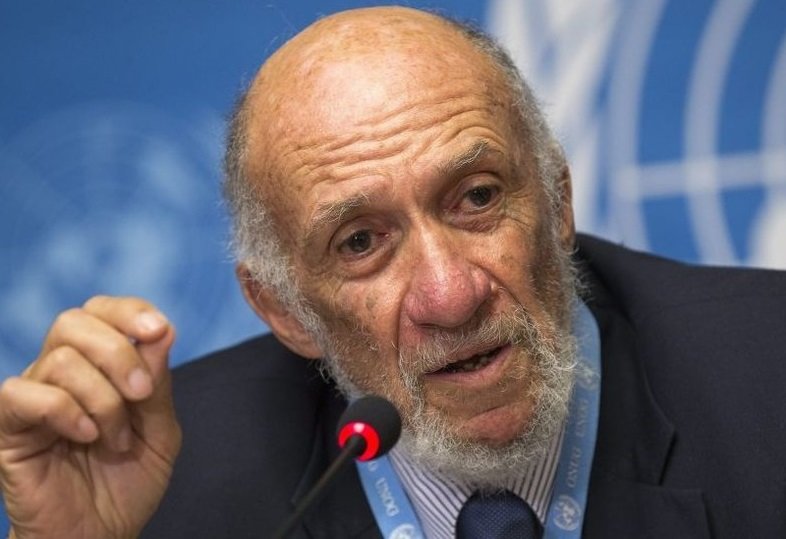
TEHRAN – The assassination of Iranian Major General Qassem Soleimani by the United States in January 2020 “was a flagrant instance of state terrorism,” says Richard Anderson Falk, a professor emeritus of international law at Princeton University.

Falk makes the remarks in an exclusive interview with the Tehran Times as Iran is marking the assassination anniversary of the senior military officer in January 2020.

General Soleimani, a legendary commander in the war against terrorists, was assassinated near Baghdad’s international airport while he was on a peace mission to Iraq.

The prominent  international law professor also says, “Iran has opposed non-state political violence of groups such as ISIS or Taliban that engage in terrorist activity by committing atrocities against civilians that amount to Crimes Against Humanity.”

“Although a military officer, General Soleimani, was not in any combat role when assassinated, and was engaged in peacemaking diplomacy on a mission to Iraq” “Iran has also consistently condemned state terrorism of the sort practiced by Israel and the United States,” says the American professor who acted as the UN Human Rights Rapporteur in the occupied Palestinian territories.

Following is the full text of the interview:

Q: In 1972, a specialized Committee on Terrorism was set up at the United Nations, and member states made great efforts to provide appropriate definitions of international terrorism, but due to intense political differences, the actual definition of international terrorism and comprehensive conventions in practice was impossible. Security Council Resolution 1373 was the most serious attempt to define terrorism after 9/11, which evolved into UN Security Council Resolution 1535. Despite providing a definition of terrorism, countries approach it differently. What is the reason?

A: There exists a basic split between those political actors that seek to define ‘terrorism’ as anti-state violence by non-state actors and those actors that seek to define terrorism as violence directed at innocent civilians, regardless of the identity of the perpetrator. The latter approach to the definition reaches targeted or indiscriminate violence directed at civilians even if the state is the perpetrator. States that act beyond their borders to fulfill counterrevolutionary goals seek to stigmatize their adversaries as terrorists while exempting themselves from moral and legal accountability.

There exists a second basic split due to state practice following political rather than legal criteria when identifying terrorist actors. When the Taliban and Al Qaeda were opposing Soviet intervention in Afghanistan they were identified as Mujahideen, but when seen as turning against the West, they were put on the top of the terrorist list. Osama Bin Laden once hailed as a Western ally deserving lavish CIA support became the most wanted terrorist after the 9/11 attacks on the World Trade Center and Pentagon. Such subjectivity and fluidity makes it virtually impossible to develop a coherent and legal approach to ‘terrorist’ activity.

“The truth is that General Soleimani had been playing a leading counterterrorist role throughout the region. He is thought to have been primarily responsible for the ending, or at least greatly weakening, the threat posed by ISIS.”In essence, geopolitical actors have always sought to have international law regard the use of force by states acting on their own as falling outside the framework of terrorism while regarding transnational political violence by adversary or enemy non-state actors as terrorism even if the targeted person or organization is a government official or member of the armed forces, or if the non-state actor is resisting occupation by foreign armed forces. Before the 9/11 attacks Israel influentially adopted this approach in its effort to portray Palestinian resistance as a criminal enterprise. After 9/11 the United States added its political weight to this statist approach to the conception of terrorism, which meant in effect that any adversary target that could be characterized as associated with a non-state actor that resorted to armed struggle was criminalized to the extent of being treated as unprotected by international humanitarian law. In practice, this subjectivity was vividly displayed in recent years by support given to anti-Castro Cuban exiles that engaged in political violence against the legitimate Cuban government, and yet were given aid, support, and encouragement while based in the United States.

The UN was mobilized after the 9/11 attacks by the United State to support this statist/geopolitical approach to political violence, which possessed these elements, and given formal expression in a series of Security Council Resolutions, including 1373, 1535:

 --terrorists are individuals who engage in political violence on behalf of non-state actors;

 --states, their officials and citizens may be guilty of supporting such activities through money, weapons, and safe haven, and therefore indictable under national law as aiding and abetting terrorism;

--political violence by states, no matter what its character, is to be treated by reference to international law, including international humanitarian law, and not viewed as terrorism;

 --even if the non-state actor is exercising its right of resistance under international law against colonialism or apartheid, its political violence will be treated as ‘terrorism’ if such a designation furthers geopolitical ambitions. 

“Iran is legally entitled to provide assistance to such a government (Syrian government) faced with insurgent challenges from within its boundaries.”The alternative view of terrorism that I endorse emphasizes the nature of political violence, rather than the identity of the perpetrator. As such, political violence can be identified as ‘state terrorism,’ which amounts to uses of force that are outside the framework of war and peace, and violate the sovereign rights of a foreign country or fundamental rights of citizens within the territory of the state. Such acts of terrorism may be clandestine or overt, and may be attributed to state actors when counterrevolutionary groups are authorized, funded, and encouraged directly or indirectly by the state. Non-state actors can also be guilty of terrorism if their tactics and practices deliberately target civilians or recklessly disregard risks of death or harm to civilians.

Q: How do you assess the role and position of Iran in the fight against terrorism in the region?

A: As far as I know, Iran has opposed non-state political violence of groups such as ISIS or Taliban that engage in terrorist activity by committing atrocities against civilians that amount to Crimes Against Humanity. Iran has also consistently condemned state terrorism of the sort practiced by Israel and the United States, and possibly other governments, within the region. In this regard, Iran has been active both in the struggle against non-state and state terrorism.

Iran has been accused of lending funding and material support to non-state actors that many governments in the West officially classify as ‘terrorist’ organizations, such as Hezbollah and Hamas. Part of the justification for U.S. sanctions arises from this allegation that Iran supports terrorism in the Middle East. These allegations are highly ‘political’ in character as both Hezbollah and Hamas engaged in violent resistance directed at unlawful occupation policies that denied basic national rights to the Lebanese and Palestinian people, including the fundamental right of self-determination, although some of their tactics and acts may have crossed the line of legality.

“When the Taliban and Al Qaeda were opposing Soviet intervention in Afghanistan they were identified as Mujahideen, but when seen as turning against the West, they were put on the top of the terrorist list.”There are also contentions that Iran’s support for the Syrian government in dealing with its domestic adversaries involves complicity in behavior that violates the laws of war and international humanitarian law. This contention is a matter of regional geopolitics. As far as international law is concerned, the Assad government in Damascus is the legitimate representative of the Syrian people, and is treated as such at the UN. Iran is legally entitled to provide assistance to such a government faced with insurgent challenges from within its boundaries. If the allegations are true that Syria has bombed hospitals and other civilian sites, then the Syrian government could be charged with state terrorism.

Q: How do you assess the role and position of General Qassem Soleimani in the fight against terrorists, especially ISIS?

A: Although a military officer, General Soleimani, was not in any combat role when assassinated, and was engaged in peacemaking diplomacy on a mission to Iraq. His assassination was a flagrant instance of state terrorism. With considerable irony, the truth is that General Soleimani had been playing a leading counterterrorist role throughout the region. He is thought to have been primarily responsible for the ending, or at least greatly weakening, the threat posed by ISIS to the security of many countries in the Middle East.

Q: Given the conflict of interests of different countries, can we see the same action by countries against terrorism? What mechanism can equalize the performance of countries against terrorism?

A: As suggested at the outset, without an agreed widely adopted and generally agreed-upon definition of terrorism it is almost impossible to create effective international mechanisms to contain terrorism. As matters now stand, the identification of ‘terrorists’ and ‘terrorism’ is predominantly a matter of geopolitical alignment rather than the implementation of prohibitions directed at unacceptable forms of political violence within boundaries and across borders.

To imagine the emergence of effective international or regional, mechanisms to combat terrorism at least four developments would have to occur:

“As matters now stand, the identification of ‘terrorists’ and ‘terrorism’ is predominantly a matter of geopolitical alignment rather than the implementation of prohibitions directed at unacceptable forms of political violence within boundaries and across borders.”

--the reliance on legal criteria to categorize political violence as terrorism;

--the inclusion of ‘state terrorism’ in the official definition of terrorism;

--the inclusion of political violence within the sovereign territory as well as across boundaries;

--an internationally or regionally agreed definition incorporating these three elements and formally accepted by all major sovereign states and by the United Nations.

In the present international atmosphere, such an international consensus is impossible to achieve. The United States and Israel, and a series of other important states would never agree. There are two sets of obstacles: some states would not give up their discretion to attack civilian targets outside their borders and would not accept accountability procedure that impose limits on their discretion over the means used to deal with domestic transnational non-state adversaries.

Under these conditions of geopolitical subjectivity such that from some perspectives non-state actors are ‘freedom-fighters’ and from others, they are ‘terrorists,’ no common grounds for meaningful and trustworthy intergovernmental arrangements exists.

It remains important for individuals and legal experts to advocate a cooperative approach to the prevention and punishment of terrorists and terrorism by reference to an inclusive definition of terrorism that considers political violence by states and by governments within their national territory as covered.

It is also in some sense to include non-state actors as stakeholders in any lawmaking process that has any prospect of achieving both widespread acceptance as a framework or implementation at behavioral levels. It would seem, in this regard, important to prohibit torture of terrorist suspects or denial of prisoner of war rights. One-sided legal regimes tend to be rationalizations for unlawful conduct, and thus operate as political instruments of conflict rather than legal means of regulation.


River to Sea Uprooted Palestinian   
The views expressed in this article are the sole responsibility of the author and do not necessarily reflect those of the Blog!

Washington uses DAESH and Iraqi traitors to fragment the country


River to Sea Uprooted Palestinian   
The views expressed in this article are the sole responsibility of the author and do not necessarily reflect those of the Blog!

Assassination of Gen. Soleimani ‘was a flagrant instance of state terrorism’: Richard Falk

January 4, 2021 – 11:4

 TEHRAN – The assassination of Iranian Major General Qassem Soleimani by the United States in January 2020 “was a flagrant instance of state terrorism,” says Richard Anderson Falk, a professor emeritus of international law at Princeton University.

Falk makes the remarks in an exclusive interview with the Tehran Times as Iran is marking the assassination anniversary of the senior military officer in January 2020.

General Soleimani, a legendary commander in the war against terrorists, was assassinated near Baghdad’s international airport while he was on a peace mission to Iraq.

The prominent  international law professor also says, “Iran has opposed non-state political violence of groups such as ISIS or Taliban that engage in terrorist activity by committing atrocities against civilians that amount to Crimes Against Humanity.”

“Although a military officer, General Soleimani, was not in any combat role when assassinated, and was engaged in peacemaking diplomacy on a mission to Iraq” “Iran has also consistently condemned state terrorism of the sort practiced by Israel and the United States,” says the American professor who acted as the UN Human Rights Rapporteur in the occupied Palestinian territories.

Following is the full text of the interview:

Q: In 1972, a specialized Committee on Terrorism was set up at the United Nations, and member states made great efforts to provide appropriate definitions of international terrorism, but due to intense political differences, the actual definition of international terrorism and comprehensive conventions in practice was impossible. Security Council Resolution 1373 was the most serious attempt to define terrorism after 9/11, which evolved into UN Security Council Resolution 1535. Despite providing a definition of terrorism, countries approach it differently. What is the reason?

A: There exists a basic split between those political actors that seek to define ‘terrorism’ as anti-state violence by non-state actors and those actors that seek to define terrorism as violence directed at innocent civilians, regardless of the identity of the perpetrator. The latter approach to the definition reaches targeted or indiscriminate violence directed at civilians even if the state is the perpetrator. States that act beyond their borders to fulfill counterrevolutionary goals seek to stigmatize their adversaries as terrorists while exempting themselves from moral and legal accountability.

There exists a second basic split due to state practice following political rather than legal criteria when identifying terrorist actors. When the Taliban and Al Qaeda were opposing Soviet intervention in Afghanistan they were identified as Mujahideen, but when seen as turning against the West, they were put on the top of the terrorist list. Osama Bin Laden once hailed as a Western ally deserving lavish CIA support became the most wanted terrorist after the 9/11 attacks on the World Trade Center and Pentagon. Such subjectivity and fluidity makes it virtually impossible to develop a coherent and legal approach to ‘terrorist’ activity.

“The truth is that General Soleimani had been playing a leading counterterrorist role throughout the region. He is thought to have been primarily responsible for the ending, or at least greatly weakening, the threat posed by ISIS.”In essence, geopolitical actors have always sought to have international law regard the use of force by states acting on their own as falling outside the framework of terrorism while regarding transnational political violence by adversary or enemy non-state actors as terrorism even if the targeted person or organization is a government official or member of the armed forces, or if the non-state actor is resisting occupation by foreign armed forces. Before the 9/11 attacks Israel influentially adopted this approach in its effort to portray Palestinian resistance as a criminal enterprise. After 9/11 the United States added its political weight to this statist approach to the conception of terrorism, which meant in effect that any adversary target that could be characterized as associated with a non-state actor that resorted to armed struggle was criminalized to the extent of being treated as unprotected by international humanitarian law. In practice, this subjectivity was vividly displayed in recent years by support given to anti-Castro Cuban exiles that engaged in political violence against the legitimate Cuban government, and yet were given aid, support, and encouragement while based in the United States.

The UN was mobilized after the 9/11 attacks by the United State to support this statist/geopolitical approach to political violence, which possessed these elements, and given formal expression in a series of Security Council Resolutions, including 1373, 1535:

 –terrorists are individuals who engage in political violence on behalf of non-state actors;

 –states, their officials and citizens may be guilty of supporting such activities through money, weapons, and safe haven, and therefore indictable under national law as aiding and abetting terrorism;

–political violence by states, no matter what its character, is to be treated by reference to international law, including international humanitarian law, and not viewed as terrorism;

 –even if the non-state actor is exercising its right of resistance under international law against colonialism or apartheid, its political violence will be treated as ‘terrorism’ if such a designation furthers geopolitical ambitions. 

“Iran is legally entitled to provide assistance to such a government (Syrian government) faced with insurgent challenges from within its boundaries.”The alternative view of terrorism that I endorse emphasizes the nature of political violence, rather than the identity of the perpetrator. As such, political violence can be identified as ‘state terrorism,’ which amounts to uses of force that are outside the framework of war and peace, and violate the sovereign rights of a foreign country or fundamental rights of citizens within the territory of the state. Such acts of terrorism may be clandestine or overt, and may be attributed to state actors when counterrevolutionary groups are authorized, funded, and encouraged directly or indirectly by the state. Non-state actors can also be guilty of terrorism if their tactics and practices deliberately target civilians or recklessly disregard risks of death or harm to civilians.

Q: How do you assess the role and position of Iran in the fight against terrorism in the region?

A: As far as I know, Iran has opposed non-state political violence of groups such as ISIS or Taliban that engage in terrorist activity by committing atrocities against civilians that amount to Crimes Against Humanity. Iran has also consistently condemned state terrorism of the sort practiced by Israel and the United States, and possibly other governments, within the region. In this regard, Iran has been active both in the struggle against non-state and state terrorism.

Iran has been accused of lending funding and material support to non-state actors that many governments in the West officially classify as ‘terrorist’ organizations, such as Hezbollah and Hamas. Part of the justification for U.S. sanctions arises from this allegation that Iran supports terrorism in the Middle East. These allegations are highly ‘political’ in character as both Hezbollah and Hamas engaged in violent resistance directed at unlawful occupation policies that denied basic national rights to the Lebanese and Palestinian people, including the fundamental right of self-determination, although some of their tactics and acts may have crossed the line of legality.

“When the Taliban and Al Qaeda were opposing Soviet intervention in Afghanistan they were identified as Mujahideen, but when seen as turning against the West, they were put on the top of the terrorist list.”There are also contentions that Iran’s support for the Syrian government in dealing with its domestic adversaries involves complicity in behavior that violates the laws of war and international humanitarian law. This contention is a matter of regional geopolitics. As far as international law is concerned, the Assad government in Damascus is the legitimate representative of the Syrian people, and is treated as such at the UN. Iran is legally entitled to provide assistance to such a government faced with insurgent challenges from within its boundaries. If the allegations are true that Syria has bombed hospitals and other civilian sites, then the Syrian government could be charged with state terrorism.

Q: How do you assess the role and position of General Qassem Soleimani in the fight against terrorists, especially ISIS?

A: Although a military officer, General Soleimani, was not in any combat role when assassinated, and was engaged in peacemaking diplomacy on a mission to Iraq. His assassination was a flagrant instance of state terrorism. With considerable irony, the truth is that General Soleimani had been playing a leading counterterrorist role throughout the region. He is thought to have been primarily responsible for the ending, or at least greatly weakening, the threat posed by ISIS to the security of many countries in the Middle East.

Q: Given the conflict of interests of different countries, can we see the same action by countries against terrorism? What mechanism can equalize the performance of countries against terrorism?

A: As suggested at the outset, without an agreed widely adopted and generally agreed-upon definition of terrorism it is almost impossible to create effective international mechanisms to contain terrorism. As matters now stand, the identification of ‘terrorists’ and ‘terrorism’ is predominantly a matter of geopolitical alignment rather than the implementation of prohibitions directed at unacceptable forms of political violence within boundaries and across borders.

To imagine the emergence of effective international or regional, mechanisms to combat terrorism at least four developments would have to occur:

“As matters now stand, the identification of ‘terrorists’ and ‘terrorism’ is predominantly a matter of geopolitical alignment rather than the implementation of prohibitions directed at unacceptable forms of political violence within boundaries and across borders.”

–the reliance on legal criteria to categorize political violence as terrorism;

–the inclusion of ‘state terrorism’ in the official definition of terrorism;

–the inclusion of political violence within the sovereign territory as well as across boundaries;

–an internationally or regionally agreed definition incorporating these three elements and formally accepted by all major sovereign states and by the United Nations.

In the present international atmosphere, such an international consensus is impossible to achieve. The United States and Israel, and a series of other important states would never agree. There are two sets of obstacles: some states would not give up their discretion to attack civilian targets outside their borders and would not accept accountability procedure that impose limits on their discretion over the means used to deal with domestic transnational non-state adversaries.

Under these conditions of geopolitical subjectivity such that from some perspectives non-state actors are ‘freedom-fighters’ and from others, they are ‘terrorists,’ no common grounds for meaningful and trustworthy intergovernmental arrangements exists.

It remains important for individuals and legal experts to advocate a cooperative approach to the prevention and punishment of terrorists and terrorism by reference to an inclusive definition of terrorism that considers political violence by states and by governments within their national territory as covered.

It is also in some sense to include non-state actors as stakeholders in any lawmaking process that has any prospect of achieving both widespread acceptance as a framework or implementation at behavioral levels. It would seem, in this regard, important to prohibit torture of terrorist suspects or denial of prisoner of war rights. One-sided legal regimes tend to be rationalizations for unlawful conduct, and thus operate as political instruments of conflict rather than legal means of regulation.


River to Sea Uprooted Palestinian   
The views expressed in this article are the sole responsibility of the author and do not necessarily reflect those of the Blog!

The American Money Tree: The Untold Story of US Aid to Israel

 By Ramzy Baroud

Source

Congress quietly wedged billions of dollars of aid to Israel even as it debated for months over a measly $600 to help Americans endure the COVID downturn.

On December 21, the United States Congress passed the COVID-19 Relief Package, as part of a larger $2.3 trillion bill meant to cover spending for the rest of the fiscal year. As usual, US representatives allocated a massive sum of money for Israel.

While unemployment, thus poverty, in the US is skyrocketing as a result of repeated lockdowns, the US found it essential to provide Israel with $3.3 billion in ‘security assistance’ and $500 million for US-Israel missile defense cooperation.

Although a meager $600 dollar payment to help struggling American families was the subject of several months of intense debate, there was little discussion among American politicians over the large funds handed out to Israel, for which there are no returns.

Support for Israel is considered a bipartisan priority and has, for decades, been perceived as the most stable item in the US foreign policy agenda.  The mere questioning of how Israel uses the funds – whether the military aid is being actively used to sustain Israel’s illegal occupation of Palestine, finance Jewish settlements, fund annexation of Palestinian land or violate Palestinian human rights – is a major taboo.

One of the few members of Congress to demand that aid to Israel be conditioned on the latter’s respect for human rights is Democratic Senator, Bernie Sanders, of Vermont, who was also a leading presidential nominee for the Democratic Party. “We cannot give it carte blanche to the Israeli government … We have the right to demand respect for human rights and democracy”, Sanders had said in October 2019.

His Democratic rival, now President-elect, Joe Biden, soon countered: “The idea that I’d withdraw military aid, as others have suggested, from Israel, is bizarre,” he said.


It is no secret that Israel is the world’s leading recipient of US aid since World War II.  According to data provided by the US Congressional Research Service, Israel has received  $146 billion of US taxpayers’ money as of November 2020.

From 1971 up to 2007, a bulk of these funds proved fundamental in helping Israel establish a strong economic base. Since then, most of the money has been allotted for military purposes, including the security of Israel’s illegal Jewish settlement enterprise.

Despite the US financial crisis of 2008, American money continued to be channeled to Israel, whose economy survived the global recession, largely unscathed.

In 2016, the US promised even more money. The Democratic Barack Obama Administration, which is often – although mistakenly – seen as hostile to Israel, increased US funding to Israel by a significant margin. In a 10-year Memorandum of Understanding, Washington and Tel Aviv reached a deal whereby the US agreed to give Israel $38 billion in military aid covering the financial years 2019-2028. This is a whopping increase of $8 billion compared with the previous 10-year agreement, which concluded at the end of 2018.

The new American funds are divided into two categories: $33 billion in foreign military grants and an additional $5 billion in missile defense.

American generosity has long been attributed to the unmatched influence of pro-Israeli groups, lead among them American Israel Public Affairs Committee (AIPAC). The last four years, however, required little lobbying by these groups, as powerful agents within the administration itself became Israel’s top advocates.

Aside from the seemingly endless ‘political freebies’ that the Donald Trump Administration has given Israel in recent years, it is now considering ways to accelerate the timetable of delivering the remainder of US funds as determined by the last MOU, an amount that currently stands at $26.4 billion. According to official congressional documents, the US “also may approve additional sales of the F-35 to Israel and accelerate the delivery of KC-46A refueling and transport aircraft to Israel.”

These are not all the funds and perks that Israel receives. Much more goes unreported, as it is channeled either indirectly or simply promoted under the flexible title of ‘cooperation’.

For example, between 1973 and 1991, a massive sum of $460 million of US funds was allocated to resettling Jews in Israel. Many of these new immigrants are now the very Israeli militants that occupy the West Bank illegal settlements. In this particular case, the money is paid to a private charity known as the United Israel Appeal which, in turn, gives the money to the Jewish Agency. The latter has played a central role in the founding of Israel on top of the ruins of Palestinian towns and villages in 1948.

Under the guise of charitable donations, tens of millions of dollars are regularly sent to Israel in the form of “tax-deductible gifts for Jewish settlement in the West Bank and East Jerusalem,” the New York Times reported. Much of the money, falsely promoted as donations for educational and religious purposes, often finds its way to funding and purchasing housing for illegal settlers, “as well as guard dogs, bulletproof vests, rifle scopes and vehicles to secure (illegal Jewish) outposts deep in occupied (Palestinian) areas.”

Quite often, US money ends up in the Israeli government’s coffers under deceptive pretenses. For example, the latest Stimulus Package includes $50 million to fund the Nita M. Lowey Middle East Partnership for Peace Funds, supposedly to provide investments in “people-to-people exchanges and economic cooperation … between Israelis and Palestinians with the goal of supporting a negotiated and sustainable two-state solution.”

Actually, such money serves no particular purpose, since Washington and Tel Aviv endeavor to ensure the demise of a negotiated peace agreement and work hand-in-hand to kill the now defunct two-state solution.

The list is endless, though most of this money is not included in the official US aid packages to Israel, therefore receives little scrutiny, let alone media coverage.

As of February 2019, the US has withheld all funds to the Palestinian Authority in the West Bank, in addition to cutting aid to the UN Palestinian Refugees agency (UNRWA), the last lifeline of support needed to provide basic education and health services to millions of Palestinian refugees.

Judging by its legacy of continued support of the Israeli military machine and the ongoing colonial expansion in the West Bank, Washington insists on serving as Israel’s main benefactor – if not direct partner – while shunning Palestinians altogether. Expecting the US to play a constructive role in achieving a just peace in Palestine does not only reflect indefensible naivety but willful ignorance as well.

River to Sea Uprooted Palestinian   
The views expressed in this article are the sole responsibility of the author and do not necessarily reflect those of the Blog!

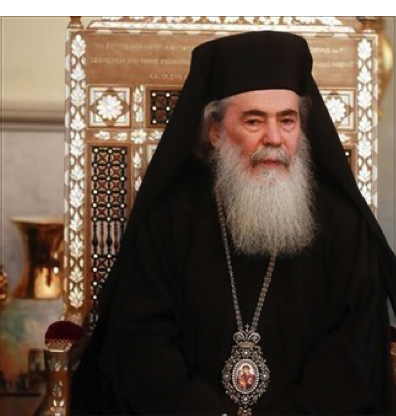
«الجبهة الشعبيّة»: لعزل البطريرك الخائن «ثيوفيلوس الثالث»


تسريبه عقارات وأراضي فلسطينية للعدو جزء لا يتجزأ من التهويد والتوسع الاستيطانيّ

جدّدت الجبهة الشعبية لتحرير فلسطين موقفها بضرورة عزل البطريرك الخائن والفاسد «ثيوفيلوس الثالث» وعدم الاعتراف به ومقاطعته بشكلِ كاملِ في ظل استمرار خيانته للأمانة ومواصلة تسريب المزيد من العقارات للكيان الصهيوني، كان آخرها قيامه بتحويل مباني دير مار إلياس الواقعة في بيت جالا إلى فندق تشرف على إدارته شركة أوروبية مشبوهة من المحتمل جداً أن تكون مملوكة للكيان الصهيوني.

وندّدت الجبهة، في تصريح صحافي، بقيام محافظة بيت لحم والأجهزة الأمنية بمنع إقامة المؤتمر الصحافي للحراك الأرثوذكسي الذي كان بصدد كشف خيوط تسريب الصفقة الجديدة لهذا البطريرك الخائن والفاسد للاحتلال في مدينة القدس.

وأكدت أنّ استمرار هذا البطريرك الخائن بتسريب المزيد من العقارات والأراضي الفلسطينية، هو جزء لا يتجزأ من عملية التهويد والتوسع الاستيطاني للكيان الصهيوني، ومحاولة أيضاً للانقضاض على الرواية والهوية الوطنية، ومحاولة لضرب الجذور التاريخية لأبناء شعبنا المسيحيين وتعلقهم بأرضهم وباعتبارهم جزءاً أصيلاً من الشعب الفلسطيني.

ودعت الجبهة إلى ضغط وطني وشعبي واسع من أجل طرد هذا البطريرك الخائن والفاسد، والتصدي لكل مخططات الكيان الصهيوني وأذنابه الهادفة للاستيلاء على الأراضي والممتلكات الفلسطينية.

وختمت الجبهة بيانها مشيدة بالمواقف الوطنية الأصيلة التي عَبّر عنها رجال الدين المسيحيون المخلصون وفي مقدمتهم النادي الارثوذكسي في بيت جالا والمجلس المركزي الأرثوذكسي في فلسطين، ومختلف الفعاليات الوطنية والمجتمعية والشبابية والنسوية برفضهم وتصديهم لهذا الدور المشبوه الذي يقوم به هذا البطريرك الخائن، داعية السلطة إلى وقف التعاطي السلبي والمريب مع هذه القضية وتَحمُلّ مسؤولياتها على المستوى الدولي من أجل نزع الشرعية عن هذا الخائن، والتحقيق في قضايا تسريب أراضي وممتلكات فلسطينية مماثلة من قبل متنفذين فلسطينيين.


River to Sea Uprooted Palestinian   
The views expressed in this article are the sole responsibility of the author and do not necessarily reflect those of the Blog!

Straight Talk by Chinese Foreign Minister Wang Yi


peacefromharmony.org/img.php?id=7606

By Stephen Lendman

Source

Commenting at the onset of 2021 on China’s geopolitical agenda, Foreign Minister Wang Yi spoke candidly about major issues — his remarks worlds apart from how his US and other Western counterparts operate.

On relations with the US and West,  Wang said unilateralism, “protectionism and power politics are standing in the way of international cooperation,” risking unacceptable confrontation over good relations among world community nations.

While most countries choose to cooperate with others for their mutual benefit, hegemon USA and its imperial partners go another way for their own self-interest over world peace and stability.

In the past year and earlier, China “scored decisive successes in the three critical battles against poverty, pollution and potential risks,” said Wang, adding:

“The whole country is on course to fully build a moderately prosperous society.” 

“The recent Fifth Plenary Session of the 19th CPC Central Committee set a great vision for China’s development in the coming years and charted the course for national rejuvenation.”

“The unity and perseverance of the Chinese people have impressed the world.” 

“The resilience and dynamism of China’s development have won global recognition.”

Throughout 2020, China advanced its geopolitical interests cooperatively with other nations and “both (its) domestic needs and the international context,” along with confronting the US “political virus” in pursuing global stability.

“We have made more friends in the world. China has deepened friendship and cooperation with all countries, making active efforts to develop relations with major powers, achieving solid progress in building a community with a shared future with neighbors, protecting and advancing the shared interests of the developing world, and working for a new type of international relations,” said Wang.

“We have been firm in safeguarding our national interests.” 

“We have responded resolutely and rationally to unjustified moves by the United States.” 

“We have handled issues relating to Taiwan, Hong Kong, Xinjiang and Tibet with justified, strong and proportionate countermeasures and won one fierce battle after another in international organizations, vigorously safeguarding China’s sovereignty, dignity and development interests.”

At the same time, Beijing prioritizes “multilateral cooperation” — worlds apart from how imperial USA operates, for its own self-interest at the expense of other nations.

Summitry led by President Xi Jinping is “the highest form of diplomacy,” said Wang.

In 2020, Xi had “87 meetings and phone calls with foreign leaders and heads of international organizations and attend(ed) 22 important bilateral or multilateral events.”

Throughout the past year and earlier, Sino/Russian relations stood the test of time by bonding for the benefit of both nations.

“In developing China-Russia strategic cooperation, we see no limit, no forbidden zone and no ceiling to how far this cooperation can go.” 

“Focusing on the central task of implementing the common understandings of the two presidents, the two countries will use the opportunity of the 20th anniversary of the signing of the Treaty of Good-neighborliness and Friendly Cooperation to renew their shared commitment to ever-lasting peace and win-win cooperation.”

“Being each other’s strategic anchor, diplomatic priority, development opportunity and global partner, the two countries will expand and deepen cooperation from a higher starting point.” 

“Together, China and Russia will continue to be the example of good-neighborly and friendly relations between major countries, add impetus to global recovery, and underpin global strategic stability.”

In disturbingly stark contrast, US hostility toward China deepened at the expense of cooperative relations Washington spurns in pursuing its unilateral interests.

What’s going on shows its unacceptable “attempt to suppress China and start a new Cold War” that risks direct confrontation.

This unsupported policy by most world community nations is “doomed to fail,” Wang stressed.

“China’s policy toward the United States is consistent and stable.” 

“We are ready to develop with the United States a relationship based on coordination, cooperation and stability.” 

“China never meddles in the internal affairs of the United States and values peaceful co-existence and mutually beneficial cooperation with the United States.” 

“Likewise, the United States also needs to respect the social system and development path chosen by the Chinese people and respect their legitimate rights to pursue a better life.”

“We don’t need a world where China becomes another United States.” This is neither rational nor feasible. 

“Rather, the United States should try to make itself a better country” — what’s highly unlikely given its diabolical hegemonic aims that keep hardening, not easing.

The US seeks dominance over other nations, not mutual cooperation it spurns.

China’s relations with the EU are at times uneasy but less threatening than how the US operates.

In 2020, China “became the EU’s largest trading partner for the first time” that hopefully will develop further ahead to benefit both sides.

A new investment treaty was agreed on that shows mutual cooperation works when pursued.

“As a permanent member of the Security Council and a responsible major country, China has been exploring a distinctive Chinese way of resolving hotspot issues,” said Wang, adding: 

“We follow a vision of common, comprehensive, cooperative and sustainable security for the world.” 

“We maintain that regional disputes should be addressed through dialogue and consultation.” 

“We uphold non-interference in internal affairs (of other nations), which is a basic norm governing international relations.”

China pursues world peace and stability, an independent foreign policy, and cooperative relations with other nations according to the rule of law.

The US operates by a lower standard, spurning the above in pursuit of its hegemonic aims.


River to Sea Uprooted Palestinian   
The views expressed in this article are the sole responsibility of the author and do not necessarily reflect those of the Blog!

Sayyed Nasrallah: Assassinating Soleimani, Al-Muhandis Set the US Troops on the Track of Being Expelled from the Region

 Sayyed Nasrallah: Assassinating Soleimani, Al-Muhandis Set the US Troops on the Track of Being Expelled from the Region

By Zeinab Abdallah

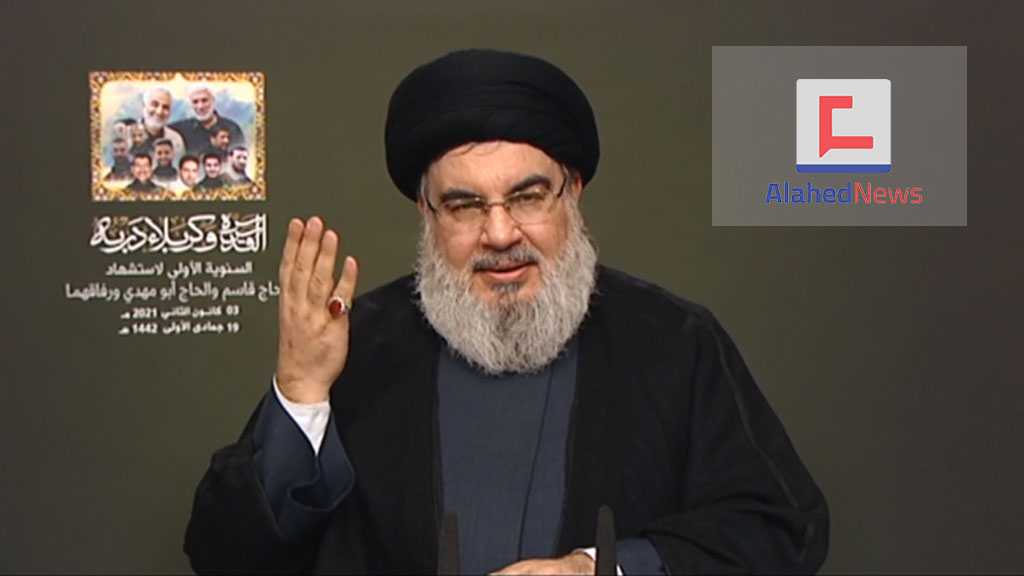
Hezbollah Secretary General His Eminence Sayyed Hassan Nasrallah delivered a speech on Sunday marking the first martyrdom anniversary of the Islamic Revolution Guard [IRG] Quds Force Commander Lieutenant General Qassem Soleimani, Iraq’s Popular Mobilization Units [PMU] second-in-command Hajj Abu Mahdi al-Muhandis, and their companions.

The martyrs were assassinated in a US drone strike ordered by outgoing President Donald Trump a year ago near Baghdad International Airport while martyr Soleimani was on an official visit to the country on January 3rd, 2020.

At the beginning of his speech, Sayyed Nasrallah condoled with the demise of Ayatollah Sheikh Mohammad Taqi Mesbah Yazdi, a prominent Iranian scholar and philosopher.

His Eminence further extended condolences to the families of the commemorated martyrs, emphasizing that the painful tragedy will be commemorated in history minding its size and the blood that was shed during it, in addition to its repercussions on the entire region.

“We mustn’t deny the grace and the kindness of those leaders, and we admit this and talk about it to the people and the world,” Sayyed Nasrallah added, underscoring that “when we are loyal to our great martyrs who were faithful in shouldering the responsibility, it will come back to us in the worldly life and the afterlife.”

“One of the main factors of victory is loyalty, and loyalty requires us to thank all those who have backed us,” Sayyed Nasrallah noted.

His Eminence further highlighted the necessity of thanking Hajj Qassem Soleimani and Hajj Abu Mahdi al-Muhandis for all what they offered, in addition to all those who represent the martyrs for the sacrifices they offered.

Hailing martyr Soleimani as a hero and a global symbol of sacrifice, loyalty, and defending the oppressed, Sayyed Nasrallah noted that “What has been uncovered about the achievements Hajj Qassem has made is still little [in comparison with what is still unknown].”

“We’ve witnessed great and remarkable shows of loyalty to the blood of the martyr leaders since their martyrdom until today,” Sayyed Nasrallah said in reference to Iran, Iraq, Syria, Yemen, Bahrain, Turkey and many Muslim and non-Muslim nations, pointing that “we in Lebanon are also concerned with showing this loyalty to those leaders.”

Since the year 2000 until this day, the Resistance was the side that is protecting and defending Lebanon, the Hezbollah leader noted, stressing that Lebanon’s main source of pride is the Resistance which was unconditionally backed by Iran.

“Iran’s support to the Resistance in Lebanon and Palestine has been unconditional,” Sayyed Nasrallah made clear.

Elsewhere in his remarks, the Resistance leader slammed certain Lebanese media outlets that tended on Saturday to fabricate a statement made by the IRG Aerospace Division Commander Brigadier General Amir Ali Hajizdeh: “There are in Lebanon certain sides that take fabrication and falsification as a profession.”

“It is true that we in Lebanon are a frontline, also is Gaza, but Hajizadeh didn’t say that we are a frontline for Iran, but a frontline to confront the ‘Israeli’ occupation,” Sayyed Nasrallah underscored.

“The resistance is the only side capable of protecting Lebanon’s oil resources thanks to its weapons, in addition to the Iranian and Syrian support,” His Eminence noted, reiterating that “The resistance in Lebanon is among the most independent resistance movements in history.”

Lebanon and Gaza are naturally the frontlines of the Muslim Nation due to their geographical position near the Zionist entity, and tensions have been high in the region and the Zionist entity is on alert on the first martyrdom anniversary of Soleimani and Al-Muhandis, Sayyed Nasrallah went on to say.

“We in Lebanon cannot equalize between those who backed us with their stance, money, weapons, and were martyred by our side, and between those who conspired against us and supported the ‘Israeli’ enemy, Sayyed Nasrallah said, setting a similar equation for the regional countries such as Palestine, Syria, and Iraq.

“The Palestinian resistance factions couldn’t equalize between those who support it and those who conspire against the Palestinian people and their sanctities. Syria couldn’t equalize between those who conspired against it and supported the Takfiri groups, and between those who defended it and supported it. The Iraqis couldn’t equalize between those who sent them Takfir suicide-bombers and between those who helped them liberate their lands.”

The Hezbollah leader then hailed the Axis of Resistance, nation, peoples, the resistance movements and their political parties, and the regional countries that have shown loyalty and appreciation to the martyrs Soleimani and al-Muhandis.

“There are major concerns among the Gulf countries, and ‘Israel’ has raised alertness ahead of the martyrdom anniversary of leaders Soleimani and al-Muhandis,” Sayyed Nasrallah said, explaining that “Tension is high in the region and we don’t know where would any incident end up; some assume that Iran would depend on its friends to respond, but when Iran wants to respond it will do it by itself had it been via a security or a military response.”

His Eminence further made clear that “The friends of Iran are the ones who decide if they wanted to respond to this crime, and Iran is not weak, it is strong and it decides how and when it responds.” He also admitted that the Axis of Resistance was able to contain the big strike of assassinating martyr Soleimani.

“The US supposed that by assassinating Hajj Qassem it would weaken Iran and the Axis of Resistance, but we are the ones who know how to turn this threat into an opportunity,” Sayyed Nasrallah outlined before addressing the US, ‘Israel’ and all those conspiring against the resistance: “When you kill our leaders, we will be more stubborn, solid and adherent to our rights.”

His Eminence also warned those betting on weakening us through killing, wars, and booby-trapped cars, telling them that they are delusional.

While noting that the slogan of expelling the US from the region wouldn’t have been applicable before the assassination of Hajj Qassem Soleimani, Sayyed Nasrallah stressed that the martyrdom of leaders Soleimani and al-Muhandis has set the US troops on the track of leaving Iraq and the region.

US President Donald Trump said that the US has found Daesh [the Arabic acronym for terrorist ‘ISIS/ISIL’ group], and this is true because there are reasons behind the existence of Daesh, Sayyed Nasrallah added.

Regarding the recent clampdown targeting Hezbollah’s financial institutions, Sayyed Nasrallah uncovered the party’s information that “the US has paid hundreds of thousands of dollars for media outlets to produce reports about the al-Qard al-Hassan Association.”

While referring to blacklisting Hezbollah as a psychological goal to frighten the Lebanese people, Sayyed Nasrallah addressed those behind it in much confident tone: “Even if you besieged us in the land, we have the mountains, the sky, the seas, the angels, and all of Allah’s creatures that we know and don’t know. We have Allah by our side, and whatever you did you will fail, it is because those who depend on Allah will emerge victorious. Victory is not but from Allah.”

His Eminence said before finishing his speech that he will appear in the coming days to tackle several important Lebanese issues he wanted to give sufficient time.


River to Sea Uprooted Palestinian   
The views expressed in this article are the sole responsibility of the author and do not necessarily reflect those of the Blog!

A Pardoning Time of Year

 By Philip Giraldi

Source

Will the president do the right thing?
Julian Assange Pardon 89b36

The resistance to the apparent election of Joe Biden as President of the United States is continuing to play out. Current President Donald Trump is continuing to fight against the presumed results of the November national election with his final card appearing to be a vote in Congress when it reconvenes on January 6th to throw out the results due to fraud in certain key states. Many have noted how the registration and electoral processes in the United States, varying as they do from state to state, were and are vulnerable to fraud. That, plus some eyewitness testimony and technical analysis, suggests that possibly systematic fraud did take place but it is far from clear whether it was decisive. This is particularly true of the vote by mail option, which was promoted by leading Democrats and which empowered literally millions of new voters with only limited attempts made to validate whether citizens or even real people were voting.

Vote by mail is now one of several options that are appearing to be weaponized by the cash-rich Democrats in the state of Georgia, where two Senate races will be up for grabs in runoff elections on January 5th. If the Democrats obtain both, they will control the Senate through the Vice President’s role in presiding over the upper chamber where she has the tie breaking vote. That will mean that we the voters can expect some dramatic changes as the Democrats respond to their various constituencies with their well enunciated grievances.

In what may be its last weeks in office, the Trump Administration is also exploiting its executive power to pardon to reverse perceived injustices and to protect remaining allies, to include some family members. Trump is already on track to pardon more individuals than any preceding president with 90 pardons issued as of Christmas Eve and many more expected. One of his initial pardons was a notable example of a miscarriage of justice in the case of presidential national security advisor designate Michael Flynn, who was wrongly accused of collaborating with Russia. If anything, he was actually cooperating with a request that came from Israel, which Congress and the media apparently do not regard as wrongdoing.

Trump’s pardon of his daughter Ivanka’s father-in-law Charles Kushner is particularly controversial, as Kushner was a multimillionaire real estate developer and a leading Democratic Party donor when he was convicted in 2005 to two years in federal prison after he pleaded guilty to 18 counts, which included both tax evasion and making illegal campaign contributions. The tale of Charles Kushner is particularly unsavory because he reportedly sought revenge after he learned that his brother-in-law and former business partner was aiding federal authorities. Charles hired a prostitute to seduce his brother-in-law in a New Jersey motel room, making a recording of the encounter using a hidden camera that he then showed to his brother-in-law’s wife, who was, of course, Kushner’s own sister.

Kushner’s prosecution was directed by then-U.S. Attorney Chris Christie, who afterwards became a prominent Trump supporter and head of his transition team before being fired in 2016, apparently per orders originating with Jared Kushner. In a 2019 interview Christie explained “Mr. Kushner pled guilty. He admitted the crimes. And so what am I supposed to do as a prosecutor? I mean, if a guy hires a prostitute to seduce his brother-in-law, and videotapes it, and then sends the videotape to his sister to attempt to intimidate her from testifying before a grand jury, do I really need any more justification than that? I mean, it’s one of the most loathsome, disgusting crimes that I prosecuted. And I was U.S. attorney in New Jersey, so we had some loathsome and disgusting crime going on there.”

Charles Kushner is also a close friend and supporter of Israeli Prime Minister Benjamin Netanyahu, which might also be relevant to his pardon and I will leave any assessment of the ethics of the Kushner clan up to the reader. Nevertheless, the consequence of Jared’s ability to influence the president could be politically damaging as he reportedly has been responsible for many of the pardons that have already taken place and is now the conduit for new petitioners.

Another highly criticized Trump pardon has involved the four Blackwater mercenaries who massacred 19 Iraqis including 2 children firing from a helicopter into a crowded Nisour Square Baghdad in 2007. The president is reportedly very friendly with Blackwater founder and former president Erik Prince, whose sister Betsy DeVos is Education Secretary and also close to the president. But in any event Trump’s pardon record is different only in terms of magnitude from those of some of his predecessors as there have been some highly questionable pardons in the past, to include Marc Rich under Bill Clinton and Elliot Abrams under George W. Bush.

There remains a long list of possible candidates for Trump to sign off on, to include a possible self-pardon, and more pardons for family members Ivanka, Jared and two of his sons as well as his lawyer Rudy Giuliani. Other current and impending pardon recipients have been individuals who were involved in the Trump campaigns, to include Paul Manafort and Roger Stone. Pardons are a particularly attractive pre-emptive option currently as a number of leading Democrats have been calling for “truth commissions” and other forms of punishment of Trump supporters and officials.

The process of issuing presidential pardons will undoubtedly continue up until Inauguration Day on January 20th, but sources are uncertain whether Trump will be courageous enough to pardon the two individuals whose freedom would most definitely be sending a powerful message for integrity in government. They are Julian Assange and Edward Snowden. Both men’s names have been coming up frequently in the alternative media, together with the development of active lobbying groups that are seeking their freedom.

Assange, a journalist and founder of WikiLeaks, is currently languishing in a British prison, where he has been for twenty-one months, awaiting a decision on whether he will be extradited to the United States or not which will reportedly be decided on January 4th. The Department of Justice has claimed that he violated the Espionage Act of 1917 by receiving classified information from Chelsea Manning. Reportedly, Assange’s mental and physical health have deteriorated sharply as he is being held in solitary confinement with only short periods of exercise and without access to reading or writing material to occupy his time. The British judge appears to be completely unsympathetic to Assange and it is generally believed that she will order his extradition if he does not fortuitously die in prison before that could take place.

Snowden, meanwhile, is living in Russia and has been granted citizenship, a country to which he fled by way of Hong Kong in 2013, after revealing to journalists details of a vast and illegal surveillance program run by the National Security Agency (NSA) against American citizens, something he discovered while he was employed as a NSA contractor. He had attempted to raise his concerns with supervisors but was rebuffed and he eventually became a self-declared whistleblower and fled the country. He has repeatedly offered to return to the United States to face trial, but has also insisted that a fair hearing would be impossible under the current circumstances.

It should be observed that Snowden is absolutely correct to assume that he would be convicted both on grounds of espionage and of compromise of classified information. The federal court in Alexandria, where national security cases are usually tried, always finds for the government even if evidence is questionable or even non-existent. A recent conviction involved ex-CIA officer Jeffrey Sterling, who was sent to prison for 42 months even though it could not be demonstrated that he had actually done anything. The court concluded that “it had to be him.”

To be sure, revealing classified information is a serious matter, even though many former government employees would agree that much material that is classified does not actually damage national security if it is revealed. Frequently, classification is used to keep the government from being embarrassed or to shut down any revelation that it has acted illegally. Both Assange and Snowden would argue that they had acted appropriately in revealing war crimes, illegal acts and even violations of the Constitution as consequences of the so-called “global war on terror.” Assange, who regards himself as a journalist, published details of the Blackwater massacre of civilians committed by the crew of a helicopter gunship in Iraq and also was involved in the exposure of the Hillary Clinton emails. Snowden, as noted above, claims to be a whistle-blower and has sought protection under relevant laws in the United States, so far to no avail.

The illegal and otherwise unconscionable acts by various elements in the U.S. government that were exposed by Assange and Snowden include war crimes, so they are not trivial. Trump, having already done a “favor” to Blackwater, might be disinclined to pardon someone who exposed its mercenaries’ crimes. But there is nevertheless, as is often the case, an interesting aspect to the story that is worth paying attention to. Trump, as is widely conceded even by some Democrats, was targeted by the Deep State even before he was nominated, an effort to destroy his presidency that persisted for years through the completely contrived mechanism of Russiagate. Given that, it would behoove Trump to strike back in his waning days in office. Both Assange and Snowden exposed illegal activities and cover-ups by the Deep State, almost certainly to include the active participation of some of the very people who have sought to bring the president down. And they both may have more to say. If Donald Trump seriously seeks to strike a blow against his enemies, it would be both fitting and just to pardon both men on that basis alone. Let us hope that President Trump has both the wisdom and fortitude to take that step in his last days in office.


River to Sea Uprooted Palestinian   
The views expressed in this article are the sole responsibility of the author and do not necessarily reflect those of the Blog!