Saturday, 7 January 2012

Although "Assassination Attempt" Wasn’t Circulated, Hariri Denies "Rumors"

Local Editor
Former Lebanese Prime Minister Saad Hariri late on Friday denied what he said was a “rumor” of a failed attempt to assassinate him in the Saudi capital, Riyadh.

The Lebanese haven’t even heard about the attempt to assassinate Hariri. However it seems that the man, who is active on Twitter, persists to reassure the Lebanese that he is still alive!
This indicated that the denial of the "rumor" was more circulated than the "rumor" it self.

“You might have heard the rumor about my so-called assassination in Riyadh. My presence here, now, is a natural denial of this lie,” Hariri said on his Twitter page.

“This is a political fabrication. Part of what they think is psychological warfare against us”, he added.

But Hariri didn’t mention the source of that “rumor”. He only stressed that this “psychological warfare doesn’t and will never work”.
Source: Websites

River to Sea Uprooted Palestinian

The views expressed in this article are the sole responsibility of the author and do not necessarily reflect those of this Blog!

Promoting War on Iran

By Stephen Lendman - Posted on 06 January 2012


My PhotoIn June 2009, a Brookings Institution report titled, "Which Path to Persia? Options for a New American Strategy Toward Iran" was a regime change policy paper. Pro-Israeli right-wing ideologues prepared it, including:
(1) Martin Indyk: former US ambassador to Israel, currently Brookings foreign policy director.

(2) Kenneth Pollack: Former CIA analyst and National Security Council staff member; current Council on Foreign Relations member and Brookings Saban Center for Middle East Policy research director.

(3) Michael O'Hanlon: Former Congressional Budget Office national security analyst, currently Brookings senior fellow for defense and military policy.

(4) Bruce Riedel: Former CIA counterterrorism specialist and assistant to the President and senior director for Near East Affairs on the National Security Council; current Brookings foreign policy senior fellow.

(5) Suzanne Maloney: Former State Department policy advisor, currently Brookings foreign policy senior fellow.

(6) Daniel Byman: Former 9/11 Commission staff member; currently Brookings Saban Center for Middle East Policy research director and Georgetown University security studies professor.
Report topics include:
  • military options for disarming Iran;
  • invasion;
  • air strikes;
  • allowing or encouraging an Israeli attack;
  • regime change; and
  • containment.
Its introduction stressed "the trouble with Iran," asking what should America do about it? It falsely claimed Iran's well along toward developing nuclear weapons. It also sited "Iranian mischief," including "support for terrorist groups," and its "wider efforts to overturn the regional status quo."

It claimed alleged "incontrovertible" evidence that "Iran has aided groups seeking to overthrow the governments of Saudi Arabia, Kuwait, and Bahrain (and arguably Lebanon and Israel as well) at various times," but didn't reveal it.

In addition, it claimed alleged evidence shows "Iran may have encouraged (perhaps even ordered) various groups to mount attacks that have derailed (Israeli - Palestinian) peacemaking efforts."

It asked if Washington "should (be) willing to accept the Islamic Republic at all."

Active Image
Iran Air Flight 655                   
Iran hasn't attacked another country in over 200 years and threatens none now. However, Brookings called Tehran a threat to America, when, in fact, Washington very much threatens Iran, the region and other independent states worldwide.

Brookings ignoried America downing Iran Air 655 in July 1988 in Iranian air space, killing 290 passengers and crew on board. Instead, it falsely accused Tehran of attacking US Persian Gulf naval forces in 1987 and 1988.

In fact, an Iraqi missile struck the USS Stark in March 1987, and the USS Samuel B. Roberts struck an Iranian mine in April 1988 in waters it had no business being in.

Brookings stressed "ticking clock" urgency to act....(I)gnoring Iran is no long a realistic alternative (because) Iran('s) the bane of the United States in the Middle East."

Claiming its position doesn't "argue for one approach over another" dismisses its hawkish stance.

America's Media War on Iran

For months, media scoundrels promoted it. They headlined bogus accusations about Iran plotting to kill Saudi Arabia's US ambassador. They feature stories about Iran's alleged nuclear threat despite no corroborating evidence proving it.

On December 29, New York Times writer John Vinocur headlined, "Clock Ticking for West to Act on Iranian Nuclear Program," saying:

"The Iranian nuclear clock ticks faster and louder in 2012." Israel's defense minister Ehud Barak said they'll have nuclear weapons in nine months and move into a "zone of immunity" safe from attack.

London-based International Institute for Studies anti-proliferation director Mark Fitzpatrick agreed, calling it "a real possibility."

US defense secretary Panetta believes it in a year, saying (i)f we have to do it, we will deal with it." Perhaps he means an election year October surprise after another self-inflicted homeland terrorist attack blamed on Iran.

Instead of responsible reporting, Vanocur encouraged war. So do other MSM contributors in print and on air.

On December 29, a Times editorial headlined, "Iran and the Strait," saying:

Doing it will be countered. "A Fifth Fleet spokesman usefully reminded Iran this week that the Navy always stands 'ready to counter malevolent actions to ensure freedom of navigation.' "

According to IAEA "inspectors, Iran has created computer models of nuclear explosions, conducted experiments on nuclear triggers and completed advanced research on a warhead that could be delivered by a medium-range missile."
Fact check

In November, outdated, forged, long ago discredited, and perhaps nonexistent documents were used to claim Iran's developing nuclear weapons.

During his tenure as IAEA director general (December 1, 1997 - November 30, 2009), Mohamed ElBaradei avoided anti-Iranian rhetoric and baseless charges. In fact, numerous times he denied a potential threat.

So do independent nuclear experts and America's Annual Threat Assessment of the US Intelligence Community as recently as March 2011.

"Tehran's latest threat to block global oil shipping should leave no doubt about its recklessness and its contempt for international law. This is not a government any country should want to see acquire nuclear weapons."
Fact check

Truth isn't The Times' long suit. Baseless charges make headlines. Fingers are pointed the wrong way. America's appalling contempt for democracy, human and civil rights, international law and its own is ignored.

Times contributors dismiss issues of equity, justice, rule of law standards, and peace. Instead, they cheerlead US wars and promote new ones.

Presidential aspirant Ron Paul said sanctions aren't "an effective means to encourage a change of behavior in another country without war. However, sanctions and blockades are not only acts of war....they are most often the first step toward" it.

"Iran has every right to develop nuclear energy for peaceful purposes." No evidence suggests "Iran has diverted enriched uranium for the peaceful and lawful generation of power toward building a nuclear weapon."

"We should be clear about this: sanctions against Iran are definite steps toward a US attack" as they were against Iraq and Libya. Moreover, disrupting Iranian oil shipments will harm "global trade and undermine the US economy, which in turn harms our national security."

"This race to war against Iran and Syria is both foolhardy and dangerous."

Paul added that threatening to block the Strait of Hormuz is a plausible response without "weapons of mass destruction" to deter menaces.

In fact, Paul's record on war is mixed. He supported attacking Afghanistan, but called war on Libya "unconstitutional (and) a loss for our American Republic."

He opposed attacking Iraq because Congress illegally ceded authority to Bush. In addition, he claimed it gave UN members say over US foreign interventions.

He also said GHW Bush sought and received UN authority to attack Iraq in 1991 because UN Resolution 678 permitted "all necessary means," implying military force if others failed.

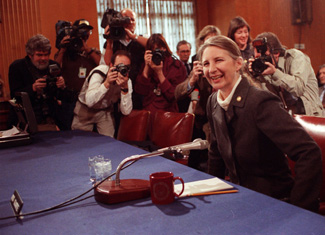
April Glaspie, former U.S. ambassador to Iraq, on Capitol Hill in 1991. (
AP Photo)
In fact, US ambassador April Glaspie OK'd invading Kuwait to settle a border dispute over cross-drilling into Iraqi territory. A recent WikiLeaks release confirmed it: the Glaspie Memo known as 90BAGHDAD423.

Saddam was deceived. Iraqis paid dearly and still do. The combination of war, sanctions, more war and occupation destroyed the "cradle of civilization." Millions also died from war, post-war violence, disease, deep poverty, deprivation, a repressive pro-Western regime, and belligerent occupation.

Claiming Iran seeks nuclear weapons is a ruse. At issue is regime change to turn an independent state into a client one. Times writers, op-ed contributors, and editors know it but feature managed news and opinion, not truth and full disclosure.

So do other major media scoundrels.

On November 22, a Washington Post editorial headlined, "More half-measures from Obama administration on Iran," saying:

"By now it should be obvious that only regime change will stop the Iranian nuclear program. That means, at a minimum, the departure of Supreme Leader Ali Khamenei...."
In other words, whatever it takes is OK, including war against another nonbelligerent state posing no threat.

On December 30, a Wall Street Journal op-ed headlined, "Iran's Hormuz Threat," saying:

"The US and Europe are at last mustering the gumption to target Iran's multibillion-dollar oil industry, and almost immediately Tehran is threatening to bring Persian Gulf tankers to a halt."

Around 40% of sea-borne oil passes through the strait or about 15.5 million barrels daily. Disrupting it, of course, affects all regional producers, including Iran. Catastrophic economic consequences would result, including skyrocketing oil prices. So would war by bringing America and Iran into direct confrontation.

"Iran's leaders are trying to see if they can intimidate (Washington) into backing down. The Western response should be to tighten sanctions further to show such tactics won't work."

"The episode is also a reminder (of Iran's) character and intentions....wholly in character for the world's leading state sponsor of terrorism." Disrupting Hormuz shipments should "be considered an act of war that would be met with a military response (against) Iran's military and nuclear assets, perhaps even its regime."
A Final Comment

Iran poses no belligerent or terrorist threat. In contrast, America, key NATO partners and Israel are global menaces.

Initiating war on Iran and/or Syria could be catastrophic, especially if nuclear weapons are used. Yet major media scoundrels promote it, mindless of the potential consequences.

Nonetheless, more war in 2012 is likely because Washington, Britain, France, and Israel want it, no matter the risks.
Perhaps a September or October surprise will become pretext to launch it. It wouldn't be the first time.

Stephen Lendman lives in Chicago and can be reached at lendmanstephen@sbcglobal.net.
Also visit his blog site at sjlendman.blogspot.com and listen to cutting-edge discussions with distinguished guests on the Progressive Radio News Hour on the Progressive Radio Network Thursdays at 10AM US Central time and Saturdays and Sundays at noon. All programs are archived for easy listening.

http://www.progressiveradionetwork.com/the-progressive-news-hour/.           
River to Sea Uprooted Palestinian

The views expressed in this article are the sole responsibility of the author and do not necessarily reflect those of this Blog!

Friday, 6 January 2012

Mr. "Zero Problems" left Tehran empty-handed

Having failed to bribe Syria, they are trying to bribe Iran...
by Alex

No, brother, you can't
According to Lebanese Al-akhbar, the Irani escalation in the Gulf, the pre-empt  coup in Iraq and coherence in Syria, called an urgent Euro-American move. 
Nato puppet, Ahmed Daoud oglu visited Tehran, carrying multiple messages, and five core files (nuclear, the Gulf, Iraq, Syria and trade). 
Tehran, discovered in talks with Oglua clear opportunism. Daoud Oglu offered an economic "bribe" hoping it would facilitates his mission, but the results were disappointing and he left empty-handed.


River to Sea

In exchange for a set of demands, he confirmed:
  • Turkey will continue buying Iranian oil, regardless of any sanctions could be imposed, 
  • Turkey is stuck to its decision concering the pipeline that would convey the Iranian gas to Europe via its territory,
  • It will not impose any sanctions on Iran's Central Bank, and will continue to deal with it, 
  • Turkey is determined to raise the value of trade between the two countries to 15 billion dollars this year, insisting on the agreed target to raise it to 30 billion dollars over the years.
Tehran confirmed:
  • Iran have no demands from the USA, other than starting practical steps to leave the Gulf similar to its withdrawal from Iraq, emphasizing that return of any USA warship to the Gulf is strictly prohibited, because the result would be unpleasant for the Americans who will be the only responsible  for their deeds.
  • Concerning the nuclear file, having succeeded in increasing the level of  uranium enrichment, Tahran don't need to Exchange uranium or nuclear rods, but still interested in any dialogue to bridge the confidence with the international community, to assured that its nuclear programme is peaceful.
Oglu wanted Iraqi vice president should stay in Iraq
Concerning the Iraqi file, Daoud Oglu acted like he wanted to save the USA project in Iraq. He carried  the banner Vice President Tariq al-Hashimi, Deputy Prime Minister Saleh Al-mutlaq, Finance Minister Rafe Al-Issawi, the speaker of the House of Osama alngivi, and Iyad Allawi. He called for a halt to prosecutions and returning to Government as partners to contain the crisis in Iraq because it would lead to sectarian warfare in the region.
When the talks hit the Syrian file, Daoud called on Iranians to advise Assad to change the course and stop the fighting and bloodshed, without giving particular demands.
Iranians emphasized: We stand by Syria. It is true that the Syrian people have right demands, but our support for President Bashar Al-Assad is a  non-negotiable principle». Astonished with Turkish enthusiasm when talking about Syria, and its silence regarding Bahrain, the Iranians reminded Daoud Oglu that he abandoned them in the case of the seven Iranians abducted in Syria, that his talk sounded like Syrian opposition spokesman. He Said that "none of the opposition factions did seize them, they don't know where they are and who did it."  
 
The talks revealed that Ankara began feeling the economic disadvantages for its policy towards Damascus (the presence of some 10,000 Turkish trucks parked at the border with Syria, the many conditions imposed by the Iraqi authorities on trade with Ankara), in clear diplomatic language Daoud expressed his full willingness to strengthen the relationship with Iran without limits, indirectly asking Iranian intervention to facilitate Turkish commercial traffic in the region.
In the press conference with Foreign Minister Ali Akbar Salehi, Oglu claimed that Iran is not worried about the Nato's «missile shield» to be errected on Turkish soil. Salehi interrupted and asked him to read the text (indicating that Oglu is lying), forcing Oglu shift to English and say "we have given assurances to the Iranians that Turkey would not in any way allow attacks against any of its neighbors, especially Iran».......

Uprooted Palestinian The views expressed in this article are the sole responsibility of the author and do not necessarily reflect those of this Blog!
(Yesterday) 'Comment' on Al-Jazeera Direct threatens a Free Syrian Army operation in Damascus' 'Midan Square'


Col. Riad Assaad's "huge operation": Suicide bomber' attack in Damascus

(Reuters) - "A suicide bomber killed about 25 people and wounded 46 in Damascus on Friday, Syria's state news agency SANA said, in the third such attack in the Syrian capital in a month.
20120106-143909.jpg

The blast occurred two days before an Arab League committee was due to discuss an initial report of Arab observers ...(and hours before the arrival of Jeffrey Feltman in Cairo)... The meeting may decide whether to continue the mission or to refer Syria to the United Nations Security Council, perhaps paving the way for some form of international action, a scenario that many Arab countries are keen to avoid..."
River to Sea Uprooted Palestinian The views expressed in this article are the sole responsibility of the author and do not necessarily reflect those of this Blog!

Firing Turkey’s Ece Temelkuran: The Price of Speaking Out


Temelkuran has played a leading role on social media in defending 11 journalists who are currently on trial in Turkey for supporting illegal “terrorist” organizations. (Photo: Sedat Suna)

Published Friday, January 6, 2012

For the first time in her nearly two-decade-long career, journalist Ece Temelkuran is without a job. The feature reporter and columnist, currently in Tunisia, writes regularly about the plight of Turkey’s ethnic minorities. She was fired from her staff position at the Haberturk daily on Thursday after publishing articles critical of the Turkish government’s handling of the massacre of Kurds on December 28 at Iraq’s border.

Turkey has long been feted by mainstream Western media as a bastion of secular democracy in a wider and largely Muslim region ruled by despots. However, critics argue that this image is allowing the Justice and Development Party (AKP) headed by Prime Minister Recep Tayyip Erdogan to become increasingly authoritarian. In recent years, journalists who report on stories not fitting within the government narrative have been targeted.

Ninety-seven media professionals are currently in prison according to the Turkish Union of Journalists. In addition to this, The Economist magazine recently reported that 47 lawyers, more than 500 students and some 3,500 Kurdish activists are in prison. A recent survey by the Associated Press found that more than one-third of the world's convicted "terrorists" are in Turkey.

Temelkuran has played a leading role on social media (she started the hashtag #freejournalists on Twitter) in defending 11 journalists who are currently on trial in Turkey for supporting illegal “terrorist” organizations.

After beginning her career as a correspondent in 1993, Temelkuran became a feature reporter in 2000 for Turkey's Milliyet daily. In 2009, she left Milliyet to take a job at the nascent Haberturk, another major daily in Turkey. On Thursday Temelkuran received a phone call while in Tunisia that she had been dismissed from her job at the newspaper.

In addition to covering Turkish affairs at home, Temelkuran has reported extensively from the Middle East and Latin America.

I spoke to Ece Temelkuran on Thursday by phone about her career, her dismissal and the current state of journalism in Turkey.

Matthew Cassel: When you're not reporting around the world what types of stories do you generally write about inside Turkey?

Ece Temelkuran: The Kurdish issue, Armenian issue, women rights, social issues...Not the most popular subjects, especially the Kurdish and Armenian issues.
MC: Why aren't they popular issues in Turkey?

ET: Because since the establishment of Turkey [in 1923, after the fall of the Ottoman Empire] Kurds have been treated as second-class citizens and there has always been a lack of political and individual rights for them. There is deep and wide racism against Kurds in Turkey and there is the armed PKK [Kurdistan Workers' Party] movement and anything that goes under Kurdish issues is considered terrorism. So it's not surprising Turkish media doesn't cover the issue, and if they do they represent the government's point of view.

MC: Do you feel that you've always been able to write what you want to? Have you ever been censored?

ET: I haven't been censored, but when I reported from Kurdistan in northern Iraq, even mentioning the name 'Kurdistan' was taboo. And when I wrote about tens of Kurdish children being tortured in 2003 people were outraged. There has always been pressure on journalists who write on the Kurdish issue.
But pressure on media has never been like this. Now it's fear of being imprisoned, and once you're in prison no one can get you out. [Journalists] Ahmet Sik and Nadim Sener have been in jail for 11 months, they didn't even know until 6 or 7 months [after their arrest] what the charges [against them] are.
Since there is government propaganda to legitimize these prosecutions, it's very hard to get around this. The propaganda machine is huge. Not only nationally but internationally.
MC: Did your firing come as a surprise?

ET: Not really because the stand I took about the arrested journalists and the massacre [of 35 Kurdish civilians on Turkey's border with Iraq] was too strong for the mainstream media to handle. Because the prime minister, a few days ago just after the massacre, [threatened] ones who use [the term] 'massacre,' and I've been using it on twitter and social media.

MC: That sounds like Turkey's recent warnings to France after its senate voted to recognize the 1915 mass killing of Armenians by Ottoman Turks as a "genocide." Why is language so important for the Turkish government?

ET: Because terminology creates political and ethical responsibility. Then if you use term 'massacre,' the prime minister might have to apologize for the massacre, which he doesn't want to. Rather he wants to blame media. And that media was silent for about a half day after the incident. None of the networks gave the news until prime minister’s official statement about massacre, but that wasn't enough. He only wants to see his thoughts [printed in the newspapers].

MC: Why were you fired?

ET: The last two articles I wrote might be perceived as 'too controversial.’ One was called "Sir, yes Sir!" referring to the prime minister. The article ended "So you give the orders my commander but I'm not listening to you anymore. We are the rest of this country! We are not listening to your orders anymore!"
The last article was about how 19 of those killed were kids between 12 and 15. He made this speech about Uludere [the border town where the attack happened] massacre, which was outrageous, and he blamed journalists. And I wrote an article repeating the number [of dead] ridiculing the prime minister’s cruel attitude in a bitter way.

MC: Are you the only person writing like this in the mainstream media?

ET: There are a few others, and all of them called me today to say that ‘we are coming as well to the land of unemployment, just wait for us.’ They say, 'we are writing our articles as if we're writing our last articles.' Everyone is pessimistic about the coming days.

MC: Why are they targeting veteran journalists like Nadim Sener and Ahmet Sik?

ET: Because they were writing books about the Gulen movement [Islamists believed to have close ties to the AKP] getting organized in police department and intelligence services. They took the manuscript of Ahmet's book, The Army of the Imam (which has since been published online). Nadim's book [on how the Gulen movement is organizing in the police and state intelligence] is unpublished.
They were reporting on different things, especially criticizing the government and revealing the bad practices of government.

MC: Who was Hrant Dink?

ET: He was an Armenian journalist and had his own paper. He was a vocal journalist about Armenian rights and oppressed minorities. And he was shot dead in the center of Istanbul in his neck. Nadim has been writing books about him. He wrote about police negligence in the investigation into Hrant's killing. Hrant was a dear friend as well. Since he wished me to write a book on Armenian issue before his death I dedicated my book Deep Mountain to him. He helped me a lot.

MC: Did Dink's killing change journalism in Turkey?

ET: Armenian issue was already a taboo for mainstream media but after his death we learned that we shouldn't talk about Armenian issue more. His funeral was historic though, because 100,000 attended and they all chanted, "We are all Armenians." Armenians have always been despised by the nationalist Turks, so that funeral was a turning point in modern Turkish history.
MC: Did it create fear among you and your colleagues?

ET: It wasn't the only [attack on journalists], and it didn't stop there. After that came the mass arrests, there have been many incidents that created fear among journalists.
This time [the attacks are] done under name of 'democracy,' or as AKP supporters call it 'advanced democracy.' This time it's hard to get the things out there and say we've been oppressed. When there was a coup and fascist generals in power with their uniforms it was easier to say who were the bad guys. Now it's more complicated because fascism didn't show up in uniforms this time. That's why international media has taken too long to understand what's really going on in Turkey.

MC: How has Turkey managed to maintain that democratic image to the outside world?

ET: Through international and national propaganda. Mainstream western media is serving their own governments' foreign policy interests. So they wanted to see this model of Muslim democracy, which looks good from outside and has freedom of people, ‘bon pour l’orient’ (French for “good enough for the orient”). It's not good enough, neither for people in Turkey or the rest of Middle East.
To the Western world it tries to show democracy, and to the Eastern side it tries to show its Muslim side. Obviously it’s not a democracy anymore. As for the Islam, I am not an expert but such cruelty cannot come from religion.

MC: Do you think Turkey is losing that democratic image?

ET: The image is changing for sure.
Today, I was surprised to see the news on the front page of the New York Times, and I think finally our colleagues around the world are coming to their senses about Turkey. They're no longer being deceived by these lies of 'AKP democracy.'

MC: Over the past year, you've reported from pro-democracy uprisings in a number of Arab countries. Do you see similarities between the repressive forms of government that people have been rising against and your own government in Turkey?

ET: Now there are rising numbers of people that think Prime Minister Erdogan is acting like Bashar Assad. After the Uludere massacre they've been referring to his previous statement about Bashar Assad, “a president who kills his own people is not legitimate anymore.”

MC: Have activists, journalists and others who want change in Turkey been inspired by the Arab uprisings?

ET: They [demand change] already, but when they do they've been attacked violently. Every demonstration that happened after elections has been suppressed by tear gas. Especially by Kurdish people, they've been violently suppressed and attacked. Now and then they do protest, but the opposition in Turkey has been divided into too many parts, they're too split to create an alternative [to the AKP].

MC: You've already lost your job, are you worried what else can happen to you when you return to Turkey?

ET: I am freaking out, it's not the imprisonment necessarily, but now I feel like I have this stamp of persona non grata by the government. I am afraid I might be unemployed for a while because no newspaper would employ me because of that stamp. And if they did I'd be really surprised.
River to Sea Uprooted Palestinian

The views expressed in this article are the sole responsibility of the author and do not necessarily reflect those of this Blog!

Shooting the Messenger in Syria

by Stephen Lendman

My PhotoAt issue is discrediting Sudanese General Mohammed Ahmed Mustafa al-Dabi. He’s Arab League observer mission head in Syria. More on him below.

The phrase “shooting the messenger” is centuries old. Shakespeare wrote “Don’t shoot the messenger” in Henry IV, part two. In Antony and Cleopatra, she reacted to Antony jilting her by threatening to treat the messenger’s eyes as balls.

In Antigone, Sophocles said, “No one loves the messenger who brings bad news,” and Plutarch’s Lives noted that a messenger bearing bad news “had his head cut off for his pains.”

Today, corrupt politicians and media scoundrels vilify truth-tellers of all stripes. Among others, they include social justice activists and whistleblowers. Even Washington-approved generals heading pro-imperial missions aren’t spared when they fail to deliver the goods.

Al-Dabi was considered safe. Sudan backed NATO’s Libya war. Assuming automatic anti-Assad support appears misguided. At least so far.
Instead of reporting regime violence, his comments included:
  • “The situation seemed reassuring so far;”“Yesterday was quiet and there were no clashes;”
  • “Some places looked a bit of a mess but there was nothing frightening;” and
  • Assad’s government has been “very cooperative.”
In other words, he contradicted Western propaganda and confirmed evidence of an externally generated insurgency. As a result, he’s now assailed as unreliable. Efforts are made to discredit him. Media scoundrels cheerlead it. It’s their customary role. “Shoot the messenger.”

On December 27, State Department spokesman Mark Toner stopped short of vilifying al-Dabi but came close saying:

Arab League monitors “bear a heavy responsibility in trying to protect Syrian civilians from the depredations of a murderous regime.”

Because Al-Dabi points fingers elsewhere, he’s assailed for not cooperating.

On January 2, New York Times writer Kareem Fahim headlined, “Chief of Arab League’s Mission in Syria Is Lightening Rod for Criticism,” saying:

Instead of confirming regime violence, he said Assad’s “government had withdrawn tanks and artillery from cities, and had released nearly 3,500 prisoners” after releasing hundreds more in November and December.

As a result, he’s now criticized and accused of being “mired in controversy: a Sudanese general who, (unnamed) rights activists say presided over the same kind of deadly and heavy-handed tactics in Sudan that the Arab League is seeking to curb in Syria.”

Al-Dabi “once ran Sudan’s notorious military intelligence agency, and has only compounded the criticism with his recent statements.”

“Last week, he spoke dismissively about the damage in Homs….On Sunday, he publicly contradicted an Arab League observer,” saying government snipers were shooting people. Interviewed by BBC, he said: “But he didn’t see.” He was referring to a hypothetical case.

Fahim and other Times contributors are notorious propagandists. During NATO’s Libya war, his managed news lacked truth.

Last summer on the Progressive Radio News Hour, Middle East/Central Asia analyst Mahdi Nazemroaya (from Tripoli) said some Western journalists performed fifth column duties. They included intelligence gathering, locating targets, and supplying bombing coordinates for NATO.
Fahim reported from Tripoli and other Libyan locations. Whether he was involved isn’t known. Clearly, however, his material lacked credibility.

Now he’s at it again, vilifying al-Dabi, calling him a “liability,” blaming Sudan’s “friendly relations with Syria,” and claiming “government attacks on civilians have continued,” instead of pointing fingers the right way.

In his book, “Winning Modern Wars,” General Wesley Clark said Pentagon sources told him two months after 9/11 that regime change was planned in Sudan, as well as Iraq, Libya, Syria, Iran, Somalia and Lebanon.

Balkanizing Sudan was planned. Strategy included vilifying its government. At issue is political and economic ties to China, especially for oil.

Washington wants it cut off. North Sudan has modest reserves, but southern Sudan is oil-rich. In July, it declared independence. As a result, China may be affected.

Though exaggerated and overblown, Sudanese President Omar al-Bashir’s disturbing human rights record is pretext, including in Darfur and South Sudan. So is Al-Dabi’s likely role. He held various high posts, including military intelligence chief, foreign security director, deputy military operations chief, and Qatar ambassador.

At issue is geopolitics; namely, Washington’s longstanding plan for unchallenged world dominance. Achieving it requires turning independent regimes into client ones, including violently when other methods fail.

Al-Dabi’s not cooperating. On Monday, Arab League director Nabil al-Araby said he’s a “capable military man with a clean reputation.” However, he conceded that mission observers can’t stop bloodshed. At the same time, he didn’t lay blame on Western-backed insurgents.

On Sunday, the Arab League’s advisory body called for mission observers to leave because violence continues. Its pro-Western Kuwaiti head, Ali Salem al-Deqbasi, claims ongoing regime “flagrant violations,” adding: Observers allow “cover to commit inhumane acts under the noses of the Arab League.”

In fact, most AL members are notorious pro-Western despots. Their record includes attacking, killing, arresting, imprisoning, and brutalizing their own people for protesting for political, economic and social justice.

They’re also serial liars, pointing fingers the wrong way instead of at themselves and Western partners.
On December 27, Foreign Policy (FP) associate editor David Kenner headlined, “The World’s Worst Human Rights Observer,” saying:

Al-Dabi “may be the unlikeliest leader of a humanitarian mission the world has ever seen. He is a staunch loyalist of Sudan’s President Omar al-Bashir, who is wanted by the International Criminal Court (ICC) for genocide and crimes against humanity….”

Fact check

Charges are way overblown. The ICC is a notorious imperial tool. It ignores appalling Western crimes, especially America’s. Its chief prosecutor Jose Luis Moreno-Ocampo is a reliable Washington ally.

WikiLeaks exposed his willingness to ignore US war crimes in Iraq. Throughout his tenure (since June 2003), he abstained from imperial prosecutions. He chose soft targets like Libya and Sudan. He absolved culpable major ones in Washington, Tel Aviv, London, Paris and other Western capitals.

FP is the influential Council on Foreign Relations’ publication. Kenner serves as associate editor. In his customary role, he assailed al-Dabi. He made unfounded/overblown accusations. He criticized his “checkered past,” including responsibility “for the worst atrocities during the Darfur genocide.”

His report lacked credibility. It was one-sided attack journalism. It’s typical corporate media managed news, not the real thing everyone deserves.

River to Sea Uprooted Palestinian
The views expressed in this article are the sole responsibility of the author and do not necessarily reflect those of this Blog!

ETHNIC CLEANSING OF AN INVENTED PEOPLE

THE ROAD TO NOWHERE by Ismail Shammout
"The main difference between Bosnia and Palestine is that ethnic cleansing in the former took place in the form of dramatic massacres and slaughters which caught the world's attention, whereas in Palestine what is taking place is a drop-by-drop tactic in which one or two houses are demolished daily, a few acres are taken here and there every day, a few people are forced to leave" ~ Edward Said

By Miko Peled
January 4, 2012
I was Mustafa Tamimi
Mostafa Tamimi from Nabi Saleh, Bahjat Zaalan and his son Ramdan from Gaza died on my fiftieth birthday and just a few days after Newt Gingrich declared them an invented people. They were murdered by the Israeli terrorist organization, the IDF, an organization that is supported and funded by the US.

One Israeli terrorist shot the invented Tamimi in the head with a tear gas canister, and another Israeli terrorist fired a rocket that murdered the invented Zaalan and his boy Ramadan.

Both terrorists were educated and trained by Israel, and armed by the US. The Israeli terrorists are not invented but quite real, and they are safe, protected by the apartheid regime that trained and sent them on their missions, and the Israeli court system will make sure that they are never brought to justice. This is how Israel’s well-oiled ethnic cleansing machine operates.

The Zionist ethnic cleansing of Palestine is not a thing of the past but an ongoing campaign that is executed by three arms of the State of Israel:
The education system,
a dedicated bureaucracy
and the security forces.
The education system is dedicated to indoctrinating and producing soldiers and bureaucrats who will execute and enforce the ethnic cleansing.

The bureaucracy is charged with making rules that make life unlivable for Palestinians.

Rules that restrict Palestinian access to their lands, and restrict their ability to travel freely to work and school.
This same bureaucracy then demands that Palestinians pay for permits to be allowed do these very same basic things that they were denied.

The security forces, the most obvious of which is the IDF, are charged with enforcing the restrictions, fighting off the resistance, armed or peaceful, and terrorizing the “invented” people of Palestine.

Since my father was a general and I served as a soldier in the IDF terrorist organization, people often ask me how is it that Israeli children who are raised in a Western style democracy become such monsters once they are in uniform.

The detailed answer can be found in my book, The General’s Son due out in February 2012, but the short answer is this: Education ~ Racism requires a mindset that is fashioned by education. In order to rationalize and justify the ethnic cleansing the Israeli education system portrays Palestinians as culturally inferior, violent and bent on the annihilation of the Jews, and at the same time, void of a true national identity. Palestinian national identity is but a figment of some anti-Semitic imagination.

Israeli children are educated to see the Palestinians as a problem that must be solved and as a threat that must be eliminated. They can go through life, as I did growing up in Jerusalem, without ever meeting a Palestinian child. They know nothing of the life or culture of Palestinians who quite often live only several hundred meters from them.

Palestinians are portrayed as an existential threat through absurd comparisons like that of Yasser Arafat to Hitler, the Palestinians to Nazis, and the Palestinian resistance to Al Qaeda.

Since Israeli kids never meet Palestinians what they learn in school, particularly in the school textbooks, is all that they know. In fact it is remarkable that even though they live so close to one another, much if not all of what Israelis know about their Palestinian neighbors comes from high school text books and popular racist stereotypes.
Israelis don’t know that Palestinians never had an army, that they do not possess a single tank, a single warship or fighter jet, that they don’t have a single artillery battery and do not in fact pose a military threat at all.
According to a new book by Dr. Nurit Peled-Elhanan, not a single photo of a person who is a Palestinian exists in Israeli textbooks and there are millions of Palestinians in and around Israel. Israelis don’t learn about Palestinian doctors and teachers, engineers and writers. They don’t learn Palestinian poetry or prose and they don’t read the works of Palestinian historians.

At a recent lecture I mentioned the ethnic cleansing of Palestine and someone called out: “What ethnic cleansing?”

People are unaware of the ethnic cleansing taking place in Palestine because Israel hides it well and the mainstream media doesn’t care enough to ask. In mainstream peace groups and dialogue groups that discuss Palestine/Israel, a basic Israeli condition is not to bring up issues like the ethnic cleansing because Israel doesn’t like to talk about it.
But for the past 64 years ethnic cleansing of Palestine is what drives the Zionist policies towards Palestinians. All Zionist governments and all Zionist political parties left right and center support the ethnic cleansing.

The Israeli judicial system lets the Israeli authorities get away with abuse, theft and murder as long as they are perpetuated against Palestinians. Had these same crimes been committed against Israeli Jews they would have been prosecuted to the full extent of the law.
Zionist supporters like to bring up the fact that on November 29, 1947 the United Nations voted to partition Palestine into a Jewish state and an Arab state. What is left out of the Zionist story is that within one year of the vote Israeli forces had managed to capture close to 80% of Palestine, destroy close to 500 Palestinian towns and villages, kill scores of unarmed civilians and force the exile of some 800,000 Palestinians.

Then, when the UN passed resolution194 in December of 1948, calling for the refugees to be allowed to return to their homes, Israel proceeded to build cities and towns, parks and highways for the use of Jewish Israelis on Palestinian land. Then the Knesset began passing laws that prohibit the return of the refugees and allow the new state to confiscate their lands.

After the war was over, the Palestinians who remained within the newly created Jewish state were forced to become citizens of a state that despised them and saw them as a “problem” and a “threat.” They were designated as “The Arabs of Israel” a designation that stripped them of a national identity and denied them any rights to the land and provided them very limited rights as citizens.

From being the rightful owners of their lands and their country they now existed at the pleasure of the new owner of the land, the state of Israel. Palestinian refugees were forced into concentration camps, conveniently called refugee camps, and those that tried to return were shot.

A military unit was created for the purpose of punishing Palestinian refugee who “infiltrated” back into their homeland, now called Israel. It was called led it and it made a name for itself as a murderous gang with a license to kill Palestinians.
So regardless of the myth, now perpetuated by Newt Gingrich among others, that says there was no forced ethnic cleansing, we know today that the creation of Israel was made possible through a systematic campaign of ethnic cleansing, conducted by the Jewish militia, involving massacres, terrorism, and the wholesale looting of an entire nation.
Newt Gingrich, being the history buff that he is, might be interested in a story I mention in my book The General’s Son, about my mother. She was born and raised in Jerusalem and she remembers the homes of Palestinians families in neighborhoods in West Jerusalem. She told me that when she was a child, on Saturday afternoons she would go for walks through these neighborhoods, admiring the beauty of the homes, watching families sit together in their beautiful gardens.
In 1948 when the Palestinian families were forced out of West Jerusalem, my mother was offered one of those beautiful, spacious homes but she refused. At age 22, the wife of a young army officer with little means and with two small children, she refused a beautiful spacious home, offered to her completely free because she could not bear the thought of living in the home of a family that was forced out and now lives in a refugee camp.

“The coffee was still warm on the tables as the soldiers came in and began the looting” she told me. “Can you imagine how much those families, those mothers must miss their homes.”
She would ask and she continued, “I remember seeing the truckloads of loot, taken by the Israeli soldiers from these homes. How were they not ashamed of themselves?” there are thousands upon thousands of homes in cities all over the country that were taken.

Moving forward now to 1967 and the myth that Israel was fighting for its existence as it was attacked by Arab armies from all directions. Much was written about this but nothing is more revealing than the minutes of the meetings of the IDF general staff from June 1967, just prior to the war.
According to the generals, one of whom was my father, Matti Peled, not only was there no existential threat but the generals clearly state that the Egyptian army needed at least a year and a half before it would be ready for war and therefore this was an opportune time to attack and destroy it.

The army pressured the cabinet to authorize an attack and indeed the cabinet approved an attack against Egypt. The IDF destroyed the Egyptian army and then went on to attack Jordan and Syria. It took the IDF six days and 700 casualties to kill an estimated 15,000 Arab forces. take the West Bank, the Golan Heights and The Sinai Peninsula.

One may like to think this was a miracle but it was a well-planned, well-executed attack against countries that had no viable military force.

The Israeli army had thus fulfilled its goal of conquering the entire Land of Israel, and the De-Arabizing of Palestine could now proceed into the West Bank and Gaza.
Since the early days of the State of Israel the IDF made it its mission to be the most brutal bully in the region. Today the IDF has one purpose: to conduct an all out war against Palestinians by terrorizing Palestinian civilians, kidnapping children from their homes and using brutal force against protesters.
We are reminded of the intensity of IDF cruelty every so often, the latest major display being the three-week bloodbath in Gaza that began on December 27, 2008. Hundreds of tons of bombs were dropped by Israeli pilots on Gaza, followed by a massive invasion of land forces. All this for the purpose of terrorizing a defenseless civilian population that includes 800,000 children.

Now that Israel has been in control of the West Bank for over four decades it had built and invested there heavily. But all of the investment and construction in the West Bank was made to bring Jews into the West Bank.

Palestinian lands are being taken at an alarming pace, their homes are destroyed and thousands are incarcerated, while industry, roads, malls, schools and gated communities with swimming pools are being built for Jews only.

Water, which is the scarcest resource of all, is controlled and distributed by the Israeli water authority, as follows: Per capita, Israelis receive 300 cubic meters of water per year.

In comparison, per capita Palestinians in the West Bank and Gaza receive 35-85 cubic meters per year, while the World Health Organization recommends a minimum of 100 cubic meter of water per person per year.
But what is even worse is that per capita, Israeli settlers in the West Bank are allocated 1500 cubic meters of water per year. Jews in the West Bank live with green lawns and swimming pools while Palestinians quite often get no water at all. Perhaps invented people have no need for water.

De-Arabizing the history of Palestine is another crucial element of the ethnic cleansing. 1500 years of Arab and Muslim rule and culture in Palestine are trivialized, evidence of its existence is being destroyed and all this is done to make the absurd connection between the ancient Hebrew civilization and today’s Israel. The most glaring example of this today is in Silwan, (Wadi Hilwe) a town adjacent to the Old City of Jerusalem with some 50,000 residents.
Israel is expelling families from Silwan and destroying their homes because it claims that king David built a city there some 3000 years ago.
Thousands of families will be made homeless so that Israel can build a park to commemorate a king that may or may not have lived 3000 years ago.
Not a shred of historical evidence exists that can prove King David ever lived yet Palestinian men, women, children and the elderly along with their schools and mosques, churches and ancient cemeteries and any evidence of their existence must be destroyed and then denied so that Zionist claims to exclusive rights to the land may be substantiated.
Once we connect the dots it is not hard to see that the occupation of the West Bank and Gaza is only a small part of the Israeli Palestinian issue. The greater issue is the ongoing ethnic cleansing of Palestine by the Zionist state.
The way forward for Israelis and Palestinians alike is to oppose the ethnic cleansing by opposing all its manifestations. This means supporting the movement to boycott, divest and place sanctions on Israel, or BDS for short, it means actively participating in the popular non-violent struggle in Palestine and it means challenging the racist laws that govern Israel by defying them.
There has to be a clear and unequivocal call to recognize that the IDF is a terrorist organization and its officers are war criminals. Furthermore, the reprehensible discrimination against Palestinians, whether they live in Israel/Palestine or not, practiced by the security officials at Ben Gurion airport and other points of entry to Israel/Palestine must be challenged. The struggle for a democracy in our shared homeland is no different than the struggle at Tahrir square and can in fact be seen as part of the Arab Spring.
“Miko Peled is a peace activist who dares to say in public what others still choose to deny. He has credibility, so when he debunks myths that Jews around the world hold with blind loyalty, people listen. Miko was born in Jerusalem in 1961 into a well known Zionist family. His grandfather, Dr. Avraham Katsnelson was a Zionist leader and signer on the Israeli Declaration of Independence. His father, Matti Peled was a young officer in the war of 1948 and a general in the war of 1967 when Israel conquered the West Bank, Gaza, Golan Heights and the Sinai. http://mikopeled.wordpress.com/


River to Sea Uprooted Palestinian

The views expressed in this article are the sole responsibility of the author and do not necessarily reflect those of this Blog!