Saturday, 19 May 2012

When Lebanese Army Becomes A Target…

Hussein Assi

Once again, Tripoli turned to a "war battlefield"...

Suddenly and without prior notice, the northern city, famous for its regular and suspicious clashes, exploded during the weekend. The announced reason was the arrest by the General Security Department of a man, suspected of having links with a terrorist organization.

Yet, the arrest was enough for the city to explode after extremist groups decided that the arrest was enough for them to set the whole city on fire. And as usual, the Lebanese Army seemed to be their main target...

Shadi Mawlawi... Extremists' New Hero!

One week ago, most Lebanese were not familiar with the name of Shadi Mawlawi. But in less than one week, the man became a "star" after his "justified" arrest turned to cause a real "war" in the country.
The story started when the General Security Department arrested Mawlawi in front of offices belonging to Finance Minister Mohamad Safadi, for whom an arrest warrant was issued by the judiciary. He was accused of having links with a terrorist organization.

Nevertheless, extremists claimed that the arrest was "suspicious" and rejected what they called the "politicization" of Mawlawi's file. They did not hesitate to undermine the state by igniting violence in the northern city. They demanded Mawlawi's release without any restrictions.

Thus, and under the pretext that Mawlawi's arrest was "unfair," hundreds of young men blocked the northern and southern roads into Tripoli. They gathered at a tent camp that had already been set up at the southern entrance of the city by demonstrators calling for the release of detained Islamists.

Lebanese Army Pays Price...

The so-called "peaceful protest" immediately turned to be a non-peaceful one, and armed clashes erupted in the city, threatening its stability. The Lebanese Army turned itself to be the extremists' target in what was believed to be a message to the Lebanese state as a whole, not the military institution only.

"The military institution applied once again its slogan of honor, sacrifice and loyalty," military sources told moqawama.org. According to the sources, this is not a choice for the army but rather a commitment. The sources admitted that there were losses within the army since the first day, when an army soldier joined the military's many martyrs throughout Lebanon's history, but said that the nation's security and stability remains the army's ultimate priority.

The sources denied the fact that the army remained inactive at the beginning of the events. "The army was on ground since the clashes erupted on Saturday," the sources highlighted. "However, for it to use its iron fist, other factors are required," they said. They explained that the political green light should be given to the army at the first level. But this is not everything. "The army seeks to restore stability and security, but it must consider well its options. It is not acceptable that the army acts, when it knows that it is a target and that its strength is threatened," the sources went on to say.

Political Exploitation...

The military sources recalled that the green light was given during the Higher Defense Council emergency session, which was held on the second day of the clashes. However, they noted that this green light could not be translated into action on the same day. "Actually, it came simultaneously with political campaigns against the army," the sources said, indirectly referring to campaigns launched by the protesters as well as the Future party. Some lawmakers, affiliated with this party, did not hesitate to speak of a "conspiracy" against the city of Tripoli and boldly accusing the military institution of taking part in such plots.

The military sources refused to comment on these campaigns in harmony with their "neutral" aspect. "The army is here to guarantee stability and security for all Lebanese without exception," the sources said. They emphasized that the military institution was aware of some inciting and provocative statements against it, but simply neglected them as it believes it should not be concerned with such campaigns.

According to the military sources, the political exploitation of the bloody incidents was the most dangerous part of the whole story. "Political exploitations make the army's mission more complicated and even impossible," they elaborated. "In contrary, the political contacts and negotiations help the army accomplish its mission," the sources said, while highlighting the fact that the military green light must be accompanied by a political agreement.

Truce Still Fragile...

"The fact that all political sides without exception declare their support of the army was the secret behind the reached truce," the military sources said. According to them, this national aspect of the army should be maintained, just like security and stability. "Without this political consensus to stand at the side of the army, situations would have been even worse."
The sources refused to answer a question about what was planned to Tripoli and the north in general. They noted that such questions should be transferred to the political sides as well as the judicial authorities. Yet, they reiterated that the situation was more dangerous than what might be imagined.

The main issue remains, in the meantime, to focus on maintaining stability and security, the sources highlighted. They noted that the reached truce was still fragile, and that all options remain open. "Despite all the efforts spared, the truce is fragile and the situation can worsen even more," the sources said, while pointing to the clashes still taking place on daily basis in Tripoli's various places. "The situation is sensitive. People are scared, there are many rumors," the sources said. "What's certain, however, is that the truce is currently under test."

What About Double Standards?

For the army's mission to succeed, the military sources refuse to enter the political debate over the incidents. They even refuse to question the motives of the campaigns launched against the military institution itself.

However, Lebanese people draw tens of question marks about what happened during the week, about the conspiracy which is set, not against Tripoli residents as some lawmakers suggested, but against the whole country. And before anything else, they question the "double standards" of the extremist cells, covered by the Future party. Indeed, between supporting the army and declaring commitment to the state and its institutions at one side and targeting the army and refusing a judicial warrant, something must be wrong!
Source: moqawama.org
River to Sea Uprooted Palestinian  
The views expressed in this article are the sole responsibility of the author and do not necessarily reflect those of this Blog!

Excuse Me, But Israel Has No Right To Exist


The phrase “right to exist” entered my consciousness in the 1990s just as the concept of the two-state solution became part of our collective lexicon. In any debate at university, when a Zionist was out of arguments, those three magic words were invoked to shut down the conversation with an outraged, “are you saying Israel doesn’t have the right to exist??”

Of course you couldn’t challenge Israel’s right to exist – that was like saying you were negating a fundamental Jewish right to have…rights, with all manner of Holocaust guilt thrown in for effect.
Except of course the Holocaust is not my fault – or that of Palestinians. The cold-blooded program of ethnically cleansing Europe of its Jewish population has been so callously and opportunistically utilized to justify the ethnic cleansing of the Palestinian Arab nation, that it leaves me utterly unmoved. I have even caught myself – shock - rolling my eyes when I hear Holocaust and Israel in the same sentence.

What moves me instead in this post-two-state era, is the sheer audacity of Israel even existing.

What a fantastical idea, this notion that a bunch of rank outsiders from another continent could appropriate an existing, populated nation for themselves – and convince the “global community” that it was the moral thing to do. I’d laugh at the chutzpah if this wasn’t so serious.

Even more brazen is the mass ethnic cleansing of the indigenous Palestinian population by persecuted Jews, newly arrived from their own experience of being ethnically cleansed.

But what is truly frightening is the psychological manipulation of the masses into believing that Palestinians are somehow dangerous – “terrorists” intent on “driving Jews into the sea.” As someone who makes a living through words, I find the use of language in creating perceptions to be intriguing. This practice – often termed “public diplomacy” has become an essential tool in the world of geopolitics. Words, after all, are the building blocks of our psychology.

Take, for example, the way we have come to view the Palestinian-Israeli “dispute” and any resolution of this enduring conflict. And here I borrow liberally from a previous article of mine…

The United States and Israel have created the global discourse on this issue, setting stringent parameters that grow increasingly narrow regarding the content and direction of this debate. Anything discussed outside the set parameters has, until recently, widely been viewed as unrealistic, unproductive and even subversive.

Participation in the debate is limited only to those who prescribe to its main tenets: the acceptance of Israel, its regional hegemony and its qualitative military edge; acceptance of the shaky logic upon which the Jewish state's claim to Palestine is based; and acceptance of the inclusion and exclusion of certain regional parties, movements and governments in any solution to the conflict.

Words like dove, hawk, militant, extremist, moderates, terrorists, Islamo-fascists, rejectionists, existential threat, holocaust-denier, mad mullah determine the participation of solution partners -- and are capable of instantly excluding others.

Then there is the language that preserves "Israel's Right To Exist" unquestioningly: anything that invokes the Holocaust, anti-Semitism and the myths about historic Jewish rights to the land bequeathed to them by the Almighty – as though God was in the real-estate business. This language seeks not only to ensure that a Jewish connection to Palestine remains unquestioned, but importantly, seeks to punish and marginalize those who tackle the legitimacy of this modern colonial-settler experiment.

But this group-think has led us nowhere. It has obfuscated, distracted, deflected, ducked, and diminished, and we are no closer to a satisfactory conclusion…because the premise is wrong.
There is no fixing this problem. This is the kind of crisis in which you cut your losses, realize the error of your ways and reverse course. Israel is the problem. It is the last modern-day colonial-settler experiment, conducted at a time when these projects were being unraveled globally.

There is no “Palestinian-Israeli conflict” – that suggests some sort of equality in power, suffering, and negotiable tangibles, and there is no symmetry whatsoever in this equation. Israel is the Occupier and Oppressor; Palestinians are the Occupied and Oppressed. What is there to negotiate? Israel holds all the chips. They can give back some land, property, rights, but even that is an absurdity – what about everything else? What about ALL the land, property and rights? Why do they get to keep anything – how is the appropriation of land and property prior to 1948 fundamentally different from the appropriation of land and property on this arbitrary 1967 date?

Why are the colonial-settlers prior to 1948 any different from those who colonized and settled after 1967?

Let me correct myself. Palestinians do hold one chip that Israel salivates over – the one big demand at the negotiating table that seems to hold up everything else. Israel craves recognition of its “right to exist.”

But you do exist - don’t you, Israel?

Israel fears “delegitimization” more than anything else. Behind the velvet curtain lies a state built on myths and narratives, protected only by a military behemoth, billions of dollars in US assistance and a lone UN Security Council veto. Nothing else stands between the state and its dismantlement. Without these three things, Israelis would not live in an entity that has come to be known as the “least safe place for Jews in the world.”

Strip away the spin and the gloss, and you quickly realize that Israel doesn’t even have the basics of a normal state. After 64 years, it doesn’t have borders. After six decades, it has never been more isolated. Over half a century later, and it needs a gargantuan military just to stop Palestinians from walking home.

Israel is a failed experiment. It is on life-support – pull those three plugs and it is a cadaver, living only in the minds of some seriously deluded foreigners who thought they could pull off the heist of the century.

The most important thing we can do as we hover on the horizon of One State is to shed the old language rapidly. None of it was real anyway – it was just the parlance of that particular “game.” Grow a new vocabulary of possibilities – the new state will be the dawn of humanity’s great reconciliation. Muslims, Christians and Jews living together in Palestine as they once did.

Naysayers can take a hike. Our patience is wearing thinner than the walls of the hovels that Palestinian refugees have called “home” for three generations in their purgatory camps.

These universally exploited refugees are entitled to the nice apartments – the ones that have pools downstairs and a grove of palm trees outside the lobby. Because the kind of compensation owed for this failed western experiment will never be enough.

And no, nobody hates Jews. That is the fallback argument screeched in our ears – the one “firewall” remaining to protect this Israeli Frankenstein. I don’t even care enough to insert the caveats that are supposed to prove I don’t hate Jews. It is not a provable point, and frankly, it is a straw man of an argument. If Jews who didn’t live through the Holocaust still feel the pain of it, then take that up with the Germans. Demand a sizeable plot of land in Germany – and good luck to you.

For anti-Semites salivating over an article that slams Israel, ply your trade elsewhere – you are part of the reason this problem exists.

Israelis who don’t want to share Palestine as equal citizens with the indigenous Palestinian population – the ones who don’t want to relinquish that which they demanded Palestinians relinquish 64 years ago - can take their second passports and go back home. Those remaining had better find a positive attitude – Palestinians have shown themselves to be a forgiving lot. The amount of carnage they have experienced at the hands of their oppressors – without proportional response – shows remarkable restraint and faith.

This is less the death of a Jewish state than it is the demise of the last remnants of modern-day colonialism. It is a rite of passage – we will get through it just fine. At this particular precipice in the 21st century, we are all, universally, Palestinian – undoing this wrong is a test of our collective humanity, and nobody has the right to sit this one out.

Israel has no right to exist. Break that mental barrier and just say it: “Israel has no right to exist.” Roll it around your tongue, tweet it, post it as your Facebook status update – do it before you think twice. Delegitimization is here – have no fear. Palestine will be less painful than Israel ever was.

Sharmine Narwani is a commentary writer and political analyst covering the Middle East. You can follow Sharmine on twitter @snarwani.

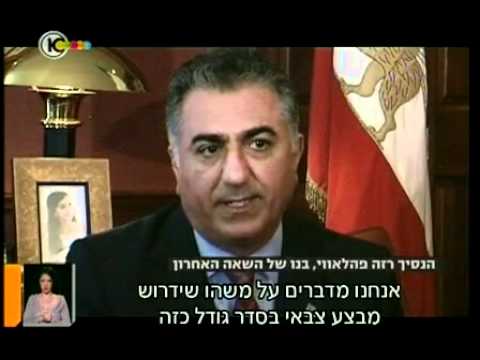
What's his name: "Israel should help Iran topple regime"

Via FLC


"(JTA) -- Iran's crown prince is urging Israel to help topple the Iranian regime. ... Reza Pahlavi -- whose father was the shah who was toppled during the 1979 Islamic revolution -- told Al Arabiya ..."


River to Sea Uprooted Palestinian  
The views expressed in this article are the sole responsibility of the author and do not necessarily reflect those of this Blog!

To the Syrian Opposition: Your Time Is Up!


Syrian National Council leader Burhan Ghalioun speaks during a news conference in Tunis 19/12/2011. (photo by REUTERS/Zoubeir Souissi )

By: Sateh Noureddine posted on Wednesday, May 16, 2012

The Arab League Chamber in Cairo remained empty during a scheduled Syrian opposition meeting on May 16. However, this is neither a setback nor a deviation from the process of change in Syria. In fact, for Syria, it will most likely be a new impetus toward the unknown.

About this Article

Summary:
The Syrian opposition canceled a major meeting with the Arab League that was to be held in Cairo May 16 because of infighting. But the cancelation does not signal a setback for change in Syria, writes Sateh Noureddine. It simply proves that the media-driven opposition is no longer relevant to the Syrian revolution.
Publisher: As-Safir (Lebanon)
Original Title:
End of Validity Period
Author: Sateh NoureddinePublished on: Wednesday, May 16, 2012
Translated On: Wednesday, May 16, 2012
Translator: Sami-Joe Abboud
Categories :Analysis & Opinion Politics Syria
No one was surprised by the cancelation of the Syrian opposition meeting at the Arab League headquarters. In fact, no one even noticed. The cancelation actually painted a very realistic portrait of the state of the Syrian opposition. For its part, the media has been putting the spotlight on the popular movements, thereby endowing them with a level of significance that does not represent their true situation. These attributes are rooted in the past, back when Syrian society used to, and it still does, oppose both loyalist and opposition figures alike.

It would not be an exaggeration to say that the Syrian opposition was created to speak for the popular majority and for the revolution. The regime, which is the opposition’s source of strength and mission, has led this revolution. Clearly, this will continue to be the case despite all of the attempts to seize the initiative and the leadership from the regime. The meeting in Cairo May 16 was part of these attempts.

The cancelation of the meeting did not disappoint anyone. The Syrian opposition seems to disagree with itself more than it does with the regime it is opposing. History has shown how even the Syrian Ba’ath Party has been unable to silence political activity, whether by force or by chance, over the past five decades.
Syrian politics are characterized by individualism, a sense of superiority in dealing with the public, creating deceptive labels for Syrian society, and suggesting impossible solutions for its problems.

Furthermore, a long period of time disconnected from events on the ground and exile have prevented the opposition from reaching Syrian society. As a result, members of society view each and every opposition figure with a great deal of suspicion. What caused this rift was the opposition’s failure to speak the public’s language. Syrian society is following the example of Tunisia, Egypt, Libya and Yemen, whose experiences are not compatible with the agendas of oppositional political parties, movements or figures.

The emptiness of the Chamber further proves that the invented opposition’s message for the past 14 months is overused and no longer relevant for live TV broadcasts. Air time for "traditional" opponents has been reduced to make room for the extensive network of field reporters who cover today's events, analyze the facts, and put them in their own words.

The invented opposition’s time is up, and good riddance. They were undeniably one of the culprits behind the fragmentation of the military and Islamist terrorism, and they are a major hindrance to both Syrian society and its hope for change without a civil war.
River to Sea Uprooted Palestinian  
The views expressed in this article are the sole responsibility of the author and do not necessarily reflect those of this Blog!

Friday, 18 May 2012

Postcolonial Theory, Whiteness & Palestine

By Gilad Atzmon
Added graphics by Alex

Postcolonial, feminist and gay studies share many similarities to the extent that some academics regard these fields as theoretically and ideologically complementary. These fields of study are primarily concerned with politics, the structure of hegemony, the oppressed and the mechanism that brings about injustice. It is only natural then, that these realms of thought, primarily concerned with prejudice and injustice, would become key instruments in our understanding of Zionism and Israeli oppression.

Without questioning the intellectual validity and the theoretical substance of the postcolonial spectrum of thought, it is clear that some contemporary leading trends within this realm of studies emphasize the role of ‘White male’ and the ‘phallus’ as being at the core of contemporary Western society’s malaise. So the next question is almost inevitable –Where does it leave the ‘White male’? Or more anecdotally, am I, a person who happens to be wrapped in pale skin and is also attached to a white phallic organ, do I bear responsibility for centuries of European genocides? Would my responsibility lessen once I decide to chop my male organ off?  Am I, or any other White male, left with any authentic ethical role?  Or are we biologically doomed to be the epitome of every wrongdoing of the Western society for generations? The astute postcolonial theorist may suggest that ‘Masculinity’, ‘Whiteness’ and the ‘Phallus’ are mere symbolic representations rather than ‘things in themselves’.

Some postcolonial and feminist theoreticians would argue that imperialism, like patriarchy is, after all, a ‘phallo-centric’, ‘supremacist’, ‘White’ ideology that subjugates and dominates its subjects. This is an interesting and even intriguing statement, yet I am not so sure that it is valid or at all relevant to our understanding of Zionism and the crimes committed by the Jewish state. Zionism and Israel are clearly supremacist ideologies, yet is AIPAC’s push for a war against Iran ‘phallo-centric’? Is the Zionist appetite for Palestinian land ‘patriarchal’, or inspired by any form of ‘phallic’ enthusiasm or even ‘Whiteness’? Is the ‘War against Terror’ that left about one and a half million fatalities in Iraq and Afghanistan, ‘phallicly’ orientated or is it the White male again?

Meet the Jewish Settlers
Let’s face it, Zionism, Israeli politics and Jewish Lobbying are not particularly ‘phallo-centric’ or ‘patriarchal’. They also have little to do with ‘Whiteness’. Zionism, and Israel are actually primarily ‘Judeo-centric’ to the bone. They are racially driven and fuelled by a particular supremacist culture that is inspired by some aspects of Talmudic Goy hating and some sporadic (and false) Old Testament (false) interpretations. But this is exactly the verdict the postcolonial scholar attempts to prevent us from reaching.

It is especially embarrassing because Israelis and Zionists openly draw their inspiration and expansionist enthusiasm from Jewish culture and texts, which they interpret in a very particular self-serving manner.

In spite of the fact that this discourse, in its current form, is pretty much, irrelevant to our understanding of Zionism and Israel, this postcolonial discourse is still, very popular amongst some anti Zionists and in particular, Jewish anti Zionists. The reason is pretty simple; it is effective in diverting attention from the real issues; it disguises the magnitude of Jewish power, Jewish politics, the inherent ‘Jewish’ nature of the ‘Jewish State’ and Jewish intellectual hegemony within the west and the Left in particular. Within the realm of the postcolonial discourse we are not even allowed to mention the ‘J word’, let alone criticise Jewish lobbying or Jewish power structures.

Prominent ’Israeli’ Seeks Despicable Nazi Remedy for Palestinians

In fact, the postcolonial discourse, allows its acolytes to talk endlessly and passionately about Israel and Zionism without saying anything meaningful.

It allows the Left to refer to Zionism as ‘settler colonialism’ in spite of the embarrassing fact that no one actually knows where or what exactly is the Jewish ‘mother state’ is[1].

Postcolonial scholars also encourage us to refer to Israel as an Apartheid state in spite of the fact that Apartheid is a racially driven system of exploitation of the indigenous. The Postcolonial enthusiast would obviously turn a blind eye to the fact that Israel is not interested in exploitation of the Palestinians. It prefers to see them gone.

Hence, since it aims to get rid of the indigenous, Israel should be realised as an avid follower of the Lebensraum (Living-space) philosophy.
From that perspective at least, Israel should be equated with Nazi Germany rather than with South Africa.

The postcolonial discourse, in its current form, allows its anti Zionist enthusiasts to spin endlessly. They can refer to Israel and Zionism without actually disturbing, hurting or even touching Israelis, Zionists and Jewish political structures.

The postcolonial theorist is basically engaged in an attack on an imaginary phantasmic construction that has zero relevance to Zionist ideology or Israeli politics whatsoever. It is basically an advanced form of an intellectual onanism.

Like Rabbinical Judaism and Stalinism, the postcolonial discourse is extremely intolerant towards dissent and criticism. It surrounds itself with a defense wall, operates as an intellectual ghetto. In fact, it also invented political correctness just to police and curtail, by means of self-censorship, any freedom of expression.


Arab and Palestinian Postcolonial Scholarship


Edward Said with Mahmoud Marwish.
One of the most influential postcolonial thinkers was Palestinian- American literary theorist Edward Said. Said’s polemic, Orientalism (1979) was a deeply profound attempt to grasp the West’s vision of the Orient, the colony and Islam. The term Orientalism, as coined by Said, covers three interrelated meanings. First, it names the academic study of the Orient. Secondly, it is a form of deliberation that constitutes the Arab as the ‘other’.  Thirdly, it is the structures that maintain Western domination over the Orient.

Being an outstanding creative intellect, Said engaged in a vast examination of a multitude of Orientalist discourse. His writings refer to political and historical texts as well as literature and media. Said obviously realised the immense importance of cultural criticism and cultural studies.

Confusingly, some of Edward Said’s Palestinian and Arab successors seem to oppose the very field of study Said championed.  
For example, as much as Said was immersed in deep cultural examination and discourse analysis, Palestinian activist and academic Ali Abunimah recently claimed the following.
“We should be very clear in condemning explanations which try to blame a culture or a religion for a political situation.“
Abunimah basically believes that culture doesn’t explain ‘anything at all’. It seems to me that Abunimah, who often integrates the term ‘Orientalism’ into his political statements and tweets, is apparently unfamiliar with the intellectual core of Edward Said’s thought and methodology.

Ali Abunimah is not happy at all with my reading of the conflict. This is understandable and totally legitimate and furthermore, he is not alone. Other exiled Palestinians seem also to be very concerned. Their outrage at my argument that Israel is not a European style colonial state implies that they fear the end to a discourse in which they have invested so much. Some of those Palestinians were very happy to add their names to the list of book burners who demanded my disavowal.

This was indeed a very sad turn – futile, yet, at the same time both revealing and predictable. Though those Arab and Palestinian scholars criticized my work for being ‘racist’ without providing a single racist comment by me, it was disappointing to discover that, it was in fact their writing that was actually saturated with biological determinist comments and peppered with blunt racism.

Recently we came across a video of cultural BDS leader Omar Barghouti exploring some ‘postcolonial’ ideas. He for instance, insisted that “the white race is the most violent in the history of mankind.” This is an outrageous sweeping generalization especially since , Barghouti surely knows that Zionism is Judeo-centric and has very little to do with Whiteness. It is not the degree of ‘Whiteness’ that constitutes the racist element within the Israeli legal system, it is rather the ‘degree of Jewishness’ that makes an Arab Jew privileged in comparison to a Palestinian with a very similar skin colour. Omar Barghouti is studying in a ‘Zionist’ Tel Aviv university (while asking the rest of us to boycott the same university). Seemingly, he has internalised the Zionist academic postcolonial jargon and has integrated and implemented some biological determinist and racist ideas into his pro-Palestinian political thinking.

And Omar Barghouti is not alone. Assad Abu Khalil, AKA The Angry Arab, is another postcolonial enthusiast who also engages in a similar racially driven approach.

In his blog post White Man and Paul Newman, Angry AbuKhalil writes “the White Man is not a racial category–or it is not merely a racial category but also a political and epistemological category.” Not only does Angry Arab agree that the ‘White Man’ is partially a racial category, he even goes as far as linking skin colour with a political stand and even epistemology.[2]

Of course, I realise that being an Arab academic in a Zionised American or British university is a tough mission.

I guess that for some time the postcolonial discourse was the only possible template that allowed a criticism of Israel and Zionism. But the time is ripe to move on. We’d better now call a spade a spade.  It is time to call Israel what it is, namely “The Jewish State”. The time has come to ask what the Jewish State is all about and what is the true meaning of the Jewish symbols that decorate Israeli tanks and airplanes? The time has come for us to grasp that the Jewish Lobby is a primary threat to world peace.

But can we do it all while being thought-policed by the rigid boundaries of the postcolonial realm?  Can we talk about Jewish identity politics while some prominent Palestinians activists attempt – to block any discussion on Jewish culture & power?  My answer is yes we can, and we’d better make every possible effort to liberate our discourse from the Judeo-centric postcolonial grip.

Whiteness, The Jew & The Queer


In the last few weeks I have wondered why Omar Barghouti attacks the ‘White race’? Is it really necessary? Couldn’t he just refer to the ‘West’, America, Orientalism or the ‘British Empire’?

Why does Angry Arab fight the White man? Is it really an elementary political category?  Does the introduction of racial categories and biological determinism serve the Palestinian cause or Arab liberation?  

I decided to jump into the water and immersed myself in some contemporary texts about whiteness and postcolonial theory. I thought that it may help me to understand the emergence of such thoughts.

Following the recommendation of my friend and musical partner Sarah Gillespie, one of the first texts I picked was Richard Dyer’s ‘White’. Dyer is a respected film scholar and a leading writer on the topic.

It didn’t take more than five pages before I stumbled upon a very interesting passage that opened my eyes. In the next few lines Dyer speaks about his childhood friendship with a Jewish pal and the impact it had on him. 
“The key figure here was a Jewish boy at school, whom I’ll call Danny Marker. I used to visit him and his family in Golders Green, a Jewish neighbourhood of London. I knew by then that I was a homosexual and I envied Danny and his family-they too were an oppressed minority, whom, like queers, you could not always spot; but, unlike us, they had this wonderful, warm community and culture and the wrongfulness of their oppression was socially recognised. I now believe that there are intellectual and political problems with making and analogy between Jews and queers, between ethnic and sexual discrimination, but I am trying to say how it felt then. I envied Danny’s ethnicity and wanted to be part of it, indeed, felt at home with it.”  (White, Richard Dyer,  White Pg 5) 
The wandering who- Gilad AtzmonIn The Wandering Who, I wrote extensively about the clear ideological and theoretical continuum between Zionism and other marginal thoughts. I explored the deep ideological similarity between Queer theory and the Jewish national aspiration.

On the one hand we notice a legitimate and reasonable call against injustice – the Zionist and the Queer theorist demand to become ‘people like other people’ a call obviously understood and supported by many. But on the other hand, we also detect another forceful demand – to maintain and preserve uniqueness and differentiation. As one can imagine, the humanist call for equality can easily clash with the forceful self-centric, clannish demand for preservation (especially when celebrated on the expense of others).

However, Richard Dyer explores here another special affinity between the queer and the Jew. As a homosexual he expresses a clear and innocent envy of his Jewish schoolmate’s social landscape. Dyer notices that in spite of being oppressed, the Jews have managed to form a “warm and wonderful community and culture.”  

Dyer’s feeling at home within the Jewish family nest may explain why Tel Aviv has become a Gay capital.

It explains why some prominent Queer activists feel so strongly and positively about the Jewish State, Zionism, Jewish culture and Jewishness in general. But it also may explain why some Arab and exiled Palestinian secular academics, feel some affinity to the Jewish dominated anti Zionist postcolonial nest. Operating as an intellectual ghetto, it may also retain some Jewish characteristics, it is probably a ‘warm community’ as Dyer describes it. It may even be that some Palestinian postcolonial secular academics would feel more comfortable in Tel Aviv University than in Al-Azhar University in Gaza.

I obviously understand it and I am far from being judgmental. But am I naïve to expect Palestinian activists and intellectuals to ensure that the, ‘wrongfulness of Palestinian oppression’ be widely and ‘socially recognised’ by the masses, rather than by a few postcolonial Jewish Anti Zionists?

It is time for our discourse to leave the ghetto.


I guess that in order to achieve such a goal, we must transcend the decaying postcolonial discourse or else completely revise it. We must drift away from any form of marginal ideology.  We must be able to deconstruct Jewish texts and Jewish cultural discourse with the same vigor that Edward Said deconstructed the European canon, whether it was Charles Dickens or Lord Balfour. We actually better locate the issue of Palestine at the forefront of the battle for a better world, humanity and humanism.

We should engage in an inclusive, open intellectual debate that welcomes all oppressed (queers, gays, Arabs, Muslims, people of colour and so on) and oppressors too. At the end of the day, with 50 million Americans living in deep poverty watching 30.000 drones fly over their heads, Gaza is now in Detroit, Newark and Philadelphia. Our solidarity with Palestine can now become a true force of genuine empathy. We don’t now just put ourselves in the shoes of the Palestinians, we actually wear them. We all strive for the same liberty. We are one.


[1]  If Israel is the Jewish ‘Settler State’ we better be informed at last where is the Jewish ‘mother state’ for colonialism is defined by a clear material, cultural and spiritual exchange between a mother and a settler states.
[2] It would be wrong not to mention professor Joseph Massad of Columbia University. Following his Mentor Edward Said, Massad also writes  about the role of colonialism, its structure, its impact  and the scars it left behind. Like Barghouti and Abu Khalil, Massad also refers occasionally to skin colour. Yet, unlike Barghouti and Abu Khalil, Massad seems to be far more careful and astute. Rather than falling into the banal biological determinist trap, he seems to critically refer and examine the role of skin colour from structural, social, cultural and political perspectives.

River to Sea Uprooted Palestinian
The views expressed in this article are the sole responsibility of the author and do not necessarily reflect those of this Blog!