Saturday, 28 July 2012

Swallowing the big lie on Syria


Syria tremseh massacre
Syrian foreign ministry spokesman Jihad Makdissi
speaks during a press conference in Damascus on
July 15, 2012. Syria's regime denied its forces used
tanks and helicopters in an assault on Tremseh,
saying what happened in the central village was the
result of clashes with rebels and not a "massacre."
(LOUAI BESHARA/AFP/Getty Images)
Commentary: Reporting massacres that didn’t happen, and other media sins.
Antibes, France — The Western media should have learned a lesson from the Iraq fiasco.

Most of the mainstream media gave a free pass to a Republican White House that promoted the Big Lie that Saddam Hussein's regime was somehow linked to terrorism and armed with weapons of mass destruction. The Bush administration found it was child's play to manipulate even the New York Times.

A lot has happened on the road from Baghdad to Damascus, but it seems that both Washington policymakers and the media still have much to learn.

This time a Democrat administration is using the Arab Spring to get rid of an inconvenient leader. No need to invade Syria or risk American lives. Just use discrete American guidance and arms supplied by American allies in the region to make sure that a home-grown insurgency has enough of the right stuff to win an insurrection. “You'll notice in the last couple of months, the opposition has been strengthened,” a “senior U.S. Official” told the New York Times on July 20. “Now we're ready to accelerate that.” U.S. Officials have been selectively leaking information on the supposedly clandestine American involvement in the Syrian conflict, an apparent effort to shape public opinion by suggesting that the United States is helping elements of the opposition, without explaining how they can tell the good guys from the bad guys.

Propaganda, or the mobilization of public opinion, is a vital part of the operation. And once again, the American and Western media seem to be asking too few questions.

Western journalists are of course having a hard time reporting the war. Some have lost their lives. Barred from legally entering Syria, most are covering it from Turkey, Lebanon or more distant listening posts. But as pointed out by Russ Baker, whose web site is sharply critical of American media coverage, reporters should be telling us more about their usually anonymous sources inside Syria.

Who is the “Mohammed” who was telephoned by the New York Times and reported the “massacre” by government forces of 200 persons in the village of Tremseh). Was he an eye witness? Did the reporter try to find other sources?

Two days later, the Times acknowledged that the “massacre of civilians” was more likely a clash between heavily armed Syrian military and lightly armed local fighters, and the death toll was closer to 100, most of them young men.
In most such cases, Western officials use the unverified reports to make instant headlines denouncing Syrian “human rights violations,” with Secretary of State Hilary Clinton and UN Ambassador Susan Rice often leading the pack.
Western reporters clearly tend to assess opposition sources less critically than Syrian government sources. That bias may be justified, but civil wars are rarely fought by angels. Horrible things are done on all sides.

The Western media also seem to overlook the fact that the Syrian government is doing what most governments do when faced with an insurrection. They use whatever force they have to stamp it out, whether it's Sherman marching through Georgia, or Israel pounding Gaza.

You may not like the Assad family, but Western governments did business with it (and still do with a number of other Middle East dictatorships) for decades despite its behavior.
The pattern in the reporting of the Syrian civil war suggests the opposition (possibly in collaboration with western governments) are trying to manipulate the media. Headlines of increasingly bigger “massacres” of innocent “civilians” and reports of serial defections by regime generals and other officials all tend to give the impression that the opposition is on a roll and the regime is on its last legs. These reports may or may not be accurate, but they should treated with a bit of circumspection.
Libya was the play book for the Obama administration's handling of Syria, and this time, the information war seems to be following the same script. Allegations of mass rapes and distribution of condoms to government soldiers were duly reported by western media during the Libyan campaign, and guess what, allegations of widespread rape by the Syrian regime have just popped up.

The end result of disposing of Colonel Gadaffi can hardly be called a success. The country is still in turmoil. You could even argue that western involvement failed to accomplish its supposed purpose, to protect civilian lives. In Syria, the result of Western involvement may be far worse.

Post Ottoman Syria has a history of sectarian conflict, which was brutally crushed by the French during their mandate in the 1920's and again by the Assad family, who took a page out of the French book and ruled with an iron hand. The danger now is that Syria will again split into hostile ethnic enclaves with unpleasant consequences for the neighbors, including Israel. A relatively stable country could become a major source of instability in the Middle East, or in the words of one expert on the Middle East, “an outcome that contains the seeds of a war that never ends.”

The mainstream media have begun to air these concerns in recent weeks. It would have been better if they had been ahead of the curve and helped inform a public discussion of American involvement in Syria before it is too late.

River to Sea Uprooted Palestinian
The views expressed in this article are the sole responsibility of the author and do not necessarily reflect those of this Blog!

Walid Jumblatt: Take Me to The King


Jumblatt declines to talk about the impact the appointment of Bandar Bin Sultan as head of Saudi intelligence will have on Lebanon. (Photo: Haitham Moussawi)
Published Thursday, July 26, 2012
Unlike other politicians in Lebanon, MP Walid Jumblatt does not feel that his security is threatened. In an interview with Al-Akhbar, he says that he cannot wait to set an appointment with the Saudi king and that his increasing criticism of Hezbollah will not affect the alliance keeping the Najib Mikati government in power.

Mukhtara - Normally, when head of the Progressive Socialist Party (PSP) and Druze leader Walid Jumblatt leaves his Beirut residence in Clemenceau to his historic home in Mukhtara, it means he is on a security alert. But this time he left Beirut to his stronghold in the Chouf mountains, “to escape the heat of summer, no more, no less,” as he puts it.

Security measures around his castle of many mansions attest to the lack of anything out of the ordinary. “I receive security reports which I do not believe. They come from the same source. It is the same fax and gets distributed to everyone,” he explains.

In his office, packed with mostly Soviet-era memorabilia, he keeps two AK-47s near his chair. They seem ready to be used at any moment. “But they are souvenirs. There is no need to oil our weapons. Who will we fight?”

The usually anxious man is not concerned these days. He is more worried about renovating the house once used as a headquarters for the military wing of his party, than about the blaze that could set fire to the country at any moment now.
River to Sea Uprooted Palestinian  
The views expressed in this article are the sole responsibility of the author and do not necessarily reflect those of this Blog!

"We have a warning for the Russian forces!"

Via FLC


'I warn the Russian Army!'
"... "We have a warning for the Russian forces: if they will send any more weapons that kill our families and the Syrian people we will hit them hard inside Syria," said Louay al-Mokdad, a logistical coordinator for the Free Syrian Army (FSA)...Informers inside the regime are telling that us that there is a big weapons' shipment arriving at Tartous in the next two weeks. We don't want to attack the port, we are not terrorists, but if they keep acting like this we will have no choice....."


Russian Arny warns FSA's "hotheads" from attacking Tartous base
MOSCOW. July 27 (Interfax) -" Any attempt to attack the Russian naval supplies and maintenance facility at the Syrian port of Tartus will be rebuffed immediately, a source in the Russian General Staff told Interfax-AVN on Friday.
"If the armed Syrian opposition ventures to implement their threat and to attack the Russian naval supplies and maintenance facility, Russia has ample capabilities in the region now to provide an adequate response. We won't recommend hotheads in the Syrian opposition doing that," he said.
"The Syrian side, too, has taken corresponding measures to enhance the naval supplies and maintenance base's protection and defense," he said."
River to Sea Uprooted Palestinian  
The views expressed in this article are the sole responsibility of the author and do not necessarily reflect those of this Blog!

Syrian rebels burn comrades' bodies in Aleppo to hide nationalities

Rebels clash with government forces in the center of Syria's restive city of Aleppo on July 25, 2012.
Sat Jul 28, 2012 8:7AM GMT
Rebels fighting against the Syrian government forces in the northwestern city of Aleppo have burned the bodies of their comrades to hide their nationalities, Press TV reports.

The report comes as clashes between army forces and armed gangs rage on in several regions in Syria.

Signs of torture can be seen on bodies found in areas held by the armed rebels, Syrian sources say.

The Syrian army on Saturday launched a military operation to clear Aleppo, the country's biggest city, form the foreign-backed rebels.

Press TV’s correspondent in Syria said that the army is inflicting heavy losses on the rebels in Aleppo.

The Red Crescent has suspended some of its operations in Aleppo because of heavy fighting.

Syrian government said that its troops have freed two Italian nationals who had been kidnapped by armed groups in a suburb of Damascus.

There have also been reports of clashes in the northern province of Idlib while calm has returned to the capital Damascus after government forces flushed out the rebels there.

Government forces also defused several bombs planted near a mosque in the Hajar al-Aswad district of the capital.

Syria has been experiencing unrest since March 2011, with demonstrations being held both against and in support of President Bashar al-Assad's government.

The Syrian government says outlaws, saboteurs, and armed terrorists are the driving factor behind the unrest and deadly violence while the opposition accuses the security forces of being behind the killings.

Damascus also says that the chaos is being orchestrated from outside the country.

DB/MA/AZ
River to Sea Uprooted Palestinian  
The views expressed in this article are the sole responsibility of the author and do not necessarily reflect those of this Blog!

Syrian troops start operations against rebels in Aleppo

Syrian soldeirs celebrate in the al-Midan area in Damascus on July 20, 2012.
Sat Jul 28, 2012 6:15AM GMT
LAST UPDATE
The Syrian army has launched a military operation against rebels in Aleppo, the country’s business hub and largest city.

According to reports, the government troops were deployed to the city’s southwestern district of Salaheddin on Saturday.

Fierce clashes between government forces and foreign-backed rebels are underway in several neighborhoods of the city.
The Red Crescent has suspended some of its operations in Aleppo because of heavy fighting.
There have also been reports of clashes in the northern province of Idlib while calm has returned to the capital Damascus after government forces flushed out the rebels there.

Government forces also defused several bombs planted near a mosque in the Hajar al-Aswad district of the capital.

Syria has been experiencing unrest since March 2011, with demonstrations being held both against and in support of President Bashar al-Assad's government.

The Syrian government says outlaws, saboteurs, and armed terrorists are the driving factor behind the unrest and deadly violence while the opposition accuses the security forces of being behind the killings.

Damascus also says that the chaos is being orchestrated from outside the country.

DB/MA/AZ

Turkey, Gulf states establish secret Syria base


Turkish forces have built up near the Syrian border in recent months. (Photo: Reuters – Osman Orsal)
Published Friday, July 27, 2012
Turkey has set up a secret base with allies Saudi Arabia and Qatar to direct vital military and communications aid to Syria's rebels from a city near the border, Gulf sources have told Reuters.
News of the clandestine Middle East-run "nerve center" shows the extent to which the three countries have joined forces to aid an uprising against Syrian President Bashar al-Assad.
"It's the Turks who are militarily controlling it. Turkey is the main co-ordinator/facilitator. Think of a triangle, with Turkey at the top and Saudi Arabia and Qatar at the bottom," said a Doha-based source.
"The Americans are very hands-off on this. US intel are working through middlemen. Middlemen are controlling access to weapons and routes."
The center in Adana, a city in southern Turkey about 100 kilometers from the Syrian border, was set up after Saudi Deputy Foreign Minister Prince Abdulaziz bin Abdullah al-Saud visited Turkey and requested it, a source in the Gulf said.
The Turks liked the idea of having the base in Adana so that they could supervise its operations, he added.
A Saudi foreign ministry official was not immediately available to comment on the operation.
Adana is home to Incirlik, a large Turkish/US air force base which Washington has used in the past for reconnaissance and military logistics operations. It was not clear from the sources whether the anti-Syrian "nerve center" was located inside Incirlik base or in the city of Adana.
Qatar, the tiny gas-rich Gulf state which played a leading part in supplying weapons to Libyan rebels, has a key role in directing operations at the Adana base, the sources said. Qatari military intelligence and state security officials are involved.
"Three governments are supplying weapons: Turkey, Qatar and Saudi Arabia," said a Doha-based source. Ankara has officially denied supplying weapons.
"All weaponry is Russian. The obvious reason is that these guys (the Syrian rebels) are trained to use Russian weapons, also because the Americans don't want their hands on it. All weapons are from the black market. The other way they get weapons is to steal them from the Syrian army. They raid weapons stores."
The source added: "The Turks have been desperate to improve their weak surveillance, and have been begging Washington for drones and surveillance." The pleas appear to have failed. "So they have hired some private guys to come do the job."
President Barack Obama has so far preferred to use diplomatic means to try to oust Assad, although Secretary of State Hillary Clinton signaled this week that Washington plans to step up help to the rebels.
The White House's wariness is shared by other Western powers. It reflects concerns about what might follow Assad in Syria and about the substantial presence of anti-Western Islamists and jihadi fighters among the rebels, many of whom enjoy Saudi or Qatari backing.
The presence of the secret Middle East-run "nerve center" may explain how the Syrian rebels, a rag-tag assortment of ill-armed and poorly organized groups, have pulled off major strikes such as the devastating bomb attack on July 18 which killed at least four key Assad aides including the defense minister.
A Turkish diplomat in the region insisted however that his country played no part in the Damascus bombing.
However, two former senior US security officials said that Turkey has been playing an increasing role in sheltering and training Syrian rebels who have crossed into its territory.
(Reuters, Al-Akhbar)
River to Sea Uprooted Palestinian  
The views expressed in this article are the sole responsibility of the author and do not necessarily reflect those of this Blog!

Reviving Nationalism in The Arab World


A Syrian refugee holding the opposition flag attends a protest against Syria's President Bashar al-Assad, in Amman 19 July 2012. (Photo: Reuters - Muhammad Hamed)
Published Wednesday, July 25, 2012

“Nationalism” has an ugly connotation in the West, its mere mention immediately evoking the memory of a rampaging Nazi Germany. In the Arab world too, the title of “nationalist” has been tarnished by the false adoption of its concept by elite cliques trying to legitimize their authoritarian rule – Saddam Hussein, for example.

But in an international system of nation-states, no nation can be true to itself without a nationalist foundation that encompasses a set of collectively shared values under the banner of a national identity. Referring to Nazi Germany in order to deny the validity of nationalism ignores the fact that all great and sovereign powers in our current era are grounded in nationalist principles.

Indeed, as with all concepts and ideologies, its extremities can produce unwanted effects, as Nazi Germany and Israel's Zionism have shown. But without a unifying national identity, a nation-state cannot be deemed as such, and risks falling into the degrading category of a “failed state.”

In their post-colonial designs on the Middle East, Western powers implemented a policy of divide and conquer that ensured steady oil flow, while maintaining regional hegemony through the suppression of the emergence of a nationalist, sovereign order reflective of the social and economic interests of the Arab peoples. Sovereignty – in other terms, independence from Western interests – is the West's ultimate fear for the Arab world. And sovereignty can only be achieved through a national conscience that produces a binding national identity.

Finding Sovereignty Through Great Power Politics

The anti-imperialist argument concerning the Syrian crisis entails a complete rejection of the hegemonic order established in the Middle East, and great power involvement in internal affairs. It also strikes at the endless struggle between the desire for self-determination of lesser powerful nations and the global interests of greater powers.

However, the weakness of the wholly rejectionist anti-imperialist stance is that it relies too heavily on moral righteousness, which skews it from the fundamental, and often cruel, realities of international relations. Oppressed peoples of weaker nations should feel outraged that greater powers so often treat them with disdain and squander their freedom for the pursuit of selfish and violent interests. But morality does not define international relations, and unfortunately, the history of human civilization has been a recurring theme of the struggles of the weak against the powerful.

Great powers almost always have a stake in the affairs of the weaker powers. An accommodation of the world chess game between great powers needs to factor when pursuing and calculating the interests of lesser states. Opportunities for self-determination of weaker nations become available when sufficient conditions are met, such as a realignment of the world order or where a contest in world power allows room for the attainment of full sovereignty by the weaker power.

Israel currently exists as an addendum of US power, but its creation was only realized following a major realignment of global power after World War II. Vietnam was able to achieve self-determination by using the world power struggle between the United States and the Soviet Union in order to reject American hegemony. The Vietnam War is often viewed as a fight for communism, but the Viet Cong were at the core nationalists simply struggling for self-determination.
“It was patriotism, not communism, that inspired me,” Ho Chi Minh famously declared. “Our secret weapon is nationalism.”

But without Soviet aid under the guise of communism, the Viet Cong would never have succeeded.

It is fair to state that the Arab world has routinely missed the few opportunities that have arisen throughout the past century to achieve self-determination. Western powers successfully manipulated and divided the region after the fall of the Ottoman Empire, and went further to install Israel following World War II. On both occasions, the peoples of the Middle East lacked national cohesion and awareness to stake their claim for the post-colonial era. There was also a failure to exploit the Cold War to produce a sovereign position, particularly in the Levant where, as opposed to Vietnam, a local sense of nationalism failed to take root.

Distinguishing Internal Political Identity from Sovereignty

While the Islamic Revolution of 1979 in Iran is demonized in the West as an act of regression, it successfully achieved self-determination for Iran in the sense that its identity and interests were no longer subordinate to the great powers. The internal political makeup of a country, as controversial as it may be, does not detract from the sovereignty achieved by that state. Iran's Islamic theocracy can rightly be contested within internal spheres, as Vietnam's communism has been since the fall of the Soviet Union, but the ability of a nation to have sovereignty over its identity and interests cannot be underscored. And despite both Iran and Vietnam's governing systems espousing different ideologies, the core motivation for their struggles lied in nationalist tendencies for self-determination and sovereignty over their decisions. Without a cohesive, nationalist understanding shared among the major stakeholders of society, there can be no clear case for self-determination.

This leads to the other glaring weakness of the anti-imperialist stance: it has remained entirely a reactionary expression to great power involvement in the region without articulating the desired nation(s) it would have in its place. Rejectionism on its own is insufficient in any attempt to alter the status quo for the better. And in this sense, the domestic sphere cannot be distinguished from the external surroundings. Rejectionism should not be the motivating force behind the need for change, but rather, a clearly defined vision for a desired nation rooted in a nationalist understanding that reflects the collective interests of its society. The movements behind Israel, Iran and Vietnam were able to define their intended state – Zionist, Islamist and Communist respectively – despite being grounded in a nationalist drive for self-determination. If the outcome is not envisioned when the conditions for the pursuit of self-determination arises, then such a pursuit is subject to manipulation by interested parties. Thus, a road leading to nowhere will be steered by external forces in a direction that will ultimately not lead to true self-determination.

Next Step for 'Arab Spring'

This is the predicament that currently faces the Arab uprisings. The revolts have come at a time of gradual realignment in the global distribution of power, with declining US power and the emergence of non-Western powers. The Arab Spring has thus taken the first step in embracing the opportunity presented to seek self-determination. It has expressed its rejection of the current hegemonic order of the Middle East, but has subsequently failed to present an alternative model that truly expresses local interests.

What is the national identity(ies) of the Arab world? Do we redraw the map and rewind the borders imposed by great powers, or do we retain them? Do we pursue an Islamist model for the region, pan-Arabism, or revert to sub-nationalist identities (such as pan-Maghreb, pan-Syrian)?

A response to such questions, and a clearly defined and accepted platform for a nation(s), must be achieved in order to fully convert the Arab uprisings into true revolutions. The Arab uprisings have thus far created the space to discuss a model that truly reflects the social interests and character of the region. But the growing sectarian discourse perpetuated by the agents of great powers in the region has so far succeeded in sidelining such a necessary debate. The uprisings have, nevertheless, shown some indication that these questions are being addressed, albeit on a low level. Events in Tunisia and Libya have revitalized the Maghreb Union, reflecting a common desire for closer cooperation. Talk of redrawing Gulf boundaries is equally emerging as a result of the Bahrain revolt, but again, shrouded by the overt sectarian discourse driven by the Gulf regimes.

The Syrian crisis is, by contrast, the example of a state lacking a cohesive national identity. The country has turned its guns on itself partly due to an absence of a national conscience. Sectarian, tribal and geographic identities are emerging at the forefront, almost completely blind to the existence of a Syrian nation, which is threatening to tear at the 'cradle of civilization'.

A discussion reviving Syria's national identity cannot be delayed until after a resolution is found to the crisis, as some have proposed, as it is necessary to define the cause motivating the Syrian revolt. Launching a war without a clear alternative nation envisioned leaves the door open to the emergence of reactionary movements and an unforeseen outcome that potentially counters the goals of self-determination. For the Syrian revolt to succeed, it needs to reinforce a sense of nationalism that is inclusive of the country's demographics in its quest for true Syrian sovereignty, where the interests of its society, as diverse it is, are wholly reflected.
Antoun Issa is the News and Opinion Editor at Al-Akhbar English.

The views expressed by the author do not necessarily reflect Al-Akhbar's editorial policy.

River to Sea Uprooted Palestinian  
The views expressed in this article are the sole responsibility of the author and do not necessarily reflect those of this Blog!

Casually: "How were those assassinations carried out? Was it the Israelis? Was it the Americans? How was it done?"

Via FLC


'Assad's days are numbered'
Diane Rehm interviewed Martin Indyk, Aram Nerguizian and Karim Sadjadpour on an episode of her National Public Radio show discussing recent events in Syria. (Audio). She asks an intriguing question regarding the recent assassinations. It wasn't the question itself that surprised me, it was that she asked it.
Rehm: Martin Indyk, we continue to hear those within Damascus throughout Syria saying, where is the United States? What is the United States doing? What more can it do?
Indyk: Well, I think that those who are calling for U.S. military intervention are likely to continue to be disappointed. The heart of the matter is that the president wants to run on a campaign platform of ending wars in the Middle East, not starting new ones, and that is broadly popular in the United States..... Simply put, the American people are war-weary after 10 years of war in the greater Middle East.
Rehm: Mm hmm.
Indyk: And so that kind of military intervention is unlikely. So the focus is much more on helping to support the opposition, perhaps now training them, supporting Saudi Arabia and Qataris....., .........
Rehm: Of course, the question becomes, how were those assassinations carried out? Was it the Israelis? Was it the Americans? How was it done?
Sadjadpour: Perhaps Aram knows more than I do. What I've read about the assassinations are is it's conflicting because the Syrian regime claims that there were suicide bombings conducted by terrorists. But journalists who went to the scene (and Sadjapour the 'expert' is talking about a most important HQ in Damascus, after this decapitation attempt) didn't see any signs of major explosions.....
Rehm: Aram.
Nerguizian: Well, I don't argue with Karim. You don't have a reliable set of narratives..... it's still an ongoing story. I don't think we have a clear picture. There's talk of involvement of Jordanian intelligence, potentially Turkish intelligence, but it's all heresy at this point.
Rehm: Martin Indyk.
Indyk: I think that if we look at the longer term trends in this battle, we can draw some more interesting conclusions which is that, first of all, ... we are witnessing is the last months -- I'm not sure about last days -- of this regime."
River to Sea Uprooted Palestinian  
The views expressed in this article are the sole responsibility of the author and do not necessarily reflect those of this Blog!

Debate on Syria: Chemical Weapons, Foreign Intervention, Regime Change and More…

by Sharmine Narwani


How is the rhetoric of the West affecting the conflict in Syria? Is it an information war and if it is an endgame for Bashar al-Assad, what will replace his regime?


Free Syrian Army fighters sit in a house on the outskirts of Aleppo, Syria, Tuesday, June 12. (world.time.com)

by Sharmine Narwani


I haven’t posted any of my Syria media interviews on this blog – I figure most readers have heard these views from me in some form or other over the past eight months. It is worthwhile though to hear them in context of a broader discussion on Syria that includes other participants, with varying points of view.
Participants in the Voice of Russia (UK) radio discussion on Syria included:
VOR’s Brendan Cole, Guardian columnist, foreign correspondent and author Jonathan Steele; Associate fellow of the Middle East and North Africa programme for Chatham House, London, Nadim Shehadi; head of the St Petersburg Centre for Modern Middle East studies, Gumer Isaev and — myself.
The discussion was broad, but focused largely on recent events inside the country: armed clashes in the major cities, Syria’s chemical weapons cache, foreign intervention, the militarization of the conflict, use of information warfare to create perceptions, regime change and even whether Syrian President Bashar al-Assad still enjoys popularity.


Follow Ms. Narwani on Twitter, Facebook, The Huffington Post and Al Akhbar English

Washington’s reaction to blasts in Damascus is a downright justification of terrorism, slams Russian Foreign Minister Sergey Lavrov. Read more

Bashar al Assad Interview — German ARD TV 05.07.12


River to Sea Uprooted Palestinian  
The views expressed in this article are the sole responsibility of the author and do not necessarily reflect those of this Blog!

Has Assad Ordered Mass Rapes?

Russ Baker, WhoWhatWhy, Jul 24 2012

A growing refrain out of Syria is that widespread rape is taking place—and sanctioned by the regime of President Bashar al-Assad.

But when WhoWhatWhy examined the allegations, it found that well-intentioned women’s groups trying to document and prevent such abuses may be falling victim to a deliberate disinformation campaign intent on rallying public support for toppling Assad.

If so, this would not be the first time false or exaggerated allegations involving women or children were used to generate public anger and build support for military action. This is a particularly effective and cynical approach—in part because it appeals to the very constituencies most resistant to war and its toll: women and human rights advocates.

While rape is horrifically common throughout the world, and more so in conflict zones, so, too, are “psychological operations” intended to shape perceptions and outcomes. Many regimes, particularly authoritarian and totalitarian ones, lie routinely to their people, but as the purported exemplars of high standards of truthfulness and accountability, the United States, Britain and their allies are expected to uphold those values.

Fomenting public outrage is hardly a new thing. Hitler used it to rally the German people. But it is not just genocidal maniacs abroad who manipulate public sentiment. Widespread opposition to US entry into World War I was overcome through an extensive range of propaganda efforts, including untrue stories of German soldiers bayoneting babies. Ironically and tragically, when credible indications of the Nazi death camps arrived in the United States, the government did nothing, the media punted, and the public, in part because of prior untruths, remained skeptical.
During the first Gulf War, a Kuwaiti princess appearing in the guise of an ordinary, anonymous eyewitness, appeared before Congress and told false stories of Iraqi soldiers killing newborn babies by taking them out of incubators. These stories, concocted by a publicity firm tied to the George H.W. Bush administration, were cited by senators supporting an invasion of Iraq. In 2011, we were told that Libyan leader Muammar Qaddafi had “ordered” mass rape.
In the Iraqi case, more people heard the original charges than the later corrections. In the Libyan case, the media simply reported the original allegations but failed to report that no corroboration had ever emerged. The allegations simply vanished.

The Allegations

Because we had written early and often about rape allegations in Libya, we wondered if similar claims might surface in Syria as well. We did not have to wait long to find out. In the summer of 2011, one of the first claims came from Oliver North of Iran-Contra Scandal fame, in a syndicated column that provided no support for the assertion that:

In Syria, Bashar Assad’s violently repressive regime continues a vicious campaign of rape, plunder and murder orchestrated by the Iranian Revolutionary Guard Corps in an effort to retain control over the Syrian people.

A UN report on human rights violations in Syria last fall repeated several witnesses’ claims that security officials had warned them their female relatives would be raped if they did not cooperate. It also cited several allegations that men were anally raped with batons and boys raped by security officials. Given the police baton rape of Rodney King in Los Angeles as well as the conviction of Penn State assistant football coach Jerry Sandusky for repeated acts of “deviant forcible sexual intercourse” with minor males, and a related coverup by the university, as well as human rights group reports on the frequency of prison rape in the United States—to say nothing of within the US military—Americans well know that such acts can take place anywhere. But because the Assad regime is notably cruel and corrupt does not in itself tell us that Assad would see a campaign of sexual terror as useful when he is already struggling to maintain public support.

The UN report, interestingly, made no mention of widespread organized rape of women.

Nonetheless, an organized, calculated, Syrian government rape operation was portrayed recently in numerous news outlets, including The Atlantic. Here’s how the US-based international news website Global Post headlined it:

New project charts rape in Syria
A new project tracks reports of sexualized violence in Syria, where attacks are usually carried out by regime forces.

Of particular interest is the subheadline, saying that sexual attacks are “usually carried out by regime forces.”

In the case of Libya, wide coverage of similar allegations was quickly followed by a growing Western chorus for the ouster of Muammar Qaddafi. But once Qaddafi had been ousted by a huge international military effort, we no longer heard a peep about those allegations—nor saw proof that they were accurate. And now, with Syria an urgent priority and Western countries struggling to overcome Russian and Chinese opposition to intervention, the echo is loud indeed.

Rape allegations represent a separate and powerful appeal to emotion, distinct from charges of massacres. The Western media also carried unverified accounts of Qaddafi’s forces committing massacres of unarmed civilians that were never borne out and seldom publicly corrected. Meanwhile, more recent allegations that rebel Libyan forces—rather than Qaddafi’s—had committed massacres have not been investigated by the new Libyan authorities, who, after all, represent the victorious rebels.

Recently, as we noted here and here, early reports suggesting that Syria’s Assad and his force were solely or principally responsible for massacres of men, women and children have been negated by partial retractions—though anecdotal evidence suggests that many more heard and still believe the original claims than the subsequent cautionary reports.

Syria`s Foreign Ministry spokesman on Monday (SANA)Recently, defectors, a growing tool in the propaganda arsenal, have been cited warning that Assad has and will use chemical weapons—again, a story famously and falsely utilized to build support for intervention in Iraq. For its part, the Syrian regime, well aware that it is losing the war of words and of how this could be used to justify another NATO bombing campaign as in Libya, has taken the atypical step of publicly promising that its chemical weapons stores are secure and will not be used against the insurgents or Syrian civilians. It has, however, just announced that it would consider itself entitled to use it against foreign invaders—a clear warning that it expects but hopes to discourage NATO from doing what it did to Qaddafi.

A Story Fit For the Tabloids

The new rape allegations have a particular, horribly evil story line, beyond the magnitude of “normal” awfulness.
The GlobalPost story contained this sickening account:

A Syrian girl remembers being kidnapped and kept in an apartment with other young girls. Each day, people in charge of the units would inject the girls’ thighs with an unknown substance, leaving them paralyzed. With the girls unable to move, they were then raped by security forces. In one instance, the girl recounted a soldier burning her genitals with a hot iron. The horrific story is one of many now recorded and posted online by Women Under Siege, an initiative by the Women’s Media Center.

Could all this be true?
Having not heard of Women Under Siege, we at WhoWhatWhy decided to check out the organization, contact it, and seek more details.

At the group’s website, we read this:

A note uploaded to a personal Facebook page written by an engineer describes multiple instances of rape as gathered by a Syrian expatriate and her husband who traveled to Jordan to meet with rape survivors. The couple said they met with the women in two apartments being rented by Saudi individuals to serve as shelters for rape victims.
The couple said they spoke to 17-year-old girl who was raped and kidnapped when her family’s home was searched. The girl was subsequently “moved from one apartment to another for 15 days. Every apartment was guarded and had a woman responsible for five to 10 girls in the apartment. Every day, the girls were injected with a substance in their thighs, after which they became unable to move, and the shabiha [plainclothes militia forces] would rape them.”
During one rape, the girl told the couple, she was tied, undressed, and her genitals, including the inside of her vagina, were burned with a hot iron. She said she passed out and awoke later at a Syrian detention center in Damascus known as the Palestine Security Branch.
Upon her release, she escaped to Jordan, where she has since undergone “multiple reconstructive surgeries,” she said. She is reportedly suffering lasting effects from the unidentified substance that was injected into her thighs, including visible injection sites and a blood disorder.


When we went to the facebook page cited, we found it was from a man named Hadi Al Bahra. Al Bahra’s personal facebook page shows that he is a male, from Damascus, Syria— but is based in Jeddah, Saudi Arabia. Al Bahra is the General Director of Saudia Online, a portal for all things Saudi. Saudi Arabia, a country with its own abominable record on treatment of women and human rights generally, is a leading advocate for military intervention to overthrow Assad.

More on Al Bahra here: He was born in Syria, and migrated to the US at 18, decades ago.

We contacted Mr. Al Bahra by email, seeking to interview him, but he did not respond.

***
Beyond that very vague “report” from Saudi Arabia, we know nothing.

We don’t know who the “Syrian expatriate” and her husband are. We have no way of knowing that they exist, and if they do, that they actually told Al Bahra the story posted on the Women Under Siege website. Even if they did, we don’t know that they are telling the truth. Even if they are, we don’t know that whoever told them that story was telling them the truth. And even if everyone is telling the truth, it still doesn’t mean that Bashar Assad is behind a campaign of deliberate sexual brutalization—or that such claims should be the basis for massive foreign military power to effect regime change in Syria.

Just a caveat, always needed in such articles: Assad is a brutal dictator, as exist throughout the world—and he and his family have been behaving brutally for decades. There is no particular evidence that his regime is demonstrably more vicious than it has ever been, excepting for his use of his military to suppress a foreign-backed domestic uprising at all costs.

Any fair comparison would have to take into account the amount of firepower, the fatalities and casualties incurred by Western military campaigns in places ranging from Vietnam to Iraq.

There also is no history of the United States and its allies insisting that other brutal, authoritarian (but allied) regimes such as those in Saudi Arabia, Bahrain, Yemen and the Gulf States also abdicate.

It Gets Worse

Here is another report from the Women Under Siege website:

Doctor tells of 2,000 women being treated in Damascus for rape
Dr. Malaz Alatassi, a founder and board member of the Syrian Sunrise Foundation, a nonprofit humanitarian aid organization based in the U.S., testified at the European Parliament on April 23, 2012, about atrocities in Syria.
Alatassi reports that he has spoken with a female physician in Damascus who says she is treating some of the 2,000 girls and women raped throughout Syria who have come to Damascus seeking support. The youngest was a 7-year-old girl who died on the operating room table, he said. Many women are pregnant and/or have tested HIV-positive, according to Alatassi. There is not enough medical, psychological, or social support to treat the women’s needs, he said, adding that many have lost husbands or parents.

WhoWhatWhy looked into the nonprofit humanitarian aid organization founded by Dr. Alatassi, the Syrian Sunrise Foundation.

You can find the articles of incorporation of the Foundation here.

It was incorporated in Delaware—a low-disclosure state more typically favored by for-profits than non-profits.

The incorporator of the foundation was Asim Ghafoor of Sterling, Virginia. Ghafoor has been in the news in the past. He was political director of the now-defunct Islamic Free Market Foundation, cofounded by Grover Norquist, the influential GOP operative. Ghafoor, an attorney, was a partner in a consulting firm that advertised good connections with US Homeland Security (and for a time had a Redskins game skybox for rubbing elbows with bigwigs), though he also represented various charitable entities that were investigated for alleged terrorist ties.

We emailed and later spoke with Alatassi. We asked him if he could put us in touch with the Syrian doctor cited in his report. He said that he would pass along our request for a Skype conversation. We did not hear back from the doctor or Alatassi.

YouTube’s Astonishing Policy Influence

Gloria Feldt, a president of Planned Parenthood,
the largest abortion clinic chain in the world.
Women Under Siege, sponsored by The Women’s Media Center, is a US-based nonprofit founded in 2005 by Jane Fonda, Robin Morgan and Gloria Steinem.

In an interview, Gloria Feldt, a former president of Planned Parenthood and a member of the Women’s Media Center’s board of directors, said it was her understanding that the Syria project was an indirect outgrowth of conversations between Steinem and the author of a book about sexualized violence in the Holocaust. She said Steinem was struck by how “sexualized violence had gotten no recognition as one of tools of repression and genocide.”

Apparently, with Syria the current top story about war, the organization thought it would be an ideal place to document the role of sexual violence there. (Steinem herself was on a writer’s retreat and, according to her office, unavailable for comment.)

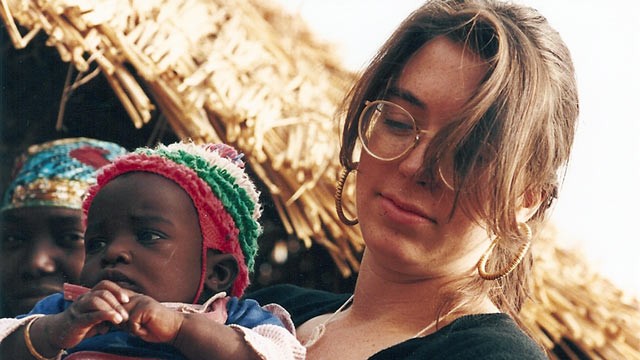
Seeking to establish where Women Under Siege gets its Syria information, we contacted Lauren Wolfe, the young journalist running it. She referred us to Karestan Koenen, a Columbia University epidemiologist who has taken the lead on the information collection. Koenen herself was a victim of a brutal rape—not in Syria, but as a volunteer for the US Peace Corps in Niger. She is one of several women who came forward to reveal that the Corps sought to suppress the story of how its own employees were victims while working in largely friendly countries. (President Obama has signed legislation to provide additional protections.)

We spoke to Koenen while she was attending a conference in Brussels.

Koenen made clear that the group’s information is almost entirely second- or third or fourth-hand and largely comes from unverified web postings.

“The overall goal of the project is to map in real time alleged sexual assaults in Syria,” she said. “The reports we have thus far are mostly identified through researchers and activists who do systematic searches of the web—Google, YouTube, etc. Most results are from that. Some are from human rights groups, some from journalists.”

Koenen noted that a very few of the allegations have been emailed to them from individuals claiming direct knowledge.

She readily conceded that there is no way to know who is taking the time and effort to create such web postings. Presumably it is not victims themselves. And she agreed that such claims should be treated with caution. She did, however, note that it is difficult to obtain accurate, documented information in real time, and that waiting until the conflict is over is also not a viable option.

As for the trends from the inputs, Koenen says, “In the vast majority of reports we’ve received—about 70 percent, the perpetrators are government forces. The fact we haven’t received so many reports about the [opposition] Free Syrian army doesn’t mean they haven’t committed rapes. We have gotten a few.”

Koenen told us that Wolfe was imminently due to speak about rape in Syria on a panel at the United Nations, shortly before the Security Council was to take yet another vote on whether to dramatically increase sanctions against Assad.

Because of Russian and Chinese objections, the Security Council did not approve those sanctions. But the United States and its allies made clear they intend to go forward with toppling Assad, and do not need UN acquiescence. As the New York Times noted:

“We’re looking at the controlled demolition of the Assad regime,” said Andrew J. Tabler, a Syria expert at the Washington Institute for Near East Policy.

Source: Lieberman and McCain?

One of the early and leading claimants for mass rape in Syria is Sen. Joseph Lieberman, a member of the Armed Services Committee and a strong supporter of US military interventions in Iraq and Libya. He, along with his friend John McCain, has been in the forefront of pushing for US military participation in support of the uprising against Assad.

By his own account, though, he is often skeptical of the value of inquiries.

He by statement or action backed away from inquiries into Hurricane Katrina malfeasance and refused to investigate the murders of civilians by Blackwater in Iraq.

And as Chairman of the Senate Homeland Security and Governmental Affairs Committee, Lieberman declared: “We like to do legislation,” Lieberman said. “We don’t like investigating … just to see who is at fault.”

Far fewer people who are reading the headlines about Assad being behind mass rapes are likely to read this caveat on the Women Under Siege site:

The thing is, rape is nearly impossible to confirm. …
[Snip]
When documenting rape, as in anything, you have to evaluate your source: Is this coming directly from the woman who was violated? From her cousin? Her cousin’s friend? In the case of Syria, many stories are coming from that cousin’s friend. Or from the cousin’s friend who “heard about” a friend of his brother’s sister…etc. Right now, Syria is a convoluted black hole of second- and third-hand reporting that few conflict zones can rival in recent history.
The sources reporting rape directly to our crowdmap or via news outlets vary: Fathers speak out for their daughters, doctors for their patients, and, perhaps most surprisingly, many of our reports are sourced from former Syrian army soldiers admitting (forcibly? We can’t know) the crimes they have committed. It’s a sinkhole of fact-checking. But, for the sake of our humanity, we believe we have to mark all of this down and try.
This is why we’ve chosen to post all our reports on WomenUnderSiegeSyria.crowdmap.com as “unverified.”

In our interview, Women Under Siege’s Koenen noted: “We have no evidence there are orders [by Assad] to do this. It seems to be widespread, in over a dozen locations, but at this point I wouldn’t be able to say.” And, asked about whether there is something unique about what is alleged in Syria that would make this a special case for military intervention, including a probable bombing campaign and all that entails, she said: “We don’t have a sense whether sexual violence is more common in this conflict than in others.”

For more on rape as a worldwide problem (including the fact that eighteen percent of women in the United States have been victims of rape or attempted rape), see this.

Finally, in order to advance the public interest, WhoWhatWhy makes this offer: We are a small nonprofit with limited editorial resources. But if someone of substantial means (though no agenda) will step forward to fund it, WhoWhatWhy will put a team in-country in Syria and try to establish whether the headlines accurately portray what is going on. We promise to report, fairly, whatever we find.
River to Sea Uprooted Palestinian  
The views expressed in this article are the sole responsibility of the author and do not necessarily reflect those of this Blog!

Assad’s Security Makeover


Syrian opposition fighters battle government security forces (unseen) during the siege of the Shaar district police station in the northern Syrian city of Aleppo which was later overrun by the rebel forces on 25 July 2012. (Photo: AFP - Pierre Torres)
Published Friday, July 27, 2012
There has been much speculation about the significance of last Tuesday’s appointment of five senior Syrian officers to top security posts, in terms both of the timing of the move and the personnel selected.
Many saw it as an attempt by President Bashar al-Assad to demonstrate the continued cohesion of the security establishment and the loyalty of top officers to the regime – whilst turning his back completely on the outside world and launching a military campaign of unprecedented ferocity aimed at crushing his armed opponents.

While the new appointments were part of the regime’s response to the July 18 bombing which killed four senior security officials in Damascus, they were not aimed at filling any posts vacated by that incident.

Assad had notified cabinet ministers that he intended to make high-level personnel changes in the country’s security agencies when he held his first meeting with the government of Prime Minister Riad Hijab in June.

In the wake of the bombing, he was quick to name a new defense minister and chief of staff. Generals Fahd al-Freij and Ali Abdallah were appointed on July 22, the former replacing General Daoud Rajiha, who was killed in the blast.

Two of the other victims – Deputy Defense Minister General Asef Shawkat, and Assistant Vice-President General Hassan Turkmani – held posts that had been specially created for them.
The job of the fourth, National Security Bureau (NSB) chief Major General Hisham Ikhtiyar, is likely to be discontinued given Tuesday’s naming of General Ali Mamlouk, the former head of the General Security Directorate (GSD), as head of a new National Security Council (NSC). Mamlouk is greatly trusted by Assad, and along with Shawkat (and General Bahjat Suleiman, current ambassador to Jordan), was considered one of the regime’s top security strategists.
The fifth victim of the bombing, Interior Minister General Mohammad al-Shaar, is in critical condition, having lost limbs, and will be unable to return to his duties. But Assad has not yet appointed a successor to head the Interior Ministry, which is effectively run by the four senior officers who serve as the minister’s assistants.
It was, therefore, the political and security fallout of the bombing, rather than its direct consequences, that Tuesday’s appointments were designed to address – not least of all the security lapses that facilitated the attack, which targeted a meeting of the regime’s Crisis Management Cell (CMC).
In May, the CMC’s members (with the exception of Shawkat), suffered symptoms of poisoning, and it transpired that an attempt had been made to poison their food. It was clear – especially when Arab TV stations and foreign-based opposition groups prematurely announced the deaths of the would-be victims – that the CMC’s meeting-places were vulnerable to infiltration. Yet despite a security review, insufficient extra precautions were put in place to prevent a bombing that dealt a major blow to the president and to the prestige and image of the security establishment, and which gave a morale-boost to the armed opposition just days after it announced an impending assault on Damascus to “liberate” it from the regime’s grip.
But that was not the CMC’s only lapse. Sources familiar with its members’ deliberations say their approach to the crisis was extreme and over-confident, reflecting their belief that it could be brought to an early end. This view was not shared by Mamlouk or Military Intelligence chief General Abdul-Fatah Qudsieh, whose agencies have their ears closer to the ground, and who expressed concerns that the opposition was growing stronger.
The NSC, which Mamlouk now heads, was created two years ago. A decree establishing it was issued, but the naming of its members was stalled. Although it is not supposed to replace the NSB, the latter was supposed to have been made redundant by the new constitution adopted last year which stripped the ruling Baath Party of its official leading status and allowed for the state to take charge of state institutions previously under party control
The NSB was linked exclusively to the party. Ikhtiyar used to head the body in his capacity as a member of the party’s national command, and he was succeeded by its deputy secretary-general, Said Bakhitan. There is no direct connection between the NSB and the other security agencies, which are under the authority of the president. One reason it was not disbanded after the adoption of the constitution is that elections to a new Baath party national command were postponed.
The CMC was established within the NSB and Baath party at the outset of the disturbances. It was initially chaired by Bakhitan, and he was succeeded by Turkmani. lt was not involved in operational decisions on the ground. Its task was to follow and monitor developments, ascertain people’s needs and conditions in the provinces, and forward its views and recommendations to the president. It included only one security chief, Shawkat, but in a capacity (deputy defense minister) not directly linked to the security agencies. It did not therefore play an intelligence role.
It appears the July 18 bombers believed they would also manage to kill the heads of the security agencies, even though they did not participate in CMC meetings. These figures – notably Mamlouk, Qudsieh, Air Force Intelligence chief Major General Jamil Hassan, and the head of the Political Security Directorate Major General Mohammed Dib Zaitoun – are members of a different cell. Along with the president’s brother Maher (and, formerly, his brother-in-law Shawkat) they constitute the president‘s innermost circle.
Most of the latest appointments were, accordingly, drawn from this group.
Unlike the CMC and the NSB , the NSC was set up with a broad remit that includes formulating political and security strategies, coordination between the intelligence agencies, consulting specialists and conducting security studies, and looking into the development of the agencies, the possible merger of some of them, and their supervision. The NSC does not bring these agencies together, or give Mamlouk authority over them. But it is supposed to provide the president with information and options to help him make decisions – a process long marred by complaints of lack of coordination between the intelligence agencies.
Poor coordination has been one of the many failings, some of them grave, in the agencies’ handling of the disturbances, with each acting independently of the others.
Hence the dual strategic and executive role of the new NSC, which makes its function not unlike that of similar bodies in countries like the US, France and Turkey. Mamlouk was given the rank of minister, and will be chairing a council including senior army generals, and reporting directly to the president.
This was also the case when Mamlouk was director of the GSD, the only security agency directly linked to the presidency. The others take their orders from lower down: Military Intelligence, Military Security, and Air Force Intelligence report to the chief of staff, while Political Security answers to the Minister of the Interior. These hierarchies do not, however, detract from Assad’s ultimate control of all decision-making. The president retained his sweeping powers in the new constitution.
Ever since the NSC was conceived, it was thought likely that it would be chaired by Shawkat or Mamlouk. The outbreak of the crisis postponed its actual creation. With Mamlouk now at its head with Qudsieh as his deputy – the pair who previously led the two most important of all the security agencies – much appears to be expected of it.
Nicolas Nassif is a political analyst at Al-Akhbar.
This article is an edited translation from the Arabic Edition.
River to Sea Uprooted Palestinian  
The views expressed in this article are the sole responsibility of the author and do not necessarily reflect those of this Blog!

Friday, 27 July 2012

Turkish Intervention in Syria: Two Birds With One Stone


A member of the Jihadist group Shura Taliban Islam control the Bab al-Hawa border gate between Syria and Turkey, 21 July 2012. (Photo: AFP - Bulent Kilic)
Published Friday, July 27, 2012

Turkey’s historic persecution of Kurds was never limited to Turkish territories. In light of the Syrian crisis, Turkey is contemplating creating a buffer zone inside Syrian territories and is using Kurdish control south of its border as an excuse to justify military intervention, perhaps with Western support.

Istanbul - In the spring of 1991, the late Turkish President Turgut Ozal did not hesitate to seek the help of his friend US President George Bush, Sr.

At the time, Turkey was being “invaded” by a big wave of Iraqi Kurds due to rumors that Iraqi President Saddam Hussein intended to launch a massive assault on the northern Kurdish region of the country after his withdrawal from Kuwait.

Bush replied by sending the so-called Hammer forces to Turkey. They were made up of around 100 US, British, French, and German warplanes, which were supposed to spend a month in the region under the pretext of protecting the Kurds and providing them with humanitarian relief.

The US also surprised everyone by taking a unilateral decision – without going back to the United Nations – declaring the area north of the 36th parallel and south of the 32nd parallel a no-fly zone, where Iraqi planes were forbidden to fly.

All the Turkish governments that followed had to renew the mandate of this force.
Opposition leaders at the time, including Bulent Ecevit, Suleyman Demirel, and Necmettin Erbakan, described it as an occupation force aimed at creating a Kurdish state. They all later became heads of governments.

They all agreed to renew the force’s mandate, which remained in Turkey until the US occupied Iraq in March 2003. Although France and Germany later pulled out, these foreign troops provided air support for Iraqi Kurds who seized the opportunity to create their autonomous federal state, even before the US occupation.

Turkish media and politicians have recently begun to speak about the issue again. They believe this scenario may be repeated in Syria, following the failure of Washington and its allies to reach a decision on direct military intervention through the UN Security Council.

At the beginning of the uprising in Syria, Turkish PM Recep Tayyip Erdogan and Foreign Minister Ahmet Davutoglu had spoken about the necessity of a buffer zone or strip inside Syria’s territories and along their common borders. They aimed to prevent refugees from coming to Turkey, which was expecting an influx of 100,000 displaced persons by the end of last year.

This could explain the establishment of more new camps all along the Turkish border with Syria, reaching from Antakya on the Orontes to Qarqamish on the Euphrates. The latter lies opposite the town of Jarablis which was taken over by the Free Syrian Army (FSA) two weeks ago.

The takeover of the border town forced the Turkish government to close all its land borders with Syria, with the exception of two.

Turkey is also expecting a further influx of refugees, which could exceed the 100,000 mark. But the number is enough to call in the help of their ally, the US, to repeat the experience that took place in northern Iraq in 1991.

Turkey also hosts FSA camps. Their numbers are growing due to the daily influx of deserters from the regular Syrian army.

There is also information of a large budget set by the US – in coordination with Qatar, Saudi Arabia, and Turkey – to “buy” the biggest number of high ranking officers. They want to convince them to flee to Turkey and are coordinating with the FSA, which controls several border crossings along the 300km stretch.

On the other hand, the Kurds are in total control of the entire border strip between Syria and Turkey, spanning from Ras al-Ayn until the outskirts of Qamishlo, close to the Iraqi borders.

The latest developments in the Syrian Kurdish areas were recently discussed by Erdogan and his military and security chiefs, who aim to tackle any surprise developments. There is also information about a new Turkish plan for reinforcements along the border with Syria, in an area stretching some 480km.

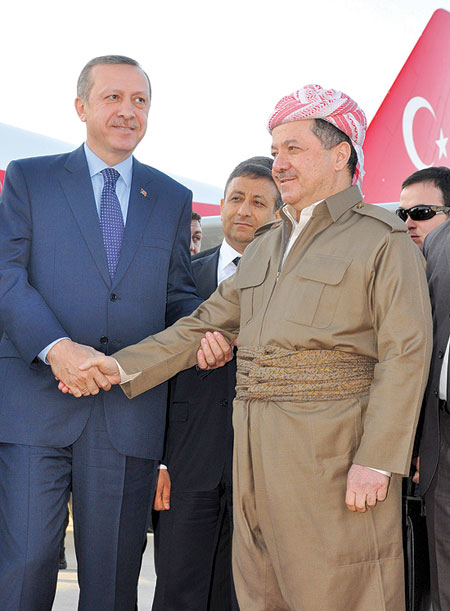
Ankara is also attempting to convince the president of the Iraqi Kurdistan region, Masoud Barzani, to be its interlocutor with Syrian Kurds, even those affiliated with the Kurdistan Workers Party (PKK), which is banned in Turkey.

Turkish analysts say that the PKK has taken control of the Kurdish part of Syria with a green light from the Syrian regime, in order to disturb and embarrass Turkey.

Yesterday, Erdogan threatened to intervene if northeastern Syria becomes a launching pad for PKK fighters to carry out operations against Turkey. In a televized interview, he said he would soon send Davutoglu to northern Iraq to discuss the latest developments in the Syrian Kurdish region.

In the same interview, Erdogan explained that Turkey “has not and will not stand idle concerning the developments in northern Syria.” It will take the necessary measures to tackle any threat emerging from that region.

He maintained that creating a buffer zone or security strip in those areas is one of the alternatives proposed for discussion in the Turkish government to counter any provocation from Syrian Kurds.
After accusing the Syrian regime of giving the PKK “custody” of several areas in the north, Erdogan warned that “Turkey is capable of exercising its right to pursue Kurdish rebels inside Syria, if necessary.”

“In the end, this is part of changing the rules of engagement” of the Turkish army towards Syria, he continued. He also repeated his criticism of Barazani for supporting Syria’s Kurds.

He added that “[Syrian President Bashar] al-Assad and his inner circle will soon be outside power in Syria,” noting that Syria “is preparing for a new era, but some countries are only delaying the process.”
Away from this, inside a safe house in Turkey, Ubed Muse, a Kurdish commander of a Syrian rebel group, asked for Turkish support to fight the Syrian regime. He also announced that he is ready for a campaign against the PKK.

Speaking to AFP, “during a break from the bloody battles in which he has led a band of 45 rebels near Aleppo,” Muse said, “I wish we could get some armed support from Turkey." He indicated that if his fighters could get help from Turkey, they would return the favor by hitting the PKK.

This article is an edited translation from the Arabic Edition.
River to Sea Uprooted Palestinian  
The views expressed in this article are the sole responsibility of the author and do not necessarily reflect those of this Blog!