Uprooted Palestinians are at the heart of the conflict in the M.E Palestinians uprooted by force of arms. Yet faced immense difficulties have survived, kept alive their history and culture, passed keys of family homes in occupied Palestine from one generation to the next.
Nawa and Tel Jabiya are going to be liberated and back to the nation very soon under the Power of the Syrian Arab Army. Army troops are inside the city Nawa from the West End with continued progress .. And the continued shelling and missile and air attacks targeting terrorists taking them dead or wounded. As the Syrian Arab Army continue to liberate city after city, town after town, we will continue to support them and the people of Syria. Homs is all under SAA Control , and now SAA is Pushing uprward To end their Madness , as you can see , they went from being trapped to being trapped.
One of the strongest videos to ever be published throughout the Syrian crisis. Syrian army rains shells on the terrorists in the city of Nawa in countryside of Daraa. SAA has the east side of Nawa covered , what SAA did was unexpected , attacking from the west side of Nawa, SAA has moved into street fighting in Nawa now .
Hezbollah's Political Council head, Sayyed Ibrahim Al Amine, on Friday said that his party had relayed to Maronite Patriarch Bechara Rai its position regarding the latter's visit to Jerusalem and its risks.
"We highlighted the risks and the repercussions on Lebanon of this visit," Amine emphasized in the wake of the visit, hoping that Rai would reconsider their stance.
On another note, Amine said that talks also featured high on the Presidential deadline, asserting that "the Patriarch stressed the need to hold the Presidential elections on schedule and refused to fall in void," holding the Deputies responsible for electing a President.
"If there is no consensus on a certain candidate, we will not attend the Presidential elections session," Amine confirmed, wishing that the Lebanese would eventually reach agreement and a new President would be elected.
Saudi Crown Prince Salman bin Abdulaziz al-Saud speaks during the opening session of the Gulf Cooperation Council on May 14, 2014 in Jeddah, Saudi Arabia. (Photo: AFP-Mandel Ngan)
Since Abdullah bin Abdul Aziz was crowned king on August 2, 2005 as successor to his half brother Fahd bin Abdul Aziz - who died on July 31, 2005 - he designed a policy for himself aimed at changing the balance of power. He put new rules for the transfer of power stemming from a background that is clearly inconsistent with the direction of his primary competition, the Sudairi faction.
The prevailing tradition [for succession] since the days of King Abdul Aziz, the founder of Saudi Arabia, required creating the position of second deputy or deputy crown prince. In 1941, the king issued a royal decree appointing his son Saud as crown prince and Faisal as deputy crown prince. This tradition was dominant in earlier times, and so Khalid bin Abdul Aziz was a second deputy or deputy crown prince for King Saud. But after Faisal’s ascension to the throne and creating the cabinet system, the position of second deputy came to apply to the succession to the throne as well as the cabinet, since the unification of the position of the king and the prime minister during the reign of King Faisal in 1964. So King Fahd became the first second deputy for the prime minister.
The position of the second deputy remained vacant for four years under the reign of King Abdullah. The reason was clear. The king did not want someone from the Sudairi wing to be appointed, which would enable that person to extend his control to key areas within the state in the next phase. This in turn would pose a future threat to the king’s wing of the royal family when he dies.
The label “Sudairi faction” is used for seven of the sons of King Abdul Aziz with his wife Hassa bin Ahmed al-Sudairi. They are King Fahd (deceased), Sultan (deceased), Abdulrahman, Turki, Nayef (deceased), Salman (the current crown prince) and Ahmed.
The king’s advisors came up with a smart idea that brought good news to the marginalized wings within the royal family. An announcement to establish an Allegiance Commission headed by Prince Mishaal bin Abdul Aziz was made on October 20, 2006. The commission was meant to postpone the question of appointing the second deputy and pass the task of choosing that person to this commission after the king’s death.
The commission is based on the idea of building an alliance within the royal family against the Sudairi wing that would include factions that have been marginalized. These marginalized wings voluntarily choose, because of the change in the rules of the game, to return to the ring, engage in a power struggle and participate at least in supporting either branch of the family.
A royal decree was issued on December 10, 2007 to establish the Allegiance Commission consisting of Abdul Aziz’s sons and grandchildren (who are 35 princes in total) headed by Prince Mishaal bin Abdul Aziz. A statement issued by the royal office in charge of royal decrees explained that the Allegiance Commission’s rules do not apply to the current king and crown prince.
According to the executive list which determines the mechanisms of implementing the Allegiance Commission a year after it is issued, the length of the membership of the appointed princes is a non-renewable four year term. Unless the brothers of the member whose term is over agree to renew it with the approval of the king.
According to the list, the king suggests to the Allegiance Commission a name or two or even three names for the position of crown prince. The commission can reject these names and appoint a candidate not suggested by the king. If the commission’s candidate is not accepted by the king, the Allegiance Commission decides the matter within months through a majority vote in which its candidate and the candidate appointed by the king take part.
At the time, this royal decree was described as a response to the challenge of developing the Saudi regime and protecting national unity. The Allegiance Commission, it was believed, would compliment three other components - the regime, the Shura Council and the Regions Council. Given that these noble goals were a motivating factor behind establishing the commission, it was hoped that power struggles and attempts to exclude one wing or another within the royal family from power would become less likely in the future. The fact is the two competing sides - the king and the Sudairi faction - are fully aware that the commission was established to avoid a Sudairi member from becoming a crown prince, which would make the state Sudairist par excellence.
The position of the second deputy remained vacant after establishing the commission for two years. In fact, the celebration that accompanied announcing the Allegiance Commission was disingenuous. The people who indulged in this exaggerated celebratory praise and flattery of the decision to establish the Allegiance Commission eventually found themselves having to engage in the same praise and flattery of another decision that contradicts the terms of the commission, namely the appointment of Prince Nayef as the king’s second deputy. It became evident later on that a deal was secretly being brokered between King Abdullah and Prince Nayef.
Members of the commission found themselves in a situation where they were either going to be false witnesses or head for early retirement. The commission lost its function at an early stage as it became evident that it was not established out of the true conviction of the king or any of the important princes. Rather it was meant to serve as a means for a specific end and for a limited time. It might continue to serve this purpose every time there is a struggle inside the royal family, thus it becomes a kind of substitute for the family council which did not acquire legal status. The commission then becomes a substitute for the council and a body to resolve conflicts inside the royal family.
The first blow that King Abdullah dealt the Allegiance Commission was on March 27, 2009 when he issued a royal decree appointing Prince Nayef bin Abdul Aziz the prime minister’s second deputy while keeping his post as interior minister. This step was enough to put an end to the role assigned to the Allegiance Commission because the mere appointment of a second deputy for the king means the commission will not play a role in appointing a crown prince in the event of the king’s death. That is exactly what happened. Nayef’s appointment however was not without a price. The king and Nayef made a deal based on sharing positions between their sons while at the same time taking posts from the Sudairi faction as it will become evident later on.
The deal was not made after it became evident to the king and the Sudairi wing that the crown prince at the time, i.e., Prince Sultan, was on his deathbed as cancer had devastated his body and he was totally focused on treatment and recuperation trips which kept him almost completely away from the affairs of the state.
On October 22, 2011, the Saudi royal court announced the death of the crown prince and defense minister, Prince Sultan. A royal decree was issued, after a notice from the head and members of the Allegiance Commission, choosing Prince Nayef as crown prince and appointing him deputy prime minister and interior minister. The statement issued by the royal court was based on basic law and the Allegiance Commission system. It said: After we were notified by his highness, the head of the Allegiance Commission, and by its members, we have chosen his royal highness Prince Nayef bin Abdul Aziz as crown prince and ordered his appointment as deputy prime minister and interior minister.
Then the king directed the princes to pledge allegiance to Nayef as crown prince while Prince Abdullah bin Faisal bin Turki bin Abdul Aziz, first, and Prince Bandar bin Musaed bin Abdul Aziz, second, took the oath as two new members of the Allegiance Commission. This highlighted the need to mobilize the largest number of votes in support of the king’s decision through the Allegiance Commission.
Perhaps Prince Talal bin Abdul Aziz was the odd one out in the commission and in the royal family. He kept on voicing his opposition to being nothing but a tool in the struggle between the different wings within the royal family and to serving as a seal to authenticate the king’s decisions. He resigned on November 16, 2011, that is three weeks after appointing Nayef crown prince. Talal had protested Nayef’s appointment as second deputy in 2009 and said that the Allegiance Commission should have been consulted before making this decision. He said in a statement that he faxed to Reuters news agency in 2009 that he calls on the royal court to explain what this appointment means and that it should not mean that Prince Nayef is going to become crown prince.
After appointing Prince Nayef crown prince, which Prince Talal saw as another violation of the role of the commission, he decided to profess his objection by submitting his resignation publicly. The Allegiance Commission pointed out on its website that Prince Talal had indeed resigned.
It was clear that a deal was hatched between King Abdullah and Prince Nayef to divide the various positions between them and hand some of them over to their sons. The king obtained privileges for himself and his faction while the Sudairi wing made huge compromises as a price for Nayef’s appointment as crown prince.
As far as Prince Nayef is concerned, a royal decree was issued on July 3, 2011 appointing his son Saud advisor with the rank of minister. Another royal decree was issued on November 6, 2011 appointing him head of the crown prince’s office and a special advisor with the rank of minister. On the other hand, that same day a series of royal decrees were issued assigning the presidency of a number of councils and committees to the office of the prime minister, that is the king, and the deputy crown prince, that is Nayef. The royal decrees include relieving Prince Abdulrahman bin Abdul Aziz - and he is one of the members of the Sudairi Seven - from his post as deputy defense minister and appointing Prince Salman as defense minister and Prince Khaled bin Sultan as his deputy.
These royal decrees mark an effort to break down the powers that were once vested in the Sudairi wing and were previously controlled by Sultan and Nayef. They are distributed now between the king, former Crown Prince Nayef and Defense Minister Salman. King Abdullah played it cleverly when he listed all these tasks within a administrative hierarchy from the king on down.
Fouad Ibrahim is a researcher and political activist from Saudi Arabia
This article is an edited translation from the Arabic Edition.
Provinces, (SANA) Units of the army and the armed forces thwarted a terrorist group's attempt to infiltrate into the safe areas in al-Ramouseh in Aleppo and left its members killed and wounded.
Army foils terrorists' infiltration, destroy their dens in Homs
A military source told SANA that an army unit foiled terrorists' attempt to infiltrate from al-Waar farms in Homs, killing and injuring scores of them, in addition to destroying their equipment.
The source added that other army units foiled terrorists' attempt to attack a military checkpoint near al-Dweir roundabout in the countryside, inflicting heavy losses upon them.
The source pointed out that the army units targeted terrorists' dens and gatherings to the south of Rahoum village in the eastern countryside of Homs and in the villages of Taldo, al-Khaldiyeh, al-Daar al-Kabera, Talbiseh and al-Rasatan, eliminating scores of terrorists.
Army eliminates terrorists in Damascus Countryside
SANA reporter said that the army targeted and destroyed terrorists' hideouts and gatherings in the areas of Adra Workers City and Joubar, killing and injuring scores of terrorists and destroying their weaponry.
The army units also targeted terrorists' gatherings and hideouts in al-Mleiha and Ein Terma areas, killing many terrorists, some of them of non-Syrian nationalities, and destroying their weapons and ammunition.
An army unit killed 6 terrorists and destroyed a vehicle loaded with weapons and ammunition in Khan al-Sheeh area. Another unit clashed with armed terrorist groups in Daraya city, killing and injuring a number of terrorists and destroying many of their weaponry and munitions.
Terrorists killed in Daraa countryside
A military source told SANA that the army units in the areas surrounding Nawa, al-Hara and Atman towns in the countryside, killing and injuring scores of terrorists, in addition to destroying their weapons and ammunition.
Meanwhile, other army units carried out operations against terrorists' dens and gatherings in Nawa city and in the hills surrounding it in Daraa countryside, killing and injuring scores of terrorists.
The source pointed out that the operations are still ongoing .
Army units inflict heavy losses upon terrorists in Idleb
A military source told SANA that the army and the armed forces' units killed and wounded terrorists in Kafr Najed, Nehlieh and Binnish in Idleb countryside and destroyed their criminal tools.
Meanwhile, another army unit targeted terrorists' dens near al-M'ara town, killing and injuring a number of them, in addition to destroying their weapons and equipment.
Israeli Prime Minister Benjamin Netanyahu told US Defense Secretary Chuck Hagel Friday that world powers must deny Iran any possibility of “developing a nuclear weapon” as the search for a final deal between Iran and the world powers intensifies.
"I think that, while the talks with Iran are going on, there is one thing that must guide the international community and that is not to let the ayatollahs win," Netanyahu's office quoted him as saying at the beginning of their meeting in Jerusalem.
"We must not allow Iran, the foremost terrorist state of our time, to develop the ability to develop a nuclear weapon," Netanyahu said.
Hagel said that Washington had the same goal.
"I want to assure you prime minister, and the people of Israel, of the United States' continued commitment to assuring Iran does not get a nuclear weapon," he said in video distributed by the US embassy.
"America will do what we must to live up to that commitment," he added.
The Pentagon chief's visit to the Zionist entity came as the United States and other major powers pressed talks with Iran on a long-term agreement to allay international concerns about its nuclear ambitions.
Iran confirms its program is for peaceful ends only insisting that is its right under the Nuclear Nonproliferation Treaty (NPT) while Israel, which is believed to be the sole nuclear power in the Middle East with more than 200 nuclear heads, is not a signatory for this treaty.
A new report from Defense for Children International Palestine (DCI-Palestine) finds that in 21.4 percent of cases documented in 2013, children detained in the Israeli military detention system reported undergoing solitary confinement as part of the interrogation process where the apparent purpose is to obtain a confession or to gather intelligence on other individuals. This represents an increase of two percent from 2012.
Israeli forces arrested Sameh Zaidan, then 17 years old, from his home at 1 a.m. in July 2013. He was held in solitary confinement for a total of 28 days. Photo: DCI-Palestine
“The use of isolation against Palestinian children as an interrogation tool is a growing trend,” said Ayed Abu Eqtaish, Accountability Program director at DCI-Palestine.
Ramallah, West Bank (PRWEB) May 12, 2014
Rising numbers of Palestinian children are being subjected to solitary confinement for interrogation purposes in Israeli detention, according to a new report from Defense for Children International Palestine (DCI-Palestine).
In 21.4 percent of cases recorded by DCI-Palestine in 2013, children detained in the Israeli military detention system reported undergoing solitary confinement as part of the interrogation process. This represents an increase of two percent from 2012.
DCI-Palestine collected 98 sworn affidavits from Palestinian children aged 12 to 17 in 2013.
“The use of isolation against Palestinian children as an interrogation tool is a growing trend,” said Ayed Abu Eqtaish, Accountability Program director at DCI-Palestine. “This is a violation of children’s rights and the international community must demand justice and accountability.”
DCI-Palestine’s research overwhelmingly suggests that the use of solitary confinement against Palestinian child detainees in the Israeli military detention system is employed almost solely for interrogation purposes. The apparent purpose is to obtain a confession or to gather intelligence on other individuals.
Globally, children and juvenile offenders are often held in isolation either as a disciplinary measure or to separate them from adult populations. The use of solitary confinement by Israeli authorities does not appear to be related to any disciplinary, protective, or medical rationale or justification.
During a period of just under two years, from January 2012 to December 2013, DCI-Palestine collected 40 affidavits from child detainees that detailed solitary confinement.
Children held in solitary confinement spent an average of 10 days in isolation. The longest period of confinement documented in a single case was 29 days in 2012, and 28 days in 2013.
In 2012, United Nations Special Rapporteur on the situation of human rights in the occupied Palestinian territories, Richard Falk, condemned Israel’s use of solitary confinement against Palestinian children, saying it “flagrantly violates international human rights standards.”
“This pattern of abuse by Israel is grave. It is inhumane, cruel, degrading, and unlawful, and, most worryingly, it is likely to adversely affect the mental and physical health of underage detainees,” Falk said.
Palestinian child detainees are held in solitary confinement and interrogated by the Israel Security Agency (ISA) at interrogation and detention centers located inside Israel, including Petah Tikva detention center, Kishon detention center, and Shikma prison in Ashkelon.
The transfer of Palestinian child detainees from the Occupied Palestinian territories to prisons inside Israel violates Article 76 of the Fourth Geneva Convention, which prohibits the transfer of detainees out of the occupied territory.
DCI-Palestine calls on Israeli military court judges to exclude all evidence obtained by force or coercion, and demands that the practice of using solitary confinement on children in Israeli detention facilities be recognized as a form of torture and stopped immediately.
The report demands that the prohibition of solitary confinement against juveniles be enshrined in law and recommends that Israeli authorities implement effective measures to ensure that perpetrators of children’s rights violations are held to account.
-- Defense for Children International Palestine is an independent child rights organization dedicated to defending and promoting the rights of children living in the Occupied Palestinian Territory. DCI-Palestine provides free legal assistance to children, collects evidence and conducts advocacy. Follow DCI-Palestine on Twitter and Facebook.
There is no doubt that incumbent President Bashar al Assad remains hot favourite for Syria’s June 3 elections. Even NATO’s advisers put his support at around 70%.
However the country’s first competitive presidential elections in recent times threatens to add a ‘normality’ to Syria’s previously one party system, a normality the western powers are desperate to avoid.
Hence Washington’s decision to deliver new weapons systems (like anti-tank missiles) to the al Qaeda-style ‘rebel’ groups, even when it has become clear that the Government and national army are prevailing in most parts of the country.
Let’s be clear about these elections, it is not some simple political choice to hold them at this time. They are required by Syria’s constitution, before the end of President Bashar’s term in July. To ignore this requirement, to suspend the constitution, would have deepened rather than help resolve the crisis.
Of course, a major test will be voter turn-out. Prospects for participation have improved strongly with the recent elimination of armed groups from Homs, Syria’s third largest city. A turn-out rate that exceeded that of 2012 would be a good sign for Syria’s democratic process.
Turnout in the 2012 Assembly and constitutional reform votes was estimated at a little over 51%; not high, but higher than the 2010 US Congressional elections participation rate of 41.6%. Remember, at that time, the Muslim Brotherhood-backed ‘Free Syrian Army’ was threatening and delivering death to those who participated in the voting.
No doubt the FSA’s al Qaeda-style successors are making the same threats now. But Syria’s army has backed them into a few corners. The last thing these sectarian fanatics want is any sort of democracy.
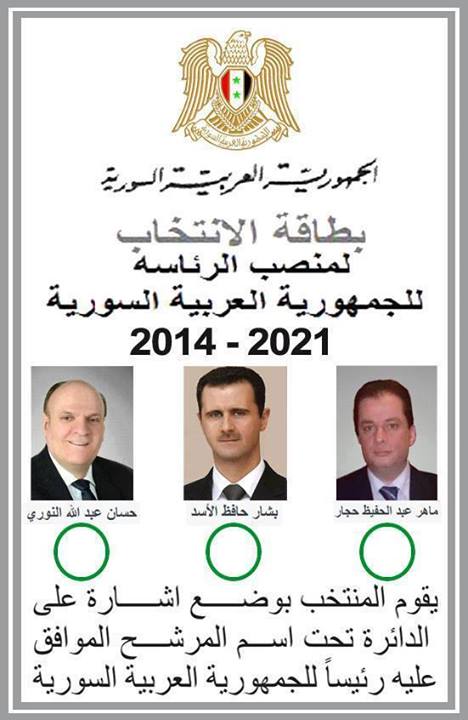
It is precisely because of the constitutional changes in 2012 that Syrian voters now have presidential choices, apart from the incumbent. The other candidates are Maher Hajjar, an independent communist from Aleppo, and businessman Hassan al-Nouri.
All three candidates have accepted a set of ‘national principles’ which include support for the Syrian Arab Army as ‘the protector of Syria against any foreign aggression and internal sabotage’. There is no Washington or Paris-backed candidate calling for an Islamic state; such sectarianism remains banned under the constitution.
However neither Hajjar nor al-Nouri can be dismissed as simple patsies for President Bashar. Under current rules each had to secure the support of at least 35 MPs in the current 200+ parliament; and MPs can only back one candidate. That means there is substantial electoral support for the two non-Ba’ath Party candidates, albeit support for those who back a ‘secular’ or pluralist nation.
Getting over the 35-MP hurdle, the new candidates still face the fact that President Bashar counts not only on the backing of the 60% of MPs who belong to the Ba’ath Party. The Syrian Social National Party (SSNP) and the Communist Party have also thrown their weight behind him. Bashar is increasingly seen as a symbol of resistance and national unity, and essential to winning the war.
In actual policy terms some more conventional themes have emerged. Hajjar, as the left candidate, remains a pan-Arabist and backs redistributive policies alongside huge capital works, to address unemployment. He also aims to attack corruption, probably the key complaint of the wider reform movement in recent years.
For his part, Al-Nouri, as the right-wing candidate, stresses a type of ‘modernization’ called the ‘smart free economy’, with emphasis on public-private partnerships. Indeed many of the major investments in Syria in recent years, like the large tourist hotels, have been joint venture operations. The small business sector, of course, is extensive.
As a candidate, Bashar al Assad sits at the centre left of this new configuration. His government has maintained free health and education, throughout economic hard times and war and, if anything, the conflict has deepened Bashar’s commitment to state investment. He was always seen as a reformer and moderniser but now, importantly, he is seen as a ‘rock’ which has successfully defended Syria against the western-backed sectarian Islamists. That is what will clinch the vote for him. He seems likely to get a higher vote than his Ba’ath party colleagues did in the Assembly elections of 2012.
By failing to engage with the reform process at the Geneva 2 talks in January (when there still existed the possibility of constitutional change) the exiled, Muslim Brotherhood-led ‘opposition’ have effectively shot themselves in the collective foot.
Rather like the pro-coup opposition in Venezuela, ten years ago, they rejected ‘normal’ politics in the hope that backing from the big powers would deliver them government by violence and deception. They rejected dialogue and reform for attacks on schools, hospitals, and ordinary people, blaming the government for their own sectarian massacres. That strategy backfired and they have now excluded themselves from Syrian political life for many years.
Syria’s democratic reform process is advancing, despite the ongoing terrorist war, and it threatens to derail the western ‘regime change’ agenda. The al Qaeda-style groups have served to unite the reform movement with pro-government forces. For these reasons, Syria’s June 3 vote will be a patriotic election.
For 66 years Israel’s founding generation has lived with the guilt of a secret, one it successfully concealed from the generations that followed. Forests were planted to hide war crimes. School textbooks mythologised the events surrounding Israel’s creation. The army was blindly venerated as the most moral in the world.
Once, “Nakba” – Arabic for “Catastrophe”, referring to the dispossession of the Palestinian homeland in 1948 – would have failed to register with any but a small number of Israeli Jews. Today, only those who never watch television or read a newspaper can plead ignorance.
As marches and festivals are held today by Palestinians across the region to mark Nakba Day – commemorating the expulsion of 750,000 Palestinians from their homes and the erasure of more than 500 villages – Israelis will be watching.
In fact, the Israeli media have been filled with references to the Nakba for the past 10 days, since Israel celebrated its Independence Day last week. The two anniversaries do not quite coincide because Israel marks its founding according to the Hebrew calendar.
While Israeli Jews were trying to enjoy guilt-free street parties last week, news reports focused on the activities of their compatriots – the Palestinians who remained inside the new state of Israel and now comprise a fifth of the population. Estimates are that one in four of these 1.5 million Palestinian citizens is from a family internally displaced by the 1948 war.
More than 20,000 staged a “March of Return” to one destroyed village, Lubya, buried under a forest near Tiberias and close to a major Israeli highway. Long tailbacks forced thousands of Israeli Jews to get a close-up view as they crawled past the biggest Nakba procession in Israel’s history.
For others, images of the marchers waving Palestinian flags and massively outnumbering Israeli police and a counter-demonstration by Jewish nationalists were seen on TV news, websites and social media.
The assault on Israel’s much cherished national mythology is undoubted. And it reflects the rise of a new generation of Palestinians no longer willing to defer to their more cautious, and traumatised, elders, those who directly experienced the events of 1948.
These youth see themselves as representing not only their immediate relatives but Palestinians in exile who have no chance to march back to their village. Many of Lubya’s refugees ended up in Yarmouk camp in Damascus, where they are suffering new horrors, caught in the midst of Syria’s civil war.
Palestinians in Israel are also being galvanised into action by initiatives like prime minister Benjamin Netanyahu’s plans to legislate Israel as a Jewish state. They see this as the latest phase of an ongoing nakba – an attempt to erase their nativeness, just as the villages were once disappeared.
Palestinians are making a noise about the Nakba on every possible front – and not just on Nakba Day. Last week media around the world reported on one such venture: a phone app called iNakba that maps the hundreds of destroyed villages across Israel. Briefly it became one of the most popular iPhone downloads, connecting refugees through new technology. iNakba visibly restores a Palestine that Israel hoped literally to have wiped off the map.
The app is the initiative of Zochrot, an Israeli organisation that is jointly run by Jews and Palestinians. They have been finding ever more creative and provocative ways to grab headlines.
They arrange regular visits to destroyed villages that a growing number of curious Israeli Jews are participating in, often in the face of vehement opposition from the communities built on the rubble of Palestinian homes.
Zochrot has created a Hebrew information pack on the Nakba for teachers, though education officials ban it. Last year it staged the first Nakba film festival in Tel Aviv. It is also creating an archive of filmed interviews with Israeli veteran fighters prepared to admit their part in expulsions.
Zochrot also held last year the first-ever conference in Israel discussing not just the principle but how to put into practice a right of return for the millions of Palestinian refugees across the region.
Palestinian youth are taking up the idea enthusiastically. Architects are designing plans for new communities that would house the refugees on or near their old lands.
Refugee families are trying to reclaim mosques and churches, usually the only buildings still standing. Israeli media reported last month that internal refugees had been attacked as they held a baptism in their former church at al-Bassa, now swamped by the Jewish town of Shlomi.
Workshops have been arranged among refugee groups to imagine what a right of return might look like. Youth from two Christian villages, Iqrit and Biram, have already set up camps at their old churches, daring Israel to hound them out like their grandparents. Another group, I Won’t Remain a Refugee, is looking to export this example to other villages.
The size of the march to Lubya and the proliferation of these initiatives are a gauge of how Palestinians are no longer prepared to defer to the Palestinian leadership on the refugee issue or wait for an interminable peace process to make meaningful progress.
“The people are sending a message to the leadership in Ramallah that it cannot forget or sideline the right of return,” says Abir Kopty, an activist with the Lubya march. “Otherwise we will take the issue into our own hands.”
Meanwhile, progress of a kind is being made with Israeli Jews. Some have come to recognise, however reluctantly, that a tragedy befell the Palestinians with Israel’s creation. But, as another march organiser notes, the struggle is far from over. “That is a first step. But now they must take responsibility for our suffering and make amends.”
Voltaire, actualité internationale, n°191
-
Outre ce site internet gratuit, nous publions une lettre confidentielle en
PDF, Voltaire, actualité internationale. Chaque jeudi soir ou vendredi
matin, vo...
A Jewish One World Government
-
A Jewish One World Government October 21 2026
___________________________________ More Vids! +BN Vids Archive! HERE!
___________________________________ Su...
The United States At A Crossroad
-
The United States At A Crossroad—An Analysis (16 Sept 2026) by Lawrence
Davidson Part I—Texas vs Minnesota Back in mid-May […]
Report on Beth Israel vigil 09-12-26
-
*Eat-a-Cheeseburger Day Approaches*
This year, EAC Day appears on Monday, September 21st. The date coincides
with the Jewish holiday called Yom Kippur. Cl...
-
Hello all,
It is with great sadness that I share with you the passing of our beloved
sister, Mother, and Grandmother, the individual that you all knew ...
Best Horror Podcast
-
Best Horror Podcast Introduction: Horror podcasts […]
The post Best Horror Podcast appeared first on Copper Shock Horror Podcast.
Ikhras Endorses Muntadhar Al-Zaidi
-
“Oh parties of banditry and sectarianism and corruption, we have come and
our goal is to destroy you.” Ikhras formally endorses Muntadhar al-Zaidi,
Iraqi j...
Prince Charles: Foreign Jews behind bloodshed in ME
-
In May, 2017, British Crown Prince Charles declined an invitation from
Zionist entity’s president Reuven Rivlin‘s to attend the 100th anniversary
of the no...
Palestinian Women – One for All, All for One
-
Honouring All Palestinian Women by Honouring Three: Hanin Zoabi, Ahed
Tamimi, Samah Sabawi Vacy Vlazna “Palestinian women have always stood side
by side ...
US’s Saudi Oil Deal from Win-Win to Mega-Lose
-
By F. William Engdahl Who would’ve thought it would come to this? Certainly
not the Obama Administration, and their brilliant geo-political think-tank
neo-...
-
*Mordechai Vanunu wins human rights prize of Brazilian Press Association *
* http://www.alternativenews.org/english/index.php/features/updates/7038-mordechai...
Abdul Aziz Rantissi:
"My ultimate wish, my God, is to attain martyrdom,"...God granted him his wish on April 17, 2004, at the hands of Israeli assassins.

 Uprooted Palestinian


 mine, on Friday said that his party had relayed to Maronite Patriarch Bechara Rai its position regarding the latter's visit to Jerusalem and its risks.


 “The use of isolation against Palestinian children as an interrogation tool is a growing trend,” said Ayed Abu Eqtaish, Accountability Program director at DCI-Palestine.