
By Pepe Escobar
A specter is haunting Washington, an unnerving vision of a Sino-Russian alliance wedded to an expansive symbiosis of trade and commerce across much of the Eurasian land mass - at the expense of the United States.

Trade and commerce are just part of the future bargain. Synergies in the development of new military technologies beckon as well. After Russia's Star Wars-style, ultra-sophisticated S-500 air defense anti-missile system comes online in 2018, Beijing is sure to want a version of it. Meanwhile, Russia is about to sell dozens of state-of-the-art Sukhoi Su-35 jet fighters to the Chinese as Beijing and Moscow move to seal an aviation-industrial partnership. This week should provide the first real fireworks in the celebration of a new Eurasian century-in-the-making when Russian President Vladimir Putin drops in on Chinese President Xi Jinping in Beijing.
You remember "Pipelineistan," all those crucial oil and gas pipelines crisscrossing Eurasia that make up the true circulatory system for the life of the region. Now, it looks like the ultimate Pipelineistan deal, worth US$1 trillion and 10 years in the making, will be signed off on as well. In it, the giant, state-controlled Russian energy giant Gazprom will agree to supply the giant state-controlled China National Petroleum Corporation (CNPC) with 3.75 billion cubic feet of liquefied natural gas a day for no less than 30 years, starting in 2018. That's the equivalent of a quarter of Russia's gas exports to all of Europe. China's present daily gas demand is around 16 billion cubic feet a day, and imports account for 31.6% of total consumption. Gazprom may still collect the bulk of its profits from Europe, but Asia could turn out to be its Everest. The company will use this mega-deal to boost investment in Eastern Siberia and the whole region will be reconfigured as a privileged gas hub for Japan and South Korea as well. If you want to know why no key country in Asia has been willing to "isolate" Russia in the midst of the Ukrainian crisis - and in defiance of the Obama administration - look no further than Pipelineistan.
Exit the Petrodollar, enter the Gas-o-Yuan
And then, talking about anxiety in Washington, there's the fate of the petrodollar to consider, or rather the "thermonuclear" possibility that Moscow and Beijing will agree on payment for the Gazprom-CNPC deal not in petrodollars but in Chinese yuan.
One can hardly imagine a more tectonic shift, with Pipelineistan intersecting with a growing Sino-Russian political-economic-energy partnership. Along with it goes the future possibility of a push, led again by China and Russia, toward a new international reserve currency - actually a basket of currencies - that would supersede the dollar (at least in the optimistic dreams of BRICS members).
Right after the potentially game-changing Sino-Russian summit comes a BRICS summit in Brazil in July. That's when a $100 billion BRICS development bank, announced in 2012, will officially be born as a potential alternative to the International Monetary Fund and the World Bank as a source of project financing for the developing world.
More BRICS cooperation meant to bypass the dollar is reflected in the "Gas-o-yuan", as in natural gas bought and paid for in Chinese currency. Gazprom is even considering marketing bonds in yuan as part of the financial planning for its expansion. Yuan-backed bonds are already trading in Hong Kong, Singapore, London, and most recently Frankfurt.
Nothing could be more sensible for the new Pipelineistan deal than to have it settled in yuan. Beijing would pay Gazprom in that currency (convertible into roubles); Gazprom would accumulate the yuan; Russia would then buy myriad made-in-China goods and services in yuan convertible into roubles. It's common knowledge that banks in Hong Kong, from Standard Chartered to HSBC - as well as others closely linked to China via trade deals - have been diversifying into the yuan, which implies that it could become one of the de facto global reserve currencies even before it's fully convertible. (Beijing is unofficially working for a fully convertible yuan by 2018.)

On completion, it would pump yet more Russian natural gas to Europe - in this case, underneath the Black Sea (bypassing Ukraine) to Bulgaria, Hungary, Slovenia, Serbia, Croatia, Greece, Italy, and Austria. Bulgaria, Hungary, and the Czech Republic have already made it clear that they are firmly opposed to any cancellation, and cancellation is probably not in the cards. After all, the only obvious alternative is Caspian Sea gas from Azerbaijan, and that isn't likely to happen unless the EU develops its own construction projects.
In any case, Azerbaijan doesn't have enough capacity to supply the levels of natural gas needed, and other actors like Kazakhstan, plagued with infrastructure problems, or unreliable Turkmenistan, which prefers to sell its gas to China, are already largely out of the picture. And don't forget that South Stream, coupled with subsidiary energy projects, will create a lot of jobs and investment in many of the most economically devastated EU nations. Nonetheless, such EU threats, however unrealistic, only serve to accelerate Russia's increasing symbiosis with Asian markets. For Beijing especially, it's a win-win situation. After all, between energy supplied across seas policed and controlled by the US Navy and steady, stable land routes out of Siberia, it's no contest.
Pick your own Silk Road
Of course, the US dollar remains the top global reserve currency, involving 33% of global foreign exchange holdings at the end of 2013, according to the IMF. It was, however, at 55% in 2000. Nobody knows the percentage in yuan (and Beijing isn't talking), but the IMF notes that reserves in "other currencies" in emerging markets have been up 400% since 2003.
The Federal Reserve is arguably monetizing 70% of the US government debt in an attempt to keep interest rates from heading skywards. Pentagon adviser Jim Rickards, as well as every Hong Kong-based banker, tends to believe that the Fed is bust (though they won't say it on the record). No one can even imagine the extent of the possible future deluge the US dollar might experience amid a $1.4 quadrillion Mount Ararat of financial derivatives. Don't think that this is the death knell of Western capitalism, however, just the faltering of that reigning economic faith, neoliberalism, still the official ideology of the United States, the overwhelming majority of the European Union, and parts of Asia and South America. As far as what might be called the "authoritarian neoliberalism" of the Middle Kingdom, what's not to like at the moment?
China has proven that there is a result-oriented alternative to the Western "democratic" capitalist model for nations aiming to be successful. It's building not one, but myriad new Silk Roads, far-reaching webs of high-speed railways, highways, pipelines, ports, and fiber-optic networks across huge parts of Eurasia. These include a Southeast Asian road, a Central Asian road, an Indian Ocean "maritime highway" and even a high-speed rail line through Iran and Turkey reaching all the way to Germany.
In April, when President Xi Jinping visited the city of Duisburg on the Rhine River, with the world's largest inland harbor and right in the heartland of Germany's Ruhr steel industry, he made an audacious proposal: a new "economic Silk Road" should be built between China and Europe, on the basis of the Chongqing-Xinjiang-Europe railway, which already runs from China to Kazakhstan, to continue through Russia, Belarus, Poland, and finally Germany. That's 15 days by train, 20 less than for cargo ships sailing from China's eastern seaboard. Now that would represent the ultimate geopolitical earthquake in terms of integrating economic growth across Eurasia. Keep in mind that, if no bubbles burst, China is about to become - and remain - the number one global economic power, a position it enjoyed for 18 of the past 20 centuries. But don't tell London hagiographers; they still believe that US hegemony will last, well, forever.
Take me to Cold War 2.0
Despite recent serious financial struggles, the BRICS countries have been consciously working to become a counterforce to the original and - having tossed Russia out in March - once again Group of 7, or G-7. They are eager to create a global architecture to replace the one first imposed in the wake of World War II, and they see themselves as a potential challenge to the exceptionalist and unipolar world that Washington imagines for our future (with itself as the global robocop and NATO as its robo-police force). Historian and imperialist cheerleader Ian Morris, in his book War! What is it Good For?, defines the US as the ultimate "globocop" and "the last best hope of Earth". If that globocop "wearies of itsrole", he writes, "there is no plan B".
Well, there is a plan BRICS - or so the BRICS nations would like to think, at least. And when the BRICS do act in this spirit on the global stage, they quickly conjure up a curious mix of fear, hysteria, and pugnaciousness in the Washington establishment. Take Christopher Hill as an example. The former assistant secretary of state for East Asia and US ambassador to Iraq is now an advisor with the Albright Stonebridge Group, a consulting firm deeply connected to the White House and the State Department. When Russia was down and out, Hill used to dream of a hegemonic American "new world order". Now that the ungrateful Russians have spurned what "the West has been offering" - that is, "special status with NATO, a privileged relationship with the European Union, and partnership in international diplomatic endeavors" - they are, in his view, busy trying to revive the Soviet empire. Translation: if you're not our vassals, you're against us. Welcome to Cold War 2.0.The Pentagon has its own version of this directed not so much at Russia as at China, which, its think tank on future warfare claims, is already at war with Washington in a number of ways. So if it's not apocalypse now, it's Armageddon tomorrow. And it goes without saying that whatever's going wrong, as the Obama administration very publicly "pivots" to Asia and the American media fills with talk about a revival of Cold War-era "containment policy" in the Pacific, it's all China's fault. Embedded in the mad dash toward Cold War 2.0 are some ludicrous facts-on-the-ground: the US government, with $17.5 trillion in national debt and counting, is contemplating a financial showdown with Russia, the largest global energy producer and a major nuclear power, just as it's also promoting an economically unsustainable military encirclement of its largest creditor, China. Russia runs a sizeable trade surplus.
Humongous Chinese banks will have no trouble helping Russian banks out if Western funds dry up. In terms of inter-BRICS cooperation, few projects beat a $30 billion oil pipeline in the planning stages that will stretch from Russia to India via Northwest China. Chinese companies are already eagerly discussing the possibility of taking part in the creation of a transport corridor from Russia into Crimea, as well as an airport, shipyard, and liquid natural gas terminal there. And there's another "thermonuclear" gambit in the making: the birth of a natural gas equivalent to the Organization of the Petroleum Exporting Countries that would include Russia, Iran, and reportedly disgruntled US ally Qatar.
The (unstated) BRICS long-term plan involves the creation of an alternative economic system featuring a basket of gold-backed currencies that would bypass the present America-centric global financial system. (No wonder Russia and China are amassing as much gold as they can.) The euro - a sound currency backed by large liquid bond markets and huge gold reserves - would be welcomed in as well. It's no secret in Hong Kong that the Bank of China has been using a parallel SWIFT network to conduct every kind of trade with Tehran, which is under a heavy US sanctions regime. With Washington wielding Visa and MasterCard as weapons in a growing Cold War-style economic campaign against Russia, Moscow is about to implement an alternative payment and credit card system not controlled by Western finance. An even easier route would be to adopt the Chinese Union Pay system, whose operations have already overtaken American Express in global volume.
I'm just pivoting with myself
No amount of Obama administration "pivoting" to Asia to contain China (and threaten it with US Navy control of the energy sea lanes to that country) is likely to push Beijing far from its Deng Xiaoping-inspired, self-described "peaceful development" strategy meant to turn it into a global powerhouse of trade. Nor are the forward deployment of US or NATO troops in Eastern Europe or other such Cold-War-ish acts likely to deter Moscow from a careful balancing act: ensuring that Russia's sphere of influence in Ukraine remains strong without compromising trade and commercial, as well as political, ties with the European Union - above all, with strategic partner Germany.
This is Moscow's Holy Grail; a free-trade zone from Lisbon to Vladivostok, which (not by accident) is mirrored in China's dream of a new Silk Road to Germany. Increasingly wary of Washington, Berlin for its part abhors the notion of Europe being caught in the grips of a Cold War 2.0. German leaders have more important fish to fry, including trying to stabilize a wobbly EU while warding off an economic collapse in southern and central Europe and the advance of ever more extreme rightwing parties. On the other side of the Atlantic, President Obama and his top officials show every sign of becoming entangled in their own pivoting - to Iran, to China, to Russia's eastern borderlands, and (under the radar) to Africa.
The irony of all these military-first maneuvers is that they are actually helping Moscow, Tehran, and Beijing build up their own strategic depth in Eurasia and elsewhere, as reflected in Syria, or crucially in ever more energy deals.
They are also helping cement the growing strategic partnership between China and Iran. The unrelenting Ministry of Truth narrative out of Washington about all these developments now carefully ignores the fact that, without Moscow, the "West" would never have sat down to discuss a final nuclear deal with Iran or gotten a chemical disarmament agreement out of Damascus. When the disputes between China and its neighbors in the South China Sea and between that country and Japan over the Senkaku/Diaoyou islands meet the Ukraine crisis, the inevitable conclusion will be that both Russia and China consider their borderlands and sea lanes private property and aren't going to take challenges quietly - be it via NATO expansion, US military encirclement, or missile shields. Neither Beijing nor Moscow is bent on the usual form of imperialist expansion, despite the version of events now being fed to Western publics.
Their "red lines" remain essentially defensive in nature, no matter the bluster sometimes involved in securing them. Whatever Washington may want or fear or try to prevent, the facts on the ground suggest that, in the years ahead, Beijing, Moscow, and Tehran will only grow closer, slowly but surely creating a new geopolitical axis in Eurasia. Meanwhile, a discombobulated America seems to be aiding and abetting the deconstruction of its own unipolar world order, while offering the BRICS a genuine window of opportunity to try to change the rules of the game.
Russia and China in pivot mode

In Washington's think-tank land, the conviction that the Obama administration should be focused on replaying the Cold War via a new version of containment policy to "limit the development of Russia as a hegemonic power" has taken hold. The recipe: weaponize the neighbors from the Baltic states to Azerbaijan to "contain" Russia. Cold War 2.0 is on because, from the point of view of Washington's elites, the first one never really left town.
Yet as much as the US may fight the emergence of a multipolar, multi-powered world, economic facts on the ground regularly point to such developments. The question remains: will the decline of the hegemon be slow and reasonably dignified, or will the whole world be dragged down with it in what has been called "the Samson option"? While we watch the spectacle unfold, with no end-game in sight, keep in mind that a new force is growing in Eurasia, with the Sino-Russian strategic alliance threatening to dominate its heartland along with great stretches of its inner rim.
Now, that's a nightmare of Mackinderesque proportions from Washington's point of view. Think, for instance, of how Zbigniew Brzezinski, the former national security adviser who became a mentor on global politics to President Obama, would see it. In his 1997 book The Grand Chessboard, Brzezinski argued that "the struggle for global primacy [would] continue to be played" on the Eurasian "chessboard", of which "Ukraine was a geopolitical pivot".
"If Moscow regains control over Ukraine," he wrote at the time, Russia would "automatically regain the wherewithal to become a powerful imperial state, spanning Europe and Asia." That remains most of the rationale behind the American imperial containment policy - from Russia's European "near abroad" to the South China Sea. Still, with no end-game in sight, keep your eye on Russia pivoting to Asia, China pivoting across the world, and the BRICS hard at work
trying to bring about the new Eurasian Century.
 Pepe Escobar is the author of Globalistan: How the Globalized World is Dissolving into Liquid War (Nimble Books, 2007), Red Zone Blues: a snapshot of Baghdad during the surge (Nimble Books, 2007), and Obama does Globalistan (Nimble Books, 2009). He may be reached at pepeasia@yahoo.com. Posted with permission of TomDispatch. Follow TomDispatch on Twitter and on Facebook or Tumblr. Check out the newest Dispatch book, Ann Jones's They Were Soldiers: How the Wounded Return From America's Wars - The Untold Story.
Now, that's a nightmare of Mackinderesque proportions from Washington's point of view. Think, for instance, of how Zbigniew Brzezinski, the former national security adviser who became a mentor on global politics to President Obama, would see it. In his 1997 book The Grand Chessboard, Brzezinski argued that "the struggle for global primacy [would] continue to be played" on the Eurasian "chessboard", of which "Ukraine was a geopolitical pivot".
"If Moscow regains control over Ukraine," he wrote at the time, Russia would "automatically regain the wherewithal to become a powerful imperial state, spanning Europe and Asia." That remains most of the rationale behind the American imperial containment policy - from Russia's European "near abroad" to the South China Sea. Still, with no end-game in sight, keep your eye on Russia pivoting to Asia, China pivoting across the world, and the BRICS hard at work
trying to bring about the new Eurasian Century.
Pepe Escobar is the author of Globalistan: How the Globalized World is Dissolving into Liquid War (Nimble Books, 2007), Red Zone Blues: a snapshot of Baghdad during the surge (Nimble Books, 2007), and Obama does Globalistan (Nimble Books, 2009). He may be reached at pepeasia@yahoo.com. Posted with permission of TomDispatch. Follow TomDispatch on Twitter and on Facebook or Tumblr. Check out the newest Dispatch book, Ann Jones's They Were Soldiers: How the Wounded Return From America's Wars - The Untold Story.


The views expressed in this article are the sole responsibility of the author and do not necessarily reflect those of the Blog!


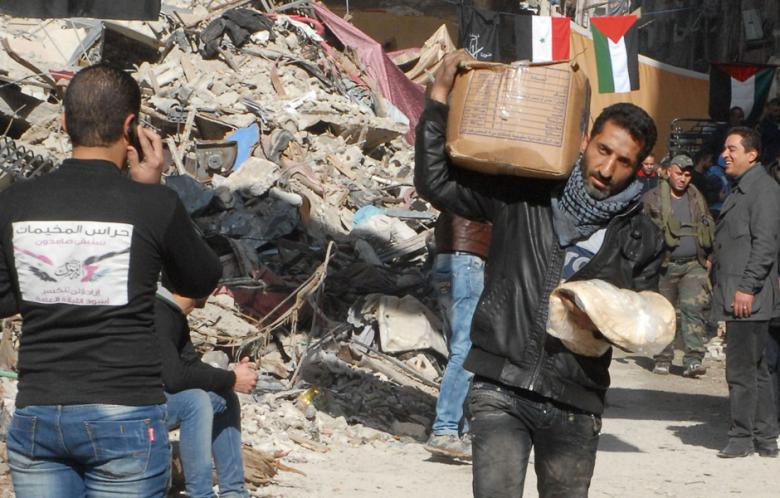

 On Feb. 26, 2012, in response to demands for constitutional change from the Syrian people, the Syrian constitution was reformed and ratified by a general referendum to allow for multiparty elections. In fact, this will be the first free election in Syrian history in which more than one candidate has stood for election for president. If Western governments are really interested in bringing freedom and democracy to Syria, why would they oppose it?
 The U.S. has been the main architect of the covert, illegal war against Syria organized through the so-called “Friends of Syria Group,” including Western countries such as Canada, as well as Arab monarchies, such as Saudi Arabia and Qatar, who have organized mainly non-Syrian mercenaries — many openly allied to al Qaeda — to attempt to overthrow the Syrian government.
 It’s important to note that the mercenaries, controlling 30 per cent of Syrian territory, not only oppose, like Kerry, the June 3 election, but also refuse to hold elections in territory they control. The reasons are twofold: first, they would be voted out by the Syrians who live under their brutal foreign occupation. Secondly, their paymaster is the Saudi government, which is an absolute monarchy and tolerates no opposition.
 Kerry is also personally responsible, whether he admits it or not, for the Syrian election being called at this time. At the Geneva 2 Conference last January, he sabotaged any chance of an internationally sanctioned, transitional government being formed in Syria by insisting Assad couldn’t be part of it. This insistence flew in the face of the Geneva 1 Communique (June 30, 2012), which stipulated there would be no preconditions to talks. Because the Geneva 2 Conference collapsed without reaching consensus, the Syrian government went ahead with the scheduled presidential election.


