Saturday, 22 November 2014

US Escalates its Failed Strategy in Syria

Yusuf Fernandez

.
Turkey and the United States have recently signed an agreement to train and equip 2,000 fighters of the "moderate" Syrian opposition, according to the Turkish newspaper Hurriyet Daily News. The training of these forces of the so-called Free Syrian Army (FSA) will begin “late December” at the Turkish Gendarmerie´s Kirsehir Training Center, located 150 kilometers southeast of the Turkish capital, Ankara, added the Turkish newspaper mentioning unidentified sources.

The training of these militants will be carried out by Turkish and American military, but the equipment and the cost of the training will be entirely paid by the US, wrote Hürriyet. The final details of the plan were agreed at a meeting between the military leaders of the two countries.
Shortly aft.er, The Washington Post indicated that the US government has been studying plans to increase the CIA’s role in arming and training “moderate” (a term meaning they are willing to surrender their country to Western powers) terrorists in Syria, a move aimed at escalating covert US support. For its part, the Pentagon is preparing to establish its own training bases, US officials said. According to the Post, “the proposed CIA buildup would expand a covert mission that has grown substantially over the past year”.” The agency now arms and trains about 400 rebels each month” and a similar number is expected “to be trained by the Pentagon when its program reaches full strength late next year”.

However, this strategy is now facing the first obstacles. Firstly, it has led the ISIL and the al-Qaeda-affiliated Nusra Front to sign an alliance in order to fight both the Syrian Army and the US-backed forces. Both groups, the largest ones of the Syrian terrorist camp, agreed in a meeting held on November 2 in northern Syrian town of Atareb not to fight against one another and cooperate against their common enemies.

Before the US started its airstrikes in Syria in September, ISIL and The Nusra Front were fierce enemies who fought each other to dominate the insurgency. The US air war targeting both groups, however, have persuaded them to cooperate against their mutual enemy. Such an agreement will present more difficulties for the American strategy against ISIL. The union of both groups will make them more effective against US-backed rebels, who are already considered weak and disorganized.

The Nusra Front has already almost wiped out the Syrian Revolutionaries Front and the Hazm Movement, two rebel groups armed and trained by the United States. On November 1, SRF surrendered after the fall of Deir Sinbal, its main stronghold in Syria, and agreed to hand over all their weapons and bases to The Nusra Front. Other dozen rebel-controlled villages in the Idlib province were also captured. “As a movement, the SRF is effectively finished," said Aymen al-Tammimi, a Syrian analyst, to the Daily Telegraph. “Nusra has driven them out of their strongholds of Idlib and Hama.”

The captured US weapons included anti-tank missiles and GRAD rockets, which added to the sizable stock of US weapons now in the hands of ISIL and The Nusra Front in Iraq and Syria. Despite being small factions within the terrorist camp in Syria, the US gave SRF and the Hazm Movement large amounts of advanced weapons.

The following day, the Harakat Movement also surrendered their military bases and weapons to The Nusra Front, when the latter seized the villages it controlled in northern Idlib province. ISIL sent 100 fighters to help The Nusra Front to take over the town of Khan al Sunbul in northern Syria but their intervention became unnecessary because the Hazm Movement surrendered without fighting and 65 of its militants defected to The Nusra Front.

The Nusra Front also took over the town of Minnig in Aleppo Province, on the outskirts of the city. Its fighters ordered all other US-backed rebels there to disband and turn their weaponry over to them,. As a result, there are already only two effective fighting forces in the Aleppo province now: The Nusra Front and the Syrian Army.

Another report by Associated Press confirmed that the “moderate rebels” that Washington is trying to boost “are instead hemorrahaging on multiple fronts". Some of their leaders have been killed. “This is the end of the Free Syrian Army," said Alaa al-Deen, an opposition activist in Idlib, referring to Western-backed militant groups. He added that in recent weeks dozens of leaders of “moderate” terrorist groups have been eliminated.

For the United States, the defeat of these groups, which had been trying to present as successful examples of its efforts in Syria, is a humiliating blow at the time that the US administration is increasing the training of rebels.

The Syrian population is also becoming fed up of these terrorists who are supported by the US, Turkey and Saudi Arabia. While Washington has been selling the idea that these people, who largely share the extremist ideology of their new enemies, are “freedom fighters” Syrian people consider them just as terrorists, bandits and brutal exploiters. In Douma, the main rebel stronghold in Eastern Gouta, near Damascus, several clashes occurred on November 14 after an attack by the inhabitants of the city against a grocery store controlled by a rebel group.

According to the opposition Syrian Observatory for Human Rights, based in London, the riots began when residents of the Syrian city tried to break into the store in charge of the takfiri group "Army of Islam" affiliated to the so-called Islamic Front. Both are led by Zahran Allush, an agent of Saudi Arabia.

“Guardians of the store opened fire on citizens and some of the latter fired, in turn, against them”, a resident said. Several people were injured in the clashes, which continued the following day in parts of Douma. “People are hungry, the city is under siege and the Army of Islam only distributes the food and medicines received from the Red Cross among its members. They charged artificially high prices to the rest of the inhabitants and made people starved. This led residents to rise up”.

On the other hand, the US and Saudi patronage of thSyrian Armyese “moderate rebel groups” have convinced Syrians that they are just mercenaries who seek to impose foreign control over Syria and put an end to the prominent role that the country has played in the Middle East for decades. Therefore, Syrians will fight these forces in order to maintain the independence of their country.

Moreover, US support for terrorist groups in Syria violates the international law, which prohibits states from giving aid to foreign insurgents seeking to overthrow the legal governments of other countries.
In this sense, US actions against Syria are a threat for the whole international community and the international legal framework. They are also a proxy war against Syria´s allies, especially Iran, Russia and China.

In short, the new US plans in Syria are only a recognition that the previous strategy against ISIL both in Iraq and Syria has failed. However, instead of drawing the right lessons from this failure, the first of which is that any successful strategy against terrorism in Syria needs the cooperation of the Syrian Army and State, which are the most effective forces in the anti-ISIS fight, the US Administration sticks once and again to the failed strategy of supporting non-existent “moderate rebels”. It means that there is not a new strategy but an escalation that has been going on in recent months and which will become a more serious failure of the US foreign policy.

Source: Al-Manar Website
21-11-2014 - 16:21 Last updated 21-11-2014 - 16:34 

River to Sea Uprooted Palestinian   
The views expressed in this article are the sole responsibility of the author and do not necessarily reflect those of the Blog!

Ex-Opposition Leader Admits Mistake about Syrian Gov’t, Says Assad Fighting Terrorists

Via Syria Solidarity Movement
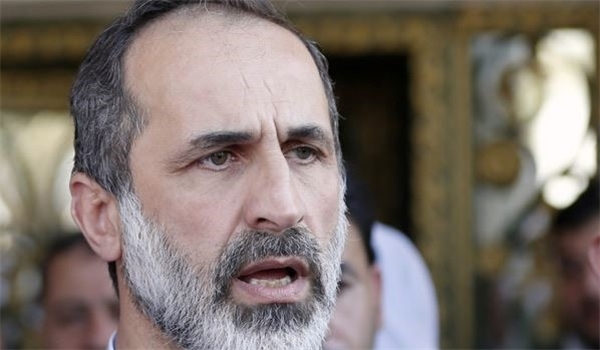
Former President of the National Coalition for Syrian Opposition Forces Moaz Al-Khatib confessed that his opposition to the Damascus government has been a grave mistake, saying that President Bashar Al-Assad has been fighting against the terrorists.
Nov 19, 2014, Fars News
“I acknowledge that I have made a mistake in the past as I imagined that the western and Arab countries as well as Turkey wanted to help Syria and its people,” Turkish news website Ulusal quoted Khatib as saying on his account on a social network.
He wrote that the so-called Friends of Syria are actually the enemies of Syria and terrorists are cooperating with them to destroy Syria.
“I have come to the conclusion that the Syrian government is fighting against the terrorists; it is paying salary to its employees in different parts, supplies electricity and do things that show it is thinking of the people,” Khatib said.
Moaz Al-Khatib is a former president of the National Coalition for Syrian Revolutionary and Opposition Forces. He is also a former prayers imam of the Umayyad Mosque in Damascus.
Syria has been experiencing unrest since March 2011 with organized attacks by well-armed gangs and terrorists against both the army and civilians.
The unrest, which took in terrorist groups from across Europe, the Middle-East and North Africa, has transpired as one of the bloodiest conflicts in recent history.
As the foreign-backed insurgency in Syria continues without an end in sight, the US government has boosted its political and military support to Takfiri extremists.

Recent Posts

River to Sea Uprooted Palestinian   
The views expressed in this article are the sole responsibility of the author and do not necessarily reflect those of the Blog!

Palestine: Talk of a Third Intifada

Where to From Here?

Only the Palestinian people can tell us when they are ready for an intifada. (Tamar Fleishman/Palestine Chronicle)


When a journalist tries to do a historian’s job, the outcome can be quite interesting. Using history as a side note in a brief news report or political analysis oftentimes does more harm than good. Now imagine if that journalist was not dependable to begin with, even more than it being “interesting”, the outcome runs the risk of becoming a mockery.

Consider the selective historical views offered by New York Times writer Thomas Freidman – exposed in the book “The Imperial Messenger” by Belen Fernandez for his pseudo- intellectual shenanigans, contradictions and constant marketing of the status quo.

In an article entitled, The Third Intifada, published last February, Friedman attempts to explain two of the most consequential events in the collective history of the Palestinian people, if not the whole region: “For a while now I’ve wondered why there’s been no Third Intifada. That is, no third Palestinian uprising in the West Bank, the first of which helped to spur the Oslo peace process and the second of which – with more live ammunition from the Israeli side and suicide bombings from the Palestinian side – led to the breakdown of Oslo.”
Ta-da, there it is: Palestinian history for dummies, by, you know .. Friedman. Never mind that the consequences that led to the first uprising in 1987 included the fact that Palestinians were rebelling against the very detached elitist culture, operating from Tunisia, which purported to speak on behalf of the Palestinian people. It was a small clique within the PLO-Fatah leadership that were not even living in Palestine at the time who signed a ruinous, secret agreement in Olso in 1993. And, at the expense of their people’s rightful demands for freedom, this arrangement won them just a few perks. The uprising didn’t help “spur the Oslo peace process”; the ‘process’ was rather introduced, with the support and financing of the United States and others, to crush the intifada, as it did.

While there is some truth to the fact that the second uprising led to the breakdown of Oslo, Friedman’s logic indicates a level of inconsistency on the part of the Palestinian people and their revolts – that they rebelled to bring peace, and they rebelled again to destroy it. Of course, his seemingly harmless interjection there of Israel’s use of live ammunition during the second uprising (as if thousands of Palestinians were not killed and wounded by live ammunition in the first), while Palestinians used suicide bombings – for the uninformed reader, justifies Israel’s choice of weapons.

According to the Israeli rights organization B’Tselem, 1,489 Palestinians were killed during the first intifada (1987-1993) including 304 children. I85 Israelis were reportedly killed including 91 soldiers.

Over 4,000 Palestinians were killed during the second intifada, and over a 1,000 Israelis. However, according to B’Tselem, the high price of death and injury hardly ceased when the second Intifada was arguably over by the end of 2005. In “10 years to the second Intifada,” the Israeli organization reported that: “Israeli security forces killed 6,371 Palestinians, of whom 1,317 were minors. At least 2,996 of the fatalities did not participate in the hostilities when killed. .. An additional 248 were Palestinian police killed in Gaza during operation Cast Lead, and 240 were targets of assassinations.”

There are other possible breakdowns of these numbers, which would be essential to understanding the nature of popular Palestinian revolts. The victims come from diverse backgrounds: refugee camps, villages, small towns and cities. Until Israel’s devastating war on Gaza, 2008-09, the numbers were almost equally divided between Gaza and the West Bank. Some of the victims were Palestinians with Israeli citizenship. Israeli bullets and shells targeted a whole range of people, starting with bystanders, to un-armed protesters, stone throwers, armed fighters, community activists, political leaders, militant leaders, men, women, children, and so on.

In some tragic way, the Israeli responses to Palestinian uprisings is the best validation of the popular nature of the intifada, which goes against every claim made by Israeli leaders that say intifadas are staged and manipulated for specific political ends.

For years, many journalists have busied themselves asking or trying to answer questions regarding the anticipated Third Intifada. Some did so in earnest, others misleadingly, as in the NBC News report: Palestinian Violence Targets Israelis: Has Third Intifada Begun? Few took a stab at objectivity with mixed results as in CNN’s: In Jerusalem, the ‘auto intifada’ is far from an uprising.

But most of them, using a supercilious approach to understanding the Palestinian collective, failed to understand what an uprising is in the first place.

Even the somewhat sensible approach that explains an intifada as popular outrage resulting from the lack of political horizon can, although at times unwittingly, seem distorted.
It is interesting that hardly any had the astuteness to predict previous uprisings. True, violence can be foreseen to some degree, but the collective course of action of a whole nation that is separated by impossible geographical, political, factional and other divides, is not so easy to analyze in merely a few sentences, let alone predict.

There were numerous incidents in the past that never culminated into an “intifada”, although they seem to unite various sectors of Palestinian society, and where a degree of violence was also a prominent feature. They failed because intifadas are not a call for violence agreed upon by a number of people that would constitute a critical mass. Intifadas, although often articulated with a clear set of demands, are not driven by a clear political agenda either.
Palestinians lead an uprising in 1936 against the British Mandate government in Palestine, when the latter did its most to empower Zionists to establish a ‘Jewish state’, and deny Palestinians any political aspiration for independence, thus negating the very spirit of the UN mandate. The uprising turned into a revolt, the outcome of which was the rise of political consciousness among all segments of Palestinian society. A Palestinian identity, which existed for generations, was crystallized in a meaningful and much greater cohesion than ever before.

If examined through a rigid political equation, the 1936-39 Intifada failed, but its success was the unification of an identity that was fragmented purposely or by circumstance.
Later intifadas achieved similar results.
The 1987 Intifada reclaimed the Palestinian struggle by a young, vibrant generation that was based in Palestine itself, unifying more than the identity of the people, but their narrative as well.
The 2000 Intifada challenged the historical anomaly of Oslo, which seemed like a major divergence from the course of resistance championed by every Palestinian generation since 1936.
Although Intifadas affect the course of politics, they are hardly meant as political statements per se. They are unconcerned with the belittling depictions of most journalists and politicians. They are a comprehensive, remarkable and uncompromising process that, regardless of their impact on political discourses, are meant to “shake off”, and defiantly challenge all the factors that contribute to the oppression of a nation. This is not about “violence targeting Israelis”, or its collaborators among Palestinians. It is the awakening of a whole society, joined by a painstaking attempt at redrawing all priorities as a step forward on the path of liberation, in both the cerebral and actual sense.
And considering the numerous variables at play, only the Palestinian people can tell us when they are ready for an intifada – because, essentially it belongs to them, and them alone.
  Related videos

حديث اليوم _ القدس وافق الانتفاضة الثالثة | الاتجاه

الملف _ عملية القدس وبوادر الانتفاضة | العالم 


حوار الاخبارية | د بسام رجا

 River to Sea Uprooted Palestinian   
The views expressed in this article are the sole responsibility of the author and do not necessarily reflect those of the Blog!
Sorry Al-Quds… Kin’s Fighting a Priority


Ahmad Farhat

The “Jihadist” projects of the Takfiris never crossed the boundaries of occupied Palestinian territories. There is no longer room for Palestine and the sacred sites in the glossaries of this approach that are used by the leaders of these groups. Seemingly, they are subjected to demolition as was the case with many of the tombs of the Prophets in Syria and Iraq, not to mention the graves and shrines of saints that were exhumed in Syria.
ISIL, Aqsa
Not only the Zionists are threatening Al-Aqsa Mosque, but also those who follow the Takfiri approach. This raises a number of questions: 
suppose that those groups came to Jerusalem, what will happen to its sacred sites? Would they be demolished as well? Are these groups going to implement all the things that the Israeli entity has been afraid to do for decades?

Of course, these Takfiri groups will not enter occupied Palestine as long as it remained under the Israeli occupation’s control. This comes because we have always heard calls for “General Mobilization” and “Jihad” in almost all the Islamic countries, but not in occupied Palestine. They aim at waging a war against the Muslims only, at controlling their properties, and at demolishing their homes as well.

For instance, Jerusalem, geographically speaking, is nearer than Syria in terms of the thousands of Tunisians who came to fight in Deir ez-Zor, Raqqa, Aleppo, Damascus, and in other areas. Moreover, the militants of the “Salafi movement” in Jordan, those who are fighting in Syria in order to liberate Jerusalem at a later stage as they claim, are just a stone’s throw away from the West Bank, occupied by the Zionists.

ISIL leader, in his most recent message, urged his fighters to fight in Saudi Arabia, Yemen, Egypt, Libya, Algeria, Tunisia, and Morocco, but did not refer to Palestine, as there was no hint of it. This clearly excludes the possibility of fighting the Muslims’ primary enemy that is violating the Islamic sanctities.


Not only Al-Baghdadi kept occupied Palestine out of his “jihad-based” circle, also the leader of al-Nusra Front Abu Mohammed al-Joulani, in a recent interview with Al-Manaarah Al-Baidhaa’ Foundation that belongs to al-Nusra, did not mention occupied Palestine on purpose, and took no notice of practicing Jihad therein.

According to the text of the interview, he said:
“...Not forgetting as well, there is a sensitivity that reached its peak with the arrival of the Mujahideen to the border between them and Israel. This no doubt, incites fear within Israel, which is a state that all contending parties are seeking to protect. It also places fear within those who have created alliances in the fight to take control of the entire region, (if we say America and Russia). We are able to say regarding the area of Shaam; the black and white have gathered against it, various nations of Kufr (disbelief) have gathered against it”.

Al-Joulani did not use the term “occupied Palestine” when he talked about the border, but he said instead the borders of “Israel”.

Accordingly, why didn’t the scope of the war of al-Nusra militants expand to include the occupied territories to liberate them, isn’t this their goal as they claim? Perhaps al-Nusra Front that is confronting in the Levant so as to gain influence is also seeking to protect the occupation countries!

This also raises a question: is al-Nusra Front ready to move forward towards the occupied territories and to abandon the “humanitarian” services provided for it by the Israeli army such as the artillery fire directed at Syrian army positions and the treatment of its injured elements in the Israeli hospitals?

Over and above, there is also a similar group called “Jund Al-Aqsa” (the soldiers of Al-Aqsa), but it seems that it is unfamiliar with the path that could take it to Jerusalem. It began to fight in Idlib, Damascus and in other areas, as if it is searching for the road to Jerusalem or perhaps its ally state that is now controlling the crossing border with occupied Palestine is preventing it from getting there.

In fact, a quick review of the armed groups on the Syrian arena reveals that their tongues and deeds lack the concept of practicing jihad in occupied Palestine against the Zionists. Quite the opposite, they have all expressed their willingness to collaborate with the Israeli entity against the Syrian State, and they announced this in mass media and in International conferences.

Why are they perpetrating brutality against the Muslims, and restoring friendly relations with the occupiers?


Fighting the Near Enemy

They believe in a number of concepts and fatwas that provide justifications for not practicing jihad in occupied Palestine against the Zionists, at the least at the current stage. According to what they believe in, fighting the near enemy takes precedence over fighting the far enemy, and “the near” means here those who reside in a Muslim country and disagree with their standpoints. They are convinced that it isn’t yet the right time to liberate Al-Aqsa, despite the increasing number of attacks against it.

Al-Qaeda’s leader Ayman al-Zawahiri, the most prominent theoretician of this organization even before the killing of Osama bin Laden, says:
“The origins of the Islamic Law give high priority to fighting those apostate rulers over fighting other pure infidels for three reasons. The first reason is that a defensive jihad takes priority over the offensive jihad because those apostate rulers are enemies that dominated the Islamic countries. The second reason relies in the fact that the sin of the apostate is graver than that of the pure infidel. Whereas, the third reason comes because they are the nearby enemy”.
Although al-Zawahiri was speaking here about the rulers, yet the same goes for those who disagree with him, and thus giving priority for the near enemy over the far one is the main function of these takfiri groups. In this context, the theoretician of the takfiri tendency Hani al-Sibai says:
“The near enemy is a malignant tumor destroying and devastating the body of our nation, is the root of all disease, and the origin of the scourge, and thus getting rid of it is a legal duty”. 
Al-Sibai in this is talking about the individuals and not the rulers.


Hence, according to them, fighting the Muslims is a legal duty that has a priority over liberating Al-Aqsa and defending the sacred sites. It has been found to displace the Muslims and to slaughter them with various justifications. In this regard, a number of fatwas authorizing the normalization of relations with the state of the Zionist occupation have been issued. For example, Sheikh Abdul Aziz bin Abdullah bin Baz, the Mufti of Saudi Arabia from 1992 until his death in 1999, issued a fatwa authorizing the so-called making normalization conventions with the Israeli enemy, where he stated that

“So if it in the interests of Muslims in a certain country to reconcile with the Jews, with regard to exchanging ambassadors, selling and purchasing and other transactions deemed lawful by the purified Shari’a (Islamic law), there is nothing wrong with this”.
As stressed by the advisor of the Mufti of Egypt, Dr. Ibrahim Najm, the terrorist organizations are misusing the verses of the Holy Quran and the sayings of the Prophet Muhammad (peace be upon him and his household), including the Hadith that call for Jihad.

He pointed out that these takfiri groups
“are pretending that they are calling for jihad and are really applying the Shari’a Law, while they are conducting acts of intimidation and terrorism and distorting words from their [proper] usages”.
Based on the aforementioned, we find that the takfir groups are extending the hand of reconciliation to the state of occupation, at the same time as they are raising the sword in the face of the Muslims who are mostly carrying the banner of Palestine and defending the sacred sites. This puts emphasis on their dogmatic deviation and highlights many suspicions surrounding their proximal and distal goals.

Adopting this approach, the followers of the takfirist thought “migrate” to the battlefronts in Afghanistan, Pakistan, Iraq, Syria, Yemen, Chechnya, Somalia and the Maghreb. It sounds as if it will never be Palestine’s turn until fighting the “Rawafid” (Shiites), the “Nusayris” (Alawites), the “Nazareth Christians”, the “Murtadeen” (Apostates), and the “Seculars” completely. This will also never happen but only after exterminating the “Abstainers” and eliminating those who are the followers of the same school in the internal battles. Just then, the Islamic Nation will not exist any longer, except for those Islamic countries upon which Allah, the Lord of the Worlds, has mercy.

Translated by: Maysa Hazimeh

Source: Al-Manar Website

19-11-2014 - 11:24 Last updated 19-11-2014 - 11:24


Comment

Read Khalid Khalid Amayereh - mouth piece for Hamas and brotherhood
Laura StuartAmayereh calling for "UNITY"?? - Unity of Gulf states against  Rawafid” (Shiites) June 3, 2012. 

  Related videos


حديث اليوم _ القدس وافق الانتفاضة الثالثة | الاتجاه

الملف _ عملية القدس وبوادر الانتفاضة | العالم 


حوار الاخبارية | د بسام رجا


River to Sea Uprooted Palestinian   
The views expressed in this article are the sole responsibility of the author and do not necessarily reflect those of the Blog!

Riyadh nips Hezbollah-Future Movement dialogue in the bud


Hezbollah Secretary-General Sayyed Hassan Nasrallah and Future Movement leader Saad Hariri visit the tomb of his father, the late Rafik Hariri. Al-Akhbar/Archive
Published Friday, November 21, 2014Al-Akhbar
Riyadh has ‘red-lighted’ the planned dialogue between Hezbollah and the Future Movement before it even began. The Saudi call for Hezbollah to be put on the list of terrorist organizations made at the United Nations threatens to renew tension between the two sides, following an undeclared truce in the media that did not last for more than a few days.
Is there a fixed Saudi, and consequently Gulf policy, vis-à-vis Lebanon? Are these countries really keen on the stability of this country, as they claim, when they hardly spare any occasion to exacerbate its divisions? These questions and others are being asked after the new Saudi escalation against Hezbollah, which is likely to aggravate the already complex situation in Lebanon and the region.
Saudi Arabia’s ambassador to the United Nations Abdallah al-Mouallimi called on the UN Security Council on Wednesday to place the Resistance Party on the list of terrorist organizations. In a special session on terrorism, Mouallimi called for punishing Hezbollah and other groups including the Abu al Fadl al Abbas Brigade, the League of the Righteous, and other “terrorist organizations fighting in Syria.”
Al-Akhbar learned that as a result of the new Saudi position, contacts will be made with Riyadh over the next few days to contain possible reactions. Well-placed sources warned against negative repercussions from the Saudi move over the ‘preliminary dialogue’ between Hezbollah and the Future Movement.
The sources expressed concern that this could put an end to the de-escalation that begun when Hezbollah Secretary General Sayyed Hassan Nasrallah, speaking during the Shia Muslim commemorations of Ashura, welcomed dialogue with the Future Movement. The sources told Al-Akhbar that the Saudi move, in addition to the sudden re-activation of the Special Tribunal for Lebanon (STL) after a long period of inactivity, by summoning political witnesses, will create tensions in the country, and are indicative of a Saudi veto on dialogue between the Future Movement and Hezbollah.
The sources asked, 
“How do the Saudis explain their position when barely two months have passed since their ambassador in Beirut Ali Awad Asiri celebrated his country’s National Day surrounded by deputies from Hezbollah? Why has Saudi Arabia made this call two days after the GCC summit, and as the UAE – which is influenced to a large extent by Riyadh’s position – placed a number of organizations on its terror list not including Hezbollah?”


The sources deduced that the Saudi policy is not yet ready to restore its balance in Lebanon and the region. The sources also had questions about Saudi-Israeli ‘intersection’ over trying to smear Hezbollah’s image as a resistance movement and link it to terrorism, something that Tel Aviv has sought for very long.
The sourced described Mouallimi’s speech at the UN as a ‘sound bubble’ that will have no results, recalling Nasrallah’s declaration that Hezbollah will be where it has to be in Syria. They said the Saudi UN envoy’s move “demonstrates real disappointment in the ranks of the Saudi leadership over the failure of its project in Syria, with [Saudi]… making random accusations right and left.”
The sources pointed out that the Saudi envoy, in the course of justifying his call, cited the emergence of terror groups like ISIS and others, which he linked to the “practices of the Syrian regime” and the “sectarian policies of some countries,” rather than Saudi and Gulf support for these groups. The sources added, “Saudi Arabia is among the top supporters of terrorist Takfiri groups in Syria, which makes its talk about fighting terrorism lacking in any seriousness.”
The sources then linked the Saudi position to “growing concerns in the ranks of the Saudi leadership over the nuclear negotiations with Iran, and real fear from the possibility of the parties reaching an agreement that would undermine the Saudi leadership’s hopes to step up the siege on Iran.”
The sources ruled out any practical effect of the Saudi position in light of the current balance of power in the international organization, and in light of the responses the Saudi envoy heard regarding his proposal.
Iran’s envoy at the United Nations Gholam Hossein Dehghani had responded to Mouallimi’s call by emphasizing the need to make a distinction between legitimate resistance and terrorism, and the need to support the resistance. He also criticized regional countries for failing to match their words with deeds, and said that few governments in the region have taken the threat seriously, while the rest did not control their borders, did not trop ISIS from recruiting, and did not stop the flow of financial support to these “criminal organizations.”
For his part, Syria's ambassador to the United Nations Bashar Jaafari accused Saudi Arabia of backing terrorism in the region, denouncing the inconsistencies in its diagnosis of the roots of terrorism. He said that al-Qaeda and its ilk had all grown thanks to Saudi patronage in Afghanistan. Jaafari also said that the carnage in Syria is supported by Saudi Arabia and Qatar, citing the call by 72 Saudi clerics for people to go for "jihad” in Syria, and wondered whether the Saudi government was serious about fighting terrorism.
(Al-Akhbar)
This article is an edited translation from the Arabic Edition.

Related
River to Sea Uprooted Palestinian   
The views expressed in this article are the sole responsibility of the author and do not necessarily reflect those of the Blog!

Europe Veering From US Abyss Over Russia?

Finian CUNNINGHAM | 20.11.2014 
It’s long overdue but better late than never that Europe might just be back-pedalling on America’s aggressive agenda towards Russia. The business-like visit to Moscow this week by Germany’s Foreign Minister Frank-Walter Steinmeier suggests that Europe can come to its senses to seek a diplomatic resolution of the escalating tensions over the Ukraine crisis – tensions that could spark a wider continental war, or worse.

Steinmeier met with his Russian counterpart Sergei Lavrov in which the pair stressed the need to find a political end to the violence in Ukraine. The German diplomat – the first high-level European envoy to Moscow in several months – also talked about normalising relations between his country and Russia and of finding a way to rescind the economic sanctions that Brussels has imposed on Moscow over recent months. 

EU ministers in Brussels balked at imposing a fourth round of sanctions earlier this week, showing a growing division over the policy among European governments. 

Interestingly, Steinmeier said his visit to the Russian capital was following up on positive discussions held last weekend with President Vladimir Putin at the G20 summit in Australia. The German foreign minister said the task now was to prevent a new spiral of violence in Ukraine. 

Given that Germany is the European Union’s largest economy, we can fairly say that Berlin’s political attitude is going to hold sway for the rest of the bloc. 

Meanwhile, the contrast with the European attitude, as seen this week through Steinmeier, could not be sharper in Washington.

This week, the Republican-controlled Congress was pushing through a bill that will significantly increase military support to the Kiev regime. The ultra rightwing cabal, despite a fig leaf of elections last month, has clearly shown no interest in implementing the ceasefire brokered on September 5 in the Belarus capital, Minsk. Civilian casualties are mounting among the ethnic Russian population in Donetsk and Luhansk as the Kiev’s military forces continue their practice of indiscriminate shelling of cities and villages with the use of banned weapons, including cluster bombs and unguided ballistic missiles.

Never mind violations of the Minsk Protocol, the murderous offensive by Kiev consists of multiple war crimes. 

Nonetheless, the US Congress is unabashed and is in fact preparing to legalise massive overt military aid to this regime whose leaders, including its nominal President Petro Poroshenko, are becoming more and more unhinged, warning earlier this week of “not being afraid of total war with Russia”. 

Republican Congressman Michael Burgess, the author of the provocatively named Ukraine Freedom Act Support, said this week: “Ukraine [sic] needs weapons, ammunition, body armour and communication means. Of course, financial support is important but not as much as weapons and ammunition to fight off the Russian troops who invaded a sovereign country.”

Note the assertion of Russian invasion by the Congressman without the slightest obligation to substantiate his claim. He probably heard it on Fox News or CNN and feels free to regurgitate it as incontrovertible fact. 

The Kiev regime’s reckless militarism over the past seven months has brought Ukraine’s economy to its knees, with its currency crashing and soaring international debts unpaid – chief among the creditors being Russia. Yet Washington sees the priority as not financial assistance but rather more militarism to provoke more aggression towards Russia. 

After the Republican mid-election victory earlier this month, Congress is likely to pass the above bill. Henceforth, the US government will be enabled to openly supply lethal materiel, including anti-tank and air defence systems, grenade launchers, machine-guns and sniper rifles. This marks a baleful escalation of Washington’s military intervention in Ukraine, which up to now has feigned its support for the Kiev regime as “non-lethal aid”. 

This is just what the US Republicans have been clamouring for. Last week, swivelled-eyed Senator John McCain said: “We want to give the Ukrainians [sic] weapons to defend themselves as the Russians are dismembering their country.” McCain, another Fox-News-regurgitating politician, was one of the main international sponsors of the neo-Nazi shock troops who seized power in Kiev earlier this year and who now openly vilify fellow Ukrainians in the eastern regions as “sub-human Moskals”.

Up till lately, Washington and Brussels have been singing off the same propaganda hymn sheet as the Kiev regime that they both railroaded into power last February in an illegal coup against the elected Ukrainian government. In an astounding inversion of reality, the US-EU axis accuses Russia of invading and subverting Ukraine. No proof is proffered and the words of the criminal, openly hostile and Russian-hating Kiev regime are promulgated as gospel truth.

Brussels has so far toed the Washington line of imposing sanctions on Russia for allegedly violating Ukraine’s sovereignty and territorial integrity. The fact that the people of Crimea voted freely and overwhelmingly to secede from the Western-installed Kiev regime in March and to join the Russian federation, followed by similar referenda for breakaway autonomy in the eastern Donetsk and Luhansk regions, is attributed, through a feat of double-think, to Moscow’s meddling. 

However, with the Western sanctions and Russian counter-sanctions taking the heaviest toll on an already recession-stricken Europe, the anti-Moscow nostrums are bound to be viewed with increasing leeriness. Tough talk may be cheap, even rewarding, for Washington, but not for the Europeans. 

‘German exports to Russia tumble’ reported the Financial Times at the end of last month, as a result of the standoff with Moscow – the worst rupture in relations since the formal end of the Cold War more than two decades ago. Elsewhere it is reported that German industry and businesses are feverishly lobbying Berlin to revise the sanctions policy, which is threatening thousands of German jobs and the biggest bilateral trade between Europe and Russia.

As the EU’s economic powerhouse, what is bad for Germany is automatically bad for the rest of Europe. 

The new EU foreign policy chief Frederica Morgherini, formerly the Italian minister, has recently expressed misgivings about the effectiveness of sanctions. Morgherini took over from Britain’s Catherine Ashton who was instrumental in the Western regime-change operation in Kiev and who had displayed a pathetic servility to Washington. 

Other European states are also increasingly finding a more critical voice towards what they see as senseless and self-defeating hostility against Russia. 

‘Hungary questions EU sanctions on Russia’ reported the Financial Times on October 16. Slovakia, the Czech Republic, Romania, Bulgaria and Austria have added their voices to question the official Washington-Brussels stance of trying to isolate Russia. 

Serbia’s Prime Minister Aleksandar Vucic has defiantly said that his country will not follow Brussels’ sanctions on Russia, citing long-lasting historical and cultural ties with Moscow, even though Belgrade currently has EU accession status. Added to that are strong economic and investment ties between Russia and Serbia. 

All these dissenting countries have a vested interest in developing the giant South Stream gas supply project from Russia, as well as from just maintaining decorous neighbourly relations. For them, the sanctions on Russia are tantamount to cutting off their nose to spite their face.

Perhaps the words of Vladimir Putin and other Russian leaders are finally beginning to win through reason and empirical evidence, or lack of it. Speaking at the Valdai Club in Sochi at the end of October, one of Putin’s main points was that US geopolitical policy is aimed at driving a wedge between Europe and Russia out of selfish American interests. Competition for Europe’s vast energy market is an obvious objective for the US, as well as the subordination of European economic policy to Wall Street and the US Federal Reserve. In short, the subordination of Europe to American capitalist hegemony.

Kremlin chief of staff Sergei Ivanov recently said that what is primarily motivating American hostility towards Moscow is that “Russia dares to have an opinion” on the future direction of global developments. This independence is seen for example in Russia’s promotion of alternative international banking to the Washington-dominated IMF, or the use of bilateral currencies for seminal Eurasian energy trade instead of dependence on the US dollar. 

Any sane person can see that Russia’s policies are entirely legitimate and even desirable for a more balanced global economy and polity. It is ludicrous for the arrogant, self-declared exceptional American nation to criminalise Russia on this basis, and that is why Washington has used the Ukraine crisis as a cover for its unacceptable imperialist agenda. 

European governments would do well to contemplate the self-indicting words of US Vice President Joe Biden. Biden told a meeting at Harvard University last month that European states were initially reluctant to adopt American sanctions toward Russia. “President Obama had to embarrass European leaders into it,” said Biden with more than a hint of glee at Washington’s power at bullying Europe. How’s that for an atrocious admission?

Washington has everything to gain from plunging its so-called European allies into a new Cold War with Russia. And Europe has everything to lose. 

But it seems now that a significant European constituency is at last waking up to the folly that has been foisted on its 500 million citizens by the likes of pro-American puppets Hermann Van Rompuy, José Manuel Barroso, David Cameron and Catherine Ashton. Will German Chancellor Angela Merkel or French President Francois Hollande grasp the courage to follow the diplomatic path being advocated by several courageous dissenting EU members? 

One hopes that Europe is beginning to part ways with the US direction on Russia – a direction that is leading to an abyss. 

American politics is arguably the most corporate-controlled, brainwashed, intellectually devoid and dangerous institution that the world has ever known. The buying of the latest Congressional elections with $4 billion in corporate campaign funds (that is, bribes) is proof that the US is not a democracy – it is a plutocracy. If Europeans have any residual democratic independence and enlightened reason, then they must find it and assert it urgently. Europe and Russia are far more natural allies than the warmongering American rulers could ever be.

River to Sea Uprooted Palestinian   
The views expressed in this article are the sole responsibility of the author and do not necessarily reflect those of the Blog!