Wed, 15 Jul 2015 18:25 UTC
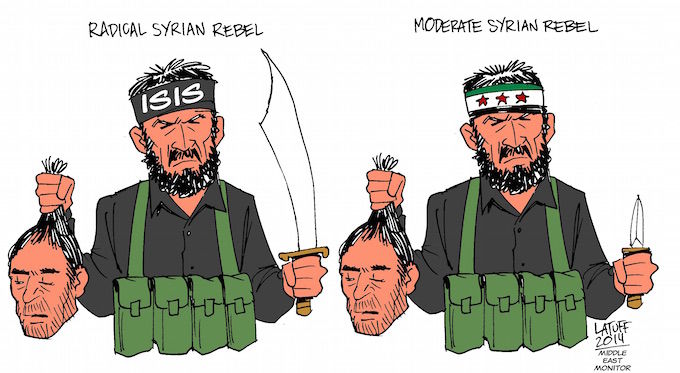
It means that out of nearly 18 million Syrians (reduced by 4 million since the start of the conflict) the US could only find 60 that were willing to fight against the Syrian Army, only 60.(1)
In other words, only an increase of ~0.000333% of the Syrian population is deemed "moderate" by the US and willing to fight. The military is currently in the process of vetting 7,000 volunteers, so if we assume that all of them will pass inspection, that will amount to a mere ~0.039222% of the population. A far cry from 0.1%, let alone 1% of the total inhabitants.
The fact that only 60 can be deemed "moderate" is also quite telling. This coming from a government who deemed the Free Syrian Army, among others, as "moderates." In September of 2014, FSA "moderate" commander and recipient of US aid Bassel Idriss admitted that "We are collaborating with the Islamic State and the Nusra Front," the reason for this being "We have reached a point where we have to collaborate with anyone against unfairness and injustice."(2)
Back in April of the same year, the leader of the US-backed "moderate" Syrian Revolutionary Front Jamal Maarouf admitted that al-Qaeda was "not our problem" and that his fighters conducted joint operations with al-Nusra. "If the people who support us tell us to send weapons to another group, we send them. They [Jabhat al-Nusra] asked us a month ago to send weapons to Yabroud so we sent a lot of weapons there. When they asked us to do this, we do it."(3)
One of the most senior "moderate" rebel commanders to be backed by the US and main recipient of Western aid, Col. Okaidi, is seen in a video, which has been authenticated by Joshua Landis of the University of Oklahoma, speaking during interviews saying "My relationship with the brothers in ISIL is good... I communicate almost daily with brothers in ISIL... the relationship is good, even brotherly."
Okaidi admits al-Qaeda is not any different from the FSA "They [al-Nusra] did not exhibit any abnormal behavior, which is different from that of the FSA." The video shows Okaidi with ISIS Emir Abu Jandal celebrating a victory, an ally ISIS fighter shouts "I swear to Allah, O Alawites, we came to slaughter you. Await what you deserve!"(4)
US Ambassador to Syria Robert Ford, who worked closely with Okaidi, himself admitted to giving material support to ISIS and al-Nusra, stating that he "absolutely does not deny" knowing that most of the rebels he backed fought alongside ISIS and Nusra.(5)
The reason for all of this is simply that, as pointed out by the leading Western journalist in the region, Patrick Cockburn, "In reality, there is no dividing wall between them [ISIS and Nusra] and America's supposedly moderate opposition allies." According to Vice President Biden, "there was no moderate middle because the moderate middle are made up of shopkeepers, not soldiers."(6)
This means that apart from a plethora of substantially foreign terrorist jihadi lunatics, there is no other force willing to fight against the government.
The reasons for this were further articulated by Obama himself, who stated that it was a "fantasy" to think that the US could arm and equip "farmers, dentists, and folks who never fought before" and have them be an effective force against Assad.(7) What is implied here is that ordinary Syrians, actually moderate individuals, have no desire for military action nor are they capable of effectively harnessing it, hence the need to support the extremists, who are. And therefore, as Biden points out, the Wests' allies "poured hundreds of millions of dollars and tens of thousands of tons of weapons to... al-Nusra and al-Qaeda and the extremist elements of jihadis coming from other parts of the world." What Biden leaves out is that this was all coordinated under a covert US-led operation.
In reality, these moderates were the peaceful opposition that did not want the destruction of the state but instead desired democratic change, who were then displaced by foreign-backers and terrorist who hijacked their uprising, as is conceded by prominent opposition leaders.(8)
This hijacking was the result of US leaders realizing that the actual moderates only wanted peaceful change, while the West desired the overthrow of the state through any means necessary, including violent takeover, and so therefore "Jihadi groups ideologically close to al-Qaeda have been relabeled as moderate if their actions are deemed supportive of US policy aims," as Patrick Cockburn rightly points out. The result of this is that "Washington thus allowed advanced weaponry to be handed to its deadliest enemy."(9)
The recent training of 60 "moderates" is nothing different.
To illustrate this, it's important to see that this narrative of a moderate opposition stays constant, while the group this label is applied to constantly changes.
Right now this label is being applied to the Southern Front, hailed as the new moderate force America can morally support. However, this group is financed and supported by the Military Operations Centre (MOC) in Amman that is staffed by agents from the US, Jordan, Saudi Arabia, UAE, as well as other anti-Assad governments, and according to Syrian expert Aron Lund, "adoption of MOC-provided talking points" of moderation by members of this alliance are likely "to be more opportunistic than heartfelt."(10)
The reason the US is now training 60 rebels is because every single other rebel group that the US trained, equipped, funded, and marked as "moderate" has gone on to join either al-Qaeda or ISIS. FSA brigades, the Syrian Revolutionary Front, Harakat Hazm, all of them have now defected to al-Qaeda and ISIS.(11)
At every point along the way while receiving US-aid they were branded as "moderates." After they went on to join ISIS or it became too hard to keep up their "moderate" image, the torch was passed on to a new group, as now it is passed onto the Southern Front, yet "in reality" there was never any "moderate middle" nor is there "a dividing wall between [the extremists] and America's supposedly moderate opposition allies."
Therefore we should not be fooled when new rebels "ideologically close to al-Qaeda" are "relabeled as moderate" all because "their actions are deemed supportive of US policy aims", whether they be the Southern Front, the new 60-trainees, or the next group that is sure to emerge in the future, especially given that from the beginning, according to US intelligence, the opposition has taken "a clear sectarian direction", and according to leading Western journalists has been dominated from the start by "ISIS and Jabhat al-Nusra... in addition to other extreme jihadi groups."(12)
There is nothing moderate about voluntarily taking up arms and agreeing to be a proxy force for foreign powers. Furthermore, there is nothing moderate about attacking and overtaking towns and villages, which is the expressed aim of this new US-backed force, when the majority of the population isn't calling for it and doesn't desire it. As Zbigniew Brzezinski has stated, Assad has more support than any group opposing him, and surely he has more support than a US-backed militia, as polls consistently show world opinion sees the US as the major threat to peace, and since most Syrians are aware of the dirty war being perpetrated on them by the West.(13)
The presence of ISIS is not an argument for the training of more rebels, it is instead an argument against this, as quite possibly the single biggest factor in the creation and rise of ISIS was the US sponsoring of the insurgency in Syria which they knew to be sectarian and extremist, coupled with the training of rebels who were either themselves extremist terrorist or affiliated with such parties, flooding them with arms and funds to the tune of $1 billion per year and $2.91 billion since 2014.(14)
It must be remembered what former Scotland Yard detective and UK counterterrorism intelligence officer Charles Shoebridge rightly pointed out, that "the 'moderate' rebels the US and UK support themselves openly welcomed the arrival of such extremists. Indeed, the Free Syria Army backed by the West was allied with ISIS, until ISIS attacked them at the end of 2013."(15)
For the first 3 years of the crisis the rebels the West openly backed were allies of ISIS, committing the exact same kind of atrocities and terroristic acts. And according to Patrick Cockburn, the US-backed FSA were at times despised even more than the other terrorist organizations as they would terrorize and ransack the civilian populations, "Pilloried in the West for their sectarian ferocity, these jihadists were often welcomed by local people for restoring law and order after the looting and banditry of the Western-backed Free Syrian Army."(16)
If you train rebels one time and they commit these atrocities and fight alongside fanatical terrorists you can at least plead ignorance and good intentions, however if you continue these actions when this has been the outcome every single time, let alone doing it over, and over, and over, and over again, then that is premeditated complicity in the sponsoring of terrorism, an act by the West that Syria's Christian leaders are also demanding an end to.(17)
This recent attempt to train "moderate" rebels is no different. There is nothing moderate about the entire process, and these fighters will go on to commit the exact same kinds of atrocities and ally with the exact same terrorist entities that all of our other rebels have done in the past.
Furthermore, just the mere action of pumping in more bullets, guns, weaponry, and fighters will inevitably lead to further bloodshed and civilian casualties caught within the crossfire, exacerbating the situation and increasing pain and suffering. As Charles Shoebridge notes, the notion that "pouring sophisticated weaponry into a war zone already awash with weapons" will somehow "save civilian lives" is a deeply "flawed assumption." "Syria's rebels must be assessed as they are, not as they once were, or as we'd romantically like them to be," and therefore on that basis, noting the extensively documented history of rebel atrocities, "we should not be backing them."(18)
In his book "The Rise of Islamic State" Patrick Cockburn writes, "An intelligence officer from a Middle Eastern country neighboring Syria told me that ISIS members "say they are always pleased when sophisticated weapons are sent to anti-Assad groups of any kind, because they can always get the arms off them by threats of force or cash payments."" (19) (emphasis mine)
I think it's about time we stop fueling the spilling of blood and the arming of terrorists inside Syria. If we actually wanted to stop ISIS, that's the first place we would start.
The fact that only 60 can be deemed "moderate" is also quite telling. This coming from a government who deemed the Free Syrian Army, among others, as "moderates." In September of 2014, FSA "moderate" commander and recipient of US aid Bassel Idriss admitted that "We are collaborating with the Islamic State and the Nusra Front," the reason for this being "We have reached a point where we have to collaborate with anyone against unfairness and injustice."(2)
Back in April of the same year, the leader of the US-backed "moderate" Syrian Revolutionary Front Jamal Maarouf admitted that al-Qaeda was "not our problem" and that his fighters conducted joint operations with al-Nusra. "If the people who support us tell us to send weapons to another group, we send them. They [Jabhat al-Nusra] asked us a month ago to send weapons to Yabroud so we sent a lot of weapons there. When they asked us to do this, we do it."(3)
One of the most senior "moderate" rebel commanders to be backed by the US and main recipient of Western aid, Col. Okaidi, is seen in a video, which has been authenticated by Joshua Landis of the University of Oklahoma, speaking during interviews saying "My relationship with the brothers in ISIL is good... I communicate almost daily with brothers in ISIL... the relationship is good, even brotherly."
Okaidi admits al-Qaeda is not any different from the FSA "They [al-Nusra] did not exhibit any abnormal behavior, which is different from that of the FSA." The video shows Okaidi with ISIS Emir Abu Jandal celebrating a victory, an ally ISIS fighter shouts "I swear to Allah, O Alawites, we came to slaughter you. Await what you deserve!"(4)
US Ambassador to Syria Robert Ford, who worked closely with Okaidi, himself admitted to giving material support to ISIS and al-Nusra, stating that he "absolutely does not deny" knowing that most of the rebels he backed fought alongside ISIS and Nusra.(5)
The reason for all of this is simply that, as pointed out by the leading Western journalist in the region, Patrick Cockburn, "In reality, there is no dividing wall between them [ISIS and Nusra] and America's supposedly moderate opposition allies." According to Vice President Biden, "there was no moderate middle because the moderate middle are made up of shopkeepers, not soldiers."(6)
This means that apart from a plethora of substantially foreign terrorist jihadi lunatics, there is no other force willing to fight against the government.
The reasons for this were further articulated by Obama himself, who stated that it was a "fantasy" to think that the US could arm and equip "farmers, dentists, and folks who never fought before" and have them be an effective force against Assad.(7) What is implied here is that ordinary Syrians, actually moderate individuals, have no desire for military action nor are they capable of effectively harnessing it, hence the need to support the extremists, who are. And therefore, as Biden points out, the Wests' allies "poured hundreds of millions of dollars and tens of thousands of tons of weapons to... al-Nusra and al-Qaeda and the extremist elements of jihadis coming from other parts of the world." What Biden leaves out is that this was all coordinated under a covert US-led operation.
In reality, these moderates were the peaceful opposition that did not want the destruction of the state but instead desired democratic change, who were then displaced by foreign-backers and terrorist who hijacked their uprising, as is conceded by prominent opposition leaders.(8)
This hijacking was the result of US leaders realizing that the actual moderates only wanted peaceful change, while the West desired the overthrow of the state through any means necessary, including violent takeover, and so therefore "Jihadi groups ideologically close to al-Qaeda have been relabeled as moderate if their actions are deemed supportive of US policy aims," as Patrick Cockburn rightly points out. The result of this is that "Washington thus allowed advanced weaponry to be handed to its deadliest enemy."(9)
The recent training of 60 "moderates" is nothing different.
To illustrate this, it's important to see that this narrative of a moderate opposition stays constant, while the group this label is applied to constantly changes.
Right now this label is being applied to the Southern Front, hailed as the new moderate force America can morally support. However, this group is financed and supported by the Military Operations Centre (MOC) in Amman that is staffed by agents from the US, Jordan, Saudi Arabia, UAE, as well as other anti-Assad governments, and according to Syrian expert Aron Lund, "adoption of MOC-provided talking points" of moderation by members of this alliance are likely "to be more opportunistic than heartfelt."(10)
The reason the US is now training 60 rebels is because every single other rebel group that the US trained, equipped, funded, and marked as "moderate" has gone on to join either al-Qaeda or ISIS. FSA brigades, the Syrian Revolutionary Front, Harakat Hazm, all of them have now defected to al-Qaeda and ISIS.(11)
At every point along the way while receiving US-aid they were branded as "moderates." After they went on to join ISIS or it became too hard to keep up their "moderate" image, the torch was passed on to a new group, as now it is passed onto the Southern Front, yet "in reality" there was never any "moderate middle" nor is there "a dividing wall between [the extremists] and America's supposedly moderate opposition allies."
Therefore we should not be fooled when new rebels "ideologically close to al-Qaeda" are "relabeled as moderate" all because "their actions are deemed supportive of US policy aims", whether they be the Southern Front, the new 60-trainees, or the next group that is sure to emerge in the future, especially given that from the beginning, according to US intelligence, the opposition has taken "a clear sectarian direction", and according to leading Western journalists has been dominated from the start by "ISIS and Jabhat al-Nusra... in addition to other extreme jihadi groups."(12)
There is nothing moderate about voluntarily taking up arms and agreeing to be a proxy force for foreign powers. Furthermore, there is nothing moderate about attacking and overtaking towns and villages, which is the expressed aim of this new US-backed force, when the majority of the population isn't calling for it and doesn't desire it. As Zbigniew Brzezinski has stated, Assad has more support than any group opposing him, and surely he has more support than a US-backed militia, as polls consistently show world opinion sees the US as the major threat to peace, and since most Syrians are aware of the dirty war being perpetrated on them by the West.(13)
The presence of ISIS is not an argument for the training of more rebels, it is instead an argument against this, as quite possibly the single biggest factor in the creation and rise of ISIS was the US sponsoring of the insurgency in Syria which they knew to be sectarian and extremist, coupled with the training of rebels who were either themselves extremist terrorist or affiliated with such parties, flooding them with arms and funds to the tune of $1 billion per year and $2.91 billion since 2014.(14)
It must be remembered what former Scotland Yard detective and UK counterterrorism intelligence officer Charles Shoebridge rightly pointed out, that "the 'moderate' rebels the US and UK support themselves openly welcomed the arrival of such extremists. Indeed, the Free Syria Army backed by the West was allied with ISIS, until ISIS attacked them at the end of 2013."(15)
For the first 3 years of the crisis the rebels the West openly backed were allies of ISIS, committing the exact same kind of atrocities and terroristic acts. And according to Patrick Cockburn, the US-backed FSA were at times despised even more than the other terrorist organizations as they would terrorize and ransack the civilian populations, "Pilloried in the West for their sectarian ferocity, these jihadists were often welcomed by local people for restoring law and order after the looting and banditry of the Western-backed Free Syrian Army."(16)
If you train rebels one time and they commit these atrocities and fight alongside fanatical terrorists you can at least plead ignorance and good intentions, however if you continue these actions when this has been the outcome every single time, let alone doing it over, and over, and over, and over again, then that is premeditated complicity in the sponsoring of terrorism, an act by the West that Syria's Christian leaders are also demanding an end to.(17)
This recent attempt to train "moderate" rebels is no different. There is nothing moderate about the entire process, and these fighters will go on to commit the exact same kinds of atrocities and ally with the exact same terrorist entities that all of our other rebels have done in the past.
Furthermore, just the mere action of pumping in more bullets, guns, weaponry, and fighters will inevitably lead to further bloodshed and civilian casualties caught within the crossfire, exacerbating the situation and increasing pain and suffering. As Charles Shoebridge notes, the notion that "pouring sophisticated weaponry into a war zone already awash with weapons" will somehow "save civilian lives" is a deeply "flawed assumption." "Syria's rebels must be assessed as they are, not as they once were, or as we'd romantically like them to be," and therefore on that basis, noting the extensively documented history of rebel atrocities, "we should not be backing them."(18)
In his book "The Rise of Islamic State" Patrick Cockburn writes, "An intelligence officer from a Middle Eastern country neighboring Syria told me that ISIS members "say they are always pleased when sophisticated weapons are sent to anti-Assad groups of any kind, because they can always get the arms off them by threats of force or cash payments."" (19) (emphasis mine)
I think it's about time we stop fueling the spilling of blood and the arming of terrorists inside Syria. If we actually wanted to stop ISIS, that's the first place we would start.
Notes:
1.) Rizzo, Jennifer, “Carter: U.S. trains only 60 Syrian rebels.” CNN, July 7th, 2015.http://www.cnn.com/2015/07/07/politics/united-states-training-syrian-rebels-ashton-carter/; CIA World Factbook, Syria.https://www.cia.gov/library/publications/the-world-factbook/geos/sy.html; Syria Regional Refugee Response, United Nations High Commissioner for Refugees. Last Updated 09 Jul 2015, accessed July 15th,
2015.http://data.unhcr.org/syrianrefugees/regional.php.
2015.http://data.unhcr.org/syrianrefugees/regional.php.
2.) Knutsen, Elise. “Frustration drives Arsal’s FSA into ISIS ranks.” The Daily Star, September 8, 2014.http://cached.newslookup.com/cached.php?ref_id=394&siteid=2319&id=8144452&t=1410149280.
3.) Hunter, Isabel. “’I am not fighting against al-Qa’ida… it’s not our problem’, says West’s last hope in Syria.” The Independent, April 2nd, 2015. http://www.independent.co.uk/news/world/middle-east/i-am-not-fighting-againstalqaida-itsnot-our-problem-says-wests-last-hope-in-syria-9233424.html.
4.) Joshua Landis, “US Key Man in Syria Worked Closely with ISIL and Jabhat al-Nusra.”https://twitter.com/joshua_landis/status/504610185952784384.
5.) “In February 2015, he [Robert Ford] openly confessed to having given support to ISIS and Al-Nusra terrorists after being questioned by Al-Monitor News journalist Edward Dark. THE TWITTER HANDLE, @fordrs58 is indeed Ambassador Robert Ford’s account, as was confirmed to me in a personal email by Dr. Joshua Landis, Director of Middle East Studies at the University of Oklahoma and the most well-known Syria scholar in the United States.” Hoff, Brad. Levant Report, May 25th, 2015. http://levantreport.com/tag/robert-ford/.
6.) Cockburn, Patrick, “Preface” & “The Rise of ISIS”, The Rise of Islamic State: ISIS and the New Sunni Revolution (Brooklyn, NY, 2015). Pg. xx, 3. Print.
7.) “Obama: Notion that Syrian opposition could have overthrown Assad with U.S. arms a “fantasy.” CBS News, June 20th, 2014. http://www.cbsnews.com/news/obama-notion-that-syrian-opposition-could-overthrow-assad-a-fantasy/.
8.) In the beginning of the uprisings, Syrians did not desire the destruction of the pluralistic and socially inclusive albeit authoritarian state given the popular support for the president and the country’s religious diversity and tolerance. They supported the country’s protection of minorities, as well as the status of women and free education and health care yet opposed corruption, the security-intelligence apparatus, and the feared political police. Wikstrom, Cajsa. “Syria: ‘A kingdom of silence’”. Al Jazeera, February 9th, 2011.http://www.aljazeera.com/indepth/features/2011/02/201129103121562395.html; Muhanna, Elias. “No Revolution in Syria: An Interview with Camille Otrakji.” http://mrzine.monthlyreview.org/2011/otrakji030511.html; Otrakji, Camille. “The Real Bashar Al-Assad.” Conflict Forum, February 4th, 2012. http://www.conflictsforum.org/2012/the-real-bashar-al-assad/; For further on this, see Tim Anderson, “Washington’s ‘New Middle East’ Stalls, the Resistance Rises.” Global Research, July 12th, 2015. http://www.globalresearch.ca/washingtons-new-middle-east-stalls-the-resistance-rises/5462101; The fact that the peaceful protests were hijacked and displaced by foreign-backed extremists is also explored in Andersons piece, as well as being conceded by leading opposition figures like Dr. Haytham Manna, who states that “the pumping of arms to Syria, supported by Saudi Arabia and Qatar, the phenomenon of the Free Syrian Army, and the entry of more than 200 jihadi foreigners into Syria in the past six months have all led to a decline in the mobilisation of large segments of the population… and in the activists’ peaceful civil movement. The political discourse has become sectarian; there has been a Salafisation of religiously conservative sectors”, Haytham Manna, The Guardian, “Syria’s opposition has been led astray by violence.” June 22, 2012.http://www.theguardian.com/commentisfree/2012/jun/22/syria-opposition-led-astray-by-violence; This point is as well articulated by leading Western journalists. According to Patrick Cockburn “Come the uprisings of 2011, it was the jihadi and Sunni-sectarian, militarized wing of rebel movements that received massive injections of money from the kings and emirs of the Gulf. The secular, non-sectarian opponents of the long-established police states were soon marginalized, reduced to silence, or killed.” As well, “Saudi involvement, along with that of Qatar and Turkey, de-emphasized secular democratic change as the ideology of the uprising, which then turned into a Sunni bid for power using Salafi jihadist brigades as the cutting edge of the revolt.” Cockburn, Patrick. “The Rise of ISIS” & “Saudi Arabia Tries to Pull Back.” The Rise of Islamic State: ISIS and the New Sunni Revolution (Brooklyn, NY, 2015), pg. 8, 103-4. Print; What Cockburn leaves out in these passages is that this was all coordinated under a covert US/CIA operation out of US-led operation rooms in Turkey and Jordan, where the US was giving intelligence to Saudi Arabia, Turkey, and Qatar on which rebels to support, which ended up going “largely to hard-line Islamists.” Schmitt, Eric. New York Times, “C.I.A. Said to Aid in Steering Arms to Syrian Opposition.” June 21, 2015.http://www.nytimes.com/2012/06/21/world/middleeast/cia-said-to-aid-in-steering-arms-to-syrian-rebels.html?_r=0; Sanger, David E. New York Times, “Rebel Arms Flow Is Said to Benefit Jihadists in Syria.” October 14, 2012. http://www.nytimes.com/2012/10/15/world/middleeast/jihadists-receiving-most-arms-sent-to-syrian-rebels.html?pagewanted=all&_r=2&.
9.) Cockburn, Patrick. “Jihadis on the March.” The Rise of Islamic State: ISIS and the New Sunni Revolution (Brooklyn, NY, 2015), pg. 52-3. Print.
10.) A prominent example of the Southern Front dubiously being labelled as moderate comes from a recent piece by the director of the Carnegie Middle East Center in Beirut. Khatib, Lina. “Syria’s Last Best Hope: The Southern Front.”The National Interest, July 6th, 2015; Cockburn, Patrick. “Isis in Syria: We can’t win a war without taking sides.” The Independent, July 4th, 2015. http://www.independent.co.uk/voices/isis-in-syria-we-cant-win-a-war-without-taking-sides-10366142.html.
11.) Zaman Alwasl, “FSA brigades pledge allegiance to ISIS in Al Bukamal, east Syria.” July 7th, 2014.https://en.zamanalwsl.net/readNews.php?id=5696; In September 2014 Abu Fidaa, a retired Colonel in the Syrian army who headed the Revolutionary Council in Qalamoun stated that “A very large number of FSA members [in Arsal] have joined ISIS and Nusra,” while FSA Commander Bassel Idriss said that “After the fall of Yabroud and the FSA’s retreat into the hills [around Arsal], many units pledged allegiance.” Knutsen, Elise. “Frustration drives Arsal’s FSA into ISIS ranks.” The Daily Star, September 8, 2014. http://cached.newslookup.com/cached.php?ref_id=394&siteid=2319&id=8144452&t=1410149280; Fadel, Leith. “3,000 FSA Fighters Defect to ISIS in the Qalamoun Mountains.” The Arab Source, January 9th, 2015. http://www.almasdarnews.com/article/3000-fsa-fighters-defect-isis-qalamoun-mountains/; “Moderate rebels who had been armed and trained by the United States either surrendered or defected to the extremists as the Jabhat al-Nusra group, affiliated with al-Qaeda… Among the groups whose bases were overrun in the assault was Harakat Hazm, the biggest recipient of U.S. assistance offered under a small-scale, covert CIA program launched this year, including the first deliveries of U.S.-made TOW antitank missiles… rebel fighters there surrendered their weapons and fled without a fight.” Sly, Liz. “U.S.-backed Syria rebels routed by fighters linked to al-Qaeda.” The Washington Post, November 2nd, 2014. https://www.washingtonpost.com/world/us-backed-syria-rebels-routed-by-fighters-linked-to-al-qaeda/2014/11/02/7a8b1351-8fb7-4f7e-a477-66ec0a0aaf34_story.html; “The Syrian rebel group Harakat al-Hazm, one of the White House’s most trusted militias fighting President Bashar al-Assad, collapsed Sunday, with activists posting a statement online from frontline commanders saying they are disbanding their units and folding them into brigades aligned with a larger Islamist insurgent alliance.” Dettmer, Jamie. “Main U.S.-Backed Syrian Rebel Group Disbanding, Joining Islamists.” The Daily Beast, March 1st, 2015.http://www.thedailybeast.com/articles/2015/03/01/main-u-s-backed-syrian-rebel-group-disbanding-joining-islamists.html; “Islamic fighters with Jabhat al-Nusra… routed US-backed groups the Syrian Revolutionary Front (SFR) and Harakat Hazm… [Washington] has thus been supplying them with heavy weapons, including TOW anti-tank missiles… ‘Some of the rebels swore allegiance to al-Nusra, others fled.’” Bacchi, Umberto. “Syria: Al-Nusra Jihadists ‘Capture US TOW Anti-Tank Missiles’ from Moderate Rebels.” International Business Times, November 3rd, 2014.http://www.ibtimes.co.uk/syria-al-nusra-jihadists-capture-us-weaponry-moderate-rebels-1472864; “Fighters under the Obama-backed SRF commander Jamal Maarouf… have apparently been joining al-Qaeda in droves. “Dozens of his fighters defected and joined Nusra, that is why the group won,” Rami Abdulrahman with the Syrian Observatory for Human Rights was quoted as saying by Reuters. Nusra fighters also confirmed the defections of U.S.-equipped fighters to al-Qaeda. According to sources on the ground cited in media reports, Nusra obtained tanks and other heavy weapons as large numbers of SRF fighters swore allegiance to al-Qaeda.” Newman, Alex. ““Moderate” Rebels Armed by Obama Join al-Qaeda, ISIS.” New American, November 21, 2014. http://www.thenewamerican.com/world-news/asia/item/19583-moderate-rebels-armed-by-obama-join-al-qaeda-isis; “Abu Majid, another rebel leader, who has been receiving western support for six months, said it had not prevented his recent defeat by Jabhat al-Nusra… More than 1,000 men, half his brigade’s strength, had left in despair, many defecting to Isil… Defection to the jihadists has now been going on for years. Mahmoud, a former prisoner of the regime who used to work for the FSA, now runs safe houses in Turkey for foreign fighters looking to join Jabhat al-Nusra and Isil.” Sherlock, Ruth. “Fears that US weapons will fall into al-Qaeda’s hands as Syrian rebels defect.” The Telegraph, November 11th, 2014.http://www.telegraph.co.uk/news/worldnews/islamic-state/11224488/Fears-that-US-weapons-will-fall-into-al-Qaedas-hands-as-Syrian-rebels-defect.html.
12.) Declassified Defense Intelligence Agency documents from August 2012 state that “Internally, events are taking a clear sectarian direction… The Salafist, the Muslim Brotherhood, and AQI [Al-Qaeda in Iraq] are the major forces driving the insurgency in Syria… AQI supported the opposition from the beginning… The West, Gulf countries, and Turkey support the opposition.” Judicial Watch. http://www.judicialwatch.org/wp-content/uploads/2015/05/Pg.-291-Pgs.-287-293-JW-v-DOD-and-State-14-812-DOD-Release-2015-04-10-final-version11.pdf; Patrick Cockburn, “The Rise of ISIS”, The Rise of Islamic State: ISIS and the New Sunni Revolution (Brooklyn, NY, 2015), pg. 3. Print.
13.) USA Today reports Defense Secretary Carter explaining that the 60 rebel fighters primary mission will be “to protect their towns and villages from ISIL fighters.” The word “protect” here is a euphemism for “control”, as these rebel groups “protect” villages by taking them over, thus insuring that others, like ISIL, do not. Vanden Brook, Tom, “Pentagon pays Syrians $400 per month to fight ISIL.” USA Today, June 22nd, 2015.http://www.usatoday.com/story/news/world/2015/06/22/pentagon-syria-isis/29113251/; The problem with this kind of “protection” is that the Syrians aren’t calling for it, and don’t desire it, especially from a US-proxy, as Zbigniew Brzezinski has stated “whether we like it or not, Assad does have some significant support in Syrian society. And probably more than any one of the several groups that are opposing him… he has a better standing than any one of them.” “Brzezinski: Assad has more support than any group opposing him,” C-SPAN, January 26th, 2015. http://www.c-span.org/video/?c4525103/brzezinski-assad-support-group-opposing; Polls consistently show that, according to world opinion, the US is the greatest threat to world peace. Gallup International’s annual global End of Year survey 2013, Gallup International.http://www.wingia.com/web/files/services/33/file/33.pdf?1437015589.
14.) Covert CIA Syrian rebel training program costs $1 billion per year. Miller, Greg et al, “Secret CIA effort in Syria faces large funding cut.” The Washington Post, June 12th, 2015. https://www.washingtonpost.com/world/national-security/lawmakers-move-to-curb-1-billion-cia-program-to-train-syrian-rebels/2015/06/12/b0f45a9e-1114-11e5-adec-e82f8395c032_story.html; “As of June 18, 2015, the total cost of operations related to ISIL since kinetic operations started on Aug. 8, 2014, is $2.91 billion.” US Department of Defense.http://www.defense.gov/home/features/2014/0814_iraq/.
15.) Ahmed, Nafeez. “How the Pentagon Exploits ISIS to Kill Surveillance Reform and Re-Occupy Iraq,” Counterpunch, September 26th, 2014. http://www.counterpunch.org/2014/09/26/how-the-pentagon-exploits-isis-to-kill-surveillance-reform-and-re-occupy-iraq/.
16.) Cockburn, Patrick. “Jihadists Hijack the Syria Uprising.” The Rise of Islamic State: ISIS and the New Sunni Revolution (Brooklyn, NY, 2015), pg. 84-5. Print.
17.) Gledhill, Ruth, “Syrian Christian leader tells West: ‘Stop arming terror groups who are massacring our people.’”Christian Today, July 1st, 2015.http://www.christiantoday.com/article/syrian.christian.leader.tells.west.stop.arming.terror.groups.who.are.massacring.our.people/57747.htm.
18.) Shoebridge, Charles. “Why We Shouldn’t Be Arming Syria’s Rebels.” Huffington Post, March 14th, 2013.http://www.huffingtonpost.co.uk/charles-shoebridge/syria-rebels-uk_b_2873880.html; Shoebridge, Charles. “The West Should Not Support Syrian Rebels.” Huffington Post, July 31st, 2012. http://www.huffingtonpost.co.uk/charles-shoebridge/post_3720_b_1722772.html.
19.) Cockburn, Patrick, “The Rise of ISIS”, The Rise of Islamic State: ISIS and the New Sunni Revolution (Brooklyn, NY, 2015), pg. 3. Print.


The views expressed in this article are the sole responsibility of the author and do not necessarily reflect those of the Blog!