Saturday, 15 October 2016

Saudi Arabia flies off the handle السعودية تفقد توازنها

Written by Nasser Kandil,

Saudi Arabia has seldom been asserted itself on one day as a center of talk, clarification, and reactions in three separated subjects. This matter is seldom with a cardboard country devoid of traditions and prudence, and led by teenagers and beginners in politics. The less description for the officials of a country that affects of such kind of delirium is emptiness, lack of competency, childishness, and the lack of experience, or if the country was among the countries which are known of their intolerance, lack of concern, and have difficulty in expressing, then the case is the injury of hysteria, loss of nerves, lack of control, shivering, trembling knees, deviation of the eye’s axis, and sagging lip, these are the symptoms of Parkinsonian syndrome which affect Saudi Arabia after the loss of its money and prestige in the two gambles in Syria and Yemen.
On one day the Chargé d ’ affaires of the Saudi embassy in Lebanon Walid Al-Bukhari wrote on Twitter saying that ” the Foreign Minister of Lebanon Jean Obeid is the wise of the Arab foreign ministers”, recalling what the later Saudi Foreign Minister Saud Al Faisal said previously, then he rewrote another tweet clarifying that what he has said about Jean Obeid was “within the framework of documenting series of the maxims of the Royal Prince Saud Al-Faisal that does not bear a lot of interpretations”, but after the first tweet and the followed clarification preoccupied the media and the political circles, in addition to the big interaction which accompanied them on the social media, he deleted the tweet and has replaced it with another one saying ” I have deleted the tweet due to misinterpretation and its remoteness of the goal” therefore the clarification and the clarification of the clarification is the sign of confusion in how to approach the behavior of the Prime Minister Saad Al-Hariri toward the nomination of the General Michael Aoun and claiming the professionalism in a way that does not like the Saudi behavior that Al-Hariri is singing out of tune, otherwise who does believe that the  Chargé d ’ affaires has documented the complete works of his late minister by tweets on Twitter?.
On the same day, Reuters agency has reported of an Egyptian governmental official that Armco the Saudi Arabian Oil Company has informed the Egyptian General Petroleum Corporation verbally of the stopping of its supplying with oil materials. The official who asked not to mention his name in a phone call with Reuters agency added that “Aramco has informed the Egyptian General Petroleum Corporation of its inability to supply Egypt with shipments of oil materials, however, the official did not mention any details about the reasons of the stopping or the expected duration according to Reuters, but he added that “Egypt will offer a number of tenders for the purchase of the local market needs of fuel, and the Egyptian General Petroleum Corporation will try to ensure more than 500 million $ from the Central Bank for the purchase of these needs. The Saudi decision comes in conjunction with a relentless Saudi campaign against Egypt, started by the Saudi representative in New York as a result of the position of Egypt which is contrary to the Saudi position toward Syria after the vote of the Egyptian representative in favor of the draft of the Russian resolution in the Security Council. After hours of the spread of the news, ARAMCO issued a clarification in which it says that the news of the stop of supplying Egypt of oil is not true, showing its regret for the spread of such news, and the ratification of some of the Egyptian officials of the ability of Saudi Arabia to do so by stopping the supply of oil to Egypt, since it knows its urgent need in these times, and that it suffered of oil scarcity and the lack of resources. But the clarification in itself is sufficient to detect the trueness of the news.
On the same day the media means which are funded and operated by Saudi Arabia, especially the satellite channels which have the slogan of “to know more” propagandized fabricated scenarios to explain the black massacre which was committed by the Saudi aircraft in its raids on the consolation hall in Sana’a, and have organized a campaign of international and Yemeni demands for detection, but the tendency is to adopt the narration of the local bombing caused by Yemeni Yemeni disagreements. Where the Secretary- General of the United Nations Ban Ki Moon who has received money  from Riyadh to cancel its name from the international black lists in the two issues of targeting the civilians and causing harm to the children has issued a statement and said that that the disaster is great and that Saudi Arabia has committed a war crime, so the denial is not benefit, because the evidences are irrefutable and more than clear, therefore the media which is based on the theory of “ to know more” has neglected the statement, the news, the Secretary-General, and the United Nations, and remained talking that the families of the victims do not believe the incitement of Al Houthis and the former President against Saudi Arabia, so they demand of an investigation.
Therefore, on one day Saudi Arabia falls ” without concern of anyone” it wanders and the scandal of hysteria which it lives since the blocking of the assets in America is disclosed to prove that the source of thought, balance, and prestige which comes from the purse of money not from anywhere else seemed empty and weak after the scarcity of money.
Translated by Lina Shehadeh,

السعودية تفقد توازنها

ناصر قنديل

– نَدَرَ أن تكون السعودية في يوم واحد محور، كلام وردّ كلام وتوضيح وتوضيح للتوضيح، وفي ثلاثة مواضيع منفصلة، في يوم واحد، وهذا أمر نادر الحدوث مع دولة كرتونية فاقدة للتقاليد والحصافة، ويقودها أولاد مراهقون ومبتدئون في السياسة، وأقلّ ما يوصف به مسؤولو دولة تصاب بهذا النوع من الهذيان بالخفة وقلة الأهلية، والصبيانية وانعدام الخبرة، أو إذا كانت الدولة من الدول المعروفة بمحافظتها وبرودتها وصعوبة النطق لديها، فيكون الحال هو الإصابة بالهستيريا، وفقدان الأعصاب، وانعدام السيطرة على الموقف، والإصابة بالارتجاف، واصطكاك الركب، وميلان محور العين، وارتخاء الشفة، وهي أعراض الشلل الارتعاشي، الذي يصيب السعودية مع خسارة أموالها وجاهها في مقامرَتَيْ سورية واليمن.

– في يوم واحد غرّد القائم بأعمال السفارة السعودية في لبنان وليد البخاري، قائلاً: «وزير خارجية لبنان جان عبيد حكيم وزراء الخارجية العرب»، مستذكراً فيها ما قاله سابقاً وزير الخارجية السعودي الراحل سعود الفيصل، ليعود ويوضح بتغريدة أخرى أنّ ما قاله حول جان عبيد كان «في إطار توثيق سلسلة من الأقوال المأثورة لسمو الأمير سعود الفيصل لا يحتمل الكثير من الاجتهادات». وبعد أن شغلت التغريدة الأولى والتوضيح الذي تبعها الأوساط الاعلامية والسياسية والتفاعل الكبير الذي رافقهما على وسائل التواصل، قام البخاري بحذف التغريدة واستبدلها بأخرى قال فيها: «لقد تمّ حذف التغريدة بسبب سوء تفسيرها وخروجها عن مقاصدها» والتوضيح وتوضيح التوضيح ليسا إلا علامة التخبّط في كيفية مقاربة حركة الرئيس سعد الحريري نحو ترشيح العماد ميشال عون، والقول بادّعاء الحرفة بما لا يشبه السلوك السعودي أنّ الحريري يغرّد خارج السرب، وإلا مَن يصدّق قيام القائم بالأعمال بتوثيق الأعمال الكاملة لوزيره الراحل بتغريدات على «تويتر»؟

– في اليوم نفسه نقلت وكالة «رويترز» عن مسؤول حكومي مصري قوله إنّ شركة «أرامكو» الحكومية السعودية للطاقة أبلغت الهيئة العامة للبترول المصرية شفهياً بالتوقف عن إمدادها بالمواد النفطية. وأضاف المسؤول الذي طلب عدم نشر اسمه في اتصال هاتفي مع وكالة رويترز: «أرامكو أبلغت الهيئة العامة للبترول بعدم قدرتها على إمداد مصر بشحنات المواد النفطية»، ولم يخض المسؤول في أيّ تفاصيل عن أسباب توقف «أرامكو» عن تزويد مصر باحتياجاتها النفطية أو المدّة المتوقّعة وفقاً لرويترز، إلا أنه تابع: «مصر ستطرح عدداً من المناقصات لشراء احتياجات السوق المحلي من الوقود. هيئة البترول في مصر ستعمل على تدبير أكثر من 500 مليون دولار مع البنك المركزي لشراء الاحتياجات، ويأتي القرار السعودي مصاحباً لحملة سعودية شعواء ضدّ مصر افتتحها الممثل السعودي في نيويورك على خلفية موقف مصر المتمايز عن السعودية تجاه سورية بعد تصويت المندوب المصري إلى جانب مشروع القرار الروسي في مجلس الأمن. وبعد ساعات من انتشار النبأ، أصدرت أرامكو توضيحاً تقول إنّ خبر التوقف عن تزويد مصر بالنفط ليس صحيحاً، مبدياً أسفه لانتشار هذا الخبر وتصديق بعض المسؤولين المصريين لإمكانية قيام السعودية بوقف إمداد مصر بالنفط وهي تعلم حاجتها الماسة في هذه الأوقات، وما تعانيه من شحّ نفطي ونقص في الموارد، والتوضيح بذاته كافٍ لكشف صحة الخبر.

– في اليوم ذاته أيضاً، طلبت وسائل الإعلام المموَّلة والمشغَّلة من السعودية، خصوصاً القنوات الفضائية التي تحمل شعار «أن تعرف أكثر» بالحديث عن سيناريوات مختلقة لتفسير المجزرة السوداء التي ارتكبتها الطائرات السعودية في غاراتها على قاعة العزاء في صنعاء، ونظمت حملة عن مطالبات دولية ويمنية بالتحقيق لكشف الملابسات، والميل لتبني رواية التفجير المحلي الناتج عن خلافات يمنية يمنية. وصدر موقف للأمين العام للأمم المتحدة بان كي مون، الذي قبض مالاً سابقاً من الرياض لرفع اسمها من اللوائح السوداء الأممية في قضيتي استهداف المدنيين، وإلحاق الأذى بالأطفال. وقال بان كي مون إنّ الكارثة كبيرة، وإنّ السعودية ارتكبت جريمة حرب، وإنّ الإنكار لا يفيد، وإنّ الأدلة دامغة وأكثر من قوية، فقرّر الإعلام القائم على نظرية «أن تعرف أكثر» بتجاهل التصريح والخبر والأمين العام والأمم المتحدة، وبقي يتحدّث عن أنّ أهالي ضحايا العزاء لا يصدّقون تحريض الحوثيين والرئيس السابق، ضدّ السعودية ويطالبون بتحقيق.

– في يوم واحد تسقط السعودية، «دون أن يسمّي عليها أحد»، وتتخبّط وتنكشف فضيحة الهستيريا التي تعيشها منذ تجميد الأرصدة في أميركا، ليتبيّن أنّ مصدر التفكير والتوازن والمهابة، يأتي من كيس المال وليس من مكان آخر، بدا فارغاً خاوياً، تعصف فيه الريح عندما شحّ المال.


River to Sea Uprooted Palestinian   
The views expressed in this article are the sole responsibility of the author and do not necessarily reflect those of the Blog!

Fake rocket attacks on ships justifies USA involvement and continued war on Yemen

October 13, 2016
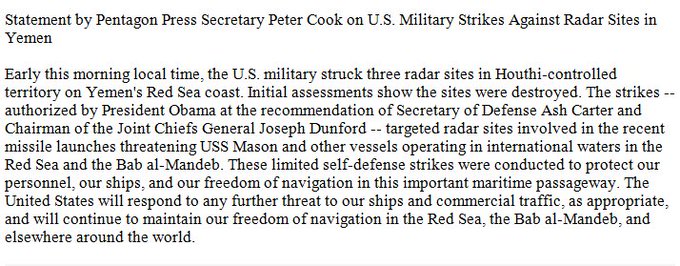
Last night the U.S. launched cruise missiles against three radar stations along the western Yemeni coast. The area is formally under control of the Sanaa government, an alliance of Houthi tribal groups from north Yemen and parts of the Yemeni army under control of the former president Saleh. But their real control is patchy and especially around Taiz and further south al-Qaeda and local south Yemeni independence fighters are predominant.
The attack comes after U.S. ships were allegedly attacked by missiles fired from the coast. All those missiles “fell into the sea short of the destroyer, which was in international waters in the Red Sea.” (Were these just short range RPG-36 al-Qaeda had received?) The Houthi as well as the Yemeni army (twice) have officially denied that they fired missiles and to have attacked any U.S. asset. Former president Saleh accused the Saudis and their al-Qaeda proxies and asked for an investigation. No one in Yemen had heard rumors of preparations orexecution of such attacks. There is no public evidence that any such attack ever happened. All such claims are solely based on the word of the U.S. military. The Houthi/Saleh government in Sanaa demands an official UN investigation into the issue.
Two weeks ago the Houthis had fired on and destroyed a United Arab Emirates fast supply ship. The missile used was decent medium range anti-ship missile of probably Chinese origin. The ship was transporting weapons and anti-Houthi troops between Assab in Eritrea and Aden in south Yemen. They had proudly admitted the attack andpublished video of it. Earlier smaller Saudi ships which blockaded the coast were attacked by local fishermen and sunk. The UAE has occupied parts of south Yemen (Dubai Port International would like to control the Aden harbor) and the UAE troops and proxy forces are immediate enemy of the Yemeni forces. But it was clear that any attack on a U.S. ship would only increase trouble for the Houthi forces. They had and have no sane reason to commit such an attack.
A recap how we got here. After some tribal upheaval in 2011-12 the President Saleh was pressed to move aside and his vice president Hadi was installed as president with a two year mandate. The installation of a new national government failed when Hadi and his sponsors denied any seat at the table for the large northern Houthi tribes (some 45% of the total population). Those tribes revolted and occupied the capital Sanaa. Hadi, then in the third year of his two year mandate, resigned, retracted and later verbally resigned again. The UN tried to negotiate a settlement but the UN envoywas ousted on behalf of Saudis and the agreed upon unity cabinet was not installed:
Yemen’s warring political factions were on the verge of a power-sharing deal when Saudi-led airstrikes began a month ago, derailing the negotiations, the United Nations envoy who mediated the talks said.
The Saudis, who had fought earlier wars against the Houthis, do not want them to have a role in any power structure. They claim that Houthi are Iranian proxies. There is no evidence for that at all and the claim is simply false. During some 18 month of war no sign of Iranian help, weapons or personal, has been seen. Even the NYT notestoday:
American intelligence officials believe that the Houthis receive significantly less support from Iran than the Saudis and other Persian Gulf nations have charged.
The Sauds want their trusted puppet Hadi back in the presidential role with unlimited powers. He can be endlessly manipulated by them. But while the Sauds are much richer their people is not significantly bigger than Yemen. Yemen has some 26 million inhabitants while Saudi Arabia has some 29 million. Every Saudi attack against Yemenis creates new recruits who will attack Saudi Arabia.
The U.S. supports the attacks by the Saudis and the UAE. It delivers planes and ammunition, its aerial tankers refill the Saudi jets taking part – in total over 5,500 times since the bombing began. U.S. intelligence is used by the Saudis to plan their attacks. U.S. officers consult the Saudi planning cells and U.S. special forces are on the ground. It ships help to blockade the Yemeni coast. Despite such massive support the U.S. officially did not consider itself part of the conflict and even tried to negotiated some powersharing agreement as if it were a “neutral” force. That did not deceive anyone in Yemen but the U.S. public was gullible as ever about this.
That ended as more and more atrocities by Saudi attacks on hospitals, schools, markets and important infrastructure became public. After the recent Saudi attack (vid)on a funeral hall filled with people offering condolences the U.S. ran out of stupid excuses. The bombs used were U.S. manufactured. The attack killed over 200 and seriously wounded many more. The local hospitals are overwhelmed and the Saudis block any evacuation. Many of casualties are tribal elites and generals.
Cholera broke out in Yemen and people are dying of hunger. The U.S. has come under pressure over this and the Saudi attacks. The State Department spokesman washopelessly trying to explain why the funeral attack was in “defense of Saudi Arabia” and different from less severe attacks in Syria which the U.S. condemns. A significant number of senators are pressing for an end to the support of the Saudi campaign. Moveon has started a petitions against the U.S. support and the Obama administration itself feared legal consequences.
An “attack” on U.S. assets that puts the U.S. into a justified “self defense” position against the Houthis makes all such concerns irrelevant.
Over the last weeks the Saudis have transported sponsored fighters aligned with al-Qaeda in Yemen from south Yemen to Saudi Arabia. These have now started to attack the Houthi areas in the north from the Saudi side of the border. All earlier such attempts miserably failed.
There are rumors that the U.S. attack on the radar stations is in preparation of a massive troop landing by UAE and Saudi mercenary forces currently assembling in the UAE rented and controlled port Assab in Eritrea. That is, in my view, quite possible.
River to Sea Uprooted Palestinian   
The views expressed in this article are the sole responsibility of the author and do not necessarily reflect those of the Blog!

Saudi dictatorship is USA’s foreign policy military wing in Syria, Yemen, Iraq

A still image from video released October 13, 2016 shows U.S. military launching cruise missile strikes from U.S. Navy destroyer USS Nitze to knock out three coastal radar sites in areas of Yemen controlled by Houthi forces. ©
A still image from video released October 13, 2016 shows U.S. military launching cruise missile strikes from U.S. Navy destroyer USS Nitze to knock out three coastal radar sites in areas of Yemen controlled by Houthi forces. © / Reuters
US airstrikes on radar sites in Yemen show support for the Saudi-led bombing campaign, says international affairs expert Dr. Sreeram Chaulia. Saudi Arabia is an integral part of US policy in the Mideast, adds Pan-African News Wire editor Abayomi Azikiwe.
The US has carried out its first direct attack against Houthi rebels, hitting three radar stations in rebel-controlled territory with Tomahawk cruise missiles. The strikes were retaliation against failed missile attacks on a US navy destroyer in the Red Sea; the latest was carried out on Wednesday. The Houthis denied their involvement in the attempts to hit the vessel.
Previously, Washington has only provided weapons and intelligence to Riyadh, which supports the internationally recognized Yemeni government. Last year, the US approved a number of weapons sales to the Saudis worth more than $20 billion. They included tanks, hand grenades and air-to-ground missiles. Fragments said to be from a US-made missile were found during the recent bombing of a funeral in the rebel-held capital Sana’a. It was blamed on the Saudi-led coalition, which promised to investigate the strike.
According to Dr. Sreeram Chaulia of the Jindal School of International Affairs, we are witnessing “a very unfortunate escalation” of the conflict. The Americans pretended to be “somewhat neutral” in this conflict, but “are now showing their true color,” which is the support the Saudi Arabia’s “barbaric bombing campaign in Yemen,” he told RT.
“Unfortunately for the Americans the evidence shows the Saudi bombing has been devastating for civilians, but then the Americans are unable to disentangle themselves from the Saudi embrace and to take a more critical position on Saudi Arabia,” he said.
“This US-Saudi Arabia alliance is at the root of this current action, which is to say that even though the Obama administration tried to reach out to Iran, at the end of the day they are with Saudi Arabia – that is what they’re showing. They are on the wrong side of history, because the people on the ground – not just the Houthis – ordinary Yemenis are all united in a form of a national resistance against the Saudi intervention. So Saudi Arabia has dragged in the Americans, and the Americans have gone along with it. It is one more fateful decision by the Obama administration. If Libya was a mistake – Yemen is proven to be as big a mistake for the US government,” Dr. Chaulia said.
It is unlikely the Obama administration will launch a full-fledged military campaign in the region, but the US seeks to maintain its “hegemonic position” in the Red Sea, he said.
“They fear that if Iran …tries to challenge their position in the Red Sea, then they have to respond and to reestablish their hegemony. So unfortunately the great power games are going on,” the analyst added.
After the deadly air strike on the funeral in the Yemeni capital last weekend, the US said it would review its support for the Saudi-led coalition.
However, nothing has happened so far, Dr. Chaulia said.
“More than 10,000 people have been killed – there is carnage going on – mostly civilians. But the Americans are continuing to back the Saudis against the Houthis. I think they are still looking at it as a great power logic of containing Iran. Unfortunately it’s been proven to be bloody and terrible for the civilians of Yemen,” he added.

Abysmal failure

The US condemnation of the strike on Sana’a that killed at least 82 mourners was just a diplomatic response, Abayomi Azikiwe, editor of Pan-African News Wire told RT.
“They said they were reviewing their military assistance to Saudi Arabia. But this is something that was said diplomatically; they have not withdrawn their assistance,” he said.
Посмотреть изображение в Твиттере
“Saudi Arabia and the Gulf Cooperation Council [GCC] are an integral part of US foreign policy in the Middle East. They transport weapons to them on a regular basis. They just approved a few weeks ago a massive arms sale and transfer to Riyadh. This is not going to stop. They utilize Saudi Arabia in regard to their attack on Syria, as well, as Iraq and Yemen. So Saudi Arabia is functioning as a foreign policy military wing of the US: Pentagon and White House, as well as the State Department,” Azikiwe said.
In March 2015 the US withdrew its diplomatic personnel and Special Forces from Yemen. That, according to Azikiwe, indicated the collapse of Washington’s foreign policy in the country.“Immediately they authorized the beginning of a massive bombing campaign by Saudi Arabia and the GCC. They have brought other governments into this war policy against Yemen, and it has been an abysmal failure,” he said.
Related Videos
River to Sea Uprooted Palestinian   
The views expressed in this article are the sole responsibility of the author and do not necessarily reflect those of the Blog!

Hollande and Johnson …. Is the response to Moscow…by demonstrations?


Written by Nasser Kandil,
If the Russian President Vladimir Putin said or did in confronting the war which was directed by Washington and its allies in Syria what the French President Hollande and the British Foreign Minister Boris Johnson said and do in confronting the Russian role of the same war, then the President Putin would become a source of ridicule and laughter, because the French President decided to anticipate the confirmed visit of the President Putin to Paris by coddling, thinking about the feasibility of his receiving, he prepared demonstrations that accompany his visit to Paris. The British Foreign Minister announced in front of the British parliament the importance of thinking of making demonstrations in front of the Russian embassy, in response to the parliamentary demands of an active behavior  as long as the way of diplomacy is impasse.
The matter is not a belittlement of the importance of the role of the public opinion in politics at all, but through discussing and evaluating the equation of proportionality between the act and the actor on one hand, and the act and the opposite act on the other hand. As the groups of Syrian opposition make a comparison by evaluating the reaction of a surgeon to a bleeding wound by a recipe that can be offered by a housewife instead of surgery and stitching the wound, or by ordaining sedative pills by a cardiologist to treat an incurable disease, as the comparison is made by evaluating the treatment of who claims the youth but carrying a pistol, with a burly young man who can catch him with a slap but he advices him to be prudent and invites him for a cup of coffee or by threatening him by calling his family. If the President Putin called for demonstrations against the wars on Syria and wondered about the feasibility of his meeting with the US President Barack Obama, then it would be said regarding the same speech on the two banks but with the exchange of roles in the comments of the allies on their allies and opponents.
Certainly neither Hollande nor Johnson do what they always do, neither say what they always say; a political wisdom and an appreciation of the popular action as well as a belief in the effectiveness of what they say and do. Usually the countries which have colonial history always threaten through deterrent decisions, the least of them is to end the diplomatic relations and to consider Russia in a state of war because it affects the deep interests of the west countries by turning the Mediterranean Sea into Russian lake, because no one believes the words of Francois Hollande and Boris Johnson  about the humanitarian aspect in Syria, where each one of  France and Britain has a history full of crimes against civilians, and it is enough to see what has happened in the Yemeni tragedy by the Saudi crimes and most recently the crime of killing hundreds in a cold blood by air raids on the condolence hall where no official at the level of ambassador in the governments of Britain and France dare to say any word of admonition.
It seemed that the governments of Britain and France were devoid of every strength, from the courage of bravery, and have moved to make policies by the force of  ignoring, releasing of deed, the recognition of the inability, and searching for something that fills the spare time of the public opinion by beholding it the responsibility to respond to Moscow instead of bearing it themselves, as well as they present their bills to Saudi Arabia which holds the responsibility of repaying the maturities of the participants in the war, just in order to say that they did not keep silent toward  Russia and they can do the possible, as they receive the cost of their shameful positions by keeping silent toward the Saudi crimes in Yemen.
When the colonial empires become old, they remember the peaceful expressions, as what happens usually with the major parties which get out of rule and decline, so they remember their ancient history by the movements of demands after they had responded to the demands of their groups by a decision from the government or by an order from an administration. Boris Johnson responded to one of the deputies of the British Parliament who asked him; will the government offer qualitative weapons to the armed groups in the eastern of Aleppo, in a way that they can withstand against the attack waged by the Syrian army which is accompanied by the Russian fiery support, by saying that his government does not think of that, because it behaves according to the NATO assembled, it does not monopolize decisions that are not shared with the allies, while it can organize demonstrations without returning to the allies!
Translated by Lina Shehadeh,

» هولاند وجونسون… الردّ على موسكو… بالمظاهرات؟

ناصر قنديل

– لو قال الرئيس الروسي فلاديمير بوتين في مواجهة الحرب التي أدارتها واشنطن وحلفاؤها في سورية أو فعل، ما قاله ويفعله الرئيس الفرنسي فرنسوا هولاند ووزير الخارجية البريطاني بوريس جونسون في مواجهة الدور الروسي في الحرب نفسها، لصار الرئيس بوتين مصدراً للسخرية والضحك. فقد قرّر الرئيس الفرنسي استباق زيارة مقرّرة للرئيس بوتين إلى باريس بالدلع ومتسائلاً عن التفكير بجدوى استقباله، وأعدّ لتظاهرات ترافق زيارته لباريس، وأعلن وزير الخارجية البريطاني أمام البرلمان البريطاني أهمية التفكير بخروج تظاهرات أمام السفارة الروسية، رداً على مطالبات نيابية بتصرّف فاعل طالما أنّ طريق الدبلوماسية مسدود.

– ليس الأمر استخفافاً بأهمية دور قوى الرأي العام في السياسة على الإطلاق، بل بمناقشة وتقييم معادلة التناسب بين الفعل والفاعل من جهة، وبين الفعل والفعل المقابل من جهة أخرى، كما تجري المقارنة من جماعات المعارضة السورية بتقييم تصرف طبيب جراح مع جرح نازف بوصفة يمكن أن تقدّمها سيدة المنزل، بدلاً من الجراحة وتخييط الجرح، أو بوصف طبيب قلب حبوب مهدئة لمعالجة مرض عضال، وكما تجري المقارنة على الضفة المقابلة بتقييم تعامل من يدّعي أنه فتوة الحي الذي يحمل مسدساً مع شاب قوي البنية يطاله بصفعة فينصحه بالتروي ويدعوه لشرب فنجان قهوة معاً، أو بتهديده بالشكوى لأهله. فلو دعا الرئيس بوتين لتظاهرات ضدّ الحرب على سورية أو تساءل عن جدوى لقائه بالرئيس الأميركي باراك اوباما لقيل في تصرفه الكلام نفسه على الضفتين، مع تبادل الأدوار في تعليقات الحلفاء على حلفائهم وخصومهم.

– بالتأكيد لا يفعل هولاند وجونسون ما يفعلان، ولا يقولان ما يقولانه، حكمة سياسية وتقديراً للعمل الشعبي وإيماناً بفاعلية ما يقولان ويفعلان، وعادة الدول ذات التاريخ الاستعماري دائماً كانت حتى أمس قريب، التلويح بقرارات رادعة أقلها قطع العلاقات الدبلوماسية، واعتبار روسيا في حالة حرب، لأنها تمسّ بالمصالح العميقة لدول الغرب، بتحويل البحر الأبيض المتوسط إلى بحيرة روسية، لأنّ أحداً لا يصدّق كلام فرنسوا هولاند وبوريس جونسون عن البعد الإنساني في سورية، ولكلّ من الدولتين الفرنسية والبريطانية سجل مليء بالجرائم بحق المدنيين، وتكفي رؤية ما يجري في الفاجعة اليمنية مع الجرائم السعودية وآخرها جريمة قتل المئات بدم بارد بغارات جوية على قاعة عزاء، لم يجرؤ موظف على مستوى سفير في حكومتي بريطانيا وفرنسا أن يقول فيها كلمة عتب.
– تبدو حكومتا بريطانيا وفرنسا وقد تجرّدتا من كلّ حول وقوة، ومن شجاعة الإقدام، وانتقلتا إلى رسم السياسات بقوة رفع العتب وإبراء الذمة والتسليم بالعجز، والبحث عن ملهاة تعبّئ فراغ الرأي العام وتحمّله مسؤولية الردّ على موسكو، بدلاً من أن يحمّلها هو هذه المسؤولية، ومن جهة مقابلة تقدم فواتيرها للسعودية التي تتولّى سداد استحقاقات المشاركين في الحرب، لتقول إنها لم تصمت لروسيا وتفعل الممكن، بمثل ما تقبض ثمن مواقفها المخزية بالصمت على الجرائم السعودية في اليمن.
– عندما تشيخ الإمبراطوريات الاستعمارية تتذكّر التعبيرات السلمية، كما يحدث مع الأحزاب الكبرى التي تخرج من الحكم وتضمُر فتتذكر تاريخها القديم بالتحركات المطلبية، بعدما كان ترد على مطالب جماعاتها بقرار حكومة وأمر إدارة. وها هو بوريس جونسون يردّ على أحد نواب البرلمان البريطاني الذي يسأله هل ستقوم الحكومة بتقديم سلاح نوعي للجماعات المسلحة في شرق حلب، يمكّنها من الصمود بوجه الهجوم الذي يشنّه الجيش السوري بدعم روسي ناري، بالقول إنّ حكومته لا تفكر بذلك لأنها تتصرف من ضمن حلف الأطلسي مجتمعاً، ولا تتفرّد بقرارات لا يشاركها فيها الحلفاء، بينما تستطيع تنظيم تظاهرات دون العودة للحلفاء!

River to Sea Uprooted Palestinian   
The views expressed in this article are the sole responsibility of the author and do not necessarily reflect those of the Blog!

Friday, 14 October 2016

Jewish ties to Al-Aqsa Mosque turns out to be just another myth

Israeli archaeologist denies Jewish ties to Al-Aqsa Mosque

MEMO | October 13, 2016
15hillary184An Israeli archaeological expert has asserted that there is no relation between the Western Wall of the Al-Aqsa Mosque compound and an ancient Jewish temple, Al Jazeera reported today. This will likely serve to undermine Israeli excavations of the site.
Meir Ben-Dov, an Israeli archaeological expert who is author of many books about Jerusalem and the Temple Mount, further asserted that the Wailing Wall, the Jewish name for the Western Wall, has no sacred significance in the Jewish faith.
In related news, UNESCO members are expected to vote on a resolution that denies Jewish links to the Al-Aqsa Mosque and the Western Wall, known as the Buraq Wall to Muslims, agencies reported on Thursday.
Israeli newspaper Haaretz said that the resolution is expected to pass by a large majority, referring this to the inability of Israeli lobbying to persuade UNESCO members not to support the resolution.
“Israel has made efforts to block the resolution or at least soften it, but succeeded only in swaying the positions of a few member states,” Haaretzstated.
The Palestinian Authority, Egypt, Algeria, Morocco, Lebanon, Oman, Qatar and Sudan pushed the draft resolution forward that declares that Jerusalem is holy for all the three Abrahamic religions of Islam, Christianity and Judaism.
The draft also includes a section that stresses that the Al-Aqsa Mosque is sacred only for the Muslims, referring to it as Al-Haram Al-Sharif, or the Sacred Sanctuary.
In April, UNESCO’s executive board ratified a similar resolution, which was supported by a number of European countries, including France.
However, after a “harsh” telephone call between Israeli Prime Minister Benjamin Netanyahu and French President Francois Hollande, France promised not to support any such resolution in the future.
 Related 
River to Sea Uprooted Palestinian   
The views expressed in this article are the sole responsibility of the author and do not necessarily reflect those of the Blog!
Vladimir Putin’s interview with the French TV channel TF1 (transcript)

October 13, 2016
Vladimir Putin’s interview with the French TV channel TF1 (transcript)President of Russia Vladimir Putin: How did you end up here? This is a just a small provincial town. These days, you find French people wherever you go in Russia, in every village. This is very good and we are pleased to see it.
Question (retranslated): Mr President, could you explain why you are not going to Paris?
Vladimir Putin: It’s very simple. We had planned to hold an official opening ceremony for the newly built Russian religious and cultural centre in Paris. From the looks of things though, this is not the best moment for official meetings, given the lack of mutual understanding, to put it mildly, that we have over events in Syria, particularly the situation in Aleppo. But we are always open, of course, to any consultations and dialogue on this matter.
Question: This is exactly what the French hoped for – to use this opportunity to discuss the situation in Syria, but it is for this reason that you are renouncing this visit.
Vladimir Putin: You know, it is not that we are renouncing the visit, but simply that we were told that the main reason for this visit, namely, opening the religious and cultural centre, is not appropriate at this moment. But if the main reason for my visit to Paris is not appropriate, we will probably find another opportunity to meet and discuss Syria. We set no limitations concerning this matter and we are open for dialogue.
It’s simply that it was made known to us that now is not the most convenient time for the events that were planned, that’s all. We are not renouncing the visit.
Question: Many Western representatives, including [US Secretary of State John] Kerry, [French Foreign Minister Jean-Marc] Ayrault and even [French President] Francois Hollande have used tough rhetoric against Russia over the airstrikes against Aleppo, which have hit civilian targets and even hospitals. Some have even used expressions such as “war crimes.” What is your response to this?
Vladimir Putin: I would say this is political rhetoric that does not have great significance and does not take into account the real situation in Syria. Let me explain what I mean. I believe deeply that some of the responsibility for what is happening in the region in general and in Syria in particular lies especially with our Western partners, above all the USA and its allies, including the main European countries.
Remember how everyone rushed to support the Arab Spring? Where is that optimism now? How did it all end? Remember what Libya or Iraq looked like before these countries and their organisations were destroyed as states by our Western partners’ forces?
Certainly, these were not examples of democracies as we understand the word today, and there probably was a need and possibility to influence these societies’ organisation, the state organisation, and the nature of these regimes. But whatever the case, these states showed no signs of terrorism. They were not a threat for Paris, for the Cote d’Azur, for Belgium, for Russia, or for the United States.
Now, they are the source of terrorist threats. Our goal is to prevent the same from happening in Syria.
I know your question about refugees. This is what you wanted to ask, it seems? If not, let me address this question all the same. Let’s recall that the refugee problem began long before Russia started making efforts to normalise and stabilise the situation in Syria. The mass departure of people from huge swathes of the Middle East and from Africa and Afghanistan too began long before we started active operations in Syria.
There is no justification for accusing Russia of being responsible for the refugee problem. Our aim is, on the contrary, to create conditions for people to be able to return to their homes.
Regarding the humanitarian situation in Aleppo, have we all forgotten how American forces launched an airstrike in Afghanistan that hit a hospital and killed people from Doctors without Borders among others? Entire wedding parties of up to 100 people were killed in Afghanistan. Look at what has just happened in Yemen, where a single strike killed 170 people and injured 500 at a funeral ceremony.
The sad reality is that wherever military operations take place, innocent people suffer and die. But we cannot allow terrorists to hide between civilians used as a human shield. We cannot allow them to blackmail the entire world when they take hostages, kill, or behead people.
If we want to win the fight against terrorism, we must fight the terrorists and not let them take the lead, not waver and retreat.
Question: Mr President, the thing is that the French do not understand why you are bombing these people you call terrorists. After all, it was ISIS who attacked us, but there are no ISIS forces in Aleppo. This is what the French do not understand.
Vladimir Putin: Let me explain. It is another terrorist group, Jabhat al-Nusra, that controls the situation in Aleppo. This group was always considered a wing of Al Qaeda and is included in the UN’s list of terrorist organisations.
What we find particularly depressing and hard to understand is that our partners, especially the Americans, are always finding a way to try to exclude this group from the list of terrorist organisations. Let me tell you why. It seems to us as though our partners are always repeating the same mistake. They want to use these terrorist organisations’ and radicals’ combat potential to pursue their own political aims, in this case, to combat President Assad and his government, and do not understand that they cannot simply stall them [the rebels] and get them to live by civilised rules after they have tasted victory over someone.
We have reached repeated agreements with the Americans that they will differentiate between Jabhat al-Nusra and its like and the so-called healthy opposition forces, including in Aleppo. They have agreed that this is necessary. What’s more, we have even agreed on concrete deadlines, but nothing is done from one month to the next.
We recently reached a ceasefire agreement, a D-day agreement, as our American friends said. I insisted that they first of all resolve the matter of separating Jabhat al-Nusra and other terrorists from the healthy opposition forces and only then declare the ceasefire.
But the Americans insisted that we first need to declare a ceasefire and then they will take care of separating the terrorists from the non-terrorists. Finally, we agreed to make concessions, agreed to their terms, and on September 12 declared a day of silence and cessation of hostilities. On September 16, American aircraft launched a strike against Syrian army forces that killed 80 people.
At this same moment, immediately after the airstrike, ISIS launched an offensive in this very same place. Our American colleagues told us that this airstrike was made by error. This error cost the lives of 80 people and, also just coincidence, perhaps, ISIS took the offensive immediately afterwards.
At the same time, lower down the ranks, at the operations level, one of the American military service personnel said quite frankly that they spent several days preparing this strike. How could they make an error if they were several days in preparation?
This is how our ceasefire agreement ended up broken. Who broke the agreement? Was it us? No.
Question: The possibility of a new cold war is being discussed, but there is at least one American who likes you – Donald Trump. What do you think about him? Do you like him?
Vladimir Putin: We like everyone. America is a great country, and Americans are interesting, amiable and talented people. They are a great people and nation.
We will work with whomever the Americans elect. Of course, it is easier to work with those who are willing to work with you. If Trump says he wants to work with Russia, we appreciate this. But it must be mutually honest.
Look, everyone is talking about humanitarian access in Aleppo. Everyone is trying to convince us that we should do this. But they do not need to convince us, because we believe it too, we believe that a humanitarian convoy should be sent there. But how can this be accomplished? There is only one road the convoys can take, with militants on one side of the road and the Syrian army on the other side. We know about the provocation, the attack on one of the convoys, and we know for certain that the attack was delivered by a terrorist group.
We have suggested that the militants and the Syrian army both pull away from the road, providing safe transit for the humanitarian convoys.
Everyone agrees, and the idea has even been put on paper, and then nothing happens; none of our partners are doing anything. They either do not want to or cannot pull the militants back, I do not know which.
An exotic proposal has been made – I am going to surprise you and your audience. It has been proposed that our armed units, Russian military personnel, be deployed on the road to ensure transit safety. The Russian military, who are courageous and decisive people, have said they would do it.
But I told them that this could only be done jointly with the US, and ordered them to make the proposal. We have proposed this, and they [the Americans] promptly refused. They do not want to deploy their troops there, but they also do not want to pull these opposition groups back, who are really terrorists. What can we do in this situation?
We must increase mutual trust and admit that these are common threats, and it is only together that we can curtail and eradicate them.
We have very good ties with the French intelligence services. They really do work on the same wave. This is true of our counterterrorism experts and their counterparts in France and several other European countries. But this is not always the case.
For example, we send our American partners information and often get no response at all. Some time ago, we sent information on the Tsarnaev brothers. We sent the first document, got no response, sent a second document, and got the response that this is not your business, they are US citizens now and we will take care of things ourselves.
The result was a terrorist attack in the USA. Is this not an example of how we end up with losses if we neglect cooperation in this very sensitive area?
We should be busy not with political rhetoric, but with looking for solutions to the situation, including in Syria. What solutions are there? There is only one solution – to convince all parties to the conflict to take the road of political settlement.
I reached an agreement with President Assad and he has accepted to take the road of adopting a new constitution and holding elections on the basis of this constitution. But we have not succeeded in convincing anyone else to take this road.
If the people do not vote for President Assad, there will be a democratic change of power, but without the help of armed intervention from outside and under strict international control, under UN supervision. I do not understand who could find this proposal unacceptable.
It is a democratic solution to the question of power in the country. We remain optimistic though and hope that we will finish by persuading our colleagues and partners that this is the only possible solution to the problem.

River to Sea Uprooted Palestinian   
The views expressed in this article are the sole responsibility of the author and do not necessarily reflect those of the Blog!

Sayyed Houthi: US Is Setting Stage for Anti-Hodeidah Offense


Sayyed Houthi
October 14, 2016
Yemen’s Ansarullah leader Sayyed Abdul Malik Al Houthi stressed on Thursday that bombing the Yemeni Navy vessels in a US crime that sets the stage for another offensive attack targeting al Hodeidah directorate.
In a statement marking the anniversary of the 14th of October Revolution, Sayyed Houthi said “The US is paving the way to an aggressive operation targeting Hodeidah, in order to inflict further harm and suffering of the Yemeni people.”
Ansarullah leader called on the Yemeni valiant army, courageous Popular Committees and the liberal heroes of the people to be highly vigilat and ready to defeat the invading aggressors and criminals, stressing the importance of building up all fighting fronts to force the aggressors to stop their aggression as a religious, national and humanitarian responsibility.
The Yemeni leader stressed that the people of Yemen must be dependent on God and shoulder the responsibility to defend themselves and their land, honor, freedom and independence.
“The people has the right to use all legitimate means in response to this brutal ans blatant aggression,” Sayyed Houthi said.
Marking the anniversary of the glorious revolution of the fourteenth of October against the British occupiers, Ansarullah chief pointed out that the anniversary comes while the people of Yemen is engaged in another historical epic in the face of the Saudi-US aggression that seeks to destroy and occupy the country and to enslave the people.

Related Videos
Related articles
River to Sea Uprooted Palestinian   
The views expressed in this article are the sole responsibility of the author and do not necessarily reflect those of the Blog!

The Spiegel interviews Sergey Karaganov, Putin’s foreign policy advisor

Via The Saker
October 13, 2016
The Spiegel interviews Sergey Karaganov, Putin’s foreign policy advisorSPIEGEL: Sergey Alexandrovich, NATO isboosting its presence in Eastern Europe in reaction to recent Russian advances. Western politicians have warned that the two sides could stumble into a situation that might result in war. Are such warnings excessive?
Karaganov: I was already speaking of a prewar situation eight years ago.
SPIEGEL: When the war in Georgia broke out.
Karaganov: Even then, trust between the great powers was trending toward zero. Russia began rearming its army and, since then, the situation has worsened considerably. We warned NATO against approaching the borders of Ukraine because that would create a situation that we cannot accept. Russia has stopped the Western advance in this direction and hopefully that means that the danger of a large war in Europe has been eliminated in the medium term. But the propaganda that is now circulating is reminiscent of the period preceding a new war.
SPIEGEL: You are hopefully referring to Russia.
Karaganov: The Russian media is more reserved than Western media. Though you have to understand that Russia is very sensitive about defense. We have to be prepared for everything. That is the source of this occasionally massive amount of propaganda. But what is the West doing? It is doing nothing but vilifying Russia; it believes that we are threatening to attack. The situation is comparable to the crisis at the end of the 1970s and beginning of the 1980s.
SPIEGEL: You are referring to the stationing of Soviet intermediate-range ballistic missiles and the American reaction?
Karaganov: Europe felt weak at the time and was afraid that the Americans might leave the continent. But the Soviet Union, though it had already become rotten internally, felt militarily strong and undertook the foolishness of deploying the SS-20 missiles. The result was a completely pointless crisis. Today, it is the other way around. Now, fears in countries like Poland, Lithuania and Latvia are to be allayed by NATO stationing weapons there. But that doesn’t help them; we interpret that as a provocation. In a crisis, we will destroy exactly these weapons. Russia will never again fight on its own territory …
SPIEGEL: …Rather, if I understand you correctly, you will pursue the strategy of forward defense.
Karaganov: NATO is now 800 kilometers (497 miles) closer to the Russian border, weapons are completely different, strategic stability in Europe is shifting. Everything is much worse than it was 30 or 40 years ago.
SPIEGEL: Russian politicians, including President Vladimir Putin, are trying to convince their population that the West wants war in order to fragment Russia. But that’s absurd.
Karaganov: Certainly there has been some exaggeration. But American politicians have openly said that the sanctions are aimed at bringing about regime change in Russia. That’s aggressive enough.
SPIEGEL: The evening news on Russian television seems to be even further removed from reality. Even a Moscow-based newspaper recently wrote of the “illusion of an external threat.”
Karaganov: The political elite in Russia don’t want domestic reform, they aren’t ready for it. As such, they welcome an external threat. You have to remember that Russia rests on two national concepts: defense and sovereignty. We approach the question of security much more reverentially than other countries do.
SPIEGEL: Your council has presented foreign and defense policy premises that speak of reclaiming a position of leadership in the world. Russia, the message is clear, does not want to see its power eroded. But what proposals have you put forth?
Karaganov: We want to prevent further destabilization in the world. And we want the status of being a great power: We unfortunately cannot relinquish that. In the last 300 years, this status has become a part of our genetic makeup. We want to be the heart of greater Eurasia, a region of peace and cooperation. The subcontinent of Europe will also belong to this Eurasia.
SPIEGEL: Europeans see current Russian policy as being rather enigmatic. The intentions of the leadership in Moscow are unclear.
Karaganov: We currently find ourselves in a situation where we don’t trust you in the least, after all of the disappointments of recent years. And we are reacting accordingly. There is such a thing as tactical surprise. You should know that we are smarter,stronger and more determined.
SPIEGEL: The partial Russian withdrawal from Syria was a surprise, for example. You intentionally left the West guessing how many troops you were withdrawing and whether you would secretly redeploy some of them. Such tactics don’t exactly create trust.
Karaganov: That was masterful, that was fantastic. We take advantage of our preeminence in this area. Russians aren’t good at haggling, they aren’t passionate about business. But they are outstanding fighters. In Europe, you have a different political system, one that is unable to adapt to the challenges of the new world. The German chancellor said that our president lives in a different world. I believe he lives in a very real world.
SPIEGEL: It has been difficult to ignore the Russian pleasure at the problems Europe is currently facing. Why is that?
Karaganov: Many of my colleagues view our European partners with derision and I always warn them not to be cocky and arrogant. Some among the European elite have sought out confrontation with us. As a consequence, we won’t help Europe, although we could do so when it comes to the refugee question. A joint closure of borders would be essential. In this regard, the Russians would be 10 times more effective than the Europeans. Instead, you have tried to make a deal with Turkey. That is a disgrace. In the face of our problems with Turkey, we have pursued a clear, hard political line — with success.
SPIEGEL: You have said that you are disappointed with Europe because it has betrayed its Christian ideals. In the 1990s, Russia wanted to be part of Europe — but the Europe of Konrad Adenauer and Charles de Gaulle.
Karaganov: The majority of Europeans want that Europe too. For the next decades, Europe will not be a model that is attractive to Russia.
SPIEGEL: In its premises, your council demanded the use of military power when “important interests of the country are clearly” threatened. Ukraine was such an instance?
Karaganov: Yes. Or a concentration of troops that we felt posed the risk of war.
SPIEGEL: The stationing of NATO units in the Baltics isn’t sufficient?
Karaganov: This chatter that we intend to attack the Baltics is idiotic. Why is NATO stationing weapons and equipment there? Imagine what would happen to them in the case of a crisis. The help offered by NATO is not symbolic help for the Baltic states. It is a provocation. If NATO initiates an encroachment — against a nuclear power like ourselves — it will be punished.
SPIEGEL: On Wednesday, the NATO-Russia Council is to meet for the second time since the Crimean crisis. You also don’t think that a resumption of this dialogue platform is worthwhile?
Karaganov: It is no longer a legitimate body. Plus, NATO has become a qualitatively different alliance. When we began the dialogue with NATO, it was a defensive alliance of democratic powers. But then, the NATO-Russia Council served as cover for and the legalization of NATO expansion. When we really needed it — in 2008 and 2014 — it wasn’t there.
SPIEGEL: You mean during the Georgian war and the Ukraine conflict. In papers issued by your council, terms like national dignity, courage and honor often appear. Are those political categories?
Karaganov: They are essential Russian values. In Putin’s world, and in mine, it is inconceivable that women be harassed and raped in public.
SPIEGEL: Are you referring to the sexual assaults that took place in Cologne on New Year’s Eve?
Karaganov: If men were to do something like that in Russia, they would be killed. The mistake is that Germans and Russians haven’t spoken seriously about their own values in the last 25 years — or they didn’t want to understand each other on the topic. During Soviet times, we too claimed there were only universal values, just as the West is doing now. It scares me when the Europeans demand more and more democracy. It sounds like times past, when people here demanded more and more socialism.
SPIEGEL: Where do you think Russian foreign policy has gone wrong?
Karaganov: In recent years, we didn’t have a political strategy for dealing with our immediate neighbors, the former Soviet republics. We didn’t understand what was really happening there. The only thing we did was subsidize these countries and buy their elite — with money that was then stolen, likely together. As a result, it wasn’t possible to prevent the Ukraine conflict. The second problem: Our politics was focused for too long on fixing past mistakes — fixing the mistakes made in the 1990s.
SPIEGEL: In the Russian press, there has been some conjecture that Russia will send out signals of rapprochement following parliamentary elections in September. Is such conjecture justified?
Karaganov: We believe that Russia is morally in the right. There won’t be any fundamental concessions coming from our side. Psychologically, Russia has now become a Eurasian power — I was one of the intellectual fathers of the eastward pivot. But now I am of the opinion that we shouldn’t turn away from Europe. We have to find ways to revitalize our relations.
Sergey Karaganov 63, is honorary head of the influential Council on Foreign and Defense Policy, which develops geopolitical strategy concepts for Russia. In May, the council issued new foreign policy premises. The council includes politicians, economists and former military and intelligence officers. Karaganov is an advisor to Vladimir Putin’s presidential administration and deacon of the elite Moscow college National Research University Higher School of Economics.
River to Sea Uprooted Palestinian   
The views expressed in this article are the sole responsibility of the author and do not necessarily reflect those of the Blog!