Saturday, 21 October 2017

israel Supplies Weapons to ISIS-Daesh

By SANA,
According to Syria’s official news agency, Syrian Forces Discover Dozens of Israeli-made Weapons and Equipment in ISIS Dens
Syrian Forces have discovered dozens of Israeli-made arms, ammunition and telecommunication devices, while searching through ISIS dens in the countrysides of Homs and Hama provinces.
Among discovered arms and equipment, there were some artillery pieces, around 800 mortar shells, a machine gun equipped with 10 thousand bullets, in addition to several rounds of bullets made for 17 mm, 14,5 mm and 30 mm machine guns, as well as an RPG, 3 RPG launchers and a whole bunch of telecommunication devices.
A great number of items discovered turned out to be of Israeli origin.
The discoveries were made while the Syrian Army was searching through and combing the areas that were recently liberated from ISIS terrorists, in particularly Jeb Al Jarrah, a village located north of Qaryatayn, and in the southern countryside of the town of Salamiyeh in Hama province.
Meanwhile, Syrian Army assumed control over strategic village of Al Husseiniyeh, located north of of Deir Ez Zour city.
This comes right after the Syrian Army liberated strategic villages of Buqrous Foukani, Buqrous Tahtani and Al Dhiyban earlier in the day.
Featured image is from Fort Russ News.

River to Sea Uprooted Palestinian   
The views expressed in this article are the sole responsibility of the author and do not necessarily reflect those of the Blog!

The Courage of the Syrian Arab Army and Allies (Russia, Iran & Hezbollah) against US Backed Terrorism

The Courage of the Syrian Arab Army and Allies against US Backed Terrorism
By Dr Bouthaina Shaaban
Dr Bouthaina Shaaban, Political and Media Advisor to Syrian President, Bashar Al Assad.
The announcement by the Russian Ministry of Defence that US support for terrorists is a major obstacle to the elimination of the terrorist organisation in Syria is not a simple or transitory declaration. It is an important and dangerous declaration that must be carefully looked at.
The successes of the Syrian army with the support of the Russian space air force in the rapid liberation of the Euphrates valley seem to contradict the plans of American colleagues,” Russian Defence Ministry spokesman Igor Konashinkov said, noting that US forces did not allow the Syrian army to pursue terrorists in the al-Tanf area.
It is understood, of course, that Russia does not want to initiate a conflict with the United States and to start a third world war, but such declarations and statements by the Russian Ministry of Defence, even if they are uttered in such de-escalatory terms such as “American colleagues,” represent a clear and explicit link between ISIS and US plans in both Syria and Iraq. This at the international level undermines the credibility of the United States, and undermines the impact of any American statements bragging about the fight against terrorism. Especially as Russian forces announced that the ISIS offensive relied on aerial reconnaissance that cannot be attained by the group unless provided by American reconnaissance planes.
We support the comprehensive approach to combating terrorism, preventing the spread of terrorist ideology and funding illegal armed groups, and we call for a political renunciation of double standards in addressing the most serious threats of our time,”said Russian President Vladimir Putin in a welcoming message to participants at the International Meeting of Heads of Security Services.
Double standards” have become synonymous with the United States, and the rise of Russia in the international system today is putting the final nail in the coffin of American unilateralism. This is what Russia’s policy depends on in its cumulative strategy, building on the shortcomings of the other, pointing to them and re-mentioning them whenever possible. While at the same time behaving differently from them, adhering to principles, values and norms in international relations.
But the biggest victim of the US sponsoring of ISIS in recent years is Syria, Iraq, and Yemen. Therefore, in addition to what the Russians are doing to draw the attention of the world to the sure link between ISIS and the United States, it is necessary to re-read all the unfolding events in Arab countries in the past seven years in light of these facts, which revealed certain close ties between ISIS, the United States, and the objectives that the Americans and Israelis hope to achieve in our countries.
When we were watching dozens of American four-wheel-drive vehicles pass from Iraq to north-east Syria, we were wondering where ISIS got all these US-made cars from, while our countries could not buy medications to save children’s lives because of sanctions and boycotts. When ISIS pays the salaries of thousands of terrorists, one wonders how could it move all of this liquidity in US dollars, while countries cannot pay for the spare parts of their civil aircraft.
The relationship between the Western and Zionist forces targeting of the Arab confrontation countries, and the Muslim Brotherhood gangs and their detachments from al-Nusra, ISIS, the Free Army, and others’ aggression on our countries is an old-new relationship, but for unknown reasons it remains in doubt despite the books written on this subject, by members of the same organisations such as Izzat al-Kharbawi.
The thorough research and investigation into this subject is an urgent need today not only to prove the creation of these movements by the West as instruments to implement its agendas which it failed to implement by other means in our region, but also to liberate the Islamic religion from all these suspicious movements and all manifestations of extremism, and the violence that has afflicted on them. The proximate end of the fighting with an ISIS on the battlefield in Iraq and Syria can be an incentive and an opportunity for political elites and Arab intellectuals to work quietly today, and hope to re-study this phenomenon, its formation, its entry into our territory, the methods it followed, the tactics that it resorted to, and the networks that provided them with support, in order to reach firm conclusions that we can provide future generations with a factual and correct account of our history that they must depend on in forming their national outlook in the future.
What we Arabs lack from our history is a study of the events we go through in a frank and in-depth manner, in order to draw lessons for the future in a timely manner; this is why we find ourselves experiencing the same turmoil more than once, and the tragedy is repeated throughout our lives in different manifestations without us learning one useful lesson that guides us in any similar experience we may encounter after a while.
Thousands of martyrs have sacrificed their lives to reach this honourable stage in this battle, and thousands have been wounded so that the will of the free peoples triumphs. Is this victory a mere news clip in the media, or should we actually make a plan in order for researchers to study all the dimensions of these events and arrive at solid scientific conclusions that we can provide not only for our peoples, but to the international family so that those who promulgate lies in order to destroy countries and peoples become more reluctant in doing so.
After these achievements in the field, we must spread research centres at the national level to honour all the sacrifices made and establish the foundations of a true and factual Arab history fit for the new world, which is rapidly taking shape, and guarantees us an honourable status at the regional and international levels.
Dr Bouthaina Shaaban, Political and Media Advisor to Syrian President, Bashar Al Assad.
This article was originally published by 21CentyryWire

River to Sea Uprooted Palestinian   
The views expressed in this article are the sole responsibility of the author and do not necessarily reflect those of the Blog!

Friday, 20 October 2017

Now the consequences of BREXIT are clearer we should be allowed a second referendum

Reverse Brexit with second referendum to save your economy OECD tells UK

‘The positive impact on growth would be significant,’ influential thinktank says of reversing Brexit – as it forecasts £40bn cost of ploughing on
Economic experts have made an explosive suggestion of a further referendum to reverse Brexit, to avoid the crippling of the British economy.
The influential Organisation for Economic Co-operation and Development (OECD) said the deadlock in the exit talks now threatened a “disorderly Brexit”, with severe consequences.
Its report controversially puts the case for a dramatic rethink on the agenda – suggesting halting EU withdrawal is a route to avoiding that fate

May must stand up to Johnson to unlock Brexit talks, says

“In case Brexit gets reversed by political decision (change of majority, new referendum, etc), the positive impact on growth would be significant,” the report said.

The suggestion is certain to infuriate Brexiteers, but will bolster campaigners calling for the British public to be given a second vote, when the “facts of Brexit” are known.
The report was immediately seized on by one pro-EU group as the “final nail in the coffin for the already long-buried notion that Brexit will benefit our economy”.
The OECD analysis suggests a “no-deal” Brexit would wipe up to a staggering £40bn off UK economic growth by 2019.
The UK economy will grow 1.5 per cent slower in 2019 if the country crashes out of the EU without a trade deal or a transition deal with the bloc in March 2019, it said.
Crucially, it makes the assumption that trade talks will break down – triggering a hard Brexit and slapping tariffs on imports and exports between the EU and UK.
Wes Streeting, a Labour MP and supporter of the Open Britain group, said: “Today’s OECD analysis should be the final nail in the coffin for the already long-buried notion that Brexit will benefit our economy.
“A hard Brexit or walking away without a deal would wreak even more punishment on the UK economy.
“The Government can avoid this if they drop their ideological and self-imposed red lines and start negotiating for continued membership of both the single market and the customs union.”
The OECD admitted that Brexit negotiations were difficult to forecast, and could “prove more favourable” than assumed in its report – boosting trade, investment and growth.
But it warned the very real threat of no deal would spark a sharp reaction by financial markets, sending the exchange rate to new lows and leading to a downgrade in the UK’s sovereign rating.
“Business investment would seize up, and heightened price pressures would choke off private consumption,” the report said.
“The current account deficit could be harder to finance, although its size would likely be reduced.

There are also risks that Scotland and Northern Ireland could vote to stay in the EU, in a second referendum, which would have a “major” impact on the national economy


River to Sea Uprooted Palestinian   
The views expressed in this article are the sole responsibility of the author and do not necessarily reflect those of the Blog!

Dealing with “The Lobby” British Style


An undercover reporter secretly records how the Israeli Embassy directs local groups
October 17, 2017

Masot

One month ago, I initiated here at Unz.com a discussion of the role of American Jews in the crafting of United States foreign policy. I observed that a politically powerful and well-funded cabal consisting of both Jewish individuals and organizations has been effective at engaging the U.S. in a series of wars in the Middle East and North Africa that benefit only Israel and are, in fact, damaging to actual American interests.
This misdirection of policy has not taken place because of some misguided belief that Israeli and U.S. national security interests are identical, which is a canard that is frequently floated in the mainstream media. It is instead a deliberate program that studiously misrepresents facts-on-the ground relating to Israel and its neighbors and creates casus belli involving the United States even when no threat to American vital interests exists. It punishes critics by damaging both their careers and reputations while its cynical manipulation of the media and gross corruption of the national political process has already produced the disastrous war against Iraq, the destruction of Libya and the ongoing chaos in Syria. It now threatens to initiate a catastrophic war with Iran.
To be sure, my observations are neither new nor unique. Former Congressmen Paul Findley indicted the careful crafting of a pro-Israel narrative by American Jews in his seminal book They Dare to Speak Out: People and Institutions Confront Israel’s Lobby, written in 1989. Professors John Mearsheimer and Stephen Walt’s groundbreaking book The Israel Lobby and U.S. Foreign Policy said much the same thing nine years ago and discussions of Jewish power do emerge occasionally, even in the mainstream media. In the Jewish media Jewish power is openly discussed and is generally applauded as a well-deserved reward bestowed both by God and by mankind due to the significant accomplishments attributed to Jews throughout history.
There is undeniably a complicated web of relationships and networks that define Israel’s friends. The expression “Israel Lobby” itself has considerable currency, so much so that the expression “The Lobby” is widely used and understood to represent the most powerful foreign policy advocacy group in Washington without needing to include the “Israel” part. That the monstrous Benjamin Netanyahu receives 26 standing ovations from Congress and a wealthy Israel has a guaranteed income from the U.S. Treasury derives directly from the power and money of an easily identifiable cluster of groups and oligarchs – Paul Singer, Sheldon Adelson, Bernard Marcus, Haim Saban – who in turn fund a plethora of foundations and institutes whose principal function is to keep the cash and political support flowing in Israel’s direction. No American national interest, apart from the completely phony contention that Israel is some kind of valuable ally, would justify the taxpayers’ largesse. In reality, Israel is a liability to the United States and always has been.
And I do understand at the same time that a clear majority of American Jews, leaning strongly towards the liberal side of the political spectrum, are supportive of the nuclear agreement with Iran and do not favor a new Middle Eastern war involving that country. I also believe that many American Jews are likely appalled by Israeli behavior, but, unfortunately, there is a tendency on their part to look the other way and neither protest such actions nor support groups like Jewish Voice for Peace that are themselves openly critical of Israel. This de facto gives Israel a free pass and validates its assertion that it represents all Jews since no one important in the diaspora community apart from minority groups which can safely be ignored is pushing back against that claim.
That many groups and well-positioned individuals work hand-in-hand with the Israeli government to advance Israeli interests should not be in dispute after all these years of watching it in action. Several high level Jewish officials, including Richard Perle, associated with the George W. Bush Pentagon, had questionable relationships with Israeli Embassy officials and were only able to receive security clearances after political pressure was applied to “godfather” approvals for them. Former Congressman Tom Lantos and Senator Frank Lautenberg were, respectively, referred to as Israel’s Congressman and Senator, while current Senate Minority Leader Chuck Schumer has described himself as Israel’s “shomer” or guardian in the U.S. Senate.
A recent regulatory decision from the United Kingdom relates to a bit of investigative journalism that sought to reveal precisely how the promotion of Israel by some local diaspora Jews operates, to include how critics are targeted and criticized as well as what is done to destroy their careers and reputations.
Last year, al-Jazeera Media Network used an undercover reporter to infiltrate some U.K. pro-Israel groups that were working closely with the Israeli Embassy to counter criticisms coming from British citizens regarding the treatment of the Palestinians. In particular, the Embassy and its friends were seeking to counter the growing Boycott, Divestment and Sanctions movement (BDS), which has become increasingly effective in Europe. The four-part documentary released late in 2016 that al-Jazeera produced is well worth watching as it consists mostly of secretly filmed meetings and discussions.
The documentary reveals that local Jewish groups, particularly at universities and within the political parties, do indeed work closely with the Israeli Embassy to promote policies supported by the government of Prime Minister Benjamin Netanyahu. It also confirms that tagging someone as an anti-Semite has become the principal offensive weapon used to stifle any discussion, particularly in a country like Britain which embraces concepts like the criminalization of “hate speech.” At one point, two British Jews discussed whether “being made to feel uncomfortable” by people asking what Israel intends to do with the Palestinians is anti-Semitic. They agreed that it might be.
The documentary also describes how the Embassy and local groups working together targeted government officials who were not considered to be friendly to Israel to “be taken down,” removed from office or otherwise discredited. One government official in particular who was to be attacked was Foreign Office Minister Sir Alan Duncan.
Britain, unlike the U.S., has a powerful regulatory agency that oversees communications, to include the media. It is referred to as Ofcom. When the al-Jazeera documentary was broadcast, Israeli Embassy political officer Shai Masot, who reportedly was a Ministry of Strategic Affairs official working under cover, was forced to resign and the Israeli Ambassador offered an apology. Masot was filmed discussing British politicians who might be “taken down” before speaking with a government official who plotted a “a little scandal” to bring about the downfall of Duncan. Labour Party leader Jeremy Corbyn, who is the first head of a political party in Britain to express pro-Palestinian views, had called for an investigation of Masot after the recording of the “take down” demand relating to Duncan was revealed. Several Jewish groups (the Jewish Labour Movement, the Union of Jewish Students and We Believe in Israel) then counterattacked with a complaint that the documentary had violated British broadcast regulations, including the specific charge that the undercover investigation was anti-Semitic in nature.
On October 9th, Ofcom ruled in favor of al-Jazeera, stating that its investigation had done nothing improper, but it should be noted that the media outlet had to jump through numerous hoops to arrive at the successful conclusion. It had to turn over all its raw footage and communications to the investigators, undergoing what one source described as an “editorial colonoscopy,” to prove that its documentary was “factually accurate” and that it had not “unfairly edited” or “with bias” prepared its story. One of plaintiffs, who had called for critics of Israel to “die in a hole” and had personally offered to “take down” a Labour Party official, responded bitterly. She said that the Ofcom judgment would serve as a “precedent for the infringement of privacy of any Jewish person involved in public life.”
The United States does not yet have a government agency to regulate news stories, though that may be coming, but the British tale has an interesting post script. Al-Jazeera also had a second undercover reporter inserted in the Israel Lobby in the United States, apparently a British intern named James Anthony Kleinfeld, who had volunteered his services to The Israel Project, which is involved in promoting Israel’s global image. He also had contact with at least ten other Jewish organizations and with officials at the Israeli Embassy,
Now that the British account of “The Lobby” has cleared a regulatory hurdle the American version will reportedly soon be released. Al-Jazeera’s head of investigative reporting Clayton Swisher commented “With this U.K. verdict and vindication past us, we can soon reveal how the Israel lobby in America works through the eyes of an undercover reporter. I hear the U.S. is having problems with foreign interference these days, so I see no reason why the U.S. establishment won’t take our findings in America as seriously as the British did, unless of course Israel is somehow off limits from that debate.”
Americans who follow such matters already know that groups like the American Israel Public Affairs Committee (AIPAC) swarm over Capitol Hill and have accomplices in nearly every media outlet. Back in 2005-6 AIPAC Officials Steve Rosen and Keith Weissman were actually tried under the Espionage Act of 1918 in a case involving obtaining classified intelligence from government official Lawrence Franklin to pass on to the Israeli Embassy. Rosen had once boasted that, representing AIPAC and Israel, he could get the signatures of 70 senators on a napkin agreeing to anything if he sought to do so. The charges against the two men were, unfortunately, eventually dropped “because court rulings had made the case unwinnable and the trial would disclose classified information.”
And Israeli interference in U.S. government and elections is also a given. Endorsement of Mitt Romney in the 2012 presidential election by the Netanyahu government was more-or-less carried out in the open. And ask Congressmen like Paul Findley, Pete McCloskey, William Fulbright, Charles Percy and, most recently, Cynthia McKinney, what happens to your career when you appear to be critical of Israel. And the point is that while Israel calls the shots in terms of what it wants, it is a cabal of diaspora American Jews who actually pull the trigger. With that in mind, it will be very interesting to watch the al-Jazeera documentary on The Lobby in America.

River to Sea Uprooted Palestinian   
The views expressed in this article are the sole responsibility of the author and do not necessarily reflect those of the Blog!

For «Israel», Concern over Iran Leads to Better Ties with Arab States


For «Israel», Concern over Iran Leads to Better Ties with Arab States
20-10-2017 | 14:30
The “Israeli” entity has been promoting the idea that its ties with Arab countries are improving, and some experts say there are signs that shared concerns over Iran are indeed nudging them closer.
Formal recognition of the “Israeli” entity by Arab states does not seem likely anytime soon, but behind-the-scenes cooperation has opened up in various areas, a number of experts and officials say.
Significant rapprochement would constitute a departure from the decades-old policy of Arab countries refusing to deal with the entity until an independent Palestinian state is created.
But in the latest sign of mutual interests, both the “Israeli” entity and Saudi Arabia congratulated US President Donald Trump last week after his speech in which he declared he would not certify the 2015 Iran nuclear deal.
“I think there are two issues that the president was concerned with and we’re all concerned with, and coincidentally on this, ‘Israel’ and the leading Arab states see eye-to-eye,” “Israeli” Prime Minister Benjamin Netanyahu said this week.
“When ‘Israel’ and the main Arab countries see eye-to-eye, you should pay attention, because something important is happening.”
Last month, Netanyahu described relations with the Arab world as the “best ever”, though without providing any details.
Leaders of Arab countries have not publicly made similar comments, though that does not necessarily mean they dispute Netanyahu’s claim.
They face sensitivities within their own countries, where the entity is often viewed with intense hostility.
But as the Middle East’s most powerful military with respected intelligence capabilities and a close bond with the United States, the “Israeli’ entity is potentially a key ally against Iran for Arab states.
“Israel” has long viewed Iran as its number one enemy, while Sunni Arab nations such as Saudi Arabia are regional rivals of the Shiite country.
“(Relations are still) under the radar and unofficial because the culture of the Middle East is sensitive” to this matter, so-called “Israeli” Communications Minister Ayoub Kara, a Netanyahu ally, told AFP.
Due to the concealed nature of any improved relations, pointing to exactly what “Israel” and Arab countries may be cooperating on is difficult.
Occasional examples have become public, such as when “Israel” announced in 2015 it would open a mission in Abu Dhabi as part of an international green energy body — its first official presence in the United Arab Emirates.
“Israeli” public radio reported last month that a Saudi prince visited the country secretly and met with “Israeli” officials about regional peace. The visit was never confirmed.
Uzi Rabi, a Tel Aviv University professor who specializes in Saudi Arabia, said there seemed to be “coordination” on issues including seeking to limit the spread of Iranian influence in the region.
It may also include cyber-security coordination, he said.
“There are Saudis meeting ‘Israelis’ everywhere now, functioning relations based on shared interests,” Rabi said.
The United States has also sought to promote links between the entity and the Arab world, with Trump’s administration hoping to leverage regional interests to reach an “Israeli”-Palestinian deal.
Trump visited the Middle East in May, travelling from Saudi Arabia to the entity in a rare direct flight between the two countries.
“There is tremendous will, really good feeling, towards ‘Israel’,” Trump said of Saudi Arabia upon arrival in the entity.
“What’s happened with Iran has brought many other parts of the Middle East towards ‘Israel’.”
But even if ties are warming, many analysts question whether major steps are possible without a deal that would end the entity’s 50-year occupation of Palestine.
In the 1980s, for example, Saudi billionaire arms dealer Adnan al-Khashoggi, a key player in the region, was said to have had a relationship with then-war minister Ariel Sharon, said Gil Merom, a specialist in political relations at the University of Sydney.
But the ties seem to have become less covert.
For years, politicians have discussed the so-called “inside out” theory, whereby Gulf Arab states would recognize the “Israeli” entity in exchange for the creation of an independent Palestinian state.
This was the basis of a 2002 Saudi-led peace plan which was never implemented.
But increasingly “Israeli” officials talk about the “outside in” idea — Arab states recognizing the entity ahead of potential Palestinian independence.
There is no sign Arab states would go along with any such plan.
Kristian Ulrichsen, a professor focused on Gulf affairs at Rice University in the United States, said the basis of ties between the “Israeli” entity and Arab countries was common enemies.
“For several of the Sunni Arab states in the region, particularly in the Gulf, there is a growing sense that the major contemporary fault-lines in the region now revolve around the perceived threat from Iran…,” he said.
“And on both these issues there is a certain convergence of interest with ‘Israel’,” he told AFP. “I do expect economic and security ties to become more open in the months and years ahead.”
Source: News Agencies, Edited by website team
Related videos
Related Articles

River to Sea Uprooted Palestinian   
The views expressed in this article are the sole responsibility of the author and do not necessarily reflect those of the Blog!

Putin: First Soviet government (Communism) was mostly Jewish: The Times of israel

Speaking at Moscow’s Jewish Museum, Russian president says politicians ‘were guided by false ideological considerations’

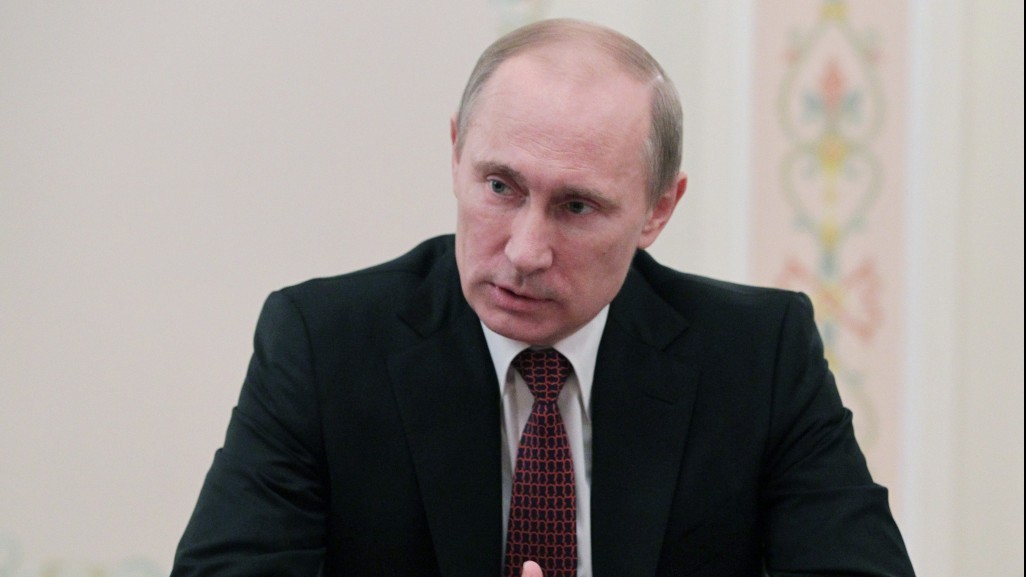
Russian President Vladimir Putin (photo credit: AP/RIA-Novosti, Mikhail Klimentyev, Presidential Press Service)
JTA — Russian President Vladimir Putin said that at least 80 percent of the members of the first Soviet government were Jewish.
“I thought about something just now: The decision to nationalize this library was made by the first Soviet government, whose composition was 80-85 percent Jewish,” Putin said June 13 during a visit to Moscow’s Jewish Museum and Tolerance Center.
Putin was referencing the library of Rabbi Joseph I. Schneerson, the late leader of the Chabad-Lubavitch movement. The books, which are claimed by Chabad representatives in the United States, began being moved to the museum in Moscow this month.
According to the official transcription of Putin’s speech at the museum, he went on to say that the politicians on the predominantly Jewish Soviet government “were guided by false ideological considerations and supported the arrest and repression of Jews, Russian Orthodox Christians, Muslims and members of other faiths. They grouped everyone into the same category.
“Thankfully, those ideological goggles and faulty ideological perceptions collapsed. And today, we are essentially returning these books to the Jewish community with a happy smile.”
Widely seen as the first Soviet government, the Council of People’s Commissars was formed in 1917 and comprised 16 leaders, including chairman Vladimir Lenin, foreign affairs chief Leon Trotsky and Joseph Stalin, who was in charge of the People’s Commissariat of Nationalities

River to Sea Uprooted Palestinian   
The views expressed in this article are the sole responsibility of the author and do not necessarily reflect those of the Blog!

Conscience catching up with Blair? ‘We were wrong to boycott Hamas after its election win’

Former prime minister says international community should have tried to pull militant Islamic faction ‘into a dialogue’ over its refusal to recognise Israel
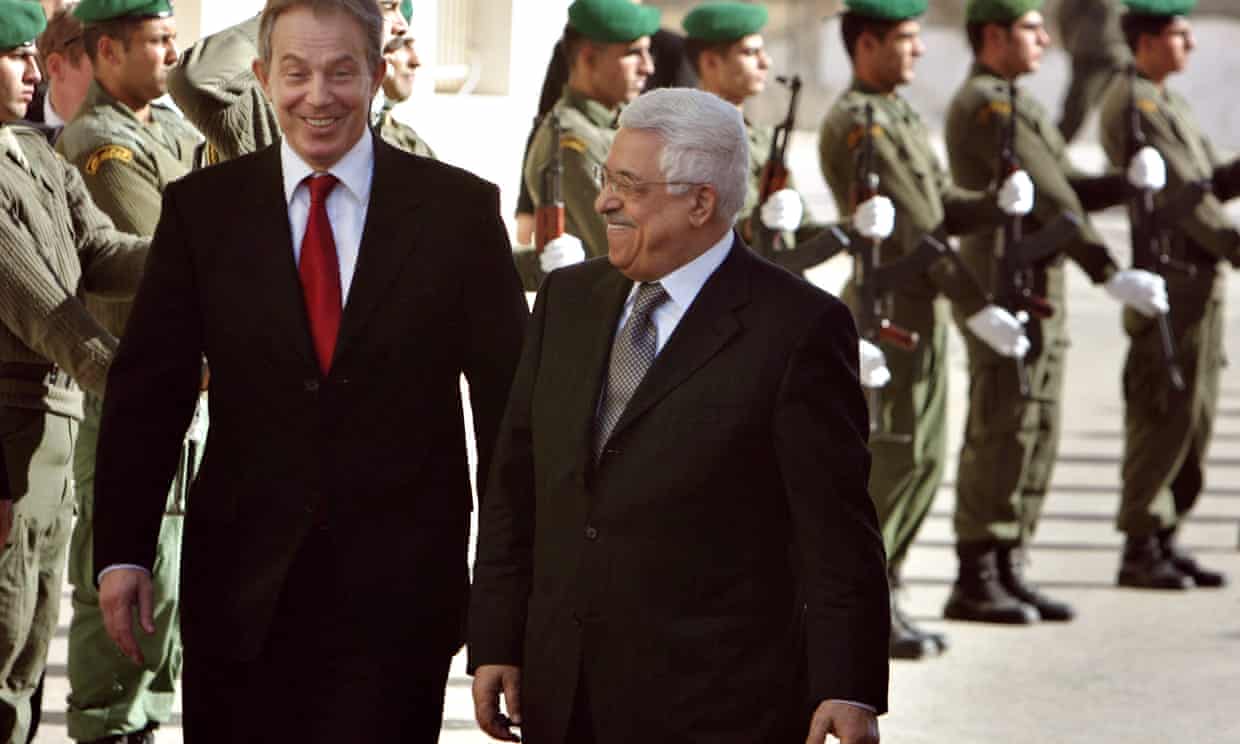
 Tony Blair and then Palestinian president Mahmoud Abbas in 2006, as violence raged in Gaza between Hamas and Fatah.Tony Blair and then Palestinian president Mahmoud Abbas in 2006, as violence raged in Gaza between Hamas and Fatah. Photograph: Muhammed Muheisen/AP
Tony Blair has said for the first time that he and other world leaders were wrong to yield to Israeli pressure to impose an immediate boycott of Hamas after the Islamic faction won Palestinian elections in 2006.
As prime minister at the time, Blair offered strong support for the decision – driven by the George W Bush White House – to halt aid to, and cut off relations with, the newly elected Hamas-led Palestinian Authority unless it agreed to recognise Israel, renounce violence and abide by previous agreements between its Fatah predecessors and Israel. The ultimatum was rejected by Hamas. The elections were judged free and fair by international monitors.
Blair, who became envoy of the Middle East quartet – composed of the US, EU, UN and Russia – after leaving Downing Street, now says the international community should have tried to “pull Hamas into a dialogue”. The boycott and Israel’s economic blockade of Gaza, which began the following year, are still in force today. A UN report two years ago said the combined effects of the blockade and the three military offensives conducted in Gaza by Israel since 2009 could make the territory “uninhabitable” by 2020. Humanitarian conditions have worsened markedly since the report was written.
Interviewed for my new book Gaza: Preparing for Dawn, out later this month, Blair said: “In retrospect I think we should have, right at the very beginning, tried to pull [Hamas] into a dialogue and shifted their positions. I think that’s where I would be in retrospect.
“But obviously it was very difficult, the Israelis were very opposed to it. But you know we could have probably worked out a way whereby we did – which in fact we ended up doing anyway, informally.”
Blair did not elaborate on subsequent “informal” dealings with Hamas but he appears to be referring to clandestine contacts between MI6 and Hamas representatives during and possibly after the kidnap of BBC journalist Alan Johnston by an extreme fundamentalist group in 2007. The kidnappers eventually released Johnston after heavy pressure from the Hamas de facto government.
Since leaving his Quartet post, Blair has held at least six lengthy private meetings with Khaled Meshaal, the Hamas political bureau chief until earlier this year, and his successor Ismail Haniyeh, partly to explore a possible long-term ceasefire between Israel and Hamas. But the international block on official contacts with Hamas has eroded western leverage in the region, increased the isolation and suffering of the Gaza public, and helped to drive the faction into the arms of Iran – all without dislodging it from its dominance of Gaza, say critics.
Blair’s rare rethink of a key foreign policy issue has surfaced as Hamas and Fatah embark on a new Egypt-brokered effort to end the schism between the two factions after a preliminary reconciliation agreement signed in Cairo last week. The split was triggered by the brief but bloody 2007 civil war in Gaza which left a victorious Hamas in charge of the coastal enclave and President Mahmoud Abbas running the West Bank-based, Fatah-dominated Palestinian Authority
Also interviewed in the book, Jonathan Powell, Blair’s former chief of staff at Downing Street, goes further, saying the Quartet strategy was “a terrible mistake”. Negotiations with Fatah alone – long promoted by the US – meant that “you have to make a concession to Fatah, then you have to make a new concession to Hamas afterwards. You want to have one negotiation, not two … If you got a united Palestinian team to negotiate with, then life would have been a whole lot easier.”
The book also cites internal Whitehall documents from January 2006, obtained under the Freedom of Information Act, which warned immediately after the Palestinian elections against ostracising the new Hamas-led authority. A heavily edited minute from the Department for International Development points out that Israel and Hamas were already co-operating at a municipal level, and suggested it would be difficult in the short-term for Hamas to renounce “its commitment to the destruction of Israel and its support for terrorism”. Instead, it suggested that “ultimately Hamas’s participation in the realities of political responsibility might bring about Hamas’s transformation to a political rather than terrorist organisation”.
A Foreign Office “e-gram” from Brussels quotes a senior European commission official saying that a million Palestinians relied directly and indirectly on EU funding. The report added: “To withdraw it would have dramatic consequences and could lead to violence. The EU was under no obligations to align its position on financial support with that of the US and Israel. The EU had not done so in the past. The wider region was watching the EU response to these elections. If we seemed, by our actions, to be rejecting the results then our claims to promoting democracy would be undermined.”

River to Sea Uprooted Palestinian   
The views expressed in this article are the sole responsibility of the author and do not necessarily reflect those of the Blog!

US Meddling Across Southeast Asia

Source030320-N-6501M-16
At a time when US political leaders decry with little evidence what they claim is a pandemic of “Russian interference” in Western political affairs from Western Europe to North America, years of documented evidence exist of this very same interference in the domestic affairs of other nations around the world, funded and directed not by Moscow, but by Washington D.C.
Across Southeast Asia alone is an interlocked, deeply rooted and heavily financed network of American-backed agitators and propagandists, operating behind the cloaks of journalism and rights advocacy, working to upend local, independent political institutions and replace them with a system created by and serving exclusively the interests in Washington that created them.
Shedding Light on US Interference in the Philippines
The Manila Times in a recent article titled, “CIA conduit funding anti-Duterte media outfits,” would shed light on US government money being channelled into the Philippines for the explicit purpose of manipulating public perception, particularly regarding politics.
The article cites the National Endowment for Democracy (NED), and its grantees, the Philippine Center for Investigative Journalism (PCIJ), the Center for Media Freedom and Responsibility (CMFR), and the Vera Files.
The article outlines the funding, stating:
NED documents show that for 2015—the earliest year for which data is available—2016 and 2017, it gave the PCIJ $106,900; Vera Files $70,000, and CMFR, $278,000. (Another funder of Vera Files is Reporters without Borders, which is also recipient of NED funds.)
Even if NED wasn’t a CIA conduit, it is an institution funded by the US government, and therefore advances US interests. Shouldn’t we be outraged that the US government is funding anti-Duterte media outfits here?
It also points out that this US interference in Filipino politics fits into a much larger, global pattern of political interference engaged in by the US government. The article cites US interference in Ukraine in particular, noting that it was US backing that eventually led to the overthrow of the elected government there between 2013 and 2014.
The article’s author, Rigoberto Tiglao, attempted to contact several of the Filipino US NED grantees, only to be confronted or evaded, a response typical of US NED grantees worldwide when questioned about their foreign funding, the dangerous conflicts of interests they are indulging in and the contradictions of posing as independent media organisations entirely dependent on foreign government funding.
Pressure on the Philippines through US-funded media is only one of several fronts the US is using to transform, direct and determine the future of the Philippines as a nation. It has placed direct political pressure on Manila to cooperate in confronting Beijing over the South China Sea. It has also attempted to use Saudi-funded terrorism in the Philippines’ south as a vector to reintroduce a significant and expanding US military presence across the archipelago nation.
The use of terrorism as both a pressure point against Southeast Asian states and as a pretext for a US military presence is a tactic the US is attempting to reuse everywhere from Indonesia and Malaysia, to southern Thailand and neighbouring Myanmar. So is the use of US NED-funded organisations operating under the guise of independent journalism or rights advocacy.
 Beyond the Philippines: Thailand and Cambodia 
Thailand faces a similar landscape of compromised opposition organisations posing as independent, yet entirely funded by the US government and US-based corporate foundations. These include Prachatai, Thai Netizens, the New Democracy Movement, the Isaan Record, Thai Lawyers for Human Rights and even the Foreign Correspondents’ Club of Thailand (FCCT).
Like their Filipino counterparts, they pose as proponents of democracy and as human rights advocates, but cover current events in a transparently one-sided manner, excusing or omitting abuse and corruption among the opposition and targeting only Thailand’s independent institutions, particularly the military and the monarchy.
In Cambodia, US government funding goes one step further, funding the entire opposition, hosting them in Washington D.C. and creating an entire media network to skew public perception in favour of this foreign enterprise and the interests that propel it.
Recently arrested opposition leader, Kem Sokha, got his start at the US State Department and Open Society-funded organisation, the Cambodian Center for Human Rights (CCHR). He would later enter politics, but would continue collaborating directly with the US government, travelling to the United States annually to conspire openly with US representatives to overthrow the Cambodian government.
An article published in the Phnom Post titled, “Kem Sokha video producer closes Phnom Penh office in fear,” would quote Kem Sokha, reporting:
And, the USA that has assisted me, they asked me to take the model from Yugoslavia, Serbia, where they can changed the dictator Slobodan Milosevic,” he continues, referring to the former Serbian and Yugoslavian leader who resigned amid popular protests following disputed elections, and died while on trial for war crimes.

“You know Milosevic had a huge numbers of tanks. But they changed things by using this strategy, and they take this experience for me to implement in Cambodia. But no one knew about this.”
In essence, while the US tenuously accuses Russia of buying Facebook and Google ads, it is openly engaged in overthrowing nations around the world. In Southeast Asia, these efforts are often interlinked, with US-funded organisations in one country supporting and helping to amplify the activities of another next door.
An American Empire’s Success Story: Myanmar 
Myanmar’s Aung San Suu Kyi and her National League for Democracy (NLD) political party’s ascension into power is an example of where exactly US ambitions will lead if unchecked. With the current government in Myanmar quite clearly disinterested in either democracy or human rights, considering the burgeoning Rohingya crisis, it is proof positive that US-funded interference merely operates behind the façade of such principles, and in no way actually seeks to uphold them.
Many NLD party members are former heads of organisations funded by the US government, while others are the recipients of US NED-funded training programmes.
Myanmar is being run by a government handcrafted by US money and interference. It is a government being pressured to turn its back on neighbouring China in favour of US plans, particularly those of its industry and financial institutions. It is also a government currently creating a humanitarian crisis that has opened the door to US-Saudi funded terrorism, a potentially larger conflict featuring brutal violence, all leading to a potential opportunity for a US military presence in a nation that directly borders China.
If allowed to, the US will transform the rest of Southeast Asia into either cooperative client states, or divided and failed states. In either scenario, it will create a united front across Southeast Asia vis-à-vis Beijing that will complicate China’s rise both in the Asia Pacific region and upon the global stage, buying time for the current ruling hegemon to consolidate its position or even reassert itself.
Pushing Back
In many ways, America’s own imagined war against Russian influence gives governments across Southeast Asia the perfect precedent and pretext to push back. Cambodia has already expelled the National Democratic Institute (NDI), a subsidiary of the US NED. It has also tightened laws regarding foreign-owned and foreign-funded media organisations. Opposition members who have openly and for years flaunted their foreign sponsorship are now being arrested and tried while their political parties are being disbanded.
As governments expose and uproot foreign influence from the region, it is equally important for Southeast Asia to fill sociopolitical game board with its own pieces regarding social networks, charity organisations, media (both domestic and international) as well as rights advocates. The price for genuinely putting government corruption in the spotlight and in relative check is easily offset by eliminating the shadows foreign-backed opposition parties have used to systematically undermine regional interests for decades from.
Russia and China, the two primary targets of US interference both directly and by disrupting their peripheries in regions like Eastern Europe and Southeast Asia, have implemented a wide array of countermeasures. Governments in Southeast Asia should consider them each in turn and how they could be adapted best to protect sovereignty and stability at home and across the region.
Joseph Thomas is chief editor of Thailand-based geopolitical journal, The New Atlas and contributor to the online magazine “New Eastern Outlook”.
https://journal-neo.org/2017/10/16/us-meddling-across-southeast-asia/

River to Sea Uprooted Palestinian   
The views expressed in this article are the sole responsibility of the author and do not necessarily reflect those of the Blog!