Uprooted Palestinians are at the heart of the conflict in the M.E Palestinians uprooted by force of arms. Yet faced immense difficulties have survived, kept alive their history and culture, passed keys of family homes in occupied Palestine from one generation to the next.
Nothing proves that India stands at the cusp of fundamental change more than the Samjhauta bombing acquittal, which is also the most public evidence yet confirming that the country’s “deep state” is in the throes of civil war over whether the civilization-state should remain a secular republic or transform into a Hindu theocracy.
An Audacious Acquittal
Four Hindu extremists were just acquitted of their long-suspected role in the 2007 terrorist bombing of the Samjhauta Express. The attack killed 70 people (the majority of whom were Pakistanis) on the railway whose name symbolically means “accord” or “compromise” and which was initially supposed to be a sign of both nuclear-armed Great Powers’ willingness to overcome their geopolitical differences, at one time even representing the only rail route between their two nations for decades at the time of its establishment in 1976. The terrorist attack was connected to Hindu extremists who carried it a day prior to the planned arrival of the Pakistani Foreign Minister to India as part of both parties’ desire to continue peace talks at the time, with the suspected intent being to derail those negotiations.
“Deep State” Divisions
It should be noted that the ruling Congress party at the time immediately condemned the attack and actively sought to bring its perpetrators to justice, hence why the four Hindu extremists were brought into custody in the first place. The Anti-Terrorist Squad of the Maharashtra Police also publicly linked Lt. Col. Prasad Shrikant Purohit to the incident, who claimed innocence by pleading that he had only “infiltrated” the group as part of his professional duty but ended up being the first Indian Army officer arrested on terrorism charges for his alleged involvement in the 2006 Malegaon anti-Muslim terrorist bombings. It’s beyond the scope of the present piece to delve into all the intricate details of these two terrorist cases, but it’s enough to point out that they raised very serious questions about the connection between elements of the Indian military-intelligence community (“deep state”) and terrorist-inclined Hindu extremists.
All of this is important to keep in mind as India approaches its upcoming general elections next month because the civilization-state is at the cusp of fundamental change if the BJP comes out on top. The contemporary ruling party differs from its Congress predecessors in that it espouses the fundamentalist Hindu ideology of Hindutva and is dedicated to imposing a so-called “Hindu Rashtra” (Hindu religious government) on the over 1.2 billion people living in this constitutionally secular state whose founding principles Congress is dedicated to protecting. In fact, it can even be said that the whole reason why the Samjhauta suspects were rounded up in the first place and Lt. Col. Purohit’s role was publicly revealed was because Congress wanted to expose the danger that Hindutva poses to India.
Birds Of A Feather
It’s extremely unlikely that the BJP would have seriously investigated that terrorist attack had it been in power at the time, especially when considering that it pretty much ignores India’s lynching epidemic carried out by its Hindutva followers against Muslims. Looking back on it, the Samjhauta bombing was one of the most recent high-profile salvos of India’s current “deep state” civil war between secularists and fundamentalists because it represented the militant rise of religious extremists against the constitutionally secular state that directly led to the Mumbai false flag terrorist attack the year later, an ascent to power that would later be “electorally legitimized” following the manipulation of communal tensions in the run-up to the 2014 polls. No one should therefore believe it to be a mere coincidence that the BJP-led government acquitted the Samjhauta suspects despite one of them – Swami Aseemanand – previouslyconfessing to the role of the BJP’s RSS ideological fountainhead in that attack and others.
The BJP and their Hindutva ilk aren’t just content with trying to create a “Hindu Rashtra” but also want to expand such a concept across what they regard as “Akhand Bharat”, or “Greater India”, from Afghanistan to Myanmar and Tibet down to the Maldives. This neo-imperial expansionist policy is strongly supported by the BJP’s “fellow travelers” in the “deep state” and given a wink-and-a-nod approval from Prime Minister Modi, though the ruling authorities are facing opposition to this from the geopolitically responsible elements of the military-intelligence bureaucracy who are suspected of undermining the government’s strategy of using Baloch terrorists in the Hybrid War on CPEC. It’s also facing resistance from secular political leaders like West Bengal Chief Minister Mamata Banerjee who publicly raised serious questions about whether the authorities let the recent Pulwama attack happen in order to shore up support for Modi’s reelection.
Concluding Thoughts
The BJP is on the brink of taking its plans for a “Hindu Rashtra” across “Akhand Bharat” to the next level if it wins the upcoming elections and forms the next government, hinting that this rogue state could become not only more geopolitically dangerous, but also more internally dictatorial after the ruling party strongly implied earlier this month that dissent is treasonous. The Samjhauta acquittal is proof of the future that lays ahead for India where Hindu extremists can commit acts of terror with abandon and impunity, a scenario that few could have thought possible back in the days of Congress rule when the authorities cracked down on such terrorist organizations and sought to bring them to justice. Nevertheless, dissident elements of the “deep state” can only do so much to fight back against the impending dystopia, with it ultimately being up to the citizens themselves to decide if this is what they truly want to see happen to their civilization-state.
For Israel, the failure to oust the Iran and Hezbollah-aligned Syrian government has arguably marked the last nail in the coffin for the hyper-aggressive ‘Yinon Plan’ style geostrategic strategy it employed from the early 80s. However, Israel’s new path forward toward its unachieved goals – mainly, bringing down Iran is already under-way and new states may soon find themselves directly relevant to Israeli ambitions.
Yemen is one such state, and Pakistan may become one soon as well in the future.
The GCC and Israel’s interests dovetail in Yemen– with Iran still the target
The move by Egypt, which in 2013 saw a military coup with the Saudis’ blessing and support establish the rule of highly pro-Saudi military man Abdel Fattah al Sisi, came during Saudi King Salman bin Abdul Aziz’s visit to Egypt in April of 2016 and was followed mere days later by the leaks regarding the 2014 MoU. Israel’s Defence Minister Moshe Yaalon had publicly approved of the deal immediately, stating that Israel and Egypt’s 1979 Camp David accord was not violated by Egypt transferring the islands of Sanafir and Tiran to the Saudis.
Iran has not been proven to be materially involved in the Yemen War, and indeed it has denied such allegations whilst providing public statements in favour of the Ansarullah faction (known often as the ‘Houthis’, and followers of Zaydism and not Twelver Shi’ism as is often assumed). This does not, however, mean the Yemen War is not of great importance to it for a number of reasons that should bear heavily in the minds of the Iranian leadership.
Iran’s capability to block the Strait of Hormuz chokepoint, through which 40% of the world’s oil and gas shipments pass from GCC states have to pass through en route to the rest of the world, in the scenario of an attack on itself has made the prospects of an Iran invasion perilous enough to prevent the US trying to do it. Utilizing its ballistic missiles against the Gulf Arab states’ water desalination plants on the coast as well as their ports and off-shore pipelines is also a deadly last-resort route Iran could take if faced with an invasion. Attacking Iran would rapidly take down not only the GCC with it, but also cripple industry, transport and essentially modern life the world over thus making many countries genuinely invested in preventing war with Iran.
The preoccupation of Saudi Arabia and Israel – as well as the UAE – with Yemen becomes clearer in lieu of this. The wide and expansive coastline of Yemen on the Gulf of Aden, opening into the Arabian Sea, provides an ideal location for the GCC states to build modern ports and redirect the energy shipments they, especially the Saudis, rely on so much for their wealth away from having to use the Strait of Hormuz to enter global shipping routes. This would weaken Iran’s trump card in the event of an invasion and make it less economically unfeasible for the USA – still pushed virtually perpetually by Israel via its lobby to attack Iran regardless of the consequences – and any willing partners to invade it.
The Red Sea islands being handed over to the Saudis was thus likely part and parcel of the behind-the-scenes Israeli-Saudi planning centered around Yemen. The Saudi intervention in Yemen starting in March of 2015 – characterized by indiscriminate bombing of civilian infrastructure and a blockade on the country causing a mass starvation crisis – has been openly blessed by Benjamin Netanyahu who claimed in typically irrational fashion that Iran intended to ‘block the straits of Bab al Mandeb’. The reason behind the lazy suggestion was obvious; to create a pretext for Israel’s involvement in Yemen by raising the spectre of the Iran bogeyman. Israel has also trained mercenaries used by the GCC in Yemen.
Despite Ansarullah not having any working relations with the Iranians (or being able to, given the blockade), their despising of Zionism is evident in their rhetoric and their resistance mentality strongly parallels that of Iran. Israel’s Bab al Mandeb concerns instead have Ansarullah, which possesses ballistic missiles, at their epicentre regardless of Iran.
The GCC’s aggression covering those straits and focusing on key Yemeni ports is hence of obvious benefit to the Israelis and ties in perfectly to the closer understanding established with Israel vis-à-vis the Red Sea, itself a highly important waterway for global shipping. Securing Yemen with a pro-GCC, pro-Israel status quo would not only enable the utilization of the Yemeni coastline to divert GCC shipping away from the Strait of Hormuz but would also create a situation where Israel and the GCC could, under one pretext or the other, shut off the access of Iranian ships to the Red Sea. This would stop them reaching the Mediterranean through the Suez Canal and onward to the European markets some in the Iranian government seem to still entertain hopes about tapping into. Such red lines are not something the Israelis are unwilling to cross, and Iran knows it.
Using Pakistani Balochistan to destabilize Iran – a plan no Zionist could resist
The game to secure Yemen and the broader Gulf of Aden and to militarize the important shipping routes is clearly on. But, as Israel and the GCC work toward making Iran more attack-able through their ventures in Yemen, another potential front for stoking conflict with Iran lays beyond what is typically considered the Middle East region.
A look at Pakistan’s 900 km long, poorly-manned border with Iran would tempt Israeli strategists to compliment their Yemen strategy seeking to neutralize Iran’s Strait of Hormuz trump card in the event of war with a heated up Balochistan front as well.
The mostly barren and open region, in the event of Pakistani complicity in such designs, could replicate the utility that the Turkish and western Iraqi fronts served Israel, the US and the GCC when they threw the kitchen sink at the Syrian government. Baloch separatist groups, with a very small population to draw recruitment from, would be a more potent weapon with states at their back capable of and known for using mercenary proxies.
In what is an under-highlighted phenomenon in South and West Asian geopolitics, the Balochistan region is not only the scene of anti-Iranian terrorist groups supported by the Israelis but a much larger and more active role by India in supporting Baloch separatists against Pakistan. India’s close ties military-strategic ties with Israel, as described in a recent article by Robert Fisk, and India’s proactive strategic understanding with the US vis-à-vis ‘containing’ China from the naval and military perspective weigh heavier than its economic relations with Iran and it could be a serious asset in destabilizing Balochistan.
Pakistan and Iran’s overlapping security interests and the India-Israel factor
While Pakistan is not complicit in anti-Iranian terrorism which utilizes its wild territory – albeit a few emotional Iranian generals claimed so days after the 13 February murder of 27 IRGC by Takfiri groups – it has not shown signs of recognizing the potential destabilization of the region by highly powerful anti-Iranian actors. While Pakistan has made visible efforts in the past despite its preoccupation with the Indian and Afghan fronts to act against such groups on its soil, such as helping Iran capture the chief of MOSSAD-backed Jundullah in 2010, it seems oblivious to the possibility that the GCC, with whom it shares close ties, would likely choose Israel and the US over Pakistani concerns in deciding to use Balochistan against Iran.
Pakistan also recently rescued 4 abducted Iranian soldiers after locating and attacking a hideout Jundullah’s successor Jaish al Adl was holding them in. The terrorists, who had entered Pakistan from the Afghan border with the Iranian guards captive, had kidnapped 12 IRGC in October last year of which 5 were previously freed by Pakistan in November. Notably, the rescue came days after Pakistani Prime Minister Imran Khan had promised Iran of ‘good news’ over a week ago.
Iran has itself been somewhat guilty of ‘sleeping on the job’ when it comes to Balochistan’s security. Indian spy Kulbhushan Yadav was discovered and captured by Pakistani security services in March 2016 when he crossed the Iran border into Pakistani Balochistan. Tasked with supporting Baloch separatists – who India openly supports and provides a wealth of curiously Hindi-speaking ‘Baloch’ Twitter accounts to advocate for – as well as sectarian groups targeting Pakistani Shias, Yadav had operated out of Chabahar, Iran, under the cover of a businessman with an authentic Indian passportbearing a fake, Muslim-sounding name.
Iran did not back up India’s immediate claims Yadav was an innocent man kidnapped from Iranian territory and considering its eagerness to get the Iran-Pakistan gas pipeline underway it is difficult to theorize that it would agree to destabilizing the region. It is obvious enough Iran was not complicit in his activities. Iran however, has not raised the issue with India thus far and instead chosen to repeatedly invoke Saudi Arabia’s alleged involvement on the Pakistani side.
Iran’s decision to verbally pressurize the Pakistani side and shoehorn the Saudis into the Balochistan issue rather than take the issue of Yadav up with India could potentially engender suspicions on the Pakistani side. It represents, for Pakistanis in the post-Yadav capture scenario, an Iranian posture demanding Pakistan do its bit yet ignoring its own duties despite Iran’s generally shrewd and sensible stance on security issues.
Moreover, Iran seems oblivious of the reasons for the US offering sanctions waivers to India for its investments in Iran which involve operating the Chabahar Port and building transport infrastructure to supply its goods to Afghanistan and beyond. India, the USA’s ‘100 year-long partner’, quite obviously does not choose economies such as Iran and Afghanistan for such large and long-term investments based on them being ideal investment environments – far from it. It seeks, instead, hegemony over Pakistan, especially in Afghanistan’s affairs.
India, who received a bloody nose in the aerial dogfights between itself and Pakistan that took off after its ‘surgical strikes’ debacle (airstrikes it claimed killed many ‘terrorists’ but in truth struck trees and rocks) in the early hours of 25 February, has been alleged by Pakistani government officials to have been plotting launch missiles at it in a joint strike with Israel.
An Iran on adequately high alert would immediately question why its biggest rivals, whose policies toward attempting to cripple its economy and especially its energy exports are as aggressive as they come, have found such agreement with India’s Iran-Afghanistan trade corridor. More importantly, Iran not extending its clear understanding of where US hostility toward it emanates from – the Israel Lobby – and thus demanding explanations of Israel’s Indian partner regarding its activities in Balochistan represents folly on its part. The possibility that leftover networks and contacts Yadav facilitated contribute to anti-Iran groups alongside the anti-Pakistan ones should be startling for the IRGC.
Mutual requirements necessitating a closer Iran-Pakistan understanding
As the author outlines in this analysis of Pakistan-Iran relations, the uncanny Israeli lobby influence on the US Treasury Department’s sanctions offices means that Israel despite its long history of advocating the toughest sanctions on Iran has made an exception for India’s trade corridor there. Knowing Israel, whose officially registered lobby on Capitol Hill AIPAC authored the first sanctions on Iran in the 90s to begin with, Israel not attempting to render Chabahar Port devoid of partners signals that it sees advantage in a powerful Indian presence in the vital Iran-Afghanistan-Pakistan region.
A powerful India with strategic depth in Afghanistan and Balochistan would be good for Israel and the US and bad for both Pakistan and Iran.
India’s own Afghanistan ambitions involve using its close ties to the US-backed Kabul regime to foster anti-Pakistan Baloch separatist groups there, and India’s state, media and political spectrum have already demonstrated with their recent brinkmanship with Pakistan that they make it an ideally aggressive partner for Israel in the region.
While it refused to become part of the GCC’s war on Yemen in 2015, Pakistan does not demonstrate cognizance of the extent of the involvement of the GCC in Middle East turmoil which has its origins rooted in Tel Aviv.
Managing to increase Iranian insecurity in the Persian Gulf region simultaneously with bolstering anti-Iranian groups in Balochistan – and targeting Pakistan as well – would be a gain for the Israelis possibly big enough to offset their failures in the Levant
The survival-oriented Iranian leadership, whose Resistance approach has strengthened it in the Middle East with several strategic victories, would do well to constructively engage the more economy-focused Pakistani government and ensure that the GCC – major investors in Pakistan – faces stiff refusal by the Pakistani side to use Balochistan against Iran.
The Pakistani military, which began the process of enhancing ties with the Iranians following the Chief of Army Staff Qamar Javed Bajwa’s visit to Tehran in November 2017, more enshrines the survival mentality that Iran would ideally look for in a partner to keep the Balochistan front under close watch. Its own vast experience with counter-terror and counter-insurgency, accumulated through the multiple operations launched against Takfiri groups that once plagued its northwest and the region bordering Afghanistan, would be an asset to the Iranians if more tactful rhetoric is applied by the latter toward Pakistan.
Iran and Pakistan’s mutual duties in organizing their priorities toward ensuring security thus parallel one another; Iran must acknowledge the close ties of India with Israel and Pakistan must acknowledge the close ties of the GCC with Israel even though the GCC is not involved in Balochistan and Afghanistan the way India is yet.
Managing to increase Iranian insecurity in the Persian Gulf region simultaneously with bolstering anti-Iranian groups in Balochistan – and targeting Pakistan as well – would be a gain for the Israelis possibly big enough to offset their failures in the Levant. To deny them the chance to do so is vital for both Iran and Pakistan.
– لم تعد ثمّة حاجة لوضع التساؤلات او رسم الشكوك حول وجود قرار إيراني سوري عراقي ببناء تكتل إستراتيجي جديد يستوعب التمايزات في أوضاع الدول الثلاث وتباينات تكوينها السياسي لصالح تكامل قطاعاتها الاقتصادية والخدمية، وتناغم سياساتها الأمنية، وربطها بشبكات نقل متعدّدة من طرق دولية وسكك حديد، وربط شبكاتها الكهربائية، وتشبيك وسائط الاتصالات بينها، وتكامل منتوجاتها الصناعية والزراعية والخدمية مع أسواق بعضها البعض وحاجاتها. وعندما يستند هذا التكتل الجديد إلى عدد سكان يقارب مئتي مليون، وقدرات اقتصادية وموارد طبيعية هائلة، وأيادٍ عاملة متنوّعة الخبرات، وأسواق واسعة وحاجات سياحية واستهلاكية تلبي بعضها البعض، فمن الطبيعي أن تشكل ولادته بالإضافة لما توفره لشعوب هذه الدول وحكوماتها، مصدر خلاص من الكثير من تعقيدات التبادل المالي التي تفرضها العقوبات الأميركية.
– الولادة التدريجية لهذا التكتل الذي بدأ يبصر النور بعد قمّتين واحدة سورية إيرانية وأخرى إيرانية عراقية، وتجسّدت أولى خطواته باجتماع رؤساء أركان جيوش الدول الثلاث، ومقرراتهم بتأمين التواصل الجغرافي الآمن بين بلدانهم من جهة، وتعاون جيوشهم في إنهاء الحرب على الجماعات الإرهابية، خصوصاً في سورية. من جهة مقابلة، سيطرح تحديات عاجلة ومتصاعدة أمام دول الجوار الثلاث الأهم، البعيدة بدرجات مختلفة على الصعيد السياسي عن هذا التكتل الجديد، والمحكومة بلغة المصالح والجوار بحسابات لا مفرّ من إقامتها، تجاه كيفية التعامل مع هذه الولادة. فتركيا التي تقيم تبادلاً تجارياً واسعاً مع إيران وتملك حدوداً مشتركة يتداخل فيها الأمن والسياسة مع هذه الدول، وتتشارك مع الدول الثلاث الهمّ الكردي، ستجد نفسها معنية بالبحث الجدي في شراكة لتوسيع هذا التكتل بصورة تجعلها شريكاً نوعياً لتكبير حجم السوق أمام بضائعها، وتوسيع نطاق التدفقات السياحية إلى أسواقها، وضمان معاملة موحّدة مع المسألة الكردية، ومثلها الأردن المعني حكماً بحاجته للموارد النفطية والمتطلع لاكتساب المزيد من السياح، ومثلهما لبنان الهادف لتسويق بضائعه الزراعية والصناعية، ولاستقطاب كتلة من السياح الذين يوفرهم هذا التكتل، سيجد نفسه، رغم التذاكي السياسي لدى بعض اللبنانيين والكيدية لدى بعضهم الآخر، معنياً من موقع المصالح بالمبادرة في البحث عن سبل التشبيك مع هذا التكتل الجديد.
– عملياً وبسبب غياب مركز عالمي قادر على قيادة العام اقتصادياً وسياسياً وعسكرياً، بعد التراجع الأميركي المشهود، ستنمو التكتلات الإقليمية. وهذا هو الحال على المقلب الآخر للحدود الإيرانية مع كل من باكستان وافغانستان، وصولاً إلى الصين وروسيا والتعاون في أفغانستان سياسياً وأمنياً، والتعاون في مجالات الطاقة وتبادل البضائع. لكن الطبيعي أن يجذب هذا التكتل مع فرصه بالاتساع ليضمّ تركيا ولبنان والأردن اهتماماً خاصاً من روسيا والصين، فالأولى مهتمة بأنابيب النفط والغاز وبتوليد الكهرباء من الطاقة النووية وبيعها، والثانية معنية بشبكات سكك الحديد وتوسيع الأسواق لبضائعها، وتكتل مرشح لبلوغ الثلاثمئة مليون بهذه المقدرات الاقتصادية سيعادل حجم أوروبا، وأميركا، ويزيد عن حجم روسيا، ما يجعله مرشحاً للتأثير على شكل الخريطة التجارية والاقتصادية للعالم، وفرض معادلات جديدة لا بدّ لأوروبا الجارة من أخذها بالحساب.
– عملياً العقوبات الأميركية تلعب دوراً عكسياً. فهي تشكل اليوم الحافز لنجاح هذا التكتل، وهي ستشكل مصدر آليات تعامل مالي تتخطى المرور بالعملة والمصارف الأميركية، وعملياً هي سترتب تراجع المكانة التي تحتلها أميركا في الاقتصاد العالمي كمركز، ولو بقيت تمثل الاقتصاد الأول تقنياً وهي المرشحة لخسارة موقع الاقتصاد الأكبر حجماً امام الصين. فعلاقة أوروبا بهذا التكتل الجديد ستكون مختلفة عن علاقتها بإيران وحدها، ومنطق المصالح يقول إن هذا التكتل سيكون فرصة أوروبا الوحيدة لمواجهة خطر الركود الاقتصادي والكساد الصناعي، وعندما نقول إن عالماً جديداً يولد، لا نقصد فقط سياسياً وعسكرياً بل اقتصادياً أيضاً.
Sana’a – Kanan, eight-year-old, all he can remember well of his martyred dad is that “my father was taking me in a trip to the park”.
Kanan was only 4-years-old when he lost his father as two suicide bombers detonated themselves with two other bombers at two pro-Zaidi mosques, Badr Mosque and Al Hashoosh, on 20 March, 2015 while worshippers gathered for Friday prayers.
At least 137 were martyred, and 351 wounded, according to medics. Local media said the attacks are “the deadliest terrorist attacks in Yemen’s history”.
Some children were killed because their fathers brought them to the mosques. However, Kanan was only 4-years-old at the time, that’s why his father did not take him there.
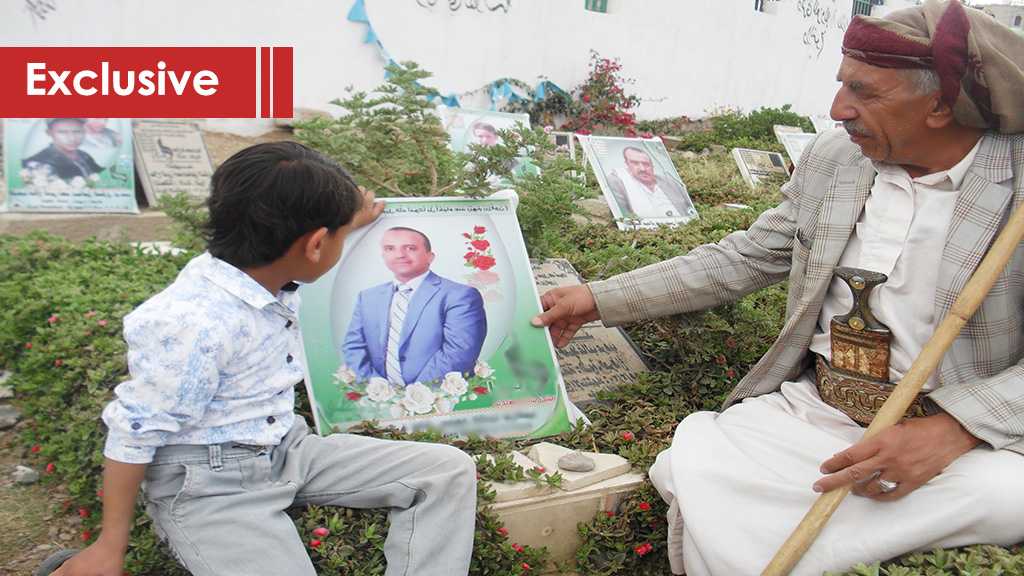
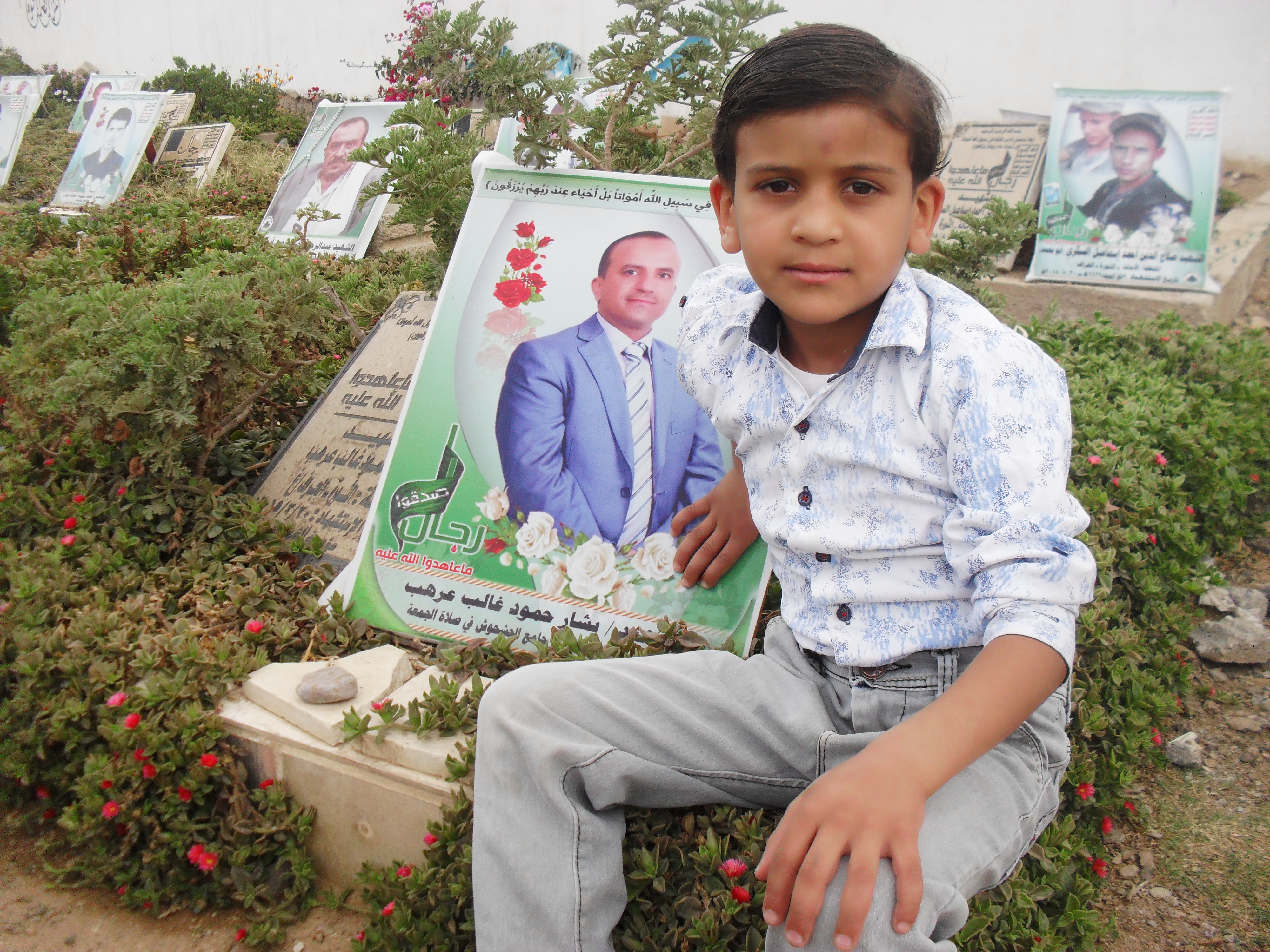
On Wednesday [March 20, 2019], the day that marks the fourth anniversary of this massacre, Kanan sat beside his father’s grave, and prayed for him along with his grandfather, Hamoud.
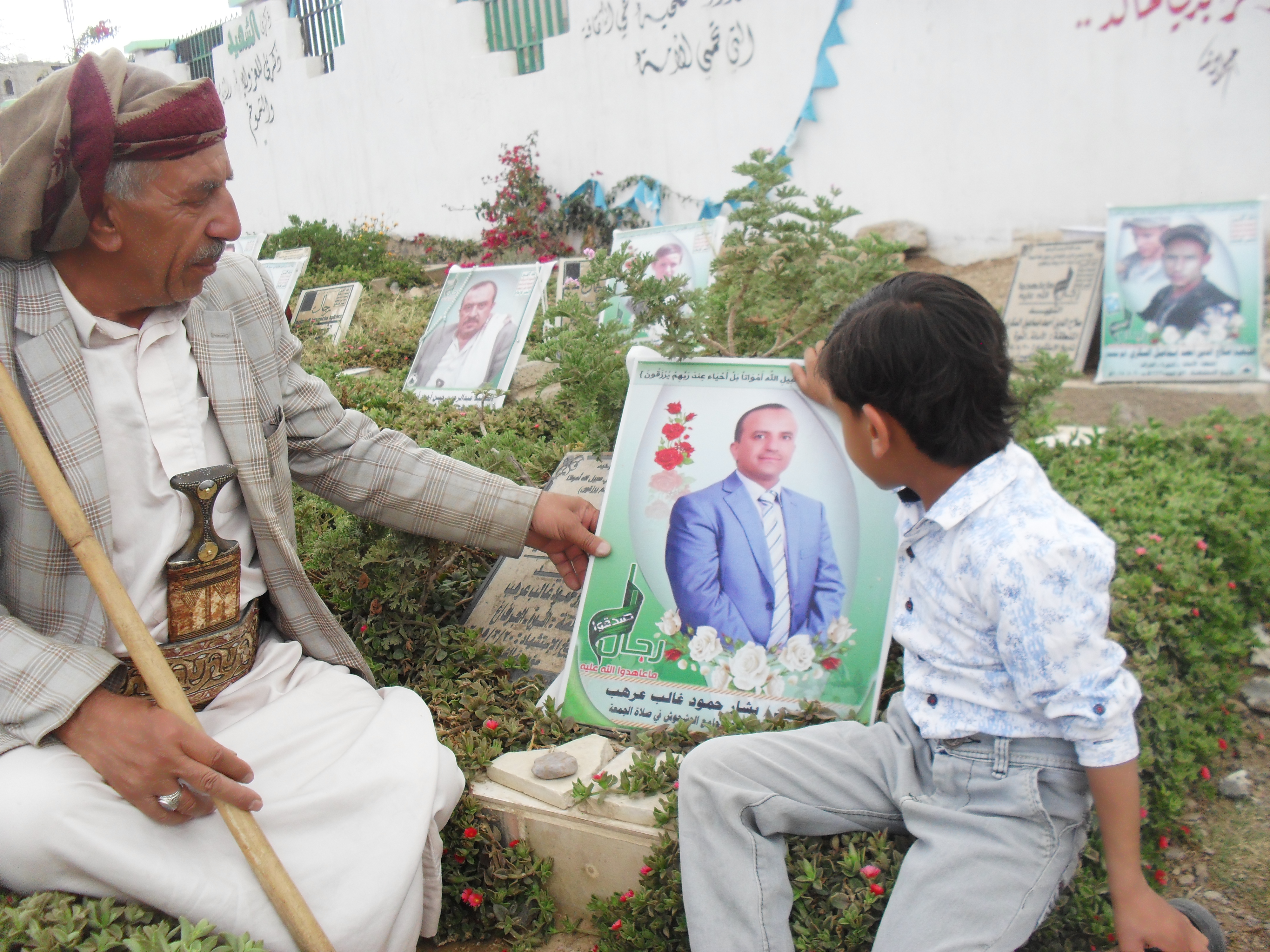
Kanan grandfather walks at Al Hashoush mosque he survived the assault but his son martyred – Date Wed, March 20, 2019 ( al-Ahed News)
Kanan has another sister. She is 9-years-old and was in a deep state of shyness that we forget to ask about her name. She also refused to be pictured nor to speak to al-Ahed News reporter.
She and Kanan study at a private school. She is at second grade, and Kanan at first grade. Kanan says he has a dream to be something special in the future.
“I dream to become a flight engineer,” Kanan said while sitting near his father grave. However, his grandfather smiled and interrupted him: “say to be a fighter pilot and take revenge from Al Saud [the Saudi monarchy that’s ruling KSA].”
Then, Kanan’s grandfather, Hamoud, was walking with a stick between the graves where hundreds buried including martyrs of these four suicide bombers that the Yemeni branch of Daesh [the Arabic acronym for terrorist ‘ISIS/ISIL’ group] claimed its responsibility for the first time since it was announced to have a branch in Yemen in November 2014.
Kanan mourns his father who martyred by Daesh suicide bombers. Date Wed, March 20, 2019 ( al-Ahed News)
US administration on the next day of the suicide bombers condemned the attack without sending condolences to the families of the victims. “The White House ‘strongly condemned’ the attacks, but said it could not confirm that those behind them were affiliated with Daesh, according to BBC.
Spokesman Josh Earnest said Daesh could be falsely claiming responsibility.
What happened?
Kanan’s grandfather, Hamoud, remembers with pain the two terrorist suicide bombers, claiming to be disabled and hiding explosives under casts, detonated at Al Hashoosh Mosque worshippers, near Sana’a International Airport, where he used to pray at and where Kanan’s father, and Hamoud’s son Ghaleb martyred.
Hamoud, during our visit to the graveyard, he pointed with his stick to a martyr. He named him Osama. Osama at his late teens. Hamoud said Osama was a guard at the entrance of Al Hashoosh mosque and any worshipper was subjected to security searches before entering the mosque via Osama.
Osama was a volunteer at the popular committees that had captured Sana’a. Hamoud says we were performing Friday prayers, “we heard an explosion outside the mosque”. “It was this boy, Osama, who stopped -at the entrance- the first suicide bomber from getting inside the mosque, then the attacker after resorted to blow himself up,” Hamoud told al-Ahed News.
Before we went to the graveyard, we met father of Osama, Mohammed Al Ward, outside the mosque. Hamoud told us he is a father of a son martyred at the entrance of the mosque in a heroic operation.
Al Ward, told us that he is proud of his son who was able to dismantle the first suicide bomber. “He was martyred to let more than 200 worshippers inside the mosque live.”
“Osama searched the suicide bomber at the entrance. The suicider told him he wants to get into the mosque to blow himself at the worshippers,” Osama’s father said, citing reports of colleagues survived the blast.
“According to the families near the entrance, they told me he got in a fistfight with the suicider, he took him over a taxi to be transported to special place, and the suicider threatened to blew himself up. Osama urged his colleague to run for their lives, but he is not afraid of his life, forcing the suicider to blow himself up,” said Osama’s father.
Kanan’s father was inside the mosque, while his grandpa was at the prayer hall. It was a surprise for our website to speak to Hamoud while he was sitting before we reach him at the same place he said he was in during the blast.
After the first explosion, another terrorist infiltrated on crutches to the mosque, claiming disabled and hiding explosives at his legs that were really detonated materials plastered on.
How it happened?
Another survivor, Mohsen Taher, in his sixties, said he was under the rostrum two minutes before the second suicider blew himself up at the same place.
Immediately after the prayer, Taher said, worshippers stormed out of the mosque, to figure out what happened outside the mosque in the first explosion. “I was one of those who run to see,” Taher said.
“I just came out from the western gate of the mosque cup the prayer yard, helping an elder man to walk, I stood at this place, where grandfather of Kanan was sitting,” Taher told al-Ahed News. “Immediately I heard second explosion inside the mosque,” Taher added.
“It was the terrorist suicide bomber who infiltrated after the first explosion that targeted the security belt. He wanted to target the preacher Taha Al Mutawakel, [now health minister].”
Taher explained that the second explosion was at the place where he performed Friday prayers. “All the people whom were around me martyred because they remained there,” Taher said, thanking Allah that he got out immediately.
“American and ‘Israeli’ Design”
People at Al Hashoosh Mosque were surprised at the international biased condemnations of the terrorist suicide bombers, where condemnations limited to denounce the assault without sending condolences to the families of victims like the one of the White House.
The international community kept silent on this crime, according to Taher, because it was “an American and ‘Israeli’ design a long time ago”.
“There were efforts to foment sectarian division and civil strife,” Taher noted. “They failed to do so, because Yemenis are all brothers, followers of Zaidism or Shafi’i Islam live together and share mosques, that’s why victims are from all community.”
At the time, there were many of Ansarullah leaders at the mosque who survived the bombers like late president Saleh Ali Al Samad, whom Hamoud said was on the second floor of the mosque. Al Samad was then martyred in a US drone air strike in Hodeidah last April.
However, innocent civilians died at this terrorist attack including Kanan’s father who was working at the Commercial Bank and Agricultural Cooperative Lending and has nothing to do with this all this sectarian assaults.
Suffering of the victims’ families
Grandfather of Kanan, Hamoud, lost his son Ghaleb in the terrorist attack. Kanan lost his father, and Hamoud mourns his son Ghaleb.
Ghaleb was working at the Commercial Bank and Agricultural Cooperative Lending Bank and was able to make a good living for his father and two sons. However, after this assault, Hamoud says his son’s salary was decreased by the bank.
“The bank pays now only $50. It’s for nothing if his children are still depending on it,” said Hamoud.
“I have tried, last year, to get one of my sons to marry Kanan’s mother, so she won’t feel the pain of parting with him [Ghaleb],” Hamoud told al-Ahed News. “They are now living together with the two children happily.”
Kanan, along with his grandfather, Hamoud, mourns Kanan dad who martyred by Daesh suicide bombers. Date Wed, March 20, 2019 ( al-Ahed News)
While we were waiting for Kanan and his sister to get out of the school so we can visit their father’s grave, Saudi-led warplanes were hovering on Sana’a for the first time in more than a month.
That Saudi overflight has demonstrated that there is no light at the end of the tunnel for the war to end, and that the cycle of war will continue to let Yemeni children like Kanan to suffer and pay the heaviest price.
With the possible U.S. military withdrawal from Syria in the news on a daily basis, the mainstream media has been quick to parrot the DOD’s claim that 2,000 troops, mostly special operations forces, are to be withdrawn from the country. Although the total number of U.S. special operators deployed to Syria may have approached as many as 5,000, the current headlines have not mentioned that the United States has special operations units deployed not just in Syria, but in a majority of the nations of the world. Over the past seventeen years, the forces at the disposal of U.S. Special Operations Command (SOCOM) have grown exponentially, more than doubling in size in numbers, with a budget that has also expanded four fold in that same period of time.
U.S. special operations forces on patrol in northern Syria. Although no concrete timeline has been publicly announced, the Trump administration has signaled its intention to pull U.S. military forces out of the country.
If U.S. SOF troops do pull out of Syria, they will still have a physical presence in over 70 nations on any given day. Although the public has an often vague and incomplete, unofficial explanation of the reasons behind these deployments, the Pentagon seems totally unwilling to explain the national defense rational or legality of these missions to anyone, including the U.S. Congress or the White House. Not only has SOCOM expanded in numbers, funding and weaponry since 2001 and the advent of the Global War on Terror (GWOT), but has acquired no small amount of political influence as well.
The U.S. special operations forces have become the darling of the military, praised by Congress, the White House, and the Media. They have willingly adopted a mythos that has been formulated and propagated by Hollywood on many levels. The U.S. public seems to worship this new class of soldier, while having little to no understanding of exactly what they do, nor any concept of how their actions might aid or hinder national security. An act has even been proposed by one state Representative to afford special income tax breaks to all SOF members.
Amidst all the praise about their prowess and successes on the battlefield, the media purposefully steers clear of reporting on their many failures. Although the U.S. has built the largest force of special operations in the world, this very fact has arguably proven to have only weakened the U.S. military as a whole. The White House, State Department and Pentagon have increasingly relied on special operations forces to bear the brunt of any and all military operations or covert actions in both acknowledged and secret areas of conflict across the globe. This over-emphasis on special operations as a military solution to all challenges has only weakened traditional, conventional forces.
While most of the public assumes that these new Spartans act to protect U.S. interests and “freedom and democracy” whenever and wherever it is deemed necessary, they have little to no understanding of how the SOF have changed since 2001, nor the increasing military and political influence that they now hold. Even fewer Americans have stopped to ponder the illegality of much of what this expanding military force is doing on a global scale, not to mention the constitutional implications of a new Praetorian class in its midst that is growing in power and influence. If history teaches us anything, it is that shadowy and unaccountable paramilitary forces do not strengthen societies that embrace democratic or constitutional governments.
The Expansion of SOF and the Rise of SOCOM
Since the inception of the “Global War on Terror” shortly following September 11, 2001, U.S. SOF have more than doubled from approximately 33,000 to almost 70,000 today. Today, Special Operations Command (SOCOM) has roughly twice the personnel at its disposal, but also four times the budget as it did in 2001. Joint Special Operations Command (JSOC), comprising perhaps the most elite and specialized of the SOF forces, numbered some 1,800 in 2001. Although quite secretive in nature, it is surmised by many analysts that JSOC may have grown to the size of SOCOM circa 2001, over the same 18 year period. If realistic, this estimation means that JSOC added its original number of 1,800 men each year, for eighteen years.
What reason was given by the U.S. DOD to justify such an expansion in a traditionally small and highly selective sub-set of conventional military forces? Special operations forces have existed since at least the Second World War. All major military powers, and even smaller nations that have not historically prioritized robust national defense postures, have invested in special operations forces to complement conventional military establishments. Special operations units are useful as a significant force multiplier in any conventional conflict, and are vital in responding to special circumstances such as anti-terrorism, hostage rescue, reconnaissance deep behind enemy lines, sabotage, and kill or capture missions.
The Pentagon has argued that terrorism has grown, with the number of internationally recognized terrorist organizations roughly doubling from 2001 to today, mostly due to the explosion of both al Qaeda and ISIS. Regardless of the facts that point to the CIA origins of al Qaeda, there is little argument that the organization has grown in concert with U.S. military intervention in the Middle East and Africa. The same can be said for the origin and spread of ISIS. There is also ample circumstantial evidence to support the theory that the CIA and SOCOM have both directly and indirectly supported both of these terrorist organizations in Syria. Regardless of whether SOCOM is directly or indirectly complicit in aiding the Islamic terrorist organizations it declares it is defending the nation against, there is a clear correlation between the growths of both, and surely SOCOM has benefitted on many levels from this relationship.
The annual declared budget for SOCOM is in the range of $12.3 billion today, up from just $3.1 billion in 2001. There is little doubt that a healthy slice of the annual Overseas Contingency Operations and Support (OCO) budget is consumed by SOCOM, as the organization is the most heavily engaged in operations on foreign soil. In 2018, U.S. Congress approved $67 billion USD for OCO, and a further $7 billion USD in mandatory appropriations. It is unclear how much funding SOCOM receives on an annual basis, as the Pentagon has proven to be largely beyond financial questioning or audit by any office of the civilian government. After failing its first audit in decades in 2018, the Pentagon shrugged off the event with humor, and no one seemed to notice.
SOCOM numbers roughly 70,000 soldiers, marines, airmen and sailors and has a declared budget of at least $12.3 billion USD. To put these numbers in perspective, SOCOM has more personnel than the entire national militaries of 120 of the 193 UN member states. Only 20 nations (including the U.S.) have a greater total defense budget than that of SOCOM. A simple cost benefit analysis would reveal that the U.S. is not making much headway in “winning” the GWOT militarily. The growth of SOCOM has done little to reduce the prevalence of terrorism in the world. It begs the question, is there any correlation at all, or is there another agenda afoot entirely?
Global Reach and Integration
The expansion in numbers and funding of America’s special operations forces is alarming in its own right, but their growing international footprint may be even more alarming. Not only were U.S. SOF deployed to at least 150 nations last year, but they have established professional alliances with national militaries in a majority of those nations. Nick Turse has documented and reported on the growing influence of SOCOM over the past few years, with his articles being widely published in major mainstream periodicals as well as online alternative media. He has established many reliable sources within the SOF community. In regular articles posted on Tom’s Dispatch, Nick has documented the growing influence of SOCOM, its expanding power, and it’s establishing of close ties to the special operations forces of nations across the globe.
U.S. Special Forces NCO instructing Malian counter-terrorism forces in patrolling and ambush small unit tactics in that West African nation.
It seems quite logical that the main area of focus for these forces immediately prior to the declaration of GWOT in 2001 would be in the Middle East; however, since as early as 2014 the United States began refocusing its deployment of special operations personnel to the African continent. More recently, since the coup in Ukraine and the civil war that erupted as a result, SOCOM has shifted much of its efforts to Europe. Although the DOD and State Department have stated that such deployments are directly connected to terrorist activities in Africa, in Europe the goal is confronting an “increasingly aggressive and assertive” Russia. In reality, deployments to Africa are largely responsive to an increased Chinese presence on the continent. Not publicly acknowledged until the official publication of the National Defense Strategy of the United States for 2018, the U.S. establishment had already come to view both Russia and China as the major threats to U.S. global hegemony.
U.S. special operations forces were deployed to an overwhelming majority of African nations in 2017.
In 2006, deployments to Africa accounted for a mere 1% of U.S. special operations foreign deployments. By the end of 2017 this number had jumped to almost 17%. What could account for such an increase? Spokesmen for the DOD have sighted the increased threat of Islamic militant groups such as Boko Haram and al Shabaab and their capability to disrupt and weaken local governments; however, SOCOM has not just deployed forces to Somalia, Libya, Mali, Burkina Faso, Nigeria and Cameroon, the traditional territories of operation of Boko Haram and African offshoots of al Qaeda. U.S. commandos deployed to 33 African countries in 2017. 61% of the nations of Africa hosted a U.S. special operations military presence to some degree. There is little doubt that terrorist groups such as Boko Haram present a destabilizing threat to African governments whom are hanging on by a threat in their efforts to govern in the best of times, yet there is little evidence to support the idea that the U.S. military is in Africa for altruistic purposes. The U.S. military, just like the French Military, is increasing its activities in Africa to protect their respective financial interests and maintain influence over African nations, and to increasingly confront the growing influence of China in the region.
The Chinese and Afghan governments have been engaged in the highest level negotiations regarding infrastructure development, transit rights and even the establishment of a Chinese military facility on the Afghan side of the Wakhan Corridor since at least late 2018.
Between the years 2009 and 2012, Chinese overseas foreign direct investment (OFDI) grew at an annual rate of 20.5%. Chinese President Xi Jinping pledged $60 billion USD in investments in Africa at the 4th Annual Investing in China Forum held in Beijing last September. The United States has often claimed that Chinese financial practices in Africa are predatory in nature. This is quite ironic coming from the country that has a controlling influence over the IMF and World Bank, two financial entities that have been responsible for indebting most of the developing world for the past half century. Neither nation is in Africa to help poor Africans, but to enrich themselves. The African continent is rich in rare earth minerals and metals used in the manufacture of modern electronics, batteries, cell phones and computers. China opened its first and largest overseas military base in Djibouti in August of 2017, located in the strategic Horn of Africa. It is just a stones throw from Camp Lemonnier, the largest U.S. military base on the continent. In a similar move, China is seeking to build a military base in Afghanistan, another nation rich in rare earth minerals where the U.S. military has struggled to maintain a viable presence for over 18 years. China plans to base at least one battalion of troops at a newly constructed facility in the northeastern province of Badakhshan, ostensibly to train Afghan security forces. Located close to the Wakhan Corridor, the base will help provide security to the One Belt One Road trade corridor through the region, and help solidify growing economic and security ties with the Central Asian nation. Coupled with the base in Djibouti and a planned PLAN naval base at Gwadar, Pakistan, China is establishing a viable defense infrastructure in the region. This directly undercuts long established U.S. interests in the region.
The Wakhan Corridor is a strategically important mountain pass, the control of which is of utmost importance to the Chinese government in securing the One Belt One Road logistics network.
While SOCOM has maintained a sizeable presence in Afghanistan and Africa to confront a growing Chinese presence in Central Asia and Africa, it has also increased operations in the European theatre as well. In 2006 only 3% of all SOF units were deployed to nations in Europe. By 2018 that percentage had grown to almost 17%. According to a statement made to Tom’s Dispatch, a spokesman for SOCEUR, Major Michael Weisman stated,
“Outside of Russia and Belarus we train with virtually every country in Europe either bilaterally of through various multinational events. The persistent presence of U.S. SOF alongside our allies sends a clear message of U.S. commitment to our allies and the defense of our NATO alliance.”
Since the disastrous failure of Petro Poroshenko’s Anti-terrorism Operation (ATO) to subdue the breakaway republics in eastern Ukraine, SOF deployments to nations bordering the Russian Federation have increased notably. As it was detailed in a previous article, SOCOM has established very close ties with Ukrainian special operations forces.
Over the past four years SOCOM has repeatedly deployed forces to Latvia, Estonia, Lithuania, Poland, Romania, Bulgaria, Moldova, Georgia, and even Finland. In 2016 alone, U.S. Special Operations Command (SOCOM) conducted no less than 37 Joint Combined Exchange Training (JCET) exercises on the European continent, with 18 such exercises in nations bordering Russia. Is SOCOM sending a reassuring message to allies, or an ominous message to Russia, the holder of the world’s largest nuclear arsenal? Is it wise defense policy to increasingly surround Russia, and back it into an increasingly tight corner? If Russian political and military leaders have learned one lesson throughout the centuries, it is that the concentration of foreign belligerent military forces on their national borders eventually leads to conflict and invasion.
Not only has SOCOM positioned itself in a majority of the nations across the globe, but increasingly along the borders of the Russian Federation and China.
The United States has become deeply entrenched in the conflict in Ukraine, having increased military aid to the ruling regime incrementally from 2014 to the present. After the disastrous Ukrainian Armed Forces winter offensive of 2015, culminating in the encirclement battle of Debaltseve, U.S. military aid kicked into high gear. Regular rotations of U.S. Army trainers teach UAF troops at the Yavoriv International Peace Keeping and Security Center modern combat skills with an increased emphasis on making the force more NATO interoperable. Ukrainian Special Forces have undergone a clear and striking transformation, and are now nearly indistinguishable from their U.S. and NATO counterparts. They are now wearing U.S. military issue Operational Camouflage Pattern (OCP) “multicam” battle dress uniforms and gear, and are increasingly using western manufactured firearm accessories, optics, and night vision equipment. More notably, the UAF special operations units have adopted a number of small arms and sniper weapons systems that utilize NATO standard ammunition such as the 5.56x45mm intermediate rifle round and the 7.62x51mm rifle round. Sniper rifles chambered in .308 Winchester and .338 Lapua have also been adopted in limited numbers.
U.S. Navy SEALs conducted a number of exercises with the Bulgarian military in the Black Sea in 2018, a clear message to Russia that the U.S. was prepared to escalate asymmetrical warfare targeting the Crimean Peninsula.
Speaking at a GEOInt (Geospatial Intelligence) annual symposium in 2014, former head of SOCOM, General Joseph Votel opined that “We want to be everywhere, know everything.” Clearly, SOCOM has increasingly pushed for the first part of his stated goal in the intervening years; however, the increased focus and funding of special operations over the past 18 years has left the U.S. military’s conventional forces in a state of atrophy and decline. The U.S. political establishment and military leadership have come to see SOCOM as the go-to solution provider for just about any scenario where military force is seen as an option. This has increased the reputation and clout of SOCOM, but this has increasingly come at the expense and detriment to more traditional conventional forces that chiefly serve the national interests of deterrence and defense.
Conventional Warfare Atrophy
In a detailed analysis posted late last year, “Why the U.S. Military is Woefully Unprepared for a Major Conventional Conflict”, I outlined the causes and effects of the decline in U.S. conventional warfare capabilities. There is undoubtedly a direct correlation between the reliance upon and exponential growth of U.S. special operations forces, and the decline in conventional force readiness and capability. This is evident in all service branches and has had a negative effect on the ability of the U.S. Armed Forces to carry out future offensive and defensive combat operations against peer adversaries. The U.S. military will have very little hope of achieving decisive military victories in either Russia’s or China’s backyard. Any assertion to the contrary is delusory.
The U.S. military obsession with counterinsurgency and occupation stemming from one U.S. invasion or regime change operation after another, has left a once cutting edge, combined-arms conventional force gutted materially and low in morale. Special operations forces were leveraged in a fight against popular uprisings, Islamic terrorist organizations, and often an alliance between the two. The overwhelming majority of the growing names on the U.S. enemies list found their genesis as a result of U.S. military adventurism. These various insurgencies were a direct reaction to heavy-handed U.S. “foreign policy” delivered at the barrel of a gun. The resulting struggles in the so called GWOT depended greatly on an ever expanding pool of special operations forces. SOF were prioritized over other traditional, conventional forces not meant for occupation and not skilled in counterinsurgency.
While the troops at the disposal of SOCOM ballooned to almost 70,000, the U.S. Army has struggled to replace armored vehicles first fielded in the 1960’s, the Navy witnessed the utter deterioration and exhaustion of its carrier air wings, and the Air Force struggled to retain pilots to fly aircraft that fell deeper into a state of disrepair. Although achieving battlefield successes, the Armed Forces of the United States have yet to decisively win any of the numerous conflicts embarked upon since 2001. The intervening years have revealed the U.S. military of today to be an organization riddled with major material shortcomings and inferiorities, while plagued with a leadership lacking sound judgement and brimming with both hubris and an unfounded superiority complex. This leadership has repeatedly decided to invest in special operations forces that are unable to win wars on their own, at the expense of conventional forces designed solely for that purpose.
Growing Political Power
SOCOM has not restricted its influence to the many battlefields across the globe, or the forging of ties with foreign militaries through training and advisory programs. Just as the CIA has stationed personnel at most U.S. embassies oversees, SOCOM has followed suit. Special Operations Liaison Officers (SOLO) are stationed at a growing number of embassies, including the NATO member countries the United Kingdom, France, Poland, Italy, Turkey and Canada. SOLOS can also be found in U.S. embassies in Australia, Brazil, Colombia, El Salvador, Peru, Israel, Jordan, and Kenya. SOCOM’s former head, General Joseph Votel, had announced the intention of putting a SOLO is at least forty U.S. embassies around the globe by 2019. This statement should be viewed with some skepticism, as SOCOM rarely speaks publicly about the extent of their operations and planning, so it is likely that SOLOs are already serving in many more U.S. embassies, especially those located in flash points or trouble spots in Africa, the Middle East, South America, and nations bordering the Russian Federation and China.
Not only should this development be worrying to host nations who may not be inclined to look at a foreign military presence on their soil as acceptable, but it also clearly exhibits closer ties between SOCOM and the Department of State. Not only has SOCOM fostered closer ties with the Department of State, but with the monolithic U.S. security apparatus as a whole. In an attempt to “be everywhere and know everything”, SOCOM has moved further away from its subordinate position in the Department of Defense, and pursued a more independent and unaccountable path, similar to that of the CIA or NSA, two organizations that it has increasingly worked closely with. SOCOM has even forged close ties with the Federal Bureau of Investigation, whose prevue is supposed to be limited to U.S. domestic crime investigations and the enforcement of federal laws.
There should be some apprehension at both the Pentagon and in the halls of Congress, of the growing power of this new military within the military. In a constitutional republic that clearly delineates, compartmentalizes, and limits government power, the growth of a largely unaccountable, secretive and influential new military organization should be viewed as a threat to the very foundations of political and social order. A number of former special operations members have run for political office in recent years and won. While electing retired soldiers into Congress and gubernatorial office will most likely bring a level of restraint to government military adventurism, with those individuals having seen and paid the price for war, there is also a chance that they will steer policy to aid the military industrial complex. The cautionary tale of Governor Eric Greitens is one such example that also signals another problem effecting the special operations community as a whole.
Scandals Tarnish the Mythology
A number of scandals involving U.S. special operations soldiers have hit the headlines in recent years, corresponding with the exponential growth of the force. In an attempt to expand the SOF, the Pentagon seems to have lowered physical, cognitive and moral standards in order to fill the ranks. The Hollywood-Pentagon alliance that has worked tirelessly to create and perpetuate the image of the invincibility of the Navy Seals, presenting them as modern day Spartans or Praetorians, has run into a minor set-back in recent years. The criminal conduct of the elite of the elite has recently tarnished a once proud and silent fraternity of soldiers.
On June 4, 2017 an Army Special Forces NCO was murdered by two Navy SEALs and two Marines “Raiders” in Mali. The original story put forward was that the soldiers accidentally killed their compatriot in an attempt to scare him into silence. The Green Beret, Staff Sergeant Logan Melgar, had uncovered gross criminal conduct by Chief Petty Officer Adam Matthews and Petty Officer Anthony DeDolph. The two SEALs had been embezzling money meant to pay off local informants, and had also been bringing local prostitutes back to the small unit’s “secret” safe house . Staff Sergeant Melgar was ambushed in the safe house, beaten and choked to death. It took military investigators roughly a year and a half to finally charge all four perpetrators with felony murder, involuntary manslaughter, conspiracy, obstruction of justice, hazing and burglary. The investigation found that the men killed Staff Sergeant Melgar while engaged in an act of burglary; however, it is not known if they were attempting to steal back or destroy evidence that the Army Staff Sergeant had collected against them.
Perhaps no better example of the meteoric rise and fall of a former Navy SEAL exists as a greater cautionary tale than that of disgraced former Missouri Governor Eric Greitens. Greitens had ridden the reputation of the SEALs into fame and political office, only to fall victim to his own despicable criminal mind. Greitens never served in combat and was not highly regarded by most rank and file SEAL members with combat experience. Many such members speaking off the record, regarded him as an overly ambitious ladder climber that intended to ride the SEAL reputation as far as it would take him. It was largely theorized that before accusations of criminal conduct started coming to the fore, that he fully intended to launch a U.S. presidential campaign. Thankfully, investigations revealed gross corruption in his political dealings and his personal life. Geitens had been listed as one of the 100 most influential people in the world by Time Magazine in 2013, and made the list of Fortune Magazine’s 50 greatest leaders in 2014. By May 29, 2017 he had resigned from political office in disgrace.
A still shot from a gubernatorial commercial promoting Eric Greitens in 2016. He ran on the collective reputation of the SEAL teams, much to the chagrin of many rank and file members.
A vocal critic of the new trend in special operations personnel seeking the spotlight and financial gain is Navy SEAL Lieutenant Forrest Crowell, who even wrote his post graduate thesis at the Naval Postgraduate School regarding the issue. While writing a detailed story on Governor Greitens in The New Yorker, Phil Klay summarized Lt. Crowell’s opinion put forward in his thesis:
“In it, he argued that the SEALs’ celebrity status had diverted their culture “away from the traditional SEAL Ethos of quiet professionalism to a Market Ethos of commercialization and self-promotion.” Crowell warned that the new approach incentivized “narcissistic and profit-oriented behavior” and undermined healthy civil-military relations by using “the credibility of special operations to push partisan politics. “The people of this nation should be suspicious of SEALs who speak too loudly about themselves,” Crowell wrote.”
Reversing the Trend
Although it remains to be seen whether or not U.S. special operations troops will be withdrawn from Syria or not, it is highly unlikely. The timetable for withdrawal continues to stretch into the future. It is also highly unlikely that SOCOM will reduce its global footprint, slow the tempo of joint military training with foreign militaries, or request a smaller budget for 2020. Like all U.S. federal government entities, it will promote itself at the expense of all others, and will resist any demands to lessen its power and influence.
President Trump has proven himself either incapable of challenging the military industrial complex, or totally complicit in the aim of that complex to perpetuate endless military conflict. There is very little sign that anyone in either the civilian government or the military leadership of the United States has the integrity or is willing to make the political sacrifice to alter the current course that the U.S. Armed Forces are embarked upon. The U.S. military has misallocated funds and priorities for the past two decades, engaged in misguided and disastrous regime change operations that have cost the nation trillions of dollars and thousands of lives. These military adventures have gutted the armed forces materially and morally. A generation of Americans have been left scarred physically and mentally. Hundreds of thousands of combatants and civilians in countries across the Middle East and Africa have lost their lives, while millions of refugees have fled the resultant chaos.
By 2019, SOCOM has reached a pinnacle in power and influence within the military industrial complex. It has garnered and fostered an almost mythical status in U.S. society. Yet it has not won and is incapable of winning any conflict that the government of the United States has seen fit to employ it in. Perhaps that is the very point. Special operations forces deployed across the globe, in almost every country you can imagine can help initiate, maintain and perpetuate conflict as long as the United States stays in a position of relatively unrivaled power in the world. The U.S. military industrial complex does not desire large winnable wars, but “low-intensity” conflicts that last as long as possible. That is how the system retains power, maintains profits, and remains relevant.
A strengthened SOCOM, deployed across the planet, establishing relationships with the foreign militaries of most of the world’s nations, and stationed in an ever growing number of U.S. embassies is a dream come true for the Deep State. There is little chance that SOCOM will reverse its course of expansion and accumulation of power at the expense of U.S. national security anytime in the immediate future. Just as the FBI, NSA and CIA have grown in power, influence and unaccountability since their creation, SOCOM seems poised to follow the same model to the detriment of the Republic that it was created to serve.
Abdul Aziz Rantissi:
"My ultimate wish, my God, is to attain martyrdom,"...God granted him his wish on April 17, 2004, at the hands of Israeli assassins.
 Uprooted Palestinian