
6 September 2021 10:08 UTC
Osama bin Laden outwitted George W Bush by dragging America into its unwinnable ‘war on terror’. If the US had reacted more rationally, the world today would look very differently

Today George W Bush lives a comfortable life in his adoptive home state of Texas. He has reinvented himself as a painter.
Osama bin Laden was shot dead by US special forces and reportedly buried at sea.
But the two men will always be remembered for the same reason: Osama bin Laden’s attack on the United States on 11 September 2001 – and Bush’s ruinous response. The memories of these terrible events are still raw, though some of the facts remain disputed.
Looking back with the perspective of 20 years, we can judge which man came closest to realising his objectives.
It was not George W Bush. With the Taliban back in charge in Afghanistan, the neoconservative project in ruins and the United States in headlong retreat from its global ambitions, Bush has a claim to be, by some distance, the most disastrous president in his country’s history.
Morally abject figure
Bin Laden is a morally abject figure, a preacher of death and hatred. Yet he outwitted Bush, the leader of the western world, the trustee of all its values, the beneficiary of its intellectual and scientific vitality.
Before 9/11, bin Laden could command at most a few thousand followers: a sandal-wearing tribal militia whose most powerful military weapons were machine guns and rocket-propelled grenades. But, paradoxically, that gave it an advantage against the most powerful and well-equipped armed forces the world has ever known. Two decades since 9/11: The human toll of the ‘war on terror’
Bin Laden induced the United States to commit itself to an open-ended asymmetric war against him and any other group of terrorists America deemed to be his allies. He wanted the US to invade Muslim countries so that jihad could bleed America’s military in prolonged guerrilla warfare. Only that way could the US, like the Soviet Union before it, be defeated.
This forced the US into committing colossal military resources for limited and impermanent gains. Above all, it imposed a steady flow of US casualties in faraway countries largely unknown to the American population, with no prospect of an end that would allow their loved ones to come home.
Those armed forces have been defeated. Not just once, but twice. First in Iraq, then in Afghanistan. They have not lost any conventional battle – but they failed, totally, to achieve their objectives.
Historians and analysts have not yet even begun to grasp the meaning and consequence of 9/11 and its aftermath. US military thinkers and their British equivalents are in open denial.
Superficial parallel
The first important point to grasp is that bin Laden himself did not defeat them. After the destruction of the Twin Towers, the al-Qaeda leader was either in hiding or on the run. His lines of communications were broken, while by the end of 2001 his organisation could count on no more than a few dozen fighters.

Meanwhile, the world was on the side of the United States, including candlelit vigils in Tehran.
George W Bush rejected these offers, a mistake brought about by a misunderstanding of the meaning of 9/11. Bush interpreted it as an act of war equivalent to the Japanese attack on Pearl Harbor on 7 December 1941.
It was a superficial parallel. For while Pearl Harbor and 9/11 were both unforeseen by intelligence agencies and came from the air, Pearl Harbor was an act of conventional war, launched by Japan, an organised state, and as such demanded a conventional military response.
Bin Laden played the United States president with the proficiency of a highly skilled judoka, whose objective is to use the weight of his opponent to defeat him
The attack on the Twin Towers, for all its horror, was a terrorist atrocity, by what modern jargon describes as a “non-state actor”. The US president could and should have dealt with it by hunting down bin Laden and his murderous associates using counterterrorism methods – those which ultimately secured his death.
He chose not to do so, launching instead his “war on terror”, an abstract, undefined and open-ended concept which played mightily into the hands of al-Qaeda. The “war on terror” gave an immediate boost in domestic politics for an undistinguished, underachieving presidency. Bush’s popularity ratings soared and his administration, with suspicious promptitude, was able to introduce a raft of tough security legislation, which it passed with minimal resistance. But it was a military and foreign policy disaster.
Bush was not alone in his error. In the UK, Prime Minister Tony Blair shared his analysis (and so did the media: even the Guardian’s headline the following day read “A declaration of war”). But this formulation laid open the question: who was the US fighting against?
Remember, no national government had supported the attack; not even the Taliban in Afghanistan supported bin Laden’s plan for international jihad. Bin Laden played the United States president with the proficiency of a highly skilled judoka, whose objective is to use the weight of his opponent to defeat him.
‘Head of the snake’
To quote Professor Fawaz Gerges, historian of al-Qaeda: “Bin Laden and his inner circle developed a strategic vision that involved forcing the United States to fight the war on bin Laden’s terms and lash out angrily against the Muslim world at large. As a small elitist vanguard, they could neither challenge American power nor survive direct confrontation with it. The only way to level the playing field lay in asymmetric warfare, one that ignited a greater clash between America and the world of Islam.”
To an astonishing extent, bin Laden caused all this to happen. His underlying objective was always to drive American forces out of Muslim countries, in particular his native Saudi Arabia, the land of the two holy places, Mecca and Medina. (That has still not been achieved, though with America exposed as an unreliable ally in headlong retreat, it is a more likely outcome than ever before.)
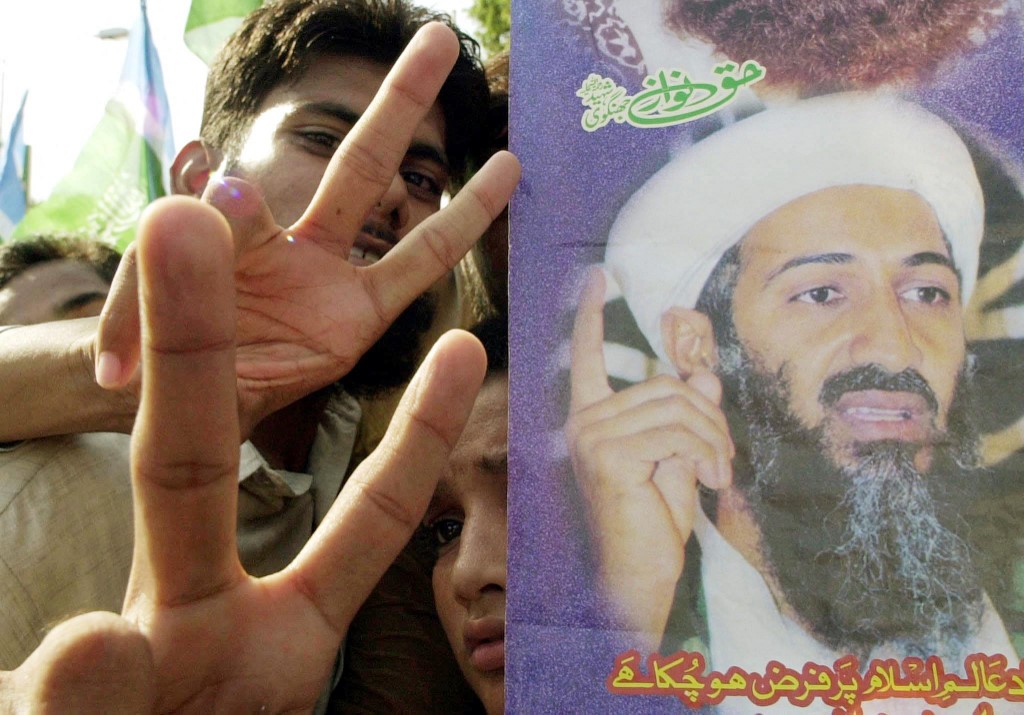
While other jihadis wanted to fight the “near enemy” – US-sponsored client regimes across the Muslim world – bin Laden’s special insight was the strategic utility of striking “at the head of the snake” and thus provoking the United States into a violent and irrational response which would poison its relationships with Muslim states and communities and make all of his Muslim opponents look like collaborators with the enemy.
Chaos and carnage
Bin Laden knew also that he and his followers could prevail in the struggle simply by remaining in being and forcing the US to accept more casualties and costs than its population would be ready to endure.
The course of events suggests that bin Laden may have understood the United States rather more clearly than Bush. He induced the US president to do exactly what he wanted, plunging much of the Muslim world into a period of chaos and carnage, from which it has yet to emerge, and creating the conditions for al-Qaeda and other terror groups to prosper.
For the neocons as for al-Qaeda, there was no middle way. The world was divided into two opposing forces: Islam and the West – and only one could emerge victorious
The neoconservatives who directed Bush’s response to 9/11 and al-Qaeda mirrored each other. They were both revivalist movements at odds with what they saw as a corrupt modernity seeking inspiration in the Salaf – the ancients. They both despised due process and the rule of law. They preferred violence to diplomacy.
For the neocons as for al-Qaeda, there was no middle way. The world was divided into two opposing forces: Islam and the West – and only one could emerge victorious. Both saw themselves as the ultimate good fighting the ultimate evil. Both despised moderate Muslims as much as western liberals.
Al-Qaeda and the neocons thus shared the false interpretation of Islam as a religion of violence and the same demented belief in an irreconcilable clash of civilisations between Muslims and the West.
Between them, they plunged much of the world into a death spiral. Muslims have suffered far worse in terms of lives lost. But America’s reputation across the world as a force for good has been destroyed, while the country now faces military defeat and a deep moral crisis from which it may not recover.
Had George W Bush acted rationally, Osama bin Laden would be despised as another terrorist – and no more. Thanks to Bush, he became a terrorist who changed world history, and a model for other terrorists across the world.
The views expressed in this article belong to the author and do not necessarily reflect the editorial policy of Middle East Eye.Peter ObornePeter Oborne won best commentary/blogging in 2017 and was named freelancer of the year in 2016 at the Online Media Awards for articles he wrote for Middle East Eye. He was also named as British Press Awards Columnist of the Year in 2013. He resigned as chief political columnist of the Daily Telegraph in 2015. His latest book, The Assault on Truth, was published in February 2021. His previous books include The Triumph of the Political Class, The Rise of Political Lying, and Why the West is Wrong about Nuclear Iran.


