Showing posts with label Abu Ghraib. Show all posts

Sunday, 20 July 2014

American torturers banned from entering Russia


Guantanamo and Abu Ghraib (AFP Photo / John Moore / wikipedia.org)

Russia has responded to US sanctions against its officials and businessmen by banning 12 more Americans from entering the country. Ten of those in the list are implicated in the Abu Ghraib torture scandal, and two are connected to Guantanamo.

We have mentioned before that it is futile to communicate with us in the language of sanctions. Such measures will not be allowed to pass without consequence,” said a statement on the foreign ministry website.

Among the most high-profile targets are Rear Adm. Richard W. Butler the Commander, of the Guantanamo Joint Task Force, who is accused of “approved the use force to end the hunger strike among inmates”, and Ricardo Sanchez, a retired general who commanded the Coalition Ground Forces in Iraq in 2003 and 2004, who was “directly responsible for the control of Abu Ghraib prison.

Most of the others on the "stop-list" are military personnel, who were found guilty of self-documented mistreatment and torture of Iraqi prisoners in Abu Ghraib.

It also includes the high-profile US District Judge Gladys Kessler, who has repeatedly ruled on the legality of force feeding at Guantanamo’s Camp Delta, though ironically, was responsible for the landmark ruling, passed in May, that bans the US Army from force feeding Syrian detainee Abu Wa'el Dhiab.

An inmate being escorted in Guantanamo (AFP Photo / John Moore)

 The Russian foreign ministry says that it is preparing further bans.

The latest wave of sanctions over Ukraine will necessarily result in counter-measures. Firstly, the border is being closed to multiple American citizens, which they will discover upon submitting a visa application. Meanwhile, economic sanctions will have a boomerang effect, and harm US business interest on Russian territory, In essence, the US is punishing itself.

The initial round of sanctions and counter-sanctions between Moscow and Washington was set off with the passing of the Magnitsky Act in the US in 2012.The act intended to prevent free entry to several Russian officials connected with the death of Russian lawyer Sergey Magnitsky, who passed away while in police custody in 2009.

Subsequently, more people Russian citizens and Crimean officials have ended up on US blacklists in several waves of sanctions.

Russia had already responded with its initial Guantanamo list of 18 names last year, to mirror the Magnitsky Act, and the 12 names this time are symmetrical to the expansion of the Magnitsky list in May.
In a separate but related move, Russia has banned controversial US congressman Jim Moran, “who has repeatedly evaded responsibility despite multiple financial misdeeds” from crossing its border. This is a response to the US banning Russian ruling party deputy Adam Delimkhanov from entering earlier this month, due to alleged mafia ties and allegations of being an accomplice to murder.

FULL LIST OF SANCTIONED AMERICANS

Gitmo

Rear Adm. Richard W. Butler, commander of the Guantanamo prison, who sanctioned the force-feeding following the detainees’ hunger strike.
Gladys K. Kessler, senior United States District Judge for the US District Court for the District of Columbia, who approved that “the legality of force-feeding” the hunger strikers at Gitmo.

Abu Ghraib

Ricardo Sanchez, a retired general who commanded the Coalition Ground Forces in Iraq in 2003 and 2004, was “directly responsible for the control of Abu Ghraib prison.”
Janis Leigh Karpinsky, retired officer, former head at Abu Ghraib and other prisons in Iraq in 2003 and 2004, who “covered up the abuse of prisoners.” After investigation she was demoted from brigadier general to colonel.
Steven L. Jordan, a retired lieutenant colonel, who headed the question of prisoners. Following the proceedings, he was reprimanded.

Steven L. Jordan.(AFP Photo / Paul J. Richards)
Ivan Frederick, former staff sergeant, “participated in the abuse of prisoners, personally beat them.”
Javal Davis, former sergeant, participated in the abuse of prisoners.
Charles Allan Graner, former US military officer, who “tortured the prisoners.”
Sabrina Dawn Harman, former US military officer, who abused the prisoners.
Jeremy SivitsLynndie Rana EnglandIsrael Rivera, former US military personnel who took part in the “torture of the prisoners.” Rivera avoided criminal liability.

Ivan Frederick.(Reuters / Alex Grimm)
River to Sea Uprooted Palestinian   
The views expressed in this article are the sole responsibility of the author and do not necessarily reflect those of the Blog!

Wednesday, 3 April 2013

British Personnel Reveal Horrors of Secret USA torture base in Baghdad

Camp Nama

Detainees captured by SAS and SBS squads subjected to human-rights abuses at detention centre, say British witnesses

View Baghdad's secret torture facility 
 
Share4         
baghdad international airport
Detainees were taken to Camp Nama, a secret US detention centre at Baghdad international airport. Photograph: Khalid Mohammed/AP
 
British soldiers and airmen who helped to operate a secretive US detention facility in Baghdad that was at the centre of some of the most serious human rights abuses to occur in Iraq after the invasion have, for the first time, spoken about abuses they witnessed there.

Personnel from two RAF squadrons and one Army Air Corps squadron were given guard and transport duties at the secret prison, the Guardian has established.

And many of the detainees were brought to the facility by snatch squads formed from Special Air Service and Special Boat Service squadrons.

Codenamed Task Force 121, the joint US-UK special forces unit was at first deployed to detain individuals thought to have information about Saddam Hussein's weapons of mass destruction. Once it was realised that Saddam's regime had long since abandoned its WMD programme, TF 121 was re-tasked with tracking down people who might know where the deposed dictator and his loyalists might be, and then with catching al-Qaida leaders who sprang up in the country after the regime collapsed.
Suspects were brought to the secret prison at Baghdad International airport, known as Camp Nama, for questioning by US military and civilian interrogators. But the methods used were so brutal that they drew condemnation not only from a US human rights body but from a special investigator reporting to the Pentagon.

A British serviceman who served at Nama recalled: "I saw one man having his prosthetic leg being pulled off him, and being beaten about the head with it before he was thrown on to the truck."
On the 10th anniversary of the invasion of Iraq, a number of former members of TF 121 and its successor unit TF6-26 have come forward to describe the abuses they witnessed, and to state that they complained about the mistreatment of detainees.

The abuses they say they saw include:
• Iraqi prisoners being held for prolonged periods in cells the size of large dog kennels.
• Prisoners being subjected to electric shocks.
• Prisoners being routinely hooded.
• Inmates being taken into a sound-proofed shipping container for interrogation, and emerging in a state of physical distress.

It is unclear how many of their complaints were registered or passed up the chain of command. A Ministry of Defence spokesperson said a search of its records did not turn up "anything specific" about complaints from British personnel at Camp Nama, or anything that substantiated such complaints.

Nevertheless, the emergence of evidence of British involvement in the running of such a notorious detention facility appears to raise fresh questions about ministerial approval of operations that resulted in serious human rights abuses.

Geoff Hoon, defence secretary at the time, insisted he had no knowledge of Camp Nama. When it was pointed out to him that the British military had provided transport services and a guard force, and had helped to detain Nama's inmates, he replied: "I've never heard of the place."
The MoD, on the other hand, repeatedly failed to address questions about ministerial approval of British operations at Camp Nama. Nor would the department say whether ministers had been made aware of concerns about human rights abuses there.
crispin blunt nama Former army officer Crispin Blunt accused defence secretary John Hutton in 2009 of sweeping under the carpet the evidence of direct British service involvement. Photograph: Anthony Devlin/PA
However, one peculiarity of the way in which UK forces operated when bringing prisoners to Camp Nama suggests that ministers and senior MoD officials may have had reason to know those detainees were at risk of mistreatment. British soldiers were almost always accompanied by a lone American soldier, who was then recorded as having captured the prisoner. Members of the SAS and SBS were repeatedly briefed on the importance of this measure.

It was an arrangement that enabled the British government to side-step a Geneva convention clause that would have obliged it to demand the return of any prisoner transferred to the US once it became apparent that they were not being treated in accordance with the convention. And it consigned the prisoners to what some lawyers have described as a legal black hole.

Surrounded by row after row of wire fencing, guarded by either US Rangers or RAF personnel, and with an Abrams tank parked permanently at its main gate, to the outside observer Camp Nama seemed identical to scores of military bases that sprang up after the 2003 invasion of Iraq. Once inside, however, it was clear that Nama was different.
Not that many people did enter the special forces prison. It was off limits to most members of the US and UK military, with even the officer commanding the US detention facility at Guantánamo being refused entry at one point. Inspectors from the International Committee of the Red Cross were never admitted through its gates.

One person who has been widely reported to have been seen there frequently was General Stanley McChrystal, then commander of US Joint Special Operations forces in Iraq.

general Stanley McChrystal General Stanley McChrystal, then commander of US Joint Special Operations forces in Iraq, was said to have visited Nama. Photograph: Christian Sinibaldi for the Guardian

While Abu Ghraib prison, just a few miles to the west, would achieve global notoriety after photographs emerged depicting abuses committed there, Camp Nama escaped attention for a simple reason: photography was banned. The only people who attempted to take pictures – a pair of US Navy Seals – were promptly arrested. All discussion of what happened there was forbidden.
Before establishing its prison at Nama, TF 121 had been known as Task Force 20, and had run a detention and interrogation facility at a remote location known as H1, in Iraq's western desert. At least one prisoner had died en route to H1, allegedly kicked to death aboard an RAF Chinook.
The British were always junior partners in TF 121. Their contingent was known as Task Force Black. US Delta Force troops made up Task Force Green and US Army Rangers Task Force Red. One half of Task Force Black comprised SAS and SBS troopers, based a short distance away at the government compound known as the Green Zone. They detained so-called high-value detainees, who were brought to Camp Nama. The other half were the air and ground crews of 7 Squadron and 47 Squadron of the RAF, and 657 Squadron of the Army Air Corps, who lived on the camp itself, operating helicopters used in detention operations and a Hercules transport aircraft.

"The Americans went out to bring in prisoners every night, and British special forces would go out once or twice a week, almost always with one American accompanying them," one British serviceman who served at Nama recalled earlier this month.

''The prisoners would be brought in by helicopter, usually one at a time, although I once saw five being led off a Chinook. They were taken into a large hangar to be bagged and tagged, a bag put over their heads and their hands plasticuffed behind their backs. Then they would be lifted or thrown on to the back of a pick-up truck and driven to the Joint Operations Centre."

The Joint Operations Centre, or JOC, was a single storey building a few hundred yards from the airport's main runway. Some of those who served at Nama believed it had formerly been used by Saddam's intelligence agencies.

The US and UK forces worked together so closely that they began to wear items of each others' uniforms. But while British personnel were permitted into the front of the JOC, few were allowed into the rear, where interrogations took place. This was the preserve of US military interrogators and CIA officers based at Camp Nama. "They included a number of women," said one British airman. "One had a ponytail and always wore two pistols, so we had to nickname her Lara Croft."

There were four interrogation cells at the rear of the JOC, known as the blue, red, black and soft rooms, as well as a medical screening area. The soft room contained sofas and rugs, and was a place where detainees could be shown some kindness. Harsh interrogations took place in the red and blue rooms, while the black room – described as windowless, with hooks in the ceiling, and where every surface was painted black – is said to be the cell where the worse abuses were perpetrated.

According to an investigation by Human Rights Watch, the New York-based NGO, detainees were subject to "beatings, exposure to extreme cold, threats of death, humiliation and various forms of psychological abuse or torture" at the JOC. The New York Times has reported that prisoners were beaten with rifle butts and had paintball guns fired at them for target practice.

Signs posted around Nama are said to have proclaimed the warning "No Blood, No Foul": if interrogators did not make a prisoner bleed, they would not face disciplinary action.

There was also an overspill interrogation room cell behind the JOC: a shipping container lined with padding. "You could see people being taken in there, and they were in pretty poor shape when they were taken out," said one British witness. He adds: "Everyone's seen the Abu Ghraib pictures. But I've seen it with my own eyes."

A number of British soldiers who served with TF 121 said that some SAS officers were permitted to attend interrogations at the rear of the JOC. Human Rights Watch reports that one SAS officer took part in the beating of a prisoner thought to know the whereabouts of Abu Musab al-Zarqawi, the leader of al-Qaida in Iraq.

While not being interrogated, according to witnesses, prisoners were held in cells the size of large dog kennels. "They were made of wire mesh with sloping corrugated roofs," said a British ex-serviceman who served at Nama. "They were chest high, and two feet wide. There were about 100 of them, in three rows, and they always appeared to have at least one prisoner in each. They would be freezing at night, and really hot during the day.

"The prisoners were mostly men, although I did see two women being taken into the JOC for interrogation. I've no idea what became of them, or to any of the male prisoners after their interrogation was completed."

Some of the scenes at Nama were so disturbing that personnel serving there would literally look the other way, rather than witness the abuse. "I remember being on sentry duty at a post overlooking the dog kennels, and the guy I was with wouldn't even look at them," one British eyewitness recalls. "I was saying: 'Hey turn around and look at them.' And he wouldn't. He just wouldn't turn around, because he knew they were there."

Some complaints made at the time by British personnel were immediately suppressed. "I remember talking to one British army officer about what I had seen, and he replied: 'You didn't see that – do you understand?' There was a great deal of nervousness about the place. I had the impression that the British were scared we would be kicked off the operation if we made a fuss," the ex-serviceman said.
According to one US interrogator interviewed by Human Rights Watch, however, written authorisations were required for many of the abuses inflicted on prisoners at Nama, indicating that their use was approved up the chain of command.

"There was an authorisation template on a computer, a sheet that you would print out, or actually just type it in," the interrogator said. "It was a checklist. It was already typed out for you, environmental controls, hot and cold, you know, strobe lights, music, so forth. But you would just check what you want to use off, and if you planned on using a harsh interrogation you'd just get it signed off. It would be signed off by the commander."

iraq detainees According to one British serviceman who was at Nama, US soldiers would bring prisoners in every night. Photograph: Jehad Nga/Corbis

Camp Nama was such a secret location that when General Geoffrey Miller, the commander of the detention centre at Guantanamo Bay, was sent to Iraq in August 2003 to advise on interrogation regimes he was initially refused entry, according to Human Rights Watch.

At the end of 2003, the Pentagon sent a special investigator, Stuart Herrington, a retired military intelligence colonel, to discover more about the methods being employed at Nama. In December that year Herrington reported: "Detainees captured by TF 121 have shown injuries that caused examining medical personnel to note that 'detainee shows signs of having been beaten'. It seems clear that TF 121 needs to be reined in with respect to its treatment of detainees."

More than 30 members of the task force were subsequently disciplined for abusing prisoners. Yet the beatings continued, according to British witnesses. The dog kennel cells remained in place, and UK special forces continued to be used to snatch suspects to be brought in for interrogation. "I can see now that we were supplying the meat for the American interrogators," says one.

In February 2004, senior British special forces and intelligence officers felt emboldened enough to mount a detention operation without an accompanying US soldier. Troopers surrounded a house in southern Baghdad that MI6 had identified as a safe house for foreign fighters. Two men were killed in the raid and two others of Pakistani origin were detained and handed over to the US authorities.
After questioning at Nama, the pair were flown to Bagram, north of the Afghan capital, Kabul, where they are thought to remain incarcerated, despite efforts by lawyers to secure their release by persuading the appeal court in London to order the issuing of a writ of habeas corpus.

Two months later, in April 2004, US news media published a series of shocking photographs showing the abuse of prisoners at a different prison, Abu Ghraib, where individuals detained by regular troops rather than special forces were being held. A few days later Task Force 121 was renamed Task Force 6-26. Shortly after this, two US Navy Seals – who had their own compound with Camp Nama – were seen taking photographs from the roof of their building. Both men were immediately arrested, British witnesses say and were not seen at Nama again.

Later that summer the secret prison was moved to Balad, a sprawling air base 50 miles north of Baghdad, where it became known as the Temporary Screening Facility (TSF). The Army Air Force and RAF troops continued their role there.

SAS troops continued to provide detainees for interrogation, operating from their base in one of a row of seven large villas inside the Green Zone. The villa next door was occupied by troops from Delta Force. Each of the homes had a swimming pool, and at the end of the long garden behind the SAS villa was a large hut occupied by a UK military intelligence unit, the Joint Forward Interrogation Team, or JFIT.

Individuals detained by the SAS – accompanied by their lone American escort – would be flown by helicopter to a landing pad behind the villas, and taken straight to the JFIT. According to former members of TF 6-26, after a brief interrogation by the British, they would be handed over to US forces, who would question them further before releasing them, or arrange for them to be flown north to Balad.

In late 2003, according to former taskforce members, two SAS members wandered next door to the Delta Force villa, where they were horrified to see two Iraqi prisoners being tortured. "They were being given electric shocks from cattle prods and their heads were being held under the water in the swimming pool. There were less visits next door after that."

While a complaint was made, it is not thought to have reported through the chain of command. And it certainly appears not to have reached Downing Street, as shortly afterwards Tony Blair, then prime minister, visited the SAS house to thank the troopers for their efforts.

By the end of 2004, according to the BBC journalist Mark Urban, MI6 officers who had visited the secret prison at Balad were expressing concern that the kennel cells had been reconstructed there, and the British government later warned the US authorities that it would hand over prisoners only if there was an undertaking that they would not be sent there.

Shortly afterwards, the RAF Hercules operated by the task force was shot down while flying from Nama to Balad, with the loss of all 10 men on board. It was the largest loss of life suffered by the RAF in a single incident since the second world war.

By now, a growing number of British members of the task force were deeply disillusioned about their role. When one, SAS trooper Ben Griffin, decided he could not return to Iraq, he expected to be face a court martial. Instead, he discovered that a number of his officers sympathised with him, and he was permitted to leave the army with a first-class testimonial.

When Griffin went public, making clear that British troops were handing over to the US military large numbers of prisoners who faced torture, the MoD came under pressure to explain itself. In February 2009 the then defence secretary, John Hutton, told the Commons that "review of records of detention resulting from security operations carried out by UK armed forces" had disclosed that two men who had been handed over had since been moved to Afghanistan. His statement made no mention of the joint task force, of H1, or of Camp Nama or Balad or how British airmen and soldiers were helping to operate the secret prisons.

Crispin Blunt, a Tory MP and former army officer, accused Hutton of "simply sweeping under the carpet the apparent evidence of direct British service involvement with delivery to gross mistreatment amounting to torture involving hundreds if not thousands of people".

Today, 10 years after the invasion and the creation of the joint US-UK taskforce that detained and interrogated large numbers of Iraqis, the MoD responds to questions about their abuse by stating that it is aware only of "anecdotal accounts" of mistreatment, and that "any further evidence of human rights abuse should be passed to the appropriate authorities for investigation".

Griffin had done just that, asking the MoD itself to investigate the activities of the taskforce of which he had been a member. The MoD obtained an injunction to silence him, and warned he faced jail if he ever spoke out again
 
River to Sea Uprooted Palestinian  
The views expressed in this article are the sole responsibility of the author and do not necessarily reflect those of this Blog!

Saturday, 26 January 2013

Abuse in UK's Iraq occupation was 'systemic'

Source

The UK government is facing more allegations of vicious abuse in its Iraqi prisons during the occupation. Now, on the eve of the 10th anniversary of the invasion, lawyers want to prove that the abuse was systemic.

Next week, from January 29, not long before the 10th anniversary of the invasion of Iraq, UK lawyer Phil Shiner will present 180 statements to a high court in London. They were gathered in Beirut by Shiner and his Public Interest Lawyers team from Iraqis detained by the British army in southern Iraq between 2003 and 2008. The testimony is shocking, both because of its volume (another 871 statements are still to come), and its sickening detail.

One civilian, known only as Khalid, said, "[A British soldier] then grabbed my penis and dragged me around the floor while holding it. He also made me squat up and down whilst naked and inserted his finger into my anus. I would have preferred to have been killed than subjected to this."

Another prisoner, named Halim, claimed he was told: "Fuck you and fuck Islam!" by a soldier who then "opened the belt of my trousers and said 'now jiggy jiggy'. The soldier put his boot in my chest and pulled my trousers down … The soldier put his foot on my chest … lifted me in the air and turned me on to my front."

FILE - Undated handout photo made available by the Baha Mousa Public Inquiry shows Iraqi man Baha Mousa and family. A British doctor was stripped of his medical license Friday, Dec. 21, 2012, for misconduct and dishonesty over the death of an Iraqi man who was beaten and killed while in the custody of British troops.The latest fallout from Britain's troubled occupation of Iraq came as defense officials confirmed they have paid 14 million pounds ($23 million) to settle claims of abuse from more than 200 Iraqis. Dr. Derek Keilloh treated Baha Mousa, a hotel clerk who died at a British base after being detained in Basra in September 2003 during a sweep for insurgents. Keilloh, then a 28-year-old captain in the Queen's Lancashire Regiment, tried unsuccessfully to revive Mousa, but denied knowledge of the scale of the man's injuries. A public inquiry found that Mousa had sustained 93 injuries, including fractured ribs and a broken nose, in an appalling episode of serious gratuitous violence by British troops. (Foto:Baha Mousa Inquiry, File/AP/dapd)
Mousa was 'kicked to death' by British troops in Basra

Not just 'bad apples'

These are two of the dozens of descriptions, which feature hooding, sleep and sensory deprivation, mock executions, stress positions, threats of rape of detainees' female relatives, regular beatings, and religious abuse.

Shiner intends to show that the "bad apples" defense usually peddled by governments in such cases will no longer wash. He will argue that the sheer volume of the evidence he has gathered shows that the abuse was "systemic," and that, under the European Convention on Human Rights, a full inquiry is required.

"We've got the training materials, we've got the policy documents," Shiner told the British Observer newspaper. "Violence was endemic to the state practices."

Kartik Raj, UK-based campaigner for Amnesty International, agreed. "The allegations of abuse, ill-treatment, and death in custody - some of them are not allegations, they're proven fact - are so credible and so many, that there really does need to be an independent and thorough investigation," he told DW. "And it is something that should be looked at as a systemic issue in a systematic manner, rather than a series of individual cases where individuals have to take out a civil action against the government."

Proving systemic abuse

The importance of proving that such cases are not isolated is shown by the injustice that followed the killing of Baha Mousa. Mousa, a 26-year-old hotel receptionist, died after just 36 hours of British custody in Basra in September 2003. A British government inquiry into the death found that he had died after having been hooded for 24 hours and severely beaten. He suffered "at least" 93 injuries, including fractured ribs and a broken nose, and died, the inquiry concluded, of a combination of lack of food and water, heat, exhaustion, fear, previous injuries, and the hooding and stress positions. Andrew Williams, a law professor who wrote the book A Very British Killing on the Baha Mousa case, concluded more simply, "He was kicked to death."

Baha Mousa's father Dawood Mousa arrives to give evidence to the Baha Mousa Inquiry in London, Wednesday Sept. 23, 2009. Mousa was a 26-year old Iraqi who was beaten and killed in the custody of British troops following a raid on his hotel in the southern Iraq city of Basra in September 2003. (AP Photo/Matt Dunham)
Mousa's father gave evidence at the inquiry into his son's death
 
Seven soldiers were charged for the war crime. Six were acquitted or had their charges dropped, while the seventh, Corporal Donald Payne, was discharged from the army, served a year in prison for "inhumane treatment," while being cleared of manslaughter and perverting the course of justice. The judge, Justice Ronald McKinnon, stated that "none of those soldiers has been charged with any offence simply because there is no evidence against them as a result of a more or less obvious closing of ranks." "A collective amnesia set in," Williams told DW.

Thanks to the sheer number and the repetition in the new statements collected by Shiner, it seems easy to establish that there was a pattern of abuse during the British army occupation of southern Iraq. According to Williams, who also works as a researcher and legal advisor for the Public Interest Lawyers, "Under international criminal law, it's not completely required that you have to prove beyond any doubt that a particular person was responsible for setting up a program of abuse." Instead, Shiner will try to "establish that there is clear evidence… that people in authority knew that it was happening, and yet nothing was done to stop it."

Training interrogators

Some of the interrogation techniques described both in the Baha Mousa inquiry and the new testimonies - including hooding, sensory deprivation, and stressing - were made illegal in Britain in the early 1970s, following a European Court of Human Rights case on the treatment of Irish prisoners.

In this undated still photo provided by The Washington Post on Friday, May 21, 2004, a hooded Iraqi detainee appears to be cuffed at the ankle chained to a door handle while being made to balance on two boxes at the Abu Ghraib prison on the outskirts of Baghdad. The Washington Post has obtained what it says are hundreds of photographs and short digital videos - as of yet unreleased - depicting U.S. soldiers physically and emotionally abusing detainees last fall in the Abu Ghraib prison. (AP Photo/Washington Post)
The abuses alleged against UK forces recall those of Abu Ghraib
 
In light of this, the training materials for British army interrogators, some of which were disclosed in the Baha Mousa inquiry, have become key evidence. But the allusions in those manuals and Powerpoint presentations are vague. "They show that there was a degree of contempt for detainees," said Williams. "There would be comments such as, 'Get them naked.' There are certain indications in these materials that most people would see as abusive in themselves, but they also open the door for soldiers to take the material as a license to invent ways of treating detainees. You need to put together the pieces of a jigsaw."

The British Ministry of Defense's answer to all this is that any general questions about abuse were dealt with by the Baha Mousa inquiry, which resulted in 73 recommendations, as well as the ongoing work of its own internal "Iraq Historic Allegations Team." But this, says Amnesty International's Raj, is not enough.

"It's clear that the Baha Mousa recommendations, including the systemic recommendations, are based on a very, very specific time frame," he said. "I think the new issues have not been sufficiently addressed."

British soldiers help Iraqi soldiers during the construction of a military base in Basra, southern Iraq on 13 April 2008. Iraqi security forces set up several military bases in areas which witnessed battles between Iraqi security forces and the Mahdi Army in Basra. EPA/HAIDER AL-ASSADEE +++(c) dpa - Bildfunk+++
British troops occupied Basra until 2009
"The inquiry only looked at the particular systems in that particular case," added Williams. "It couldn't look at the investigation that took place after Baha Mousa was found dead, nor could it look at any other examples of abuse that had come to light. It couldn't join the dots."

'Culture of contempt'

Once they are joined, argues Williams, these dots create an image of what he calls a "culture of contempt" during the occupation of Iraq - including not only abuse of prisoners of war and civilians, but also unlawful killings on the streets.

If the high court does rule that there will be a public inquiry, it could go beyond making recommendations to actually prescribing responsibility. "From an international criminal law position, the answer to the question 'how high does it go?' is that it goes to top of government," said Williams. "But in terms of direct culpability - that's impossible to know unless you look at individual cases. As to general governmental responsibility, one has to ask who was in power at the time, who was overseeing the way that troops were operating and the means of interrogation."

The fact that the British government recognizes that there is a problem seems beyond doubt - in December it was reported that over £14 million (16.7 million euros) had been paid out to over 150 Iraqis in compensation for their treatment at the hands of British soldiers. "Why would they receive compensation, unless there was some legitimacy to their complaints?" asked Williams
 
River to Sea Uprooted Palestinian  
The views expressed in this article are the sole responsibility of the author and do not necessarily reflect those of this Blog!

Monday, 21 January 2013

Fresh charges: British "Abu Ghraib" hearing next week


Screenshot: Video uploaded on 13 July 2009 showing a British soldier screaming abuse at hooded Iraqi detainees has been played at the public inquiry into the death of Baha Mousa. (Video: ITN News)
Published Sunday, January 20, 2013
 
The UK was accused of pursuing a policy of systematic torture over a five-year period and breaking international laws of war during the 2003 invasion of Iraq.

There will be a hearing next week to review the fresh charges against Britain at the high court in London, led by civil rights lawyers, as the 10th anniversary of the invasion nears this March.
The Public Interest Lawyers group, founded by Phil Shiner, has conducted face-to-face interviews in Lebanon with Iraqi survivors, and the relatives of those unlawfully killed, that claim to have been tortured and abused by British intelligence officers and soldiers.

In addition to reports of beatings and other forms of violence, witness statements include sexual depravity, insults to Islam, masturbating over a prisoner, female interrogators stripping for information, and sodomy with the finger, according to an article in The Guardian.
Others were deprived of sleep, starved, threatened with execution, and subjected to sensory deprivation.

The video below posted by The Guardian “ shows a prisoner threatened, intimidated, subjected to sensory deprivation and complaining of starvation.”

Even though many died after beatings, they were said to have died of “natural causes,” the article reports.

The public hearing, to take place on January 29 over three days and expected to shed light on a "systematic" abuse by the British army, follows an inquiry into the death of Baha Moussa, an innocent hotel worker killed in Basra in 2003, while in British custody.

In the case put forth by the Shiner and his colleagues, the army doctor in charge at the time of reporting ill-treatment along with ensuring the well-being of other prisoners, was found guilty of misconduct and banned from practicing medicine.

The doctor had only reported a small trace of dried blood under Moussa’s nostril but the civilian, in custody for 36 hours, had been hooded for 24 of those hours and was found to have suffered at least 93 external injuries prior to his death according to a post-mortem examination.
Linked to the case, Cpl Donald Payne was dismissed from the Army and jailed for a year, while seven others admitted to inhumane treatment.

The video below depicts a British soldier yelling abusively at hooded Iraqi hostages and had been shown at the public inquiry into the death of Baha Mousa.


Video showing a British soldier screaming abuse at hooded Iraqi detainees has been played at the public inquiry into the death of Baha Mousa.

The Public Interest Lawyers group has so far collected 180 statements for the end-January inquiry, and it is expected that they will present a total of 1051 at the public hearing.

Interviews were conducted in Lebanon where the “travel formalities are more straightforward.” The witnesses were located and encouraged to cooperate by a “local Iraqi citizen” and then interviewed in Lebanon, where statements were drawn up using “high-quality interpreters” according to a transcript of a public hearing.

Shiner and his colleagues are currently representing 130 former detainees who say that “they or their family members were unlawfully detained, ill-treated, or killed by UK forces” during the war on Iraq.
 
River to Sea Uprooted Palestinian  
The views expressed in this article are the sole responsibility of the author and do not necessarily reflect those of this Blog!

Monday, 11 June 2012

A License To Kill: Beyond Good And Evil

by Daniel Mabsout
Sunday, June 10th, 2012
War Crimes in Iraq
The world order must act and for that it needs agents and instruments of action. The task is huge and it needs a huge army, the Army is there and also the weapons are there, all sorts of weapons, but there are actions the armies will not do, or will only do reluctantly and with repercussions.The US army has committed atrocities -no doubt- by the standards of any army; these are considered atrocities that should not have happened, that is why they were leaked to the media in order to deny the fact that they were normal and natural and insinuate that they were a deviation that needed to be checked.

A regular army has a set of moral principles that are there, and even if the army will not abide by them, any deviation is considered as such and is not really praised, and could even be sanctioned, as happened to some US soldiers in Iraq or – previously – in Vietnam when the atrocities committed by US soldiers were denounced and exposed.

Due to this, the world order wanted to carry on the evil job of genociding humanity- but needed something other than a regular army, something that has no moral code, that will be free to act and let loose from any obligation towards humanity. This is how assassins’ schools probably started, they originated from this certain need the world order felt -at a certain moment of history – to breed a species of devils, or specially trained killers, specialized in killing, that can kill anyone anytime and anyplace with whatever means or weapons without suffering any psychological, moral or emotional set back, and out of their own freedom and with no obligation on others..

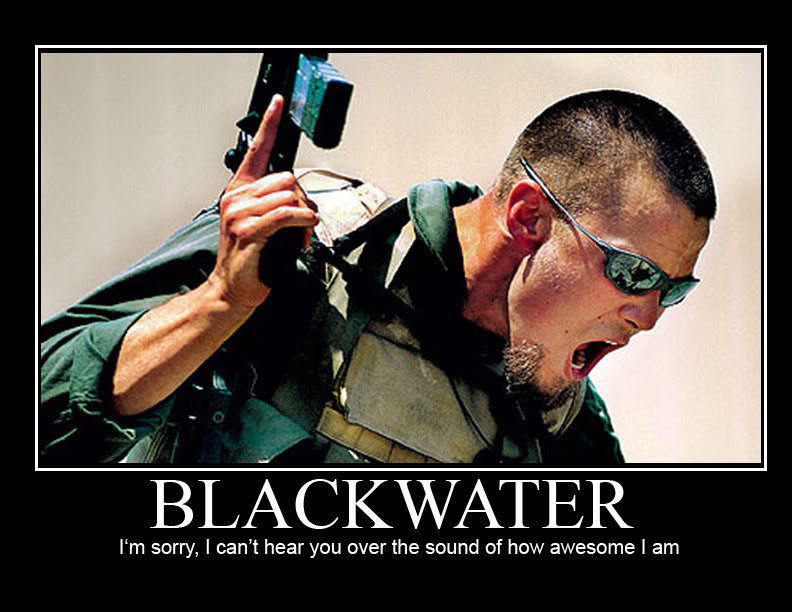
Organizations like Black Water did not spring from the need to meet security requirements as pretended, but from this need to have someone- other than the regular army -that could carry on special secret missions that involve massive killing and slaughter and which break the laws of humanity; someone anonymous that will assume the job out of obsession with killing and with his role as a killer, someone who cannot be identified nor located easily in case of retaliation or set back; some one that can turn the filthy job of killing into a clean one, behind which no one specific is found or identified, no definite organization, except the floating name –maybe- of al Qa’ida.
This cleanliness of the job is most important, it makes the crime look as if committed by an occult power, transcendental, beyond reach, that no one can have access to, that no one can challenge or defeat; a super hidden power that could not be revealed, equal- in this -to the blind destiny that rules and strikes without thinking or discriminating, without memory or remorse, a machine functioning with the proper mechanism fed with the proper reaction to move when necessary.

There is no doubt that the US and allies have invented the biggest assassin human machine that ever existed. And along with the researches that developed the killing air drones, and those that discovered and developed the viruses and bacteria that attack human beings and spread diseases, were conducted studies – of a different kind – carried on by specialized centers and researchers, that analyzed –extensively-the human and social behavior in all its complexity for the purpose of designing – to perfection –the future killing assassins who will carry on the difficult job of doing away with the portion of humanity targeted by the world order. It is not an easy task to design such a person that will kill without motivation, who attempts at human life not in order to serve his country or his ideology or to defend himself or his land, but who kills because he has the desire and inclination to do.
Whether Arab, Latin, Anglo Saxon or God knows what, the future assassin must- definitely – undergo a brainwashing, maybe a sort of identification with a special divinity to whom everything is permitted and whose acts are not accountable and who – because of this – they can dispose of human life without fear. These are the assassins that will be in charge of the major task of liquidating humanity as assigned by the world order. Whether he looks Muslim or bearded, with his face is covered or not, this is not the real identity of this assassin, his identity is that of an assassin even if the world order wants you to identify him as a Muslim or a terrorist- as they say. For us- he is nothing but a killer that has graduated from the assassins’ schools of USA because these killers are school graduates, they have diplomas probably and licenses: licenses to kill and slaughter and come out clean of all this, and you can be sure, they believe in what they are doing.


Abu Ghraib Prison
These schools-are not functioning alone, they are assisted –as well–by multiple research centers that work day and night on the human psyche to obtain the best results for the best product. As for the ground of application and practice of these theories and concepts of the human psyche, there are non other than Guantanamo and Abu Ghraib and the multiple underground prisons that US intelligence is monitoring -all over the world -through local and foreign agents.
These are the places where the extent of human suffering is studied and the extent of human violence is measured by means of torture and deprivation and humiliation practiced on mostly innocent victims who have been chosen at random, from poor countries, from the streets of Baghdad or Basra, or from the villages of Afghanistan and Baluchistan -after being accused of crimes they did not commit-.

They are going to be used as guinea pigs who will have to feed- unwillingly- and provide material for the researches conducted by the bloody masters of this world who have decided to do away with humanity and have- for this purpose- mobilized science and man and built schools and prisons.
River to Sea Uprooted Palestinian  
The views expressed in this article are the sole responsibility of the author and do not necessarily reflect those of this Blog!