Showing posts with label CIA's Opium Trade. Show all posts

Monday, 30 August 2021

“I Was Living Like Scarface”: The Ludicrous Costs of the War in Afghanistan Revealed in New Documents, Testimonies

 August 25th, 2021

By Alan Macleod

Source

“Holy cow, I was living like Scarface…I was paying out anywhere between $300-400,000 per week to $5 million per week at times. All in cash.” Matthew Hoh, U.S. Marine Corps Captain and former State Department official.

 Province, Afghanistan, over U.S. policy in the country. “The way to prove that you were doing your job was by spending money,” Hoh told MintPress, continuing:

Money being spent on an institutional level was a metric of success. Somehow in the minds of the U.S. political leaders, in Iraq and Afghanistan, dollars spent equated to things being constructed and effective counterinsurgency [against the Taliban]…But the Taliban themselves were taking the money! The Taliban guys were doing the construction work. It was absolutely nuts!”

Funding the enemy

By this time, the U.S. had effectively lost control of Afghanistan. One officer told Hoh that he controlled only the area “as far as my machine guns reach and the Taliban control everything else.” If that was the case, why didn’t the Taliban overrun any of the network of small U.S. bases throughout the country? One reason was that they were afraid of U.S. airpower. But an equally important factor, Hoh claimed, was that NATO outposts were handing out millions of dollars in cash to local firms and groups as part of their mission — enormous sums in a country where the majority live on less than $2 per day. “The Taliban were making a ton of money off these outposts,” Hoh exclaimed, “and everyone knew exactly where the money was going!”
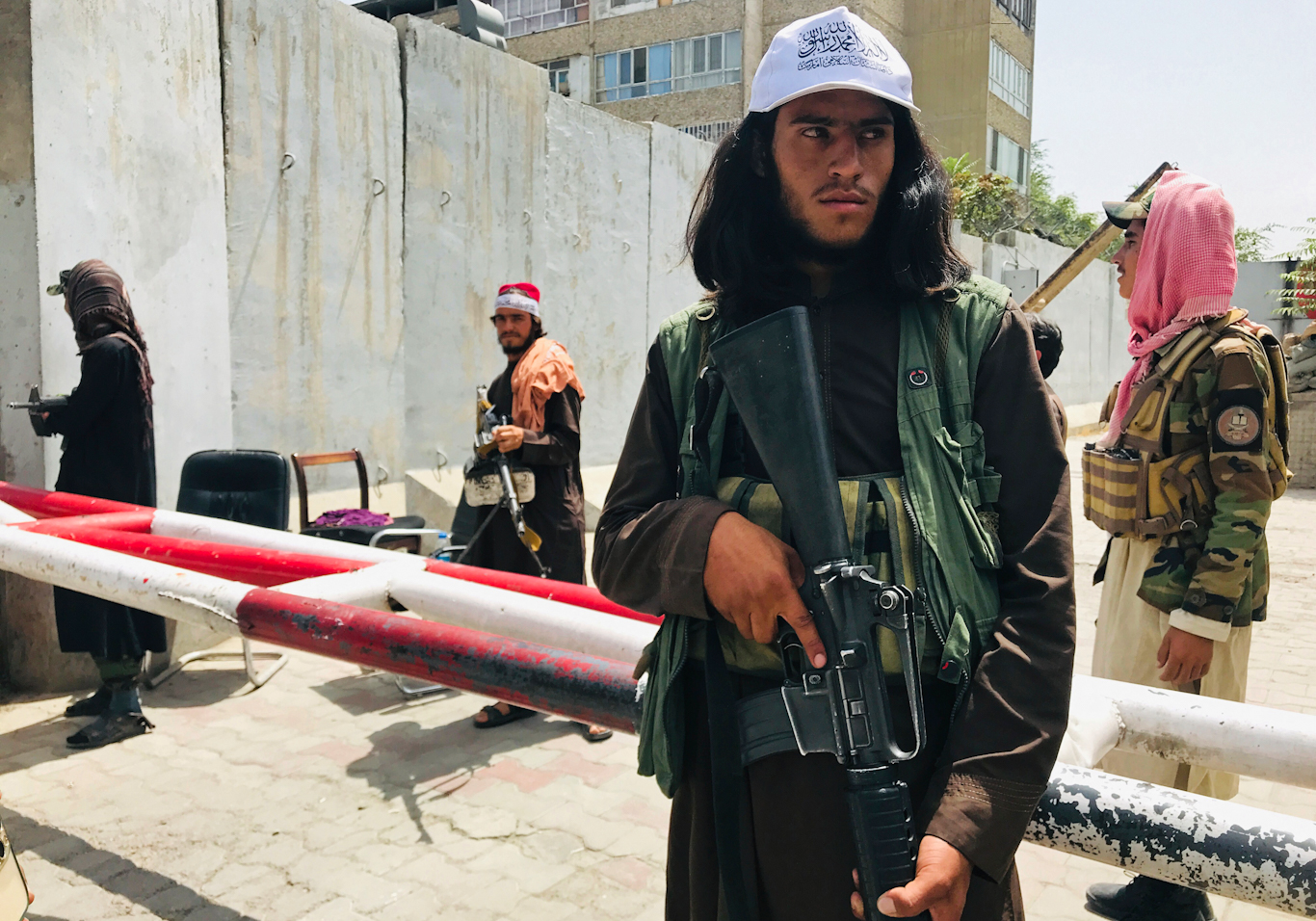
Taliban fighters hold American weapons at a checkpoint previously manned by US troops in Kabul, Aug. 17, 2021. Photo | AP

Taliban fighters hold American weapons at a checkpoint previously manned by US troops in Kabul, Aug. 17, 2021. Photo | AP

While this might sound far-fetched to a lay person, the notion that the U.S. was directly paying off the Taliban has been an established fact for over a decade, the latest SIGAR report noting that Washington has been “buying” the insurgents’ cooperation, making the Taliban “unofficial subcontractors to the U.S. government.”

“We’re talking about a fountain of money that the Taliban were happy to take. Whether they took it directly or it was the Taliban commander’s cousin that was the contractor, it doesn’t matter. The absurdity of all this — and everyone knew it was going on!” Hoh exclaimed.

Flooding Afghanistan with cash

In an attempt to win hearts and minds, U.S. forces began spending vast sums of money on reconstruction and social projects. Yet the money spent was far more than Afghanistan could productively absorb and it continued to grow to the point where American agencies had no way of effectively disbursing and overseeing it. This cash-in-hand system also created widespread networks of corruption that sustained huge numbers of people, including many in Washington.

As the SIGAR study explained, the assumption underpinning the whole strategy was that ordinary Afghans were the source of the corruption and that increased spending would reduce the fraud over time. Only after years of this strategy did the U.S. realize it was the enormous cash injection itself that was causing the problems. But, “rather than revisit their assumptions when progress proved elusive, U.S. officials concluded that it would be better to power through the shortcut by adding even more money” — a decision that might lead some to question the officials’ motives.

Flooding the country with cash produced a myriad of unforeseen negative economic consequences, making some places resemble gold-rush towns. Such was the speed and ambition of reconstruction efforts in Helmand Province, for instance, that local teachers quit their jobs to become day laborers for better wages, leaving children in the lurch.
Afghanistan Bagram
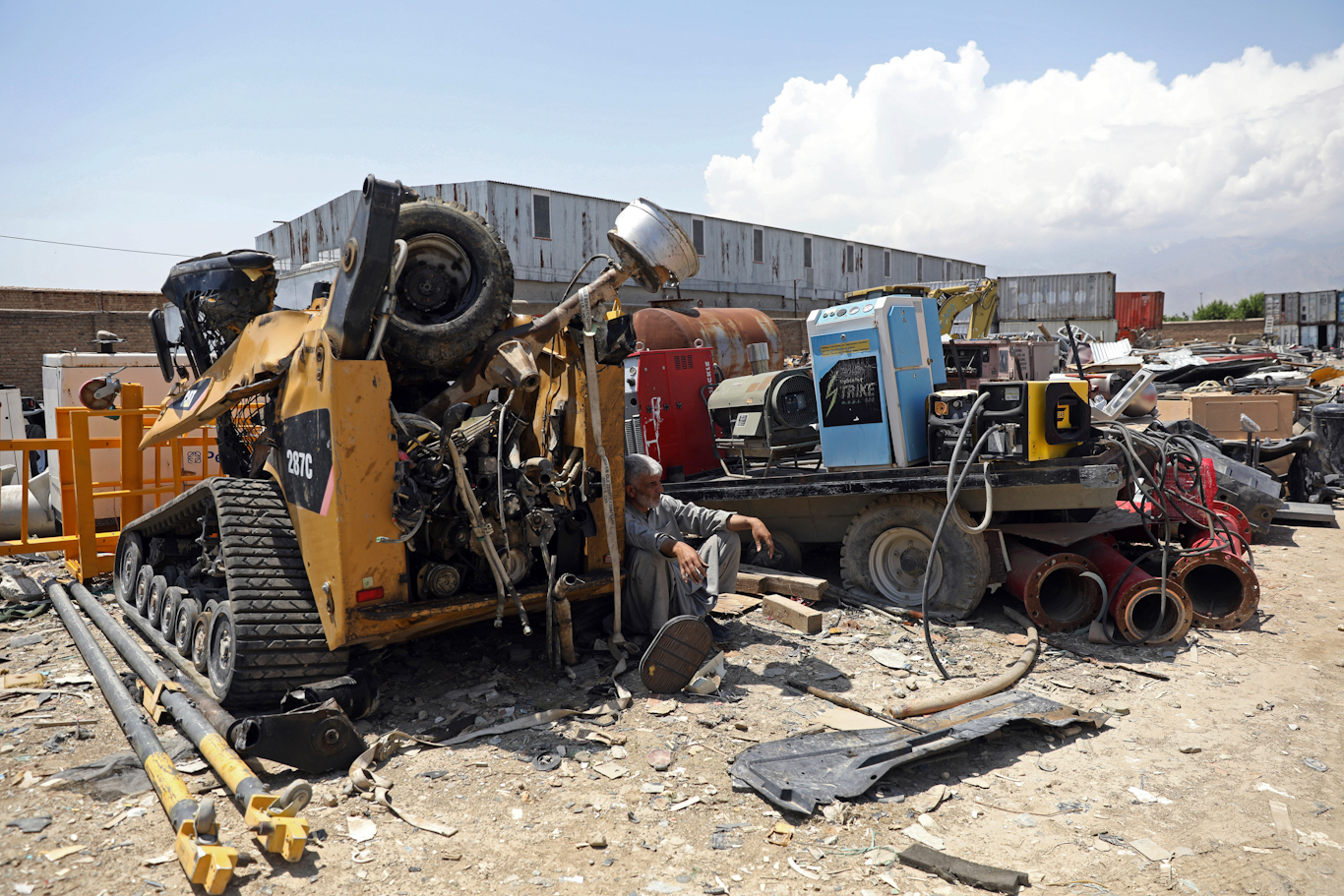
A man rests in the shade of destroyed machinery sold by the US military to a scrapyard, outside Bagram Air Base. Rahmat Gul | AP

A man rests in the shade of destroyed machinery sold by the US military to a scrapyard, outside Bagram Air Base. Rahmat Gul | AP

Hoh, who had been sent to Iraq to perform essentially the same function, had never seen anything like it. “Holy cow, I was living like Scarface… I was paying out anywhere between $300-400,000 per week to $5 million per week at times. All in cash,” he said.

I had $50 million in cash. The most I ever had at one point was $24 million on hand, in $100 bills, sitting in safes in my bedroom. And there was hardly any oversight whatsoever. Once we signed that money out of the vault in Baghdad, it was up to me how to document that money was spent and where the money went…I had no requirement. Literally. I am not joking. No guidance and no requirement to provide documentation about where that money went.”

No oversight

Because U.S. forces could not travel freely in Afghanistan, rarely venturing far beyond their bases, they were largely forced to take Afghan contractors at their word. This resulted in corner-cutting and shoddy workmanship becoming the norm, as Afghans had no incentive to produce quality work. SIGAR noted one particularly embarrassing instance where the U.S. paid $2.4 million for a new compound that it could never use, as it was built outside the security perimeter of the base for which it was commissioned.

Making money off American ignorance became a relatively sophisticated operation, with one Kandahar-based organization even providing contractors with doctored images of fake projects, replete with fraudulent geotags embedded in the digital photographs, helping local businesses swindle USAID. As former Ambassador to Afghanistan Ryan Crocker told SIGAR, “The ultimate point of failure for our efforts wasn’t an insurgency. It was the weight of endemic corruption.”

Poppy fiasco

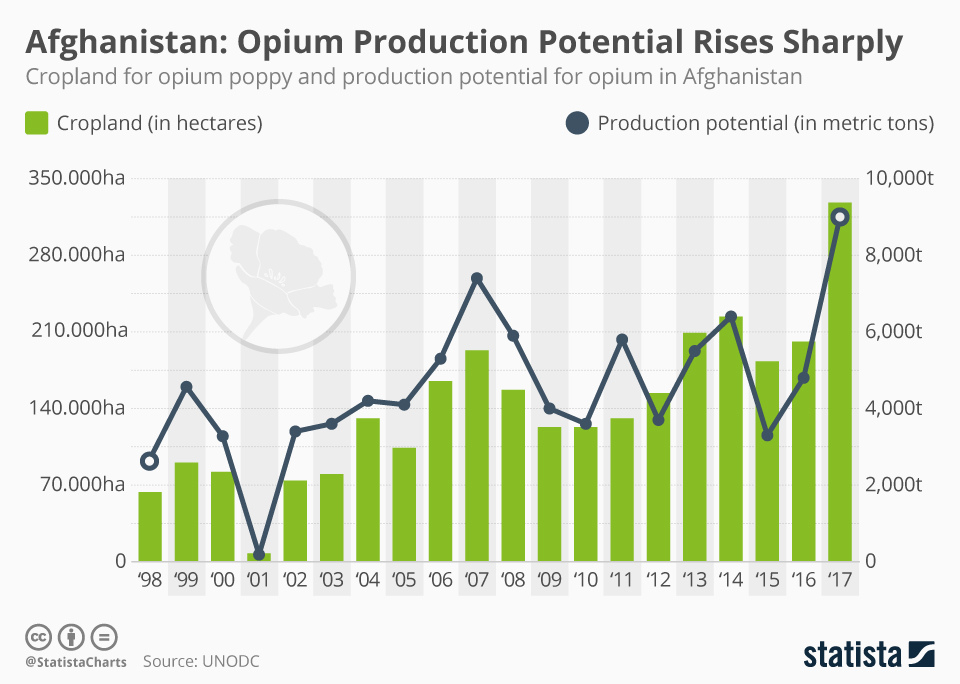
The heroin trade exploded under the U.S. watch. In 2001 — the year of the invasion — Afghanistan produced just 185 tons of the drug. However, that number ballooned to over 9,000 tons by 2017, according to the United Nations Office on Drugs and Crime. The boom turned Afghanistan into the world’s first true narco-state, according to Professor Alfred McCoy, author of “The Politics of Heroin: CIA Complicity in the Global Drug Trade.”

The trade implicated almost everybody in power, including Afghan President Hamid Karzai’s brother Ahmed Wali, among the biggest and most notorious drug kingpins in the south of the country.

Attempts to crush opium production often backfired comically. Local farmers were given cash not to plant poppies. But frequently, they would simply take the money and plant the crop elsewhere, unbeknownst to the Americans. Thus, they were simultaneously getting paid to plant and paid not to plant.
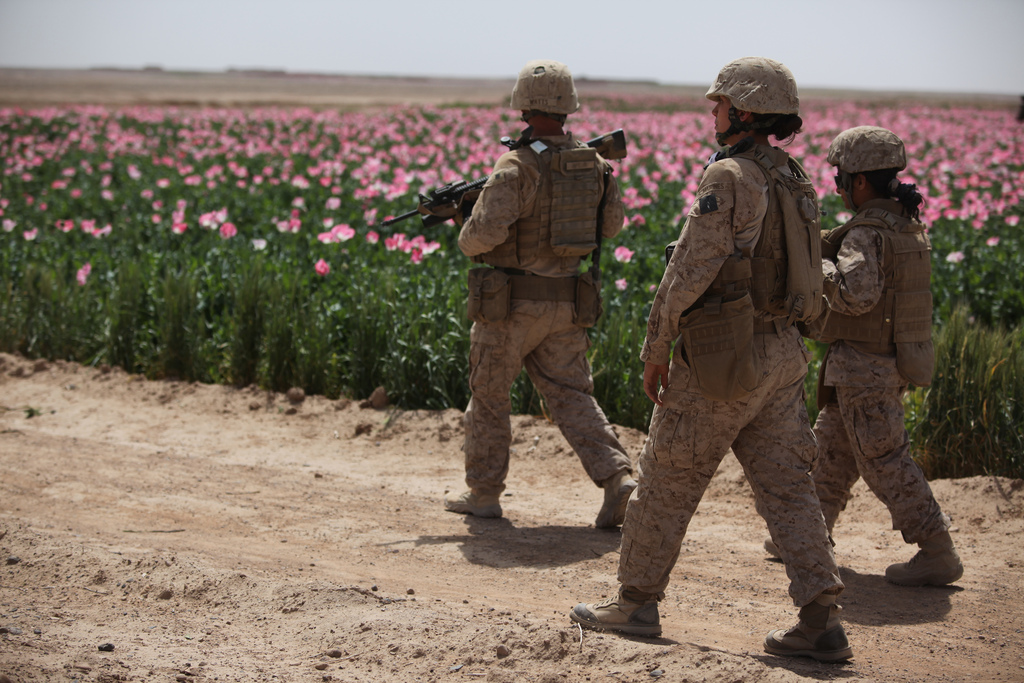
U.S. Marines assigned to the female engagement team (FET) of I Marine Expeditionary Force (Forward) conduct a patrol alongside a poppy field while visiting Afghan settlements in Boldak, Afghanistan, April 5, 2010. (DoD photo by Cpl. Lindsay L. Sayres, U.S. Marine Corps/Released)
US Marines conduct a patrol alongside a poppy field in Boldak, Afghanistan on April 5, 2010. Photo | DoD

US Marines conduct a patrol alongside a poppy field in Boldak, Afghanistan on April 5, 2010. Photo | DoD

The U.S. also often paid huge sums of money to Afghan warlords to destroy poppy fields. However, local bosses — who grew the crop themselves — would simply destroy their rivals’ fields and collect the money, leaving themselves both enriched and in a dominant position to further control the trade in their area.

One notable example of this is local strongman Gul Agha Sherzai, who eradicated his competitors’ crops in Nangarhar Province (while quietly leaving his own in Kandahar Province untouched). But all the U.S. saw was a local politician seemingly committed to stamping out the illegal drug trade. They therefore showered him with money and other privileges. “We literally gave the guy $10 million in cash for rubbing out his competition,” Hoh said. “If you were going to write a movie about this, they’d say ‘This is too far fetched. No one is going to believe this. Nothing is this insane or stupid.’ But that is the way it is.”

At war with the truth

Truth, the ancient Greek playwright Aeschylus noted, is always the first casualty in war. And Afghanistan is a prime example of this phenomenon. The release of the Afghanistan Papers in 2019 showed that there had been a years-long drive to deliberately deceive the public about the conflict, with officials consistently sharing over-optimistic figures and assessments they knew to be untrue, all in an effort to keep the occupation going.

The SIGAR report details how “[e]normous pressure to demonstrate progress to the Congress and the American and Afghan people distorted accountability systems into spin machines,” condemning the “utterly dishonest” handling of the war, and concluding that “[t]here was little appetite for honest assessments of what worked and what did not.” “The American people have been lied to,” concluded John Sopko, the special inspector general at SIGAR.

Has the U.S. made things better?

Images of desperate people fleeing the Taliban’s seemingly unstoppable advance have flooded Western TV networks and social media news feeds, with well-paid pundits hand-wringing about how such a retreat must never happen again, that we are abandoning our allies, and how all our good work across the country will quickly be undone.

However, it is important to soberly assess the condition Afghanistan is being left in. While things were far from fine before the U.S.-led invasion, polls conducted by American organizations show Afghanistan to be the saddest place on earth. Zero percent of respondents claimed that they are “thriving” as opposed to 85 percent who said they were “suffering,” when asked by Gallup in 2019. And while war has been good business for some, President Ashraf Ghani — who fled the country as soon as the American troops left — recently admitted that 90% of the population was living on less than $2 per day.
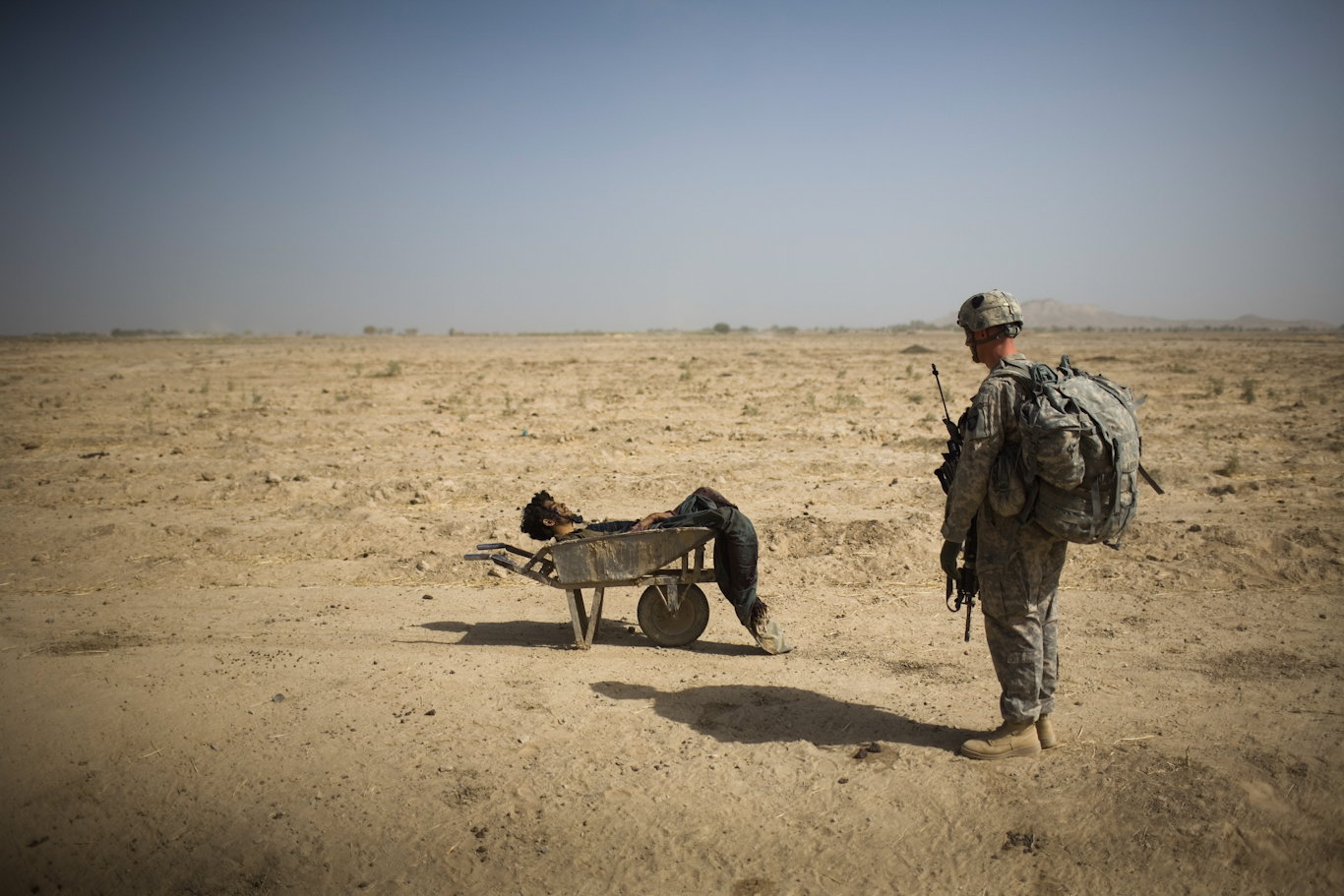
A US soldier looks at the body of a suspected Taliban fighter killed in a coalition missile strike in Kandahar, Oct. 10, 2010. Rodrigo Abd | AP

A US soldier looks at the body of a suspected Taliban fighter killed in a coalition missile strike in Kandahar, Oct. 10, 2010. Rodrigo Abd | AP

On the Afghanistan Papers, MintPress News contributor and founder of anti-war group CODEPINK Medea Benjamin wrote:

The debacle in Afghanistan is only one case in a fundamentally flawed U.S. policy with worldwide consequences. New quasi-governments installed by U.S. ‘regime change’ in country after country have proven more corrupt, less legitimate and less able to control their nation’s territory than the ones the U.S. has destroyed.

Before the rise of the Taliban (who, incidentally, derived much of their power from U.S. money and arms flowing to the anti-Soviet Mujahideen), half of Afghan university students were women, as were 40% of the country’s doctors, 70% of its teachers and 30% of its civil servants.

For all the talk of the advancement in women’s rights and education in the country, today, in half of Afghanistan’s provinces, fewer than 20% of teachers are female (and in many, that number is less than 10%). Only 37% of girls can even read (as opposed to 66% of boys), according to Human Rights Watch.

Fear of personal safety in the country has increased virtually every year in Afghanistan since 2005, reaching all-time highs today. Hundreds of thousands of people have lost their lives and 5.9 million people have fled their homes. In 2018 alone, Afghans submitted 1.17 million complaints to the International Criminal Court, detailing accounts of atrocities from all groups, including U.S. forces.

Killing and making a killing

Thus, it is painfully clear that there are many losers in this conflict. But there were also clear winners. Even losing wars make money, and much of that money went to private or semi-private companies that populate the suburbs of Washington, D.C.

Hoh stated that there was corruption and stealing among American officials as well as Afghan. Deals were not documented, often completed upon a handshake alone, and there is often no paper trail to explain where all this money went. “But a lot of this was just legal,” he said, noting that 40% of the “aid” money earmarked for Iraq and Afghanistan never even left the United States, going towards management and consultancy fees for the prime contractor.

One of these groups is Creative Associates International, a for-profit NGO that received $449 million worth of contracts in Afghanistan, including one to rebuild the country’s education system around a privatized model. Creative Associates redesigned the Afghan curriculum, purging any mention of the past few decades of the country’s history (including the Taliban) from textbooks. “You can’t buy that kind of thought control — unless you have a few hundred million,” wrote one American educator.

Weapons companies have also made a killing supplying the U.S. and its allies with the arms necessary to sustain a 20-year campaign. As Jon Schwarz of The Intercept noted, defense stocks have outperformed the market by 58% over the past two decades. A prime example of this is Lockheed Martin. $10,000 of that company’s stock bought in September 2001 would now be worth more than $133,000. Lockheed Martin itself today receives more in federal contracts than all weapons manufacturers put together did 20 years ago.

Hoh sardonically noted that “the one place that reconstruction was successful was in Northern Virginia.” The rest of America might be struggling, but Raytheon Acres is flourishing.

Why we fight

In the wake of the 9/11 attacks, the United States and its allies originally entered Afghanistan to capture Osama Bin Laden, for whom the Taliban were said to have previously provided sanctuary. Underreported at the time was that the Taliban offered to hand him over to a third country if the U.S. would provide evidence connecting him to the terrorist attacks.

The U.S.’ mission slowly changed from stamping out al-Qaeda to opposing the Taliban, to the point that, when Bin Laden was killed in 2011 (in Pakistan), there was little talk of pulling the U.S. out of Afghanistan. Highlighting the phenomenon of mission creep is the fact that in the first draft of the U.S.’ 2009 military strategy for Afghanistan document, there is no mention of al-Qaeda, because NATO believed the group was “no longer a problem.”

While President Joe Biden has been praised and condemned in equal measure for his decision to remove troops from the country, he was at pains to make clear that this was not a renunciation of violence, saying:

Today a terrorist threat has metastasized well beyond Afghanistan. Al-Shabab in Somalia, al-Qaeda in the Arabian Peninsula, al-Nusra in Syria, ISIS attempting to create a caliphate in Syria and Iraq and establishing affiliates in multiple countries in Africa and Asia. These threats warrant our attention and our resources.”

“We’ve developed counterterrorism over-the-horizon capability that will allow us to keep our eyes firmly fixed on the direct threats to the United States in the region, and act quickly and decisively if needed,” he added.

Therefore, it is clear that the White House has not learned the lessons that anti-war activists hoped they had. With Washington also increasingly setting its sights on China and Russia, the exorbitant costs in Afghanistan might seem cheap in comparison to any future wars dwarfing this one in scale.


River to Sea Uprooted Palestinian   
The views expressed in this article are the sole responsibility of the author and do not necessarily reflect those of the Blog!

Friday, 20 August 2021

Inside US Afghanistan pullout : The Grayzone interviews Pepe Escobar

 August 19, 2021


River to Sea Uprooted Palestinian   
The views expressed in this article are the sole responsibility of the author and do not necessarily reflect those of the Blog!

Saturday, 26 June 2021

Geopolitics, Profit, and Poppies: How the CIA Turned Afghanistan into a Failed Narco-State

June 25th, 2021 

By Alan Macleod

CIA Afghanistan Drug trade Feature photo
The war in Afghanistan has looked a lot like the war on drugs in Latin America and previous colonial campaigns in Asia, with a rapid militarization of the area and the empowerment of pliant local elites.

AFGHANISTAN — The COVID-19 pandemic has been a death knell to so many industries in Afghanistan. Charities and aid agencies have even warned that the economic dislocation could spark widespread famine. But one sector is still booming: the illicit opium trade. Last year saw Afghan opium poppy cultivation grow by over a third while counter-narcotics operations dropped off a cliff. The country is said to be the source of over 90% of all the world’s illicit opium, from which heroin and other opioids are made. More land is under cultivation for opium in Afghanistan than is used for coca production across all of Latin America, with the creation of the drug said to directly employ around half a million people.

This is a far cry from the 1970s, when poppy production was minimal, and largely for domestic consumption. But this changed in 1979 when the CIA launched Operation Cyclone, the widespread funding of Afghan Mujahideen militias in an attempt to bleed dry the then-recent Soviet invasion. Over the next decade, the CIA worked closely with its Pakistani counterpart, the ISI, to funnel $2 billion worth of arms and assistance to these groups, including the now infamous Osama Bin Laden and other warlords known for such atrocities as throwing acid in the faces of unveiled women.

“From statements by U.S. Ambassador [to Iran] Richard Helms, there was little heroin production in Central Asia by the mid 1970s,” Professor Alfred McCoy, author of “The Politics of Heroin: CIA Complicity in the Global Drug Trade,” told MintPress. But with the start of the CIA secret war, opium production along the Afghanistan-Pakistan border surged and refineries soon dotted the landscape. Trucks loaded with U.S. taxpayer-funded weapons would travel from Pakistan into its neighbor to the west, returning filled to the brim with opium for the new refineries, their deadly product ending up on streets worldwide. With the influx of Afghan opium in the 1980s — Jeffrey St. Clair, co-author of “Whiteout: The CIA, Drugs and the Press,” alleges — heroin addiction more than doubled in the United States.

“In order to finance the resistance for a protracted period, the Mujahideen had to come up with a livelihood beyond the weapons that the CIA was providing,” McCoy said, noting that the weapons issued could not feed the fighters’ families, nor reimburse them for lost labor:

So what the resistance fighters did was they turned to opium. Afghanistan had about 100 tons of opium produced every year in the 1970s. By 1989-1990, at the end of that 10-year CIA operation, that minimal amount of opium — 100 tons per annum — had turned into a major amount, 2,000 tons a year, and was already about 75% of the world’s illicit opium trade.”

The CIA achieved its goal of giving the U.S.S.R. its Vietnam, the Soviets failing to quash the Mujahideen rebellion by the time they finally pulled out in 1989. But American money and weapons also turned Afghanistan into a dangerously unstable place full of warring factions that used opium to fund their battles for internal supremacy. By 1999, annual production had risen to 4,600 tons. The Taliban eventually emerged as the dominant force in the country and attempted to gain international legitimacy by stamping out the trade.

In this, they were remarkably successful. A 2000 ban on opium cultivation by the Taliban-led government led to an almost overnight drop to just 185 tons harvested the following year, as frightened farmers chose not to risk attracting their wrath.

The Taliban had hoped that the eradication program would win favor in Washington and entice the United States to provide humanitarian aid. But unfortunately, history had other ideas. On September 11, 2001, the U.S. experienced a massive case of blowback, as Bin Laden’s forces launched attacks on New York and Washington. The U.S. ignored the Taliban’s offer to hand him over to a third party, instead opting to invade the country. Less than a month after the planes hit the World Trade Center, U.S. troops were patrolling the fields of Afghanistan.

The world’s first true narco-state

The effect of the occupation was to expand drug production to unprecedented new proportions, Afghanistan becoming, in Professor McCoy’s estimation, the world’s first true narco-state. McCoy notes that by 2008, opium was responsible for well over half of the country’s gross domestic product. By comparison, even in Colombia’s darkest days, cocaine accounted for only 3% of its GDP.

Today, the United Nations estimates that around 6,300 tons of opium (and rising) is produced yearly, with 224,000 hectares — an area almost the size of Rhode Island — planted with poppy fields.

Afhganistan Opium production graph
Source | Dyfed Loesche | Statista

But even while it was financing a widespread and deadly aerial spraying campaign in Colombia, the United States refused to countenance the same policy in Afghanistan. “We cannot be in a situation where we remove the only source of income of people who live in the second poorest country in the world without being able to provide them with an alternative,” said NATO spokesman James Appathurai.

Not everyone agreed, however, that a passionate commitment to defending the quality of life of the poorest was the actual reason for rejecting the policy. Matthew Hoh, a former captain in the U.S. Marine Corps is one skeptic. Hoh told MintPress that airborne fumigation was not carried out because it would be outside the control of Afghan government officials, who were deeply implicated in the drug trade, owning poppy fields and production plants themselves. “They were afraid that, if they went to aerial eradication, the U.S. pilots would just eradicate willy nilly and a lot of their own poppy fields would be hit.” In 2009, Hoh resigned in protest from his position at the State Department in Zabul Province over the government’s continued occupation of Afghanistan. He told MintPress:

NATO forces were more or less guarding poppy fields and poppy production, under the guise of counterinsurgency. The logic was ‘we don’t want to take away the livelihoods of the people.’ But really, what we were doing at that point was protecting the wealth of our friends in power in Afghanistan. “

According to Hoh, there was widespread disillusionment within the military among service members who had to risk their lives on a day to day basis. “What are we doing here? This is bullshit,” was a common sentiment among the rank and file.

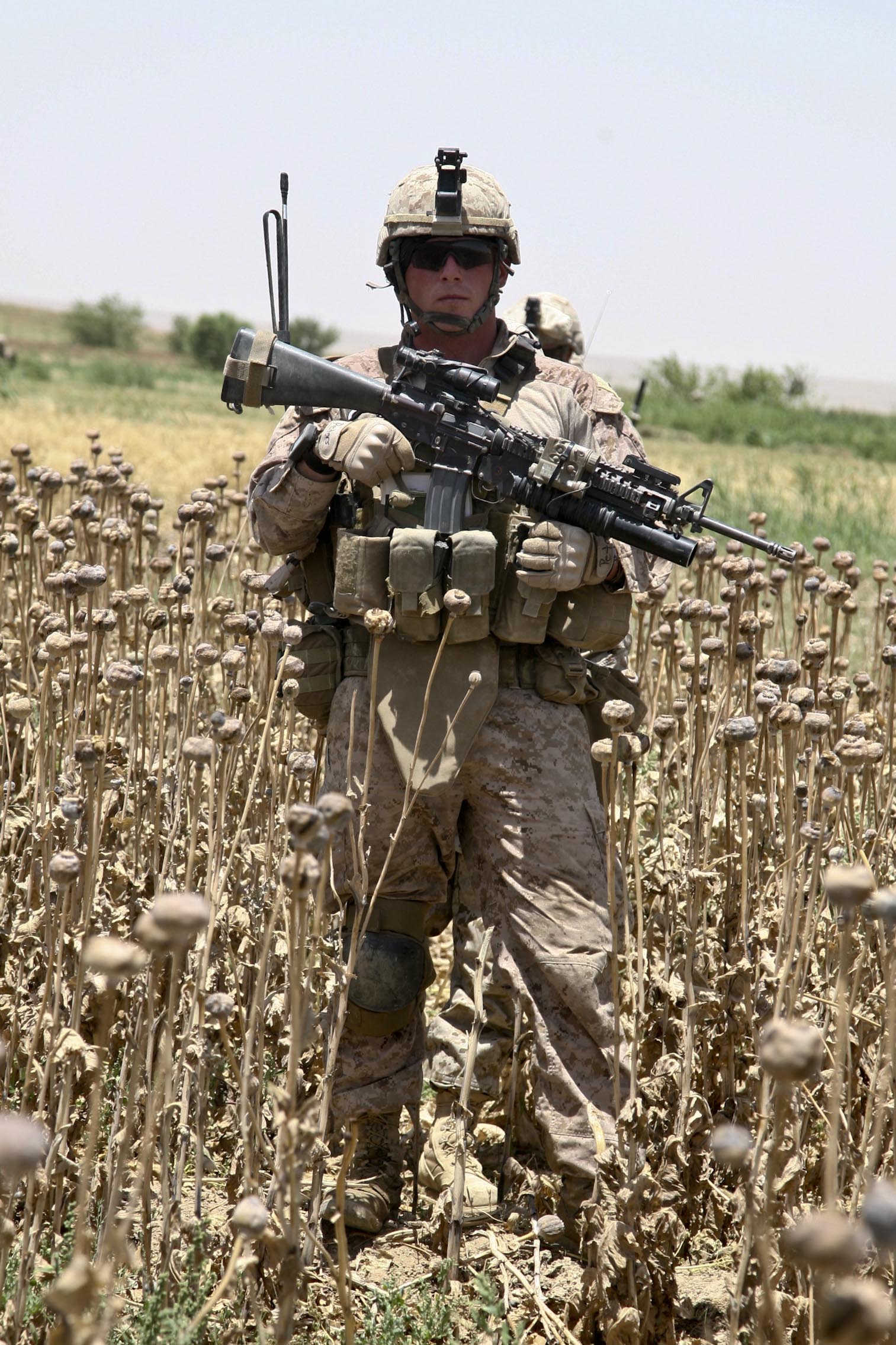
U.S. Marine Corps Cpl. James K. Peters stands in an opium poppy field while performing a foot patrol at Sangin, Afghanistan, May 19, 2011. (U.S. Marine Corps photo by Cpl. Jeremy C. Harris/Released)
A US Marine stands in a poppy field during a foot patrol at Sangin, Afghanistan. Photo | DVIDS

The heroin trade implicated virtually everyone in power, including Afghan President Hamid Karzai’s brother Ahmed Wali, among the biggest and most notorious drug kingpins in the south of the country, a man widely understood to be in the pay of the CIA.

U.S. attempts to stymie the opium trade, such as the policy of paying domestic militias to destroy poppy fields, often backfired. Locals came up with ways of profiting, such as refraining from planting in one area, collecting large sums of money from occupying forces, and using that cash to plant elsewhere — effectively getting paid both to plant and not to plant. Even worse, local warlords and drug bosses would destroy their rivals’ crops and collect money from the U.S. for doing so, leaving themselves both enriched and in a stronger position than before, having gained NATO forces’ favor.

One notable example of this is local strongman Gul Agha Sherzai, who eradicated his competitors’ crops in Nangarhar Province (while quietly leaving his own in Kandahar Province untouched). But all the U.S. saw was a local politician seemingly committed to stamping out an illegal drug trade. They therefore showered him with money and other privileges. “We literally gave the guy $10 million in cash for rubbing out his competition,” Hoh said. “If you were going to write a movie about this, they’d say ‘This is too far fetched. No one is going to believe this. Nothing is this insane or stupid.’ But that is the way it is.”

McCoy noted that the Taliban was one of the prime beneficiaries of the drug trade, and used it to increase their power and vanquish the U.S.:

That booming opium production, and the U.S. failure to curb it, provided the bulk of the financing for Taliban, who captured a significant but unknown share of the local profits from the drug traffic, which they used to fund guerrilla operations over the past 20 years, becoming a determinative factor in the U.S. defeat in Afghanistan.”

‘The needle and the damage done’

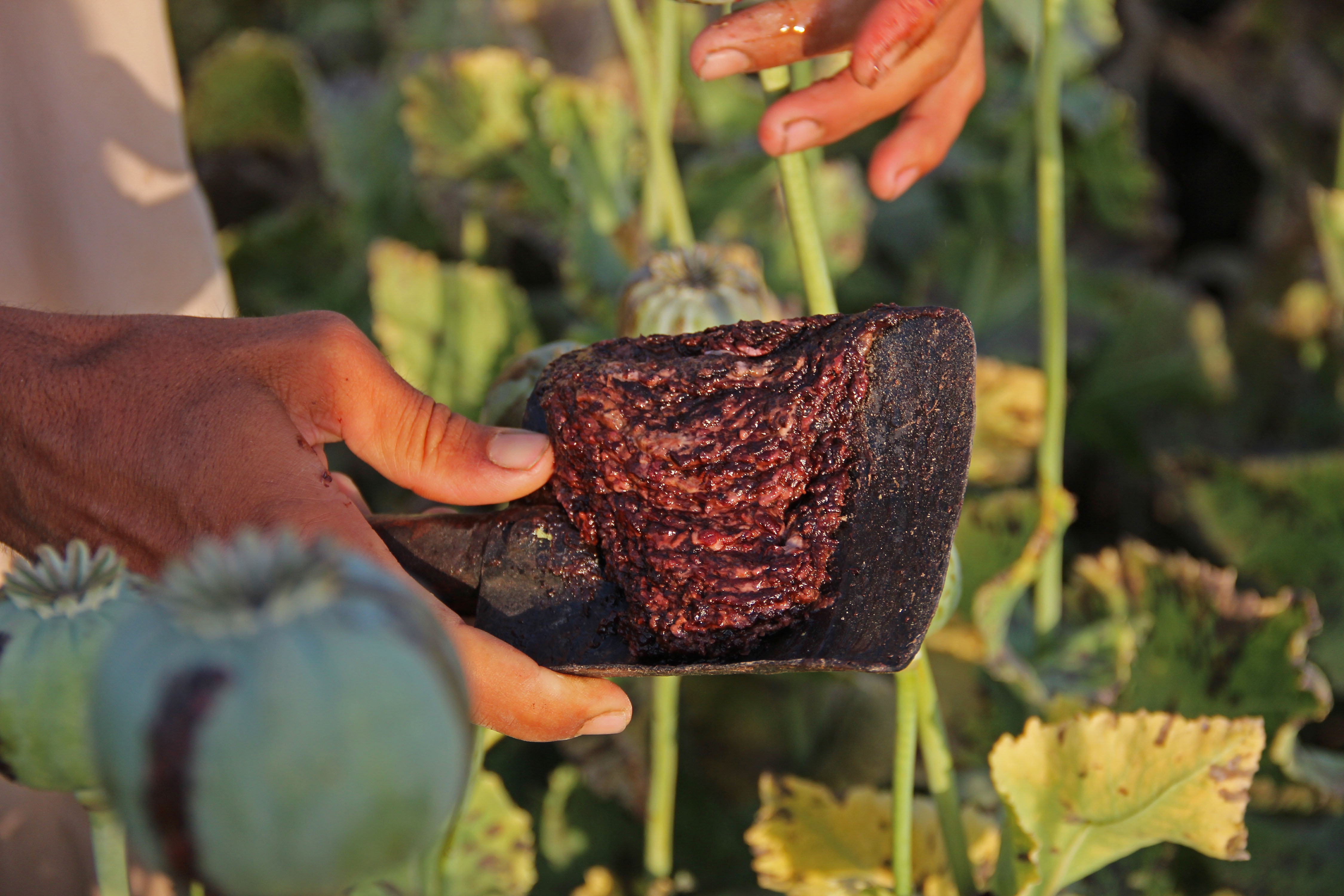
It is not particularly difficult to grow opium. Opium poppies flourish in warm and dry conditions, away from the damp and the wind. Consequently, they have found a fertile home across much of central and western Asia. The plant has flourished in Afghanistan, particularly in southern provinces like Helmand, close to the tripoint where Afghanistan meets Pakistan and Iran. Much of the irrigation system in Helmand was underwritten by USAID, an organization that acts as the CIA’s public-facing front. In full bloom, the poppy fields look spectacular, with beautiful flowers of vibrant pink, red or white. Underneath the flowers, one can find a large seed pod. Farmers harvest these, draining them of a sap which dries into a resin. This is often transported out of the country through the so-called “Southern Route” via Pakistan or Iran. But, as with any pipeline, much of the product is spilled along the way, causing an epidemic of addiction across the region.

The effect on the Afghan population has been nothing short of a disaster. Between 2005 and 2015, the number of adult drug users jumped from 900,000 to 2.4 million, according to the United Nations, which estimates that almost one in three households are directly affected by addiction. While Afghanistan also produces copious amounts of marijuana and methamphetamine, opioids are the drug of choice for most, with around 9% of the adult population (and a growing number of children) addicted to them. Added to this has been a spike in HIV cases, as users share needles, Professor Julien Mercille, author of “Cruel Harvest: U.S. Intervention in the Afghan Drug Trade,” told MintPress.

Only contributing further to the despair has been 20 years of war and U.S. occupation. The number of Afghans living in poverty rose from 9.1 million in 2007 to 19.3 million in 2016. A recent poll conducted by Gallup found that Afghans are the saddest people on Earth, with nearly nine in ten respondents “suffering” and zero percent of the population “thriving,” in their own words. When asked to rate their lives out of a score of ten, Afghans gave an average answer of 2.7, a record low for any country studied. Worse still, when asked to predict the quality of their life in five years, the mean answer was even lower: 2.3.

The effects of the CIA operation to bleed the Soviets dry in Afghanistan have also produced a humanitarian crisis in neighboring Pakistan. As McCoy noted, in the late 1970s, Pakistan had barely any heroin addicts. But by 1985, Pakistani government statistics reported over 1.2 million, turning the two nations into “the global epicenter of the drugs trade” almost overnight.

The problem has only grown since. A 2013 U.N. report estimated that almost 7 million Pakistanis use drugs, with 4.25 million requiring urgent treatment for dependency issues. Nearly 2.5 million of these people were abusing heroin or other opioids. Around 700 people die every day from overdoses. The highest rate of dependency is, unsurprisingly, in provinces on the Afghan border where heroin is manufactured. The same U.N. study notes that 11% of people in the northwestern province of Khyber Pakhtunkhwa use illicit substances — primarily heroin.

The drug crisis, of course, is also a medical crisis, with overstretched public hospitals filled with drugs-related maladies. The social stigma of addiction has ripped families apart while the money and power illicit drugs have brought has turned many towns into hotspots of violence.

Iran has a similar number of opioid users, generally estimated at between two and three million. In towns close to the Afghan/Pakistani border, a gram of opium can be bought with loose change — between a quarter and fifty cents. Thus, despite the extremely harsh penalties for drug possession and distribution on the official books, the country has the highest addiction rate in the world

On a micro level, addiction tears apart families and ruins lives. On an international scale, however, the opium boom has placed an entire region under significant strain. Therefore, one consequence of U.S. policy in the Middle East — from supporting jihadists to occupying nations — has been to unleash a worldwide opium addiction that has made a few people fantastically wealthy and destroyed the lives of tens of millions.

Domestic despair

The boom in production has also led to a worldwide disaster. In the past decade, opioid-related deaths increased by 71% globally, according to the United Nations. Much of the product grown by Afghan warlords ends up on Western streets. “I don’t see how it can be a coincidence that you have that explosive growth in poppy production in Afghanistan and then you have the worldwide opioid epidemic,” Hoh stated, a connection that raises the question of whether users in Berlin, Boston, or Brazil should be seen as victims of the war in Afghanistan as much as fallen soldiers are. If so, the numbers would be staggering. Nearly 841,000 Americans have died of a drug overdose since the war in Afghanistan began, including more than 70,000 in 2019 alone. The majority of these have involved opioids.

Officially, the DEA claims that essentially all illicit opioids entering the U.S. are grown in Latin America. Hoh, however, finds this unconvincing. “When you look at their own information and their reports on the illicit opioid production hectarage in Mexico and South America, it is clear that there is not enough production in the Western hemisphere to meet the demand for illicit opiates in the U.S.,” he told MintPress.

A dirty history

The U.S. government has a long history of directly involving itself with the worldwide narcotics trade. In Colombia, it worked with President Alvaro Uribe on a nationwide drug war, even as internal U.S. documents identified Uribe as one of the nation’s most important drug traffickers, an employee of the infamous Medellin Cartel and a “close personal friend” of drugs kingpin Pablo Escobar. Profits from drug-running funded Uribe’s election runs in 2002 and 2006.

General Manuel Noriega was also a key ally of the U.S. For many years, the Panamanian was on the CIA payroll — despite Washington knowing he was involved in drug trafficking since at least 1972. When he became de facto dictator of Panama in 1984, little changed. But the director of the Drug Enforcement Agency initially praised him for his “vigorous anti-drug trafficking policy.” Eventually, however, the U.S. decided to invade the country and capture Noriega, sentencing him to 40 years in federal prison for drug crimes largely committed while he was still in the CIA’s pay.

At the same time as this was going on, investigative journalist Gary Webb exposed how the CIA helped fund its dirty war against Nicaragua’s leftist government through sales of crack cocaine to black neighborhoods across the United States, linking far-right paramilitary armies with U.S. drug kingpins like Rick Ross.

Afghanistan Opium CIA
An Afghan farmer collects raw opium from poppy plants in his field in Chaparhar, Afghanistan. Nisar Ahmad | AP

To this day, the U.S. government continues to support Honduran strongman Juan Orlando Hernandez, despite the president’s well-established connections to the cocaine trade. Earlier this year, a U.S. court sentenced Hernandez’s brother Tony to life in prison for international drug smuggling, while Juan himself was an unindicted co-conspirator in the case. Nevertheless, President Hernandez has proven himself effective at suppressing the anti-imperialist Left inside his country and cementing the U.S.-backed 2009 military coup, one reason he is unlikely to face charges in the near future.

Using the illegal drug trade and the profits from it to fund imperial objectives has been a constant of great empires going back centuries. For instance, in the 1940s and 1950s, the French Empire utilized opium crops in the so-called “Golden Triangle” region of Indochina in order to help beat back a growing Vietnamese independence movement. Going further back, the British used its opium machine to subdue and economically conquer much of China. Britain’s insatiable thirst for Chinese tea was beginning to bankrupt the country, as the Chinese would accept only gold or silver as payment. It therefore used the power of its navy to force China to cede Hong Kong, from which Britain began flooding China with opium it grew in its possessions in South Asia.

The humanitarian impact of the Opium War was staggering. By 1880, the British were inundating China with over 6,500 tons of opium every year — equivalent to many billions of doses, causing massive social and economic dislocation as China struggled to cope with a crippling, empire-wide addiction. Today, many Chinese still refer to the era as “the century of humiliation.” In India and Pakistan, too, the effect was no less dramatic, as colonists forced farmers into planting inedible poppy fields (and, later, tea) rather than subsistence crops, causing waves of huge famines, the frequency of which had never been seen before.

Millions of losers

The story is much more nuanced than some “CIA controls the world’s drugs” conspiracy theories make out. There are no U.S. soldiers loading up Afghan carts with opium. However, many commanders are knowingly enabling warlords who do. “The U.S. military and CIA bear a large responsibility for the opium production boom in Afghanistan,” Professor Mercille said, explaining:

Post-9/11, they basically allied themselves with a lot of Afghan strongmen and warlords who happened to be involved in some way in drug production and trafficking. Those individuals were acting as local allies for the U.S. and NATO, and therefore were largely protected from retribution or arrest for drug trafficking because they were U.S. allies.”

From the ground, the war in Afghanistan has looked a lot like the war on drugs in Latin America and previous colonial campaigns in Asia, with a rapid militarization of the area and the empowerment of pliant local elites, which immediately begin to embezzle the massive profits that quietly disappear into black holes. All the while, millions of people pay the price, suffering inside a militarized death zone and turning to drugs as a coping mechanism. In the story of the opium boom, there are few winners, but there are millions of losers.


River to Sea Uprooted Palestinian   
The views expressed in this article are the sole responsibility of the author and do not necessarily reflect those of the Blog!