Showing posts with label Environment pollution. Show all posts

Saturday, 25 September 2021

China in Action – Carbon Neutral by 2050

 September 24, 2021

China in Action – Carbon Neutral by 2050

By Peter Koenig for the Saker Blog

The Glasgow Conference will focus at implementation of the Paris Agreement in a comprehensive, balanced and effective manner, building a fair global climate governance system, equitable and centered on win-win cooperation – with focus on renewable energy, the phase-out of fossil fuels, zero-emissions vehicles, resilience-building, carbon-pricing, green finance, nature-based climate solutions such as afforestation and reforestation, biodiversity conservation, and waste management.

Transcript of a presentation at a Webinar sponsored by the Chongyang Institute of Renmin University, Beijing
23 September 2021

An early priority for China – at least two to three decades back – was to reduce Carbon Dioxide (CO2) output, as well as that of other greenhouse gases, such as methane, nitrous oxide, ozone and some artificial chemicals such as chlorofluorocarbons (CFCs), to eventually reach carbon neutrality, meaning, eliminating as much CO2 as is produced, by 2050.

With industrialization and excessive consumption, the output of CO2 and other greenhouse gases has increased rapidly and especially in later years. And this despite repeated pledges during numerous UN-sponsored Environmental Conferences, to reduce the world’s carbon footprint.

Global Carbon dioxide levels reached 419 parts per million (ppm) in May 2021, the highest since CO2 output has been measured 63 years ago. Compare this to China’s CO2 output of 409 ppm by 2018.

China is often blamed as being the world’s largest polluter which may be the case in absolute terms, as China also has the world’s largest population. However, putting China’s CO2 output in perspective, on a per capita basis, China ranks only 5rd, after Australia, the US, Russia and Germany:
– Australia: 17.27 tons per capita
– USA: 15.52 tons p/c
– Russia: 11.33 tons p/c
– Germany: 8.52 tons p/c
– China: 7.38 tons p/c (less than half the US level)
– India: 1.91 tons p/c
These are 2019 figures.

—-

China’s 14th Five Year Plan (14th FYP), published in March 2021, included 2025 energy and carbon intensity reduction targets, as well as a mid-point non-fossil share target to achieve her nationally determined contributions, or NDC.

At China’s Leaders Climate Summit in April 2021, President Xi Jinping announced that China will strictly control coal generation until 2025 when she will start to gradually phase out of coal.

President Xi just announced at the UN General Assembly in NYC of 2021, that China seizes using coal powered plants as of now.
——-
To understand the concept and the lingo of the different terms and terminologies, lets back track a bit.

It all began decades ago – with the First United Nations Conference on Environment and Development (UNCED), also known as the ‘Earth Summit’, held in Rio de Janeiro, Brazil, from 3-14 June 1992. It set the stage for the reduction of greenhouse gases, the most important of which is Carbon Dioxide.

CO2 emissions are toxic and harmful for the environment and life, when produced in excess.

However, lets also keep in mind – CO2 is one of the most important gases on earth, because the plants use it to produce carbohydrates in a process called photosynthesis. Since humans and animals depend on plants for food, thus, CO2 is necessary for the survival of life on earth.

—–
In the meantime, there have been numerous climate change conferences around the world, most of them UN-sponsored, the latest one – if I’m not wrong, was the Santiago Climate Change Conference, the 25th so-called Conference of the Parties (COP25) of December 2019, meaning the 25th conference to the United Nations Framework Convention for Climate Change (UNFCCC).

The names of these conferences and their results are often confusing, at times also controversial, especially between the industrialized countries and the so-called developing countries, or the Global South.

A chief reason for potential conflicts is rapid industrialization – excessive consumption, particularly in the West, or the Global North. The output of CO2 and other greenhouse gases has increased rapidly and unequally between the Global North and the Global South. Yet, developing countries are often asked to take similar measure to reduce greenhouse gases, in particular, CO2.

A safe level of CO2 in the air, according to one of the first 21st Century UN Conferences – it may have been the 2009 Copenhagen Conference, was suggested to be 350 ppm. This figure was already exceeded in 1987, reaching, as mentioned before, 419 ppm in May 2021.

Despite covid, the concentration has not been significantly changed for the better. In some cases, to the contrary.

Despite pledges to the contrary, the main source of energy has changed little in the last 20 years. Hydrocarbons are still king. Today’s world economy still depends on some 84% of hydrocarbons (petrol, gas, coal) of all energy used, as compared to 86% at the turn of the century.
—–
What does Carbon Neutral mean?

Carbon neutral – the amount of CO₂ emissions put into the atmosphere is the same as the amount of CO2 removed from the atmosphere. The impact is neutral. This is not making it actively worse, but it doesn’t make it better either, especially when the average output is above 400 ppm, meaning above the considered “safe” target of 350 ppm.

Carbon negative, or carbon net zero might be a step in the right direction. It means the amount of CO₂ removed from the atmosphere, is bigger than the CO₂ output. The impact is positive; something is actively done to reduce the harm to the atmosphere – and to improve the air for every breathing life.

We have the historical responsibility to urgently cleaning up the atmosphere to eventually get back to the civilized level of 275 ppm.

Since the beginning of human civilization, our atmosphere contained about 275 ppm of carbon dioxide. According to renowned climatologist Dr. James Hansen, these are the conditions under which civilization developed and to which life on earth adapted. Going beyond this indicator, risks disrupting our global climate system’s 1,000,000+ years of relative stability. Beginning in the 18th century, with the age of industrialization, humans began to burn coal, gas, and oil to produce energy and goods. The carbon in the atmosphere began to rise, at first slowly and, then ever more rapidly.

Many of the activities we do every day, rely on energy sources that emit carbon dioxide and other greenhouse gases. We’re redistributing millions and millions of years’ worth of carbon, once stored beneath the earth as fossil fuels, and releasing it into the atmosphere.

Just a thought.

Apologies for this long background. The environmental agenda is very complex.

—-
As to China – China’s Ministry of Environment and Ecology publishes regularly CO2 concentration levels. China’s greenhouse gas emission in 2018 reached 409.4 ppm with an estimated annual growth of 1.3%.

While in full action towards Carbon neutrality, China was hosting the 5th Ministerial meeting on Climate Action in April 2021. A virtual event attended by the European Union and Canada, plus ministers and representatives from 35 governments and international organizations, from all the world’s regions.

The meeting aimed at drastically reducing the carbon level in the air, through significant shifts from fossil fuel energy to alternative sources for the upcoming UN Climate Change Conference (COP26), hosted by the UK, from 31 October to 12 November 2021 in Glasgow.

China is already pushing ahead with this agenda.

The Ministers asked for an equitable transition throughout the implementation process. This may include financial, technological and capacity building support to developing countries, especially the poorest and most vulnerable ones. Implementation of the Paris Agreement should also reflect the principle of common but differentiated responsibilities and respective capabilities, in the light of different national circumstances.

China’s ambitious agenda to reach carbon neutrality or better, by 2050, includes …

  • Investing in projects of liquid hydrogen which can be used, for instance, in hydrogen fuel cell automobiles, and Hydrogen metallurgy, a technology that applies hydrogen instead of carbon.
  • Third generation photovoltaic energy with efficiency above 40%, is another sector where China’s world-class development and vast demands may attract global investors.
  • In addition, China has ambitious research projects into generating energy from photosynthesis, the process plants use to transform carbon dioxide and sunlight into energy. It’s an ecosystem’s way of producing fuel at a high level of efficiency (>90%) without polluting residues.
  • Green parks in urban areas and reforestation as well as improved water management, so as to reduce areas of frequent droughts and convert them into green agricultural crop lands.
  • At the same time, China is seeking new alternative energy investments abroad, such as an automotive lithium-ion battery production in Germany – a planned investment of 1.8 billion euros.

And much more….

China is not only on the right track to seek environment-friendly renewable sources of energy, thus, reducing her carbon footprint – but to exceed the 2050 net zero emissions target into a carbon negative project.

China, as in other matters of importance to the world’s societies, just to mention one – poverty alleviation – may be again an example on environmental progress. Towards a human society with shared benefits for all.

************

Peter Koenig is a geopolitical analyst and a former Senior Economist at the World Bank and the World Health Organization (WHO), where he has worked for over 30 years on water and environment around the world. He lectures at universities in the US, Europe and South America. He writes regularly for online journals and is the author of Implosion – An Economic Thriller about War, Environmental Destruction and Corporate Greed; and co-author of Cynthia McKinney’s book “When China Sneezes: From the Coronavirus Lockdown to the Global Politico-Economic Crisis” (Clarity Press – November 1, 2020)

Peter Koenig is a Research Associate of the Centre for Research on Globalization. He is also is a non-resident Sr. Fellow of the Chongyang Institute of Renmin University, Beijing.


River to Sea Uprooted Palestinian   
The views expressed in this article are the sole responsibility of the author and do not necessarily reflect those of the Blog!

Saturday, 28 August 2021

Here comes China: Afghanistan, 7 Deadly Sins, Space, Common Prosperity

 August 28, 2021

Afghanistan is where the eyes of the world are. In my view, and according to the Chinese media and commentary, China is the inheritor of Afghanistan in terms of possible rebuilding of the country (finance, economy, industry, and trade) and also to ensure that a terrorist problem does not threaten across the border with China. The jury is out in terms of the trajectory here. China though has its embassy open, and this photo possibly says it all.


Afghanistan’s China Town reopens, not disrupted by the deadly blasts in Kabul airport


Vladimir Putin had a telephone conversation with President of the People’s Republic of China Xi Jinping.

In the context of the 20th anniversary of the Treaty of Good-Neighbourliness and Friendly Cooperation, the presidents noted with satisfaction that the Russian-Chinese strategic partnership has been developing progressively and dynamically. The main thing is that both sides are interested in further strengthening cooperation on the entire complex of issues on the bilateral and international agenda.

The leaders had an in-depth discussion on the Afghanistan problem. They expressed readiness to step up efforts to counter the threats of terrorism and drug trafficking emanating from Afghanistan and emphasised the importance of achieving peace as soon as possible and preventing the spread of instability to neighbouring regions. It order to do this, the presidents intend to use the potential of the Shanghai Cooperation Organisation as much as possible, among other things. The two leaders also agreed to step up bilateral contacts and close cooperation, above all between the foreign ministries.

On the occasion of the upcoming 76th anniversary of the end of World War II, the relevance of the work to preserve the truth about the events of that period and prevent attempts to falsify history was noted.

The conversation was held in a traditionally friendly and trust-based atmosphere.


From the Chinese media, 7 deadly sins that the US committed in Afghanistan

Sin 1: Warmonger

Sin 2: Machiavellian

Sin 3: Human Rights Abuses

Sin 4: State-Sponsored Terrorism

Sin 5: Heroin Trafficking

Sin 6: Blasphemy

Sin 7: Environment Destruction

http://www.news.cn/english/2021-08/24/c_1310146023.htm


In Afghanistan, China Is Ready to Step Into the Void, by Zhou Bo

This complete article is available on Godfree’s newsletter and this is but a short excerpt.  However, it illustrates the internal view of China on Afghanistan:

Zhou Bo is a senior fellow at the Center for International Security and Strategy at Tsinghua University and a member of the China Forum. He was a senior colonel in the People’s Liberation Army from 2003 to 2020 and is an expert on the Chinese army’s strategic thinking on international security. He directed the Centre for Security Cooperation in the Office for International Military Cooperation at the Ministry of National Defense.

The speed and scope of the Taliban’s takeover in Afghanistan have prompted introspection in the West over what went wrong, and how, after billions of dollars spent on a 20-year war effort, it could all end so ignominiously. China, though, is looking forward. It is ready to step into the void left by the hasty U.S. retreat to seize a golden opportunity.

While Beijing has yet to formally recognize the Taliban as Afghanistan’s new government, China issued a statement on Monday saying that it “respects the right of the Afghan people to independently determine their own destiny” and will develop “friendly and cooperative relations with Afghanistan.”

The message here is clear: Beijing has few qualms about fostering a closer relationship with the Taliban and is ready to assert itself as the most influential outside player in an Afghanistan now all but abandoned by the United States.

Unlike the United States, China brings no baggage to the table in Afghanistan. China has kept a low profile in the country since the U.S. invasion, not wishing to play second fiddle to the United States in any power politics. Beijing watched as Washington’s foray in Afghanistan became a messy and costly morass. In the meantime, China provided Afghanistan millions of dollars in aid for medical assistance, hospitals, a solar power station and more. All the while, Beijing was fostering stronger trade relations, eventually becoming one of Afghanistan’s largest trading partners.

With the U.S. withdrawal, Beijing can offer what Kabul needs most: political impartiality and economic investment. Afghanistan in turn has what China most prizes: opportunities in infrastructure and industry building — areas in which China’s capabilities are arguably unmatched — and access to $1 trillion in untapped mineral deposits, including critical industrial metals such as lithium, iron, copper and cobalt. Though critics have raised the point that Chinese investment is not a strategic priority in a less secure Afghanistan, I believe otherwise.


Digital Yuan

Through the ages, money has taken various forms, (shells, stones, beads, various types of coins where the value was inherent in the material that the coin was made from and other that used a worthless material but assured by some kind of backing like gold, or simply trust in sovereign promises).

In terms of paper money, in the 13th century, the Chinese emperor Kublai Khan embarked on a bold experiment. China at the time was divided into different regions, many of which issued their own coins, discouraging trade within the empire. So Kublai Khan decreed that henceforth money would take the form of paper.

This was a huge step and even today we use paper money to an extent, but more and more we use digitized currencies. It is not strange that China again comes up with the major step of disintermediating the current technology of money by the creation of its DCEP. (This is not a cryptocurrency, however, technologically, it functions like one).  Transactions are fast, the basis is cash, and China is building it out as a two tier system (PBC and local banks assuring stable financial infrastructure and supervision, which, in effect, is the ‘backing’), as well as multi-scheme, which is the connection to retailers and third-party payment platforms (think of something like Paypal). Ownership of the currency business is then an open new market economic category.

We see more and more countries following suit but there is no one that is as far along as China on roll-out of digital currency, already trading with it, using it via smart contracts and more and more in cross border trade.

China builds cross-border finance blockchain platform

http://www.news.cn/english/2021-08/25/c_1310148785.htm

As all technology changes, the technology of money will also change and in reality, is in the process of change as we speak. The size of the change in financial technology spearheaded by China could well be of the magnitude, as was the acceptance of paper money, i.e., the whole world, just as Kublai Khan created his system in the 13th century. The prospective use cases of digital money at this level staggers the imagination and the strength of an economic weapon of this kind is routinely underestimated.


While we have money going all digital, why not do the same with the rest:

Following China’s push for a digital currency, the country plans to roll out digital driver’s licenses nationwide by 2022. Nearly 2 million residents have obtained digital driver’s licenses so far, as cited by Xinhua. Digital licenses will have the same legal effect as physical licenses and can be used to rent vehicles, file insurance claims and handle traffic violations. An official mobile app accepts applications for a digital license. 400 million people are licensed to drive in China. Read full article →


Space, yes, one cannot get away from China these days without talking about space.

A Chinese satellite has tested a technology that could offer the most accurate means yet of tracking air traffic from space, in the hope of preventing repeats of the Malaysia Airlines Flight 370 tragedy. Each aircraft in the sky emits a radio signal, and constantly monitoring all planes over a large area is technically challenging. But Beihang Kongshi 1, a small satellite in near-Earth orbit, can update the status of an aircraft every eight seconds – about twice as fast as American technology, meaning the tracking is more accurate. Read full article  $→

In the mean time the Mars Rover is an unadulterated success. The National Space Administration said on its website Friday that Zhurong completed its 90-day program on August 15 and was in excellent technical condition and fully charged. Read full article →


Technology and Legal

In modern terms, China is a young country and in certain areas, specifically technology, legal structures lag behind technological development. This is not new if you are in technology but given the size and growth of China’s technology sector, may create some problems. In case you’ve been living under a very large rock: Regulators in Beijing have been on a mission to constrain the market dominance of China’s tech behemoths for months now. The principle value in the technological companies is that of building big fast and getting rich fast. But, the common value in the Chinese government is ‘common prosperity’. Wealth inequality is not as pronounced as in the west and China wants to keep it that way.  You may build big fast and get rich fast, but do not forget the country that gave you the platforms to create your behemoth of an industry.  Get rich, but not too rich.

The new legislation has all kinds of knock-on effects.  For example, labor laws (for one) and the value of all work and no play is being shaved. For example, ‘996’ work hours are illegal. “The ‘996’ work culture — a 12-hour, six-day work schedule that had been popular among Chinese tech companies until recently — is a serious violation of Chinese labor law, according to China’s Supreme People’s Court and its Ministry of Human Resources and Social Security.” Read full article →


Defense

The People’s Liberation Army Rocket Force has improved the accuracy and range of its ballistic missile force, the world’s largest, according to a new US Army report. The DF-11, the most widely deployed short-range ballistic missile, was originally designed to hit targets up to 300km away, but newer models have expanded ranges beyond 700km. “Accuracy has also increased, reducing” the intended target point to only 30m, “giving theatre commanders a long-range precision strike capability”, according to the army publication. The DF-11 can employ both conventional and nuclear warheads. The “solid-fuel rocket and mobile transporter-erector-launchers enable rapid launch and reload operations”, it added. Read full article $→

China has successfully tested two short-range conventional missiles designed to take out enemy communications systems. The PLA Rocket Force recently tested two new missiles that can overcome “complex electromagnetic interference” to destroy facilities in a “fast-reaction” operation. “[The missiles] successfully hit the target in an enemy camp equipped with multilayer defences several hundred kilometres away and effectively paralysed the enemy’s key communications node,” CCTV reported. Read full article $→


The legal machinations around Huawei CFO Meng Wanzhou house arrest in Canada seem to be drawing to a close, if in fact it will be allowed to draw to a close. Jeff J. Brown provided a solid analysis and background of the story.


To conclude, yes, the elephants are back home but nobody is betting that they will stay home this time. They may at any time decide to again go on a walk-about.

And on Winnie the Pooh:

Selections from Godfree Roberts’ extensive weekly newsletter: Here Comes China. You can get it here: https://www.herecomeschina.com/#subscribe

Further selections and editorial and geopolitical commentary by Amarynth.


River to Sea Uprooted Palestinian   
The views expressed in this article are the sole responsibility of the author and do not necessarily reflect those of the Blog!

Saturday, 24 April 2021

Critical ‘Israeli’ Weak Spot in Navy Highlighted

 Critical ‘Israeli’ Weak Spot in Navy Highlighted

By Staff, Haaretz

In an analysis piece published by ‘Israeli’ Haaretz newspaper, and under the title “Haaretz Naval Conflict with Iran Sheds Lights on a Critical ‘Israeli’ Weak Spot,” Amos Harel wrote:

More than two months have passed since the severe oil spill in the Mediterranean Sea, which caused great damage to the offshore waters and the coasts of ‘Israel’ and Lebanon. The washing ashore of lumps of tar is considered one of the major ecological disasters in ‘Israel’s’ history. Those who purportedly bore direct guilt for the disaster were marked.

But the incident dramatized ‘Israel’s’ high level of vulnerability to ecological disasters. Two months on, ‘Israel’ has done very little to improve its response to this danger, which could be repeated either deliberately or accidentally.

The ‘Israeli’ entity lags well behind countries that are coping with similar threats. There is no governmental authority that exercises routine supervision and control over maritime pollution. A good many of the powers reside in the War Ministry, through the navy, but those bodies inherently focus on salient security hazards and are not trained to deal with matters such as oil spills or arranging fishing rights.

The discovery of natural gas deposits in the occupied territories economic zones more than a decade ago rendered the whole question far more critical, both because of the value of the assets at risk and because of the potential damage liable to be caused if they are attacked.

Three governmental decisions – in 2008, 2013 and 2017 – addressed a local plan to deal with oil spills, but the plan was never implemented and did not receive the necessary resources. Following the latest spread of pollution, in which 1,200 tons of crude oil [from a total cargo of 115,000 tons] spilled into the sea, a legislative bill was again submitted, but it looks like a copy-paste of the previous bills. At any rate, politicians in the transition government have more pressing matters to deal with.

Responsibility for dealing with oil spills lies with the Environmental Protection Ministry. In principle, there is across-the-board agreement that ‘Israel’ needs to quickly activate a better monitoring system, one that draws on serial satellite images of the Mediterranean, and to continually analyze data on the movement of ships and the dangers they pose.

These systems are available in the private sector. In fact, the ‘Israeli’ military and other security bodies lease services from private companies on a permanent basis. Yet bureaucratic hurdles have so far prevented ‘Israel’ from drawing up a contract for the implementation of systematic, permanent monitoring of the sea. Part of the delay is apparently related to the political tensions between Likud and Kahol Lavan.

After the maritime disaster, Prime Minister Benjamin Netanyahu approved a diversion of $13.6 million from the environmental protection budget to deal with the oil spills. A committee of directors general was also formed.

However, according to knowledgeable sources, the crowning glory of the actions taken the past two months was the purchase of a tractor to clean the tar-strewn shore. No improvement was registered in the routine monitoring of pollution hazards; while at the same time the possibility that someone will try to foment “ecological terror attacks” has only increased, in light of the activity attributed to ‘Israel’ and the accusations made by the government itself.

This wouldn’t be such a big story if it weren’t for the escalation in maritime activity,” a source involved in the matter told Haaretz. “We have waited since 2008, we’ll wait a little longer. But the fact that the attacks are now above the radar completely changes the picture. ‘Israel’ has already stated publicly that it is vulnerable. Everything has become more urgent.”

As Maya Jacobs, CEO of Zalul, an NGO dedicated to protection of ‘Israeli’ seas, streams and coasts, puts it, “Everyone with eyes in their head sees the kind of easily damageable targets we are placing in the sea. ‘Israel’ is not putting enough emphasis on protecting the maritime environment. The maritime campaign with Iran that was revealed is further heightening the risks. What’s needed here is a continuous, comprehensive monitoring system that will rely on regional cooperation and encompass more countries of the Mediterranean-shore region.”

Jacobs also noted another emerging threat. As called for in the ‘Abraham Accords’ with the United Arab Emirates, a memorandum of understanding was signed between Tipline [Eilat-Ashkelon Pipeline] and a UAE corporation. It stipulates that oil will be transported from the emirates to Tipline’s fuel terminal in Eilat, from there to be channeled to Ashkelon and then continue on its way in the Mediterranean, thus saving the costs of passage through the Suez Canal.

This is a huge and potentially highly lucrative project, but it also greatly intensifies the risks to the environment in the Red Sea. An article published by Prof. Shaul Chorev and Dr. Moshe Terdiman, from the University of Haifa’s Maritime Policy and Strategy Research Center, notes that “a solitary hitch in tankers or an oil spill could seriously endanger the coral reefs and the unique ecological system in the Gulf of Eilat. Cases of such spills have already occurred in the past.”


River to Sea Uprooted Palestinian   
The views expressed in this article are the sole responsibility of the author and do not necessarily reflect those of the Blog!

Friday, 12 March 2021

اختبار القوة الحاسم يمنيّ


ناصر قنديل

يترافق إعلان النيات الأميركي بالخروج من سياسات المراحل السابقة لعقدين ماضيين، التي توزعت بين الحروب المباشرة في عهد الرئيس السابق جورج بوش، والحروب بالوكالة في عهد الرئيس الأسبق باراك أوباما، والعقوبات القاتلة في عهد الرئيس السابق دونالد ترامب، مع محاولات تلمّس خريطة طريق لاستراتيجية بديلة تسعى لصناعة تفاهمات دولية إقليمية بأقل قدر ممكن من التنازلات التي تمسّ بهيبة ومكانة واشنطن العالمية، وتأمين ما يلزم لاستراتيجيتها القائمة على أولويّة المواجهة مع الصين وروسيا، من بوابة ما وصفه الرئيس الأميركي جو بايدن باستبدال مثال القوة بقوة المثال، بعناوين حقوق الإنسان وحماية البيئة ومكافحة الفساد، لأن واشنطن تدرك أن التخفف من أعباء المراحل السابقة بتسويات سيُبنى على موازين قوى أظهرتها مراحل المواجهة، كما تدرك أن الترسمل لمرحلة قوة المثال تستدعي تقليم أظافر وتحجيم حلفاء رئيسيين يترتب على إضعافهم تراجع النفوذ الأميركي لحساب الخصوم الإقليميين، ولذلك تختبر واشنطن بالتتابع سقوف التفاهمات التي تحاول تحقيقها، وكلما اكتشفت فشل تسويق سقف مرتفع تستبدله بسقف أدنى، وهي محكومة بالخشية من دفع أثمان يصعب ترميم التوازنات ما بعدها، أو الفشل بصناعة التفاهمات بسبب الأثمان المكلفة لها، أو تزعزع كيانات حليفة وتراجعها بسبب الترسمل على حسابها للمهمة المقبلة، أو ضياع فرص الترسمل بسبب الحرص على حماية هذه الكيانات وأدوارها الحليفة.

في الملف النووي الإيراني يتحكّم عامل الوقت الداهم على القرار الأميركي الذي لم يُخفِ الخشية من أن ينجم عن طول أمد التفاوض قبل العودة إلى الاتفاق النوويّ، نجاح إيران ببلوغ العتبة الخطرة، أي عتبة امتلاك إيران مقدرات كافية لإنتاج سلاح نووي. وهذا ما يشكل أولويّة أميركيّة عالميّة تختلف عن الأولويات الإقليمية المتمثلة بملفات تفرضها ساحات الاشتباك وتعقيداتها، حيث لا خارطة طريق أميركية واضحة بعد لكيفية التعامل معها، وفيما يبدو أن سورية تمثل أعقد الملفات، لتداخلها مع الأجوبة الصعبة على الأسئلة الصعبة، من نوع كيف سيكون أي تصوّر لسورية واقعياً من دون أن يضع في الاعتبار أن ميزان القوى لم يعد يسمح بفرض شروط على الدولة السورية التي تجاوزت مرحلة الخطر، وحيث روسيا وإيران وقوى المقاومة شركاء في الإنجاز، وكيف سيكون تأثير اي تصور واقعي على مستقبل أوزان وأحجام روسيا وإيران والمقاومة، التي لا يريد لها الأميركي أن تتعزّز، وكيف سيكون تأثير أيّ تصور واقعيّ لسورية على كل من «إسرائيل» وتركيا، ولكل منهما ملف خاص وحساس في رؤية الأمن والدور ضمن أي استراتيجية أميركية للمنطقة؟

يبدو أن الملف اليمني هو الملف المتقدم والأشد قدرة على رسم توازنات يمكن التأسيس عليها لملفات أخرى في الرؤية الأميركية، وفقاً للاختيار الأميركي الذي بدأ مقاربة أوضاع المنطقة بمقاربة الملف اليمني من زوايا عدة، واحد يتصل بإعلان واضح بالدعوة لوقف الحرب وتوصيفها ككارثة إنسانية يجب ان تتوقف وتحميل السعودية والإمارات مسؤولية استمرارها، وترجمة ذلك بإعلان وقف صفقات السلاح الأميركي إلى حكومتي البلدين، وثانٍ يتصل بالتقرب من أنصار الله عبر إلغاء تصنيفهم على لوائح الإرهاب، وثالث بإرسال وفد أميركي إلى عُمان لحوار أنصار الله. وهذه المقاربات الأميركية رغم وضوحها تبدو اختبارات تجريبية لما يمكن أن ترسو عليه التوازنات التي ستكون ذات تأثير موضوعي ومعنوي على سائر ساحات الاشتباكات، بحيث يبدو حجم المسافة الأميركية من الحليف السعودي مؤشراً يراقبه سائر الحلفاء في تل أبيب وأنقرة، وصولاً إلى منظمة قسد، ومشروع الدويلة الكردية شمال شرق سورية. وبالمقابل يمثل حدود ما يمكن قبوله في العلاقة مع أنصار الله مؤشراً يمكن القياس عليه لما سيكون ممكناً قبوله من خصوم واشنطن في ساحات أخرى كسورية ولبنان وسواهما، والفشل في التوصل لتفاهمات تنهي الحرب في اليمن كما النجاح مؤشرات لمستقبل المقاربة الأميركية في سائر الساحات.

يشهد الملف اليمني سخونة غير مسبوقة، واستثمار الحد الأقصى لأوراق القوة من الطرفين السعودي واليمني. والأكيد أن التوازنات التي سيرسو عليها مستقبل المواجهة، على جبهة مأرب من جهة، وتوازن الردع الصاروخي من جهة مقابلة، سيكتب تاريخ اليمن والخليج وربما المنطقة بأسرها.


فيديوات متعلقة


مقالات متعلقة


River to Sea Uprooted Palestinian   
The views expressed in this article are the sole responsibility of the author and do not necessarily reflect those of the Blog!

Wednesday, 28 October 2020

Capitalism is Double-billing Us: We Pay from Our Wallets only for Our Future to Be Stolen from Us

October 26, 2020

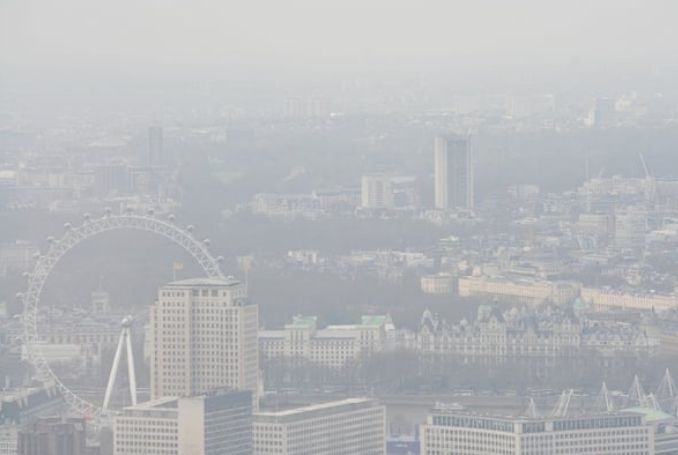
Air pollution in London. (Photo: File)

Here is a word that risks deterring you from reading on much further, even though it may hold the key to understanding why we are in such a terrible political, economic and social mess. That word is “externalities”.

It sounds like a piece of economic jargon. It is a piece of economic jargon. But it is also the foundation stone on which the west’s current economic and ideological system has been built. Focusing on how externalities work and how they have come to dominate every sphere of our lives is to understand how we are destroying our planet – and offer at the same time the waypost to a better future.

In economics, “externalities” are usually defined indifferently as the effects of a commercial or industrial process on a third party that are not costed into that process.

Here is what should be a familiar example. For decades, cigarette manufacturers made enormous profits by concealing scientific evidence that over time their product could prove lethal to customers. The firms profited by externalizing the costs associated with cigarettes – of death and disease – on to those buying their cigarettes and wider society. People gave Philip Morris and British American Tobacco their money as these companies made those smoking Marlboros and Lucky Strikes progressively unhealthier.

The externalized cost was paid – is still paid – by the customers themselves, by grieving families, by local and national health services, and by the taxpayer. Had the firms been required to pick up these various tabs, it would have proved entirely unprofitable to manufacture cigarettes.

Inherently Violent

Externalities are not incidental to the way capitalist economies run. They are integral to them. After all, it is a legal obligation on private companies to maximize profits for their shareholders – in addition, of course, to the personal incentive bosses have to enrich themselves, and each company’s need to avoid making themselves vulnerable to more profitable and predatory competitors in the marketplace.

Companies are therefore motivated to offload as many costs as possible on to others. As we shall see, externalities mean someone other than the company itself pays the true cost behind its profits, either because those others are too weak or ignorant to fight back or because the bill comes due further down the line. And for that reason, externalities – and capitalism – are inherently violent.

All this would be glaringly obvious if we didn’t live inside an ideological system – the ultimate echo chamber enforced by our corporate media – that is complicit either in hiding this violence or in normalizing it. When externalities are particularly onerous or harmful, as they invariably are in one way or another, it becomes necessary for a company to obscure the connection between cause and effect, between its accumulation of profit and the resulting accumulation of damage caused to a community, a distant country or the natural world – or all three.

That is why corporations – those that inflict the biggest and worst externalities – invest a great deal of time and money in aggressively managing public perceptions. They achieve this through a combination of public relations, advertising, media control, political lobbying and the capture of regulatory institutions. Much of the business of business is deception, either making the externalized harm invisible or gaining the public’s resigned acceptance that the harm is inevitable.

In that sense, capitalism produces a business model that is not only rapacious but psychopathic. Those who pursue profit have no choice but to inflict damage on wider society or the planet, and then cloak their deeply anti-social – even suicidal – actions.

Psychopathic Demands

A recent film that alludes to how this form of violence works was last year’s Dark Waters, concerning the long-running legal battle with DuPont over the chemicals it developed to make non-stick coatings for pots and pans. From the outset, DuPont’s research showed that these chemicals were highly dangerous and accumulated in the body. The science overwhelmingly suggested that exposed individuals would be at risk of developing cancerous tumors or producing children with birth defects.

There were huge profits to be made for DuPont from its chemical discovery so long as it could keep the research hidden. So that’s exactly what its executives did. They set aside basic morality and acted in concert with the psychopathic demands of the marketplace.

DuPont produced pans that contaminated its customers’ food. Workers were exposed to a cocktail of lethal poisons in its factories. The company stored the toxic waste products in drums and then secretly disposed of them in landfills where they leached into the local water supply, killing cattle and producing an epidemic of disease among local residents. DuPont created a chemical that is now everywhere in our environment, risking the health of generations to come.

But a film like Dark Waters necessarily turned a case study in how capitalism commits violence by externalizing its costs into something less threatening, less revelatory. We hiss at DuPont’s executives as though they are the ugly sisters in a pantomime rather than ordinary people not unlike our parents, our siblings, our offspring, ourselves.

In truth, there is nothing exceptional about the DuPont story – apart from the company’s failure to keep its secret hidden from the public. And that exposure was anomalous, occurring only belatedly and against great odds.

An important message the film’s feelgood ending fails to deliver is that other corporations have learned from DuPont’s mistake – not the moral “mistake” of externalizing their costs, but the financial mistake of getting caught doing so. Corporate lobbyists have worked since to further capture regulatory authorities and to amend transparency and legal discovery laws to avoid any repetition, to ensure they are not held legally liable, as DuPont was, in the future.

Victims of Our Bombs

Unlike the DuPont case, most externalities are never exposed. Instead, they hide in plain sight. These externalities do not need to be concealed because they are either not perceived as externalities or because they are viewed as so unimportant as to be not worth factoring in.

The military-industrial complex – the one we were warned about more than half a century ago by President Dwight Eisenhower, a former US general – excels in these kinds of externalities. Its power derives from its ability to externalize its costs on to the victims of its bombs and its wars. These are people we know and care little about: they live far from us, they look and sound different to us, they are denied names and life stories like us. They are simply numbers, denoting them either as terrorists or, at best, unfortunate collateral damage.

The externalities of the west’s war industries are opaque to us. The chain of cause and effect is nowadays obscured as “humanitarian intervention”. And even when war’s externalities come knocking at our borders as refugees flee from the bloodshed, or from the nihilistic cults sucked into the power vacuums we leave behind, or from the wreckage of infrastructure our weapons cause, or from the environmental degradation and pollution we unleash, or from the economies ruined by our plunder of local resources, we still don’t recognize these externalities for what they are. Our politicians and media transform the victims of our wars and our resource grabs into, at best, economic migrants and, at worst, barbarians at the gate.

Snapshots of Catastrophe

If we are entirely ignorant of the externalities inflicted by capitalism on victims beyond our shores, we are gradually and very late in the day waking up to some of capitalism’s externalities much closer to home. Parts of the corporate media are finally admitting that which can no longer be plausibly denied, which is evident to our own senses.

For decades politicians and the corporate media managed to veil two things: that capitalism is an entirely unsustainable, profit-driven, endless consumption model; and that the environment is being gradually damaged in ways harmful to life. Each was obscured, as was the fact that the two are causally connected. The economic model is the primary cause of environmental damage.

People, especially the young, are slowly awakening from this enforced state of ignorance. The corporate media, even its most liberal elements, is not leading this process; it is responding to that awakening.

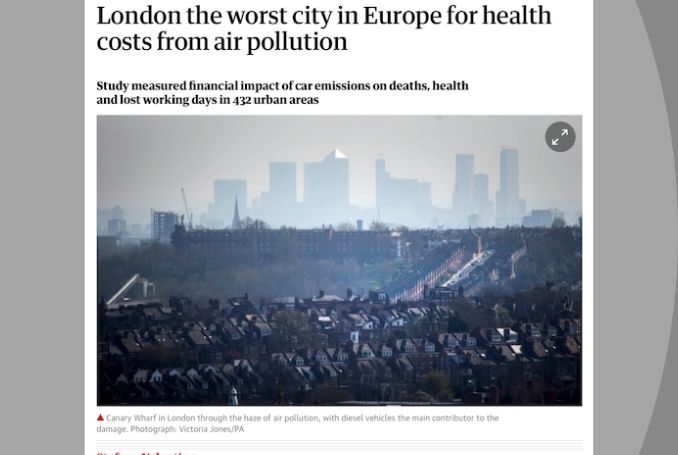
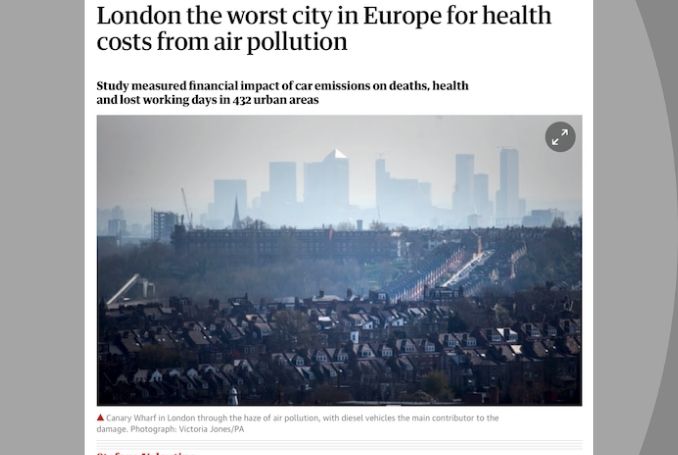
Last week the Guardian newspaper prominently ran two stories about externalities, even if it failed to frame them as such. One was about micro-plastics leaching from feeding bottles into babies, and the other about the toll air pollution is taking on the populations of major European cities.

The latter story, based on new research, specifically assessed the cost of air pollution in European cities – in terms of “premature death, hospital treatment, lost working days and other health costs” – at £150 billion a year. Most of this was caused by pollution from vehicles, the profitable product of the car industry. The researchers admitted that their figure was an under-estimate of air pollution’s true cost.

But, of course, even that underestimate was arrived at solely on the basis of metrics prioritized by capitalist ideology: the cost to the economy of death and disease, not the incalculable cost in lost and damaged human lives, and even less the damage to other species and the natural world. Another report last week alluded to one of those many additional costs, showing a steep rise in depression and anxiety caused by air pollution.

The other story, on baby bottles, is part of a much bigger story of how the plastics industry – whose products are derivatives of the fossil fuel industry – has long been filling our oceans and soil with plastics, both of the visible and invisible kind. Last week’s report revealed that the sterilization process in which bottles are heated in boiling water resulted in babies swallowing millions of micro-plastics each day. The study found that plastic food containers were shedding much higher loads of micro-plastics than expected.

These stories are snapshots of a much wider environmental catastrophe unfolding across the planet caused by profit-driven industrialized society. As well as heating up the climate, corporations are chopping down the forests that don’t burn down first, ridding the planet of its lungs; they are destroying natural habitats and soil quality, and they are rapidly killing off insect populations.

These industries’ externalities are, for the time being, impacting most severely on the natural world. But they will soon have more visible and dramatic effects that will be felt by our children and grandchildren. Neither of these constituencies currently has a say in how our capitalist “democracies” are being run.

Perception Managers

Capitalism isn’t only harming us, it’s double-billing us: taking first from our wallets and then depriving us of a future. We have now entered an era of deep cognitive dissonance.

Unlike a few years ago, many of us now understand that our futures are at grave risk from changes in our environment – the effect. But the task of today’s perception managers, like those of yesteryear, is to obscure the main cause – our economic system, capitalism.

The increasingly desperate effort to dissociate capitalism from the imminent environmental crisis – to break any perception of a causal link – was highlighted early this year. It emerged that counter-terrorism police in the UK had included Extinction Rebellion, the west’s main environmental protest group, on a list of extremist organizations. Under related “Prevent” regulations, teachers and government officials are already required by law to report anyone who they suspect of being “radicalized”.

In a guide explaining the purpose of the list, officials and teachers were told to identify anyone who speaks in “strong or emotive terms about environmental issues like climate change, ecology, species extinction, fracking, airport expansion or pollution”.

Why was Extinction Rebellion, a non-violent, civil disobedience group, included alongside neo-Nazis and Islamic jihadists? A whole page is dedicated to the threat posed by Extinction Rebellion. The guide explains that the organization’s activism is rooted in an “anti-establishment philosophy that seeks system change”. That is, environmental activism risks making apparent – especially to the young – the causal connection between the economic system and damage to the environment.

Once the story broke, the police hastily rowed back, claiming that Extinction Rebellion’s inclusion was a mistake. But more recently establishment efforts to decouple capitalism from its catastrophic externalities have grown more explicit.

Last month England’s department of education ordered schools not to use any materials in the curriculum that question the legitimacy of capitalism. Opposition to capitalism was described as an “extreme political stance” – opposition, let us remember, to an economic system whose relentless pursuit of growth and profit treats the destruction of the natural world as an uncosted externality.

Paradoxically, education officials equated the promotion of alternatives to capitalism as a threat to free speech, as well as an endorsement of illegal activity, and – inevitably – as evidence of antisemitism.

Suicidal Trajectory

These desperate and draconian measures to shore up an increasingly discredited system are not about to end. They will get much worse.

The establishment is not preparing to give up on capitalism – the ideology that enriched and empowered it – without a fight. The political and media class proved that with their relentless and unprecedented attacks on Labour opposition leader Jeremy Corbyn over several years. And Corbyn was offering only a reformist, democratic socialist agenda.

The establishment has also demonstrated its determination to cling on to the status quo in its relentless and unprecedented attacks on Wikileaks founder Julian Assange, who is locked away, seemingly indefinitely, for revealing the externalities – the victims – of the west’s war industries and the psychopathic behavior of those in power.

Efforts to end the suicidal trajectory of our current “free market” system will doubtless soon be equated with terrorism, as the Prevent strategy has already intimated. We should be ready.

There can be no escape from the death wish of capitalism without recognizing that death wish, and then demanding and working for wholesale change. Externalities may sound like innocuous jargon, but they and the economic system that requires them are killing us, our children and the planet.

The nightmare can end, but only if we wake up.

– Jonathan Cook won the Martha Gellhorn Special Prize for Journalism. His books include “Israel and the Clash of Civilisations: Iraq, Iran and the Plan to Remake the Middle East” (Pluto Press) and “Disappearing Palestine: Israel’s Experiments in Human Despair” (Zed Books). Visit his website www.jonathan-cook.net. He contributed this article to The Palestine Chronicle.


River to Sea Uprooted Palestinian   
The views expressed in this article are the sole responsibility of the author and do not necessarily reflect those of the Blog!