An indepth look at the recent coronavirus-related political and social developments in Russia by a regular SouthFront reader from Moscow.
Implementing President Putin’s directives, Russian federal authorities intensified their efforts to contain both the economic and social impact of the nation-wide coronavirus lockdown, and also some local authorities’ overzealous efforts. This move was impatiently awaited by the Russian society for a month.
It became clear in May that something went wrong in Russia. While in March one could still speak of insufficient medical statistics, of contradictory scientific findings, by now the SARS-COV-v2 situation has become clear.
Due to a variety of reasons, in March and April the world had to cope not so much with the spread of the virus, but rather a pandemic of fear and other processes which might collectively be called “coronacrisis”. One can thus identify three main challenges for humanity today:
- The coronavirus epidemic as such;
- The global socio-economic crisis;
- The pandemic of fear and mass psychosis which complicated professional assessments of the first two problems and, therefore, the development of effective anti-crisis measures.
Separately, one should note that many political forces and financial circles have used the situation for profit. This includes deal-makers of all kinds, from petty speculators and local officials to global elites and corporations. No, they did not “create coronavirus”, at least there is no credible data to this effect, but they nevertheless used it to their advantage.
Russia was not bypassed by these processes. What is more, Russia experienced them to a greater extent than others. It turned out that Russian bureaucracy is unable to deal with new threats and challenges. It uncovered the clannish character of a sizable portion of Russian elites. It revealed problems with executive competence of many regional and federal officials. Especially when it comes to the economy, health care, and social security.
Russia’s President Vladimir Putin apparently found himself in informational vacuum, which was particularly evident in the first half of April. It seems that the negative socio-economic developments were triggered by Vladimir Putin’s seemingly correct decision, made in late March, to give regions extraordinary powers. It meant decentralizing authority in order to give regional officials authority to act according to the situation in their region. That’s how many other countries have done, including Germany where the outcome was a positive one.
However, Russian bureaucracy and “liberal” clans that have fused with official institutions and which view themselves as a “new aristocracy” are not the same thing as German regional officials. The gap between Russian elite clans and the population is huge. This is the reason for the clumsy and in some cases even criminal, profit-motivated actions by elite clans after they were granted extraordinary powers.
Modern liberalism, sometimes referred to as “neo-liberalism”, is an ideology promoting serving global monopolies and market speculators. These “liberals” top priority is increasing personal consumption with minimal intellectual or physical effort, using the margin simplification of modern technologies in order to satisfy selfish desires under the guise of post-modern sophistry. Thus they consume public resources while giving nothing in return. Rather, they stand in the way of humanity’s progress.
President Putin and his closest administration members realized by mid-April that unless action is taken at federal level, the situation could quickly transform from critical to catastrophic. It was necessary to reassert control.
On April 23, President Vladimir Putin ordered the government to mitigate the socio-economic crisis being provoked by the COVID-19 outbreak.
“The coronavirus epidemic, challenging the whole world, threatens the lives and health of people first and foremost, but it also impacts the economy, and the condition of entire industries, which is no less dangerous,” Putin said. “Our common crucial task is to mitigate such adverse effects and reduce inevitable socioeconomic losses.”
The president noted that this is exactly why the government made a number of decisions to support families, employment and households’ revenues, individual entrepreneurs, small and medium enterprises, and industry-forming companies, along with measures for disease prevention and bolstering healthcare capabilities.
“Nobody needs abstract promises that don’t affect people’s lives, and the effect of such decisions and allocated resources will be low,” Putin said, adding that the government and the Central Bank should promptly make the necessary changes to the regulatory framework.
“It’s not enough to announce that decisions have been made, dear colleagues. We need to work through all the stages of their implementation so that the help arrives on time so that those who really need it can take advantage of it.”
Earlier, on April 15, the Russian president announced a first package of measures to support the country’ economy hit by consequences of the COVID-19 outbreak and the following lockdown. The measures included:
- Monthly state payments to small and medium-sized businesses for every employee in April and May, provided firms maintain 90% of their workforce. The payment is 12,130 rubles ($160) for an employee per month;
- The federal government allocates a package of 200 billion rubles ($2.6 billion) of support for regional budgets;
- At least 23 billion rubles ($307 million) of government support for airlines.
- The federal government will reform the government-backed system of interest-free salary loans for firms. The reform is aimed at providing an easier access to loans by businesses.
As of April 24, the Central Bank of Russia (CBR) estimated economic losses at 4-6% of annual GDP. This was the first recorded outcome of actions undertaken by regional authorities and the economic bloc of the federal government, thanks to whom the economy had ground to a halt even in regions where the number of cases was in single or double digits. Even the RCB team of economic liberals was forced to acknowledge that fact, even as they opposed direct economic support of enterprises and the population.
“The Bank of Russia has substantially reviewed its baseline scenario parameters. GDP is forecast to decrease by 4-6% in 2020. The Russian economy is thereafter expected to follow a recovery path with growth predicted to total 2.8-4.8% in 2021 and 1.5-3.5% in 2022,” the press release says.“The spread of the coronavirus pandemic in Russia and the restrictive measures in place to address it have combined with a drop in external demand and a further decline in the prices of oil and other export goods to make a substantial negative impact on economic activity. In this environment, Q2 GDP is set to decline.”
According to the press release, the deficit of the payment balance in 2020 will be $35 billion in 2020 and $20 billion in 2021, and a return to surplus is expected in 2022. The negative payment balance is forecasted for the first time since 1997.
The complicated socio-economic situation caused by the coronavirus crisis and its economic consequences of the national-wide lockdown revealed a conflict between the representatives of the formally “patriotic” part of the elites and the so-called “liberals” affiliated with the West and the global financial capital.
For example, the head of the Central Bank Elvira Nabiullina publicly opposes initiatives to introduce additional measures to stabilize the Russian currency market and prevent currency speculations amid the developing economic and social crisis.
On April 23, it became publicly known that the office of Elvira Nabiullina has sent the Ministry of Economic Development a letter in which it asked to silence ex-presidential adviser and the current Integration and Macroeconomics Minister of the Eurasian Economic Commission Sergei Glazyev. The letter claimed that Glazyev’s statements “carry reputational risks for joint government and Bank of Russia”.
A few days earlier, Glaziev proposed to levy a tax (0.01%) on purchase of foreign currency, as well as to fix the currency position of commercial banks and introduce a time lag between the application for purchase and delivery of currency. These measures (employed in multiple countries around the world) should help to stabilize the financial market and limit the impact of currency speculations (the tax of 0.01% will affect only actors that make hundreds of thousands speculative purchases).
Glazyev alongside other prominent economists that can afford the luxury of having own independent opinion describe the current economic crisis “a consequence of profound structural changes in the global economy due to a change in technological and world economic structures”. He emphasizes the need to implement stabilization measures and consistently accuses the Central Bank of giving control of the ruble exchange rate to financial speculators.
It was during this time that the public rift between so-called “globalists” and national-oriented forces was growing not only in the economic sphere. The Federal Government and the Parliament started to demonstrate that they do not support actions of the team led by Moscow Mayor Sergei Sobyanin and forces which it represents. The bone of contention are the draconian lockdown measures, mass surveillance, and illegal fees for violations of the ‘self-isolation regime’ pushed by the Moscow city managers.
While many European countries started to ease coronavirus restrictions in the second half of April, the Sobyanin team was seeking to increase pressure and limitations under the pretext of the crisis. These attempts were being conducted under the cover of unprecedented propaganda campaign that included even threats to deploy troops on the streets of the city, tighten the ‘self-isolation’ regime (in fact the home arrest regime) and further, and statements blaming Moscow residents for failures of the regional authorities.
The threat to deploy troops on the streets of Moscow was made by Sobyanin in an interview with Rossiya 24 TV channel on April 23.“In many other large cities, the situation is somewhat different, first they introduce very soft, very democratic measures, and then they are forced to send troops into the streets. We don’t want this scenario, so we have the optimal mode of self-isolation installed in Moscow ,” Sobyanin said hinting that if Moscow residents continue demonstrating their dissatisfaction with the city managers’ actions, troops will be deployed.
As later events have shown, these actions had no impact on Moscow’s actual epidemiological situation, though the fines did enrich the city budget and organizations close to the mayor. Moscow government also tried to shift blame onto the inhabitants. For example, on April 24 , Deputy Mayor of Moscow Anastasia Rakova blamed Moscow residents for the regional authorities’ move to harden the imposed regime of ‘self-isolation’.
“Of course, what can I say, Moscow residents are tired. And they really became less responsible towards the compliance with the regime of self-isolation. More and more people go out on the street, use their personal or public transport. We were forced to take measures aimed at tightening the regime of self-isolation,” Rakova said.
Rakova added that there are more and more hospitalized and severely ill patients with COVID-19 in the capital.
“If last week the average daily level of hospitalization was 1,300-1,400 people, today it is 1,900,” Rakova said.
The numbers provided by Rakova originated from the Moscow COVID-19 HQ that on April 23 noted the increase of COVID-19 cases in the city and said that the situation was worsening.
Let’s take a look what happen in Moscow a week earlier that caused the increase of COVID-19 cases. For everyone, excluding Russian mainstream media and the Moscow COVID-19 HQ, the answer is clear.
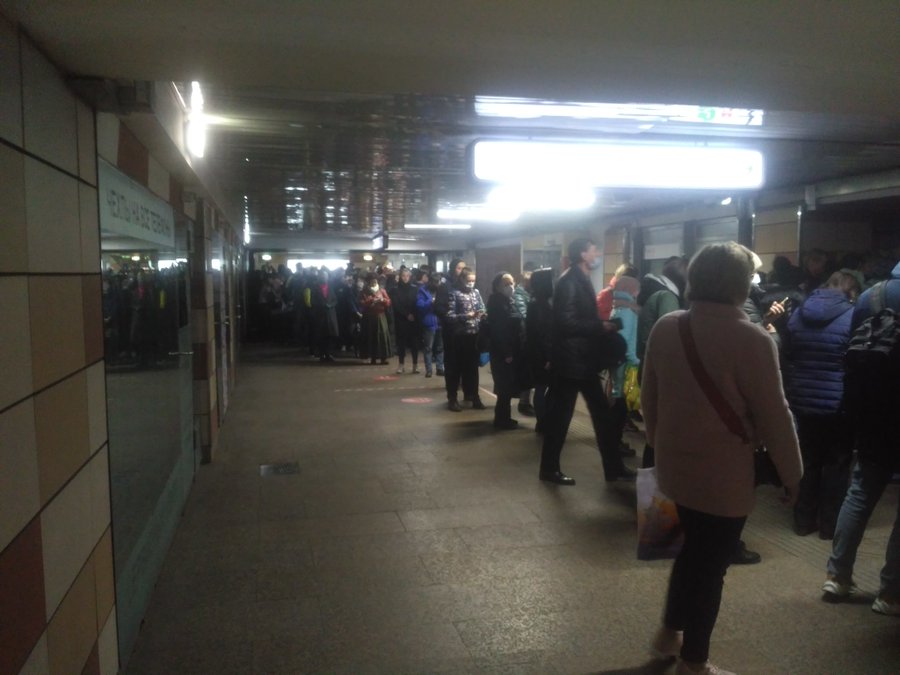
On April 15, the Sobyanin team introduced a mandatory digital pass system triggering mass traffic jams and throngs of people waiting at metro stations while their digital passes (QR codes) to be checked by authorities. Hundreds of thousands of people (some sources say that over 1 million) struck in crowds.
Znak.com  @znak_com На входе в московское метро — тотальная проверка пропусков. Скапливаются большие очереди, в которых явно не удается соблюдать социальную дистанцию.
@znak_com На входе в московское метро — тотальная проверка пропусков. Скапливаются большие очереди, в которых явно не удается соблюдать социальную дистанцию.
Фото: Sergey Elkin, Jazzverok, The Insider, Fredegonda1


794Twitter Ads info and privacy 380 people are talking about this
Fredegonda@Fredegonda1 Первый день с пропусками в метро. Кто еще не заболел, точно заболеет.
Fredegonda@Fredegonda1 Первый день с пропусками в метро. Кто еще не заболел, точно заболеет.
Note: The pass for movement is a set of letters and numbers. The first four characters indicate the expiration date of the document, and the remaining 12 will identify its owner and the purpose of the trip.
Electronic passes are divided into three categories:
- for trips to work or business trips – issued once valid through to the end of the month;
- for trips to medical institutions – issued for trips to a specific hospital, the number of such passes per week is not limited;
- one-time for trips for personal purposes that do not violate the rules of the self-isolation regime – issued for one day no more than twice a week.
Contrary to the public declarations of the city managers, the very first day of the usage of the digital pass system in fact contributed to the spread of the COVID-19 pandemic in Russia and derailed the previous weeks of the ‘self-isolation regime’ and sacrifices of the country’s economy.
The reason of the traffic collapse and the new wave of the COVID-19 outbreak spread was the demand of Sobyanin to conduct mass checks of digital passes. The Moscow authorities through its channels immediately laid blame for the consequences of their own actions on Police, in particular on the Head of the Ministry of Internal Affairs branch in the Moscow Metro Colonel Shamil Sibanov.
It is hard to imagine that Sobyanin that has a wide and long experience of management of the social systems and his team of ‘effective managers’ did not foresee how the digital pass system introduction would end.
As a result of the April 15 incident and similar developments of smaller scale in the next days, tens of thousands people (the estimated number is 30,000-50,000) were likely infected.
The average incubation period of the COVID-19 disease is 5.1 days. In the case of a severe progress of the disease, the exacerbation occurs after 2nd-3rd day from the onset of symptoms of the disease. If the course is moderate, then exacerbation could occur on the 7-8th day. Accordingly, the increase in the number of COVID-19 cases in Moscow was expected to begin on April 21-22 and, according to an official data by the Moscow COVID-19 HQ, this happened.
In spite of the tragedy, the Moscow authorities continued to push their ‘digital pass system’ idea and even further expanded the digital surveillance and control measures over Moscow residents.
On April 22, they imposed an automated control of digital passes for personal, government and commercial transport moving around the city. Cameras for photo and video recording of traffic violations monitor whether license plate numbers are included in the lists of such passes. If the number is not entered in the digital pass, the car owner is being recognized as a violator of the ‘self-isolation regime’ and gets a fine of 5,000 rubles (~66 USD).
This applies to everyone, including military service members, special service officers and federal officials. Therefore, Moscow authorities insist that officers (including intelligence officers) and officials should provide their personal data to the united database managed by the regional authorities to avoid fines. This poses a direct threat to the interest of the state and creates conditions for leaks of sensitive data to Western special and intelligence services. There is no secret that a major part of the Sobyanin team, including Sobyanin himself, are directly or indirectly affiliated with the West. For example, the main consultants of Moscow mayor’s office, including the health departments, social welfare, and IT is Boston Consulting Group and people from openly pro-Western Higher School of Economics.
The positions of the federal government, security services and the federal legislative system were ignored. This measure also went contrary to the recommendations of the Supreme Court of the Russian Federation.
All of these measures were adopted additionally to the already existing fees for ‘self-isolation’ regime violations.
Note: On April 2, Moscow mayor Sergey Sobyanin announced administrative fines for violations of the regime of ‘self-isolation’ in the city. The document (a Moscow city law) was published on the mayor’s official website. The law provides for a fine for violators of up to 5,000 rubles (~ 65 USD), and for organizations – up to 500,000 rubles (6,410 USD).
This situation created an additional administrative pressure on city residents, especially socially disadvantaged groups of the population that had little resources to pay new fines, but still had an essential need to go to work, travel to the hospital, help relatives with the purchase of products and had other urgent matters to leave home.
The financial explanation of the current situation is that the Moscow city managers are just creating an additional instrument to solidify their own power and compensate economic losses from traffic rules violations fine and paid parking.
On April 22, Moscow authorities reported that the created digital pass tracking system already detected 230,000 cars without digital passes. This is 230,000*5,000=1,150,000,000 rubles (~15,333,333 USD) of revenue in fines for a single day.
The Sobyanin team tried to expand these flawed policies to other regions. The Moscow mayor was a mastermind behind idea to expand the Moscow style system into the entire country. For sure under his control and based on a smartphone app developed for the Moscow region.
Russia needs digital passes “so that we could see the traffic, its volume and the travelers,” he claimed.“I believe [the system] can be extended… to control the movement of air, rail and intercity and inter-regional bus transport.”
It’s worth reminding these events unfolded between April 6 and 24. In other words, when Moscow’s mayor practically usurped power in the socio-economic realm in the whole country. The Coronavirus HQ headed by Sobyanin duplicated the functions of Prime Minister Mishustin’s government agencies. His influence on regional elites greatly exceeded that of Mishustin who took up his post only 3 months earlier. Moreover, Mishustin was not perceived as a political player but merely as an effective technocrat. Many governors copied Moscow mayor’s actions, viewing him as, at a minimum, the future Prime Minister.
President V.V. Putin only began to overcome the cloud of disinformation at that time. It apparently became possible after Putin was forced to adopt self-isolation and remote work after visiting the Kommunarka infection ward.

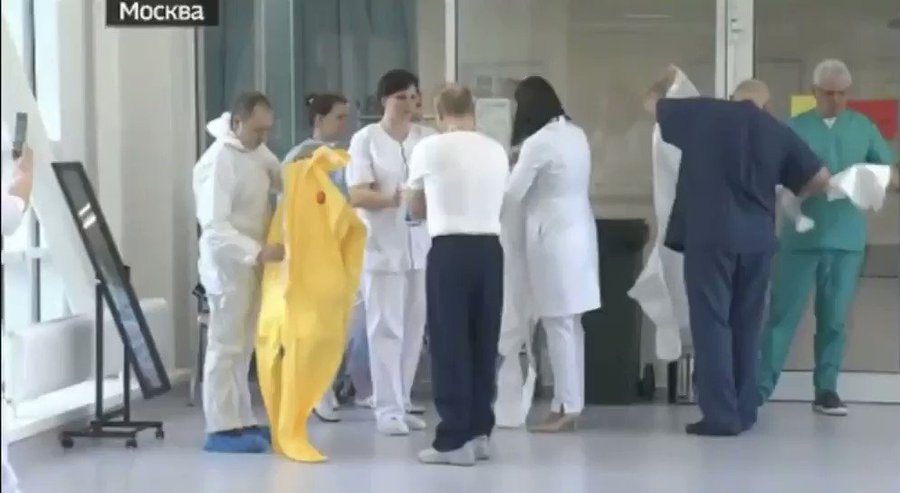
On March 24, President Putin visited a hospital for coronavirus patients on Kommunarka. It was the first repurposed Moscow clinic. During his visit, Putin was accompanied by the chief physician Denis Protsenko.
On March 28, Putin’s visible activity dropped off. It did not return to normal on March 30. At the same time, it was announced that Protsenko contracted COVID-19 (he recovered by April 15). Putin self-isolates. After that, in late March and early April, changes were made in federal laws which further allowed Moscow mayor Sobyanin revamp municipal legislation and de-facto take it out of the federal power structure.
It’s not clear whether the decline in Putin’s political activity in the first two weeks of April was connected to his health or whether it was a political maneuver. It’s hard not to notice that after April 15, and especially after April 23, Putin began to operate more actively. There were clear signals given that Putin was not pleased with Putin’s activity. In spite of draconian measures, the number of COVID-19 cases in Moscow grew. There was information about the catastrophic situation in a number of Moscow clinics, and that Moscow health care officials want as many fatalities attributed to COVID-19 as possible.
The situation reached the point of absurdity. Sobyanin and his team claim that tests supposedly don’t work, and therefore COVID-19 diagnosis ought to be given in accordance with symptoms. Deputy Mayor Rakova stated that all Moscow inhabitants with signs of respiratory illness would be considered as potentially coronavirus-infected.
The motivation to categorize all individuals with respiratory symptoms as COVID-19 cases became more clear after it became known that several large sites in Moscow and Moscow region would be reconstructed as hangar-style hospitals.
Such hospitals are being built, for example, in Pavilion No. 75 of VDNKh. With a surface area of 53 thousand square meters, it can accommodate 1,779 beds. This is an hangar with a single ventilation system where the beds are not separated by hard partitions. In addition to VDNKh, similar temporary hospitals for patients supposedly suffering from COVID-19 will be deployed in the Krasnaya Presnya Expo-Center, the Sokolniki Convention and Exhibition Center, Krylatskoye Ice Palace, and Moskva Mall on the Kashirka Road. They would have a total of 10 thousand beds, not counting 5 thousand additional beds being added to existing city hospitals. These hangar hospitals would collect all patients with signs of respiratory illness, including flu, pneumonia, bacterial bronchitis, allergies, etc., in other words everyone who was suspected of COVID-19.
It’s obvious that there is high danger of intra-hospital mutual infections. Considering the high contagiousness of SARS-COV-v2, one can assume that soon every patient in such hangar hospital would be COVID-19-positive. Billions of rubles were disbursed without proper evaluation of competing offers. The average cost of a single bed, according to open sources, would be about 650 thousand rubles (8,666 USD). In turn, a single COVID-19 course of treatment costs about 205 thousand rubles (2,733 USD), according to mandatory health insurance price tables. It’s more expensive than, for example, a chemotherapy round of treatments in Russia.
In accordance with the decision by Moscow government, these funds ought to be allocated for every patient admitted to a COVID-19 hangar hospital. This in a situation where tests supposedly “don’t work”, diagnoses are issued according to symptoms. As a result, there are massive opportunities for personal enrichment for a small circle of people.
One might object on the basis that lives are more important than money. Nevertheless, Moscow has dozens of empty hospitals. Many of them were closed only recently. Mayor Sobyanin closed 460 municipal medical facilities and reduced the number of ambulances and physicians by 37% during the last five years.
What is more, many existing hospitals repurposed as COVID-19 infection centers are using only 30% of their capacity. For example, the Voronovskoye Moscow Infectious Disease Clinical Center is operating at only 25% capacity. The Center, which has 800 beds, admitted only 233 patients as of May 12. A similar situation can be observed in the Kommunarka hospital where, as of May 13, there were only 317 patients as compared to its capacity of 1300 beds, not counting the 1000 beds that were additionally set up. The 15th Filatovo Hospital which was one of the first to take in COVID-19 patients, had 1340 patients as of May 12, while the capacity was 1740 beds.
Ordinary hospitals in the meantime greatly reduced or stopped planned operations and patient visits. It particularly concerns the cancer patients, heart surgeries, transplants, planned surgeries on children, etc. One can find a video on the Internet with a multi-kilometer chain of ambulances, caused not by a huge number of respiratory patients but criminally incompetent logistical organization.
Death rate is increasing not so much from COVID-19 complications but rather from poorly organized Moscow health care system, and also a decrease in Moscow inhabitants’ immunity who were forbidden to leave homes, participate in any form of physical activity in open air, and were subjected to massive informational stress.
Economic problems are becoming critical, with a sharp increase in unemployment.
None of these facts went unnoticed in the Kremlin. On April 30, 2020, there was unexpected information on how Prime Minister Mishustin allegedly became infected and is leaving for hospital treatment. His place was temporarily occupied by the First Deputy Prime Minister Andrey Belousov, a Soviet-school economist. Moreover, he was appointed as the acting Prime Minister by Vladimir Putin’s decree. In earlier such cases of illness or absence, no such decrees followed. Belousov is not only a widely acknowledged professional but also a political heavyweight. He may be compared, with qualifications, to such major figures as Maslyukov and Gerashchenko who led Russia out of the 1998 crisis.
Events continued to unfold. On May 6, there was another meeting that included President Putin and Acting Prime Minister Belousov. Following the meeting, the coronavirus control authority was de-facto returned to the government of the Russian Federation from Sobyanin’s working group. Moreover, the Moscow mayor was not able to force the government to extent quarantine until the end of May for the whole country. Deliberately promoted media hysteria concerning coronavirus dangers did not help either, nor did playing around with statistics. For example, during the meeting Sobyanin claimed that Moscow supposedly had 300,000 infections. Furthermore, he claimed that the number of hospitalizations in Moscow has not changed. Sobyanin’s motives are unclear. They may be based in political ambitions, but also on economic calculations.
Not having achieved his goal, Sobyanin de-facto ignored the president’s position and announced that Moscow’s self-isolation would be extended to May 31 with the regime being further strengthened through the addition of the requirement to wear masks and gloves under the penalty of fines.
Several regions immediately followed suit, apparently by inertia. They included the Moscow region, St. Petersburg, and Crimea. Which makes it all the more surprising to hear that the admissions of patients into hospitals was reduced by, for example in Kommunarka, a factor of three.
Masks and gloves are not provided for free, but rather are being sold by businesses affiliated with the Moscow mayor’s office. For example, the Moscow metro 50 rubles, or 70 cents, will buy you ONE very simple mask and gloves. The Rospotrebnadzor recommended term of wearing such mask does not exceed 2 hours.On May 14, it was revealed that Moscow authorities bought the largest producer of masks in Russia. According to the available data, before the start of the crisis the cost of a single mask was 1 ruble (0.013 USD). After the start of the COVID-19 crisis, the cost grew up to 7 rubles (0.093 USD). At the same time, the cost of a single mask, which is being sold in the Moscow Metro (controlled by the local authorities), is 30 rubles (0.4 USD). The revenue from this business goes to persons and organizations affiliated with the city’s mayor.
On top of this, the Sobyanin team undertook additional steps to increase an administrative pressure on Moscow residents. In April, local authorities obliged people that receive administrative protocols imposing on them a forceful regime of quarantine (ironically described as the self-isolation) imposed on them because they may be suspected of being infected with SARS-CoV-2 to install a special application on their phones and tablets. The application monitors the activity and location (via GPS) of the user and demands him to make selfies (sent to the dedicated server) to confirm his location several times per day (in fact almost every hour). This move put Moscow a one step closer to becoming a real-life digital concentration camp.
On April 16, Moscow authorities officially announced a decision to label all people with respiratory symptoms will be diagnosed with “suspected coronavirus infection”. All of these people, whom the mayor team was able to locate and detect, became a target of forceful monitoring and administrative limitations. In fact, administrative decisions of these kind are imposed widely towards a variety of people, including children with sinusitis, rhinitis, otits, people with allergy or some chronic illness. The Sobyanin team did not stop on this and on May 10 introduced an update to the monitoring application. This update allowed it to impose fines on residents that fail to make a selfie within an hour after the request. Other reasons for fines are changes of the location, the shut off of application or the phone with the installed application (due to any reasons). The fine of 4,000 rubles (53 USD) is imposed for every such incident.
It’s hard to justify this measures by the need to contain the coronavirus outbreak or care about people. The two main possible reasons are vested interest of the local authorities that pump money into the budget and affiliated structures by this way or political games, in which the Sobyanin team is playing to damage actions and policies of President Putin and the federal government.
Reports appeared in Russian social media that Google proposed the Moscow authorities at least 0.5 million USD to promote information regarding the COVID-19 outbreak; in fact, to fuel the hysteria over the situation.
The next big event took place on May 11. President Vladimir Putin announced the work holiday would come to an end. As of May 12, the regime of limitations would gradually be shut down. Vladimir Putin announced this in his address to the Russian citizens at the beginning of meeting with governors. Then he announced a new and unprecedented, for contemporary Russia, packet of measures of support for ordinary citizens and businesses. These decisions were diametrically opposed to the ideas supported by the liberal clan that includes Nabiulina, Sobyanin, Siluanov, and others.
The new support measures include:
- All families with children aged 3-15 may receive one-time payments of 10 thousand rubles (133 USD) per child, starting on June 1.
- Individual entrepreneurs, small and mid-sized businesses in hard-hit industries as well as socially-oriented non-commercial organizations will have all tax and insurance payments canceled for the second quarter, with the exception of value-added tax.
- Self-employed will have their income taxes paid in 2019 refunded. They will also receive “tax capital” at the rate of one minimum-wage annual salary to fulfill tax payments.
At the same time, Putin’s address left the impression of half-measures. It included announcements that governors’ additional coronavirus-related powers were being extended, giving them the ability to raise and reduce restrictions depending on the situation.
However, even that format had the effect of an exploding bomb.
Since May 11, when Putin announced the decision to ease coronavirus restrictions, Russia has become a target of a large-scale international media campaign designed to fuel the coronavirus panic in the country. Western mainstream media and Russian-language media organizations funded by the West or affiliated with it structures and persons released a coordinated series of articles arguing and speculating (with no evidence) that Russia is hiding the real COVID-19 death toll. An overwhelming majority of these articles refers to ‘anonymous sources’ or representatives of the ‘non-system’ Russian opposition (like Alexei Navalny) that seek to gain some hype without any real evidence.
An example:
Are you kidding? BECAUSE THEY ARE LYING, as they do about everything. Stop having medical experts write about Russian coronavirus and use only fake news experts. Every number is a lie. cnn.com/2020/05/13/opi…


1,950 people are talking about this
The Russian Foreign Ministry descried these reports as fake news. Nonetheless, the interesting fact is that no article released in the framework of this new anti-Russian campaign criticizes actions of Sobyanin or members of the liberal part of the Russian elites. All of them are aimed against President Putin and the federal government. This campaign goes fully in the framework of the efforts of the Russia-based liberal clans to keep the coronavirus-related restrictions and further. In fact, Russian social media and news media are full of reports revealing that in many cases local authorities insist to add any person with a positive (and in some cases even supposedly positive) SARS-CoV-2 test to the coronavirus death toll.
Right after the president’s meeting with the governors, Tatarstan announced removing the pass regime and destroying all personal data collected.
The government of one of Russia’s key regions also signaled immediate removal of all the main limitations starting on May 12. One should note that the Moscow pass regime was based on Kazan’s experience, with Sobyanin himself closely collaborating with Kazan financial and economic elites. Tatarstan was followed by Bashkiriya and many other regions. The Federal Ministry of Health signaled that 33 regions were ready to remove the restrictions.
Moscow Region Governor Vorobyov, who closely followed the example of Moscow mayor also announced and earlier also announced the quarantine would be НКО extended until May 31, delayed his announcement by four hours. But by 21:20 Moscow time he announced that “due to new demands of the epidemiological legislation the planned construction and production starts are delayed until May 18.” He did not mention the end of May.
It seems that Sobyanin and the liberal team needed a whole day to decide how to proceed. It seems they decided not to change the course of action and instead decided on a collision course with the president, possibly also with the intent of increasing social instability in Moscow. It is difficult to interpret these facts differently.
Interestingly, several unofficial media sources which are nevertheless seen as linked to the presidential administration began to openly accuse Sobyanin of an attempted coup d’etat. Thus the popular Kremlyovskiy Bezbashennik Telegram channel (reportedly linked with former adviser to President Putin -Vladislav Surkov) writes:
“it is entirely correct to write about the consequences of scandalous decisions made by Sobyanin which raise social tensions and which may lead to unrest in Moscow. But these are not mistakes by the mayor and no, he has not lost his mind. It’s all part of the plan being implemented step by step by the Party of Troubles which “Stag” described already at the start of this whole coronavirus bacchanalia. The HQ of the Covid-19 party and its frontman Sobyanin should be happy with the results of the investigation. The battle for Moscow has seen the use of the stratagem of seizure of power through destabilizing the situation an using the “street factor” in order to nullify the Constitution (in other words, the State) and obtain extraordinary powers during social unrest. Therefore as far as Sobyanin is concerned, the worse, the better. They’ll never get another chance to get power”.
If events continue to develop in this way, the last doubts that coronavirus is being deliberately used by certain elite factions in order to achieve certain political and economic objectives will scatter. It looks like that the initial plan of Sobyanin and his colleagues from the liberal clan was to de-facto conduct a creeping seizure of power in the country through the system of digital totalitarianism created under a pretext of the combating coronavirus outbreak. They achieved some successes, but the recent developments demonstrate that apparently this plan has not been 100% effective. The federal government and the Kremlin have realized the threat of the uncontrolled ‘lockdowns’ imposed by the regional authorities and working to compensate the social, administrative and economic damage of these actions.
Furthermore, actions of the Moscow authorities already significantly undermined the trust the Sobyanin team had among Moscow residents and caused a major negative reaction in the social media all across the country. The negative economic, social and medical impact of their actions are an open secret.
Moscow government and allied liberal clans are not about to give up or change their plans. Even modest attempts of the Sobyanin team to turn off the already set course met with a wave of criticism in the media controlled by the so-called liberal bloc. This week, a new media campaign was launched. It claims that Moscow authorities allegedly underestimate mortality from the COVID-19 outbreak.
Moscow risks becoming a center of socio-economic tension and political instability due to Mayor’s Office actions in delaying the gradual removal or weakening of administrative, social, and economic restrictions. Even when they are forced to remove them, Sobyanin’s team will do everything possible to preserve as many powers as possible during the pandemic. This may include the ability to limit the movement of citizens in the capital. In any event, one may confidently predict that the political tension between Moscow and federal authorities will grow. It may enable external forces which are interested in social instability in Russia to further destabilize the situation.
MORE ON THE TOPIC:
River to Sea
 Uprooted Palestinian
The views expressed in this article are the sole responsibility of the author and do not necessarily reflect those of the Blog!